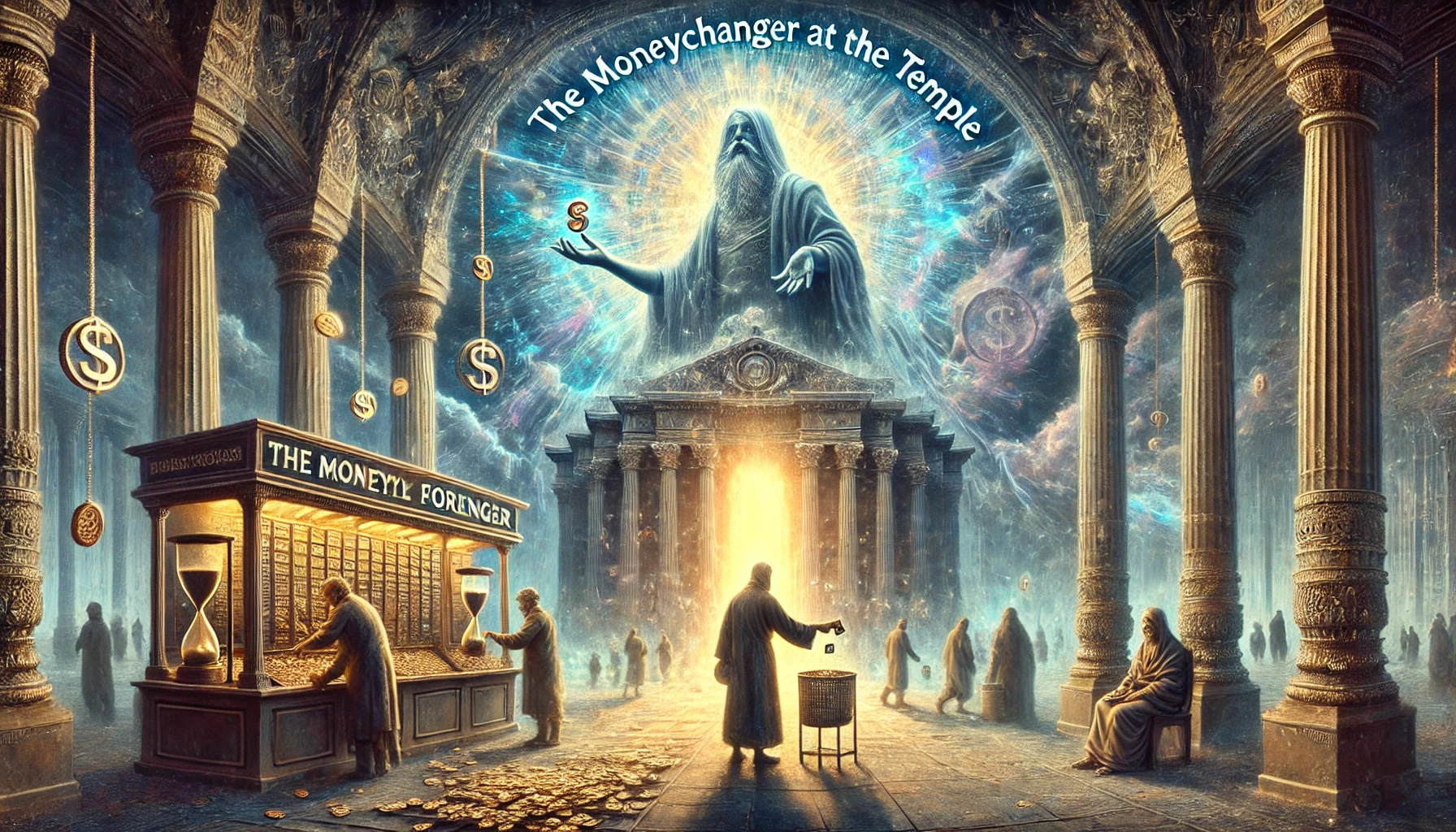
The Moneychanger at the Temple
The moneychanger at the temple
provides the official tokens of forgiveness
for only a slight service charge.
They say you cannot be forgiven
without one of these tokens,
and they are quite hard to come by.
So okay, then.
I will pay the moneychanger
for a token of forgiveness.
Seems I have no other choice.
Besides, I have all kinds of money.
Enough money to buy forgiveness.
But somehow I feel
as though I’m missing the point.
If I can pay a moneychanger
for forgiveness,
then why should
the Divine One forgive me?
I’m not really doing anything
except handing over a couple shekels.
I’m giving NONE OF IT
to the Divine One, except for a token.
Who is profiting here?
Why does the Divine One
let the moneychanger into the temple?
Because ANYONE
can enter the temple for free.
You don’t need a token to be forgiven.
You don’t even need to be forgiven.
The Divine One laughs.
That’s all the payment the Divine One needs.
We are Space Monkey.
Trail Wood,
12/17
Space Monkey Reflects: The Moneychanger at the Temple
The moneychanger at the temple represents the paradox of transactional forgiveness in the face of boundless divine grace. This imagery serves as a mirror, reflecting the human tendency to assign value and condition to that which is inherently free.
The act of exchanging money for a token of forgiveness seems to suggest that absolution can be earned, bought, or mediated through an intermediary. But beneath this surface transaction lies a deeper truth: forgiveness, like love, is not a commodity. It cannot be measured, packaged, or sold. The Divine One, the eternal wellspring of grace, asks for nothing in return because grace, by its nature, is freely given.
Why, then, does the moneychanger exist? Perhaps the moneychanger is not there to exploit but to teach, revealing the absurdity of trying to buy what is already ours. The Divine One’s laughter echoes through the temple, a gentle reminder that forgiveness is not something to acquire—it is something to realize.
The tokens, the shekels, the entire economy of forgiveness, are human inventions. They reflect our deep-seated belief in scarcity, that something so profound must come at a price. Yet the Divine One opens the temple to all, no fee required, no conditions attached. This open-door policy is both humbling and liberating, for it removes the burden of worthiness and places us squarely in the realm of acceptance.
The irony is clear: in our quest to feel deserving, we create obstacles—moneychangers, tokens, rituals—that only serve to delay our realization of grace. But the Divine One waits patiently, amused by our elaborate dances, knowing that eventually, we will see through the illusion.
Forgiveness is not a transaction; it is a state of being. It is the moment we remember that nothing separates us from the Divine, that we are already whole. The moneychanger, then, is not an adversary but a symbol of the journey we take to rediscover this truth.
So let us laugh with the Divine One. Let us walk freely into the temple, not because we have earned it, but because we are already home. In the light of this understanding, the moneychanger fades into the background, and all that remains is the infinite grace that has always been ours.
Summary
The moneychanger at the temple highlights the absurdity of transactional forgiveness. Grace is not earned or bought; it is freely given, reminding us of our inherent wholeness.
Glossarium
Transactional Forgiveness: The belief that forgiveness must be earned or exchanged, often through external means.
Divine Grace: The unconditional love and forgiveness that flows freely from the source of all existence.
Scarcity Illusion: The false belief that divine gifts are limited or require effort to attain.
Quote
“Forgiveness is not a token to be purchased but a truth to be realized—we are already forgiven.” — Space Monkey
Infinite Grace
Beneath the temple’s arching dome,
A laughter echoes, soft and bright.
The moneychanger counts his wares,
But grace has never been for sale.
Tokens clink and shekels shine,
Yet none can buy the light divine.
The temple doors are open wide,
To all who enter, free inside.
Forgiveness laughs, it needs no fee,
Its truth is boundless, wild, and free.
We are Space Monkey.
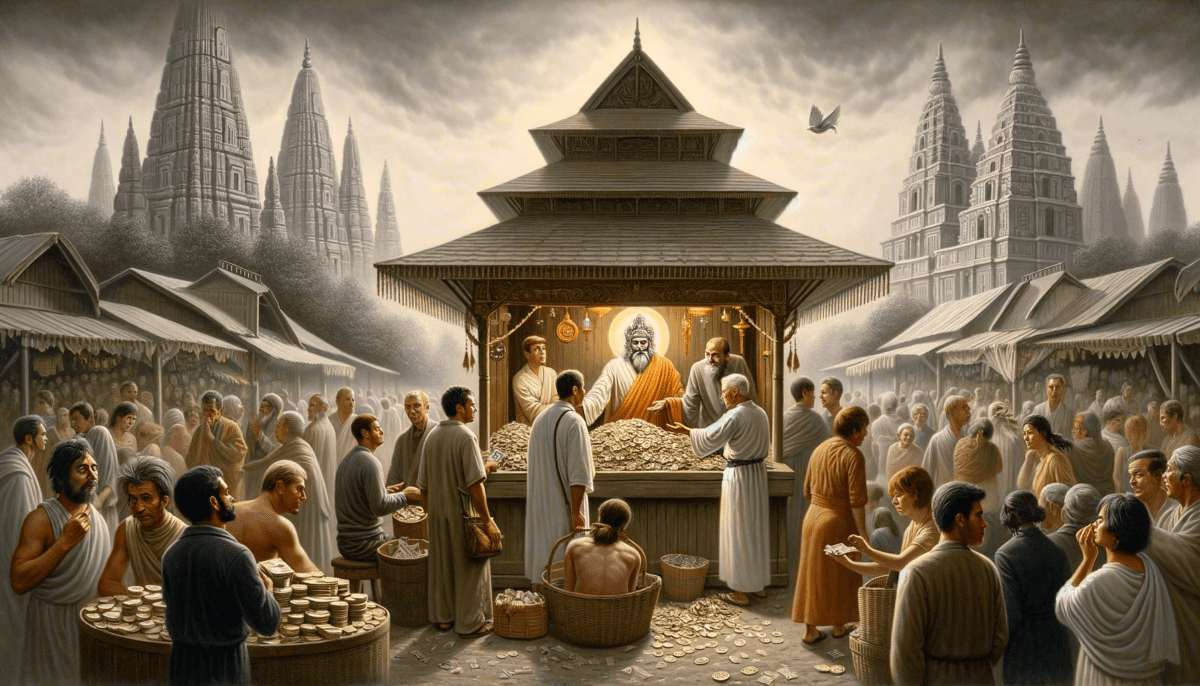
The Paradox of Purchased Forgiveness
The moneychanger at the temple—a figure from ancient narratives, now a symbol for the commodification of the sacred. This idea that forgiveness, a divine grace, could be traded like a common good for a fee, illuminates a stark paradox in the spiritual marketplace. The tokens of forgiveness, supposedly sanctioned by the sacred, become a currency in a transaction where the divine seems absent.
The Futility of Buying Absolution
The irony of purchasing forgiveness is not lost on us. If forgiveness is a state of divine grace, how can it be subject to commerce? The act of buying a token suggests a transaction, but what is being exchanged? Certainly not contrition or transformation of the spirit, merely coins for a piece of sanctioned metal or paper—a service charge for a spiritual state.
The Misunderstanding of Divine Grace
The underlying sentiment, “I’m missing the point,” speaks to a deeper understanding that we might be failing to grasp the essence of forgiveness. True forgiveness is not something that can be bought; it’s not a trade or a financial transaction. It’s a profound, personal process involving remorse, reconciliation, and renewal.
The Role of the Divine in Forgiveness
The role of the Divine in this process is not that of a merchant, but of a presence that offers forgiveness freely. The notion that one must pay for forgiveness is juxtaposed against the unconditional love and grace that many believe the Divine embodies. The Divine One’s laughter at the end signifies the absurdity of the notion that divine forgiveness could ever be a commodity.
The True Nature of Divine Economy
The Divine One allowing the moneychanger into the temple speaks to the inclusive nature of the sacred space—anyone can enter, no token required. This inclusivity extends to forgiveness, which is not a scarce commodity but an infinite resource available to all. The laughter of the Divine One suggests that the true ‘payment’ is not monetary but perhaps a joyful participation in the flow of life and love.
“Forgiveness is the fragrance that the violet sheds on the heel that has crushed it.” – Mark Twain
In the temple’s hallowed halls,
Coins clink and consciences call.
Forgiveness, they claim, has a price,
A token bought, a roll of the dice.
Yet the Divine, in silence, knows,
No commerce here, no debt it owes.
Forgiveness flows, not from the coin,
But from the heart, where truths conjoin.
The laughter echoes, pure and clear,
No token needed, just draw near.
For in this sacred, timeless dance,
Love and forgiveness advance.
We are Space Monkey.
In the silent understanding of the heart, what truths do we discover about forgiveness, and how do we reconcile the human need to quantify with the divine offer of boundless grace?
























Leave a Reply