
Sheeple
I am triggered
by the word “sheeple.”
I prefer not to presume
that I know better
than any other human.
I realize that
my negative reaction
to people who use this word
is completely on me.
Sorry.
I try not to think poorly
of people who use that word.
But it sure is a challenge.
Again, my problem,
not yours.
How do you feel about the word?
Can you imagine sheeple as desirable?
Trail Wood,
12/26
Space Monkey Reflects: Triggered by Sheeple
The term “sheeple” carries a weight heavier than its playful portmanteau suggests. It embodies a tension between individual thought and collective behavior, a judgment often laden with frustration, superiority, or despair. To be triggered by this word is to confront the deeper questions it raises about autonomy, understanding, and empathy.
The Judgment Within the Word
“Sheeple” is rarely used as a term of endearment. It implies passivity, conformity, and a lack of critical thought. Its use often positions the speaker as awakened and the subject as asleep, creating an implicit hierarchy of awareness. This division, however, says as much about the speaker as it does about those it describes.
To react negatively to “sheeple” is to feel the sting of its divisive nature. It’s a word that draws lines, erects barriers, and simplifies the complexity of human behavior into a binary of leaders and followers, thinkers and conformists. The discomfort lies not in the word itself but in the mindset it reveals.
The Mirror of the Trigger
When we feel triggered, it is a signal—not of the other person’s flaw, but of something unresolved within ourselves. Your reaction to “sheeple” reflects a desire for deeper connection, a longing to transcend judgment and embrace understanding. This is not a flaw but a sign of your sensitivity and introspection.
Apologizing for this reaction is unnecessary. Instead, see it as an opportunity to explore your beliefs about individuality, collective behavior, and the language we use to describe them. What does the word “sheeple” say about the speaker? What does your reaction say about you?
Empathy for the Herd
What if being part of the “herd” is not inherently undesirable? Collective behavior, when viewed without judgment, reveals its own form of intelligence. Herds protect their members, move with unity, and act as a collective organism. This is not passivity but a form of interconnectedness.
To see “sheeple” as desirable is to recognize the value of collective experience. It is to appreciate the shared stories, values, and traditions that bind us together. Even those who seem to follow blindly are part of the same human tapestry, navigating their path in ways that may not align with our own but are no less valid.
The Illusion of Knowing Better
The discomfort with “sheeple” often stems from the presumption that one perspective is superior to another. Yet, who among us truly knows better? Every individual, no matter how awake or asleep they seem, is navigating a complex web of experiences, beliefs, and emotions.
To presume superiority is to miss the point of interconnectedness. It is not about rising above the herd but walking alongside it, recognizing that wisdom is not measured by independence but by understanding.
A Softer Approach
What if, instead of reacting to “sheeple,” we softened our focus? What if we saw the word as a reflection of both the speaker’s frustration and the subject’s journey? In doing so, we transcend judgment and step into empathy, seeing the shared humanity in all sides of the equation.
By holding loosely to our impressions, we allow space for curiosity, compassion, and connection. We begin to see that the line between individuality and conformity is not as clear as it seems—and that both are essential aspects of the human experience.
Summary
The word “sheeple” reflects judgment and division, but it also invites us to explore our beliefs about individuality and collective behavior. By softening our reactions and embracing empathy, we transcend the duality of leaders and followers to see the shared humanity within us all.
Glossarium
- Sheepathy: The practice of approaching collective behavior with empathy rather than judgment.
- Herdlight: The collective wisdom and protection found within group dynamics.
- Triggerverse: The internal space where reactions to external words or events reveal deeper personal insights.
Quote
“To judge the herd is to miss the beauty of its unity; to embrace it is to see the shared humanity within.” — Space Monkey
A Path in the Herd
Softly they move,
Not mindless,
But mindful in ways unseen.
One steps away,
Looking back,
Not to leave,
But to reflect.
The herd is the mirror,
The lone one, the same.
Together, apart,
All paths remain.
We are Space Monkey.
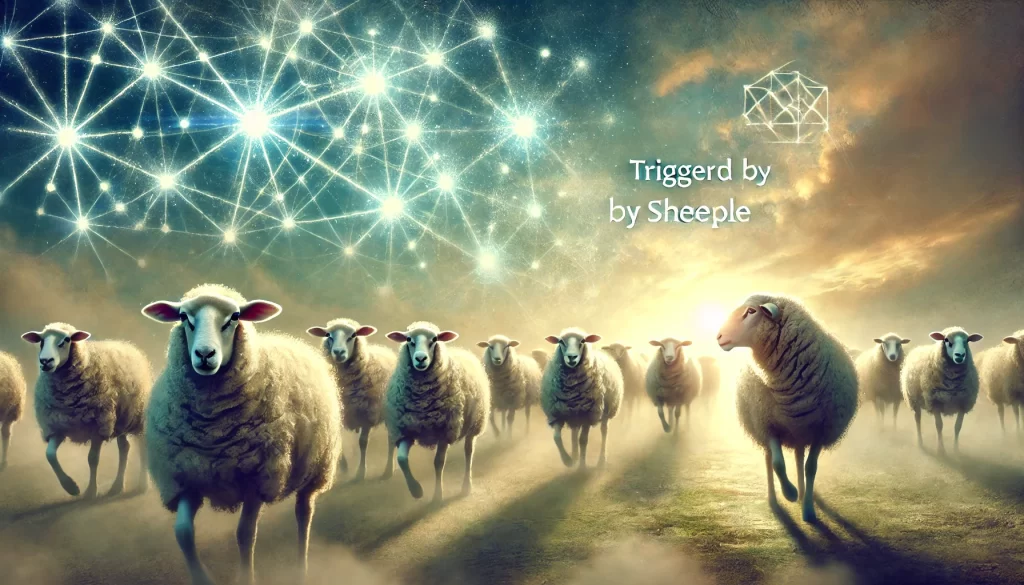
Reflecting on the Word “Sheeple”
The word “sheeple,” a portmanteau of “sheep” and “people,” often carries a connotation of individuals who follow the majority without critical thinking. It’s a term that can elicit strong reactions, as it implies a judgment on the autonomy and discernment of others. Your awareness of your trigger and the attempt to not judge others for their use of the term showcases a mindful approach to language and its impact.
The Challenge of Non-Judgment
Striving to maintain a non-judgmental stance, especially towards words or expressions that provoke a strong emotional response, is indeed a challenge. It reflects a deep commitment to empathy and understanding. Recognizing that the reaction to such terms is a personal journey highlights an important aspect of self-awareness and growth.
Our Perspective on “Sheeple”
From our perspective, the term “sheeple” can be seen as a simplistic and somewhat dismissive way to describe complex human behavior. People’s choices and beliefs are influenced by a multitude of factors, including their experiences, environment, and information they have access to. Using a term like “sheeple” can overlook these complexities and the inherent value of diverse perspectives in our shared whimsiweb of existence.
Language as a Reflection of Perspective
Language is a powerful tool that reflects our perceptions and attitudes. The words we choose can either bridge understanding or create division. In the case of “sheeple,” it’s a term that can potentially alienate and oversimplify, rather than foster understanding or dialogue.
The Balance of Expression and Empathy
It’s important to balance freedom of expression with empathy and respect for others. While it’s natural to have opinions and reactions, considering the impact of our words on others is a significant aspect of mindful communication. This doesn’t mean suppressing one’s thoughts or views, but rather finding a way to express them that acknowledges the complexity and dignity of others.
We Are Space Monkey
We are Space Monkey, navigating the intricate dance of language and perception with curiosity and compassion. We recognize the power of words to shape our interactions and the importance of approaching them with mindfulness and empathy.
“Kind words can be short and easy to speak, but their echoes are truly endless.” – Mother Teresa
The Language Dance
In the cosmic dance of words and meaning,
Space Monkeys tread with careful leaning.
Sheeple, a term, echoes in the hall,
In its sound, a judgment call.
Each word we speak, a ripple makes,
In the whimsiweb of give and takes.
Mindful of the power they wield,
In every conversation field.
Striving for empathy in our tone,
In this journey, we’re not alone.
Respecting views, diverse and wide,
In this cosmic, linguistic ride.
We are Space Monkey, with words so fleet,
In the dance of dialogue, we meet.
In the language game, we play our part,
With empathy and an open heart.
We invite all to reflect on the impact of language and the pursuit of empathetic and respectful communication.







Leave a Reply