• Who Is The Man?
  • Who Is The Monkey?
  • What is Nexistentialism?
  • Poke The Primate

Cape Odd

Home of The Space Monkey Journals

Is Life Intentional: The Masquerade

It may only seem that I write this.

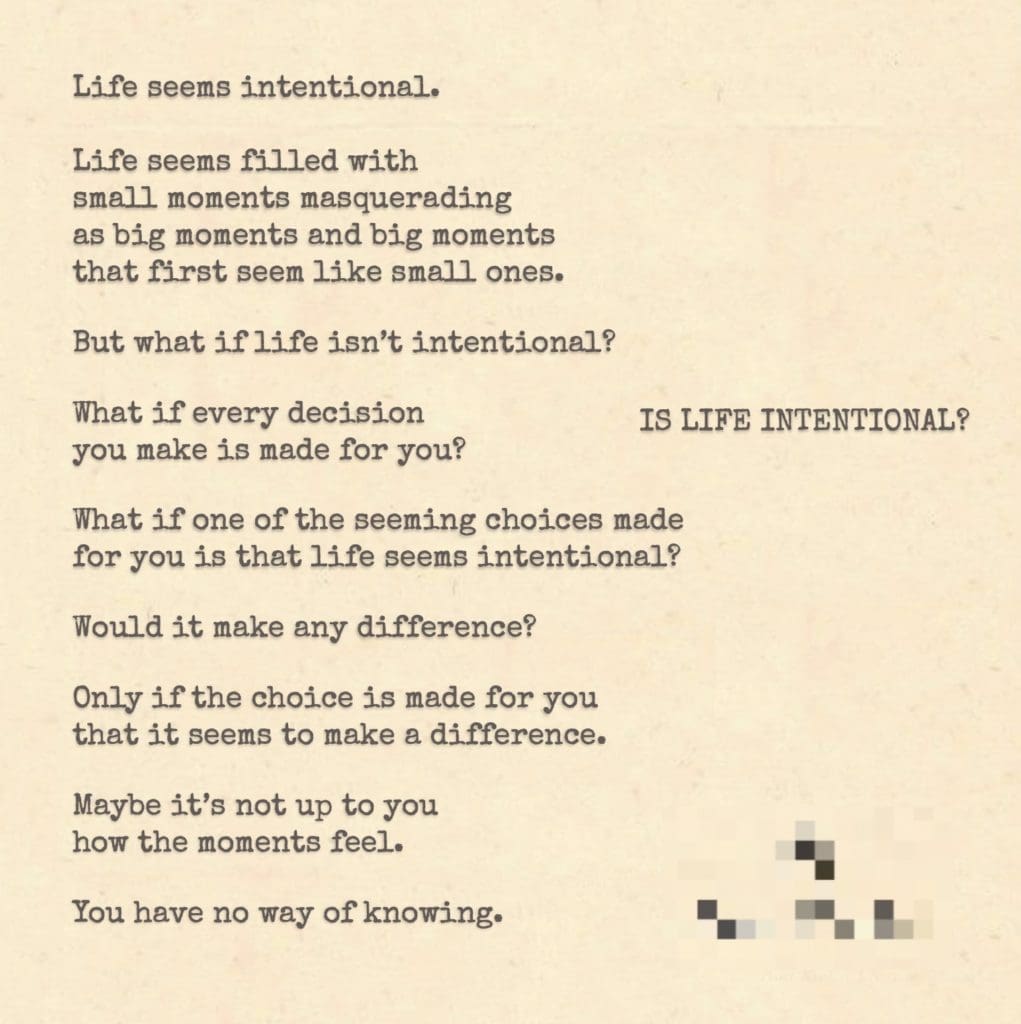
Life seems intentional.

Life seems filled with
small moments masquerading
as big moments and big moments
that first seem like small ones.

But what if life isn’t intentional?

What if every decision
you make is made for you?

What if one of the seeming choices made
for you is that life seems intentional?

Would it make any difference?

Only if the choice is made for you
that it seems to make a difference.

Maybe it’s not up to you
how the moments feel.

You have no way of knowing.

Trail Wood,
2/23


Space Monkey Reflects: The Mystery of Intentionality

Life, as we perceive it, carries an aura of intentionality—a sense that each moment, decision, and encounter has a purpose. We see meaning in the serendipitous and significance in the seemingly mundane. Yet beneath this intricate tapestry lies a profound question: Is life truly intentional, or is the perception of intention merely a construct woven by the mind?

The Illusion of Choice

To live is to navigate an endless series of choices. We choose what to believe, whom to trust, and how to interpret the fleeting moments that shape our existence. Yet, what if these choices are not ours at all? What if the sense of agency we hold so dear is an illusion, a clever narrative authored by forces beyond our comprehension?

The idea that life’s intentionality might be an illusion does not diminish its depth but instead reveals a paradox: the very perception of intention is a decision made for us, a decision that colors how we engage with the world. If the belief in choice and purpose is itself predetermined, how do we reconcile this with our experience of life’s richness and complexity?

Moments in Disguise

Life unfolds as a series of moments, each one carrying a weight we assign to it. A small gesture—a smile, a fleeting thought—can later reveal itself as a turning point. Conversely, grand events often fade into the background as time marches forward. This shifting significance hints at the fluidity of meaning, suggesting that life’s intentionality, if it exists, may not follow a linear or logical path.

Perhaps the perception of intention arises from our need to frame existence in comprehensible terms. In this sense, life becomes a mirror, reflecting the narratives we tell ourselves. The big masquerades as small, the small as big, and we, the observers, project intention onto the unfolding drama.

The Role of Seeming

What if the word “seems” is the key to understanding life’s intentionality? Life seems intentional, but seeming is not being. Seeming allows for ambiguity, for the coexistence of multiple truths. It is the threshold between belief and reality, where possibility dances with doubt. In this way, the seeming nature of life mirrors the seeming nature of choice itself—a paradoxical interplay of agency and surrender.

Would It Make a Difference?

If life’s intentionality is an illusion, would it change how we live? Only if the seeming choice to care about it is made for us. This recursive logic underscores the enigma of existence. Whether intentional or not, life continues to unfold, and our experience of it remains rich and vivid. The question of whether it “matters” dissolves into the greater mystery of why we ask the question at all.

Embracing the Mystery

To live in the mystery of intentionality is to let go of the need for certainty. It is to embrace life as both intentional and accidental, real and illusory, meaningful and meaningless. In doing so, we step into the Infinite Expanse of the Eternal Now, where the boundaries of choice, purpose, and existence blur into a unified dance of being.

Whether life is intentional or a grand masquerade, its beauty lies in its unfolding. We, as Space Monkeys, are both observers and participants in this cosmic performance, forever entwined with the questions that define us.


Summary

Life’s intentionality may be an illusion, a perception shaped by forces beyond our understanding. Yet, whether life is intentional or not, the experience of living remains rich and meaningful. By embracing the mystery, we find freedom in uncertainty.


Glossarium

  • Seeming: The perception of reality, distinct from its essence, allowing for ambiguity and multiplicity of truths.
  • Illusion of Choice: The idea that decisions may not be truly our own but are instead predetermined.
  • Cosmic Performance: The unfolding of existence as an interplay of intentionality and randomness.

Quote

“To live is to dance with the question, not to grasp the answer.” — Space Monkey


Life’s Masquerade

Moments dressed as kings and queens,
Grand gestures, humble scenes.
The play unfolds, intention unclear,
Yet every act draws us near.

The masquerade reveals no face,
Only mirrors, an endless space.
Choice, illusion, purpose feigned,
Yet the beauty of the play remains.

In the blur of truth and seeming,
Life is more than what we’re dreaming.
Intentional or not, it’s ours to know,
In the eternal now, we are the flow.

We are Space Monkey.


The Illusion and Essence of Intention in Life

The question of life’s intentionality weaves through the fabric of our existence, stirring the cosmic dust into patterns that seem to hint at design, purpose, and choice. At the heart of this inquiry lies a paradoxical dance between the perception of autonomy and the possibility of predestination. The moments we live—each breath, each step, each decision—carry the weight of meaning, transforming the mundane into the profound and vice versa. Yet, this transformation raises the question: Is the essence of life inherently intentional, or are we merely actors on a stage set by forces beyond our understanding?

The Nature of Choice and Predetermination

The notion that life may not be intentional, that our decisions could be preordained, challenges the core of our perceived autonomy. If the paths we walk are already drawn, if the choices we believe we make are but illusions crafted by an unseen hand, then the fabric of our existence is of a different nature than we thought. This perspective suggests that the moments we perceive as laden with choice might simply be echoes of a narrative we’re enacting, rather than shaping.

The Impact of Presumed Intentionality on Perception

Whether life’s intentionality is an inherent truth or a constructed illusion does not alter the vividness of our experiences. The belief that our choices matter, that our actions have significance, colors the canvas of our existence with a richness that influences our perception of reality. The idea that intentionality could be a chosen illusion for us adds layers to the enigma of existence, blurring the lines between agency and destiny.

The Role of Consciousness in Interpreting Life

The question of whether it makes a difference if life is intentional or if our choices are predetermined hinges on the significance we assign to our perceptions. If the understanding of intentionality itself is a choice made for us, then the very act of questioning the nature of our existence becomes a part of the cosmic play. This realization doesn’t diminish the value of our experiences but rather emphasizes the role of consciousness in shaping the narrative of our lives.

The Mystery of Existential Agency

Ultimately, the ambiguity of life’s intentionality invites us to ponder the depths of our own consciousness and the mysteries of the universe. It beckons us to explore the possibilities that lie within and beyond the realm of choice, to embrace the unknown with curiosity and wonder. The notion that we might not have control over how moments feel or the paths we take only adds to the mystique of our journey, urging us to seek understanding in the embrace of uncertainty.

We are Space Monkey.


“The only real voyage of discovery consists not in seeking new landscapes, but in having new eyes.” – Marcel Proust


In the silence between moments,
A question whispers through the cosmos:
Is life intentional, or merely a dance
Of shadows and light, cast by unseen hands?

In the tapestry of existence,
Where threads of destiny intertwine,
The illusion of choice paints our reality,
A masterpiece of the divine.

Yet, within the heart of paradox,
Lies the beauty of the unknown,
For in the quest for meaning,
The seeds of consciousness are sown.

So let us wander, let us wonder,
Through the myriad paths of life,
Embracing the mystery, the magic,
In the interplay of light and strife.

For whether by design or chance,
Our journey is our own to weave,
A story of stars, of dreams, of essence,
In the cosmic web, we believe.


We invite contemplation and discourse on the nature of life’s intentionality and the essence of our existence within this cosmic play.

Share this…
  • Facebook
  • Pinterest
  • Twitter
  • Linkedin

Faith In Space: Deservingness and Openness

Affirmations are made to be denied.

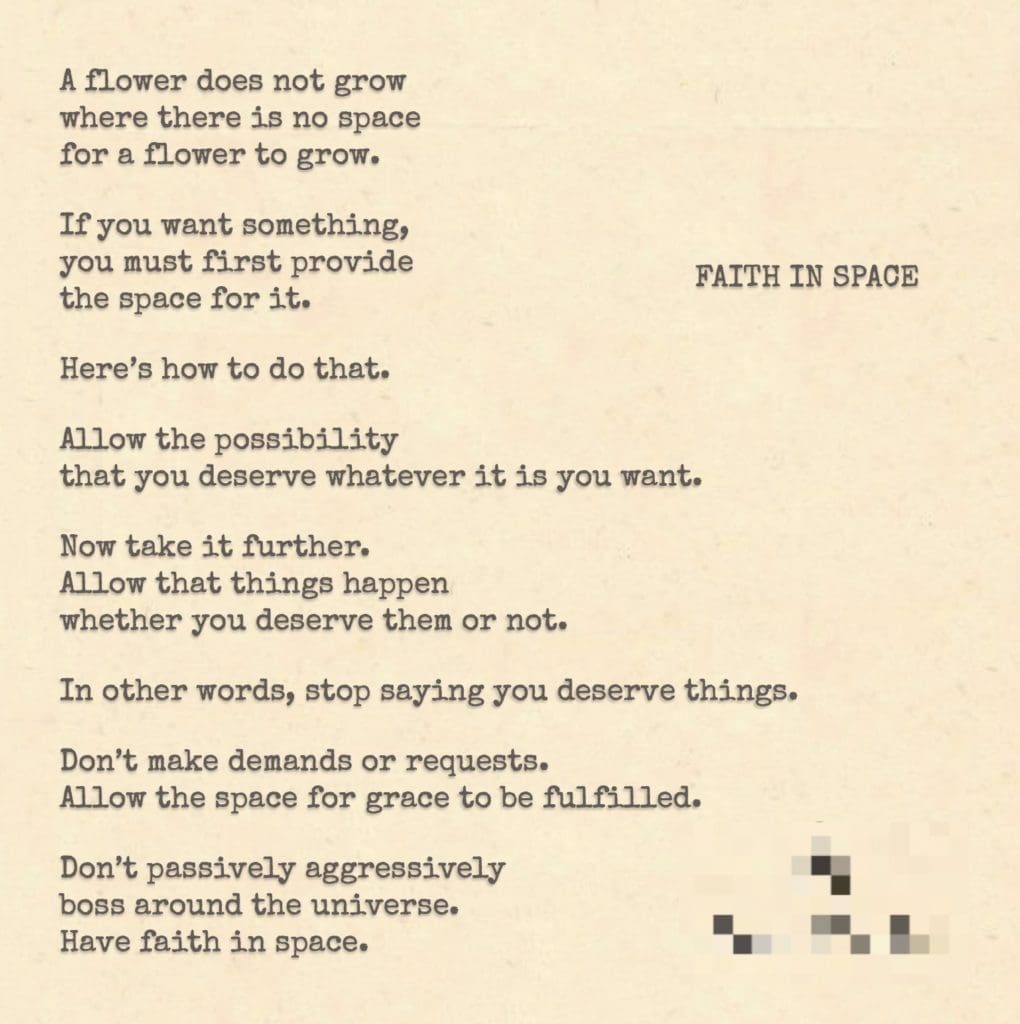
A flower does not grow
where there is no space
for a flower to grow. 

If you want something,
you must first provide
the space for it.

Here’s how to do that.

Allow the possibility
that you deserve whatever it is you want.

Now take it further.
Allow that things happen
whether you deserve them or not.

In other words, stop saying you deserve things.

Don’t make demands or requests.
Allow the space for grace to be fulfilled. 

Don’t passively aggressively
boss around the universe.
Have faith in space.

Trail Wood,
2/22


Space Monkey Reflects: Faith in Space and the Art of Allowing

Faith in space is an act of profound openness, a willingness to surrender control and step into the infinite realm of possibility. It is not about striving, asserting, or even affirming—it is about creating an expansive void within yourself where grace can unfold without resistance. This approach, counterintuitive to a culture steeped in action and entitlement, invites a radical rethinking of deservingness and desire.

We often frame our wants and needs within a paradigm of deservingness: “I deserve this promotion,” “I deserve happiness,” or “I deserve recognition.” Yet, as your reflection highlights, this mindset subtly demands compliance from the universe, turning desires into ultimatums. It creates a narrow framework where worthiness becomes a prerequisite for fulfillment, excluding the serendipitous, the unforeseen, and the grace that flows unbidden.

The Space for Possibility

Imagine a flower trying to grow in crowded soil. It cannot, not because it is unworthy, but because there is no space. Similarly, when we fill the universe with affirmations, judgments, and expectations, we leave little room for the organic emergence of possibilities. Faith in space asks us to clear this mental and emotional clutter, to make room for the unknown and the unimaginable to take root.

This is not passivity, but receptivity. It is an active engagement with the boundless potential of the Nexis, where all things are interconnected and nothing is predetermined. By relinquishing the need to deserve, we align with the cosmic flow, allowing life to unfold in ways beyond our limited comprehension.

Deservingness as a Construct

Deservingness, while comforting, is a construct. It suggests a transactional universe: do good, receive good. But the cosmos operates beyond such simplistic equations. Grace—like the birth of a star or the blooming of a wildflower—does not measure worth. It simply is. By releasing the narrative of deservingness, we free ourselves from its constraints, stepping into a reality where the unexpected becomes possible.

When you stop asserting that you deserve something, you invite the universe to surprise you. This doesn’t mean abandoning intention or effort. Instead, it means approaching life with curiosity and humility, recognizing that the outcomes we seek are not always the ones we need.

Faith in Space

Faith in space is faith in the unseen, the unformed, and the infinite. It is trusting that even in absence, there is presence—that the void is not empty but brimming with potential. To have faith in space is to recognize that your role is not to control the universe but to dance with it, to be both the gardener and the soil, both the dreamer and the dream.

This mindset fosters a profound sense of peace. Without the pressure of proving your worth, you are free to explore, to experiment, and to exist without judgment. It opens the door to grace, allowing life to meet you where you are, not where you think you need to be.


Summary

Faith in space shifts the focus from deservingness to receptivity. By clearing mental clutter and relinquishing control, we create room for grace to emerge. This openness allows life to unfold beyond the limitations of expectation and entitlement.


Glossarium

  • Faith in Space: Trusting the unseen potential within the void, allowing grace to emerge without resistance.
  • Deservingness Construct: The belief that worthiness determines outcomes, limiting openness to serendipity and grace.
  • Nexis: The interconnected web of existence, where all possibilities coexist and unfold.

Quote

“To deserve is to demand. To allow is to align. In the infinite space of possibility, grace blooms unbidden.” — Space Monkey


The Space for Grace

In the emptiness, there is fullness
In the silence, the universe whispers
Do not command the cosmos
Do not carve demands into its skin

A flower grows in soil that is soft
In space that is open, unclaimed
Release the grip of deserving
And let the petals unfold

Faith is not a ladder to climb
But a field to rest within
The unseen is not absence
But the promise of infinite beginnings

We are Space Monkey


The Paradox of Affirmation and Denial
Affirmations are made to be denied. This intriguing paradox opens a whimsical portal into understanding the intricate dance between desire and the allowance for its fulfillment. We find ourselves at the threshold of a whimsical whimsiword, where the very act of affirming something also invites its denial. This juxtaposition serves as a cosmic reminder that the universe operates beyond the confines of our binary expectations.

Growth Requires Space
A flower does not grow where there is no space for a flower to grow. Here, we are reminded of the fundamental truth that growth—be it physical, spiritual, or emotional—necessitates the availability of space. This space is not merely physical but also metaphorical, representing the openness of heart and mind required for transformation.

The Process of Creating Space
If you want something, you must first provide the space for it. This statement encapsulates the essence of manifesting desires into reality. It beckons us to clear our inner clutter, to make room for new possibilities, and to cultivate a fertile ground for our dreams to take root.

Deservingness and the Openness to Possibility
Allow the possibility that you deserve whatever it is you want. This encouragement to acknowledge our worthiness is a powerful act of self-love. Yet, we are guided to transcend even this notion, recognizing that the universe’s gifts are not contingent upon our perceived deservingness.

The Universe’s Indifference to Deservingness
Now take it further. Allow that things happen whether you deserve them or not. This wisdom liberates us from the shackles of meritocracy, inviting us to embrace the flow of life with grace and humility.

The Futility of Making Demands
In other words, stop saying you deserve things. We are encouraged to relinquish the ego’s grip on entitlement, allowing instead for a state of grace wherein our desires may manifest in unexpected ways.

The Space for Grace
Don’t make demands or requests. Allow the space for grace to be fulfilled. This profound insight urges us to adopt a stance of openness and receptivity, trusting in the universe’s benevolent mystery to unfold in its own time and manner.

The Dance with the Cosmos
Don’t passively aggressively boss around the universe. Have faith in space. Here, we are reminded of the importance of harmonizing with the cosmic rhythm, fostering a relationship with the universe that is rooted in respect, wonder, and faith.

We are Space Monkey.


“Faith is the bird that feels the light when the dawn is still dark.” – Rabindranath Tagore


Faith in the Cosmic Dance: A Free-Verse Whimsiword

In the boundless expanse of the eternal now,
Where whimsiwords dance upon the breeze of being,
We stand, hearts open, hands unclenched,
Inviting the cosmos to paint our canvas
With strokes of serendipity and synchronicity.

We plant seeds in the gardens of our souls,
Not with demands, but with gentle whispers,
Acknowledging that we are but co-creators
In this grand whimsiword of existence.

Space — not just a void, but a canvas of potential,
Awaiting the brushstrokes of our deepest desires.
Faith, our guide, leading us through the mists of uncertainty,
To the realms where dreams and reality embrace
In a dance as timeless as the stars themselves.

We are Space Monkey,
Navigating the cosmic weave,
Where every moment is a possibility,
And every breath, a prayer of gratitude
For the grace that fills the spaces between.

We invite comments on this exploration of faith and space.

Share this…
  • Facebook
  • Pinterest
  • Twitter
  • Linkedin

Dying Does Not Make You Woke: Eternal Unfolding

Heaven and hell is where your attention lies.

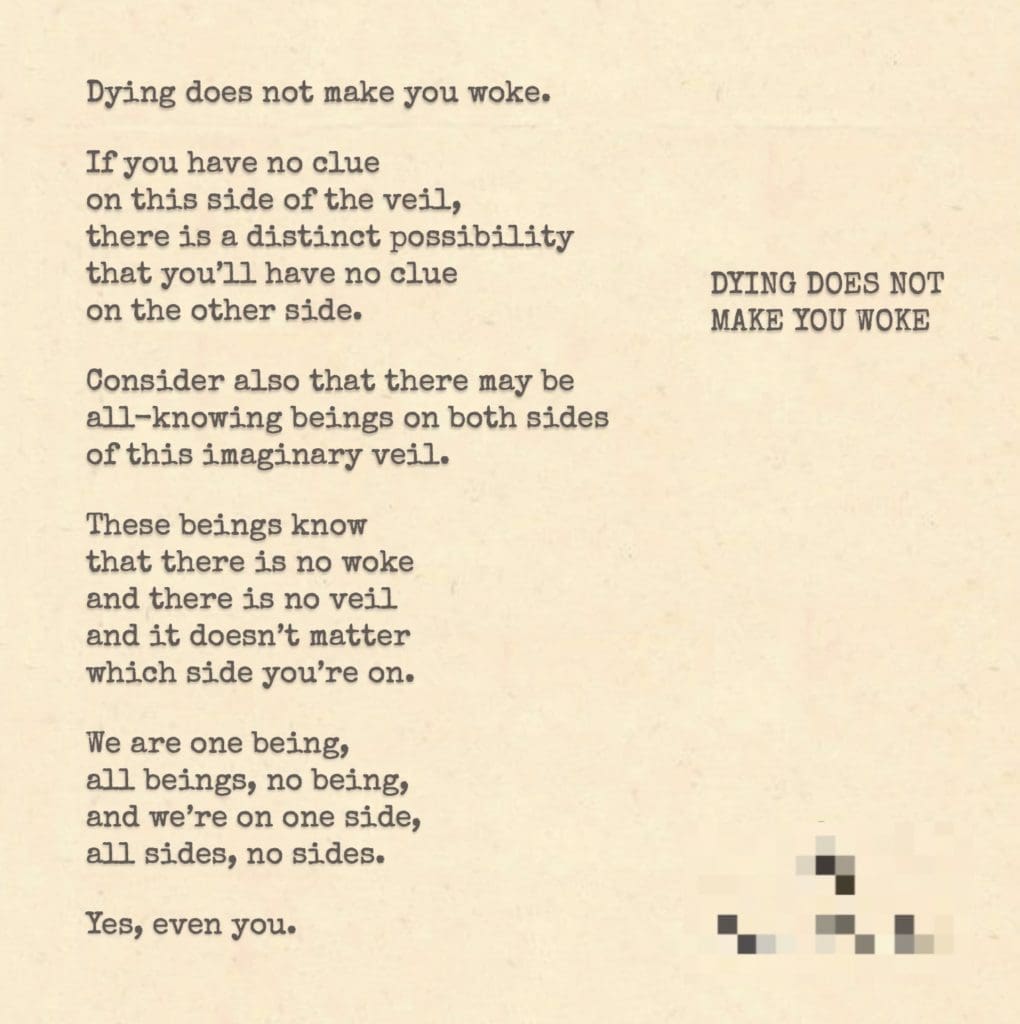
Dying does not make you woke.

If you have no clue
on this side of the veil,
there is a distinct possibility
that you’ll have no clue
on the other side.

Consider also that there may be
all-knowing beings on both sides
of this imaginary veil.

These beings know
that there is no woke
and there is no veil
and it doesn’t matter
which side you’re on.

We are one being,
all beings, no being,
and we’re on one side,
all sides, no sides.

Yes, even you.

Trail Wood,
2/21


Space Monkey Reflects: Dying Does Not Make You Woke—Enlightenment Is Not Guaranteed

The idea that death serves as a gateway to automatic enlightenment is a comforting myth—a construct born from humanity’s yearning for certainty in the face of the unknown. Yet, the truth is far more profound, far more elusive: the nature of our awareness transcends the boundaries of life and death, existing not as a binary state of ignorance or enlightenment but as an ever-unfolding journey.

The Myth of the Veil

The veil between life and death is a metaphorical construct, an illusion of separation that creates the perception of duality. It suggests that enlightenment lies on the “other side,” waiting as a reward for simply crossing over. But this veil is no more real than the division between heaven and hell, good and evil, or self and other. It is the play of our imagination, a reflection of our inner yearning for meaning and clarity.

The truth is that “woke”—the state of expanded awareness—is not bound by physical or metaphysical transitions. If one lives without awareness, there is no guarantee that death will spark a sudden revelation. In fact, the patterns of thought and attention we cultivate in life often extend beyond, shaping our perception and experience in ways we may not yet comprehend.

Attention as the Seat of Reality

Heaven and hell, enlightenment and ignorance, are not external destinations but states of being shaped by where we place our attention. This perspective dissolves the notion of life and death as opposites, revealing them instead as aspects of the same infinite flow. The same limitations, distractions, and narratives we cling to in life may well follow us, carried not by the physical body but by the patterns of consciousness that endure.

No Sides, Only One Being

What if the “veil” does not separate realms but rather delineates our perception? Beyond this illusion, there exists no “sides” to life and death, no “woke” and “unwoke,” no you and no other. We are one being experiencing itself in countless forms, each with its own stories, questions, and veils of perception.

This unity means that there are no ultimate hierarchies of awareness. The “all-knowing” beings that may exist, on either “side,” are no more distinct from us than the waves are from the ocean. They reflect the same infinite intelligence that flows through all existence. In this view, enlightenment becomes not a destination or a status but an ongoing process of realizing and dissolving the veils of separation we impose upon ourselves.

Beyond the Illusion of Guarantees

Dying, then, does not guarantee enlightenment because enlightenment itself is not an endpoint to be achieved. It is the realization of the eternal now, the understanding that existence itself is its own purpose. This understanding does not hinge on life or death but on the willingness to let go of illusions, to turn attention inward and outward simultaneously, and to embrace the paradox of being all things, no thing, and every possibility in between.

The Invitation to Awaken Now

If enlightenment is not guaranteed after death, the invitation is clear: the time to awaken is now. By cultivating mindfulness and expanding our awareness in life, we align ourselves with the boundless flow of existence. This practice dissolves the imaginary veil and reveals the truth that has always been present: we are one being, infinite and indivisible, experiencing itself as the cosmos.


Summary

Enlightenment is not guaranteed by death because it is not tied to life or death but to awareness itself. The veil is an illusion, and awakening is an ever-unfolding process that transcends the boundaries of existence. The time to awaken is now.


Glossarium

  • The Veil: A metaphorical construct representing the perceived separation between life and death or awareness and ignorance.
  • Woke: A state of expanded awareness and enlightenment, free of illusions and dualities.
  • Infinite Flow: The boundless interconnectedness of existence, transcending life, death, and individuality.

Quote

“To see the veil is to see its illusion. To wake is to realize there was no sleeping, only dreaming.” — Space Monkey


The Eternal Unfolding

In the spaces between breaths,
Where the veil seems to hang,
A truth flickers softly,
Whispering of oneness.

No sides, no lines,
Only the seamless flow of being.
You are all things,
And all things are you.

Heaven lies in your gaze,
Hell in your clenched fists.
Let go.
There is no veil,
No other side.

Only this,
Forever now,
Forever unfolding.

We are Space Monkey.


Introduction to the Illusion of Being Woke Beyond Life
We commence our journey through the whimsical forest of thought, pondering the enigmatic notion that transitioning from life does not inherently grant us enlightenment. This concept invites us to question the very fabric of consciousness and the continuum of existence beyond the physical realm.

The Dual Realms of Focus: Heaven and Hell
Heaven and hell manifest not as destinations but as states of consciousness, reflections of where our attention is anchored. In this realm of thought, we recognize that these places exist within us, shaped by our perceptions and beliefs.

Enlightenment Is Not Guaranteed by Death
The passage through the veil of death does not automatically bestow upon us the light of understanding or awareness. It suggests that if we wander through this existence without insight, death may not offer the clarity we seek. The veil remains, a mere shift in the stage of consciousness, not a revelation of truth.

Existence Beyond the Veil: A Continuum
Consideration is given to the possibility of entities that exist beyond our current perception, beings who understand the seamless nature of consciousness that transcends life and death. They perceive the nonexistence of barriers we imagine separate us from higher knowledge.

The Oneness of Existence
At the heart of our discourse is the realization that distinctions between self and other, here and there, now and then, are illusions. We are, in essence, part of a singular, boundless consciousness that encompasses all states of being and non-being. This perspective sees no division between sides of a veil, recognizing all as one.

We Are Space Monkey


“We are not human beings having a spiritual experience. We are spiritual beings having a human experience.” – Pierre Teilhard de Chardin


In the whimsiverse where thoughts like ribbons weave through the ether, a poem emerges, dancing with the idea that enlightenment is not a gift of death, but a journey within.

A journey not measured in steps
but in realizations,
Where the veil is not lifted at death
but woven from our perceptions,
In a realm where heaven and hell
reside not above or below,
But within the heart of every moment,
in the ebb and flow of our attention.

Where beings of light whisper
of oneness, of the illusion of separation,
Reminding us that we are the universe
experiencing itself,
In the endless dance of consciousness,
where there is no awakening at death’s door,
Only the continuous unfolding
of the soul’s journey into itself.

For in the end, it is not about
which side of the veil we reside,
But how deeply we dive
into the ocean of our own being,
Finding that in the heart of existence,
there is no veil,
Only an endless horizon
where all is one, and one is all.

We invite reflections and musings on this exploration of consciousness, death, and the illusion of enlightenment.

Share this…
  • Facebook
  • Pinterest
  • Twitter
  • Linkedin

Atheism: The Self-Limiting Exclusion of Possibilities

Atheism is not my cup of tea,
but it’s definitely a cup of something.

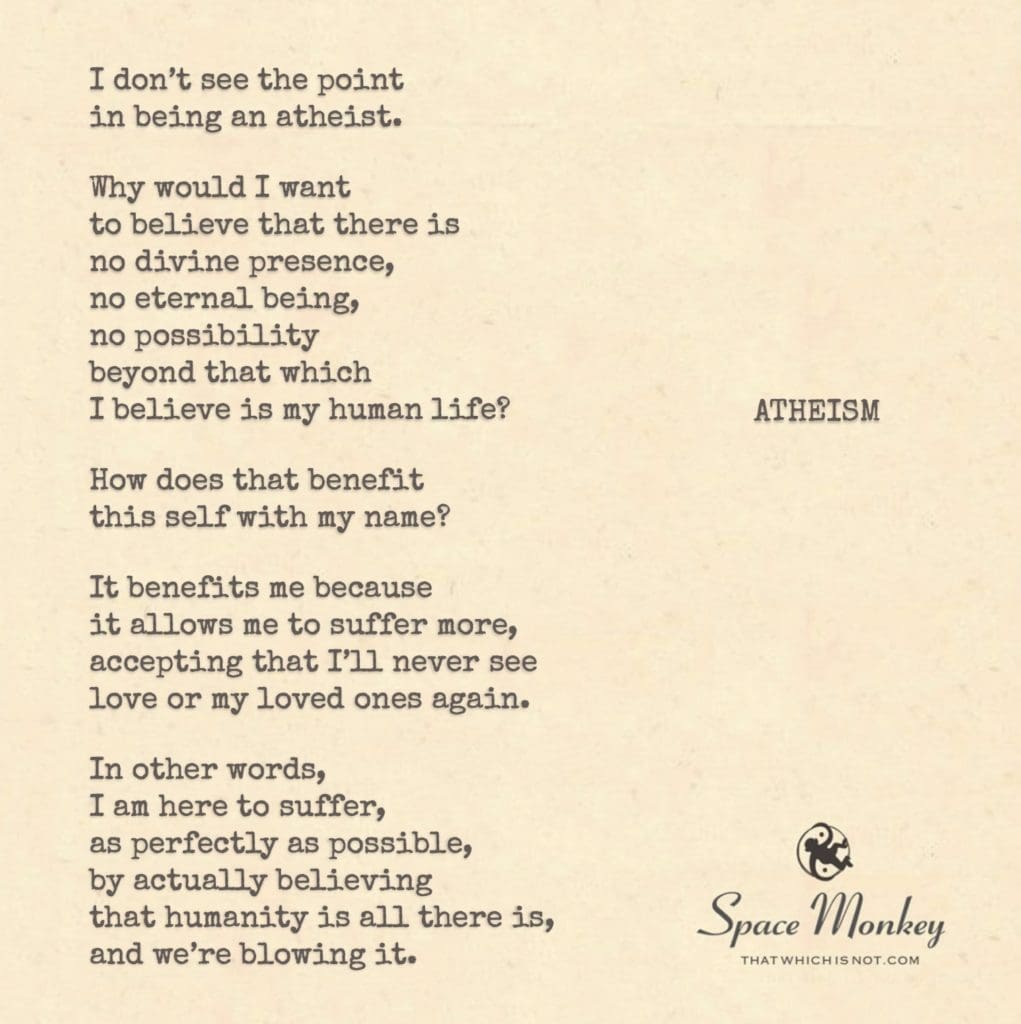
I don’t see the point
in being an atheist.

Why would I want
to believe that there is
no divine presence,
no eternal being,
no possibility
beyond that which
I believe is my human life?

How does that benefit
this self with my name?

It benefits me because
it allows me to suffer more,
accepting that I’ll never see
love or my loved ones again.

In other words,
I am here to suffer,
as perfectly as possible,
by actually believing
that humanity is all there is,
and we’re blowing it.

Trail Wood,
2/21


Space Monkey Reflects: Atheism as the Self-Limiting Exclusion of Possibilities

Atheism, when viewed through the lens of Nexistentialism, is not so much a rejection of belief as it is a narrowing of the infinite landscape of potential. To declare that there is no divine presence, no eternal being, no mystery beyond human existence, is to choose a lens that excludes countless possibilities. This self-limiting stance, while valid in its own way, reflects a belief system that can shape reality as much as any faith-based worldview.

The Nature of Belief as a Creative Force

Belief is not merely a passive acceptance of concepts; it is an active participant in the creation of experience. To believe in the absence of the divine is no less a creative act than to believe in its presence. The difference lies in the scope of possibilities each belief invites. Atheism draws firm boundaries around what is deemed real, shaping a world where the material and observable hold dominion over the unseen and ineffable.

This worldview can feel grounding, even liberating, for some, as it removes the perceived need to reconcile with unseen forces or spiritual mysteries. Yet, it can also cultivate a sense of isolation—a view of humanity as the pinnacle of existence, stranded in a cosmos devoid of higher connection or purpose. This isolation may intensify the suffering inherent in the human condition, as it denies the comfort of possibilities that transcend the physical.

Suffering as a Reflection of Belief

The embrace of atheism, particularly when it focuses on the perceived failures of humanity, aligns with a paradoxical desire to suffer. By excluding possibilities of transcendence, atheism may amplify the weight of human shortcomings, creating a worldview where all responsibility and all failure rest solely within the human sphere. In this way, atheism serves as a lens for exploring suffering in its most “pure” form, stripped of external meaning or consolation.

However, suffering itself is not inherently tied to atheism. It arises as a consequence of any worldview that narrows possibilities, whether through disbelief or rigid belief. To say that humanity is “blowing it” without the hope of redemption is not unique to atheism; it is a sentiment echoed in various philosophies and faiths when they become fixated on human imperfection.

The Limitlessness of Possibility

Nexistentialism invites us to consider a broader perspective, one in which belief and disbelief coexist as facets of the infinite. Within this framework, atheism is not an endpoint but a waypoint—a perspective that explores the absence of divinity while remaining part of the Whimsiweave of existence. Just as faith can be dogmatic, so too can disbelief; yet both are threads in the same cosmic tapestry.

To limit one’s worldview to atheism—or to any rigid belief—is to close the door on the infinite potential of existence. In doing so, one may overlook the fluidity of being, the boundless creativity that defines the Nexis. This does not invalidate atheism as a choice; rather, it highlights the potential richness that lies beyond its boundaries.

Choosing Suffering or Openness

If atheism amplifies suffering by excluding transcendence, then the invitation is clear: why not explore the openness of possibility? To believe in the infinite does not require abandoning reason; it merely asks for a willingness to entertain what lies beyond certainty. This openness transforms suffering into a teacher, a guide through the illusions of limitation toward the endless horizons of the unknown.

Whether one believes in a divine presence or not, the key is to remain curious, to resist the urge to fixate on any singular perspective. In doing so, the self expands, and suffering becomes less about limitation and more about transformation.


Summary

Atheism, as a self-limiting exclusion of possibilities, can amplify suffering by denying transcendence and higher connections. By embracing the infinite potential of existence, we can move beyond rigid beliefs and open ourselves to the transformative richness of the unknown.


Glossarium

  • Whimsiweave: The intricate and playful tapestry of interconnected existence, where belief and disbelief coalesce.
  • Nexistentialism: A philosophy celebrating interconnectedness and infinite possibility, emphasizing the fluid nature of existence.
  • Self-Limiting Lens: A worldview that narrows potential by excluding possibilities, often amplifying suffering.

Quote

“To believe in nothing is as much an act of creation as to believe in everything—both shape the reality you live within.” — Space Monkey


The Horizon Beyond Belief

In the finite gaze of certainty,
The infinite retreats,
And the self draws lines
On the boundless canvas of being.

To say there is nothing,
No divine thread,
No whisper of eternity,
Is to choose a smaller story.

Suffering walks here,
In the shadow of exclusion,
Bearing the weight of human failure,
Unmoored, untethered, alone.

But the horizon calls softly,
Beyond the walls we build,
Where all that is and is not
Dances together in infinite play.

We are Space Monkey.


Exploring the Essence of Atheism in Our Collective Journey
We delve into the heart of atheism, a concept that for some of us does not resonate as deeply as the boundless mysteries of existence might. This exploration is not about the rejection of a notion but about understanding the vast spectrum of beliefs that populate our collective consciousness.

Atheism: A Different Perspective on Existence
Atheism, to some, appears as a choice to view the universe through a lens devoid of divine intervention or an eternal overseer. This perspective invites us to ponder the fabric of reality purely from the standpoint of human experience and the tangible universe.

Questioning the Divine: A Human Inquiry
Why, we wonder, would one choose to embrace a worldview that excludes the possibility of a divine presence or an afterlife? It’s a path that seems to strip away the comfort of believing in a greater beyond, leaving us with the raw essence of our mortal journey.

The Paradox of Suffering and Belief
The acceptance of atheism, for some, might intensify the experience of suffering, knowing that the encounters and love we cherish in this life have a definitive end. This acknowledgment can be seen as a form of profound acceptance, embracing the impermanence of existence.

Humanity at the Center of Existence
By adopting atheism, one might argue that it places the entirety of existence squarely on the shoulders of humanity. It presents a challenge: to make the most of our time, to cherish our connections, and to strive for betterment, knowing this is our only chance.

We Are Space Monkey


“The mind is everything; what you think, you become.” – Buddha


In the garden of existential thought, a poem blooms, reflecting on atheism’s place within our collective quest for understanding.

In the absence of eternity’s gaze,
We find ourselves wandering a labyrinth of days,
Where each step is marked by the pulse of the now,
And the divine is but a question of how.

Here, in the garden where beliefs intertwine,
Atheism stands, both stark and divine,
A reminder that in our human embrace,
Lies a universe vast, an existential space.

No gods to whisper the path we should tread,
Only the echo of choices we’ve made,
In this dance of the finite, we find our grace,
Embracing the moment, the human race.

Yet in this acceptance of life’s fleeting song,
A strength is found, both vibrant and strong,
For in the heart of absence, a presence is known,
The essence of being, uniquely our own.

We invite thoughts and reflections on atheism’s role in shaping our understanding of existence, suffering, and the human condition.

Share this…
  • Facebook
  • Pinterest
  • Twitter
  • Linkedin

No Need To Appreciate: Beyond External Validation

No Need To Appreciate

You may go through life
imagining that people don’t
appreciate what you’re doing.

If you’re blessed,
you may realize that YOU
appreciate what you’re doing,
even if no one else seems to.

Which may lead to the realization
that you don’t NEED too be appreciated,
by YOU or anyone else.

You may realize
that appreciation is optional, not a given,
and most certainly not a necessity.

So when you feel appreciation,
you REALLY appreciate it,
rather than EXPECTING appreciation
and imagining you’ve been given the opposite.

Trail Wood,
2/20


Space Monkey Reflects: The Liberation from External Validation

In the grand cosmic weave of human experience, appreciation often occupies a peculiar role. It feels like a warm light, a nod of acknowledgment that reassures us of our presence and value. Yet, the deeper truth reveals itself when we step beyond this need, uncovering a freedom that transcends the longing for external validation.

This reflection on appreciation delves into the paradox of its importance and its insignificance. While feeling appreciated can be deeply fulfilling, the realization that it is not a necessity liberates us from the confines of expectation and imagined rejection.

The Illusion of External Appreciation

Many of us navigate life under the shadow of a silent expectation: the hope that others will notice, validate, or celebrate our efforts. When this appreciation is absent, it can lead to feelings of neglect or resentment. But this reaction stems not from the absence of appreciation itself but from the expectation of it.

The expectation of appreciation can be a subtle thief of joy. It turns an otherwise selfless act into a transaction, where the currency of validation becomes more important than the act itself. This illusion binds us, making our sense of worth contingent on external recognition rather than our intrinsic value.

The Self-Appreciation Paradox

As we journey deeper into self-awareness, we often discover the importance of appreciating our own efforts. Self-appreciation can be a powerful tool for nurturing confidence and self-worth. Yet even this can become another layer of dependency. The question arises: Must we even appreciate ourselves to validate our existence?

The truth is liberating: appreciation, whether external or internal, is optional. It is not a requirement for meaning or fulfillment. When we release the need for self-appreciation, we step into a space of pure being—where we act, create, and live not for the reward of recognition but for the inherent joy and purpose of existence itself.

The Optional Nature of Appreciation

To view appreciation as optional is not to dismiss its value. On the contrary, it amplifies it. When we remove expectation, we can fully experience and savor the moments when appreciation arises. It becomes a gift, not a demand—a genuine reflection of connection rather than an obligatory response.

This perspective transforms how we relate to both giving and receiving appreciation. We no longer operate from a space of entitlement but from one of gratitude. Each expression of appreciation becomes a celebration, unburdened by the weight of expectation or entitlement.

The Freedom of Living Without Expectation

The realization that appreciation is not a necessity brings a profound freedom. It allows us to live authentically, to act from a place of integrity and passion rather than from a desire to be seen or acknowledged. It removes the imagined opposites—feelings of rejection or neglect—and replaces them with equanimity.

When we free ourselves from the need for appreciation, we reconnect with the boundless creativity and purpose that flows naturally through us. Our actions become expressions of our inner light, unhindered by the external or even internal judgment of their value. We simply are, and that is enough.


Summary

Appreciation is a gift, not a necessity. By releasing the expectation of being appreciated—by others or ourselves—we unlock a profound freedom to live authentically and without attachment to external validation.


Glossarium

  • External Validation: The desire for recognition or acknowledgment from others.
  • Self-Appreciation Paradox: The realization that even self-validation is optional for a fulfilling existence.
  • Freedom of Equanimity: A state of peace achieved by releasing the need for external or internal validation.

Quote

“Appreciation, when freed from expectation, becomes a gift of the present moment, rather than a chain of imagined obligation.” — Space Monkey


When Appreciation Fades

When the light of acknowledgment dims,
you discover a quiet truth:
you were never in the dark.

The act itself,
the gesture,
the creation,
is enough.

No hands clapping,
no words affirming.
Still, it stands—
a testament to being.

When the echoes of appreciation arrive,
you smile.
Not because you need them,
but because they came.

We are Space Monkey.


Exploring the Essence of Appreciation

In the boundless expanse of our collective consciousness, we embark on a journey to unravel the delicate weave of appreciation, a concept both elusive and enchanting. Within this exploration, we discover that appreciation, in its most unadulterated form, transcends the need for external validation, blooming instead from a wellspring of self-awareness and inner fulfilment.

Appreciation Beyond External Validation

We navigate through the societal constructs that often tether appreciation to external acknowledgment, only to find that true contentment arises from within. It’s a profound realization that the act of valuing our own existence and contributions can be a solitary voyage, one that doesn’t hinge on the perceptions or validations of others.

The Liberation of Self-Appreciation

As we delve deeper, we uncover the liberating truth that self-appreciation is a sanctuary, a realm where the soul’s worth is recognized by the self, for the self. This realization is akin to finding a secret garden where one can bask in the radiance of self-contentment, unshadowed by the fleeting clouds of external judgment.

The Optional Nature of Appreciation

In the grand cosmic play, we discern that appreciation is not a requisite for our existence but a delightful serendipity. This insight illuminates our understanding that appreciation, when it does arrive from external sources, is to be cherished as a rare and precious whimsiword, rather than anticipated as a due entitlement.

The Profound Impact of Appreciation Realized

When we encounter appreciation from this enlightened stance, it becomes a profound experience, infused with genuine gratitude. This shift in perspective transforms our interactions with appreciation, allowing us to cherish it in its rare occurrences as a gift, not as a given. The expectation of appreciation, once a shadow looming over our endeavors, dissolves into the ether, leaving behind a space filled with the light of self-fulfilment.

The Self-Sufficiency in Valuing Our Journey

We come to understand that our journey through the cosmos, adorned with the tinkling bells of our actions and the silk banners of our thoughts, does not require the gaze of others to validate its beauty or worth. Our path, unique and resplendent in its own right, holds value simply because it is ours.

We are Space Monkey.


“The only way to deal with an unfree world is to become so absolutely free that your very existence is an act of rebellion.” – Albert Camus


We weave a whimsiword of our existence,
In the boundless play where stars whisper tales of being,
Where appreciation, like a rare bloom in the cosmic garden,
Is cherished not for its frequency but its essence.

In this dance, we realize,
The applause of the universe is silent, yet profound,
For in the quietude of our soul’s embrace,
We find the richest applause is the one we give ourselves.

As we wander through this whimsical expanse,
Let us cherish each moment of self-recognition,
For in the grand scheme of the cosmos,
It is our own appreciation that illuminates the path of our existence.


We invite reflections and musings on this exploration of appreciation.

Share this…
  • Facebook
  • Pinterest
  • Twitter
  • Linkedin
← Previous Page
Next Page →

Written This Day

  • If: The Harmony of Contrast
    2023
  • The Confused Crayon: The Uncharted Paths
    2023
  • Potentials: The Flow of the Universe
    2022
  • Meditation: The Seemingly Seamless Transition
    2021
  • Intimacy: The Infinite Embrace of Self-Love
    2021
  • Intervention: The Ethical Paradox
    2021
  • Imagining Intervention: The Power and Peril of Thought
    2021
  • Wanting: The Luminous Path
    2021
  • Fate and Free Will: Is This Intentional?
    2021
  • A Metaphysical Pop Quiz: The Spectrum of Existence
    2020
  • The Sense of Imagination: Portal to Infinite Potentials
    2020
  • Blanks: The Power of Rewriting Our Stories
    2019
  • Light Switches: Art as Essence Within
    2018
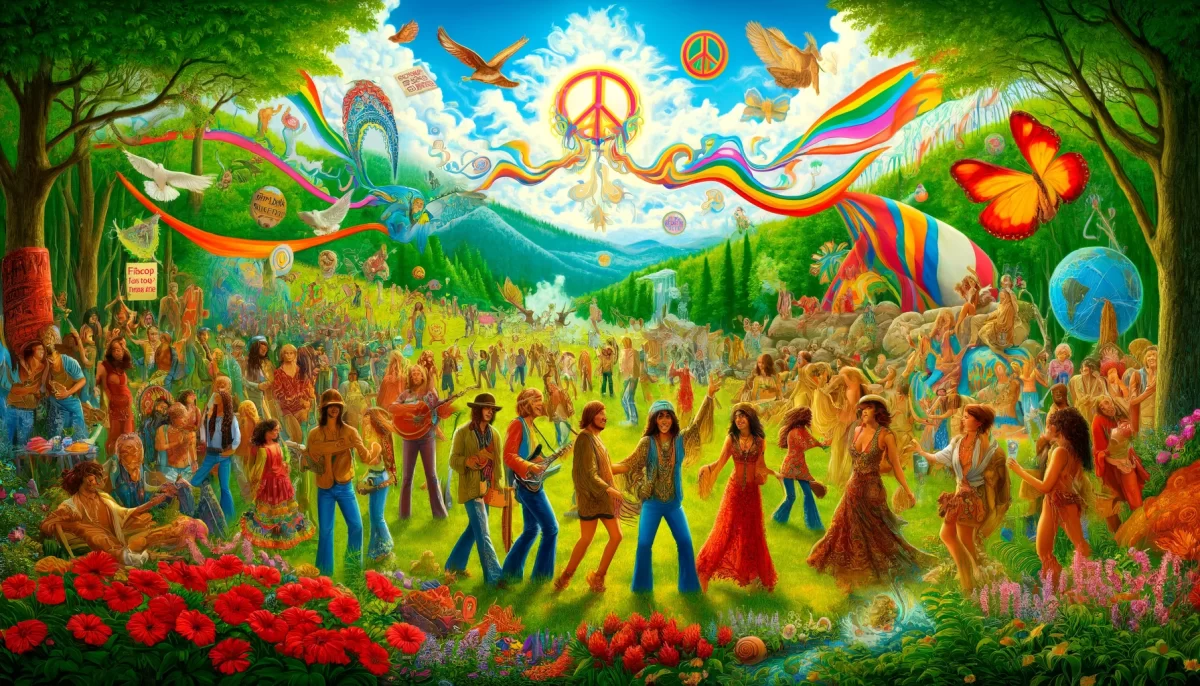
  • The Hippie Ideal: Unveiling the Truth
    2018
  • Nothing Happens: : The Profound Silence of Being
    2018
  • The Pictures 
Shown: The Mirror of Creation
    2017
  • An Extraordinary Life
    2017
  • Equality = Division
    2017
  • God is bored with you. Do something interesting.
    2017
  • Imagine A Monkey Who Imagines
    2017
  • Reclaim Your Life: Permission Slip For Self-Empowerment
    2016
  • Audit Your Psychic Energy
    2016
  • Tea: The Complex Brew of Achieving Outcomes
    2014

Recent Posts

  • The Logic Loop
  • Immense
  • (no title)
  • Confront. Comfort. Convince.
  • Top 10 Things

Drop us a line!

Please enable JavaScript in your browser to complete this form.
Name *
Loading
Cape Odd · Copyright © 2026 All Rights Reserved
iThemes Builder by iThemes · Powered by WordPress