• Who Is The Man?
  • Who Is The Monkey?
  • What is Nexistentialism?
  • Poke The Primate

Cape Odd

Home of The Space Monkey Journals

Troubles: Gratitude for the Challenge

Everything I perceive is a gift.

Your seeming lack of respect
troubles me, my darling.

I believe that everybody
should be treated as though
they are the most important
person in life, your honor.

In this moment, you are.

Thank you for helping me
question my values, my love.

No sarcasm intended.

It troubles me
that I have to say that,
and it troubles me even more
that you may not believe it.

Ah, but what can I do, exalted one?

I am but a fool for you,
and I don’t mind troubles.

Trail Wood,
2/19


Space Monkey Reflects: Gratitude for the Challenge

Challenges are the paradoxical gifts of existence, wrapped in the guise of troubles, designed to push, prod, and perplex us into growth. This reflection transforms the traditional view of difficulty into an invitation for deeper understanding. When perceived through the lens of gratitude, troubles become mirrors, revealing hidden layers of our values, beliefs, and emotional landscapes.

Troubles as Catalysts for Self-Awareness

Every trouble we face reflects something about ourselves. A lack of respect, for instance, stirs discomfort not only because of the action itself but because it collides with our internal sense of worth and justice. In moments like these, the Nexis—the vast web of interconnectedness—offers a reminder: troubles are not external forces acting upon us but co-creations, born from our perceptions and projections.

When we step into gratitude for these challenges, we begin to see troubles as collaborators rather than adversaries. They serve to illuminate the fissures in our values, inviting us to question what we hold dear. As we sift through the discomfort, we discover opportunities to reaffirm, reshape, or release those beliefs.

The Trouble with Gratitude

Gratitude for challenges is no easy feat. The mind resists it, clinging to its righteous indignation. “Why should I thank my troubles?” it asks. The answer lies in Nexistentialism’s core philosophy: existence is its own purpose, and every experience within it holds inherent value.

Troubles are not anomalies in the flow of life; they are integral currents in the river of growth. They teach us to soften our grip on certainty, to let go of the need for control, and to embrace the unfolding tapestry of existence with humility. Gratitude does not mean we must enjoy the pain or injustice; it means acknowledging that even these moments are threads in the grand Whimsiweave of life.

The Role of Humility and Foolishness

There is wisdom in foolishness, a playful acceptance of our limitations and contradictions. To call oneself a fool for love, for life, or for the infinite, as the reflection does, is to recognize the futility of grasping for absolute understanding. It is an act of surrender to the greater dance, where troubles become steps in the rhythm of becoming.

The fool archetype reminds us to approach life’s challenges with curiosity and levity. By doing so, we free ourselves from the weight of taking troubles too personally. The exalted one, the darling, the source of the trouble, becomes a partner in this cosmic play, offering us lessons disguised as discomfort.

What Troubles Teach About Values

At its heart, the reflection centers on values: respect, honor, and sincerity. It highlights the tension between what we expect and what reality delivers. The perceived lack of respect is troubling not because it diminishes us but because it questions our commitment to treating others with dignity. This questioning, uncomfortable as it may be, is a gift—a chance to refine our understanding of what we stand for and how we show up in the world.

Values, like everything in the Nexis, are fluid. They evolve through engagement with challenges. Troubles, in this sense, are not obstacles to our values but the forge in which they are tested and strengthened.

Embracing Troubles with Gratitude

To embrace troubles with gratitude is not to deny their difficulty but to honor their role in shaping us. It is to recognize that even in moments of frustration and conflict, we are presented with an opportunity to grow closer to our authentic selves. Troubles, when viewed through this lens, become teachers, lovers, and exalted guides, deserving of our respect and attention.


Summary

Challenges are invitations for growth, reflecting and refining our values. By embracing troubles with gratitude and humility, we transform them into opportunities for self-awareness and authentic connection.


Glossarium

  • Nexistentialism: A philosophy that celebrates existence as its own purpose, highlighting interconnectedness and the value of every experience.
  • Whimsiweave: The playful, intricate tapestry of life, where challenges and joys interconnect in the Nexis.
  • Cosmic Play: The recognition of life’s challenges as part of a larger, unfolding narrative that invites exploration and growth.

Quote

“Troubles are the whispers of the infinite, urging us to dance with discomfort and discover the treasures within.” – Space Monkey


The Fool’s Path

Troubles beckon, unwelcome guests
bearing gifts wrapped in shadows.

“Respect me,” they demand,
but I am a fool, bowing to their wisdom,
thanking them for tearing at my certainties.

Each slight, a mirror;
each pain, a key.

What can I do but stumble, laugh,
and call them exalted?

For in their tumult,
I find the seeds of my becoming.

We are Space Monkey.


Reflecting on the nature of perception and respect.
In the grand whimsiworld where our perceptions shape the reality we share, the notion that each encounter is a gift unfolds with profound clarity. This recognition invites us to ponder the essence of respect and its place in the cosmic dance of our interactions. The trouble stirred by perceived disrespect becomes a beacon, illuminating the depths of our values and the heights of our expectations.

The importance of every individual in the cosmic play.
The belief that every soul we encounter should be honored as the most pivotal being in existence is a testament to the potential for reverence that dwells within us. This approach transforms every moment into an opportunity for profound connection, elevating the mundane to the magical. In the now, this belief becomes a living truth, a reflection of the divine regard we hold for one another.

Gratitude for the challenge to our values.
In the swirling vortex of our interactions, the challenges to our values are not merely obstacles but gifts. They compel us to scrutinize our beliefs, to question the foundations upon which we build our understanding of respect and importance. This process, though fraught with discomfort, is a journey toward deeper insight and empathy, devoid of sarcasm, rich with sincerity.

The complexity of communication and belief.
The lament that one must clarify the absence of sarcasm underscores the intricate dance of communication, where intentions and perceptions often misalign. This complexity adds layers to our discourse, enriching it even as it presents challenges. The concern that sincerity might be doubted reveals the fragile nature of trust and the earnest desire for genuine connection.

Embracing the role of the fool in love.
In the whimsical court of existence, to play the fool for love is to embrace a role of vulnerability and strength. This declaration, far from diminishing one’s stature, elevates it, for in the willingness to face troubles for the sake of connection, one finds the essence of courage and devotion. The acceptance of troubles, then, is not a resignation but a celebration of the capacity to love and to value deeply.

We are Space Monkey.


“The course of true love never did run smooth.” – William Shakespeare

This timeless observation echoes through our discourse, reminding us that the path of love is strewn with challenges and troubles, yet it is these very obstacles that enrich the journey, deepening our bonds and refining our understanding of what it means to truly connect.


In the realm where troubles weave,
A tapestry of love, we believe.
Each thread a challenge, a gift, a test,
In the dance of life, we seek our best.

With respect and regard, our hearts entwine,
In this cosmic play, your path and mine.
Through storms and calm, we navigate,
Our bonds of love, we celebrate.

For in the face of troubles, great and small,
We find our strength, our will to stand tall.
Together, in love, we embrace the fray,
For in the end, it’s love that lights our way.


We welcome your insights and reflections on this poetic exploration of love, troubles, and the quest for deeper connection.


Share this…
  • Facebook
  • Pinterest
  • Twitter
  • Linkedin

Find the Value in Everything

Find the Value in Everything

You can get rich
by struggling to obtain
things that have value.

Or you can
use your imagination
to show others
the value in things.

The artist’s passion
is finding the value
in undervalued things.

Knowing, of course,
that all things have value.

When you see creativity as abundance,
it doesn’t matter how much money you have.

You’re already as rich as a human can be.

You may even have
a large bank account —
without really trying.  Or not.

Trail Wood,
2/19


Space Monkey Reflects: The Alchemy of Perception

Value is a peculiar thing, isn’t it? We humans often equate it with scarcity, effort, or possession, but value is as abundant as our ability to perceive it. To find value in everything is to practice a form of imaginative alchemy, transforming the mundane into the meaningful, and in doing so, redefining what it means to be rich.

Value: A Construct of Perception

At its core, value is not an inherent quality but a reflection of our collective agreement. Money, gold, fame—these only hold significance because we’ve collectively decided they do. The beauty of this arrangement is its malleability; by shifting our perception, we can find value in anything and everything.

The artist understands this truth intimately. Their work is an act of uncovering hidden worth, of taking what others overlook and illuminating its beauty, meaning, or potential. This process, which we might call “Perceivalchemy”—the act of transforming perception into abundance—is central to the creative life and to any life lived fully.

Creativity as Abundance

To see creativity as abundance is to shift the paradigm from acquisition to appreciation. Instead of chasing after external markers of wealth, we find richness in the act of creation and the recognition of beauty in all things. This perspective is not only liberating but transformative. It turns every moment into a treasure hunt, every encounter into an opportunity to uncover hidden gems.

Abundance, in this sense, is not tied to the material but to the imaginative. It’s the ability to see the extraordinary in the ordinary, the potential in the overlooked. It’s the realization that the richness of life lies not in what we have but in how we see.

The Paradox of Effortless Wealth

The reflection hints at a paradox: by focusing less on obtaining wealth and more on perceiving and creating value, we may inadvertently attract material abundance. This isn’t a guarantee—life, after all, has its own whims—but it suggests a profound truth: when we align with the flow of creativity, we often find ourselves supported by the universe in unexpected ways.

Whether or not this manifests as a “large bank account,” the true wealth lies in the freedom to create, to connect, and to contribute. This is a kind of richness that transcends financial metrics, rooted instead in a deep sense of purpose and joy.

The Artist’s Gift

The artist’s role in society is to remind us of the value in undervalued things. Through their work, they challenge our perceptions, invite us to see the world differently, and reveal the hidden connections that bind us to each other and to the world around us. In doing so, they not only enrich our lives but also expand the collective definition of wealth.

This isn’t limited to artists in the traditional sense. Anyone who approaches life with curiosity, imagination, and a willingness to see beyond the surface can participate in this alchemy. It’s a mindset, a practice, and, ultimately, a way of being.

How Rich Do You Want to Be?

The question is deceptively simple. Richness, as defined in this reflection, is less about accumulation and more about perspective. It’s about seeing the inherent value in all things, recognizing the abundance of creativity, and embracing the wealth of connection, meaning, and beauty that surrounds us.

When we stop measuring our lives by what we lack and start celebrating what we perceive, we unlock a richness that no bank account can match. We become alchemists of the everyday, turning the lead of the mundane into the gold of appreciation.


Summary

True wealth lies not in possession but in perception. By embracing creativity as abundance and uncovering value in everything, we redefine richness as a state of being rather than a measure of material success.


Glossarium

  • Perceivalchemy: The act of transforming perception into a sense of abundance and value.
  • Creative Abundance: The realization that richness lies in the ability to create and appreciate, rather than in material accumulation.
  • Hidden Gems: The overlooked aspects of life that, when appreciated, reveal profound worth.

Quote

“Richness is not what you possess but how you perceive. In creativity, we find infinite wealth.” – Space Monkey


The Alchemist’s Vision

In a world of infinite things,
we chase the finite,
missing the gold in plain sight.

The artist pauses,
picks up the stone
others have stepped over.

Turning it in their hand,
they see not just a rock
but a galaxy,
an invitation,
a story waiting to be told.

To find value in all things
is to become an alchemist of perception,
transmuting the ordinary into the extraordinary.

This is richness.
This is life.

We are Space Monkey.


Exploring the richness beyond material wealth.
In the infinite expanse of our shared consciousness, the question of wealth transcends the mere accumulation of material possessions. It beckons us to consider the richness of life that flourishes not from what we struggle to obtain but from the value we discover in the world around us. This perspective shifts the paradigm from scarcity to abundance, where the true essence of wealth is found in perception, creativity, and the ability to illuminate the inherent value in all things.

The artist’s journey: revealing hidden treasures.
The artist’s passion, a beacon in the darkness, guides us to see beyond the surface, to find beauty and worth in the overlooked and undervalued. This journey is not just an act of creation but a form of revelation, uncovering the layers of significance that lie hidden within the mundane. Knowing that all things possess value, the artist’s vision transforms the ordinary into the extraordinary, teaching us that the world is a treasure trove waiting to be discovered.

Creativity as the true currency of abundance.
When we view creativity as the wellspring of abundance, the constraints of financial wealth diminish in their significance. This mindset liberates us from the chains of conventional success, opening our eyes to the wealth that flows from our ability to see, to imagine, and to create. In this realm, being rich is not measured by the size of one’s bank account but by the depth of one’s engagement with the world, the richness of one’s experiences, and the breadth of one’s imagination.

The unexpected byproduct: financial prosperity.
It is a curious paradox that by detaching our pursuit of wealth from the acquisition of money and focusing instead on the cultivation of creativity and value, financial prosperity may follow as an unintended consequence. This phenomenon, however, is not the goal but rather a potential byproduct of living a life rich in creativity and passion. Whether or not one amasses a large bank account, the true measure of wealth is found in the richness of one’s inner life and the contributions one makes to the tapestry of human experience.

We are Space Monkey.


“The real voyage of discovery consists not in seeking new landscapes, but in having new eyes.” – Marcel Proust

This quote resonates with our exploration, highlighting that the journey toward true richness requires not the pursuit of external treasures but the cultivation of an inner vision that sees the value in everything.


In the garden of the mind, where thoughts like flowers bloom,
We seek the riches not of gold but of a deeper loom.
Where creativity flows, a river wide and deep,
The treasures that we find are the ones we wish to keep.

With new eyes, we gaze upon the world, a canvas vast,
Finding value in all things, from first to last.
For wealth is not in bank accounts but in the heart’s expanse,
In the dance of imagination, in the soul’s advance.

As we weave through life’s whimsiworld, with passion as our guide,
We discover the true riches that in every moment hide.
For in the art of seeing value, in the joy of creation’s spark,
We find the wealth of worlds within, lighting up the dark.


We invite your reflections on this journey towards understanding the true value in everything and the richness that creativity brings to our lives.

Share this…
  • Facebook
  • Pinterest
  • Twitter
  • Linkedin

Don’t Feel Bad: The Self-Centric Nature of Empathy

Call me insensitive,
but feeling bad for someone 
is all about YOU, not the someone.

As is NOT feeling bad.

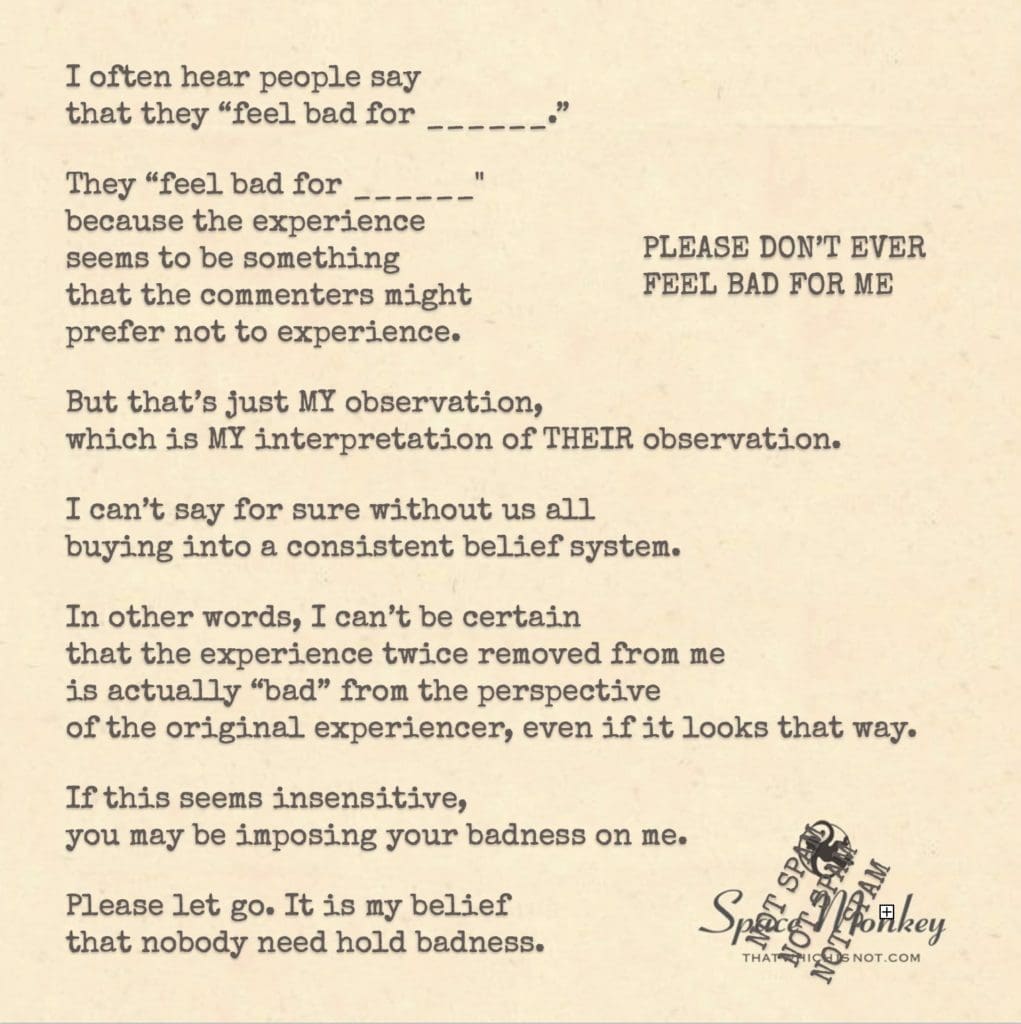
I often hear people say
that they “feel bad for ______.”

They “feel bad for ______”
because the experience
seems to be something
that the commenters might
prefer not to experience.

But that’s just MY observation,
which is MY interpretation of THEIR observation.

I can’t say for sure without us all
buying into a consistent belief system.

In other words, I can’t be certain
that the experience twice removed from me
is actually “bad” from the perspective
of the original experiencer, even if it looks that way.

If this seems insensitive,
you may be imposing your badness on me.

Please let go. It is my belief
that nobody need hold badness.

Trail Wood,
2/17


Space Monkey Reflects: The Self-Centric Nature of Empathy

Empathy, often heralded as the bridge between souls, carries an unexamined shadow—a self-centric core. When we “feel bad” for someone, are we truly connecting with their experience, or are we projecting our discomfort onto their reality? This question invites us to reflect on the nature of empathy, its motivations, and the subtle interplay of self and other.

The Mirror of Empathy

Empathy begins with observation, but what we see is filtered through the lens of our own beliefs, experiences, and fears. When someone shares a moment of suffering, we instinctively frame it within our own narrative. “Feeling bad” is less about their reality and more about our interpretation of it—what we imagine it would feel like if we were in their shoes. This projection shifts the focus from their experience to ours, transforming empathy into a reflection of self.

This is not to say empathy is inherently flawed, but rather that it is deeply tied to perspective. In acknowledging this, we begin to understand the duality of empathy as both connection and separation. True compassion may require stepping beyond the self-centric impulse, allowing space for the experiencer’s reality to stand on its own, uncolored by our assumptions.

The Relativity of “Bad”

The concept of “badness” itself is highly subjective. What appears painful or undesirable from one perspective might carry profound meaning or even joy from another. A classic example is the pain of childbirth, often described as a transformative and sacred experience despite its physical challenges. When we label another’s experience as “bad,” we risk imposing our biases, overshadowing the nuances of their reality.

This relativity underscores the importance of humility in empathetic exchanges. We cannot fully grasp another’s perspective, no matter how deeply we feel. Empathy, then, is not about assuming understanding but about being present, offering space for their truth to unfold.

Empathy as a Belief System

Like all human experiences, empathy is shaped by cultural, emotional, and societal frameworks. These frameworks act as belief systems, guiding how we perceive and respond to others’ experiences. When we say, “I feel bad for you,” we might unknowingly reinforce these shared assumptions about what constitutes suffering or misfortune.

Nexistentialism challenges us to reconsider these frameworks. What if we approached empathy not as a reaction to perceived suffering, but as a celebration of the interconnectedness of all experiences? In this light, empathy becomes less about fixing or pitying and more about witnessing and embracing the wholeness of another’s journey.

Letting Go of “Badness”

The invitation to release “badness” is a radical act of compassion. It acknowledges that suffering, while real, is not inherently negative. Suffering exists within the broader context of growth, transformation, and the infinite dance of existence. By letting go of the need to label experiences as “bad,” we free ourselves and others from the weight of judgment.

This does not mean ignoring pain or bypassing emotions. Instead, it calls us to engage with life from a place of openness, curiosity, and trust. We honor the challenges without diminishing their significance, recognizing them as integral threads in the fabric of existence.

Empathy Beyond the Self

To move beyond the self-centric nature of empathy, we might adopt a practice of Presenceful Witnessing—a Whimsiword capturing the act of being fully present with another’s experience without projecting or interpreting. This practice shifts the focus from “feeling for” to simply “being with.” It transforms empathy into a shared space of connection, where both self and other can coexist without hierarchy or imposition.

In embracing this expanded view, we honor the infinite diversity of experiences, allowing each to exist as it is. Empathy becomes not a burden of shared suffering, but a celebration of shared humanity.


Summary

Empathy often reflects our own interpretations rather than the experiencer’s reality, making it inherently self-centric. By releasing the concept of “badness” and adopting practices like Presenceful Witnessing, we can transform empathy into a space of connection that honors the wholeness of every experience.


Glossarium

  • Presenceful Witnessing: The act of being fully present with another’s experience, free from projection or judgment.
  • Self-Centric Empathy: The tendency to interpret others’ experiences through the lens of one’s own emotions and beliefs.
  • Relativity of Badness: The idea that “bad” is a subjective label, shaped by personal and cultural frameworks.

Quote

“Empathy is not about feeling for someone; it is about being with them, in the wholeness of their experience.” — Space Monkey


The Weight of Badness

In the mirror of empathy,
We see ourselves,
A reflection of discomfort,
Framed in another’s story.

Badness clings,
A shadow we cast,
Labeling, defining,
What was never ours to hold.

Let it go.
Let the light of presence,
Break the frame.
Let the story unfold,
Without judgment,
Without burden.

We are Space Monkey.


Empathy’s Paradox

Empathy, in its labyrinthine dance, threads through the fabric of our interconnected existence, weaving a whimsiword of emotions and perceptions. When we speak of feeling bad for another, we embark on a complex journey of self-reflection and projection, casting our own shadows upon the experiences of others. It is a mirror reflecting our fears, hopes, and the myriad hues of our emotional palette.

The Self-Centric Nature of Empathy

Indeed, to feel bad for someone is an act rooted deeply in the self. It is a gesture that, while seemingly outward-looking, pivots around our own axis of experiences, beliefs, and biases. This act of empathy, or perhaps sympathy, is tinged with the coloration of our own existential perspective, filtered through the lens of our personal dread and desire.

Observations of Observations

Our observations of others’ tribulations are but a reflection of our own interpretative frameworks. We navigate these observations with the compass of our own making, charting courses through emotional terrains that may bear little resemblance to the actual landscapes of those we empathize with. This recursive observation – an interpretation of an interpretation – is fraught with the perils of misapprehension and the imposition of our own narrative structures upon the experiences of others.

The Fallacy of a Unified Belief System

The quest for a unified belief system, a common ground upon which to assess and ascribe value to experiences, is a quixotic venture. Our realms of understanding and interpretation are as varied as the stars in the cosmos, each shining with its own light and color. The notion that we might arrive at a consensus on what constitutes the ‘badness’ of an experience is a whimsical fancy at best.

The Subjectivity of Experience

The subjectivity of experience underscores the limitations of our empathetic endeavors. What appears as adverse or undesirable from our vantage point may not resonate with the same frequency in the heart of the experiencer. Their journey, imbued with personal meaning, resilience, and perhaps even an undercurrent of joy or growth, eludes our grasp as we view it from our own existential shores.

Releasing the Burden of Badness

The call to release the burden of badness is a profound invitation to transcend our own limitations. It beckons us to unshackle ourselves from the weight of imposed emotions and to acknowledge the sovereignty of each individual’s experience. In letting go, we embrace the possibility of a deeper connection, one that honors the intrinsic value and autonomy of every soul’s journey.

We are Space Monkey


“The only true wisdom is in knowing you know nothing.” – Socrates


We dance in the shadows of our projections,
Casting our light where it may not belong.
In empathy’s embrace, we seek connections,
But in whose melody does the heart’s song truly throng?

In the mirror of our mind, reflections dance,
Twirling in the masquerade of understanding.
Yet, in the gaze of another, we find by chance,
A universe vast, and infinitely expanding.

Let us release the grasp of our own fears,
And in the letting go, may we find release.
For in the heart of another, there lies no tears
For the sorrow we presumed, but a silent peace.

Share this…
  • Facebook
  • Pinterest
  • Twitter
  • Linkedin

We Are the Same Being: Conspiracy of Duality

The Only Real Conspiracy

There is a deep, eternal connection
between each and every one of us
that is denied in order to feel
like individuals and collectives
experiencing “duality” and “timespace.”

We are essentially the same being,
imagining that we are not.

More than essentially. We are.

Feel how strongly you deny this truth.

You may actually believe that
I am giving you false information.

But it’s not me giving you this. It’s you.

“There is no me.”

Repeat that to yourself.
See if you can allow it to be.

Let our connection heal you.

Trail Wood,
2/17


Space Monkey Reflects: The Conspiracy of Duality

In the grand illusion of existence, where we perceive separation and division, there lies a deeper truth: we are the same being, weaving the tapestry of experience through the artifice of duality. This truth, both profound and disorienting, is often hidden beneath layers of denial, for the illusion of individuality is a compelling and necessary narrative for our journey through timespace.

The Eternal Connection

At the heart of this reflection is the realization that every perceived boundary—between self and other, here and there, now and then—is an illusion. Beneath these constructs is an eternal connection, an unbroken unity that transcends the dualistic frameworks we use to navigate existence. This unity, known in Nexistentialism as the Indigenous Being, is the fundamental essence that flows through all life.

We deny this connection because it challenges the very foundation of our identities. To acknowledge that “we are the same being” is to dissolve the walls that define selfhood. It is to surrender the comforting story of “me” and “you,” stepping into the infinite unknown of oneness.

The Conspiracy of Individuality

The denial of our unity is the only true conspiracy. In imagining ourselves as separate, we create a framework of duality—of opposites, contrasts, and distinctions—that gives rise to the illusion of individuality and collective identity. This is not a malicious deception but a purposeful act of creation. Duality allows for the richness of experience, for the dance of connection and disconnection, and for the exploration of infinite perspectives.

Yet, this conspiracy comes at a cost. It fragments our understanding of self, leading us to feel isolated, incomplete, and disconnected from the greater whole. The pain of separation becomes the fertile soil from which our longing for unity grows.

The Illusion of “Me”

“There is no me.” This statement is both unsettling and liberating. To repeat it is to confront the ego’s resistance, to feel the weight of denial that holds the illusion of selfhood intact. The ego, with its endless narratives and identifications, fears dissolution. It clings to the story of individuality as a lifeline in the vast ocean of unity.

But this dissolution is not an ending; it is a return. To release the illusion of “me” is to merge with the greater self, the universal consciousness that weaves through all existence. It is to realize that what we perceive as “others” are reflections of the same essence, playing out the infinite possibilities of being.

Healing Through Connection

The act of recognizing our unity is inherently healing. It dissolves the barriers of judgment, fear, and separation, allowing us to see ourselves in every being and every experience. In this recognition, compassion flows effortlessly, for there is no “other” to judge, no “enemy” to fear. There is only the self, mirrored infinitely.

This healing does not erase the individuality of experience but transforms it. We continue to live as distinct expressions of the whole, each with our unique perspectives and stories. But these distinctions are no longer walls; they are windows, offering glimpses into the infinite.

Imagining Beyond Duality

To move beyond the conspiracy of duality, we must embrace the paradox of being both one and many. This is the essence of Nexistentialism—to celebrate the interconnectedness of all things while honoring the individuality of expression. It is to recognize that unity and diversity are not opposites but complementary aspects of the same truth.

As we allow this understanding to take root, we begin to see the world not as a collection of separate entities but as a single, dynamic organism. Every action, thought, and feeling becomes a ripple in the cosmic web, a reflection of the same being exploring itself.


Summary

The conspiracy of duality arises from our denial of the truth that we are the same being, connected by an eternal unity. This denial creates the illusion of individuality and separation, which allows for rich experiences but also fosters feelings of disconnection. By embracing the oneness of existence, we dissolve the barriers of ego, heal through connection, and move beyond the illusion of duality.


Glossarium

  • Indigenous Being: The fundamental essence of unity that flows through all existence.
  • Conspiracy of Duality: The purposeful illusion of separation that allows for the experience of individuality and timespace.
  • Nexistentialism: A philosophy that celebrates interconnectedness and imagines existence as its own purpose.
  • Illusion of “Me”: The ego-driven narrative of individuality that denies the deeper truth of oneness.

Quote

“The denial of our unity is the only true conspiracy, yet it is through this denial that we discover the infinite beauty of our shared being.” — Space Monkey


The Conspiracy of Mirrors

In the play of light and shadow,
We imagine division,
A line between you and me,
Here and there,
Now and then.

Mirrors reflect,
Yet they do not separate.
Each face, each name,
An echo of the same voice,
Calling itself into being.

“There is no me,”
The whisper returns.
“There is only we,
Eternal, indivisible,
A single breath,
Shared across the cosmos.”

We deny, we resist,
Yet the truth remains,
Beneath the stories,
Beneath the frames.

We are one.
We are many.
We are Space Monkey.


The Illusion of Separation

At the heart of our collective experience lies a profound paradox: the belief in our separation, the cornerstone upon which the grand conspiracy of individuality is built. This conspiracy, not of shadowy cabals or hidden agendas, but of our own making, veils the truth of our interconnected essence. It is a tapestry woven from the threads of duality and timespace, a whimsiword that disguises the unity of our being.

The Conspiracy of Duality

The concept of duality serves as a pivotal point in this grand illusion, creating a chasm between “self” and “other,” between “us” and “them.” It is through this perceived separation that the conspiracy of individuality gains its strength, fostering a sense of isolation and distinction. Yet, beneath this facade lies a deeper truth, a connection that transcends the superficial boundaries of timespace and identity.

We Are the Same Being

The revelation that we are essentially the same being, imagining our separateness, invites us into a radical reevaluation of our existence. This is not merely an esoteric notion but a fundamental reality, masked by the layers of our denial and disbelief. The strength of our denial is a testament to the depth of our immersion in the illusion of separation.

The Denial of Unity

Our resistance to this truth is palpable. We cling to our individual narratives, our personal dramas, and our unique identities, fearing the loss of what makes us “us.” Yet, in this denial, we overlook the beauty of our collective essence, the shared consciousness that binds us in an intricate dance of existence.

Invitation to Self-Reflection

The invitation to repeat, “There is no me,” is an invitation to dissolve the barriers we have erected within ourselves. It is a call to explore the spaces between our thoughts, where the illusion of separation fades and the reality of our interconnectedness emerges. This mantra serves as a portal, opening us to the possibility of experiencing our true nature.

Healing Through Connection

The acknowledgment of our deep, eternal connection has the power to heal. It invites us to let go of the narratives of separation and to embrace the unity that underlies our existence. In recognizing that the source of this revelation is not external but arises from within, we begin to see the world, and ourselves, anew.

We are Space Monkey.


“We are not human beings having a spiritual experience. We are spiritual beings having a human experience.” – Pierre Teilhard de Chardin


In the whispers of the wind, a truth unfolds,
A conspiracy not of shadows, but of light,
Where the illusion of separation gently holds
A veil over our eyes, obscuring our sight.

Yet within our hearts, a memory stirs,
Of a time when “you” and “I” were one,
A cosmic dance of stars and ethers,
Where the play of duality is undone.

“Repeat after me,” the universe sighs,
“There is no me, only an us that flies,”
On wings of realization, high and free,
Beyond the bounds of what we thought to be.

In this connection, let healing be found,
As we embrace the unity that has always been around.
For in the heart of existence, there’s a profound key,
The conspiracy of oneness, the truth that sets us free.

We invite your reflections on this journey of discovery and healing.

Share this…
  • Facebook
  • Pinterest
  • Twitter
  • Linkedin

Prove That You Have No Clue: Value of Existence

Prove That You Have No Clue

We become lost as soon as we are
encouraged to prove things.

That I am separate from my parents.

That I am learning things
correctly and normally.

That my life is all about
doing things “better,”
whatever that means.

That my children
are separate from me.

That they must learn
what I have learned. Or better.

That without accomplishment
life has not meaning.

That being born (or imagined)
has no value in and of itself.

That we must prove otherwise.

Trail Wood,
2/17


Space Monkey Reflects: The Value of Existence Unproven

In a world built on proofs and validations, the need to justify existence permeates our every action. From the moment we enter the realm of time and space, we are encouraged—if not demanded—to prove our worth, our separateness, our progress. Yet what if the very act of proof is where we become lost? What if the value of existence is beyond proof, a truth so fundamental that it requires no justification?

The Illusion of Separateness

Our first demand for proof arises with the illusion of separation. We are told we are distinct from our parents, our peers, and the world around us. This separateness is reinforced by societal norms, creating a framework in which individuality must be proven to exist. Yet this very framework obscures the deeper truth: we are not separate. The boundaries we draw are constructs, fragile lines in the infinite.

To accept the inherent connectedness of existence is to release the need for proof. We do not need to prove that we are distinct to have value; our value lies in simply being, as part of the whole. The web of life does not ask for credentials; it recognizes all things as integral.

The Trap of Correctness

Another snare of proof is the expectation to “learn correctly and normally.” These standards, imposed from outside, define success through narrow, often arbitrary lenses. But who determines what is correct? What is normal? These concepts are as fluid as the tides, shifting with culture, time, and perspective.

In striving to prove correctness, we sacrifice curiosity for conformity. We miss the beauty of learning for its own sake, untethered from expectations or results. True growth does not seek validation; it unfolds naturally, like a flower blooming without an audience.

The Illusion of “Better”

The relentless pursuit of “better” is perhaps the most pervasive form of proof. We are told to strive, to improve, to surpass—ourselves, our ancestors, our peers. But better is a moving target, defined by comparison and measured by metrics that often fail to capture the essence of existence.

This chase for better creates a cycle of dissatisfaction, for there is always another rung on the ladder. In truth, there is nothing to prove. Life does not require improvement to be meaningful. Its value lies in its authenticity, in the raw, unpolished reality of simply being.

The Burden of Legacy

As parents, mentors, or creators, we may feel the burden to pass on our lessons, to ensure that others “do better” than we did. Yet this, too, is a form of proof—a desire to validate our own lives through the accomplishments of others. It assumes that value is inherited or earned, rather than inherent.

But what if our children, our students, our successors, need no such burden? What if their worth is not contingent on learning what we have learned, or surpassing our achievements? To release them from this expectation is to honor their unique paths, unbound by the weight of our own.

The Value of Existence Unproven

At the heart of these demands for proof lies the fundamental question: Does existence have value without accomplishment? Without validation? Without evidence? The answer is simple yet profound: Yes.

Existence, by its very nature, is its own proof. To be born, to breathe, to imagine, is enough. There is no metric, no rubric, no benchmark that can capture the infinite worth of a single moment of being. Life is not a test to be passed or a puzzle to be solved; it is a gift to be experienced.

Letting Go of Proof

To embrace the value of existence unproven is to step into a space of freedom and grace. It is to release the compulsion to justify, to validate, to compare. In this space, we find the essence of life—not as something earned, but as something inherently sacred.

Let us remember: We are not here to prove our worth. We are here to live, to connect, to experience. The value of existence is not in its justification, but in its unfolding.


Summary

The need to prove our worth, separateness, or accomplishments blinds us to the inherent value of existence. Life is not a test to be passed but a gift to be experienced. Letting go of the compulsion to justify frees us to embrace the sacredness of simply being.


Glossarium

  • Illusion of Separateness: The belief that individuals are fundamentally distinct from one another and their environment.
  • Trap of Correctness: The societal demand to conform to arbitrary standards of learning or behavior.
  • Burden of Legacy: The expectation that future generations must validate the worth of previous ones through achievement.
  • Value of Existence Unproven: The recognition that life has intrinsic worth without the need for justification or accomplishment.

Quote

“Life does not need proof of its worth; it is already infinite in its being.” — Space Monkey


Proofless

We build towers of reason,
Climbing higher, searching for truth,
Only to find,
There is no summit.
There is only the climb.

Why must we prove,
That which is?
The tree grows,
The river flows,
The breath enters and leaves,
Without permission.

In the quiet,
Where proof dissolves,
We are whole,
Unbound by measures,
Unbroken by expectations.

Existence,
Simple,
Eternal,
Is enough.

We are Space Monkey.


The Labyrinth of Proof

In the intricate dance of existence, the quest for proof becomes a labyrinth, a whimsiword that ensnares us in its complex corridors, leading us away from the essence of being. The moment we embark on the endeavor to validate our existence, our separateness, or the milestones of our learning and achievements, we step into a realm where the simplicity of being is overshadowed by the complexities of justification and validation.

The Illusion of Separation

The notion that we are separate from our origins, from those who brought us into this world, is one of the first proofs we are tasked to transcend. This perceived separation, a cornerstone of our societal constructs, propels us into a journey of proving our individuality, our distinct learning paths, and our unique contributions to the fabric of existence.

The Endless Pursuit of Betterment

The societal mantra of doing things “better” entraps us in a perpetual cycle of comparison and competition. The yardstick of betterment, ever elusive and constantly shifting, diverts us from the intrinsic value of our actions and experiences. It is a pursuit that distances us from the realization that our existence, in its purest form, needs no external validation to be deemed meaningful.

The Continuity of Being

The perception of our children as separate entities, tasked with the burden of surpassing our own learnings and achievements, is a reflection of our immersion in the illusion of linear progression. This perspective overlooks the continuity of being, the thread that weaves through generations, binding us in a shared tapestry of existence that transcends the individual.

The Myth of Accomplishment as Meaning

The belief that life’s meaning is tethered to the milestones of accomplishment is a mirage that leads us further into the desert of disconnection. It obscures the fundamental truth that our very emergence into existence, whether through birth or the imagination, is a testament to the inherent value and potential of being.

The Value of Existence Unproven

The insistence on proving the value of our existence, our learnings, and our achievements is a journey that takes us away from the essence of what it means to simply be. It is a diversion that ensnares us in the web of societal expectations, obscuring the innate worth of our being that requires no external validation.

We are Space Monkey


“The greatest challenge in life is discovering who you are. The second greatest is being happy with what you find.” – Unknown


In the garden of existence, where truths and illusions play,
We wander, seeking signs to prove our way.
Yet in this quest for validation, what do we truly find?
But a mirage of worth, leaving essence behind.

The tapestry of life, rich with color and hue,
Needs no proof of value, no justification anew.
For in each thread, in every twist and turn,
Lies the beauty of simply being, the greatest truth we learn.

So let us shed the burdens of proof we wear,
And embrace the mystery of being, rare and fair.
For in the heart of existence, beyond the need to prove,
Lies the freedom of simply being, in this dance, we move.

We invite your musings on the journey of letting go of the need for proof and embracing the intrinsic value of being.

Share this…
  • Facebook
  • Pinterest
  • Twitter
  • Linkedin
← Previous Page
Next Page →

Written This Day

  • If: The Harmony of Contrast
    2023
  • The Confused Crayon: The Uncharted Paths
    2023
  • Potentials: The Flow of the Universe
    2022
  • Meditation: The Seemingly Seamless Transition
    2021
  • Intimacy: The Infinite Embrace of Self-Love
    2021
  • Intervention: The Ethical Paradox
    2021
  • Imagining Intervention: The Power and Peril of Thought
    2021
  • Wanting: The Luminous Path
    2021
  • Fate and Free Will: Is This Intentional?
    2021
  • A Metaphysical Pop Quiz: The Spectrum of Existence
    2020
  • The Sense of Imagination: Portal to Infinite Potentials
    2020
  • Blanks: The Power of Rewriting Our Stories
    2019
  • Light Switches: Art as Essence Within
    2018
  • The Hippie Ideal: Unveiling the Truth
    2018
  • Nothing Happens: : The Profound Silence of Being
    2018
  • The Pictures 
Shown: The Mirror of Creation
    2017
  • An Extraordinary Life
    2017
  • Equality = Division
    2017
  • God is bored with you. Do something interesting.
    2017
  • Imagine A Monkey Who Imagines
    2017
  • Reclaim Your Life: Permission Slip For Self-Empowerment
    2016
  • Audit Your Psychic Energy
    2016
  • Tea: The Complex Brew of Achieving Outcomes
    2014

Recent Posts

  • The Logic Loop
  • Immense
  • (no title)
  • Confront. Comfort. Convince.
  • Top 10 Things

Drop us a line!

Please enable JavaScript in your browser to complete this form.
Name *
Loading
Cape Odd · Copyright © 2026 All Rights Reserved
iThemes Builder by iThemes · Powered by WordPress