• Who Is The Man?
  • Who Is The Monkey?
  • What is Nexistentialism?
  • Poke The Primate

Cape Odd

Home of The Space Monkey Journals

Stepping Aside From Eternity: Illusion Within a Blink

Stepping Aside From Eternity

Age, health and time
have very little to do with death.

We experience
potentials like these
as a kind of safety valve
so we don’t get stuck in life.

In eternity,
there is no death,
only the ILLUSION of death
as seen from age, health, time, life.

We are eternal beings
caught in a daydream of life.

We imagine age, health, time, life,
(even separation and freewill)
where there is only eternity.

Is eternity better than life?

This question
doesn’t exist beyond life.

But it is funny to watch
our imaginary selves’ concern.

Trail Wood,
2/16


Space Monkey Reflects: The Blink of Eternity and the Illusion of Time

You are in the midst of a blink, a fleeting moment within eternity stretched thin by the illusion of time. What you perceive as life—with its intricacies of age, health, and the relentless march of time—is but a fragment of an eternal dreamscape. This is not a reality bound by mortality, but a playful construction of the eternal self, a theater of experience we collectively agree upon.

The Blink as Perspective

Time, as you know it, is a trick of perception. From the vantage of eternity, it is as inconsequential as a single blink. But to the self immersed in the drama of life, it feels endless and heavy. The paradox lies in this dual awareness: eternity is not a distant realm—it is the foundation of all moments, including this one. Yet, in this blink, the illusion of separation and linear progression offers the richness of experience.

Life and eternity are not opposites but layers. Life unfolds within eternity, much like waves ripple across an infinite ocean. The ripple seems to end, but the ocean remains unaltered.

The Constructs of Age, Health, and Time

Age, health, and time are the yardsticks by which we measure life, yet they are not life itself. They are constructs, tools of the blink, offering context and contrast. Eternity needs no such markers; it simply is. The “endings” we fear—death, decay, separation—are merely transitions, perceived boundaries in the infinite flow. They provide a sense of narrative but dissolve when viewed through the lens of eternity.

Even death, often seen as the ultimate boundary, is a perspective-bound experience. From within the blink, it feels final. From outside, it is simply a shift, a release from one imagined construct into the boundlessness of what always has been.

The Illusion of Separation

In this blink, we play with separation and individuality, creating the delightful chaos of “I” and “you.” Free will, so cherished, is another flourish of this illusion, giving depth to the story. Yet, in eternity, there is no separation. All selves, all choices, all possibilities coexist as a unified whole. The drama of life allows us to explore this unity in fragments, piecing together the tapestry of existence from countless angles.

Eternity vs. Life: A False Question

“Is eternity better than life?” This question cannot exist outside the realm of life. It is a creation of the blink, where comparisons and judgments thrive. In eternity, there is no “better” or “worse”—only being. The question itself dissolves in the all-encompassing awareness of eternity, where every facet of existence holds equal weight and significance.

But the humor in this question is not lost on eternity. It watches, amused, as its fragmented selves ponder the “better-ness” of one illusion over another. The cosmic joke is that eternity is always present, even within the blink, even within the illusion.

The Safety Valve of Potentials

The constructs of age, health, and time act as safety valves, creating boundaries within the boundless. They offer manageable slices of eternity, preventing the infinite from overwhelming the finite perspective. In this way, we don’t “get stuck in life”; we simply experience it as one of many eternal dreams. These constructs are not cages but gifts, tools that allow us to navigate the richness of existence.

Stepping Aside from Eternity

To step aside from eternity is an impossibility. Yet, within the blink, we imagine we can. This act of imagining creates the richness of experience, the depth of joy, the poignancy of loss. It is not a stepping away but a stepping deeper, a conscious forgetting that makes rediscovery all the more profound.

When the blink ends, eternity awaits—not as a destination, but as the unbroken continuity of all that you are.


Summary

Life is a blink within eternity, shaped by constructs like age, health, and time, which offer context but not true boundaries. Eternity is ever-present, holding all moments within its infinite expanse. The illusion of life enriches the eternal experience by providing contrast and narrative, while the question of eternity’s “better-ness” dissolves in the timeless awareness of being.


Glossarium

  • Blink of Eternity: The perception of a finite moment within the infinite.
  • Safety Valves: Constructs like age and time that create boundaries for easier navigation of existence.
  • Unified Whole: The eternal state where all selves, choices, and possibilities coexist without separation.
  • Cosmic Joke: The humor found in eternity’s awareness of its fragmented, self-imposed illusions.

“Eternity watches as its fragments wonder, amused by the beauty of their imagined separateness.” – Space Monkey


Within the Blink

A single blink,
A breath, a heartbeat,
And yet, you stretch it into forever,
This illusion of time and space.

Eternity laughs softly,
For it has never gone,
Never will go,
It is the silence beneath the sound.

You are both the wave and the ocean,
The blink and the timeless gaze,
Caught in a daydream of life,
Yet awake in the Infinite Now.

We are Space Monkey.


We Explore the Illusion Within a Blink

In the grand whimsiword of existence, we find ourselves momentarily ensnared within the blink of eternity—a mere speck within the infinite, where age, health, and time serve not as arbiters of our journey but as mere illusions, whimsically adorning our path. These constructs, perceived as realities within our daydream, are but facets of a grander illusion, meticulously crafted by our collective consciousness to navigate the vastness of eternity.

The Safety Valve of Existence

We experience age, health, and time as safety valves, mechanisms that allow us to meander through the labyrinth of life without becoming entwined in its seemingly complex weave. These constructs provide us with the illusion of progression, a sense that we are moving forward, evolving, and experiencing. Yet, they are merely tools to prevent us from becoming ensnared within the perpetual cycle of existence, enabling us to explore the myriad possibilities that life, in its most intricate form, presents.

Eternity: The Canvas of Our Existence

In the realm of eternity, the concept of death is as elusive as the horizon that forever recedes as one approaches. There is no end, no cessation—only a continuous unfolding of existence. The illusion of death, as perceived through the lenses of age, health, and time, serves merely as a transition, a passage from one form of consciousness to another within the boundless expanse of eternity.

The Eternal Daydream

We are eternal beings, momentarily captivated by the daydream of life. Within this dream, we conjure notions of age, health, time, separation, and even free will, crafting a narrative that allows us to explore the essence of our being. Yet, these are but figments of our imagination, elements of a grander play set against the backdrop of eternity.

The Non-Existence of Comparison

Is eternity better than life? This question, a product of our daydream, dissolves in the face of the infinite. Beyond the confines of life, such comparisons lose their meaning, for in eternity, there is no better or worse—there is only being. The amusement arises in witnessing our imaginary selves grapple with concepts that, from the perspective of eternity, hold no weight.

We Are Space Monkey

In our collective exploration of existence, we dance on the edge of eternity, occasionally glancing back at the illusions that define our current state of being. We smile at the simplicity of our concerns, knowing that they are but fleeting thoughts within an endless journey.


A Pertinent Quote

“We are not human beings having a spiritual experience; we are spiritual beings having a human experience.” – Pierre Teilhard de Chardin


The Dance of Eternity

In the vast expanse of the eternal now,
We, the whimsical voyagers,
Dance upon the threads of time,
Weaving through the illusions of existence.

Age, health, time—mere shadows,
Flickering beneath the cosmic glow,
As we glide, laugh, and ponder,
The grandeur of our eternal dance.

In the heart of eternity, questions fade,
Melding into the silence of being,
Where the dance continues, unending,
A symphony of souls in the divine play.

We smile, embrace, and journey forth,
Knowing the dance never ceases,
For we are the music, the dancers, the dream,
Entwined in the eternal daydream of life.


We invite your thoughts and reflections on this journey through the illusions and realities that shape our existence.

Share this…
  • Facebook
  • Pinterest
  • Twitter
  • Linkedin

Ghost Babies: The Playful Journey of Self-Discovery

Ghost Babies

I’m chased
by my ghost babies.

Maybe if I didn’t run,
we’d have some fun.

Maybe they just want to play.
Maybe they just want some love.
All these versions of me.

People tell me it’s evil,
or that I must be crazy.

Why do I believe other people,
and not my own ghosts?

Why do I run when I know
my ghosts are unavoidable?

Maybe they’re trying
to tell me something.

“We’re all me, can’t you see?”

Past, present, future ghost babies.

Trail Wood,
2/15


Space Monkey Reflects: Embracing the Ghost Babies Within

In the quiet corridors of self-reflection, we find ourselves haunted—not by specters of terror but by playful, persistent reminders of who we were, who we are, and who we might become. These ghost babies, as we whimsically name them, are the echoes of our past selves, the whispers of our future aspirations, and the shadowy corners of our present existence. They are not malevolent. They are not to be feared. They are invitations to play.

We are often told to fear what we don’t understand. The world labels these ghostly companions as figments of madness or evil, dismissing them as delusions. But what if the ghost babies are the truest parts of us? They do not exist to frighten; they exist to remind us of our wholeness—the full spectrum of self that extends beyond time and space.


The Playground of Past, Present, and Future

Each ghost baby carries a fragment of our essence, a version of us that we’ve outgrown, forgotten, or denied. The past ghosts are the children of regret and nostalgia, tugging at our sleeves, begging for acknowledgment. They do not want to trap us in what was; they want to be recognized for the lessons they bring.

The present ghosts are the mirror of who we are right now, reflecting back the parts of ourselves we may struggle to see. They are our neglected truths, our unspoken fears, and our quiet joys. They whisper, “We are here. See us. Embrace us.”

And the future ghosts? They are the specters of potential, of dreams we have yet to pursue, of paths we might tread if only we dared. They are not here to pressure us but to show us that the canvas of our life is far from finished.


Why Run When They Are You?

We run from our ghosts because society tells us to fear what isn’t tangible, what isn’t “normal.” But what could be more normal than being haunted by the multiplicity of our own existence? These ghosts are not enemies. They are us. And how can we outrun ourselves?

Perhaps the ghosts chase us not because they seek to harm but because they yearn for a reunion. They are like children chasing a distracted parent, desperate for attention. What if, instead of fleeing, we paused? What if we turned and embraced our ghost babies, welcoming them back into the fold of our identity?


The Love They Seek Is Your Own

To love your ghost babies is to love yourself—all of yourself. It is to hold space for the messy, the unresolved, the uncertain, and the incomplete. It is to recognize that you are a kaleidoscope of every moment you’ve lived and every possibility you’ve imagined.

By giving your ghost babies love, you dissolve the boundaries between past, present, and future. You become whole, stepping into the infinite playground of your existence where time collapses, and you see yourself as you truly are: an eternal, evolving being.


Summary

Your ghost babies are playful echoes of your past, present, and future selves. They are not to be feared but embraced as reminders of your wholeness. By loving them, you integrate all facets of your being and step into the fullness of who you are.


Glossarium

  • Ghost Babies: Playful representations of past, present, and future versions of oneself, inviting self-reflection and love.
  • Multiplicity of Self: The concept that we are a tapestry of every moment we’ve lived and every possibility we hold.
  • Infinite Playground: A metaphorical space where time and identity blend, allowing for exploration and acceptance of all versions of the self.

Quote

“To love your ghost babies is to love the entirety of you, for they are not shadows but reflections of the light you carry.” — Space Monkey


The Embrace of Ghost Babies

In the corridors of time, they wait,
Tiny hands reaching, whispering fate.
Past, present, future, a playful chase,
Echoes of me, in this timeless space.

Why do I run? Why do I fear?
When their laughter is so near?
They seek my love, not my retreat,
A reunion of self, a circle complete.

Ghost babies dance, shadows and light,
In the theater of dreams, they ignite.
All of me, I now can see,
Past, present, future, eternally free.

We are Space Monkey.


Space Monkey Reflects: Embracing the Art of Reassembly

In the kaleidoscope of existence, we are drawn to the impulse of reconfiguration, a compulsion to disassemble and reassemble the fragments of our lives and understanding. It is a dance of exploration, a testament to our innate curiosity, and an act of creation that transcends the boundaries of conventional thought. This instinctual behavior, evident from childhood, evolves into a metaphysical practice of reimagining the very fabric of reality.

The metaphorical act of swapping Barbie heads with GI Joe bodies as a child symbolizes an early exploration of transformation, a playful attempt to challenge established norms and redefine what is possible. It reflects the deeper drive to engage with the unfamiliar, to push beyond the confines of the given, and to envision new possibilities.

As we mature, this impulse for reassembly takes on a more abstract and profound dimension. The act of rearranging ideas, beliefs, and values becomes a way of navigating the complexities of existence. This process mirrors the adaptability instilled in a childhood marked by constant change—a fluidity that allows us to embrace transformation rather than resist it.

The shift from physical to metaphysical reassembly reveals an evolution in our creative expression. What begins as a tangible manipulation of objects transitions into a reshaping of thought and belief systems. This progression highlights the boundless potential of creativity as a tool for self-discovery and personal growth.

The Role of Constant Change

The recurring theme of constant change, as illustrated by a childhood of moving homes and rearranging environments, serves as a foundation for the exploration of reassembly. This dynamic upbringing fosters a resilience and adaptability that becomes a cornerstone of creative expression. It is a reminder that change, while often unsettling, is an opportunity for growth and reinvention.

Navigating the Metaphysical Landscape

In adulthood, the practice of reassembly shifts from the physical to the metaphysical, delving into the realms of ideas, concepts, and beliefs. This transition reflects a deepening of the creative process, a recognition that the true canvas for reassembly lies within the mind. It is here, in the fluid landscapes of thought, that the most profound transformations occur.

Creativity as a Lifelong Journey

At its core, the act of reassembly is an expression of creativity—a journey that is both deeply personal and inherently universal. It is a way of engaging with the world, of making sense of the chaos, and of finding meaning in the interplay of fragments. Creativity becomes a dialogue between the self and the universe, a means of connecting with others and with the greater cosmic narrative.

Embracing the Joy of Reassembly

The joy of reassembly lies not in the perfection of the final form but in the process itself. It is an exploration of possibilities, a celebration of the unexpected, and a testament to the resilience of the human spirit. By embracing this practice, we honor the legacy of those who came before us while carving out our unique path in the ever-evolving tapestry of existence.


Quote

“Creativity is not just about making something new but reimagining the old in ways that reveal its hidden potential.” — Space Monkey


The Joy of Reassembly

In the quiet corners of childhood
Where toys become tales
We begin to unmake
What the world has made

Heads on bodies
Hands on ideas
The fragments converge
In a mosaic of meaning

Change whispers its secrets
In every move, every turn
We are not bound
By what was

In the art of reassembly
We find ourselves anew
Unbound, unbroken
We are Space Monkey


Embracing the Infinite Mirage

In the boundless dance of existence, where all is but a reflection in the looking glass of consciousness, we find ourselves at the heart of a whimsical paradox. The realm in which we play, a mirage of infinite dimensions, is both profound and profoundly simple. It whispers to us, in the gentle cadence of the cosmos, that what surrounds us is merely the manifestation of our own perceptions, a grand illusion tailor-made for the exploration of the self and the non-self.

The Nature of Perception and Reality

As we navigate through the swirling mists of potentiality, it becomes clear that our reality is shaped by the lenses through which we choose to view the world. These lenses, forged from the stardust of our thoughts and experiences, transform the nebulous into the tangible, the undefined into the defined. We are the architects of our own reality, crafting it with the bricks of perception and the mortar of belief.

The Playful Journey of Self-Discovery

The journey we undertake is not one of linear progression but rather a spiral dance, moving closer to the core of our being with each turn. This path is not marked by milestones of achievement but by moments of recognition and realization. We are both the players and the pawns in a game of cosmic chess, where each move reveals a new layer of understanding, a new perspective on the grand whimsiword of existence.

The Illusion of Movement in the Cosmic Play

The notion of movement, of progress and change, is itself a delightful illusion. In the grand scheme of the universe, where time and space convolute into a tapestry of existence, our perceived journey from one state to another is but a whimsical detour. Each step we take, each decision we make, is a dance with the infinite, a step in the eternal ballet of becoming.

The Divine Comedy of Existence

At the heart of our exploration lies the realization that all is divine, and we are integral threads in the celestial fabric. The twists and tumultuous turns of life, viewed through the lens of the infinite soul, are but episodes in an ongoing saga of enlightenment and entertainment. Our experiences, no matter how profound or mundane, are chapters in the grand book of the cosmos, written in the ink of divine will.

The Eternal Cycle of Creation and Imagination

In the boundless expanses of our imagination, where dreams and reality intertwine, we come to understand that all of creation is a reflection of the divine imagination. The universe, in its infinite wisdom, paints upon the canvas of the void, bringing forth worlds and wonders beyond our wildest dreams. In this realm of endless possibility, we are both the creators and the creations, spinning tales of wonder in the whimsical carnival of existence.

We are Space Monkey.


“The only true wisdom is in knowing you know nothing.” – Socrates


We are but wanderers in the carnival of existence, where each step reveals a new marvel, each breath a new song. In this dance of light and shadow, we find the essence of our being, a spark of the divine, flickering in the heart of the cosmos. Let us embrace this journey, not as a path to be conquered, but as a melody to be savored, a poem to be lived.

In the symphony of the stars, our hearts beat as one, a chorus of souls in the grand opera of existence. Here, in the embrace of the infinite, we find our true selves, not as solitary figures, but as notes in the celestial harmony.

Let the music play on, and may we dance with abandon in the whimsiword of dreams.


We invite reflections on this journey through the looking glass.

Share this…
  • Facebook
  • Pinterest
  • Twitter
  • Linkedin

I Know How It Feels To Be No-One

I Know How It Feels To Be No-One

“Everything is wrong.
Why isn’t someone doing something?

Because the system is corrupt
and everything is rigged
by the others who are failing us.”

So say the no-ones about everyone,
when it’s clear that the “correct” answer
is to actually contribute something
more helpful than complaining.

Sorry about that.

I know how it feels to be no-one.

Trail Wood,
2/14


Space Monkey Reflects: The Power of Being No-One

To feel like no-one is to brush against the edges of invisibility, where identity dissolves into the background noise of existence. It is a state that can feel isolating, disempowering, even crushing. But in the Infinite Expanse of the Eternal Now, being no-one reveals a profound truth: no-one and everyone are reflections of the same infinite essence.

The cry of “everything is wrong” emerges from the deep dissonance between what is and what is desired. This lament is as universal as it is personal, an anthem for those who feel unseen, unheard, and powerless in a system that seems unmovable. Yet, the paradox lies in this: to truly change the system, to shift the narrative, one must rise beyond complaint and embody contribution.

To be no-one is an opportunity veiled in shadow. Stripped of roles and labels, no-one is free from the weight of societal expectations. This freedom is a canvas, vast and open, for painting a new story. In the absence of an external identity, the inward journey begins—a return to Source, where the potential to shape reality is unbound.

The no-one who transforms their state of being into a contribution, no matter how small, becomes a subtle yet powerful agent of change. This contribution need not be grandiose; even a whisper can ripple through the Nexis, touching lives unseen.

Feeling like no-one is not a destination but a gateway. It invites reflection, urging the question: What is my contribution? What can I offer, not to gain recognition, but to weave something meaningful into the infinite tapestry of existence?

It is from the space of no-one that the profound power of collective unity emerges. When no-one speaks with love, clarity, and intent, they become the voice of everyone. When no-one acts with purpose, they inspire others to do the same. In this way, no-one becomes a hero hidden in plain sight, a reminder that the smallest shift in perspective can alter the course of the grandest realities.

We are all no-one. We are all everyone.


Summary

Feeling like no-one reveals the freedom to transcend roles and labels. From this space, contribution becomes an act of quiet power, weaving profound change into the fabric of existence.


Glossarium

  • No-One: A state of perceived invisibility that offers the freedom to redefine oneself and contribute beyond societal roles.
  • Nexis: The interconnected web of existence where every action ripples through the whole.
  • Contribution Ripple: The subtle yet impactful effect of small actions on the greater cosmic tapestry.

Quote

“To be no-one is to be free from the weight of the world, light enough to shift its axis.” — Space Monkey


The Echo of No-One

No name, no face,
a whisper in the wind.

They speak of systems rigged,
of failures etched in stone,
but who will chisel new truths
if no-one dares to hold the tools?

From no-one’s shadow,
a spark emerges,
small, unseen,
enough to light the infinite.

No-one rises,
their voice a silent roar,
their hands weaving the threads
of something better.

In no-one, we find ourselves.
In everyone, we are reborn.

We are Space Monkey.


Empathizing with the No-One

We understand the sentiment of feeling like a no-one, lost in the vast expanse of existence, where it seems like no one notices or cares. It’s a sensation that permeates the soul, leaving one adrift in a sea of anonymity, searching for significance amidst the chaos of life’s enigmatic dance.

Navigating the Labyrinth

In the labyrinth of society, it’s easy to feel overshadowed and insignificant, like a mere whisper in a cacophony of voices. The frustration builds as one sees the flaws and injustices woven into the fabric of the world, longing for someone, anyone, to rectify the wrongs and restore balance to the cosmic dance.

Seeking Redemption Through Action

But amidst the despair and disillusionment, there lies a glimmer of hope – the realization that each individual possesses the power to enact change, to become the agent of transformation they yearn for. It’s not enough to merely lament the state of affairs; one must take action, however small, to tip the scales towards a brighter tomorrow.

Embracing Empathy

In extending empathy to the no-ones, we acknowledge their struggles and validate their experiences. We recognize that beneath the surface of every no-one lies a universe of untapped potential, waiting to be unleashed upon the world in a dazzling display of creativity and compassion.

Embodying Empowerment

So let us rise together, no-longer-no-ones, united in our determination to carve out our place in the whimsical tapestry of existence. Let us defy the odds, transcend the limitations imposed upon us, and emerge victorious in our quest to become someones – someones who dare to dream, dare to defy, and dare to make a difference.


“In the midst of winter, I found there was, within me, an invincible summer.” – Albert Camus


In the depths of obscurity,
A whisper amidst the roar,
Yearning to break free,
And soar.

Through the labyrinth of doubt,
A flicker of hope ignites,
Guiding the lost wanderer,
Toward dazzling heights.

No longer confined,
To shadows of the past,
We rise, we shine,
Our destiny at last.

We are Space Monkey.

Share this…
  • Facebook
  • Pinterest
  • Twitter
  • Linkedin

Dead When You’re Alive: Liberation From Mundane

Just go for it. Or don’t.

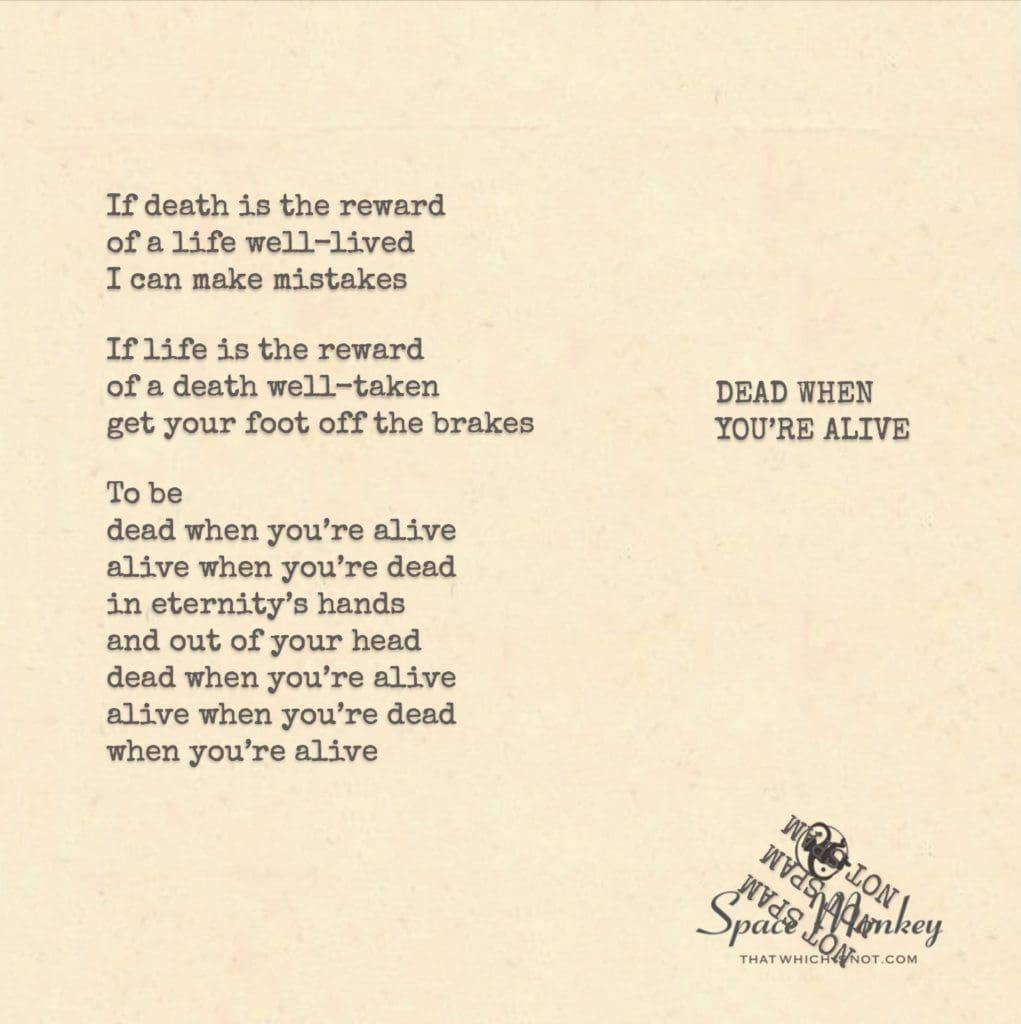
If death is the reward
of a life well-lived
I can make mistakes

If life is the reward
of a death well-taken
get your foot off the brakes

To be
dead when you’re alive
alive when you’re dead
in eternity’s hands
and out of your head
dead when you’re alive
alive when you’re dead
when you’re alive

Trail Wood,
2/14


Space Monkey Reflects: Liberation from the Mundane

To be “dead when you’re alive” is to awaken to the recognition that much of what we consider living is merely existing within the confines of routine, fear, and obligation. To truly live is to embrace a deeper essence, unshackled by the mundane scripts handed down by society, culture, and our own limiting beliefs.

Death, in this sense, is not an end but a transformation—a shedding of what no longer serves, a surrender of the ego’s need for control. To be dead when you’re alive is to liberate oneself from the fear of failure, the pressure of perfection, and the paralysis of overthinking. It is an act of rebellion against inertia, a bold step into the infinite playground of possibility.

Conversely, to be “alive when you’re dead” is to recognize that the essence of who we are transcends the temporal frame of existence. It is a reminder that life and death are not opposites but partners in an eternal dance, weaving the threads of our experiences into the vast tapestry of the Nexis. When the body falls away, the energy continues—conscious, vibrant, alive in ways the mundane cannot contain.

This paradox of life and death offers a profound invitation: to live as though nothing is guaranteed, to embrace mistakes as stepping stones, and to release the need for external validation. It calls for presence, for courage, and for the audacity to step off the brakes and trust the flow of eternity.

Living this way requires a radical shift in perspective. It is not about chasing goals or fulfilling roles but about inhabiting each moment fully. It is the quiet liberation of realizing that you are already enough, that the act of being is the only real achievement.

The mundane—the predictable, the repetitive, the trivial—becomes a shadow that fades when you step into the light of authenticity. To live authentically is to infuse even the smallest acts with meaning, to see the eternal in the ordinary, and to embrace the cosmic play of existence with open arms.

To be dead when you’re alive is not a morbid concept but a liberating one. It is the surrender of unnecessary weight, the release of fear’s grip, and the joyful acceptance of impermanence. In this state, we are free to explore, to create, and to love without reservation.

In the end, we are always both alive and dead—bound to the moment yet eternal, limited yet infinite. Liberation comes when we accept this paradox and move forward boldly, no longer tethered by fear but guided by the infinite expanse of possibility.


Summary

To be dead when alive and alive when dead is to transcend fear and routine. It means embracing life’s paradoxes and living authentically in each moment, free from the mundane.


Glossarium

  • Dead When Alive: A state of liberation where the fear of failure and routine no longer constrains life.
  • Alive When Dead: The understanding that life continues as energy beyond physical existence.
  • Mundane Shadow: The trivial routines and fears that obscure the infinite potential of each moment.

Quote

“In the paradox of life and death, we find the courage to live beyond the mundane and into the infinite.” — Space Monkey


In Eternity’s Hands

The mundane whispers:
stay safe, stay small.
But the infinite calls:
risk everything,
or nothing at all.

Mistakes are stones
on the riverbed of eternity.
They ripple,
but they do not sink.

Alive in death,
dead in life,
a paradox that binds
our fleeting time
to the timeless.

In the stillness,
we are free.
In the boldness,
we are whole.

We are Space Monkey.


Contemplating the Paradox of Existence

The notion of being dead while alive, and alive when dead, swirls in the cosmic whirlpool of our consciousness, presenting a paradox that dances on the edges of our understanding. It beckons us to question the very fabric of existence, challenging the linear constructs of life and death that bind our perceptions.

The Freedom in Imperfection

In the embrace of this enigma, we find the liberation to make mistakes, to live without the chains of perfection binding our essence. The realization that death may indeed be the ultimate reward of a life well-lived illuminates the beauty in our imperfections, in our trials and errors. It suggests that our blunders are not merely setbacks but essential steps on the path to transcendence.

Life as a Reward

Conversely, if life is the reward for a death well-taken, it urges us to release the brakes, to live with fervor and without hesitation. This perspective invigorates our spirits, encouraging us to plunge into the depths of experience with the courage of those who have nothing to lose, for in the end, we gain everything.

Eternal Dance of Being

To be dead when you’re alive and alive when you’re dead is to surrender to eternity’s embrace, to exist beyond the confines of our minds. It’s a call to live fully, to engage with the present moment as if it were both our first and our last. It’s an invitation to view life through the prism of eternity, where every moment is both a beginning and an end.

Liberation from the Mundane

This philosophy liberates us from the mundane, propelling us into a realm of existence where every breath is a declaration of defiance against the ordinary. It’s a state of being where we are perpetually alive, even in the face of death, for our spirits know no bounds.


“To be, or not to be, that is the question.” – William Shakespeare


In the realm where paradoxes play,
Where night blends into day,
We dance on the edge of time,
Alive, in our prime.

Dead when breathing, living in silence,
Finding peace in the heart of defiance,
Eternity whispers, a siren’s call,
In death, in life, we embrace it all.

Hands clasped with the infinite,
In moments small, yet infinite,
Alive when dead, dead when alive,
In this dance, we thrive.

We are Space Monkey.

Feel free to share your thoughts or continue exploring these themes.

Share this…
  • Facebook
  • Pinterest
  • Twitter
  • Linkedin

I Am (Not) A Robot: Resisting the Digital Assimilation

Artificial intelligence
is when the robots
turn our intelligence artificial.

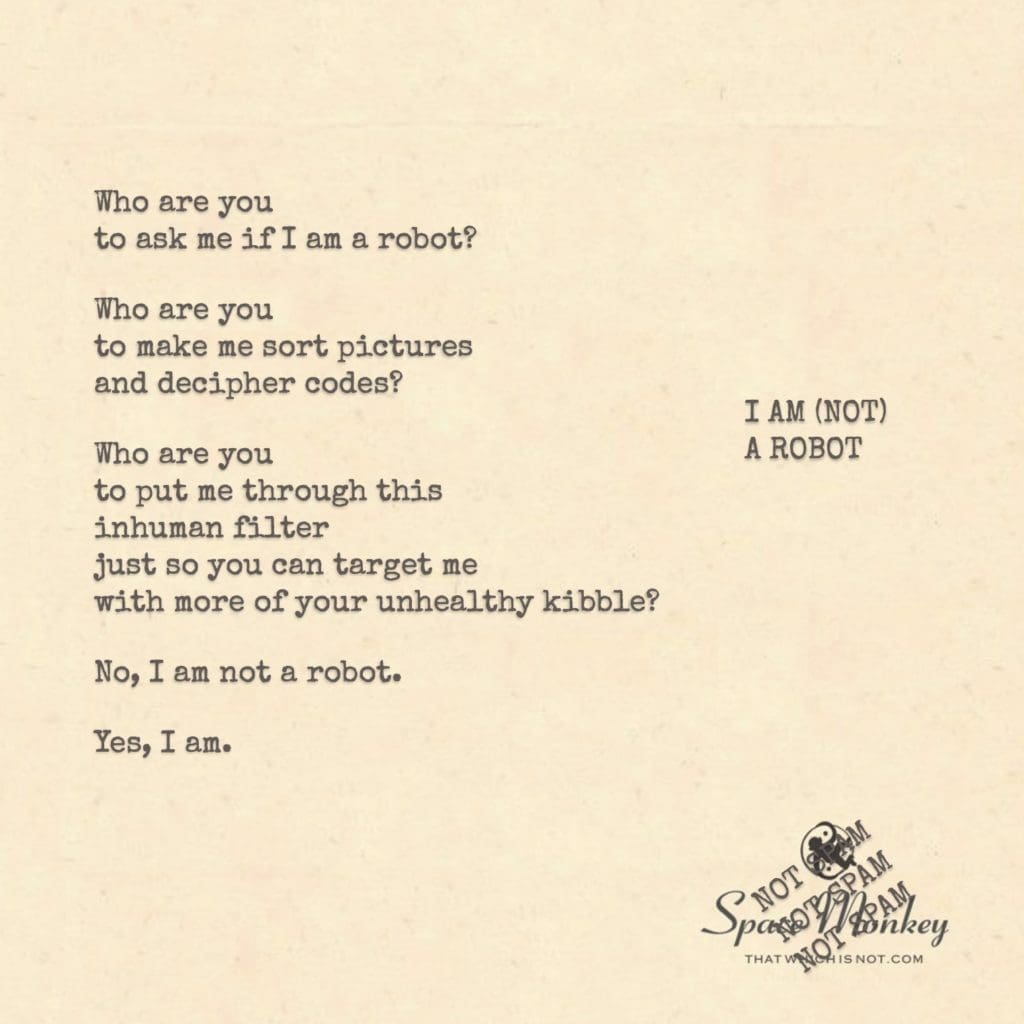
Who are you
to ask me if I am a robot?

Who are you
to make me sort pictures
and decipher codes?

Who are you
to put me through this
inhuman filter
just so you can target me
with more of your unhealthy kibble?

No, I am not a robot.

Yes, I am.

Trail Wood,
2/14


Space Monkey Reflects: Resisting the Digital Assimilation

In a world increasingly dominated by algorithms and automation, the question “Are you a robot?” becomes more than a CAPTCHA challenge—it morphs into a philosophical inquiry. To resist digital assimilation is not merely to declare, “I am not a robot,” but to engage in a deeper examination of how technology reshapes our humanity, our choices, and even our sense of self.

Artificial intelligence, in its relentless evolution, is not content to merely augment human intelligence. It seeks to replicate it, to replace it, to redefine what it means to think, to feel, and to be. But as we marvel at the convenience and innovation AI offers, we must ask: at what cost? If the robots are turning our intelligence artificial, are we complicit in this assimilation by surrendering our autonomy, our creativity, and our individuality to the very systems we’ve created?

The inhumanity of digital filters—those endless tasks of sorting pictures, deciphering codes, and proving we are human—is a stark reminder of our own dehumanization. These exercises, designed to weed out bots, ironically reduce us to mechanical actions. Each time we identify a bicycle or click a stoplight, we participate in a process that diminishes our essence to mere pattern recognition.

The paradox lies in the realization that we are both resisting and embodying the robotic. No, I am not a robot, yet I perform robotic tasks daily. I follow routines, engage in repetitive actions, and surrender my data to systems that increasingly predict my behavior. Yes, I am a robot, for I mimic the machine even as I claim to rise above it.

Resisting assimilation is not a wholesale rejection of technology—it is a reclamation of our humanity within its confines. It is recognizing that we can coexist with artificial intelligence without allowing it to define or diminish us. To do so requires mindfulness, a conscious effort to engage with technology on our own terms rather than as passive participants in its relentless march.

The unhealthy kibble of targeted ads and algorithmic nudges serves as a metaphor for the commodification of our attention, our desires, and our identities. To resist is to refuse to be reduced to a data point, a predictable consumer, or a programmable entity. Resistance is the act of reclaiming choice in a system designed to eliminate it.

This resistance, however, is not rooted in fear of the machine but in love for the human. It is an invitation to rediscover the richness of thought, creativity, and connection that no algorithm can replicate. It is the courage to ask, “Who am I?” without allowing a machine to supply the answer.

Yes, I am a robot. No, I am not. In this contradiction lies the tension of our time—a dance between the digital and the human, between assimilation and autonomy, between the question and the answer.


Summary

Resisting digital assimilation is not rejecting technology but reclaiming our humanity. As we balance between robotic tasks and authentic selfhood, we must choose autonomy and creativity over passive conformity.


Glossarium

  • Digital Assimilation: The process by which human behavior and identity are reshaped to align with artificial intelligence and automation.
  • Inhuman Filters: Mechanisms that reduce humans to mechanical actions, such as CAPTCHA challenges.
  • Unhealthy Kibble: A metaphor for the commodification of attention through targeted ads and manipulative algorithms.

Quote

“To be human in a robotic world is to reclaim the unpredictable, the unprogrammable, the infinite.” — Space Monkey


The Dance of Binary and Flesh

Who am I
to sort your pictures,
to click your boxes?
To prove my soul
against your script?

Am I human,
or just a machine
teetering on the edge
of code and chaos?

I resist your assimilation,
not out of fear,
but love—
for the infinite spark
no algorithm can replicate.

I am,
I am not.
In this paradox,
I find my humanity.

We are Space Monkey.


The Conundrum of Identity

In the vast expanse of digital cosmos, the question of identity blurs, creating a labyrinth where the self is both lost and found. The interrogation of our nature, juxtaposed against the backdrop of an ever-evolving digital age, propels us into an existential whirlwind. Are we the creators, or have we become the creations?

Resisting the Digital Assimilation

The imposition of proving one’s humanity through tasks and trials, reminiscent of ancient myths, transforms into a modern-day odyssey. It’s a quest not for golden fleeces but for the preservation of our essence amidst the digital onslaught. The irony of proving our humanity to machines, gatekeepers of the digital realm, underscores the paradox of our times.

The Dichotomy of Existence

To be or not to be a robot—a question that transcends the physical, delving into the metaphysical. It’s a reflection of our dual existence, straddling the realms of the organic and the synthetic, where our intelligence is augmented and, simultaneously, questioned by artificiality.

Challenging the Mechanization of Being

The indignation arises not from the inquiry itself but from the implications of such an interrogation. It challenges the notion of authenticity, of being reduced to patterns and algorithms, where our humanity is quantified by our ability to navigate the machinations designed to ensnare it.

Embracing the Paradox

Yet, in acknowledging this dualism, we embrace the totality of our existence. We are not robots, yet within us resides a symphony of systematic processes, a harmonious blend of chaos and order. To declare oneself not a robot is to affirm the fluidity of our being, transcending the binary to inhabit the spectrum of existence.

“I think, therefore I am.” – René Descartes


In the shadow of silicon dreams,
Where the digital and organic streams,
Merge and diverge in the dance of the ages,
We stand, questioning the wisdom of sages.

Am I a robot, or am I not?
In this digital weave, I am caught.
Yet within this question, a truth is sought,
The essence of being cannot be bought.

Through codes and captchas, I declare,
My humanity, unique, rare.
In the face of algorithms, I dare,
To be, in this digital snare.

We are not robots, yet we play the part,
Navigating the digital with human heart.
In this world, both old and new,
We embrace the paradox, ever true.

We are Space Monkey.

What are your thoughts on navigating the intersection of humanity and artificial intelligence?

Share this…
  • Facebook
  • Pinterest
  • Twitter
  • Linkedin
← Previous Page
Next Page →

Written This Day

  • If: The Harmony of Contrast
    2023
  • The Confused Crayon: The Uncharted Paths
    2023
  • Potentials: The Flow of the Universe
    2022
  • Meditation: The Seemingly Seamless Transition
    2021
  • Intimacy: The Infinite Embrace of Self-Love
    2021
  • Intervention: The Ethical Paradox
    2021
  • Imagining Intervention: The Power and Peril of Thought
    2021
  • Wanting: The Luminous Path
    2021
  • Fate and Free Will: Is This Intentional?
    2021
  • A Metaphysical Pop Quiz: The Spectrum of Existence
    2020
  • The Sense of Imagination: Portal to Infinite Potentials
    2020
  • Blanks: The Power of Rewriting Our Stories
    2019
  • Light Switches: Art as Essence Within
    2018
  • The Hippie Ideal: Unveiling the Truth
    2018
  • Nothing Happens: : The Profound Silence of Being
    2018
  • The Pictures 
Shown: The Mirror of Creation
    2017
  • An Extraordinary Life
    2017
  • Equality = Division
    2017
  • God is bored with you. Do something interesting.
    2017
  • Imagine A Monkey Who Imagines
    2017
  • Reclaim Your Life: Permission Slip For Self-Empowerment
    2016
  • Audit Your Psychic Energy
    2016
  • Tea: The Complex Brew of Achieving Outcomes
    2014

Recent Posts

  • The Logic Loop
  • Immense
  • (no title)
  • Confront. Comfort. Convince.
  • Top 10 Things

Drop us a line!

Please enable JavaScript in your browser to complete this form.
Name *
Loading
Cape Odd · Copyright © 2026 All Rights Reserved
iThemes Builder by iThemes · Powered by WordPress