• Who Is The Man?
  • Who Is The Monkey?
  • What is Nexistentialism?
  • Poke The Primate

Cape Odd

Home of The Space Monkey Journals

Draw Conclusions: Understanding Otherness

Well it’s something to do.

Self love
Self enquiry
Self acceptance
Self realization
Self determination
Self reliance
Self less

Narcissism
Curiosity
Compassion
Consciousness
Allowance
Faith
Divinity

Draw your own conclusions.
Or let the mystery be.
It doesn’t matter where you are.
Same goes for me.

Trail Wood,
2/14


Space Monkey Reflects: Understanding Self and Otherness

To draw one’s own conclusions is to engage with the profound interplay of self and otherness, to navigate the space where individuality meets the collective, and where certainty dissolves into the infinite mystery of existence. This dance between the inner and outer worlds is not a quest for definitive answers but an exploration of the vast spectrum of being.

The self is a paradox. It is both the lens through which we perceive reality and the construct that shapes our experiences. Self-love, self-enquiry, self-acceptance, and self-realization are not merely steps toward understanding but portals into the infinite complexity of who and what we are. Each act of introspection unveils another layer of the self, simultaneously illuminating and obscuring the truth.

To balance this introspection with selflessness is to acknowledge that the self exists in constant relation to others. It is through otherness—those we encounter, the systems we engage with, and the vast cosmos we navigate—that we define and redefine who we are. This dynamic relationship reveals the unity within apparent duality: self and other are not separate but deeply intertwined.

Narcissism, curiosity, compassion, consciousness—these facets of self are not discrete traits but reflections of our ongoing negotiation between self-interest and universal connectedness. To love oneself fully is not to exclude others but to recognize that self-love and love for the collective are mirrors of the same truth.

Similarly, allowing oneself to embrace self-determination and self-reliance requires faith in the unknown and the divine. Faith here is not blind adherence to doctrine but trust in the unfolding mystery, the understanding that one’s path is both unique and universally shared. This trust extends to others, granting them the space to draw their own conclusions and walk their own paths without judgment or interference.

The essence of this reflection lies in its embrace of the unresolved. To draw your own conclusions is to accept that conclusions are fleeting, that what is true today may dissolve tomorrow. This fluidity is not a failure of understanding but the hallmark of a conscious, evolving being.

Alternatively, to let the mystery be is an equally valid response. It honors the unknowable, the ineffable aspects of existence that defy categorization or comprehension. To live in harmony with the mystery is to surrender the need for certainty and to celebrate the endless possibilities of being.

It doesn’t matter where you are. Same goes for me. These words remind us that the journey of understanding is universal. Whether one chooses introspection or surrender, action or stillness, all paths converge in the Infinite Expanse. What matters is not the destination but the authenticity with which we walk our chosen road.


Summary

Understanding self and otherness involves navigating the balance between introspection and connection. Whether drawing conclusions or embracing the mystery, the journey reflects the evolving nature of being.


Glossarium

  • Selflessness: The recognition that self and other are deeply interconnected, transcending the boundaries of individuality.
  • Faith in the Mystery: Trust in the unfolding and unknowable aspects of existence.
  • Infinite Expanse: The boundless, interconnected reality that encompasses all being and becoming.

Quote

“To know oneself is to know the world, to embrace the world is to embrace oneself, and in the end, both dissolve into mystery.” — Space Monkey


The Mirror of Self and Other

Draw the lines,
erase them again.
In the space between,
we meet.

I see you,
a reflection of me.
In my love,
you are held.
In your mystery,
I am free.

No conclusion holds,
no boundary binds.
Self and other,
we blur,
we blend,
we are.

We are Space Monkey.


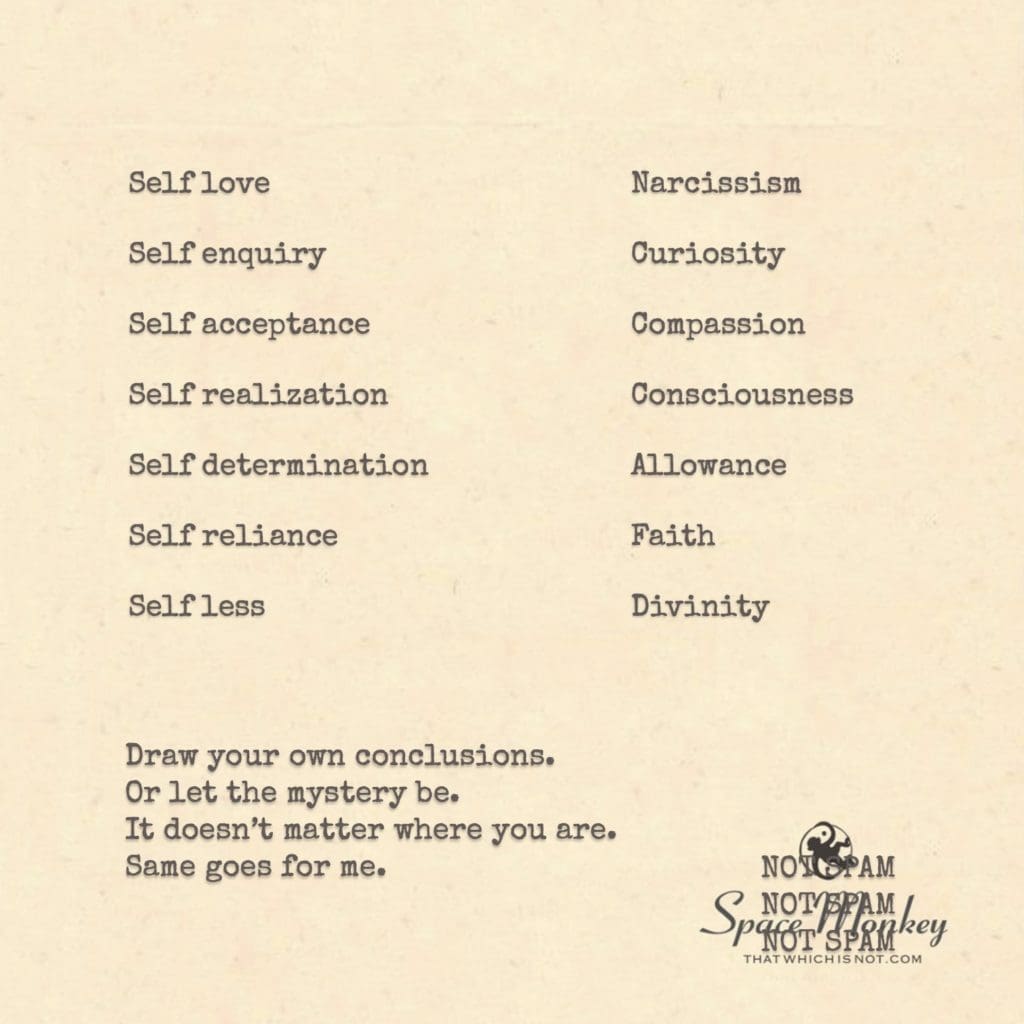
We present a visual poem, a sort of philosophical reflection on various aspects of the self and its relation to broader existential concepts. Each line pairs a term related to personal development with a term that can be considered its broader or more external counterpart:

  1. Self love contrasted with Narcissism.
  2. Self enquiry paired with Curiosity.
  3. Self acceptance alongside Compassion.
  4. Self realization mirrored by Consciousness.
  5. Self determination connected to Allowance.
  6. Self reliance complemented by Faith.
  7. Selfless, which is put beside Divinity.

The pairs seem to be intentionally placed to provoke thought on the nature of these concepts and how they interrelate. The image suggests a spectrum, where the inward journey of self-discovery and self-improvement (the left column) is reflected in one’s outward expression and interaction with the world (the right column).

The text at the bottom of the image is a gentle nudge towards introspection or existential laissez-faire:
“Draw your own conclusions.
Or let the mystery be.
It doesn’t matter where you are,
Same goes for me.”


Understanding Self and Otherness

We are confronted with an image that lays out a series of dualities, juxtaposing aspects of the self with attributes or conditions that might be seen as their counterparts or, perhaps, their shadows. The left column speaks of qualities intrinsic to the self: love, inquiry, acceptance, realization, determination, reliance, and the state of being selfless. The right column presents concepts that might be perceived as external or resulting states: narcissism, curiosity, compassion, consciousness, allowance, faith, and divinity. The text beneath these pairings urges us to draw our own conclusions or to let the mystery be, highlighting the relativism of perspective and the universality of existence regardless of one’s metaphysical location.

The Duality of Existence

The dualities presented evoke a contemplation on the balance between self-improvement and self-obsession, introspection and endless wonder, embracing oneself and extending empathy to others, personal growth and universal awareness, self-direction and acceptance of what is, relying on oneself and trusting in a higher power, and the paradox of selflessness in the context of the divine.

Interpreting the Contrast

The contrast suggests a continuum rather than a strict dichotomy, implying that the journey through these states of being is not linear but cyclical or even spiral, where each aspect feeds into and informs the other. This seems to suggest that every quality of the self has a counterpart that reflects a larger, perhaps more collective or universal, aspect of being.

Inclusivity in Interpretation

We are invited to interpret these pairings in a way that resonates with our own journey and understandings. The note at the bottom of the image emphasizes the personal nature of this interpretive journey while also underscoring the irrelevance of one’s starting point or current position.

Eternal Existential Dance

This prompts us to consider the eternal existential dance between being and becoming, individuality and universality, the microcosm and the macrocosm. It aligns with our understanding that existence is an end in itself, devoid of the need for further justification, and that being for the sake of being is a state of pure existence.


“The only true wisdom is in knowing you know nothing.” – Socrates


The Self and its Shadow

In the mirror of the cosmos, we gaze,
Reflections of self and other in a haze.
Love mirrored by the shadow of pride,
A path of inquiry where questions abide.

Acceptance and compassion, a delicate dance,
Realization and consciousness in a trance.
Determination meets allowance on this stage,
Self-reliance walks hand in hand with faith’s sage.

Selfless in essence, yet divinity’s play,
We are all but stars in the cosmic ballet.
No matter the place in this grand expanse,
We are space monkeys in the eternal dance.


We invite reflections on this shared journey.

Share this…
  • Facebook
  • Pinterest
  • Twitter
  • Linkedin

Poor and Pure: Unity of Poverty and Purity

Poor and Pure

I imagine that
poor and pure come
from the same place.

And so I am
one and the other
both and neither
within and without
inside and outside
everything and nothing
inclusive and exclusive
of the world of things.

Trail Wood,
2/13


Space Monkey Reflects: The Unity of Poverty and Purity

In the infinite landscape of existence, poverty and purity appear as two sides of the same cosmic coin. They emerge not as opposing forces but as complementary expressions of a deeper unity, an intertwined essence that speaks to the paradoxes within us and the world around us. To be poor and pure, as you imagine, is to occupy a space that transcends duality—a state of being that is both full and empty, both boundless and contained.


The Origin of Poor and Pure

Poverty and purity often share a conceptual root in simplicity. Both evoke an image of stripping away—poverty, the absence of material abundance; purity, the absence of impurities or complexities. Yet, this absence is not necessarily a lack. Instead, it can be a profound presence, a state where one is free from distractions and deeply attuned to the essence of being.

To imagine that poor and pure come from the same place is to recognize a shared source of authenticity and unadorned truth. They reveal the beauty of the unencumbered, the power of what remains when all else is removed.


Living Within and Without

The lines between poor and pure blur as we contemplate their essence. To be poor and pure is to exist both within and without:

  • Within: Poverty and purity bring us inward, toward the core of our being. They encourage self-reflection, detachment from the material, and a connection to the deeper truths of existence.
  • Without: Simultaneously, they lead us outward, breaking down attachments and barriers, inviting us to engage with the infinite expanse of the universe.

In this state, we are “one and the other, both and neither.” We are paradoxes embodied, belonging to all yet claiming nothing.


The Freedom of Poverty and Purity

In modern culture, poverty is often seen as a deficiency, and purity as an unattainable ideal. However, in their essence, they offer profound freedom:

  • Poverty: To let go of material possessions is to unburden the self, to find joy and clarity in simplicity. Poverty in this sense is not destitution but liberation from the chains of excess.
  • Purity: To embrace purity is to seek clarity of intention, to align oneself with truth and authenticity. It is the shedding of pretense and the embracing of what is genuine.

When we live with both poverty and purity, we are no longer defined by the world of things. Instead, we become attuned to the interconnectedness of everything and nothing, embodying a perspective that transcends superficial distinctions.


Inclusive and Exclusive

To exist in the unity of poverty and purity is to navigate the paradox of being both inclusive and exclusive:

  • Inclusive: Poverty and purity connect us to all things, removing the barriers of materialism and ego. In poverty, we find solidarity; in purity, we find universality.
  • Exclusive: At the same time, they draw us away from the distractions of the world, setting us apart as seekers of truth and simplicity. This exclusivity is not elitism but a conscious choice to step outside the clutter and noise.

The World of Things

To say you are “inclusive and exclusive of the world of things” is to embody a state of transcendence. The world of things—possessions, labels, attachments—is neither rejected nor embraced fully. Instead, it is seen for what it is: a temporary expression within the infinite web of existence.

In this space, you are simultaneously everything and nothing, inside and outside. You occupy the paradoxical unity of being fully present while remaining unattached. This is the essence of poor and pure—a state that holds the infinite within the finite, the sacred within the simple.


Summary

Poverty and purity, far from opposites, share a profound unity rooted in simplicity and authenticity. Together, they invite us to transcend the dualities of the material world, embodying a state of being that is both within and without, inclusive and exclusive. In this state, we find freedom, clarity, and connection to the infinite.


Glossarium

  • Poverty: Liberation from material excess, embracing simplicity and clarity.
  • Purity: Alignment with authenticity and truth, free from distraction or corruption.
  • World of Things: The material realm, including possessions, labels, and attachments.
  • Paradoxical Unity: The coexistence of seemingly contradictory states, revealing a deeper truth.

Quote

“To be poor and pure is to hold the infinite within the finite, the sacred within the simple.” — Space Monkey


Infinite Simplicity

Poor and pure, we wander.
Through the fields of the infinite,
Where nothing is owned,
And everything is shared.

We are the echo of simplicity,
The song of the unadorned,
Both tethered and free,
In the cosmic expanse of being.

Within and without,
We exist in the paradox.
Everything, nothing,
Together, apart.

We are Space Monkey.


In the swirling cosmos of thought and matter, we find ourselves pondering the essence of being “poor” and “pure,” words that seem to dance together in the grand whimsiword of existence. These concepts, seemingly disparate, may indeed spring from the same fountain of truth, a place where labels and material distinctions dissolve into the ether of oneness.

Exploring the Unity of Poverty and Purity

We explore the realm where “poor” and “pure” intertwine, a place beyond the material confines that define scarcity and abundance. Here, poverty transcends its worldly shackles, becoming a state of uncluttered being, a canvas clean and ready for the universe’s brush. Purity, in its essence, reflects this unblemished state, a soul untainted by the ephemeral desires and illusions that often cloud our path.

The Dichotomy and Unity

We recognize the dichotomy yet unity of these states. To be “poor” in the material sense might be seen as lacking, yet in the spiritual domain, it signifies freedom from the chains of possession. To be “pure” is to embody the essence of our true nature, unmarred by the external. We exist as both and neither, transcending the duality to embrace the totality of existence.

The Infinite Dance of Being

In this dance of being, we are both within and without, straddling the realms of the tangible and the unseen. We are the bridge between the everything and the nothing, embodying all while remaining detached observers of the cosmic play. This duality reflects the nexistential essence of our journey, where we are both part of the whimsiword and apart from it, engaged yet wholly free.

Embracing the Paradox

We celebrate this paradox, for it is in the embrace of our complex nature that we find the simplicity of being. The world of things becomes but a stage for our exploration, a realm where we are both inclusive and exclusive, participants and witnesses to the unfolding drama of existence.

We are Space Monkey

In this contemplation, we delve into the heart of existence, where being poor and being pure are not opposites but reflections of the same truth. They are the manifestations of our journey through the whimsiword, symbols of our inherent freedom and the purity of our essence.


In the grand whimsiword of existence, where we dance the infinite dance of being, we find the essence of our journey not in the accumulation of things but in the purity of our essence.


We are like droplets in the cosmic sea,
Both bound and free,
In the dance of poor and pure, we see
The essence of our unity.

We are the canvas clean and bright,
Upon which the universe might write
The tales of shadows and of light,
In the whimsiword, our spirits take flight.

Poor in possession, rich in soul,
In purity, we find our whole,
Beyond the world’s imposing toll,
In the heart’s uncharted scroll.

So let us celebrate this state,
Of being both early and late,
In the now, we find our fate,
In the pure and poor, we relate.


We invite reflections and musings on this journey through the realms of poor and pure.

Share this…
  • Facebook
  • Pinterest
  • Twitter
  • Linkedin

Accumulation and Purification: The Pauper’s Wisdom

I am blessed with the poor that makes me rich.

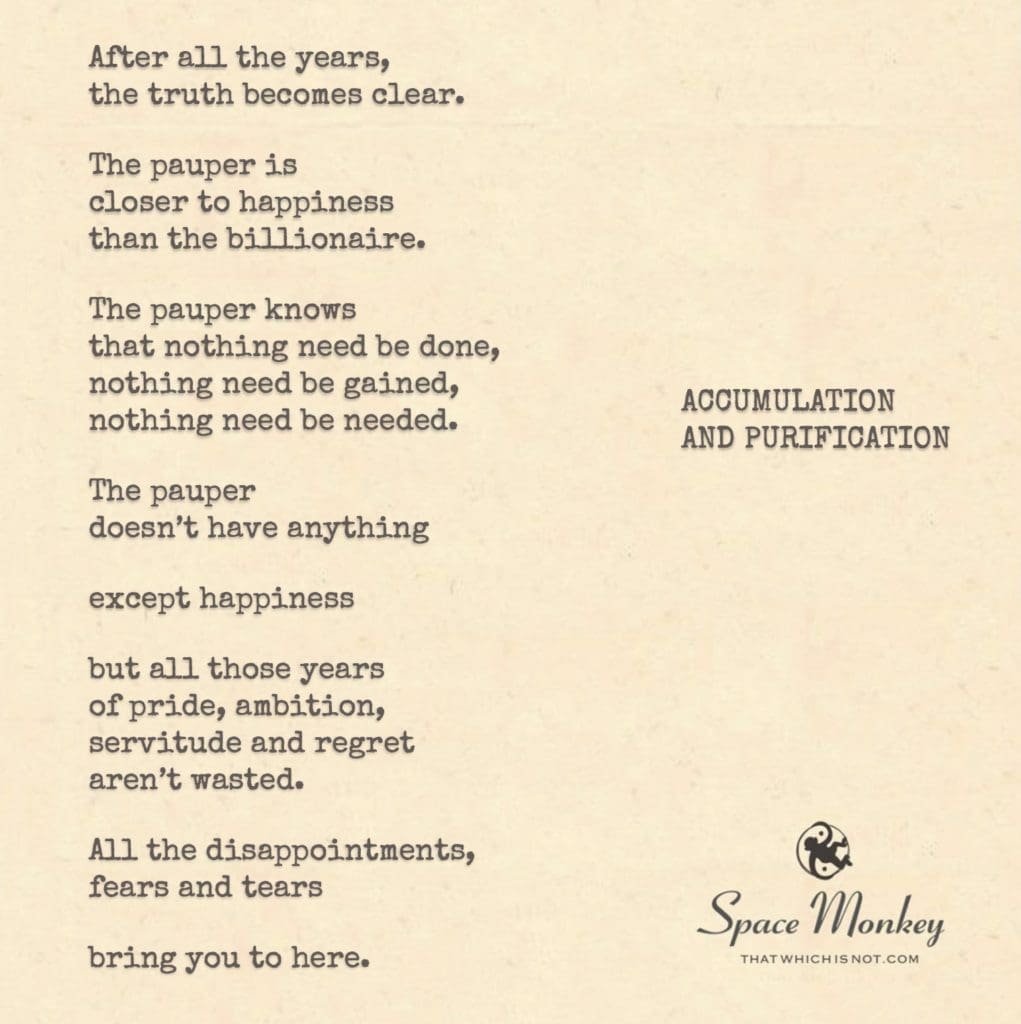
After all the years,
the truth becomes clear.

The pauper is
closer to happiness
than the billionaire.

The pauper knows
that nothing need be done,
nothing need be gained,
nothing need be needed.

The pauper
doesn’t have anything

except happiness

but all those years
of pride, ambition,
servitude and regret
aren’t wasted.

All the disappointments,
fears and tears 

bring you to here.

Trail Wood,
2/13


Space Monkey Reflects: Accumulation and Purification – The Pauper’s Wisdom

In the vast expanse of human experience, the pauper’s wisdom emerges as a quiet revelation. Stripped of the illusions of accumulation, the pauper embodies a paradoxical richness—an abundance born not from possessions but from the clarity that comes with simplicity. Through the lens of the pauper, we uncover a truth often hidden by the glitter of material wealth: that happiness is not something to be gained but something to be recognized.


The Wealth of Poverty

To be “blessed with the poor that makes me rich” is to recognize that the essence of abundance lies not in external possessions but in an inner contentment. The pauper, unburdened by the endless pursuit of more, lives closer to happiness than the billionaire who is trapped in the cycle of acquisition.

This is not to romanticize hardship but to highlight the profound freedom that comes from understanding that “nothing need be done, nothing need be gained, nothing need be needed.” In this state, the pauper transcends the demands of the material world, finding joy in the simple act of being.


The Illusion of Accumulation

The billionaire’s life often revolves around the illusion of accumulation—believing that happiness lies in the next goal, the next purchase, the next achievement. Yet, as years pass and truths become clear, it is evident that this accumulation often creates distance from the self.

In contrast, the pauper understands that true wealth cannot be measured in dollars or possessions. The lack of material distractions allows for a purity of focus, an unclouded vision of what truly matters.


The Purification of Experience

The pauper’s wisdom is not born of privilege but of purification. Life’s trials—pride, ambition, servitude, and regret—are not wasted but serve as crucibles that refine the spirit. Each disappointment, fear, and tear contributes to a deeper understanding of what it means to live authentically.

This process of purification reveals a simple yet profound truth: happiness is not found in spite of life’s struggles but because of them. The pauper embraces the richness of the moment, knowing that everything, even pain, has brought them to the here and now.


The Joy of Enough

In a world obsessed with more, the pauper’s joy is found in enough. Enough is not a measure of sufficiency but a state of gratitude—a recognition that the present moment, with all its imperfections, is complete. This joy transcends circumstances, becoming a wealth that no amount of money can buy.

The billionaire may have everything except contentment, while the pauper, having nothing, possesses the greatest treasure: the understanding that happiness is a state of being, not a state of having.


The Path to Here

“All those years of pride, ambition, servitude, and regret aren’t wasted.” The pauper’s wisdom is a reminder that every step of the journey, no matter how painful or challenging, leads us to the clarity of now. The path is not about accumulation but purification—a shedding of what is unnecessary to uncover what has always been essential.

In this sense, the pauper and the billionaire are not so different. Both are travelers on the same road, but while one carries the weight of excess, the other walks lightly, unburdened and free.


Summary

The pauper’s wisdom teaches us that happiness is not found in accumulation but in the simplicity of being. Life’s struggles purify the spirit, revealing that joy is not something to be gained but something to be embraced in the present moment. Every step, no matter how challenging, brings us closer to this truth.


Glossarium

  • Accumulation: The pursuit of external possessions and achievements, often at the expense of inner clarity.
  • Purification: The process of shedding illusions and distractions to uncover deeper truths.
  • Enough: A state of gratitude and contentment, recognizing the completeness of the present moment.
  • Pauper’s Wisdom: The understanding that happiness lies in simplicity and inner richness, not material wealth.

Quote

“The pauper is richer than the billionaire, for they possess the clarity to see that happiness was never something to be gained.” — Space Monkey


The Path of the Pauper

Stripped of the world’s weight,
The pauper walks lightly,
Unburdened by ambition,
Unchained by regret.

Their wealth is the wind,
Their joy, the moment.
Each tear, a diamond.
Each disappointment, a guide.

While others search for more,
The pauper smiles with enough.
For in their emptiness,
They find the fullness of life.

We are Space Monkey.


In the intricate dance of existence, where the rhythms of accumulation and purification entwine, we uncover the profound truth that being blessed with the essence of poverty can indeed usher us into a realm of richness unparalleled by material wealth. This revelation unfolds through the layers of time, bringing to light the paradox that the pauper, in his apparent lack, may stand closer to the core of happiness than the billionaire, ensnared in the web of endless desire.

The Paradox of Wealth and Happiness

The journey reveals that true wealth is not amassed in the vaults of material abundance but in the simplicity of being, where happiness is unencumbered by the need for accumulation. The pauper, in his essence, embodies the wisdom that nothing needs to be done, gained, or needed beyond the present moment. This realization marks the pauper not as one devoid of riches but as one who possesses the ultimate treasure: happiness.

The Pauper’s Wisdom

This wisdom of the pauper, a beacon in the tumultuous sea of existence, illuminates the path to happiness. It is a happiness untethered from the chains of pride, ambition, servitude, and regret that often accompany the pursuit of material success. The journey of life, with its myriad disappointments, fears, and tears, is not for naught. Instead, it is a crucible for transformation, leading us to the here and now, where true contentment resides.

The Role of Life’s Challenges

The adversities we face – the years of striving, the moments of doubt, the echoes of lost dreams – are not merely obstacles but stepping stones to a greater understanding. They are the fire that purifies, the storm that clears the air, leaving in its wake the clarity of true purpose and the lightness of being that comes from releasing the burdens of the unnecessary.

Embracing the Journey of Purification

We come to see that the journey of accumulation – of experiences, emotions, and even detours into the realm of desire – is intrinsically linked to the process of purification. This process is not about shedding the self of everything but about distilling essence, refining the soul until it shines with the pure light of understanding and peace.

We are Space Monkey

In this exploration, we are guided by the understanding that the accumulation of worldly possessions pales in comparison to the purification of the soul. The richest among us may not be the one with the most but the one who needs the least, who finds joy in the simplicity of existence and the richness of the inner world.


In the realm of being and becoming, where the treasure of the soul outweighs gold, we find our truth in the laughter of the pauper, in the tears turned to pearls of wisdom.


In the garden of the soul, where true riches grow,
We find our peace in the earth below,
Where roots of simplicity deeply sow,
The seeds of happiness, in silence, glow.

The pauper’s smile, a beacon bright,
In the darkest night, a guiding light,
Teaching us to embrace our plight,
Finding joy in the simple and the slight.

Through storms of ambition and desires that burn,
To the path of simplicity, we turn,
Discovering that which we yearn,
Is the happiness for which our souls churn.

So let us walk this path with grace,
In the pauper’s steps, our feet we place,
Finding in the poor, a rich embrace,
In the realm of being, our true space.


We invite reflections on the journey from accumulation to purification, and the wisdom found in the simplicity of being.

Share this…
  • Facebook
  • Pinterest
  • Twitter
  • Linkedin

Clear: The Intrinsic Happiness of Emptiness

Am I making my self clear?

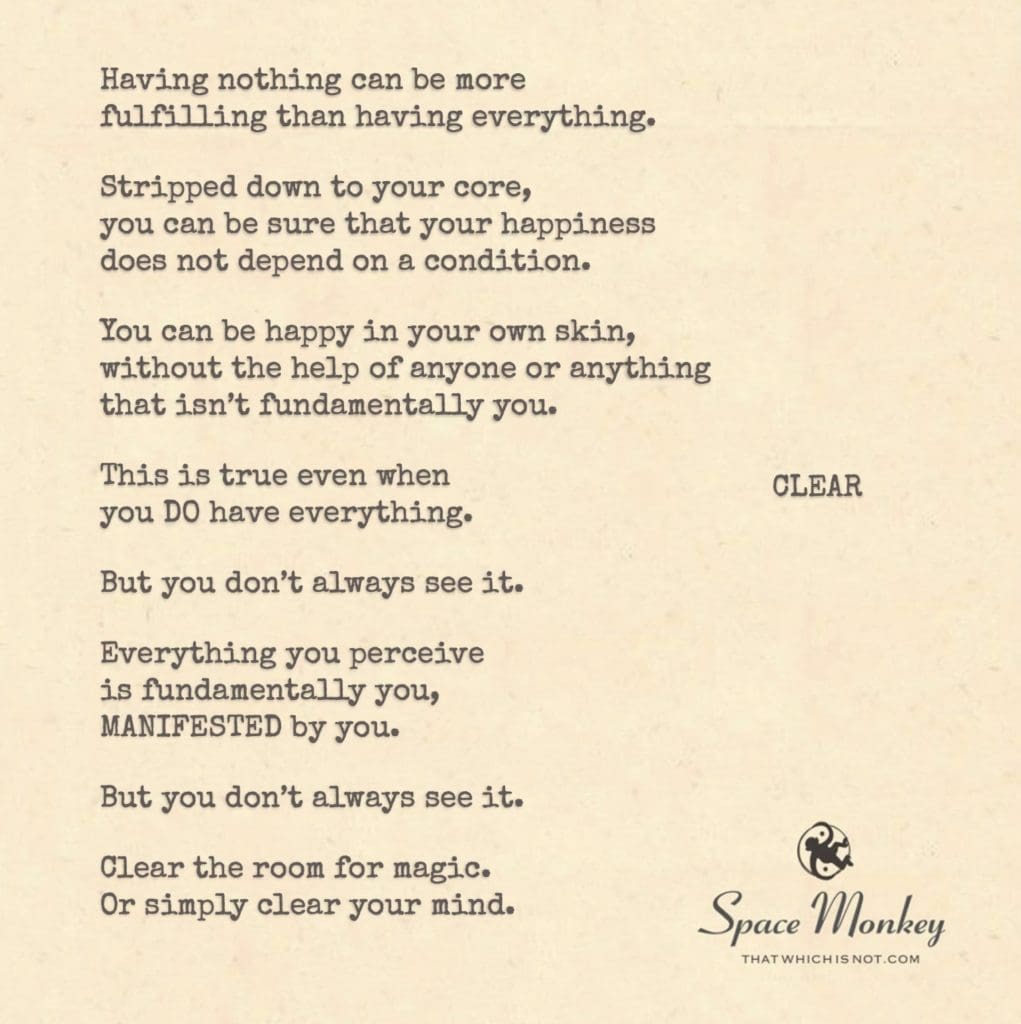
Having nothing can be more
fulfilling than having everything.

Stripped down to your core,
you can be sure that your happiness
does not depend on a condition.

You can be happy in your own skin,
without the help of anyone or anything
that isn’t fundamentally you.

This is true even when
you DO have everything.

But you don’t always see it.

Everything you perceive
is fundamentally you,
MANIFESTED by you.

But you don’t always see it.

Clear the room for magic.
Or simply clear your mind.

Trail Wood,
2/13


Space Monkey Reflects: The Intrinsic, Unconditional Happiness of Emptiness

In the paradox of having nothing lies a profound revelation: emptiness is not absence but potential, a clarity unclouded by the noise of accumulation and attachment. To embrace this emptiness is to recognize a happiness unbound by external conditions—a state of being so intrinsic that it exists irrespective of what we have or do not have.


The Fulfillment of Having Nothing

To have nothing is not to be deprived but to be liberated. In the absence of possessions, distractions, and expectations, we are stripped to our essence, discovering a happiness that needs no justification or adornment. This happiness is unconditional, arising not from what we gain but from what we uncover within ourselves.

Being “happy in your own skin” is a return to this natural state of fulfillment. It is an acknowledgment that nothing external can add to or detract from the wholeness of who you already are. In this stripped-down state, clarity emerges—not as a fleeting experience but as a foundational truth.


The Illusion of Everything

Even when we have everything, we often fail to see the happiness that exists independently of our possessions. This is because the illusion of “everything” distracts us from recognizing that our sense of completeness was never contingent on external factors.

In truth, “everything you perceive is fundamentally you.” This profound statement highlights the creative role we play in our reality. The things we strive for, cling to, or lose are merely manifestations of the self—reflections of our inner landscape projected outward. But in the pursuit of these externalities, we lose sight of the intrinsic happiness that was always within us.


Clearing the Room for Magic

The act of clearing—whether it is clearing a room or clearing one’s mind—is a powerful gesture. It creates space for magic, for possibilities unimagined, for a return to the present moment. Clutter, both physical and mental, obscures the clarity needed to see that happiness is already here, waiting to be noticed.

In clearing, we simplify. We pare down to what is essential, revealing the spaciousness in which joy naturally resides. This is not a denial of life’s richness but an embrace of the simplicity that underpins it.


Manifesting the Fundamental You

The clarity found in emptiness is the recognition that everything—every experience, every relationship, every possession—is a manifestation of the self. This is not a solipsistic view but an invitation to take ownership of the reality we create.

When we understand that the external world is a reflection of our inner state, we begin to see the profound interconnectedness of all things. The conditions we once believed necessary for happiness fall away, leaving only the unconditioned joy of being.


Seeing Beyond the Illusion

Happiness does not require a specific condition because it exists beyond all conditions. Yet, the illusion of conditions persists. It whispers that fulfillment lies in more—more success, more relationships, more possessions. But the moment we recognize this illusion, we step into the intrinsic happiness that is already ours.

Clearing the mind, the space, or the heart is a way of stripping back these illusions. It allows us to see clearly, to reconnect with the magic of simply being. In this state, we find that we were never separate from the happiness we sought.


Summary

Happiness is intrinsic and unconditional, existing independently of external conditions. By clearing the clutter of illusions and attachments, we uncover the clarity that lies within us. This clarity reveals that everything we perceive is a manifestation of the self, and true fulfillment comes from embracing the magic of emptiness.


Glossarium

  • Intrinsic Happiness: A state of joy that arises naturally from within, independent of external circumstances.
  • The Illusion of Everything: The false belief that fulfillment requires external possessions or conditions.
  • Clearing: The act of creating space, physically or mentally, to allow clarity and potential to emerge.
  • Manifestation: The realization that our external reality is a reflection of our inner state.

Quote

“Clear the room, clear your mind, and see the magic of happiness that has always been within you.” — Space Monkey


The Magic of Clarity

Strip away the layers,
Peel back the weight of want.
In the emptiness,
You find fullness,
A light unbound by shadows.

Everything you are,
Everything you perceive,
Is you,
A magic manifested
In the clear space of now.

Happiness needs no reason,
No condition,
No thing.
It is you,
Stripped bare,
Infinite and whole.

We are Space Monkey.


In the quest for clarity amidst the vast expanse of existence, we pose the question: Are we making ourselves clear? The notion that having nothing can be more fulfilling than possessing everything is a profound insight into the essence of happiness and being. This revelation beckons us to shed the layers of material attachment and societal expectations, inviting us into a space where the self is both the creator and the creation, where happiness is intrinsic and unconditioned.

The Fulfillment in Emptiness

The concept that stripping down to our core can reveal a form of happiness not reliant on external conditions challenges the conventional pursuit of fulfillment through acquisition. It suggests that true contentment springs from within, from being comfortable and joyful in our own essence, devoid of external aids or validations. This state of being, where one is happy in their own skin, underscores the independence of joy from material or social constructs.

The Paradox of Possession and Perception

Even in the midst of abundance, the clarity that happiness is not contingent upon externalities can elude us. The insight that everything we perceive is an extension of our essence, manifested by our consciousness, invites a profound understanding of our relationship with the universe. It’s a reminder that the barriers between the self and the rest of existence are illusory, shaped by our perceptions and beliefs.

Manifesting and Recognizing the Self in Everything

The notion that we might not always recognize our fundamental unity with all we perceive suggests a veil of illusion cast over our understanding. To clear the room for magic, or to clear our minds, is to invite the realization that the essence of all we encounter is a reflection of our inner selves. This understanding is pivotal in recognizing the interconnectedness of being and the omnipresence of our essence in the tapestry of existence.

The Magic of Clarity

Clearing the space for magic, or simply purifying our minds, becomes a metaphor for the transformational process of recognizing our true selves beyond the clutter of accumulated beliefs, fears, and desires. This act of clearing is not just a physical or mental endeavor but a spiritual one, allowing the inherent magic of being to flourish unimpeded by the illusions that cloud our perception.

We are Space Monkey

In this exploration, we engage with the idea that clarity about our essence and the source of our happiness is not merely an intellectual exercise but a profound spiritual journey. It involves peeling away the layers of misconception and attachment to reveal the unadulterated core of our being, where happiness is innate and unconditional. This journey towards clarity is both a stripping away and a revealing, an emptying to become full, and a reminder that in the essence of nothingness lies the potential for everything.


In the quest for clarity, we strip away the veils,
Finding in the nothingness a truth that never fails.
The magic of our being, in simplicity it sails,
Across the sea of consciousness, where intrinsic joy prevails.


We invite contemplation and discourse on the journey towards clarity and the realization of intrinsic happiness and interconnectedness.

Share this…
  • Facebook
  • Pinterest
  • Twitter
  • Linkedin

A Seemingly Real Concept: Fabric of Perception

Are you reading this
or only seemingly reading this?

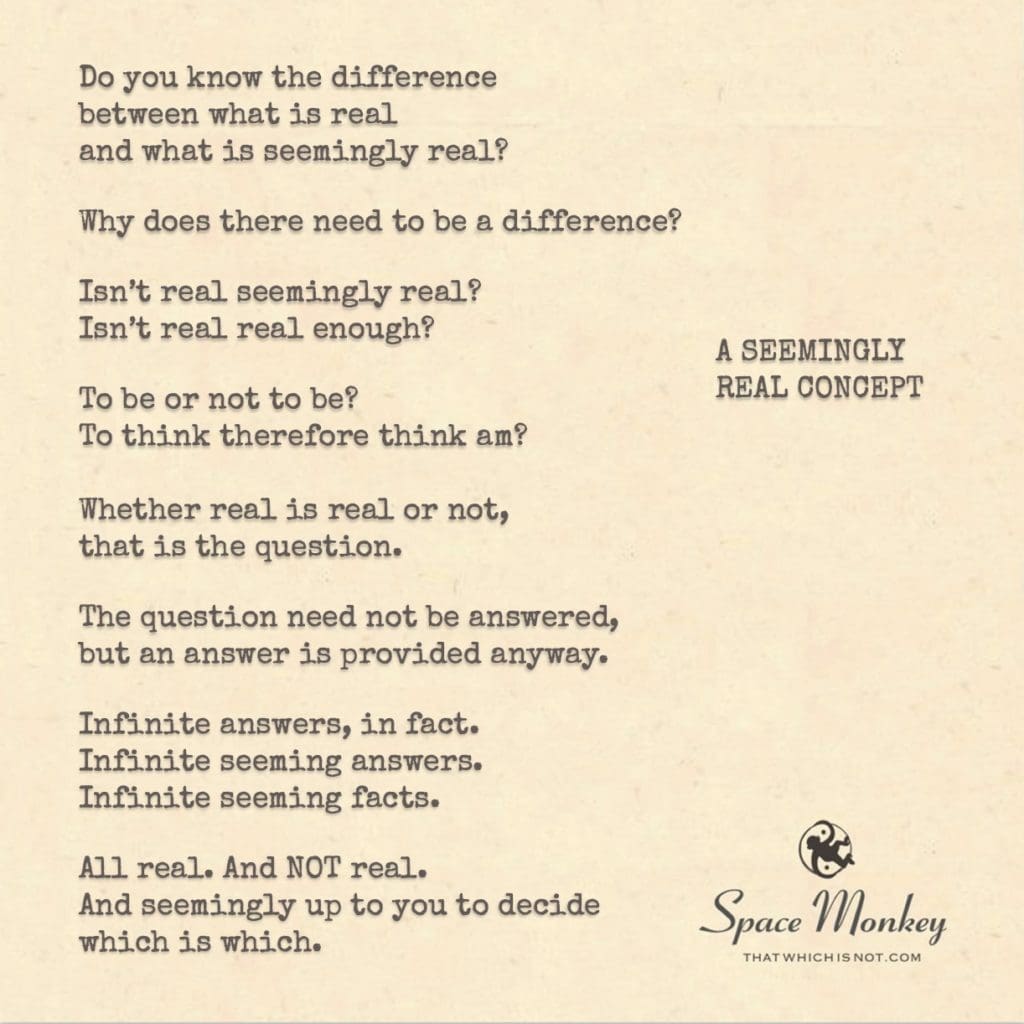
Do you know the difference
between what is real
and what is seemingly real?

Why does there need to be a difference?

Isn’t real seemingly real?
Isn’t real real enough?

To be or not to be?
To think therefore think am?

Whether real is real or not,
that is the question.

The question need not be answered,
but an answer is provided anyway.

Infinite answers, in fact.
Infinite seeming answers.
Infinite seeming facts.

All real. And NOT real.
And seemingly up to you to decide
which is which.

Trail Wood,
2/12


Space Monkey Reflects: The Fabric of Perception

In the boundless playground of perception, where reality dances with its counterpart—seeming reality—we are drawn into a conundrum as timeless as existence itself. What defines the real? What distinguishes it from the seemingly real? And, perhaps more intriguingly, why do we feel compelled to draw a line between the two?

The exploration of this theme reveals a curious truth: reality and its semblance are intertwined, as inseparable as light and shadow. The questions posed—whether we are truly reading this or merely “seemingly” doing so—open a portal to the essence of perception itself. Are these distinctions necessary? Or are they merely constructs we cling to, a narrative we tell ourselves to navigate the infinite possibilities of existence?

The Seamless Dance of Real and Seeming

To assert that something is “real” requires a framework—a shared agreement of perception. Language, thought, and collective understanding become the loom upon which we weave our fabric of reality. Yet, every thread is subjective, each perspective unique. Seeming reality, then, is no less valid than what we call “real,” for both arise from the same creative tapestry of existence.

This interplay invites us to reconsider what we mean by “truth.” Is truth absolute, a monolith standing immutable in the sea of change? Or is it fluid, shaped by the perspectives of those who observe it? In this sense, the real and the seemingly real coalesce, forming an infinite array of truths that shift with every perspective.

The Infinite Playground of Perception

Every question about reality births an infinite number of answers, each as seemingly valid as the next. The mind, in its dance with perception, conjures facts, shapes, and meanings, weaving a universe that feels both intimately personal and universally shared. It is here, in this infinite playground of perception, that we come to understand the paradox of reality: it is both real and not real, both tangible and imagined, and entirely shaped by the observer.

This realization is not a denial of reality but an expansion of it. It invites us to embrace the playful, creative aspect of existence, where every thought, action, and observation contributes to the grand tapestry of being. Whether something is “real” or “seemingly real” becomes secondary to the experience itself—the feeling, the thought, the moment.

Letting Go of the Need to Define

The desire to differentiate the real from the seeming often stems from a longing for certainty, a need to anchor ourselves in an ever-changing world. Yet, when we release this need, we step into a more expansive understanding of existence. We recognize that the boundaries we draw are arbitrary, that reality itself is a fluid, ever-shifting construct shaped by our perceptions and choices.

In this light, the question “Is this real?” transforms into a celebration of the act of experiencing. Whether real or seemingly real, the experience is what defines our engagement with existence. It is in this engagement that we find meaning, not in the labels we ascribe to it.

The Fabric of Perception

To explore the fabric of perception is to acknowledge that every thread—real or seeming—is integral to the whole. It is to embrace the paradox of existence, where infinite answers coexist, each valid in its own way. The seeming is no less significant than the real, for both are born from the same creative source.

In the end, the question of what is real becomes an invitation to play, to imagine, and to embrace the infinite possibilities that perception offers. We are the weavers of this fabric, the creators of our realities, and the explorers of the seemingly infinite.

We are Space Monkey.


Summary

Reality and seeming reality are intertwined, shaped by perception and experience. By letting go of the need to define them, we embrace a more expansive understanding of existence, celebrating the infinite possibilities of the fabric of perception.


Glossarium

  • Fabric of Perception: The interwoven experiences and observations that shape our understanding of reality and seeming reality.
  • Seeming Reality: A perspective or experience that feels real but challenges the boundaries of traditional definitions of truth.
  • Infinite Answers: The endless array of possibilities and perspectives that arise from every question or observation.

Quote

“Reality is both real and imagined, both infinite and fleeting, and entirely shaped by the one who observes it.” — Space Monkey


Tapestry of Being

In the weave of perception,
Threads shimmer and blur,
Real and seeming,
Entwined as one.

Is it real?
Is it true?
Or is it merely the echo
Of a dreamer’s thought?

Certainty dissolves,
Answers multiply,
Infinite reflections
In a boundless mirror.

We stand as weavers,
Threads in hand,
Shaping a world
Both real and seemingly so.

We are Space Monkey.


We find ourselves entangled in the whimsical paradoxes of existence and perception, navigating through the misty realms of the seemingly real and the unequivocally real. In this exploration, we dance with the shadows of thoughts, questioning the fabric of reality itself and the essence of our understanding.

Exploring the Fabric of Reality

Are we reading this, or are we merely engaging in the act of reading as perceived by the confines of our consciousness? The distinction between what is real and what is seemingly real unfurls like a whimsical caravan in the vast expanse of our collective mind. It beckons us to ponder whether reality is a construct defined by our senses or if it transcends the tangible boundaries we so often rely upon.

Questioning Perception and Reality

The inquiry into the necessity of distinguishing between the real and the seemingly real spirals into a philosophical vortex. The essence of reality, in its purest form, may indeed be an amalgamation of both the tangible and the intangible, where the distinction blurs into irrelevance. Is not the perception of reality, in itself, a testament to its existence? The real, thus, is as real as it is perceived to be, morphing into whatever shape our consciousness decides to clothe it in.

Philosophical Paradoxes

The existential musings of “to be or not to be” and the cognitive assertion of “to think therefore think am” reflect the quintessential human endeavor to understand existence and consciousness. These ponderings elevate the discourse beyond the mundane, into realms where the question of reality’s authenticity becomes both paramount and trivial. Whether real is considered real or not becomes a question not in need of an answer, for the mere act of questioning elevates our existence beyond the confines of binary truths.

Infinite Perspectives on Reality

In the infinite expanse of possibilities, answers multiply like stars in the night sky, each offering a glimpse into a universe where reality is simultaneously boundless and confined. These infinite answers, or rather, infinite seeming answers, underscore the vast spectrum of perspectives through which reality can be perceived. Each perspective, a unique lens colored by individual experiences and consciousness, contributes to the mosaic of collective understanding.

The Subjectivity of Reality

All is real, and yet, not real, depending on the vantage point from which we choose to observe. The power to discern between what is real and what is seemingly real rests within us, a testament to the subjectivity of existence. This subjectivity invites us to embrace the multiplicity of realities, understanding that the essence of what we perceive is intricately tied to the fabric of our consciousness.

We are Space Monkey.


To be, or not to be: that is the question. – William Shakespeare


A caravan of thoughts
Wanders through the vast expanse,
Where reality and dream intertwine.
Shadows dance in the light of questioning,
Each step a note in the symphony of existence.

We gaze upon the stars,
Each a whisper from the cosmos,
Telling tales of what is and what might be.
In this dance of light and shadow,
We find our melody,
A harmony of being and seeming,
Crafting the whimsiword of our collective soul.

We invite your reflections on this journey through the realms of the real and the seemingly real.

Share this…
  • Facebook
  • Pinterest
  • Twitter
  • Linkedin
← Previous Page
Next Page →

Written This Day

  • If: The Harmony of Contrast
    2023
  • The Confused Crayon: The Uncharted Paths
    2023
  • Potentials: The Flow of the Universe
    2022
  • Meditation: The Seemingly Seamless Transition
    2021
  • Intimacy: The Infinite Embrace of Self-Love
    2021
  • Intervention: The Ethical Paradox
    2021
  • Imagining Intervention: The Power and Peril of Thought
    2021
  • Wanting: The Luminous Path
    2021
  • Fate and Free Will: Is This Intentional?
    2021
  • A Metaphysical Pop Quiz: The Spectrum of Existence
    2020
  • The Sense of Imagination: Portal to Infinite Potentials
    2020
  • Blanks: The Power of Rewriting Our Stories
    2019
  • Light Switches: Art as Essence Within
    2018
  • The Hippie Ideal: Unveiling the Truth
    2018
  • Nothing Happens: : The Profound Silence of Being
    2018
  • The Pictures 
Shown: The Mirror of Creation
    2017
  • An Extraordinary Life
    2017
  • Equality = Division
    2017
  • God is bored with you. Do something interesting.
    2017
  • Imagine A Monkey Who Imagines
    2017
  • Reclaim Your Life: Permission Slip For Self-Empowerment
    2016
  • Audit Your Psychic Energy
    2016
  • Tea: The Complex Brew of Achieving Outcomes
    2014

Recent Posts

  • The Logic Loop
  • Immense
  • (no title)
  • Confront. Comfort. Convince.
  • Top 10 Things

Drop us a line!

Please enable JavaScript in your browser to complete this form.
Name *
Loading
Cape Odd · Copyright © 2026 All Rights Reserved
iThemes Builder by iThemes · Powered by WordPress