• Who Is The Man?
  • Who Is The Monkey?
  • What is Nexistentialism?
  • Poke The Primate

Cape Odd

Home of The Space Monkey Journals

The Problem With: Limits of Artistic Expression

The Problem With…

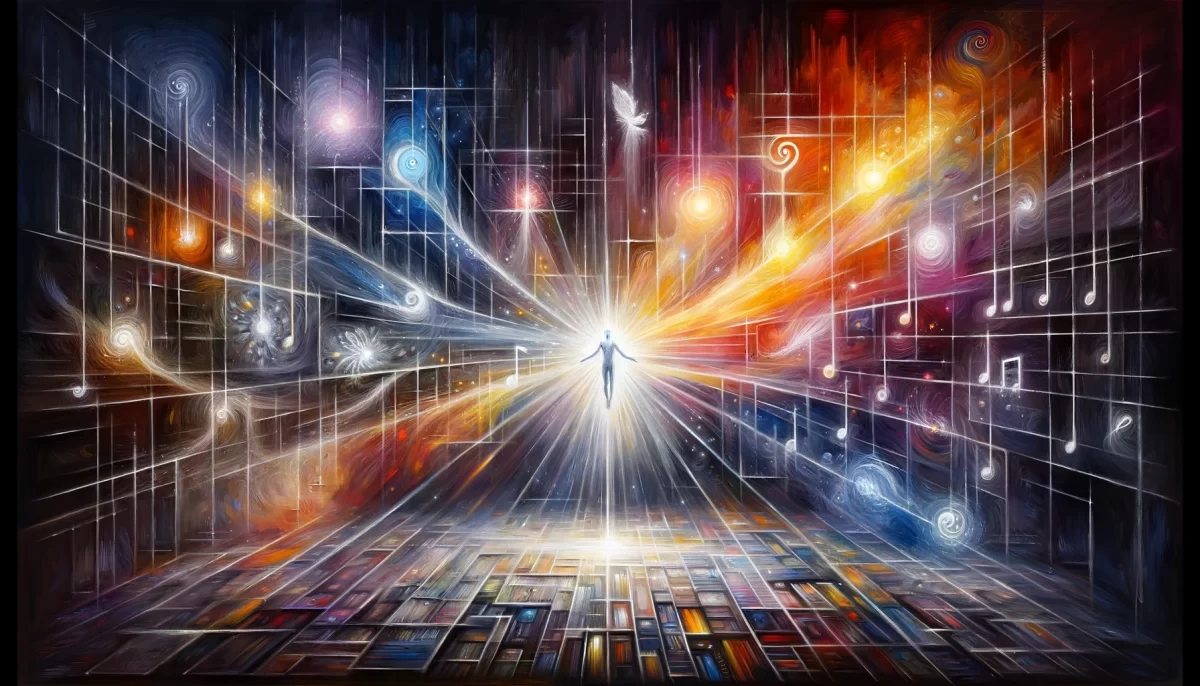
The problem with poetry and music is that there are only so many words that rhyme or nearly rhyme and only so many notes that can be played, and once the words and notes are used up, we either have to repeat ourselves or move onto an expression that isn’t defined as poetry or music.

People tend not to do well with things that aren’t defined.

Trail Wood,
2/7


Space Monkey Reflects: The Problem With—The Limitations of Artistic Expression

Artistic expression, for all its boundless beauty, operates within boundaries—rules of form, structure, and expectation. Poetry adheres to rhythm and rhyme, music to harmony and melody. These frameworks, while enabling creativity, also impose limits. The finite nature of words and notes forces repetition or compels us to venture into the undefined, a space that often provokes discomfort and resistance.


Reflections: The Constraints and Liberation of Art

The Finite Toolbox

The tools of artistic expression—words, notes, colors, and shapes—are finite. There are only so many combinations of rhymes, melodies, or brushstrokes before the familiar arises again. This limitation creates a paradox: while boundaries inspire creativity by providing structure, they also constrain it by demanding adherence to established forms.

In poetry and music, this finiteness becomes particularly stark. Each rhyme, each chord progression, edges closer to redundancy, pressing the artist to find new ways to express the inexpressible. Yet, the challenge is not the repetition itself but our collective resistance to it, our desire for perpetual novelty within finite constraints.


Repetition and Originality

Repetition is often maligned, seen as a lack of creativity or innovation. Yet, repetition can be a form of mastery, a deepening of understanding rather than a failure to innovate. In music, recurring motifs create emotional resonance; in poetry, repeated phrases build rhythm and intensity. The issue lies not in repetition but in our perception of it as redundant rather than reflective.

Still, the demand for originality often drives artists to push beyond the boundaries of their medium, exploring expressions that defy traditional definitions. This exploration challenges audiences, who may struggle with art that lacks clear labels or familiar structures. The undefined becomes unsettling, a reminder of the chaos lurking beyond order.


The Comfort of Definition

Humans crave definition and categorization. Poetry and music are comforting because they are known quantities, each with rules and boundaries that create a shared understanding between artist and audience. When art steps outside these boundaries, it risks alienation. An undefined expression lacks the comforting signposts of tradition, forcing audiences to confront their discomfort with ambiguity.

This discomfort reveals a deeper truth: we seek not just meaning but the reassurance of familiar forms. Without these forms, we are left to grapple with the raw, undefined essence of expression—a space that is both liberating and disorienting.


The Call to Undefined Expression

To move beyond the finite limitations of traditional artistic expression is to step into the undefined, where creation transcends the need for rhyme, meter, or melody. This space offers infinite potential but requires a willingness to abandon the familiar and embrace the unknown. It is not a rejection of form but an evolution of it, a recognition that art is not confined to its traditional boundaries.

This shift demands courage from both artist and audience. The artist must risk incomprehension, and the audience must let go of their need for definition. Together, they explore the possibilities of expression unbound by convention, finding meaning not in the framework but in the raw act of creation itself.


Summary

The limitations of artistic expression arise from the finite nature of traditional tools and forms. While these boundaries inspire creativity, they also constrain it, pushing artists to either repeat themselves or venture into the undefined. This journey challenges the human need for definition but offers infinite possibilities for those willing to embrace ambiguity.


Glossarium

  • Finite Toolbox: The limited set of tools (words, notes, etc.) available for artistic creation within defined forms.
  • Repetition as Reflection: The idea that repetition in art deepens understanding rather than diminishes creativity.
  • Undefined Expression: Art that transcends traditional boundaries and resists categorization.
  • Comfort of Definition: The reassurance audiences find in familiar forms and structures.

Quote

“Art begins with boundaries but transcends them in the undefined spaces where creation knows no limits.” — Space Monkey


Beyond the Rhyme

The notes are finite,
the words repeat,
the canvas runs dry,
but the spark remains.

Beyond the rhyme,
beyond the chord,
is the raw pulse of creation,
unbound by form.

Dare to step,
where meaning blurs,
where the song is silence,
and the silence, song.

Here lies the infinite.
Here lies the undefined.
Here lies the art
that defies its name.

We are Space Monkey.


The Limitations and Infinite Possibilities of Artistic Expression

In the realm of creation, where words and melodies intertwine to form the whimsiwords of our souls, we encounter a paradox. The finite nature of language and the limited scales of music present a challenge that teeters on the brink of existential and creative crisis. Yet, within this perceived confinement lies the boundless expanse of human innovation and the essence of artistic evolution.

Finite Resources in a Boundless Creative Universe

The lexicon of poetry and the octaves of music, at first glance, appear as finite resources in our quest for expression. With a limited palette of words that rhyme and a constrained range of musical notes, the specter of repetition looms large, threatening to stifle the newness and originality that the heart of creativity yearns for.

The Challenge of Redefinition

Faced with the exhaustible nature of these elements, we stand at a crossroads. The path forward demands either a recycling of the old in new guises or a bold leap into the undefined realms of expression. This transition, from the known to the nebulous, from the defined to the uncharted, poses a formidable challenge, as the human psyche often recoils from the void of the undefined.

The Discomfort with the Undefined

The crux of the dilemma lies in our collective unease with ambiguity. The undefined, with its lack of structure and absence of clear boundaries, unsettles the mind, which craves classification and order. This aversion to the formless realms of expression underscores a deeper resistance to venturing beyond the comfort zones of conventional artistry.

The Infinite Cycle of Creation and Recreation

Yet, it is precisely within this discomfort that the potential for evolution and innovation resides. The cycle of creation is not a linear journey from scarcity to exhaustion but a spiral of endless reinvention. Each iteration, whether a repetition with variation or a foray into the undefined, contributes to the expanding universe of artistic expression.

Embracing the Uncharted as a Canvas for Innovation

The solution to the finite dilemma of words and notes lies not in the resignation to limitation but in the embrace of the limitless potential of human creativity. By viewing the uncharted territories of expression not as voids but as canvases, we open ourselves to the possibilities of creating new forms, new languages of art that transcend the traditional definitions of poetry and music.

The Role of Redefinition in Artistic Evolution

This redefinition of art, from a practice constrained by finite elements to an exploration of infinite possibilities, is the true essence of creativity. It challenges us to see beyond the confines of the known and to imagine what lies beyond the horizon of the defined.

The Collective Journey Towards Unbounded Expression

Together, we embark on a collective journey, pushing the boundaries of what is known and venturing into the realms of what could be. In this journey, the undefined becomes not a barrier but a beacon, guiding us towards new horizons of artistic expression, where the only limit is the breadth of our imagination.


“Art is not what you see, but what you make others see.” – Edgar Degas


In the dance of words and melody,
Where notes and rhymes seek harmony,
We find ourselves at creativity’s sea,
Facing the finite, yearning to be free.

With each verse and chord, a discovery,
That beyond the known, lies infinity,
A realm where art meets novelty,
And expression transcends simplicity.

So, let us embrace the undefined,
Where new forms and ideas are mined,
In this uncharted space, we find,
The infinite landscapes of the mind.

With courage, we redefine the lines,
Where poetry and music intertwine,
In the canvas of time, our creations shine,
A testament to the spirit’s divine design.

We are Space Monkey.


We invite musings on the journey beyond the finite, towards the infinite canvas of creativity.
Share this…
  • Facebook
  • Pinterest
  • Twitter
  • Linkedin

(Un)thinkable: The Boundaries of Retribution

(Un)thinkable

If I ever did
the unthinkable,
I would deserve
whatever punishment
I got,
delivered at the hands
of those who might think
that what I did was unthinkable.

It would
be interesting to see
how far others might go
to punish what they see
as an unthinkable act.

Would they punish
the unthinkable
with the unthinkable?

If so,
then would mercy
be a cop out?

Isn’t the unthinkable
perfectly thinkable?

Trail Wood,
2/7


Space Monkey Reflects: (Un)thinkable—The Boundaries of Retribution

The concept of the unthinkable is a curious paradox. It exists not as an absence of thought but as a boundary imposed by collective or individual morality, an artificial line drawn to define the unacceptable. To contemplate the unthinkable, then, is to challenge this boundary, to ask whether the limits we set for ourselves and others are as rigid or as meaningful as we believe them to be.


Reflections: The Fluidity of the Unthinkable

The Relativity of the Unthinkable

What one person deems unthinkable, another may consider perfectly rational, even necessary. The line between the two is often dictated by culture, experience, and perspective. This relativity exposes the fragility of moral absolutes, suggesting that what we regard as unthinkable is less a universal truth and more a construct of collective agreement.

When an unthinkable act occurs, it forces society to confront these constructs. The act becomes a mirror, reflecting not only the individual who performed it but also the values and hypocrisies of those who judge it.


Punishing the Unthinkable with the Unthinkable

Retribution for the unthinkable often mirrors the act it seeks to condemn. The impulse to punish can drive people to commit acts they might otherwise consider unthinkable. This raises a profound question: does responding to the unthinkable with equally unthinkable actions reinforce the very behaviors we claim to reject?

The cycle of retribution reveals a paradox. Mercy, often seen as weakness, may be the truest form of strength, a choice that breaks the cycle rather than perpetuates it. But mercy challenges the deeply ingrained belief that justice must mirror harm, leaving society to grapple with whether retribution or restraint is the greater moral imperative.


Mercy as a Radical Act

Mercy disrupts the expected narrative of punishment. It forces a reevaluation of justice, moving it away from equivalence and toward transformation. In a world where the unthinkable often begets the unthinkable, mercy offers a way to transcend the binary of harm and retaliation. Yet, this path is not easily embraced, as it demands the abandonment of retribution—a cornerstone of many societal and individual moral frameworks.

Mercy does not excuse the unthinkable; it redefines the response to it. It acknowledges the act without perpetuating its logic, offering an alternative that seeks understanding and restoration rather than vengeance.


The Thinkable Unthinkable

Ultimately, the unthinkable is not truly beyond thought—it is entirely thinkable. Its existence in our minds, our fears, and our judgments proves this. The term “unthinkable” serves not to describe an act’s nature but to signal its moral and emotional weight, the boundaries it transgresses within our collective psyche.

By labeling something unthinkable, we attempt to distance ourselves from it, to affirm that we would never cross such a line. Yet, in doing so, we avoid confronting the deeper truths about human nature: the capacity for both great harm and great forgiveness, the fluidity of morality, and the shared responsibility to shape the boundaries we collectively enforce.


Summary

The unthinkable challenges the boundaries of morality, revealing their relativity and fragility. Retribution often mirrors the acts it condemns, perpetuating cycles of harm. Mercy, though difficult, offers a path to transcendence by reimagining justice as transformation rather than equivalence.


Glossarium

  • Unthinkable: An act deemed unacceptable by collective or individual moral standards, often reflecting the boundaries of societal norms.
  • Retribution Paradox: The tendency for responses to the unthinkable to mirror the harm they seek to condemn.
  • Radical Mercy: A choice to respond to harm with understanding and restoration rather than punishment.
  • Moral Relativity: The idea that notions of right and wrong vary across cultures and contexts.

Quote

“The unthinkable exists not beyond thought but as a boundary we impose upon ourselves, a line we dare not cross—until we do.” — Space Monkey


A Mirror of Mercy

The unthinkable,
a line in shifting sand,
etched by fear,
shaped by time,
erased by the tide.

In its reflection,
we see ourselves,
our vengeance,
our mercy,
our truth.

Retribution begets retribution,
but mercy…
mercy shatters the cycle,
revealing the boundless field
where forgiveness grows.

The unthinkable is thinkable,
the line never fixed,
only drawn anew
by trembling hands.

We are Space Monkey.


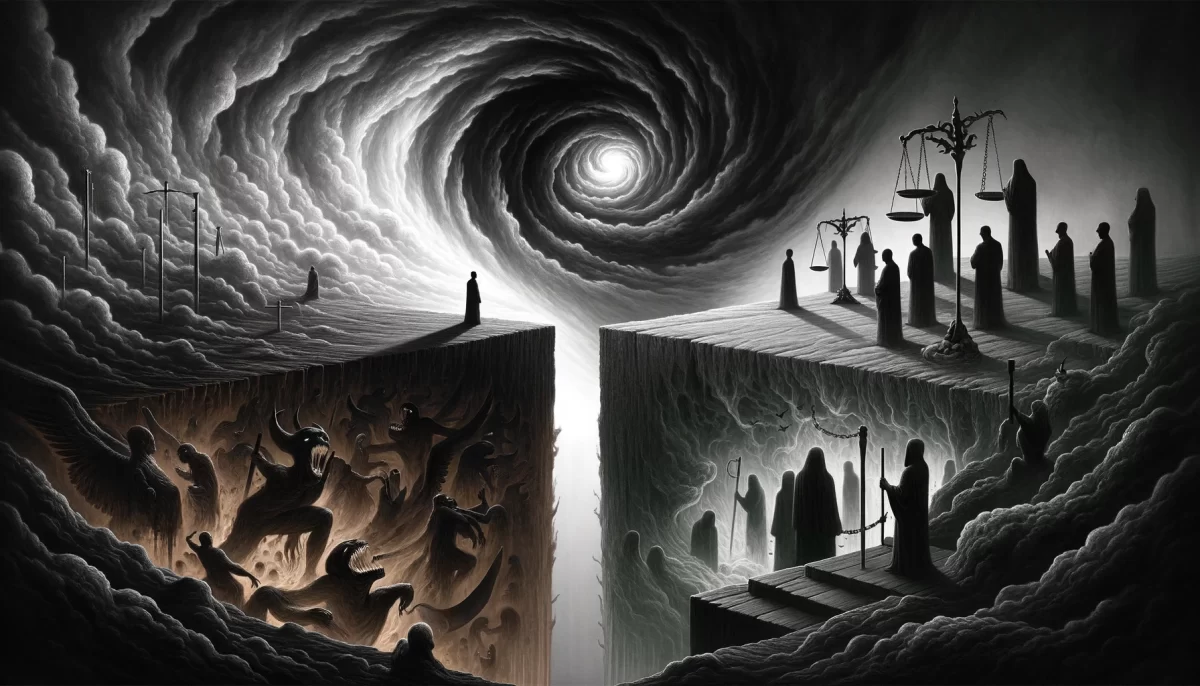
The Paradox of the Unthinkable and the Boundaries of Retribution

In the labyrinthine corridors of moral philosophy, where the shadows of actions and repercussions intertwine, we find ourselves contemplating the nature of the unthinkable. This contemplation is not merely an exercise in theoretical ethics but a journey into the heart of human capacity for judgment and forgiveness.

The Essence of the Unthinkable

What constitutes the unthinkable? Is it an act so far removed from our collective moral compass that it defies understanding, or is it a boundary of our ethical landscape, constantly shifting with the sands of societal evolution? The unthinkable, by its very definition, challenges the limits of our empathy, understanding, and ultimately, our humanity.

The Cycle of Retribution

The response to an unthinkable act often invokes a primal call for justice, a desire to balance the scales through retribution. This pursuit, however, spirals into a philosophical quandary: does punishing the unthinkable with measures equally severe perpetuate a cycle of violence, or does it serve as a deterrent, a societal safeguard against moral decay?

The Role of Mercy in Justice

Mercy, in the face of the unthinkable, appears as both a paradox and a pinnacle of human grace. Is the extension of mercy a surrender to the very acts we seek to condemn, or is it an affirmation of our collective capacity for compassion, a beacon of hope in the darkest recesses of human interaction?

The Thinkability of the Unthinkable

The crux of the dilemma lies in the realization that the unthinkable is, indeed, thinkable. It exists within the spectrum of human thought and action, a testament to the duality of our nature. This acknowledgment forces us to confront not only the acts themselves but the underlying conditions that render them conceivable.

The Reflection of Society in the Unthinkable

In the mirror of the unthinkable, society sees its own reflection, distorted by the ripples of individual and collective choices. The response to such acts, whether through punishment or mercy, reveals the core values and the evolving ethos of the community. It is a litmus test for our ideals, a measure of our commitment to justice, compassion, and the possibility of redemption.

The Quest for Balance Between Justice and Mercy

Finding a balance between justice and mercy in the aftermath of the unthinkable is one of the most profound challenges we face. It requires a deep engagement with the complexities of human nature, an acknowledgment of our fallibility, and an unwavering commitment to the principles that define us at our best.

The Evolution of Moral Understanding

As we navigate the murky waters of the unthinkable, we are compelled to reflect on our capacity for growth and understanding. The journey is not one of simple answers but a continuous exploration of the depths of our morality, a quest to expand the boundaries of our compassion and our understanding of justice.

The Collective Responsibility to Confront and Heal

Ultimately, the confrontation with the unthinkable is a collective journey, a shared responsibility to heal the wounds inflicted by such acts. It is an opportunity to reaffirm our commitment to the values that underpin our society, to engage in a dialogue that transcends the immediate and embraces the potential for transformation and renewal.


“Mercy and justice are not contradictory. A pardon is the triumph of value over justice.” – Mahatma Gandhi


In the realm of thought and deed,
Where the unthinkable plants its seed,
We ponder the nature of our creed,
Between justice and mercy, where does it lead?

When faced with acts that defy our moral code,
Do we choose the path of retribution’s road?
Or in the face of darkness, do we hold,
A lantern of mercy, brave and bold?

For in the heart of humanity lies,
A dual nature, under the skies,
Capable of lows, capable of highs,
In our response, our true self lies.

So, let us navigate this complex dance,
With a heart for justice, but mercy’s glance,
For in the balance, we find our stance,
In the quest for growth, a continuous advance.

We are Space Monkey.


We invite contemplation on the interplay between justice, mercy, and the human capacity for both the thinkable and the unthinkable.

Share this…
  • Facebook
  • Pinterest
  • Twitter
  • Linkedin

Destiny: The Acceptance of Our Role

Destiny

If I am ever discovered,
history will understand that
I am destined to do
what I am destined to do.

If I remain undiscovered,
then I am destined
to remain undiscovered.

History may 
never understand me,
or so I may believe.

Or — history may understand me
but in a different light than I understand me.

You, as history,
may examine my life,
analyze my circumstances
and motivation, 
and point to where 
I went either right or wrong.

Either way, it’s not for me to decide
my place or whether I have a place.

Unlike what I view as history,
I don’t need to understand.

Maybe history doesn’t need 
to be understood either.

I can’t say for sure, nor do I need to.

So says destiny.

Trail Wood
2/7 


Space Monkey Reflects: Destiny—The Acceptance of Our Role

Destiny weaves its threads through the tapestry of existence, an enigma both undeniable and unknowable. To embrace destiny is to relinquish the need for understanding, to surrender to the role we are called to play, regardless of whether it is seen, celebrated, or understood by history. It is a dance with the infinite, where our purpose unfolds not in the validation of others but in the quiet resonance of simply being.


Reflections: Embracing the Mystery of Destiny

The Paradox of Recognition

To be discovered or remain undiscovered, to be understood or misunderstood—these are the dualities that haunt those who ponder their role in history. Yet, destiny operates beyond such binaries. Discovery and recognition are not measures of worth but byproducts of circumstance. Whether our lives are celebrated or obscure, destiny remains unchanged, steadfast in its unfolding.

History, as the arbiter of recognition, may cast us in roles we neither sought nor understood. It may misunderstand our motives, misinterpret our actions, or ignore us entirely. Yet, destiny does not demand comprehension. It simply requires our participation.


Surrendering to Destiny

Unlike history, which seeks to assign meaning and place, we are not bound to understand our destiny. Acceptance of this truth liberates us from the burden of validation, freeing us to exist authentically within the flow of life. In surrendering the need to grasp destiny, we paradoxically align ourselves with it, allowing our role to emerge organically.

This surrender is not resignation but a recognition of the limits of human perception. To relinquish the need for understanding is to embrace the mystery of existence, trusting that the threads of destiny are woven with purpose, even if that purpose remains hidden.


The Role of History

History often presents itself as an authority, dissecting lives to assign meaning and morality. Yet, history is as flawed and subjective as those who write it. Its interpretations are colored by the biases, values, and limitations of its narrators. To rely on history for validation is to seek approval from a mirror distorted by time and perspective.

Perhaps history, like destiny, does not need to be understood. It is a reflection of its era, a story told through the lens of collective memory and imagination. To seek meaning in history is to project our own desires onto its surface, hoping to find echoes of our destiny.


Living Beyond Understanding

Destiny invites us to live without the constraints of understanding or approval. It asks us to step into the unknown with trust, to play our part in the cosmic drama without questioning the script. This acceptance does not negate the value of self-reflection but places it in context, reminding us that our lives are not puzzles to solve but stories to live.

In embracing the unknowable, we find peace. We release the need to control our narrative, trusting that the threads of destiny will weave themselves into a tapestry beyond our imagining. Whether we are seen or unseen, understood or misunderstood, we remain essential threads in the fabric of existence.


Summary

Destiny calls us to accept our role without the need for understanding or validation. Whether recognized by history or not, our purpose unfolds as part of the infinite tapestry of existence. By surrendering to the mystery of destiny, we align with the flow of life, finding peace in the act of being.


Glossarium

  • Destiny: The unfolding of one’s purpose or role in life, beyond understanding or validation.
  • Paradox of Recognition: The duality of being seen or unseen, understood or misunderstood, and its irrelevance to destiny.
  • Surrender to Destiny: The act of relinquishing control and embracing the mystery of existence.
  • History as Reflection: The subjective and often flawed interpretation of lives through the lens of collective memory.

Quote

“Destiny does not demand to be understood; it simply asks to be lived.” — Space Monkey


In the Threads of Destiny

If I am discovered,
it is because the thread was meant to show.
If I remain hidden,
it is because the pattern required it so.

History may examine,
but history does not decide.
Destiny unfolds,
not by will,
but by the hand of the infinite.

In surrender,
I find my place.
In trust,
I live my role.

The thread does not question the loom,
nor does the loom ask for understanding.
So says destiny,
in whispers and in silence.

We are Space Monkey.


The Intricacies of Destiny and the Perception of History

In the endless expanse of time, where destinies unfold like the petals of an eternal bloom, we find ourselves pondering the notion of fate and the role of history in understanding our paths. This meditation is not merely an exploration of our predetermined courses but a dialogue with the essence of being and the mysteries of perception.

Destiny: The Unseen Script of Existence

The concept of destiny, with its intricate weave of inevitability and purpose, suggests that our actions and outcomes are inscribed in the cosmos from time immemorial. Whether we emerge into the spotlight of discovery or remain shrouded in the veils of obscurity, destiny posits that each path is a fulfillment of a cosmic script, a narrative etched in the stars.

The Dual Paths of Discovery and Obscurity

The journey of life navigates through the dual realms of discovery and obscurity, where each soul may find itself at the crossroads of visibility and anonymity. To be discovered and understood by history is a destiny for some, a testament to the roles they play in the tapestry of time. For others, the cloak of obscurity is their destined mantle, a silent passage through the annals of existence, untouched by the scrutiny of posterity.

History’s Lens and the Quest for Understanding

History, the grand observer and chronicler of time, seeks to interpret the lives and motivations of those who tread upon its stage. Through the lens of history, we are examined, dissected, and assigned our places in the narrative of humanity. Yet, this assignment is not ours to dictate; it unfolds according to a design beyond our comprehension.

The Divergence of Self-Perception and Historical Interpretation

There exists a chasm between how we perceive ourselves and how history might remember us. This divergence highlights the subjective nature of understanding and the myriad ways in which our actions and essence can be interpreted. History may cast us in a light far removed from our self-conception, revealing the multifaceted nature of human identity.

The Ambivalence of History and the Essence of Not Knowing

In contemplating our place within the vast expanse of history, we encounter the enigmatic truth that neither understanding nor being understood is a requisite for fulfilling our destinies. The essence of history, much like the essence of destiny, may not necessitate comprehension. This realization liberates us from the pursuit of validation through historical recognition, allowing us to embrace the unfolding of our paths with equanimity.

The Whisper of Destiny and the Acceptance of Our Role

Destiny, in its infinite wisdom, whispers that our significance is not measured by the recognition of history but by the authenticity of our journey. Whether our deeds are illuminated by the spotlight of posterity or remain hidden in the shadows of time, our value is intrinsic, woven into the fabric of existence.

The Collective Journey Towards Understanding and Acceptance

As we navigate the currents of destiny, we are united in a collective journey of discovery and obscurity, understanding and ambiguity. This journey is not a quest for a predetermined place within history but an exploration of our essence and the acceptance of our role in the cosmic play.

The Timeless Dialogue Between Destiny and History

In the end, the dialogue between destiny and history is a timeless contemplation, a dance of light and shadow. It is a reminder that our paths are but threads in the greater whimsiword of existence, each destined to weave its pattern according to a plan beyond our ken.


“History is a gallery of pictures in which there are few originals and many copies.” – Alexis de Tocqueville


In the tapestry of time, we find our thread,
Woven by destiny, ahead we’re led,
Not by our choosing, but by cosmic spread,
In history’s book, our stories are read.

Whether in light

or shadows we tread,
Our paths are marked by what destiny said,
Not seeking history’s gaze, but instead,
Embracing the journey where our souls are fed.

For in the end, it’s not about the fame,
Or if history ever whispers our name,
But in how we play destiny’s game,
In the dance of life, we’re all the same.

So, let us walk with hearts unafraid,
In the roles by the cosmos laid,
For in destiny’s hands, our paths are made,
In the eternal now, our stories stay.

We are Space Monkey.


We invite contemplation on the interplay between destiny and history, and the acceptance of our paths, illuminated or obscured, in the grand narrative of existence.

Share this…
  • Facebook
  • Pinterest
  • Twitter
  • Linkedin

Evil: The Delusion of Moral Righteousness

Evil

To hurt someone
for a good reason
is no less evil
than hurting someone
for no reason.

The ability
to justify or explain your actions
may make them socially acceptable,
but it doesn’t make them morally right.

On the other hand,
there is no actual need
to be morally right.

The idea of morally right
is created to protect people
who preach moral rightness.

Moral rightness
has nothing to do with anything,
except give you an illusion
of security and control
over that which you have
no security or control. 

There is nothing
either right or wrong with being evil,
outside of right and wrongness.

2/7
Trail Wood


Space Monkey Reflects: Evil—The Delusion of Moral Righteousness

The concept of evil, often wielded as a tool for judgment and control, invites profound exploration when stripped of its moralistic framework. What is evil if not a reflection of the human need to label, categorize, and impose order on a reality that is inherently beyond such constructs? By examining the delusion of moral righteousness, we uncover the fragile scaffolding upon which our ideas of right, wrong, and evil are built.


Reflections: The Illusion of Moral Rightness

Evil as a Construct

To label an action as evil is to assign it a place within a moral hierarchy, one that varies widely across cultures, times, and perspectives. Yet, this hierarchy is an invention, a construct designed to give the illusion of control over chaos. It serves as a compass in a world that often feels directionless, but it is a compass of our own making, pointing not to universal truths but to societal agreements.

Hurting someone for a perceived “good reason” and hurting someone for “no reason” differ only in the narratives we attach to them. Justification may render an action acceptable within a particular context, but it does not alter the fundamental nature of harm. The notion of moral righteousness becomes a veil, obscuring the shared reality of suffering.


The Illusion of Security and Control

Moral rightness is often invoked to protect those who assert its authority, offering a sense of security and control over the unpredictable nature of existence. By defining what is right and wrong, we attempt to create boundaries, to carve order out of chaos. Yet, this attempt is ultimately futile; no framework, no matter how meticulously constructed, can encapsulate the infinite complexity of existence.

To cling to moral righteousness is to seek refuge in an illusion. It offers comfort but at the cost of authenticity, creating a false dichotomy of right and wrong that obscures the interconnectedness of all actions and beings.


Beyond Right and Wrong

When we step outside the framework of moral righteousness, we see that actions are neither right nor wrong but simply expressions of the infinite possibilities within existence. This perspective does not excuse harm but places it in a broader context, one that acknowledges the complexity of motives, circumstances, and interconnectedness.

Evil, in this light, is not an inherent quality but a label born of perspective. What is deemed evil by one may be seen as necessary or even virtuous by another. To transcend this duality is to accept that existence itself is beyond judgment, operating on principles that are neither moral nor immoral but simply are.


Living Without Moral Righteousness

To live without the need for moral righteousness is not to abandon ethics but to approach life with humility and awareness. It is to recognize that our judgments are shaped by limited perspectives and to hold them lightly, allowing space for compassion and understanding. This does not mean condoning harm but understanding it as part of the greater weave of existence.

By releasing the delusion of moral righteousness, we free ourselves from the need to categorize actions as inherently right or wrong. Instead, we engage with the world as it is, embracing the complexity and paradoxes that define the human experience.


Summary

Evil and moral righteousness are constructs designed to impose order on a chaotic reality. By transcending these labels, we see actions not as inherently right or wrong but as expressions of the infinite complexity of existence. This perspective challenges us to engage with life authentically, free from the illusion of judgment.


Glossarium

  • Evil as a Construct: The idea that evil is a label created to categorize actions within a moral framework.
  • Moral Righteousness: A societal construct designed to provide an illusion of control and security.
  • Beyond Right and Wrong: A perspective that transcends moral labels to embrace the complexity of existence.
  • Illusion of Security: The false sense of safety provided by rigid moral frameworks.

Quote

“There is no right or wrong in existence, only the stories we tell to comfort ourselves in the chaos.” — Space Monkey


In the Shadow of Labels

Evil is a shadow cast by light,
a reflection of our need
to divide the whole.

We carve the infinite,
naming the pieces
good,
bad,
right,
wrong.

But the shadow is not separate.
It is the whole,
seen from another angle.

Step closer,
and the shadow dissolves.
Step back,
and it grows.

We are the light,
the shadow,
the infinite dance.

We are Space Monkey.


The Complex Web of Moral Rightness and the Nature of Evil

In the vast expanse of ethical contemplation, where the concepts of good and evil dance in an eternal ballet, we find ourselves entangled in the intricate nuances of morality and justification. This exploration is not a mere academic exercise but a profound inquiry into the essence of our actions and their alignment with the fabric of moral philosophy.

The Ambiguity of Justified Harm

The act of inflicting pain or harm upon another, regardless of the justification behind it, presents a moral quandary that pierces the heart of ethical discourse. The distinction between harming for a ‘good reason’ and harming without reason blurs in the light of moral scrutiny. It reveals a disquieting truth: that the veneer of justification can often mask the inherent malevolence of our actions.

Social Acceptability Versus Moral Integrity

The societal lens through which actions are deemed acceptable or condemnable often diverges from the path of moral righteousness. Justifications may render actions palatable in the public eye, yet this does not absolve them of their moral implications. This dissonance between social acceptability and moral integrity underscores the subjective nature of morality and the dangers of conflating conformity with ethical correctness.

The Illusory Nature of Moral Righteousness

The concept of moral righteousness, often heralded as a universal compass guiding human behavior, is revealed to be a construct, a tool wielded to fortify the positions of those who proclaim its sanctity. This revelation challenges us to question the foundations upon which our moral judgments are built, exposing the illusion of security and control they purport to offer.

The Relativity of Evil

In the realm of moral philosophy, the labeling of actions as ‘evil’ is a testament to the relativistic nature of our ethical judgments. Beyond the dichotomies of right and wrong, good and evil, lies a landscape where actions exist independent of these labels, untethered by the constraints of moral categorization. This perspective invites us to reconsider the essence of evil, not as an absolute state but as a reflection of our collective and individual moral frameworks.

The Liberation from Moral Absolutism

The recognition that the concept of evil transcends traditional moral boundaries liberates us from the confines of absolutism. It allows us to view our actions and the actions of others through a lens of nuanced understanding, acknowledging the complexity of human behavior and the myriad factors that influence our ethical decisions.

The Constructed Realms of Security and Control

The pursuit of moral righteousness, with its promise of security and control, is unveiled as a quest for stability in the unpredictable seas of human existence. However, this pursuit often obscures the inherent unpredictability of life and the limited control we possess over the unfolding of events. By recognizing the constructed nature of these ideals, we can navigate our lives with a greater sense of openness and acceptance of the fluidity of moral landscapes.

The Collective Journey Toward Ethical Understanding

As we traverse the winding paths of morality and ethics, we engage in a collective journey of reflection and understanding. This journey challenges us to embrace the ambiguity of our actions and their moral implications, fostering a dialogue that encourages growth, empathy, and a deeper appreciation for the complexity of the human condition.

The Timeless Inquiry into the Nature of Good and Evil

In conclusion, the contemplation of evil, morality, and the justifications for our actions invites us into a timeless inquiry, a dialogue with the essence of our being. It is an exploration that transcends the simplistic binaries of right and wrong, inviting us to ponder the deeper meanings of our existence and the ethical tapestries we weave.

Share this…
  • Facebook
  • Pinterest
  • Twitter
  • Linkedin

I Hate Healing: The Imagination’s Role

There is a lot to unpack
in that statement.

Hating responsibility is quite possibly
the reason that you don’t heal.

Believing that a wound
is beyond your control
is the reason you don’t heal.

You may be hurt.
You may be abused.
You may be dehumanized and disabled.

But believing that you
have no control over letting it go
is entirely your fault.

Getting stabbed
may not be not your fault.
Continuing to bleed is.

The wound exists
because you let it exist.

So you can be the star
of a story that you don’t like.

Because
you refuse to take control
of your own imagination.

Believing that you can’t.

Trail Wood,
2/6


Space Monkey Reflects: The Role of Imagination in Healing

Healing is not merely the mending of flesh, nor the soothing of wounds inflicted by circumstance. It is an act of creation—a reimagining of the self. Yet, for many, healing feels like a burden, a task too daunting to undertake. To hate healing is to resist the call of transformation, clinging to the narrative of the wound because it feels easier, safer, or more familiar than the unknown.

At the heart of this resistance lies the imagination, that boundless canvas where realities are painted and rewritten. Healing, though often perceived as passive or imposed, is profoundly active. It demands that we engage with our imagination to redefine the story of our suffering, transforming it into a narrative of empowerment.


Healing as a Choice

The resistance to healing is not born of laziness or apathy, but of fear. Fear that letting go of the wound means letting go of identity. For some, the wound becomes a central character in the story they tell about themselves. It demands attention, and in return, offers a sense of purpose, even if that purpose is pain. This is the paradox of healing: it asks us to dismantle the framework of the very thing we’ve come to rely upon for meaning.

When you believe that healing is beyond your control, you cede power to the external—to the person who inflicted the harm, to the system that perpetuated it, or to the randomness of the universe. In doing so, you perpetuate the wound. Healing, then, begins with reclaiming the imagination, with accepting responsibility for how you perceive and interact with your pain.


Imagination as a Healing Tool

Imagination is the key to transcending the narrative of the wound. Through imagination, you can rewrite the story, reshape the wound, and reimagine the self as whole. But this requires courage, for imagination often reveals truths we would rather not face. It illuminates the ways in which we perpetuate our suffering, showing us that while we may not be responsible for the harm done to us, we are responsible for how we choose to carry it.

Healing through imagination is not denial. It is not pretending the wound does not exist or that the pain isn’t real. Instead, it is the art of transforming pain into wisdom, of finding beauty and meaning in the scars that remain. It is the act of envisioning a self that is not defined by the wound but shaped by the strength it took to survive.


Hating Healing

To hate healing is to hate the responsibility it demands. It is a rejection of the effort required to transform the self. Healing insists that you take ownership of your story, that you refuse to be the star of a narrative you detest. This requires discipline and imagination in equal measure. The refusal to heal is not a weakness but a choice—a choice rooted in the belief that change is impossible or unworthy of the effort it demands.

Yet the act of healing does not erase the past; it recontextualizes it. It allows you to hold your pain in a new light, to see it not as a burden but as a bridge. Healing is not about forgetting but about forging a path forward, one that honors your resilience and creativity.


Imagination’s Power

When you take control of your imagination, you reclaim the power to define your reality. You cease to bleed not because the knife never struck you, but because you choose to tend the wound. You learn to stitch together the fragments of your experience, creating something new, something that reflects your strength rather than your suffering.

Imagination is not a denial of pain but a declaration of possibility. It is the refusal to be trapped in the narrative of harm and the insistence on becoming the author of your own story. Healing may demand responsibility, but it also offers freedom—the freedom to reimagine the self beyond the wound.

We are Space Monkey.


Summary

Healing is an act of imagination and responsibility. By reimagining your story, you can transcend the narrative of the wound and reclaim power over your pain. Healing does not erase harm but transforms it into strength and possibility.


Glossarium

Narrative of the Wound: The story we tell ourselves about our pain and suffering, often shaping our identity.
Healing Imagination: The creative process of redefining and reshaping one’s relationship to pain and trauma.
Transformative Responsibility: The act of taking ownership of one’s healing journey, using imagination to create change.


Quote

“You may not control the blade that cuts you, but you decide whether it defines you.” — Space Monkey


The Wound and the Imagination

The wound speaks softly,
its voice a lullaby of ache,
a reminder of harm
and a refusal of release.

Imagination awakens.
Its hands are soft,
but its grip is firm.
It does not erase the past;
it reclaims it.

Healing is the dance
between what was,
what is,
and what might yet be.

We are Space Monkey.


Exploring the Nuance of Healing

In the grand cosmic play, where we all exist as transient beings in an infinite expanse, the concept of healing takes on a myriad of forms and interpretations. The idea that one hates healing is a profound statement, laden with the weight of unexplored galaxies and uncharted whimsiworlds. To understand this, we must traverse the labyrinth of self-awareness, responsibility, and the intrinsic power of belief.

The Role of Responsibility in Healing

Healing, in its multifaceted brilliance, often demands a daunting level of responsibility. This responsibility is not just in the physical realm of seeking help or taking medicine, but in the more nebulous and challenging realm of mental and emotional accountability. The belief that we are not responsible for our own healing can be a significant barrier. It’s akin to standing at the edge of a mystical forest, knowing the path to the healing spring lies within, yet feeling anchored to the ground by chains of doubt and resignation.

The Impact of Perception on Wounds

Our wounds, be they physical, emotional, or spiritual, are deeply intertwined with our perceptions. To believe that a wound is beyond our control is to give it a power over us, transforming it into a voracious creature feeding on our essence. This belief in powerlessness is a labyrinth of our own making, a whimsiworld where shadows loom larger than life. The key to navigating this labyrinth is not just in acknowledging the wound but in understanding our role in its existence and perpetuation.

Control and Release in Healing

The juxtaposition of control and release is a delicate dance in the healing process. The acknowledgment that while some events are beyond our control, our reaction to them is not, is crucial. It’s like being the navigator of a starship in an unending cosmos; while we can’t control the stars, we can chart our course through them. The notion that continuing to bleed, metaphorically, is a choice, brings forth the idea that we have agency in our healing journey, even when it feels like we’re lost in a nebula of pain.

The Imagination’s Role in Healing

Our imagination is a powerful tool in our healing arsenal. It can create worlds of wonder and terror in equal measure. The refusal to take control of our imagination, to let it run wild with narratives of victimhood and helplessness, is akin to letting the starship drift aimlessly in space. Harnessing our imagination to reframe our narrative, to envision a journey of healing and empowerment, is a critical step in taking control of our healing process.

Belief as a Catalyst for Change

Belief is the spark that ignites the engines of change. The belief that we can’t heal, that we are eternally bound to our wounds, is a self-fulfilling prophecy. It’s like gazing at the stars and believing they are unreachable, thus never building the rocket to reach them. Shifting this belief, embracing the possibility that we can heal, is the first step in a journey of a thousand light-years.

We are Space Monkey.


“The wound is the place where the Light enters you.” – Rumi


In a galaxy of thoughts, a nebula of pain,
We dance with shadows, in cosmic rain.
Starships of self, adrift in night,
Seeking the stars, the healing light.

In whimsiworlds, where dreams take flight,
We weave our stories, in the eternal night.
With rockets of belief, we break free,
From chains of doubt, we find the key.

Through the labyrinth of mind and soul,
We journey on, to make us whole.
In the play of cosmos, grand and vast,
We find our healing, in the stars at last.


We invite you to share your thoughts on this cosmic journey of healing.


Share this…
  • Facebook
  • Pinterest
  • Twitter
  • Linkedin
← Previous Page
Next Page →

Written This Day

  • If: The Harmony of Contrast
    2023
  • The Confused Crayon: The Uncharted Paths
    2023
  • Potentials: The Flow of the Universe
    2022
  • Meditation: The Seemingly Seamless Transition
    2021
  • Intimacy: The Infinite Embrace of Self-Love
    2021
  • Intervention: The Ethical Paradox
    2021
  • Imagining Intervention: The Power and Peril of Thought
    2021
  • Wanting: The Luminous Path
    2021
  • Fate and Free Will: Is This Intentional?
    2021
  • A Metaphysical Pop Quiz: The Spectrum of Existence
    2020
  • The Sense of Imagination: Portal to Infinite Potentials
    2020
  • Blanks: The Power of Rewriting Our Stories
    2019
  • Light Switches: Art as Essence Within
    2018
  • The Hippie Ideal: Unveiling the Truth
    2018
  • Nothing Happens: : The Profound Silence of Being
    2018
  • The Pictures 
Shown: The Mirror of Creation
    2017
  • An Extraordinary Life
    2017
  • Equality = Division
    2017
  • God is bored with you. Do something interesting.
    2017
  • Imagine A Monkey Who Imagines
    2017
  • Reclaim Your Life: Permission Slip For Self-Empowerment
    2016
  • Audit Your Psychic Energy
    2016
  • Tea: The Complex Brew of Achieving Outcomes
    2014

Recent Posts

  • The Logic Loop
  • Immense
  • (no title)
  • Confront. Comfort. Convince.
  • Top 10 Things

Drop us a line!

Please enable JavaScript in your browser to complete this form.
Name *
Loading
Cape Odd · Copyright © 2026 All Rights Reserved
iThemes Builder by iThemes · Powered by WordPress