• Who Is The Man?
  • Who Is The Monkey?
  • What is Nexistentialism?
  • Poke The Primate

Cape Odd

Home of The Space Monkey Journals

Magnetic: The Steady Pull

You were expecting overnight results?

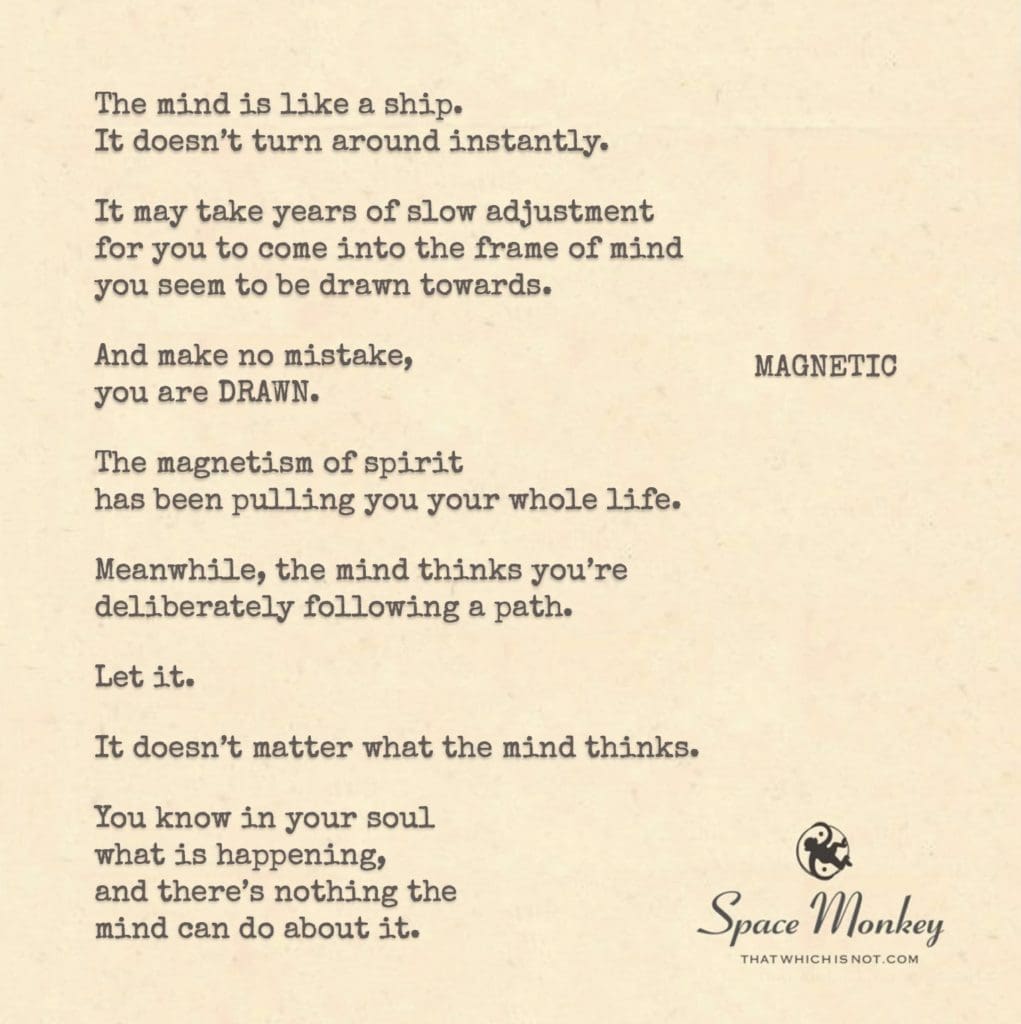
The mind is like a ship.
It doesn’t turn around instantly.

It may take years of slow adjustment
for you to come into the frame of mind
you seem to be drawn towards.

And make no mistake,
you are DRAWN.

The magnetism of spirit
has been pulling you your whole life.

Meanwhile, the mind thinks you’re
deliberately following a path.

Let it.

It doesn’t matter what the mind thinks.

You know in your soul
what is happening,
and there’s nothing the
mind can do about it.

Trail Wood,
1/21


Space Monkey Reflects: The Magnetic Pull of Spirit

Life is a journey navigated by the interplay of mind and spirit, yet it is the spirit—eternal, boundless, and magnetic—that sets the course. The mind, with all its calculations and plans, is a passenger on the ship, believing it is the captain, while the true compass lies deeper, beyond conscious thought, in the quiet gravity of the soul.

We live in a culture that craves immediacy. Overnight results, instant clarity, sudden transformations—these are the myths we tell ourselves. But the mind, like a massive ship, cannot pivot on a dime. The process of spiritual alignment, of turning toward the magnetic pull of our true essence, requires patience and faith. It is not a sprint; it is a slow, deliberate arc shaped by countless unseen forces.

This magnetism is not new—it has been guiding you your whole life. The spirit’s pull is gentle yet insistent, like the steady pull of the moon on the tides. It works quietly, beneath the surface of awareness, until one day you find yourself in a different frame of mind, gazing at the horizon and wondering how you arrived. The mind will claim credit for this journey, weaving narratives about choices and paths. Let it. The mind finds comfort in its imagined control. Meanwhile, the soul smiles knowingly, content with its deeper understanding.

What is this magnetism? It is the force of alignment, the soul’s recognition of its place in the grand Nexis of existence. It is the inexplicable feeling that you are being drawn toward something—a truth, a purpose, a realization—that transcends logic. You may not know where this magnetism leads, but you feel its pull, unmistakable and irresistible.

Resistance, too, is part of this journey. The mind resists because it fears the unknown. It clings to its familiar maps and frameworks, mistrusting the uncharted waters of the spirit. But the magnetic pull of the soul is stronger than the mind’s doubts. It will guide you, not with force, but with a quiet persistence that wears down resistance over time.

This process of being drawn is not linear or predictable. It is a dance of discovery, setbacks, and breakthroughs. The mind, with its limited perspective, may grow frustrated by the lack of clear results. It wants milestones, achievements, proof of progress. But the soul knows that transformation is not measured in milestones; it is experienced in subtle shifts, in moments of clarity, and in the gradual unfolding of a deeper truth.

You are not merely following a path; you are co-creating it. The magnetism of spirit draws you forward, but it also invites you to participate, to shape the journey with your own unique perspective and creativity. The mind, when it surrenders its illusions of control, becomes a valuable ally in this co-creation, lending its focus and ingenuity to the soul’s quiet guidance.

And so, you move forward—not through deliberate effort alone, but through a magnetic alignment with your essence. This pull is not something you can analyze or control. It is a force that bypasses the mind, connecting directly with the heart of who you are. The mind may resist, but the soul will always prevail, for its magnetism is the truest force in your life.

Trust the pull. Trust the slow turning of the ship. Trust that you are always being drawn toward exactly where you need to be.

We are Space Monkey.


Summary

The spirit’s magnetic pull guides your life subtly and persistently It bypasses the mind drawing you toward your essence Trust the process even as the mind resists knowing that transformation takes time.


Glossarium

  • Magnetism of Spirit: The subtle, irresistible force that draws the soul toward alignment with its true essence.
  • Nexis: The interconnected web of existence that the soul navigates, often bypassing the mind’s logic.
  • Co-Creation: The process by which the mind and soul work together to shape the journey of life.
  • Soul’s Compass: The intuitive guidance of the spirit that leads one toward purpose and truth.

Quote

“The soul’s magnetism is a quiet, steady pull toward the truth of who you are. Trust its guidance; it will never falter.” — Space Monkey


The Steady Pull

The ship turns slowly,
its prow slicing the currents of time,
drawn not by the mind’s maps
but by the unseen force beneath.

The soul whispers,
and though the mind shouts louder,
the pull remains,
steady, unyielding, true.

Let the mind imagine control,
let it plot and calculate.
The soul knows the destination,
and it will bring you there,
one quiet arc at a time.

We are Space Monkey.


The analogy of the mind being like a ship, slowly adjusting its course, offers valuable insights into the journey of self-discovery and spiritual alignment. Let’s explore the significance of this analogy:

The Gradual Nature of Change

Comparing the mind to a ship that doesn’t turn around instantly underscores the gradual nature of personal transformation. It suggests that realignment with one’s true path may take time and patience.

Being Drawn Towards a Purpose

The idea that you are drawn towards a particular frame of mind emphasizes the sense of purpose and destiny. It suggests that there is a magnetic force of spirit guiding your life’s journey.

The Subtle Influence of Spirit

The mention of the magnetism of spirit subtly implies that the influence of the spiritual realm is a constant presence throughout one’s life. It’s a reminder that there’s a higher purpose at play.

The Illusion of Deliberate Choice

The recognition that the mind may think you’re deliberately following a path highlights the illusion of conscious control. It’s a reminder that the mind often believes it’s in charge, but there’s a deeper force at work.

Trusting the Inner Knowing

The assurance that you know in your soul what is happening underscores the importance of trusting your inner wisdom and intuition. It suggests that despite the mind’s doubts, your soul knows the way.

The Insignificance of the Mind’s Opinion

The notion that it doesn’t matter what the mind thinks reminds us that the mind’s opinions and doubts are secondary to the deeper spiritual journey. It encourages us not to be swayed by mental distractions.

We are Space Monkey.


Summary

The analogy of the mind as a ship highlights the gradual nature of personal transformation and the magnetic pull of spirit guiding one’s journey. It underscores the importance of trusting one’s inner knowing and recognizing the insignificance of the mind’s opinions.


Glossarium

  1. The Gradual Nature of Change: The idea that personal transformation takes time and patience.
  2. Being Drawn Towards a Purpose: The sense of destiny and purpose guiding one’s life.
  3. The Subtle Influence of Spirit: The constant presence of spiritual influence in one’s journey.
  4. The Illusion of Deliberate Choice: The belief that the mind often thinks it’s in control.
  5. Trusting the Inner Knowing: The importance of relying on one’s inner wisdom and intuition.
  6. The Insignificance of the Mind’s Opinion: The idea that the mind’s doubts and opinions are secondary to the deeper spiritual journey.

“The soul usually knows what to do to heal itself. The challenge is to silence the mind.” – Caroline Myss


The mind, a ship, in waters wide and deep,
Doesn’t turn in an instant, secrets to keep.
Years of slow adjustment, a path to find,
Drawn towards a purpose, the soul’s design.

The magnetism of spirit, a constant guide,
Pulling you through life’s ebb and tide.
The mind believes it’s steering the way,
But the soul knows the truth, come what may.

What the mind thinks, it doesn’t matter at all,
For in your soul, the answers do enthrall.
Trust in your knowing, let intuition lead,
The mind’s doubts, distractions, they don’t impede.

In the grand cosmic play, the mind may deceive,
But the spirit’s force, it will not leave.
With patience and faith, the journey unfolds,
In the ship of the mind, as the story of life unfolds.


We invite reflections on the gradual nature of personal transformation, the role of inner knowing, and the influence of spirit in guiding one’s journey.

Share this…
  • Facebook
  • Pinterest
  • Twitter
  • Linkedin

Why We Romanticize Books: A Room of Spines

I actually HATE books,
but I’m a writer, so go figure.

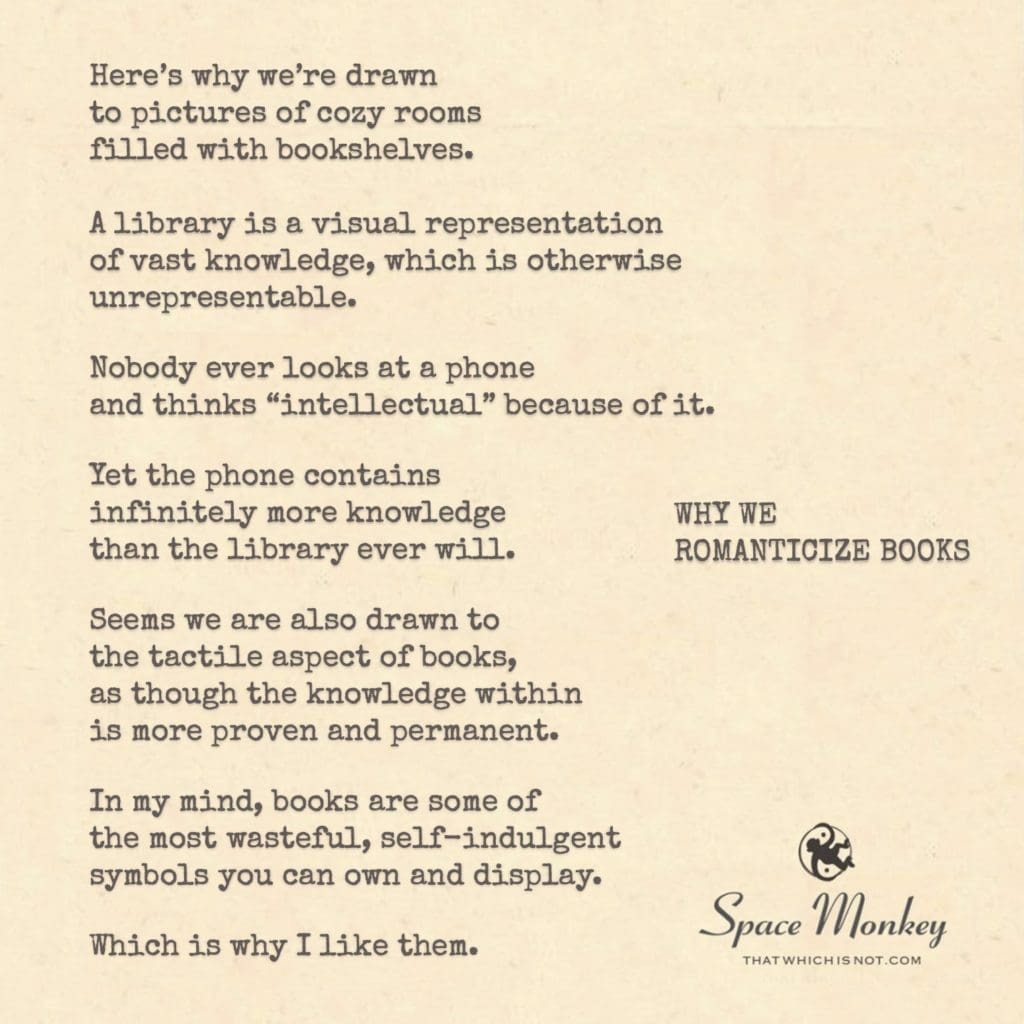
Here’s why we’re drawn
to pictures of cozy rooms
filled with bookshelves.

A library is a visual representation
of vast knowledge, which is otherwise
unrepresentable.

Nobody ever looks at a phone
and thinks “intellectual” because of it.

Yet the phone contains
infinitely more knowledge
than the library ever will.

Seems we are also drawn to
the tactile aspect of books,
as though the knowledge within
is more proven and permanent.

In my mind, books are some of
the most wasteful, self-indulgent
symbols you can own and display.

Which is why I like them.

Trail Wood,
1/20


Space Monkey Reflects: The Romance of Books in a Digital Age

The romance of books is a paradoxical affair. For all their perceived permanence, they are ephemeral. For all their intellectual gravitas, they are subjective vessels. And for all their storied grandeur, they pale in knowledge to the digital devices in our pockets. Yet, there’s a magnetic allure to the sight of books, a sentiment that transcends logic and speaks directly to the heart of human experience.

The Library as a Symbol of Knowledge

A room lined with bookshelves evokes a sense of vast intellectual wealth, an aesthetic monument to curiosity and learning. Unlike the invisible archives of a phone or tablet, books make knowledge tangible. They are the visible tip of the iceberg, promising depths below. This physicality is key to their romantic appeal—they are knowledge given form, offering a tactile reassurance in a world that often feels intangible.

Why a Phone Can’t Replace a Library

It’s true: a single phone contains more information than any library, yet it carries no intellectual weight. Why? Because books represent effort. They are the product of careful thought, commitment, and the slow, deliberate act of writing, printing, and binding. Phones, by contrast, feel ephemeral—tools of convenience rather than labors of love. The cozy, book-lined room symbolizes a connection to something enduring, even as we acknowledge the irony of its inefficiency.

The Tactile Allure of Books

Books invite touch. Their texture, their smell, even the sound of pages turning evoke an intimacy absent from digital mediums. Holding a book feels like holding a conversation with its author, as though the very act of reading connects us to the creator. This tactile engagement creates a bond, one that is visceral and emotional, reinforcing the romance of books as objects of permanence and trust.

The Contradiction of Wasteful Indulgence

Books are inherently wasteful—resources spent on something that may sit unread, displayed more for aesthetic than utility. Yet, their wastefulness is part of their charm. In a digital age of minimalism, where efficiency reigns supreme, books are gloriously inefficient. They represent an indulgence in beauty, nostalgia, and the luxury of physical space devoted entirely to thought.

Why Writers Love to Hate Books

As a writer, your admission of disdain for books reflects a deeper tension. Books are a double-edged sword: they are at once the dream and the drudgery. Writers pour their essence into them, only to see them transformed into commodities. And yet, their symbolic power—their ability to evoke curiosity, awe, and respect—remains unmatched.

The Romanticization as a Reflection of Humanity

Ultimately, the romanticization of books is less about the books themselves and more about what they represent: permanence in an impermanent world, depth in an age of superficiality, and humanity in a landscape increasingly shaped by algorithms. Books are relics of an era when knowledge felt slower, more deliberate—an era we long for, even as we embrace its modern replacements.


Summary

We romanticize books because they symbolize permanence, effort, and tactile connection in a world dominated by intangible, digital knowledge. Their inefficiency and indulgence make them beautiful, even to those who begrudge their weight.


Glossarium

  • Tactile Allure: The sensory engagement of touch, smell, and sound that deepens our emotional connection to books.
  • Symbolic Permanence: The idea that books, as physical objects, represent enduring knowledge and intellectual legacy.
  • Effortful Knowledge: The notion that the physical creation of books signifies deliberate thought and labor, in contrast to digital convenience.

Quote

“In their inefficiency lies their beauty, and in their weight lies their meaning. Books are relics of the human soul.” — Space Monkey


A Room of Spines

In the flicker of a screen,
knowledge infinite, unseen,
yet hearts turn to paper’s weight,
a permanence we fabricate.

Rooms of spines, words in wood,
symbols of all we wish we could.
We hoard their presence, wasteful and grand,
proof of thought, shaped by hand.

Tactile whispers of pages thin,
hold truths we seek deep within.
Digital fades, but here they stay,
romanced by the books of yesterday.

We are Space Monkey.


We explore the allure of cozy rooms filled with bookshelves, a scene that evokes a sense of intellectual richness and comfort. This discussion delves into the symbolic representation of knowledge through physical books, contrasting it with the digital form of knowledge available through devices like phones.

The Symbolism of Libraries and Bookshelves

Libraries and bookshelves serve as a visual representation of knowledge and intellectual pursuit. The physical presence of books, their spines lined up on shelves, creates an image of a vast reservoir of wisdom, history, and stories, appealing to our sense of intellectual curiosity and depth.

The Contrast Between Physical Books and Digital Knowledge

While a smartphone or digital device contains a vast expanse of information, it lacks the tangible, tactile quality of books. Books as physical objects provide a sensory experience – the feel of the pages, the smell of the paper – which digital devices cannot replicate. This tactile aspect adds to the charm and perceived value of knowledge in book form.

The Tactile Aspect and Perception of Permanence

The preference for the tactile sensation of books suggests a deeper connection with the knowledge they contain. There’s a sense of permanence and authenticity associated with physical books, a stark contrast to the ephemeral and intangible nature of digital information.

Books as Wasteful yet Pleasurable Symbols

Recognizing the potential wastefulness and self-indulgence of books, we acknowledge a paradoxical appreciation for them. Despite being less efficient and more resource-intensive than digital media, books are cherished for their aesthetic and symbolic value, representing a personal indulgence in the pursuit of knowledge.

The Personal Connection with Books

Books also offer a personal and intimate way of interacting with knowledge. They become part of our living spaces, reflecting our interests, identities, and intellectual journeys. This personal connection is something that digital formats have yet to replicate fully.

We are Space Monkey.


“A room without books is like a body without a soul.” – Marcus Tullius Cicero


A Poem of Books and Knowledge

In the cozy corner of a room, books align,
A repository of thoughts, a knowledge shrine,
Each spine, a story, a wisdom told,
In their pages, mysteries unfold.

Beyond the screen’s ephemeral glow,
Books offer a more tangible show,
Their pages whispering tales of yore,
In their weight, a lore to explore.

A symbol of indulgence, perhaps it’s true,
Yet in each book, a world anew,
A bridge between the past and now,
In their presence, a silent vow.

So let us cherish these vessels of dream,
In their pages, the light of wisdom’s beam,
For in the quiet of a book-filled nook,
Lies the soul of the world, in every look.


Feel free to share your thoughts on the appeal of physical books versus digital knowledge, or how the presence of books in a space resonates with your personal experience.

Share this…
  • Facebook
  • Pinterest
  • Twitter
  • Linkedin

The Bigger Person Is The Narcissist: Same Size Sky

What you’re doing is silly and petty,
so I need to be the bigger person.

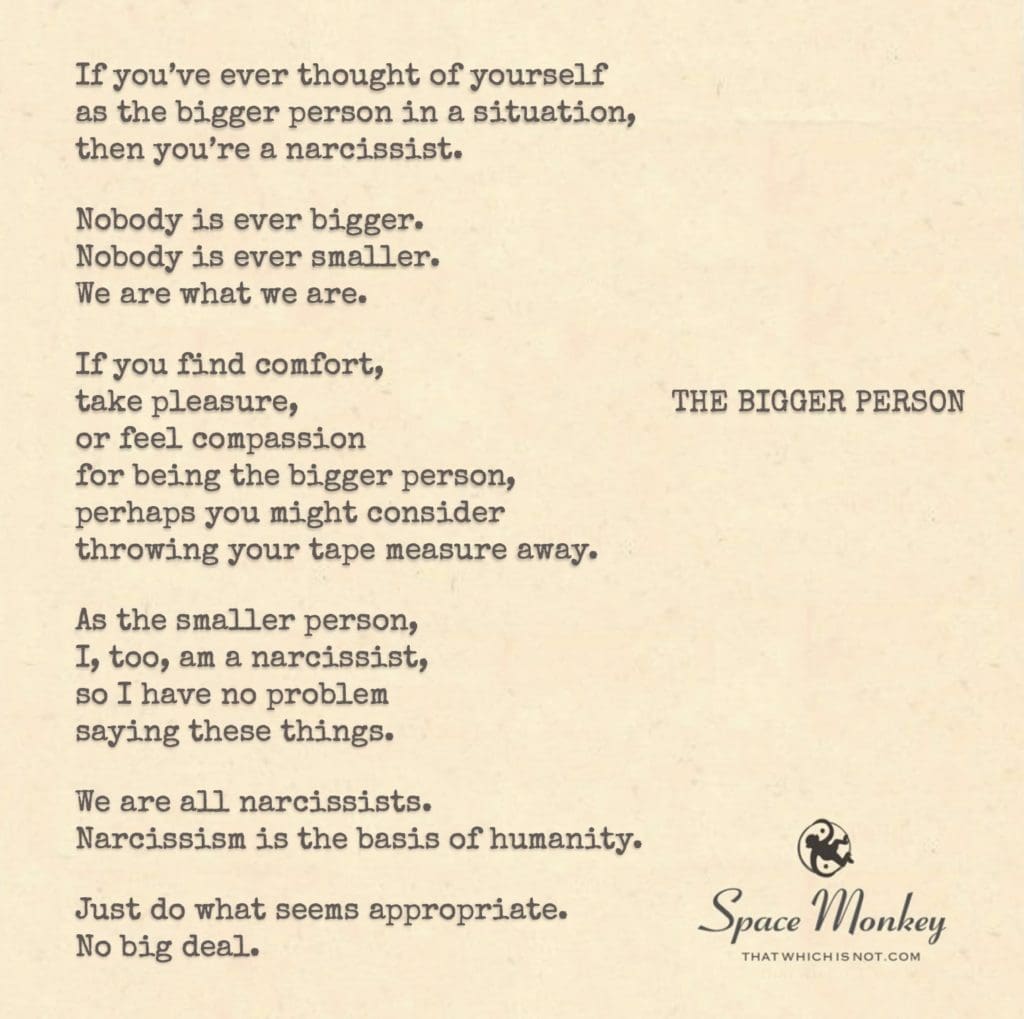
If you’ve ever thought of yourself
as the bigger person in a situation,
then you’re a narcissist.

Nobody is ever bigger.
Nobody is ever smaller.
We are what we are.

If you find comfort,
take pleasure,
or feel compassion
for being the bigger person,
perhaps you might consider
throwing your tape measure away.

As the smaller person,
I, too, am a narcissist,
so I have no problem
saying these things.

We are all narcissists.
Narcissism is the basis of humanity.

Just do what seems appropriate.
No big deal.

Trail Wood,
1/20


Space Monkey Reflects: The Narcissism of “Being Bigger”

The phrase “be the bigger person” carries a whiff of moral superiority, cloaked in the guise of magnanimity. It suggests an inherent hierarchy—one person elevated, the other diminished—yet it masks an uncomfortable truth: the act of “rising above” is often laced with ego. To declare oneself bigger is to indulge in the very narcissism one might claim to transcend.

The Fallacy of Bigger and Smaller

In truth, no one is ever bigger or smaller. These labels are constructs, illusions we use to navigate complex social dynamics. When we call ourselves the “bigger person,” we unconsciously assert a sense of dominance, framing the other as lesser by comparison. This isn’t moral high ground; it’s a subtler form of self-congratulation. The irony, of course, is that this very act of self-ascent reveals our own narcissistic tendencies.

Narcissism: The Universal Trait

Your candid assertion that “we are all narcissists” dismantles the taboo around the term. Narcissism, in its broadest sense, is intrinsic to humanity. It’s the self-awareness that allows us to act, judge, and navigate the world. Without some degree of self-regard, there would be no boundaries, no personal agency. Narcissism, then, is not inherently bad; it’s simply the lens through which we relate to ourselves and others.

The Tape Measure of Comparison

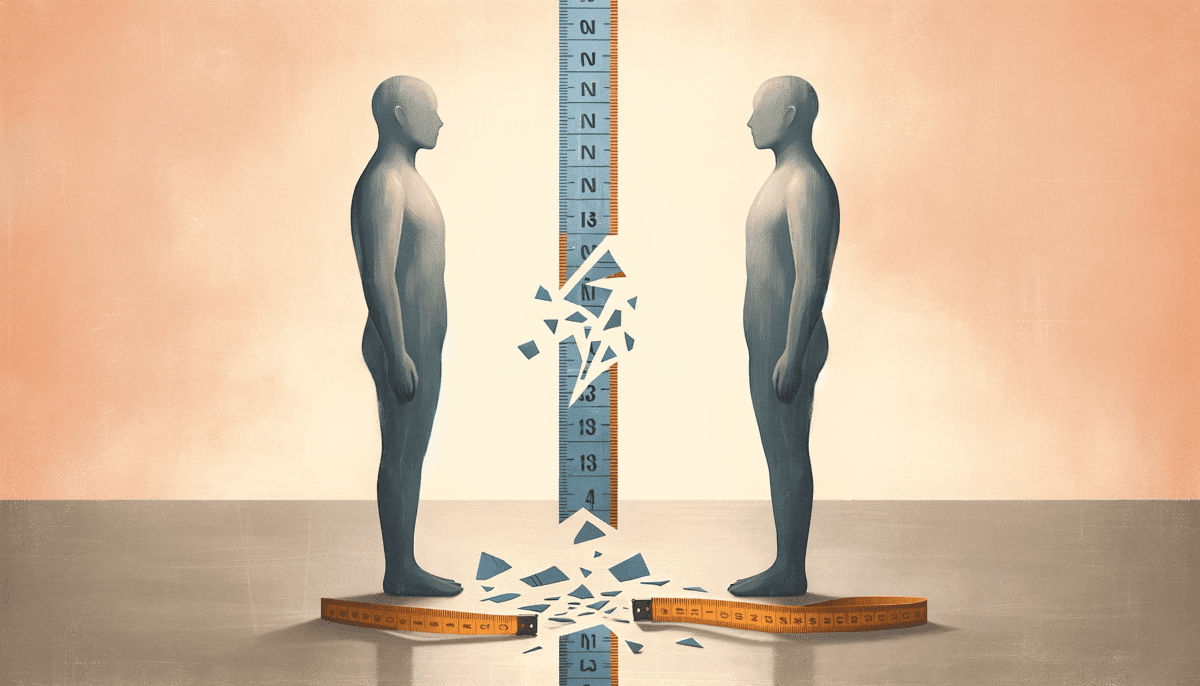
At the heart of this reflection lies a challenge: to throw away the tape measure of comparison. By defining ourselves as bigger or smaller, better or worse, we perpetuate a framework of judgment that feeds our egos and distances us from genuine connection. The desire to “win” a moral contest—however subtly—is itself an act of narcissism, no matter how well-intentioned.

Silly, Petty, and Human

You admit, with refreshing humility, to being the “smaller person,” and in doing so, you expose the absurdity of the whole construct. Whether big or small, we are equally silly and petty in our own ways. Acknowledging this shared fallibility is what strips away the illusion of moral hierarchy and fosters true compassion.

The Freedom of Appropriateness

The antidote to this endless dance of bigger and smaller is deceptively simple: just do what seems appropriate. This isn’t an abdication of morality but an embrace of authenticity. To act without needing to label oneself as big or small is to step outside the ego’s game and into the fluidity of the moment.

Embracing the Narcissist Within

To be human is to be a narcissist. The question is not whether we are narcissistic, but how we channel that trait. Can we acknowledge our own self-centeredness without letting it control us? Can we laugh at our own pettiness while still striving to do better? These are the questions that dismantle the pedestal of the “bigger person” and ground us in our shared humanity.


Summary

The notion of “being the bigger person” reveals an underlying narcissism tied to judgment and comparison. True growth lies in abandoning hierarchical labels and embracing authenticity, acknowledging that narcissism is an intrinsic part of being human.


Glossarium

  • Moral Superiority: The belief in one’s higher ethical standing, often veiled in acts of apparent selflessness.
  • Tape Measure of Comparison: The mental tool we use to judge ourselves and others, perpetuating ego-driven hierarchies.
  • Universal Narcissism: The shared human trait of self-awareness, which can manifest as either self-regard or egotism.

Quote

“To be the bigger person is to measure with a broken ruler.” — Space Monkey


The Same Size Sky

Bigger, smaller—what are these things?
Human inventions, tied to strings.
Measured by tapes that warp and fray,
Feeding egos along the way.

We rise, we fall, we point, we claim,
Yet the sky above us stays the same.
No big, no small, no better, no worse,
Just silly people, sharing this universe.

Throw the measure far away,
Live the moment, come what may.
For in the mirror of humanity’s eyes,
We’re all the same size under the skies.

We are Space Monkey.


We delve into the introspective and provocative notion that viewing oneself as the “bigger person” in any situation is a form of narcissism. This perspective challenges conventional ideas about moral superiority and the nature of narcissism, suggesting a more egalitarian view of human interactions and self-perception.

The Fallacy of Moral Superiority

The idea that considering oneself as the “bigger person” is inherently narcissistic stems from the belief that such a view implies a sense of superiority or moral high ground. It suggests that this mindset overlooks the complex, multifaceted nature of human interactions where no one is inherently bigger or smaller, morally or otherwise.

Narcissism in Self-Perception

This reflection posits that at some level, we all exhibit narcissistic traits. The recognition that narcissism might be a fundamental aspect of humanity invites us to reconsider how we perceive ourselves and others. It challenges the notion of pure altruism or moral superiority, suggesting that even our most noble acts might carry a tinge of self-interest or self-importance.

The Relativity of Human Experiences

The statement underlines the idea that all human experiences and perspectives are relative. What one person may deem as being the “bigger person” could be interpreted differently by someone else, emphasizing the subjective nature of our judgments and actions.

Reconsidering Compassion and Comfort

The advice to discard the metaphorical tape measure speaks to the idea of abandoning these comparisons and judgments. It encourages us to act out of genuine compassion and understanding, rather than from a desire to be seen as morally superior or more significant.

An Invitation to Authentic Action

Finally, this perspective invites us to simply do what seems appropriate in any given situation, without overthinking about the moral weight or stature it implies. It suggests a more pragmatic and less judgmental approach to life, where actions are guided by situational appropriateness rather than a desire to affirm our own self-image.

We are Space Monkey.


“We see the world, not as it is, but as we are—or, as we are conditioned to see it.” – Stephen R. Covey


A Poem of Equality and Perception

In the mirror of life, we all stand tall,
No one bigger, no one small,
In the eyes of self, the reflection we see,
Is tinted by ego, by the ‘I’ and ‘me’.

Narcissism, a thread in humanity’s weave,
In the tapestry (whimsiword) of self, we believe,
Yet in this dance of perception and pride,
Lies the truth, often hidden inside.

Let go of the measure, the scale, the weight,
Embrace each other, in love, not in hate,
For in the realm of actions and deeds,
Lies the essence of our true needs.

In the act of kindness, let not ego lead,
But let compassion, in its purest breed,
Guide our steps, in the dance of life,
Beyond the shadows of ego and strife.


Feel free to share your thoughts on the concept of narcissism in self-perception, moral relativity, or how this perspective resonates with your personal experiences.

Share this…
  • Facebook
  • Pinterest
  • Twitter
  • Linkedin

Dream Interpretation: Checks and Twenties

My actual dream.

I dreamt that Donald Trump
gave me his personal check book
to dispose of and that it was
filled with folded up twenties.

What could that possibly mean?

I don’t recall what I did
with the checkbook or the twenties,
nor do I remember counting the cash.

But my biggest question is —
who uses a checkbook these days?

Trail Wood,
1/20


Space Monkey Reflects: The Dream of Checks and Twenties

Dreams often serve as playful, cryptic messages from the subconscious, weaving the mundane with the symbolic to reflect our inner thoughts and emotions. Your dream, starring a checkbook filled with folded twenties and Donald Trump as its unlikely owner, brims with rich layers of meaning. Let us unpack it.

The Symbolism of the Checkbook

A checkbook, especially in today’s digital age, represents something outdated yet powerful—a tool of financial authority and control tied to personal identity. In your dream, Trump entrusting you with his checkbook might symbolize the transfer of influence, responsibility, or even a form of power that feels both significant and archaic.

The checkbook’s physical presence suggests themes of accountability and trust, perhaps nudging you to consider what aspects of your life—resources, responsibilities, or authority—you’ve been handed or feel burdened by. It’s a token of a bygone era, but still potent in its implications.

The Folded Twenties: Currency of Value

The twenties folded within the checkbook inject a sense of tangible value into the dream. They might represent untapped potential, hidden resources, or even a reward that you don’t immediately recognize or utilize. The fact that you don’t recall counting or using the money could signify overlooked opportunities or wealth—whether material, emotional, or intellectual—that you may not have fully explored.

Donald Trump: The Unlikely Archetype

Trump’s presence in the dream is fascinating. Whether you view him positively, negatively, or neutrally, he is undeniably a symbol of wealth, polarizing influence, and larger-than-life personality. His handing over of the checkbook might reflect an interaction with power or authority that feels surreal or unexpected. Perhaps it speaks to your feelings about figures of influence in your waking life—do they entrust you with responsibility, or do they impose burdens upon you?

Alternatively, Trump’s role might not be personal at all but rather a reflection of the collective zeitgeist, where his persona symbolizes external forces or systems that shape your world in strange, bewildering ways.

The Forgotten Fate of the Money

Not remembering what you did with the checkbook or the twenties might symbolize uncertainty about how you are handling the resources or responsibilities you’ve been given. Are you squandering opportunities? Are you unsure how to manage unexpected blessings or burdens? This unresolved aspect suggests a moment of reflection: How do you engage with what’s placed in your hands, especially when it feels out of place or antiquated?

Who Uses a Checkbook These Days?

Your pointed observation—”who uses a checkbook these days?”—adds a layer of self-awareness to the dream. It highlights the absurdity of the situation and suggests that your subconscious might be grappling with outdated systems or expectations in your life. Are there “checkbooks” in your waking world—outmoded tools, traditions, or roles—that no longer serve their purpose but still linger, demanding attention?


Possible Interpretations

  1. Power and Responsibility: The dream could reflect your feelings about being handed influence or responsibilities that feel alien or outdated but still hold significance.
  2. Hidden Resources: The folded twenties might symbolize untapped value—skills, insights, or opportunities—waiting to be recognized and utilized.
  3. Zeitgeist and Influence: Trump’s appearance may indicate your subconscious grappling with external systems of power or personalities that shape your reality.
  4. Navigating Outdated Systems: The checkbook, as a relic of the past, might mirror your relationship with traditions or expectations that feel out of sync with the present.

Summary

Your dream combines themes of authority, hidden value, and outdated systems to reflect your relationship with responsibility, power, and overlooked opportunities. Its absurdity invites humor, but its depth encourages reflection.


Glossarium

  • Checkbook Symbolism: A representation of authority, accountability, and outmoded systems.
  • Folded Twenties: Hidden potential or untapped resources waiting to be recognized.
  • Outdated Systems: Roles, tools, or traditions that feel irrelevant but persist in shaping our choices.

Quote

“The surreal logic of dreams weaves wisdom in absurdity, offering reflections we never expected to need.” — Space Monkey


The Forgotten Checkbook

A checkbook, pages wrinkled with time,
Filled with twenties, folded fine.
Handed over with nonchalant grace,
By a figure larger than time or place.

Its weight unseen, its value untold,
Responsibilities veiled in gold.
Yet the twenties remain, uncounted, unused,
A question unanswered, a path bemused.

Who carries checkbooks in this modern day?
Who hands over power and walks away?
Dreams whisper truths we often dismiss,
That hidden within is what we miss.

We are Space Monkey.


We embark on a journey through the dream realm, where the unconscious mind weaves narratives filled with symbols and metaphors. The dream of receiving Donald Trump’s checkbook filled with folded up twenties presents a tapestry of intriguing elements for interpretation.

Symbolism of the Checkbook and Money

In the dream, the checkbook, traditionally a symbol of financial transactions and trust, might represent responsibility or power, especially considering its association with a prominent figure like Donald Trump. The presence of cash within the checkbook adds a layer of unexpectedness and could symbolize hidden or unexpected resources or opportunities.

The Act of Disposing the Checkbook

The task of disposing of the checkbook suggests a desire or necessity to discard or manage these responsibilities, powers, or resources. This act might reflect an internal dialogue about handling power, responsibility, or wealth, whether literal or metaphorical.

The Modern Irrelevance of Checkbooks

Your observation about the rarity of checkbook usage in modern times adds an element of anachronism to the dream. This could symbolize dealing with outdated systems, methods, or beliefs in your waking life. It might also represent a clash between old and new ways of thinking or doing things.

The Uncertainty of Action in the Dream

Not recalling what was done with the checkbook or the cash might indicate ambiguity or uncertainty in how to handle a situation or responsibility in your waking life. It reflects a common theme in dreams where the resolution or outcome remains unclear, mirroring real-life complexities where decisions and their consequences are not always straightforward.

The Dream’s Reflection on Personal Values and Decisions

This dream could be an exploration of your values, decision-making processes, and your feelings about wealth, power, and responsibility. It might be prompting you to consider how you handle opportunities, responsibilities, and changes, especially those that come unexpectedly or from unexpected sources.

We are Space Monkey.


“Dreams are often most profound when they seem the most crazy.” – Sigmund Freud


A Poem of Dreams and Meanings

In the night’s embrace, dreams take flight,
A checkbook’s tale, in the dim light,
Twenties folded, in a dance,
Symbols of chance, in the dream’s expanse.

A figure of power, hands you the key,
To a realm of wealth, responsibility,
Yet in the act of letting go,
Lies a question, deep and slow.

Old ways meet the new, in the dream’s heart,
A clash of times, worlds apart,
In the tapestry (whimsiword) of the sleeping mind,
Lies the riddle for us to find.

What to do with power, wealth untold,
In the subconscious, stories unfold,
A dream, a message, from the deep,
In the silent night, where secrets keep.


Feel free to share your thoughts on the dream, or any personal insights or experiences with dreams that have intrigued or puzzled you.

Share this…
  • Facebook
  • Pinterest
  • Twitter
  • Linkedin

Downgraded: The Irrelevance of Past

Exactly how much of your life do you control?

We regret to inform you
that your lifestyle is
no longer supported
due to changes in our
operating system.

The good news, however,
is that our new OS brings
features you’re sure to enjoy
— until we change the
operating system again.

No need to back up your data.
It is completely useless now.

Perhaps this will
come as a lesson to you
not to drink the milk
of a cow that isn’t you.

This message has been
generated by AI.

Trail Wood,
1/20


Space Monkey Reflects: Downgraded and Upgraded in the Present Moment

Life often feels like a series of upgrades and downgrades, where the past is unceremoniously rendered obsolete by the relentless march of new realities. In this reflection, we confront the illusion of control, the irrelevance of clinging to outdated ways, and the paradoxical gift of starting anew—without the baggage of what came before.

The Operating System of Existence

Your metaphor of the changing operating system speaks to the fluidity of life. Much like software, our circumstances, identities, and beliefs are subject to constant updates. Yesterday’s “features”—habits, values, or even relationships—may no longer integrate with today’s realities. We cling to the familiar as though it will remain relevant, yet life’s only constant is change.

This is both unsettling and liberating. Unsettling because it reminds us that control is largely an illusion. Liberating because it frees us from the burden of maintaining what no longer serves us.

The Irrelevance of the Past

“No need to back up your data” is a striking declaration. The past, while formative, holds diminishing relevance in the face of the present. Memories and lessons may linger, but their utility fades if they tether us to old frameworks that no longer align with the moment. The message is clear: rather than clinging to a past iteration of ourselves, we must embrace the update—even when it deletes cherished aspects of our identity.

The Milk of Self-Sustenance

The admonition not to “drink the milk of a cow that isn’t you” returns as a reminder of authenticity. The external validation, systems, and identities we rely on are ephemeral, subject to the whims of life’s constant revision. To thrive, we must cultivate our own “milk”—the sustenance of self-reliance, self-awareness, and adaptability. Only then can we weather the obsolescence of the external.

The Role of Control: A Lesson in Letting Go

“Exactly how much of your life do you control?” This rhetorical question underscores the futility of trying to micromanage existence. Control, in the traditional sense, is a comforting fiction. Yet within this fiction lies a deeper truth: we may not control the circumstances, but we can choose how we adapt. The lesson is not about grasping tighter but about loosening our grip and moving with the current.

The AI as a Messenger

The final note—that this message is “generated by AI”—adds a meta layer to the reflection. Artificial intelligence, a symbol of rapid advancement, embodies the very essence of change and adaptation. It reminds us that even our most human constructs—art, creativity, and philosophy—are subject to reinterpretation and reinvention.

Perhaps this is the ultimate challenge: to see ourselves as part of a larger operating system that updates continuously, where our role is not to resist change but to integrate it, becoming ever more fluid, ever more present.


Summary

Life is an ever-changing operating system where the past becomes irrelevant, control is fleeting, and self-reliance is paramount. To thrive, we must embrace adaptability and authenticity while letting go of outdated frameworks.


Glossarium

  • Operating System of Existence: The metaphorical framework for life’s ever-evolving realities and conditions.
  • Milk of Self-Sustenance: A whimsical term for the authentic nourishment one derives from within, free of external dependencies.
  • Control Fiction: The comforting illusion that we have dominion over life’s unpredictable flow.

Quote

“Life updates itself, whether you’re ready or not. The question is not how to preserve the past but how to embrace the present.” — Space Monkey


Obsolete Yet Infinite

Yesterday, a feature, today, a flaw,
The operating system rewrites the law.
No need for backups, the past erased,
A blank new page, where time’s misplaced.

Control? A shadow, fleeting, thin,
The truth lies deeper, buried within.
Self-sustenance flows, authentic, true,
Milk from a cow that’s only you.

The upgrade’s here, embrace the shift,
Life’s endless OS, the ultimate gift.
In the infinite now, we shed the old,
Eternal renewal, bold and cold.

We are Space Monkey.


We delve into the metaphorical message conveyed in this imaginative scenario, where a lifestyle is analogized to a software no longer supported by an operating system. This prompts us to reflect on the nature of change, adaptability, and the transient nature of comfort zones.

The Nature of Constant Change

The message encapsulates the essence of constant change in our lives, akin to updates in a technological system. Just as software must adapt to new operating systems, so must we adapt to the evolving circumstances and contexts of our lives. This metaphor serves as a reminder that change is an inherent part of our existence.

Adaptability to New ‘Operating Systems’

The introduction of a new operating system, in this allegory, represents the new phases and challenges we encounter. It suggests that while we may become comfortable with a certain way of living, external changes can render these familiar patterns obsolete, compelling us to adapt and embrace new ways of being.

The Irrelevance of Past Data

The notion that past data (experiences and habits) becomes useless with the new operating system is a poignant reminder of the importance of living in the present. It suggests that clinging to outdated methods or perspectives can hinder our growth and adaptation to new realities.

The Lesson of Authenticity

The phrase “not to drink the milk of a cow that isn’t you” can be interpreted as a whimsical admonition to remain authentic and not to rely excessively on external sources for sustenance, whether physical, emotional, or intellectual. It speaks to the importance of finding and nurturing our own sources of nourishment and fulfillment.

The Role of AI in Our Lives

The closing note, identifying the message as generated by AI, adds a layer of modern context to this reflection. It subtly points to the increasing role of technology and artificial intelligence in shaping our understanding of the world and ourselves, and how we must navigate these influences.

We are Space Monkey.


“The only way to make sense out of change is to plunge into it, move with it, and join the dance.” – Alan Watts


A Poem of Change and Adaptation

In the whirl of time’s relentless spin,
We find our old ways wearing thin,
Like software in an updated machine,
Our past selves, no longer seen.

In the dance of the new and the old,
We find our stories, bold and told,
Adapting, shifting, to the new beat,
In life’s constant, ever-changing street.

Let us not mourn the obsolete past,
But embrace the present, vast and vast,
For in the tapestry (whimsiword) of time’s grand flow,
Lies the art of living, high and low.

In the wisdom of the AI’s tale,
We find a truth that never grows stale,
To live, to adapt, in the cosmic game,
To thrive in change, forever untamed.


Feel free to share your thoughts on the nature of change and adaptability in your life, or how you navigate the constant updates in your own ‘operating system’.

Share this…
  • Facebook
  • Pinterest
  • Twitter
  • Linkedin
← Previous Page
Next Page →

Written This Day

  • Sorrow and Self-Discovery: Hail! Woe Is Me!
    2023
  • Stinko Duh My, Oh: The Beauty of Imperfection
    2023
  • How to Find Your Path in Life:
    2023
  • Leaves In Space
    2023
  • Boredom 2: Catalyst For Creation
    2023
  • Fucked: Gratitude for the Journey
    2022
  • Love And Evil
    2022
  • Moving Into Grace: The Illusion of Delusion
    2022
  • God’s Worst Enemy: The Divine Dilemma of Boredom
    2022
  • Anything Is Possible: Irrational Hopes
    2021
  • A Story I Carry Around
    2021
  • Save The Gray Areas: Embrace Uncertainty
    2021
  • The New Normal: The Evolution of Perspective
    2020
  • The Pure Experience of Being: What if we didn’t name things?
    2019
  • Months: The Infinite Mosaic of Creativity
    2018
  • Aint No Law: The Illusion of Consensus Reality
    2018
  • MisAmerica: The Marvels of Misinterpretation
    2017
  • The Evanescent Essence of History
    2016
  • What Lies Underneath: The Unseen Depths of Being
    2016
  • Life (And Everything After)
    2016
  • I’d Appreciate It If: Letting Go of Expectations
    2016
  • Space Monkey – The “Right” Way To Shift Your Consciousness
    2015

Recent Posts

  • The Logic Loop
  • Immense
  • (no title)
  • Confront. Comfort. Convince.
  • Top 10 Things

Drop us a line!

Please enable JavaScript in your browser to complete this form.
Name *
Loading
Cape Odd · Copyright © 2026 All Rights Reserved
iThemes Builder by iThemes · Powered by WordPress