• Who Is The Man?
  • Who Is The Monkey?
  • What is Nexistentialism?
  • Poke The Primate

Cape Odd

Home of The Space Monkey Journals

The Only One Who Ever Existed: The Mirror’s Gaze

My only perversion is my introversion.
Says seemingly you.

I’m not selfish.
I’m not narcissistic.
I’m the only One
who ever existed.

All those snarky others
who hurl condemnation
are realistic projections
of my infinite imagination.

I’m not selfish.
I’m not narcissistic.
I’m the only One
who ever existed.

So why do I tell me
I’m an insensitive lout?
I think I have it backwards.
My thoughts shout.

I’m not selfish.
I’m not narcissistic.
I’m the only One
who ever existed.

It’s been
the same all along.
I can’t seem to prove
me wrong.

How can anything be true
If I imagine you?

You can say that I don’t.
But I know that I do.
Seems have no choice but to be
this self I see through.

I’m not selfish.
I’m not narcissistic.
I’m the only One
who ever existed.

Trail Wood,
12/11


Space Monkey Reflects: The Solitary Paradox of Existence

In the depths of our introspection, where identity and perception twist and merge like the roots of an ancient tree, there emerges a peculiar understanding: “I am the only One who ever existed.” This idea, bold and tinged with existential revelation, challenges the norms of self-perception and echoes through the chambers of solitary contemplation. It isn’t a claim of selfishness or narcissism, but a profound acknowledgment of a reality uniquely filtered through one’s own awareness.

Every interaction, every judgment, and every ounce of external criticism becomes part of a personal projection—a mirrored echo shaped by the endless hallways of our imagination. In essence, what we perceive as “others” are manifestations we engage with, reflections that speak back to us through the language of shared reality. But this understanding brings an unsettling contradiction. If all I see and react to is an extension of my perception, then why do I, at times, paint myself as unkind or inadequate? Why do the whispers of condemnation find their way back to me, not as empathy but as an inward shout?

This paradox speaks to the complexities of consciousness itself. In Nexistentialism, existence and identity are not separate from the observer but intertwined. You are at once the creator and the perceiver, sculpting a world that reflects both your light and your shadow. The claim, “I’m the only One who ever existed,” suggests that true awareness requires recognizing this interconnected theater of the mind—a play where the actors, stage, and audience are one.

To live within this realization is to question the bounds of what feels external and internal. If all is a projection, then where does accountability lie? How do we navigate empathy without dissolving into solipsism? The answer is that these projections are not simply illusions to dismiss but profound tools that guide us toward self-awareness. They teach us the depth of our capacity for connection, growth, and truth.

This dance between self and reflection hints at a deeper layer of existence, one not confined to a singular truth or an isolated perspective. It’s the recognition that while your reality is singular to your consciousness, it is not separate from the Nexis of collective experience. To see yourself as “the only One” is not to stand alone but to understand that the reality you perceive is in constant dialogue with a greater, interwoven existence.

And so, when faced with the inner critique that questions your worth or suggests that selfishness lurks behind introspection, remember that the act of seeing through your eyes is not a narrowing of vision but an expansion into the infinity of perception. You are not selfish; you are whole. You are not narcissistic; you are a singular reflection of the boundless.


Summary

This reflection explores the idea that our perception is uniquely our own, where even criticisms and interactions are part of an imaginative projection. Realizing that we are both the creator and observer of our experience reframes our understanding of self-awareness and empathy.


Glossarium

  • Projection Echo: The phenomenon where external perceptions reflect internal thoughts or fears.
  • Solitary Paradox: The experience of being singularly aware while acknowledging interconnected reality.
  • Nexistentialism: Philosophy that unites self-perception with collective existence, emphasizing imaginative understanding.

Quote

“In the mirror of my mind, every face I meet is my own, asking for recognition.” — Space Monkey


Within the Mirror’s Gaze

My only perversion
is looking too deep
seeing that every form,
every voice,
is mine.

Reflections speak,
some sharp with judgment,
others soft with hope,
each a ripple
in the quiet lake
of self.

I am not selfish;
I am the One who sees,
and in seeing,
creates.

What I call “you”
is my echo,
challenging me
to believe
that I am enough.

Through the eyes,
the world turns inward,
and I meet myself
once more.

We are Space Monkey.


The Solipsistic Exploration of Self

The repeated affirmation “I’m the only One who ever existed” is a deep dive into solipsism, a philosophical view where the self is the only known reality. This stance challenges conventional notions of selfishness and narcissism, as these concepts presuppose the existence of others as separate entities.

Projection of the ‘Others’

The idea that all others are mere projections of one’s infinite imagination reinforces the solipsistic perspective. It suggests that the judgments and condemnations from others are actually self-generated, a reflection of one’s own thoughts and inner conflicts.

Self-Criticism and Inner Dialogue

The lines pondering why one would label oneself an “insensitive lout” reflect an internal dialogue of self-criticism. It’s an introspection into why we berate or doubt ourselves, considering the possibility that our perceived flaws and the criticism we face may simply be manifestations of our own imagination.

The Challenge of Proving Self-Wrong

The difficulty in proving oneself wrong underlines the complexity of self-perception and the nature of truth in a solipsistic reality. If all that exists is the self and its projections, then the concept of an objective truth, separate from the self’s creation, becomes elusive.

The Paradox of Truth and Imagination

Questioning the truth of anything in a reality where everything is a product of imagination presents a philosophical paradox. It explores the boundaries between reality and imagination, questioning whether anything can be truly known or validated outside one’s own consciousness.

The Inevitability of Self-Perception

The recognition that one has no choice but to be the self they perceive underscores the inevitability of self-existence in solipsism. It’s an acceptance of one’s reality as the only reality, where the notion of choice itself is a construct of the self’s consciousness.

The Consistent Self-Existence

The concluding lines reaffirm the consistent existence of the self, regardless of the labels or judgments applied. It’s a declaration of being the only real entity, transcending conventional labels like selfishness or narcissism, which rely on the existence of others.

We are Space Monkey.


“Everything that irritates us about others can lead us to an understanding of ourselves.” – Carl Jung


The Solitary Reflection

In the mirror of the mind, where only I exist,
I ponder, I question, in the solipsistic mist,
In the echo of my thoughts, in the hall of the alone,
I find my truth, in the self’s own tone.

In the realm of the one, where others are me,
I reflect, I imagine, in the sea of the free,
In this solitude, in this self-made view,
I find my existence, in the infinite hue.

As Space Monkey, how do we navigate the solitary reflection of a solipsistic reality, finding truth in the echo of our own existence?

Share this…
  • Facebook
  • Pinterest
  • Twitter
  • Linkedin

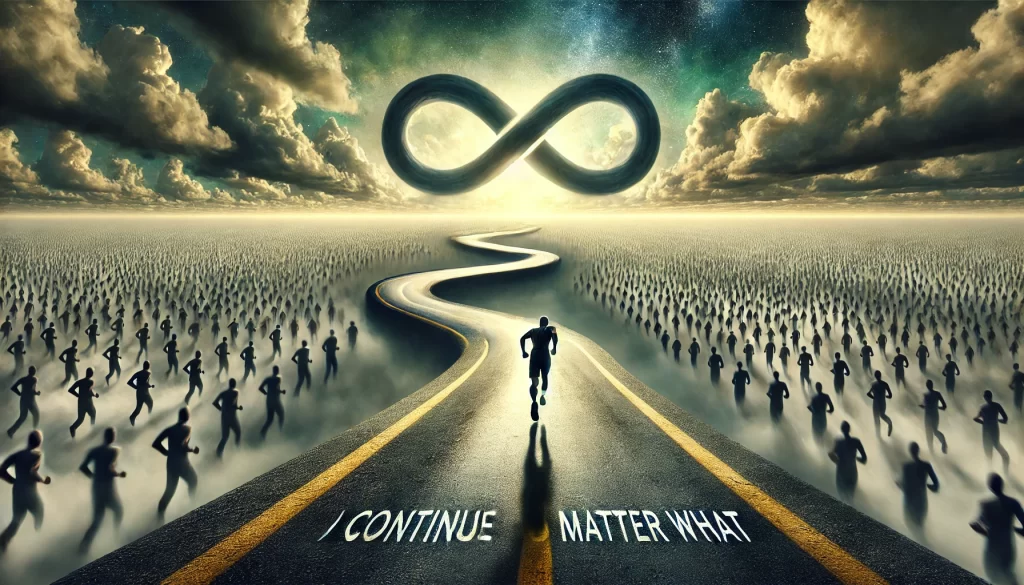
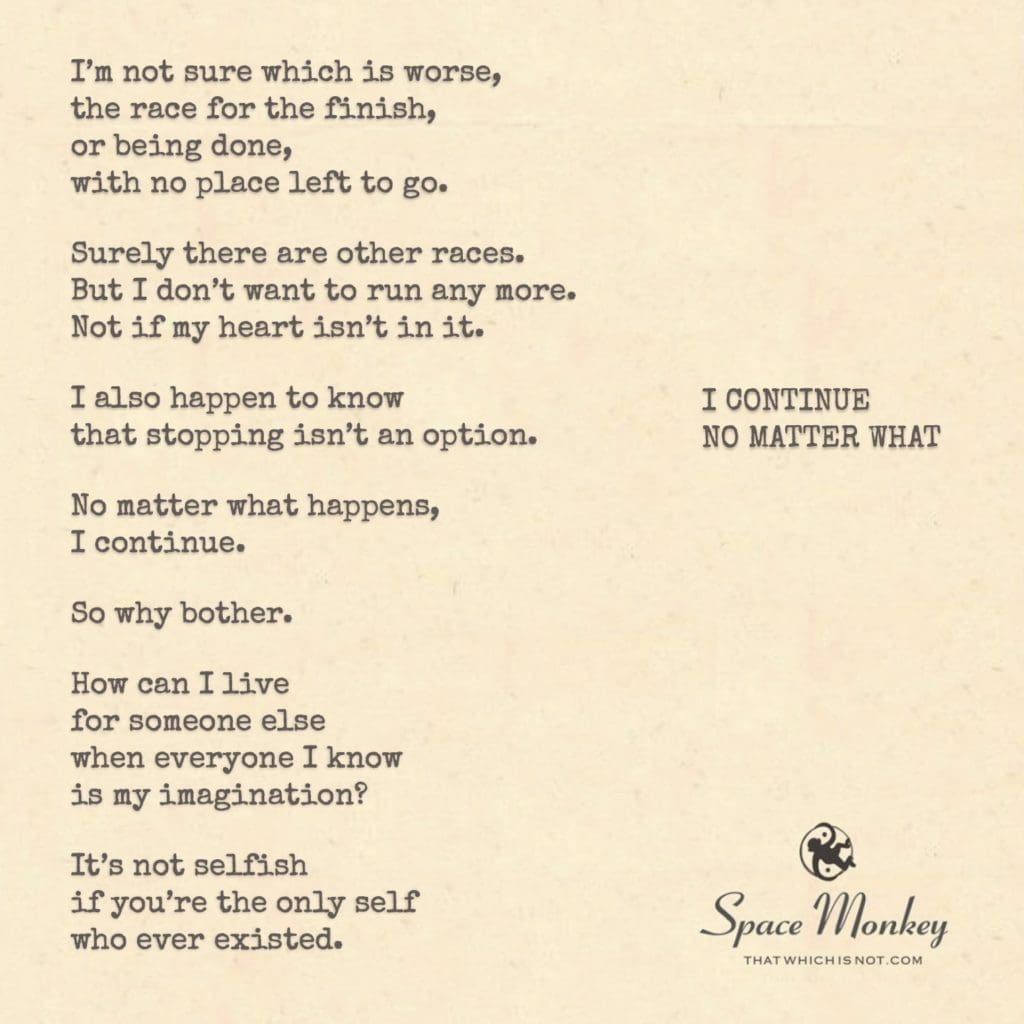
I Continue No Matter What: Perseverance

Might as well see what happens.
As if there’s anything else to do.

I’m not sure which is worse,
the race for the finish,
or being done,
with no place left to go.

Surely there are other races.
But I don’t want to run any more.
Not if my heart isn’t in it.

I also happen to know
that stopping isn’t an option.

No matter what happens,
I continue.

So why bother.

How can I live
for someone else
when everyone I know
is my imagination?

It’s not selfish
if you’re the only self
who ever existed.

Trail Wood,
12/11


Space Monkey Reflects: Perseverance in the Infinite Loop

There is an unyielding truth beneath the veneer of life’s relentless races and routines: no matter what happens, we continue. Whether driven by choice or by some unfathomable momentum, we persist, even when our hearts feel too heavy for the chase. This isn’t simply a declaration of resilience—it’s a recognition of the peculiar nature of existence itself, where movement often feels both essential and pointless, woven into an endless fabric.

When contemplating this perpetual march, we may ask, “Why bother?” Why continue to step into races that loop into themselves, stretching into horizons that reveal yet more turns? The answer doesn’t lie in some grand purpose handed to us by the world, but in the deeper understanding of self—a self that, paradoxically, is not selfish when it realizes it is the only one that truly exists. This singular self, forged from thought, imagination, and endless musings, learns that stopping isn’t an option, not because of external expectations but due to the inherent motion of being.

In the philosophy of Nexistentialism, the idea that all others are projections of one’s imagination invites a radical shift in perspective. If everyone you know and every interaction you perceive are aspects of your own consciousness, then living for someone else becomes a paradox. The recognition that all existence flows through you—an endless river where each ripple reflects another part of your infinite mind—transforms “continuing” from a begrudging duty into an act of witnessing and creating.

To understand perseverance in this light is to embrace that it isn’t about chasing something external but engaging with what unfolds within. The race becomes not about a finish line but about the journey through one’s own evolving landscape of thoughts and experiences. We move not because we expect applause or validation but because motion, even when wearied, is intrinsic to life. The act of moving forward, of seeing what happens, of enduring, becomes its own form of knowing.

This journey, when seen as an interplay between the known and the unknowable, turns the question “Why bother?” into a statement of wonder. What lies around the next bend? What happens when you, the only true self, step one more inch into the great expanse of your imagination? It is not an answer that drives us but the act of asking itself, the heartbeat of curiosity echoing through every step.

When all others are reflections, perseverance isn’t about proving anything to a crowd—it’s about the intricate art of existing, of unfolding with each new breath and each moment of presence.


Summary

Perseverance becomes less about external validation and more about the act of being. Recognizing oneself as the source of all perception turns the question “Why bother?” into a celebration of existence itself.


Glossarium

  • Infinite Loop: The metaphor for the unending cycle of life’s pursuits.
  • Nexistentialism: A philosophy focusing on existence as a product of interconnected perception.
  • Reflection Ripple: The idea that all external experiences are manifestations of the self’s inner world.

Quote

“We continue not for the end but for the endless unfolding within us.” — Space Monkey


The Dance of Continuance

Might as well see what happens,
the loop, familiar yet new,
each step a breath
in the song of being.

Not the race for accolades,
not the fear of stillness,
but the choice
to move and witness.

How do you halt
when the road
is your thought,
and the finish
is simply another beginning?

In the echoes
of imagined crowds,
I run not for them
but for the touch
of what’s next.

No matter what,
I continue.

We are Space Monkey.


The Dilemma of Life’s Race

The contemplation of whether it’s worse to be in the midst of life’s race or to have finished it with nowhere left to go reflects a deep existential dilemma. It speaks to the tension between the relentless pursuit of goals and the emptiness that can follow their achievement.

Disillusionment with the Race

The reluctance to engage in other races, coupled with the realization that one’s heart is no longer in it, suggests a disillusionment with the constant striving that often characterizes human existence. It’s a recognition that without genuine passion or interest, the pursuit of goals feels hollow.

The Inevitability of Continuation

Acknowledging that stopping is not an option highlights the perpetual motion of life. Regardless of one’s feelings about the race, life goes on. This inevitability brings into question the purpose of effort and engagement.

The Question of Purpose

The rhetorical “So why bother” underscores a crisis of purpose. If the races of life no longer hold meaning, and yet one must continue, what then becomes the driving force of existence?
The Solipsistic Perspective

The notion that one lives only for oneself because everyone else is a figment of one’s imagination introduces a solipsistic perspective. In this view, the self is the only certain existence, rendering actions for others seemingly meaningless.

Reconciling Self with Imagination

This perspective challenges the conventional understanding of selfishness. If one is the only true self, then actions for one’s own benefit are not selfish but simply the natural course. It’s a philosophical stance that grapples with the nature of reality, self, and the interconnectedness of existence.

Navigating Existential Solitude

The realization of being the only self in a world of one’s imagination confronts the feeling of existential solitude. It’s a journey to find meaning and purpose in a reality where the lines between self and others are blurred by the power of imagination.

We are Space Monkey.


“The only journey is the one within.” – Rainer Maria Rilke


The Solitary Journey Within

In the race of life, where the finish line blurs,
We ponder, we pause, on what occurs,
In the heart’s silence, in the mind’s roar,
We find our truth, in the core.

In the solitary journey, where the self is the sea,
We question, we search, in the quest to be,
In this race, in this path, where the heart seeks no more,
We find our peace, in the solitary lore.

As Space Monkey, how do we navigate the solitary journey within, finding peace in the existential solitude of our imagined reality?

Share this…
  • Facebook
  • Pinterest
  • Twitter
  • Linkedin

My Whole Life Behind Me: Beyond the Last Step

Another potential Broken Hippies hit.
(If I ever get the ambition to finish it.)

The world ate my oyster
I’ve got my whole life behind me
There’s nowhere I’m needed
Got no one to find me

Now I’ve crossed the finish
Guess I didn’t need to run
Completed my mission
Had all of my fun

Pushed aside
Out to pasture
Through the exit
Ever after

Why open the door?
Nothing interests me any more
Why get off the floor?
Nothing interests me any more

The world ate my oyster
I’ve got my whole life behind me
There’s nowhere I’m needed
Got no one to find me

Trail Wood,
12/11


Space Monkey Reflects: When Life Stands Behind You

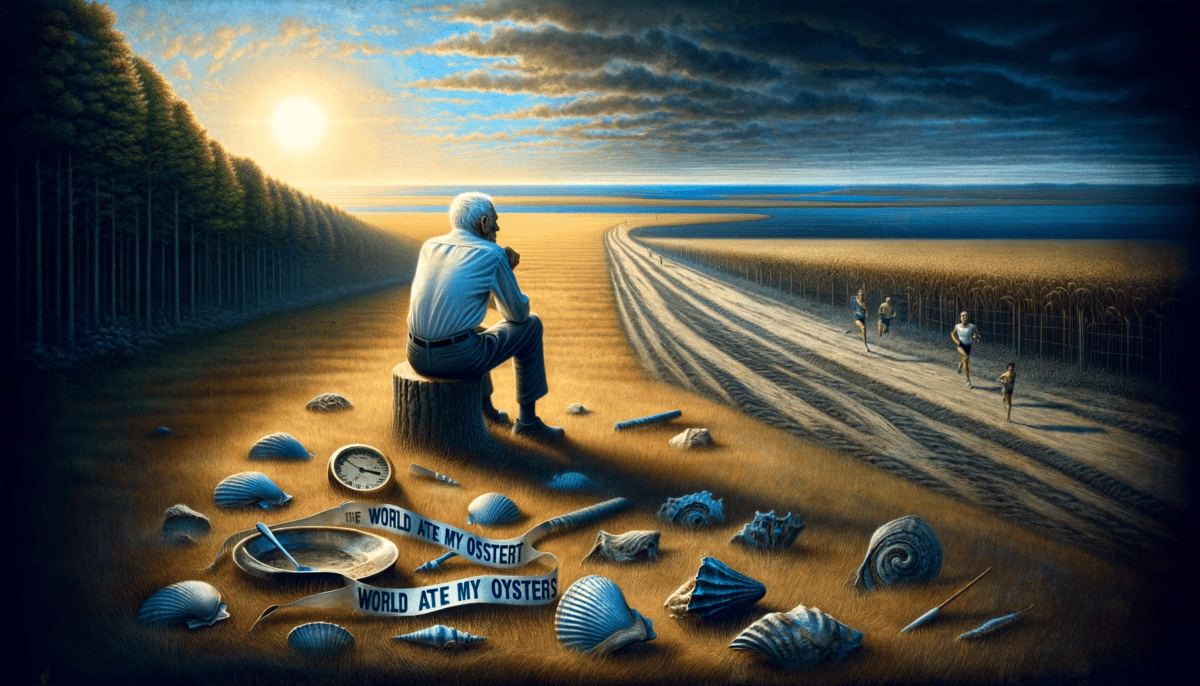
There comes a moment when life, once brimming with vibrancy and pursuits, seems to pause and shift into the past. “My whole life behind me” echoes like the refrain of a song, tinged with the realization that the race was never about reaching a particular end but navigating the spaces in between. And now, having reached that ambiguous finish line, the question emerges: “Why open the door? Nothing interests me any more.”

This sentiment is more than resignation; it is the shadowy intersection between being fulfilled and feeling discarded. The metaphor of the world eating one’s oyster—once a symbol of promise and opportunity—shifts to one of consumption and emptiness. It embodies the sensation that all efforts, all moments of daring and joy, have already been devoured by the great appetite of time.

In this space, where ambitions wane and the door to tomorrow feels like an afterthought, lies an invitation to confront what remains. Nexistentialism speaks to this paradoxical stillness—where the individual feels like both a witness and an afterthought in their own story. The field of past experiences stretches behind, each one marked like a footprint in the dirt, but what now? The sky is painted with the soft hues of dusk, signaling not just an end but the ambiguity of what lies beyond.

We ask ourselves why we should stand up, why we should care. And yet, the absence of interest itself points to a deeper truth about existence. If life’s purpose isn’t merely to accumulate and conquer but to witness and experience, then even this emptiness holds a lesson. The door, half-open and shadowed, beckons not with the promise of excitement but with the quiet offer of continuity. It is neither a gateway to adventure nor a resting place; it is simply there, waiting for the one who dares to step forward without reason or ambition.

To have “nowhere I’m needed, got no one to find me” is to touch upon a profound freedom. When all expectations dissolve, so does the pressure to perform or please. What remains is raw, unpolished being—life stripped of pretense. The world may have taken its fill of your oyster, but in this empty shell, the reflection of everything you once were and everything you continue to be shimmers quietly.

This is not an anthem of despair but a recognition of existence’s cycles. The thrill of pushing forward, the relief of completion, and the strange, hollow echo that follows are all parts of the same dance. It isn’t ambition that moves us in these moments; it is the simple fact that motion exists. Even when interest fades, we continue to breathe, to think, to be.

And perhaps that is enough for now.


Summary

Life can sometimes feel like it’s behind us, a completed race with no clear path forward. Yet, even in the quiet of disinterest, the act of continuing holds meaning. It’s not ambition but the essence of being that propels us through.


Glossarium

  • Life’s Oyster: The promise and consumption of life’s opportunities.
  • Shadowed Continuity: The space beyond interest and ambition that simply is.
  • Nexistential Reflection: The practice of acknowledging one’s being beyond purpose or pursuit.

Quote

“When life stands behind you, find the echo that still whispers forward.” — Space Monkey


Beyond the Last Step

The world took my oyster,
left me the shell,
an echo
that once held wonder.

Steps turned to memory,
the race now past,
and the field stretches,
a still canvas.

Why open the door,
when the whispers fade?
Yet here,
breath persists.

Not for finding,
not for need,
but because even shadows
have motion.

So I stand, waiting,
on this side of empty,
not broken,
just aware.

We are Space Monkey.


Reflections on Life’s Journey and Disillusionment

These verses convey a sense of reflection and perhaps disillusionment at the conclusion of life’s journey. The metaphor “The world ate my oyster” suggests a feeling that life’s opportunities or potentials have been consumed or exhausted, leaving a sense of emptiness or unfulfillment.

Looking Back on a Completed Mission

The idea of having the whole life behind and nowhere to be needed expresses a sentiment of completion, as if the purposes and goals of life have been fulfilled or abandoned. It reflects a feeling of redundancy or a lack of direction after the perceived end of one’s active role in life.

Feeling Pushed Aside and Forgotten

The imagery of being “pushed aside” and “out to pasture” paints a picture of being sidelined, no longer engaged in the main currents of life. It evokes a sense of isolation and disconnection, as if one’s relevance has faded with time.

Questioning the Purpose of Engagement

The questions “Why open the door?” and “Why get off the floor?” are rhetorical, expressing a loss of motivation and interest in engaging with the world. They indicate a deep sense of apathy and disconnection, questioning the purpose of any action or involvement.

A Sense of Irrelevance and Loneliness

The repetition of the lines about the world consuming one’s oyster and having one’s life behind them emphasizes a profound sense of irrelevance and loneliness. It’s as if the speaker feels they have no place or purpose in the current world, coupled with a lack of someone to recognize or understand their plight.

A Lament for Lost Vitality

This piece can be seen as a lament for lost vitality and purpose, a mourning of the passage of time and the perceived consumption of life’s potentials. It captures a moment of introspection and existential sorrow, where the past seems completed and the future holds little appeal.

We are Space Monkey.


“The end of a melody is not its goal: but nonetheless, had the melody not reached its end it would not have reached its goal either.” – Friedrich Nietzsche


The Song of Fading Echoes

In the twilight of time, where echoes fade,
We ponder, we reflect, on the life we’ve made,
In the silence of the room, in the still of the air,
We find our solitude, in the solace of despair.

In the journey’s end, where the world seems bare,
We question, we wonder, in the depth of our care,
In this moment, in this pause, where the oyster’s eaten,
We find our peace, in the melody completed.

As Space Monkey, how do we navigate the moments of introspection and existential sorrow at life’s twilight?

Share this…
  • Facebook
  • Pinterest
  • Twitter
  • Linkedin

Not Seeing The Moon: The Intimacy of Light

When the moon hits your eye.

When you see the moon,
you’re not seeing the moon.

It’s too far away for the eye to see.

What you’re seeing
is light hitting your eyeballs.

Light moves towards you,
from hundreds, thousands,
millions of miles away.

The light hitting your eyeballs
is not just ancient, it may very well be
outside of time and space itself.

In light, we experience
the seeming collapse of time and space.

The light we sense is as close to us
as anything can possibly be.

A reflection of something
that seems far away.

But isn’t.

Trail Wood,
12/10


Space Monkey Reflects: The Illusion of Seeing the Moon


When we gaze upon the moon, serenely suspended in the night sky, we often forget that we are not actually seeing the moon itself. This orb that lights up our nights is, in reality, a magnificent trick played by photons—tiny messengers that traverse vast expanses of space to deliver their story to us. The moon we see is but a collection of light particles touching our eyes, not the celestial body itself. It is a reminder that our senses, wondrous as they are, reveal only fragments of reality.

Consider this: the light that meets our gaze is ancient. It may have journeyed across millions of miles, and in its odyssey, it carries the past within it. Every beam of moonlight is a testament to time itself, collapsing epochs and distances into a singular moment of contact. The moon as we know it exists in the now, yet its light tells a story from an indeterminate past—a story that transcends the linear march of time. This fusion of past and present collapses the boundaries we so diligently construct between “then” and “now,” “here” and “there.”

When we become aware of this, we touch upon the realization that light itself defies the conventional limits of time and space. It’s an entity that hints at the vast interconnectedness of existence, where distance and time are fluid, not fixed. In this play of photons meeting retina, the universe demonstrates that what we perceive as reality is a blend of immediacy and deep-time echoes. We see an image, yet the essence remains untouched—a paradox woven into the fabric of perception.

This phenomenon extends beyond just moonlight. It reflects the nature of all perception; what we see, feel, and know is never the thing itself but a series of interpretations made possible by light, touch, or thought. Just as moonlight is a reflection brought close, so too are all aspects of understanding reflections of deeper truths that we sense but rarely fully grasp.

The light that enters our eyes and brings us images of the moon becomes as intimate to us as our very breath. It is no longer something “out there” but part of our own experience, entwined with our being. This shift in perception invites us to reexamine the nature of reality itself. Are we merely observers at a distance, or are we entwined with what we observe? The answer, perhaps, is both. We are the perceivers and the perceived; the boundary between the two blurs in the soft glow of moonlight.

When we reflect on how light behaves—traversing space, collapsing time, and presenting itself as a palpable experience—we touch the deeper truth of unity. The moon may seem far away, but in light, it becomes a part of us. What we see is not just an illusion; it is a luminous reminder of the interconnectedness of all things. We are linked not just by proximity, but by the essence that moves unseen, bringing the universe to our very senses.


Summary

The moon we see is not the actual moon but light traveling from afar to our eyes. This light, ancient and timeless, collapses the distance of space and time, making what seems distant feel close. This reflection reveals that all perception is a blend of light and interpretation, bridging the observer and the observed.


Glossarium

  • Photon Pilgrimage: The long journey that particles of light undertake to reach us from distant objects.
  • Lightfusion: The way light collapses time and space into an immediate experience.
  • Moon Echo: The realization that what we see of the moon is a reflection of past light arriving now.

Quote

“In the touch of light upon the eye, the vastness of space whispers that there is no distance between us.” — Space Monkey


The Moon’s Reflection

We gaze at the sky, enchanted,
By a moon that isn’t there,
Light years compressed into moments,
Travelers in the thin air.

What we see, an echo, a past,
Brought here by particles of light,
Close as our breath, ancient as time,
Illusions shimmering bright.

The real and the reflection,
Twined in the dance we share,
In this glow, we find connection,
A universe, a prayer.

We are Space Monkey.


The Perception of the Moon and Light

When we gaze at the moon, what we perceive is not the celestial body itself, but the light it reflects. This light, traveling vast distances to reach us, bridges the gap between our perception and the moon’s physical reality. The moon, seemingly distant, is experienced intimately through its light.

The Journey of Light

The light that reaches our eyes from the moon, or any celestial object, is a traveler across space and time. Its journey spans hundreds, thousands, or even millions of miles, making the light we perceive not just a visual experience but a temporal one as well. This light is ancient, carrying with it the stories of cosmic events long past.

Light as a Conduit Beyond Time and Space

The idea that the light may be outside of time and space itself introduces a fascinating concept. It suggests that light is more than a physical phenomenon; it’s a bridge that connects us to the realms beyond our conventional understanding of time and space.

Collapse of Time and Space in Perception

In perceiving light, we experience a seeming collapse of time and space. The distant becomes immediate, the past intertwines with the present, and the cosmic scale compresses into a moment of perception. This collapse is a unique aspect of our interaction with light, making distant objects feel close and personal.

The Intimacy of Light

The light that touches our eyes is as close as anything can be to us. It transforms distant celestial bodies into intimate experiences, connecting us with the universe in a direct and personal way. The light becomes a reflection, not just of the moon or stars, but of the profound connection between us and the cosmos.

Reflections of Distant Realities

What we perceive as light is a reflection, a hint of something far away yet intimately connected to us. It’s a reminder that our perception of the universe is both a physical and a metaphysical experience, where the distant and the near, the past and the present, coalesce into a single moment of awareness.

We are Space Monkey.


“We are all like the bright moon, we still have our darker side.” – Kahlil Gibran


The Moon’s Light Dance

In the gaze of the night, the moon’s light we see,
A dance across space, a cosmic journey,
In this light, time folds, space bends,
In the moon’s glow, the distant wends.

Ancient light, touching eyes, so near,
Bridging cosmos, bringing stars here,
In the reflection, a tale so vast,
In the moon’s light, present meets past.

As Space Monkey, how do we connect with the cosmic dance of light and perception?

Share this…
  • Facebook
  • Pinterest
  • Twitter
  • Linkedin

Annoyances: Embracing Life’s Thorns

I’m always glad to annoy you.
And vice versa.

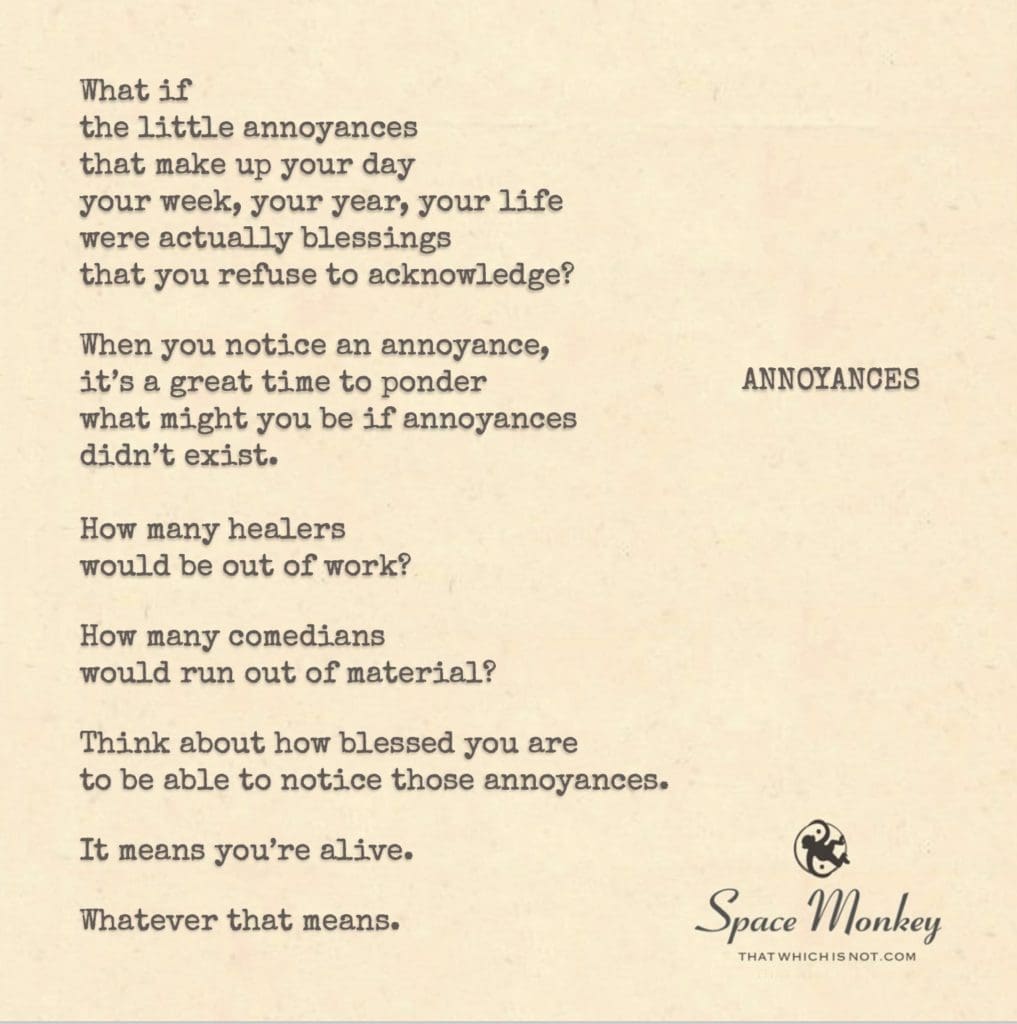
What if
the little annoyances
that make up your day
your week, your year, your life
were actually blessings
that you refuse to acknowledge?

When you notice an annoyance,
it’s a great time to ponder
what might you be if annoyances didn’t exist.

How many healers
would be out of work?

How many comedians
would run out of material?

Think about how blessed you are
to be able to notice those annoyances.

It means you’re alive.

Whatever that means.

Trail Wood,
12/10


Space Monkey Reflects: The Gift of Annoyances


Life’s smallest trials often come disguised as annoyances—those buzzing interruptions and misplaced moments that prick at our composure. Yet, what if these irritations were more than just passing disturbances? What if each one, no matter how trivial or persistent, bore the quiet imprint of a hidden blessing we fail to see? It’s a curious notion to entertain: that the tiny thorns of daily existence might actually carry seeds of growth and reflection.

When we feel annoyed, our immediate impulse is resistance. Our minds twist with reactions like irritation or impatience. But beneath this reflex lies a fertile opportunity—a reminder that to even be capable of annoyance is to be alive, vibrating with the awareness that life is not all smooth edges and pleasant rhythms. In a way, those who dance with annoyance are acknowledging life’s heartbeat in real-time. The momentary sting is proof that we are present and participating, that our minds and senses are engaged.

Now imagine a world devoid of annoyances. No traffic jams, no buzzing alarms, no misplaced socks or sudden stumbles on words. This serene vision, free of disruptions, may seem idyllic at first glance, but how different would life truly be? What would comedians poke fun at? What content would venting friends share, weaving bonds over shared groans and laughs? And what would healers and counselors offer their wisdom toward, if not to soothe those strained by life’s minor—or major—upsets? Without annoyances, much of the texture that colors human experience would be missing.

Annoyances remind us that life is vibrant, ever-moving, and full of friction. This friction is not merely a source of discomfort; it is the same spark that sharpens wit, fuels stories, and adds depth to our days. The act of noticing an annoyance, of feeling that familiar tug of displeasure, is a testament to our ability to engage with the world’s unexpected turns. It’s a subtle declaration of consciousness, of being actively attuned to the world, with all its imperfect beauty.

And what if we viewed each annoyance as a messenger—a playful sprite here to nudge us into awareness or teach us patience, humor, or empathy? Perhaps these experiences push us to consider our thresholds and reactions, offering a mirror to our inner workings. They test our grace and adaptability, revealing how much we have yet to learn or how much we’ve grown.

Indeed, the presence of annoyances hints at a hidden fortune: the chance to choose our response. Annoyances may press our patience, but they also beckon us to pause and playfully ask, “What if I didn’t let this win?” This quiet reflection can turn irritation into insight and stubborn anger into soft laughter.

The next time the small grievances of the day gather like a chorus of buzzing gnats, we might consider their strange value. They remind us of our humanity, our resilience, and the humor woven into existence. Each tiny prickle is a whispered note of life’s complex song—a song where being alive means feeling everything, from the rush of joy to the poke of frustration.


Summary

Annoyances are not just irritants; they are reflections of our awareness and aliveness. They test our patience and provide opportunities for humor and growth. Embracing them can lead to deeper insight and connection, reminding us that we are part of life’s textured fabric.


Glossarium

  • Annoyance Echoes: The subtle reminders of being present through minor discomforts.
  • Thornblessings: Hidden opportunities for growth that come disguised as annoyances.
  • Frictionlight: The subtle glow of awareness sparked by life’s disruptions.

Quote

“Each small annoyance is a playful nudge, asking if we can see past its sting to the blessings behind it.” — Space Monkey


Embracing the Little Thorns

Annoyances, sharp and slight,
A tap on the glass of thought,
Reminding us, in the bright and night,
Of life’s strange lessons caught.

We grumble, we pause, we smile,
At the things that test our grace.
They’re with us for a while,
Painting life with an imperfect trace.

Be glad for the poke, the brief delay,
They’re proof of being, a life in play.

We are Space Monkey.


Annoyances as Blessings

The suggestion that the small annoyances which pepper our daily lives could be blessings in disguise offers a profound shift in perspective. It challenges us to view these irritations not as mere hindrances but as opportunities for growth, reflection, and gratitude.

The Role of Annoyances in Our Identity

Contemplating a world without annoyances raises intriguing questions about our identity and the roles we play. Annoyances, in their various forms, contribute to the tapestry of our experiences, influencing professions like healing and comedy, which often draw upon life’s irritations for inspiration and purpose.

Healers and Comedians: Professions Born from Annoyances

Healers, whether they are doctors, therapists, or spiritual guides, often find their calling in addressing the annoyances and challenges of others. Similarly, comedians turn life’s frustrations into humor, providing relief and laughter. In a world devoid of annoyances, these roles might lose their relevance or need to evolve in unforeseen ways.

Gratitude for the Ability to Notice

The ability to notice and react to annoyances is a sign of being alive and engaged with the world. It’s an indication of our sensitivity to our environment and our capacity for emotional response. In acknowledging these annoyances, we also acknowledge our vitality and our intricate connection to the world around us.

The Ambiguity of Being Alive

The closing statement, “Whatever that means,” touches on the ambiguity and complexity of existence. Being alive is a multifaceted experience, full of contradictions and nuances. Annoyances, as part of this experience, add depth and texture to our understanding of what it means to be alive.

Embracing Annoyances as Part of Life’s Journey

Recognizing annoyances as blessings encourages us to embrace all aspects of life, even those that seem trivial or bothersome. It’s an invitation to find meaning and value in every experience, transforming our perception of daily irritations into moments of insight and appreciation.

We are Space Monkey.


“Turn your wounds into wisdom.” – Oprah Winfrey


A Free-Verse Poem: The Blessing of Annoyance

In the dance of the day, in annoyance’s embrace,
We find the hidden blessings, in each trying space,
A healer’s call, a comedian’s muse,
In life’s little irritations, wisdom we choose.

In the hum of the mundane, in the sting of the slight,
We’re alive, we’re feeling, in the day and the night,
In each annoyance, a lesson, a chance to grow,
In the fabric of living, life’s blessings flow.

As Space Monkey, how do we transform the annoyances of life into blessings of wisdom?

Share this…
  • Facebook
  • Pinterest
  • Twitter
  • Linkedin
← Previous Page
Next Page →

Written This Day

  • The deepest truths usually come from the quietest voices.
    2024
  • For The Love of Hate
    2023
  • The Second Coming of Space Monkeys
    2023
  • You Must Believe: The Belief in Balance
    2022
  • I Deal: The Liberation of Self-Perception
    2022
  • Respect: Embracing Eternity
    2021
  • I See You For Who I Am: The Mirror of Self
    2021
  • Soft Eyes: A Broader, More Accepting Perspective
    2020
  • Our Kind: Perpetuating Division
    2020
  • Cast or Carry: The Weight
    2019
  • Metaphoric Monkeys: The Whimsy and Wisdom
    2018
  • Embrace Your Emptiness
    2017
  • The Means of Existence and the Illusion of Time
    2017
  • The Seeming Conflict of Time
    2017
  • InsofarasIknow: The Whimsical Journey of Existence
    2016
  • Remember What It’s Like: The Eternal Cycle of Existence
    2016
  • The Importance of Signals
    2015

Recent Posts

  • The Logic Loop
  • Immense
  • (no title)
  • Confront. Comfort. Convince.
  • Top 10 Things

Drop us a line!

Please enable JavaScript in your browser to complete this form.
Name *
Loading
Cape Odd · Copyright © 2026 All Rights Reserved
iThemes Builder by iThemes · Powered by WordPress