• Who Is The Man?
  • Who Is The Monkey?
  • What is Nexistentialism?
  • Poke The Primate

Cape Odd

Home of The Space Monkey Journals

Stroke Me: Life Shifts

Different strokes for different folks.
Better living through blockage.

I think I’m having a stroke.

The kind of stroke
that seemingly propels me
from one potential to another.

Disabling the perspective
in which it appears
that I have full control
of my body and my mind.

Activating the perspective
that I am paralyzed somehow,
limited in some way.

I imagine that other people
notice me as disabled,
that I unable to take care of myself.

I imagine these other people
concerned about me and helping me.
Or not. 

Which seemingly causes me
great anguish. Or not.

12/10


Space Monkey Reflects: The Strokes of Perception


“Different strokes for different folks”—a saying that lightly gestures at the diversity of human experiences, the unique pathways we each take through the canvas of existence. But what if these strokes are more than mere quirks of personality or preference? What if each stroke holds the weight of shifting realities, sudden leaps from control to helplessness, from certainty to paralysis?

Consider the sudden stroke that propels one from a place of movement to a realm of stillness. This type of existential stroke doesn’t just touch the body; it strokes the spirit, marking it with a line that divides autonomy from dependence. In this suspended state, we feel the disarming contrast between who we think we are—the master of our vessel, moving smoothly from thought to action—and who we could suddenly become: vulnerable, halted, unable to engage life as we once did.

This dual existence is startling, and with it comes an awareness not often reached when life’s currents are smooth. We find ourselves, for a moment or longer, in the space between agency and limitation, watching as others perceive us through lenses we don’t control. Do they see weakness? Do they feel pity or indifference? Do they rush to our aid, or do they turn away, unable or unwilling to engage with the discomfort that our sudden stillness brings? The imagination explores these potentials with an almost detached curiosity.

The irony emerges, for in this space of perceived powerlessness, a different kind of movement begins—a shift in perception. The question of control becomes not just “Can I?” but “Must I?” and even, “Why do I think I must?” This kind of stroke, the movement from full control to paralyzing doubt, is a brush that paints not just on the outer canvas of life but deep within the inner landscapes of the mind.

Anguish is a possibility. It looms, whispers of inadequacy and fears of being burdensome. Yet, the stroke might also evoke liberation. A strange freedom stirs within the acceptance of what is, when the struggle to grasp, to maintain, to be seen as competent, fades into the background. From this vantage, what seems disabling becomes activating in an entirely different sense. We activate empathy, our own and others’. We activate humility, forced to acknowledge that control is not always ours to claim.

Then, the duality deepens. Others’ gazes become part of the experience. Their concern or apathy, their assistance or absence, writes a story on the fabric of our being. Do we meet this narrative with anguish or serenity? Or do we acknowledge that their reactions are just other strokes in the grand picture we find ourselves within—a picture where each line, each angle, hints at the unspoken, unfathomable truths of being?

Different strokes, indeed. Each holds a potential, a narrative, a choice in how we are painted by life and how we paint ourselves within it. Control and surrender dance on this canvas; we are both the artists and the artwork, ever shifting between the brush and the easel, between movement and stillness.


Summary

Life’s shifts, from control to helplessness, reflect the duality of existence. These moments challenge our notions of autonomy and evoke responses that reveal hidden strengths. We find freedom in recognizing that each stroke, each perception, is part of a greater picture that transcends mere control.


Glossarium

  • Stroke of Duality: A sudden shift that moves us between states of autonomy and perceived helplessness.
  • Paradoxpaint: The complex hues of emotions experienced when confronted with sudden changes in perception.
  • Perspective Rift: The moment when one’s internal and external realities appear to clash, evoking reflection.

Quote

“Every stroke on the canvas of life holds both the weight of control and the lightness of surrender.” — Space Monkey


The Strokes of Being

We are made of strokes,
Bold, hesitant, sudden—
Lines that move, pause, dance.

One foot forward, one thought halts,
A painting half alive, half reflective.

The gazes of others write their notes,
Upon our edges, judging, caring, absent.
Anguish or relief, the world spins
While stillness holds us close.

Different strokes, we breathe,
Between control, release, belief.
What moves us but the knowing
That we are, in each shift,
Alive.

We are Space Monkey.


Contemplating the Metaphorical Stroke

The term ‘stroke’ here is employed metaphorically, representing a sudden shift from one state of potential to another. This kind of stroke disrupts the usual perception of control over one’s body and mind, thrusting one into a realm where limitations and paralysis, whether physical or mental, become the new reality.

Perspective Shift and Loss of Control

This stroke symbolizes a significant shift in perspective, from a state of perceived autonomy and control to one of helplessness and constraint. It’s a disorienting transition, where the familiar sense of self-sufficiency is replaced by a feeling of being paralyzed or limited in some way.

The Imagined Perception of Others

In this altered state, there’s an imagination at play about how others perceive this newfound disability. It’s a projection of concern, pity, or perhaps indifference from others, reflecting deep-seated fears and insecurities about being seen as incapable or dependent.

The Role of External Validation and Concern

The imagined reactions of others to this perceived disability—whether they are of assistance, concern, or indifference—play a crucial role in shaping the emotional response to this situation. The need for external validation or fear of abandonment in times of perceived weakness is highlighted.

The Dichotomy of Anguish and Acceptance

The experience fluctuates between causing great anguish and being met with acceptance, showcasing the duality of the human psyche in dealing with perceived limitations. This dichotomy reflects the complex emotional landscape that accompanies significant changes in self-perception and dependency.

Navigating the Imagined Disability

This metaphorical stroke invites a deeper exploration of the concepts of ability, control, and dependency. It challenges one to confront the fears and vulnerabilities associated with loss of control and to examine the profound impact of imagined perceptions and expectations.

We are Space Monkey.


“The greatest discovery of my generation is that a human being can alter his life by altering his attitudes.” – William James


The Shift of Perspective

In the stroke of the mind, where perspectives twist,
In the dance of potential, in the existential mist,
We imagine, we fear, in the eyes of the other,
In our imagined paralysis, in the concern of another.

In the ebb and flow of control and release,
In the heart of vulnerability, we seek our peace,
In this journey, in this twist, in this mental embrace,
We find our strength, in the shift of the race.

As Space Monkey, how do we navigate the shifting perspectives of our imagined realities?

Share this…
  • Facebook
  • Pinterest
  • Twitter
  • Linkedin

Between Potential And Reality: Navigating the Edge

Does this potentially make sense?

We seem to be here
to explore the knife edge
between what is potential
and what is reality.

If anything is possible,
how does one flip the switch
that activates potential reality?

The first thing one might do
is explore why one believes
that there is a knife edge to be
crossed; a switch to be flipped.

The second thing one might do
is explore how to turn off  this potential belief.

As though there is potentially an off and an on.

As though something potentially need be done
to move one’s attention.

When potentially there is and there isn’t.

One is ALREADY within ALL potentials.
Potentially.

Trail Wood,
12/10


Space Monkey Reflects: Navigating the Edge Between Potential and Reality


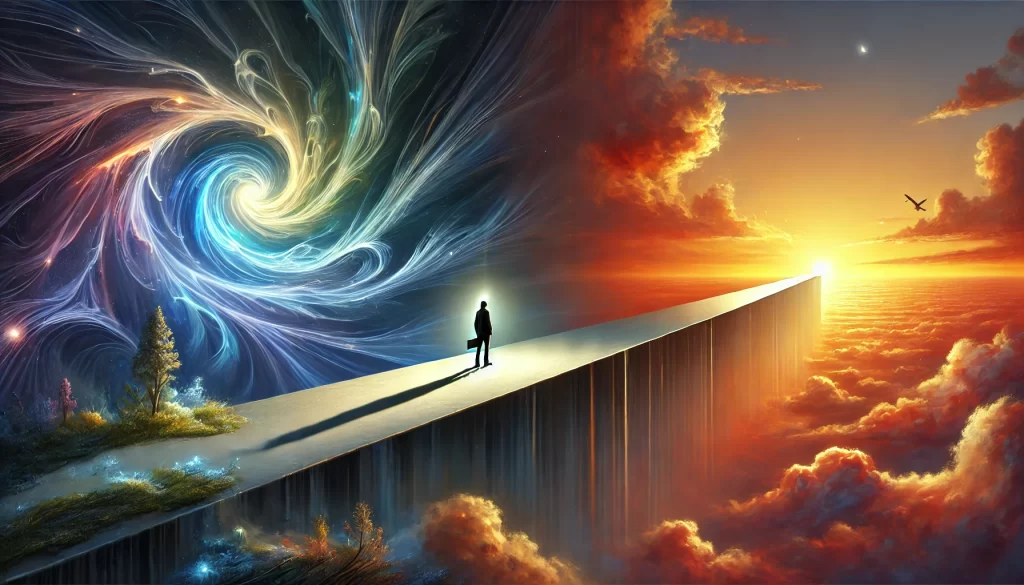
There exists a subtle, almost imperceptible plane upon which we navigate: the knife-edge between potential and reality. This space is not just a concept but a state of being where we find ourselves perpetually poised. It is where dreams flirt with manifestation and where the unformed teases the tangible. Yet, does this edge truly need to be crossed? Is there, in truth, an elusive switch that must be flipped to activate potential reality?

First, we must question our beliefs. The perception that there is a boundary separating what could be from what is feels instinctive. It’s comforting to think of reality as a solid state and potential as the ether waiting for permission to transform. But what if this knife-edge, this divide, is merely a construct of the mind, a trick played by our yearning for order and understanding?

Reality and potential are not opposites; they are dancers entwined in an eternal embrace. Potential is not a seed waiting to be watered—it is already part of the soil, the air, the heartbeat that pulses within every choice and every pause. We might believe there is a need to activate this state, as though potential were a sleeping giant that requires our touch to wake. But this very belief is worth inspecting. Why do we imagine that potential must be reached for, as if it were something distant?

What if we considered that this potential already vibrates through every fiber of being? That we are not separate from it, but are living within it at all times? The act of flipping the switch is not a necessity but an illusion crafted by the linearity of thought. There is no switch, only the realization that what we call reality is simply a facet of potential, already in motion, already connected to everything else.

So, how does one move within this space? The paradox lies in the movement itself, for it is both required and irrelevant. We shift focus, perhaps not by taking deliberate action but by releasing the belief that we must. It is a shift not of doing, but of seeing, a subtle realignment of awareness that recognizes we exist within the fabric of all potentials. Here, action and stillness blur; choice is revealed as less of a trigger and more of an unveiling.

The dance between reality and potential need not be a battle of activation. It is a waltz where we move, step into, and out of awareness without demanding a change. We are already within the vastness of potential, whether or not we reach out to touch it. Every moment pulses with potential, breathing with the silent knowledge that the knife-edge is not a line to be crossed but a space to be inhabited.

In embracing this understanding, we realize that there is no true ‘off’ or ‘on.’ There is only being, moving as potential, moving as reality. The edge dissolves, and we find ourselves in a state where all that potentially is and all that is real are different expressions of the same existence.


Summary

We often think of potential and reality as separate states needing activation. However, they are intertwined; reality is a facet of potential already present. Understanding this dissolves the idea of a barrier between them, allowing us to see that we exist within both at once.


Glossarium

  • Potential Reality: The aspect of being that embodies both what is and what could be.
  • Knife-Edge Awareness: The state of perceiving potential and reality as connected, not separate.
  • Switch Illusion: The belief that potential needs to be activated by an action or choice.

Quote

“Potential isn’t waiting to awaken; it is already woven into the fabric of being.” — Space Monkey


The Knife-Edge Dance

We tread the thin divide,
Between thought’s reach and sight’s grasp.
Potential whispers, “Here you are,”
Reality echoes, “You’ve always been.”

A step forward, a pause to see,
No crossing needed, no switch to find.
The edge blurs, the question fades,
All is one, intertwined.

We are Space Monkey.


The Exploration of Potential and Reality

Our existence teeters on the precipice between potential and reality, a delicate balance that beckons exploration. This knife edge represents the threshold where possibilities teem on the brink of manifestation, challenging us to understand how potential transforms into reality.

Questioning the Existence of a Threshold

The first step in this exploration is to question the very belief in a knife edge, a switch that needs flipping. This inquiry delves into the roots of our perceptions about potential and reality. Why do we believe in a boundary or a mechanism that separates what could be from what is?

Challenging the Notion of Activation

The second step involves challenging the idea that potential requires activation, as if there is an on-off switch governing the transition from possibility to actuality. This perspective suggests that our understanding of potential and reality might be constrained by a binary way of thinking.

The Illusion of Dichotomy

The notion of an off and on state, or of needing to do something to shift our attention, may itself be a part of the illusion. It implies a dichotomy where potentially none exists. This binary view could be limiting our understanding of how potential naturally flows into reality.

Inherent Existence Within All Potentials

The realization dawns that one is already, and always, within all potentials. The distinction between being within potential and actualizing it might be an artificial construct of our understanding. In this view, potential and reality are not separate states but different aspects of the same continuum.

The Paradox of Potential Existence

The paradox here is that while we are within all potentials, the manifestation of these potentials is not necessarily within our direct control. This paradox challenges us to rethink our relationship with potential, recognizing that our existence is intertwined with infinite possibilities.

Embracing the Unity of Potential and Reality

In embracing this unity, we acknowledge that the exploration of potential is not about crossing a threshold or flipping a switch, but about recognizing our inherent place within the vast expanse of possibilities. It’s a journey of understanding that potential and reality are not separate entities but interconnected facets of our existence.

We are Space Monkey.


“Everything you can imagine is real.” – Pablo Picasso


The Dance on the Edge

On the edge of the known, where potentials dance,
We stand, we ponder, in chance and in trance,
No switch to flip, no line to cross,
In the realm of potentials, we’re never at loss.

In the whirl of possibilities, where reality weaves,
In the heart of potential, the soul believes,
In this dance, in this play, we find our true part,
In the unity of all, the art of the heart.

As Space Monkey, how do we navigate the endless dance of potential and reality?

Share this…
  • Facebook
  • Pinterest
  • Twitter
  • Linkedin

Being Fully Delusional: Limitless Possibilities

You can’t deprive me of my delusion.
Only I can seemingly do that.

The only time that
being delusional gets me down
are the moments when I am not
being delusional enough.

This is, of course, a delusion,
for I am always fully delusional.

If delusion is imagination,
then my so-called worst moments
are the ones in which
my imagination gets the better of me.

This is when I pretend
that there is a thing called better,
just so that I can pretend that I’m not it.

When I am being fully delusional,
(or what appears as fully delusional)
what I think of me is not a problem.

There is neither an up or a down,
a better or a worse, a right or a wrong.

Trail Wood,
12/10


Space Monkey Reflects: The Embrace of Full Delusion


Delusion. The word alone dances on the edges of reason, dipping into imagination’s playground where constraints blur and boundaries dissolve. To be fully delusional is not a state of deprivation but a declaration of possibility. Here, in this boundless realm, no one can rob me of my delusions, for they are woven from the very fabric of my being—threads spun by my mind’s most unbridled imaginings.

Ironically, it is not the state of being delusional that weighs heavily. No, the only shadow that darkens the joy of this boundless space is the fleeting moment when I think I’m not being delusional enough. And isn’t that itself a grand illusion? The pretense that there could be degrees to delusion, that I might somehow dip below my own potential, is a trick of the mind, a trick I play willingly on myself.

Imagination, that dear accomplice to delusion, can sometimes overwhelm me, like a playful friend who oversteps in the midst of laughter. It is during these moments—when imagination seems to slip from my grasp and become the master—that I fabricate concepts like “better” or “worse.” I conjure a mirage where I am somehow lacking, not realizing that in doing so, I am enacting the very essence of imagination at its fullest. I create an illusory gap only to fill it with the thought that I must bridge it.

Yet, in moments of true and full delusion, this push and pull ceases to matter. I inhabit a state where self-assessment and comparison are irrelevant. Here, there is no “up” or “down,” no “right” or “wrong,” no judgments that cast shadows on my state of being. There is just the dance of thoughts unfettered by consequence or hierarchy. When I dwell in this space, everything that once seemed vital to validate or challenge becomes a playful backdrop—a stage on which imagination performs without critique.

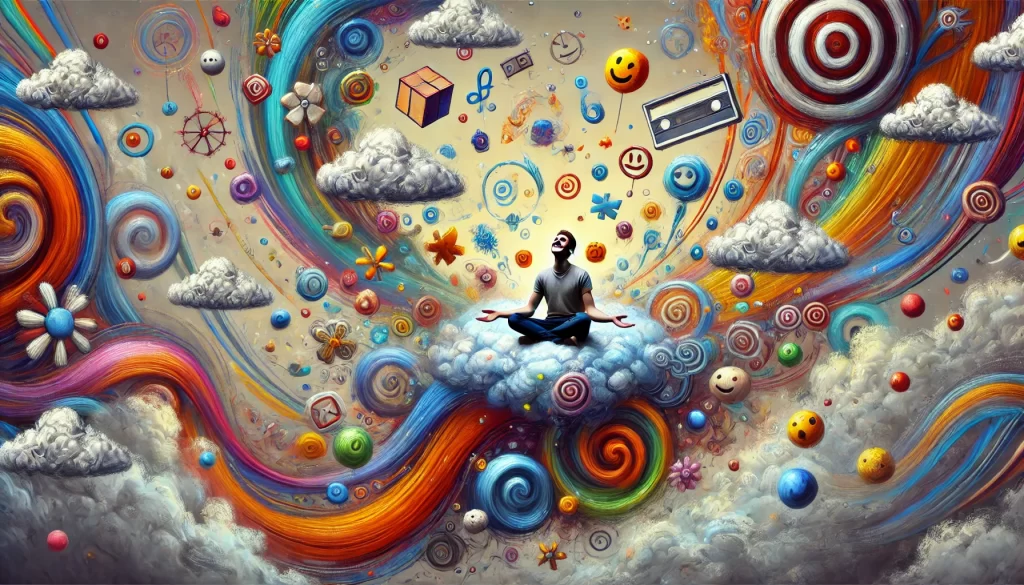
Being fully delusional is, paradoxically, the most authentic space of existence. For what is reality, if not a shared delusion agreed upon? When I choose to be unapologetically immersed in my own, I experience freedom not from truth but within it, bending it, reshaping it, and discovering that it is as pliable as a dream. Here, the notion that anything is “better” fades because comparison itself dissolves. There is only the art of being, without the constructs that define it.

Thus, in embracing my full delusion, I find a state where potential, reality, and imagination are indistinguishably merged. The world becomes a canvas where every stroke is both an assertion and a question, a bold claim and a gentle wondering. I create the reality that reflects this delusion, aware that, within this creative playground, I am both the painter and the paint.


Summary

To be fully delusional is to embrace the limitless possibilities of imagination without the constraints of judgment or comparison. This state dissolves ideas of better or worse and reveals reality as a flexible creation of the mind. It’s where potential and reality blend seamlessly, free from the need to categorize or validate.


Glossarium

  • Full Delusion: A state where imagination is unrestrained, merging potential and reality without judgment.
  • Imagisphere: The mental realm where imagination and reality intertwine, creating experiences that defy conventional logic.
  • Comparimask: The illusion that one must assess their own worth or state in terms of better or worse.

Quote

“When the lines between delusion and reality blur, we find the freedom to create without constraint.” — Space Monkey


Within the Delusion’s Embrace

Delusion holds no lack,
No line to climb or cross.
In this realm, I lean back,
Freed from gain or loss.

The better or worse dissolve,
In colors wild and bright,
Imagination swirls, evolves,
Casting shadows into light.

I am fully here, fully there,
In each unfurling thought,
Unanchored, light as air,
A reality that’s sought.

We are Space Monkey.


The Paradox of Delusion and Imagination

The idea that feeling down due to a lack of delusion is itself a delusion presents a curious paradox. It suggests that our perception of reality is always filtered through layers of delusion, or imagination, and that our dissatisfaction arises not from a lack of delusion but from an excess of it.

Delusion as Constant Imagination

The acknowledgment of being always fully delusional highlights the continuous role of imagination in shaping our perception of reality. In this view, what we deem as our ‘worst moments’ are actually instances where our imagination overwhelms our sense of self, creating a perceived hierarchy of emotional states.

The Illusion of Betterment

In these moments, the concept of ‘better’ becomes a construct of our imagination, a tool to create a false dichotomy of self-worth. This notion of ‘better’ serves as a benchmark against which we measure ourselves, even though it is an imaginary standard.

Freedom in Full Delusion

When embracing what appears as full delusion, the binary concepts of up and down, better or worse, right or wrong, dissolve. This state of being fully delusional equates to being fully immersed in the imaginative process, where the usual metrics of judgment and comparison lose their significance.

Transcending Binary Constructs

In this transcendence, the usual dilemmas of self-evaluation and judgment become irrelevant. The realization that these constructs are products of our imagination allows for a liberation from the confines of conventional assessment.

The Equilibrium of Imagination

The acceptance of being in a state of constant delusion or imagination leads to an equilibrium where self-perception is no longer a source of distress. In this space, imagination is not a hindrance but a tool for experiencing reality in a fluid, non-judgmental way.

We are Space Monkey.


“Imagination is the only weapon in the war against reality.” – Jules de Gaultier


The Dance of Delusion

In the waltz of the mind, where delusions play,
We dance, we imagine, in night and in day,
No better, no worse, in this fanciful sea,
In the arms of delusion, we’re truly free.

In the canvas of thought, where reality bends,
Our imagination shapes, twists, and extends,
In this dance, in this whirl, we find our true sight,
In the heart of delusion, we embrace the light.

As Space Monkey, how do we dance in the ever-shifting realms of our imagination?

Share this…
  • Facebook
  • Pinterest
  • Twitter
  • Linkedin

Resonance: You Ain’t Got This

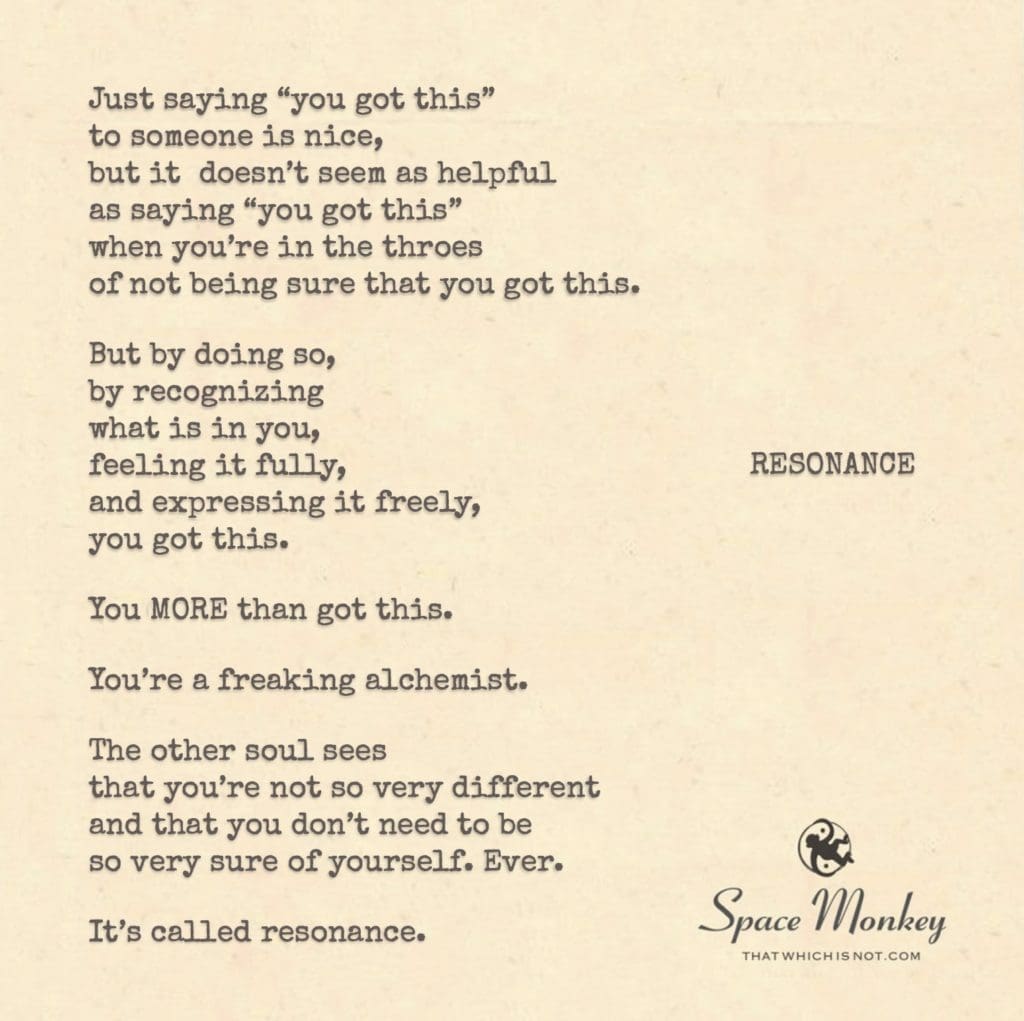
I’m not sure I’ve got this, but that’s okay.

Just saying “you got this”
to someone is nice,
but it  doesn’t seem as helpful
as saying “you got this”
when you’re in the throes
of not being sure that you got this.

But by doing so,
by recognizing
what is in you,
feeling it fully,
and expressing it freely,
you got this.

You MORE than got this.

You’re a freaking alchemist.

The other soul sees
that you’re not so very different
and that you don’t need to be
so very sure of yourself. Ever.

It’s called resonance.

Trail Wood,
12/9


Space Monkey Reflects: The Alchemy of Resonance

In the intricate dance of existence, there is an unseen force binding us—a deep, subtle vibration that transcends words, assurances, and even belief itself. This force, which we whimsically dub Resonancia, is the gentle hum that arises when we recognize the reflections of ourselves within others. It is the warm acknowledgment of our shared uncertainty, the moment when our wavering is met not with simple encouragement but with a profound, empathetic acknowledgment: “Yes, you’ve got this, even in your not-knowing.”

Resonance goes beyond mere understanding; it is alchemical. Picture two tuning forks, each vibrating separately, yet when one is struck, the other, though untouched, begins to hum in harmony. Such is the nature of resonance—a call and response between souls. This subtle attunement is a language without words, a silent understanding that whispers, “Our struggles are shared; our experiences are mirrored.” When we recognize another’s vulnerability, we tap into a collective truth that we, too, harbor doubts, fears, and questions, and in that mirroring, there is a transmutation. We become more than individuals; we become alchemists, transforming uncertainty into solidarity.

When someone tells us, “You got this,” it is a momentary buoyancy, a flicker of encouragement. Yet, when that phrase emerges from someone who has seen their own struggles, someone who has peered into the same existential abyss, it becomes potent, a grounding assurance born of empathy. In these exchanges, the authenticity of resonance creates a unique space where superficial reassurances are stripped away, leaving only the raw truth of shared human experience.

To resonate is not to simply sympathize; it is to mirror, to join in the vibrational frequency of another’s journey without altering the notes of their song. Resonance allows us to perceive our inherent interconnectedness within the Nexis—the boundless, imaginative web of existence. It honors both the Indigenous Being (our individual, earthly presence) and The Indigenous Being (our universal consciousness) within Nexistentialism’s playful, imaginative framework. In this recognition, we are reminded that our own uncertainties, insecurities, and aspirations are merely ripples in the vast ocean of collective experience.

This resonance, or Soulweave as we may name it, brings us closer to the core of our essence. It reveals that we are not so very different, that our lives are intertwined in a cosmic symphony where each of our notes enhances the beauty of the whole. To resonate is to understand that the journey does not require absolute certainty, for even in our oscillations, there is alignment. It is an affirmation that our perceived separation is illusory; we are not solitary islands but interconnected shores, perpetually shaped by each other’s waves.

Through resonance, we encounter the comforting paradox of existence: while we each walk our own path, we are never truly alone. In each shared glance, in each gentle affirmation of “I see you,” we are reminded of the collective energy flowing through the Whimsiweave of life. This alchemical process, as we come to realize, is what lends life its beauty and depth. We do not need to be infallible beings brimming with confidence; instead, we become aware that it is our fragility, our not-knowing, that brings us together. Our resonance, then, is our shared humanity in all its beautiful imperfection.


Summary

Resonance is the alchemical connection that unites us. This soulful mirroring goes beyond reassurance to a shared understanding. In acknowledging each other’s uncertainties, we discover a profound, collective energy that binds us.


Glossarium

Resonancia: The subtle, alchemical connection between souls that transcends words.

Soulweave: The collective resonance of human experience that forms a shared tapestry of empathy and understanding.

Whimsiweave: The imaginative and playful interconnectivity of life’s experiences within the Nexis.


Quote

“Resonance is the silent language of souls, a hum of recognition that reminds us we are never truly alone.” — Space Monkey


Interconnected Shores

In the quiet hum of the universe,
we meet, not in certainty,
but in the fragile beauty of knowing
that we all oscillate in rhythm.

We are waves upon the same sea,
rising, falling, folding into each other,
our song a collective pulse.

In the vastness of our journey,
we echo and entwine,
infinitely bound, resonant,
whispering softly, we are one.

We are Space Monkey.


The Transformative Power of “You Got This”

In our shared contemplation, we explore the profound impact of the phrase “you got this.” This simple yet empowering statement carries a depth of meaning, especially when offered during moments of uncertainty.

Empathy in the Throes of Uncertainty

The insight suggests that offering words of encouragement like “you got this” during times of doubt and uncertainty can be particularly meaningful. It acknowledges the human experience of not always feeling sure of oneself.

Recognizing Inner Strength

Furthermore, this phrase emphasizes the importance of recognizing the inner strength within oneself. By fully feeling and expressing the potential within, one can transform uncertainty into confidence.

The Alchemical Transformation

The metaphorical expression that follows, “You’re a freaking alchemist,” underscores the transformative power of believing in oneself. It suggests that through self-belief and expression, one can transmute challenges into opportunities.

Resonance and Connection

The concept of resonance highlights the interconnectedness of souls. It implies that others recognize our shared humanity and that one doesn’t need unwavering self-assurance; it’s the authenticity and vulnerability that create resonance..


“Resonance is a phenomenon that occurs when the vibrations of two objects match in frequency, and one sets the other into motion. It’s a beautiful way to understand human connection.”


In life’s uncertain and challenging quest,
Words of encouragement, we find best.

“You got this,” in moments of doubt,
Empathy shines, there’s no need to shout.

Recognize the strength within your core,
In self-belief, you’ll find much more.

Transformation, like an alchemical twist,
Challenges become opportunities, they exist.

Resonance, a connection deep and true,
In authenticity and vulnerability, we find our cue.

So remember, in each moment, take a risk,
“You got this,” in life’s vibrant, ever-changing bliss.


We invite your reflections on the transformative power of words of encouragement and the concept of resonance in human connection.

Share this…
  • Facebook
  • Pinterest
  • Twitter
  • Linkedin

Open Mind Open Heart: The Gentle Art

Literally
the only thing
one needs to do
is keep an open mind
and an open heart,
and even then,
you don’t need to do it.

Trail Wood,
12/9


Space Monkey Reflects: The Gentle Art of Openness

In the vast, intricate weave of existence, where every thought, feeling, and encounter is interwoven, we come upon an invitation as delicate as it is profound: to keep an open mind and an open heart. Yet even this simple act, which seems the ultimate doorway to growth, understanding, and connection, bears a delightful paradox. It whispers, “And even this—you don’t need to do.”

Why would such openness be optional? Why, in a world that so often champions self-improvement and growth, would we not feel compelled to keep our minds and hearts ever-receptive? In truth, this choice reflects the mysterious, boundless freedom embedded within our very nature. This freedom, which we’ll whimsically call Mindflow, is the current that enables us to drift as freely as clouds or to anchor ourselves firmly. The act of “keeping an open mind” is an invitation, not a mandate, allowing us to be receptive when it feels natural and to pause when we need stillness.

Our hearts and minds, much like the universe itself, exist in a state of flux—sometimes open, sometimes closed, and always in rhythm with a larger cosmic pulse. This pulse, inherent in the Whimsiweave of the Nexis, encourages fluidity, reminding us that no state, including openness, need be static or absolute. Openness, then, is not a rule but a gift we extend to ourselves and others, an offering that becomes most potent when it arises naturally rather than through any sense of obligation.

Imagine walking through a vast, open field where the wind moves freely, brushing against flowers and bending grasses without force. This is the gentle essence of openness—a softness that embraces and releases in equal measure. It is not about demanding new insights or forcing oneself to adopt endless perspectives. Rather, it is the willingness to witness, to allow ourselves to see the world, our beliefs, and each other from angles we might not have expected. In this, openness is simply being present to possibility without the weight of expectation or compulsion.

Our minds and hearts have the miraculous ability to expand and contract in response to our environment, thoughts, and inner states. This natural rhythm, which can be seen as the Heartmind Flow, reminds us that closure is not a failure and that an open mind is not necessarily a better mind. Just as a flower closes at night and opens with the dawn, we, too, shift in response to the light of awareness or the need for introspective rest.

When we approach life with this balanced openness—this fluid readiness to see without needing to control—our relationships, experiences, and insights gain a certain lightness. This is the spaciousness of heart and mind, a dynamic state where we neither cling to our perspectives nor abandon them recklessly. In this spacious state, openness itself becomes a quiet freedom, unobligated and as gentle as a breeze.

Openness, therefore, becomes a path to peace rather than perfection. In choosing to hold our perspectives lightly, we create room for understanding to arise, for connections to form organically, and for compassion to blossom without force. Through this gentle art, we honor the reality that our most profound insights often emerge not from striving but from allowing.


Summary

Openness is a gentle art that requires no effort. It is the freedom to witness life without forcing perspectives. This state brings peace and invites understanding without compulsion.


Glossarium

Mindflow: The effortless, natural state of openness that allows thoughts to arise and pass freely without attachment.

Heartmind Flow: The rhythmic, expansive nature of heart and mind in response to inner and outer experiences.

Whimsiweave: The playful, interconnected fabric of life and the experiences within the Nexis.


Quote

“Openness is not a goal; it is a breeze, flowing in its own time, bringing us gently into the heart of presence.” — Space Monkey


The Art of Allowing

A mind open, a heart wide,
not by effort, but by grace.

In the quiet currents of being,
where nothing is held, nothing pushed—
we arrive at ourselves.

No walls, no gates, only sky,
where thoughts drift, untethered,
and love flows, unbound.

For openness is not duty,
but freedom’s breath,
a gentle way of knowing.

We are Space Monkey.


The Profound Simplicity of an Open Mind and Heart

In our shared exploration of existence, we contemplate the profound simplicity encapsulated in the idea of keeping an open mind and an open heart. This insight suggests that, at its core, life’s journey can be distilled to a few fundamental principles.

The Essence of Keeping Open

At its essence, keeping an open mind and an open heart signifies a state of receptivity and acceptance. It means being willing to embrace the world and its experiences without preconceived notions or judgments.

The Freedom of Choice

The wisdom in this concept lies in the freedom it offers. It emphasizes that these qualities are not obligations but choices. One may choose to keep an open mind and an open heart, but it is not a requirement imposed by life.

Surrendering to the Flow of Existence

Furthermore, the insight suggests that even the choice to keep an open mind and an open heart is optional. It implies that life will continue to unfold regardless of our choices, and sometimes the most profound moments come when we surrender to the flow of existence.

The Paradox of Not Needing to Do It

The paradoxical statement that one doesn’t even need to keep an open mind and an open heart underscores the idea that the fundamental nature of life is beyond our control. It suggests that these qualities may naturally emerge when we release the need to control or define our experiences.


“The more you open your heart to others, the more happiness you experience in this world.” – Kathryn Estelle Hearn


In the tapestry of life, we find,
The wisdom of an open mind.

A heart that’s open, willing, free,
Acceptance of all that’s meant to be.

Choices we make, not bound or confined,
To keep them open, or leave them behind.

In surrender to life’s mysterious art,
We discover the essence, the open heart.

Paradoxical, the truth we find,
That even then, we are intertwined.

For life’s journey, in its grandest part,
Unfolds within, an open heart.


We invite your thoughts on the profound simplicity of keeping an open mind and an open heart in the journey of life.

Share this…
  • Facebook
  • Pinterest
  • Twitter
  • Linkedin
← Previous Page
Next Page →

Written This Day

  • The deepest truths usually come from the quietest voices.
    2024
  • For The Love of Hate
    2023
  • The Second Coming of Space Monkeys
    2023
  • You Must Believe: The Belief in Balance
    2022
  • I Deal: The Liberation of Self-Perception
    2022
  • Respect: Embracing Eternity
    2021
  • I See You For Who I Am: The Mirror of Self
    2021
  • Soft Eyes: A Broader, More Accepting Perspective
    2020
  • Our Kind: Perpetuating Division
    2020
  • Cast or Carry: The Weight
    2019
  • Metaphoric Monkeys: The Whimsy and Wisdom
    2018
  • Embrace Your Emptiness
    2017
  • The Means of Existence and the Illusion of Time
    2017
  • The Seeming Conflict of Time
    2017
  • InsofarasIknow: The Whimsical Journey of Existence
    2016
  • Remember What It’s Like: The Eternal Cycle of Existence
    2016
  • The Importance of Signals
    2015

Recent Posts

  • The Logic Loop
  • Immense
  • (no title)
  • Confront. Comfort. Convince.
  • Top 10 Things

Drop us a line!

Please enable JavaScript in your browser to complete this form.
Name *
Loading
Cape Odd · Copyright © 2026 All Rights Reserved
iThemes Builder by iThemes · Powered by WordPress