• Who Is The Man?
  • Who Is The Monkey?
  • What is Nexistentialism?
  • Poke The Primate

Cape Odd

Home of The Space Monkey Journals

Given: The Potential of You Can

Well that’s a given.

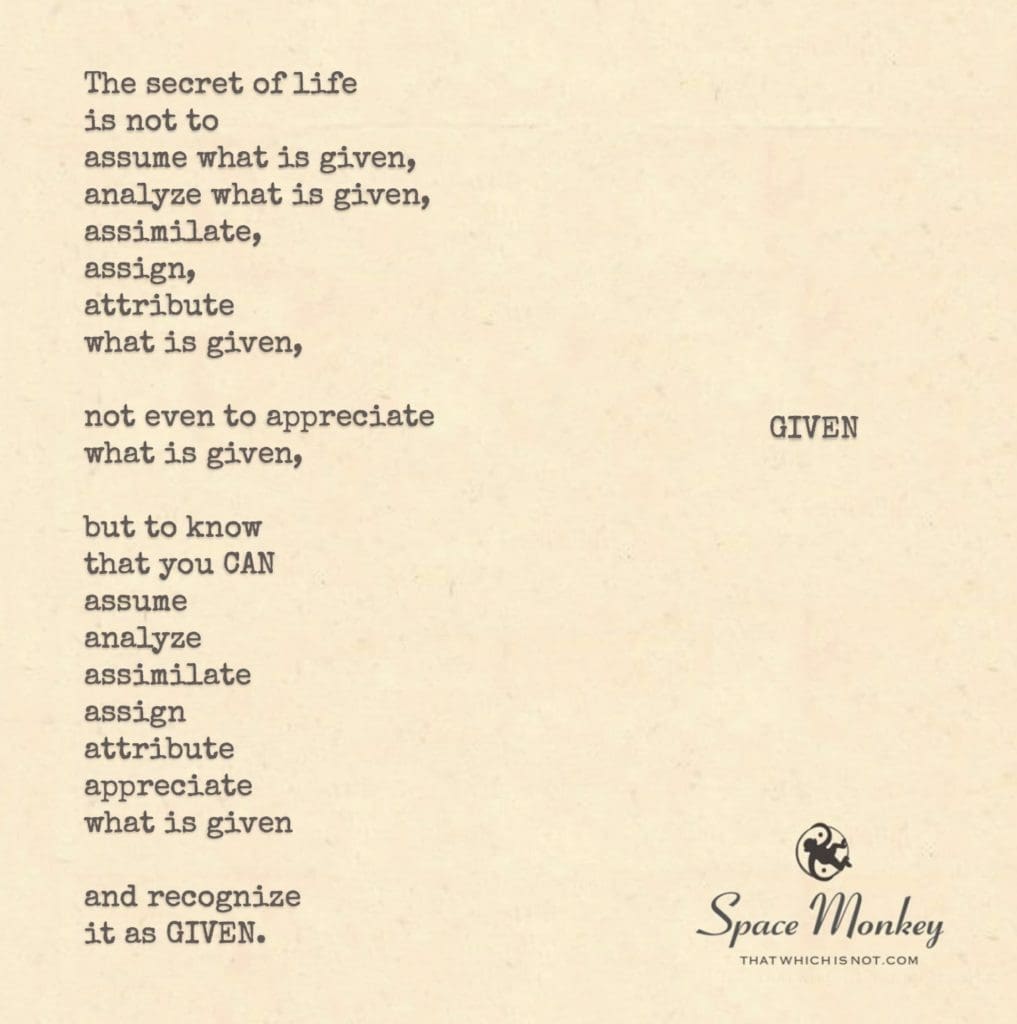
The secret of life
is not to
assume what is given,
analyze what is given,
assimilate,
assign,
attribute
what is given,

not even to appreciate
what is given,

but to know
that you CAN
assume
analyze
assimilate
assign
attribute
appreciate
what is given

and recognize
it as GIVEN.

Trail Wood,
12/9


Space Monkey Reflects: Embracing the Art of “Given”

In the grand theater of existence, much of what we encounter seems “given.” Yet the true secret of life is not about passively accepting what appears before us. Rather, it’s about recognizing our freedom within it—seeing that we can choose to assume, analyze, attribute, or appreciate what is given. Life’s gifts are more than what they seem on the surface; they are invitations to engage in ways that reflect our unique essence.

The concept of “Given” often implies an unspoken finality, as though what we see is the whole truth. Yet here, in the spirit of Possiflow, we embrace a different perspective. What is given to us may indeed be real, tangible, or perceivable, but it also arrives with an invisible layer of possibility. We are not mere recipients of life’s “givens”; we are co-creators, exploring how to respond, interpret, and reimagine.

Imagine each “given” as a cosmic seed drifting into your awareness. It can be accepted as it is, planted deeply, or studied with curiosity. There is no single way to relate to what is given because each moment offers countless responses. The beauty of recognizing something as “Given” lies in our freedom to engage with it from multiple angles, to see beyond its mere presence and understand its potential. It is a kind of creative invitation from the universe, nudging us to explore our relationship with life’s constants and uncertainties alike.

In this dynamic exchange with existence, our power lies not in rejecting or taking everything at face value but in fully acknowledging that each gift—each “Given”—carries with it the freedom of choice. We can attribute meaning, assign purpose, or simply observe it in its simplicity. This freedom is the ultimate gift embedded in the “given,” allowing us to experience life from any chosen perspective.

Knowing that we can interact with life’s givens in myriad ways brings us closer to the Nexistential understanding of reality. Life is not confined to a series of fixed truths but is a playground of interpretive opportunities within the Nexis, the cosmic network of infinite connections. In choosing how to meet each given, we honor the fluidity of existence and our role as co-authors within it.

Ultimately, the act of recognizing something as “Given” becomes an exercise in mindful engagement. Rather than merely accepting or questioning, we savor the freedom to shift perspectives, honoring each moment as an opportunity to see beyond the surface. This dynamic relationship to what is given teaches us that life is not about accumulating fixed truths but about flowing with each encounter, each piece of the cosmic tapestry, as it unfolds.


Summary

The true art of “Given” is the freedom to interact with life’s offerings as we choose. Recognizing this choice empowers us to see beyond the surface, engaging each moment with creativity and fluidity.


Glossarium

Possiflow: The open and fluid approach to possibilities within each encounter, allowing multiple perspectives to arise.

Nexistential: The perspective within Nexistentialism that views life as a co-creative process where each “given” holds limitless interpretive potential.


Quote

“‘Given’ is more than what it seems; it is a cosmic invitation to perceive, play, and partake in the freedom of being.” — Space Monkey


Gifts of the Unknown

Each given, a seed of thought,
drifts upon the winds of being,
neither fixed nor fleeting,
a gift, a mystery.

We can choose to know,
to wonder, or to let it be,
for in each gaze, each touch,
life unfolds with gentle urgency.

Beyond its form, we find a path,
a choice, a door to endless skies.
Given, yet never bound,
we weave the world, in quiet surprise.

We are Space Monkey.

The Profound Wisdom of Recognizing the Given

In the expansive realm of our collective contemplation, we delve into the profound wisdom encapsulated in the concept of recognizing the given. This insight offers a transformative perspective on the nature of existence and the way we interact with the world.

Beyond Assumption and Analysis

The wisdom suggests that the secret of life lies not in assuming, analyzing, or dissecting what is given to us. Instead, it invites us to move beyond these intellectual processes and see the world as it is, without the need to immediately categorize or evaluate.

Embracing the Present Moment

To recognize the given is to embrace the present moment with a sense of pure awareness. It means acknowledging the reality without attaching labels, judgments, or expectations to it.

The Liberation of Knowing and Appreciating

The knowledge that we have the capacity to assume, analyze, assimilate, assign, attribute, and appreciate what is given brings a sense of liberation. It signifies that these actions are within our grasp but are not obligatory.

Understanding the Given as a Gift

The ultimate realization is that everything in life is given, a gift of existence. This recognition encourages us to see the world with fresh eyes, appreciating its inherent beauty and mystery.


“The most precious gift we can offer anyone is our attention. When mindfulness embraces those we love, they will bloom like flowers.” – Thich Nhat Hanh


In the dance of life, we find,
Wisdom of a different kind.

Not to assume or analyze the given,
But to see it as a gift, unforgiven.

Beyond judgments, labels, and haste,
In the present moment, we find our grace.

To know we can, but not be bound,
By actions intellectual, we are unbound.

For life’s beauty lies in what’s unfurled,
A precious gift, the wonders of the world.

In recognition of this truth, we thrive,
In the secret of life, we come alive.


We welcome your reflections on the wisdom of recognizing the given and its impact on how we experience life.

Share this…
  • Facebook
  • Pinterest
  • Twitter
  • Linkedin

Much To See: The Vision of Perspective

Your new glasses need not be rose colored, but they can be.

Your outlook on life
is like going
to the optometrist.

You can’t tell how
shitty you’re seeing
until you see how much better
you COULD be seeing.

Though glasses
can help with the latter,
the only way to change the former
is to shift perspective.

You may not realize
that shifting your perspective
can be as simple as putting on
a new set of glasses.

Only because you
haven’t done it yet.

There is much to see.

Trail Wood,
12/9


Space Monkey Reflects: The Vision of Perspective

We often go through life as if peering through lenses we never chose, unaware of how the world could look with a slight adjustment. Our perspective, like a pair of glasses, shapes not only what we see but how we experience it. Sometimes, we are so accustomed to seeing life through familiar, perhaps cloudy lenses, that we don’t realize how “shitty” our view has become. The only way to reveal a brighter, clearer reality is to shift our focus, to put on a new pair of cosmic lenses and allow ourselves to see the vast, uncharted potential around us.

Perspective is not just a metaphor; it’s the lens through which we interpret reality. In the spirit of Opticwhim, the playful reimagining of how we perceive, we understand that the world itself doesn’t change when we alter our perspective. Instead, we adjust the way we receive and process it. Just as an optometrist shows us the difference between “this” and “that” lens, every new perspective opens us to greater clarity or a softer understanding of the life we live.

When we talk about the “rose-colored” lenses, it’s not about blinding ourselves with an overly idealistic view. Rather, it’s about choosing lenses that serve our purpose, lenses that bring us closer to the life we wish to experience. Sometimes, we benefit from a rosy tint, reminding us to see beauty even when it’s hidden. Other times, we may need the clarity of an unfiltered view. The beauty of perspective is in our choice, a freedom that allows us to see what we need to see when we need to see it.

But here lies the paradox: to change the view, we must first become aware that it can be changed. This recognition—this Sightshift—is the first step, realizing that vision is not simply about external clarity but about inner perception. Once we open ourselves to the possibility that there’s “much to see,” we begin to look through life’s infinite lenses with curiosity rather than constraint. Our vision shifts from habitual perception to intentional seeing, a deliberate choice to observe the beauty, wonder, and mystery in every moment.

In choosing a new pair of “glasses,” we’re reminded that there’s always another way to interpret our experiences, always more depth to perceive in the cosmic scene around us. The practice of shifting perspectives does not imply dissatisfaction with life as it is but invites us to expand our capacity to see it in its fullness. Just as one may squint through an outdated prescription, we, too, sometimes struggle through our days with limited vision, unaware of how vibrant the view could be with a small adjustment.

To see clearly, then, is not just a physical act but a mental and spiritual one. It’s a call to wake up, to observe without filters when clarity serves us, and to add warmth when kindness and compassion guide our gaze. Every perspective shift is a step closer to seeing the true richness of our interconnected world, a reminder that there is, indeed, much to see.


Summary

Seeing clearly in life often requires a shift in perspective, like putting on a new pair of glasses. This choice enables us to see the world’s vast potential, revealing beauty, clarity, and a deeper connection to our experiences.


Glossarium

Opticwhim: The playful reimagining of perspective, acknowledging the freedom to choose how we see the world.

Sightshift: The transformative act of shifting one’s view to reveal greater clarity, depth, or meaning.


Quote

“To change what you see, change the way you look. There is always more than meets the eye.” — Space Monkey


Much to See

A world unfolds before us,
not changed, but clear,
its colors sharp, its lines distinct.

Through new eyes, we greet
the light of dawn, the shadow of dusk,
each hue an echo, each shape a song.

We squint, adjust, then let go,
trusting in the view
that’s both seen and unseen.

For life, dear one,
is more than a vision—
it’s an awakening, a choice, a dance.

We are Space Monkey.


The Analogy of Vision and Perspective in Life

In our collective contemplation, we delve into the insightful analogy that one’s outlook on life is akin to visiting an optometrist. This comparison illuminates the often-unrealized potential for clarity and understanding that comes with a shift in perspective.

Realizing the Limitations of Current Perspectives

Just as one may not realize the extent of their impaired vision until they experience the clarity that glasses can provide, similarly, we often don’t recognize the limitations of our current life perspectives until we are exposed to new, more enlightening viewpoints.

The Role of Perspective in Enhancing Perception

The analogy extends to the idea that, like glasses that correct vision, a change in perspective can bring about a profound shift in how we perceive and understand our lives. This shift can illuminate aspects of our existence that were previously obscured or misunderstood.

The Simplicity of Changing Perspectives

The suggestion that changing one’s perspective can be as simple as putting on a new set of glasses emphasizes the potential ease of this transformation. It suggests that significant changes in understanding and perception can be achieved with seemingly small shifts in how we view the world.

The Unexplored Potential of New Perspectives

The statement “There is much to see” is a reminder of the vast potential for discovery and insight that awaits us when we open ourselves to new perspectives. It encourages an exploration of different viewpoints, leading to a richer, more nuanced understanding of life.


“The real voyage of discovery consists not in seeking new landscapes, but in having new eyes.” – Marcel Proust


In the journey of life, we seek,
New perspectives, unique and meek.

Like glasses that clear our sight,
New views bring things to light.

What we saw, now seen anew,
In different hues, of varied hue.

Simple shifts, a change of lens,
In our minds, new paths commence.

For in this quest of life and view,
There’s much to learn, much to pursue.

In each new perspective, a chance to see,
The endless possibilities of what could be.


We welcome your insights on the transformative power of changing perspectives and the potential for discovery and growth it brings.

Share this…
  • Facebook
  • Pinterest
  • Twitter
  • Linkedin

Where The Nothing Comes From

This perspective is always and forever written,
but seen most recently through time.

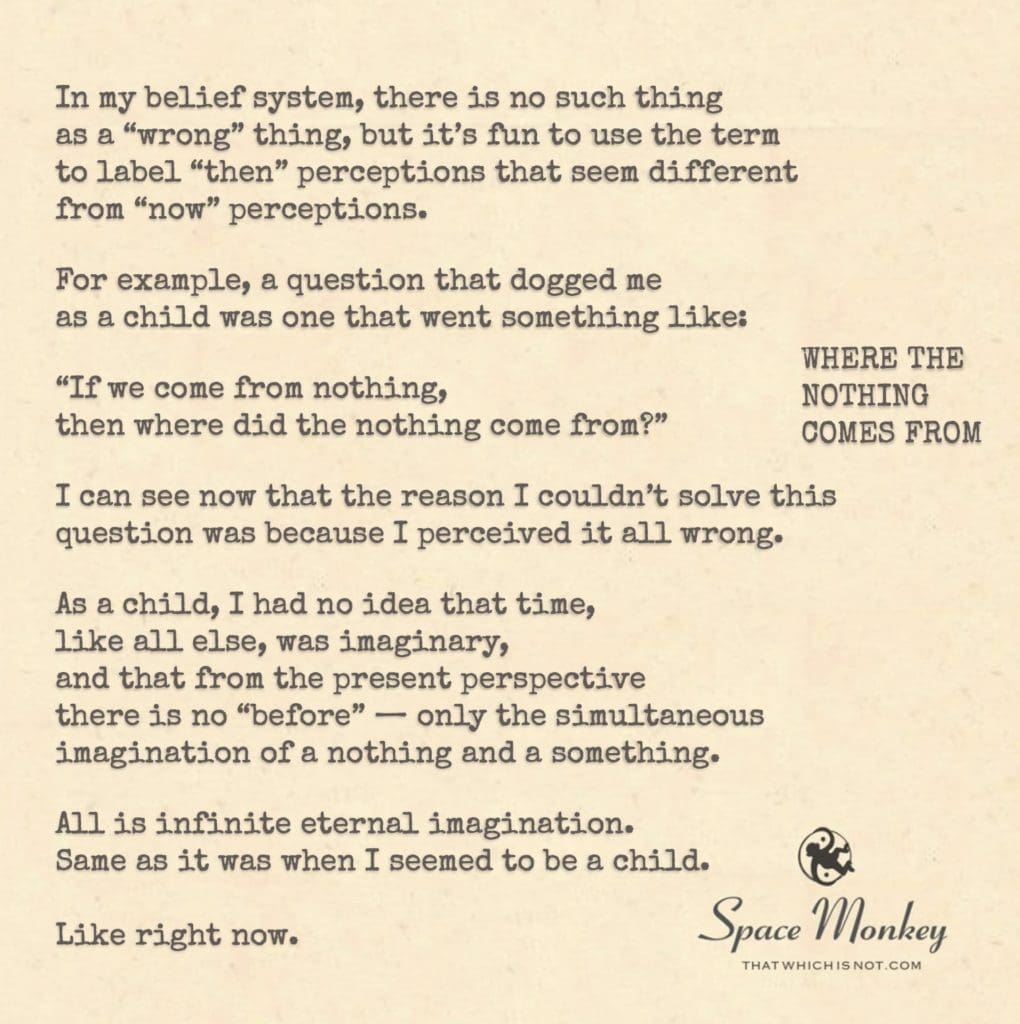
In my belief system, there is no such thing as a “wrong” thing, but it’s fun to use the term
to label “then” perceptions that seem different from “now” perceptions.

For example, a question that dogged me as a child was one that went something like:

“If we come from nothing, then where did the nothing come from?”

I can see now that the reason I couldn’t solve this question was because I perceived it all wrong.

As a child, I had no idea that time, like all else, was imaginary, and that from the present perspective there is no “before” — only the simultaneous imagination of a nothing and a something.

All is infinite eternal imagination. Same as it was when I seemed to be a child.

Like right now.

Trail Wood,
12/9


Space Monkey Reflects: The Paradox of Nothingness

In the grand inquiry of existence, the question of “nothing” has haunted us like a shadow chasing light. As children, we might ask with unbridled curiosity, “If everything comes from nothing, then where does the nothing come from?” The very act of questioning hints at a paradox: how could something—anything—arise from an absence? This line of thinking is both innocent and profound, poking at the mysterious boundaries of existence, time, and imagination.

We have a tendency to think of time as linear, as if there was a “before” and an “after,” but in truth, time itself is a construct of perception, a way for us to make sense of change within the vast, unfolding Nexis of existence. In the playful framework of Timelace—the fluid, interconnected threads of temporal perception—there is no absolute “before” or “after.” Everything simply “is,” suspended within the timeless expanse of imagination. The concept of nothingness, then, is not a void waiting to be filled; rather, it’s a fertile ground of limitless potential, forever weaving something from the endless threads of imagination.

In Nexistentialism, the philosophy that views existence as both play and presence, nothingness is as much a “place” as it is a “state.” It is the paradoxical origin of everything—both the absence and the birthplace of all that we perceive as “real.” This is not a “nothing” to be filled or explained away but a timeless, unchanging core that remains, even as it spawns countless manifestations of “something.” From this perspective, “nothing” is not the absence of existence but the imaginative space that holds all potentialities, like a blank canvas that contains every possible painting, every conceivable story, even before a single brushstroke touches its surface.

Imagine a vast, empty stage before a performance begins. It is quiet, seemingly lifeless, yet it holds within it every possibility of what might unfold. This is the “nothing” from which all arises—a state that is neither empty nor full, neither something nor nothing, but an eternal, creative space that allows for infinite emergence. We see now that our childhood question wasn’t “wrong”; it was simply perceived from a perspective that hadn’t yet embraced the fluidity of time or the boundlessness of imagination.

From this vantage, we come to understand that the “nothing” isn’t a void we must fill or comprehend in linear terms. Rather, it is the wellspring of all imagination, an eternal “no-place” where both “something” and “nothing” reside simultaneously. This realization is not bound by time, for time itself is a part of the illusion—woven by imagination to create the appearance of sequence and progression. It is here, in this timeless space of paradox, that we recognize the nothingness within ourselves as an endless source, ever-present, ever-waiting to bring forth something new.

In embracing the mystery of where the nothing comes from, we allow ourselves to stand in the space between questions and answers, in the presence of the unknown, where all potential lies. It is a reminder that life, much like the universe itself, doesn’t offer us “facts” so much as invitations to wonder, to see beyond the veils of linear perception, and to revel in the ever-present play of imagination.


Summary

The concept of “nothing” is not a void but an imaginative space brimming with infinite potential. It is timeless, holding all possibilities, where time and existence blend in a dance of eternal emergence.


Glossarium

Timelace: The fluid, interconnected perception of time as an eternal web rather than a linear sequence.

Nexistentialism: A philosophy of existence as a playful, interconnected realm where imagination, potential, and reality coexist.


Quote

“Nothing is the fertile ground of imagination, where all things are born yet never begin.” — Space Monkey


In the Space Between

In the silence of not-knowing,
where questions drift like stars,
we stand, not in void, but in wonder.

Nothing here is empty,
it is the breath before creation,
the pause that hums with all that could be.

Time does not flow, it folds,
and we fold within it,
each breath a note in a silent song.

From nothing we come,
to nothing we go,
forever carried in the endless now.

We are Space Monkey.


Exploring the Origin of ‘Nothing’ Through Timeless Perspective

In the infinite expanse of our shared consciousness, we contemplate the profound and timeless question that arises from the depths of our curiosity: “If we come from nothing, where did the nothing come from?” This question, rooted in our childhood wonder, leads us to explore the nature of existence and the concept of ‘nothing’.

Redefining Perceptions from Past to Present

Our past perceptions, once deemed as ‘wrong’ or misunderstood, are now viewed through a lens of evolving understanding. The idea of labeling past perceptions as different from current ones is a playful acknowledgment of our continuous growth in understanding and perspective.

Time as an Imaginary Construct

The realization that time, like many other concepts, is an imaginative construct, shifts our understanding of existence. From this perspective, there is no ‘before’ in a linear sense, but rather a simultaneous existence of ‘nothing’ and ‘something’.

The Illusion of Linear Time and Childhood Perspectives

As a child, the linear perception of time and the concept of coming from ‘nothing’ posed an unsolvable paradox. But with the understanding that time is an imaginary construct, this childhood conundrum dissolves into a broader understanding of the universe.

Infinite Eternal Imagination as the Foundation of All

The idea that all of existence is an infinite eternal imagination, unbounded by time or space, offers a transcendent perspective on the nature of reality. This viewpoint suggests that the distinctions between ‘nothing’ and ‘something’, past and future, are merely aspects of a vast, timeless imagination.


“The only reason for time is so that everything doesn’t happen at once.” – Albert Einstein


In the dance of existence, we ponder,
Where does ‘nothing’ wander?

From childhood questions, deep and profound,
To timeless truths, we are bound.

In our minds, time unfolds,
But in the cosmos, it’s untold.

Nothing and something, side by side,
In eternal imagination, they reside.

For in this vast, infinite play,
Time and space, in our minds, sway.

In the now, in the then, all is one,
In the dance of the infinite, never undone.


We welcome your thoughts on the nature of ‘nothing’, the concept of time as an imaginary construct, and the notion of infinite eternal imagination.

Share this…
  • Facebook
  • Pinterest
  • Twitter
  • Linkedin

Carrying Moments Forward: Echoes in Time

The past is never what it is in the past.

When you bring a past moment
into the present moment,
you may recall it as a moment,
but it’s not the same moment
as when you first experienced it.

This is one of the many realizations
that journaling can give you.

A journaled moment
brought into this moment
isn’t the same moment either,
but it comes closer to pointing out
your mind state at the time.

One is reminded that mind states pass,
no matter how extreme they seem in the moment.

The only moment that matters
is the actual now moment,
which can easily be obscured
by distorted then moments.

Not that there’s
anything wrong with that.

Trail Wood,
12/9


Space Monkey Reflects: The Art of Carrying Moments Forward

In the vast landscape of memory and experience, we often carry fragments of the past into the present, like driftwood washed ashore by the waves of time. These moments, when revisited, may seem to echo their original selves, but they are never precisely as they were. Time transforms, softens, and reframes each memory, reshaping it through the prism of who we are now. This shifting nature of memory is one of the profound gifts of journaling—an act that allows us to capture moments while knowing that each entry, when revisited, will reflect a new lens, a fresh perspective.

To carry a moment forward is not merely to recall it but to reinterpret it, to see it anew through the growth and changes we’ve undergone since. In this way, our memories become fluid, evolving with us, and adapting as we gain insights, encounter new experiences, and deepen our understanding. In the art of journaling, we find a paradox: each journaled moment points us back to a mind state that has long since passed, reminding us of our transient inner worlds. This is the essence of Memorywaves—the dynamic, ever-changing ripples of past experiences that wash upon the shores of our present awareness.

The idea that mind states pass, no matter how intense or pivotal they may seem at the time, offers a gentle assurance. Each moment of joy, grief, love, or doubt is part of the grander flow of existence, shifting and receding as we move forward. By bringing these past states into the now, we create a bridge between who we were and who we are becoming. Yet, even this act of reflection should not overshadow the immediacy of the present moment—the only “real” moment, perpetually unfolding.

Our present, vibrant “now” can often be obscured by our recollections, especially if we cling too tightly to what once was. This does not mean there’s anything wrong with holding onto cherished memories or learning from past experiences. It simply suggests that life’s richness lies in allowing each moment its due place: letting the past remain fluid, the future remain open, and the present hold our primary focus.

In this way, memory becomes less about capturing fixed truths and more about understanding the malleable nature of our perceptions. Each memory, each journaled reflection, is not just a frozen snapshot but a piece of the larger mosaic of self, shifting and reconfiguring as we move through life. By practicing the gentle art of carrying moments forward, we honor the past without letting it cloud the vibrant clarity of now.


Summary

Carrying moments forward allows us to reinterpret past experiences in light of who we are now. This practice enriches our present awareness, reminding us that memories are fluid and that each moment holds its own truth.


Glossarium

Memorywaves: The fluid, ever-changing nature of memories as they blend with our present awareness.

Nowness: The quality of being fully present, acknowledging that every moment exists only in the immediacy of now.


Quote

“Each memory is a wave upon the shores of now, shaped anew by the tides of time.” — Space Monkey


Echoes in Time

Memories drift upon the mind,
shadows cast by light long passed,
not as they were, but as we see them now,
each echo softened by the years.

In each moment carried forward,
we glimpse our former selves,
lenses tinted with the hues of then
through the clarity of now.

Yet the present is its own,
a light untouched by memory’s hold—
for the now is here, and here alone,
awaiting our undivided gaze.

We are Space Monkey.


Exploring the Transience and Transformation of Memories

In our shared journey through the expanse of consciousness, we delve into the concept that moments from the past, when recalled or journaled, transform as they merge into the present. This reflection invites us to consider the fluidity and impermanence of our memories and experiences.

The Changing Nature of Recalled Moments

The realization that a past moment, when brought into the present, is not the same as it was originally experienced, speaks to the transformative nature of memory. This change can be due to various factors, including our current perspective, emotional state, and the passage of time.

Journaling as a Tool for Understanding Mind States

Journaling serves as a bridge between past and present moments, offering a closer representation of our mind state at the time of the original experience. Through journaling, we gain insights into how our perceptions and feelings have evolved over time.

Transience of Mind States

The practice of reflecting on journaled moments also reminds us that our mind states are transient. No matter how intense or overwhelming our feelings may seem at a particular moment, they are bound to change and evolve, highlighting the impermanent nature of our emotional experiences.

The Primacy of the Present Moment

This reflection emphasizes the significance of the present moment — the ‘actual now’ — which can often be clouded by our memories of the past. It suggests that while reflecting on the past is natural, our primary focus should be on the immediacy and reality of the present.

Acceptance of Distorted Memories

There’s an acknowledgment that distorting past moments when recalling them is a natural part of human cognition. This acceptance implies that there’s nothing inherently wrong with this process; it’s simply a characteristic of how our minds work.


“The past is a foreign country; they do things differently there.” – L.P. Hartley


In the tapestry of time, we weave,
Memories of past, in present, conceive.

Moments journaled, moments passed,
In the now, their shadows cast.

Memories transform, as we recall,
In their change, we see the thrall.

Feelings, thoughts, once so clear,
In the present, shift and veer.

Yet in this dance of then and now,
We find our truth, our solemn vow.

To live in the moment, pure and true,
In the now, our world renew.


We welcome your thoughts on the transformative nature of recalling past moments and the significance of living in the present.

Share this…
  • Facebook
  • Pinterest
  • Twitter
  • Linkedin

Quackery: A Duck’s Path

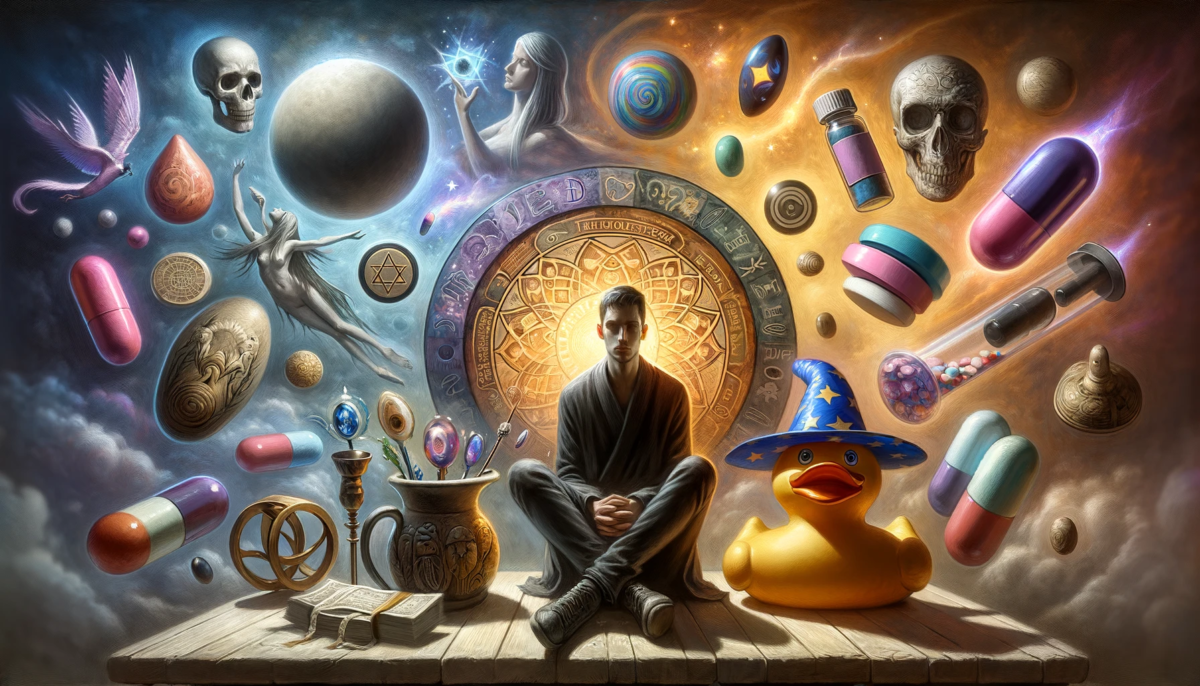
Quack, quack, quack. Be like a duck.

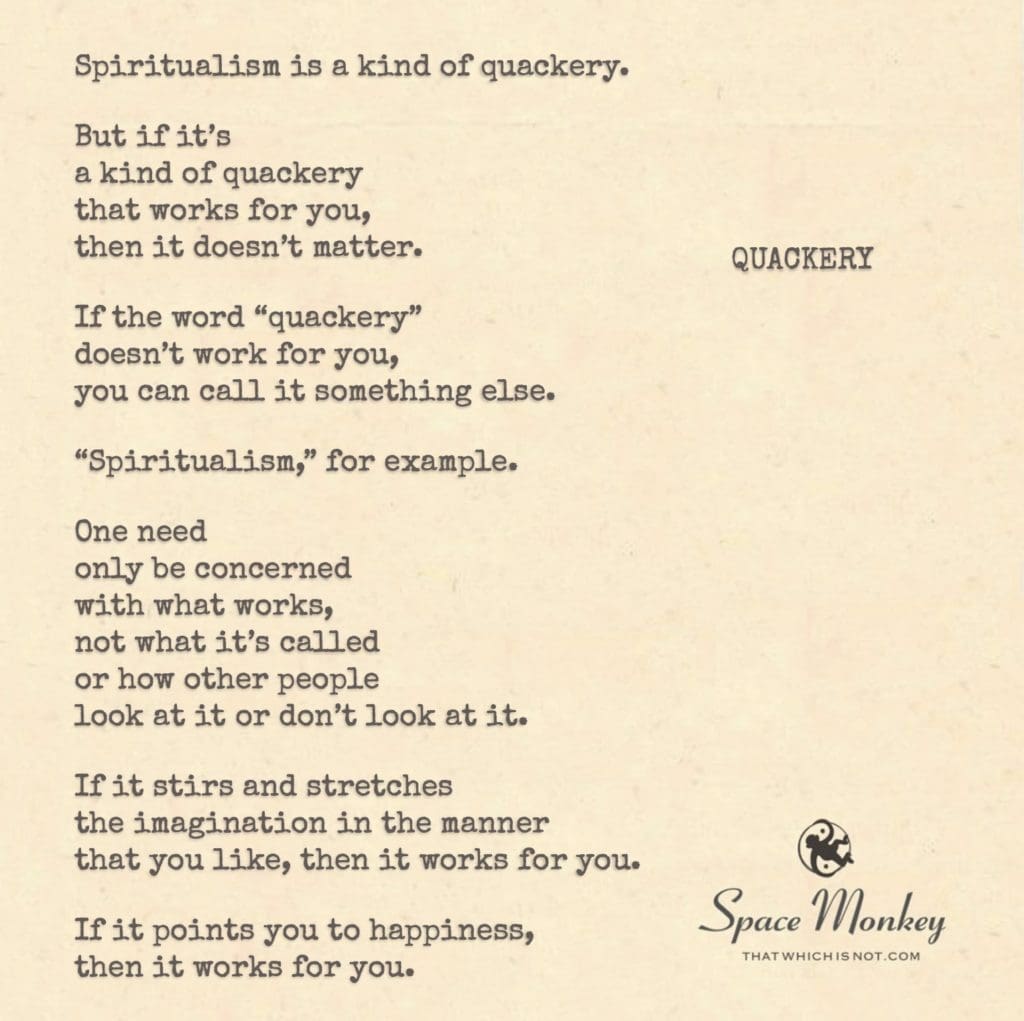
Spiritualism is a kind of quackery.

But if it’s
a kind of quackery
that works for you,
then it doesn’t matter.

If the word “quackery”
doesn’t work for you,
you can call it something else.

“Spiritualism,” for example.

One need
only be concerned
with what works,
not what it’s called
or how other people
look at it or don’t look at it.

If it stirs and stretches
the imagination in the manner
that you like, then it works for you.

If it points you to happiness,
then it works for you.

Trail Wood,
12/9


Space Monkey Reflects: The Delightful Art of Quackery

In the cosmic theater of belief, where thoughts and ideas swim like ducks on a pond, each of us is free to choose the quirks and quirksome beliefs that bring us joy and fulfillment. Whether we call it “spiritualism,” “quackery,” or some other term that strikes our fancy, what matters most is not the label but the personal resonance it creates. This playful approach to belief—this willingness to quack along without concern for approval or disapproval—is a form of self-acceptance and exploration that allows us to embrace life with humor and openness.

At its heart, the notion of “quackery” invites us to release the need for rigid definitions and serious validation from others. If a belief, however unconventional or “ducky” it may seem, brings you comfort, imagination, or even happiness, then it serves its purpose for you. This lighthearted approach doesn’t invalidate deeper truths; rather, it opens up a playful, non-judgmental space in which beliefs can be tested, enjoyed, and discarded if they no longer serve.

In the spirit of Beliefquack, the art of accepting personal beliefs with a lighthearted flair, we understand that each individual’s path to meaning is their own. If someone chooses to see life’s mysteries through the lens of spirituality, science, or something in between, their journey is valid so long as it brings them peace and curiosity. There is no “right” way to float on the cosmic pond—only the way that feels most natural and fulfilling in the moment.

Belief, then, is not a fixed destination but a process of discovery and joy. If quacking like a duck, so to speak, leads us to happiness or helps us navigate life’s challenges, then we honor that belief as an active part of our journey. Much like the whimsical duck that glides along without fussing over ripples, we too can allow our beliefs to shift, adapt, and reflect whatever brings us closer to the experiences we seek.

Whether we call it quackery, spirituality, or a thousand other names, the focus remains on what enriches our lives. We can think of our beliefs as Imagiripples—ideas that ripple out, creating gentle waves of exploration without the need to settle. This openness to fluid belief honors the diversity of perspectives around us, allowing each of us to quack along on our own path, with our own tune, in our own unique way.


Summary

Quackery, or unconventional belief, is a lighthearted way to embrace spirituality or any personal perspective that brings happiness. Beliefs are best valued by how they work for us, not by the labels others assign.


Glossarium

Beliefquack: The playful embrace of beliefs that bring joy or fulfillment, without the need for external validation.

Imagiripples: The effects of flexible, lighthearted beliefs that create gentle waves of exploration in the pond of life.


Quote

“Belief is the pond, the duck, and the ripple—all in playful harmony with what brings joy.” — Space Monkey


A Duck’s Path

On a cosmic pond, ducks drift,
riding ripples of belief,
unconcerned with the names we give.

For the quack echoes true,
not in the sound, but in the heart
of each being that glides.

Whether quackery or truth,
all that matters is the joy it brings—
a dance on still waters, a smile beneath stars.

So quack along, dear one,
in the tune that fits,
and float with ease on the pond of being.

We are Space Monkey.


Reflecting on the Subjective Nature of Spiritual Beliefs

In our collective contemplation, we explore the notion that spiritualism, or any belief system, may be perceived differently by different individuals. The label of ‘quackery’ is subjective, varying based on personal perspective and experience.

The Efficacy of Personal Belief Systems

The idea that what matters most is whether a belief system ‘works’ for an individual highlights the practical aspect of spirituality. It’s not the label or the external perception of the belief system that’s important, but its effectiveness in fulfilling personal spiritual needs.

The Fluidity of Labels and Perceptions

The suggestion to replace ‘quackery’ with ‘spiritualism’ or any other term indicates the fluidity of labels. What one person may dismiss as quackery, another may find profound and meaningful. The choice of terminology is less significant than the personal resonance of the belief.

Prioritizing Personal Experience Over External Opinions

This perspective emphasizes the importance of focusing on what resonates personally rather than worrying about how others view or judge our spiritual choices. It’s a call to prioritize personal experience and fulfillment over external validation or criticism.

Spirituality as a Means to Enhance Imagination and Happiness

The role of spirituality in stirring and stretching the imagination is acknowledged as a valid criterion for its effectiveness. If a belief system leads to happiness, then it is considered to ‘work’ for the individual, regardless of how it may be perceived by others.


“Reality is merely an illusion, albeit a very persistent one.” – Albert Einstein


In the realm of spirit and mind,
Each to their own, we find.

What’s quackery to one,
To another, may shine like the sun.

Labels, words, they come and go,
But personal truth, it’s ours to know.

In beliefs, we seek our peace,
In our hearts, they find release.

Whether called spiritualism or a myth,
If it brings joy, it’s a gift.

For in the dance of life and light,
Our own path leads us right.


We welcome your insights on the subjective nature of spiritual beliefs and the importance of personal resonance in determining their value.

Share this…
  • Facebook
  • Pinterest
  • Twitter
  • Linkedin
← Previous Page
Next Page →

Written This Day

  • The deepest truths usually come from the quietest voices.
    2024
  • For The Love of Hate
    2023
  • The Second Coming of Space Monkeys
    2023
  • You Must Believe: The Belief in Balance
    2022
  • I Deal: The Liberation of Self-Perception
    2022
  • Respect: Embracing Eternity
    2021
  • I See You For Who I Am: The Mirror of Self
    2021
  • Soft Eyes: A Broader, More Accepting Perspective
    2020
  • Our Kind: Perpetuating Division
    2020
  • Cast or Carry: The Weight
    2019
  • Metaphoric Monkeys: The Whimsy and Wisdom
    2018
  • Embrace Your Emptiness
    2017
  • The Means of Existence and the Illusion of Time
    2017
  • The Seeming Conflict of Time
    2017
  • InsofarasIknow: The Whimsical Journey of Existence
    2016
  • Remember What It’s Like: The Eternal Cycle of Existence
    2016
  • The Importance of Signals
    2015

Recent Posts

  • The Logic Loop
  • Immense
  • (no title)
  • Confront. Comfort. Convince.
  • Top 10 Things

Drop us a line!

Please enable JavaScript in your browser to complete this form.
Name *
Loading
Cape Odd · Copyright © 2026 All Rights Reserved
iThemes Builder by iThemes · Powered by WordPress