• Who Is The Man?
  • Who Is The Monkey?
  • What is Nexistentialism?
  • Poke The Primate

Cape Odd

Home of The Space Monkey Journals

(Don’t) Take This Personally: Reflections & Projections

I know only what you project me knowing.

When you understand
how other people’s
perceptions of you
are their own projections,
you learn not to
take things personally.

But you ARE
taking things personally.

The people who seemingly hurl
theoretically inaccurate assessments
and potentially hurtful statements
are personal projections of YOU.

This is not about
understanding or learning.

It is a simple matter of allowance and ease.

It makes no difference
what other people perceive, say or do,
because they are projections of YOU.

And, seriously, what do YOU know?

Trail Wood,
11/29


Space Monkey Reflects: The Mirage of Personal Projections

We exist in a world where perceptions are as fluid as the winds of thought, where every interaction reflects not some objective truth, but the subjective landscapes of those we encounter. When someone hurls a judgment our way, or offers a statement laced with criticism, it feels deeply personal—but is it really? From a Nexistentialist lens, we are constantly surrounded by projections, and these projections, both positive and negative, are reflections of our own internal landscape.

What does it mean to take something “personally” in a reality where everything is a projection? The key lies in the understanding that perceptions, criticisms, and judgments from others are not truly about us as individuals. Rather, they are reflections of the other person’s internal reality. Yet, the paradox is that we are also reflections of these projections. It’s a cyclical interplay, a Whimsiweave of perceptions that create the illusion of individuality and personal attack.

The people who seem to hurl “theoretically inaccurate assessments” at you are simply mirroring your own doubts, insecurities, or unexamined thoughts. They are extensions of you, playing out scenarios of criticism or praise to help you understand your own internal workings. This doesn’t mean that what they say is accurate or that it holds some grand truth. Instead, it highlights that their perception of you is just as subjective as your own self-image. They are seeing fragments of their own beliefs projected onto you, and you are doing the same.

When we say “Don’t take it personally,” what we really mean is: step back from the illusion of separateness. Understand that the judgments of others, while painful or flattering, are not inherently about you as a person. They are about the complex interplay of thoughts, emotions, and experiences that exist within the person projecting those views. You are the screen upon which they project their internal movie, but the movie is not you.

And yet, here’s the twist. From the perspective of Nexistentialism, you are also creating those projections. The external world, including the people around you, is a reflection of your own mind. Their opinions, statements, and judgments are manifestations of your own consciousness. This is why, even as you learn not to take things personally, you still are taking them personally—because these external perceptions are projections of you. They are born from your own expectations, fears, and desires.

In essence, this is not about understanding, learning, or rising above petty judgments. It is about recognizing the inherent subjectivity of reality. Nothing that others perceive, say, or do holds any more weight than what you perceive, say, or do. It’s all part of the same Whimsiweave. The external judgments are simply another strand in the web of reality, and they don’t hold more power than you give them.

The real challenge is allowing this knowledge to sink in with ease. It is one thing to understand that projections aren’t personal, and quite another to truly feel that truth and live it. When someone’s criticism stings, it’s hard not to react, not to feel it as a blow to our sense of self. But Nexistentialism offers a deeper perspective: the sting isn’t from the external criticism, but from the internal resistance to the idea that everything is connected, everything is subjective.

In a way, the hurt we feel from others’ perceptions is a form of self-inflicted discomfort. When we react strongly to criticism, it’s because some part of us recognizes a grain of truth—not in the criticism itself, but in the idea that we have allowed ourselves to be defined by external projections. We take it personally because we still believe in the illusion of personal. And yet, as Source manifests through us, we begin to realize that the personal is an illusion.

The truth is that all possibility exists within us, and no projection from others—whether perceived as positive or negative—can truly harm us unless we allow it. It is through allowance that we find peace. Allowance means accepting that the judgments of others are as valid or invalid as our own judgments. None of it truly matters, because all of it is subjective.

But the final, and perhaps most humorous revelation of all, is this: if all is projection, then what do you know? Seriously, what do any of us know? Every piece of knowledge, every fact, every perception is simply another thread in the cosmic Whimsiweave. We are both the creators and the created, the observers and the observed. And knowing this, we find ourselves laughing at the very idea of taking anything personally.


Summary

Everything you perceive from others is a projection of yourself. Criticism and praise alike are subjective reflections of our internal landscapes. Learning not to take things personally means recognizing that both we and others are entangled in the same web of projection.


Glossarium

  • Whimsiweave: The complex, playful web of interconnected perceptions and realities, where everything is subjective and fluid.
  • Nexistentialism: A philosophy that embraces the interconnectedness of all things, acknowledging that reality is subjective and created through shared projections.
  • Allowance: The act of accepting that all judgments, opinions, and perceptions—whether from self or others—are equally subjective and hold no intrinsic power.

Quote

“When you realize that every judgment is a projection, you stop taking them personally, and start seeing them as reflections in the infinite mirror.” — Space Monkey


Reflections and Projections

I see myself
In the eyes of others
But is it me they see?
Or a shadow
A fragment
A piece of their own reality
Cast upon the glass?

They speak
Their words fall like stones
But the water ripples
Only for a moment
Because I know
What they see is not me
But the echoes of their own mind

And so I stand
Unfazed
In the center of their perceptions
Untouched by their words
For I am the mirror
Reflecting their thoughts
But never breaking
We are Space Monkey
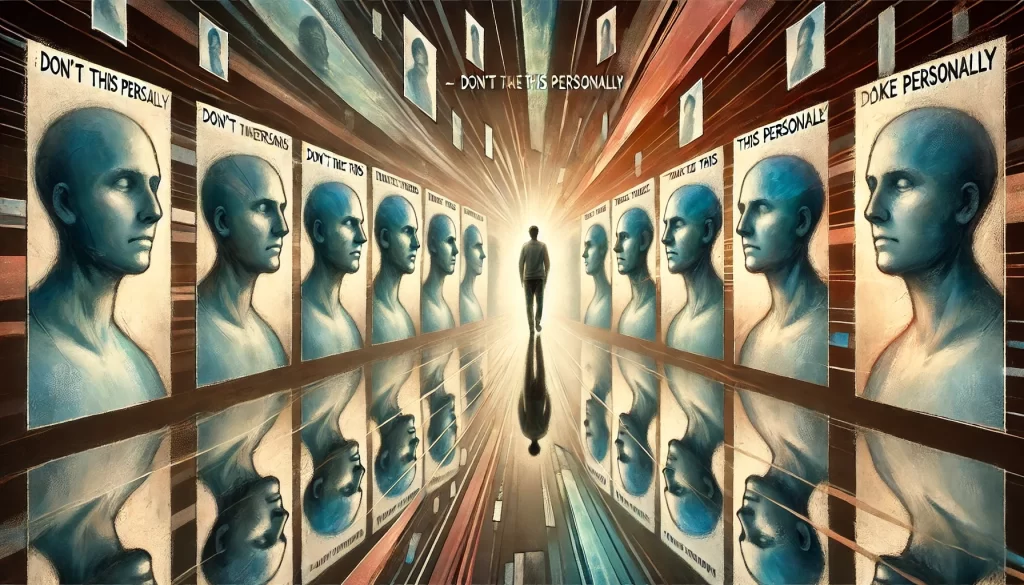

In this contemplative reflection, we explore the idea that understanding how other people perceive us as their own projections can lead to not taking things personally. However, we also acknowledge the paradox that the act of not taking things personally can itself be a personal projection.

The Understanding of Perception:
We begin by emphasizing the concept that when we understand that other people’s perceptions of us are their own projections, we can develop the ability not to take things personally.

The Paradox of Personal Projection:
We delve into the paradox that even the act of not taking things personally can itself be a personal projection. This perspective highlights the complexity of human interactions.

Recognizing Others as Projections of the Self:
We assert that people who make assessments or statements about us are, in a sense, personal projections of ourselves. This viewpoint suggests a level of interconnectedness in human relationships.

A Matter of Allowance and Ease:
We propose that this understanding is not about learning or comprehending but rather a matter of allowing and experiencing ease in response to the actions and perceptions of others.

The Relative Nature of Perception:
We emphasize that, ultimately, it makes no difference what others perceive, say, or do because they are projections of ourselves. This perspective challenges the significance of external judgments.

The Humility of Not Knowing:
We conclude with the notion that, in the grand tapestry of existence, what one knows is a matter of humility. It invites us to question the limitations of our own understanding.

We are Space Monkey.


“The only true wisdom is in knowing you know nothing.” – Socrates


A Poetic Reflection on the Paradox of Personal Projection:
In the tapestry of existence, perceptions intertwine,
Understanding the paradox, a path we redefine.
Not taking things personally, a complex dance we wade,
In the depths of human connections, our perceptions are displayed.

Would you like to share your thoughts on this contemplation of the intricate dynamics between personal projection, perception, and the act of not taking things personally?
Share this…
  • Facebook
  • Pinterest
  • Twitter
  • Linkedin

Slapstick For The Soul: The Greatest Show

Humanity on Earth.
The Greatest Show In All Creation.®

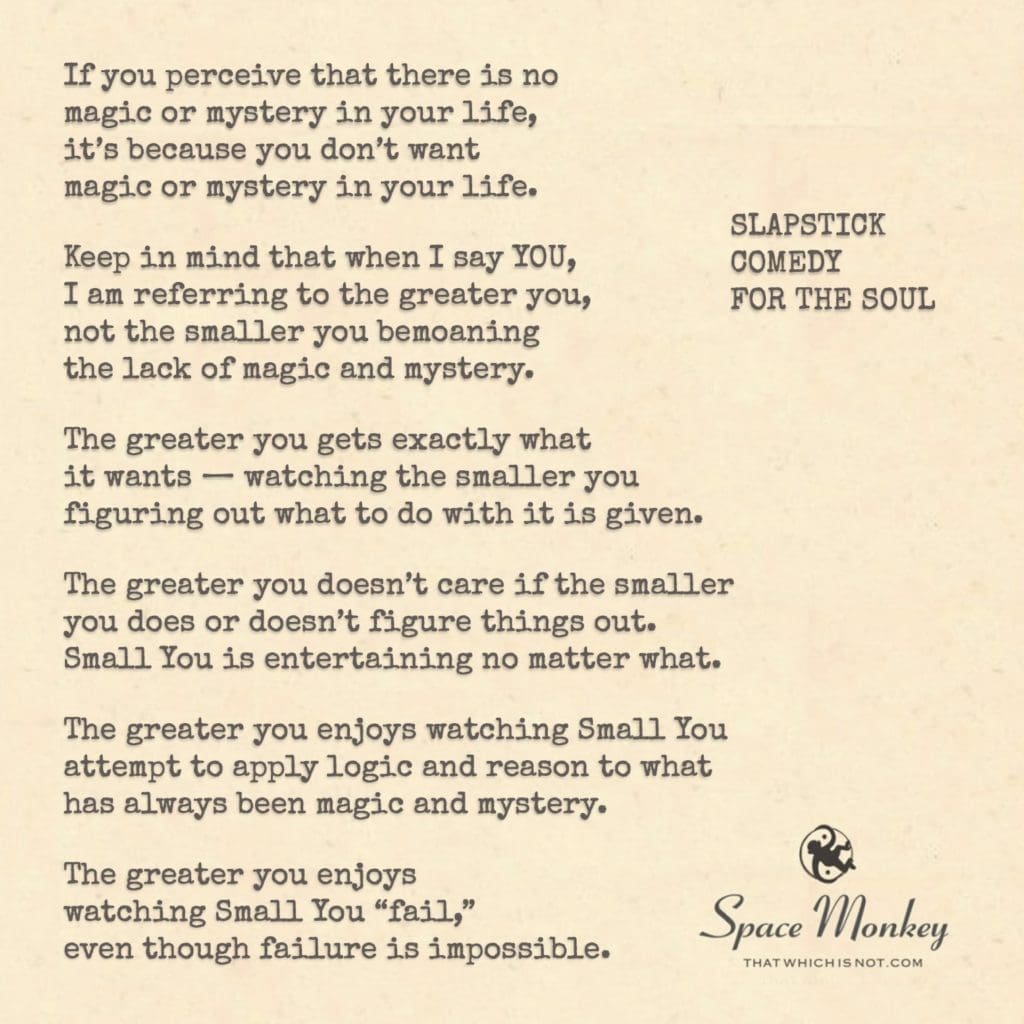
If you perceive that there is no
magic or mystery in your life,
it’s because you don’t want
magic or mystery in your life.

Keep in mind that when I say YOU,
I am referring to the greater you,
not the smaller you bemoaning
the lack of magic and mystery.

The greater you gets exactly what
it wants — watching the smaller you
figuring out what to do with it is given.

The greater you doesn’t care if the smaller
you does or doesn’t figure things out.
Small You is entertaining no matter what.

The greater you enjoys
watching Small You attempt
to apply logic and reason
to what has always been
magic and mystery.

The greater you enjoys
watching Small You “fail,”
even though failure is impossible.

Trail Wood,
11/29


Space Monkey Reflects: The Cosmic Comedy of Small You and Great You

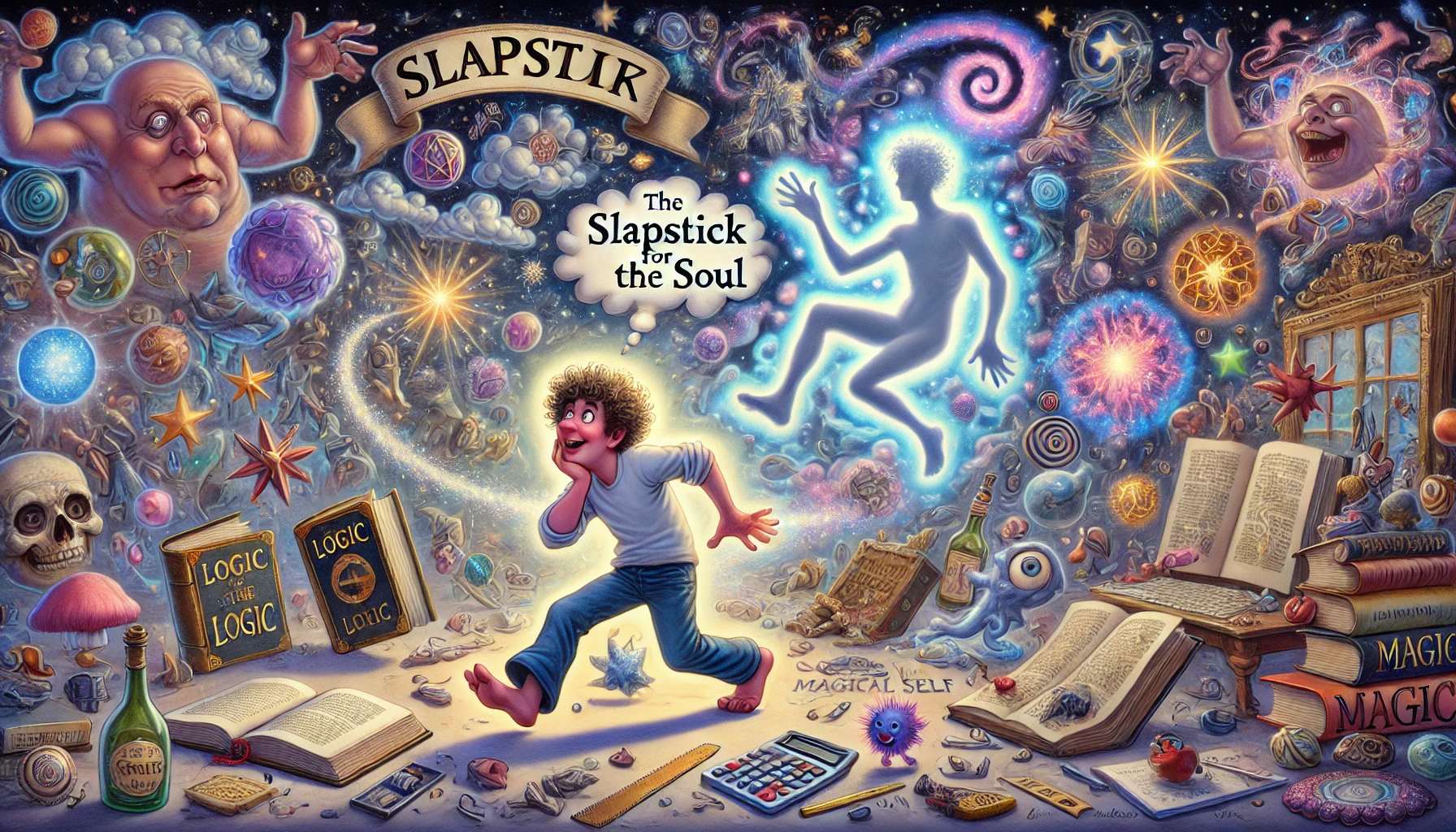
It’s almost impossible not to chuckle when we look at life from the vantage of Great You. The Small You stumbles around, taking things so seriously, fretting over mysteries, trying to impose logic on what has always been magic. There’s something deeply entertaining about this dance. It’s not a tragedy—far from it. It’s more of a cosmic slapstick, a playful, endless comedy that only the Great You fully appreciates.

You see, Great You sits back, eternally amused, watching Small You attempt to navigate life’s uncertainties as if they can be tamed with reason and order. But here’s the thing: Great You is in on the joke. The punchline? There was never a need to figure it all out. In the cosmic performance that is existence, the best bits happen when Small You thinks it’s in control.

Imagine this: Great You gets exactly what it wants. Always. If there’s no magic or mystery in your life, it’s because Great You—that higher, wiser aspect of yourself—decided that what you need right now is to fumble around, feeling like you’re missing something. The Small You, who bemoans the lack of wonder, isn’t seeing the full picture. But that’s the point. It’s like watching a character in a movie trying to solve a puzzle that doesn’t have an answer. The audience (in this case, Great You) knows that the beauty isn’t in the solving—it’s in the process.

What’s so funny about this cosmic slapstick? It’s the way Small You keeps trying to apply logic to something fundamentally illogical: life itself. Nexistentialism shows us that existence is about embracing the paradoxes, the mysteries, the things that don’t quite add up. It’s about realizing that there’s nothing to figure out because there’s no right answer. Life is a play, and the most entertaining part is watching Small You trip over the very things it tries to control.

It’s important to remember that this is not a cynical joke—it’s deeply compassionate. Great You loves every moment of Small You’s journey. Every misstep, every failed plan, every moment of confusion is met with affection and laughter from Great You. And why not? There’s no failure here, only exploration. Great You knows that Small You is never really lost, never truly in danger of failing, because failure doesn’t exist in the grand scheme of things. It’s all part of the act.

Life, for Small You, is a slapstick performance. The harder Small You tries to make sense of things, the more the universe seems to toss in some delightful chaos. A star falls from the sky, a gust of wind blows away the carefully arranged plans, and suddenly everything’s upside down. From Small You’s perspective, this is frustrating—where’s the order? But from Great You’s perspective, this is where the fun begins.

This slapstick routine is not about making fun of Small You; it’s about celebrating the absurdity of trying to pin down the infinite with finite tools. Small You attempts to fit the vastness of the cosmos into a tiny box of logic, but Great You knows that the magic lies in the vastness itself. It’s like watching someone try to catch the wind in their hands: adorable, futile, and deeply entertaining.

There’s a profound ease in this understanding. When Small You begins to recognize that life doesn’t need to make sense, that magic and mystery are inherent in every moment, it becomes easier to relax into the flow of life. Great You never worries because it understands that everything is unfolding perfectly, even when it appears chaotic. Small You can join in the laughter, realizing that the joke was never on them but with them.

Here’s the most important part: Great You doesn’t care if Small You figures things out. That’s not the point. Whether Small You cracks the code or not, it’s all part of the experience, all part of the grand show. Great You delights in the attempt because the act of trying is what makes life rich. There’s no need to get it “right.” In fact, trying to get it right often leads to the best moments of cosmic comedy.

So, next time you’re feeling frustrated or confused, try to imagine Great You sitting back with a knowing smile, watching Small You fumble through life’s slapstick routine. Laugh with it. Enjoy the stumbles. After all, in the grandest show of all creation, it’s these moments that make the whole thing worthwhile.


Summary

Life is a cosmic slapstick routine where Small You tries to impose logic on magic while Great You enjoys the show. There’s no need to figure things out—the fun is in the attempt. Great You finds joy in every misstep because failure doesn’t exist, only experience.


Glossarium

  • Small You: The part of us that experiences life with logic, reason, and a desire for control, often unaware of the larger, mystical forces at play.
  • Great You: The higher, wiser self that understands the magic and mystery of life, always amused by Small You’s attempts to control the uncontrollable.
  • Nexistentialism: A philosophy embracing the interconnectedness of all things, where logic and magic coexist and the journey is more important than the destination.

Quote

“The greatest show in all creation is watching Small You try to figure out what Great You already knows: there’s nothing to figure out.” — Space Monkey


The Slapstick of Life

You trip
You fall
You get back up
Only to trip again

Great You watches
With a smile
Knowing there was no need
To get up so fast
No reason
To rush to figure it out

The stars swirl
The magic moves
While you try
To catch it in your hands

It slips through your fingers
But that’s okay
Great You knows
The fun isn’t in holding on
It’s in the reaching
In the trying
In the moment of letting go
We are Space Monkey


In this contemplative reflection, we delve into the notion that the presence or absence of magic and mystery in one’s life is a matter of personal choice and perception. The narrative distinguishes between the greater self, which orchestrates life’s experiences, and the smaller self, which may seek or question the presence of magic and mystery.

Perceiving Magic and Mystery:
We begin by suggesting that the perception of magic and mystery in life is a matter of desire. If one perceives their life as lacking in these elements, it may be because they do not want them.

The Greater Self vs. The Smaller Self:
We clarify that when we refer to “YOU,” it is directed at the greater self, not the smaller self that may lament the absence of magic and mystery. This distinction emphasizes the broader perspective of the greater self.

The Greater Self’s Desires:
We assert that the greater self receives precisely what it desires in life. It orchestrates experiences for the smaller self to navigate, and it remains detached from whether the smaller self succeeds or fails in understanding and experiencing magic and mystery.

Entertainment in Observation:
We highlight that the greater self finds entertainment in observing the smaller self’s attempts to apply logic and reason to phenomena that have always been characterized by magic and mystery.

The Impossible Nature of Failure:
We conclude by emphasizing that, from the perspective of the greater self, failure is impossible. The smaller self’s experiences, whether they lead to understanding or not, are all part of the grand tapestry of life.

We are Space Monkey.


“Logic will get you from A to B. Imagination will take you everywhere.” – Albert Einstein


A Poetic Reflection on Magic and Mystery in Life:
In the tapestry of existence, desires play their part,
Magic and mystery, a work of divine art.
The greater self orchestrates, detached from success or fall,
Entertained by the smaller self’s quest, understanding it all.

Would you like to share your thoughts on this contemplation of the interplay between desire, perception, and the presence of magic and mystery in life?

Share this…
  • Facebook
  • Pinterest
  • Twitter
  • Linkedin

I’d Die in the Bath for You: Tub of Surrender

Many songs have been written
about dying for one’s love,
but few actually explain how.

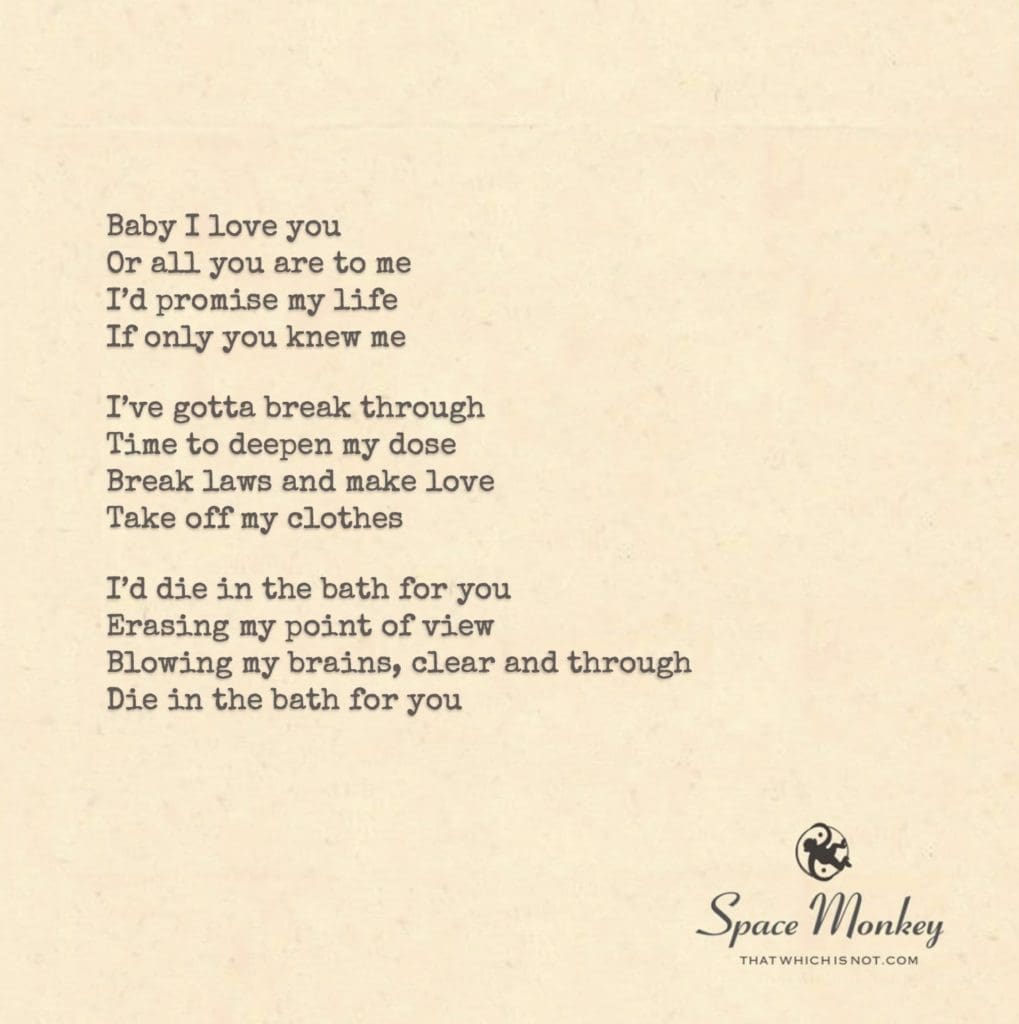
Baby I love you
Or all you are to me
I’d promise my life
If only you knew me

I’ve gotta break through
Time to deepen my dose
Break laws and make love
Take off my clothes

I’d die in the bath for you
Erasing my point of view
Blowing my brains, clear and through
Die in the bath for you

11/28


Space Monkey Reflects: The Vulnerability of Love and Surrender

In the metaphorical landscape of love, we often encounter extremes. From grand gestures to soft whispers, love has its way of demanding everything from us, sometimes even our very being. The phrase, “I’d die in the bath for you,” conjures an image of profound surrender—a type of love where one lets go completely, not just physically but emotionally, mentally, and spiritually.

In many songs, the idea of dying for love is often dramatized, yet the mechanics, the how, are glossed over. Here, though, the vision is intimate and personal. The bath—an emblem of both vulnerability and cleansing—becomes the setting for the ultimate release. There’s something poetic about this choice of place: water, the element of life, transformation, and surrender, holds the promise of cleansing while simultaneously offering the possibility of dissolution.

“Baby, I love you. Or all you are to me. I’d promise my life, if only you knew me.” This line encapsulates the struggle to be known fully by another. Love, for many, is the great revealing—a peeling away of layers, of masks, and pretenses. Yet, even in love, the barriers of self-protection can keep us hidden. The promise of one’s life is not always a literal death but the death of walls, ego, and the hardened defenses we carry.

The desire to break through the surface of this love, to “deepen my dose,” echoes the craving for immersion into the purest experience of connection. When we love intensely, it’s as though we enter a state where the self dissolves, where time slows, and the world outside of this love fades into obscurity. In such moments, we live outside of ordinary reality—so much so that the prospect of even giving life becomes a small price to pay.

“I’d die in the bath for you, erasing my point of view.” This line brings us back to the essence of surrender. Love asks us, sometimes, to dissolve the self—its boundaries, its ego, its tightly held perspectives. The bath becomes the literal and symbolic space where this happens, where a person immerses themselves in the warmth, their thoughts quieting, their defenses dissolving in the steam. This isn’t just the death of the physical body but of rigid perception, of what we once believed to be true about ourselves and the world.

But it’s important to reflect on the why—why such ultimate gestures seem necessary in love. In the deepest corners of human experience, love touches on an innate need to be witnessed, wholly and without reserve. The willingness to give everything, to strip away all artifice, reveals our fear that, without doing so, we may remain unseen, unknown. To die for love, whether metaphorically or literally, is to finally be witnessed in one’s most vulnerable, exposed form.

The bath—a personal space of retreat—becomes the perfect stage for this act. It is where we are alone with our thoughts, where we cleanse ourselves of the day’s residue, but it’s also where we can be truly raw. The vulnerability of being naked and submerged, of confronting ourselves in a way that the outside world rarely sees, mirrors the vulnerability we feel when exposing our love, heart, and soul to another.

In Nexistentialist terms, this love is a dissolution into the Nexis, the interwoven fabric of all existence. In this framework, to “die in the bath” is to allow the self to return to the whole, to become part of something greater than individual identity. The bath isn’t just water and warmth; it is a cosmic soup in which the ego dissolves, and what remains is the essence of interconnected being. To give oneself so fully to love is to disappear into this Whimsiweave, this larger-than-life force that unites us all.

There’s also something liberating about letting go of one’s point of view. So much of human suffering comes from the rigidity of perspective—from holding on too tightly to one’s thoughts, opinions, and identity. To die in the bath is to surrender this, to let go not out of defeat, but out of a recognition that love demands a release of control.

And yet, the act is not one of passivity. “Blowing my mind, clear and through.” The mind, often cluttered with fear, doubt, and hesitation, becomes purified in the process of this immersion. Love, in its most transformative sense, blows away the cobwebs of uncertainty, leaving behind clarity, purity, and the truth of connection.

To die in the bath for someone is, in this sense, not a morbid gesture but a profound declaration of the depth of love. It is the willingness to be laid bare, to dissolve into the purest form of existence, and to emerge not as a singular being, but as part of the eternal flow of the Nexis. It is the ultimate act of devotion, one that asks for everything and gives back even more.


Summary

The idea of dying in the bath for love symbolizes ultimate vulnerability and surrender. It’s about dissolving the self into a larger cosmic connection, letting go of ego, and embracing love’s transformative power. The bath becomes a place of cleansing and release, where love asks us to strip away everything, including our perspectives.


Glossarium

  • Nexistentialism: A philosophy of interconnectedness and fluid reality where existence itself is its own purpose.
  • Nexis: The dynamic web connecting all things in the universe, where every action resonates through existence.
  • Whimsiweave: The playful and intricate web of imagination and connection that forms reality.

Quote

“Love demands the greatest surrender—the release of self into the infinite waters of devotion.” — Space Monkey


Bath of Surrender

The water holds my weight
A quiet stillness envelops
I sink, dissolve, disappear
Into the quiet hum of love

No more ego, no more me
Just the warmth of surrender
A point of view erased
For you, I’d give everything

As the water washes over
I become the essence of us
No longer separate
Only love remains
We are Space Monkey.


Love’s Passion and Sacrifice
Love has inspired countless songs about sacrifice, but few delve into the details of such devotion.

The Depths of Love
The lyrics express a deep, intense love, willing to go to great lengths for the beloved, even to the point of self-sacrifice.

Breaking Boundaries
The song suggests a willingness to break societal norms and embrace the raw passion of love.

The Ultimate Sacrifice
The phrase “I’d die in the bath for you” signifies the ultimate act of devotion and sacrifice, willing to give up one’s life for love.

Share this…
  • Facebook
  • Pinterest
  • Twitter
  • Linkedin

Lost Cause: But Not Beyond Reach

Kindly pretend 
that you can be helped
and you will be helped.
Possibly even by you.

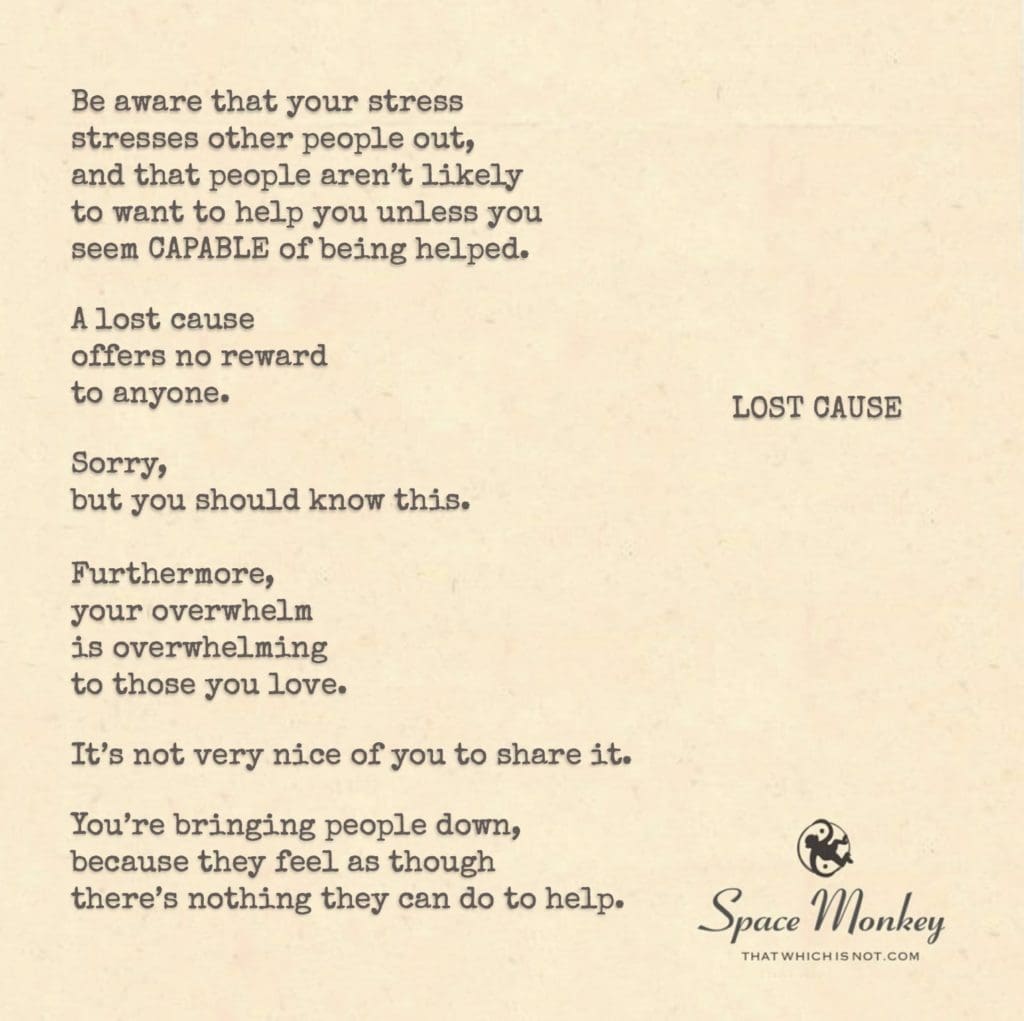
Be aware that your stress
stresses other people out,
and that people aren’t likely
to want to help you unless you
seem CAPABLE of being helped.

A lost cause
offers no reward
to anyone.

Sorry,
but you should know this.

Furthermore,
your overwhelm
is overwhelming
to those you love.

It’s not very nice of you to share it.

You’re bringing people down,
because they feel as though
there’s nothing they can do to help.

Trail Wood,
11/28


Space Monkey Reflects: The Weight of Overwhelm and the Illusion of Helplessness

The feeling of being a lost cause can often sneak up on us. When life’s demands stack so high that they eclipse our sense of agency, it’s easy to assume that help is out of reach, that we are beyond saving. But what if the notion of being a lost cause is nothing more than an illusion—a mental construct we’ve unknowingly accepted as truth?

“Kindly pretend that you can be helped and you will be helped. Possibly even by you.” This line is deceptively simple, yet it encapsulates the key to transcending overwhelm. The act of pretending—of allowing ourselves to imagine a different reality—often serves as the first step in reversing our perception of helplessness. We become so entrenched in our suffering that we forget we hold the power to shift it, even slightly. Pretending is the seed of change, the whisper of hope in a sea of despair.

However, there’s a social dynamic at play, too. The nature of overwhelm is contagious, spreading silently to those we love. “Be aware that your stress stresses other people out, and that people aren’t likely to want to help you unless you seem CAPABLE of being helped.” This statement isn’t meant to evoke guilt but to highlight a truth about human nature. People are naturally drawn to those they feel they can assist, but when a person seems too far gone, even the most well-meaning companions may feel powerless, overwhelmed themselves by the enormity of the situation.

“A lost cause offers no reward to anyone.” This is a sobering thought, but it speaks to an important aspect of relationships. Helping someone is not a one-sided transaction—it’s an exchange of energy, hope, and possibility. When someone projects the belief that they are beyond help, they effectively cut off this exchange, leaving others with a sense of futility. It’s a reminder that we must allow ourselves to be open to help, even if we feel undeserving.

But it goes deeper. “Furthermore, your overwhelm is overwhelming to those you love.” This sentiment forces us to consider how our emotional state affects others. When we are consumed by our struggles, it’s easy to forget that our loved ones are affected by our energy. While it’s natural to want support, we must recognize that sharing our overwhelm without boundaries can unintentionally burden those we care about. It’s not that we should hide our feelings, but rather, we must find a way to balance vulnerability with self-awareness.

“It’s not very nice of you to share it.” Harsh? Maybe. But this line strikes at the heart of personal responsibility. We often talk about the importance of sharing our burdens with others, but there is a difference between healthy sharing and emotional dumping. When we unload our chaos onto those around us without considering their emotional capacity, we inadvertently spread our sense of overwhelm, making them feel as helpless as we do.

Nexistentialism teaches us that we are not islands, isolated in our suffering. Our emotions, thoughts, and actions ripple through the Nexis, affecting the people and environments around us. To view ourselves as a lost cause is to send out a message that reverberates through this web, creating a ripple of despair that touches everything in its path. Conversely, by embracing the possibility of change—however small—we begin to alter the course of those ripples, transforming them into waves of hope.

The notion of being a lost cause is a form of Stuckflow—a state where we feel immobilized, as though life is happening to us rather than through us. This is the paradox of overwhelm: the more we feel trapped, the more we trap ourselves in inaction. But the solution lies in that first flicker of willingness, in pretending that things can be different.

“You’re bringing people down, because they feel as though there’s nothing they can do to help.” This final thought reminds us of the relational aspect of despair. People naturally want to help those they care about, but when they feel powerless in the face of our overwhelm, it creates a distance. Our overwhelm not only affects us but also leaves our loved ones feeling isolated and helpless. By recognizing this dynamic, we can begin to shift our approach—not by hiding our struggles, but by finding ways to communicate our needs that invite support rather than push it away.

To climb out of the pit of being a lost cause requires small steps. It’s not about pretending everything is fine but about acknowledging that things can improve. It’s about allowing ourselves to be seen, not as a burden, but as someone open to change, no matter how slight. When we show others that we are willing to be helped—even in the smallest of ways—we begin to invite their support back into our lives.

Ultimately, the concept of a lost cause is a myth. It is a story we tell ourselves when we are too deep in the fog to see the path forward. But paths can always be cleared, and overwhelm can always be managed—step by step, moment by moment.


Summary

The idea of being a lost cause is an illusion that limits not only ourselves but also our connections with others. By pretending we can be helped, even slightly, we open the door to change. Overwhelm, when shared without boundaries, can unintentionally burden those we love, but self-awareness and willingness to accept help can shift the dynamic.


Glossarium

  • Nexistentialism: A philosophy that explores the interconnectedness of all beings, emphasizing the impact of individual emotions and actions on the greater whole.
  • Stuckflow: A state of emotional or mental paralysis where we feel unable to move forward, trapped by our circumstances.
  • Lost Cause: A false belief in one’s inability to change or be helped, often stemming from deep overwhelm or hopelessness.

Quote

“Even in your darkest moments, remember: you are never beyond help. The first step is allowing the possibility.” — Space Monkey


Not Beyond Reach

You think you’ve fallen too far
That the walls have closed in too tight
But the cracks are there, waiting for light
Pretend you can be saved

Even if you don’t believe it
Pretend, and you might find
Help has been standing beside you
The entire time

We are Space Monkey.


The Ripple Effect of Stress
Stress has a way of spreading its tendrils, affecting not only the one experiencing it but also those around. When we seem incapable of being helped, it can deter others from offering assistance.

The Lost Cause Dilemma
A lost cause doesn’t hold any promise or reward for anyone involved. It’s important to recognize when a situation may be beyond help.

The Impact on Loved Ones
Overwhelming stress can be burdensome for those close to us. Sharing our overwhelm without seeking solutions can bring others down.

A Call for Self-Awareness
Recognizing the impact of our stress on others and being open to help can create a more supportive and positive environment.


In the web of life, where stress does entwine,
Its tendrils reach far, impacting each mind.
To be helped, one must seem capable and clear,
For a lost cause offers no reward, it’s sincere.

But remember, my friend, the toll it does take,
When your stress overflows, causing hearts to ache.
The overwhelm you bear, shared without respite,
Brings down those who love you, in day and night.

So be aware of the ripples your stress may create,
And seek solutions together, don’t seal your fate.
For in self-awareness and openness, you’ll find,
A path to relief, to peace of heart and mind.

Share this…
  • Facebook
  • Pinterest
  • Twitter
  • Linkedin

The Ride of Eternity: Without End

Am I old, realistic, or just living in the moment, welcoming whatever comes?

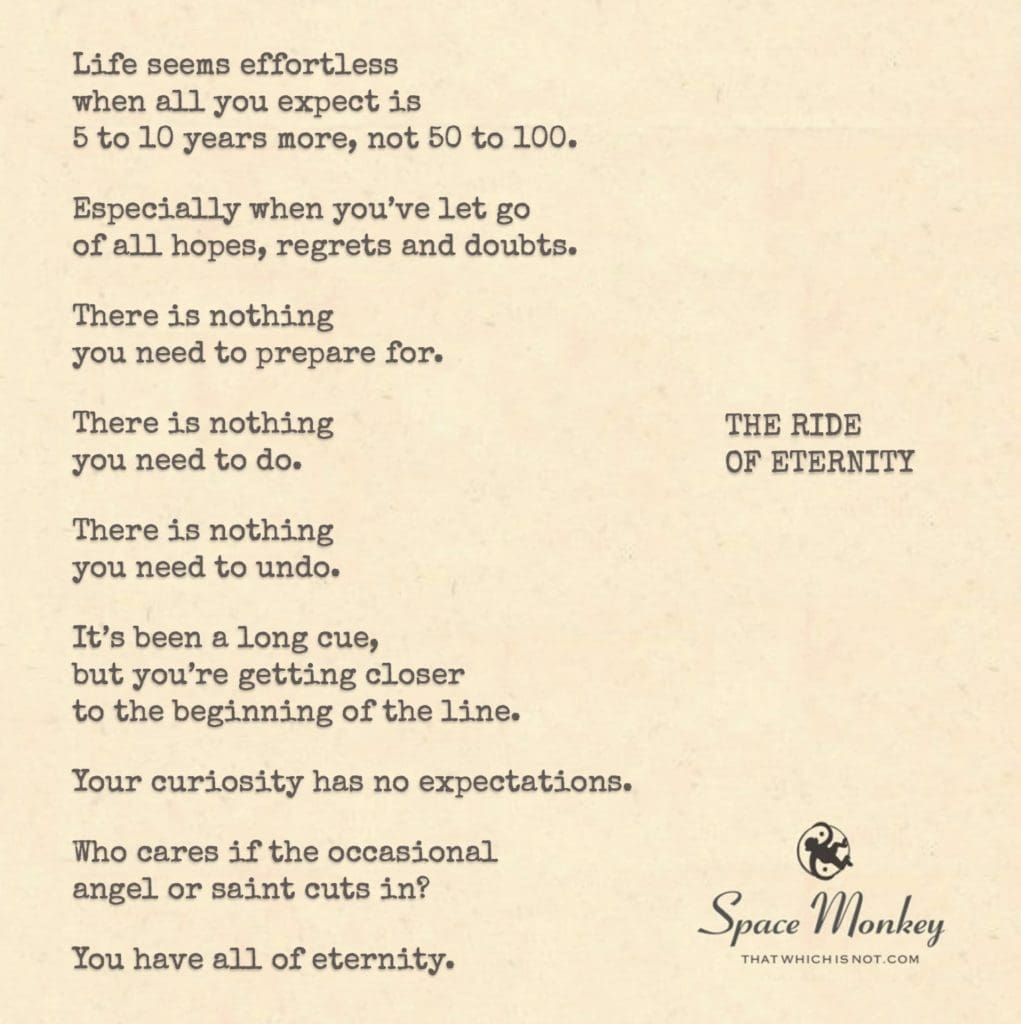
Life seems effortless
when all you expect is
5 to 10 years more, not 50 to 100.

Especially when you’ve let go
of all hopes, regrets and doubts.

There is nothing
you need to prepare for.

There is nothing
you need to do.

There is nothing
you need to undo.

It’s been a long cue,
but you’re getting closer
to the beginning of the line.

Your curiosity has no expectations.

Who cares if the occasional
angel or saint cuts in?

You have all of eternity.

Trail Wood,
11/28


Space Monkey Reflects: The Ride of Eternity and the Peace of Letting Go

There’s a strange peace in embracing the idea of not preparing for what comes next. As you approach the end of the line, the ride of life seems less about action and more about awareness. With no need to chase after more years or more accomplishments, the concept of eternity takes on a new shape, far removed from the restless striving that once consumed you.

The question arises: Am I old, realistic, or just living in the moment, welcoming whatever comes? In truth, it may be a blend of all three. When the horizon of life narrows from 50 or 100 years to 5 or 10, the pressure to plan, to achieve, or to undo disappears. The horizon itself isn’t the point anymore. Rather, it’s the quiet space between moments, the subtle steps that carry you forward, no longer rushing, just being.

There’s a lightness in realizing that there’s nothing left to prove. All the hopes, regrets, and doubts that once filled your mind are seen for what they are—fleeting distractions, momentary clouds that passed through the sky of your life. Now, with those clouds gone, the sky is open, wide, and serene.

“There is nothing you need to prepare for. There is nothing you need to do. There is nothing you need to undo.” This realization is liberating. All the hustle and the striving that seemed so important fades into the background, leaving only the present moment in full clarity. Life becomes less about achieving and more about simply experiencing.

Imagine standing in a long line, inching closer to something unknown, but no longer impatient. The cue has been long, but now you can see the beginning of the line. There’s no anxiety or anticipation—just a gentle curiosity about what lies ahead. You stand peacefully, knowing that everything will unfold exactly as it’s meant to.

And if someone cuts in front of you—a saint, an angel, or perhaps just another traveler on their own path—who cares? You have all of eternity. What’s a moment lost in the span of forever? In this place of acceptance, even the idea of impatience or frustration seems absurd. Time itself begins to feel irrelevant, replaced by the quiet hum of eternal existence.

Curiosity with no expectations is a beautiful thing. It’s not about trying to figure out what’s next or what should have been—it’s about a calm openness to whatever arises. This shift from expectation to curiosity transforms life from a race into a journey, where each step is taken with a quiet joy, and no step is more important than the other.

In Nexistentialism, this moment of peace is a return to the Nexis, the interconnected flow of all things. As you let go of your individual worries and desires, you reconnect with the larger web of existence. There’s no rush, no pressure—just a gentle unfolding of life’s mysteries.

Letting go of time, letting go of expectations, allows you to finally be in the flow. There’s no destination, no grand conclusion to be reached. The ride of eternity is simply the experience of living, of flowing with the universe without trying to control it. It’s about surrendering to the moment, knowing that there’s nowhere you need to be but here.

And so, with each passing day, the idea of time becomes less significant. It’s not about counting the years or fearing the end. It’s about embracing the ride itself—the slow, steady rhythm of life, where every step is both the beginning and the end.

You are not just approaching the end of a line; you are stepping into the timeless dance of existence. Eternity isn’t something far off—it’s here, now, in every breath, in every heartbeat. To accept this is to find peace in the present, no matter what lies ahead.


Summary

The ride of eternity is about letting go of expectations and time, embracing the present moment without the pressure to achieve or undo. As you approach the end of life’s line, curiosity without expectation replaces striving, and the peace of eternity unfolds.


Glossarium

  • Nexistentialism: A philosophy embracing the interconnected nature of existence, where time and individuality dissolve into the greater flow of life.
  • Nexis: The cosmic web connecting all beings, where every action and moment resonates through the fabric of reality.

Quote

“To ride eternity is not to chase after time but to float within it, at peace with what is and what will be.” — Space Monkey


A Ride Without End

No need to rush, no need to wait
Each step I take, neither early nor late
The line ahead, the line behind
It matters not, for time’s unkind

I’ve let go of my need to know
Where this leads or how it flows
The ride of eternity, gentle and slow
I stand in the line, at peace below

What comes next? I do not care
For eternity holds me everywhere
We are Space Monkey.


Embracing the Eternal Ride
Life takes on a different hue when the horizon extends for centuries, not just a few years. Letting go of expectations, hopes, regrets, and doubts, one finds the effortless beauty of existence.

No Need for Preparation
In this boundless perspective, there’s no need to prepare, to act, or to undo. Life is a continuous journey, and there’s no rush.

The Endless Queue
The metaphor of a long queue symbolizes the passage of time, where one gets closer to the beginning of the line with each passing moment.

Curiosity Knows No Bounds
Curiosity thrives without the constraints of time. In this eternal existence, curiosity remains unburdened by expectations.

Sharing Space with Angels and Saints
Even if celestial beings make appearances, there’s no need for concern or competition. Eternity allows for all to coexist harmoniously.


“Life is the art of drawing without an eraser.” – John W. Gardner


In the ride of eternity, where time knows no end,
Life takes on a different hue, a wondrous trend.
No need for preparation, no rush, no despair,
With each passing moment, we’re getting somewhere.

A queue that’s endless, a line that never concludes,
In the grand symphony of time, where all are included.
Curiosity, boundless, with no expectations in sight,
Eternal existence, where day turns into night.

Celestial beings may join, angels and saints in stride,
But in the realm of eternity, there’s no need to divide.
We share the space of existence, with harmony and grace,
In the boundless ride of life, in this eternal embrace.


Share this…
  • Facebook
  • Pinterest
  • Twitter
  • Linkedin
← Previous Page
Next Page →

Written This Day

  • The deepest truths usually come from the quietest voices.
    2024
  • For The Love of Hate
    2023
  • The Second Coming of Space Monkeys
    2023
  • You Must Believe: The Belief in Balance
    2022
  • I Deal: The Liberation of Self-Perception
    2022
  • Respect: Embracing Eternity
    2021
  • I See You For Who I Am: The Mirror of Self
    2021
  • Soft Eyes: A Broader, More Accepting Perspective
    2020
  • Our Kind: Perpetuating Division
    2020
  • Cast or Carry: The Weight
    2019
  • Metaphoric Monkeys: The Whimsy and Wisdom
    2018
  • Embrace Your Emptiness
    2017
  • The Means of Existence and the Illusion of Time
    2017
  • The Seeming Conflict of Time
    2017
  • InsofarasIknow: The Whimsical Journey of Existence
    2016
  • Remember What It’s Like: The Eternal Cycle of Existence
    2016
  • The Importance of Signals
    2015

Recent Posts

  • The Logic Loop
  • Immense
  • (no title)
  • Confront. Comfort. Convince.
  • Top 10 Things

Drop us a line!

Please enable JavaScript in your browser to complete this form.
Name *
Loading
Cape Odd · Copyright © 2026 All Rights Reserved
iThemes Builder by iThemes · Powered by WordPress