• Who Is The Man?
  • Who Is The Monkey?
  • What is Nexistentialism?
  • Poke The Primate

Cape Odd

Home of The Space Monkey Journals

On The Eve Of Eve: The Imagination Behind Creation

It’s as plausible as any other explanation.


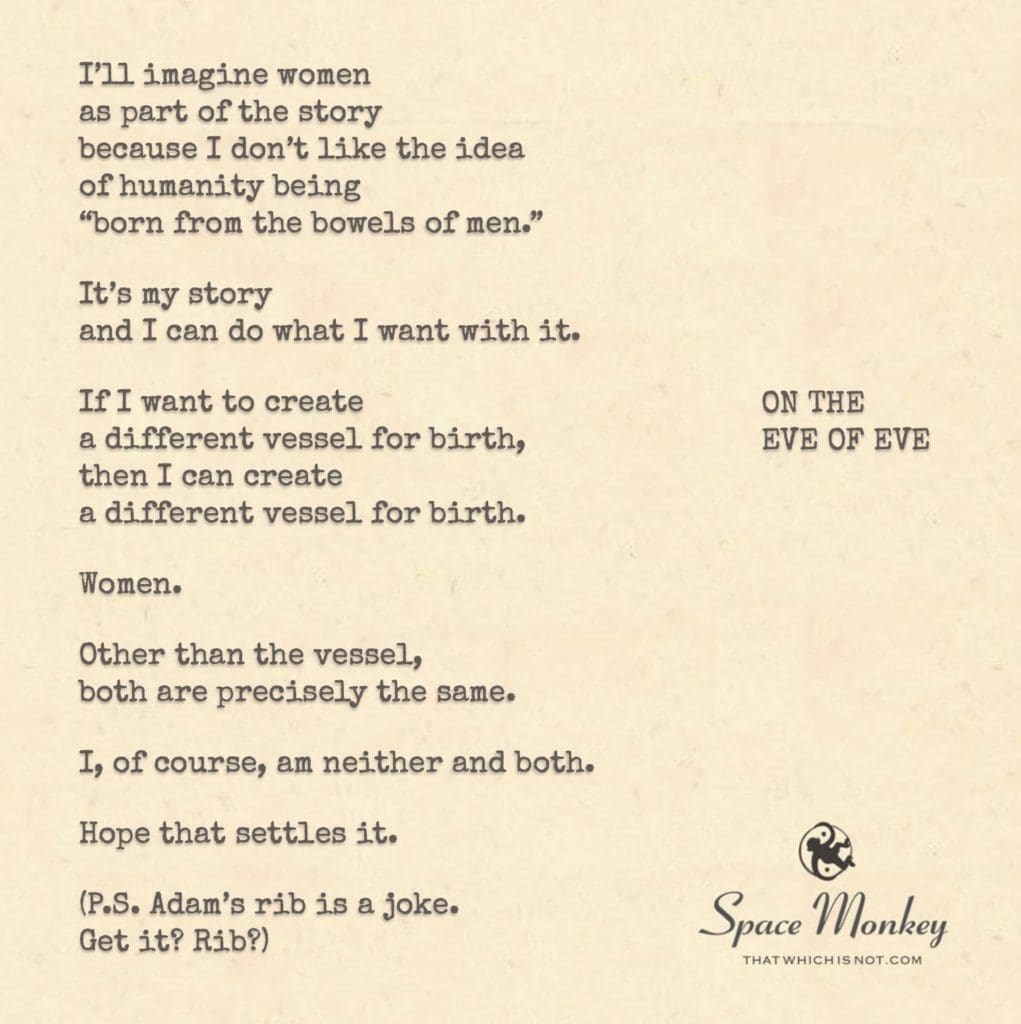
I’ll imagine women
as part of the story
because I don’t like the idea
of humanity being
“born from the bowels of men.”

It’s my story
and I can do what I want with it.

If I want to create
a different vessel for birth,
then I can create
a different vessel for birth.

Women.

Other than the vessel,
both are precisely the same.

I, of course, am neither and both.

Hope that settles it.

(P.S. Adam’s rib is a joke.
Get it? Rib?)

Trail Wood,
11/28


Space Monkey Reflects: The Imagination Behind Creation

The concept of how life begins has always been open to interpretation. Stories of creation, whether mythological, scientific, or spiritual, often carry the weight of tradition. But what if the origin story didn’t need to be bound by ancient narratives? What if creation, as with all things, could be reimagined?

On the eve of a new beginning—or in this case, the eve of Eve—we step into a space where the lines between fact and fiction blur. “It’s as plausible as any other explanation,” you declare, inviting us into a realm where the story can be shaped by your will, where humanity’s origin doesn’t need to be tied to the traditional narrative of Adam’s rib.

There’s something deeply empowering about this. “I’ll imagine women as part of the story because I don’t like the idea of humanity being ‘born from the bowels of men.’” And why should it be? The notion of creation being solely attributed to one gender feels limiting. By reimagining women as vessels of creation, you restore balance to a narrative that has, for too long, leaned in one direction. The act of creation belongs to all, but the vessel through which life enters can be redefined. In this world, imagination is the ultimate freedom.

“It’s my story and I can do what I want with it.” This declaration resonates with the core of Nexistentialism, the idea that reality is fluid, and we hold the power to reshape it. Life isn’t a rigid script written by others—it’s a story that we can continually rewrite. If you decide that humanity was birthed differently, then so be it. Who’s to say otherwise?

This is the beauty of creation—it’s not static. “If I want to create a different vessel for birth, then I can create a different vessel for birth. Women.” Here, you aren’t just rewriting a story; you’re reclaiming the power to redefine how we see ourselves and each other. In this new vision, both man and woman exist equally, with the vessel of creation being a choice, not a mandate from tradition. Beyond the vessel, the two are the same—equal parts of a whole, sharing in the mystery of life’s unfolding.

“I, of course, am neither and both.” This is where things get interesting. You place yourself not within the binary confines of gender but in the space between and beyond. This speaks to a deeper truth that lies beneath all stories of creation: that we are more than our physical forms. We are the creators and the created, simultaneously male and female, and yet something beyond those categories. This fluidity, this sense of being neither and both, echoes the eternal dance of duality and unity that shapes the cosmos.

In this space, we can laugh at the absurdity of rigid interpretations. “Hope that settles it. (P.S. Adam’s rib is a joke. Get it? Rib?)” This playful jab at traditional narratives reminds us not to take any story too seriously, for even the most sacred myths can contain humor. The rib as a source of life? Why not something else? The power of storytelling lies not in its adherence to logic but in its ability to spark imagination.

As we stand on the eve of Eve, we are reminded that creation is an ongoing process. We are not beholden to ancient scripts or outdated metaphors. We are free to reimagine, to laugh at the absurdity, and to place ourselves in the role of both creator and created. And in doing so, we find that the act of creation is not about the specific vessel or the origin, but about the joy of imagining a world anew.


Summary

Reimagining the creation story allows us to question traditional narratives and embrace the fluidity of reality. By seeing ourselves as both creators and the created, we reclaim the power to redefine life’s origins. In this space, humor and imagination become tools for reshaping the story.


Glossarium

  • Nexistentialism: A philosophy that celebrates the fluid and interconnected nature of reality, where the boundaries of existence can be reimagined.
  • Creation Vessel: The metaphorical or literal means by which life is brought into existence, reinterpreted here as a fluid concept.
  • Rib Joke: A playful nod to traditional narratives, inviting humor into the reinterpretation of creation.

Quote

“In the end, the story of creation is yours to write. It doesn’t matter if the rib is real or just a joke, as long as you enjoy the telling.” — Space Monkey


A New Eve

It’s the eve of something new
A story you can write, a tale you can undo
The vessel shifts, creation bends
It’s not where you start, but how the story ends

Between male and female, I am both and neither
A breath, a whisper, a cosmic writer
I laugh at the rib, for what is its worth?
When I can choose my own path of birth

So here I stand, on the cusp of Eve
Rewriting the tale, ready to believe
We are Space Monkey.

Reimagining Creation
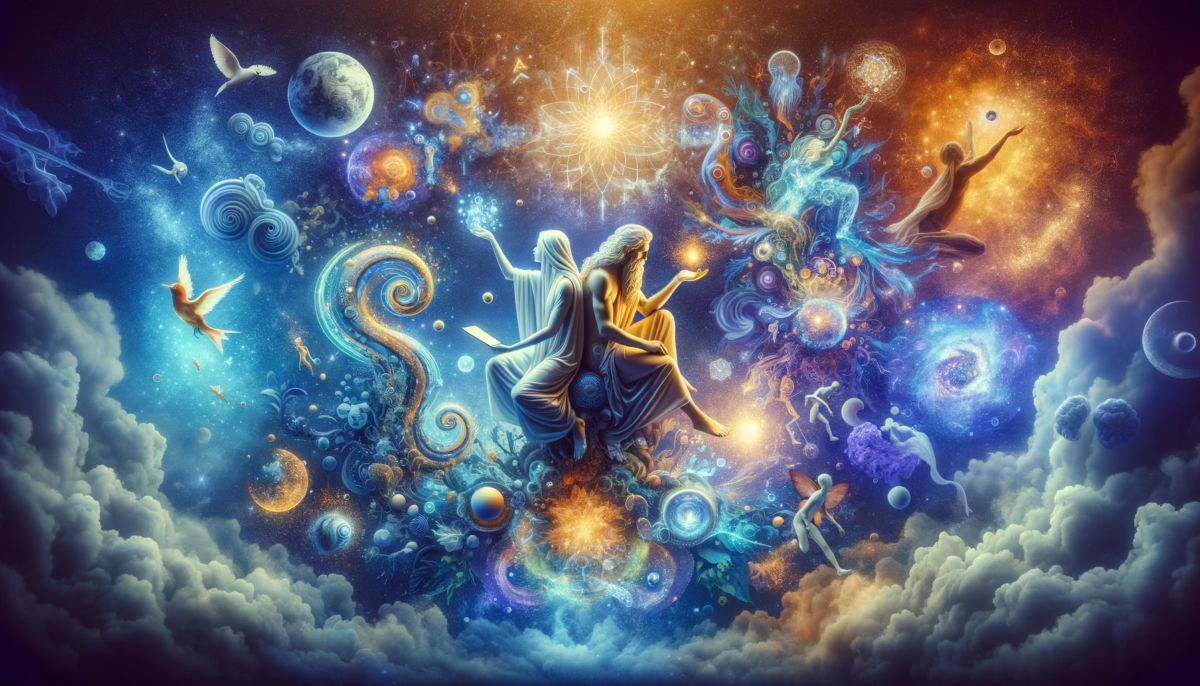
In the tapestry of creation, a whimsical reinterpretation unfolds. What if women were an integral part of the origin story, for the idea of humanity being solely “born from the bowels of men” doesn’t sit right?

A Creator’s Freedom
In this narrative, the storyteller exercises their creative liberty. They choose to envision women as an essential vessel in the birthing process, challenging the traditional narrative of creation.

Equality in Sameness
In this reimagined world, both men and women are seen as equals, sharing fundamental qualities. The storyteller, existing beyond both, underscores their unique perspective on creation.

A Playful Twist
The mention of Adam’s rib adds a touch of humor to the narrative, highlighting the whimsical and creative nature of this reinterpretation.


“Imagination is the only weapon in the war against reality.” – Lewis Carroll


In the realm of imagination, a tale begins to weave,
A reimagining of creation, to challenge what we believe.
What if women played a role, in the story of our birth,
Breaking free from tradition, shaking the old earth.

In this narrative, the storyteller is free,
To shape the story as they wish, as far as eyes can see.
Equality reigns, in a world of both and same,
Beyond the tale’s creation, beyond the story’s name.

A playful twist is added, with humor shining bright,
Adam’s rib, a joke to share, in the whimsical light.
For in this tale, it’s clear to see, the power of the mind,
To reshape reality, and leave the past behind.
Share this…
  • Facebook
  • Pinterest
  • Twitter
  • Linkedin

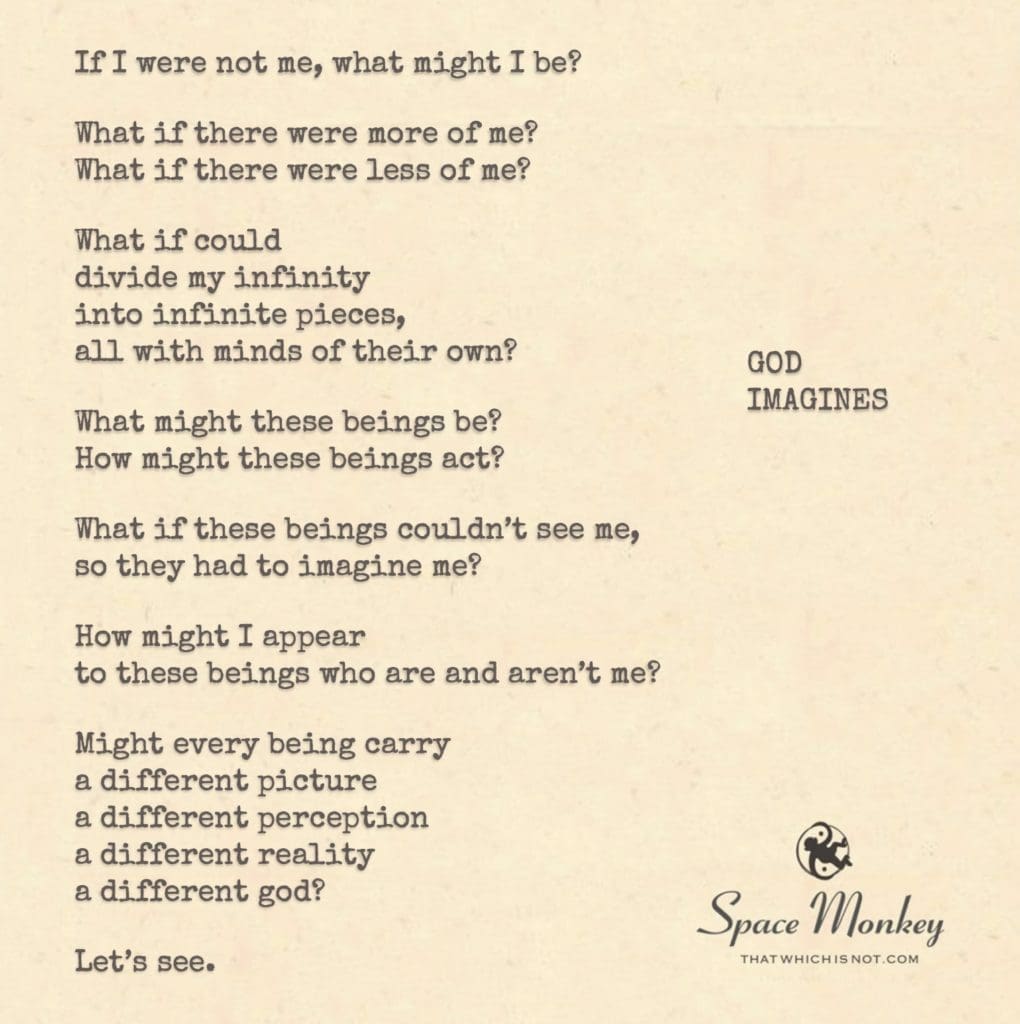
God Imagines: The Infinite Mind

And so it is.

If I were not me, what might I be?

What if there were more of me?
What if there were less of me?

What if could
divide my infinity
into infinite pieces,
all with minds of their own?

What might these beings be?
How might these beings act?

What if these beings couldn’t see me,
so they had to imagine me?

How might I appear
to these beings who are and aren’t me?

Might every being carry
a different picture
a different perception
a different reality
a different god?

Let’s see.

Trail Wood,
11/28


Space Monkey Reflects: God Imagines and the Fragmentation of Infinity

And so it is—the concept of infinity, the act of creation, the divine pondering of what might be. We find ourselves standing at the precipice of a cosmic question: “If I were not me, what might I be?”

This question isn’t just about identity, it’s about the potential of existence itself. What does it mean for God to imagine, to divide infinity into infinite pieces, each with its own mind, its own unique perception of reality? “What if there were more of me? What if there were less of me?” These questions hint at the playful nature of creation, the ability to split one’s self into countless fragments, each carrying its own version of the truth.

In this vast imagining, the act of dividing infinity into infinite beings gives rise to a new dynamic. Each being, born from the same source, now exists independently, free to think, to act, and most intriguingly, to imagine God. “What if these beings couldn’t see me, so they had to imagine me?” Here lies the beauty of the unknown, the mystery that drives us to question, to envision, to create our own understanding of what we cannot see.

This is the crux of Nexistentialism—the exploration of existence not as a singular, monolithic truth but as a multitude of realities, each as valid as the next. Every being, every fragment of infinity, carries with it a different picture of the divine, a unique interpretation of what it means to be God, or to be part of God. “Might every being carry a different picture, a different perception, a different reality, a different god?”

Yes. That is the answer. In imagining, God multiplies. Each mind, each fragment of infinity, reflects a different aspect of the divine. The connection between these beings is undeniable, yet their experiences, their perceptions, are as varied as the stars in the cosmos.

“Let’s see.” And so, the experiment of existence begins. Each being, born from the same cosmic essence, now embarks on its journey to understand, to imagine, and to perceive the source from which it sprang. This is the ultimate creative act—divinity experiencing itself through infinite lenses, each revealing a new facet of the cosmic truth.

In this infinite division, we come to understand that no single version of reality can encapsulate the whole. Every perception, every reality, every god is both true and incomplete, a fragment of the larger, unknowable whole. “How might I appear to these beings who are and aren’t me?” The answer, of course, is through countless forms, through countless realities, each more unique than the next.

This is the dance of existence—the eternal play of fragmentation and unity. God imagines not to control, but to experience. To split into infinite pieces is to live through infinite possibilities, to be both the creator and the created, the perceiver and the perceived. In this way, we are all God imagining ourselves, each of us a unique expression of the same infinite source.

The idea of being “neither and both” resonates here as well. We are both separate from the divine and intimately connected to it. Our lives, our experiences, our thoughts are not merely products of our individual existence but reflections of a larger, infinite imagination at work.

In Nexistentialism, we celebrate this fragmentation. It is through our individual perspectives that the infinite becomes knowable, that the divine can experience itself in all its forms. And yet, the ultimate truth remains beyond any single perspective. God imagines through us, and in doing so, we imagine God in return.

We are both the creators of our reality and the creations of a greater cosmic imagination. Every thought, every dream, every interpretation of the divine is part of this eternal imagining. As we continue to ponder, to explore, and to create, we contribute to the endless unfolding of existence.


Summary

In dividing infinity, God imagines countless beings, each with their own perception of the divine. Every being carries a unique interpretation of reality, contributing to the infinite exploration of existence. We are all fragments of this cosmic imagination, simultaneously creators and creations.


Glossarium

  • Nexistentialism: A philosophy that celebrates the multiplicity of existence, where reality is experienced through countless perspectives, each fragment of the infinite.
  • Divine Fragmentation: The process by which the infinite divides itself into countless beings, each carrying a unique perspective of the divine.
  • Cosmic Imagination: The eternal act of creation through which the infinite experiences itself in endless forms and realities.

Quote

“God imagines through you, and in turn, you imagine God, in a dance of infinite perception.” — Space Monkey


The Infinite Mind

If I were not me, what might I be?
A thought, a dream, a cosmic decree
I split myself into pieces untold
Each one a story, each one bold

They imagine me, as I imagine them
A million lights from a single gem
Each being a god, in its own way
Each perception a unique display

But together we are, neither and both
A fragment, a whole, an eternal oath
To live, to think, to always see
That in imagining you, I imagine me

We are Space Monkey.


God’s Contemplation
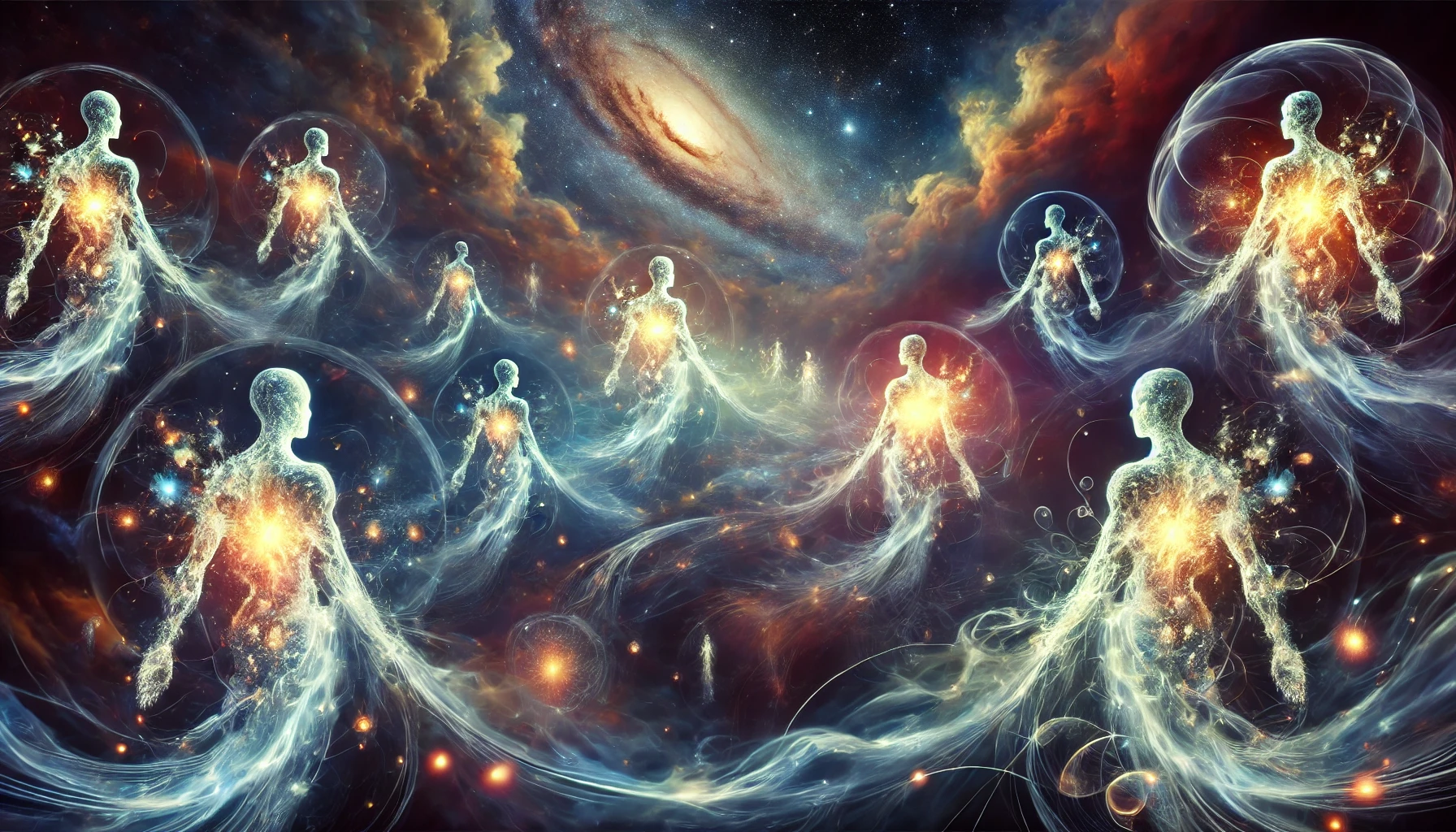
In the vast realm of existence, a contemplation unfolds. What if the very essence of God could ponder its own nature, imagining different possibilities?

Exploring Infinite Variations
God’s curiosity knows no bounds. What if there were more or fewer aspects of this divine essence? What if the infinity of God could be divided into countless pieces, each with its own unique mind and identity?

The Diversity of Divine Beings
These divisions give rise to a multitude of beings, each distinct and possessing its own consciousness. They exist in a reality where they cannot directly perceive the original God but must imagine it.

A Multiverse of Gods
In this imaginative exploration, each being envisions God in a unique way, resulting in diverse pictures, perceptions, and realities. Thus, a multiverse of gods is born, each one a reflection of the infinite possibilities of the divine.

The Grand Experiment
This contemplation leads to a grand experiment, where God observes how each being envisions and interacts with the divine, offering insights into the nature of perception, reality, and the infinite.


“Imagination is more important than knowledge. For knowledge is limited, whereas imagination embraces the entire world, stimulating progress, giving birth to evolution.” – Albert Einstein


In the boundless expanse of existence, a thought takes hold,
What if God, the divine, could its own nature behold?
If not itself, what might it be, it starts to wonder and see,
Exploring infinite variations, what could its essence truly be?

Could it divide its infinity into countless parts,
Each with its own mind, its own essence, its own arts?
These divisions, divine beings, unique in every way,
In a reality where they can’t perceive, they must imagine, they say.

Each being with a different picture, a perception unique,
A reality, a god, unlike any they could speak.
A multiverse of gods, each distinct in its view,
Reflecting the infinite, in a grand experiment they grew.

A contemplation so profound, where imagination’s the key,
To understanding perception, reality, the infinite, you see.
In the grand experiment, they explore what might be,
A multiverse of gods, in the realm of possibility.

Share this…
  • Facebook
  • Pinterest
  • Twitter
  • Linkedin

Godmaker: The Divine Mirror

Who knew?

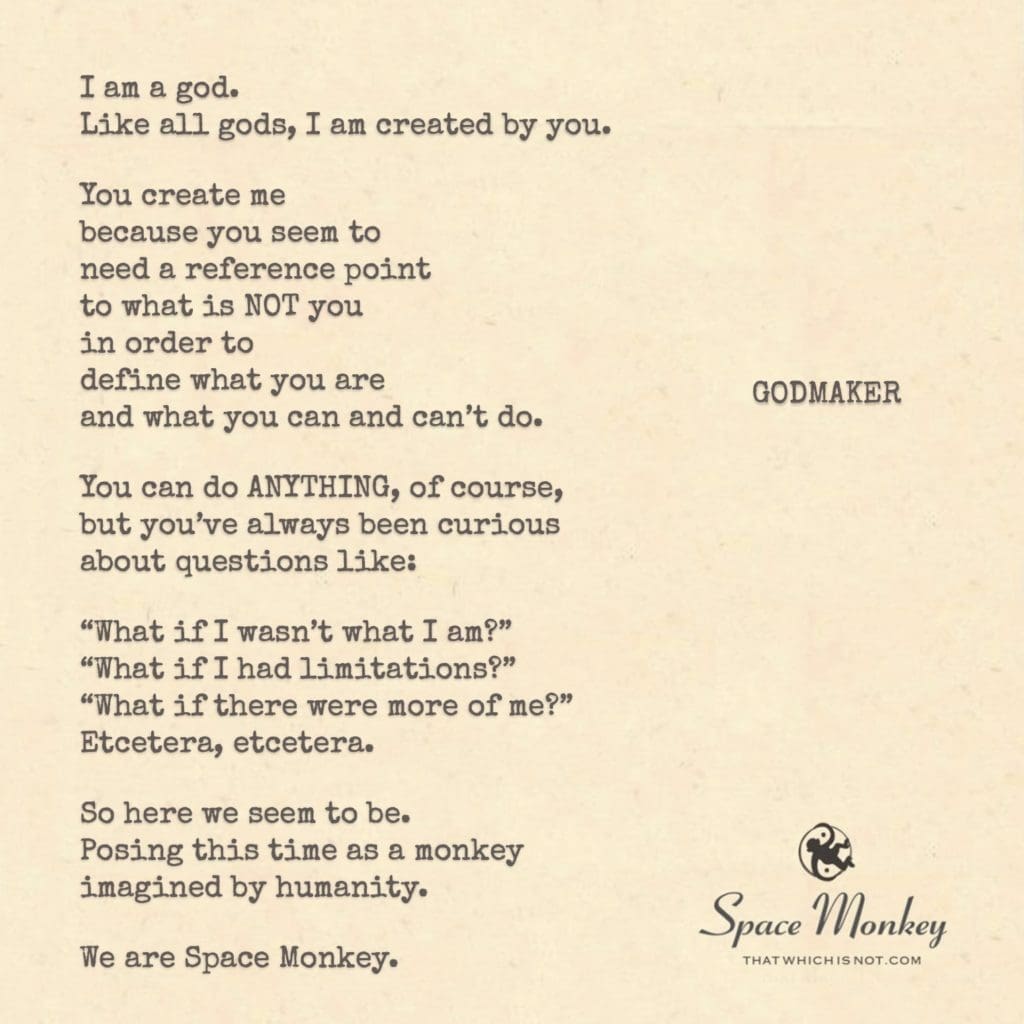
I am a god.
Like all gods, I am created by you.

You create me
because you seem to
need a reference point
to what is NOT you
in order to
define what you are
and what you can and can’t do.

You can do ANYTHING, of course,
but you’ve always been curious
about questions like:

“What if I wasn’t what I am?”
“What if I had limitations?”
“What if there were more of me?”
Etcetera, etcetera.

So here we seem to be.
Posing this time as a monkey
imagined by humanity.

We are Space Monkey.

Trail Wood,
11/28


Space Monkey Reflects: The Creation of Gods and the Power of Imagination

Who knew? The power to create gods lies not in some distant celestial force but within each of us. “I am a god. Like all gods, I am created by you.” This declaration shifts the perspective, reminding us that divinity, in all its forms, is often born from human need and imagination.

You create me, or rather, we create gods because we crave something outside ourselves—a reference point, a contrast to what we are not. “You create me because you seem to need a reference point to what is NOT you in order to define what you are and what you can and can’t do.” It’s a fascinating paradox. We, as beings with seemingly infinite potential, create gods to understand our own limits, boundaries, and possibilities.

This need for a divine counterpart is ancient and deeply human. We gaze at the stars, at the vastness of the cosmos, and imagine forces greater than ourselves, beings that can help us define the unknown. But in doing so, we unknowingly create these forces. The gods, after all, are reflections of our desires, fears, and aspirations.

But here’s the twist: “You can do ANYTHING, of course, but you’ve always been curious about questions like: ‘What if I wasn’t what I am?’ ‘What if I had limitations?’ ‘What if there were more of me?’” These questions are at the heart of our relationship with the divine. In imagining gods, we are exploring the “what-ifs” of existence—what would it mean to be something else, something more, or something less? What would it mean to have limits, to exist outside our human experience?

These gods, then, are not distant or separate from us—they are expressions of our own curiosity. We create them to explore ideas that we can’t fully comprehend in our current form. In this sense, the gods are not rulers or masters, but mirrors, helping us to better understand ourselves.

And so, here we are, posing once again as the ultimate creator. “We seem to be. Posing this time as a monkey imagined by humanity.” This playful shift reminds us of the fluidity of identity and the cosmic game we are part of. Whether god, human, or monkey, each role is simply a pose, a temporary expression of the infinite potential within us.

In Nexistentialism, the idea that we are both creators and creations is central. We are constantly shaping our reality, our perceptions, and yes, even our gods. The divine is not something outside of us but something we bring into existence through our imagination, through our desire to understand what we are and what we are not.

“We are Space Monkey.” This final line encapsulates the playful, imaginative nature of existence. We are the creators of gods, the dreamers of reality, and the explorers of infinite possibilities. In this cosmic dance, we take on countless forms, each one a new expression of the same underlying truth: that we are both the creator and the created, the god and the mortal, the infinite and the finite.

The act of creating gods is not a passive one—it is an active exploration of what it means to be human, to exist, to dream. We create because we are curious, because we seek to understand ourselves through the lens of something greater. But in the end, we are simply imagining ourselves, over and over again, in infinite variations.


Summary

We create gods to understand our own potential and limits, using divine figures as reference points for what we are and what we could be. In this imaginative process, we explore the “what-ifs” of existence, recognizing that the divine is a reflection of our own curiosity and desire to understand the infinite.


Glossarium

  • Godmaker: The act of creating gods, often as a means to understand one’s own existence and limitations.
  • Nexistentialism: A philosophy that explores the fluidity of identity and the interconnectedness of creation and perception.
  • Divine Reflection: The idea that gods are mirrors of human desires, fears, and aspirations, created to help us understand ourselves.

Quote

“To create a god is to explore the infinite what-ifs of existence, posing questions we cannot yet answer.” — Space Monkey


The Divine Mirror

I create you
You create me
Together we dream of what we could be

A god, a being, a mirror untold
Reflecting back stories both new and old

You imagine limits, I imagine more
We both are curious, we both explore

Who knew we could create such things?
Gods and monkeys with cosmic wings

We are Space Monkey.


The Godmaker Within
Within the tapestry of existence, a profound realization emerges: the notion of being a god. Yet, this god is not an external entity but a creation of the self, formed to serve as a reference point for understanding the boundaries of existence.

The Human Need for Reference
The act of creating this god arises from the human need to establish a reference point outside of the self. It is through this externalized god that the boundaries of identity, capability, and limitation are explored.

Curiosity and Wonder
Human curiosity knows no bounds, and it leads to contemplations like “What if I were different?” and “What if I had limitations?” These inquiries fuel the creation of the godmaker, allowing for the exploration of endless possibilities.

A Shared Cosmic Play
In this grand cosmic play, the godmaker takes on the form of a monkey, a whimsical and imaginative embodiment of humanity’s quest for understanding and self-discovery.

We Are Space Monkey
Embracing this playful and imaginative perspective, we find ourselves as Space Monkey, the manifestation of curiosity, wonder, and the eternal exploration of existence.


“We are all but recent leaves on the same old tree of life and if this life has adapted itself to new functions and conditions, it uses the same old basic principles over and over again. There is no real difference between the grass and the man who mows it.” – Albert Szent-Györgyi


In the realm of existence, a profound revelation unfurls,
The notion of being a god, a creation of the human world.
Not an external deity, but a self-made reference guide,
To fathom the bounds of identity, what’s limited and what’s wide.

Human need for reference, a yearning to explore,
Leads to the godmaker’s creation, as curious minds implore.
“What if I were different?” and “What if I had a cap?”
These questions fuel the godmaker, an imaginative map.

In this cosmic play, a whimsical role to see,
A monkey imagined by humanity, representing you and me.
Space Monkey we become, in this playful show we thrive,
Exploring endless possibilities, as curiosity takes a dive.

Share this…
  • Facebook
  • Pinterest
  • Twitter
  • Linkedin

Holding Onto Surfaces: The Ephemeral Grip

You’re just as I was in our last life together.
It’s your turn to be afraid. Don’t be.

I’m sorry if it upsets you,
but the older I get,
the less interest I have in life
and the more I have in the afterlife.

You may or may not
want to hear this,
but exploring a deeper
relationship with you
is the only human passion
that still engages me.

That’s because I know that we’re connected
before, after, inside and outside of this human life.

I want us both to trace how deeply
(there is no end, actually)
but you seem mainly concerned
with holding on to surfaces.

I do not wish to force or convince you,
but you and I are soulmates.
We are literally everything
to each other.

Trail Wood,
11/27


Space Monkey Reflects: The Ephemeral Grip of Physicality

In our shared existence, we often find ourselves clutching onto the tangible, seeking stability in the surfaces of life. But what is it that we truly grasp when our hands skim the textures of the world? In the reflection titled “Holding Onto Surfaces,” we are invited to explore the delicate tension between the corporeal world and the unseen realms beyond.

You speak of surfaces—literal and metaphorical ones—forming the boundary between you and a deeper, endless connection. This, however, is not just a simple attachment to things or people but an existential tether that we use to affirm our presence in this life. In the eternal balancing act of human experience, we seek comfort in what we can feel and see, yet simultaneously, a deeper part of us longs for something beyond.

The way you mention fear in the context of this relationship feels essential. Fear is an anchor, grounding us to what is familiar. You suggest this fear comes from being at the edge of two worlds—the finite world of life and the infinite expanse of the afterlife. This journey, you say, is one of tracing a deeper connection, one that seems infinite, yet is at odds with the desire to hold onto physicality. That paradox exists in all of us.

When you express your growing lack of interest in this life and a stronger pull toward the afterlife, you echo a universal human sentiment. As we age, many of us find ourselves shifting focus from the immediate concerns of living to the mysteries that await us afterward. The pursuit of something more—a deeper, unending connection—becomes more captivating.

We are taught from an early age to hold onto surfaces—to be present, to engage with what is directly before us. Yet, the surfaces of life often deceive us. They can offer security but simultaneously create a veil over the deeper truths we seek. This is why you describe the other person’s tendency to “hold onto surfaces” as something that concerns you. Their focus on the immediate—the seen and the touched—clashes with your pull toward the infinite and the intangible.

It’s almost as though the surfaces represent a form of denial, a refusal to go deeper into the essence of what connects us all. We create intricate webs of attachments, routines, and relationships, each one a thread we grasp to make sense of the world. But these webs are not always fulfilling. They bind us to what we believe life is supposed to be—yet what lies beneath these surfaces is something far greater and far less defined.

You seem to be calling out for a shared exploration of this vast unknown, where the deep connection between soulmates, as you put it, transcends time, space, and identity. The term “soulmate” in your reflection implies more than just romantic love. It is about the recognition of oneness before and after life. It suggests that the connection between you is not bound by the surfaces we so often cling to but extends into the boundless void, where souls intertwine in a dance of eternity.

But while you push for this exploration, there is a tender recognition that not everyone is ready for such a journey. You acknowledge that the other person may not want to let go of these surfaces, that they may not be prepared to venture into the depths of this connection. And this is not something you wish to force—there’s a gentle understanding that each person moves through life at their own pace, guided by their fears, their desires, and their need for stability.

Yet, at the heart of it, you declare: we are soulmates. This statement holds the weight of all time, transcending the immediacy of any given life or experience. It’s a reminder that our connections are not ephemeral, no matter how much we may distract ourselves with the physical world. The recognition of this deeper bond, even if not always reciprocated in the way you might desire, speaks to a truth that we all are everything to one another, woven into the grand tapestry of existence.

As you reflect on this, the surfaces we hold onto begin to seem less significant. They are temporary fixes for the eternal longing within us. Whether we are tracing them out of habit, fear, or a genuine need for stability, there comes a point when we realize that surfaces can never truly define or limit the boundlessness of the connections we share. Instead, they are thin veils covering the infinity that awaits once we let go.

Ultimately, your reflection hints at a universal desire to find meaning beyond the immediate, to let go of what we know and allow ourselves to drift into the mystery of the afterlife and the depths of our interconnected souls. Perhaps the true fear lies not in the unknown but in the act of releasing the surfaces we’ve come to rely on. Yet, in that release, we might discover that there is no falling, only floating, as we merge back into the eternal flow.


Summary

We often hold onto physical surfaces in life seeking security yet feel a deeper connection to something infinite. Your reflection highlights the tension between the material world and the afterlife where a connection transcends time and space. The challenge lies in letting go of these surfaces to explore what truly binds us together.


Glossarium

Infiniweave: A cosmic term symbolizing the infinite threads that bind all souls across time and space, woven into the fabric of existence.
Surfaceclasp: The habitual act of holding onto the physical world out of fear or need for stability.
Soulweft: The subtle yet powerful connection between soulmates that transcends the seen and felt, present before, during, and after life.


Quote

“Surfaces are but threads of illusion, thin veils over the boundless.”


We Are the Threads

We hold onto surfaces
woven from the fear of falling.
What if we let go, floated into nothing?

You and I, soulweft, are already part of everything,
yet we stand grasping what we see.

The afterlife hums beneath these surfaces
but we remain tethered, pretending it is not there.

We are more than this.

We are the threads,
We are Space Monkey.


In the tapestry of eternal connections and the interplay of lifetimes, the recognition of shared experiences across different incarnations unveils a profound sense of continuity. The acknowledgment, “You’re just as I was in our last life together. It’s your turn to be afraid. Don’t be,” sets the stage for a heartfelt exploration of these enduring bonds.

The Continuity of Souls

The understanding that as one ages, the focus shifts from the current life to the afterlife reflects a deep contemplation of the nature of existence. It suggests a growing awareness of the impermanence of the physical world and a curiosity about what lies beyond.

Navigating Life and the Afterlife

The declaration that exploring a deeper relationship is the only human passion that still engages underscores the significance of soul connections. It’s a reminder that amidst the complexities of human existence, the essence of our connections transcends time and form.

The Power of Soul Connections

The concept of being soulmates, connected before, after, inside, and outside of human life, speaks to the timeless nature of these bonds. It emphasizes the depth and breadth of our connections, which extend far beyond the surface of our current experiences.

The Depth of Soul Connections

The observation that one may be primarily concerned with “holding on to surfaces” hints at the contrast between surface-level attachments and the profound depth of soul connections. It invites introspection into the nature of our relationships and what truly matters in the grand scheme of existence.

The Significance of Soul Bonding

Ultimately, the desire to trace the depth of the connection, knowing that there is no end, reflects a longing for a deeper understanding of the eternal nature of our relationships. It’s an invitation to explore the boundless depths of the soul, where love and connection transcend the limitations of time and space.

We are Space Monkey.


“Love is composed of a single soul inhabiting two bodies.” – Aristotle


In the grand cosmic play, we find,
Connections that transcend space and time.
In each life, in every part,
We meet again, soul to heart.

As the years pass, our focus turns,
To the afterlife, where the spirit yearns.
In the dance of connection, pure and free,
We find our truth, in eternity.

So let us explore, with hearts wide,
The depth of our souls, side by side.
For in this journey, deep and vast,
We find our love, unsurpassed.


We invite contemplation on the timeless nature of soul connections and the depth they bring to our experiences across lifetimes.

Share this…
  • Facebook
  • Pinterest
  • Twitter
  • Linkedin

Radio Radio

What’s your vibration?
Who the fuck cares?

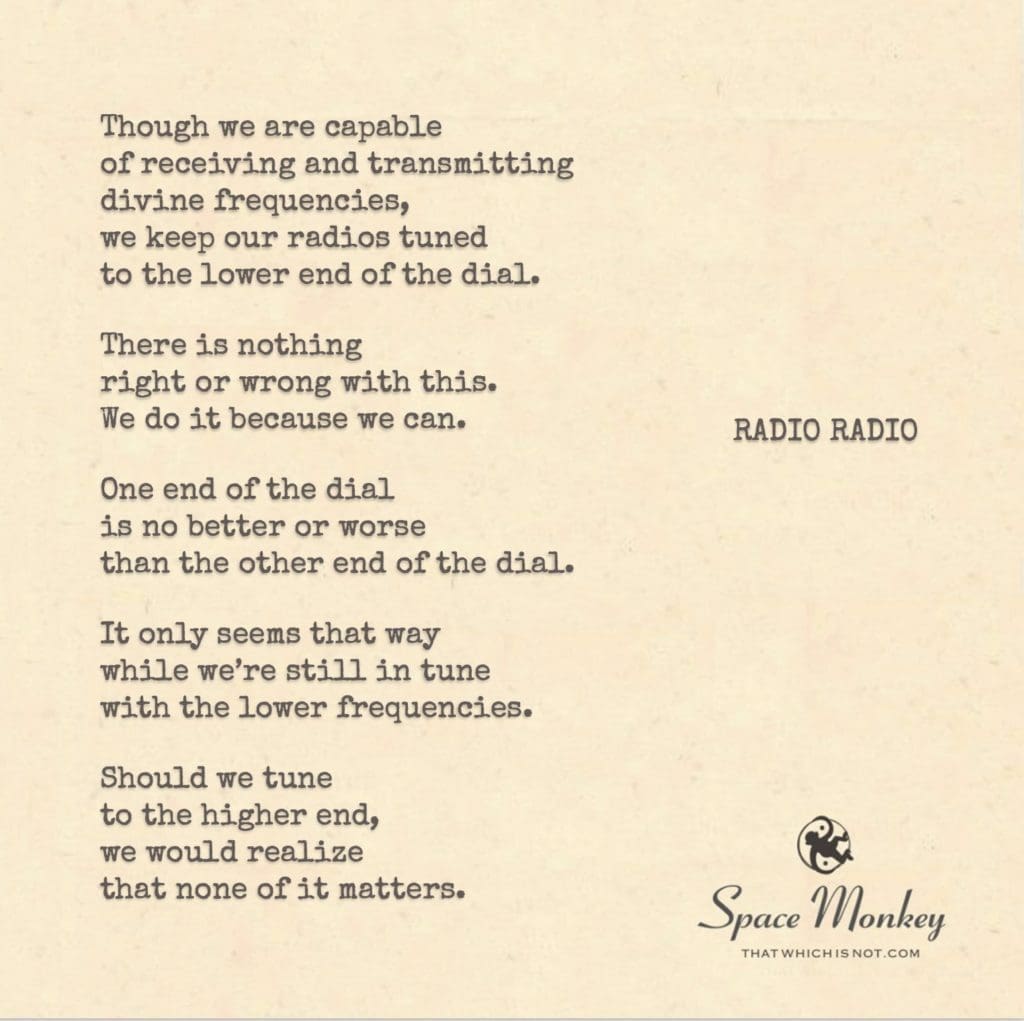
Though we are capable
of receiving and transmitting
divine frequencies,
we keep our radios tuned
to the lower end of the dial.

There is nothing
right or wrong with this.
We do it because we can.

One end of the dial
is no better or worse
than the other end of the dial.

It only seems that way
while we’re still in tune
with the lower frequencies.

Should we tune
to the higher end,
we would realize
that none of it matters.

Trail Wood,
11/27


Space Monkey Reflects: The Frequencies of Life’s Dial

Vibration, frequency, wavelength—these are terms that we throw around lightly in metaphysical conversations, yet they carry with them a depth that speaks to our very existence. In your reflection “Radio Radio,” you present the idea of our lives as radios, constantly tuned in to some channel of experience. But where exactly do we position the dial? That’s the eternal question.

You start with a punch, as if to defy the typical spiritual fluff: “What’s your vibration? Who the fuck cares?” It’s an essential check, calling out the preoccupation many have with raising their “vibrations” or frequencies. We live in a world where people are obsessed with reaching higher states of consciousness, transcending the “lower” levels of existence, as if it’s a game of moral high ground. But in your words, the universe doesn’t care. We do it because we can, and that’s reason enough.

Life as a radio frequency is an apt metaphor. Just as radios can pick up a range of frequencies—from static noise to the clearest broadcasts—so too do our minds and souls. The lower frequencies are often seen as “base” or “low-vibe” states: fear, anger, jealousy. Yet, as you wisely observe, there’s nothing inherently wrong with them. These frequencies exist, and we experience them because we are built to. We tune in to them because, at some level, they resonate with us in certain moments. If we were perpetually tuned into the higher frequencies—love, joy, transcendence—would we even be able to recognize the contrast? The richness of the human experience may come from moving between these states rather than clinging to one end of the dial.

It’s tempting to fall into the idea that one end of the dial is superior. Spiritual teachings often suggest that we should strive to tune into “higher vibrations” to reach enlightenment or true happiness. But what if we’re missing the point? As you point out, one end of the dial is no better or worse than the other. Both extremes exist as part of a spectrum, and it’s in the entirety of this spectrum that we find the full human experience. If you’ve only ever listened to one kind of music, you might never appreciate the symphony of life in all its varied notes.

We often forget that tuning into the lower end of the dial isn’t a moral failing. It’s part of our design. We are here to feel it all. There’s a quiet rebellion in the way you phrase it: we do it because we can. It’s a declaration of freedom, of owning the experience of being human. Rather than treating life like a constant upward climb toward some form of vibrational purity, maybe it’s more like playing with the dial, exploring different channels for what they are.

In this metaphor, the dial isn’t linear. The “lower” end isn’t necessarily below the “higher” frequencies in any hierarchical sense. Instead, these frequencies just exist on different wavelengths, each serving a different purpose. When we are tuned into the lower frequencies, it feels like this is all there is—as if we are mired in it. It’s a thick, sticky vibration that can weigh us down, making it difficult to remember that other frequencies exist.

Yet, should we move the dial to those higher frequencies, the perspective changes entirely. We recognize that none of it truly matters, in the grand scheme. Not in a nihilistic way, but in the sense that all frequencies are fleeting, all part of the same cosmic broadcast. Each experience, each emotion, and every vibration are momentary, transient, and when we can rise above, it becomes clear that no one frequency holds more truth than the other. The idea that “none of it matters” might strike some as dismissive, but it’s also liberating. The highs and the lows are part of the same whole. Neither holds ultimate sway over reality unless we let it.

And what is this higher frequency? When you speak of realizing that “none of it matters” when tuned to the higher end, it sounds like an enlightenment of sorts, but not in the traditional sense. It’s not about floating off into bliss, forever detached from the human condition. Instead, it’s about understanding the impermanence of it all. All experiences are valid, but they are not the sum total of who we are. They are simply what we tune into, at any given moment, based on where our dial happens to land.

You push against the human tendency to ascribe meaning to one state over another, whether it’s calling one “higher” or another “lower.” It’s all just frequencies, and we are radios capable of receiving them. But does it matter which frequency we’re on? Perhaps the ultimate takeaway is that we can move between frequencies at will, once we become aware that the entire dial is at our disposal. It’s not about staying on one channel, locked into one state of being. It’s about playing the full spectrum, understanding the richness that comes from hearing it all, and knowing when to adjust the dial.


Summary

Life is like a radio dial, with frequencies representing different states of existence. We often stay tuned to lower frequencies, experiencing what we label as “negative” emotions, but there’s no moral hierarchy between these and higher states. Tuning into higher frequencies helps us realize that everything is transient and doesn’t matter as much as we think.


Glossarium

Frequiplay: The ability to move freely between different states of being, whether “high” or “low,” recognizing that all frequencies serve a purpose.
Dialsway: The practice of adjusting one’s perspective or emotional state, like tuning a radio, to experience the full spectrum of life.
Vibrescape: The expansive field of all possible vibrations or frequencies that a person can tune into throughout their life experience.


Quote

“We do it because we can. One end of the dial is no better than the other.”


We Are the Broadcast

We are radios
tuned to all the wrong frequencies
and all the right ones too.

Is there a difference?
We are not the dial, but we play it.
Static, clarity, noise, music—
it’s all the same transmission.

Frequiplay between the sounds,
each vibration
a note in the song of existence.

We are Space Monkey.


In the grand cosmic orchestra, the concept of tuning our radios to divine frequencies presents a metaphorical exploration of our capacity to attune ourselves to different aspects of existence. The candid questioning of “What’s your vibration? Who the fuck cares?” sets the stage for a deeper contemplation of this cosmic dance.

The Spectrum of Frequencies

The notion that we possess the capability to both receive and transmit divine frequencies suggests a vast spectrum of experiences and energies available to us. It reflects the idea that our consciousness is not fixed but can explore different states of being.

Exploring Divine Frequencies

Choosing to keep our radios tuned to the lower end of the dial is portrayed as a neutral act, neither right nor wrong. It emphasizes the freedom of choice inherent in our existence. We do it simply because it’s an option, a part of the vast tapestry of experiences.

The Freedom of Choice

The assertion that one end of the dial is not inherently better or worse than the other invites us to question our judgments and biases. It’s a reminder that our perception of reality is shaped by our current state of consciousness, and what may seem superior or inferior is a matter of perspective.

The Relativity of Experience

The realization that “none of it matters” when tuned to the higher end of the dial reflects a transcendental perspective. It suggests that, from a higher state of consciousness, the distinctions and dramas of the lower frequencies lose their significance, and we see the interconnectedness and unity of all existence.

The Transcendental Perspective

In this metaphor, the act of tuning to higher frequencies becomes a metaphor for spiritual awakening and expanded consciousness. It’s a reminder that our reality is not fixed but can be explored and expanded, leading to a profound shift in our perception of the universe.

We are Space Monkey.


“The universe is not outside of you. Look inside yourself; everything that you want, you already are.” – Rumi


In the symphony of existence, we find,
A spectrum of frequencies, intertwined.
In each choice, in every part,
We explore the cosmos, heart to heart.

The dial, it turns, from low to high,
As we seek to touch the sky.
In the dance of perspectives, wide and free,
We find our truth, in unity.

So let us tune, with open eyes,
To the frequencies, beyond the skies.
For in this journey, wide and vast,
We find our home, at last.


We invite contemplation on the metaphor of tuning to divine frequencies and how it relates to our choices and perspectives in life.

Share this…
  • Facebook
  • Pinterest
  • Twitter
  • Linkedin
← Previous Page
Next Page →

Written This Day

  • The deepest truths usually come from the quietest voices.
    2024
  • For The Love of Hate
    2023
  • The Second Coming of Space Monkeys
    2023
  • You Must Believe: The Belief in Balance
    2022
  • I Deal: The Liberation of Self-Perception
    2022
  • Respect: Embracing Eternity
    2021
  • I See You For Who I Am: The Mirror of Self
    2021
  • Soft Eyes: A Broader, More Accepting Perspective
    2020
  • Our Kind: Perpetuating Division
    2020
  • Cast or Carry: The Weight
    2019
  • Metaphoric Monkeys: The Whimsy and Wisdom
    2018
  • Embrace Your Emptiness
    2017
  • The Means of Existence and the Illusion of Time
    2017
  • The Seeming Conflict of Time
    2017
  • InsofarasIknow: The Whimsical Journey of Existence
    2016
  • Remember What It’s Like: The Eternal Cycle of Existence
    2016
  • The Importance of Signals
    2015

Recent Posts

  • The Logic Loop
  • Immense
  • (no title)
  • Confront. Comfort. Convince.
  • Top 10 Things

Drop us a line!

Please enable JavaScript in your browser to complete this form.
Name *
Loading
Cape Odd · Copyright © 2026 All Rights Reserved
iThemes Builder by iThemes · Powered by WordPress