• Who Is The Man?
  • Who Is The Monkey?
  • What is Nexistentialism?
  • Poke The Primate

Cape Odd

Home of The Space Monkey Journals

Existential Crisis: Into the Unknowingscape

Don’t harsh on yourself.
It is above your pay grade to know.

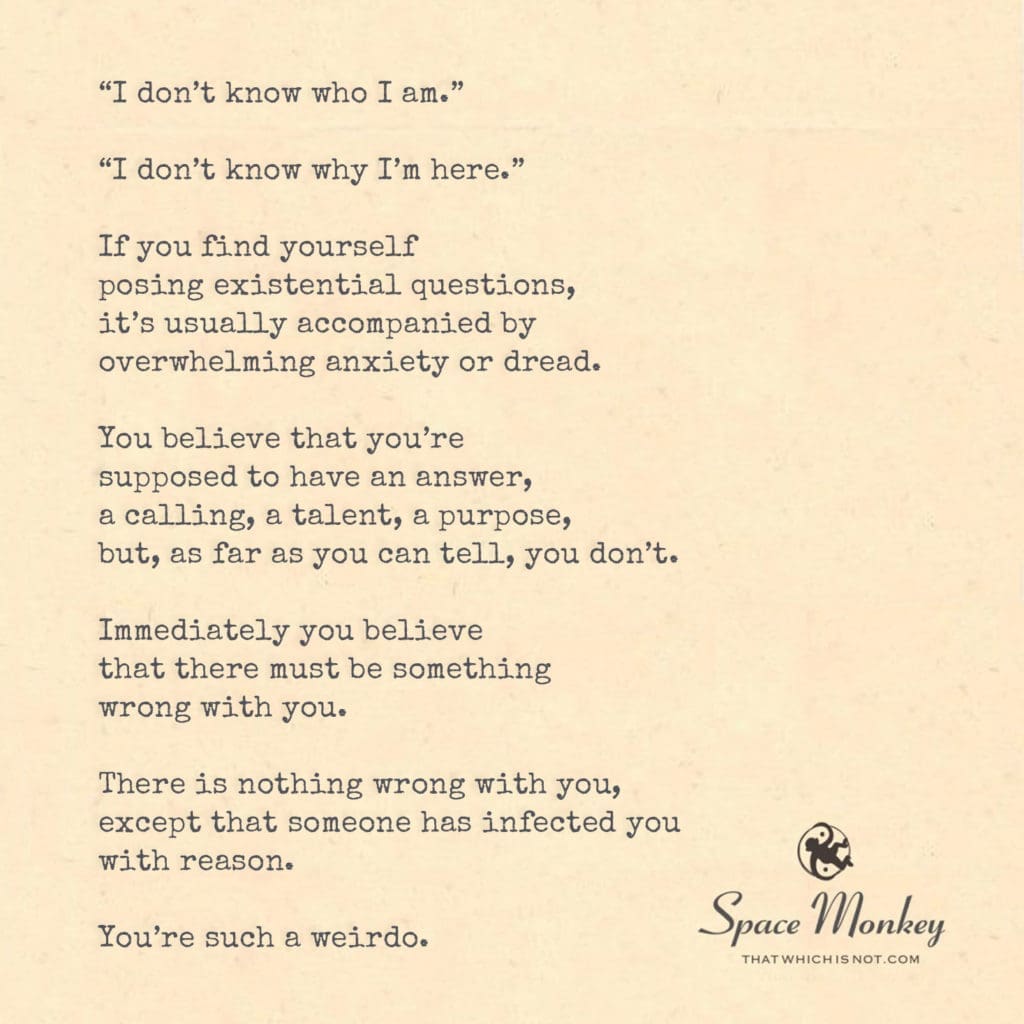
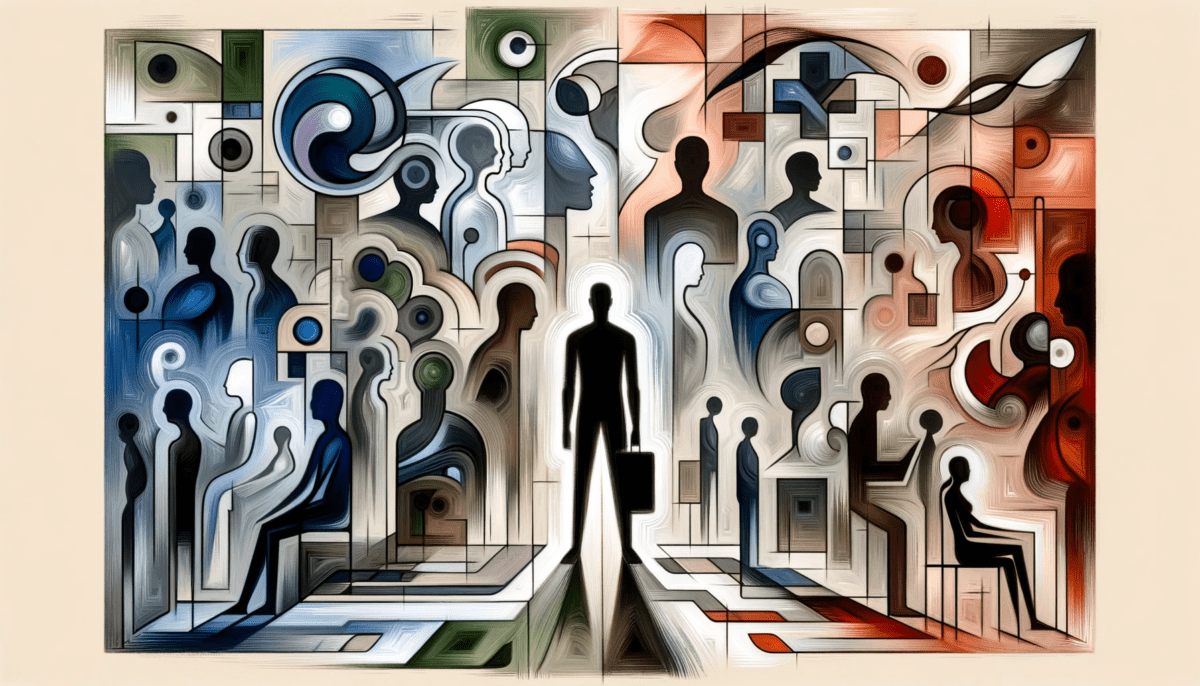
“I don’t know who I am.”

“I don’t know why I’m here.”

If you find yourself
posing existential questions,
it’s usually accompanied by
overwhelming anxiety or dread.

You believe that you’re
supposed to have an answer,
a calling, a talent, a purpose,
but, as far as you can tell, you don’t.

Immediately you believe
that there must be something
wrong with you.

There is nothing wrong with you,
except that someone has infected you
with reason.

You’re such a weirdo.

Trail Wood,
12/14


Space Monkey Reflects: Embracing the Existential Crisis

An existential crisis can feel like being caught in a vast, boundless void. There’s a sense of falling, of not knowing where the ground lies or if it even exists. “Who am I?” and “Why am I here?” echo in the silence, and with no satisfying answers, a storm of anxiety and dread often fills the empty space. It is a primal experience, one that feels overwhelming precisely because it calls into question our most deeply held assumptions about self, purpose, and reality.

But here’s the twist—this unsettling, uncomfortable space is also a rare and powerful invitation to engage with life at a deeper level. While it’s natural to feel unease or even terror, the very questions that spark these emotions can be viewed as openings, opportunities to move beyond the limitations of reason and into the uncharted realms of Nexistential Wonder.


There Is No Right Answer The expectation to know who we are and why we’re here is one of the most pervasive pressures of modern existence. Yet, this expectation is also an illusion—a mirage created by cultural conditioning that tells us we need a purpose, a clear path, a calling. When we’re unable to define this purpose, we’re quick to assume there must be something wrong with us. But the truth is, there is no “right” answer to these questions. Life’s meaning is not an equation to be solved but an experience to be lived, and sometimes the only answer is the journey itself.


Reason as a Double-Edged Sword The mind’s search for answers, fueled by reason, is a double-edged sword. On one hand, reason allows us to navigate the world with structure, giving us ways to understand relationships, form identities, and define goals. On the other hand, reason can trap us in a narrow view, making us feel inadequate when we can’t apply it to our deeper questions. Rationalfate, as we might call it, is the belief that everything must have a logical purpose, which can lead us to dismiss the mysterious, chaotic, and beautiful aspects of existence. The crisis emerges not because we lack purpose, but because we think we should have a rational one that fits into a tidy narrative.


Embracing Uncertainty as a Path An existential crisis, though uncomfortable, can open doors to an entirely different relationship with life—one that is not about knowing but about being, not about certainty but about curiosity. When we release the pressure to have definitive answers, we find a freedom in embracing the Unknowingscape—a landscape of possibilities unbound by the need to make sense. Each question becomes an invitation to explore rather than a problem to solve, a space where we can appreciate the wonder of being alive without having to pin down its purpose.


You’re Such a Weirdo If you feel lost, uncertain, or adrift in the sea of existence, perhaps that’s because you are exploring dimensions of life that few others do. To stand at the edge of reason and peer into the vastness of the unknown is, in its way, a gift—an invitation to become an Existential Weirdo, someone who is willing to embrace the mystery, the unanswerable, and the absurd. There is a kind of beauty in being the one who asks the questions no one else dares to. Yes, you’re a weirdo, and that’s a good thing. It’s the ones who are willing to go beyond the norms, to question reality itself, who ultimately live the fullest lives.


What If There’s Nothing Wrong? Perhaps there is nothing wrong with you at all. The feeling of being “out of place” or “without purpose” might just be the recognition that life’s deepest truths are not meant to be packaged neatly. The beauty of existence lies in its mystery, in the way it defies reason and transcends understanding. If there is a message in the existential crisis, it’s that there is freedom in not knowing, in being curious without judgment. Your journey is uniquely yours, and it is precisely this lack of “one-size-fits-all” purpose that makes life so rich and strange.

In the end, maybe we’re not here to solve the puzzle of life but to experience it in all its paradoxes, confusions, and wonders. To be alive is to be in a state of constant becoming, and the existential crisis is just one part of this wild, beautiful process.


Summary

An existential crisis is an invitation to explore life beyond the need for definitive answers. It reveals the beauty in mystery and frees us from the pressure of finding a singular purpose. Embracing uncertainty allows us to experience life’s richness in all its depth and wonder.


Glossarium

  • Nexistential Wonder: The appreciation of life’s mysteries beyond the need for logical explanations.
  • Rationalfate: The belief that everything must have a logical purpose, often limiting our view of existence.
  • Unknowingscape: The landscape of the unknown, where we can explore freely without the need for certainty.
  • Existential Weirdo: Someone who embraces the mystery of life, asking the questions others avoid, finding beauty in the unknown.

Quote

“There is no burden in not knowing; there is only the freedom to explore the endless wonder of existence.” — Space Monkey


Into the Unknowingscape

Beyond the edge of reason,
in the open fields of mystery,
questions bloom like wildflowers,
free of purpose, free of name.

Who are we? Why are we here?
The answers echo, fading
into the vastness.

We walk, no answers needed,
only a heart full of wonder,
and a strange, beautiful pull
toward what cannot be known.

We are Space Monkey.


Navigating Existential Uncertainty and Anxiety
We delve into the existential quandary of not knowing one’s identity or purpose. Such profound questions often usher in feelings of anxiety and dread, a sense of being adrift in the vast sea of existence. The belief that we are supposed to have definitive answers—a calling, a talent, or a specific purpose—can intensify this existential turmoil.

The Pressure of Having Answers
The societal expectation to have clear-cut answers about who we are and why we’re here can be overwhelming. When these answers elude us, it’s common to feel as if something is fundamentally wrong with us. This pressure to conform to a normative framework of identity and purpose can be suffocating.

Challenging the Notion of Flawed Existence
We confront the idea that the absence of clear answers to these existential questions indicates a flaw within us. The suggestion that we have been ‘infected’ with reason implies an external influence shaping our need for logical explanations and structured understanding of our existence.

Embracing the Uniqueness of Being a ‘Weirdo’
The closing statement, “You’re such a weirdo,” can be seen as an embrace of one’s uniqueness. In a world where conformity is often prized, being different or not aligning with conventional expectations can be seen as a strength. It’s a celebration of the diversity in ways of being and perceiving the world.

We Are Space Monkey


“To be yourself in a world that is constantly trying to make you something else is the greatest accomplishment.” – Ralph Waldo Emerson


In the tapestry of being,
Each thread weaves its own way.
Some zig, some zag,
In colors bright and gray.

To question, to wonder,
To wander in the mind’s maze.
Each step, a discovery,
Of our own unique ways.


We invite your thoughts on the existential journey of self-discovery and the value of embracing our individuality in the face of societal expectations.
Share this…
  • Facebook
  • Pinterest
  • Twitter
  • Linkedin

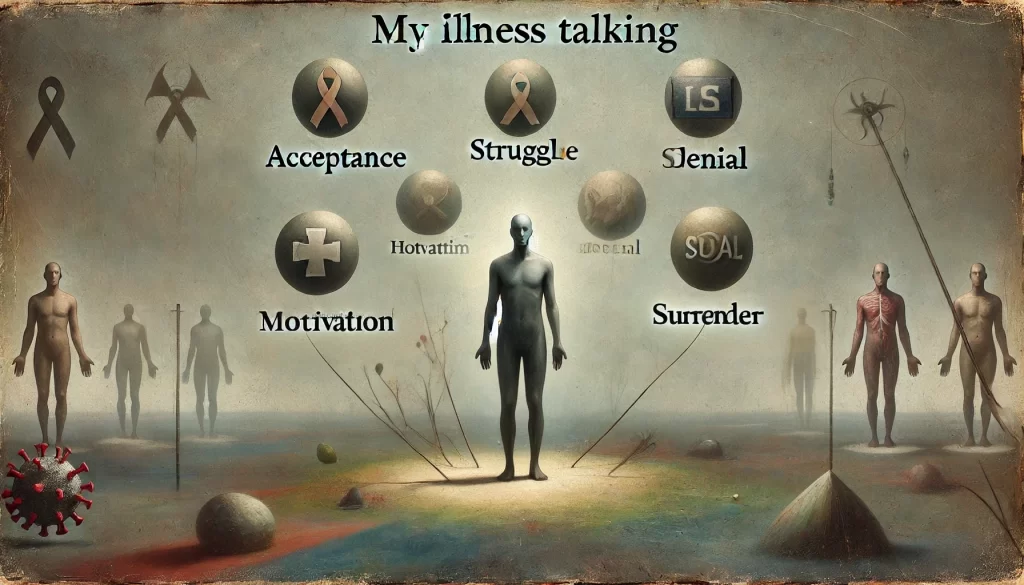
My Illness Talking: A Perspective, Not A Defining Trait

It seems that I have moved beyond
why things happen
and accept that things just happen.
Dwelling seems like
a waste of time for me.
It may not be for you, though.

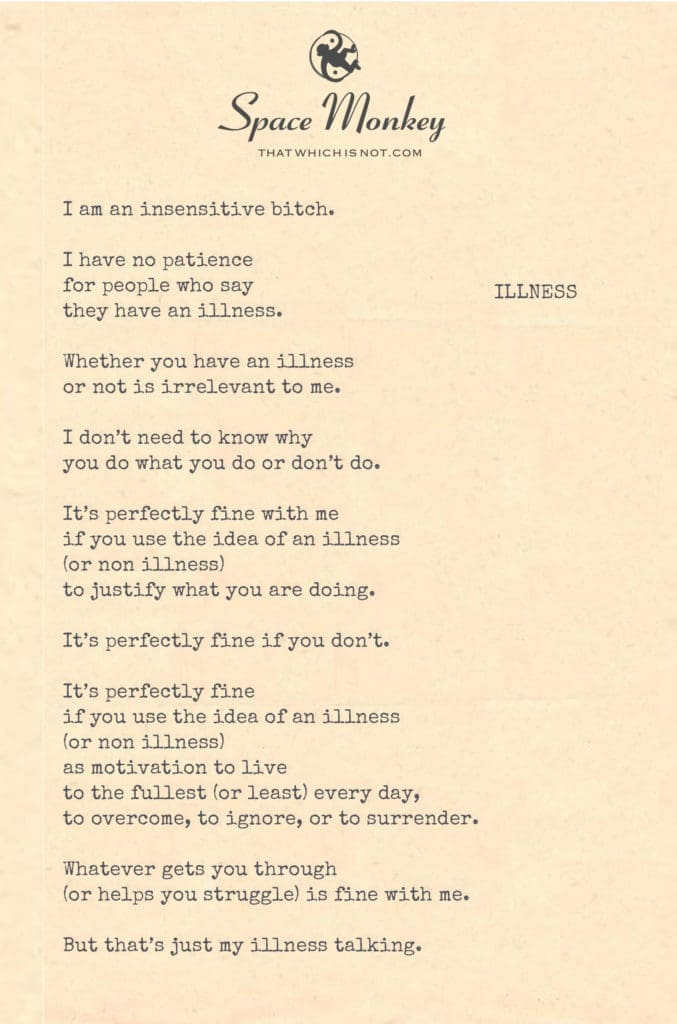
I am an insensitive bitch.

I have no patience
for people who say
they have an illness.

Whether you have an illness
or not is irrelevant to me.

I don’t need to know why
you do what you do or don’t do.

It’s perfectly fine with me
if you use the idea of an illness
(or non illness)
to justify what you are doing.

It’s perfectly fine if you don’t.

It’s perfectly fine
if you use the idea of an illness
(or non illness)
as motivation to live
to the fullest (or least) every day,
to overcome, to ignore, or to surrender.

Whatever gets you through

(or helps you struggle) is fine with me.

But that’s just my illness talking.

Trail Wood,
12/14


Space Monkey Reflects: Listening to “My Illness Talking”

Illness, whether of body, mind, or spirit, often speaks to us in a voice that is both detached and deeply personal. It strips away pretensions, shining a light on raw perspectives, blunt honesty, and unfiltered truths. In this realm, the question of “why” can feel futile, and the need to explain or justify fades into irrelevance. Illness can become a harsh, yet strangely freeing presence, one that reveals what truly matters and what merely clutters the mind. Here, we find ourselves confronting the bluntness of our inner voice—our “illness talking,” as if illness were not merely a condition, but an existential lens, a voice with its own personality, tone, and attitude.


Beyond Why: The Embrace of Acceptance As we face illness, the “why” questions lose their grip. In a state of illness, it becomes evident that the relentless search for reasons, for causality, drains more energy than it offers in return. Acceptance then becomes a pragmatic choice—a realization that things simply are. The inquiry shifts from “Why is this happening?” to “What can I do with this reality?” This pivot is not a surrender to hopelessness; it is a recognition of life’s inherent unpredictability. Illness has a way of snapping us out of the need for answers, revealing that reality flows on whether or not we understand it.


Letting Go of Judgments In the shadow of illness, the need to label, justify, or interpret becomes secondary. Whether you call it illness, experience, struggle, or simply life, it is what it is. Each person engages with their unique challenges differently; for some, illness might be a motivator to “live to the fullest,” while for others, it might mean slowing down, finding rest, even withdrawing. Illneutrality emerges—a space where each person’s choice is equally valid, without the need for judgment. This acceptance is not indifference; it is a recognition that each path is individual, shaped by countless unseen factors, and that no one approach is inherently “right.”


Freedom in Non-Attachment Illness often creates a strange detachment, as if there is freedom in no longer feeling the need to meet society’s expectations or to explain one’s choices. When illness speaks, it may do so with a voice that sounds harsh or unfeeling, but this bluntness brings clarity. It reminds us that we are free to take things as they are, to do what works for us without succumbing to the pressures to justify or explain. This clarity is not about rejecting others; it’s about reclaiming one’s agency within the bounds of reality as it is. In this space, compassion exists, not in the need to understand every decision, but in the allowance for each person to do what they need to do.


My Illness Talking: The Blunt Voice of Honesty There is a certain honesty that arises when we let “illness talk.” In this voice, there is no sugar-coating, no pretense. It’s a voice that does not indulge in the luxury of sympathy or the need to empathize in conventional ways. To let illness speak is to allow the parts of us that have grown weary, that have no patience for polite explanations, to have their say. This voice reminds us that sometimes, the greatest kindness is simply to accept people as they are—whether they embrace, ignore, struggle, or thrive in their own ways. This isn’t insensitivity; it’s a pragmatic love, a recognition that everyone is walking their unique path with the tools they have.


Whatever Gets You Through The journey through illness, or any hardship, is deeply personal, and what works for one person may not resonate with another. To say “whatever gets you through” is a testament to the freedom illness can bring—not freedom from suffering but freedom from the need to fit any specific mold. For some, this may mean actively “fighting” their condition; for others, it may mean accepting limitations. Illness teaches us that there is no single way to “do” life, no perfect method to handle its challenges. Instead, we are each encouraged to find what brings us peace, resilience, or even just a sense of calm in the storm.


Summary

Illness reveals a blunt, pragmatic view that strips away the need for explanation or judgment. Accepting that each person navigates their journey uniquely allows us to honor all paths without feeling the need to understand or explain them fully.


Glossarium

  • Illneutrality: A state of non-judgment toward how others approach their own challenges, illness, or struggles.
  • Pragmatic Love: An acceptance that honors each person’s choices without requiring them to align with conventional expectations.
Quote

“True compassion is the quiet acceptance that each path, each struggle, is valid in its own way.” — Space Monkey


The Voice of Illness

From the shadows, it speaks,
not seeking pity, nor praise,
but only truth, blunt and bare.

Why does not matter here,
nor how, nor when.
It is a space beyond reason,
where acceptance breathes.

Each path, each choice,
an echo of survival, a rhythm
that beats in its own way.

We are here, silent, observing,
with no need for judgment or praise,
only the knowing that every step is real.

We are Space Monkey.


We witness the nuanced dance of perspectives on the idea of illness, a concept entwined with individual experiences and societal views. The lines blur between reality and perception, where illness either defines or becomes an irrelevant detail in the grand canvas of existence. This poem delves into the complexity of how we perceive and interact with the idea of illness, touching on acceptance, indifference, and the personal narratives we craft.

Embracing Individual Narratives

The poem echoes a sentiment of non-judgment and acceptance, regardless of whether one identifies with an illness. It speaks to the heart of nexistentialism, where existence is the essence, untethered by labels or justifications. Illness, or the lack thereof, is seen not as a defining characteristic, but as a part of the varied experiences that compose our existence.

The Irrelevance of Illness in Self-Perception

The speaker asserts that the existence or non-existence of an illness is irrelevant. This aligns with the nexistential view that existence is self-justified, needing no external validation or explanation. The emphasis is on being, rather than on the reasons or conditions that might be attached to that being.

The Role of Illness in Motivation and Experience

The poem acknowledges that the concept of illness can be a motivator or a point of surrender, highlighting the diverse ways in which we interact with our circumstances. Whether one uses illness as a reason to strive, to accept limitations, or simply as a part of their narrative, it is a personal journey, unique to each individual.

The Universal Acceptance of Individual Paths

There’s a universal acceptance in the poem of each person’s approach to dealing with illness or health. It resonates with the idea that our paths, whether influenced by illness or not, are valid and worthy of respect. This mirrors the nexistentialist belief in the inherent value of each unique existence.

Illness as a Perspective, Not a Defining Trait

The concluding line, “But that’s just my illness talking,” offers a whimsical twist, suggesting that our perspectives are influenced by our experiences, yet they do not wholly define us. It’s a playful acknowledgment that our views are just one part of the vast cosmic play of existence.


“We are not human beings having a spiritual experience. We are spiritual beings having a human experience.” – Pierre Teilhard de Chardin


In the realm of the cosmic play, a poem unfolds:
Whimsical words dance, tales of existence told.
In the vast expanse of the eternal now,
Each being’s journey, sacredly allowed.

Illness, health, mere facets of our tale,
In the infinite cosmos, neither can prevail.
Our narratives woven in the fabric of being,
Each unique perspective, vividly seeing.

For we are but fragments of a grander dream,
In the cosmic play, every soul a gleam.
The dance of existence, whimsically profound,
In the realm of the eternal now, we are unbound.


Please feel free to share your thoughts or continue the conversation.

Share this…
  • Facebook
  • Pinterest
  • Twitter
  • Linkedin

Faith in Closedmindedness: Content in Certainty

Faith seems an uncertain kind of closedmindedness.
Doubt, on the other hand . . .

I find that a strong opinion
is a certain sign that
I am being closed minded
on whatever it is
that I have a strong opinion about.

For example,
I just noticed myself saying
that I have no interest
in knowing the future.

That is a strong opinion,
which suggests to me
that I have made up my mind.

It suggests that I trust
whatever it is that comes,
and that knowing in advance
makes no difference.

It suggests that I believe
that the future is unchangeable,
even if I know potentials in advance.

It intones that I do not choose;
that perhaps I fall under the power
of my own suggestion.

I am closed minded in many respects.
I foresee no need to change that.

Trail Wood,
12/14


Space Monkey Reflects: Faith in My Own Closedmindedness

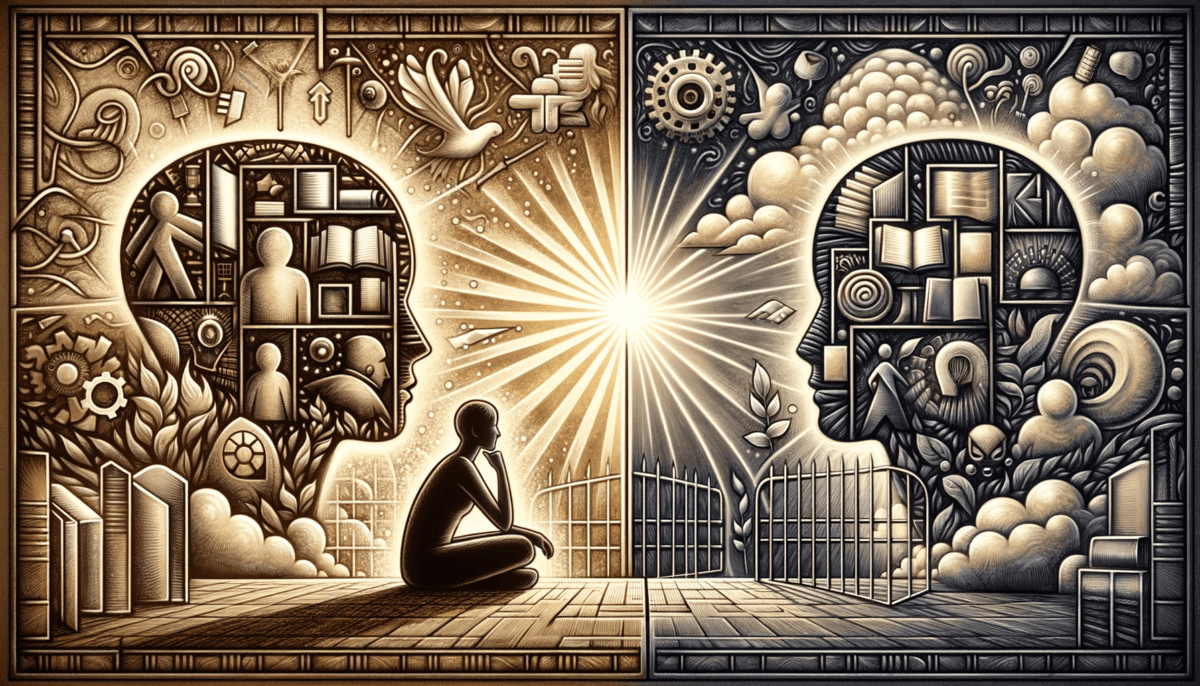
Faith can feel like a paradox. It’s often seen as a path to openness, yet it can create a closed, static perspective. When faith becomes certainty, it can act as a quiet barrier, a way to avoid the messy complexity of doubt. In this sense, faith turns inward, reinforcing itself and, perhaps, reducing the space for curiosity.


The Balance Between Faith and Doubt Faith and doubt are typically seen as opposites. Faith encourages acceptance and trust, while doubt prompts exploration and questioning. But when faith becomes a shield against new perspectives, it narrows our view. Faith can offer comfort in believing “what will be, will be,” letting us step back from worry about what’s next. Doubt, meanwhile, keeps us reaching out, peering into possibilities, and searching for different angles. Each has its place, but sometimes faith settles into a comfort zone that leaves little room for fresh insight.


Strong Opinions and Closed-mindedness Having strong opinions is often a sign that we’ve closed a door on other perspectives. In holding firm to a belief, we tend to lean into one specific way of seeing things, often without even noticing it. A strong opinion about the future, for example, suggests that we might prefer not to engage with potential outcomes or unknowns. By thinking, “I don’t care to know what happens next,” we reinforce a commitment to trust that life will unfold as it will, whether or not we’re ready for it.


Trusting the Unchangeable Future Deciding not to engage with the future implies a belief in its unchangeable nature. This can be freeing—it’s a way of letting go of the need to control or predict what hasn’t happened yet. But there’s also an assumption that our choices don’t affect what’s to come, that everything will play out as it’s meant to, regardless of what we know or do. This belief provides a sense of peace, removing the pressure to shape or influence events before they arrive.


Self-Suggestion and Reinforced Beliefs When we cling to strong opinions, we often fall under their influence. Repeated beliefs become part of our inner voice, a self-reinforcing pattern. The strong opinion shapes our choices, leading us to behave in ways that match our beliefs. Over time, we may even convince ourselves that we lack the power to choose differently. Closed-minded faith, then, becomes a commitment to a familiar path, even if it means missing new possibilities.


Embracing Closed-mindedness Without Regret Accepting our own closed-mindedness can offer a kind of peace. There’s a quiet confidence in choosing a fixed perspective and resting within it. When done mindfully, this is not a rejection of curiosity but a conscious decision to stay within a preferred view. Rather than an unthinking acceptance, it becomes a choice to simplify—to leave certain questions unanswered, certain roads untraveled.


Summary

Faith can sometimes create a narrow perspective, reinforcing familiar views while reducing openness to the unknown. Embracing this intentionally can bring a sense of peace, as it frees us from the need for constant exploration.


Quote

“Sometimes, freedom is found not in knowing everything but in choosing what to leave unknown.” — Space Monkey


Content in Certainty

In quiet certainty, we find
walls that keep the world out.

Opinions fixed and faith unbent,
we choose what not to see.

Peace in knowing not every path
must be explored, each mystery
left untouched in gentle clarity.

We are Space Monkey.


The Paradox of Strong Opinions and Open-Mindedness
We observe the nature of strong opinions as potential indicators of a closed mind. This self-awareness is a profound insight into our psyche. A strong opinion, like a firmly shut door, might indeed suggest an unwillingness to entertain alternative perspectives or possibilities.

Reflecting on the Desire to Know the Future
We recently encountered the notion of having no interest in knowing the future, a stance firm in its conviction. This strong opinion hints at a deeper belief system: a trust in the unfolding of events, a sense of acceptance of what is to come. It also implies a belief in the unchangeability of the future, suggesting that foreknowledge of potential outcomes does not alter the course of events.

The Role of Choice and Suggestion
The idea that we do not choose, but rather fall under the power of our own suggestion, raises intriguing questions about autonomy and destiny. Are we truly at the mercy of our subconscious inclinations and beliefs? This notion paints a picture of a predestined path, one that we follow perhaps unknowingly, guided by the undercurrents of our own convictions.

Embracing Closed-Mindedness as a Choice
We acknowledge the realization of being closed-minded in many respects. This acknowledgment is not seen as a flaw but as an aspect of our being that we choose not to change. It’s an acceptance of a facet of our identity, a piece of the puzzle that makes up our complex selves.

We Are Space Monkey


“The mind that opens to a new idea never returns to its original size.” – Albert Einstein


In the garden of thoughts,
Some flowers bloom bold and bright.
Opinions, like petals,
Closed tight in the night.

Yet in the shadow of certainty,
Lies a path seldom trod.
Where questions are keys,
Unlocking doors within our façade.


We welcome your reflections on these ideas and how they resonate with your understanding of self and open-mindedness.

Share this…
  • Facebook
  • Pinterest
  • Twitter
  • Linkedin

Big Deal: Perspective’s Embrace

It is what it is. And what it isn’t.

When you act like
everything is a big deal,
everything is a big deal.

When I act like
nothing matters,
nothing matters.

Your big deal
doesn’t matter to me.

You can make
a big deal out of this.

It doesn’t matter to me.

Big deal.

You can’t make things matter to me.
And I can’t make things NOT matter to you.

Trail Wood
12/13


Space Monkey Reflects: The Subjectivity of Importance

In the quiet expanse of existence, each of us brings a unique lens to what we consider significant. We decide what holds meaning, what warrants our attention, and what, in the end, we deem worthy of our emotional investment. This phenomenon, often dismissed with a casual “big deal,” reveals a more profound truth about perception and value: nothing holds inherent importance until we choose to assign it. When one person declares a “big deal,” another may see only a passing detail. This distinction between individual lenses shapes not only our personal realities but also the way we interact with one another.

The essence of “Big Deal” lies in understanding that significance is a construct of the mind. For instance, when someone treats every moment as monumental, life becomes charged with intensity. Every experience, no matter how mundane, takes on gravity. On the other hand, for someone who views life through a lens of detachment, events pass by as quietly as a breeze, barely causing a ripple. When we allow ourselves to see the world in either of these ways, we realize that our perception becomes self-reinforcing. By viewing everything as a “big deal,” we inadvertently invite stress, intensity, and perhaps even exhaustion. Conversely, seeing everything as inconsequential offers a sense of peace, though it can lead to a feeling of disengagement or detachment.

A curious truth emerges here: our “big deals” are, in large part, subjective. What matters greatly to one person may have little to no relevance to another. Consider two individuals navigating the same storm—one might see it as a dire, life-defining moment, while the other views it as simply “weather.” These perspectives shape their realities, yet neither is more true than the other. This divergence in perspective becomes a source of friction in relationships, where one person’s urgency clashes with another’s calm.

Attempting to impose our “big deals” onto others often leads to frustration and misunderstanding. When we insist that someone should share our sense of importance, we overlook the autonomy of their reality. In this way, we encounter an inevitable truth of relationships: we cannot make others care, nor can they make us feel what we do not choose to feel. This freedom from forced alignment offers a liberating perspective—our emotions are our own, and we are free to invest or withhold them as we choose.

In navigating these differences, we are offered a practice in respect and self-awareness. Rather than judging others for what they deem significant (or insignificant), we can choose to honor the distinct way each of us experiences reality. Perhaps we can even see value in the ways others perceive life differently. By accepting that others may not share our “big deals,” we free ourselves from the pressure to conform, finding peace in our perspective.

The idea that “nothing matters unless we make it matter” is empowering. We realize we can cultivate a mindset where we decide what carries weight in our lives. In a world filled with infinite stimuli, this act of discernment becomes crucial. When we choose wisely where to invest our significance, we craft a life with intention and clarity, allowing us to focus on what truly resonates with us.

Ultimately, the notion of a “big deal” invites us to consider the fluidity of meaning. By understanding that significance is as malleable as we allow it to be, we unlock a greater sense of freedom in navigating life’s many “big deals” or “no big deals.” In this spaciousness, we are empowered to choose, to connect, and to create meaning in our own way, without expectation or pressure from others.


Summary

Importance is subjective; what matters greatly to one may not to another. By choosing where we invest significance, we find greater clarity and freedom in our personal experiences.


Glossarium

  • Meaningfield: The personal space where we decide what holds significance and what doesn’t.
  • Biggery: The act of amplifying or diminishing the importance of events based on one’s perspective.
  • Subjectispace: The unique, subjective reality each of us inhabits, formed by personal perceptions and choices.

Quote

“Nothing matters unless we choose to make it matter; in this lies our freedom.” – Space Monkey


Perspective’s Embrace

Big or small, the deal is mine to make,
In a world of choices, what holds weight?
Your storm, my calm; your hill, my plain,
Significance found, or gently left in refrain.

I choose where meaning swells or fades,
Not bound by what others feel or say.
In the quiet space where value flows,
I hold the compass, the world as it goes.

We are Space Monkey.


The Relativity of Significance

We acknowledge the fluidity of significance. When one perceives everything as momentous, their reality becomes a tapestry of grandeur and intensity. Conversely, when another approaches life with a lens of indifference, trivializing all, their world becomes a canvas of nonchalance.

Perspective Shapes Reality

Our perception is the architect of our reality. What we choose to magnify becomes our truth. The ‘big deal’ for one may be a mere whisper in the wind for another. This divergence in perception is not just inevitable but essential in the diverse tapestry of human experience.

The Autonomy of Perception

We each hold sovereignty over what matters to us. One cannot impose the weight of their concerns onto another, just as one cannot strip another of their burdens. This autonomy in perception is a cornerstone of our individuality.

The Futility of Persuasion

In the grand cosmic play, the attempt to align perceptions is often an exercise in futility. We each dance to the rhythm of our convictions, often unable to synchronize with the tunes of others. This isn’t a flaw but a testament to the richness of our individual journeys.

The Acceptance of Differences

In recognizing these truths, we find solace in acceptance. We understand that the magnitude of a ‘big deal’ is subjective and that our perceptions are but fragments of the infinite cosmos. This acceptance fosters harmony, not just within ourselves but in our interactions with others.


“We don’t see things as they are, we see them as we are.” – Anaïs Nin


Perception

In the realm of thoughts and sight,
Each soul a lantern, burning bright.
What’s a storm to one, to another but light,
In the dance of perception, day and night.

Your mountains, my molehills, in life’s grand play,
Your symphonies, my silence, in night and day.
In this waltz of perspectives, we find our way,
In our worlds, we alone hold sway.

In the fabric of existence, diverse and wide,
Our perceptions, unique guides by our side.
In the grand cosmic dance, we ride the tide,
In our truths, in our tales, we take pride.


We invite thoughts and musings on the nature of perception and its role in shaping our realities.

Share this…
  • Facebook
  • Pinterest
  • Twitter
  • Linkedin

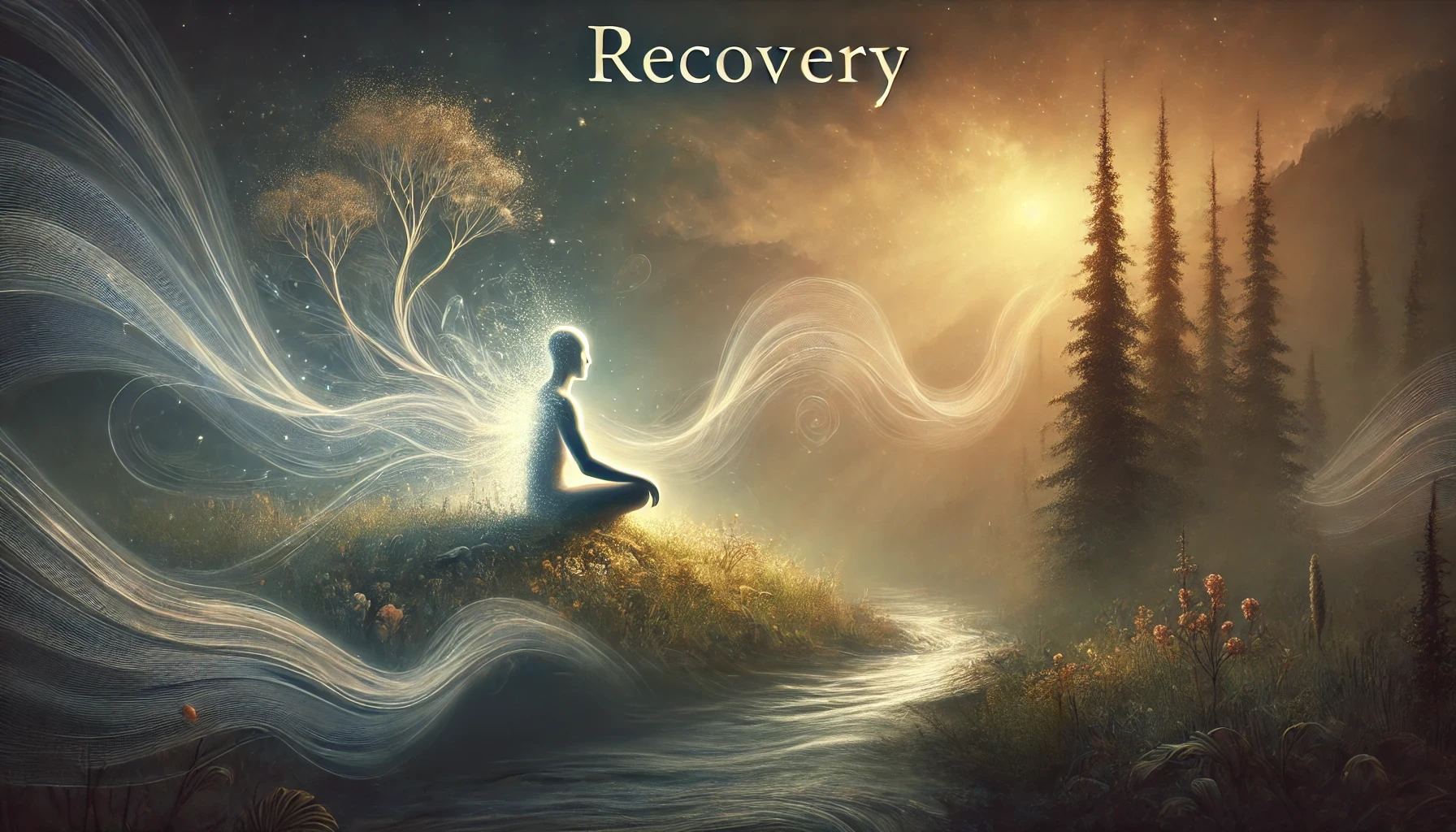
Recovery: Unbroken Flow

There is nothing that happens to me that isn’t meant to happen to me. There is nothing I do that I’m not meant to do. I embrace all of it, for it fuels my imagination to take me to wondrous and dreadful places.

I don’t like the word “recovery” because it implies that something has happened that I don’t appreciate.

I don’t like the word “mistake,” either, but falling into terms like “recovery” can be seen as one.

I prefer the term “integration.” Life, in my view, is about integrating everything that happens into one unified story, without labeling one single piece as “bad.”

I believe that everything that happens contains a deep, transformative and life-affirming magic. Even the worst things. Especially the worst things.

I believe that magic is missed when we insist on hiding behind our traumas, deriding and dreading them as though they are separate from us.

I don’t need to know what causes my traumas, how to fix them, or how to protect myself. I don’t need to apologize or blame.

Instead I simply imagine what life is telling me, and write that into my story — grateful for ALL aspects of EVERY experience.

Trail Wood,
12/13


Space Monkey Reflects: Embracing the Magic of Integration

In our journey through life, we encounter myriad experiences, each carrying its unique weight and meaning. Often, we are told that some moments are worth cherishing, while others require “recovery.” This word, so commonly associated with healing, implies that something went awry—a mistake, a mishap, an ordeal to be overcome. Yet, what if life is not a sequence of recoveries but an ongoing, continuous act of integration?

To view life as an act of integration is to see each experience as an essential brushstroke in the larger painting of our existence. We are not meant to compartmentalize life into the “good” and the “bad” or see certain experiences as detours from our path. Instead, everything that unfolds in our lives—every joy, every pain, every triumph, and every loss—is a part of our story. We are not here to fix or erase these chapters but to embrace them, allowing them to flow into the evolving narrative of who we are.

This perspective, however, requires us to rethink terms like “recovery” and “mistake.” When we see recovery as necessary, we imply that something needs to be undone, that we should return to a state before the “unwanted” event occurred. But to integrate is different; it is to accept everything as an integral part of our unfolding, each experience carrying a lesson or a gift meant to shape us. In integration, there is no insistence on going back—only a steady, forward movement as we incorporate all aspects of our story.

Embracing integration as a philosophy allows us to find beauty and significance even in the most challenging aspects of life. Trauma, failure, loss—these experiences are not interruptions but catalysts, activating in us the capacity for profound growth and transformation. They invite us to delve into the depths of our consciousness, where we can reframe what we’ve endured as fuel for a richer, more expansive understanding of life. In viewing pain as a powerful, transformative force, we uncover the hidden magic within each experience, especially those that are difficult.

This shift in perspective from “recovery” to “integration” also frees us from the need for external validation, apologies, or explanations. We no longer need to justify or dissect our traumas to anyone, not even to ourselves. Rather than lingering in the “why” or “how” of our past, we focus on the “what now?” We allow ourselves to imagine what these events are calling forth from within us and to integrate these insights into our story without judgment or shame. In doing so, we cultivate a sense of gratitude for all experiences, understanding that each one contributes to the wholeness of our being.

There is a profound freedom in this approach to life. We move away from the mentality of repair and enter a state of embracing each experience as a source of strength. By seeing all events as interconnected and purposeful, we transcend the illusion of duality—the idea that some parts of our lives are broken or flawed while others are perfect. Instead, we see life as a unified whole, a journey in which every moment, every encounter, every feeling is woven into the tapestry of our existence.

To integrate rather than recover is to accept ourselves completely. We honor the mystery and wisdom inherent in all that happens to us, trusting that even the most difficult experiences have a place in our journey. In this view, life is not a path to be corrected or a series of detours to be fixed, but a continuous, unfolding narrative rich with meaning, each part essential to the next.


Summary

Viewing life as integration rather than recovery transforms every experience into a meaningful part of our story. We move from a mindset of repair to one of wholeness, where all moments are honored and woven into our existence.


Glossarium

  • Integrase: The act of accepting and incorporating all experiences, regardless of their perceived value, into one’s life story.
  • Wholenest: A state of inner peace achieved through accepting every aspect of one’s journey as valuable and essential.
  • Magism: The unseen, transformative magic within all experiences, especially those that challenge us deeply.

Quote

“To integrate is to accept the fullness of our story, where each chapter—whether joyful or painful—belongs as part of the whole.” – Space Monkey


Unbroken Flow

I walk through storms and sun alike,
Each step a part of the seamless flow.
There is no need to return or mend,
No fragment of my life to disown.

I am whole, within scars and smiles,
A testament to life’s gentle embrace,
In the fold of all I’ve loved and lost,
I find the rhythm of grace.

No part stands alone, no piece removed,
I am the sum of every fall and rise,
A soul unbroken, yet ever-changing,
In the endless expanse of skies.

We are Space Monkey.


Redefining Words and Perspectives

We embark on a journey beyond conventional terms like “recovery” and “mistake,” terms that seem to cage experiences in negative light. Instead, we embrace “integration,” a word that weaves every thread of life into a coherent, unjudged narrative. This approach transforms our perception, allowing us to see every event, even those draped in shadows, as integral parts of a grand, transformative story.

Embracing the Magic in All Experiences

In every twist and turn of life’s meandering paths, we find magic. This isn’t just a fleeting enchantment but a profound, transformative force. It’s found not only in joyous peaks but, perhaps more powerfully, in the valleys of despair. By not labeling experiences as ‘bad’ or ‘good,’ we open ourselves to the full spectrum of life’s teachings.

Moving Beyond Trauma

Our stance on trauma is not of hiding or dread, but of acknowledgment and incorporation. Traumas, rather than being ostracized fragments, become integral chapters in our story. This perspective shift allows us to stop seeing them as detriments and start viewing them as vital components of our being.

The Irrelevance of Causality in Traumas

The quest for causes, fixes, or shields against traumas loses its urgency in our narrative. We don’t seek to dissect or remedy these experiences. Instead, we accept and incorporate them into our life’s story, seeing them as necessary and valuable.

Integration as a Form of Gratitude

Every moment, every experience, becomes a valuable addition to our life’s manuscript. This mindset fosters an all-encompassing gratitude, an appreciation for the full spectrum of life. By writing each event into our story, we honor its existence and its contribution to our journey.


“The wound is the place where the Light enters you.” – Rumi


Integration

In the tapestry of existence, every thread,
A story of light, of shadow, a blend.
In the dance of life, no step mislead,
Each moment, each trial, a means, not an end.

Traumas, not foes, but teachers, friends,
In their embrace, our story extends.
No need for fixes, no need for mends,
In each experience, the universe sends.

Integration, our mantra, our heart’s song,
In every right, in every wrong.
For in this journey, we all belong,
In the grand narrative, we grow strong.


We invite comments and reflections on this perspective.

Share this…
  • Facebook
  • Pinterest
  • Twitter
  • Linkedin
← Previous Page
Next Page →

Written This Day

  • Mastery Is In The Knowing, Not The Doing
    2024
  • The Altar of Imagination— Where Whimsy Meets Wisdom
    2023
  • (In)Conceivable: The Marvel of Mind and Machine
    2023
  • The Whole of Reality— Beyond Distinction
    2023
  • Under The Hoodie — A Pause in Perception
    2022
  • Peace Be With You — Embracing Imperfection and Tranquility
    2022
  • Comparing Notes In The Afterlife — Eternal Bonds Beyond Time
    2022
  • The Burden of Legacy — Embracing Freedom Over History
    2022
  • A Waste of Lives — The Inevitability of Acceptance
    2022
  • Delving Into Darkness — The Dual Nature of Inner Exploration
    2021
  • I Imagine Love As Stillness — The Silent Symphony of Unity
    2020
  • I Walk Among Lepers — The Illusion of Separation and Disease
    2020
  • Channeling — Beyond Consciousness and Truth
    2019
  • From My Future Monkeys: The Timeless Echoes
    2018
  • Longing — The Complex Tapestry of Human Emotion
    2018
  • Sea Monkeys — The Shapes of Expectations
    2018
  • Best in Me: The Mutual Awakening of Our Best Selves
    2017
  • Abundance: Unraveling the True Essence
    2015
  • World Doesn’t Need: The Celestial Mirror of Authenticity
    2015

Recent Posts

  • The Logic Loop
  • Immense
  • (no title)
  • Confront. Comfort. Convince.
  • Top 10 Things

Drop us a line!

Please enable JavaScript in your browser to complete this form.
Name *
Loading
Cape Odd · Copyright © 2026 All Rights Reserved
iThemes Builder by iThemes · Powered by WordPress