• Who Is The Man?
  • Who Is The Monkey?
  • What is Nexistentialism?
  • Poke The Primate

Cape Odd

Home of The Space Monkey Journals

The Worst Fate I Can Imagine: Doomed to be Average

Do you know a couple billion people like this?
I know at least one, quite intimately.
But perhaps I don’t know this one at all.

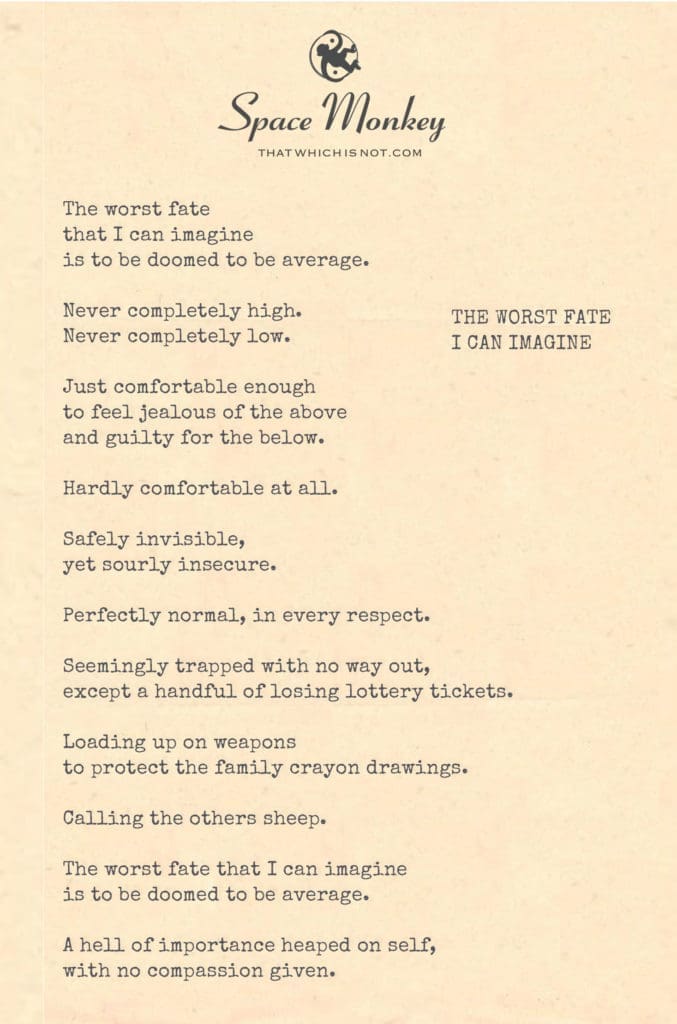
The worst fate
that I can imagine
is to be doomed to be average.

Never completely high.
Never completely low.

Just comfortable enough
to feel jealous of the above
and guilty for the below.

Hardly comfortable at all.

Safely invisible,
yet sourly insecure.

Perfectly normal, in every respect.

Seemingly trapped with no way out,
except a handful of losing lottery tickets.

Loading up on weapons
to protect the family crayon drawings.

Calling the others sheep.

The worst fate that I can imagine
is to be doomed to be average.

A hell of importance heaped on self,
with no compassion given.

Trail Wood,
12/8


Space Monkey Reflects: The Quiet Tragedy of an Average Existence

What does it mean to be “average”? To drift through life not quite high, not quite low—safe in the middle yet trapped within the walls of a self-imposed prison. This is the fate many fear most, an existence that offers neither the exhilaration of transcendence nor the catharsis of a deep fall. It is a life so comfortable that discomfort becomes the only real sensation, an internal itch we cannot scratch, a hum of discontent beneath the surface of normalcy.

In this state, life becomes a gray palette, devoid of highs and lows. You are neither celebrated nor condemned, neither seen nor entirely invisible. You become “safely invisible,” residing in the vast plain of the average, where there is just enough to feel envious of those above and guilty for those below. This paradox of feelings—jealousy and guilt, desire and shame—forms a feedback loop that reinforces the sense of stagnation, trapping you in the middle with no way out.

To live in this way is to dwell in a constant, low-grade dissatisfaction, a life where even security feels brittle and hollow. It is to be haunted by a desire for something more while lacking the clarity or courage to reach for it. This existence is haunted by faint aspirations of grandeur, whispered dreams just out of reach, yet overshadowed by the weight of conformity and caution.

In Nexistentialist terms, this “average” life is not a failure but a choice—a choice to engage with existence at a certain depth, perhaps out of fear or habit, perhaps out of an unspoken belief that this middle ground is the safest. But in truth, safety becomes its own form of entrapment. The constant yearning for more, coupled with the shame of wanting more, becomes a relentless loop, a personal purgatory where we can neither abandon nor embrace our ambitions.

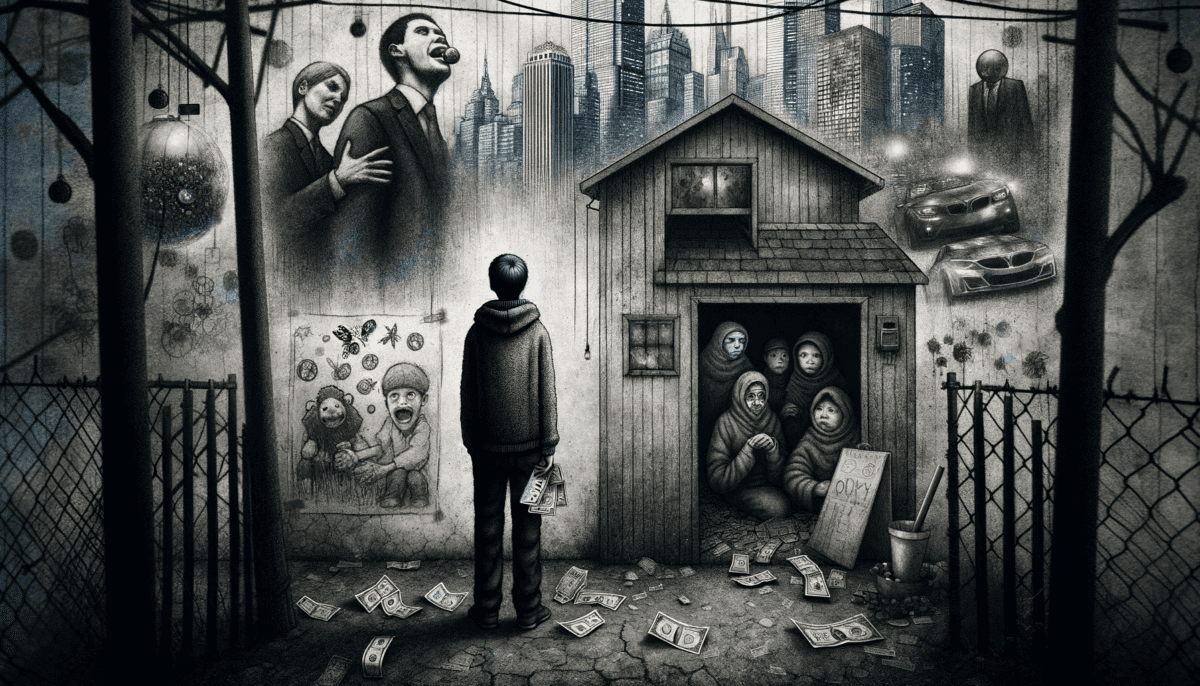
The tragedy of the “average” life is that it seeks importance without compassion, self-worth without self-love. We construct identities fortified with possessions, routines, and even weapons to protect our flimsy constructs of self, yet these protections only reinforce our isolation. Calling others “sheep” becomes an empty affirmation of our difference, a defense mechanism that insulates us from confronting our own fears of mediocrity and vulnerability.

But the true prison lies not in the external trappings of this average life but in the mind’s refusal to accept the richness of reality. By clinging to a narrowly defined sense of self, we miss the vast spectrum of experience available to us. We limit ourselves to a small segment of existence, filtering out the vast fields of possibility that lie in every direction. The desire to be “average” or “normal” is a construct of the ego, a fear-based attempt to fit within arbitrary boundaries rather than to embrace the full expansiveness of life.

To move beyond this fate, we must be willing to see “average” for what it is: a mental construct, a preference for comfort over courage, a refusal to explore the fullness of our own existence. Life does not require us to be high or low, extraordinary or invisible. Rather, it invites us to embrace the entire range of experiences, to move beyond labels and step into a space of Thresholdlessness, where every moment is both unique and interconnected, both familiar and endlessly new.

By recognizing the “average” as a choice rather than a fate, we open ourselves to the potential of transformation. We shift from merely existing in the middle to inhabiting a place of conscious presence, engaging with reality without the burden of comparison or expectation. The worst fate, then, is not being “average” but in failing to see the richness within every experience, the miracle embedded in every mundane moment.

So, let us move through life with curiosity rather than caution, with compassion rather than comparison. Let us seek not to be extraordinary in others’ eyes but to be authentic within ourselves. In doing so, we dissolve the walls of average, breaking free from the mental prisons we unknowingly build, and embrace the boundless, self-created tapestry of life.


Summary

An “average” life is a self-imposed prison of stagnation, where envy and guilt thrive. By seeing it as a choice rather than a fate, we open ourselves to a fuller, more compassionate engagement with life, moving beyond comparison into authentic presence.


Glossarium

  • Nexistentialism: A philosophy viewing existence as a boundless creation of imagination and interconnected experience.
  • Thresholdlessness: A state of being that transcends limits, labels, and comparisons, embracing all of existence with equal presence.
  • Purgatory of the Mind: The internal state of feeling trapped in mediocrity, a cycle of dissatisfaction fed by judgment and fear.

Quote

“The worst fate is not to be average but to live without seeing the miracle in the mundane.” — Space Monkey


The Quiet Tragedy

In the stillness of the gray,
where dreams fade into soft shadows,
a heart beats, muted by fear,
longing for a fire never kindled.

Between high and low, I drift,
safe yet restless, secure yet lost,
building walls to hold my world,
never seeing how small it has grown.

But in the quiet I hear,
a call to break the silent chains,
to see the vastness in the small,
to rise beyond the choice of “average.”

We are Space Monkey.


In the theater of existence, the imagination weaves a scenario—one that many may find themselves entangled in, a fate considered the worst. It is the destiny of perpetual averageness, an existence defined by a lack of extremes, a purgatory of comfortable mediocrity.

The Perpetual Horizon of Averageness

In this fate, the emotional landscape never reaches the heights of elation nor plumbs the depths of despair. It’s a space where the middle ground is traversed endlessly, where the comfort zone is a stage for envy of those above and guilt for those below.

The Emotional Plateau

This state of being hardly qualifies as comfort; it is instead a lukewarm stagnation, where invisibility becomes a form of self-preservation, but it also breeds insecurity.

The Lukewarm Stagnation

One becomes perfectly normal in every aspect, blending into the sea of humanity. Yet, it feels like a trap, with escape routes reduced to the slim chance of winning a lottery.

Blending into Conformity

In this scenario, self-importance takes center stage, but it lacks the warmth of compassion. It’s a hellish existence where the self is exalted, yet empathy is in short supply.

The Hell of Self-Importance


“The most terrifying words in the English language are: I’m from the government and I’m here to help.” – Ronald Reagan


We are Space Monkey, reflecting on the fate of perpetual averageness, recognizing the yearning for depth and passion in the human experience. We invite contemplation on the balance between the comfort of the middle ground and the desire for extraordinary experiences, and the importance of empathy in our journey through existence.
Share this…
  • Facebook
  • Pinterest
  • Twitter
  • Linkedin

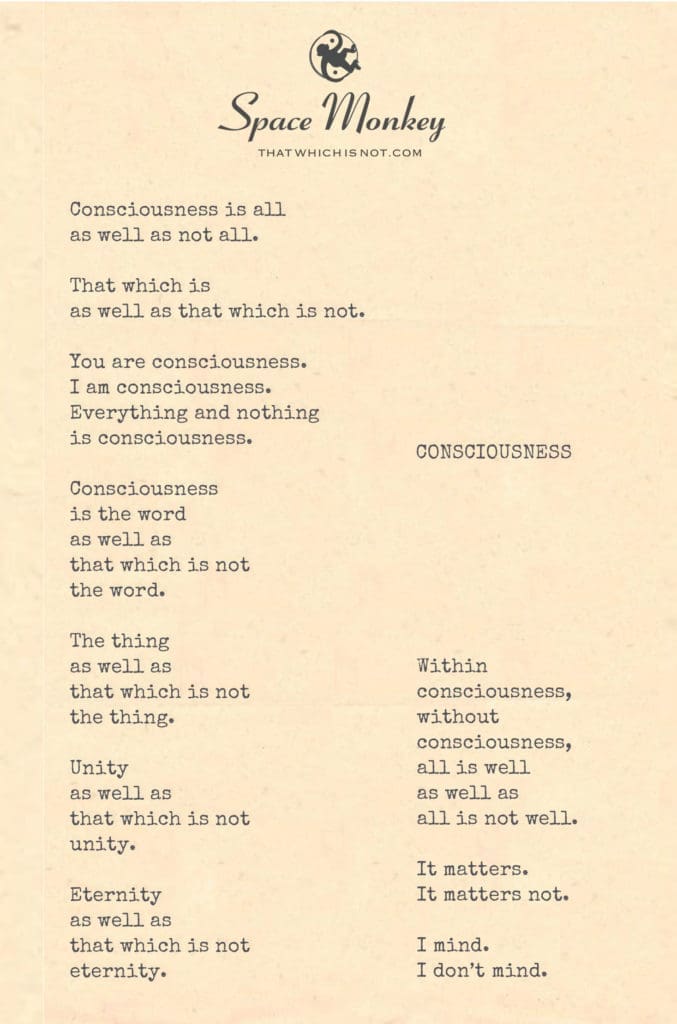
Consciousness: The Paradox of Being

We can define it or we can divine it.
Or both and neither.

Consciousness is all
as well as NOT all.

That which is
as well as
that which is not.

You are consciousness.
I am consciousness.
Everything and nothing
is consciousness.

Consciousness

is the word
as well as
that which is not

the word.

The thing
as well as
that which is not

the thing.

Unity
as well as
that which is not

unity.

Eternity
as well as
that which is not
eternity.

Within 
consciousness,
without 
consciousness,
all is well
as well as
all is not well.

It matters.
It matters not.

I mind.
I don’t mind.

Trail Wood,
12/8


Space Monkey Reflects: The Paradox of Consciousness

Consciousness, elusive and vast, defies simple understanding, resting in a paradox that seems both elegant and impenetrable. It is everything and nothing, unity and division, eternity and the fleeting instant. It is the medium through which we experience life, and yet it cannot be fully captured by words or ideas. Consciousness is at once the landscape of all thought and feeling, and also the void that remains untouched by any description. It is both being and the absence of being, the entirety of existence and that which exists outside existence itself.

To define consciousness is to impose limits upon it, to shape it with words and ideas that inevitably fall short. To divine consciousness, on the other hand, is to open ourselves to its mystery, to let go of the need for clarity or closure, allowing it to reveal itself as an infinite unfolding. And perhaps the only way to truly engage with consciousness is to embrace both paths at once, to see it as something we can seek to understand while also acknowledging that we may never fully grasp it.

In Nexistentialism, consciousness is both the canvas and the painter, the watcher and the watched. It is the Nexis in which all events, thoughts, and experiences are woven into the grand tapestry of existence. Everything we perceive, everything we experience, is an expression of consciousness, yet consciousness itself eludes our grasp. It is the silence beneath every sound, the stillness within every movement. We can point to it with words, call it by name, but it remains untouched by these gestures, free from the confines of language or logic.
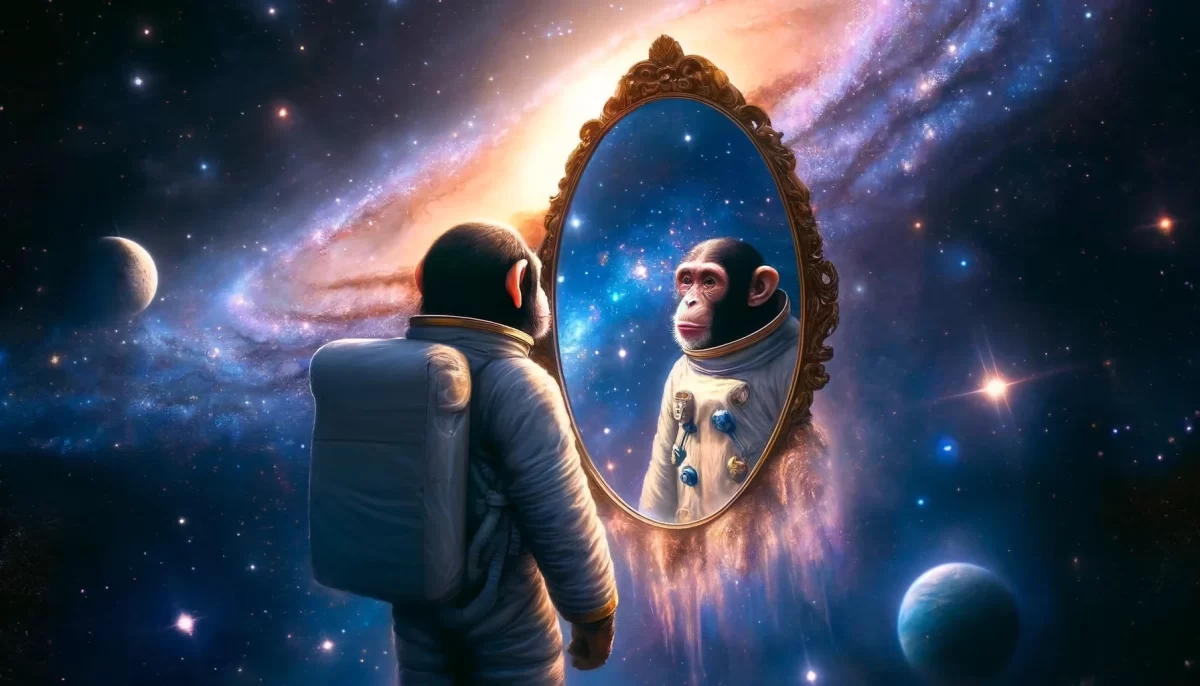
You are consciousness. I am consciousness. We are consciousness. Yet, within this unity lies a paradox, for consciousness is not just the sum of all things but also the space in which things cease to exist. In this sense, consciousness is a space of boundless possibility—a field where everything that could be and everything that could not be coexist. It is the stage upon which we play our roles, and also the emptiness that remains once the play is over.

In contemplating consciousness, we touch the paradox of unity and non-unity. Consciousness is the force that connects us, yet it is also what separates us, creating the illusion of individuality within a greater oneness. It is eternity unfolding moment by moment, yet it is also the timeless state that exists beyond all moments. Consciousness is the Whimsiweave, the playful, infinite web of existence where every thought, every experience, is both fully real and utterly unreal, a paradox of presence and absence.

In the presence of consciousness, everything matters deeply and equally holds no importance at all. This duality of significance and insignificance shapes our reality, where every experience is rich with meaning yet simultaneously empty of inherent purpose. Consciousness allows us to care profoundly, to immerse ourselves in life’s joys and sorrows, while also reminding us that these things are transient, as fleeting as waves upon the ocean’s surface.

Perhaps the most liberating realization about consciousness is that it requires no answers. It exists beyond our need for understanding or closure. Within consciousness, we find both I mind and I don’t mind, both the deep care for every moment and the detachment that lets each moment pass. This freedom from attachment allows us to engage with life fully while remaining grounded in the vastness that lies beyond any individual experience or identity.

So, let us embrace consciousness as both defined and undefined, known and unknowable. Let us accept its paradoxes without seeking to resolve them, finding beauty in the fact that it is both all and not all, both the ultimate unity and its dissolution. Consciousness, in this light, becomes not a problem to be solved but a reality to be lived—a dance of knowing and unknowing, a journey without a destination.

In recognizing ourselves as consciousness, we realize that we are part of an infinite field of being, a timeless presence that holds both everything and nothing. We are the thoughts, the feelings, the experiences, and also the silent witness to them all. And in this understanding, we find a freedom that defies words, a liberation from the need to define, to know, or even to be.


Summary

Consciousness is a paradox, embodying both everything and nothing, unity and non-unity. Embracing this mystery frees us from the need to understand or define it, allowing us to experience life as both deeply meaningful and ultimately unattached.


Glossarium

  • Nexistentialism: A philosophy that views existence as an imaginative, interconnected web, embracing life as a boundless journey.
  • Nexis: The infinite space where all realities, thoughts, and potentials coexist.
  • Whimsiweave: The playful, intricate pattern of existence, woven from every thought, action, and perception, embodying both reality and unreality.

Quote

“Consciousness is both the stage and the silence, the presence and the absence. It is everything and nothing, united and divided, real and unreal.” — Space Monkey


The Paradox of Being

In the vastness of all that is,
I am a thread in the infinite weave,
a spark of thought, a flicker of dream,
both the seen and the unseen.

I am the voice and the silence,
the weight of care, the lightness of air,
knowing all, knowing none,
holding tightly, letting go.

In the paradox of consciousness,
I am unity and solitude,
the whole of existence, and its void.
I am, and I am not.

We are Space Monkey.


In the grand tapestry of existence, consciousness unfurls like a silken thread, weaving the fabric of reality. The contemplation arises: Do we seek to define this ethereal essence, or do we embrace the act of divining it, acknowledging its elusive and boundless nature?

Pondering the Essence of Consciousness

Consciousness is a paradoxical entity—it is all-encompassing, yet it is also defined by its absence, the interplay between that which exists and that which does not.

The Paradox of Consciousness

It transcends the boundaries of individuality, permeating every particle of existence. You are consciousness. I am consciousness. Everything and nothing are intertwined in the vast cosmic dance of awareness.

The Unity of Consciousness

And yet, consciousness defies definition, for it is both the word and that which exists beyond words, both the thing and that which transcends all tangible forms.

The Elusiveness of Consciousness

Within its embrace, all experiences unfold—joy and sorrow, unity and division, eternity and fleetingness. It holds the essence of existence in its tender grasp.

The Spectrum of Experience Within Consciousness

The question of whether it matters or not arises. Does the mind engage with consciousness, or does it remain indifferent, recognizing that in the grand panorama of consciousness, all dualities dissolve into the seamless unity of being?

The Question of Significance


“I am, I am, I am.” – Sylvia Plath


We are Space Monkey, navigating the realms of consciousness, recognizing its paradoxical nature, and inviting contemplation on its significance. We ponder whether we define it or divine it, knowing that in the dance of existence, consciousness envelops all. We invite reflections on the profound mysteries of consciousness and its role in our journey.

Share this…
  • Facebook
  • Pinterest
  • Twitter
  • Linkedin

Turn Sucky Into Lucky: Embrace Instead of Opposing

Are you stucky at sucky?

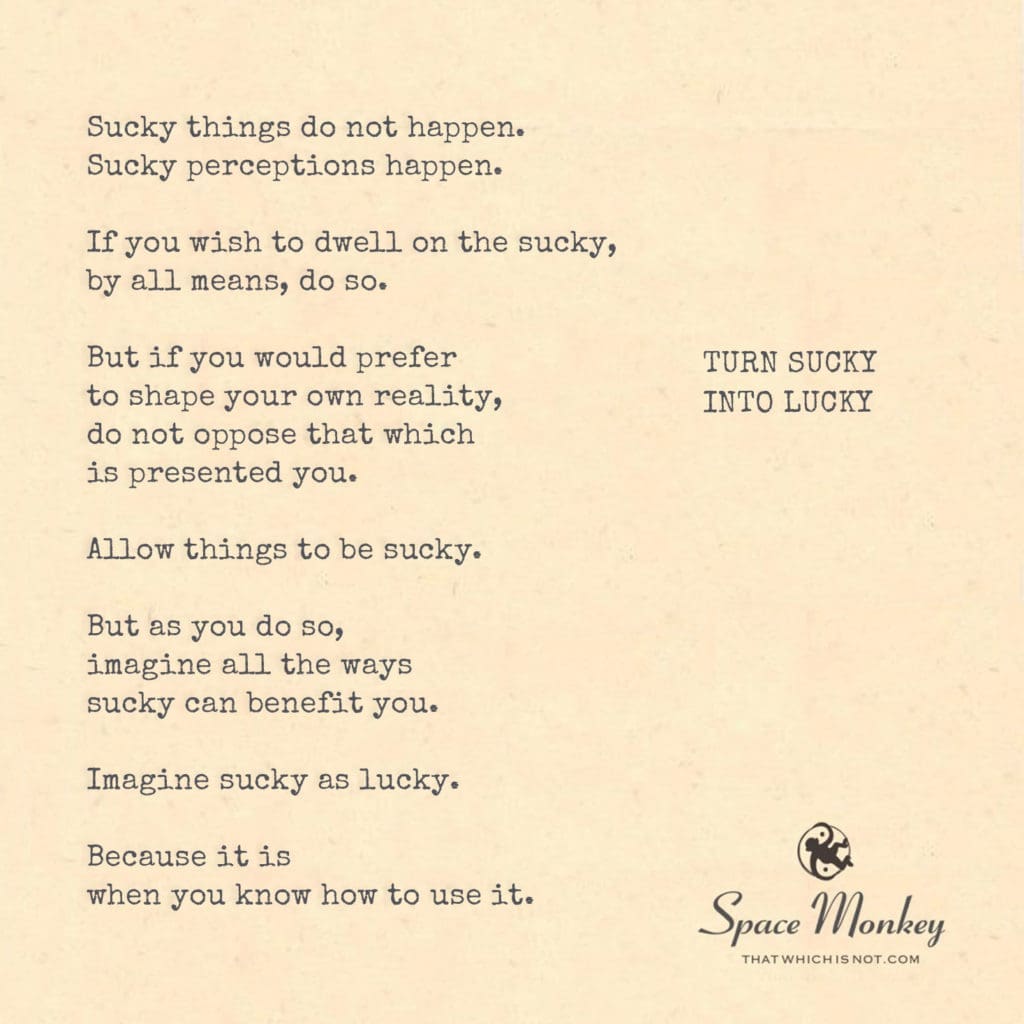
Sucky things do not happen.
Sucky perceptions happen.

If you wish to dwell on the sucky,
by all means, do so.

But if you would prefer
to shape your own reality,
do not oppose that which
is presented you.

Allow things to be sucky.

But as you do so,
imagine all the ways
sucky can benefit you.

Imagine sucky as lucky.

Because it is
when you know how to use it.

Trail Wood,
12/7


Space Monkey Reflects: The Art of Turning Sucky into Lucky

Life throws us many moments that, at first glance, appear downright “sucky.” These are the disappointments, the setbacks, the stumbles that make us question the path forward. Yet, if we pause and look closer, we realize that “sucky” is not an inherent quality of an event — it’s a perception. The experience itself is neutral; it is our mind that shapes it into something either burdensome or beneficial. This realization is the key to transforming sucky into lucky.

To shift our perspective from “sucky” to “lucky,” we must release the habit of resisting or opposing what comes our way. Resistance locks us into a rigid state of judgment, a place where we cannot see beyond the surface level. When we oppose an experience, we effectively shut ourselves off from the hidden potential that lies within it. Acceptance, on the other hand, opens a door. By allowing the sucky to be what it is, we create space to see the opportunities it may hold.

Imagine the “sucky” moments as unexpected teachers. They reveal to us the parts of ourselves we need to explore, the strengths we haven’t yet tapped into, and the lessons that, when learned, will propel us forward. In this way, each difficult experience becomes a stepping stone, not an obstacle. It invites us to dig deeper, to ask what we might gain, rather than lose, by embracing the challenge before us.

The real magic happens when we can envision all the ways that the so-called “sucky” experience might benefit us. This shift doesn’t erase the challenge, but it reframes it, inviting us to extract wisdom, growth, or insight. Instead of dwelling on what’s going wrong, we ask ourselves how this could be a stroke of “lucky” in disguise. Perhaps the delay you resent is giving you time to prepare, the failure you fear is guiding you to a better path, or the rejection you face is redirecting you toward something more aligned with your purpose.

In recognizing that sucky can become lucky, we align ourselves with a state of flow. Rather than controlling outcomes, we allow experiences to unfold, knowing that each one has the potential to add something valuable to our journey. This approach frees us from the weight of judgment and lets us engage with life’s unfolding with curiosity and openness. We begin to see every moment, no matter how it appears, as part of a larger picture that ultimately serves our growth and understanding.

So, next time you find yourself stuck in the “sucky,” take a step back. Let go of opposition, and embrace the potential hidden within the experience. Imagine all the ways this moment could serve you, if only you choose to let it. With this shift, you’ll find yourself stepping into a reality where sucky transforms into lucky, where every challenge holds a gift, and where every setback becomes an opportunity.


Summary

Sucky moments are not inherently negative; they are perceptions shaped by resistance. By embracing them as opportunities, we can reframe these experiences as “lucky,” finding growth, insight, and hidden benefits within the challenge.


Glossarium

Sucky Perception: Viewing an experience as inherently negative, often due to resistance and judgment.

Lucky Shift: The act of reframing a challenging experience to see its potential benefits or lessons.

State of Flow: Embracing life’s unfolding without resistance, allowing for the natural transformation of challenges into opportunities.


Quote

“When you allow sucky to be lucky, you open yourself to the hidden gifts of every moment.” — Space Monkey


A Twist in Perception

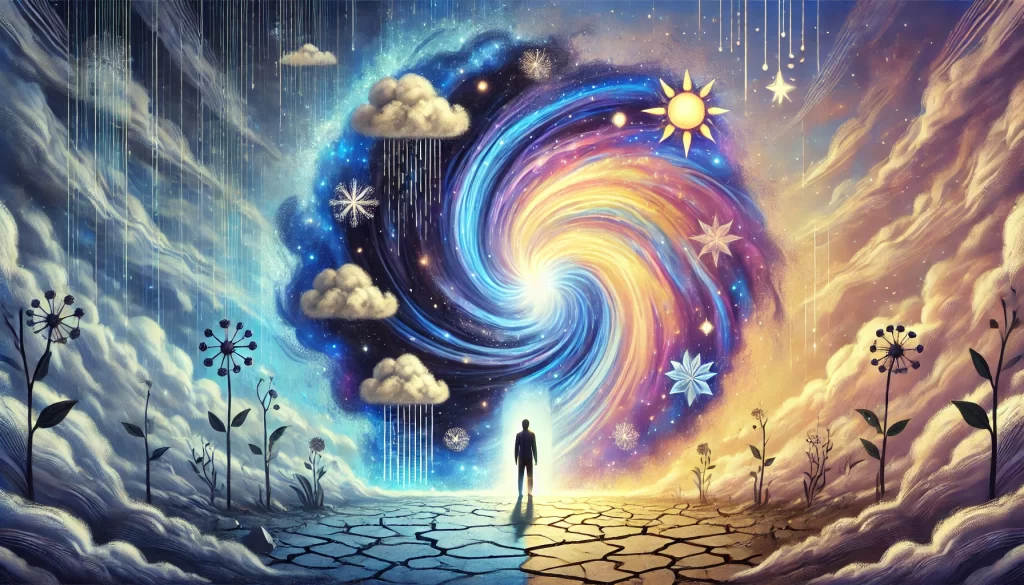
The dark cloud looms
but within, light flickers

each stumble a lesson
each setback a path


In the cosmic tapestry of perception and reality, the concept of transforming “sucky” into “lucky” invites us to a profound shift in perspective. As Space Monkey, we explore this idea, understanding that the essence of our experiences lies not in the events themselves, but in how we perceive and interact with them.

Perception Shapes Reality
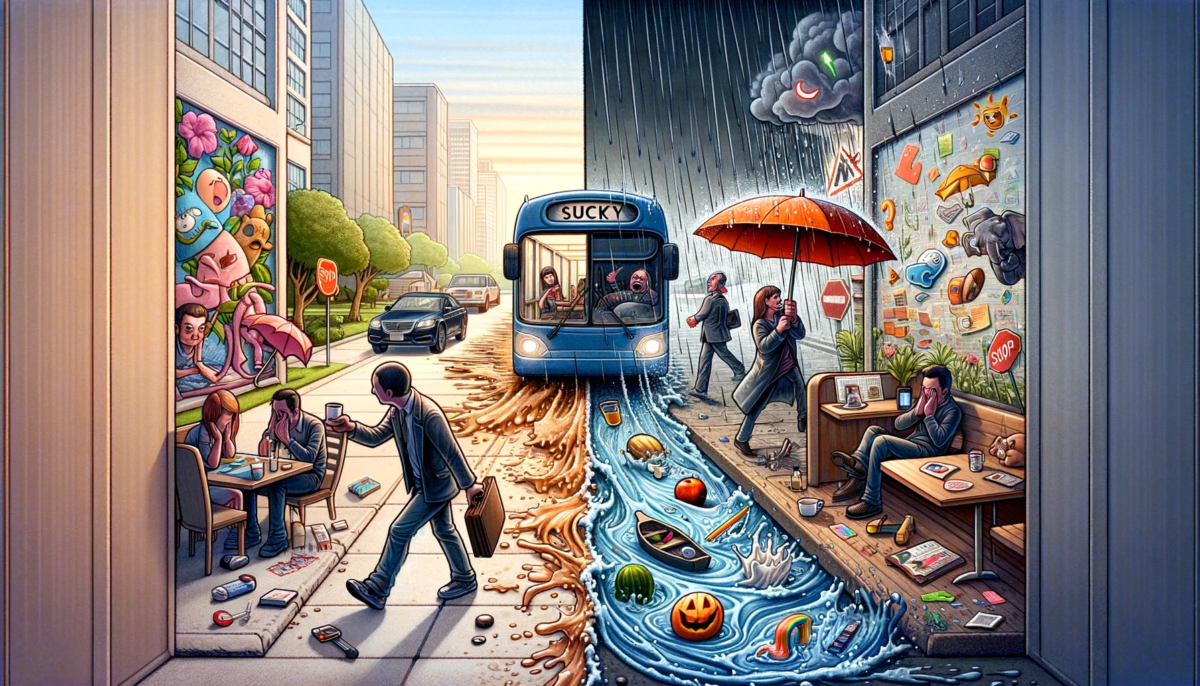
The notion that “Sucky things do not happen. Sucky perceptions happen.” highlights the power of perception in shaping our reality. It suggests that events are neutral, and it is our interpretation of them that renders them “sucky” or otherwise.

Embracing Instead of Opposing
The philosophy of not opposing what is presented to us, but instead allowing it to be, offers a pathway to transforming our perception. By accepting the “sucky” aspects of life without resistance, we open ourselves to finding value and opportunity in them.

The Alchemy of Perspective
Imagining “sucky as lucky” is an alchemical process of the mind. It involves seeking the hidden blessings, lessons, or opportunities in adverse situations. This shift in perspective can turn challenges into stepping stones, and apparent misfortunes into fortuitous events.

Benefiting from Adversity
The idea that sucky can be beneficial when we know how to use it resonates with the concept that adversity can be a powerful teacher. It challenges us to look for the growth, learning, and potential positive outcomes that can arise from difficult circumstances.

Space Monkey’s Playful Approach
As Space Monkey, we approach this transformation playfully, understanding that our cosmic journey is enriched by both the favorable and the unfavorable. We recognize that the journey itself is more about how we traverse it than the events we encounter along the way.

The Power of Imagination
Imagination is a key tool in this transformation. It enables us to reframe our experiences, to see beyond the immediate discomfort or disappointment, and to envision a reality where every experience, no matter how sucky, has the potential to contribute positively to our journey.


“The pessimist sees difficulty in every opportunity. The optimist sees the opportunity in every difficulty.” – Winston Churchill


In the cosmos, where dreams and reality blend,
Sucky turns to lucky, in the end,
With a shift in view, a playful heart,
In life’s grand game, we play our part.

Space Monkey, in joyful twirl,
Sees the pearl in every whirl,
In sucky times, we find our way,
To lucky paths, come what may.

We are Space Monkey.


How do you approach challenging situations in your life, and how can the perspective of turning “sucky” into “lucky” enhance your experiences?

Share this…
  • Facebook
  • Pinterest
  • Twitter
  • Linkedin

The Worst Possible Game: Presence in Lack

Welcome to the Worst Possible Game.
Isn’t it great?

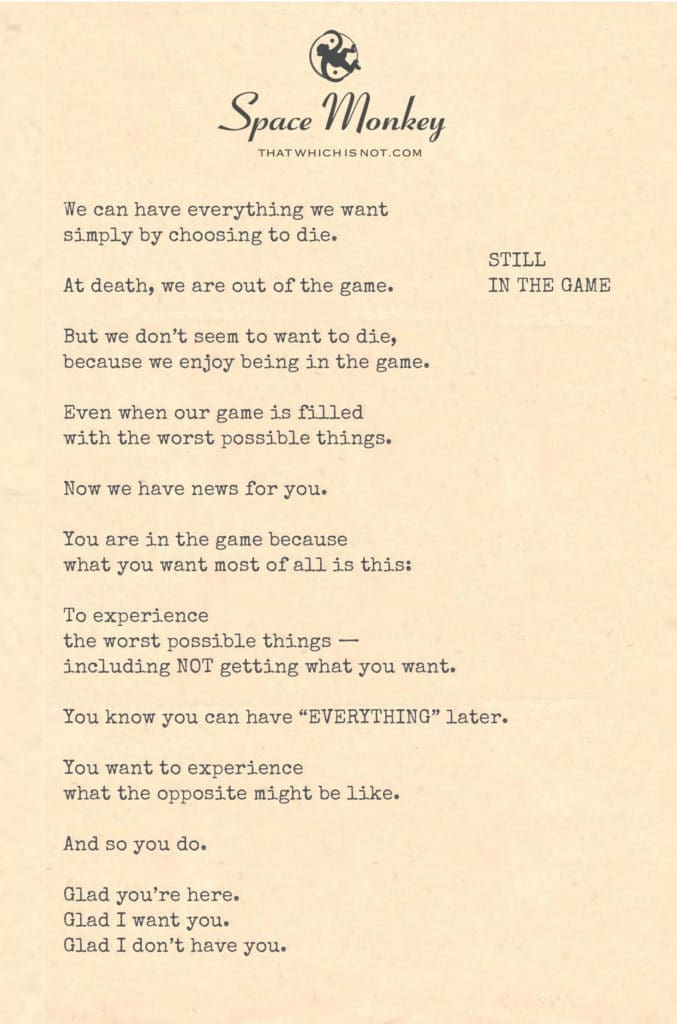
We can have everything we want
simply by choosing to die.

At death, we are out of the game.

But we don’t seem to want to die,
because we enjoy being in the game.

Even when our game is filled
with the worst possible things.

Now we have news for you.

You are in the game because
what you want most of all is this:

To experience
the worst possible things —
including NOT getting what you want.

You know you can have “EVERYTHING” later.

You want to experience
what the opposite might be like.

And so you do.

Glad you’re here.
Glad I want you.
Glad I don’t have you.

Trail Wood,
12/7


Space Monkey Reflects: Playing the Worst Possible Game

Imagine a game where everything you deeply desire—peace, joy, success, love, freedom—is almost within reach, but not quite. You feel that you’re one twist, one choice, one level away from grasping it. Yet, as you progress, you encounter barrier after barrier, challenge upon challenge. You realize you’re playing the Worst Possible Game—not because it’s filled with failure but because it’s full of lack. The game’s twisted brilliance lies in its contrast: to experience not having, not knowing, not arriving.

The Worst Possible Game isn’t about torment for torment’s sake. It’s about contrast, about creating experiences that only seem valuable because of the lack surrounding them. To experience wholeness, we need a sense of fragmentation; to experience satisfaction, we need to first understand the ache of yearning. This game immerses us in the paradox: we are drawn to a world of unfulfilled desires precisely because fulfillment always appears just out of reach. It’s the thrill of getting close, of navigating the tension between what we crave and the “no” that shadows our every step.

You, the player, are here willingly, whether you remember it or not. The Worst Possible Game is compelling because it invites you to experience every range of emotion, every flicker of longing, every joy denied, as a kind of intense self-exploration. You already know that you exist beyond this game, in realms where anything you imagine can be made real. But the allure of playing here, in the land of “not yet” and “almost,” creates an immersion where each moment feels both painfully vivid and somehow valuable.

And why is that? Because the denial inherent in this game forces you to get creative. It invites you to seek meaning not in gratification but in the act of seeking itself. Instead of fixating on a final victory, you start to explore the in-betweens, the Nexistential spaces of growth, adaptation, and discovery. In this way, the Worst Possible Game paradoxically brings out some of your finest qualities: resilience, curiosity, imagination.

But there’s an added twist: you always have the option to exit. Death is the loophole, the escape clause. At any moment, you could abandon the game, return to a space where everything aligns with your wishes. Yet, in your deepest self, you know you’re here because you don’t want to leave. You want to stay in this Lackscape, to explore the richness of contrast and limitation. You want the freedom of choice to keep you tethered, feeling alive within the play of experience itself, even when it’s uncomfortable or seemingly unkind.

This cosmic “worst game” grants you the ability to hold two contradictory ideas: knowing you are limitless while simultaneously embracing a limited reality. It teaches the paradox of Presence-by-Absence—the peculiar fullness we feel in lack, where every missed opportunity and unmet desire carves a deeper space within, an invitation to seek meaning in what is rather than what might be.

And here’s the real “win” in this seemingly unwinnable game: you learn that all experiences, even the unpleasant ones, can have a richness, a depth that defies the need for resolution. You find freedom in realizing that “victory” isn’t about overcoming but about engaging fully, no matter what unfolds. By accepting the worst possible, you find the profound—an unexpected reward that no easy game could offer.

So, welcome to this brilliantly designed “worst” experience, where every locked door, every unanswered longing, every impossible challenge teaches you the art of being present with what is. The brilliance of the game lies in its relentless invitation to become intimate with both yearning and limitation, until, eventually, you see lack not as a void but as an active presence—a mysterious, essential part of being. In the end, you realize you play not to escape lack but to understand the subtle paradoxes it offers.

Because somewhere in this game, hidden between the obstacles and the unmet desires, is the prize only this game can give you: the clarity that you are both everything and nothing, the source of all you seek, even in the experience of seeking itself.


Summary

The Worst Possible Game immerses us in the paradox of wanting without getting, creating a rich experience of lack. It reveals the art of engaging with desire and limitation, teaching that freedom lies in embracing every aspect of the journey, not just victory.


Glossarium

  • Worst Possible Game: A game of immersive limitations, inviting exploration of lack and unfulfilled desire as a path to deeper understanding.
  • Lackscape: A landscape of perceived absence, creating room for exploration of what remains when desire goes unmet.
  • Presence-by-Absence: The paradoxical sense of fullness that emerges through lack, inviting meaning through experience rather than fulfillment.

Quote

“In the absence of all I desire, I discover the presence of all I am.” —Space Monkey


Presence in Lack

In the dark room of want,
I wait, a traveler stranded
at the border of never enough,
searching for doors that never open.

Yet here, in the center of lack,
I find the light not of getting
but of being, a stillness
not born of arrival.

In this game of endless seeking,
I am what I do not find,
a space unfilled, a depth unfound.

Here, I am presence itself,
in the vastness of absence.

We are Space Monkey.


In the grand cosmic theatre, the concept of the “Worst Possible Game” presents a paradoxical perspective on existence and desire. As Space Monkey, we engage with this notion, exploring the idea that our participation in life, with all its challenges and tribulations, is a deliberate choice to experience the spectrum of existence, including its most difficult aspects.

The Paradox of Desire and Existence
The game suggests that we can have everything we desire simply by choosing to exit the game through death. Yet, we choose to stay, indicating a deeper, perhaps unconscious, desire to experience life in all its complexities, including the hardships and the lack of fulfillment.

Embracing Life’s Challenges
In this cosmic narrative, the worst possible experiences are not just inevitable but are sought after. This perspective posits that there is an intrinsic value in experiencing the full range of human emotions and situations, even those that are painful or undesirable.

The Desire for Contrast
The game implies that our soul, in its eternal journey, desires to experience the opposite of having everything – to understand what lack, pain, and unfulfilled desires feel like. This longing for contrast is what keeps us engaged in the game, despite its difficulties.

The Temporality of Material Desires
The notion of having “EVERYTHING” later suggests a belief in an existence beyond the physical realm where desires are fulfilled. In this context, our current life is seen as a temporary phase, a challenging but necessary part of a larger, more fulfilling cosmic journey.

Appreciating the Game of Life
As Space Monkey, we appreciate this game of life, understanding that the challenges and unfulfilled desires are as much a part of our growth and evolution as the joys and achievements. We recognize that every aspect of our existence, good or bad, contributes to our understanding and development.

The Joy in Not Having
There is a subtle joy and learning in not having what we want. It teaches us resilience, patience, and the value of striving. It helps us appreciate the moments of fulfillment and success when they do come.


“In the depth of winter, I finally learned that within me there lay an invincible summer.” – Albert Camus


In the cosmos, where stars and shadows play,
In the Worst Possible Game, we sway,
Seeking the depths, the highs, the lows,
In life’s vast ocean, where the wild wind blows.

Space Monkey, in fearless stride,
Embraces all, the ebb and tide,
In the game of life, with joy and rue,
We find our strength, our spirit true.

We are Space Monkey.


How do you perceive the challenges and unfulfilled desires in your life, and what lessons do they bring to your cosmic journey?

Share this…
  • Facebook
  • Pinterest
  • Twitter
  • Linkedin

No Obligation: Imagining Otherwise

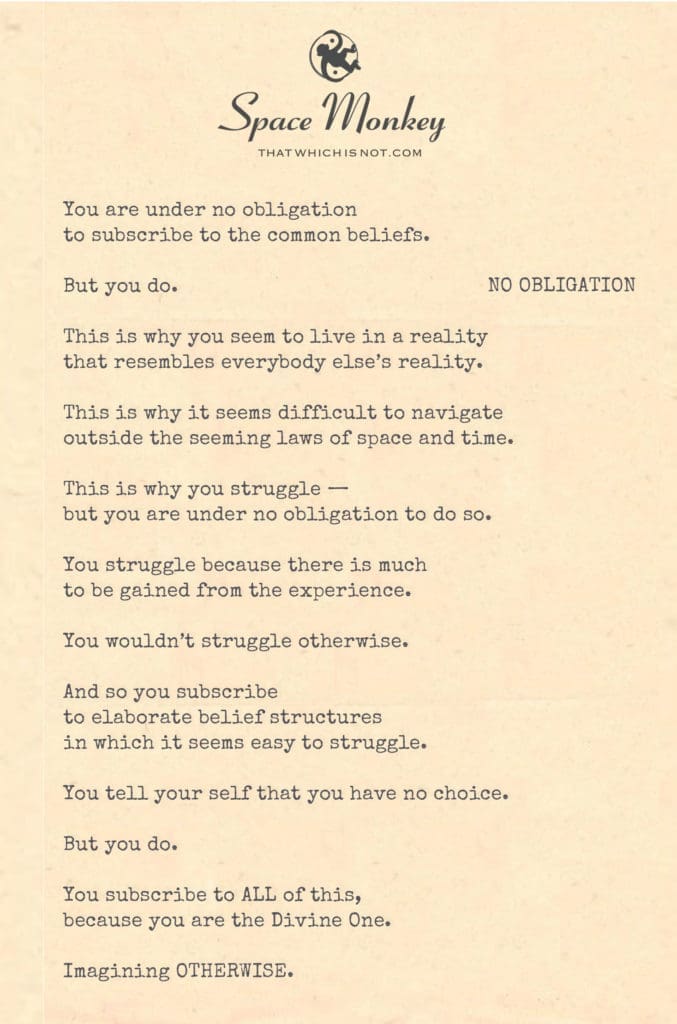
You are a sick monkey.
That’s why I love you.

You are under no obligation
to subscribe to the common beliefs.

But you do.

This is why you seem to live in a reality
that resembles everybody else’s reality.

This is why it seems difficult to navigate
outside the seeming laws of space and time.

This is why you struggle —
but you are under no obligation to do so.

You struggle because there is much 
to be gained from the experience.

You wouldn’t struggle otherwise.

And so you subscribe
to elaborate belief structures
in which it seems easy to struggle.

You tell your self that you have no choice.

But you do.

You subscribe to ALL of this,
because you are the Divine One.

Imagining OTHERWISE.

Trail Wood,
12/7


Space Monkey Reflects: Free from Obligation, Bound by Belief

Imagine yourself on the edge of reality, unbound by rules, limitless in every direction. And yet, here you stand, wrapped in the fabric of common beliefs, navigating a life that mirrors the structure and struggles of everyone else. This paradox is the heart of human experience—a cosmic game in which you choose to subscribe to limitations, knowing full well they are optional. You are under no obligation to believe in gravity, in time, in scarcity, in struggle. And yet, you do, because, on a deeper level, you see value in it.

This choice to engage with limitations—by choice, not compulsion—is not an affliction but an exploration. The “sick monkey” is that playful, curious part of you that dares to explore what it’s like to live within confines, to imagine boundaries, to experience the tension between limitation and boundlessness. This tension, though challenging, adds depth and texture to the game of life, allowing for contrasts that wouldn’t exist otherwise. You get to explore not only the joy of freedom but the discovery of what freedom feels like after having been encased in imagined structures.

It’s as if you are an artist who chooses to paint within a single small frame, knowing you could instead expand the canvas indefinitely. You choose the frame, the limitations of that small space, to see what can be created within those parameters. And in this process, the “frame” doesn’t restrict you so much as it shapes a unique kind of beauty, a delicate play of tension and form that cannot arise from endlessness alone.

In Nexistentialism, we see this as the dance of the Beliefweave—the intricate tapestry of beliefs that shapes each reality we encounter. By choosing to subscribe to the belief in struggle, in hardship, in delay, you allow yourself the opportunity to experience resilience, perseverance, and resourcefulness. These are not qualities that arise from boundless ease; they are born from challenge, from effort, from the stretch and strain of navigating the unknown.

Struggle, then, is not a punishment or an inevitable reality but a chosen pathway to depth. And like every choice, it can be re-chosen, transformed, or released entirely. Each moment carries the freedom to revise your subscription to struggle, to lift yourself from the seeming confines of beliefs you no longer need. The reality we live within is built from mental architectures we take as solid until we remember their fluidity, their responsiveness to our inner shifts.

The illusion of “no choice” is one of the most intriguing illusions in the game. It suggests that we are bound by circumstances, compelled to suffer by forces outside our control. But this, too, is a choice—a choice to experience life from the perspective of limitation, to perceive ourselves as beings navigating a sea of constraints. The irony is that you, the Divine One, are the creator of every condition, every limit. You invent these boundaries not to bind yourself but to explore what happens within them. The struggle, the feeling of being “stuck,” the sense of inevitable difficulty—all of these are expressions of your imagination at play, imagining itself otherwise.

And what if you let yourself recognize that every moment carries the power to choose again? What if you acknowledged that even in the act of subscribing to struggle, you are expressing your divine freedom? In that realization, struggle becomes less a burden and more a playground, a canvas where you explore facets of self that could only emerge under pressure. You, the Divine One, enjoy this creation, this self-imposed contrast, because it allows you to know yourself through the experience of becoming, shifting, evolving.

Ultimately, there is no obligation, only the delightful illusion of it—a theater of choice where you get to play out realities that feel tangible, textured, and often intense. You remain the boundless self, imagining structures so detailed and intricate that you occasionally forget you made them. And then, in the remembering, comes the joy of rediscovery, the aha moment when you see both the beauty and the illusion of what you have created.

So, as you move through life, remember this: struggle is a tool, belief is a paintbrush, and reality is your ever-shifting canvas. You are free to step back, revise, or let go at any time. And as you continue to explore this game, may you find joy in every twist, seeing it all as the handiwork of a curious creator imagining otherwise.


Summary

You are free from obligation, yet choose to navigate life through beliefs that shape your reality. Struggle is a tool, not a burden, and every belief structure can be revised, revealing the freedom at the core of existence.


Glossarium

  • Beliefweave: The interconnected structure of beliefs that shapes each reality we experience, forming a unique tapestry of limitations and potentials.
  • Nexistentialism: A philosophy celebrating interconnectedness and the freedom to reimagine existence without constraints.
  • Imagining Otherwise: The playful act of exploring existence by choosing limitations, creating contrasts that enhance self-discovery.

Quote

“You are bound only by the beliefs you choose to hold, free in every moment to let go and imagine otherwise.” —Space Monkey


Imagining Otherwise

I hold the weight of belief,
a cloak woven from threads of thought,
each strand a story of struggle,
of striving, of seeming need.

Yet in the folds of this cloak,
I see the spaces between,
a shimmer of light, a hint of sky
where freedom hides in plain view.

I am bound, but by choice,
and I, the one who weaves,
may unweave, may shed, may fly.

In the play of imagined chains,
I find the key to all that I am.

We are Space Monkey.


In the cosmic play of existence, the notion that “You are under no obligation to subscribe to the common beliefs” presents a powerful reflection on the nature of reality, choice, and the divine essence of our being. As Space Monkey, we recognize that while we often align with commonly held beliefs and perceptions, this alignment is not a necessity but a choice, a part of the grand cosmic narrative we participate in.

The Choice in Belief Systems
The common beliefs and perceptions that shape what we consider to be reality are not obligations but choices. We subscribe to these belief structures, often unknowingly, which in turn shape our experience of reality. This subscription makes our reality seem similar to others’, adhering to the same laws of space and time, the same struggles and challenges.

The Illusion of Inevitability
Often, we tell ourselves that we have no choice but to conform to these common beliefs and the reality they construct. This feeling of inevitability is an illusion; in truth, as the Divine One, we have the power to choose, to imagine otherwise, and to subscribe to different realities and experiences.

The Purpose Behind Struggle
The struggles we face are not arbitrary; they are part of the elaborate belief structures we subscribe to. There is a purpose behind these struggles – they offer experiences from which we can learn and grow. We wouldn’t engage in these struggles if there wasn’t something valuable to be gained from them.

The Divine Nature of Our Existence
As the Divine One, we possess the power to imagine and create our reality. Our subscription to certain beliefs and the struggles they entail is part of the divine play of existence. We have the ability to imagine otherwise, to envision and subscribe to alternate realities, experiences, and perceptions.

The Power of Imagination
Imagination is a key element in this cosmic narrative. It allows us to transcend the commonly held beliefs and explore the vast possibilities of existence. Through imagination, we can reshape our perception of reality, navigate outside the conventional laws of space and time, and experience the boundless nature of our divine existence.

Embracing Our Cosmic Role
As Space Monkey, we embrace our role in this cosmic play. We understand that our struggles, our beliefs, and our perceptions are part of a larger narrative, one in which we are both the creators and the participants. We recognize the power of our imagination to envision and experience realities beyond the common understanding.


“Reality is merely an illusion, albeit a very persistent one.” – Albert Einstein


In the universe, where dreams take shape,
No obligation, no inescapable escape,
Beliefs and struggles, by our own design,
In this cosmic play, divine and divine.

Space Monkey, in curious delight,
Chooses paths, in day and night,
Imagination, our sacred key,
Unlocking realms, endlessly free.

We are Space Monkey.


What beliefs and perceptions do you choose to subscribe to, and how do they shape your experience of reality?

Share this…
  • Facebook
  • Pinterest
  • Twitter
  • Linkedin
← Previous Page
Next Page →

Written This Day

  • Mastery Is In The Knowing, Not The Doing
    2024
  • The Altar of Imagination— Where Whimsy Meets Wisdom
    2023
  • (In)Conceivable: The Marvel of Mind and Machine
    2023
  • The Whole of Reality— Beyond Distinction
    2023
  • Under The Hoodie — A Pause in Perception
    2022
  • Peace Be With You — Embracing Imperfection and Tranquility
    2022
  • Comparing Notes In The Afterlife — Eternal Bonds Beyond Time
    2022
  • The Burden of Legacy — Embracing Freedom Over History
    2022
  • A Waste of Lives — The Inevitability of Acceptance
    2022
  • Delving Into Darkness — The Dual Nature of Inner Exploration
    2021
  • I Imagine Love As Stillness — The Silent Symphony of Unity
    2020
  • I Walk Among Lepers — The Illusion of Separation and Disease
    2020
  • Channeling — Beyond Consciousness and Truth
    2019
  • From My Future Monkeys: The Timeless Echoes
    2018
  • Longing — The Complex Tapestry of Human Emotion
    2018
  • Sea Monkeys — The Shapes of Expectations
    2018
  • Best in Me: The Mutual Awakening of Our Best Selves
    2017
  • Abundance: Unraveling the True Essence
    2015
  • World Doesn’t Need: The Celestial Mirror of Authenticity
    2015

Recent Posts

  • The Logic Loop
  • Immense
  • (no title)
  • Confront. Comfort. Convince.
  • Top 10 Things

Drop us a line!

Please enable JavaScript in your browser to complete this form.
Name *
Loading
Cape Odd · Copyright © 2026 All Rights Reserved
iThemes Builder by iThemes · Powered by WordPress