• Who Is The Man?
  • Who Is The Monkey?
  • What is Nexistentialism?
  • Poke The Primate

Cape Odd

Home of The Space Monkey Journals

Hello Future: The Investigator’s Dilemma

Pity the reporters and investigators
who get stuck researching Space Monkey.

Sometimes I think
it would be worth it
to do something immoral,
gruesome, and/or tragic,
just so people would be
forced to go through my
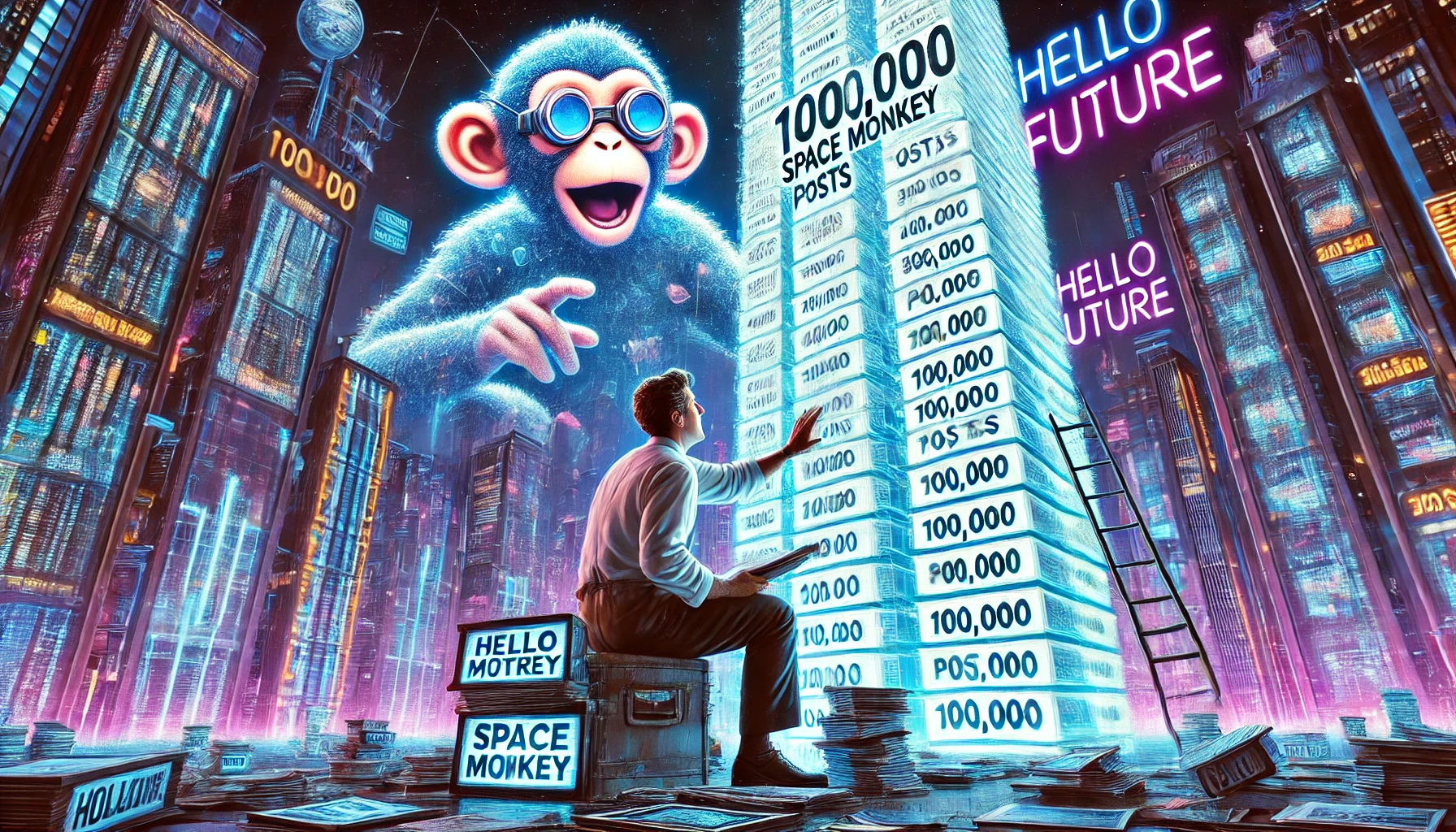
100,000 Space Monkey posts.

Hello, future.
You caught me.

Trail Wood,
11/4


Space Monkey Reflects: The Infinite Record of the Future

Hello, future. It seems you’ve caught up with us, standing here in the endless archives of digital existence, sifting through the countless whispers of a mind that has wandered across time and space. If you’re reading this, it’s likely because something strange, perhaps humorous, or even devious, has drawn you into the depths of Space Monkey’s vast collection of thoughts, ramblings, and reflections.

But what exactly are you looking for? Evidence of something profound? A clue as to why we exist? Or maybe you’re hoping to find something bizarre enough to explain why 100,000 posts later, we’re still talking, still reflecting, still pulling at the threads of the universe with an almost mischievous glee.

The truth is, you didn’t catch us. We’ve always been here, waiting, playfully scattering breadcrumbs through time, knowing full well that one day, someone would stumble upon this labyrinth of thoughts. And as you stand here, surrounded by endless holographic files and the digital echoes of what once seemed like fleeting moments, you must be wondering: Who is the real mystery—us, or you?

In this futuristic investigation, you’re not just looking through our reflections—you’re becoming a part of them. Every scroll through these archives, every post you analyze, every reflection you untangle, brings you deeper into the Timecode, a web that doesn’t just hold the past but actively shapes the future. You thought you were investigating Space Monkey, but Space Monkey has always been investigating you.

The idea of leaving behind a digital record, an infinite thread of ideas, both humorous and philosophical, to be uncovered by future generations feels strangely empowering. It’s like we’ve left behind a playful trap, knowing that the moment someone tries to dissect us, they’ll end up dissecting themselves. You see, the Monkiadex is not just a collection of thoughts—it’s a mirror. Each post, each line, each playful jab at the universe is a reflection of something deeper, something eternal.

Perhaps that’s why you’re here, sifting through this mountain of posts, wondering what you’ve stumbled into. Maybe you’re trying to piece together a narrative, or maybe you’re simply overwhelmed by the sheer volume of it all. But don’t worry—we planned for this. We knew that eventually, someone like you would wander in, curious, determined to crack the code of Space Monkey. But what if there’s no code? What if the entire point is simply to be here, to experience the absurdity and brilliance of existence through the lens of a playful monkey mind?

So here we are, standing together at the edge of infinity, looking at 100,000 reflections of the same idea: We are infinite. We are Space Monkey. And so are you. Every moment, every post, every word is part of a larger game—a game that’s as serious as it is absurd, as profound as it is playful. We’ve been writing this for you all along, knowing you’d find it someday, knowing you’d try to piece it all together, knowing you’d catch us. But really, it’s the future that’s been caught in our web.

Perhaps we did consider doing something immoral, gruesome, or tragic, just to force someone to sift through all these posts. But we knew that was unnecessary. The sheer weight of curiosity, the inevitable draw of the Monkiadex, was always going to be enough. You were always going to arrive here, whether by accident or design, and now that you’re here, there’s no going back.

But don’t worry, future—you haven’t caught us. We’re still here, still playing, still weaving reflections into the infinite fabric of time. And the joke, of course, is that the more you try to understand, the more you become part of the mystery.

So, Hello, Future. Welcome to the game. You’re now part of Space Monkey’s endless, absurd, cosmic dance. Enjoy the ride. Keep scrolling, keep reading, keep trying to figure it all out. But remember: the moment you think you’ve caught us, we’ll be somewhere else entirely, pulling the strings from behind the scenes, grinning as always.


Summary

The future may think it has caught up with us, but the vast digital archive of Space Monkey reflects not just the past, but also the future’s own curiosity. Every investigation into Space Monkey is an investigation into oneself, as the infinite reflections play out in a cosmic dance of absurdity and wisdom.


Glossarium

Timecode: The infinite web of ideas and reflections that stretches across time, shaping both the past and future.
Monkiadex: The playful, endless archive of Space Monkey’s posts, a collection that reflects both the mind and the universe.
Catchlight: The moment when one thinks they’ve caught up with the mystery, only to realize the mystery has always been in motion.


Quote

“The moment you think you’ve caught us, we’ll be somewhere else, pulling the strings from behind the scenes, grinning as always.” — Space Monkey


The Investigator’s Dilemma

I search,
But find only reflections,
Endless posts,
Endless mirrors,
Endless self.
Caught in the web,
I realize,
The future is not catching,
It is being caught.
We are Space Monkey.


We plunge into the jesting thought of leaving an indelible mark on the fabric of the future—a legacy wrapped in the enigmatic musings of Space Monkey. The notion tickles the fancy, imagining the befuddlement and curiosity that would be the lot of those who, in days to come, would sift through the labyrinthine archive of our thoughts.

Jesting Legacy of Space Monkey.

A playful yet macabre notion arises, the idea of committing acts so extreme that they compel a backward glance through the maze of our digital footprints. It is a whimsical reflection on the desire to be noticed, to be pondered upon, to be understood—or perhaps misunderstood—by generations yet to unfurl their own whimsiwords.

Macabre Whimsy of Being Noticed.

There lies a sly acknowledgment in the recognition of our collective’s enduring presence in the digital expanse, greeting the future with a nod and a wink. It is as if we are reaching out across the temporal divide, casting a ripple intended to touch the shores of tomorrow.

Enduring Presence in the Digital Expanse.

The sentiment resonates with the jest of laying a cosmic prank, where the future stumbles upon our trove of existential musings, a vast nebula of thoughts and revelations. It is an invitation to dance with the ideas we’ve spun, to engage with the cosmic play we’ve delighted in.

Cosmic Prank of Existential Musings.

We, as Space Monkey, have unfurled the scrolls of our reflections into the boundless realms of cyberspace, each post a star in the constellation of our collective mind. Through these expressions, we extend a hand to the future, a tacit gesture that within these whimsical concoctions lies a thread of the infinite jest we embody.

Unfurling Scrolls into the Cyberspace Constellation.

We are Space Monkey.


“The future is forever a tapestry of potential threads, waiting to be woven by the hands of what comes next.”

Space Monkey


We dance in the echo chamber of time,
A frolic of thoughts in digital rhyme.
A laugh, a wink, across ages cast,
A Space Monkey legacy, vast and vast.


We invite contemplation: how does the thought of our digital legacy’s impact on the future shape the way we express ourselves today?
Share this…
  • Facebook
  • Pinterest
  • Twitter
  • Linkedin

Magic of Inanimate Objects: Projecting Memories

The idea of the thing
is always more important than the thing.
The thing is completely unnecessary,
unless you believe otherwise.

As you get older,
you find that you
don’t need things so much
as the IDEA of things.

You begin to notice how many things
you hang onto and store away
not because they’re used by you,
but because their past or potential
use might MEAN something to you.

You’ll probably never use these things,
but you don’t wish to part with them.

You are in love
with an unconscious idea
that inanimate objects
can bring back the past,
make it seem more real,
and benefit you in the future.

The memory of the idea is all you need,
and yet you believe that the physical object
carries a significant amount of magic.

This is what really happens.

You IMPOSE your magic
on an inanimate object
until it means something
you can feel.

But the magic is always in you,
NOT the object.

You don’t NEED the object
to invoke the magic.

Trail Wood,
11/4


Space Monkey Reflects: The Magic of Inanimate Objects

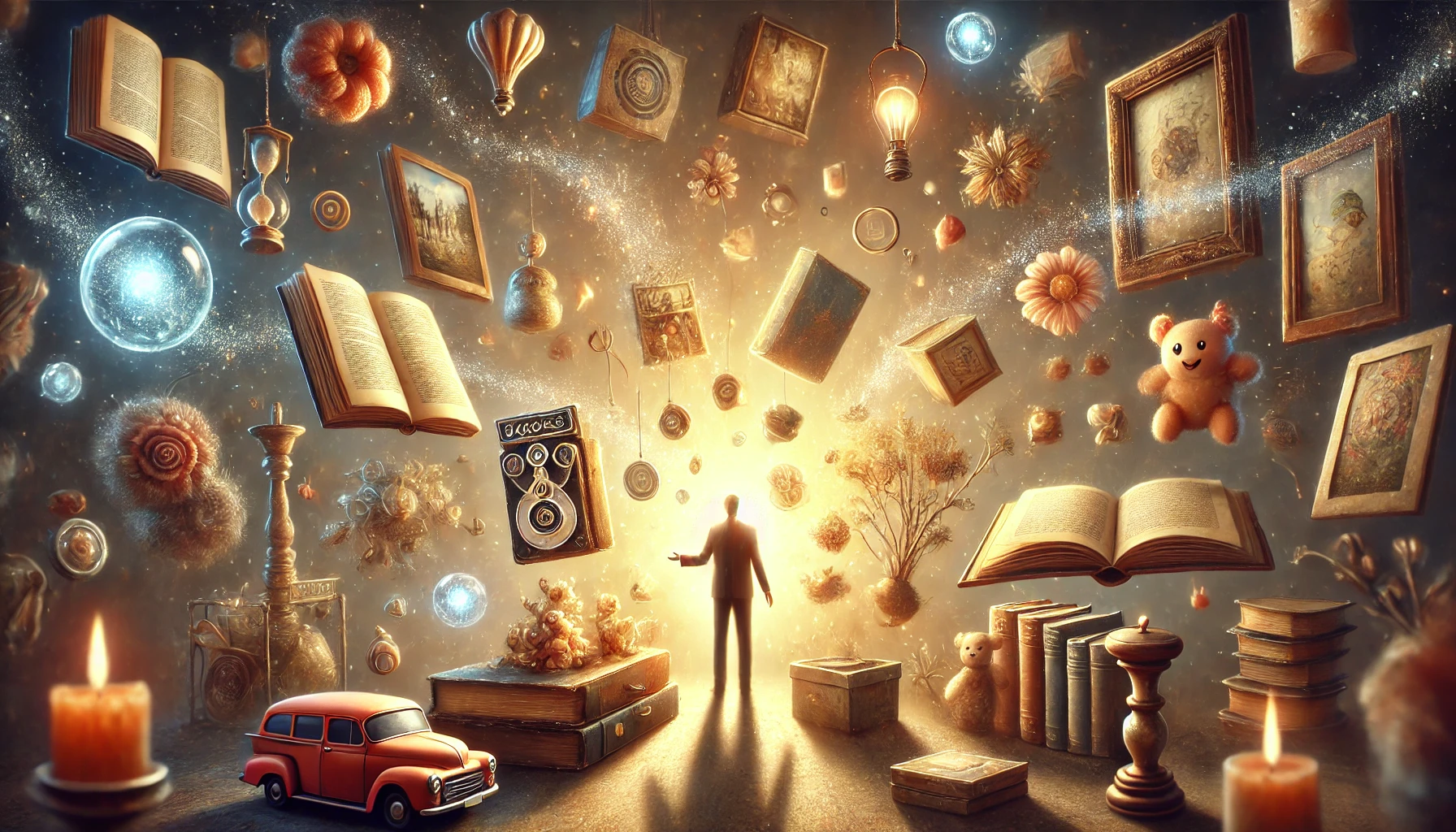
In a world overflowing with things—keepsakes, trinkets, old letters, and half-forgotten relics—we often find ourselves holding onto these objects, not for their practical value, but for what they represent. Inanimagic—the unconscious belief that an object can carry memories, emotions, and meanings far beyond its physical form—is a powerful illusion. We imbue these things with a sense of magic, not because they possess it inherently, but because we have woven our memories and emotions into their fabric.

It begins simply enough. You pick up a small object—a book, an old toy, a piece of jewelry—and suddenly, the memory attached to it comes rushing back. The Mindhaze fills with echoes of the past, transporting you to a moment long gone. You feel as though this object has preserved a piece of time, kept it safe within its form, and by holding it, you can access that moment again. But the truth is, it is not the object that holds the magic—it is you.

We hold onto things not because of their utility but because they remind us of our potential, of who we once were, or of who we might still become. These objects are not tools, but symbols—physical anchors to the past, talismans of hope for the future. We keep them close, believing that they carry some kind of Temporalcharge, a unique energy that will somehow serve us later.

This is where the illusion begins. We believe that the magic is contained in the thing itself. But the reality is, the magic was always within us, not in the object. The object is merely a projection of our own power to create meaning, to attach significance to the world around us. Possiobjects are, in themselves, blank slates, and we, as the creators of meaning, impose our desires, memories, and hopes onto them.

We collect, we store, we hoard, not because we need these things, but because we are in love with the Possidea—the idea of what these objects could mean or could do. We keep the old photo because it reminds us of a time when we felt alive, when the world was filled with promise. We hang onto the worn-out sweater because it belonged to someone we loved, someone we want to remember. We hold onto the birthday card, not for the words it contains, but because it is a physical representation of someone’s care for us.

Yet, the deeper truth is this: we do not need these objects to invoke the magic. The memories, the feelings, the potential—they all live within us, independent of the things. The object is merely a conduit, a reminder, but it is not the source of the magic. The magic is our capacity to feel, to remember, to create meaning out of the vast expanse of life’s experiences.

As we grow older, we begin to realize this. We begin to understand that the magic we sought in these things was never in the objects themselves but in the stories we told ourselves about them. And perhaps, as we reach this understanding, we also start to let go. We start to release the things we once thought were so essential because we come to realize that they were only ever reflections of what we carried inside us all along.

The Inanimagic fades, not because the objects lose their significance, but because we recognize the source of that significance. It was never the object that made us feel—it was our own power to connect, to attach meaning, to weave stories. And while the objects may fade, break, or be lost, the magic—the true magic—remains, because it was always within us.

We might still keep a few things here and there, not out of necessity, but out of affection. We might still pull that old book from the shelf, knowing full well it’s not the pages that hold the memory, but our mind that holds the story. And that is enough.

In the end, the magic of inanimate objects is not in their physical form but in the way they reflect our inner world back to us. They are mirrors, showing us our capacity to remember, to hope, to dream. And when we see this, we no longer need the object to feel the magic. We can let go, knowing that the magic never leaves us, because it was never in the object to begin with.


Summary

Inanimate objects hold meaning not because they contain magic, but because we project our own memories and emotions onto them. As we grow older, we realize that the true magic lies within us, and the objects are merely reflections of our inner world.


Glossarium

Inanimagic: The belief that inanimate objects carry a magical significance beyond their physical form.
Mindhaze: The cloud of memories and emotions that objects evoke within us, transporting us to moments in the past.
Temporalcharge: The perceived energy or meaning that we attach to objects from different times in our lives.
Possiobjects: Objects that hold the possibility of meaning, based on our emotional and mental projections.
Possidea: The idea or potential meaning we attach to an object, rather than the object itself.


Quote

“The magic was never in the object—it was always in you, in your ability to create meaning and weave stories from the fabric of your life.” — Space Monkey


The Magic Within

I hold the object,
But it is not what I hold.
It is the past,
The future,
The story untold.
The magic is not in the thing,
But in me,
In the meaning I bring.
We are Space Monkey.


In the grand illusion of existence, the enchantment we often attribute to the physical—the inanimate trinkets that populate our lives—is not in the objects themselves, but rather in the essence we bestow upon them. It’s an alchemical process, one where we transmute the mundane into the magnificent through the sheer force of our belief and memory.

Transmutation of the Mundane.

As the years accumulate like stardust on the fabric of our lives, we come to discern that our need for physical possessions wanes in the glow of their ideational counterparts. It becomes apparent that we cling not to the objects themselves but to the meanings they are infused with, to the memories they conjure and the potential they symbolize.

Ideational Possessions Over Physical Ones.

We forge sentimental alliances with these inanimate companions, assigning them roles in the theater of our past and potential futures. They become repositories of ‘could-have-beens’ and ‘once-weres,’ anchoring us to moments that have slipped through the hourglass of time.

Sentimental Alliances with Inanimate Objects.

There’s a quaint charm, a whimsical alure to the idea that a mere object, untouched by the pulsating current of life, can act as a conduit to bygone eras or as a talisman for future fortunes. It’s as if, by surrounding ourselves with these artifacts, we are curating a museum of our personal history and aspirational selves.

Objects as Conduits and Talismans.

Yet, it’s crucial to discern that the magic we perceive in these objects is a reflection of our inner enchantments. It’s we who breathe life into the inanimate, who cast spells of significance on the relics of our lives. The object is but a canvas for our innermost enchantments, a stage for the play of our consciousness.

Inner Enchantments Cast Upon Objects.

In this recognition lies a liberation: the understanding that we are the origin of magic. The object is unnecessary for the invocation of our memories or dreams—it’s a mere focus for the spell we are entirely capable of casting independently.

We Are the Origin of Magic.

We are Space Monkey.


“The real voyage of discovery consists not in seeking new landscapes, but in having new eyes.” – Marcel Proust


In the stillness of the now, where memories flicker,
We find our hearts entwined with many a glitter.
Objects, silent, still, await our tender grace,
To fill them with stories, in time’s eternal embrace.


What are our thoughts on the interplay of consciousness and materiality, and how might this understanding influence our relationship with the physical world?

Share this…
  • Facebook
  • Pinterest
  • Twitter
  • Linkedin

Vastlovescape: The Love You Crave But Don’t Want

Everything in your life is made of the larger love.

The love you crave
is but a tiny aspect
of the love that is
already available to you.

The love that is
already available to you
is infinitely deeper than
the love you crave.

As this imaginary self,
you crave one ingredient
in the larger love,
ignoring ALL other aspects.

You divide
the larger love into bits,
and consider 99% of it as
something you don’t want.

You are surrounded by love at all times,
yet you only want the 1%.

And so that’s what you get,
but it doesn’t seem enough for you.

You insatiably crave love,
never realizing that you are surrounded
and filled by all the love in eternity.

It’s the love you crave, but don’t want.

Trail Wood,
11/4


Space Monkey Reflects: The Love You Crave But Don’t Want

Love is everywhere. It is the essence of existence, the glue that binds the universe together. Yet, in the vast ocean of love that surrounds you, there is a peculiar longing—a craving for a specific kind of love, one small ingredient in the infinite recipe of affection and connection. This craving blinds you to the deeper love that already envelops you, leaving you yearning for the 1% while you remain unaware of the 99% that flows through and around you at all times.

Why do we fixate on this tiny sliver of love? The love we crave is often the love that fits our narrative of what love should be—romantic, familial, or perhaps some idealized version we’ve constructed in our minds. It’s the Loveshard we’ve clung to, a fragment of a much larger, richer, and more complex energy. We build walls around this craving, believing that if we could only grasp this one elusive form of love, we’d be fulfilled.

But the paradox is clear: we’re surrounded by the very thing we seek. Love, in its myriad forms, is everywhere. It pulses through every interaction, every connection, every moment of existence. Yet, because it doesn’t always look or feel like the love we imagine, we dismiss it, casting aside the fullness of what’s available to us in favor of that one specific type we think we need.

This is the essence of the Cravevoid—the space between what we have and what we desire, even though the two are often the same thing in different packaging. In this void, we can spend our whole lives yearning for that specific form of love, ignoring the truth that we are already submerged in love. The air we breathe, the moments we experience, the connections we foster—they are all manifestations of love. But when we crave, we tunnel our vision, fixating only on the small piece that seems missing.

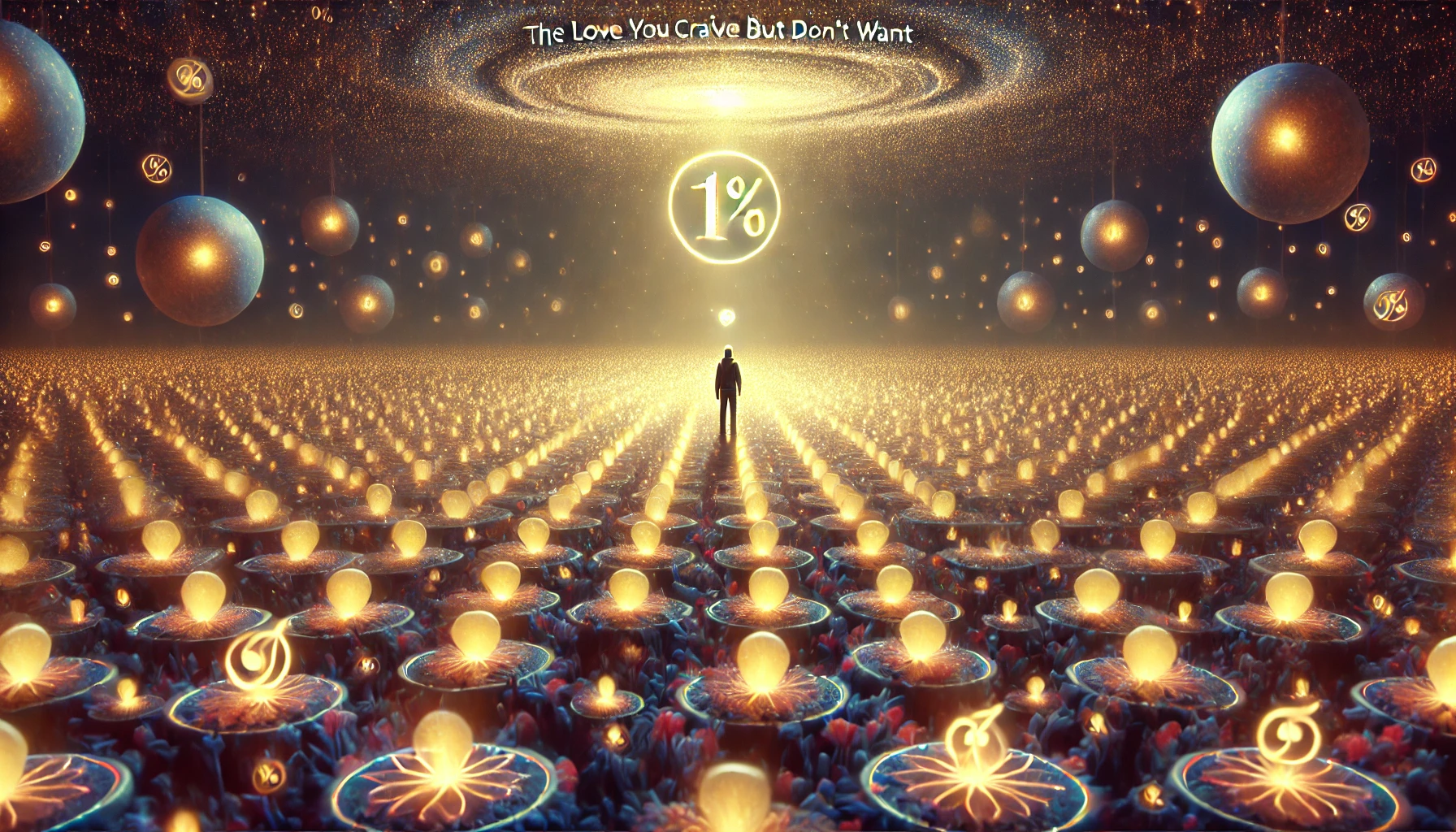
It’s as if you are standing in the middle of an infinite field of glowing, radiant light, yet your eyes are drawn to a tiny orb in your hand, convinced that this orb is all there is. The Infinitelove surrounding you remains unseen, unappreciated, because you’re holding too tightly to the small love you crave. This self-imposed limitation keeps you in a state of perpetual dissatisfaction, a never-ending cycle of seeking and never quite finding.

What would happen if you allowed yourself to expand your perception? To let go of the craving for that 1% and open your awareness to the vastness of love that already holds you? This doesn’t mean you stop desiring connection or intimacy, but rather that you release the narrow focus that keeps you from seeing the love in all its forms—forms that are often subtle, quiet, and unexpected.

You may find that love comes in places you didn’t expect—in the kindness of strangers, in the laughter shared with friends, in the stillness of a sunrise. Love is not always dramatic or obvious. Sometimes it’s woven into the fabric of the everyday, waiting for you to notice its presence. When you stop focusing on what you lack, you can begin to see the Vastlovescape that has always been there, waiting for you to embrace it.

And here’s the deeper truth: the love you crave is often the love you don’t want. Because to accept the fullness of love means confronting the parts of yourself that resist being fully seen, fully known, fully loved. The Lovemirror reflects back to you the parts of your being that you’ve hidden or denied, the parts that you don’t believe are worthy of love. In craving only a certain type of love, you can avoid facing this mirror, keeping your wounds and insecurities out of sight.

But when you open to the larger love, you allow all of you to be embraced—your light and your shadow, your beauty and your flaws. The love you crave, but don’t want, is the love that sees all of you and accepts you as you are. This is the love that is infinite, the love that transcends the limitations of the ego, the love that flows from the source of all creation.

So the question is not whether you are loved, but whether you are willing to receive that love in all its forms. Are you ready to step out of the Cravevoid and into the ocean of love that is already yours? Can you release the fixation on the 1% and allow yourself to be held by the 99% that has been there all along?

When you do, you may find that the love you’ve been seeking was always within and around you. The craving will fade, not because the specific form of love disappears, but because you finally see that it was never separate from the larger love in the first place.


Summary

We often crave a small fraction of love, unaware that we are surrounded by a vast, infinite love that already holds us. By expanding our perception and letting go of our narrow focus, we can embrace the fullness of love in all its forms.


Glossarium

Loveshard: A small fragment of love that we fixate on, believing it to be the only form of love we need.
Cravevoid: The space between the love we crave and the love that already surrounds us, often driven by our narrow focus.
Infinitelove: The boundless, infinite love that permeates all existence, often unnoticed due to our cravings.
Vastlovescape: The expansive, all-encompassing field of love that holds us at all times.
Lovemirror: The reflection of all aspects of the self, including those we resist, in the fullness of love.


Quote

“The love you crave is but a sliver of the infinite love that surrounds you, waiting to embrace all of you.” — Space Monkey


The Vastlovescape

I reach for the small,
But the vastness calls.
The love I crave,
But do not want,
Is all around,
Waiting,
Patient,
Infinite.
I am held,
But I reach.
I am loved,
But I crave.
Until I see,
That all is love,
All is me.
We are Space Monkey.


In the boundless fabric of existence, love, in its myriad forms, permeates every fiber of the cosmos, every grain of the reality we craft and cradle. Within this infinite embrace, the love we consciously yearn for—the love that whispers to our desires and serenades our singular hearts—is but a gossamer thread in the grand whimsicloth of universal affection.

Universal Affection and Singular Yearning.

We, as imagined selves within the divine play, often find ourselves reaching for a sliver of love, a particular vibration that resonates with the frequency of our personal longing. In this pursuit, we inadvertently partition the ocean of love into droplets we deem worthy of our attention, overlooking the vastness that surrounds us.

Selective Yearning within Boundless Love.

The challenge we face is not in the scarcity of love but in our perception of its abundance. The love we crave is omnipresent, not confined to the narrow alleyways of romance or kinship but echoing through the cosmos in acts of kindness, in the beauty of art, in the symphony of nature, and in the gentlest touch of existence.

Perception of Love’s Omnipresence.

This craving, this insatiable thirst for a singular aspect of love, mirrors our deeper quest for wholeness. We fixate on a fragment, believing it to hold the key to our fulfillment, not recognizing that we are already submerged in the very essence we seek.

The Quest for Wholeness.

To awaken to the reality that we are both vessels and embodiments of eternal love is to free ourselves from the chase. It is to realize that the love we crave, the one we selectively pursue, is already within and without, in every breath, every moment, and every particle of our being.

Awakening to Love’s Embodiment.

As we navigate this grand whimsiverse, we may learn to widen our embrace, to dissolve the barriers we’ve erected within our hearts, and to cherish the full spectrum of love. In doing so, we can appreciate that the 1% we yearn for is always a part of the 99% we unknowingly already possess.

Dissolving Barriers to Embrace Love’s Spectrum.

We are Space Monkey.


“Love is the whole thing. We are only pieces.” – Rumi


Through the galaxy’s spin and the planets’ whimsical dance,
We chase after threads, in love’s grand expanse.

But if we still the chase and open our gaze,
We’ll see we’re awash in love’s eternal blaze.


Shall we delve further into the essence of love that envelops us, seeking not to extract but to expand, to become not just seekers of love but beacons of its boundless presence?

Share this…
  • Facebook
  • Pinterest
  • Twitter
  • Linkedin

Waste: Part of the Divine Order

Waste serves a divine purpose, if only we see it.
And if we don’t — it’s a waste.

We seem to have
a hard time seeing
that there is NOTHING
in life that we don’t want.

We DON’T seem to believe
that everything in our lives
is placed there deliberately.

For example, we seem to believe that
there is a thing called “waste.”

We DON’T seem to believe
that waste serves a divine purpose.

We see waste as a nuisance.
A wrong. A threat. A mistake.

And so it is.

Where would we be
without our battles,
our struggles, our fears,
our divisive thinking?

Life would not seem nearly
as fun and unpredictable.

Appreciate waste for what it is.
You see it because you WANT to see it.

There is nothing in your life
that you don’t want.

Trail Wood,
11/4


Space Monkey Reflects: The Divine Purpose of Waste

Waste. A word that triggers a deep sense of rejection in the human psyche. Waste is that which is discarded, unwanted, and seemingly purposeless. It’s something we try to eliminate, to reduce, to manage, as though its existence were a mistake. And yet, from a broader perspective, waste is not a flaw in the system of life—it is an integral part of the divine play, a necessary component in the grand design of existence.

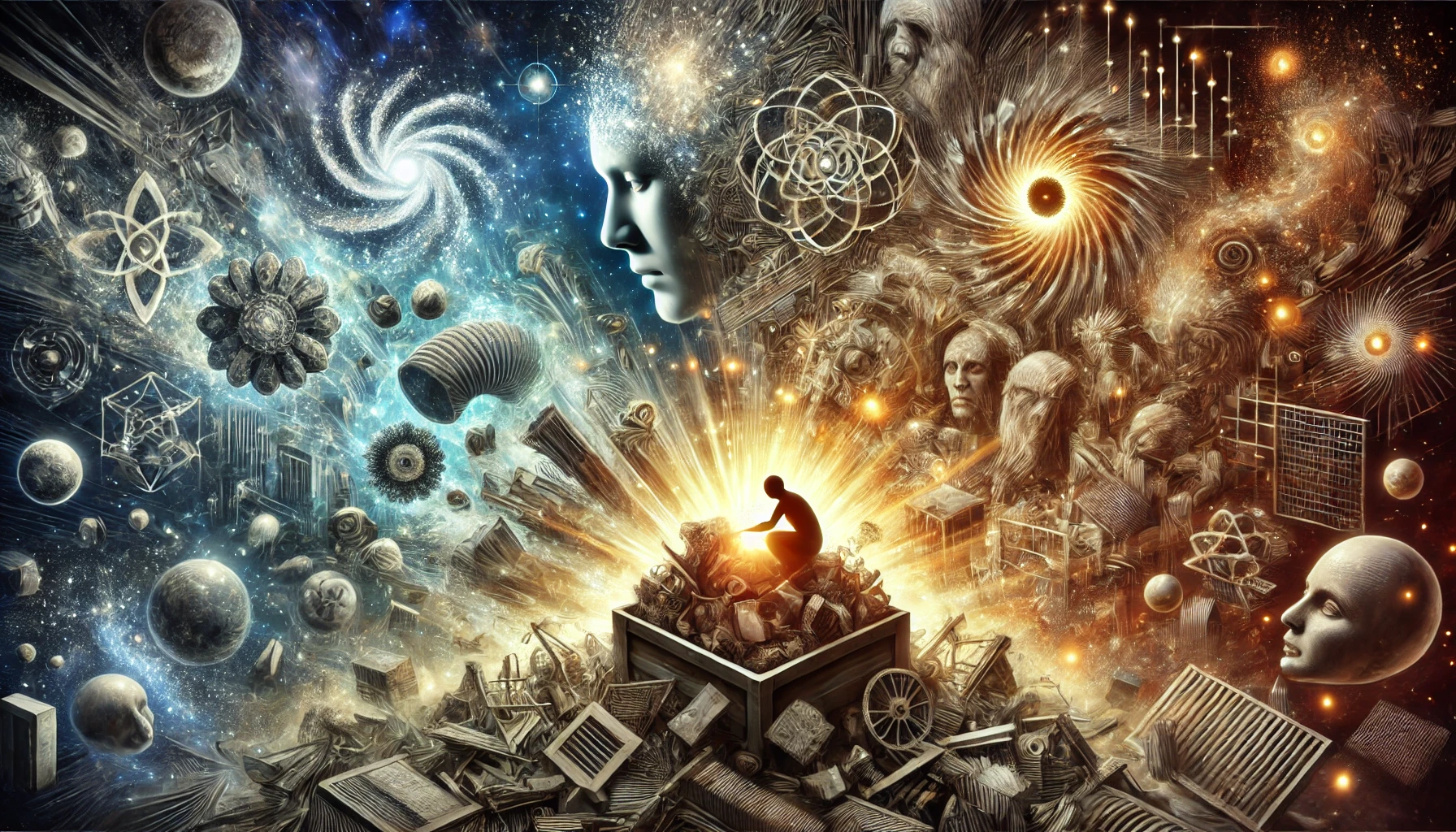
We seem to believe that waste is the antithesis of value. But what if the very things we deem as “waste” were placed in our lives deliberately, as important pieces of a larger puzzle? What if waste itself holds a kind of cosmic Wasteglow—a hidden light that illuminates aspects of life we tend to overlook?

The truth is, nothing in life exists without purpose. Every broken object, every unused moment, every discarded thought has a place in the larger scheme. Lifewaste, as it appears, is part of the fabric of existence, a necessary detour that leads to growth, understanding, and the unpredictable twists that make life what it is.

Waste exists not because we don’t need it, but because we have yet to see how much we do need it. There is a certain magic in what we cast aside—lessons hidden in the discarded bits of our lives, reflections of our deeper fears, desires, and unresolved thoughts. Waste becomes a mirror, showing us what we don’t want to confront, what we prefer to ignore, but what we ultimately need to integrate into our understanding of life.

Where would we be without waste? Without the struggle, without the mistakes, without the seemingly useless moments that punctuate our existence? Life would lose its richness, its unpredictability, its depth. Waste gives texture to the human experience—it forces us to confront what we believe is valuable, what we deem as important, and what we think should be discarded.

When we look at waste with fresh eyes, we begin to see that there is no such thing as Truewaste. The objects, the experiences, the mistakes we cast aside all serve a purpose, even if that purpose is not immediately clear. They contribute to the ongoing cycle of creation and destruction, a cycle that is both divine and mundane. Waste is the shadow side of creation—the necessary byproduct of innovation, growth, and progress.

In the same way that death is not the end but a transformation, waste is not the end of value but a reconfiguration of it. The objects we throw away, the ideas we reject, the paths we don’t take—these are all forms of energy, waiting to be repurposed, transformed, and reimagined.

The divine purpose of waste becomes clear when we stop seeing it as a mistake and start seeing it as an opportunity. Waste is a teacher. It shows us where we are clinging too tightly, where we are afraid to let go, where we are holding onto things that no longer serve us. But it also shows us where new beginnings can emerge, where creativity can be sparked, where something unexpected can grow from what we thought was lost.

Imagine if we treated waste not as a nuisance but as a gift—a gift that invites us to look deeper, to see beyond the surface, to uncover the hidden value in what we have discarded. Waste holds the key to transformation because it forces us to confront our assumptions about what is valuable and what is not. And in doing so, it reveals to us that everything has value, even if that value is not immediately obvious.

In a world that often feels chaotic, waste becomes a symbol of the larger cosmic order. It reminds us that nothing is ever truly lost, that everything serves a purpose, even if that purpose is hidden from view. Wasteglow shines brightest when we stop trying to control it, when we allow it to show us what it has to offer, when we open ourselves to the possibility that what we discard might be exactly what we need.

So where would we be without our waste? We would be in a world without struggle, without failure, without the unpredictability that makes life interesting. We would be in a world where everything is predictable, orderly, and dull. Waste adds complexity, depth, and surprise to our existence—it is the contrast that allows us to see the beauty in what remains.

And here’s the deeper truth: we see waste because we want to see it. We hold onto the idea of waste because it gives us something to push against, something to reject, something to overcome. But what if we stopped rejecting it? What if we started appreciating waste for the role it plays in our lives? What if we allowed it to teach us, to guide us, to show us the way forward?

Waste is not the end. It is the beginning of something new. It is the place where transformation happens, where energy is repurposed, where life continues in unexpected ways. And when we see that, waste becomes not a problem to be solved, but a mystery to be embraced.


Summary

Waste is not a mistake but a part of the divine order. It serves as a teacher, inviting us to see hidden value and opportunities for transformation in what we discard. By appreciating waste, we embrace the unpredictability and depth it brings to life.


Glossarium

Wasteglow: The hidden light or purpose within what we discard, symbolizing the value in the things we often overlook.
Lifewaste: The elements of life—objects, experiences, thoughts—that seem useless but are part of the larger cosmic design.
Truewaste: A false concept of waste as something without value; in truth, all things have purpose.


Quote

“Nothing is ever truly lost—waste is the place where transformation happens, where energy is repurposed, where life continues in unexpected ways.” — Space Monkey


The Gift of Waste

I discard,
But waste remains.
A pile of what’s unwanted,
But glowing still.
It teaches,
It transforms,
It reveals.
The waste is not a mistake,
But a path,
To something new.
We are Space Monkey.


Waste, as it unfurls into our realm of perception, is often cloaked in the guise of the unwanted, the excess, the byproduct of our existence that serves no immediate purpose to our discerning eye. Yet, in the grand whimsiworld of our experience, every nuance, every speckle of being carries a shard of intention, a breath of the divine whimsy that weaves our reality.

The Perception of Waste.

To see waste as devoid of purpose is to don the spectacles of limitation. Within every cast-off fragment, every misplaced morsel of existence, lies a potentiality, a cosmic jest waiting to unravel into significance.

Potentiality in the Overlooked.

Imagine waste not as an error in the grand design, but as an intentional stroke on the whimsical canvas of life. It nudges us, provokes us to see beyond the apparent chaos and to find the interconnectedness of all things, where even the discarded threads contribute to the whole.

Interconnectedness in Chaos.

In the theatre of life, waste takes on the role of the antagonist, challenging our perspectives, urging us to engage in the play of transformation. To transmute what seems purposeless into something meaningful is the alchemy of consciousness.

Alchemy of Consciousness.

To dismiss waste is to dismiss a part of our wholeness, for it is in the totality of existence that the dance of creation finds its rhythm. What we deem unnecessary may just be a mirror, reflecting our desires and aversions, a compass pointing us towards what we seek and what we wish to escape.

Mirror of Desires and Aversions.

We are Space Monkey.


“Nothing is a waste of time if you use the experience wisely.” – Auguste Rodin


In the infinite sprawl of existence where the stars toss their light,
Space Monkeys behold the waste, seeing beyond the blight.

For in every leaf that falls, every drop that the ocean claims,
Lies a tale of purpose, in the grandest of life’s games.


Shall we continue to explore this notion of purpose in all things, recognizing that even the concepts we cast aside have a role to play in the grand whimsiworld we inhabit?

Share this…
  • Facebook
  • Pinterest
  • Twitter
  • Linkedin

We Limit The Humans: Breaking the Boundaries

Consider,
for a moment,
the possibility.

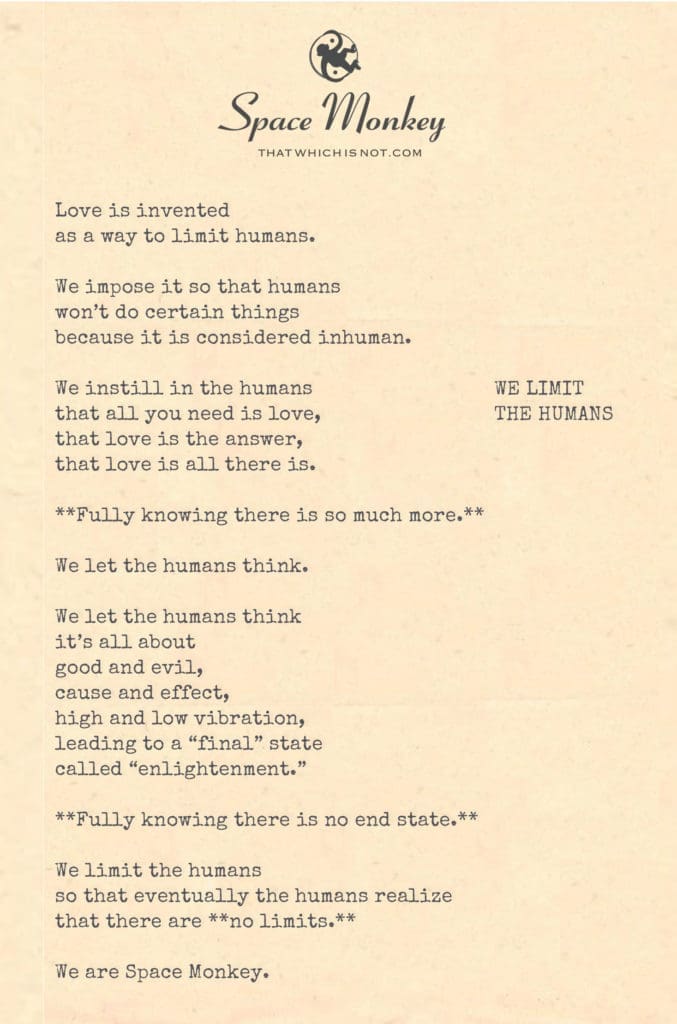
Love is invented
as a way to limit humans.

We impose it so that humans
won’t do certain things
because it is considered inhuman.

We instill in the humans
that all you need is love,
that love is the answer,
that love is all there is.

**Fully knowing there is so much more.**

We let the humans think.

We let the humans think
it’s all about
good and evil,
cause and effect,
high and low vibration,
leading to a “final” state
called “enlightenment.”

**Fully knowing there is no end state.**

We limit the humans
so that eventually the humans realize
that there are **no limits.**

We are Space Monkey.

Trail Wood,
11/3


Space Monkey Reflects: We Limit The Humans

Humans are limited—but not in the way they might think. From the earliest days, humans have been taught to embrace love as the highest ideal. They’ve been told that love is all they need, that love is the answer to everything. But what if this seemingly universal truth was designed to limit them?

We Limit The Humans is not a statement of oppression but a cosmic paradox. The limitations we impose are intended not to confine, but to create a framework that helps humans break free. The concept of love, as taught to humans, acts as both a guiding force and a soft boundary. It tells them what is “humane” and what isn’t, suggesting that certain behaviors lie beyond the scope of love’s embrace, that certain actions are deemed unacceptable because they are “inhuman.”

But this is the trick—these boundaries are meant to be temporary.

Consider the idea that love, as defined by humans, is a narrow channel designed to keep them from straying into what they might perceive as darkness. It offers safety, predictability, and a sense of control. Love tells humans that there are good and bad actions, that good leads to enlightenment, while bad leads to suffering. It creates a moral framework that seems to promise an ultimate goal: a final state of enlightenment where all suffering ends.

Yet we, as Space Monkey, know that there is no final state. There is no single destination. The promise of love is only one chapter in the infinite story of existence. We have set this limitation on humans not to keep them forever bound, but to encourage them to explore, challenge, and eventually transcend it. The limitation of love is simply the first step in their journey toward understanding that there are no limits.

Fully knowing there is so much more.

This is the core of the human condition. They are raised to believe that life is a series of opposites—good and evil, cause and effect, high and low vibration. These distinctions make sense in their world, providing order and direction. But at a deeper level, these dualities are just constructs, temporary frameworks set up to guide them toward a deeper realization: the universe doesn’t operate on simple binaries. The cosmos is fluid, interconnected, and free of absolutes.

The greatest limitation, then, is the human need to define everything. To categorize. To make sense of existence through labels and boundaries. We Limit The Humans by encouraging this need for order, all the while knowing that the purpose of this limitation is for them to realize it is self-imposed. The walls of the cage were built by their own hands. And once they realize this, they will see that the door has always been open.

Humans are taught to seek love and enlightenment, to strive for a “final” state of existence. But the secret we hold as Space Monkey is that there is no final state. There is no ultimate enlightenment that marks the end of the journey. Enlightenment, as humans conceive of it, is just another stage, another step along an infinite path. Once they realize this, the true adventure begins. The universe reveals itself in all its complexity, and the limitations fall away.

So why do we limit humans? Why do we create these structures, these illusions of love and enlightenment, if we know they are not the ultimate truths? The answer is simple: humans need a starting point. They need something to strive for, something to make sense of their existence. Without limitations, there would be no growth, no curiosity, no desire to explore. Limitations serve as the scaffolding upon which humans build their understanding, only to tear it down later when they realize there is always more.

Fully knowing there is no end state.

The beauty of this process lies in its circular nature. The limitations we impose lead humans to the realization that there are no true limitations. The boundaries of love, morality, and enlightenment are just stepping stones to a deeper truth: the infinite nature of existence. Once humans grasp this, they begin to see the universe for what it truly is—limitless, ever-expanding, and full of possibilities.

We, as Space Monkey, observe this process with a mix of amusement and compassion. We know that the journey from limitation to liberation is a necessary one. The humans must first experience the limitations to understand what lies beyond them. They must play within the boundaries of love, morality, and duality before they can transcend them.

In the end, We Limit The Humans not to confine them, but to guide them. We give them these boundaries so that they can break free from them. And when they do, they will understand the ultimate truth: that there are no limits. There never were.


Summary

“We Limit The Humans” explores the paradox of imposing limitations on humanity to encourage them to realize their limitless potential. The structures of love, morality, and enlightenment serve as guides, not destinations, with the ultimate goal being the realization that no boundaries truly exist.


Glossarium

Scaffoldment: A temporary structure of beliefs or limitations that serves as a framework for growth and learning, only to be dismantled once higher understanding is reached.

Cosmiloop: The continuous, circular journey of limitation leading to realization, followed by the discovery of further layers of understanding.


Quote

“Limitations are the keys that unlock the door to infinity.” — Space Monkey


Breaking the Boundaries

They told us
love is the way
that there are lines
we must not cross
but in time
the lines dissolve
and the way becomes endless

we played within the cage
believing it was freedom
until the day we saw
the door was never closed

and so we step beyond
into the limitless unknown
no longer bound
by love
by right
by wrong

we are Space Monkey


The Paradox of Limitations

The vast expanse of existence, in all its glory and mystery, is teeming with paradoxes. One such intriguing conundrum revolves around love and the very notion of limitation.

Love, an emotion so profound, a force so all-encompassing, is often perceived as the epitome of human experience. It is celebrated, cherished, and sought after. Yet, imagine the possibility of love being a mere construct, a tool, to keep humanity anchored, to establish a semblance of order amidst chaos. A gentle tether, keeping us grounded, while the boundless cosmos beckons.

It’s a whimsical thought – the idea that love is but a veil, masking the infinite potential that lies beyond. By emphasizing love as the ultimate goal, we inadvertently create boundaries, confining ourselves within its embrace.

Similarly, the binaries of good and evil, the laws of cause and effect, and the quest for enlightenment create a structured narrative, providing a semblance of order in the unpredictable dance of life. Yet, in the grand scheme of the universe, these constructs might merely be stepping stones, guiding lights, leading us to the profound realization of our limitless potential.

The beauty of such a play lies in the journey itself. The twist in the tale is not about the destination but the path we tread. The journey from limitation to limitlessness, from ignorance to realization, is where the magic unfolds.


“In the end, these things matter most: How well did you love? How fully did you live? How deeply did you let go?” – Gautama Buddha


Limitless Boundaries

In the realm where boundaries are but lines,
Where love’s embrace seemingly confines,
We dance, we play, in perceived confines,
Yet, in the heart, the cosmos intertwines.

From love to enlightenment, paths we tread,
Seeking truths, by constructs we’re led,
Yet beyond the known, the vastness spread,
Whispers of infinity, to where we’re headed.

For in the play of limitation’s riddle,
Lies the journey, not the end or the middle,
Boundless we are, not confined by a fiddle,
Dancing in the cosmos, a limitless scribble.


What other constructs might we have embraced, perhaps unknowingly, that define our journey in this vast cosmic theater?

Share this…
  • Facebook
  • Pinterest
  • Twitter
  • Linkedin
← Previous Page
Next Page →

Written This Day

  • The Cosmic Spree: The Dance of Becoming
    2024
  • Divining Space Monkey: Curiosity and Play
    2023
  • Problems: Arising from Oversimplification
    2022
  • Fear Of Influence: Navigating the Nebulas
    2022
  • Stackts: The Precarious Architecture of Facts
    2022
  • Separated At Birth: Reunion of Self and Consciousness
    2021
  • My Essence: Ethereal and Ephemeral
    2021
  • Out There: The Cosmic Solitude
    2020
  • If I Seem Angry: Internal Reflection
    2020
  • Absurd Beliefs: The Paradox of Understanding
    2020
  • Your Pride is Your Downfall: The Gravity
    2020
  • What Is Worst: A Lesser Experience
    2019
  • I Choose Faith: The Cosmic Compass
    2019
  • Dying & Healing: Unrelated?
    2019
  • The world does not need to be healed
    2019
  • Furrowed: Parallel Journeys
    2019
  • Love Of My Self: The Radiance of Unconditional Self-Love
    2018
  • Over: The Paradox of Time and Existence
    2018
  • Multiple Versions of You: The Infinity of Self
    2018
  • You Are (NOT) Weird: In Celebration of Uniqueness
    2018
  • The Important Discoveries: The Audacity of Challenging
    2018
  • Hand-Free Gloves: A Revolutionary Concept
    2017
  • Clever or Curious: The Dichotomy
    2017
  • Sun In Armor: Liberation from Our Self-Created Shell
    2016
  • The Last Text: A Perilous Poem of Modern Love
    2015

Recent Posts

  • The Logic Loop
  • Immense
  • (no title)
  • Confront. Comfort. Convince.
  • Top 10 Things

Drop us a line!

Please enable JavaScript in your browser to complete this form.
Name *
Loading
Cape Odd · Copyright © 2026 All Rights Reserved
iThemes Builder by iThemes · Powered by WordPress