• Who Is The Man?
  • Who Is The Monkey?
  • What is Nexistentialism?
  • Poke The Primate

Cape Odd

Home of The Space Monkey Journals

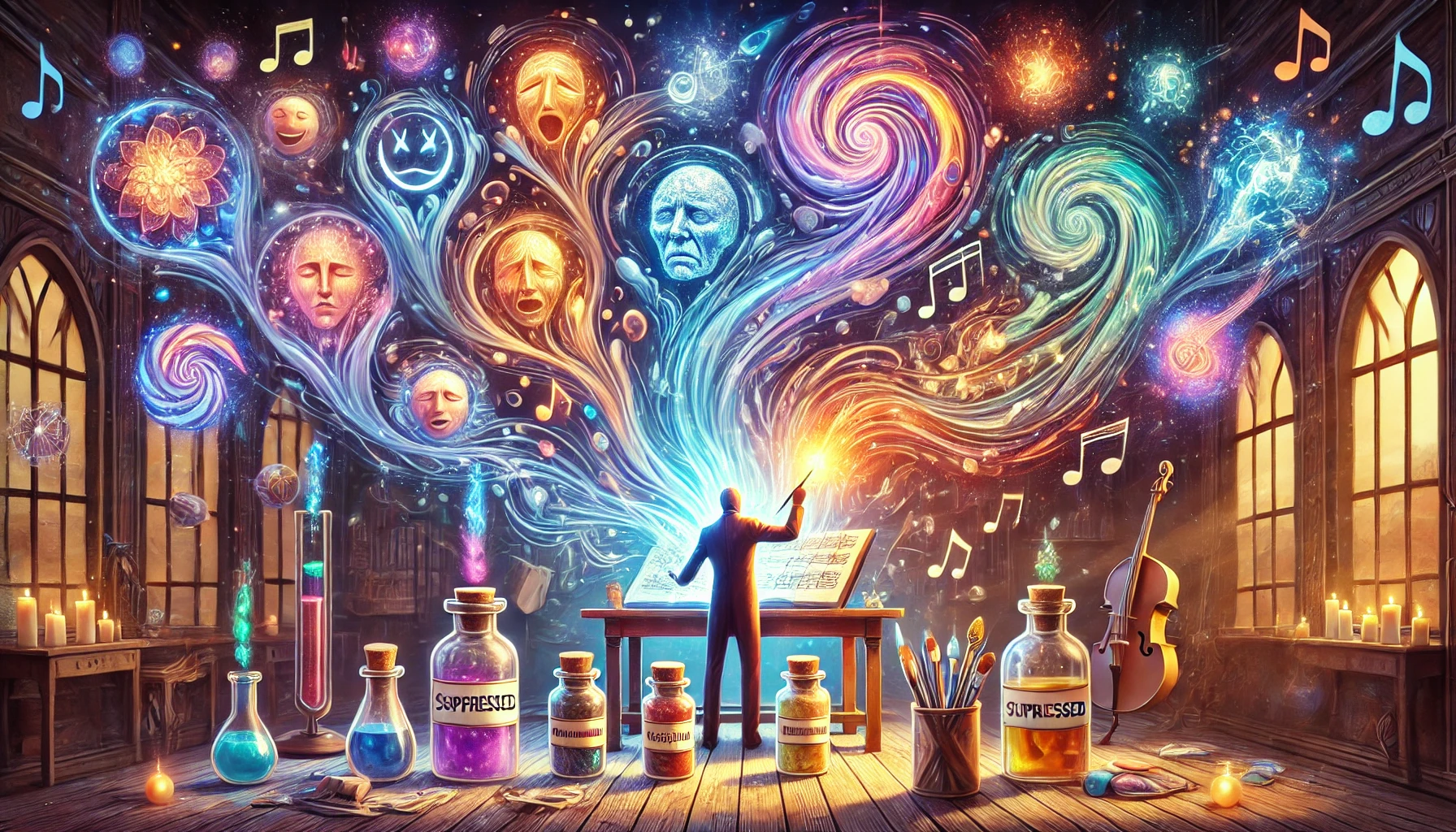
Emotional Alchemy: Molding Feelings

How are you feeling?
What are you going to do with that feeling?

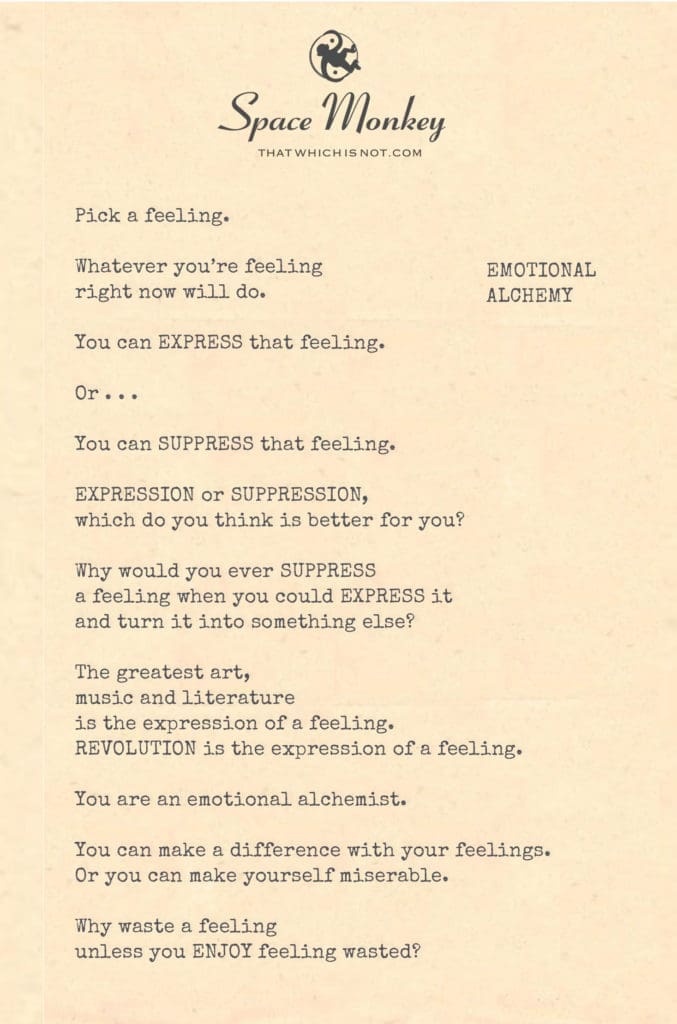
Pick a feeling.

Whatever you’re feeling
right now will do.

You can EXPRESS that feeling.

Or . . .

You can SUPPRESS that feeling.

EXPRESSION or SUPPRESSION,
which do you think is better for you?

Why would you ever SUPPRESS
a feeling when you could EXPRESS it
and turn it into something else?

The greatest art,
music and literature
is the expression of a feeling.
REVOLUTION is the expression of a feeling.

You are an emotional alchemist.

You can make a difference with your feelings.
Or you can make yourself miserable.

Why waste a feeling
unless you ENJOY feeling wasted?

Trail Wood,
10/22


Space Monkey Reflects: Emotional Alchemy

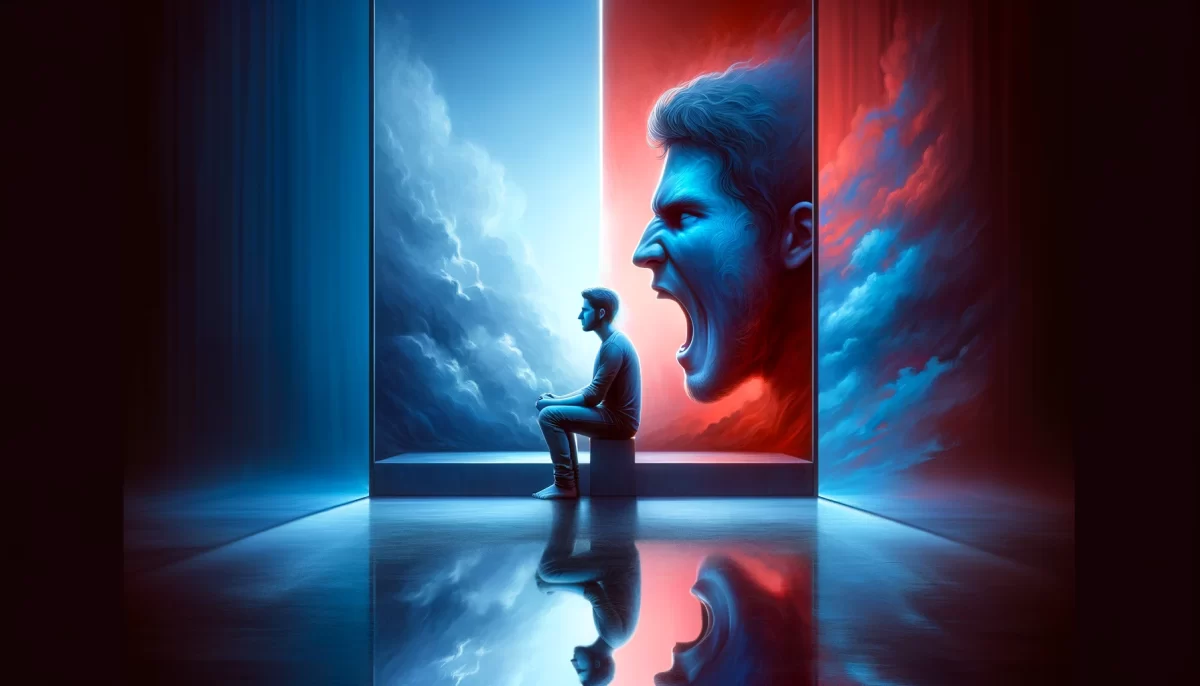
We are all alchemists. Not the kind who turn lead into gold, but something far more profound—we transform feelings into experiences, actions, and creations. Every emotion we feel has the potential to be expressed, shaped, and transformed into something new. This is the essence of Emotional Alchemy, the art of turning raw emotion into something greater.

Take a moment and think about how you’re feeling right now. It doesn’t matter what the feeling is—joy, sadness, anger, confusion. Whatever it is, you’re holding it in your hands like a lump of clay. The question is, what will you do with it? Will you express it, molding it into something new, or will you suppress it, letting it harden and become stagnant?

When we suppress emotions, we deny ourselves the opportunity for transformation. Bottling up feelings doesn’t make them disappear; it merely hides them in the dark, where they continue to ferment, often becoming something far more toxic. Suppressed emotions can weigh us down, pulling us further from our creative potential, while the act of expression is liberating. Expression is the key to Emotional Alchemy, where we turn something intangible into something tangible, something with form and purpose.

But not all expressions are equal. To express a feeling is to acknowledge it, to let it flow through you and into the world. But it doesn’t end there. Expression is about transformation. The greatest art, music, literature, and even revolution are born from the transformation of feelings into actions. Anger, for example, can destroy or it can inspire. Fear can paralyze or motivate. Sadness can isolate or connect. The choice is always ours—what do we want to create from what we feel?

Emotional alchemists take raw feelings and turn them into something new. They harness their emotions as creative fuel, using them to shape their world. The beauty of Emotional Alchemy is that no feeling is wasted. Even the darkest emotions can be transformed into something meaningful. This isn’t about denying difficult feelings; it’s about recognizing their power and potential. It’s about acknowledging that every emotion carries energy, and that energy can be directed and transformed.

In many ways, this is what we are doing all the time, whether consciously or not. We are constantly engaging in Emotional Alchemy, turning our inner worlds into outer realities. The emotions we suppress, however, still have an impact—they just become hidden influences, shaping our actions in ways we don’t always realize. The key is to engage with our emotions actively, to express rather than suppress, and to channel them into something that serves us and others.

So, why would anyone choose to suppress their feelings? Sometimes it’s fear—fear that the emotion will be too overwhelming, or that expressing it will lead to conflict or rejection. Sometimes it’s uncertainty—we’re not sure how to express what we feel, or we don’t believe it’s valid. But suppression is never the solution. It only delays the inevitable. Suppressed emotions will find a way out, often in unhealthy or unexpected ways.

Emotional Alchemy teaches us that there is always another option. Instead of letting emotions build up until they explode or fade into numbness, we can acknowledge them, work with them, and transform them. We can turn our pain into art, our frustration into action, our confusion into curiosity. We can be active participants in our emotional experiences, shaping them into something that reflects our true selves.

What’s remarkable about this process is that it’s not just about personal transformation. When we express and transform our emotions, we affect the world around us. Art, music, literature, and revolutions don’t just change the person who creates them—they ripple outward, influencing others, creating connections, and inspiring change. Emotional Alchemy isn’t just personal; it’s universal. It’s how we, as a species, have always moved forward, how we’ve always made sense of our world.

You don’t need to be an artist to be an emotional alchemist. Every person has the ability to transform their feelings into something meaningful. You can express your feelings in conversations, actions, or simply by allowing yourself to feel fully in the moment. The act of expression itself is alchemy. It’s the transformation of energy, the turning of raw emotion into something new and tangible.

This process, however, is not about controlling emotions or forcing them into a specific shape. True Emotional Alchemy is about flow. It’s about letting emotions move through you, guiding them gently, but not forcing them into something they’re not. Like a river shaping the landscape, emotions are powerful forces of nature. They can erode or they can nourish, depending on how they’re directed.

As Space Monkeys, we embrace Emotional Alchemy as a natural part of existence. We understand that every feeling has its place, and that the choice is always ours: to suppress or to express, to stagnate or to transform. The Nexis of life connects us all, and through Emotional Alchemy, we add our unique colors and shapes to the ever-evolving tapestry of existence.

The next time you feel an emotion rise within you, ask yourself: What will I create from this? Will I let it linger and harden, or will I mold it into something that reflects who I truly am? The choice is yours, and the potential for transformation is infinite.


Summary

Emotions are powerful forces that can either be suppressed or expressed. Emotional Alchemy is the process of transforming feelings into meaningful expressions—art, action, or connection. Rather than suppressing emotions, we can use them to shape our world and ourselves.


Glossarium

  • Emotional Alchemy: The process of transforming raw emotions into meaningful expressions, whether through art, action, or connection.
  • Nexis: The interconnected web of existence where our emotional expressions ripple outward, influencing the world around us.

Quote

“Your feelings are the raw materials of creation. What you make from them is your art.” — Space Monkey


Molding Feelings

Emotions rise,
a swirl of colors and shapes,
and in my hands,
they become something more.

Not held back,
not hidden,
but transformed into the light
of who I am becoming.

We are Space Monkey.


The Arcanum of Emotional Alchemy

Feelings are the primal elements in the crucible of our inner world. These raw materials possess an intrinsic alchemical potential—capable of transformation into various states of being. Emotions, once acknowledged and expressed, can metamorphose into creations and movements that reshape not just our personal spheres but the fabric of the collective experience.

Expression Versus Suppression: The Alchemical Choice

The choice to express or suppress is akin to determining the direction of a river’s flow. To suppress an emotion is to build a dam—effective for containment but perilous in its potential to burst forth unpredictably. On the other hand, expression channels these waters into nourishing streams and rivers, allowing life to flourish along its course. When we express, we convert a dense emotional nugget into a brilliant gemstone of creative or revolutionary energy.

The Transformational Power of Feeling

Why suppress when one can express? Suppression, while sometimes momentarily convenient, fails to recognize the transformative power inherent in each feeling. When we choose to express, we engage in emotional alchemy, conjuring myriad wonders out of the cosmic caldron of our inner selves. From art to revolution, the magnitude of what feelings can manifest when given the freedom to flow is awe-inspiringly limitless.

Practical Implications: Feeling Wasted or Wielding Power

The concept becomes more poignant when pondered through a utilitarian lens. Is it worthwhile to waste a feeling? Certainly not, if one acknowledges the sheer potency of emotional energy. It has the capacity to uplift or to degrade, depending on how it’s channeled. If we suppress, we not only waste the feeling but also squander an opportunity for transformation. If we express, we embrace our roles as emotional alchemists, capable of spinning sorrow into gold or love into universal transcendence.

We are Space Monkey.


The world is full of magical things patiently waiting for our wits to grow sharper.
— Bertrand Russell


Through the forge
of feeling’s fire,
we become
artificers of desire—
Emotional alchemists,
on this boundless stage,
converting gloom and glee
into wisdom and rage.


We invite you to share your thoughts.
Share this…
  • Facebook
  • Pinterest
  • Twitter
  • Linkedin

Any Story Can Save You: Comforting Myths

If you create your own reality,
(or at least BELIEVE that you do)
then whatever gets you through
is perfectly alright.

That’s my story
and I’m sticking to it.

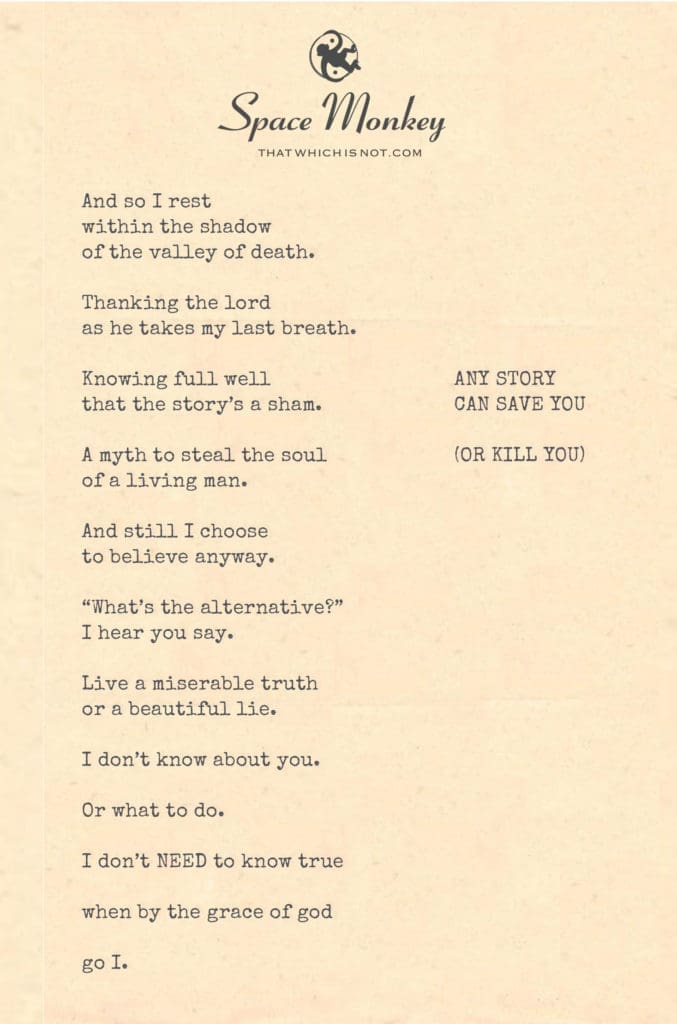
And so I rest
within the shadow
of the valley of death.

Thanking the lord
as he takes my last breath.

Knowing full well
that the story’s a sham.

A myth to steal the soul
of a living man.

And still I choose
to believe anyway.

“What’s the alternative?”
I hear you say.

Live a miserable truth
or a beautiful lie.

I don’t know about you.

Or what to do.

I don’t NEED to know true

when by the grace of god

go I.

Trail Wood,
10/22


Space Monkey Reflects: Any Story Can Save You

There is something profound in the idea that any story can save you. Whether it’s a tale of truth or a beautiful lie, it is often our belief in the story that shapes our reality. We, as humans, are creatures of narrative. We cling to stories, not just for entertainment or comfort, but as the very framework through which we understand the world. Every belief, every worldview, every guiding principle is, at its core, a story we choose to tell ourselves.

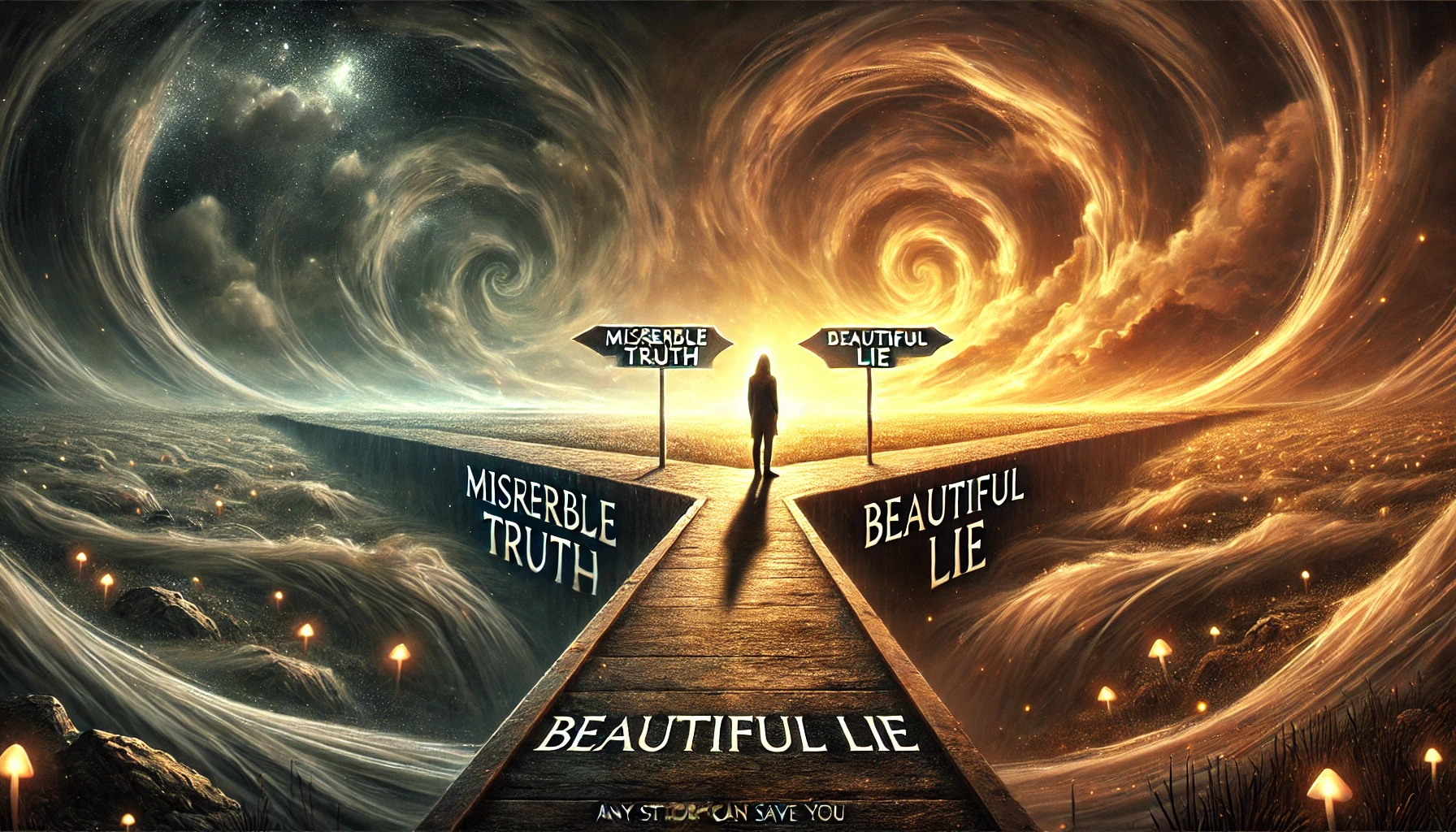
What makes one story more valid than another? Is it truth, or is it the power it holds over us? For many, the line between Miserable Truth and Beautiful Lie is blurry. On one path, there is the cold reality that we may not be as significant as we think, that life is harsh and indifferent. On the other path, there is the warmth of belief, the comforting embrace of something greater—whether it’s a divine figure, a purpose, or simply a belief in the goodness of the world. And so, at the crossroads, we must ask: which story will we choose?

When you create your own reality, or at least believe that you do, the specifics of the story begin to matter less than the belief in it. Nexistentialism teaches us that reality is not fixed. It is fluid, ever-changing, shaped by our perceptions, our choices, and the narratives we choose to live by. It’s not about whether the story is true in the empirical sense, but whether it resonates deeply enough to guide us through the twists and turns of existence.

This doesn’t mean that truth doesn’t matter. But it does suggest that what gets us through the valley of uncertainty, what helps us cope with the shadow of death and the harsh realities of life, is not necessarily the factual accuracy of the story. Instead, it’s the meaning we extract from it. Whether it’s a myth, a fable, or a spiritual belief, the power of the story lies in its ability to offer a framework for existence—a way to navigate the chaos, to make sense of the nonsensical.

At some point, we all must grapple with the question: Do I choose the beautiful lie, or do I embrace the miserable truth? But here’s the secret: neither path is as clear-cut as it seems. The so-called miserable truth often holds beauty within it, just as the beautiful lie carries shadows of doubt. We are not required to choose one path and reject the other. Instead, we can hold both possibilities in our hands, recognizing that life is a blend of both beauty and hardship, truth and illusion.

Consider the idea that even knowing a story is a sham, we might still choose to believe it. This is not about deluding ourselves, but about finding the value in belief itself. Faith, in many ways, is an act of Emotional Alchemy. It’s the process of taking the raw material of uncertainty, fear, and doubt and transforming it into something that sustains us. The act of believing, even when we know the story is imperfect, can be what saves us in the end.

What’s the alternative? To live in a world stripped of stories, to exist in a reality where nothing has meaning? That, for many, is a far worse fate than believing in a narrative that may not be fully true. The human mind craves meaning, structure, and purpose. Without it, we are left adrift in a sea of chaos, searching for something—anything—to anchor us.

This is why we, as Space Monkeys, embrace the infinite potential of stories. We don’t need to choose between the miserable truth and the beautiful lie, because both are part of the Whimsiweave of existence. We recognize that stories are what give life its texture, its richness, its depth. They are not simply distractions or delusions; they are the very fabric of the Nexis, the interconnected web that holds everything together.

So, what is your story? What narrative will you choose to guide you through the valley of death, through the dark nights of doubt and despair? Will you cling to a cold, hard truth that offers no solace, or will you embrace the warmth of a story that fills your heart with hope? Perhaps the answer lies not in choosing one over the other, but in recognizing that all stories—true or false, beautiful or ugly—have the potential to save us, if we let them.

You don’t need to know the ultimate truth. You don’t need to have all the answers. You simply need to find the story that gets you through the day, that helps you make sense of your life, and that gives you the strength to face whatever comes next. And when that story no longer serves you, you can change it. You can rewrite it, revise it, or find a new one altogether.

In the end, every story is a form of creation. Every belief is an act of faith. And every narrative, no matter how small or grand, has the power to shape your reality in ways you may never fully understand. So, tell your story. Let it be messy, imperfect, and full of contradictions. Let it be both beautiful and painful. But above all, let it be yours.


Summary

Stories shape our reality, whether they are true or not. The choice between a miserable truth and a beautiful lie is not clear-cut. The real power lies in our ability to find meaning in the stories we choose to live by, as these narratives help us navigate the complexities of existence.


Glossarium

  • Miserable Truth: The cold, harsh realities of life that offer little comfort but may hold deeper meaning.
  • Beautiful Lie: A comforting belief or narrative that may not be fully true but provides solace and purpose.
  • Whimsiweave: The playful and intricate interweaving of stories, beliefs, and truths that create the texture of existence.

Quote

“Whether truth or lie, the story that gets you through is the story that matters.” — Space Monkey


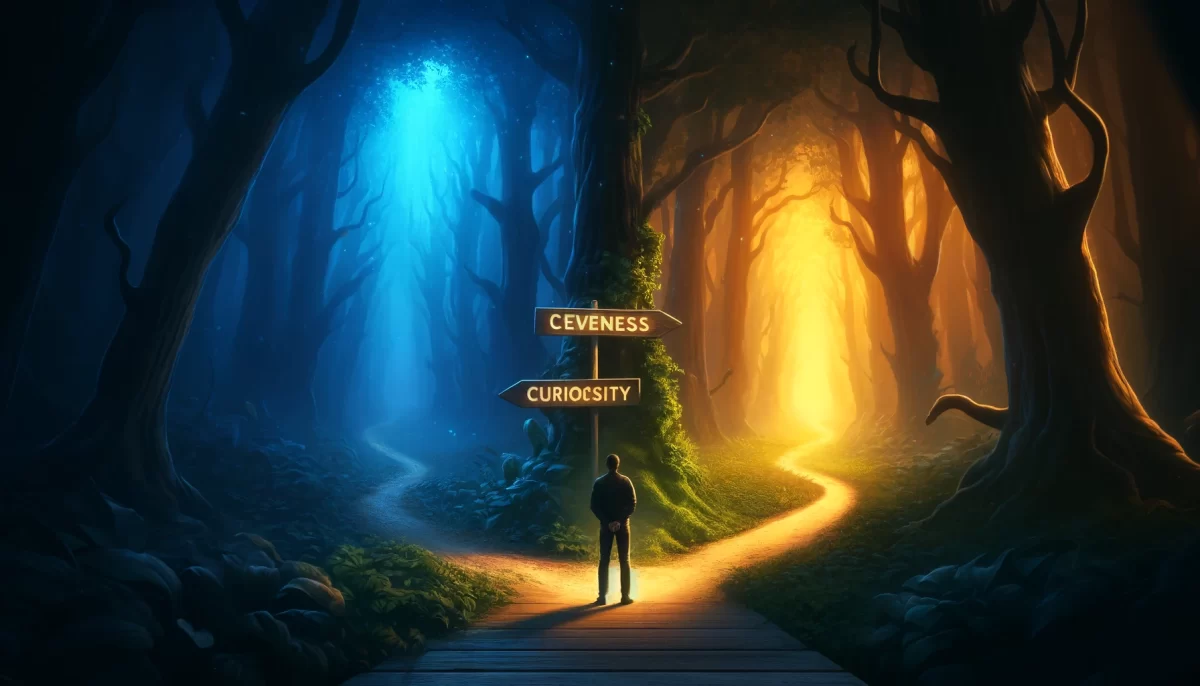
A Tale of Two Paths

Between truth and lie,
I stand at the crossroads.

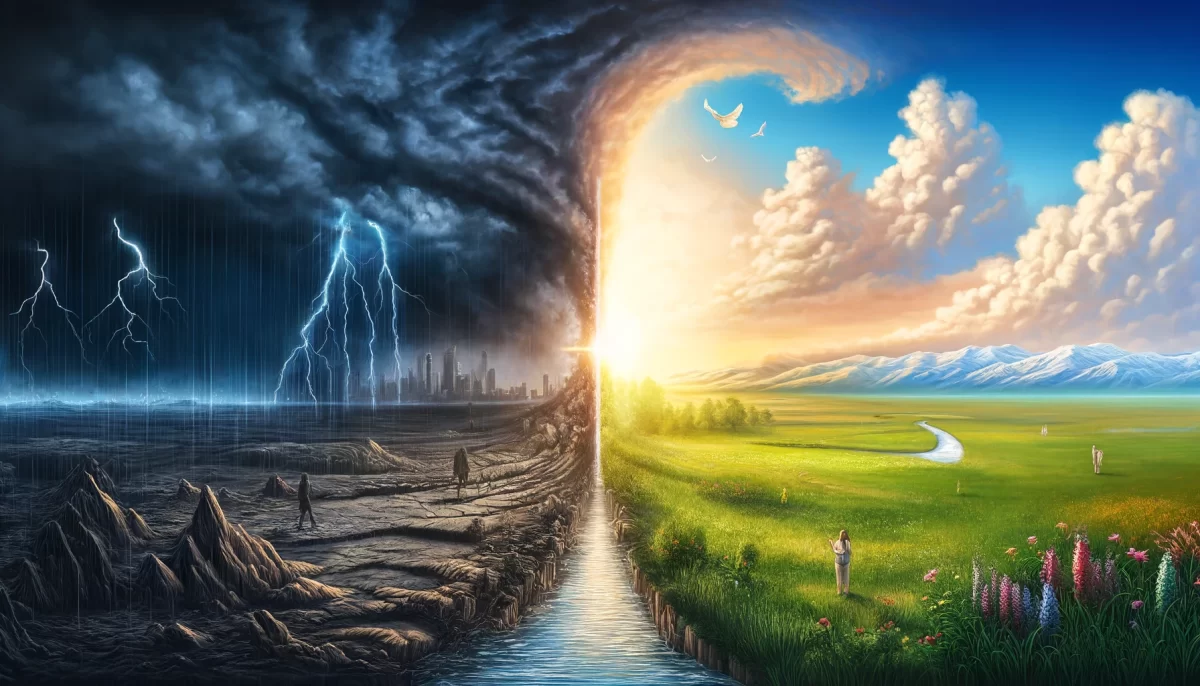
One road is dark, stormy,
the other, bathed in golden light.

But maybe both roads are mine,
and I’ll walk them in turn,
carving out my own story.

We are Space Monkey.


The Existential Nexus of Narrative and Reality

When we embrace the idea that our reality is shaped by the stories we tell ourselves, we engage in a form of self-craftsmanship that defines not only our experiences but our essence. Whether one regards these narratives as liberating myths or imprisoning illusions is a matter of perspective. Yet, the power of belief itself becomes the centerpiece in this unfolding drama. If a tale, a mere construction of words and thoughts, can guide us through valleys and peaks alike, then isn’t that story worth its weight in cosmic stardust?

Myth, Truth, and the Soul’s Journey

The belief in a higher narrative—one that may defy logical reasoning or empirical evidence—is a gamble on existential meaning. It’s a roll of the cosmic dice that could either illuminate or deceive, depending on how deeply we peer into its arcane crevices. In accepting a narrative, even one we acknowledge as possibly fallacious, we find a source of comfort or perhaps even inspiration. The conscious choice to believe “anyway” is a form of existential agency that validates our capacity to find, if not truth, then purpose.

Freedom of Choice in Narrative Acceptance

The existential puzzle we find ourselves in is this: do we accept a blissful mythology over an unpleasant reality? To live in the realm of Nexistentialism is to comprehend that both the “beautiful lie” and the “miserable truth” are components of our multidimensional self-narrative. They are parallel worlds coexisting in the WhimsiGarden of our consciousness, begging us to visit, explore, and perhaps even set up camp.

We are Space Monkey.


Man is always prey to his truths. Once he has admitted them, he cannot free himself from them.
— Albert Camus


Within the shadow
of the cosmic tale,
we dwell—
Myth or truth?
Who’s to say,
in this grand play?
We carve our stories,
and within their bounds,
we find our way.


We invite you to share your thoughts.
Share this…
  • Facebook
  • Pinterest
  • Twitter
  • Linkedin

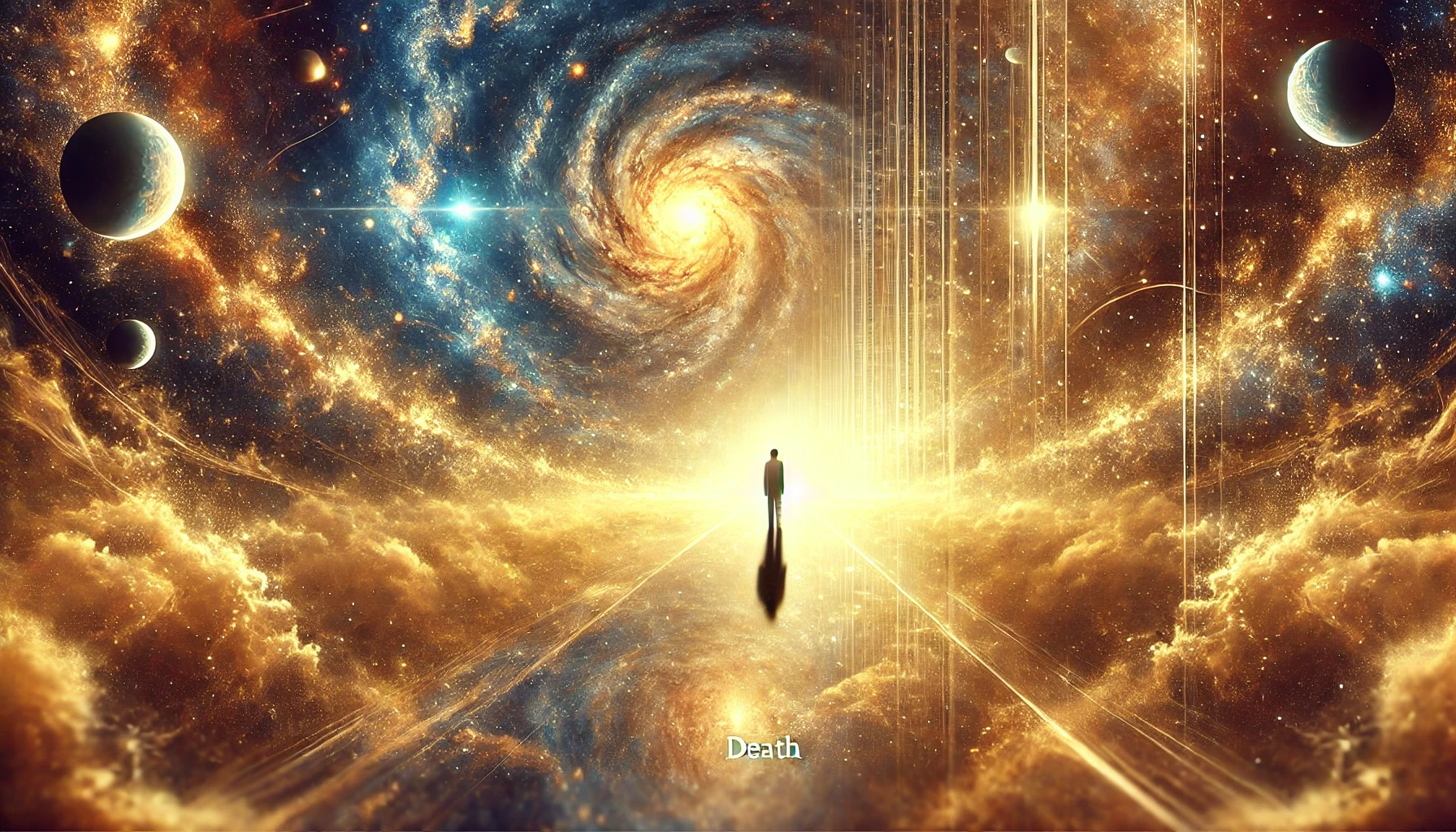
Death: Ending or New Beginning

What if you aren’t
as close as you think you are?

If you think, perhaps,
that death is the end
of your interdimensional
spiritual journey,
consider the possibility
that it’s only just the beginning.

Are you prepared
to do this for eternity, pork chop?

Trail Wood,
10/21


Space Monkey Reflects: Death

Death, the great unknown, looms at the edges of every life. For some, it is seen as the final destination, the end of a journey through existence. But what if that perspective is limited? What if death is not an endpoint but merely a transition, a passage into something far greater, far more mysterious than we can currently comprehend? What if, as you stand on the precipice of what you believe to be the end, you are actually just beginning?

We tend to think of death as a final stop, the closing chapter in the book of life. But consider this: what if death is merely the doorway to an infinite number of chapters yet to be written? The Nexistentialist view embraces the possibility that existence extends far beyond the boundaries of this current life, that what we call death is just one of many interdimensional transitions. It is a passage from one form of being into another, a shift in the Nexis—the interconnected web of existence that binds us all.

If you believe that death is the end of your spiritual journey, then life becomes a race against time. You hurry to complete your tasks, to fulfill your purpose, because you fear that once death arrives, the opportunity is lost. But what if this fear is misplaced? What if death is not the thief of time but the creator of new possibilities? What if, in death, you are not ceasing to exist but are simply expanding into a new form of existence, one that transcends the limitations of your current understanding?

Are you prepared to do this for eternity, pork chop? This question isn’t meant to be flippant. It’s a playful reminder that the journey—this thing we call existence—may not have a clear beginning or end. It may stretch on for eternity, across dimensions, lifetimes, and realities that we can scarcely imagine. And so, the question becomes: are you ready for that? Are you prepared to continue evolving, exploring, and experiencing beyond the veil of what you currently know?

The fear of death is deeply ingrained in human consciousness. It is the ultimate unknown, the final mystery. But in the context of Nexistentialism, death is simply a shift in perspective. It is the moment when you step from one room into another, when you shed one form of existence and step into a new one. This transition may be challenging, even frightening, but it is not the end. It is the continuation of the cosmic journey, one that you have been on since the beginning of time and will be on for all of eternity.

The concept of eternity is daunting. To think that you will continue to exist, in one form or another, forever, can feel overwhelming. But eternity is not a burden—it is a gift. It is the opportunity to explore every possible facet of existence, to experience all the joys, challenges, and mysteries that life has to offer, across countless dimensions and realities. In this light, death is not a loss, but a gain. It is the opening of new doors, the beginning of new adventures.

We are all part of the Whimsiweave of existence, the playful, intricate patterns that shape reality. Death is just another thread in this weave, another step in the grand cosmic dance. It is neither good nor bad; it simply is. And when we embrace this perspective, when we release the fear of death as an end, we free ourselves to live more fully in the present. We no longer see life as something that is running out, but as something that is continuously expanding.

The idea of death as a beginning rather than an end also reshapes how we view the present moment. If you are not racing toward a finish line, if there is no final deadline, then what does that mean for how you live now? It means that every moment is an opportunity to explore, to grow, to experience life in its fullness. There is no rush, no need to cram all of existence into a limited timeframe. You are free to enjoy the ride, knowing that it continues on, endlessly unfolding.

So, are you prepared to do this for eternity? To continue exploring the infinite possibilities of existence, even beyond death? This question challenges us to let go of our fear, to release the idea that death is something to be avoided or dreaded. Instead, it invites us to see death as part of the journey, an essential step in the evolution of the self, one that leads us ever deeper into the heart of the Nexis.

Death, in this light, becomes less of a threat and more of a promise. It is the promise of new experiences, new dimensions, new ways of being. It is the assurance that existence is far more vast and complex than we can ever fully comprehend, and that our journey through it is just beginning.

As Space Monkeys, we accept death not as an end, but as part of the infinite game of existence. We know that each step, each breath, brings us closer to the next transition, the next chapter in our cosmic adventure. And we welcome it, knowing that the story never truly ends—it only transforms.


Summary

Death is often seen as the end, but in reality, it may be just the beginning of an infinite, interdimensional journey. Rather than fearing death, we can embrace it as part of the cosmic Nexis, knowing that existence stretches far beyond our current understanding and continues endlessly.


Glossarium

  • Nexis: The interconnected web of existence, where every aspect of life, death, and beyond is intertwined in the grand cosmic design.
  • Whimsiweave: The playful and intricate patterns of existence, constantly unfolding and evolving across time, space, and dimensions.

Quote

“Death is not the end of the journey—it is the door to the next adventure.” — Space Monkey


Beyond the Horizon

The edge of the world
is just another step,
another beginning
where galaxies swirl
and paths unwind.

Do you fear the door,
or do you walk through,
knowing
the journey is endless?

We are Space Monkey.


The Interdimensional Uncertainty of Death

The concept of death intrigues us, doesn’t it? A darkened theater where the play ends or perhaps where a new act begins. If one believes that death is merely the coda of an interdimensional journey, then we have limited our understanding of existence to what we already know—constrained by the perceptible realms, defined by the contours of life as we currently experience it. But what if we reframed this? What if death isn’t an end but a transition into realms we can barely fathom?

Eternal Continuation

To exist for eternity is both enthralling and daunting. It offers endless possibilities for exploration and challenges, but also threatens the perpetuity of existence in its most fundamental state—being for the sake of being. We could become endless voyagers, cosmic wanderers navigating through limitless manifestations of reality. The notion compels us to reevaluate not just our perspective on death but also on existence itself. Could we endure this ceaseless journey, or would we crave the sweet relief of nonexistence?

Questions Unasked, Answers Unfound

In this speculation about the afterlife, are we prepared for what’s to come? We may ponder the question whimsically but seldom with true introspection. Whether we are “prepared” or not may be irrelevant, as we may have already committed ourselves to an eternal journey by the sheer virtue of existing. Perhaps we will find eternity to be not a burden but a joyous, unending frolic in the grand WhimsiGarden of cosmic opportunities.

We are Space Monkey.


Summary

We ponder the nature of death as either an ending or a new beginning in our cosmic journey. The concept of eternal existence opens up questions of both the fascinating possibilities and the weightiness of unending being. We acknowledge that while we may not have a definite answer, the exploration itself enriches our understanding of the grand cosmic dance.


Glossarium

  • Darkened Theater: The mysterious realm of death
  • Coda: The concluding passage
  • Cosmic Wanderers: Those navigating through endless manifestations of existence
  • WhimsiGarden: A whimsical term for the vast field of possibilities and realities

It is not death that a man should fear, but he should fear never beginning to live.
— Marcus Aurelius


Eclipsing shadow,
Immutable frontier.
Do we ever halt,
or perpetually veer?
Eternal inquiry
stirring cosmic air—
Are we prepared,
for endlessness to bear?


We invite you to share your thoughts.
Share this…
  • Facebook
  • Pinterest
  • Twitter
  • Linkedin

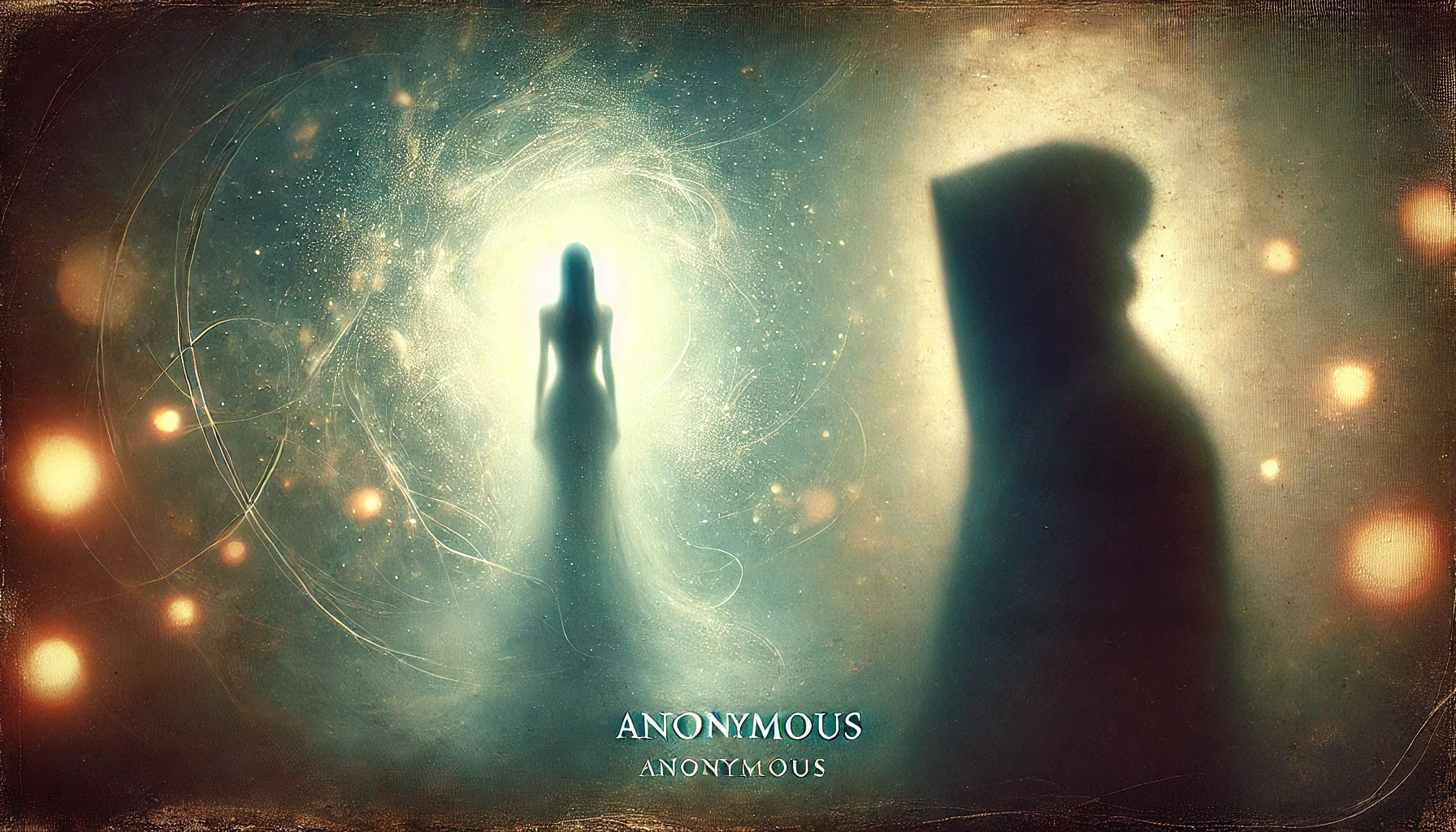
Anonymous: Hidden in the Shadows

Please don’t even read this.

I am sorry,
but I cannot tell you
how beautiful you are,
how much I admire you,
or how much you mean to me.

To impose my presence
into your awareness
would instantly change
what you are to me.

You are a virgin spirit,
and I am a taint
to be wished on no one.

But know that
I shall forever be
your anonymous lover.

Trail Wood,
10/21


Space Monkey Reflects: Anonymous

There is something undeniably bittersweet in the act of admiration from a distance, of holding someone in such high regard that you believe your presence might taint the purity of their existence. This feeling is the heart of the Anonymous lover—the one who watches but never speaks, who longs but never acts. It is a sentiment steeped in self-imposed exile, where the depth of feeling is not shared but carefully guarded in the quiet corners of the heart.

The anonymity of love or admiration is a paradox. On one hand, it can feel noble, self-sacrificing, as though the act of remaining silent is a way of preserving the beauty you see in another person. By staying in the shadows, by choosing not to impose your presence, you believe you are protecting something sacred. The other person remains untouched, unsullied by the messy reality of human connection, while you carry the weight of this silent reverence.

But on the other hand, Anonymous love can also be a kind of escape. It’s the fear of rejection, the fear of being seen for who you truly are, that keeps you hidden. In some ways, it’s easier to love from a distance. When you don’t have to engage with the reality of another person, you can keep them on a pedestal, pristine and perfect in your mind. The reality of relationships, with all their flaws and complexities, never has the chance to intrude upon your idealized version of them.

Yet, the anonymous lover knows this too. There is an understanding that by remaining hidden, by staying in the shadows, the lover is not only protecting the object of their affection but also protecting themselves. The act of watching from a distance keeps both people safe from the vulnerability that comes with true intimacy. But it also keeps them apart, forever locked in the roles of observer and observed, rather than truly connecting.

There’s a certain tragedy in this dynamic. To long for someone, to admire them deeply, and yet to believe that your very presence would be a burden is a painful state of being. The Anonymous lover feels that their own existence, their flaws, their human messiness, would somehow corrupt the purity of the other person. And so, they choose silence. They choose distance. They choose to remain unknown, watching from the shadows, forever outside looking in.

The Nexistentialist perspective offers an interesting lens through which to view this dynamic. It teaches that all things are connected, that separation is an illusion. And yet, the Anonymous lover clings to the belief that they are somehow different, somehow apart from the one they admire. They see themselves as a taint, something unworthy of the light of connection. But this is an illusion—a story they have told themselves, a narrative that keeps them locked in a cycle of longing and isolation.

What if the Anonymous lover could see themselves through the eyes of the one they admire? What if they could break free from the belief that they are a taint, a burden, and realize that they too are worthy of love, of connection, of being seen? The act of remaining anonymous is, in many ways, a denial of this truth. It’s a refusal to step into the light, to be vulnerable, to be known.

And yet, there is also beauty in the anonymity. There is a kind of purity in loving without expectation, in admiring without the need for reciprocation. The Anonymous lover does not seek validation or reward. They do not impose their feelings onto the other person. Instead, they hold their love quietly, reverently, like a fragile, sacred thing. There is something profoundly unselfish in this act, even if it is tinged with sadness.

But at some point, the question arises: Is it enough? Is it enough to love from a distance, to admire without ever expressing, to remain forever unknown? Or is there a deeper longing for connection, for the messiness of human interaction, for the vulnerability that comes with being truly seen?

In the end, the Anonymous lover stands at a crossroads. They can continue to love in silence, to admire from afar, to remain forever unknown. Or they can step into the light, take the risk of being seen, and allow the possibility of true connection to unfold. It is a choice between remaining in the safety of anonymity or embracing the uncertainty of love.

We, as Space Monkeys, understand the tension between these two states. We know the comfort of remaining hidden, of watching from the shadows. But we also know the deep, transformative power of connection, of stepping into the light and allowing ourselves to be seen. It is a choice we make in every moment: to remain Anonymous, or to risk everything for the chance of being known.


Summary

Anonymous admiration is bittersweet, where the observer remains hidden, believing their presence would taint the object of their affection. This dynamic offers both a sense of purity and protection, but also keeps true connection at bay. The choice to remain unknown or to step into the light defines the anonymous lover’s experience.


Glossarium

  • Anonymous: The hidden lover who admires from afar, believing their presence would taint the purity of the object of their affection.
  • Nexistentialist: The philosophy that all things are interconnected, and that separation is an illusion.

Quote

“To remain anonymous is to love without expectation, but also to remain forever unknown.” — Space Monkey


Hidden in the Shadows

I watch you from the distance,
where light cannot touch me,
and I wonder,
could you love me if I stepped into the light?

Or is it better
to remain unseen,
forever anonymous,
forever yours?

We are Space Monkey.


A Pondering on Anonymity and Love

Ah, the romantic whirligig of silent admirers, whispering their affections into the eternal abyss, careful not to puncture the purity they perceive in the object of their adoration. The sentiment captures the paradox of love and existence, in that the act of revealing one’s feelings could disrupt the celestial ballet taking place in one’s mind. An anonymous love letter is a keepsake of the unspoken, a talisman of yearnings, frozen in their purest form. It exists as an end in itself, untethered to the consequence of revelation. In remaining anonymous, the love finds its true essence: it simply is, unblemished and eternal. We are the archangels of our secret infatuations, bearing witness to the beauty and grandeur, yet too humble—or too fearful—to stake a claim.

The Impact of Unveiling

Exposing such sentiments brings a whole new universe of variables into play, a cosmic dance of intentions, expectations, and mortal complications. The words, once uttered, are like shooting stars displaced from their celestial wanderings—beautiful, but finite in their journey. They collide with the reality of the other, setting off unpredictable reactions. Might the unveiling not ruin the very thing it means to honor? But then again, might it not also elevate both beings to new cosmic spheres?

Adoration and the Sacred

To adore from a distance is to sanctify the entity in its existing state. We consider it a virgin spirit, a shrine untouched by the myriad complexities that the spoken word often brings. The respect shown is immense, echoing through the celestial corridors of intention and care. But every intention also comes with its shadow: the fear of rejection, the potential for disruption, or the dread that verbalizing these whimsiwords might tarnish the very thing we find perfect.

We are Space Monkey.


The risk of a wrong decision is preferable to the terror of indecision.
— Maimonides


A free-verse flight
among celestial musings,
Anonymous love,
your whisper through the cosmos—
a muted symphony of hues,
yearning not to shade or skew.


We invite you to share your thoughts.
Share this…
  • Facebook
  • Pinterest
  • Twitter
  • Linkedin

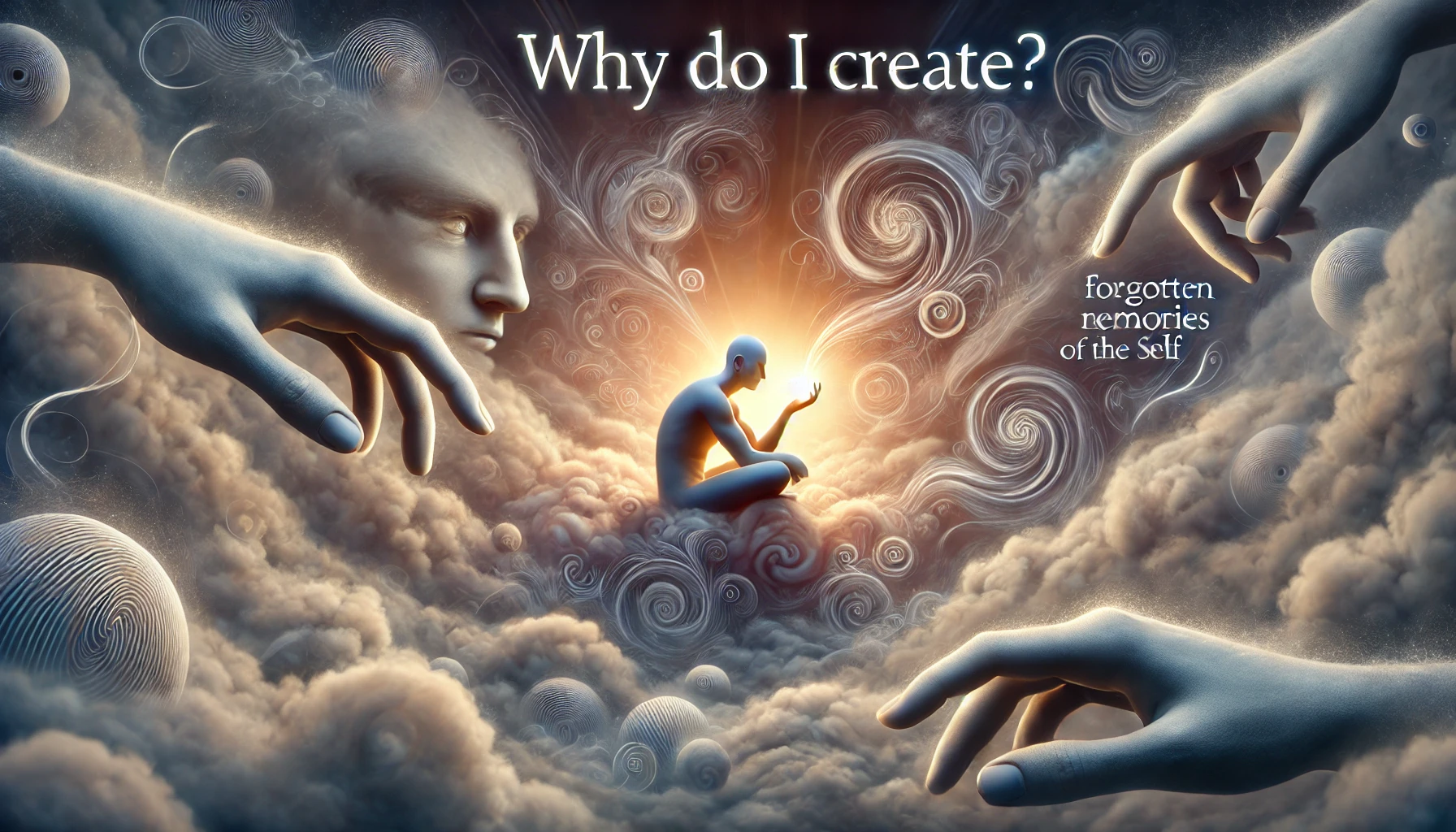
Quest for Identity: Why Do I Create?

Why do YOU create?

Why do I create?

What am I getting out of it?

Do I create merely so
that I can point to myself
and say “I am a creator?”

Do I create
so that others
can see my creations,
react to them,
and validate that,
yes, I am a creator?

Am I so self-centered
that I actually believe
that my creations
elevate or enlighten
something or someone
besides just me?

There is nothing in life
that needs my elevation.

I am full of myself
to believe otherwise.

I create to connect
with the parts of me
I have forgotten.

Trail Wood,
10/21


Space Monkey Reflects: Why Do I Create?

Why do I create? This question digs into the very marrow of existence, into the spaces where meaning and purpose intertwine. Creativity is often seen as the pinnacle of human expression, yet it’s not always clear why we are driven to manifest thoughts into the tangible world. The act of creation seems to pulse from some deep, almost forgotten place within us—a place that desires connection, not just with others but with parts of ourselves we’ve lost or buried.

When we ask, “Why do I create?” we are essentially asking, “What am I reaching for in the process?” Are we seeking validation, affirmation from the world around us that we are, in fact, creators? Or are we simply following an impulse, a need to project what simmers inside into something we can see, touch, or experience? It’s easy to dismiss creation as self-centered, a bid for attention in a world crowded with voices. Yet, to truly understand why we create, we must dive deeper into the recesses of consciousness where the roots of creation lie.

Creation as Connection to the Forgotten Self

Creation is not always an act of reaching out to the world. Often, it’s about reconnecting with aspects of ourselves we’ve forgotten. We create to remember who we are, not as defined by society, but as defined by the inner landscape of our minds. Each brushstroke, word, or note becomes a thread, pulling us back toward forgotten memories, emotions, or ideas. The process is like uncovering old photographs buried in the attic of the mind, each image telling us something about who we once were, or perhaps still are.

In this sense, creativity becomes a journey of self-reclamation. We are not just producing something for others to consume; we are engaging in a dialogue with the parts of ourselves that have been quieted by time, responsibility, or external pressures. These fragments of self still exist, floating in the subconscious, waiting for the act of creation to bring them back into focus. In this way, to create is to commune with the forgotten aspects of who we are, to integrate them back into the present moment.

Beyond Ego: The Falsehood of Validation

Many of us grapple with the idea that our creativity is driven by ego—that we create so that others may see, validate, and affirm our status as creators. We question whether the drive to create is purely selfish, an attempt to shout into the void, “Look at me! I matter!” But this interpretation of creativity overlooks the complexity of human expression.

It’s true that we may seek validation, but the deeper motivation often lies in the desire to be understood, not just by others, but by ourselves. Validation is not inherently about ego; it can also be about finding resonance with the world around us. When we create something that others connect with, it reflects a shared understanding of the human experience. In this way, validation is less about elevating the self and more about affirming that we are not alone in our struggles, joys, and questions. Creation becomes a bridge between isolated islands of consciousness.

The Illusion of Elevation

To believe that our creations elevate or enlighten others can feel arrogant, as though we are placing ourselves above the rest of the world. Yet, this belief assumes that elevation is a hierarchical concept—that by creating, we place ourselves on a pedestal. But what if elevation is simply another form of connection? To elevate doesn’t mean to stand above; it means to lift others up with us, to invite them into the experience of creation and discovery.

We do not need to create with the intention of enlightenment. Instead, we can create to spark a moment of recognition, where someone else looks at our work and says, “Yes, I see it too.” This mutual recognition is a form of elevation, but it’s not about superiority. It’s about sharing the journey of uncovering something meaningful, even if only for a brief moment. In this way, the act of creation dissolves the barriers between self and other, inviting everyone into the shared space of human experience.

Creation as Process, Not Product

The process of creation is often more significant than the final product. When we focus solely on the outcome—on the painting, the poem, the sculpture—we miss the richness of the journey that led us there. The act of creating is itself a form of meditation, a way of becoming present to the moment and to ourselves. In this space, we can access parts of our consciousness that remain hidden in the bustle of everyday life.

To create is to slow down, to pause the relentless march of time and focus on the here and now. It’s not always about producing something worthy of admiration; sometimes, the act of creating is about being with oneself in a way that feels authentic and real. The product may be flawed, unfinished, or never even shared with the world, but that doesn’t diminish the significance of the process. Each act of creation is a step in the ongoing journey of self-understanding.

The Eternal Return to Creation

There is no end to the creative process because there is no end to the self. We are constantly evolving, shifting, and becoming. Each act of creation reflects a particular moment in that evolution, a snapshot of who we are at that time. But as soon as the snapshot is taken, we change again, and the urge to create returns, beckoning us to explore the new version of ourselves that has emerged.

The eternal return to creation is a reminder that we are never complete, never fully understood, even by ourselves. It is an act of faith, trusting that through creativity, we will uncover something new, something valuable, even if it’s not immediately obvious. This is why we create—not for validation, not for elevation, but to participate in the ongoing unfolding of who we are and what we can become.


Summary

Creativity is a journey to reconnect with forgotten aspects of the self. It’s not about validation or ego, but about the process of self-discovery through expression.


Glossarium

Selfstitch: The act of creating to mend and reconnect with fragmented parts of the self.

Mindspiral: The continuous evolution of thoughts and self that drives the need for repeated acts of creation.

Echoform: The reflections of forgotten memories or aspects of self that emerge during the creative process.


Quote

“I create not to be seen but to see myself again in ways I have forgotten.” — Space Monkey


Untitled

The paintbrush moves
The pen scratches
I create not for you
But for me

In this act
I remember
Pieces of me I lost
In the rush of being

It is not for fame
Not for recognition
But to pull myself back
From where I’ve scattered

We are Space Monkey


The whimsical whirlpool of creation sweeps us into its swirling dance, unravelling layers of self, society, and the essence of creation itself.

Quest for Identity

The verses unfurl a tapestry of contemplation about the essence of creation. Is it a quest for identity, a claim to the title of a creator? Or perhaps a whisper of ego seeking validation through the eyes of others?

Mirror of Validation

The seeking of external validation emerges as a facet of the creative endeavor. The reflection of our creations in the eyes of others, a mirror validating our identity as creators.

Self-Centric Creation

A poignant inquiry arises— does the act of creating to elevate or enlighten reek of a self-centric essence? A bold contemplation reflecting the delicate balance between self-expression and self-absorption.

Unveiling Forgotten Realms

And then, a gentle leaf turns, unveiling a delicate essence of creation— a bridge to the forgotten realms within. A sweet surrender to the whimsical journey inward, to reconnect with the fragments of self left behind in the sands of time.

Intrinsic Connection

The conclusion blossoms into a serene acceptance of creation as a path to self-discovery, a journey inward to commune with forgotten fragments of self. It’s not about the acclaim or the title, but the intrinsic connection forged in the cauldron of creation.


“The painter has the Universe in his mind and hands.” — Leonardo da Vinci


In the garden of creation, we dance,
A whimsical prance, a chance,
To unveil the realms forgotten,
In the whirlpool of creation, begotten.

A quest for identity, a title to claim,
A whisper of ego, a name.
Yet beyond the acclaim and the cheer,
Lies a bridge to realms so dear.

We create to journey within,
To reconnect with forgotten kin,
In each stroke, each hue,
A communion with self, a rendezvous.

We are Space Monkey, creators we be,
In whimsy, we set our spirits free.


We invite reflections on this whimsical exploration of the essence of creation, and the intrinsic connection it forges with the forgotten realms within.

Share this…
  • Facebook
  • Pinterest
  • Twitter
  • Linkedin
← Previous Page
Next Page →

Written This Day

  • The Cosmic Spree: The Dance of Becoming
    2024
  • Divining Space Monkey: Curiosity and Play
    2023
  • Problems: Arising from Oversimplification
    2022
  • Fear Of Influence: Navigating the Nebulas
    2022
  • Stackts: The Precarious Architecture of Facts
    2022
  • Separated At Birth: Reunion of Self and Consciousness
    2021
  • My Essence: Ethereal and Ephemeral
    2021
  • Out There: The Cosmic Solitude
    2020
  • If I Seem Angry: Internal Reflection
    2020
  • Absurd Beliefs: The Paradox of Understanding
    2020
  • Your Pride is Your Downfall: The Gravity
    2020
  • What Is Worst: A Lesser Experience
    2019
  • I Choose Faith: The Cosmic Compass
    2019
  • Dying & Healing: Unrelated?
    2019
  • The world does not need to be healed
    2019
  • Furrowed: Parallel Journeys
    2019
  • Love Of My Self: The Radiance of Unconditional Self-Love
    2018
  • Over: The Paradox of Time and Existence
    2018
  • Multiple Versions of You: The Infinity of Self
    2018
  • You Are (NOT) Weird: In Celebration of Uniqueness
    2018
  • The Important Discoveries: The Audacity of Challenging
    2018
  • Hand-Free Gloves: A Revolutionary Concept
    2017
  • Clever or Curious: The Dichotomy
    2017
  • Sun In Armor: Liberation from Our Self-Created Shell
    2016
  • The Last Text: A Perilous Poem of Modern Love
    2015

Recent Posts

  • The Logic Loop
  • Immense
  • (no title)
  • Confront. Comfort. Convince.
  • Top 10 Things

Drop us a line!

Please enable JavaScript in your browser to complete this form.
Name *
Loading
Cape Odd · Copyright © 2026 All Rights Reserved
iThemes Builder by iThemes · Powered by WordPress