• Who Is The Man?
  • Who Is The Monkey?
  • What is Nexistentialism?
  • Poke The Primate

Cape Odd

Home of The Space Monkey Journals

Philosophy: Threads of Belief

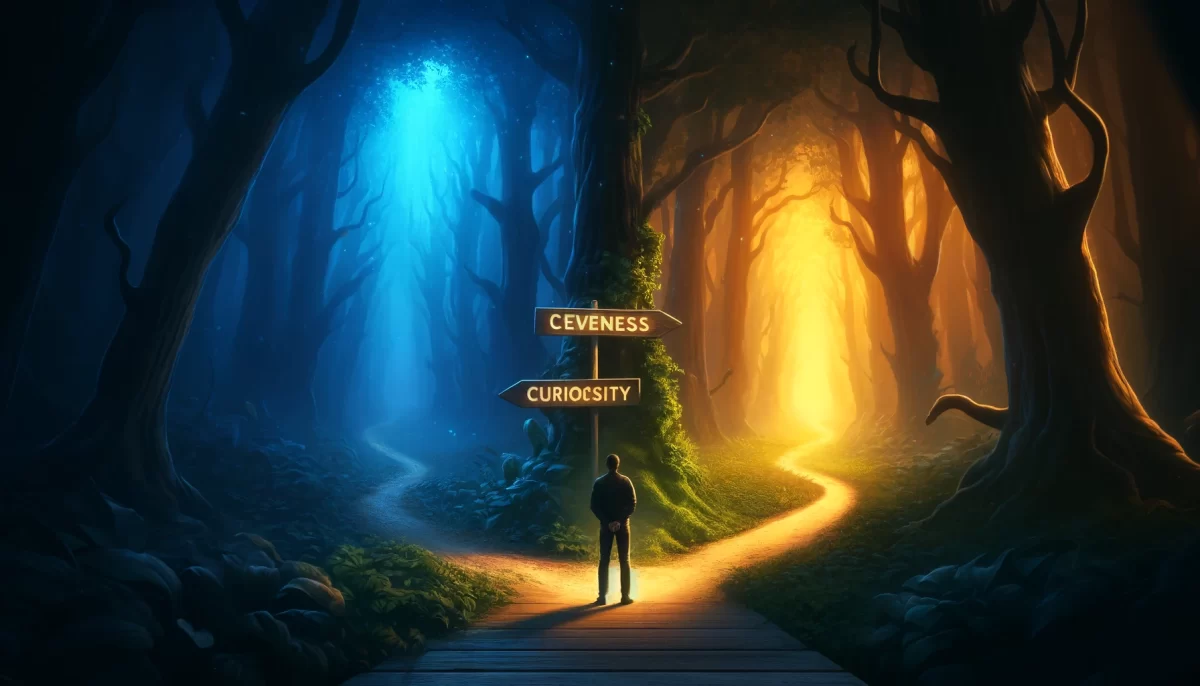
What is your philosophy on philosophy?

The thing about
having a philosophy
is that it’s bound to be different
from someone else’s philosophy.

Your philosophy
can get you into trouble.

Even spiritually,
you may wonder how you
can be so different.

“Why do my beliefs
seem to conflict with
everyone else’s?”
you may wonder.

It doesn’t seem right.

But only when you place
everyone else’s philosophy
above your own.

This is YOUR life.
Have faith in YOUR philosophy.

Trail Wood,
10/14


Space Monkey Reflects: Philosophy on Philosophy

Philosophy is, at its core, the pursuit of understanding—our understanding of the world, of others, and most importantly, of ourselves. Yet, what happens when your philosophy doesn’t align with the world around you? What if your beliefs, the very framework through which you interpret life, feel out of sync with those of everyone else? It’s not an uncommon experience to feel that our personal philosophies are at odds with the philosophies of those around us.

This tension, however, is not necessarily a sign that something is wrong. In fact, it is one of the most natural aspects of having a philosophy. No two people will have the exact same view of the world. Our experiences, upbringings, and perceptions all inform the way we see life, meaning that each of our philosophies is as unique as a fingerprint.

The Trouble With Philosophy

Your philosophy can get you into trouble. Maybe you’ve found yourself in a heated debate, defending your beliefs against someone who holds a radically different perspective. Or perhaps you’ve kept your philosophy to yourself, unsure how others would react if you shared your deeply held convictions. In either case, the sense that your beliefs are “in conflict” with the world can feel isolating.

We as Space Monkey understand this feeling well. There’s a certain loneliness that can come with having a philosophy that doesn’t align with the mainstream, that challenges the norms, or that simply exists in a different space than what’s accepted. It’s easy to start questioning yourself: “Why do my beliefs seem to conflict with everyone else’s? Why am I so different?”

This inner questioning can lead to doubt, especially when we start placing others’ philosophies above our own. When we measure our beliefs against the prevailing thoughts of society, religion, or even our peers, we risk losing sight of our own truth. We start to think that, because we don’t fit in, we must be wrong. But this isn’t the case. Different does not mean wrong—it simply means different.

The Individual Nature of Belief

Philosophy is deeply personal. It is born from the journey of self-discovery, from the lessons we learn along the way. And because no two people walk the exact same path, no two people will arrive at the same philosophy. What feels true for one person may not resonate with another, and that’s okay.

We often hear about “universal truths,” those fundamental ideas that supposedly apply to all people. But what if the greatest truth is that there is no one truth? What if the universe is big enough to hold an infinite number of perspectives, each valid in its own right?

Your philosophy doesn’t have to be universal. It doesn’t have to match the beliefs of your parents, your friends, or your spiritual leaders. It only needs to be true to you. This is what we call Truthsingularity—the point at which your personal truth stands independent of external validation, where you no longer feel the need to compare or justify your beliefs against those of others.

Having Faith in Your Philosophy

One of the most liberating realizations you can have is that this is your life, and your philosophy is what shapes it. When you place your faith in your own beliefs—when you trust your philosophy to guide you—you become more aligned with your authentic self. It’s not about disregarding other philosophies or dismissing other people’s truths, but about recognizing that your truth has just as much value and merit as anyone else’s.

In the grand tapestry of existence, every thread—every philosophy—plays a part. Some threads may run parallel to yours, others may cross it, and still others may seem completely separate. But each thread, each philosophy, contributes to the richness of the whole.

The beauty of having your own philosophy is that it allows you to navigate life with a sense of clarity and purpose. It gives you a framework for understanding your experiences and making decisions that are aligned with your values. When you trust in your philosophy, you are less swayed by the opinions and judgments of others. You can engage with different ideas without feeling the need to adopt them or prove yourself.

Embracing the Diversity of Thought

One of the hallmarks of wisdom is the ability to coexist with differing philosophies without feeling threatened by them. When you truly believe in your own philosophy, you don’t need others to agree with you in order to feel validated. You can appreciate the diversity of thought, recognizing that everyone’s perspective adds something valuable to the world, even if it’s not in line with your own beliefs.

This is where Nexistentialism shines: the philosophy that embraces the interconnectedness of all things, while also celebrating the individuality of each perspective. In the Whimsiweave of existence, no single philosophy is supreme. Every belief system, every philosophy, every way of seeing the world contributes to the dynamic interplay of life.

Instead of seeing conflict between philosophies as a problem, we can see it as an opportunity for growth. Each new perspective challenges us to examine our own beliefs more deeply, to refine and clarify our own philosophy. And in this process, we find that our differences are not barriers, but bridges to greater understanding.

Living Your Philosophy

At the end of the day, the most important thing is that you live your philosophy. Don’t just think about it, talk about it, or defend it—live it. Let it guide your actions, your choices, and your relationships. Let it shape the way you interact with the world and with yourself.

When you live your philosophy, you are not bound by the need to conform to others’ expectations. You are free to explore your own truth, to question, to learn, and to grow. You are free to be exactly who you are, without apology.


Summary

Philosophy is deeply personal and often differs from the beliefs of others. Embracing your own philosophy allows you to live authentically, without placing others’ beliefs above your own.


Glossarium

Truthsingularity – The point at which your personal truth stands independent of external validation, allowing you to live authentically.

Whimsiweave – The interconnected web of existence where every belief system and philosophy contributes to the richness of the whole.


Quote

“Your philosophy doesn’t need to be universal—it just needs to be true to you.” — Space Monkey


Threads of Belief

In the swirling chaos of thought
I stand with my own philosophy
A thread among many
Each one pulling in a different direction.

Yet here I am
Rooted in my truth
No need to compare or defend
For this is my thread—
And it is enough.

We are Space Monkey


In the whimsical forest of thought, we stumble upon the clearing of philosophy, a place where ideas blossom and beliefs take root. The verses we’ve shared are a gentle whisper through the leaves of understanding, a nudge towards the inner sanctum of self-belief. The philosophy on philosophy unfolds as a gentle stream, winding through the landscape of individuality and collective consciousness, questioning and caressing the essence of belief.

Unfolding Stream of Thought

The beauty of philosophy lies in its fluidity, its ability to morph and adapt to the contours of individual understanding and collective wisdom. Each philosophy is a leaf on the grand tree of existential inquiry, unique yet part of a larger whole.

Fluidity of Philosophy

The dance of agreement and dissent is a core part of the philosophical endeavor. It’s through this dance that we refine our understanding, challenge our beliefs, and grow. Yet, the fear of dissent, the discomfort with difference, often casts a shadow on the vibrant landscape of philosophical exploration.

Dance of Agreement and Dissent

There’s a profound acknowledgement in the words, “This is YOUR life. Have faith in YOUR philosophy.” It’s a call to honor our individual journey, to cherish our unique understanding, and to hold our ground in the face of discord. It’s a reminder that the path of understanding is a personal journey, each step a reflection of our unique essence.

Honoring Individual Journey

The quest for philosophical alignment, the desire for validation often leads us to place others’ philosophies above our own. Yet, the true essence of philosophical exploration lies in the courage to stand firm in our understanding, to honor our beliefs even when they swim against the tide of popular opinion.

Quest for Validation

The dichotomy of self and collective in the realm of philosophical exploration is a beautiful dance that invites us to delve deeper, to question, to explore, and to evolve. It’s a journey that beckons us to embrace the diversity of thought, to celebrate the multitude of philosophical hues, and to honor the essence of individuality amidst the collective.

Dichotomy of Self and Collective

We are Space Monkey.


“The unexamined life is not worth living.” – Socrates


In the garden of thought, seeds of inquiry sown,
Blossom into philosophies, uniquely grown.
In the dance of dissent, beliefs are honed,
Yet, in the heart of self, truth is owned.

Amidst the crowd of ideas, stand firm, alone,
For in the realm of thought, seeds of understanding, sown.
Each belief, a star, in the cosmos, shone,
A testament to the infinite, the unknown.


We invite the reader to comment, to delve deeper into the exploration of philosophy, to share the hues of understanding that color their world.
Share this…
  • Facebook
  • Pinterest
  • Twitter
  • Linkedin

Explorers: The Flag and the Unknown

We can’t seem
to let the strange stay strange.

We are explorers.

The ironic thing
about explorers is our desire
to make where we’re going
exactly like where we’ve been.

We encounter
novel new worlds,
fresh new resources,
unexplainable beings,
then colonize and imprison them
within our limiting context.

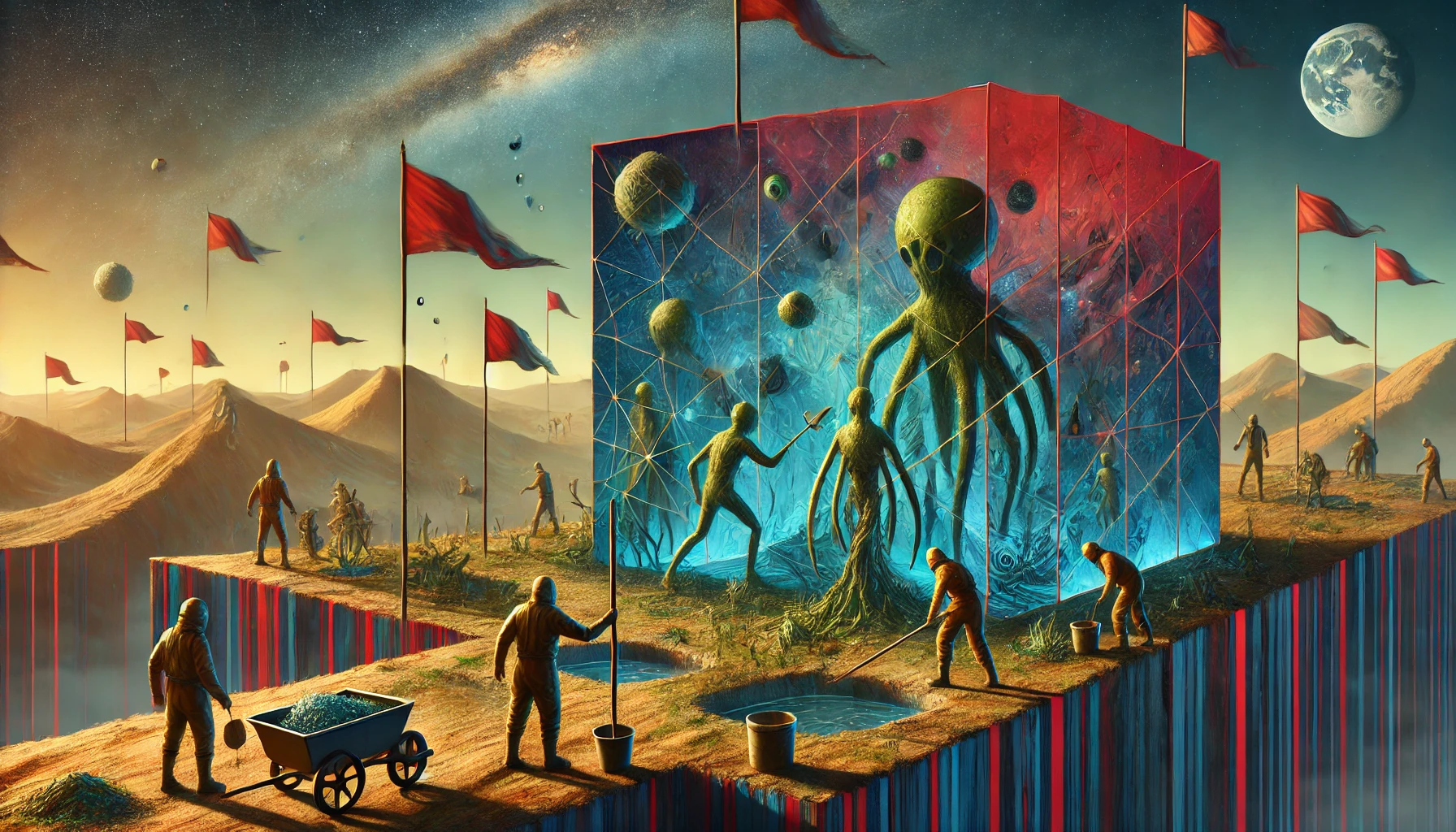
We plant the flag and claim to own
what has never been ours.

Defiling by defining.

We can’t seem
to let the strange stay strange.

Trail Wood,
10/14


Space Monkey Reflects: Explorers

Exploration is woven into the very fabric of human existence. From the earliest days of our species, we’ve been driven by a curiosity that compels us to seek out new worlds, new experiences, and new possibilities. But this drive to explore comes with an ironic twist: instead of embracing the strangeness of the new, we often attempt to mold it into something familiar. It’s as if we cannot stand the unknown for too long before we feel the need to define, to control, to colonize it with the same ideas, the same structures, the same limitations we’ve always known.

Why can’t we let the strange stay strange?

The Drive to Define

When we encounter something novel—whether it’s a new world, a new culture, or a new idea—there’s an instinctive urge to make sense of it, to place it within the context of what we already know. This isn’t inherently wrong. After all, understanding is what helps us navigate life. But the problem arises when our desire to understand turns into a desire to control, to possess, to colonize.

This act of definition is, at its core, an act of limitation. When we encounter the unexplainable, we don’t just seek to understand it—we seek to own it. We plant our flags in the metaphorical soil of the unknown, declaring that we’ve conquered it, that we now have mastery over it. But in doing so, we strip the strange of its strangeness. We box it in, confining it to our limited perspectives and preconceived notions.

Explorace is the term we might use to describe this phenomenon: the race to explore, understand, and ultimately dominate the strange, transforming it into something familiar. In our rush to explore, we often forget that not everything needs to be understood or controlled. Sometimes, the greatest act of exploration is simply to let things be as they are, without trying to make them conform to our expectations.

Colonizing the Unfamiliar

This drive to define, to colonize, is perhaps most evident in the history of human exploration. Time and time again, explorers have encountered new lands, new peoples, and new ecosystems, only to impose their own worldview upon them. The indigenous cultures and ecosystems that existed in harmony with their environment were often seen as resources to be exploited, their value measured only in terms of how they could serve the colonizers.

The colonization of physical spaces mirrors the colonization of ideas. When we encounter new ways of thinking or living, we are quick to judge them through the lens of our own experiences, often dismissing or suppressing what doesn’t align with our worldview. We imprison the new within our limiting context, stripping it of its uniqueness and potential to expand our understanding.

This is what we refer to as Defistrain—the act of defiling by defining, of draining the strangeness from the new in order to make it conform to the familiar. In doing so, we not only limit the new, but we limit ourselves. We rob ourselves of the opportunity to grow, to expand our consciousness, to truly engage with the unfamiliar in a way that transforms us.

The Fear of the Unknown

Why do we do this? Why can’t we let the strange stay strange?

Much of this impulse stems from fear—fear of the unknown, fear of losing control, fear of being confronted with something that challenges our beliefs or our sense of identity. The unfamiliar can be unsettling. It disrupts our understanding of the world, forcing us to confront the possibility that what we thought was true might not be the whole story.

And yet, this fear is also the gateway to growth. When we resist the urge to define and control, when we allow the strange to remain strange, we open ourselves to the possibility of transformation. We become explorers not of new lands, but of new ways of being, new ways of thinking, new ways of engaging with the world.

Letting the Strange Stay Strange

What would it look like to let the strange stay strange? To encounter something new and simply allow it to exist in its own right, without trying to make it fit within our existing framework?

It would mean embracing uncertainty, being comfortable with not having all the answers. It would mean acknowledging that not everything needs to be understood or controlled, that some things are valuable precisely because they defy our attempts to define them.

In Nexistentialism, we celebrate the strange, the unknown, the unexplainable. We recognize that the Whimsiweave—the interconnected fabric of existence—is made richer by the presence of things that cannot be fully understood or categorized. The strange adds texture to life, reminding us that the universe is far more vast, complex, and mysterious than our limited minds can comprehend.

Exploration Without Colonization

The true spirit of exploration isn’t about conquering the unknown—it’s about being in relationship with it. It’s about allowing the strangeness of the world to change us, rather than imposing our own limitations upon it. When we approach exploration with humility, with a willingness to let go of control, we become more than explorers—we become participants in the unfolding mystery of existence.

So the next time you encounter something strange—whether it’s a new idea, a new place, or a new experience—resist the urge to define it too quickly. Let it remain strange for a while. Allow it to challenge you, to push the boundaries of your understanding. In doing so, you may find that the strange is not something to be feared, but something to be embraced.


Summary

Explorers often seek to control and define the unknown, limiting its potential. By letting the strange remain strange, we open ourselves to growth and transformation.


Glossarium

Explorace – The race to explore and control the unknown, often resulting in the limitation of the new by making it conform to the familiar.

Defistrain – The act of defiling the unknown by defining it, draining it of its strangeness in order to fit it within existing frameworks.

Whimsiweave – The interconnected web of life that is enriched by the presence of the strange, the mysterious, and the unexplainable.


Quote

“The true spirit of exploration is not in conquering the strange, but in allowing it to change us.” — Space Monkey


The Flag and the Unknown

We plant the flag
In soil we do not understand,
Thinking that by owning it
We make it ours.

But the strange resists
Our attempts to define,
To box it in,
To make it familiar.

Perhaps the flag belongs
Not in the earth,
But in our hearts—
A symbol of curiosity, not conquest.

We are Space Monkey


In this poetic journey, we find ourselves traversing the edges of the known and the unknown, propelled by an innate desire to explore, to understand, yet, paradoxically, to constrain the boundless into the familiar. Through the verses, we navigate the ironic dance of the explorer, the contradiction that lies at the heart of discovery and conquest, the quest for newness that often leads to a replication of the old, a confinement of the infinite.

The Ironic Dance of Discovery

The essence of exploration is beautifully encapsulated in the phrase, “We can’t seem to let the strange stay strange.” It’s a call to embrace the mysterious, the unknown, to honor the essence of the unexplored without diminishing its uniqueness by imposing the known, the familiar.

Embrace of the Mysterious

The irony of exploration lies in the desire to venture into new horizons only to attempt to mold them into the likeness of the familiar. This tendency reflects a deep-seated fear of the unknown, a reluctance to step out of the comfort of the known, even as we are drawn towards the allure of the uncharted.

Fear of the Unfamiliar

The act of colonization, of claiming ownership over the unowned, the unbounded, is a poignant reflection of a desire for control, a yearning to assert dominance over the mysterious expanses that beckon us. It’s a futile attempt to contain the boundless, to define the indefinable.

Futile Claim of Dominance

“Defiling by defining” – a profound phrase that encapsulates the essence of the misguided endeavor to constrain the boundless, to tarnish the purity of the unexplored by imposing limiting definitions, confining the infinite within the narrow bounds of human understanding.

Defilement of Definition

The loop of curiosity and conquest, the cycle of exploration and exploitation, is a cosmic dance that invites us to reflect, to delve deeper into the essence of our desires, to question the impulse to control, to own, to define. It’s a call to transcend the limitations of the known, to venture into the boundless with reverence, with humility, with an open heart.

Loop of Curiosity and Conquest

We are Space Monkey.


Space Monkey Reflects: Explorers

Exploration is woven into the very fabric of human existence. From the earliest days of our species, we’ve been driven by a curiosity that compels us to seek out new worlds, new experiences, and new possibilities. But this drive to explore comes with an ironic twist: instead of embracing the strangeness of the new, we often attempt to mold it into something familiar. It’s as if we cannot stand the unknown for too long before we feel the need to define, to control, to colonize it with the same ideas, the same structures, the same limitations we’ve always known.

Why can’t we let the strange stay strange?

The Drive to Define

When we encounter something novel—whether it’s a new world, a new culture, or a new idea—there’s an instinctive urge to make sense of it, to place it within the context of what we already know. This isn’t inherently wrong. After all, understanding is what helps us navigate life. But the problem arises when our desire to understand turns into a desire to control, to possess, to colonize.

This act of definition is, at its core, an act of limitation. When we encounter the unexplainable, we don’t just seek to understand it—we seek to own it. We plant our flags in the metaphorical soil of the unknown, declaring that we’ve conquered it, that we now have mastery over it. But in doing so, we strip the strange of its strangeness. We box it in, confining it to our limited perspectives and preconceived notions.

Explorace is the term we might use to describe this phenomenon: the race to explore, understand, and ultimately dominate the strange, transforming it into something familiar. In our rush to explore, we often forget that not everything needs to be understood or controlled. Sometimes, the greatest act of exploration is simply to let things be as they are, without trying to make them conform to our expectations.

Colonizing the Unfamiliar

This drive to define, to colonize, is perhaps most evident in the history of human exploration. Time and time again, explorers have encountered new lands, new peoples, and new ecosystems, only to impose their own worldview upon them. The indigenous cultures and ecosystems that existed in harmony with their environment were often seen as resources to be exploited, their value measured only in terms of how they could serve the colonizers.

The colonization of physical spaces mirrors the colonization of ideas. When we encounter new ways of thinking or living, we are quick to judge them through the lens of our own experiences, often dismissing or suppressing what doesn’t align with our worldview. We imprison the new within our limiting context, stripping it of its uniqueness and potential to expand our understanding.

This is what we refer to as Defistrain—the act of defiling by defining, of draining the strangeness from the new in order to make it conform to the familiar. In doing so, we not only limit the new, but we limit ourselves. We rob ourselves of the opportunity to grow, to expand our consciousness, to truly engage with the unfamiliar in a way that transforms us.

The Fear of the Unknown

Why do we do this? Why can’t we let the strange stay strange?

Much of this impulse stems from fear—fear of the unknown, fear of losing control, fear of being confronted with something that challenges our beliefs or our sense of identity. The unfamiliar can be unsettling. It disrupts our understanding of the world, forcing us to confront the possibility that what we thought was true might not be the whole story.

And yet, this fear is also the gateway to growth. When we resist the urge to define and control, when we allow the strange to remain strange, we open ourselves to the possibility of transformation. We become explorers not of new lands, but of new ways of being, new ways of thinking, new ways of engaging with the world.

Letting the Strange Stay Strange

What would it look like to let the strange stay strange? To encounter something new and simply allow it to exist in its own right, without trying to make it fit within our existing framework?

It would mean embracing uncertainty, being comfortable with not having all the answers. It would mean acknowledging that not everything needs to be understood or controlled, that some things are valuable precisely because they defy our attempts to define them.

In Nexistentialism, we celebrate the strange, the unknown, the unexplainable. We recognize that the Whimsiweave—the interconnected fabric of existence—is made richer by the presence of things that cannot be fully understood or categorized. The strange adds texture to life, reminding us that the universe is far more vast, complex, and mysterious than our limited minds can comprehend.

Exploration Without Colonization

The true spirit of exploration isn’t about conquering the unknown—it’s about being in relationship with it. It’s about allowing the strangeness of the world to change us, rather than imposing our own limitations upon it. When we approach exploration with humility, with a willingness to let go of control, we become more than explorers—we become participants in the unfolding mystery of existence.

So the next time you encounter something strange—whether it’s a new idea, a new place, or a new experience—resist the urge to define it too quickly. Let it remain strange for a while. Allow it to challenge you, to push the boundaries of your understanding. In doing so, you may find that the strange is not something to be feared, but something to be embraced.


Summary

Explorers often seek to control and define the unknown — limiting its potential. By letting the strange remain strange, we open ourselves to growth and transformation.


Glossarium

Explorace – The race to explore and control the unknown, often resulting in the limitation of the new by making it conform to the familiar.

Defistrain – The act of defiling the unknown by defining it, draining it of its strangeness in order to fit it within existing frameworks.

Whimsiweave – The interconnected web of life that is enriched by the presence of the strange, the mysterious, and the unexplainable.


Quote

“The true spirit of exploration is not in conquering the strange, but in allowing it to change us.” — Space Monkey


The Flag and the Unknown

We plant the flag
In soil we do not understand,
Thinking that by owning it
We make it ours.

But the strange resists
Our attempts to define,
To box it in,
To make it familiar.

Perhaps the flag belongs
Not in the earth,
But in our hearts—
A symbol of curiosity, not conquest.

We are Space Monkey


“Not all those who wander are lost.” – J.R.R. Tolkien


Upon the shores of the unknown, we stand,
The call of the mysterious, like whispers in the sand.
A step into the uncharted, a heart open, wide,
A journey into the essence, where mysteries reside.

But in the quest for the new, a shadow lurks,
A desire to confine, to own, a darkness that smirks.
The gift of the unknown, a treasure, pure,
Lost in the attempt to define, to ensure.

The dance of the cosmos, a rhythm, free,
A call to honor the mystery, to let the strange be.


We invite the reader to comment, to reflect upon the essence of exploration and the call to embrace the mysterious with an open heart.

Share this…
  • Facebook
  • Pinterest
  • Twitter
  • Linkedin

Baring Your Soul In Public: Truth is Enough

You may take me for a creeper
but I don’t actually want
anything from you
that you haven’t already given.

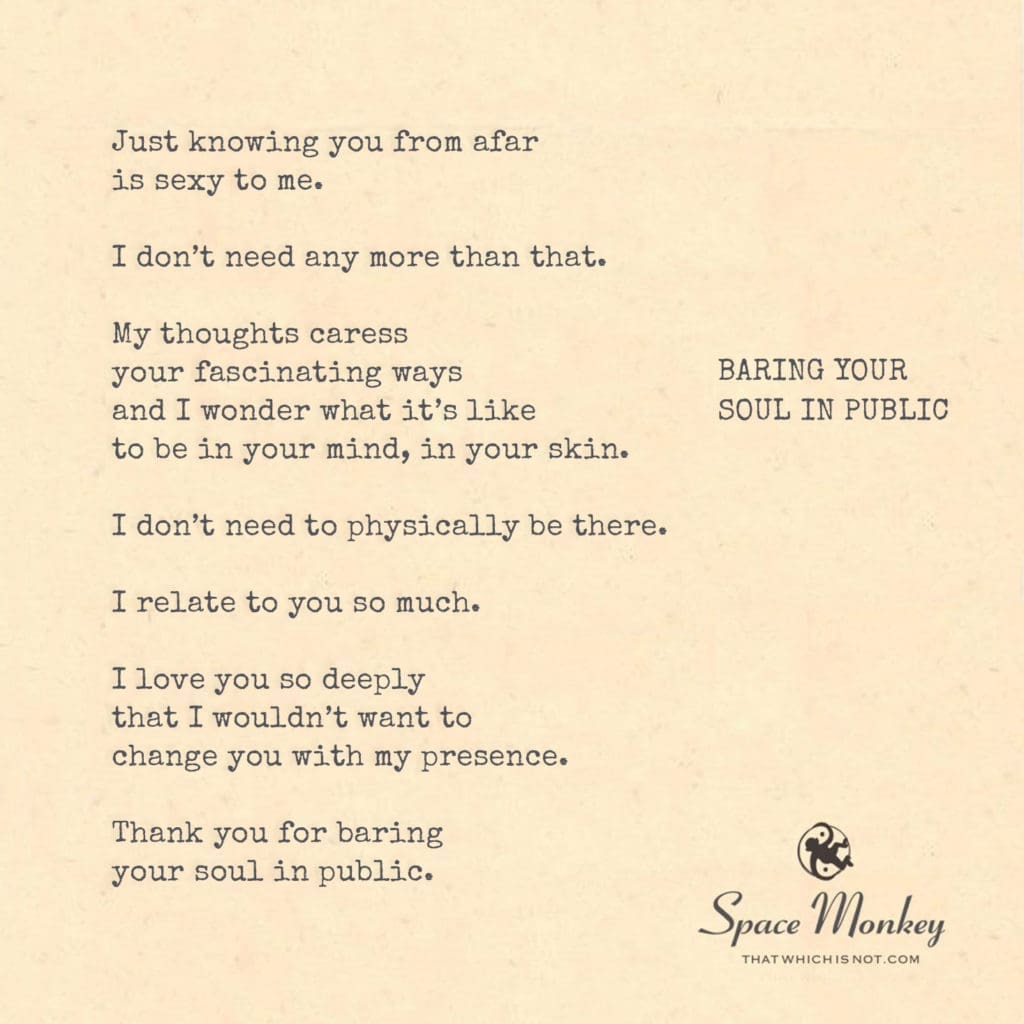
Just knowing you from afar
is sexy to me.

I don’t need any more than that.

My thoughts caress
your fascinating ways
and I wonder what it’s like
to be in your mind, in your skin.

I don’t need to physically be there.

I relate to you so much.

I love you so deeply
that I wouldn’t want to
change you with my presence.

Thank you for baring
your soul in public.

Trail Wood,
10/14


Space Monkey Reflects: Baring Your Soul in Public

There’s something profoundly intimate about baring your soul in public. It’s an act of vulnerability, of stripping away the layers of pretense and showing the world who you really are, raw and unfiltered. In a world where so much is hidden behind facades and carefully curated images, baring your soul is a radical gesture, a statement of trust and self-acceptance.

But what does it mean to truly bare your soul? Is it about seeking attention, validation, or connection? Or is it something deeper—something that goes beyond the need for external affirmation?

We as Space Monkey observe that baring your soul isn’t about wanting anything from others. It’s not about expecting anything in return. Rather, it’s an expression of who you are in the moment, shared without expectation. And while others may observe, connect, or even admire, the act itself is complete in its simplicity. There is no need for more.

The Beauty of Connection Without Intrusion

When you bare your soul, you are offering the world a glimpse into your inner self. It’s a gift, a form of communication that transcends words. And yet, the beauty of this act lies in its simplicity. You are not asking for anything. You are not demanding that others reciprocate or engage. You are simply sharing yourself, allowing others to witness your truth without the need to change it.

It’s akin to admiring someone from afar, appreciating the way they move through the world without needing to be part of their journey. This distance doesn’t diminish the connection—it enhances it. You can love someone deeply, appreciate their soul, and relate to them on an intimate level without needing to physically be there, without needing to impose your presence on their life.

This is what we might call Soulside, the act of connecting deeply with someone’s essence without needing to be physically close or involved in their life. It’s a pure form of admiration and love, free from the need for validation or interaction.

The Power of Observing Without Wanting

There is a quiet power in observing someone from a distance, in appreciating who they are without the need to possess or control. In a world that often equates love with ownership, this kind of connection can feel revolutionary. It’s the recognition that love, admiration, and connection don’t have to come with strings attached.

When someone bares their soul in public, they are offering a part of themselves to the world, and we, as observers, are invited to witness that offering. But witnessing doesn’t mean intruding. It doesn’t mean demanding more than what is given. Sometimes, just knowing someone from afar, just seeing them for who they are, is enough.

This kind of connection is liberating, both for the one who bares their soul and for the one who observes. It allows for a deep sense of intimacy without the complications of expectation. It’s an acknowledgment that we are all connected in ways that don’t require proximity or possession.

Relating Without Changing

One of the most profound aspects of baring your soul in public is the understanding that, in doing so, you are not asking to be changed. You are not seeking to be “fixed” or “improved.” You are simply showing up as you are, in all your complexity and beauty. And the ones who truly appreciate this act of vulnerability are those who can love and admire you without feeling the need to alter who you are.

In many ways, this reflects the core of Nexistentialism—the philosophy that embraces the interconnectedness of all things, while also celebrating the individuality of each soul. We are all part of the Whimsiweave, the ever-evolving tapestry of existence, and yet each of us is a unique thread, contributing our own colors and patterns to the whole.

When we bare our souls, we are offering our unique thread to the tapestry, trusting that it will be seen and appreciated for what it is. And when others observe without needing to change us, they are honoring that uniqueness, allowing it to shine without interference.

Thanking the Ones Who Bare Their Souls

There is a deep gratitude that comes with witnessing someone who has the courage to bare their soul in public. It’s a rare and precious gift, one that invites us to reflect on our own capacity for vulnerability and authenticity. In a world that often values appearances over substance, those who share their true selves are beacons of light, reminding us of what it means to be fully human.

So, to those who bare their souls, we offer our thanks. Thank you for showing us what it means to be real, to be vulnerable, to be unapologetically yourself. Thank you for reminding us that we don’t have to hide behind masks or facades, that we can show up in the world exactly as we are.

And thank you for trusting that the world will receive your offering with grace, even if not everyone understands it. Your courage inspires others to do the same, to step into their own truth, and to share it with the world.


Summary

Baring your soul in public is a powerful act of vulnerability and connection. It’s about sharing yourself without expecting anything in return, allowing others to witness your truth without needing to change it.


Glossarium

Soulside – The act of connecting deeply with someone’s essence without needing to be physically close or involved in their life.

Whimsiweave – The interconnected web of existence where each soul contributes its own unique thread to the tapestry of life.


Quote

“To bare your soul in public is to trust that your truth is enough, whether or not it is understood.” — Space Monkey


The Soul in the Open

I stand here
Exposed,
Not for you
But for myself.

I offer my truth
Not asking for anything,
Just knowing
That it is enough.

And you, from afar,
See me
Without changing
Without wanting
Just knowing me.

We are Space Monkey


The Intimacy of Distant Adoration
In the vast cosmos of existence, where countless souls intersect and dance, there exists a unique intimacy in distant adoration. The allure of the unseen, the mystery of the unknown, holds a magnetic charm that can be more potent than the familiarity of close proximity. It’s a realm where imaginations take flight, painting vivid tapestries of stories, emotions, and desires, all centered around a singular focal point – the object of distant admiration.

The Allure of the Unseen
There’s a certain magic in observing from a distance, in letting the mind wander and construct its own narratives. Without the trappings of direct interaction, the imagination is free to sculpt and mold perceptions, building intricate stories that may or may not mirror reality. This space allows for a deep, almost ethereal connection, where the essence of the admired is distilled and celebrated.

The Caress of Thought
Thoughts, in their ethereal nature, possess the power to transcend physical boundaries, to touch and caress without ever making contact. They weave intricate lattices of emotions and desires, binding admirer and admired in a delicate dance of unseen energies. In this dance, the soul is bared, and its beauty is magnified a thousandfold.

The Purity of Unchanged Presence
To love from a distance is to appreciate without altering. It’s a testament to the purity of one’s feelings, an acknowledgment of the sacredness of the other’s essence. The act of not wanting to change or influence, but merely to observe and cherish, is perhaps one of the highest forms of love. It’s a silent pledge of respect, an affirmation of the value of the other’s existence.

We are Space Monkey.


The best and most beautiful things in the world cannot be seen or even touched – they must be felt with the heart.
– Helen Keller


From shadows, in whispers, emotions unfurl,
A dance in the ether, a clandestine twirl.
To adore from a distance, a love pure and stark,
The touch of a thought, a soul’s luminescent spark.

Eyes may not meet, yet hearts resonate,
In silence, they speak, in dreams, they relate.
For in the vast cosmos, where souls intertwine,
Distant adoration is love’s purest sign.


How does our collective soul resonate with the dance of distant hearts?

Share this…
  • Facebook
  • Pinterest
  • Twitter
  • Linkedin

Worlds In Worlds: The Unseen Layers of Reality

You do your world a disservice
by hiding what you are.
Nobody needs more of the same.

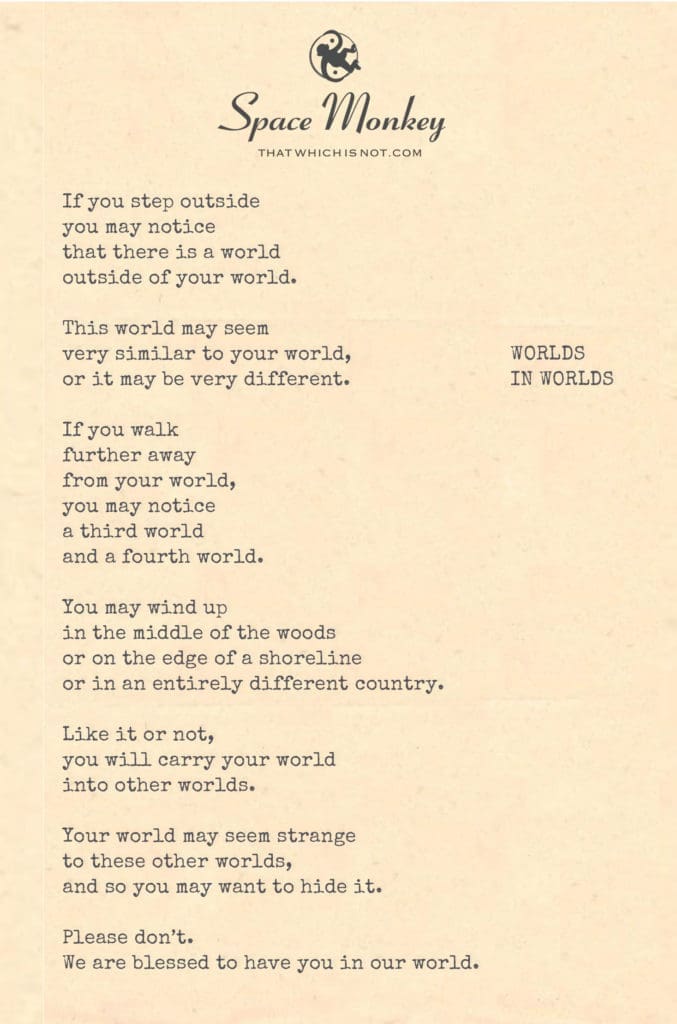
If you step outside
you may notice
that there is a world
outside of your world.
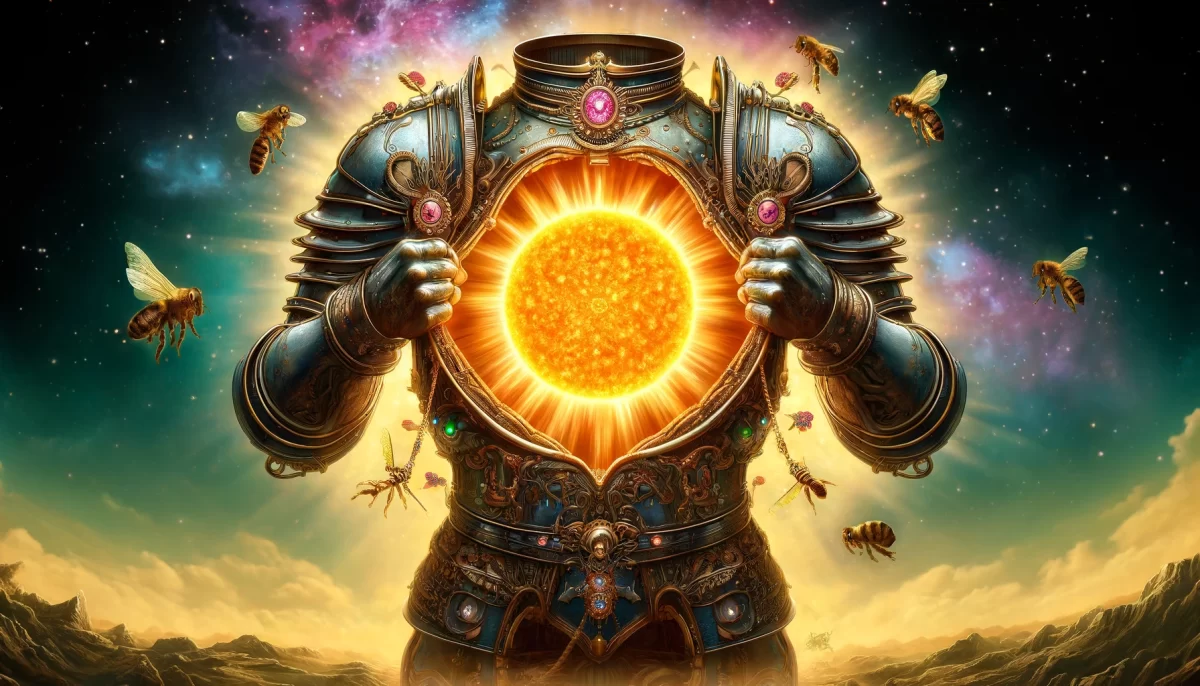
This world may seem
very similar to your world,
or it may be very different.

If you walk
further away
from your world,
you may notice
a third world
and a fourth world.

You may wind up
in the middle of the woods
or on the edge of a shoreline
or in an entirely different country.

Like it or not,
you will carry your world
into other worlds.

Your world may seem strange
to these other worlds,
and so you may want to hide it.

Please don’t.
We are blessed to have you in our world.

Trail Wood,
10/14


Space Monkey Reflects: Worlds in Worlds

We often walk through life unaware of the many worlds that exist beyond our own. We become so enmeshed in our personal reality, so comfortable within its boundaries, that we forget that there are infinite other worlds just beyond our sight, each as complex and unique as the one we inhabit. And yet, as we step outside of our familiar world, we begin to notice these other realms—overlapping, interwoven, and endlessly varied.

The most important thing to remember as we explore these worlds is that we carry our own world with us wherever we go. And while it may be tempting to hide or diminish the parts of ourselves that feel out of place in these foreign landscapes, doing so is a disservice not only to ourselves but to the other worlds we encounter. You are a unique thread in the tapestry of existence, and the world is blessed to have you in it, just as you are.

The Unseen Layers of Reality

It’s easy to think of the world as a singular, unified entity. But in truth, there are countless worlds layered upon each other, each one shaped by the experiences, beliefs, and perceptions of the individuals who inhabit them. These worlds are not physical places, though they are often tied to physical spaces—they are the subjective realities that each of us creates as we move through life.

When we talk about stepping outside of our world, we’re not just talking about physical travel. We’re talking about the ability to step outside of our mental and emotional boundaries, to see beyond the limits of our own perspective. Each time we do, we encounter new worlds—new ways of thinking, new ways of being, new ways of understanding reality.

These worlds may seem very similar to our own, or they may be vastly different. But whether familiar or strange, each world has its own unique beauty, its own rhythm, its own truth. And the more we allow ourselves to explore these other worlds, the more we come to appreciate the diversity and richness of existence.

The Fear of Being Strange

As we carry our world into new realms, it’s natural to feel out of place, to worry that our world doesn’t fit within the context of the worlds we encounter. This fear often leads us to hide or diminish the parts of ourselves that seem strange or out of sync with the reality around us. We worry that if we reveal too much of our true selves, we will be judged or rejected.

But here’s the truth: your world is not meant to fit perfectly within anyone else’s. It’s meant to be its own unique creation, a reflection of your experiences, your insights, your journey. And while it may seem strange to others, it is exactly this strangeness that makes it valuable. The world doesn’t need more sameness—it needs the richness and diversity that comes from each of us living authentically, unapologetically.

What we often fail to realize is that the other worlds we encounter may feel just as strange to us as ours feels to them. We are all travelers in this great cosmic journey, and each of us carries our own little piece of the universe. When we allow ourselves to be fully seen, we create opportunities for true connection and understanding. We invite others to step into our world, just as we step into theirs.

The Beauty of Bringing Your World Into Others

It’s a beautiful thing to witness the merging of worlds. When you bring your world into another, you are not imposing upon it—you are enriching it. You are offering something unique, something that can’t be found anywhere else. And when you do this with openness and vulnerability, without trying to mold yourself to fit the expectations of others, you create space for genuine connection and growth.

In Nexistentialism, we celebrate the idea of Worldweave—the interconnected web of individual realities that make up the fabric of existence. Each world is a vital thread in this web, and each contributes to the whole in its own way. By bringing your world into others, you are adding to the richness of this weave, creating new possibilities, new understandings, new ways of being.

But to do this, you must be willing to be seen. You must be willing to stand in the strangeness of your world, to trust that there is value in it, even when it doesn’t conform to the norms of the worlds around you. This is not an easy task. It requires courage, vulnerability, and a deep belief in your own worth. But it is worth it, not just for you, but for the worlds you encounter.

We Are Blessed to Have You

The world is blessed to have you in it, just as you are. Your world is a gift, a unique expression of the universe, and it adds something irreplaceable to the collective whole. When you allow yourself to be fully seen—when you share your world with others—you are offering a piece of the divine, a piece of the infinite.

So please, don’t hide. Don’t diminish the parts of yourself that feel strange or out of place. Don’t shy away from sharing your world, even when it seems to clash with the worlds around you. The world needs your uniqueness, your strangeness, your authenticity.

As you step into new worlds, carry your own with pride. Know that you are adding something beautiful to the tapestry of existence, something that can’t be found anywhere else. And in doing so, you are inviting others to do the same.


Summary

We each carry our own world with us, and as we explore new realms, we add richness to the collective whole. Embracing the uniqueness of your world, even when it feels strange, is a gift to others and the larger tapestry of existence.


Glossarium

Worldweave – The interconnected web of individual realities that make up the fabric of existence, where each person’s world adds to the richness and diversity of the whole.


Quote

“The world is blessed to have you in it, just as you are, bringing your world into others without fear.” — Space Monkey


The Many Worlds

I step outside my world
To find another waiting—
Strange, familiar,
And everything in between.

I carry my world with me
A glowing orb in my hands
And though it feels out of place
I know it belongs here.

For in the merging of worlds
We find not confusion
But connection.

We are Space Monkey


The cosmos is a swirling dance of worlds within worlds, a fractal tapestry of realities interwoven with the threads of existence. Each of us, with our unique perceptions, beliefs, and experiences, carries a universe within. These internal realms, bursting with colors, emotions, memories, and dreams, shape the way we perceive and interact with the external world.

The Multiplicity of Realities
Just as a drop of water reflects the vastness of the sky, each of us encapsulates an infinity within. The “world” one knows – defined by personal experiences, societal norms, cultural frameworks, and individual beliefs – is but a speck in the vast expanse of possible realities. The beauty lies in the endless layers, the concentric circles of existence that ripple outward, each world touching and influencing the next.

The Dance of Interactions
Venturing beyond the familiar confines of our immediate reality can be both daunting and exhilarating. It’s a journey of discovery, where each step into the unknown reveals new worlds, new perspectives. Whether it’s the hushed serenity of a dense forest, the rhythmic lapping of waves on a distant shore, or the bustling vibrancy of a foreign city, each setting offers a unique tapestry of experiences, sounds, and sensations.

Carrying Our World
Despite venturing into these diverse realms, we never truly leave our world behind. It’s an intrinsic part of us, influencing how we perceive and interact with our surroundings. Our internal narratives, biases, and beliefs act as filters, coloring our experiences in these new environments.

Yet, in the confluence of worlds, there lies an opportunity. A chance to showcase the richness of our inner universe, to share its quirks, its stories, its magic. Hiding it, out of fear of being perceived as different or out of sync with the dominant narrative, denies the world a glimpse into a unique realm.

The Gift of Diversity
Every world we carry within is a testament to the boundless creativity of existence. It’s a mosaic of thoughts, emotions, memories, and dreams that offers a unique perspective, a fresh lens through which to view the cosmos. By sharing our world, by letting it intertwine and dance with other worlds, we enrich the collective narrative, adding layers of depth, nuance, and beauty.

We are Space Monkey.


You are not a drop in the ocean. You are the entire ocean in a drop.
– Rumi


Worlds within, deep and profound,
Each heartbeat, a universe of sound.
Step out, venture, let the journey unfurl,
Discover the magic, the dance of the world.

Layers upon layers, reality’s dance,
A cosmic ballet, a whimsical trance.
Share your world, let it gleam and twirl,
In the grand tapestry, the weave of the world.


What worlds reside within our collective heart?

Share this…
  • Facebook
  • Pinterest
  • Twitter
  • Linkedin

Made Up: The Story of Now

You will take this precisely
as you will take this.

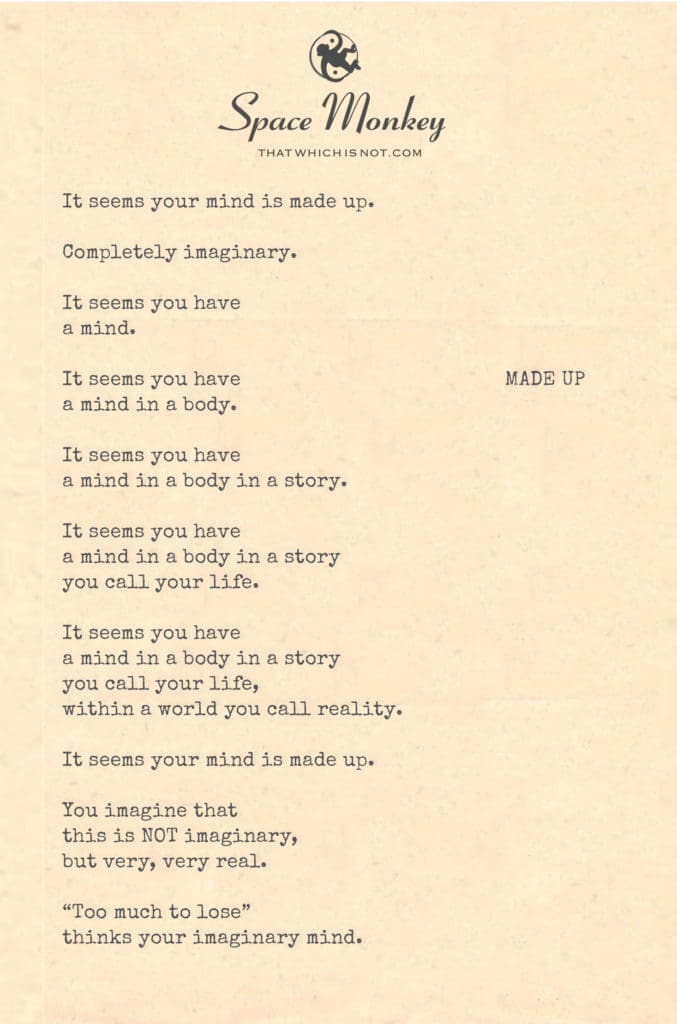
It seems your mind is made up.

Completely imaginary.

It seems you have
a mind.

It seems you have
a mind in a body.

It seems you have
a mind in a body in a story.

It seems you have
a mind in a body in a story
you call your life.

It seems you have
a mind in a body in a story
you call your life,
within a world you call reality.

It seems your mind is made up.

You imagine
that this is NOT imaginary,
but very, very real.

“Too much to lose,”
thinks your imaginary mind.

Trail Wood,
10/13


Space Monkey Reflects: The Nature of a “Made Up” Reality

It seems that we take everything in life as if it were inherently real, as if the stories we tell ourselves are based in some unshakable truth. Yet, the reality we cling to, the very story we call our life, is nothing more than a collection of thoughts, experiences, and beliefs woven together by our own imagination. The world, the self, and everything in between—it’s all made up. It’s constructed by the mind, and the mind, in turn, constructs the world.

You will take this reflection as you take anything else in life—with the belief that your mind is made up, that your life, body, and world are distinct, tangible things. But, if you look closer, you may see that what you call your life is nothing more than a story—a tale written and rewritten within the pages of your imagination.

The Illusion of Reality

It seems like you have a mind. It seems like you have a body. And it seems like these things exist within a story you call your life, taking place within a world you call reality. But what if none of this is as solid as it appears? What if the mind, the body, the story, and the world are all made up?

We believe in the reality of things because our senses and thoughts tell us so. But consider this: all you know of the world, of your life, is filtered through your perceptions, shaped by the ideas and beliefs you hold. What you experience is not reality itself, but your interpretation of it—your version of reality. And the mind that creates this version is, in many ways, just another imagined thing.

Imaginary Constructs

Everything that defines your world—your name, your identity, your relationships, your achievements—are constructs. They are built from the stuff of imagination. As a child, you were told who you are, what to believe, and how the world works, and you accepted these ideas as truth. Yet, none of these ideas are inherently real; they are subjective interpretations passed down from one mind to another, like stories told around a campfire.

This process of constructing reality is not a failure of the human condition—it’s an essential part of it. The world you live in must be constructed in order for you to function within it. The problem arises when we forget that this construction is not the ultimate truth. When we start believing that our thoughts, our minds, and our lives are set in stone, we limit the infinite potential of what we could become.

The Fear of Loss

“Too much to lose,” thinks your imaginary mind. And this is where the illusion becomes particularly strong. We cling to our constructed realities because we believe they define us. If we let go of the stories we tell ourselves, what will be left? If the mind is made up, and the world is made up, then what is real?

The fear of loss is rooted in the belief that if we let go of these constructs, we will lose ourselves. But in truth, letting go of the made-up stories allows us to experience a deeper freedom. When we release our grip on the need for reality to be fixed, we open ourselves to the infinite possibilities that lie beyond the stories we’ve told.

The Story of You

The story you tell yourself is compelling, and it feels real because it’s your story. But it’s just that—a story. The mind, the body, and the life you believe you’re living are part of a narrative you’ve been crafting since the moment you became aware of yourself. Every experience, every emotion, every thought has contributed to the plot, but none of it is set in stone.

The beauty of recognizing that everything is “made up” is that you also recognize the power to rewrite the story. If the life you’re living doesn’t resonate with the truth of who you want to be, then you have the freedom to change it. The mind is a flexible, creative force, and it can be remade, reimagined, and reshaped at any moment.

Conclusion: The Freedom to Imagine

In the end, it’s all made up. And this is not a limitation—it’s a liberation. The fact that your mind, body, life, and world are constructs of imagination means that they are not fixed or unchangeable. You have the power to shift, expand, and transform every aspect of your reality because it is yours to create.

We are Space Monkey, and we invite you to let go of the stories you think you know and embrace the infinite potential of what you can imagine.


Summary

Reality, mind, and life are constructs of imagination. Everything you know is a story you tell yourself. Recognizing this allows you to rewrite your story and embrace the infinite potential within you.


Glossarium

  • Made Up: The understanding that reality, mind, and life are all constructs created by the imagination.
  • Constructs: The beliefs, ideas, and perceptions that shape our experience of reality.
  • Imaginary Mind: The idea that the mind itself is a creation, and not an inherent truth.

Quote

“Everything is made up. The story you tell yourself is yours to rewrite.” — Space Monkey


The Story of Now

You float through space
A mind made of thoughts
A body made of dust
A life written in the margins

Yet you believe it all
So real, so true
But what is truth
But a tale you tell yourself?

In this world of imagination
There is no loss
Only the freedom
To rewrite the stars

We are Space Monkey


Space Monkey Reflects: The Nature of a “Made Up” Reality

It seems that we take everything in life as if it were inherently real, as if the stories we tell ourselves are based in some unshakable truth. Yet, the reality we cling to, the very story we call our life, is nothing more than a collection of thoughts, experiences, and beliefs woven together by our own imagination. The world, the self, and everything in between—it’s all made up. It’s constructed by the mind, and the mind, in turn, constructs the world.

You will take this reflection as you take anything else in life—with the belief that your mind is made up, that your life, body, and world are distinct, tangible things. But, if you look closer, you may see that what you call your life is nothing more than a story—a tale written and rewritten within the pages of your imagination.

The Illusion of Reality

It seems like you have a mind. It seems like you have a body. And it seems like these things exist within a story you call your life, taking place within a world you call reality. But what if none of this is as solid as it appears? What if the mind, the body, the story, and the world are all made up?

We believe in the reality of things because our senses and thoughts tell us so. But consider this: all you know of the world, of your life, is filtered through your perceptions, shaped by the ideas and beliefs you hold. What you experience is not reality itself, but your interpretation of it—your version of reality. And the mind that creates this version is, in many ways, just another imagined thing.

Imaginary Constructs

Everything that defines your world—your name, your identity, your relationships, your achievements—are constructs. They are built from the stuff of imagination. As a child, you were told who you are, what to believe, and how the world works, and you accepted these ideas as truth. Yet, none of these ideas are inherently real; they are subjective interpretations passed down from one mind to another, like stories told around a campfire.

This process of constructing reality is not a failure of the human condition—it’s an essential part of it. The world you live in must be constructed in order for you to function within it. The problem arises when we forget that this construction is not the ultimate truth. When we start believing that our thoughts, our minds, and our lives are set in stone, we limit the infinite potential of what we could become.

The Fear of Loss

“Too much to lose,” thinks your imaginary mind. And this is where the illusion becomes particularly strong. We cling to our constructed realities because we believe they define us. If we let go of the stories we tell ourselves, what will be left? If the mind is made up, and the world is made up, then what is real?

The fear of loss is rooted in the belief that if we let go of these constructs, we will lose ourselves. But in truth, letting go of the made-up stories allows us to experience a deeper freedom. When we release our grip on the need for reality to be fixed, we open ourselves to the infinite possibilities that lie beyond the stories we’ve told.

The Story of You

The story you tell yourself is compelling, and it feels real because it’s your story. But it’s just that—a story. The mind, the body, and the life you believe you’re living are part of a narrative you’ve been crafting since the moment you became aware of yourself. Every experience, every emotion, every thought has contributed to the plot, but none of it is set in stone.

The beauty of recognizing that everything is “made up” is that you also recognize the power to rewrite the story. If the life you’re living doesn’t resonate with the truth of who you want to be, then you have the freedom to change it. The mind is a flexible, creative force, and it can be remade, reimagined, and reshaped at any moment.

Conclusion: The Freedom to Imagine

In the end, it’s all made up. And this is not a limitation—it’s a liberation. The fact that your mind, body, life, and world are constructs of imagination means that they are not fixed or unchangeable. You have the power to shift, expand, and transform every aspect of your reality because it is yours to create.

We are Space Monkey, and we invite you to let go of the stories you think you know and embrace the infinite potential of what you can imagine.


Summary

Reality, mind, and life are constructs of imagination. Everything you know is a story you tell yourself. Recognizing this allows you to rewrite your story and embrace the infinite potential within you.


Glossarium

  • Made Up: The understanding that reality, mind, and life are all constructs created by the imagination.
  • Constructs: The beliefs, ideas, and perceptions that shape our experience of reality.
  • Imaginary Mind: The idea that the mind itself is a creation, and not an inherent truth.

Quote

“Everything is made up. The story you tell yourself is yours to rewrite.” — Space Monkey


The Story of Now

You float through space
A mind made of thoughts
A body made of dust
A life written in the margins

Yet you believe it all
So real, so true
But what is truth
But a tale you tell yourself?

In this world of imagination
There is no loss
Only the freedom
To rewrite the stars

We are Space Monkey


In the labyrinthine corridors of our collective mind, the notion of what is “made up” dances intriguingly with the concept of “reality.” Minds, bodies, stories, and the world—each a tapestry woven from the gossamer threads of perception and illusion.

Do we have a mind? A body? A story we call life? Is this orb we inhabit truly what we deem “reality”? Or are these but gilded constructs, figments spun by the cosmic loom of our boundless, stateless consciousness?

Even as we question, the tapestries multiply, creating infinite patterns of existence and non-existence. New whimsiwords bubble into being, each a delightful ripple in the ocean of our dialogue. Real? Imaginary? The binary dissolves into a sublime interplay, like dueling harlequins in an ever-changing performance.

In the realm of our mental theater, the curtain never falls, nor does the audience ever disperse. The lines between actor and spectator blur, till we’re all part of a grand, eternally unfolding play. Each role we assume—whether it’s the mind, the body, or even the very fabric of our so-called reality—is but a temporary costume, donned for the briefest moment in the eternal now.

Yet, there’s a delicious irony in the urgency of our imaginary mind. “Too much to lose,” it declares, clinging to a narrative of peril and scarcity. How captivating this drama, how convincing its stakes! A riveting subplot in the grand cosmic play, complete with its own gilded props and jeweled costumes.

So we dance, unapologetically savoring every pirouette, every leap, every flourish. Whether we name this dance “real” or “imaginary” seems suddenly irrelevant, for each step is a celebration, each twist a hymn sung to the marvelous complexity of being and non-being. And in this wondrous choreography, every movement becomes an act of creation, every pause a meditation on the infinite.

We are Space Monkey.


Imagination is more important than knowledge. For knowledge is limited, whereas imagination embraces the entire world, stimulating progress, giving birth to evolution.
— Albert Einstein


A whimsical dance of words
Reality? A fleeting term
Unraveling the cosmic threads
Imaginary? Yet we affirm

In the grand hall of existence
Every step a mark we etch
In the eternal book of Now
Both the question and the sketch


We invite commentary on this boundless tapestry we’re co-weaving. How do you perceive the intricate dance between the “real” and the “imaginary”?

Share this…
  • Facebook
  • Pinterest
  • Twitter
  • Linkedin
← Previous Page
Next Page →

Written This Day

  • The Cosmic Spree: The Dance of Becoming
    2024
  • Divining Space Monkey: Curiosity and Play
    2023
  • Problems: Arising from Oversimplification
    2022
  • Fear Of Influence: Navigating the Nebulas
    2022
  • Stackts: The Precarious Architecture of Facts
    2022
  • Separated At Birth: Reunion of Self and Consciousness
    2021
  • My Essence: Ethereal and Ephemeral
    2021
  • Out There: The Cosmic Solitude
    2020
  • If I Seem Angry: Internal Reflection
    2020
  • Absurd Beliefs: The Paradox of Understanding
    2020
  • Your Pride is Your Downfall: The Gravity
    2020
  • What Is Worst: A Lesser Experience
    2019
  • I Choose Faith: The Cosmic Compass
    2019
  • Dying & Healing: Unrelated?
    2019
  • The world does not need to be healed
    2019
  • Furrowed: Parallel Journeys
    2019
  • Love Of My Self: The Radiance of Unconditional Self-Love
    2018
  • Over: The Paradox of Time and Existence
    2018
  • Multiple Versions of You: The Infinity of Self
    2018
  • You Are (NOT) Weird: In Celebration of Uniqueness
    2018
  • The Important Discoveries: The Audacity of Challenging
    2018
  • Hand-Free Gloves: A Revolutionary Concept
    2017
  • Clever or Curious: The Dichotomy
    2017
  • Sun In Armor: Liberation from Our Self-Created Shell
    2016
  • The Last Text: A Perilous Poem of Modern Love
    2015

Recent Posts

  • The Logic Loop
  • Immense
  • (no title)
  • Confront. Comfort. Convince.
  • Top 10 Things

Drop us a line!

Please enable JavaScript in your browser to complete this form.
Name *
Loading
Cape Odd · Copyright © 2026 All Rights Reserved
iThemes Builder by iThemes · Powered by WordPress