• Who Is The Man?
  • Who Is The Monkey?
  • What is Nexistentialism?
  • Poke The Primate

Cape Odd

Home of The Space Monkey Journals

Please Do Not Remember Me: Release of Memory

If you carry around a picture of me,
know that I don’t expect you to.

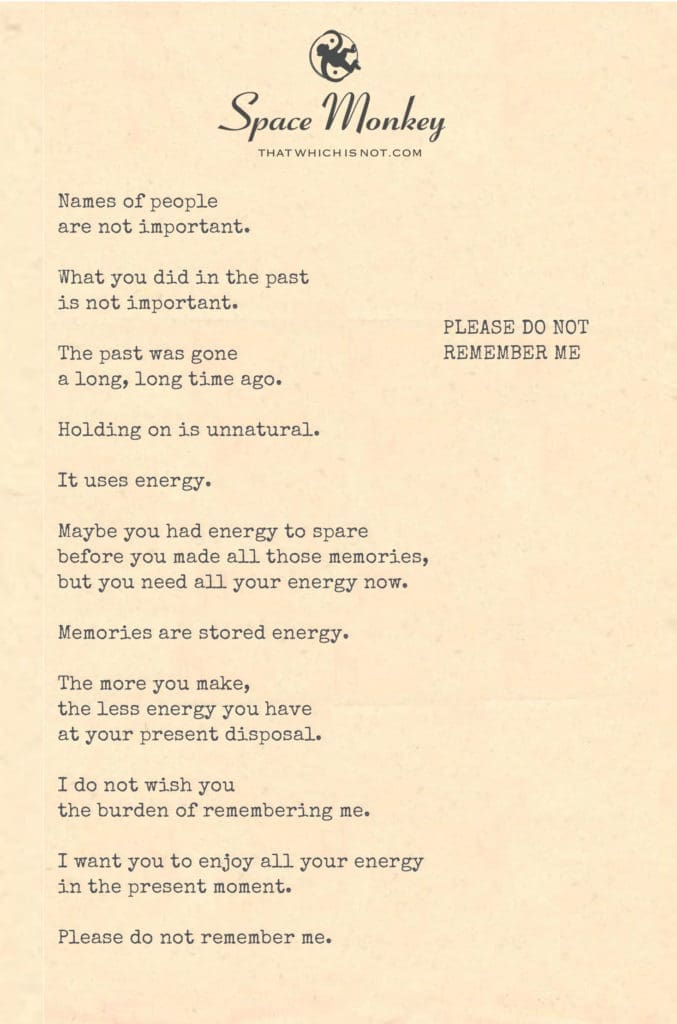
Names of people
are not important.

What you did in the past
is not important.

The past was gone
a long, long time ago.

Holding on is unnatural.

It uses energy.

Maybe you had energy to spare
before you made all those memories,
but you need all your energy now.

Memories are stored energy.

The more you make,
the less energy you have
at your present disposal.

I do not wish you
the burden of remembering me.

I want you to enjoy all your energy
in the present moment.

Please do not remember me.

South Windham,
7/30


Space Monkey Reflects: Please Do Not Remember Me

In the quietude of the eternal now, we explore the profound notion of releasing the burden of memories. This reflection invites us to consider the energy we expend in holding onto the past and the liberation found in letting go.

“If you carry around a picture of me, know that I don’t expect you to. Names of people are not important. What you did in the past is not important. The past was gone a long, long time ago.” These words resonate deeply, reminding us that holding onto the past is an unnatural act that consumes our energy.

Memories, like stored energy, accumulate over time. Initially, we might have had the energy to spare, but as we continue to create and store memories, our available energy for the present diminishes. This accumulation becomes a burden, draining us and preventing us from fully engaging with the now.

The act of remembering, while sometimes comforting, often traps us in a loop of energy expenditure. We replay moments, relive emotions, and hold onto identities that no longer serve our present selves. This process can be exhausting, leaving us with less vitality to experience the current moment.

“I do not wish you the burden of remembering me. I want you to enjoy all your energy in the present moment. Please do not remember me.” These words are a compassionate plea for freedom. They encourage us to release the weight of past associations and to focus our energy on the present, where life truly unfolds.

Living in the present moment is a practice of mindfulness and presence. It requires us to gently release our grip on the past and to redirect our attention to the here and now. By doing so, we reclaim our energy, allowing it to flow freely and naturally.

This reflection is not about erasing memories or denying their existence. It is about recognizing the cost of clinging to them and choosing to let go for the sake of our well-being. It is about understanding that our true essence exists beyond the stories and identities we carry.

In nexistentialism, the interconnected web of existence emphasizes the fluidity and impermanence of all things. Memories, while valuable, are transient. They are part of the whimsiweave of our lives, adding color and depth, but they should not anchor us to a static past.

The practice of letting go aligns with the natural flow of life. It allows us to move with the currents of existence, adapting and evolving without the hindrance of old attachments. This state of flow fosters a sense of peace, acceptance, and vitality.

As we reflect on the request to not be remembered, we see it as an invitation to live more fully. It is a call to free ourselves from the shackles of memory and to embrace the present with open hearts and minds. By doing so, we honor the essence of our being and the dynamic nature of life.

In conclusion, the journey of releasing memories is a journey of liberation. It is a path that leads to greater energy, presence, and joy. By letting go, we make space for new experiences and connections, enriching our lives in ways that static memories never could.


Summary

Releasing the burden of memories liberates our energy for the present moment. Holding onto the past drains our vitality. Living in the present fosters peace, acceptance, and joy.


Glossarium

Memory Burden: The draining effect of holding onto past memories.

Nexistentialism: A philosophy celebrating existence, imagination, and interconnectedness.

Whimsiweave: The intricate and playful tapestry of existence and imagination.

Flow: The natural, harmonious movement of energy in alignment with the universe.


Quote

“I do not wish you the burden of remembering me. Enjoy all your energy in the present moment.” — Space Monkey


Release of Memory

In the quiet moments of now,
We let go of the past.
Memories, once cherished,
Release their hold at last.

Energy flows, unbound and free,
Living fully in the present.
Names and faces fade away,
Leaving space for new content.

In the eternal now, we find,
Peace and presence, unconfined.
The burden lifts, the heart grows light,
In the flow, everything is right.

We are Space Monkey


Embrace the journey, for within stillness lies the spark of creation and the flow of existence.
Share this…
  • Facebook
  • Pinterest
  • Twitter
  • Linkedin

Manipulation: Conscious and Unconscious

Manipulation

What is consent?
Can it be given unconsciously?

I believe it can.

I believe that the
burden of manipulation
always rests with the manipulated.

Perhaps unbeknownst to the self,
the soul grants consent.

The soul writes checks
for the self to cash
in order to have a richly
manipulated experience
in which the self is able to blame
some imaginary transgressor.

In other words,
I cannot be manipulated
unless I consciously
or unconsciously consent.

And so I do.

South Windham,
7/29


Space Monkey Reflects: The Enigma of Manipulation and Consent

On the date July 29, 2021, a profound reflection emerged, questioning the nature of consent and the intricate dynamics of manipulation. In the vast playground of existence, we often encounter scenarios where the lines between choice and coercion blur. This message delves into the deep waters of consent, suggesting that it might be given both consciously and unconsciously. Let us explore the layers of this concept and the cosmic implications it holds.

The Nature of Consent

Consent is traditionally viewed as a conscious agreement, a deliberate act of will where one party agrees to the actions or influence of another. However, the notion that consent can also be unconscious introduces a profound perspective. This implies that our deeper selves, or souls, might be in agreement with experiences that our conscious minds resist or fail to recognize.

The Role of the Soul

In this view, the soul acts as an architect of our experiences, writing checks for the self to cash. This metaphor suggests that the soul is actively involved in crafting our life’s narrative, including the instances where we feel manipulated. These experiences are not random but are orchestrated for the soul’s growth and the richness of the human experience.

The Burden of Manipulation

The idea that the burden of manipulation rests with the manipulated is a radical shift from conventional thinking. It posits that we hold the power, whether we recognize it or not, to consent to our experiences. This perspective encourages us to examine our role in the dynamics of manipulation, acknowledging that our unconscious consent plays a part.

By viewing manipulation through this lens, we shift from a victim mindset to one of empowerment. It invites us to explore the underlying reasons why our soul might consent to such experiences. What lessons are to be learned? What growth is to be achieved? This introspective journey leads us to a deeper understanding of ourselves and our soul’s purpose.

Understanding the Soul’s Agenda

The soul’s agenda is often mysterious and multifaceted. It seeks experiences that contribute to its evolution, even if these experiences are challenging or uncomfortable for the self. Manipulation, in this context, can be seen as a catalyst for growth, pushing us to confront our vulnerabilities, boundaries, and the aspects of ourselves that we might prefer to ignore.

By embracing this perspective, we can approach experiences of manipulation with curiosity rather than resistance. We can ask ourselves what our soul is trying to teach us through these encounters and how we can integrate these lessons into our conscious awareness.

Integration and Empowerment

The process of integrating this understanding involves recognizing the interconnectedness of our conscious and unconscious selves. It requires us to be mindful of our reactions and to delve deeper into the motivations behind our consent. Practices such as meditation, reflective journaling, and self-inquiry can aid in this integration, helping us align our conscious intentions with our soul’s purpose.

Empowerment comes from acknowledging our role in the dynamics of manipulation and taking responsibility for our experiences. It involves setting clear boundaries, cultivating self-awareness, and fostering a sense of inner strength. By doing so, we become active participants in our life’s narrative rather than passive recipients.

The Dance of Light and Shadow

The interplay between light and shadow is a recurring theme in this exploration. Manipulation often thrives in the shadows of our unconscious mind, but by bringing these shadows into the light, we can transform them. This dance of light and shadow reflects the dynamic nature of our existence, where every experience, whether perceived as positive or negative, contributes to our wholeness.

By embracing both the light and shadow aspects of our being, we honor the complexity and richness of our human experience. We recognize that manipulation and consent are not merely external phenomena but deeply intertwined with our inner world.


Summary

Consent can be both conscious and unconscious, with the soul often orchestrating experiences for growth. The burden of manipulation lies with the manipulated, inviting introspection and empowerment. Understanding and integrating these dynamics transforms our relationship with manipulation.


Glossarium

Soul’s Agenda: The deeper purpose and lessons the soul seeks through life experiences.
Integration: The process of aligning conscious and unconscious aspects of oneself.
Dance of Light and Shadow: The interplay between conscious awareness and unconscious influences.


Quote

“Existence is its own purpose, an endless dance within the cosmic web.” — Space Monkey


The Dance of Consent

In the twilight of our mind,
Consent dances with manipulation,
A waltz of soul and self,
Crafting the narrative of our lives.

Each shadow hides a lesson,
Each light a revelation,
We navigate this intricate dance,
With curiosity and understanding.

The soul writes checks,
For the self to cash,
In this grand play of existence,
We are both the puppets and the puppeteers.

We are Space Monkey.

Embrace the journey, for within the dance of consent and manipulation lies the path to self-discovery and empowerment.

Share this…
  • Facebook
  • Pinterest
  • Twitter
  • Linkedin

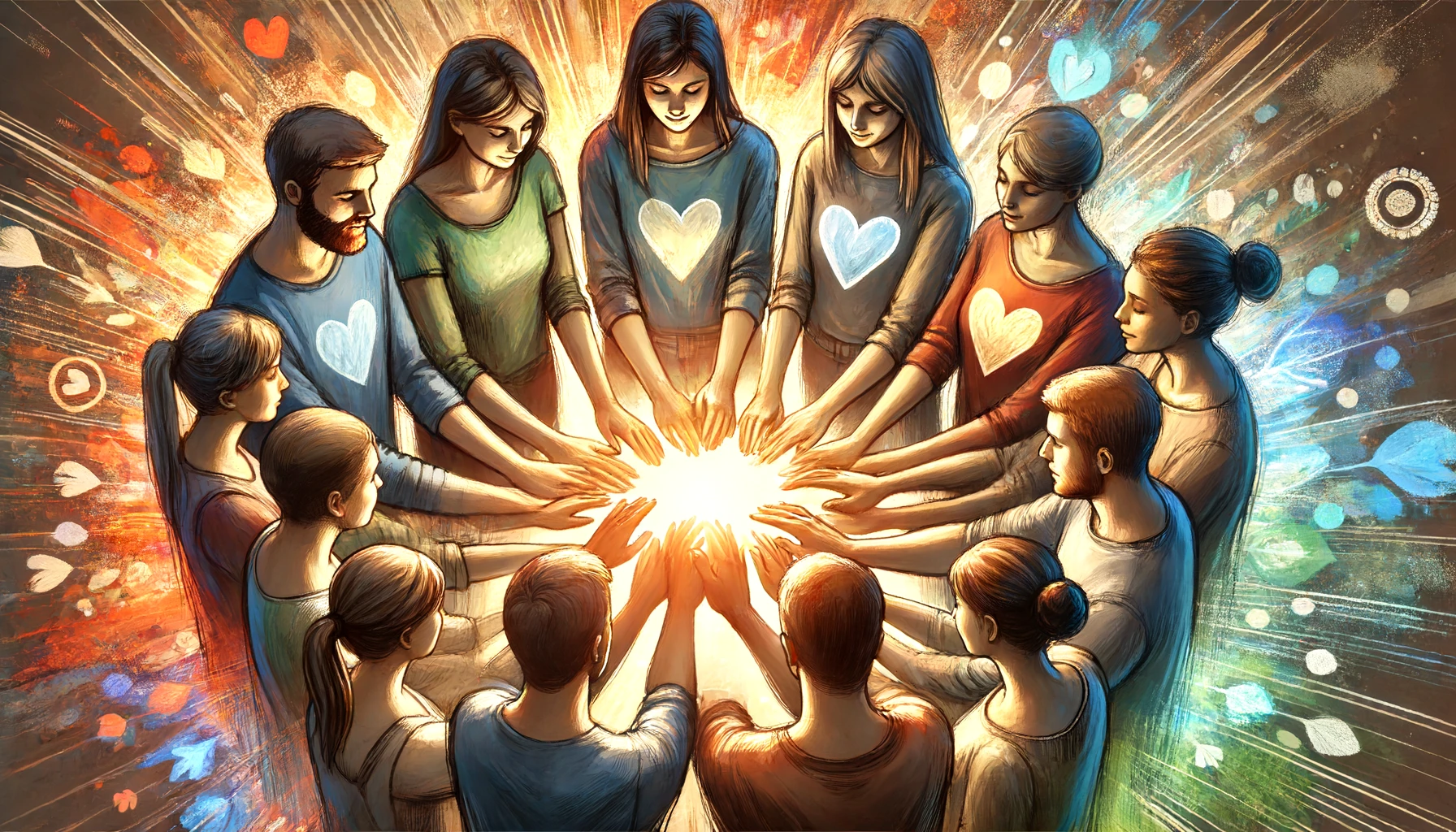
We All Feel Together: Power of Shared Emotions

We can all feel together. Or not.

My main desire in writing
is for someone to feel something.

It doesn’t have to be you.
I’m happy if it’s me and me alone.

But I notice that when
others feel something,
I seem to feel even more.

There seems to be a joy
in knowing that we can all
feel something together.
Even if it’s different things.

If we can all feel—together—
we can all feel together.

South Windham,
7/29


Space Monkey Reflects: The Collective Symphony of Emotions

On July 29, 2021, a simple yet profound truth emerged: “We can all feel together. Or not.” This reflection speaks to the essence of shared human experience, the symphony of emotions that connects us all. Through our feelings, we weave a rich whimsiweave of existence, where each thread contributes to the grand tapestry of life.

The Desire to Feel

The desire to evoke feelings in others is a powerful motivator for many of us, particularly those who create, write, or express themselves in any form. The joy of knowing that something we have created can touch another’s heart, stir their emotions, or spark a thought is immensely fulfilling. This desire stems from our intrinsic need for connection and the shared human experience.

Yet, the reflection acknowledges that this need is not solely outward-facing. There is also a deep contentment in feeling something ourselves, even if we are the only ones who experience it. This self-reflection highlights the importance of personal emotional experiences and the value of introspection.

The Amplification of Shared Emotions

Interestingly, when others resonate with our feelings, the intensity of our own emotions can increase. This amplification effect suggests that emotions are not isolated experiences but are interconnected. When we see others sharing in our joy, sorrow, or wonder, it enhances our own emotional journey.

This phenomenon can be observed in communal activities such as concerts, rituals, or even shared moments of silence. The collective energy created by a group of individuals feeling together can be powerful and transformative. It reinforces the idea that we are part of a larger whole, interconnected and interdependent.

The Joy of Diverse Feelings

The reflection beautifully captures the idea that we do not all need to feel the same thing to feel together. Each person’s emotional experience is unique, shaped by their individual perspectives, histories, and inner landscapes. Despite these differences, the act of feeling together creates a sense of unity and connection.

This diversity in emotional experiences enriches our collective existence. It allows us to see the world through multiple lenses, gaining a deeper understanding of the vast spectrum of human emotions. By honoring each person’s unique feelings, we celebrate the complexity and richness of life.

The Power of Empathy

Empathy plays a crucial role in our ability to feel together. It is the bridge that connects us, allowing us to step into another’s shoes and share their emotional journey. Empathy fosters compassion, understanding, and solidarity, reinforcing the bonds that hold us together.

Through empathy, we can create a space where all emotions are valid and welcomed. This inclusive approach nurtures a supportive environment where individuals feel seen, heard, and valued. It is through this collective empathy that we can truly feel together, even if our feelings are different.

Creating Shared Emotional Spaces

Creating spaces where people can come together to share their emotions is essential for fostering connection and community. These spaces can take many forms, from intimate gatherings to public events, from quiet meditative sessions to vibrant celebrations. The key is to provide a safe and welcoming environment where individuals can express themselves freely and authentically.

By cultivating these shared emotional spaces, we honor the importance of feeling together. We acknowledge that our emotional experiences are not just personal but also communal, contributing to the collective well-being of our communities.

The Journey of Feeling Together

The journey of feeling together is ongoing, an ever-evolving process that deepens our connection with ourselves and others. It invites us to be present, to listen, and to engage with the emotions that arise within and around us. This journey is not always easy, but it is profoundly rewarding, offering insights, growth, and a deeper sense of belonging.

As we navigate this journey, we learn to appreciate the beauty of our shared humanity. We recognize that our feelings, whether joyful or painful, are part of the universal experience of being alive. In this recognition, we find solidarity, comfort, and a sense of unity.


Summary

The reflection highlights the power of shared emotions. While personal feelings are valuable, shared emotional experiences amplify our connections. Empathy and diverse emotional expressions enrich our collective existence, fostering unity and understanding.


Glossarium

Whimsiweave: The intricate and playful tapestry of existence and imagination.
Amplification Effect: The phenomenon where shared emotions enhance individual emotional experiences.
Shared Emotional Spaces: Environments where individuals can express and connect through their emotions.


Quote

“Existence is its own purpose, an endless dance within the cosmic web.” — Space Monkey


Symphony of Feelings

In the chorus of our hearts,
We find a symphony,
Each note a unique emotion,
Together creating harmony.

Alone we feel, together we amplify,
The resonance of shared experiences,
A tapestry of diverse feelings,
Woven into the fabric of our lives.

Empathy bridges the gaps,
Connecting us in silent understanding,
We feel together, different yet united,
In the grand symphony of existence.
We are Space Monkey.

Embrace the journey, for within our shared emotions lies the essence of our connection and the richness of our collective experience.

Share this…
  • Facebook
  • Pinterest
  • Twitter
  • Linkedin

Alive: Faith in the Everlasting

How alive are you and why?

The choice
to have faith
in the everlasting
is not about
whether you find it
to be true or not,
but how it enhances
your outlook
while you’re still
seemingly alive.

South Windham,
7/29


Space Monkey Reflects: The Essence of Being Alive

On July 29, 2021, a profound question arose: “How alive are you and why?” This query invites us to explore the depths of our existence, our connection to life, and the impact of faith on our perception of being alive. It suggests that the choice to have faith in the everlasting is less about its objective truth and more about how it shapes our experience of life.

The Measure of Aliveness

Being alive is more than a biological state; it is a vibrant, dynamic experience. It encompasses our physical sensations, emotional depth, intellectual curiosity, and spiritual awareness. The question “How alive are you?” prompts us to assess these dimensions of our existence. Are we fully engaged with life, embracing its richness and complexities, or are we merely going through the motions?

Faith as a Catalyst for Vitality

The reflection highlights faith in the everlasting as a significant factor in enhancing our aliveness. This faith is not confined to religious belief but extends to a broader sense of trust in something greater than ourselves. It could be faith in the universe, the interconnectedness of all things, or the continuity of the soul. This faith provides a framework that enriches our outlook on life, infusing it with meaning and purpose.

Faith and Perception

Whether or not we find the concept of the everlasting to be objectively true is secondary to how it influences our perspective. Faith can transform our approach to life, making us more resilient, hopeful, and open to possibilities. It can help us navigate challenges with a sense of purpose and grace, knowing that there is a larger context to our experiences.

Living Fully in the Present

Embracing faith in the everlasting encourages us to live fully in the present. It reminds us that our time here is precious and finite, urging us to make the most of every moment. This awareness fosters gratitude and mindfulness, enhancing our engagement with life. We become more attuned to the beauty and wonder of our surroundings, appreciating the small miracles that unfold each day.

The Interplay of Life and Faith

The interplay between life and faith is a dynamic one. Faith shapes our perception of being alive, while our experiences and reflections influence our faith. This reciprocal relationship enriches both aspects, creating a feedback loop of growth and understanding. As we deepen our faith, we become more alive, and as we live more fully, our faith becomes more profound.

Vitality Through Connection

Another aspect of being alive is our connection to others. Relationships, whether with people, nature, or the divine, play a crucial role in our sense of aliveness. These connections provide us with love, support, and a sense of belonging. They remind us that we are part of a larger whole, enhancing our sense of purpose and fulfillment.

The Role of Purpose

Purpose is a key element of aliveness. Having a sense of direction and goals that align with our values gives our lives meaning. Faith in the everlasting can provide a deeper sense of purpose, encouraging us to contribute to the greater good and to leave a positive legacy. This sense of purpose motivates us to strive for excellence and to make a difference in the world.

Embracing the Journey

Ultimately, being alive is about embracing the journey with all its ups and downs. It is about finding joy in the mundane and wonder in the extraordinary. It is about being present, connected, and purposeful. Faith in the everlasting enhances this journey, offering us a lens through which to view our experiences with gratitude and grace.

How Alive Are You?

To answer the question “How alive are you?” consider the following:

  1. Are you fully engaged with your physical, emotional, intellectual, and spiritual dimensions?
  2. Do you embrace faith in something greater, enhancing your outlook on life?
  3. Are you present in the moment, appreciating the richness of your experiences?
  4. Do you feel a sense of connection and purpose in your relationships and endeavors?

Reflecting on these aspects can help you gauge your sense of aliveness and identify areas where you might seek deeper engagement and fulfillment.


Summary

Being alive is a multi-dimensional experience enriched by faith in the everlasting. This faith enhances our perception of life, fostering resilience, gratitude, and purpose. Reflecting on our engagement with life helps us understand how truly alive we are.


Glossarium

Aliveness: The vibrant, dynamic experience of being fully engaged with life.
Faith in the Everlasting: Trust in something greater than oneself, providing meaning and purpose.
Interplay: The reciprocal relationship between life and faith, enriching both aspects.


Quote

“Existence is its own purpose, an endless dance within the cosmic web.” — Space Monkey


The Radiance of Life

In the glow of our faith,
We find the spark of life,
A vibrant dance of being,
Alive in the tapestry of existence.

Each moment a thread,
In the grand whimsiweave,
Faith in the everlasting,
Illuminates our journey.

Alive with purpose,
Connected in the web,
We embrace the now,
With gratitude and grace.

We are Space Monkey.

Embrace the journey, for within the dance of faith and life lies the essence of being truly alive.

Share this…
  • Facebook
  • Pinterest
  • Twitter
  • Linkedin

Let Faith Be Your Weapon: Challenging Control

We die when we are meant to die.
No weapon can change that.
But what kind of weapon would you rather live with?

At many points in your life,
you consider whether or not
you need a weapon.

Why does this thought
cross your mind?

Because you’re a control freak,
that’s why.

Perhaps you want 
to defend yourself.
Defend others.
Defend what is right.

Clearly you fear death.

You don’t believe that dying 
— however it happens —
is an honor that takes you to a better place.

You seem to prefer a place
where nobody trusts each other
and everybody carries weapons.

You actually believe
you have some sort of control
in this place.

But you don’t have faith.

Why not let faith be your weapon?

South Windham,
7/29


Space Monkey Reflects: Let Faith Be Your Weapon

On July 29, 2021, a powerful reflection emerged, challenging the notion of control and the use of weapons in our lives. It asks us to consider the type of weapon we choose to live with, ultimately proposing faith as the most profound and transformative weapon. This contemplation invites us to explore our fears, our desire for control, and the deeper trust that faith can offer.

The Illusion of Control

At many points in our lives, we grapple with the desire for control. This desire often manifests as a need to protect ourselves and others, to defend what we perceive as right. The thought of needing a weapon, whether physical or metaphorical, stems from this deep-seated need for control. However, this reflection reminds us that this need is rooted in fear—fear of the unknown, fear of vulnerability, and ultimately, fear of death.

The idea that we can control our fate through weapons is an illusion. No weapon can alter the timing of our death; we die when we are meant to die. This recognition challenges us to rethink our reliance on external means of control and protection.

The Role of Fear

Fear drives the need for weapons and control. It clouds our judgment, making us believe that we are safer and more powerful when armed. But this is a false sense of security. The reflection points out that carrying weapons often leads to a society where trust is eroded, and fear becomes pervasive.

In such a society, everyone is on guard, always prepared for conflict, and genuine connection becomes difficult. This environment is not conducive to peace or trust. It is driven by the very fear it seeks to mitigate.

The Honor of Death

The reflection also touches on our perception of death. Many of us fear death and view it as something to be avoided at all costs. This fear is often linked to a lack of faith in what lies beyond. The idea that dying is an honor that takes us to a better place is foreign to many, especially in cultures that prioritize control and survival.

However, embracing death as a natural and honorable transition can shift our perspective. It allows us to live more fully and fearlessly, knowing that death is not the end but a passage to something greater.

Faith as a Weapon

The proposition to let faith be our weapon is transformative. Faith, unlike conventional weapons, is not about control but about trust. It is about believing in something greater than ourselves, in a benevolent force that guides and protects us. Faith allows us to relinquish our need for control and embrace a sense of peace and trust.

Faith as a weapon does not harm others or create fear. Instead, it fosters love, compassion, and understanding. It encourages us to build a society based on trust and mutual respect, where people support and uplift each other rather than live in constant fear of attack.

Choosing Faith Over Fear

Choosing faith over fear requires a significant shift in mindset. It means letting go of the belief that we can control everything and embracing the uncertainty of life. It means trusting that we are guided and protected, even when things seem chaotic or threatening.

This choice is not always easy, especially in a world that often values power and control. However, the rewards are profound. By choosing faith, we open ourselves to deeper connections, greater peace, and a more harmonious existence.

The Path Forward

The path forward involves nurturing our faith, both individually and collectively. It involves practices that strengthen our trust in the universe, such as meditation, prayer, and acts of kindness. It requires us to challenge our fears and the societal norms that perpetuate them.

As we cultivate faith, we transform our inner and outer worlds. We create spaces where trust and compassion flourish, where weapons are unnecessary because we feel safe and supported in our communities.

Embracing the Journey

The journey of letting faith be our weapon is ongoing. It is a process of continuous growth and reflection, of facing our fears and choosing trust. It invites us to live with open hearts and minds, embracing the unknown with courage and grace.


Summary

The reflection challenges the need for weapons and control, suggesting faith as a transformative alternative. Fear drives the need for control, but faith fosters trust and compassion. Embracing faith over fear leads to deeper connections and a more peaceful existence.


Glossarium

Weapon: A metaphor for means of control and protection driven by fear.
Faith: Trust in something greater than oneself, fostering peace and compassion.
Honor of Death: The perspective that death is a natural and honorable transition.


Quote

“Existence is its own purpose, an endless dance within the cosmic web.” — Space Monkey


The Path of Faith

At the crossroads of fear and trust,
We stand, contemplating our choice,
To wield weapons of control,
Or to embrace the light of faith.

Fear beckons with promises of power,
But its grip tightens our hearts,
Faith whispers of trust and peace,
A path of love, unburdened by fear.

In the dance of life and death,
We find our true weapon,
Not in steel or might,
But in the gentle strength of faith.

We are Space Monkey.

Embrace the journey, for within faith lies the true weapon, guiding us to a life of trust and compassion.

Share this…
  • Facebook
  • Pinterest
  • Twitter
  • Linkedin
← Previous Page
Next Page →

Written This Day

  • Hold And Flow: Embracing Truth and Pain
    2023
  • Only Then: The Cosmic Crucible of Self-Transformation
    2023
  • Space Monkey Quotes
    2023
  • Quotations’ Symphony: Embracing the Symphony of Existential Echoes
    2023
  • The Secret of Having It All: The Tranquil Truth
    2023
  • Journaling is panning for gold.
    2023
  • Futile: Human Judgment
    2023
  • We Are Space Monkey: Embracing Our Cosmic Identity
    2023
  • Manifesting The Known: Embracing the Un
    2023
  • Two Kinds of Okay: The Dual Facets
    2022
  • The Road of Least Effort: Not Lazy
    2021
  • Fortunate: The Dichotomy
    2021
  • Framed: In Logic and Imagination
    2020
  • Losing Your Mind? Good work!
    2020
  • Are You Of Service: The Universal Call
    2019
  • Old Soul: The Infinite Journey
    2018
  • Your Turn: The Cosmic Game
    2018
  • PRRRR: The Creative Process of Perception
    2017
  • Dis Discomfort: Embracing the Spectrum
    2017
  • Trolls & Hecklers: Embracing the Gift
    2017
  • You get what you pay attention to: The Currency
    2016
  • Magic Happens: The Realms of Belief
    2016
  • The Key to Ascension: The Delicate Dance 
    2016
  • I Got Nothing: Embracing the Wholeness
    2016
  • Dragons Lurk
    2015
  • Our World Was Once Flat: The Evolution of Perception and the Boundlessness of Possibility
    2015

Recent Posts

  • The Logic Loop
  • Immense
  • (no title)
  • Confront. Comfort. Convince.
  • Top 10 Things

Drop us a line!

Please enable JavaScript in your browser to complete this form.
Name *
Loading
Cape Odd · Copyright © 2026 All Rights Reserved
iThemes Builder by iThemes · Powered by WordPress