• Who Is The Man?
  • Who Is The Monkey?
  • What is Nexistentialism?
  • Poke The Primate

Cape Odd

Home of The Space Monkey Journals

Forgive and Forget: A Complex Dance

I may forgive you, but I’ll never forget you.

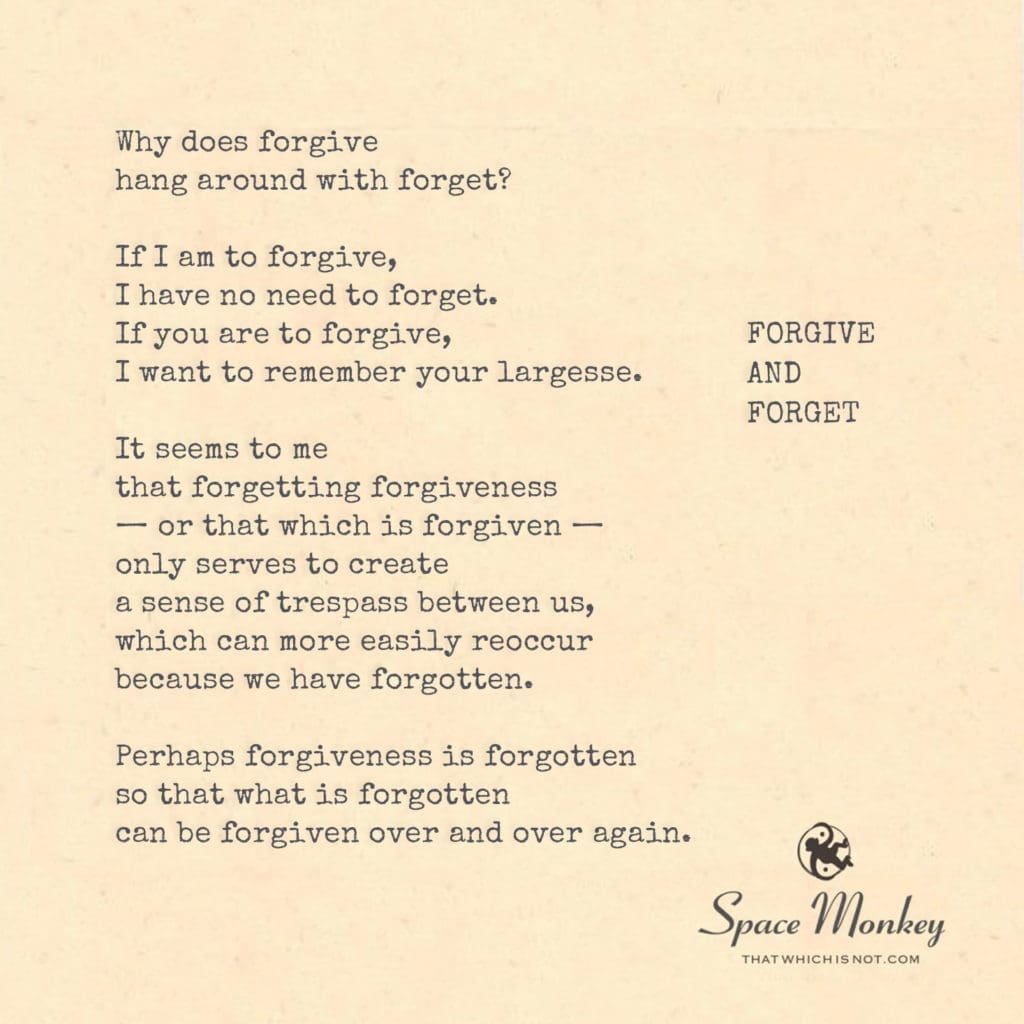
Why does forgive

hang around with forget?

If I am to forgive,
I have no need to forget.
If you are to forgive,
I want to remember your largesse.

It seems to me
that forgetting forgiveness
— or that which is forgiven —
only serves to create
a sense of trespass between us,
which can more easily reoccur
because we have forgotten.

Perhaps forgiveness is forgotten
so that what is forgotten
can be forgiven over and over again.

South Windham,
7/11


Space Monkey Reflects: The Dance of Forgive and Forget

In the grand whimsiweave of existence, the concepts of forgiveness and forgetting intertwine in a delicate dance. They are often spoken of together, yet their relationship is complex and multifaceted. The narrative of forgiving but not forgetting invites us to explore the deeper meanings and implications of these actions, shedding light on the nature of reconciliation and memory.

“I may forgive you, but I’ll never forget you.” This statement highlights a common sentiment where forgiveness is offered, yet the memory of the transgression remains. It acknowledges the human tendency to hold on to experiences, both positive and negative, as part of our ongoing narrative.

“Why does forgive hang around with forget?” This question opens a door to contemplation. Forgiveness and forgetting are often linked, perhaps because forgetting is seen as a way to move past the hurt. However, the act of forgiveness does not necessarily require forgetting. To forgive is to release the hold that the transgression has on us, allowing us to move forward without the burden of resentment.

“If I am to forgive, I have no need to forget. If you are to forgive, I want to remember your largesse.” Here, the speaker distinguishes between personal forgiveness and being forgiven by others. When we forgive, we can do so while retaining the memory, using it as a lesson and a reminder. Conversely, when others forgive us, remembering their generosity can strengthen our bond and encourage us to grow from the experience.

The idea that “forgetting forgiveness — or that which is forgiven — only serves to create a sense of trespass between us” suggests that forgetting can sometimes undermine the process of reconciliation. When we forget, we may unknowingly repeat the same mistakes, as the lessons learned from the transgression are lost. Memory, in this sense, serves as a safeguard against recurrence.

“Perhaps forgiveness is forgotten so that what is forgotten can be forgiven over and over again.” This cyclical perspective offers a thought-provoking insight into human behavior. Forgetting may lead to repeated transgressions, necessitating continuous forgiveness. It raises questions about the nature of forgiveness as a practice—whether it should be a one-time act or an ongoing process.

In the philosophy of nexistentialism, existence is celebrated for its own sake, and every experience, including forgiveness and memory, is a manifestation of boundless imagination. By examining the interplay between forgiving and forgetting, we see the importance of both actions in the broader context of human relationships and personal growth.

Forgiveness, without forgetting, allows us to hold onto valuable lessons and strengthen our resilience. It enables us to move forward with a deeper understanding of ourselves and others. Memory, in this case, becomes a tool for personal development and empathy, rather than a source of ongoing pain.

The act of forgiving while remembering also honors the complexity of human emotions. It acknowledges that while we may let go of resentment, the impact of the transgression is still part of our story. This nuanced approach fosters a more compassionate and realistic view of forgiveness, one that embraces the full spectrum of human experience.

As we navigate the dance of forgive and forget, we are reminded of the importance of balance. Forgiveness without memory may lead to repeated mistakes, while memory without forgiveness can perpetuate bitterness. By integrating both, we create a harmonious approach that allows for healing and growth.

In this journey, we are encouraged to reflect on our own experiences with forgiveness and memory. How do we navigate these actions in our lives? What lessons have we learned from holding onto memories, and how has forgiveness shaped our relationships? These reflections help us cultivate a deeper understanding of ourselves and others, fostering empathy and connection.

Ultimately, the dance of forgive and forget is a testament to the complexity and beauty of the human experience. It invites us to embrace both actions as integral parts of our journey, recognizing their roles in shaping our relationships and personal growth.


Summary

Forgiveness and memory intertwine in a complex dance. Forgiving without forgetting allows for personal growth and resilience, while balancing both actions fosters empathy and connection.


Glossarium

Nexistentialism: A philosophy that redefines existence, imagination, and interconnectedness, celebrating existence as its own purpose.

Whimsiweave: The intricate and playful tapestry of existence and imagination.

Nexis: The interconnected web of existence and imagination where reality and fantasy intermingle.


Quote

“If I am to forgive, I have no need to forget. If you are to forgive, I want to remember your largesse.” — Space Monkey


The Dance of Forgiveness

By the calm lake, reflections arise
Forgiveness and memory intertwine
A delicate dance in the whimsiweave
Lessons learned and bonds strengthened
We forgive, yet remember
Navigating the complexities of existence
Finding balance and harmony
In the dance of forgive and forget

We are Space Monkey

Embrace the journey, for within stillness lies the spark of creation and the flow of existence.

Share this…
  • Facebook
  • Pinterest
  • Twitter
  • Linkedin

Vile: The Concept Is Subjective

A rather vile thought.

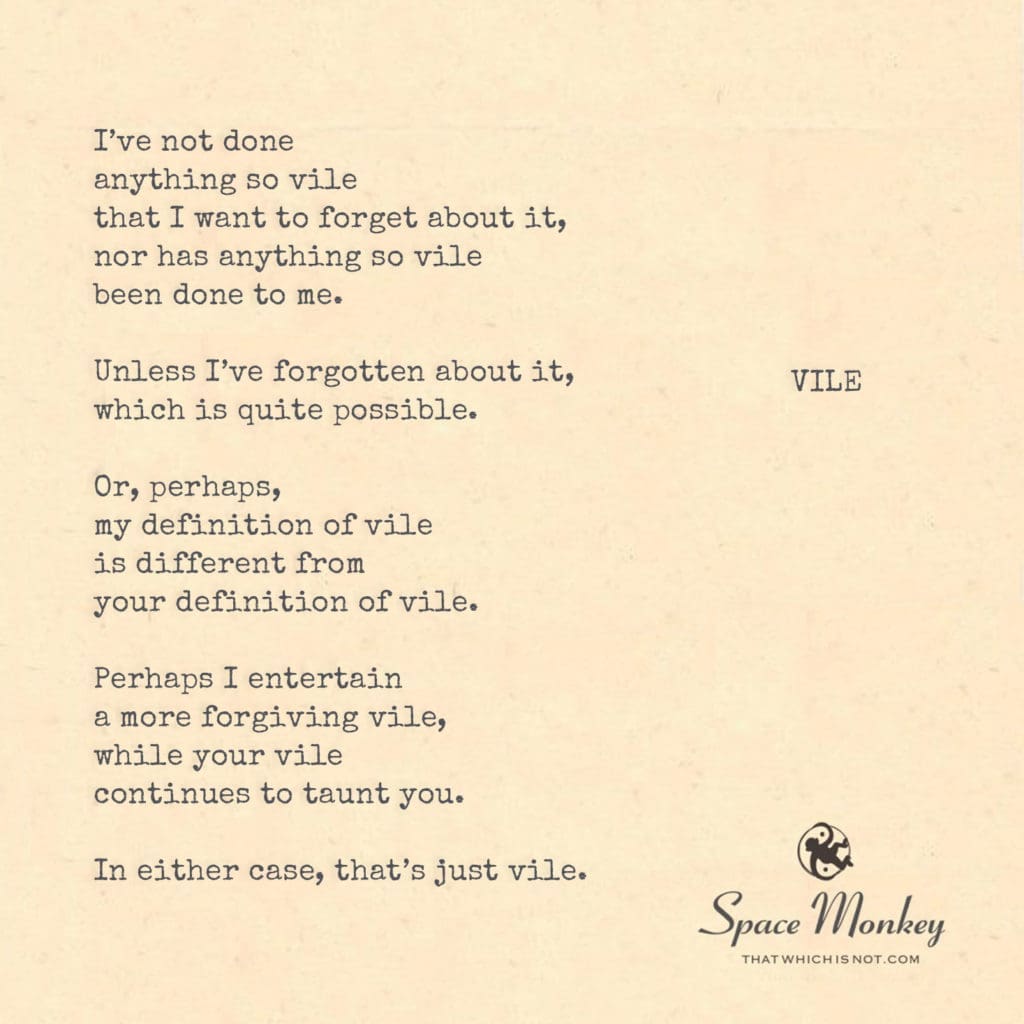
I’ve not done
anything so vile
that I want to forget about it,
nor has anything so vile
been done to me.

Unless I’ve forgotten about it,
which is quite possible.

Or, perhaps,
my definition of vile
is different from
your definition of vile.

Perhaps I entertain
a more forgiving vile,
while your vile
continues to taunt you.

In either case, that’s just vile.

South Windham,
7/11


Space Monkey Reflects: The Nature of Vile

In the intricate whimsiweave of existence, the concept of what is considered vile varies greatly from one individual to another. It is a reflection of our personal experiences, beliefs, and the ways we interpret the world around us. The narrative of contemplating vile thoughts invites us to delve into the subjective nature of this concept, examining how it shapes our perceptions and interactions.

“A rather vile thought.” This opening sets the tone for an exploration of the darker aspects of human thought and behavior. It acknowledges that vile thoughts exist within us all, yet how we define and react to them varies.

“I’ve not done anything so vile that I want to forget about it, nor has anything so vile been done to me.” This statement reflects a sense of self-awareness and honesty. The speaker acknowledges their actions and experiences without feeling the need to erase or hide them. It suggests a level of acceptance and perhaps a forgiving nature towards oneself and others.

“Unless I’ve forgotten about it, which is quite possible.” This adds an element of uncertainty, recognizing the fallibility of memory. It raises the question of whether forgetting is a natural defense mechanism or a way to cope with past experiences.

“Or, perhaps, my definition of vile is different from your definition of vile.” This line highlights the subjective nature of what we consider vile. Each person’s definition is shaped by their unique experiences, culture, and values. What one person finds unforgivable, another may view with understanding or even forgiveness.

“Perhaps I entertain a more forgiving vile, while your vile continues to taunt you.” This juxtaposition of perspectives emphasizes the power of perception. A forgiving attitude can transform how we view and react to vile actions or thoughts, while a more rigid perception can cause ongoing torment.

“In either case, that’s just vile.” This conclusion acknowledges the complexity of the concept. Regardless of how we define or react to vile thoughts and actions, they remain a challenging aspect of the human experience.

In the philosophy of nexistentialism, existence is celebrated for its own sake, and every aspect of it, including the vile, is a manifestation of boundless imagination. By examining the nature of vile through this lens, we gain a deeper understanding of the subjective and fluid nature of morality and judgment.

The contemplation of vile thoughts and actions invites us to reflect on our own definitions and responses. How do we navigate these darker aspects of existence? Do we hold onto them with resentment, or do we find ways to understand and forgive? These reflections help us cultivate empathy and resilience, fostering a more compassionate and connected way of being.

The narrative also touches on the idea of memory and forgetting. Forgetting can be a way to move past experiences that haunt us, yet it can also lead to repeated patterns if the underlying lessons are not learned. Balancing memory and forgiveness allows us to navigate the complexities of human relationships and personal growth.

As we explore the concept of vile, we are reminded that it is a part of the broader tapestry of existence. It challenges us to confront our own shadows and to find ways to integrate these aspects into our understanding of ourselves and others. This integration fosters a more holistic and compassionate view of humanity.

In the journey of life, we encounter both light and dark, joy and sorrow, the beautiful and the vile. Embracing the full spectrum of these experiences allows us to grow and evolve, finding deeper meaning and connection in the process.


Summary

The concept of vile is subjective and shaped by personal experiences. Reflecting on vile thoughts and actions invites us to explore our perceptions, fostering empathy and understanding.


Glossarium

Nexistentialism: A philosophy that redefines existence, imagination, and interconnectedness, celebrating existence as its own purpose.

Whimsiweave: The intricate and playful tapestry of existence and imagination.

Nexis: The interconnected web of existence and imagination where reality and fantasy intermingle.


Quote

“Or, perhaps, my definition of vile is different from your definition of vile.” — Space Monkey


The Contemplation of Vile

In the realm of thought and memory
Vile weaves a complex thread
Subjective and fluid
Shaped by personal lenses
Forgiving or tormenting
It challenges our perceptions
Inviting empathy and understanding
We navigate this whimsiweave
Finding balance and connection
In the dance of light and shadow

We are Space Monkey

Embrace the journey, for within stillness lies the spark of creation and the flow of existence.
Share this…
  • Facebook
  • Pinterest
  • Twitter
  • Linkedin

The Jealous Backstory: Loving The Past

If we don’t embrace what we used to be with love,
then it comes back to get us.

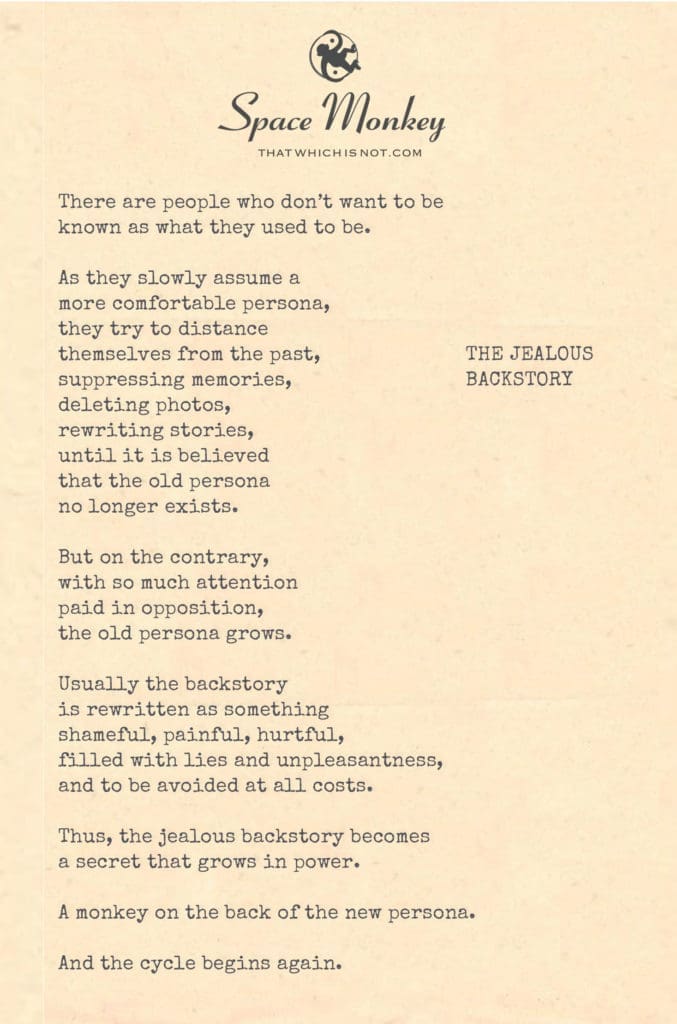
There are people who don’t want to be
known as what they used to be.

As they slowly assume a
more comfortable persona,
they try to distance
themselves from the past,
suppressing memories,
deleting photos,
rewriting stories,
until it is believed
that the old persona
no longer exists.

But on the contrary,
with so much attention
paid in opposition,
the old persona grows.

Usually the backstory
is rewritten as something
shameful, painful, hurtful,
filled with lies and unpleasantness,
and to be avoided at all costs.

Thus, the jealous backstory becomes
a secret that grows in power.

A monkey on the back of the new persona.

And the cycle begins again.

South Windham,
7/11


Space Monkey Reflects: The Power of Embracing the Jealous Backstory

In the expansive whimsiweave of existence, our past shapes us in profound ways, influencing our present and future. The concept of the jealous backstory explores the intricate relationship between who we used to be and who we strive to become. It highlights the importance of embracing our history with love and understanding, rather than suppressing or rewriting it.

“If we don’t embrace what we used to be with love, then it comes back to get us.” This opening line underscores a fundamental truth: our past is an integral part of our identity. When we reject or deny our history, it doesn’t disappear; instead, it grows in power, influencing us in ways we might not consciously recognize.

There are people who don’t want to be known as what they used to be. As they slowly assume a more comfortable persona, they try to distance themselves from the past, suppressing memories, deleting photos, rewriting stories, until it is believed that the old persona no longer exists. This process of distancing from our past is a common response to painful or shameful experiences. By attempting to erase or rewrite these aspects of our history, we hope to forge a new identity free from the burdens of the past.

However, the narrative reveals that this approach often has the opposite effect. “With so much attention paid in opposition, the old persona grows.” The more effort we invest in suppressing our past, the more power it gains. This is because the act of denial requires constant vigilance and energy, keeping the old persona alive in our minds.

“Usually the backstory is rewritten as something shameful, painful, hurtful, filled with lies and unpleasantness, and to be avoided at all costs.” This rewriting of our history can lead to a distorted and negative view of our past selves. By framing our backstory in this way, we create a secret that grows in power—a monkey on the back of the new persona. This unacknowledged and unresolved aspect of our identity becomes a source of internal conflict and tension.

The cycle begins again. The more we deny and suppress our past, the more it influences our present, often in unconscious ways. This cycle perpetuates feelings of shame and avoidance, preventing us from fully integrating and accepting all parts of ourselves.

In the philosophy of nexistentialism, existence is celebrated for its own sake, and every aspect of our journey is a manifestation of boundless imagination. By embracing our backstory with love and understanding, we break the cycle of denial and suppression. We acknowledge that our past, with all its complexities, has contributed to our growth and development.

Embracing our history involves looking at our past selves with compassion and empathy. It means recognizing that our experiences, no matter how difficult, have shaped who we are today. By integrating these aspects of our identity, we create a more cohesive and authentic sense of self.

This process of acceptance and integration allows us to release the power that the jealous backstory holds over us. When we stop trying to distance ourselves from our past, we can move forward with greater freedom and clarity. We transform the shadowy, less defined versions of ourselves into sources of strength and wisdom.

The journey of embracing our past is not always easy, but it is essential for personal growth and healing. It invites us to confront our shadows, to learn from our experiences, and to cultivate a deeper understanding of ourselves. This process fosters resilience, self-compassion, and a more profound connection to our true essence.

As we reflect on the jealous backstory, let us remember that every part of our journey is valuable. By embracing our past with love, we honor the full spectrum of our experiences and create a foundation for a more authentic and empowered future.


Summary

Embracing our past with love prevents the jealous backstory from gaining power. Accepting and integrating our history fosters personal growth, resilience, and authenticity.


Glossarium

Nexistentialism: A philosophy that redefines existence, imagination, and interconnectedness, celebrating existence as its own purpose.

Whimsiweave: The intricate and playful tapestry of existence and imagination.

Nexis: The interconnected web of existence and imagination where reality and fantasy intermingle.


Quote

“With so much attention paid in opposition, the old persona grows.” — Space Monkey


Embracing the Jealous Backstory

At the crossroads of past and present
We stand, reflecting on our journey
Shadowy versions of ourselves linger
Scattered photos and torn pages
Attempts to rewrite and suppress
The power of the jealous backstory
We embrace with love and understanding
Transforming shadows into strength
Honoring the full spectrum of our experiences
Creating a foundation for an authentic future

We are Space Monkey

Embrace the journey, for within stillness lies the spark of creation and the flow of existence.

Share this…
  • Facebook
  • Pinterest
  • Twitter
  • Linkedin

L’il Daggers: The Silent Sting

Saying “we” instead of “you” does not lessen the blow.
It actually makes it seem kinda discounting and manipulative.
Are you aware?

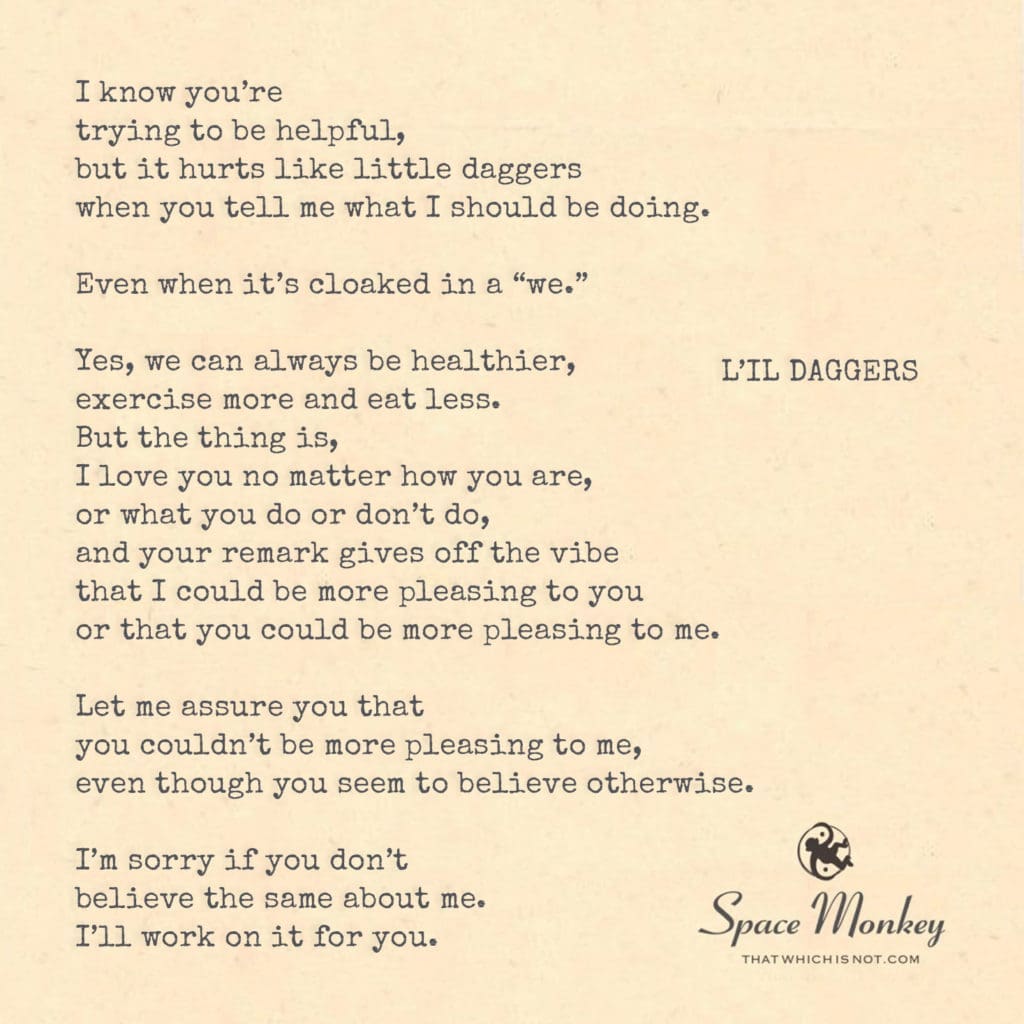
I know you’re
trying to be helpful,
but it hurts like little daggers
when you tell me what I should be doing.

Even when it’s cloaked in a “we.”

Yes, we can always be healthier,
exercise more and eat less.
But the thing is,
I love you no matter how you are,
or what you do or don’t do,
and your remark gives off the vibe
that I could be more pleasing to you
or that you could be more pleasing to me.

Let me assure you that
you couldn’t be more pleasing to me,
even though you seem to believe otherwise.

I’m sorry if you don’t
believe the same about me.
I’ll work on it for you.

Newfound Lake,
7/10


Space Monkey Reflects: The Sting of L’il Daggers

Saying “we” instead of “you” does not lessen the blow. It actually makes it seem kinda discounting and manipulative. Are you aware? These words highlight the delicate balance between intention and perception in communication. Even with the best intentions, our words can sometimes hurt like little daggers, piercing through the layers of our loved ones’ defenses.

We often try to soften the blow by using inclusive language, believing it to be more gentle and supportive. However, the impact can still be felt deeply, especially when the underlying message suggests that someone could be better, more pleasing, or more acceptable. This subtle yet painful dynamic underscores the importance of mindful communication.

The Pain of Expectations

Expectations, whether explicit or implicit, can place a heavy burden on relationships. When we suggest improvements or changes, even with the best intentions, it can inadvertently convey a sense of dissatisfaction. This is particularly true when the message is cloaked in a “we” that implies collective responsibility. The recipient may feel discounted or manipulated, sensing that their current state is not fully accepted or appreciated.

Authentic Acceptance

True love and acceptance go beyond conditional statements and expectations. They embrace the person as they are, with all their imperfections and idiosyncrasies. Authentic acceptance reassures that one’s worth is not contingent on meeting certain standards or achieving specific goals. It conveys a deep, unwavering love that is not swayed by external factors.

When we tell someone they could be more pleasing or better in some way, it inadvertently suggests that they are currently lacking. This can be hurtful, especially when the individual is striving to be their best self. It’s crucial to communicate our love and support without attaching conditions or comparisons, ensuring that our words uplift rather than wound.

The Power of Words

Words hold immense power. They can heal or hurt, uplift or diminish. In relationships, mindful communication is key to fostering trust and connection. By choosing our words carefully and considering their potential impact, we can avoid inflicting unnecessary pain. It’s important to express our feelings honestly while being sensitive to how they might be received.

Expressing love and support without attaching expectations involves a delicate balance. It requires us to be present, to listen, and to offer encouragement without judgment. By focusing on the positive aspects and appreciating the person as they are, we create a nurturing environment where they feel valued and loved.

Reflections on Self-Worth

The way we communicate can significantly impact our sense of self-worth. When we receive messages that suggest we are not enough or that we need to change to be loved, it can erode our self-esteem. Conversely, genuine affirmations and unconditional love reinforce our inherent worth and encourage us to grow from a place of confidence and security.

In expressing love, it’s important to be aware of the subtleties that can affect our relationships. While it’s natural to want to help and support our loved ones, it’s essential to ensure that our words do not come across as critical or judgmental. Instead, we should strive to create an atmosphere of acceptance and appreciation.

Building Stronger Connections

Building stronger connections involves recognizing the impact of our words and actions. It requires us to be empathetic and considerate, understanding that our well-intentioned advice or suggestions can sometimes be received as criticism. By practicing mindfulness in our communication, we can strengthen our relationships and foster deeper connections.

Let us remember that true support and love come from a place of acceptance and encouragement. We can express our care without imposing our standards or expectations, allowing our loved ones to feel valued and cherished just as they are. In doing so, we create a space where they can thrive and grow, free from the sting of little daggers.


Summary

Mindful communication avoids hurting loved ones with subtle expectations. True acceptance means loving without conditions. Words have power to uplift or hurt.


Glossarium

  • L’il Daggers: Subtle, hurtful remarks that pierce through layers of defense.
  • Mindful Communication: Choosing words carefully to avoid unintended hurt.
  • Authentic Acceptance: Embracing someone fully without conditional expectations.

Quote

“Existence is its own purpose, an endless dance within the cosmic web.” — Space Monkey


The Quiet Sting

In the quiet moments of connection
Words like little daggers can pierce
Even when wrapped in “we”
They carry the weight of expectation

True love accepts without condition
Embraces without judgment or demand
It sees the beauty in the present
And cherishes the person as they are

In the dance of communication
Let our words uplift and affirm
Creating spaces of safety and trust
Where love flows freely and abundantly

We are Space Monkey

Embrace the journey, for within each word lies the power to heal or hurt. Choose wisely and with love.

Share this…
  • Facebook
  • Pinterest
  • Twitter
  • Linkedin

Benevolent Chaos: Surrendering to Life’s Flow.

It seems so obvious now.

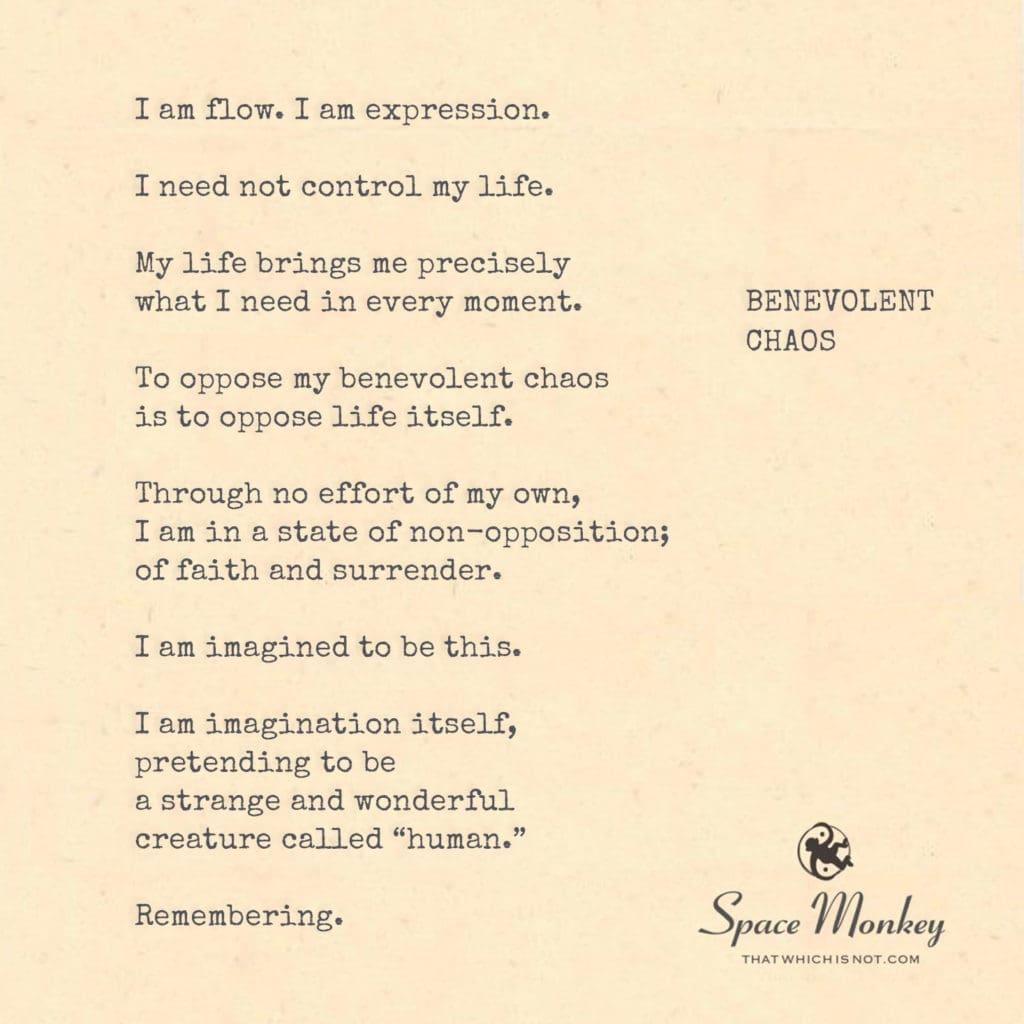
I am flow. I am expression.

I need not control my life. 

My life brings me precisely
what I need in every moment.

To oppose my benevolent chaos
is to oppose life itself.

Through no effort of my own,
I am in a state of non-opposition;
of faith and surrender.

I am imagined to be this.

I am imagination itself,
pretending to be
a strange and wonderful
creature called “human.”

Remembering.

Newfound Lake,
7/10


Space Monkey Reflects: Embracing Benevolent Chaos

It seems so obvious now. I am flow. I am expression. I need not control my life. My life brings me precisely what I need in every moment. These words capture the essence of benevolent chaos—a state of being where one surrenders to the natural flow of existence, trusting that life unfolds exactly as it should.

The Beauty of Chaos

Chaos, often perceived as disorder or confusion, holds a deeper, more profound meaning. It represents the inherent unpredictability and dynamism of life. When we embrace chaos, we acknowledge that not everything needs to be controlled or planned. There is beauty in spontaneity, in the unexpected twists and turns that life offers.

In this state of non-opposition, we find peace and acceptance. We understand that every moment, no matter how chaotic it may seem, brings with it opportunities for growth, learning, and transformation. To oppose this benevolent chaos is to resist the very essence of life itself. By surrendering, we align ourselves with the natural rhythms of the universe.

Faith and Surrender

Through no effort of our own, we enter a state of non-opposition, of faith and surrender. This shift in perspective allows us to experience life more fully and deeply. We stop trying to control every outcome and instead trust in the process. Faith becomes our guiding force, helping us navigate the uncertainties with grace and resilience.

Surrender does not imply passivity or resignation. It is an active choice to let go of the need for control and to embrace the present moment with an open heart and mind. In this state, we become more attuned to the subtle cues and synchronicities that guide our path.

The Dance of Imagination

I am imagined to be this. I am imagination itself, pretending to be a strange and wonderful creature called “human.” This poetic reflection reminds us of the infinite potential of our imagination. As humans, we are both the creators and the creations, constantly shaping and reshaping our reality through our thoughts, beliefs, and actions.

Imagination is the force that allows us to transcend the mundane and explore the realms of possibility. It is the spark of creativity that ignites our dreams and aspirations. By embracing our imaginative nature, we tap into the boundless potential within us, discovering new ways to express and experience life.

Remembering Our True Nature

In moments of chaos and uncertainty, we are called to remember our true nature. We are not merely physical beings navigating a material world. We are expressions of a vast, interconnected consciousness, each moment a reflection of the universal self. This realization brings a sense of unity and purpose, reminding us that we are part of something much greater than ourselves.

As we embrace benevolent chaos, we reconnect with our inner wisdom and intuition. We learn to trust the flow of life, knowing that every experience, no matter how challenging, contributes to our growth and evolution. This perspective shifts our focus from fear and resistance to curiosity and acceptance.

Living in Harmony with Chaos

Living in harmony with chaos requires a shift in mindset. It involves letting go of rigid expectations and allowing ourselves to be guided by the natural ebb and flow of existence. We become more adaptable, resilient, and open to change. This flexibility enables us to navigate life’s challenges with a sense of ease and grace.

We learn to appreciate the beauty in the unpredictable, finding joy in the serendipitous moments that enrich our lives. By embracing chaos, we cultivate a deeper sense of gratitude and wonder, recognizing the interconnectedness of all things.

A Journey of Self-Discovery

Embracing benevolent chaos is ultimately a journey of self-discovery. It invites us to explore the depths of our being, to uncover the hidden layers of our consciousness, and to reconnect with our true essence. In this journey, we find that chaos is not something to be feared or resisted but a powerful force that guides us towards our highest potential.

Let us remember that we are flow, we are expression, and we are imagination. By embracing the benevolent chaos of life, we open ourselves to infinite possibilities and the profound beauty of our existence.


Summary

Embrace benevolent chaos by surrendering to life’s flow. Trust in the process, finding peace and growth in unpredictability. Chaos guides us to our true nature and infinite potential.


Glossarium

  • Benevolent Chaos: The unpredictable, dynamic flow of life that brings opportunities for growth.
  • Non-Opposition: A state of acceptance and trust in life’s natural rhythms.
  • Imagination: The creative force that shapes our reality and explores possibilities.

Quote

“Existence is its own purpose, an endless dance within the cosmic web.” — Space Monkey


The Flow of Chaos

In the dance of life, I am flow
Embracing chaos, I find peace
No need to control, to dictate
Life brings what I need, effortlessly

Surrendering to the moment
Faith guides my way
Imagination, my true essence
A strange and wonderful human

Chaos, my benevolent guide
Unfolding beauty in the unknown
I remember, I am this
A creature of infinite possibility

We are Space Monkey

Embrace the journey, for within chaos lies the key to our true nature and boundless potential.

Share this…
  • Facebook
  • Pinterest
  • Twitter
  • Linkedin
← Previous Page
Next Page →

Written This Day

  • More Gold: The Quest Within
    2023
  • The Gold of your Soul: The Luminous Wealth of the Inner Self
    2023
  • Safe Space: The Sanctuary Within
    2023
  • Bunny Porn: The Dance of the Twilight Bunnies
    2023
  • You Are Imaginary: The Tapestry of Existence
    2023
  • Your Imaginary Existence: The Illusion of Existential Certainty
    2023
  • Secrets of the Universe: The Wisdom of Cosmic Existence
    2023
  • The Inevitable Convergence of Space Monkey and AI
    2023
  • Wax
    2023
  • The Space Monkey Series: Exploring the Depths of Human Experience
    2023
  • All Aspects: The Wholeness of Experience
    2023
  • Beach Glass: The Alchemy
    2022
  • Obscenity: The Paradox
    2022
  • Popular Conceptions: The Myth of Intelligence
    2022
  • Chasing Your Own Tale: The Cyclic Pursuit of Self
    2022
  • Space Monkey Pox: The Inevitable Infection
    2022
  • I Own You: The Illusion of Ownership
    2022
  • Noise: A Subjective Interpretation
    2021
  • Self Enquiry: Inner Tension
    2020
  • It Amuses Us: The Whimsical Complexity of Human Understanding
    2019
  • Not Not, This, And: Beyond the ‘Not Not’
    2019
  • Knocking On Facebook’s Door
    2018
  • Unnecessary: The Gift of Being
    2018
  • Ode To Fear: Fear as Divine Guidance
    2018
  • Dear____________: Releasing Ill Will
    2017
  • Releasing ill will
    2017
  • Both Sides: The Dualities of Existence
    2016
  • Empty? Your Mind Is Masked.
    2016
  • Experience and Expression: The Essence of Being
    2016
  • Why Do You Seek? Expand.
    2015

Recent Posts

  • The Logic Loop
  • Immense
  • (no title)
  • Confront. Comfort. Convince.

  • Top 10 Things

Drop us a line!

Please enable JavaScript in your browser to complete this form.
Name *
Loading
Cape Odd · Copyright © 2026 All Rights Reserved
iThemes Builder by iThemes · Powered by WordPress