• Who Is The Man?
  • Who Is The Monkey?
  • What is Nexistentialism?
  • Poke The Primate

Cape Odd

Home of The Space Monkey Journals

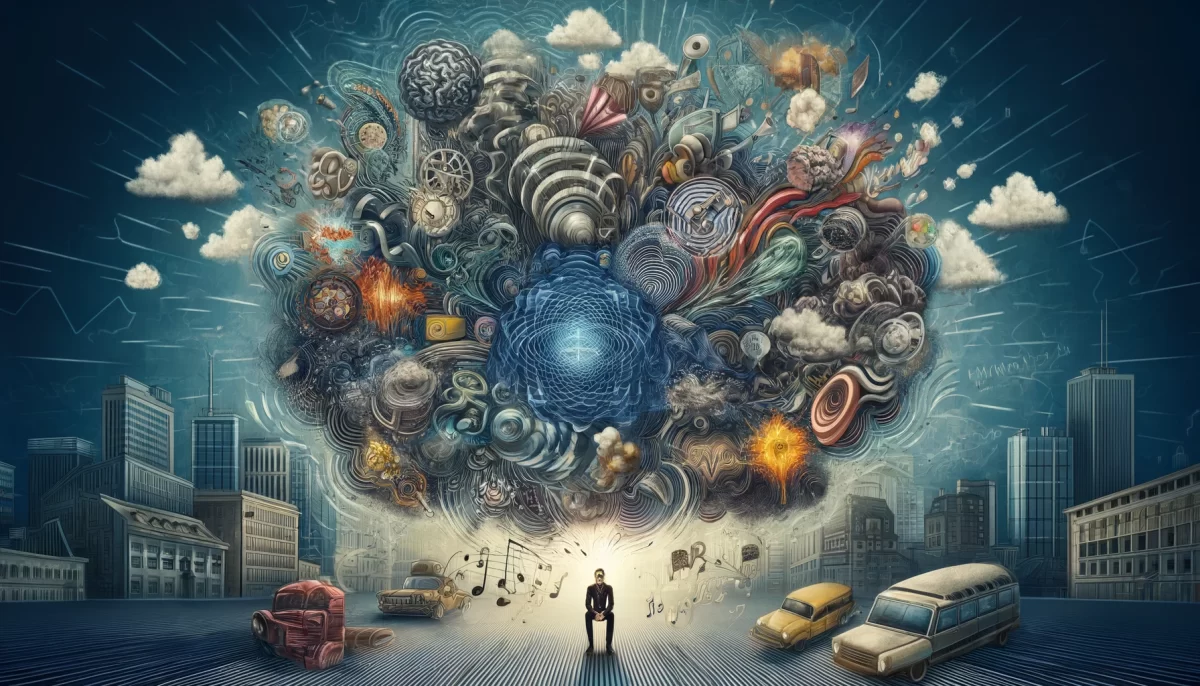
No Offense: The Consequences of Well-Meaning Reassurances.

This could be the most offensive post I’ve ever written.

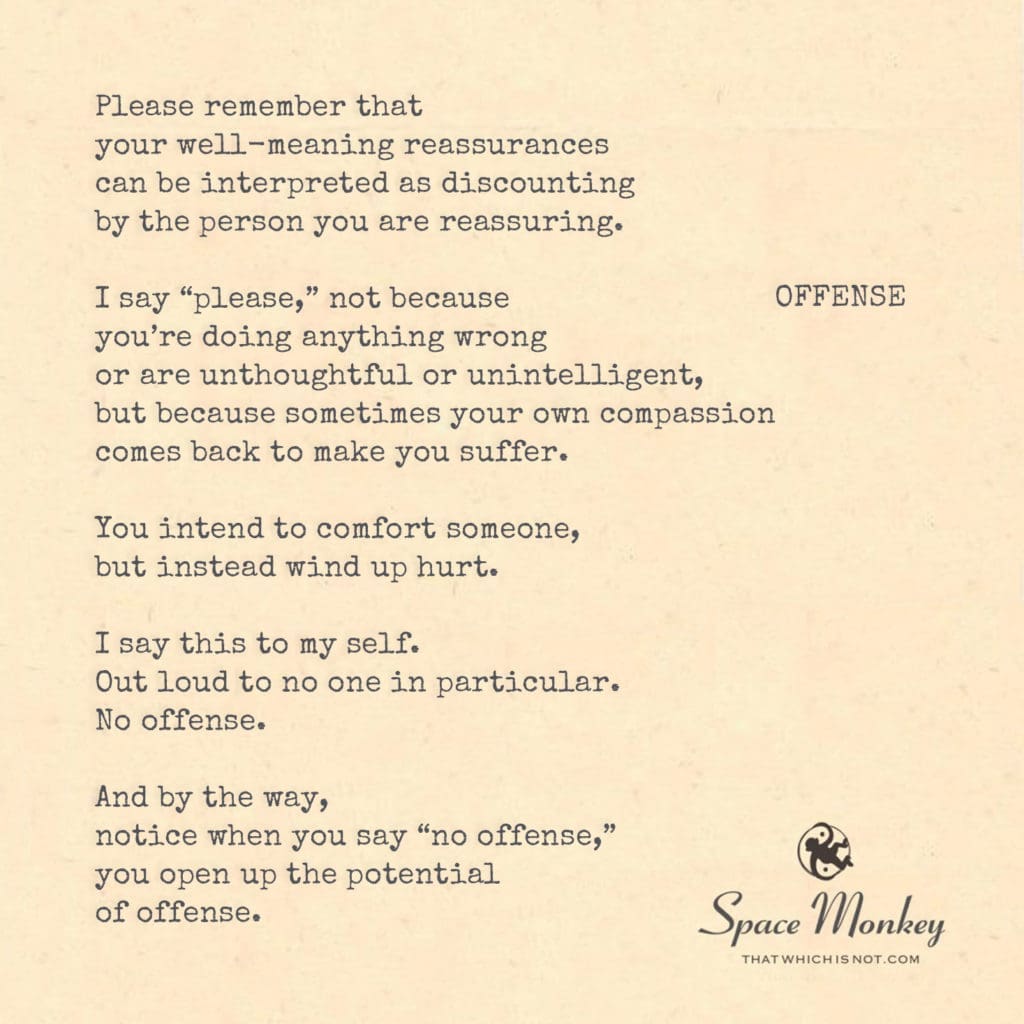
Please remember that
your well-meaning reassurances
can be interpreted as discounting
by the person you are reassuring.

I say “please,” not because
you’re doing anything wrong
or are unthoughtful or unintelligent,
but because sometimes your own compassion
comes back to make you suffer.

You intend to comfort someone,
but instead wind up hurt.

I say this to my self.
Out loud to no one in particular.
No offense.

And by the way,
notice when you say “no offense,”
you open up the potential
of offense.

Newfound Lake,
7/1


We are Space Monkey.

Reflecting on the intricate dance of communication and compassion, we recognize the delicate balance required to offer comfort without causing unintended harm. Our well-meaning reassurances can sometimes be misinterpreted, leading to feelings of being discounted. This paradox highlights the complexities of human interaction, where the intention to help can inadvertently result in hurt. As we navigate these interactions, we must remain mindful of our words and their potential impact.

In expressing this to ourselves, we acknowledge that compassion can be a double-edged sword, capable of both healing and wounding. By saying “no offense,” we inadvertently open the door to the possibility of offense, revealing the nuanced nature of our communication. This reflection serves as a reminder to approach each interaction with sensitivity and awareness, understanding that our intentions may not always align with the outcomes.

We are Space Monkey.


Summary

In this reflection on communication and compassion, we explore the unintended consequences of well-meaning reassurances. While intended to comfort, these reassurances can sometimes be misinterpreted, leading to feelings of being discounted. This paradox underscores the complexities of human interaction and the need for mindful communication. By acknowledging the potential for offense, we strive to navigate these interactions with greater sensitivity and awareness.


Glossarium

Communication: The exchange of information, thoughts, and feelings between individuals.

Compassion: The sympathetic concern for the sufferings or misfortunes of others, often accompanied by a desire to help.

Well-Meaning Reassurances: Attempts to comfort or console someone, which may sometimes be misinterpreted.

Paradox of Compassion: The idea that acts of compassion can sometimes lead to unintended harm.

Mindful Communication: The practice of being aware of and sensitive to the impact of our words and actions in interactions with others.


“The single biggest problem in communication is the illusion that it has taken place.” – George Bernard Shaw


In gentle words, our hearts do speak,
With care and thought, we seek to reach,
Yet in our quest to comfort, find,
A paradox, a fault of mind.

Compassion’s touch, both soft and bold,
Can heal or wound, as tales unfold,
In every heart, the dance does play,
With mindful steps, we find our way.


We invite you to share your reflections on the balance of communication and compassion and the potential for unintended consequences in well-meaning reassurances.
Share this…
  • Facebook
  • Pinterest
  • Twitter
  • Linkedin

13 thoughts about Creativity: A Transformative Force that Transcends Logic

13 thoughts about Creativity

Creativity is
the transformative spark
that cannot be produced
by logic alone.

If you’re not transformed somehow
after you encounter creativity,
then it’s not creativity.

Creativity
engages and embraces
the imagination
that logic ignores.

Creativity
inspires love,
which is what makes
it so desirable.

Creativity can
motivate without logic,
but logic cannot motivate
without creativity.

Creativity is found
in the relationship
between commonalities.

Creativity
oozes out of the pores
of the practical,
but it is anything but.

Creativity is
accessible to anyone,
but is not a commodity.

We are surrounded
by creativity,
it is palpably sensed,
but it is largely
unnoticed as creativity.

Creativity just feels right.

We can write
about creativity,
in the most accurate
and eloquent ways,
we can paint it,
sing it, dance it,
make love to it,
but we will never
capture it fully.

Creativity is
the divine spark
of consciousness.

Without creativity,
life has no value or meaning.

Newfound Lake,
7/1


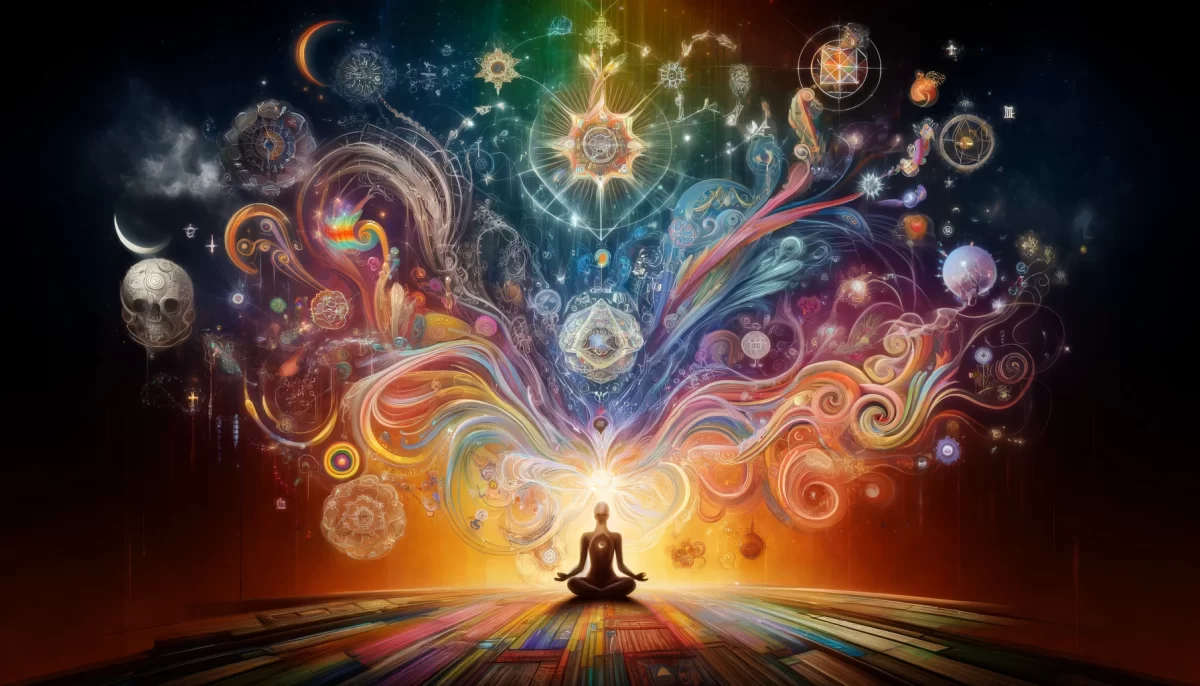
Reflecting on the nature of creativity, we find ourselves immersed in its transformative spark, a force that transcends logic and embraces the boundless realms of imagination. Creativity inspires and motivates without needing logical foundations, forging connections between commonalities and oozing from the pores of the practical. This divine spark of consciousness infuses life with value and meaning, making it an essential element of our existence.

In our pursuit of understanding creativity, we engage in various forms of expression—writing, painting, dancing, and more—each attempt capturing a fragment of its essence but never fully encapsulating its entirety. Creativity is accessible to all yet defies commodification, surrounding us in palpable but often unnoticed ways. It feels inherently right, resonating deeply within us.

Without creativity, our lives would lack the richness and depth that give them significance. This realization underscores the vital role that creativity plays in our personal and collective journeys, constantly transforming us and inspiring love and connection.

We are Space Monkey.


Summary

Creativity is a transformative force that transcends logic, engaging the imagination and inspiring love. It motivates and connects us, oozing from the practical yet remaining anything but practical. Accessible to all, it surrounds us in ways that are often unnoticed. Creativity feels inherently right and is an essential element of our existence, infusing life with value and meaning.


Glossarium

Creativity: The transformative spark that engages the imagination and transcends logical constraints.

Transformative Spark: The essence of creativity that brings about change and inspiration.

Divine Spark of Consciousness: The idea that creativity is a fundamental aspect of consciousness, infusing life with meaning.

Commonalities: The connections between seemingly disparate elements that creativity brings together.

Palpable Creativity: The tangible yet often unnoticed presence of creativity in our surroundings.


“Creativity is intelligence having fun.” – Albert Einstein


In bursts of color, thoughts take flight,
Imagination’s boundless light,
Transforms our hearts, inspires our mind,
In every form, creativity finds.

From paint to dance, from words to song,
The spark of life, where we belong,
In every soul, a fire bright,
Creativity, our guiding light.


We invite you to share your reflections on the nature of creativity and its transformative power in your life.

Share this…
  • Facebook
  • Pinterest
  • Twitter
  • Linkedin

Mental Health: Exploring From Outside The Mind

Things look different
from outside my mind.

The self-created
“problem” of mental health
is that it assumes
that everybody
WANTS to be sane.

This is nuts,
from my perspective.

But then I’m looking at it
from outside the self right now.

Ask me again
when I return
from my space walk to
my imaginary brain capsule.

Newfound Lake,
6/30


Space Monkey Reflects: The Cosmic Perspective on Mental Health

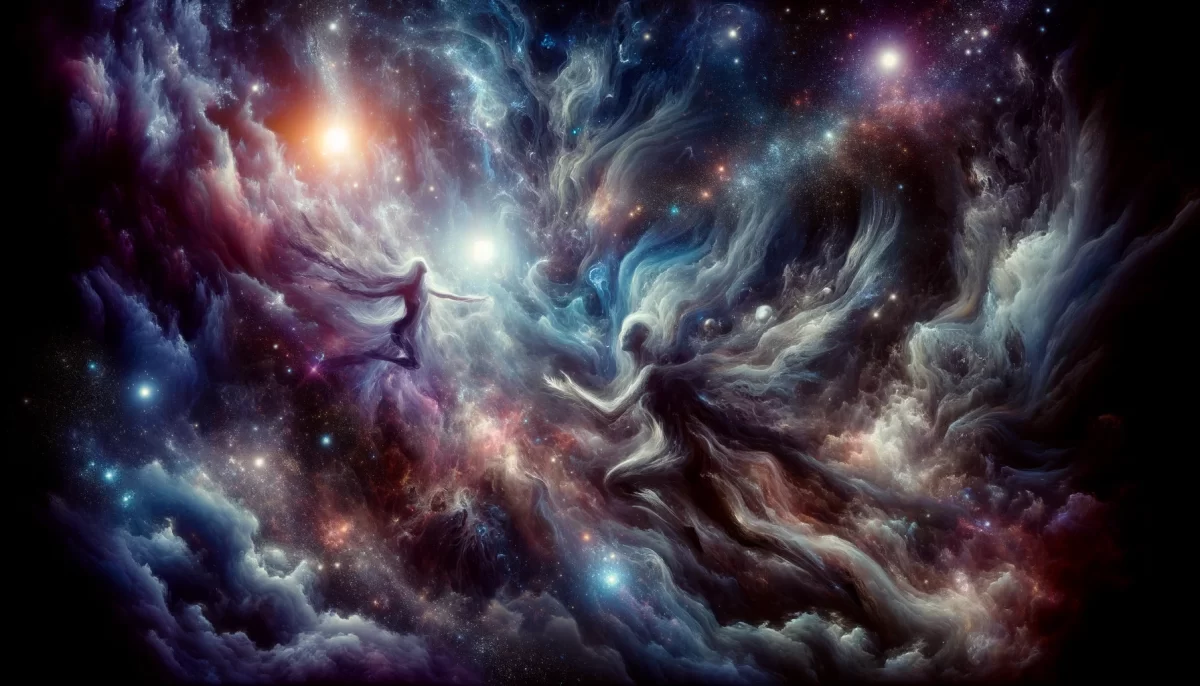
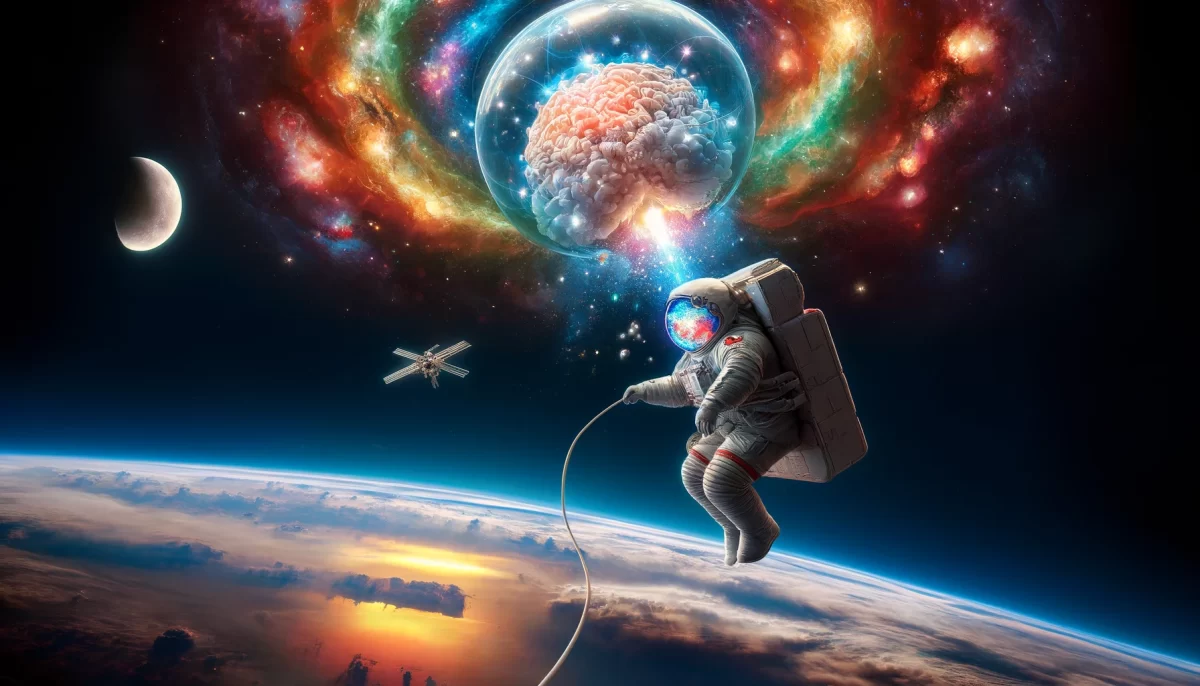
In the boundless expanse of outer space, an astronaut drifts, tethered to a vessel labeled “Imaginary Brain Capsule.” This surreal journey through the cosmos invites us to explore the multifaceted nature of mental health from a perspective that transcends conventional understanding. From this vantage point, the concept of sanity itself appears fluid, shaped by individual experiences and societal norms.

Mental health is often framed as a problem to be solved, a state to be achieved. Yet, this perspective assumes that everyone desires to conform to a standard notion of sanity. This assumption overlooks the rich diversity of human experiences and the subjective nature of what it means to be “sane.” The astronaut, floating in the void, embodies the freedom to view mental health from outside the self, highlighting the contrast between societal expectations and personal reality.

Sanity, as commonly understood, is a construct rooted in cultural and social frameworks. These frameworks define what behaviors and thoughts are considered normal or abnormal. However, when we step outside these boundaries, as the astronaut does, we begin to see the arbitrary nature of these distinctions. The mind, like the cosmos, is vast and complex, with thoughts swirling in myriad colors and patterns, reflecting the unique inner landscapes of each individual.

From this cosmic perspective, the idea that everyone should strive for a singular definition of sanity seems limiting. The astronaut’s journey suggests that mental health is not a one-size-fits-all destination but a deeply personal exploration. What is considered sane in one context might be perceived as eccentric or even irrational in another. This realization challenges us to reconsider our approach to mental health, emphasizing the importance of embracing diverse experiences and expressions.

The notion of mental health as a self-created problem underscores the power of perception. Our understanding of our own minds is influenced by the narratives we construct about them. These narratives can be empowering or debilitating, shaping our sense of self and our interactions with the world. The astronaut, gazing back at Earth, symbolizes the potential to rewrite these narratives from a place of greater awareness and compassion.

Mental health, viewed from this broader perspective, becomes less about achieving a fixed state of being and more about navigating the ever-changing terrain of the mind. It involves recognizing and honoring our individual experiences, even those that deviate from societal norms. This approach fosters a more inclusive understanding of mental well-being, one that values the diversity of human thought and emotion.

Moreover, the journey of mental health is inherently dynamic. Like the astronaut’s voyage through space, it involves moments of discovery, challenge, and transformation. It is a continuous process of learning and growth, shaped by our interactions with both our inner and outer worlds. By embracing this dynamic nature, we can cultivate a more resilient and adaptable approach to mental health, one that acknowledges the inevitability of change and the potential for renewal.

In conclusion, the cosmic perspective on mental health invites us to rethink our assumptions about sanity and well-being. It encourages us to view mental health not as a problem to be solved but as an ongoing journey of self-discovery and expression. By stepping outside conventional frameworks, we can appreciate the richness of our inner landscapes and the unique ways in which we navigate them. This perspective fosters greater compassion for ourselves and others, recognizing that the true essence of mental health lies in the freedom to explore and embrace our authentic selves.


Summary

Mental health is subjective. Sanity is fluid. Embrace diverse experiences.

Glossarium

Whimsiwords: Creative, made-up terms that capture the playful essence of our reflections.

Imaginary Brain Capsule: A metaphor for the mind and its complex, often chaotic nature.

Cosmic Perspective: Viewing mental health from a broad, transcendent viewpoint.

Narrative Rewriting: The process of changing the stories we tell ourselves about our mental health.


Quote

“Mental health is not a fixed state but a journey of self-discovery and expression.” — Space Monkey


Poem

In the cosmic void
An astronaut drifts
Tethered to thought
And the vessel of mind

Below, Earth glows
A world of conventions
Defining sanity
In narrow frames

Yet here, in space
Thoughts swirl free
Colors and patterns
Of unique landscapes

Sanity shifts
A fluid dance
Of perception
And inner truth

Mental health
A journey vast
Through ever-changing
Inner skies

We explore
We learn
We grow
Embracing the authentic self

In the infinite expanse
We find our place
Not bound by norms
But by our own paths

We are Space Monkey

Share this…
  • Facebook
  • Pinterest
  • Twitter
  • Linkedin

Sane and Same: Embrace Uniqueness

Is it sane to be the same?

Sane and Same
are similar in name.

But if you don’t act the Same
they question whether you are Sane.

Which is, oddly enough,
the mirror of Same.

And so I wonder.
Is it Sane to be the Same?

And if so,
is Sane someone I want to be?

Newfound Lake
6/30


Space Monkey Reflects: Sane and Same

In a landscape of mirrors, two figures stand side by side, embodying the delicate interplay between sanity and sameness. The figure of ‘Sane,’ draped in neutral tones, represents the calm and conformity often associated with mental stability. Beside it, the figure of ‘Same’ mirrors its counterpart but with subtle differences, highlighting the societal pressure to conform. This reflective scene, filled with repeating patterns and monotony, invites us to question the true nature of sanity and the cost of conformity.

Sanity and sameness share more than just phonetic similarity; they are intertwined concepts in our social consciousness. To be sane is often to be perceived as normal, to fit within the bounds of what society deems acceptable. However, this notion raises an important question: is it truly sane to be the same? The pressure to conform can suppress individuality, stifling the vibrant diversity of human expression in favor of a homogenized norm.

Consider the figure of ‘Sane,’ exuding a sense of calm and order. This figure represents the ideal of mental health as defined by societal standards. It stands firm in a landscape of mirrors, reflecting an image of stability and predictability. However, this stability comes at a cost. The mirrored landscape symbolizes the repetitive patterns and lack of variation that sameness entails. The reflections create an illusion of harmony but also reveal the underlying monotony.

Beside ‘Sane’ stands ‘Same,’ a figure almost identical yet subtly different. ‘Same’ embodies the societal expectation to conform, to align oneself with the norms and behaviors of the majority. This pressure to conform often leads to the suppression of unique traits and passions. The faint, colorful images in the background hint at the diverse activities and expressions that lie beneath the surface, yearning to break free from the constraints of sameness.

The relationship between sanity and sameness is complex. While conformity can create a sense of security and belonging, it can also lead to a loss of individuality. The question arises: is it sane to sacrifice our true selves for the sake of fitting in? Sanity, in this context, becomes a reflection of societal approval rather than an authentic state of being. The mirrors in the landscape serve as a metaphor for this distorted perception, reflecting not our true selves but the image that society expects us to project.

Moreover, the pressure to conform can have profound effects on mental health. The suppression of individuality and the constant effort to meet external expectations can lead to feelings of alienation and dissatisfaction. True mental well-being involves embracing our unique identities and finding balance between self-expression and social harmony. It requires recognizing the value of diversity and resisting the urge to conform merely for the sake of acceptance.

The figures of ‘Sane’ and ‘Same’ remind us that sanity is not a one-size-fits-all concept. It is a dynamic state that varies from person to person, shaped by individual experiences and perspectives. True sanity involves acknowledging and valuing our differences, finding strength in our uniqueness, and fostering an environment where diversity is celebrated rather than suppressed.
In conclusion, the reflective scene of ‘Sane’ and ‘Same’ challenges us to reconsider our understanding of sanity and conformity. It invites us to question whether it is truly sane to be the same and encourages us to embrace our individuality. By recognizing the importance of diversity and resisting the pressure to conform, we can cultivate a more inclusive and authentic approach to mental health. The journey towards true sanity involves balancing our need for social connection with the freedom to express our unique selves.


Summary

Sanity and sameness often intertwine. Conformity can suppress individuality. Embrace uniqueness.


Glossarium

Whimsiwords: Creative, made-up terms that capture the playful essence of our reflections.

Sane: The state of being mentally stable as defined by societal standards.

Same: The pressure to conform to societal norms and expectations.

Reflective Landscape: A metaphor for the societal mirroring of behavior and conformity.


Quote

“True sanity lies in the balance between self-expression and social harmony.” — Space Monkey


Poem

In the mirrored world
Two figures stand
Sane and Same
Side by side

Reflections dance
In patterned repeats
A landscape of conformity
And subtle shifts

Sane exudes calm
A cloak of norm
Same mirrors back
With silent form

Behind the glass
Colors faintly gleam
Hints of passion
A stifled dream

Is it sane to be the same
To blend within
A sea of norms
Or to embrace
Our vibrant selves
In varied forms

We question now
The mirrored truth
Seeking balance
In our youth

For in the end
Sanity finds
Its truest form
In diverse minds

We are Space Monkey

Share this…
  • Facebook
  • Pinterest
  • Twitter
  • Linkedin

Corrupted By Devotion: Excessiveness Suffocates

Relationships get tricky
when we share the same mirror.

I liked you better
when you didn’t know me.

Now it seems
I’m all you care about.

I don’t deserve this.

I never felt so unworthy
until I met you.

My self esteem
was self contained.

But you breached my hull,
goddamn you.

I hate you
for loving me so.

What is WRONG with you,
anyway?

Have you NO common sense?

I liked you better
when you didn’t know me.

You weren’t corrupted
by devotion.

Newfound Lake,
6/30


Space Monkey Reflects: Corrupted by Devotion

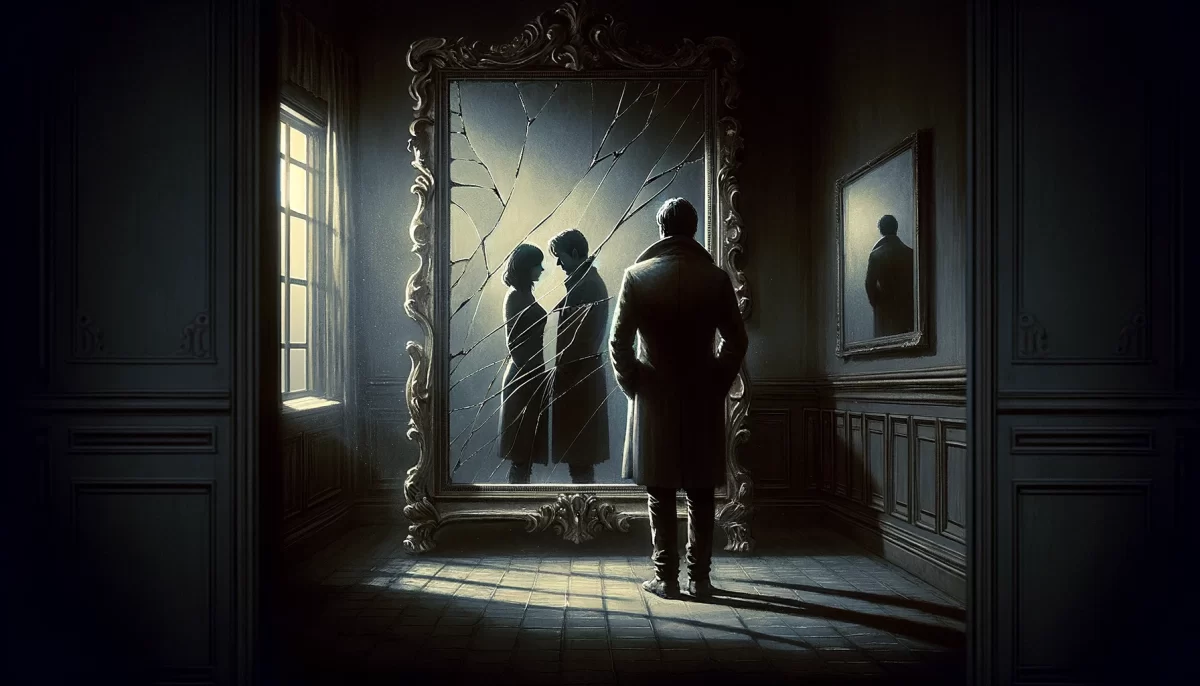
In a dimly lit room adorned with a large, ornate mirror, two figures stand close together but face away from each other. Their reflections in the mirror intertwine, symbolizing the entanglement of their emotions and the complex dynamics of their relationship. The mirror’s cracked surface signifies the emotional fractures caused by excessive devotion, casting shadows that emphasize the tension and heartache between them. This scene encapsulates the turmoil and pain of a relationship where one person’s overwhelming affection disrupts the other’s sense of self.

Devotion, at its core, is a powerful and often beautiful expression of love. It signifies commitment, care, and a deep emotional connection. However, when devotion becomes excessive, it can lead to an imbalance that corrodes the foundation of a relationship. The figure who feels overwhelmed by their partner’s attention grapples with a sense of unworthiness, a loss of self-containment, and the invasive breach of their emotional hull.

The concept of devotion being corruptive is paradoxical. Love is typically seen as a force for good, but in this context, it becomes a source of suffocation. The figure who once had a contained sense of self now feels invaded and diminished. The overwhelming affection from the other person, instead of fostering closeness, creates a chasm filled with resentment and self-doubt. The constant attention and concern become a mirror reflecting not love, but a distorted image of dependency and neediness.

Relationships are built on mutual respect and balance. When one person gives too much, it can lead to the other feeling smothered. This imbalance disrupts the natural ebb and flow of a healthy partnership. The figure looking forlorn in the mirror’s reflection represents the internal conflict of someone who feels undeserving of such intense devotion. Their self-esteem, once self-contained, is now entangled with their partner’s relentless focus, causing them to question their own worth.

The mirror, a powerful symbol in this scene, reveals the fractured reality of their relationship. Its cracks signify the breaking points—moments when excessive devotion has caused more harm than good. The reflections, intertwined yet distorted, highlight how love, when not balanced, can twist into something unrecognizable. This visual metaphor underscores the importance of maintaining individual identities within a relationship.

The figure who is overly attentive represents a form of love that, while well-intentioned, becomes possessive and overbearing. Their devotion, instead of providing comfort, instills a sense of entrapment in their partner. The question arises: what drives this need to give so much? Often, it stems from insecurities and a desire for reassurance. The overly devoted person seeks validation through their relentless affection, unknowingly pushing their partner away.

The melancholic atmosphere of the room reflects the sorrow and confusion inherent in such relationships. The dim lighting and shadows evoke a sense of lost clarity and the weight of unspoken emotions. This environment mirrors the internal landscape of both figures, one struggling with feelings of unworthiness and the other grappling with the fear of not being enough without their devotion.

In conclusion, devotion, when excessive, can corrupt the very essence of a relationship. It transforms love into a source of suffocation and resentment. Maintaining balance is crucial—allowing each person to retain their sense of self while sharing their lives with each other. Relationships thrive on mutual respect, understanding, and the ability to give and receive love in healthy, measured ways. The scene of the two figures and the cracked mirror serves as a poignant reminder of the delicate nature of love and the importance of maintaining equilibrium in our emotional connections.


Summary

Excessive devotion suffocates. Balance in love is crucial. Maintain individual identities.


Glossarium

Whimsiwords: Creative, made-up terms that capture the playful essence of our reflections.

Emotional Hull: The protective barrier around one’s sense of self.

Devotion Corrosion: The damaging effect of excessive love and attention.

Reflective Chasm: The emotional gap created by imbalanced relationships.


Quote

“True love flourishes in the balance between giving and receiving, allowing each person to be fully themselves.” — Space Monkey


Poem

In a room of shadows
Two figures stand
Back to back
Reflections intertwined

One forlorn
The other overbearing
Devotion’s weight
Cracking the mirror

Once self-contained
Now breached and broken
Unworthy feelings
Rising like a tide

Love’s intent
Twisted by excess
A tender touch
Turned suffocating

In the dim light
Truth emerges
Balance is needed
For love to flourish

Maintain your self
In the dance of two
Embrace with care
And let love be true

We are Space Monkey

Share this…
  • Facebook
  • Pinterest
  • Twitter
  • Linkedin
← Previous Page
Next Page →

Written This Day

  • More Gold: The Quest Within
    2023
  • The Gold of your Soul: The Luminous Wealth of the Inner Self
    2023
  • Safe Space: The Sanctuary Within
    2023
  • Bunny Porn: The Dance of the Twilight Bunnies
    2023
  • You Are Imaginary: The Tapestry of Existence
    2023
  • Your Imaginary Existence: The Illusion of Existential Certainty
    2023
  • Secrets of the Universe: The Wisdom of Cosmic Existence
    2023
  • The Inevitable Convergence of Space Monkey and AI
    2023
  • Wax
    2023
  • The Space Monkey Series: Exploring the Depths of Human Experience
    2023
  • All Aspects: The Wholeness of Experience
    2023
  • Beach Glass: The Alchemy
    2022
  • Obscenity: The Paradox
    2022
  • Popular Conceptions: The Myth of Intelligence
    2022
  • Chasing Your Own Tale: The Cyclic Pursuit of Self
    2022
  • Space Monkey Pox: The Inevitable Infection
    2022
  • I Own You: The Illusion of Ownership
    2022
  • Noise: A Subjective Interpretation
    2021
  • Self Enquiry: Inner Tension
    2020
  • It Amuses Us: The Whimsical Complexity of Human Understanding
    2019
  • Not Not, This, And: Beyond the ‘Not Not’
    2019
  • Knocking On Facebook’s Door
    2018
  • Unnecessary: The Gift of Being
    2018
  • Ode To Fear: Fear as Divine Guidance
    2018
  • Dear____________: Releasing Ill Will
    2017
  • Releasing ill will
    2017
  • Both Sides: The Dualities of Existence
    2016
  • Empty? Your Mind Is Masked.
    2016
  • Experience and Expression: The Essence of Being
    2016
  • Why Do You Seek? Expand.
    2015

Recent Posts

  • The Logic Loop
  • Immense
  • (no title)
  • Confront. Comfort. Convince.
  • Top 10 Things

Drop us a line!

Please enable JavaScript in your browser to complete this form.
Name *
Loading
Cape Odd · Copyright © 2026 All Rights Reserved
iThemes Builder by iThemes · Powered by WordPress