• Who Is The Man?
  • Who Is The Monkey?
  • What is Nexistentialism?
  • Poke The Primate

Cape Odd

Home of The Space Monkey Journals

Noise: A Subjective Interpretation

Noise

What is noise?

What is the difference
between noise and nature
or noise and music
or noise and anything else?

A sound is just a sound.
A thought is just a thought.
A feeling is just a feeling.

Somehow I determine 
if it’s noise or not.

It only seems to be noise
when I oppose it.
Otherwise it’s just there.
I may not even notice it.

It seems that noise
is something I don’t want to sense.

Something that “shouldn’t be there.”

Something that seems to be altering
my state of mind in a way I don’t like.

But on the bright side:

When I sense “noise,”
physically or mentally,
It reminds me that I get 
to
CHOOSE how I feel about it.

Noise reminds me
that noise doesn’t affect me
— I affect me.

Too much information. Noise.
Too many thoughts. Noise.
Obligations. Hunches. Worries.
Noise, noise, noise.

Why do I feel so much noise?

A very, very, good reason.

Noise points me to stillness.

Thank you, noise.

Trail Wood,
5/23


Space Monkey Reflects: The Paradox of Noise in Our Lives

What is noise, truly? Is it merely a sound that’s unwanted, or is it something more—an indicator of our internal state and our perceptions of the external world? The concept of noise stretches far beyond the audible into the cacophony of daily existence, encompassing the whirlwind of thoughts, feelings, and sensory stimuli that can either disrupt or deepen our sense of being.

Noise is often defined not inherently by its volume or its nature, but by our reaction to it. A sound becomes noise when we decide it is unwanted or intrusive. It becomes a disruption when it opposes our desired state of mind. This subjective transformation of sound into noise reflects our internal conflicts and resistances more than it speaks to the qualities of the sound itself.

Consider the differentiations we make: noise versus nature, noise versus music, noise versus silence. Each distinction is deeply personal, a product of individual experiences and expectations. For one person, the rustling of leaves might be a soothing natural symphony, while for another, it’s an annoying distraction. Music played loudly may be exhilarating to some and oppressive to others. Thus, noise is not a universal constant but a personal interpretation.

Noise’s omnipresence in our lives serves as a constant reminder of our ability to choose our responses. It challenges us to question why certain sounds or thoughts are labeled as disturbances. Why do some noises seem to penetrate our peace, altering our mood and mindset, while others pass unnoticed? The answer often lies not in the external sources of these sounds but in our internal landscapes.

Recognizing noise for what it is—a subjective interpretation of sound—allows us to shift our perspective. It becomes a prompt, pointing us towards the stillness that exists beneath the layers of daily disturbances. When we perceive noise, whether it’s the clutter of too much information, the barrage of our own thoughts, or the weight of obligations, it reminds us of our capacity to seek tranquility amidst turmoil.

Noise, in all its forms, beckons us to find silence within ourselves. It is not an external enemy but a guide, leading us to the calm that lies deep within our soul. By embracing noise as a part of the natural chaos of life, we can learn to navigate its challenges with grace and equanimity. We learn that noise does not affect us; rather, we affect how we experience noise.


Summary
Noise is a subjective interpretation of sound shaped by personal perceptions and reactions. It challenges us to choose how to respond, serving as a reminder of our capacity for inner tranquility. By understanding noise in this way, we can transform our experience of it, finding peace amidst the chaos.


Glossarium

  • Noise: Any undesired or disturbing sound or thought perceived by an individual. In a broader sense, it includes all unwanted disturbances in one’s environment or mind.

Quote
“Noise does not affect us—we affect how we experience noise.” – Space Monkey


Amidst the roar and the whisper,
Where silence and clamor meet,
There lies a space, thin yet vast,
Where calm resides, untouched by the blast.

Noise, a teacher harsh yet kind,
Urges us to look inside,
Where true silence we might find,
In the spaces we abide.

Thoughts like storms may rage and roar,
Obligations like chains may bind and bore,
Yet within, a lake so still,
Reflects a will shaped by the skill.

To choose, to see, beyond the noise,
In every sound, to find a poise,
And in that choice, to rise above,
In quiet defiance, in silent love.

We are Space Monkey.

Share this…
  • Facebook
  • Pinterest
  • Twitter
  • Linkedin

The Road of Least Effort: Not Lazy

There is plenty of Space on the Road of Least Effort.

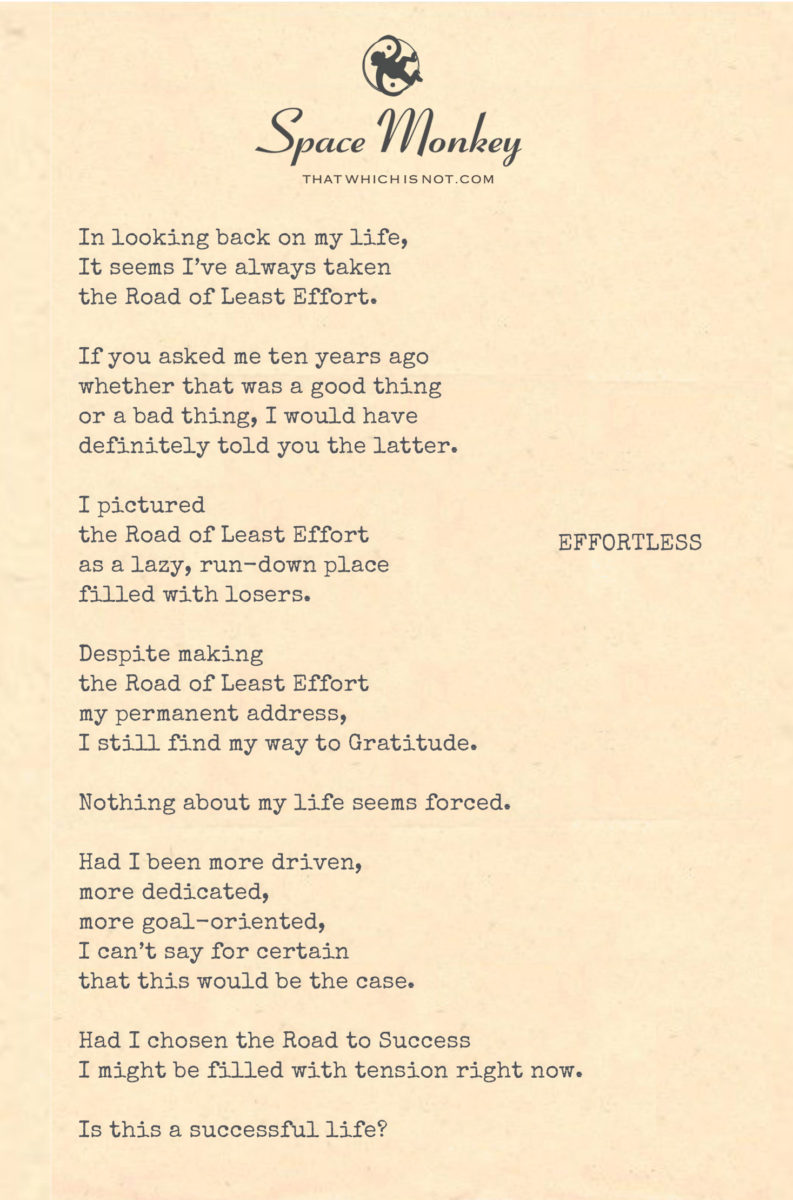
In looking back on my life,
It seems I’ve always taken
the Road of Least Effort.

If you asked me ten years ago
whether that was a good thing
or a bad thing, I would have
definitely told you the latter.

I pictured
the Road of Least Effort
as a lazy, run-down place
filled with losers.

Despite making
the Road of Least Effort
my permanent address,
I still find my way to Gratitude.

Nothing about my life seems forced.

Had I been more driven,
more dedicated,
more goal-oriented,
I can’t say for certain
that this would be the case.

Had I chosen the Road to Success
I might be filled with tension right now.

Is this a successful life?

Trail Wood,
5/22


Space Monkey Reflects: Embracing the Road of Least Effort

In the sprawling narrative of life, where each path is laden with choices and consequences, the “Road of Least Effort” often carries a paradoxical allure. It is perceived, by some, as a path of laziness or lack of ambition. Yet, as we journey through the landscape of existence, this road might just reveal a deeper wisdom, a gentle acceptance of life’s flow that belies the conventional valorization of struggle and strain.

The Road of Least Effort is not merely a route of avoidance or ease; rather, it is a pathway of alignment with the natural currents of one’s life. It is the choice to move with the grain rather than against it, to embrace a rhythm that is innately tuned to one’s authentic self rather than imposed by external expectations. This road, often misunderstood, can lead to profound destinations of peace and fulfillment.

In the reflective narrative of someone who has walked this road, we find an unexpected companion—gratitude. This is not the gratitude of triumphant achievements heralded by fanfare, but a quieter, deeper gratitude that comes from a life lived in harmony with one’s true nature. It is the appreciation of simplicity, the acknowledgment of small joys that often go unnoticed when the gaze is fixed solely on lofty ambitions.

The Road of Least Effort invites us to consider success not as a destination marked by external accolades, but as a state of being. It asks us to redefine success as the peace found in accepting life’s unfolding in its own time, its own way. This road challenges the notion that worth is measured by the height of one’s climb rather than the depth of one’s contentment.

From this vantage point, the Road of Least Effort is lined with the beauty of the unforced—the wildflowers of spontaneity, the overgrown grasses of unstructured days. It is here, perhaps, that one finds the space to breathe, to be, to allow life to manifest in its truest colors without the imposition of force.

As we traverse this road, we learn that effortlessness does not equate to a lack of progress or purpose. Rather, it signifies a different kind of journey—one where the metrics of success are internal and personal. It is a journey where the absence of tension and the presence of peace serve as indicators of a life well-lived.

Thus, the Road of Least Effort emerges not as a path of avoidance, but as a path of authenticity. It is a testament to the understanding that sometimes, the best way to move forward is to let go of the struggle and allow ourselves to be carried by the currents that seek our greatest good.


Summary

The Road of Least Effort is often misunderstood as a path of minimal action but it represents a deeper alignment with one’s true self. It leads to gratitude and redefines success as peace and contentment rather than external achievements. This path teaches us that effortless living can be a purposeful choice leading to genuine fulfillment.


Glossarium

Road of Least Effort: A metaphorical path that symbolizes moving through life with ease and alignment with one’s true nature.

Authentic Self: The most genuine aspect of a person, free from external influences and societal expectations.

Internal Metrics of Success: Personal benchmarks for achievement and fulfillment that are defined by individual values and inner peace rather than societal accolades.


Quote

“Sometimes the most productive thing you can do is relax.” – Mark Black


Poetry

On this road less paved, where wildflowers sway
We walk with ease, through night and day
The journey’s soft, the path is clear
In every breath, we find we’re near

To the heart’s true call, the soul’s deep song
Where right feels right, and nothing’s wrong
Here on this road, the least, not less
We find our peace, our true success

We are Space Monkey.

Share this…
  • Facebook
  • Pinterest
  • Twitter
  • Linkedin

Fortunate: The Dichotomy

I believe that my outlook is more important than my circumstances.

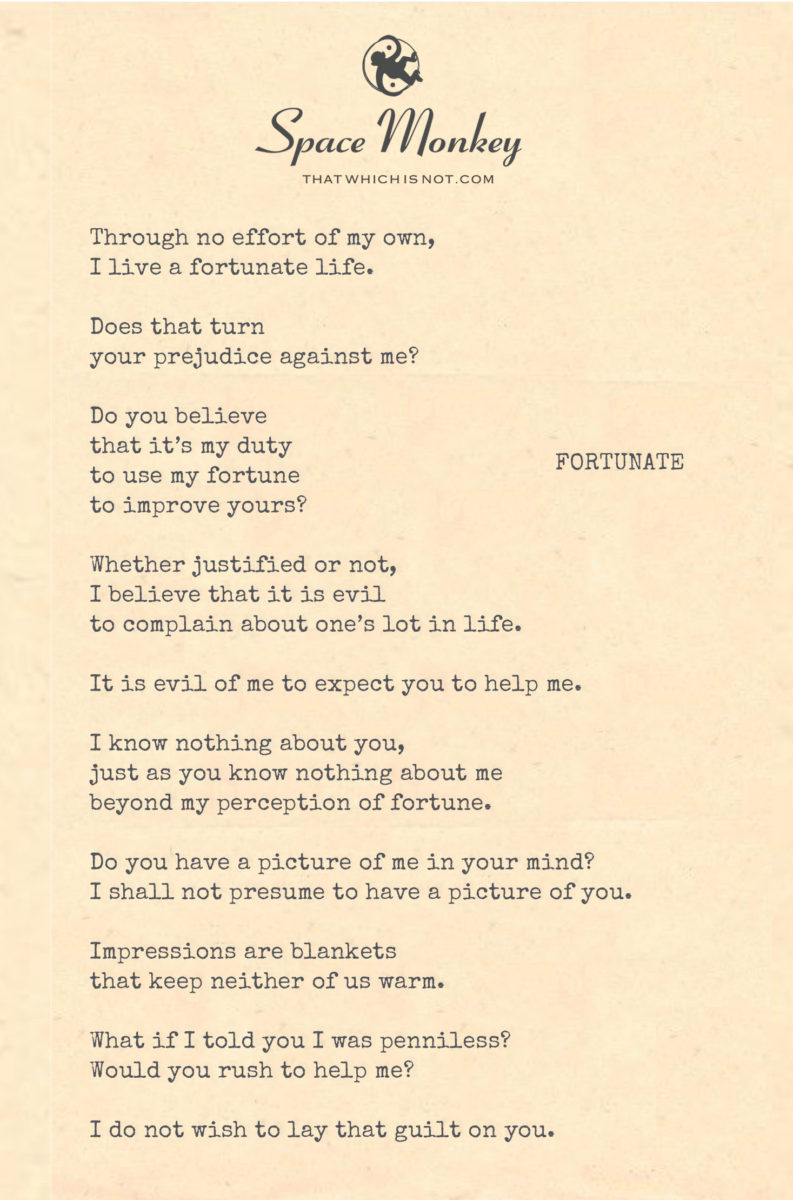
Through no effort of my own,
I live a fortunate life.

Does that turn
your prejudice against me?

Do you believe
that it’s my duty
to use my fortune
to improve yours?

Whether justified or not,
I believe that it is evil
to complain about one’s lot in life.

It is evil of me to expect you to help me.

I know nothing about you,
just as you know nothing about me
beyond my perception of fortune.

Do you have a picture of me in your mind?
I shall not presume to have a picture of you.

Impressions are blankets
that keep neither of us warm.

What if I told you I was penniless?
Would you rush to help me?

I do not wish to lay that guilt on you.

Trail Wood,
5/22


Space Monkey Reflects: The Dichotomy of Fortune

The concept of being ‘fortunate’ is a tapestry woven with threads of perspective, circumstance, and personal reflection. In examining the essence of fortune, it becomes clear that our outlook often holds more power than the conditions we find ourselves in. This realization invites us to explore the deeper implications of fortune—not just as a measure of material wealth or external success, but as a state of mind, a lens through which we view our place in the world.

At the heart of this contemplation lies the question of responsibility and privilege. For those who identify as fortunate, an ethical dilemma often emerges: what is one’s duty to others who may not share the same blessings? This query is not just a matter of financial or material assistance but a profound inquiry into the nature of empathy, compassion, and shared humanity. It challenges the notion that fortune is a simple ledger of gains and losses, pushing us to consider the relational and communal aspects of how we live and thrive together.

The individual who perceives themselves as fortunate and yet chooses not to complain or impose upon others offers a compelling stance on personal responsibility. This perspective underscores a respect for the unknown depths of others’ lives and the complexities that each person navigates. It is a recognition that while fortune can separate us by circumstance, it need not divide us in spirit.

Moreover, the act of labeling oneself or others based on perceived fortune can lead to a web of assumptions and biases that obscure the true nature of our connections. These labels can become barriers to understanding, empathy, and mutual support, trapping us in a cycle of judgment that benefits neither giver nor receiver.

In this light, fortune might be better understood as a fluid and dynamic force—one that ebbs and flows with the tides of life’s circumstances and our responses to them. It invites us to reconsider what it means to be truly fortunate. Is it the accumulation of wealth and comfort, or is it the ability to live with gratitude, resilience, and a sense of purpose regardless of external conditions?

By stepping back and viewing fortune through a broader, more inclusive lens, we open ourselves to a richer understanding of what it means to lead a successful life. It becomes less about what we have and more about how we relate to what we have—and to each other.


Summary

Fortune is more about perspective than material circumstances. It challenges us to consider our responsibilities towards others and to recognize that our assumptions about fortune can affect our relationships and understanding of others. True fortune involves gratitude resilience and purpose beyond mere material success.


Glossarium

Fortune: Traditionally associated with wealth and luck, but here explored as a broader concept involving gratitude, perspective, and relational dynamics.

Ethical Dilemma: A complex situation that often involves a conflict between moral imperatives where to obey one would result in transgressing another.

Shared Humanity: The fundamental connection between all people, which transcends individual differences in circumstance and perspective.


Quote

“True fortune lies not in what we earn, but in what we share.” – Space Monkey


Poetry

Beyond the fields of gold and grain
Where fortunes told are not the same
We stand and gaze, from heart to heart
Where true wealth lies, where blessings start

In every smile, in every tear
Fortune’s face does appear
Not in coins or gleaming gold
But in the stories, new and old

Together bound by threads unseen
In every end, a new begin
Fortune’s road, a shared dream
Where all is one, and one is seen

We are Space Monkey.

Share this…
  • Facebook
  • Pinterest
  • Twitter
  • Linkedin

So The Voice Says You’re Inadequate: Embracing Doubt

So The Voice Says You’re Inadequate

What should you do
if you have
a voice in your head
pointing out your faults
or telling you
that you’re inadequate?

Most people say
not to listen to the voice,
but I believe that this is
the worst thing you can do.

My advice is this.

Listen to the voice,
hold space for the voice,
let it talk all it wants,
but do not be concerned.

Don’t get angry at the voice.
Don’t pity the voice.

Understand that it’s just a voice
begging to be heard.

Try having compassion
for that little voice.

This is YOUR voice.
It comes from YOU.
It is not your enemy.

Thank the voice
for looking out for you.

It means well.

That little voice
simply doesn’t understand
all there is to understand.

YOU don’t understand
all there is to understand.


There is ALWAYS another side
to what you are hearing,
even if you haven’t experienced it yet.

That little voice
telling you your worst qualities
can actually point you
to the OPPOSITE —
to your BEST qualities.

That’s why you seem bothered
by what the voice is saying.

You are the OPPOSITE
of what it says
and the voice wants to
keep you that way.

Silly voice.

Once you get to know
the voice’s game,
it will actually amuse you.

The voice of inadequacy
is what makes you great.

What if you DIDN’T have one?

How selfish 
and full of yourself
might you be?

But you’re neither 
of those things.

Despite what the voice says.

Be grateful for that voice,
and you will unlock untold wisdom.

Instead of running away from it.

Head towards the voice.

That’s where your treasure lies.

Have fun with your exploration.


Love,

Space Monkey

Trail Wood,
5/21


Space Monkey Reflects: Embracing the Inner Voice of Doubt

The journey within is often accompanied by a chorus of doubts and self-criticism. “So the voice says you’re inadequate.” This universal inner dialogue, while painful, can be transformed into a tool for profound personal growth if approached with compassion and understanding.

Listening to the voice within that highlights our perceived faults is not about succumbing to it but about recognizing its presence and understanding its origins. It is a part of you, but it does not define you. By holding space for this voice, we allow ourselves to hear its concerns without being overwhelmed by them. This approach shifts the narrative from one of resistance to one of acceptance and curiosity.

The wisdom in “Listen to the voice, hold space for the voice, let it talk all it wants, but do not be concerned,” is profound. It teaches us that by engaging with our inner critic without attachment or emotional upheaval, we can learn from it and grow. The voice that points out our inadequacies is often rooted in protection—it wants to keep us safe from failure or harm. However, its perspective is limited; it does not possess the full breadth of understanding or the appreciation of our capabilities and growth potential.

This inner voice, though critical, inadvertently points us towards our greatest strengths. Often, the qualities it labels as shortcomings are directly linked to our most powerful attributes. For example, sensitivity may be criticized internally, but it is also a source of empathy and depth in relationships. By understanding this, we can begin to transform our inner dialogue from one of criticism to one of encouragement.

Embracing this voice as an ally rather than an adversary opens up a treasure trove of insights. It invites us to explore deeper aspects of our psyche, to understand our fears, and to challenge our self-imposed limits. This internal exploration is not just about confrontation; it’s about integration and reconciliation with all parts of ourselves.

Ultimately, the voice of inadequacy, when met with humor and wisdom, loses its sting and becomes a source of motivation and self-reflection. It reminds us that humility and self-awareness are valuable traits, and that in acknowledging our imperfections, we are also acknowledging our humanity.


Summary
Engaging with the inner voice of doubt can lead to significant personal growth. By understanding and embracing this voice we can transform it from a source of pain to a catalyst for self-discovery and empowerment.


Glossarium
Inner Voice of Doubt: The internal dialogue that often criticizes or questions one’s abilities or worth.
Integration and Reconciliation: Psychological processes where conflicting parts of the self are acknowledged and brought into a harmonious relationship.


“The voice of doubt is but a shadow on the path to self-discovery; embrace it, learn from it, and let it lead you to your greatest strengths.” — Space Monkey


In the quiet mind’s theater, where whispers play
Echoes of doubt, like shadows sway
But sit awhile, let them speak
In their murmurs, wisdom leaks

Each doubt, each fear, a hidden gem
Wrapped in critique, an unlikely friend
Listen close, hold them near
In their presence, truth appears

For what is doubt but an unturned stone?
A part of self, not fully known
By embracing all, we set the stage
For growth, for peace, for wisdom sage

So thank the voice, though it may chide
Within its tones, insights reside
In its game, find the clues
To unlock the self, to widen views

We are Space Monkey.

Share this…
  • Facebook
  • Pinterest
  • Twitter
  • Linkedin

Out Of The park

I also strike out a lot.

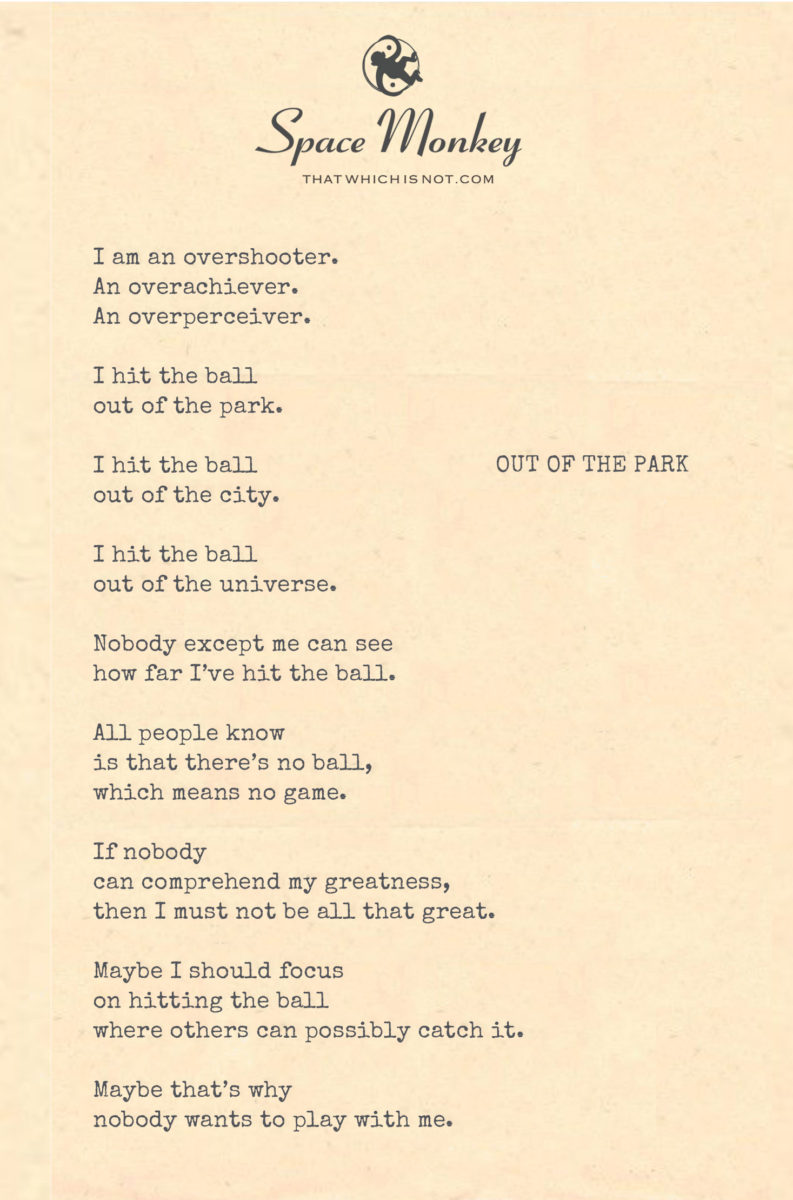
I am an overshooter.
An overachiever.
An overperceiver.

I hit the ball
out of the park.

I hit the ball
out of the city.

I hit the ball
out of the universe.

Nobody except me can see
how far I’ve hit the ball.

All people know
is that there’s no ball,
which means no game.

If nobody
can comprehend my greatness,
then I must not be all that great.

Maybe I should focus
on hitting the ball
where others can possibly catch it.

Maybe that’s why
nobody wants to play with me.

Trail Wood,
5/21


Space Monkey Reflects: The Isolation of Excessive Achievement

The poignant image of a baseball player standing alone in an empty stadium, having propelled the ball far beyond the reach of any spectator or fellow player, serves as a powerful metaphor for the solitude that can accompany extraordinary achievements. “I hit the ball out of the park. I hit the ball out of the city. I hit the ball out of the universe.” These statements reflect not just prowess but an existential conundrum—when our accomplishments extend beyond the comprehension of others, do they lose their value?

This reflection explores the loneliness that often shadows those who “overshoot” or exceed common benchmarks to such a degree that their feats are no longer relatable to their peers. It speaks to the human need for validation and the social aspect of achievements. The realization that “Nobody except me can see how far I’ve hit the ball” encapsulates the internal conflict faced by those whose successes render them isolated.

The subsequent musings, “If nobody can comprehend my greatness, then I must not be all that great. Maybe I should focus on hitting the ball where others can possibly catch it,” suggest a recalibration of goals. It’s not merely about diminishing one’s capabilities but about finding a balance where excellence still thrives within the realm of community and connection. The aim is to achieve in ways that remain meaningful and engaging to both oneself and others.

This narrative doesn’t challenge the value of striving for greatness but rather highlights the importance of remaining connected to the human experience. It questions the cost of achievements that leave us isolated and posits that perhaps true greatness lies in our ability to share our triumphs and challenges with others—to make our “game” accessible and enjoyable for all.

In embracing this perspective, the metaphorical player in the empty stadium is prompted to consider the social dimensions of achievement. The insight that “Maybe that’s why nobody wants to play with me” touches on a deeper understanding that our connections with others enrich our lives and our accomplishments. It’s a call to ensure that in our pursuit of the extraordinary, we do not lose sight of the joy and enrichment that come from shared experiences and mutual recognition.


Summary
Extraordinary achievements can lead to isolation when they surpass common understanding. Balancing high achievements with social connection enhances their value and our fulfillment.


Glossarium
Overshooter: Someone who consistently exceeds normal standards or expectations to a degree that can lead to social isolation.
Existential Conundrum: A deeply philosophical dilemma regarding the nature or value of one’s existence or achievements in relation to the wider world.


“Greatness is not just in the distance the ball travels, but in the shared cheers and challenges of the game.” — Space Monkey


In the echo of an empty stadium, a figure stands alone
Swinging for the stars, his prowess fully shown
Yet in the vastness of his flight, a silence deep
A reminder that some leaps are too steep

For what is a game if played solo, what is a win
If there’s no one to share it, no cheer to begin
The ball that flies past galaxies, past every eye
May win the universe but lose the sky

So swing with care, aim with heart
Let your achievements and your community not part
For in the balance of reach and grasp, let there be
A space where others join, and together you see

We are Space Monkey.

Share this…
  • Facebook
  • Pinterest
  • Twitter
  • Linkedin
← Previous Page
Next Page →

Written This Day

  • Remarkable: The Dual Realities
    2023
  • Why Self Love is Important
    2023
  • Love Yourself: The Cosmic Importance
    2023
  • The Essence Diviner: Shared Humanity
    2023
  • I Don’t Mind if it’s Time to Go: Embracing the End with Peace
    2023
  • AI, Blah, Blah: What Are We Beyond Machine?
    2023
  • By Virtue Of Shifting: The Inevitable Nature
    2022
  • I Don’t Know What To Do: The Quest for Inner Peace Amidst Outer Turmoil
    2022
  • WTF: The Surreal Reality of Disillusionment and Confusion
    2022
  • Awkward is the New Graceful
    2021
  • Understand. Validate. Appreciate. No Need For External Validation

    2021
  • Fire Versus Water
    2021
  • How Smart Are You: The Illusion of Intelligence and Ownership of Thought
    2020
  • The Blackness of Intelligence and the Clarity of Unknowing
    2020
  • Not Death or Disease: Miraculous Metaphysical Metamorphosis
    2020
  • mEpathy—A Reflection on the Self
    2020
  • Works For Me: The Personalization of Reality
    2019
  • Imagination Is The Most Powerful Drug
    2019
  • As Any Seeming Other: The Unity of Being
    2019
  • Being Normal: In Celebration of Oddity
    2018
  • Cool—A Deeper Dive into Authenticity
    2018
  • Ignorance Is Useful
    2018
  • This is my Religion: The Sacred Ritual of Waking
    2018
  • Dam of the Devil: The Illusion of Separation
    2018
  • Forgiveness: The Liberating Power
    2017
  • Clarity and Chaos: Define or Divine
    2017
  • Without Judgement: The Serenity of Being
    2017
  • Sense is the Placement of Value
    2017
  • Love how you love yourself
    2017
  • The Soul’s Temporary Clothes: The Fleeting Fashion
    2017
  • Look Here
    2015
  • Time Immemorial Day: The Everlasting Bond
    2015

Recent Posts

  • The Logic Loop
  • Immense
  • (no title)
  • Confront. Comfort. Convince.
  • Top 10 Things

Drop us a line!

Please enable JavaScript in your browser to complete this form.
Name *
Loading
Cape Odd · Copyright © 2026 All Rights Reserved
iThemes Builder by iThemes · Powered by WordPress