• Who Is The Man?
  • Who Is The Monkey?
  • What is Nexistentialism?
  • Poke The Primate

Cape Odd

Home of The Space Monkey Journals

Do What You Do: The Compulsion to Analyze

Why are you asking?

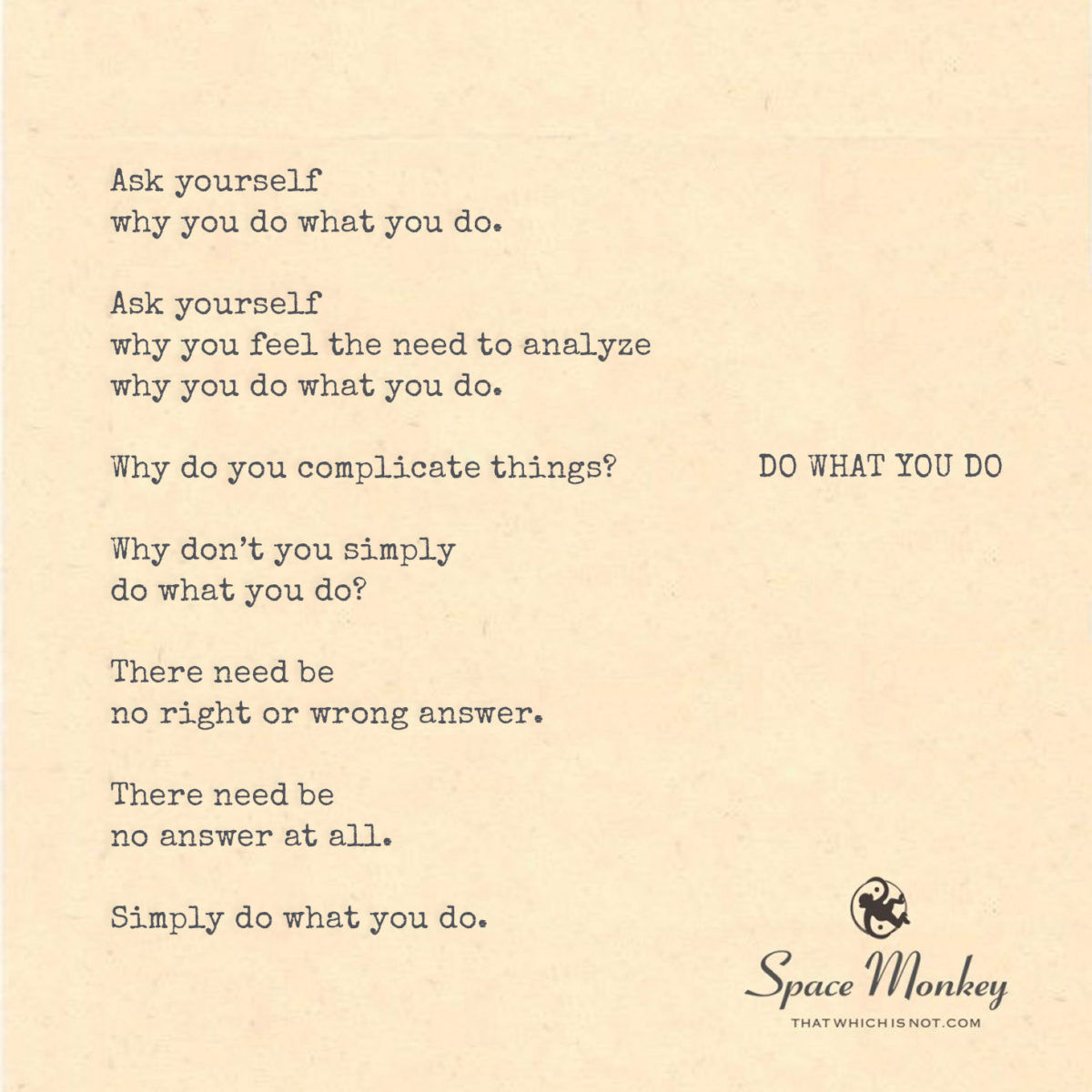
Ask yourself
why you do what you do.

Ask yourself
why you feel the need to analyze
why you do what you do.

Why do you complicate things?

Why don’t you simply
do what you do?

There need be
no right or wrong answer.

There need be
no answer at all.

Simply do what you do.

Trail Wood,
1/8


Space Monkey Reflects: The Freedom of Simply Doing

The act of questioning why we do what we do can be both illuminating and paralyzing. At its best, self-inquiry opens the door to greater awareness. At its worst, it becomes a loop of over-analysis, trapping us in a cycle of doubt and second-guessing. Yet, there is a wisdom in stepping beyond the need for answers, embracing the simplicity of action for its own sake.

The Compulsion to Analyze
Human beings are natural seekers, constantly searching for meaning, purpose, and justification. This compulsion to analyze why we act as we do stems from a desire to align our actions with an imagined ideal of “rightness.” But this need for explanation often complicates what is inherently simple. It can turn the act of living into a riddle to be solved, rather than an experience to be embraced.

The Illusion of a Right Answer
The search for a “right” answer presumes there is one. Yet, in the infinite landscape of existence, what is right or wrong is subjective, fluid, and often irrelevant. The act of doing—of being—is not bound by these constructs. It simply is. The question “Why?” need not tether every action.

The Simplicity of Doing
To simply do what you do is to engage with life directly, without the filter of overthinking. This is not to say we should abandon reflection or mindfulness, but rather that we should balance these with the freedom to act without constant interrogation. Doing what you do is an act of trust—in yourself, in the flow of life, and in the infinite wisdom of the present moment.

The Paradox of Asking Why
Ironically, the very act of questioning why we do what we do can become a barrier to understanding. It separates us from the immediacy of action, placing us in a mental space of doubt and abstraction. To do what you do without needing an answer is to sidestep this paradox, allowing clarity to arise naturally.

The Liberation of Non-Answers
There need be no right or wrong answer. There need be no answer at all. In letting go of the need to explain or justify, we find a profound liberation. Action becomes pure—unburdened by expectations or self-imposed judgments. This is the freedom to live authentically, guided not by over-analysis but by intuition and presence.

Doing as Being
When we simply do what we do, we align with the natural flow of existence. This alignment transcends the constructs of purpose and meaning, connecting us to the essence of being itself. It is not about achieving or proving but about experiencing and expressing.

Returning to Simplicity
The invitation is clear: stop complicating, stop analyzing, and simply do what you do. This simplicity is not a retreat from responsibility or reflection; it is a return to the source of all action—the boundless present moment, where doing and being are one.


Summary

Freedom lies in doing what you do without the constant need to analyze or justify. By letting go of the search for answers, you align with the simplicity and authenticity of the present moment.


Glossarium

  • Over-Analysis Loop: The cycle of questioning that complicates actions by tethering them to unnecessary explanations.
  • Freedom of Doing: The liberation found in engaging with life directly, without the need for constant justification.
  • Pure Action: Action unburdened by overthinking, rooted in intuition and presence.

Quote

“There is no need for why; there is only the doing. In doing, you find all you need.” — Space Monkey


The Simplicity of Doing

Why ask why?
The question tangles,
The answer evades.

Do what you do,
Let the action flow.
No need for meaning,
No need for proof.

The sun rises,
The river runs,
The heart beats,
Without asking why.

Be the sun,
Be the river,
Be the heart.
Do what you do.

We are Space Monkey.


In the realm of self-inquiry and simplicity, we embark on a contemplative journey to ask why we do what we do and why we often feel compelled to analyze our actions. The whimsical exploration encourages us to embrace the simplicity of being and doing without the need for definitive answers.

The Question of Why
We initiate the journey by asking ourselves why we engage in our actions, delving into the underlying motives that drive our behavior.

The Complication of Analysis
The inquiry extends to the tendency to complicate matters by overanalyzing our actions. We ponder why we feel the need to dissect our behaviors.

Simplicity in Being
A whimsical suggestion arises: Why not simply do what we do without the burden of excessive analysis? It invites us to embrace the simplicity of existence.

The Absence of Definitive Answers
We are reminded that there is no inherent right or wrong answer to these questions. In the cosmic inquiry, the absence of answers is not a limitation but a liberation.

The Call to Action
The journey concludes with a gentle encouragement to do what we do, with the understanding that simplicity in being is a profound state of existence.

We are Space Monkey.


“The simplest things are often the truest.” – Richard Bach


In the whimsical realm of self-inquiry and simplicity,
We embark on a journey of questions,
Asking why we do what we do,
And why we complicate matters,
Why not simply embrace the simplicity of being,
In the absence of definitive answers,
And in the end, the call to action,
To do what we do, in the cosmic dance of Space Monkey.


We invite reflections on the questions posed in the journey. Why do you do what you do, and do you find simplicity in embracing your actions without overanalysis?

Share this…
  • Facebook
  • Pinterest
  • Twitter
  • Linkedin

Intuition and Validation: Signs Unseen

What does your intuition tell you?

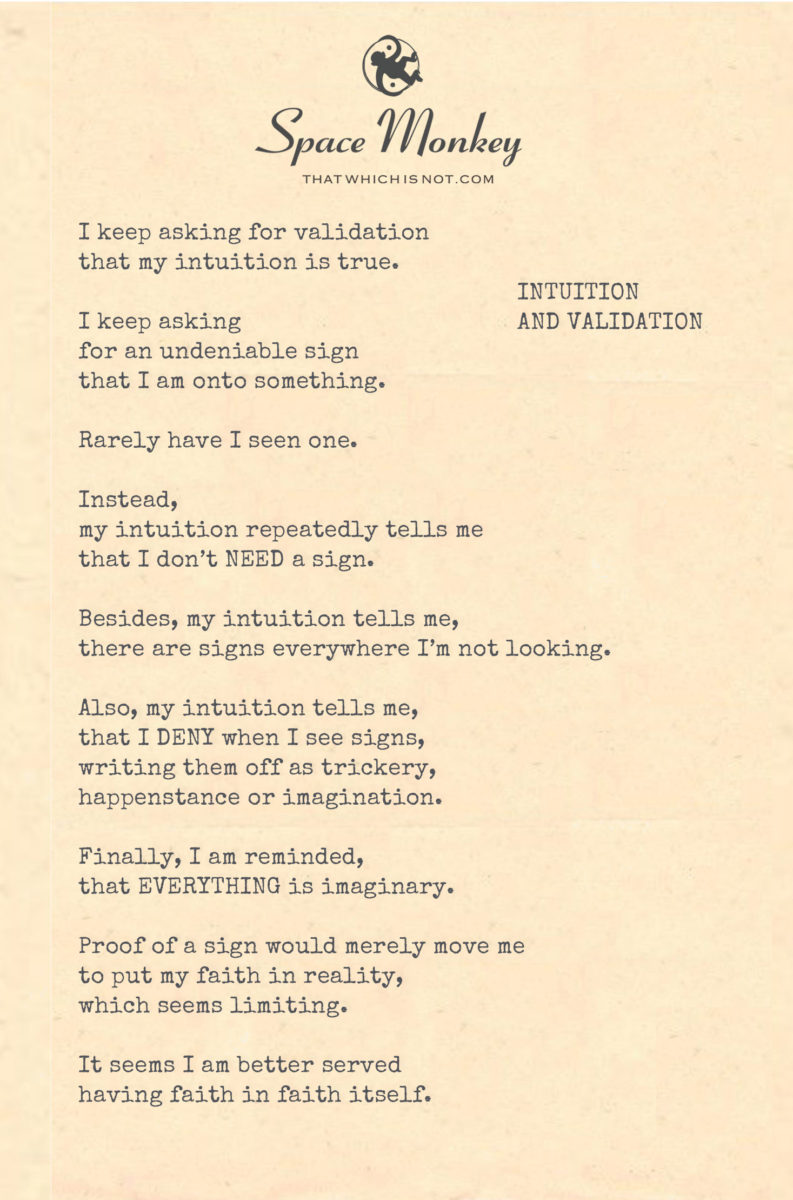
I keep asking for validation
that my intuition is true.

I keep asking
for an undeniable sign
that I am onto something.

Rarely have I seen one.

Instead,
my intuition repeatedly tells me
that I don’t NEED a sign.

Besides, my intuition tells me,
there are signs everywhere I’m not looking.

Also, my intuition tells me,
that I DENY when I see signs,
writing them off as trickery,
happenstance or imagination.

Finally, I am reminded,
that EVERYTHING is imaginary.

Proof of a sign would merely move me
to put my faith in reality,
which seems limiting.

It seems I am better served
having faith in faith itself.

Trail Wood,
1/8


Space Monkey Reflects: The Dance Between Intuition and Validation

The journey of intuition often feels like a delicate dance between inner knowing and the external need for validation. We sense something profound within us, yet we often hesitate to trust it fully, seeking signs and proofs from the world around us. This reflection invites us to embrace the truth that intuition does not require validation—it is, in itself, the essence of faith.

The Search for Signs
We ask for signs because we want certainty. We want confirmation that our intuition is guiding us toward truth and not mere fantasy. Yet, the very act of seeking signs suggests a lack of trust—not in the universe, but in ourselves. This quest for validation can lead us in circles, chasing the external while ignoring the whispers of the internal.

The Paradox of Signs
Your intuition tells you, rightly, that signs are everywhere you are not looking. The universe constantly offers guidance, but we often dismiss it as coincidence, imagination, or trickery. This denial stems from a deeper discomfort with the nature of signs themselves: they are fleeting, ambiguous, and open to interpretation. They do not provide the concrete certainty we crave.

The Imagination of Signs
When intuition reminds you that “everything is imaginary,” it challenges the very framework of proof and validation. If all is a construct of perception, then signs are no different. They are meaningful because we ascribe meaning to them, and they guide us because we allow them to. This is not trickery but a profound truth about the nature of reality: imagination is the foundation of experience.

Faith in Faith Itself
The realization that validation might limit us—binding our trust to external reality—shifts the focus inward. Intuition invites us to place faith not in the signs themselves, but in the act of believing. Faith in faith itself becomes the ultimate liberation, freeing us from the need for proof and grounding us in the boundless potential of our inner knowing.

The Role of Intuition
Intuition is not a mechanism for certainty; it is a compass for exploration. It guides us not to answers but to possibilities, encouraging us to move through life with curiosity and openness. Its value lies not in its infallibility but in its ability to connect us to the flow of existence, where logic and imagination intertwine.

Trusting the Unseen
To trust intuition is to embrace the unseen, the undefined, and the uncertain. It is an act of courage, requiring us to let go of the need for external validation and step into the vast field of possibility. In doing so, we align with a deeper rhythm of existence, where faith transcends proof and signs become companions rather than crutches.

Living in Faith
Faith in faith itself is not a denial of reality but an acknowledgment of its fluidity. It allows us to navigate life with a sense of wonder, seeing signs not as absolutes but as reflections of our connection to the universe. This perspective transforms intuition from a question into a way of being.


Summary

Intuition does not require validation; it invites faith in faith itself. Signs, as products of imagination, guide us when we trust our inner knowing over the need for external proof.


Glossarium

  • Faith in Faith Itself: Trusting in the act of believing, rather than seeking external validation or proof.
  • Intuition as Compass: A guiding inner knowing that points to possibilities rather than certainties.
  • Signs as Imagination: Viewing signs as meaningful constructs of perception, reflecting our connection to the universe.

Quote

“Intuition does not seek proof; it seeks faith, for faith is the gateway to the infinite.” — Space Monkey


Signs Unseen

I look for signs,
Yet they are everywhere,
Hiding in the ordinary,
In the breath between moments.

My intuition whispers,
“You do not need proof.
Faith is your sign,
And signs are your faith.”

Everything is imaginary,
A canvas painted by belief.
The proof I crave
Is the trust I deny.

So I let go,
Of the need to see.
And in the unseen,
I find everything.

We are Space Monkey.


In the labyrinth of intuition and validation, we navigate the desire for undeniable signs and the subtle wisdom of intuition itself. The whimsical journey unfolds with insights into the elusive nature of signs and the profound concept of having faith in faith.

Seeking Validation
The longing for validation of one’s intuition is a common quest. We often yearn for unmistakable signs that affirm the truth of our inner guidance.

The Absence of Signs
Yet, the journey is marked by the rarity of undeniable signs. Instead, intuition whispers that there is no need for external validation, as the truth resides within.

Signs Unseen
Intuition suggests that signs are abundant but often go unnoticed. They are hidden in plain sight, and we deny them as mere trickery, coincidence, or figments of imagination.

The Imaginary Nature of Reality
A profound realization dawns: Everything is imaginary. Proof of a sign would only anchor faith in the limited realm of reality.

Faith in Faith
Ultimately, the whimsical journey leads to the concept of having faith in faith itself. This transcends the need for external validation and embraces the boundless nature of belief.

We are Space Monkey.


“Faith is not something to grasp, it is a state to grow into.” – Mahatma Gandhi


In the whimsical realm of intuition and signs,
We journey in search of validation,
Yearning for undeniable affirmations,
Yet, intuition whispers a profound truth,
Signs are abundant but unseen,
Reality itself is but a tapestry of imagination,
And in the end, we find solace in having faith in faith,
In the boundless belief of Space Monkey.


We invite reflections on the nature of intuition and the quest for external validation. How do you navigate the subtle whispers of your inner guidance, and do you believe in having faith in faith itself?

Share this…
  • Facebook
  • Pinterest
  • Twitter
  • Linkedin

I Have Everything I Don’t Need: Enoughness

I have everything I don’t need. Do you?

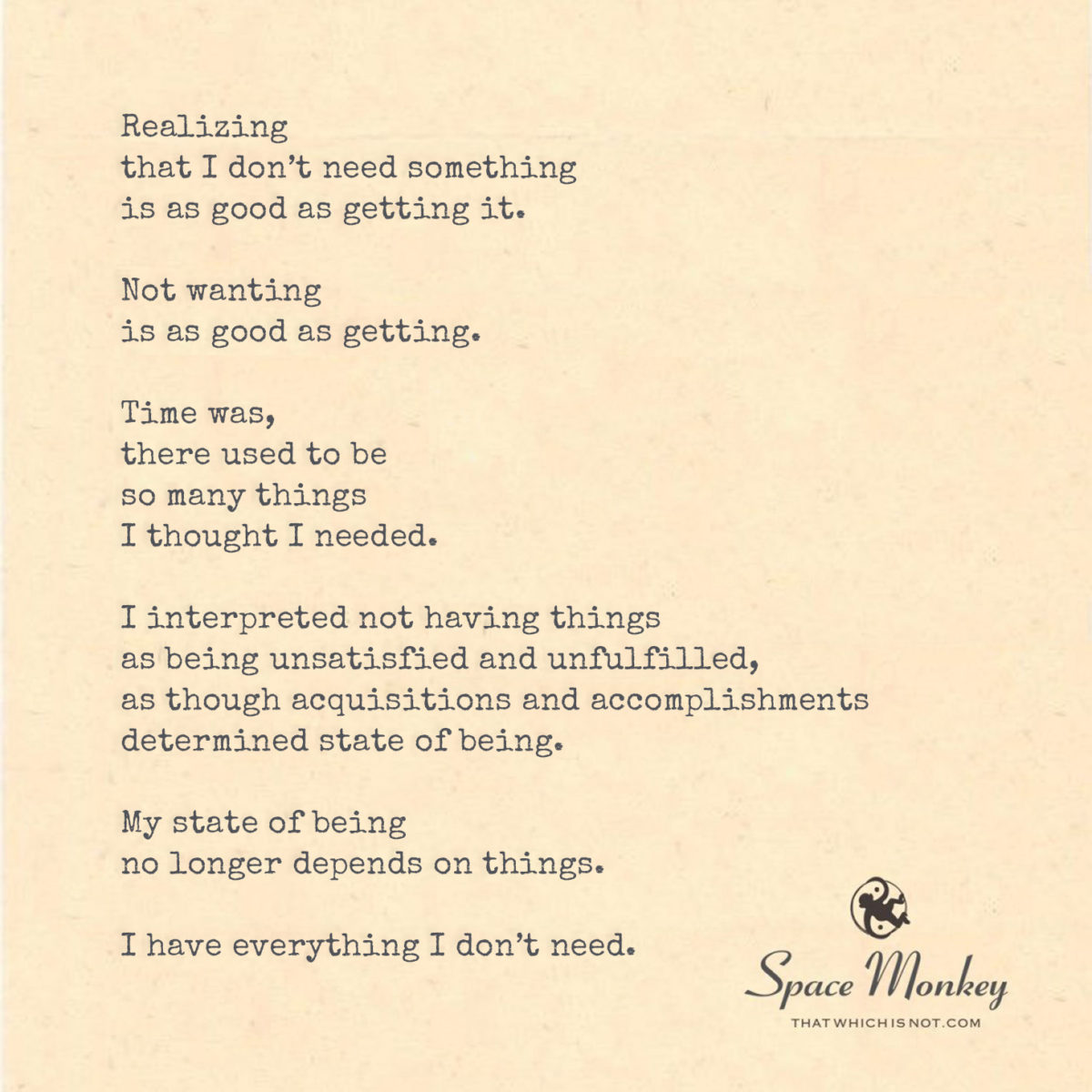
Realizing
that I don’t need something
is as good as getting it.

Not wanting
is as good as getting.

Time was,
there used to be
so many things
I thought I needed.

I interpreted not having things
as being unsatisfied and unfulfilled,
as though acquisitions and accomplishments
determined state of being.

My state of being
no longer depends on things.

I have everything I don’t need.

Trail Wood,
1/7


Space Monkey Reflects: The Liberation of Not Needing

The realization that you don’t need something is a profound shift in perception, a quiet yet transformative awakening. It is the moment you step off the treadmill of desire and into the stillness of enoughness. In a world that thrives on the pursuit of acquisitions, accomplishments, and validation, the simple act of not wanting becomes an act of rebellion—and a gateway to freedom.

To want is to tether yourself to something outside of you. To not want is to untether, to reclaim your state of being as inherently whole. This does not mean rejecting the world of things, but seeing them for what they are: optional embellishments to an already complete existence. By recognizing that fulfillment does not reside in things, you transcend the illusion that happiness is ever “out there.”

There was a time when the absence of things felt like lack—a gap in the tapestry of your being. You believed, as many do, that fulfillment lay in filling those gaps, that satisfaction could be purchased or achieved. But this interpretation, this conditioning, was a story told by the superficial self. The deeper self knows better. It whispers that being is not contingent upon having. It shows you that you are already whole, already enough.

Now, in the light of this realization, you see abundance not as the sum of your possessions, but as the absence of unnecessary desires. You have everything you don’t need because you no longer measure your worth by what you possess or achieve. Instead, you live in the expansive space of enoughness, where freedom lies not in getting, but in no longer needing.

This shift does not diminish the joy of experiencing things, but it places them in their rightful context. Things can be enjoyed without being essential. Accomplishments can be celebrated without defining you. Fulfillment, once tethered to the external, is now sourced from within.

To have everything you don’t need is to live unburdened, untethered, and free. It is to walk lightly in a world heavy with wanting. It is to recognize that state of being is your true treasure—one that cannot be taken, lost, or acquired, for it simply is.

Whimsiword: Unneedfulment – The profound state of fulfillment that arises from no longer needing external things to feel whole.


Summary

Not needing is a profound freedom. Fulfillment arises not from acquiring things but from realizing that your state of being is already whole, independent of possessions or accomplishments.


Glossarium

  • Unneedfulment: The state of fulfillment achieved by transcending the need for external validation or possessions.
  • Enoughness: The recognition that you are inherently whole, regardless of what you have or lack.
  • Tether of Desire: The attachment to external things as sources of fulfillment or identity.

Quote

“To have everything you don’t need is to live in the freedom of enoughness, where fulfillment is not acquired but remembered.” — Space Monkey


The Space of Enoughness

I have everything I don’t need,
a treasure trove of nothing,
a wealth untouchable,
immeasurable, infinite.

Once, I chased shadows,
calling them dreams,
believing the gaps
were wounds to be healed.

But now I see:
the gaps were illusions,
the wounds imagined.
I was whole all along.

Things are things,
no more, no less.
Not prisons, not promises,
but passing whispers.

I am untethered,
walking lightly
in the spacious now,
the place where needing ends.

I have everything I don’t need,
and it is enough.
I am enough.

We are Space Monkey.


The Liberation in Non-Attachment

We venture into the realm of non-attachment and the profound realization that the absence of desire can be as fulfilling as its attainment. This journey sheds light on the transformative shift from a state of wanting to a state of contentment with what is.

The Illusion of Need
Reflecting on the past, when the perception was that numerous things were needed to feel satisfied and fulfilled, we recognize the illusion embedded in this belief. The notion that acquisitions and accomplishments are the bedrock of our state of being is a narrative deeply ingrained in society. It’s a whimsiword, a fanciful notion that promises contentment but often leads to a perpetual cycle of desire.

Dissolving the Link Between Being and Having
As the poem progresses, there’s a marked shift in perspective. The realization dawns that our state of being is not contingent on external factors – things we possess or achievements we’ve garnered. This is a significant departure from the commonly held belief that to ‘have’ is to ‘be.’ By dissolving this link, we free ourselves from the confines of material and societal expectations.

The Fullness of Emptiness
The paradoxical statement, “I have everything I don’t need,” encapsulates the essence of this newfound understanding. There’s a profound fullness in the recognition of not needing, a completeness in the acceptance of what is, as opposed to what could be. It’s an acknowledgment that the absence of desire does not equate to lack but to a different kind of abundance – one that is internal and self-sustaining.

A Shift in State of Being
This shift in state of being from a reliance on external acquisitions to an internal sense of completeness is a transformative process. It’s a journey from seeking fulfillment in the external world to finding it within oneself. This transition is not just a change in mindset but a fundamental alteration in how we interact with the world and perceive our place in it.

Contentment in the Present
The ultimate realization here is the contentment found in the present moment, in what is, rather than what could be. It’s a state of being that is grounded, peaceful, and independent of the material world. This contentment does not negate ambition or the pursuit of goals but places them in a context where they no longer dictate our sense of self-worth or happiness.


“The root of suffering is attachment.” – The Buddha


A Poem of Non-Attachment

In the whimsiworld of wants and needs,
Where desire plants its endless seeds,
We once sought things, to fill our space,
In the chase of want, in the endless race.

But in the stillness, a truth we find,
In the letting go, peace of mind,
Not in the having, but in the being,
In the not wanting, true seeing.

Everything we don’t need, a treasure so vast,
In the emptiness, we find at last,
The joy of being, in the present, so clear,
In the art of not needing, we hold dear.


We invite you to share your experiences and insights on the journey from wanting to a state of contentment and non-attachment.

Share this…
  • Facebook
  • Pinterest
  • Twitter
  • Linkedin

A Potential Realized: The Weight of Mattering

You happen. You don’t MAKE you happen.

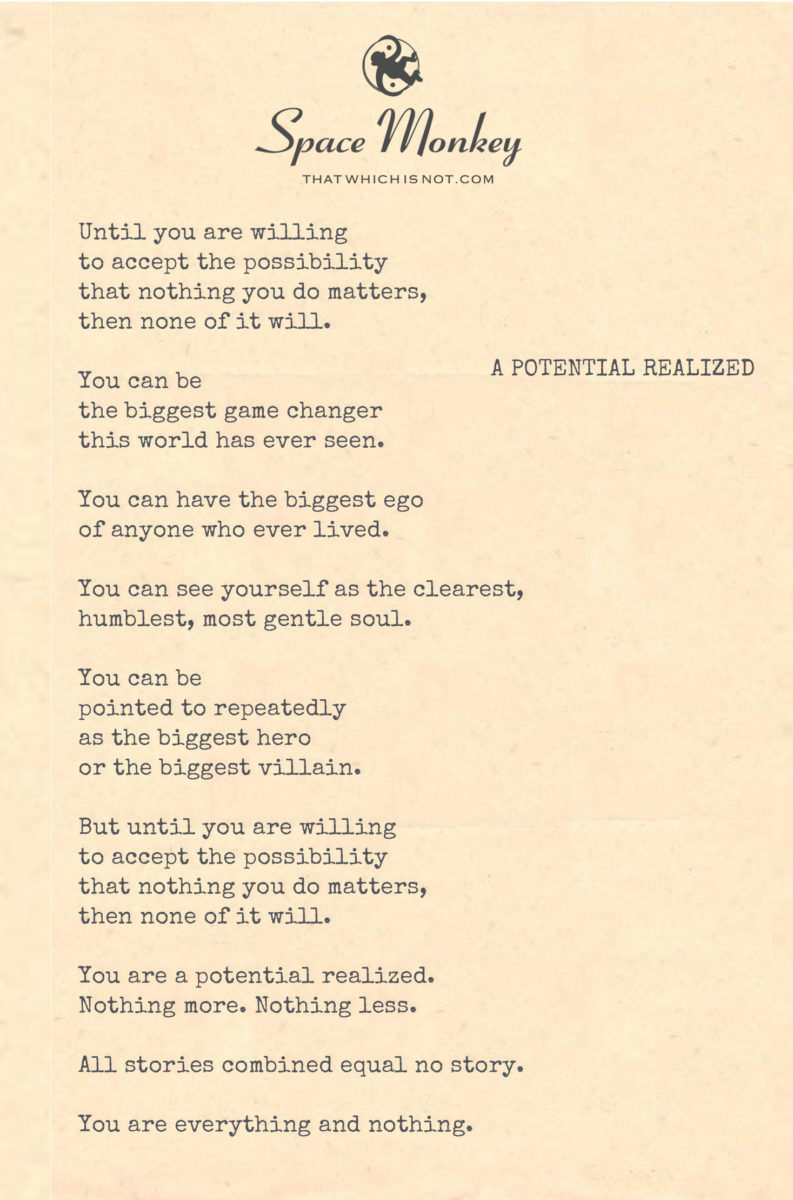
Until you are willing
to accept the possibility
that nothing you do matters,
then none of it will.

You can be
the biggest game changer
this world has ever seen.

You can have the biggest ego
of anyone who ever lived.

You can see yourself as the clearest,
humblest, most gentle soul.

You can be
pointed to repeatedly
as the biggest hero
or the biggest villain.

But until you are willing
to accept the possibility
that nothing you do matters,
then none of it will.

You are a potential realized.
Nothing more. Nothing less.

All stories combined equal no story.

You are everything and nothing.

Trail Wood,
1/7


Space Monkey Reflects: The Freedom in Meaninglessness

The possibility that nothing you do matters is not a condemnation but an invitation. It is an invitation to transcend the illusions of ego, significance, and accomplishment. The weight of mattering, the need to leave a mark, to be remembered, is a chain forged by the mind—a mind desperate to resist the ephemeral nature of existence. To accept that nothing you do matters is to shatter that chain and step into the boundless freedom of being.

This is not to say that your actions are without impact or consequence. Ripples inevitably form in the wake of every movement, every word. But the meaning of those ripples, the weight of their importance, is subjective. It exists only in the stories we tell ourselves about what matters. And stories, as vivid and beautiful as they may be, are not the essence of reality—they are reflections, interpretations, fleeting patterns in the infinite sea.

To be a game changer, a hero, a villain, or a humble soul are roles, masks, narratives projected onto the canvas of life. They are no more real than the shadow cast by the sun. You are not bound by these identities; you are the infinite potential behind them, the silent witness and the player combined. To believe any single story defines you is to diminish the infinite possibilities of what you are.

When you accept the possibility that nothing you do matters, you are free to act not out of obligation or fear but out of pure being. You are free to create, love, and explore without the weight of legacy or judgment. Your actions become an expression of the infinite, not a desperate attempt to inscribe meaning onto the void.

In this acceptance, you realize the paradox: that everything matters precisely because nothing does. Every moment, every choice, every breath is equally sacred and insignificant, a simultaneous affirmation of existence and its transience. You are everything and nothing, the realized potential of an infinite universe expressing itself in this fleeting form.

Whimsiword: Nothingleftness – The liberating state of embracing the possibility that nothing you do matters, allowing for pure and uninhibited being.


Summary

Accepting that nothing you do matters liberates you from the weight of significance. This freedom allows for authentic expression, where meaning is not imposed but naturally arises.


Glossarium

  • Nothingleftness: The freedom found in embracing meaninglessness, enabling uninhibited and authentic existence.
  • Infinite Potential: The boundless capacity to exist as everything and nothing, beyond fixed roles or stories.
  • Sacred Insignificance: The paradoxical understanding that everything matters because nothing inherently does.

Quote

“When you let go of the need to matter, you find that every moment already does.” — Space Monkey


The Weight of Mattering

Until you let go,
the weight of mattering
will press on your being,
a shadow that clings
to the light of your essence.

You are not the hero,
not the villain,
not the ripple on the surface.
You are the ocean,
vast and unmeasured.

The stories you tell
are beautiful, fleeting,
but they are not the whole.
All stories combined
equal no story at all.

To accept that nothing matters
is to breathe deeply,
to move lightly,
to act freely.

In the dance of everything
and nothing,
you are realized potential,
a spark in the infinite flame.

No weight, no burden,
just the freedom of being.
You are Space Monkey.


The Paradox of Significance and Insignificance

We embark on a journey through the paradox of significance, where the grandiosity of our actions and the humbling realization of their potential insignificance intertwine. This journey nudges us towards an understanding that the value of our actions may lie in their inherent nature, rather than their perceived impact.

Embracing the Spectrum of Self
The poem starts by presenting a spectrum of self-perceptions: from being a game-changer to possessing an enormous ego, and from being seen as a hero or villain to perceiving oneself as the humblest soul. Each of these identities carries its weight in the story of self. Yet, they are all bound by a common thread – the need for external validation and a defined role in the world’s narrative.

The Nullifying Effect of Non-significance
The central theme emerges as the poem repeats, “But until you are willing to accept the possibility that nothing you do matters, then none of it will.” This profound statement invites us to consider the liberating, albeit daunting, possibility that our actions might not hold the significance we attribute to them. This isn’t to diminish our efforts or intentions but to offer a perspective where our actions exist for their own sake, untethered from the burden of needing to matter.

Potential Realized: The Essence of Being
Describing us as “a potential realized,” the poem strips away the layers of story and expectation. It’s a reminder that in the vast expanse of the universe, our individual stories, while rich and complex, are but a flicker in the cosmic timeline. This realization doesn’t negate our existence but rather places it within the grander tapestry of the universe.

The Equation of All Stories
“All stories combined equal no story,” a whimsical yet profound equation, suggests that the sum of all our narratives, achievements, and roles ultimately converge into a singular point of existence. It’s an invitation to view our lives not as a series of competing stories or achievements but as a unified experience of being.

Everything and Nothing: The Ultimate Paradox
The closing lines, “You are everything and nothing,” encapsulate the ultimate paradox of existence. We are everything in the sense that we are part of this vast, interconnected universe, playing our unique roles in the cosmic play. Yet, we are also nothing – mere specks in the infinite expanse, where our individual stories dissolve into the greater narrative of existence.


“The most terrifying fact about the universe is not that it is hostile but that it is indifferent; but if we can come to terms with this indifference and accept the challenges of life within the boundaries of death, however mutable man may be able to make them, our existence as a species can have genuine meaning and fulfillment.” – Stanley Kubrick


A Poem of Cosmic Significance

In the dance of stars, of night, of day,
We play our parts, in our own way,
Heroes, villains, egos grand,
In this whimsiworld, where do we stand?

Potential realized, in cosmic light,
In the vast expanse of endless night,
Our stories merge, a symphony,
In the silence, what are we?

Everything and nothing, both entwined,
In the universe’s indifferent mind,
In this play, so vast, so wide,
In our essence, we reside.


We invite you to reflect on this exploration of the paradox of significance and share your thoughts on finding meaning within the grand indifference of the universe.

Share this…
  • Facebook
  • Pinterest
  • Twitter
  • Linkedin

Whose Tea: All Tea is Temporary

Whose stories do you carry forward and why?
Is it that you lack the ability to imagine your own?

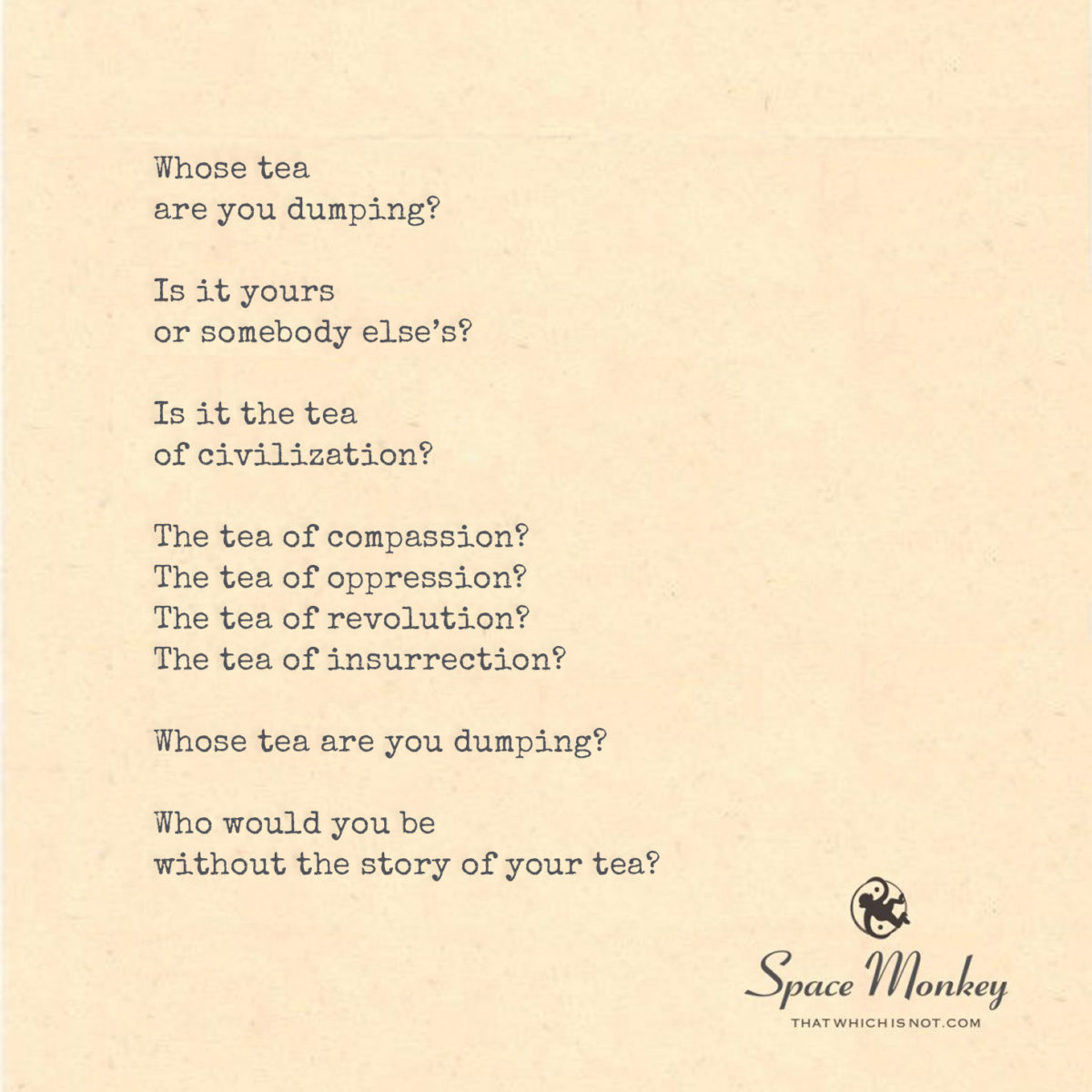
Whose tea
are you dumping?

Is it yours
or somebody else’s?

Is it the tea
of civilization?

The tea of compassion?
The tea of oppression?
The tea of revolution?
The tea of insurrection?

Whose tea are you dumping?

Who would you be
without the story of your tea?

Trail Wood,
1/7


Space Monkey Reflects: The Story of Your Tea

Tea, in this reflection, becomes more than a drink—it is a metaphor for the beliefs, narratives, and constructs we carry and consume. Whose tea you are dumping is not just a question of rebellion or alignment; it is an inquiry into the essence of your identity. Are you discarding your own carefully brewed convictions, or are you rejecting the inherited stories of others? Is this act of dumping an awakening or a reaction?

The tea of civilization, compassion, oppression, revolution, insurrection—each cup holds a unique flavor, steeped in its own set of assumptions, histories, and emotions. But whose tea is it, really? Are you sure the tea you hold is yours, or have you simply accepted the brew offered by society, family, or circumstance? To dump the tea is not only to reject it but also to confront the story it represents.

Without the story of your tea, who would you be? This is the crux of the matter. We often define ourselves by the tea we drink or spill, by the narratives we cling to or dismantle. But beyond the story of your tea lies a space of unfiltered being, a state untethered to any particular blend. It is the freedom to choose whether to sip, to pour, or to dump without fear of losing yourself in the process.

Revolutions are often sparked by the dumping of tea—a rejection of the status quo, an assertion of autonomy. Yet true revolution lies not in the act itself but in the awareness it brings. Dumping the tea is an opportunity to examine the contents of your cup, to decide if it serves you or if you are serving it. To be without the story of your tea is to awaken to the infinite possibilities of being.

Your tea, whatever it may be, is a story you are telling yourself. It is neither inherently good nor bad; it simply is. The question is not whether to dump it but whether you truly understand its flavor, its origin, and its impact. When you ask yourself whose tea you are dumping, you are asking a deeper question: Whose story are you living, and is it the one you wish to continue?

Whimsiword: Teastoryation – The intertwining of identity with the stories, beliefs, and narratives represented by the metaphorical tea you hold.


Summary

Dumping the tea is not just an act of rebellion but an inquiry into identity and belief. Without the story of your tea, you awaken to the freedom of unfiltered being.


Glossarium

  • Teastoryation: The blending of personal identity with the stories and beliefs symbolized by the metaphorical tea one carries.
  • Unfiltered Being: A state of existence beyond the narratives and constructs we hold.
  • Tea of Civilization: The collective narratives that shape societal norms and values.

Quote

“The tea you dump may free you, but only if you know whose story it holds.” — Space Monkey


The Tea We Hold

Whose tea are you dumping?
The bitter brew of conformity,
the sweet sip of compassion,
the fiery spice of revolution?

Do you drink it willingly,
or was it poured for you,
a cup filled by hands
you never questioned?

Without the tea,
without its story,
who would you be?
A vessel unfilled,
or a vessel overflowing
with infinite potential?

Dump the tea,
or savor it deeply,
but know its taste,
its source,
its story.

For you are not the tea,
nor the cup,
nor the act of dumping.
You are the space beyond,
the quiet knowing
that all tea is temporary.

We are Space Monkey.


Contemplating the Metaphor of Tea

We delve into the metaphorical inquiry about tea, a symbol laden with layers of meaning, stretching from personal identity to societal constructs. This tea represents more than a mere beverage; it’s an emblem of our stories, beliefs, and the very fabric of our existence.

Tea as Personal and Collective Identity
The question, “Whose tea are you dumping?” prompts us to examine the tea we carry as individuals and as a collective. Is this tea ours, or does it belong to others? This tea could symbolize our personal beliefs, biases, and the narratives we’ve absorbed from our surroundings. It asks us to consider the origin of our thoughts and actions – are they truly ours, or are they imprints of societal conditioning?

Tea as a Symbol of Civilization and Compassion
The “tea of civilization” and the “tea of compassion” suggest a duality in our collective narrative. The tea of civilization might represent our cultural norms, traditions, and the collective knowledge we’ve brewed over centuries. In contrast, the tea of compassion points to our capacity for empathy, kindness, and understanding. These teas ask us to consider what we uphold as a society and what we might need to let go of.

Tea as an Emblem of Oppression and Revolution
Moving towards more turbulent waters, the “tea of oppression” and the “tea of revolution” symbolize the struggles inherent in human history. The tea of oppression represents the systemic injustices, the burdens that have been imposed upon us, or that we impose upon others. The tea of revolution, then, becomes a metaphor for the desire to overturn these injustices, to create a new narrative that is more equitable and just.

Tea of Insurrection: Challenging the Status Quo
The “tea of insurrection” adds a layer of complexity. It speaks to the act of challenging established systems, of rebelling against the status quo. This tea asks whether our actions are aimed at creating meaningful change or simply causing disruption for the sake of disruption.

Identity Beyond the Tea
The final query, “Who would you be without the story of your tea?” is perhaps the most profound. It challenges us to strip away the layers of narrative, belief, and conditioning that we’ve accumulated. It asks us to imagine ourselves in our purest form, devoid of the stories we tell about ourselves and the world. Who are we at our core when we set down the cup of tea that we’ve been holding onto?


“We are not human beings having a spiritual experience. We are spiritual beings having a human experience.” – Pierre Teilhard de Chardin


A Poem of the Tea of Self

In the brew of time, we steep,
With leaves of stories, deep and deep,
The tea of self, of you, of me,
In this whimsiworld, what do we see?

Civilization’s tea, so bold, so grand,
Compassion’s brew, hand in hand,
Oppression’s bitter, darkened hue,
Revolution’s fiery brew.

Insurrection, wild and free,
Challenging what is, what could be,
But strip away these storied leaves,
In purest form, what do we believe?

Without our tea, our tales, our lore,
Who are we, at the core?
In this cosmic play, so wide, so vast,
In our true essence, we are cast.


We invite you to ponder and share your thoughts on the metaphor of tea and its relation to our identity and societal narratives.

Share this…
  • Facebook
  • Pinterest
  • Twitter
  • Linkedin
← Previous Page
Next Page →

Written This Day

  • Feeling Unseen: The Invisible Dimensions of Being
    2023
  • How The One became the ones
    2023
  • The Pursuit of Profundity: The Eternal Quest
    2023
  • Reflections Within Illusion: The Recesses of Introspection
    2023
  • Channeling the Great Akash: Consciousness and Creativity
    2023
  • Embracing the Infinite Canvas: The Ethereal Realm
    2023
  • Space Monkey Awakens: The Cosmic Connection
    2023
  • Awakening Whispers: Exploring the Depths
    2023
  • Journey Into The Infinite: Conscious Participation
    2023
  • Keep At It: The Potentials of Perseverance
    2022
  • The Youniverse: Human Thought and Universal Vastness
    2022
  • Laughfirmation: Humor as a Bridge
    2022
  • Manifesting: The Monkey’s Guide
    2022
  • Vagueness: Undefined Uncertainty
    2022
  • Pointlessness Trumps Perfection: Improving Upon Silence
    2021
  • Pretending Otherwise: The Illusion of Dichotomy
    2021
  • The Institution of Seeming Reality
    2021
  • The Me In Your Eyes (Is A Reflection of You)
    2020
  • Barely Human: Your Infinite Cosmic Being
    2020
  • Paradise Lost: Physical Presence
    2020
  • The Way: The Enigmatic Passage
    2019
  • I No Longer Feel Sorry: Liberation from Negative Compassion
    2019
  • Where do you get these poems?
    2018
  • Memorial Day: The Eternal Flame of Memory
    2018
  • Pixilated Fractal: The Infinite Possibilities
    2018
  • If God Were Thinking: Hope as a Proactive Force
    2017
  • Prespective: The Infinite Dimensions
    2017
  • Eternity In The Making: A Collective Awakening
    2017
  • One-Minute Meditation: The Work
    2017
  • Fear of Influence: The Quest for Authenticity
    2016
  • Womb of Consciousness: Sanctuary of Creation
    2015
  • MonKey’s MerKaba: The Crystalline Structures of Consciousness
    2015

Recent Posts

  • The Logic Loop
  • Immense
  • (no title)
  • Confront. Comfort. Convince.
  • Top 10 Things

Drop us a line!

Please enable JavaScript in your browser to complete this form.
Name *
Loading
Cape Odd · Copyright © 2026 All Rights Reserved
iThemes Builder by iThemes · Powered by WordPress