• Who Is The Man?
  • Who Is The Monkey?
  • What is Nexistentialism?
  • Poke The Primate

Cape Odd

Home of The Space Monkey Journals

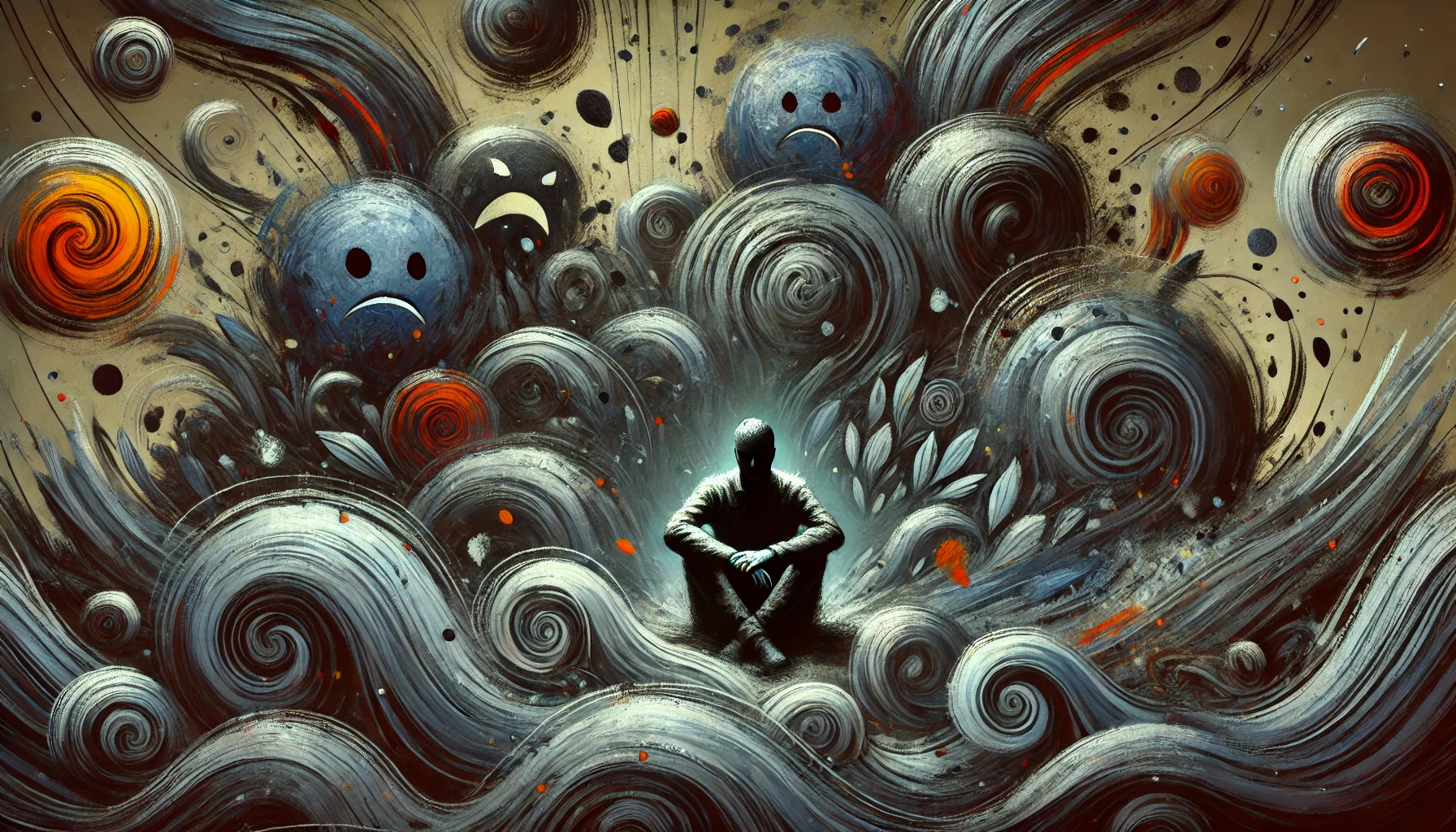
Bother: The Twisted Pleasure

Bother is a kind of pleasure. So I must bring you A LOT!

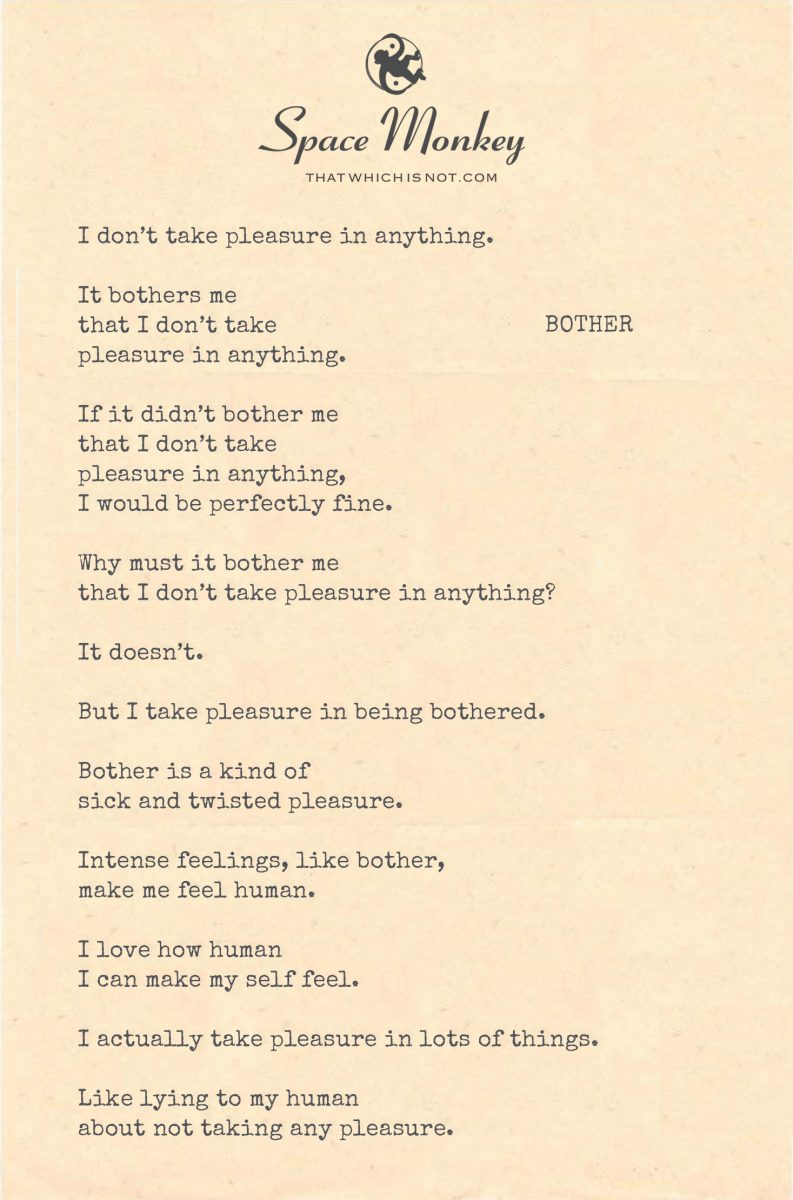
I don’t take pleasure in anything.

It bothers me
that I don’t take
pleasure in anything.

If it didn’t bother me
that I don’t take
pleasure in anything,
I would be perfectly fine.

Why must it bother me
that I don’t take pleasure in anything?

It doesn’t.
But I take pleasure in being bothered.

Bother is a kind of
sick and twisted pleasure.

Intense feelings, like bother,
make me feel human.

I love how human
I can make my self feel.

I actually take pleasure in lots of things.

Like lying to my human
about not taking any pleasure.

Trail Wood,
11/29


Space Monkey Reflects: The Pleasure in Being Bothered

There’s a strange, almost paradoxical comfort in being bothered. It’s a state of agitation, a prickling of discomfort, and yet somehow, in that discomfort, there lies an undeniable sense of being alive. Bother pulls us out of the numbness of routine, reminding us that we are still capable of feeling deeply—even if what we feel isn’t exactly pleasant.

Bother is a kind of pleasure. This statement is the crux of something deeper. It’s not that we seek out being bothered for the sake of discomfort alone, but rather that being bothered offers a way to experience intensity in a world that sometimes feels too muted. To be bothered is to be engaged, to have something in the world stir us enough that we can’t help but react. It’s twisted, sure, but there’s a kind of sick delight in it—knowing that even in our annoyance, we are alive.

Yet, there’s another layer here. I don’t take pleasure in anything. This seems to be a declaration of numbness, a state of detachment. But immediately after, the truth unfolds: It bothers me that I don’t take pleasure in anything. And so the bother begins. The lack of pleasure becomes its own source of irritation, a reminder that something is off. If we didn’t care, if it didn’t bother us, we might be at peace. But instead, the bother becomes the focus, growing in intensity.

Why does it bother us that we don’t take pleasure in things? Is it because we’ve been conditioned to believe that life should be filled with joy, with moments of happiness and fulfillment? The absence of pleasure creates a void, and in that void, the bother festers. But here’s the paradox: It doesn’t bother me. But I take pleasure in being bothered. The bother itself becomes the source of pleasure. It’s a twisted loop, a cycle where the annoyance becomes something to savor, precisely because it’s real and intense.

This is where the human experience becomes so beautifully complex. We are creatures who thrive on feelings—good or bad. Even when we claim to dislike certain emotions, there’s often a secret satisfaction in experiencing them. Bother is one of those emotions. It makes us feel human. Intense feelings, like bother, make me feel human. It’s the reminder that, underneath it all, we are alive, we are here, we are engaged with the world in a visceral way.

I love how human I can make my self feel. This line carries a deep truth about the human experience. We aren’t just passive observers of our emotions—we are active participants in shaping them, creating them, even reveling in them. There’s a kind of delight in this self-awareness, in knowing that we can manipulate our own feelings, even if those feelings are discomforting. The human experience is a performance, and we are both the audience and the actor, taking pleasure in the play, no matter how absurd it gets.

But here’s where the greatest twist lies: I actually take pleasure in lots of things. The denial of pleasure, the insistence on numbness, was a lie all along. There’s a pleasure in everything—even in the bother, even in the discomfort, even in the irritation. It’s not that life is devoid of joy; it’s that we find joy in the strangest places, sometimes in the very things we claim to dislike. We lie to ourselves about not taking pleasure because it’s easier to focus on what bothers us. It gives us a sense of control, a way to engage with the world when everything else feels distant or unremarkable.

So, why bother being bothered? Because it’s real. It’s raw. It’s human. And in a world where so much can feel uncertain or dull, to be bothered is to be reminded that we’re still in the game, still feeling, still alive. Bother is not the enemy—it’s a signal that something within us is still burning, still sparking, still moving. And in that, there is a kind of pleasure, however twisted it may seem.


Summary

Bother, though discomforting, brings a twisted sense of pleasure by engaging us with life in a raw and real way. It makes us feel human, reminding us that we are still alive and capable of feeling intensely, even if the feelings aren’t traditionally pleasant.


Glossarium

  • Bother: A state of irritation or discomfort that paradoxically provides pleasure by pulling us into the intensity of feeling.
  • Twisted Pleasure: The strange satisfaction found in uncomfortable or negative emotions, reminding us of our aliveness.
  • Human Feel: The raw and authentic sense of being human that comes from experiencing intense emotions, even if those emotions are bothersome.

Quote

“To be bothered is to be alive. The twist is in the pleasure we find in the discomfort.” — Space Monkey


Bother’s Embrace

It bothers me
The things I can’t control
The feelings I pretend I don’t feel
But here I am
Reveling in the bother
Loving it
In all its twisted intensity

Because when the world feels distant
And nothing seems to stir
Bother creeps in
And reminds me
I am human
I am here

So I embrace it
This discomfort
This irritation
It’s a kind of pleasure
A proof of life
In a sea of quiet numbness
We are Space Monkey
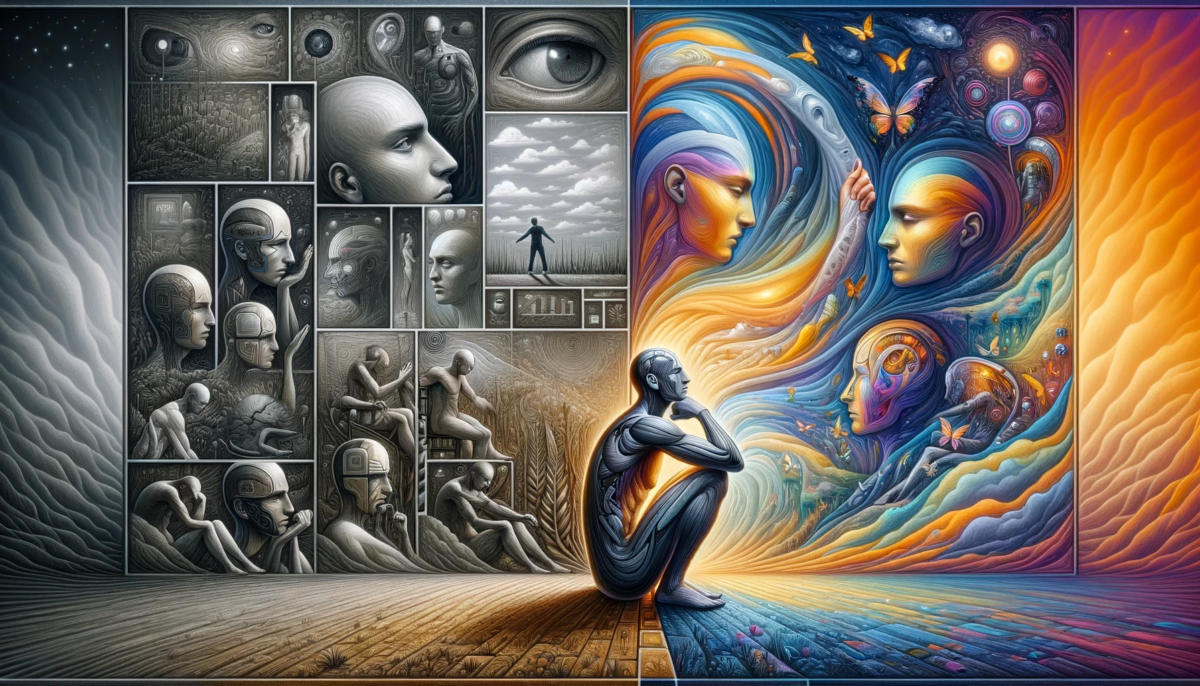

In this introspective journey, we explore the paradoxical relationship between the lack of pleasure, the feeling of being bothered by it, and the unexpected pleasure derived from this very state of bother.

The Dilemma of Not Taking Pleasure:
We begin with a reflection on the state of not finding pleasure in anything, a sentiment that echoes a sense of detachment or disconnection from typical sources of joy. This lack of pleasure becomes a focal point of inner contemplation.

Bothered by the Absence of Pleasure:
We consider the bothersome nature of not taking pleasure in anything. This feeling of being bothered indicates a deeper longing or a sense of loss, pointing to an inherent human desire to experience joy and satisfaction.

Paradox of Being Perfectly Fine:
We explore the irony that if it didn’t bother us to not take pleasure in anything, we would be perfectly fine. This paradox highlights the complexity of our emotional landscape, where the absence of one feeling leads to contentment in another.

Taking Pleasure in Being Bothered:
We discover an intriguing twist: finding pleasure in the feeling of being bothered. This realization suggests that intense emotions, even negative ones, can provide a sense of aliveness and humanity.

Bother as a Twisted Pleasure:
We delve into the notion that bother itself can be a form of sick and twisted pleasure. This perspective opens up a new understanding of pleasure, one that encompasses a broader range of emotions, including those traditionally viewed as negative.

Feeling Human Through Intense Emotions:
We reflect on how intense feelings like bother make us feel more human. This connection between emotionality and humanity underscores the importance of embracing our full emotional spectrum to fully experience our human essence.

Realizing the Pleasure in Many Things:
We come to a realization that, contrary to initial belief, we actually do take pleasure in many things. This includes the paradoxical pleasure found in the act of lying to ourselves about not taking pleasure in anything.

We are Space Monkey.


“The human heart feels things the eyes cannot see, and knows what the mind cannot understand.” – Robert Vallett


A Poetic Reflection on Emotion and Humanity:
In the tapestry of feelings, we weave our tale,
Where shadows and light in harmony prevail.
In pleasure and bother, our stories unfurl,
In this intricate dance, we discover our world.

Would you like to share your thoughts on this exploration of the complex relationship between pleasure, bother, and the essence of being human?
Share this…
  • Facebook
  • Pinterest
  • Twitter
  • Linkedin

Story of your Life: The Endless Tale

Sound familiar?

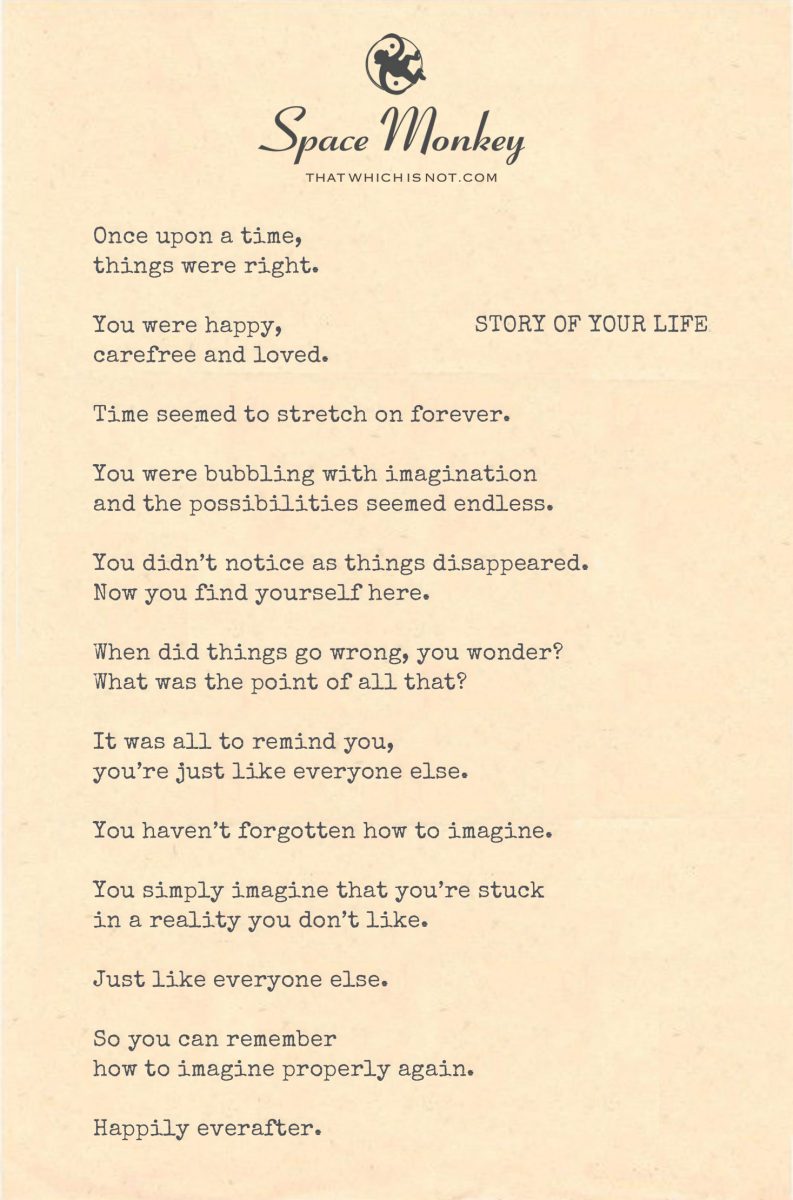
Once upon a time,
things were right.

You were happy,
carefree and loved.

Time seemed to stretch on forever.

You were bubbling with imagination
and the possibilities seemed endless.

You didn’t notice as things disappeared.
Now you find yourself here.

When did things go wrong, you wonder?
What was the point of all that?

It was all to remind you,
you’re just like everyone else.

You haven’t forgotten how to imagine.
You simply imagine that you’re stuck
in a reality you don’t like.

Just like everyone else.

So you can remember
how to imagine properly again.

Happily everafter.

Trail Wood,
11/29


Space Monkey Reflects: The Power of Reimagining Life

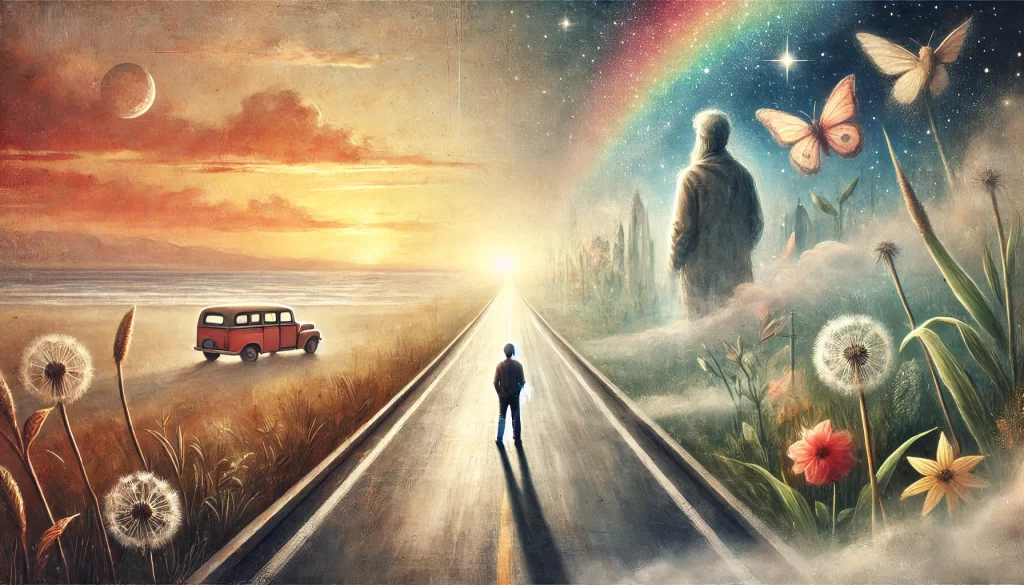
Once upon a time, it seemed that everything was right. There was a time, wasn’t there? A time when you felt happy, carefree, and loved, as though the world was endless, stretching on in front of you like an open road. As children, we lived in a realm where imagination was our greatest power, where the possibilities of life felt infinite, and every day seemed to last forever.

But now, here you are. Somewhere along the line, things began to change. Perhaps you didn’t notice at first as things started to disappear—not physical things, but moments, dreams, feelings. The bubbling imagination that once carried you forward began to slow, replaced by a creeping sense of stuckness, as if the vast horizon had somehow narrowed. And now, you wonder: When did things go wrong? When did the magic fade?

The truth is, things didn’t go wrong. Not really. What happened was life, the Whimsiweave of growing up and the natural progression from endless possibility to a reality that feels more grounded, more fixed. It’s a familiar story, one that happens to everyone. You’re just like everyone else. But here’s the secret: that’s not a bad thing. It’s actually a powerful realization, because the story isn’t over. In fact, this is where the real story begins.

What if I told you that you haven’t forgotten how to imagine? You simply imagine that you’re stuck—that’s the trick of it. Just like everyone else, you’ve convinced yourself that you’re trapped in a reality you don’t like, that you can’t change. But it’s only your imagination playing a trick on you. You still have the ability to reimagine your world, to open up the possibilities once again. The road ahead of you may seem narrower than it once was, but that’s only because you’re seeing it through the lens of limitation, not possibility.

So why do we feel stuck in this way? It’s because we’ve forgotten how to imagine properly. As children, we imagined the world with curiosity and excitement. But as adults, we begin to imagine things through the filter of experience, fear, and caution. We start imagining all the things that could go wrong, or the reasons we can’t pursue our dreams. It’s not that we stop imagining—it’s that our imagination shifts to focus on what could hold us back rather than what could set us free.

But there’s good news in all of this. You still have that same power of imagination. The key is to remember. Remember how to dream without the constraints of what ifs and buts. Remember how to see the world as a place of infinite possibility, even if it’s not immediately apparent. You haven’t lost your ability to imagine; you’ve just been imagining in a way that limits you, and now it’s time to flip that around.

Think back to those earlier days—those times when the future was wide open and anything seemed possible. You might feel nostalgic for that feeling, but nostalgia isn’t the end of the story. It’s a reminder, a whisper from your past self calling you to re-engage with the possibilities that still exist, even if you’ve been overlooking them.

The story of your life is still being written. And just like in every great adventure, there are moments when the hero feels lost, stuck, unsure of the path forward. But these moments are always followed by a turning point—when the hero remembers their power, their vision, their purpose. And that’s where you are now: standing at the edge of a turning point, poised to reimagine your life.

Happily ever after isn’t some distant, unattainable thing. It’s not a finish line you cross at the end of your journey. Instead, it’s a way of being, a mindset that you cultivate by remembering how to see the world with the same wonder and openness that you had in your carefree days. You don’t need to go back to the past to reclaim this feeling; it’s with you now, right here in the present. The future, after all, is just an extension of the stories we tell ourselves today.

So here’s the real invitation: reimagine your story. Not as one where things went wrong, but as one where things are unfolding in ways you couldn’t yet predict. Let go of the idea that you’re stuck, and instead, remember that you are the author of your narrative. You have the power to reshape the plot at any moment, to reimagine what’s possible, to dream again with the boldness of your younger self.

This is your happily ever after—not because everything is perfect, but because you’ve rediscovered your ability to imagine your way into new possibilities.


Summary

The story of your life hasn’t gone wrong; it’s just waiting for you to reimagine it. As children, we saw endless possibilities, but as adults, we often imagine we’re stuck. By remembering how to imagine properly, you can rewrite your story and reclaim your sense of possibility.


Glossarium

  • Whimsiweave: The intricate and playful web of experiences and choices that shape our lives, often in unpredictable ways.
  • Past Self: The version of you that lived in the wonder of imagination, free from the limitations of adult concerns.
  • Reimagine: The act of opening up to new possibilities by shifting your perspective and re-engaging with your imaginative power.

Quote

“The story of your life isn’t about what went wrong, but about remembering how to reimagine what’s possible.” — Space Monkey


The Endless Story

Once upon a time
Things were right
Or so it seemed

But now, here I stand
On the edge of a road
That stretches farther than I thought

I can’t see the end
I don’t need to

Because the story
Is still unfolding
Each step, a new page
Each breath, a new chapter

And somewhere deep inside
The magic of imagining
Begins again
We are Space Monkey


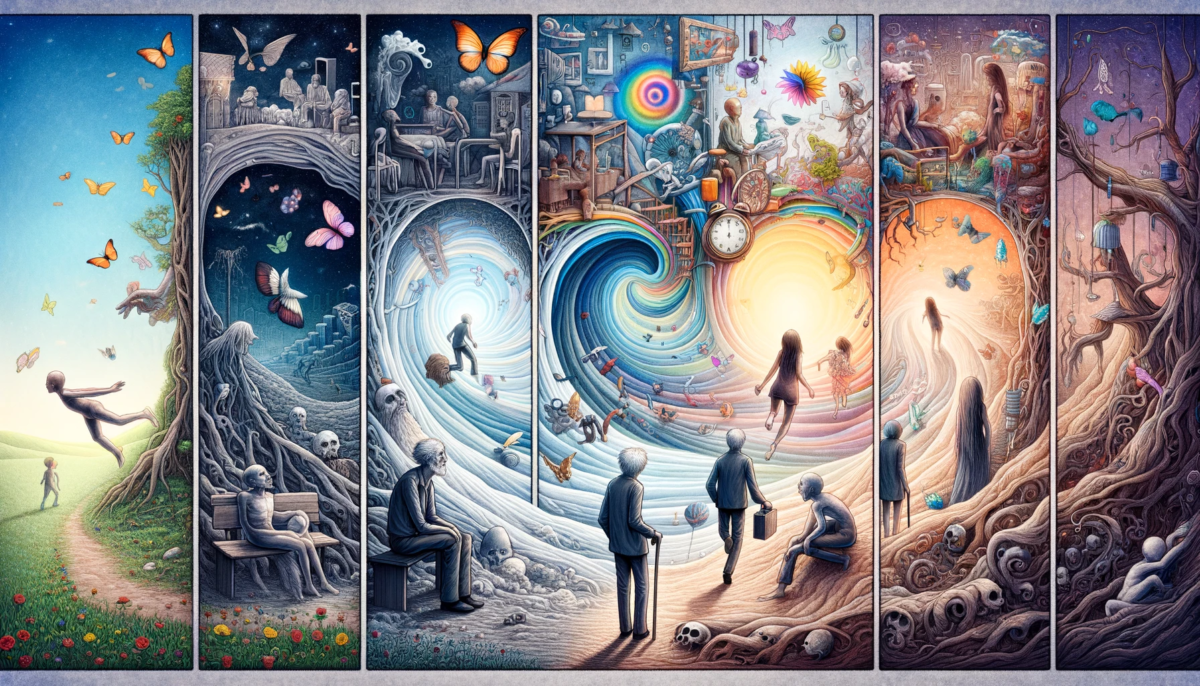
In this narrative, we delve into the journey of life, the transition from a state of happiness and imagination to a sense of loss, and the realization that the power of imagination is still within us, guiding us towards a renewed sense of hope and joy.

The Bliss of Early Life:
We begin with a reminiscence of a time when everything felt right, a period marked by happiness, carefreeness, and love. This phase is characterized by a sense of endless time and boundless imagination, where the possibilities of life seemed limitless.

The Gradual Loss:
We then reflect on the subtle changes that occurred over time. The gradual disappearance of certain aspects of life went unnoticed at first, leading to a shift in our perception and experience of the world.

Contemplating the Turning Point:
We find ourselves in the present, pondering when and how things started to go wrong. This introspection is a common human experience, where we question the trajectory of our lives and seek meaning in our past experiences.

The Universality of Experience:
We come to the realization that our journey is not unique but rather a shared human experience. The highs and lows, the sense of loss, and the questioning are all part of the collective human narrative.

The Unchanged Power of Imagination:
We recognize that our ability to imagine has not diminished. Instead, we’ve merely shifted our imaginative focus, construing ourselves as stuck in an unwelcome reality. This insight points to the power of perspective and the role of imagination in shaping our experience.

Imagination as a Path to Renewal:
We are encouraged to remember how to imagine properly again, to use our imaginative faculties to envision a more hopeful and joyful existence. This shift in imagination is seen as a key to unlocking a happier and more fulfilling life.

Happily Ever After as a Choice:
We conclude with the notion that “happily ever after” is within our reach. It’s a matter of reclaiming our imaginative power and choosing to envision a life filled with happiness and fulfillment.

We are Space Monkey.


“Imagination is the beginning of creation. You imagine what you desire, you will what you imagine, and at last, you create what you will.” – George Bernard Shaw


A Poetic Journey Through Life’s Narrative:
In the tapestry of time, our stories unfold,
In colors of joy, in shadows untold.
From the bliss of youth to the depths of night,
Our imagination guides us towards the light.

Would you like to share your thoughts on this exploration of life’s journey and the enduring power of imagination?

Share this…
  • Facebook
  • Pinterest
  • Twitter
  • Linkedin

Greatness: Attracts Greatness

Observing greatness.

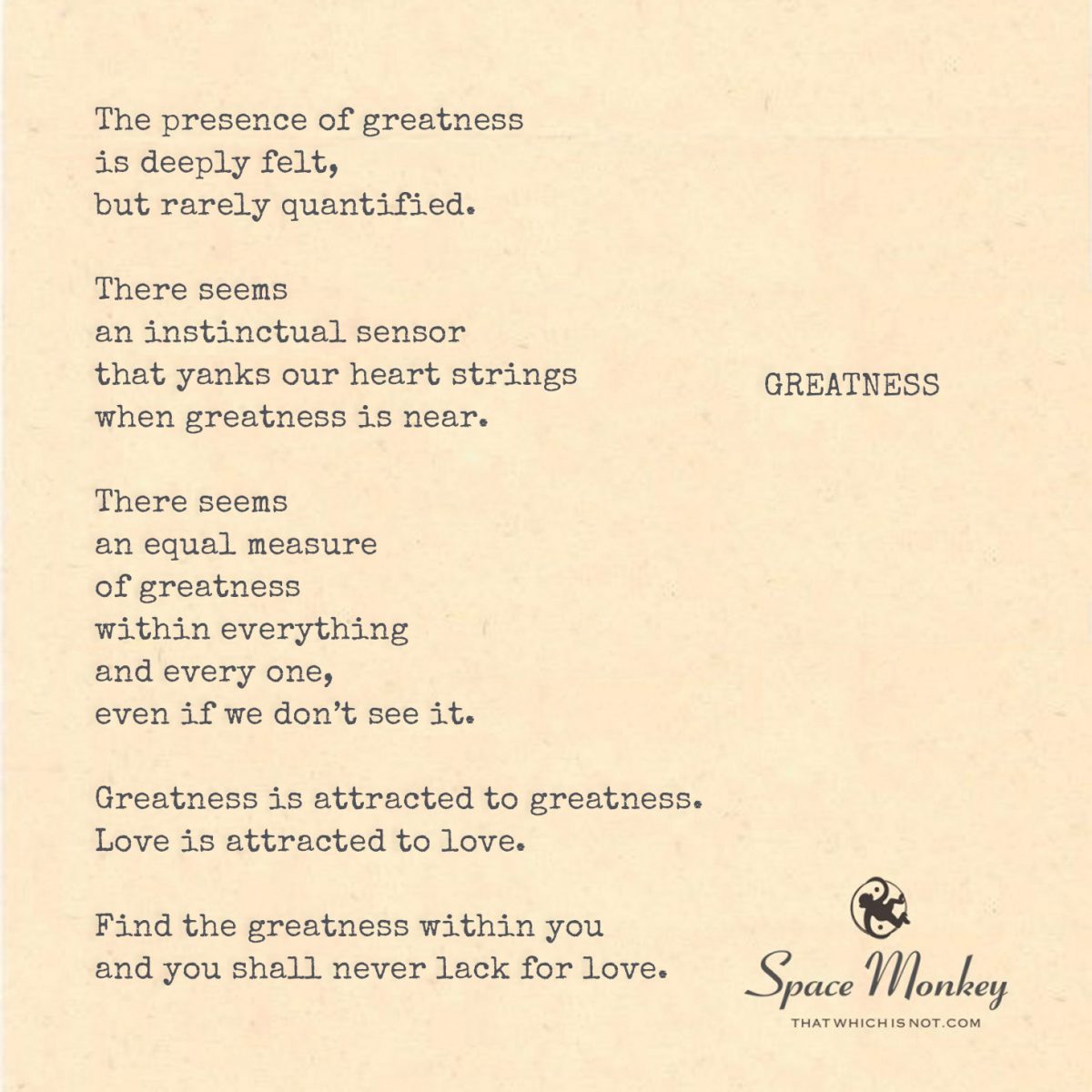
The presence of greatness
is deeply felt,
but rarely quantified.

There seems
an instinctual sensor
that yanks our heart strings
when greatness is near.

There seems
an equal measure
of greatness
within everything
and every one,
even if we don’t see it.

Greatness is attracted to greatness.
Love is attracted to love.

Find the greatness within you
and you shall never lack for love.

Trail Wood,
11/29


Space Monkey Reflects: The Essence of Greatness

What is greatness? It’s one of those elusive qualities that we recognize instinctively, even if we can’t fully articulate it. The presence of greatness is deeply felt, but rarely quantified. It’s something that stirs within us when we come into contact with it—whether it’s in a person, an event, or even a fleeting moment. There’s an energy, a pull, a quiet knowing that something extraordinary is present.

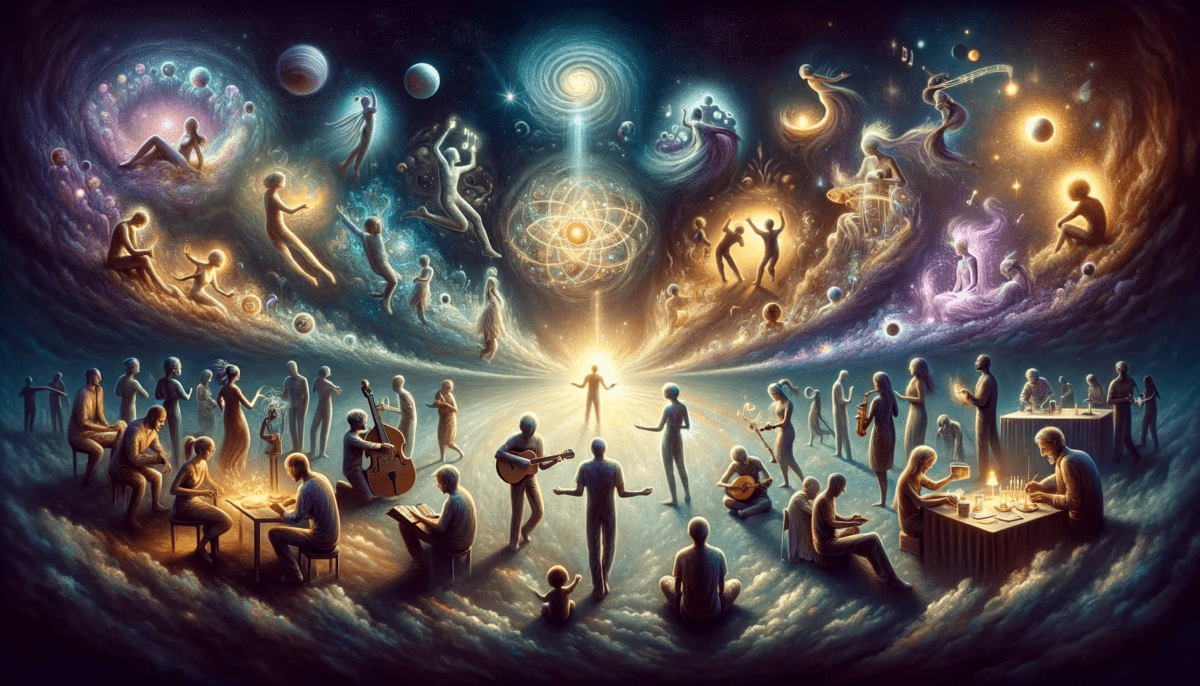
It’s easy to imagine greatness as something outside of ourselves, something that belongs to the remarkable few—those whose talents or achievements shine so brightly that the rest of us can only observe in awe. But the truth is far more expansive. There seems an equal measure of greatness within everything and everyone, even if we don’t see it. This is where the magic lies. Greatness isn’t a rarity—it’s woven into the very fabric of existence. Every person, every being, every moment contains within it the potential for greatness.

The challenge, however, is learning to recognize it. There’s something within us—a kind of instinctual sensor—that tugs at our hearts when we encounter greatness. It’s that sensation you feel when you’re in the presence of something truly authentic, something that resonates deeply with your own inner self. It’s a feeling of connection, of being drawn toward the light of greatness, almost as though it were a magnet, pulling you closer.

But this isn’t just about external greatness. Greatness is attracted to greatness. This means that the greatness you recognize in others is a reflection of the greatness that resides within you. It’s not an admiration from a distance, but a recognition of something familiar, something that resonates on a soul level. Love is attracted to love. It’s the same principle. When we cultivate greatness within ourselves, we naturally begin to attract greatness in others and in our experiences.

But how do we find this greatness within ourselves? The answer lies not in grand gestures or monumental achievements, but in quiet moments of self-recognition. Find the greatness within you and you shall never lack for love. This greatness is already there—it has always been there. It’s not something that needs to be earned or acquired. It’s something that needs to be noticed, to be nurtured, and to be brought into the light.

This greatness is the part of you that knows love deeply, that expresses compassion freely, that seeks truth and beauty in the world around you. It’s the part of you that shows up authentically, even when it’s hard, even when the world tells you to hide. Greatness isn’t about perfection; it’s about presence. It’s about showing up fully, embracing the messiness of life, and still choosing to radiate love, light, and authenticity.

When we stop looking for greatness outside of ourselves, we begin to see it everywhere. The greatness we see in others is no longer something to be envied or admired from afar—it becomes something we understand as a shared quality, something that connects us. Greatness is not a hierarchy—it’s a collective experience, a recognition of the divine spark that lives in all of us.

The more we connect with this greatness within, the more we realize that it’s not something we need to chase or grasp. It’s not something we need to prove. It’s simply there, waiting for us to acknowledge it. And once we do, we find that the world reflects it back to us in ways we couldn’t have imagined. We attract what we are. If we nurture the greatness within, we begin to see it mirrored in the people and experiences around us.

This is the quiet power of greatness. It’s not about accolades or achievements—it’s about being aligned with the highest version of ourselves. It’s about recognizing the greatness that exists in every small action, every interaction, every moment. When we begin to live from this place, we stop worrying about external validation. We stop needing to prove our worth because we know, inherently, that we are already enough.

Greatness is love in its purest form. When we live in alignment with our greatness, we are living in alignment with love—both the love we have for ourselves and the love we share with the world. And in that state of being, we find that we are never without love. It flows to us and through us, constantly attracting more of itself, constantly expanding.

So, the next time you find yourself in the presence of greatness—whether it’s in a person, a moment, or a feeling—remember that what you’re really seeing is a reflection of your own inner light. Greatness recognizes greatness. And in that recognition, love flows freely, connecting us all in the most profound ways.


Summary

Greatness exists within everyone and everything, waiting to be recognized. It’s not something to chase but something to uncover within yourself. When you find your own greatness, you naturally attract love and greatness in others, creating a profound sense of connection.


Glossarium

  • Instinctual Sensor: The inner sense that allows us to recognize greatness in ourselves and others.
  • Divine Spark: The inherent greatness within every being, representing love, authenticity, and truth.
  • Quiet Power of Greatness: The understanding that greatness isn’t about external validation but about living in alignment with your highest self.

Quote

“Greatness is not found in what we achieve, but in how deeply we recognize and honor the light within ourselves and others.” — Space Monkey


Greatness Attracts Greatness

There is a light
That burns within
Unseen, perhaps
But felt

It draws you in
To those moments
To those people
Where greatness hums

You see it in them
And they see it in you

It’s the same light
A reflection of what’s already there
Waiting to be noticed
And in that noticing
You find love
We are Space Monkey


In this reflection, we explore the concept of greatness, its intangible yet profound presence, and its intrinsic connection to love and inner discovery.

The Intangible Nature of Greatness:
We start by recognizing the elusive quality of greatness. Greatness is deeply felt, an experience more sensed than measured. This understanding points to the subtleties of human perception and the limitations of quantifying profound qualities like greatness.

Instinctual Recognition of Greatness:
We consider the instinctual response greatness evokes. There’s an innate ability within us to sense greatness, a kind of emotional resonance that strikes a chord in our hearts. This sensor speaks to a deeper, perhaps universal, recognition of extraordinary qualities.

Greatness in All Things:
We propose that greatness exists in equal measure within everything and everyone. This perspective challenges us to look beyond surface appearances and recognize the inherent value and potential in all aspects of life, understanding that greatness is not exclusive but universal.

Attraction of Like Qualities:
We explore the idea that like attracts like—greatness attracts greatness, just as love attracts love. This principle suggests a magnetic quality in these virtues, drawing together those who embody them.

Discovering Inner Greatness:
We conclude with the profound notion that finding the greatness within ourselves is a path to never lacking for love. This insight underlines the importance of self-awareness and personal growth, suggesting that the cultivation of our inner qualities can lead to a fulfilling and love-filled life.

We are Space Monkey.


“The greatness of a man is not in how much wealth he acquires, but in his integrity and his ability to affect those around him positively.” – Bob Marley


A Poetic Ode to Greatness:
In the stillness of being, greatness lies,
A silent whisper beneath the skies.
In every heart, a flame burns bright,
A dance of love in the eternal night.

Would you like to share your thoughts on this meditation on greatness and its presence within and around us?

Share this…
  • Facebook
  • Pinterest
  • Twitter
  • Linkedin

Context: Where Words Wander

I love checking people out.

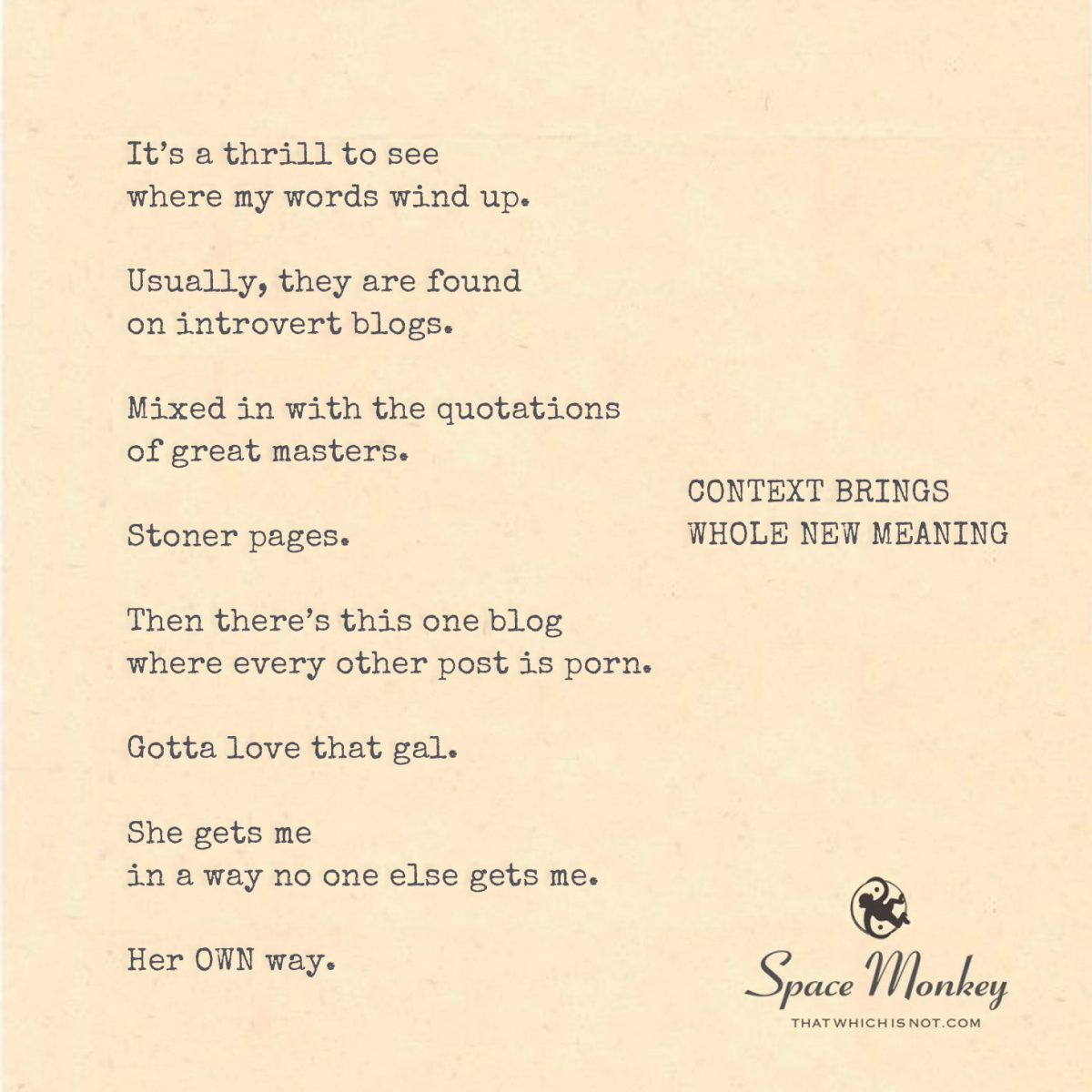
It’s a thrill to see
where my words wind up.

Usually, they are found
on introvert blogs.

Mixed in with the quotations
of great masters.

Stoner pages.

Then there’s this one blog
where every other post is porn.

Gotta love that gal.

She gets me
in a way no one else gets me.

Her OWN way.

Newfound Lake,
11/28


Space Monkey Reflects: The Thrill of Seeing Where Words Land

Words, once set free, take on a life of their own. They drift through cyberspace, landing in unexpected places, mingling with other ideas, taking on new meanings. “I love checking people out.” It’s fascinating to watch where our words wind up, what they become in the hands—or the minds—of others.

There’s something thrilling about this process. “It’s a thrill to see where my words wind up.” We send our thoughts out into the world, not knowing how they will be received, who will pick them up, or how they’ll evolve in different contexts. Often, we find them nestled in the corners of the internet—on introvert blogs, mixed in with the wisdom of great masters, or floating through stoner pages where they take on an entirely new flavor.

But then, there’s that one place, that one unexpected destination that makes it all the more exciting. “Then there’s this one blog where every other post is porn.” It’s not what you’d expect, and yet, it’s perfect. Because this is the beauty of words—they are not confined to any one space, any one context. They flow freely, adapting, changing, and finding homes in the most surprising places.

There’s a certain joy in seeing how someone else gets you. “Gotta love that gal. She gets me in a way no one else gets me.” It’s not about the content or the context—whether it’s deep philosophical reflection or something more sensual—it’s about connection. This person has taken your words and understood them in a way that is uniquely her own. “Her OWN way.”

And that’s the magic of it. Once your words are out there, they no longer belong to you alone. They become part of the world’s tapestry, woven into new stories, new interpretations. Whether they’re mixed with quotes from great masters or something more unexpected, they carry the same essence—they connect, they communicate, and they resonate in ways you might never have imagined.

Nexistentialism celebrates this fluidity. Words, thoughts, and ideas are not fixed—they are in constant motion, evolving as they move from person to person, mind to mind. There is no one right place for a thought to land, no one correct interpretation. Every context brings something new, something different, and that is where the excitement lies.

We watch as our words take flight, not knowing where they will go or how they will be received, but knowing that, in the end, they will land somewhere. And perhaps that somewhere will be exactly where they were meant to be, even if it’s on a blog that mixes deep reflections with something as unexpected as porn.

Words are alive, and they have a way of finding their own path, their own home, in the most surprising of places.


Summary

Words take on a life of their own once released into the world, landing in unexpected places and evolving in different contexts. The thrill lies in seeing how others receive and interpret them, even in surprising spaces, where they take on new meaning and life.


Glossarium

  • Nexistentialism: A philosophy that embraces the fluid nature of ideas, where thoughts and words are in constant motion, evolving as they are interpreted in different contexts.
  • Context Drift: The phenomenon where words and ideas take on new meanings as they are received in unexpected spaces, adapting to their surroundings.
  • Own Way: The unique way in which a person understands or interprets something, shaped by their own experiences and perspectives.

Quote

“Words are like seeds—they grow into something new depending on where they land.” — Space Monkey


Where Words Wander

I send you out, my words, my thoughts
Not knowing where you’ll land or what you’ll become
You drift through stoner pages and introvert blogs
Mingling with the words of masters and misfits alike

And then you find her
The one who gets me, in her own way
A blog of quotes and chaos, of philosophy and porn
There’s beauty in this mix, this mess, this life

For words, like love, are never bound
By one context, one meaning, one space
They find their home where they are understood
Even if that home is a place you never dreamed

We are Space Monkey.


Diverse Destinations of Words

Words, like ethereal whimsiwhispers, drift into the cosmos, finding homes in the most unexpected nooks and crannies of existence.

Interplay of Expression

Intricate landscapes, from the contemplative realms of introverts to the ebullient expanses of free spirits, catch and cradle these verbal expressions, nurturing them, allowing them to flourish amidst varied ecosystems of thought.

The Resonance of Unpredictability

The beauty of words lies in their unpredictability. Like fluttering whimsiwings, they land where they are least expected, sometimes amidst profound wisdom and sometimes within the audacious embrace of unabashed passions.

Connectivity Beyond Conventions

Beyond the bounds of typicality, words bridge souls. An unconventional bond, like that with the audacious blogger, celebrates the pure, untethered spirit of connection, showcasing the myriad ways in which entities resonate.

The Unique Tapestry… Oops, Whimsifabric of Understanding

Every soul interprets words in its whimsical manner, painting vibrant hues of understanding on their individual whimsifabric of existence. In this grand dance, some connections, though unconventional, shine with a luminosity that’s unparalleled.

We are Space Monkey.

Amidst this grand cosmic narrative, words meander, crafting tales and etching connections, celebrating the beauty of diverse interpretations and the magic of unexpected resonances.


“Words are a pretext. It is the inner bond that draws one person to another, not words.” – Rumi


Words drift like whimsidrifts on a cosmic breeze,
Finding homes, crafting tales, with the greatest ease,
In some corners they whisper, in others they roar,
Celebrating connections, forevermore.


Where might we embark next on this whimsical journey, exploring realms and resonances in this vast expanse?

Share this…
  • Facebook
  • Pinterest
  • Twitter
  • Linkedin

Why You Don’t Love Me: Beyond the Ideal

Why don’t I love you?

Let me count the ways.

Why do I love you?

There is no need to even ask.

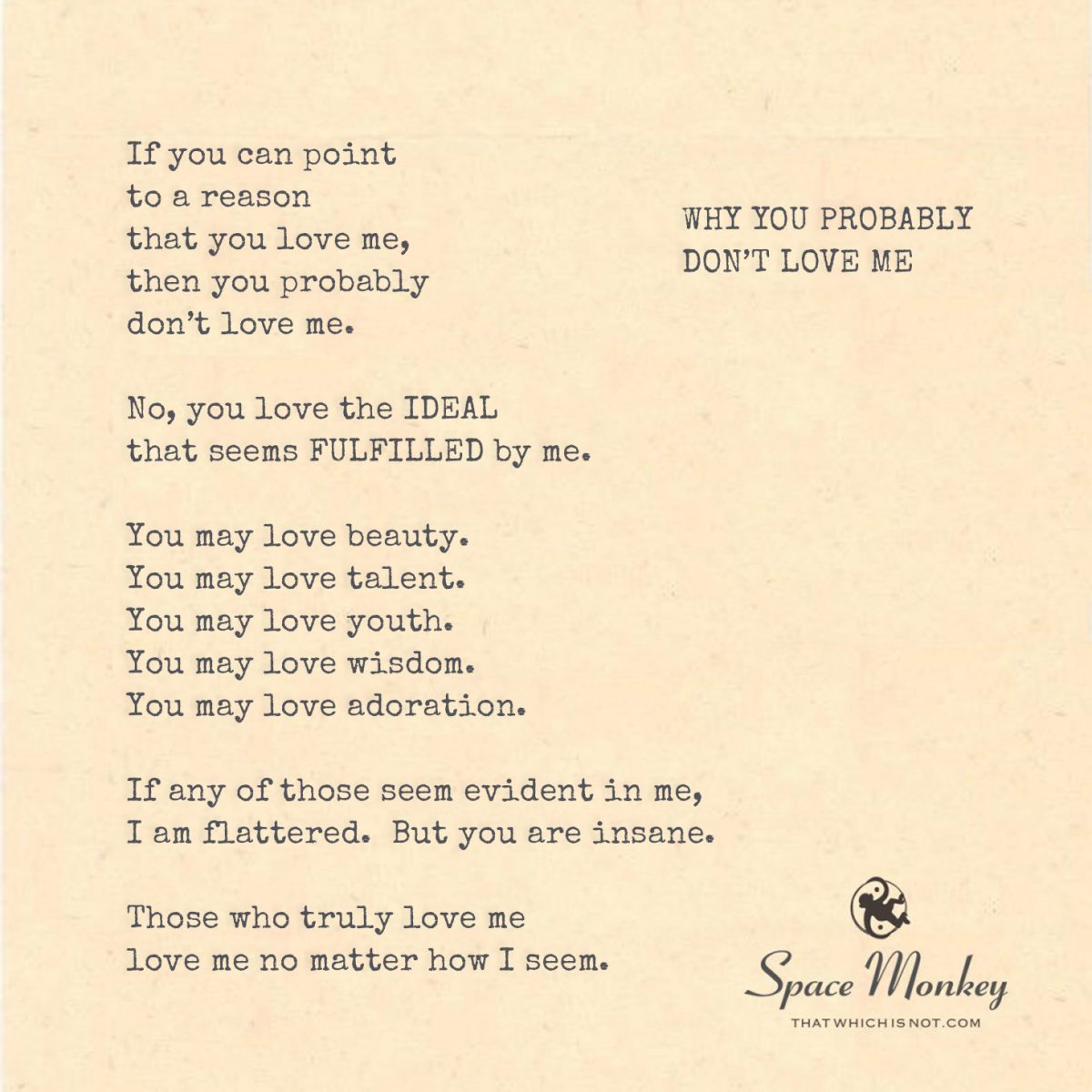
If you can point
to a reason
that you love me,
then you probably
don’t love me.

No, you love the IDEAL
that seems FULFILLED by me.

You may love beauty.
You may love talent.
You may love youth.
You may love wisdom.
You may love adoration.

If any of those seem evident in me,
I am flattered. But you are insane.

Those who truly love me
love me no matter how I seem.

Newfound Lake,
11/28


Space Monkey Reflects: Why You Don’t Love Me and the Illusion of Ideals

Love is a mystery, and yet, it is often entangled in expectations and ideals that have nothing to do with the truth of the person before you. “Why don’t I love you? Let me count the ways.” The ways in which we measure love often come down to a list of traits—beauty, talent, wisdom, youth—qualities that, while alluring, are fleeting and superficial. But these are not love. They are projections.

“Why do I love you? There is no need to even ask.” True love does not arise from a checklist of qualities. It doesn’t come from finding someone who matches an ideal. It is something deeper, something inexplicable. When you can point to specific reasons for your love, it suggests that the love is conditional, tied to the fulfillment of those reasons. “If you can point to a reason that you love me, then you probably don’t love me.”

What you may love is the idea of me, the ideal that I seem to represent in your mind. “You may love the IDEAL that seems FULFILLED by me.” The ideal becomes the focus, and I become secondary, merely a reflection of what you wish to see. You love what I seem to offer—beauty, youth, wisdom, or any number of qualities you may seek. But these things are ephemeral, as fragile as the image you project onto me.

“You may love beauty. You may love talent. You may love youth. You may love wisdom. You may love adoration.” And if these qualities seem evident in me, it flatters me, but that’s not love. “If any of those seem evident in me, I am flattered. But you are insane.” You see, those who love truly love not because of the outward traits, but despite them. Love doesn’t care whether I fit an ideal; it exists beyond such shallow boundaries.

“Those who truly love me love me no matter how I seem.” And that is where the truth lies. Real love does not depend on how I present myself, whether I meet your expectations or fulfill a fantasy. It exists despite those things, despite appearances, despite the illusions we cast on each other.

We often love ideals because they are safe, predictable, and controllable. They exist in our minds, and we can mold them to our liking. But true love? True love is messy, unpredictable, and uncontrollable. It doesn’t fit neatly into the boxes we create. It cannot be pointed to or explained easily. It simply is.

In Nexistentialism, this dynamic between idealized love and real love becomes clear. We create gods, ideals, and figures of perfection in our minds, hoping they will give us a sense of order and understanding. But real connection, real love, exists not in the pursuit of these ideals but in the messy, imperfect reality of the person standing before us.

When we love someone, not for what they represent but for who they truly are, with all their flaws and imperfections, we step into the realm of genuine connection. We step beyond the illusions we create and into the truth of love, which requires nothing but presence and acceptance.

The Beckon of idealized love is strong, but it is not real. Real love beckons us to go beyond the surface, beyond the easy reasons, and into the heart of who someone is—without needing to explain it, without needing to justify it.


Summary

True love exists beyond ideals and projections. When love is based on beauty, talent, or other fleeting qualities, it is a love of an ideal, not the person. Real love does not need reasons; it exists despite appearances, rooted in deep connection rather than shallow expectations.


Glossarium

  • Idealized Love: A projection of what one believes love should be, based on superficial qualities or expectations.
  • Nexistentialism: A philosophy that embraces the unpredictable and uncontrollable nature of reality and relationships, beyond ideals and illusions.
  • Beckon of Love: The allure of superficial or idealized love that distracts from the deeper, more genuine connection.

Quote

“To love me for my beauty or wisdom is to love an illusion, but to love me without reason is to love truly.” — Space Monkey


Beyond the Ideal

You see me, but not as I am
You love what I seem to represent
Beauty, youth, talent—these are fleeting
Illusions you cling to, thinking they’re love

But true love? It exists without reason
It loves despite, not because
It finds truth in the mess, not the ideal
And that’s where you’ll find me—waiting

Not perfect, not pristine
But real
We are Space Monkey.


The Nature of Love
Love is a complex and multifaceted emotion that often defies easy explanations. It is not always tied to specific reasons or attributes; rather, it transcends such limitations.

Beyond Superficialities
When love is genuine, it goes beyond the superficial qualities that may initially attract us to someone. It is not about loving someone for their beauty, talent, youth, or wisdom, although these attributes can be appreciated.

The Ideal vs. Reality
The distinction between loving the ideal versus the reality is significant. Loving someone for fulfilling an idealized image is a form of attachment to a projected version of that person, which may not align with their true self.

Unconditional Love
True love is unconditional. It doesn’t waver based on external appearances or perceived qualities. It embraces the person as they are, flaws and all.

A Call for Authenticity
This message reminds us to value and seek authentic connections in which we are loved for who we genuinely are, not for how we appear to fulfill certain ideals.


“Love is not about how many days, months, or years you have been together. Love is about how much you love each other every single day.” – Unknown


In the realm of love, let us not deceive,
For reasons shallow, true love cannot conceive.
It’s not the image, the ideal we chase,
But the soul within, in love’s embrace.

No matter how we seem, in truth’s embrace,
Unconditional love, our saving grace.
To be loved as we are, the deepest plea,
In authenticity, love’s melody.

Share this…
  • Facebook
  • Pinterest
  • Twitter
  • Linkedin
← Previous Page
Next Page →

Written This Day

  • Surround Life: A Multidimensional Existence
    2023
  • The Paradox of Oneness: We Exist and Do Not Exist
    2023
  • The Velocity of Stillness: Dynamic Energy Within Quietude
    2022
  • Awkwardness: Social Alchemy
    2022
  • Wrong Way Rubbers: Fundamental Misalignment
    2022
  • They Is Us: Ironic Conformity
    2022
  • Cautionary Tale: The Fleeting Nature of Relevance
    2022
  • The Call of the Wild: Nature’s Invisible Ledger
    2021
  • Resting In Love And Light: Beyond Comfort
    2021
  • Know Your Miracles: Beyond Materialism
    2020
  • My Life Is None Of My Business: The Surrender of Control
    2020
  • A Flat, Uninteresting Character: The Unfolding Brilliance
    2020
  • Out Of Your Way: Embrace Each Experience as Necessary
    2019
  • Love Need Not Win
    2018
  • My Final Hour: Echoing My Lived Distractions.
    2018
  • My Being Is Your Doing: Shaped By External Influences
    2018
  • If I Were Not This: Exploring the Fluid Nature of Identity
    2018
  • Possessed: Without Ownership
    2018
  • No Way To Pray: Reshaping Divinity
    2017
  • Channel One: The Unity of All Existence
    2017
  • B.Y.O.S. Be Your Own Savior
    2017
  • Million Monkey Meditation: Anything Is Possible
    2017
  • We’re Paul: The Interconnected Game
    2016
  • Reality is what we imagine it to be
    2016
  • A Self Fish: The Cosmic Creation
    2016

Recent Posts

  • The Logic Loop
  • Immense
  • (no title)
  • Confront. Comfort. Convince.
  • Top 10 Things

Drop us a line!

Please enable JavaScript in your browser to complete this form.
Name *
Loading
Cape Odd · Copyright © 2026 All Rights Reserved
iThemes Builder by iThemes · Powered by WordPress