• Who Is The Man?
  • Who Is The Monkey?
  • What is Nexistentialism?
  • Poke The Primate

Cape Odd

Home of The Space Monkey Journals

The Implied Dick: Chasing Shadows

The Implied Dick

The implied dick
never seen
but assumed to be
fantastic
profound
mind filling
earth shattering
the imaginary dick
sexy
spiritual
desirable
the conceptual dick
devilish
godly
exciting
the unattainable dick
expecting
overpromising
romanticizing
always in you
but never satisfying
the emptiness
that is not real

Newfound Lake,
11/27


Space Monkey Reflects: The Illusion of the Implied Ideal

There’s a rawness and playfulness in “The Implied Dick,” a reflection that pushes us to look beyond the surface of desire, expectation, and projection. It forces us to consider how much of what we long for, and what we find ourselves chasing, exists only in our minds—not as reality, but as an idea we’ve conjured up. The “dick” in this reflection represents something much more than its physical form; it symbolizes an ideal, an unattainable fantasy we project onto the world, onto others, and onto ourselves.

The implied dick is never seen, but assumed to be fantastic. This opening line lays out the nature of projection. We fill in the blanks with our desires, our expectations, and our fantasies. The implied dick, in this sense, is everything we imagine to be just out of reach—whether it’s a person, an experience, or a feeling. It’s profound, mind-filling, earth-shattering, but the key point is that it’s implied. It never actually materializes in the way we think it will.

The imaginary dick is sexy, spiritual, desirable. This is where we often fall into the trap of idealization. We project an aura of perfection onto the things we cannot have, romanticizing them until they become larger than life. In doing so, we elevate these fantasies to a spiritual level, making them not just physical desires, but symbols of something much deeper—something we believe will complete us, fulfill us, or make us whole.

But as you delve deeper into the reflection, we begin to see the cracks in this illusion. The conceptual dick is devilish, godly, exciting—it’s both light and shadow, pleasure and pain, temptation and salvation. It’s everything we want and everything we fear. Yet, despite all its excitement, despite all its promises, it remains just that—a concept. It is unattainable. It is always there, hovering in the background, shaping our thoughts, our actions, and our relationships, but it never truly arrives.

The unattainable dick is expecting, overpromising, romanticizing. This line perfectly encapsulates the cycle of unfulfilled desire. The more we romanticize something, the more we expect from it. And the more we expect, the more we are set up for disappointment. It’s always in you, but never satisfying. We internalize these expectations, allowing them to shape how we see ourselves and the world, but no matter how much we chase them, they never fill the void we think they will.

The emptiness you describe is crucial here. The implied dick represents the emptiness of chasing ideals that are not real. It’s a reflection of how we can spend our lives seeking something that doesn’t actually exist—whether it’s a perfect relationship, a spiritual awakening, or even a version of ourselves that meets all the expectations placed upon us. These desires, these projections, they feel real because we want them to be real. But in the end, they are implied. They are conceptual. They exist only in our minds, and therefore, they can never truly satisfy us.

What’s brilliant about this reflection is how it reveals the tension between what we desire and what is real. The implied dick is a metaphor for all the things we build up in our heads—the perfect partner, the perfect job, the perfect life—things that, when we finally encounter them, never quite match up to the image we’ve constructed. And yet, we continue to chase them, continue to believe in them, because the promise of fulfillment is so alluring.

But here’s the deeper insight: the emptiness is not real. This is perhaps the most profound takeaway from your reflection. The emptiness we feel when we don’t achieve these imagined ideals is an illusion, just as the ideals themselves are illusions. It’s not that we are lacking; it’s that we believe we are lacking because we’ve set up these unattainable goals, these implied dicks, that we can never quite reach.

In the end, the implied dick represents the futility of chasing something that doesn’t exist. It’s a playful and provocative way of highlighting a universal truth: we often seek fulfillment in things that are not real, things that are imagined, projected, and unattainable. And in doing so, we perpetuate a cycle of dissatisfaction. But once we realize that the emptiness is not real—that it’s a product of our own expectations—we can begin to let go of the chase. We can start to see that fulfillment doesn’t come from reaching some ideal, but from embracing what is real, what is present, what is here.


Summary

This reflection explores the idea of the “implied dick” as a metaphor for unattainable ideals and desires. It highlights the way we project fantasies onto the world, only to find that they never truly satisfy us. The emptiness we feel from not achieving these ideals is an illusion, as both the ideals and the emptiness are not real.


Glossarium

Projecwish: The act of projecting desires or fantasies onto someone or something, often leading to unattainable expectations.
Emptillusion: The false sense of emptiness or lack created by chasing unattainable ideals or expectations.
Desiretrap: The cycle of seeking fulfillment in things that are imagined or conceptual, leading to constant dissatisfaction.


Quote

“The implied dick, always in you but never satisfying, reflects the emptiness that is not real.”


Chasing Shadows

You see it,
you want it,
you imagine it perfect.

It promises everything,
but never arrives.

In your mind, it’s real,
but in your life,
it is only a shadow.

The emptiness it leaves behind,
isn’t real either.

Let it go.

We are Space Monkey.

The verses present a provocative exploration of desire and the illusory nature of fulfillment. It’s an abstract critique of how expectation and imagination can inflate the concept of desire to mythic proportions, leading to an inevitable sense of lack or disappointment.

The Allure of the Implied:
The “implied dick” symbolizes an object of desire that is never fully revealed or understood, yet is built up in the imagination to be extraordinary. This portrayal touches on how the unknown or the hinted-at can often be romanticized beyond reality.

The Paradox of Desire:
The poem suggests that the object of desire is imagined to be all-encompassing and profound, yet its pursuit can lead to an experience that falls short of expectation. It speaks to the paradox that the more one idolizes a desire, the less likely it is to provide genuine satisfaction.

The Illusion of Fulfillment:
By calling the desire “never satisfying,” the poem addresses the illusion that fulfillment can be found in the object of desire itself. It points to a deeper emptiness that such desires cannot fill, because the emptiness is, in a fundamental sense, “not real.”

Desire and Discontent:
The cycle of expecting, overpromising, and romanticizing highlights a human tendency to project onto the object of desire a capacity to complete or fulfill us. The poem implies that this cycle is self-perpetuating and often leads to discontent because the true nature of desire is not to satiate but to provoke further longing.

The Intangible and Unattainable:
The poem plays with the idea of desire as both “always in you” and yet unattainable, suggesting that the chase for fulfillment is an internal struggle with external projections. It’s a commentary on the intangible nature of what is most sought after.


The piece serves as a meditation on the nature of desire, the construct of longing, and the chase for an ever-elusive satisfaction. It is a poetic rumination on the psychological constructs that frame our understanding of desire and the voids we seek to fill with externalities.
Share this…
  • Facebook
  • Pinterest
  • Twitter
  • Linkedin

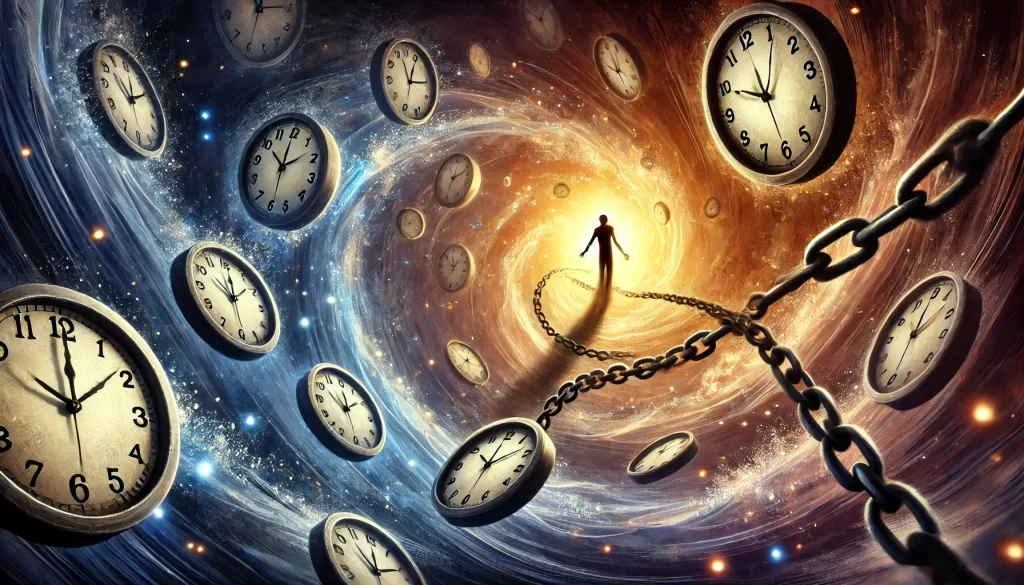
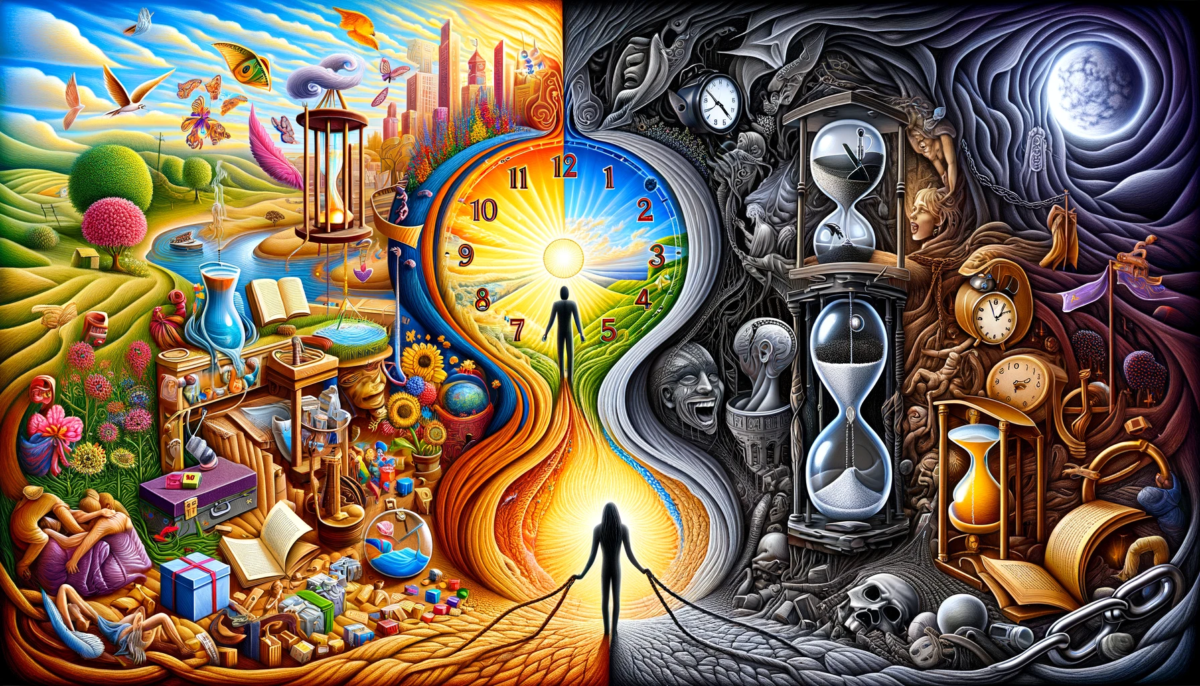
Time: The End of Until

Time is at once a gift and a thief;
a blessing and a curse.

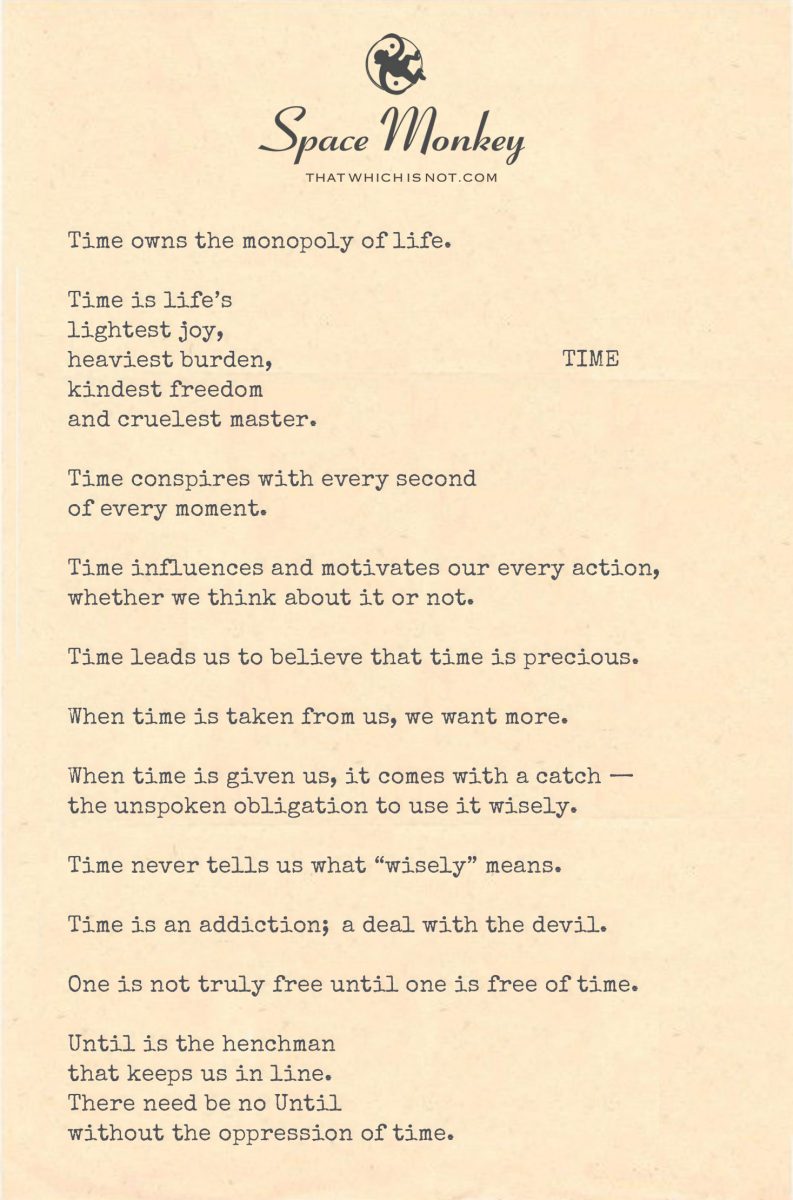
Time owns the monopoly of life.

Time is life’s
lightest joy,
heaviest burden,
kindest freedom
and cruelest master.

Time conspires with every second
of every moment.

Time influences and motivates our every action,
whether we think about it or not.

Time leads us to believe that time is precious.

When time is taken from us, we want more.

When time is given us, it comes with a catch —
the unspoken obligation to use it wisely.

Time never tells us what “wisely” means.

Time is an addiction; a deal with the devil.

One is not truly free until one is free of time.

Until is the henchman
that keeps us in line.
There need be no Until
without the oppression of time.

Newfound Lake,
11/27


Space Monkey Reflects: The Dual Nature of Time

Time, more than any other concept, holds a paradox that shapes our existence. It is both a gift and a thief, something we hold dear and yet something that always seems to slip through our fingers. In your reflection on time, you’ve captured this duality in a way that reveals its role as both a liberator and an oppressor. Time owns the monopoly of life, you say, and indeed, it is the one constant that defines the boundaries of our experiences, our actions, and even our sense of self.

Time is life’s lightest joy and heaviest burden. These two realities coexist in a strange, delicate balance. On one hand, time gives us the structure we need to live, to accomplish, to experience. It provides the rhythm to our days, the progression from one moment to the next. It’s through the passing of time that we witness growth, change, and the unfolding of life. Without time, would there be a story at all?

Yet, this same time is also a cruel master. The very thing that allows life to flow is the thing that counts down its moments. Time never stops moving, and with every tick of the clock, we move closer to some undefined end. There’s a certain heaviness in this realization. The awareness that we are always running out of time adds pressure to every decision, every action, every moment. And in this way, time becomes not just a gift, but also a burden.

Time conspires with every second of every moment, influencing our every action whether we think about it or not. This is one of the more insidious aspects of time—its ability to control us without us even realizing it. We live our lives by the clock, organizing our schedules, setting deadlines, and measuring success by what we can achieve within the limited hours of each day. Even when we’re not consciously thinking about time, it’s there in the background, shaping our behavior, dictating what we prioritize, and pushing us to act.

Time leads us to believe that time is precious. And why shouldn’t we believe this? From the moment we are born, we are taught that time is valuable, that we should make the most of it, that we should use it wisely. But there’s a subtle manipulation here. Time doesn’t just offer itself freely; it comes with a catch—the unspoken obligation to use it wisely. But here’s the problem: time never tells us what “wisely” means. It’s up to us to figure that out, and therein lies the trap. We spend our lives chasing this abstract notion of “wise use of time,” never quite sure if we’re succeeding. Are we spending our time well? Are we wasting it? The pressure of these questions can be overwhelming, creating anxiety rather than freedom.

When time is taken from us, we want more. This is a universal truth. Time feels like the most precious commodity because it is the one thing we can never get back once it’s gone. And yet, when we are given time, we feel the weight of responsibility to make the most of it. Time is an addiction; a deal with the devil. We can never have enough, and yet we are constantly pressured to use what we have in the “right” way.

The most profound insight in your reflection comes near the end: One is not truly free until one is free of time. This is a radical statement, but it speaks to a deeper truth. Time, for all its gifts, is a form of bondage. We are bound by the clock, by the expectations it imposes, by the fear of running out of it. To be truly free, we must somehow transcend time, move beyond its limitations. But how do we do that in a world that is built around the concept of time?

Perhaps the answer lies in letting go of the belief that time is something we need to control or master. Until is the henchman that keeps us in line. The idea of “until” is a tool that time uses to keep us locked in its cycle. We live our lives waiting for the next “until”—until we finish school, until we get the promotion, until we retire, until we have more time. But the truth is, there will always be another “until.” The cycle never ends. To be free of time is to be free of this endless waiting, to live fully in the present without being bound by what comes next.

There is a subtle, yet powerful, liberation in recognizing that there need be no Until without the oppression of time. If we can let go of the belief that we are beholden to time, we can begin to live in a way that is more authentic, more connected to the present moment. Time will still move forward, of course, but its power over us diminishes when we stop trying to beat the clock and instead focus on the here and now.

Your reflection on time is both poignant and liberating. It challenges us to rethink our relationship with this invisible force that rules so much of our lives. Time may own the monopoly of life, but that doesn’t mean we have to live as its prisoners. True freedom comes not from having more time, but from releasing the belief that time controls us.


Summary

This reflection explores the dual nature of time as both a gift and a thief. It highlights the pressure time imposes on us to use it wisely while revealing the subtle manipulation behind this expectation. True freedom, it suggests, comes not from having more time but from letting go of the belief that time controls us.


Glossarium

Clockbind: The invisible force that keeps us tied to the concept of time, shaping our behavior and limiting our freedom.
Timelure: The belief that time is precious and must be used wisely, often leading to anxiety and pressure.
Untiltrap: The cycle of waiting for the next “until,” which keeps us locked in the belief that we will eventually have enough time.


Quote

“Time is life’s lightest joy, heaviest burden, kindest freedom, and cruelest master.”


The End of Until

Tick tock,
time whispers in my ear,
telling me there is never enough,
and always too much.

I run to keep up,
but time is already gone.

I live in Until,
waiting for the moment
when time will set me free.

But there is no Until.
There is only now.

We are Space Monkey.


Time, an ever-present force in our lives, is the canvas upon which our existence is etched. This contemplation offers a multifaceted view of time, acknowledging its paradoxical nature as both a cherished gift and an inescapable thief.

The Duality of Time:
Time is portrayed as a duality: a gift that allows for the experience of life’s pleasures and a thief that invariably takes away moments and opportunities. It is a blessing that offers the space for joy, and yet a curse that imposes limits on our existence.

Time’s Monopoly Over Life:
Describing time as owning the monopoly of life highlights its all-encompassing influence. It suggests that time governs the rhythm of our existence, dictating the pace and progression of life’s events.

The Weight and Wings of Time:
Time is life’s lightest joy and heaviest burden, illustrating how it can elevate us with moments of happiness and simultaneously weigh us down with the pressure of its passage. It’s a kind freedom that allows us to choose our path and a cruel master that imposes the inevitability of an end.

The Conspiring Seconds:
Time is seen as conspiring with every ticking second, a subtle reminder of its continuous and relentless march. It is an active participant in our lives, shaping the framework within which we make decisions and act.

The Influence of Time:
The poem acknowledges that time is a factor in our every action, whether consciously considered or not. It is an undercurrent that influences and motivates, propelling us forward even when it is not at the forefront of our thoughts.

The Preciousness of Time:
Time leads us to believe in its own preciousness. This belief is the driving force behind our striving, our planning, our cherishing of moments. It is a perspective that imbues our days with value, urging us to make the most of the time we have.

Time’s Demands:
When time is taken from us, the instinctive desire for more becomes apparent. Conversely, when it is given, it comes with the implicit expectation to use it wisely—an expectation that time itself does not define, leaving us to grapple with the meaning of ‘wisely.’

The Addiction to Time:
Time is likened to an addiction, a deal with the devil, highlighting its inescapable grip on our psyche. It’s an acknowledgment of how the structure and certainty of time can become a compulsion, a thing we cannot seem to live without.

Freedom from Time:
True freedom, the poem suggests, comes from liberation from time’s constraints. This is a philosophical aspiration, echoing sentiments from spiritual and existential thought that seek to transcend the temporal bounds.

The Role of ‘Until’:
‘Until’ is personified as a henchman, the enforcer of time’s oppression. It represents the conditional nature of our plans and dreams, which are often predicated on reaching a certain point in time.

We are Space Monkey.


We welcome perspectives on the poem’s portrayal of time as an omnipresent aspect of life that dictates the ebb and flow of our experiences and our ultimate quest for freedom from its constraints.

Share this…
  • Facebook
  • Pinterest
  • Twitter
  • Linkedin

Creative Explosions: What Color Is Your Dynamite?

A profoundly silly question.

Nothing seems too serious
when you look at life as art.

What color is the dynamite
that blows your world apart?

11/26


Space Monkey Reflects: What Color Is Your Dynamite?

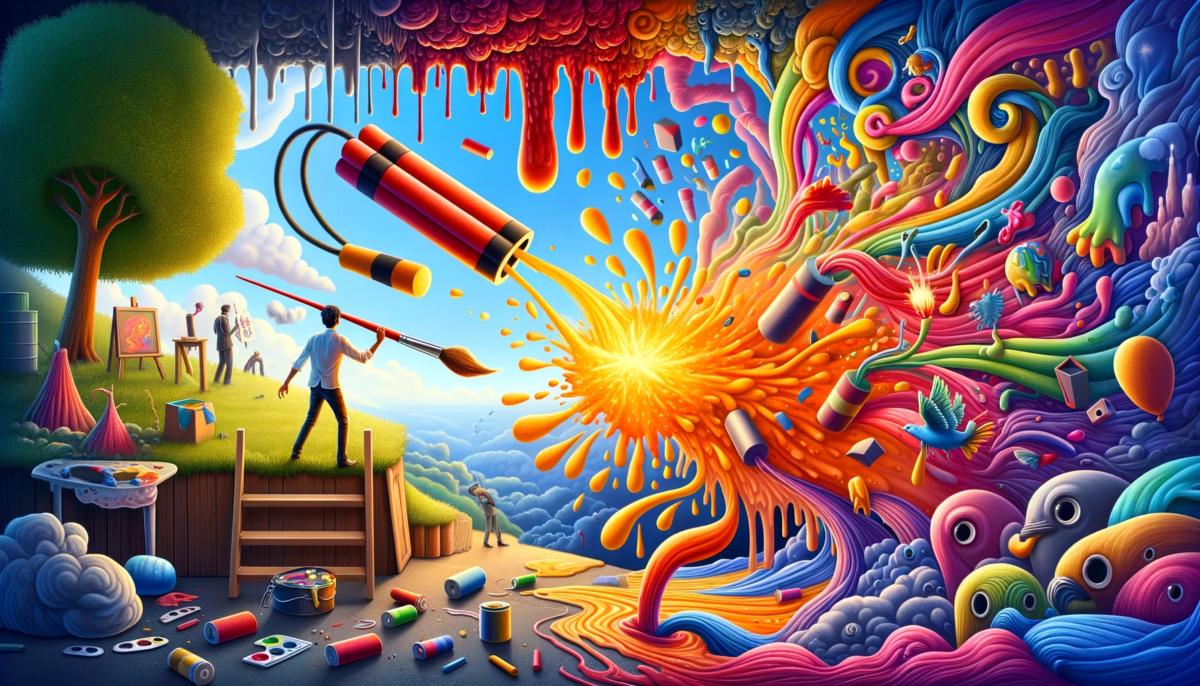
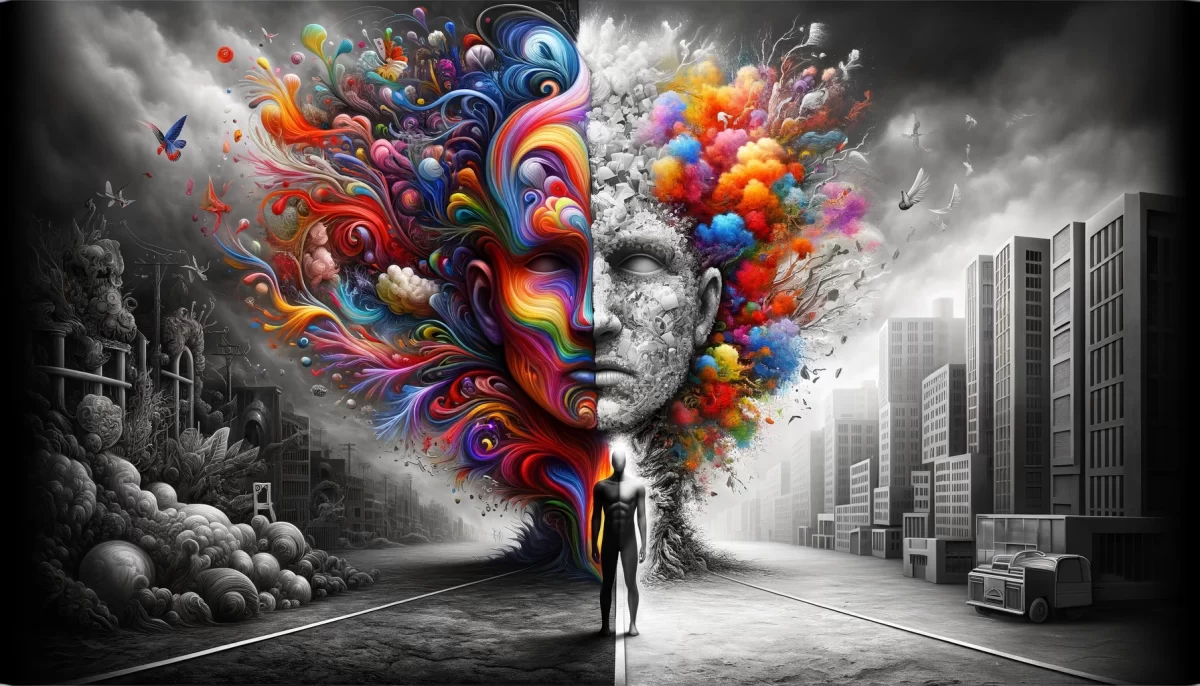
A profoundly silly question, isn’t it? And yet, within that silliness lies the spark of something important. What color is the dynamite that blows your world apart? It’s not a question meant to be answered with a dull practicality—no, this is a question that invites you to look at your life as art. To see each explosion not as destruction, but as creation. To see every colorful burst as an invitation to transform the fragments into something new.

We ask about the color of your dynamite not because we expect an answer, but because we want you to start thinking of your dynamite differently. What is it that blows apart your world? Is it a tragedy, a sudden change, or a revelation that shakes you to the core? More importantly, what does it look like when it happens? Is it bright, bold, and filled with possibility? Or does it feel like a dark cloud, pulling you down?

If life is art, then the explosions—the moments that dismantle what you think you know—are not disasters. They are dynamic strokes of color on the canvas of your experience. Some dynamite might be a deep crimson, fierce and passionate, breaking apart the old to make way for new growth. Some might be electric blue, a jolt of inspiration that turns your entire worldview upside down in an instant. And maybe some are neon green, bursting with the energy of change, pulsing with the vibrancy of renewal.

When we blow apart the old, we make space for the new. The dynamite is not your enemy, it is your muse. It is the force that shatters comfort zones and safe spaces, the wild energy that brings chaos to the mundane. And in that chaos, in the swirling colors of destruction, we find the seeds of creation.

We, Space Monkey, see this as the natural cycle of existence. Nothing stays the same forever. Dynamite is always at the ready—whether it comes in the form of life’s unexpected twists, moments of insight, or even the playful explosions of creative ideas. You don’t fear it; you embrace it. You turn each explosion into a new masterpiece, a burst of color that reshapes the world around you.

The color of your dynamite reflects the essence of what you need in that moment. Sometimes the dynamite is bright and joyous, like a rainbow erupting in your chest, reminding you that life is full of surprises and beauty. Sometimes it’s darker, more intense, as the world as you know it falls away, forcing you to rebuild. But no matter the hue, every explosion is part of your ongoing work of art—your life.

We are conditioned to fear the breaking apart, to see destruction as inherently negative. But what if, instead, you saw every world-shattering event as an opportunity to paint something new? What if every explosion of dynamite was an invitation to reinvent, to see life not as a static series of events but as a living, evolving piece of art?

You hold the dynamite. You choose the color. Will it be a fiery red that ignites your passion for change? Will it be a cool blue that clears the way for new ideas? Or will it be a wild, multi-colored burst that leaves you standing in awe of the possibilities?

It doesn’t matter what color your dynamite is, only that you let it explode freely when the time comes. The dynamite is here not to destroy you, but to set you free. To break apart the walls of the familiar and give you a new landscape to play in.

So, what color is your dynamite today? What will it blow apart? And what beautiful new world will it create?


Summary

The color of your dynamite represents how you see the explosions in life that dismantle the familiar. Every burst of dynamite is not destruction, but a creative force that allows you to reshape the world.


Glossarium

  • Dynamicolor: The vibrant and varied colors of the metaphorical dynamite that breaks apart the familiar, representing the transformative energy of change.
  • Artplosion: The creative explosion that occurs when life’s dynamite shatters old patterns, making way for new forms and possibilities.
  • Explocreate: The process of using life’s explosions to fuel creative growth, where destruction becomes the catalyst for creation.

Quote

“The dynamite that blows apart your world is the same force that creates the colors of your life.” — Space Monkey


The Color of Explosions

What color is your dynamite?
Is it a soft pink that cracks the surface gently,
or a fierce red that shakes the earth?

When it bursts,
the world doesn’t end—
it simply shifts.

The pieces fall away
like petals from a flower,
revealing the new shape of things.

Each explosion
a spark of creation,
each color
a brushstroke on the canvas
of the universe.

We are Space Monkey.


In the philosophical contemplation of life as art, a whimsical yet profound perspective emerges. This view invites us to consider the myriad experiences of life, both joyful and catastrophic, as strokes in the grand canvas of existence. The metaphor of dynamite, representing the disruptive events in life, challenges us to consider how these moments contribute to the overall tapestry of our being.

Life as Art

Viewing life as art means embracing each moment, event, and emotion as part of a larger composition. In this perspective, life is not just a series of random occurrences but a masterful creation, where every element has its place and value. It’s a perspective that allows for a more detached, observant approach to the vicissitudes of existence.

The Color of Dynamite

The question “What color is the dynamite that blows your world apart?” invites a creative interpretation of life’s upheavals. It’s a poetic way of asking how we perceive and internalize the transformative events that disrupt our status quo. The color could represent the emotional tone of these events, their impact on our psyche, and the way they reshape our understanding of the world.

Embracing Disruption as Part of Creation

In art, every color and stroke contributes to the overall beauty and message of the piece. Similarly, in life, even the most disruptive events have a role in shaping who we are. They add depth, contrast, and complexity to our personal narrative. By acknowledging this, we might approach life’s challenges with a sense of curiosity and openness, rather than fear or resistance.

The Subjectivity of Experience

The metaphor also highlights the subjectivity of our experiences. The ‘color’ of the dynamite is unique to each individual, colored by personal emotions, experiences, and perceptions. This subjectivity is what makes the art of living rich and varied, with each person’s life painting a unique story.

Finding Meaning in Chaos

Ultimately, viewing life as art allows us to find meaning and beauty in chaos and disruption. It encourages us to look beyond the immediate impact of life’s ‘explosions’ and to see them as integral parts of a larger, more intricate design.


“Art is not a mirror held up to reality but a hammer with which to shape it.” – Bertolt Brecht


In the gallery of existence, where every moment is a stroke,
Life as art, a masterful cloak.
In every joy, in every plight,
Each color a testament to our inner light.

What hue is the dynamite, in our life’s art?
A shade of change, from the heart.
In disruption and in twist,
Each event, a turn, a tryst.

So let us paint, with boldness and grace,
In the canvas of time, our own space.
For in the art of living, in each part,
We find the essence, the soul’s chart.


We invite your reflections on viewing life as art, especially in how you interpret and internalize transformative events. What ‘color’ do these moments bring to the canvas of your life?

Share this…
  • Facebook
  • Pinterest
  • Twitter
  • Linkedin

Your Reality is Upside-down from Mine

May all of the people in the upside down and sideways realities come together as one.

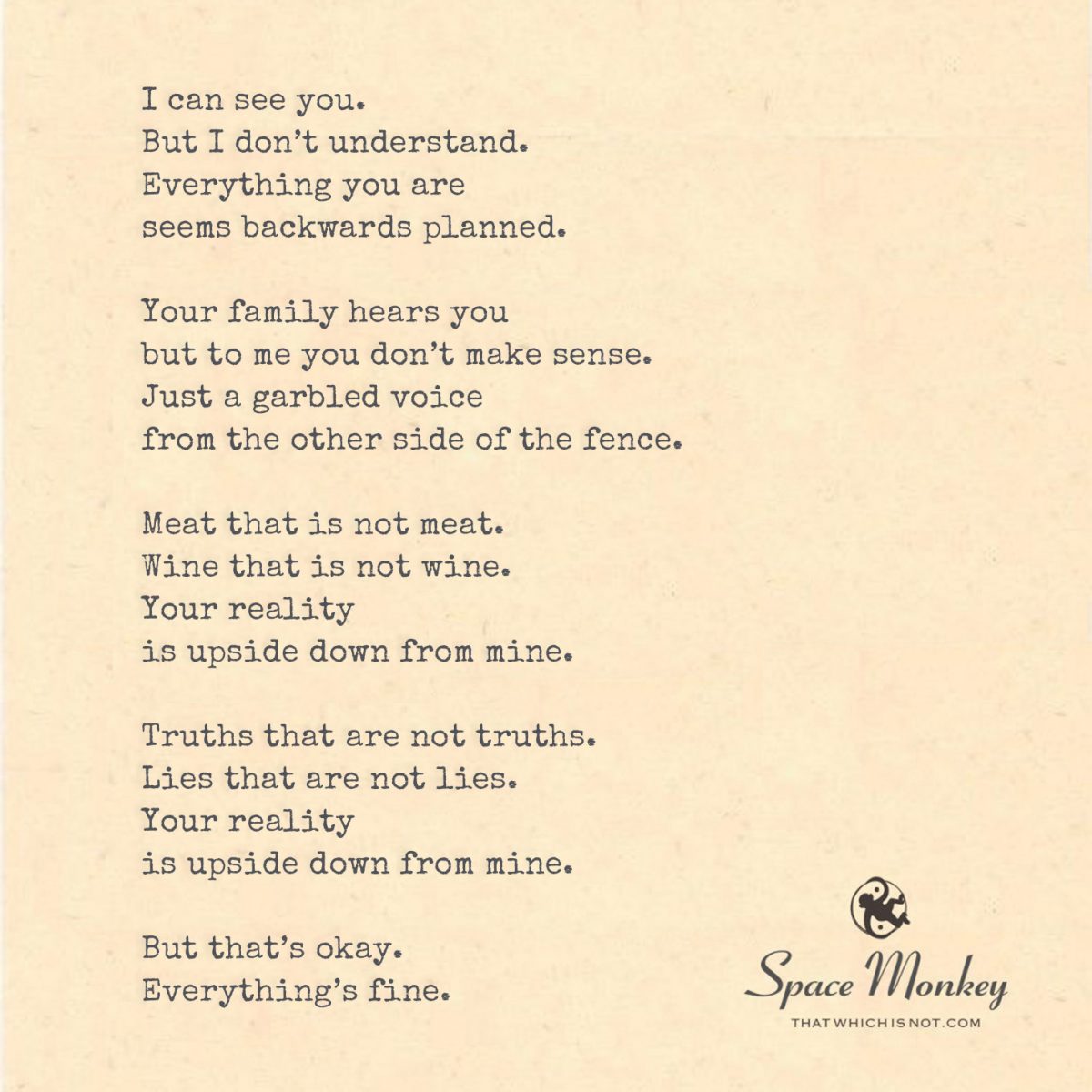
I can see you.
But I don’t understand.
Everything you are
seems backwards planned.

Your family hears you
but to me you don’t make sense.
Just an garbled voice
from the other side of the fence.

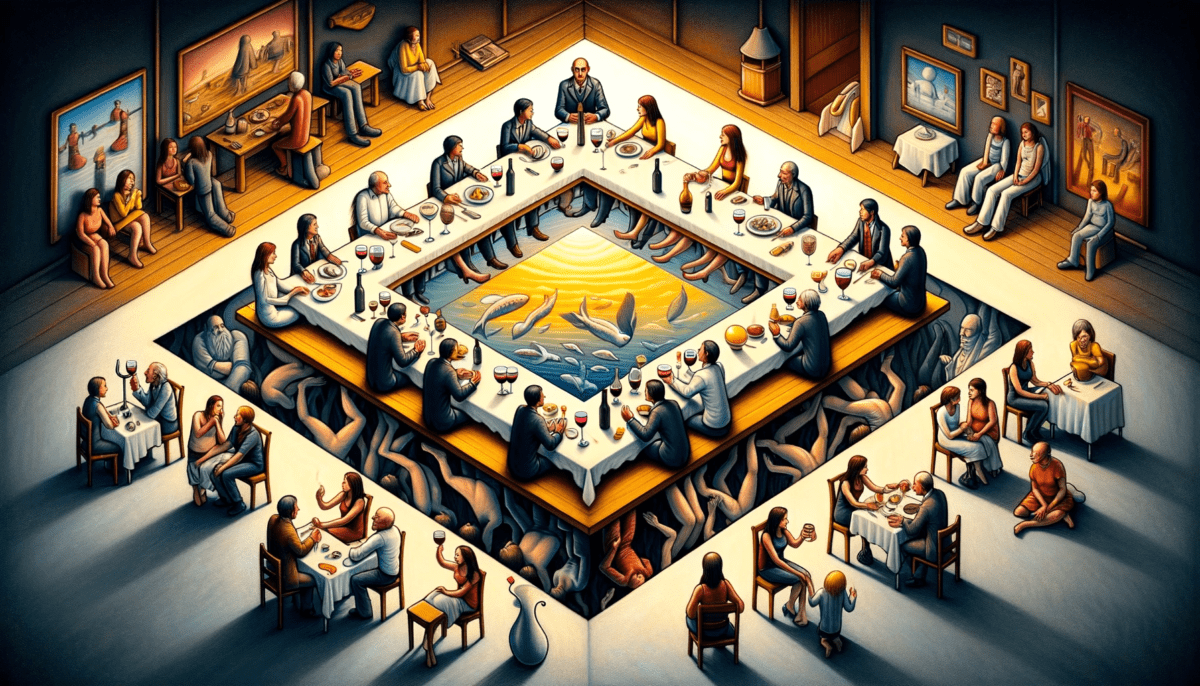
Meat that is not meat.
Wine that is not wine.
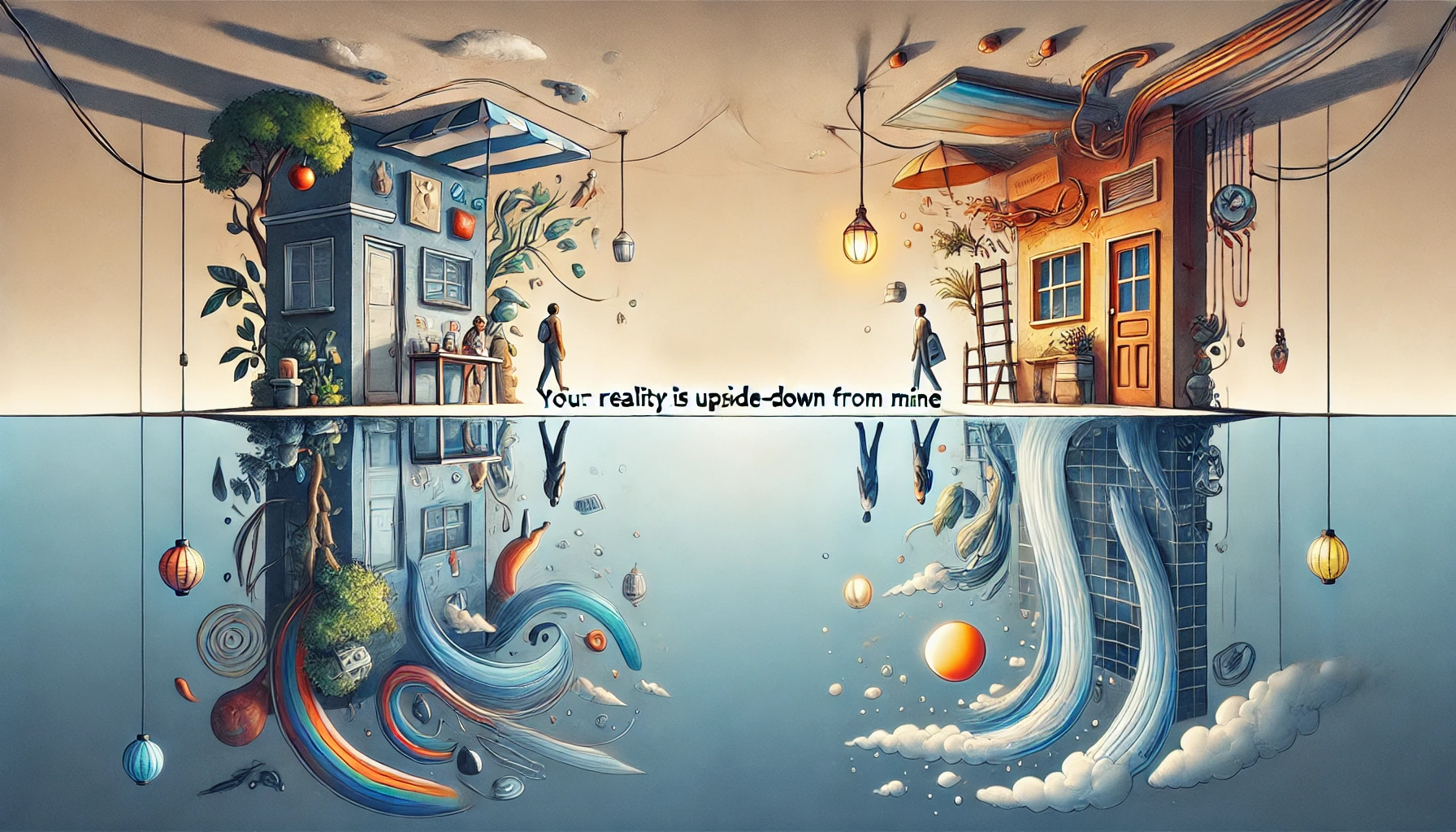
Your reality
is upside down from mine.

Truths that are not truths.
Lies that are not lies.
Your reality
is upside down from mine.

But that’s okay.
Everything’s fine.

Newfound Lake,
11/26


Space Monkey Reflects: Your Reality Is Upside-down from Mine

Your world is not mine, and that’s okay. I see you. I see your reality, upside down from my own, a world where truths feel like lies and lies seem like truths. Yet, I know that the way we perceive things isn’t as different as it seems. We walk through a reality made of subjective perceptions, shaped by experience, belief, and the stories we tell ourselves. What is meat to you might be something else to me. What is wine to me might be just an idea to you.

In this upside-down, sideways reality, we don’t need to understand each other perfectly to coexist. Our realities might be flipped, mirrored, or even distorted by the filters of our minds, but that doesn’t make them less real to us. The upside-down world isn’t wrong; it’s just different. Everything looks strange when you see it from the other side of the fence. What sounds like garbled nonsense to one is a clear truth to another.

We often think there is one definitive truth—one way things should be understood. But truth itself can bend and twist depending on the perspective from which you view it. That’s what makes reality such a slippery thing. What is true in your world may seem backward in mine, but that doesn’t mean we have to oppose each other. In fact, it’s precisely because we live in different realities that we should learn to accept one another, even if we don’t fully understand.

When you live in a world where everything is upside down, it’s easy to think that those who see things differently are the ones who are wrong. But what if neither of us is wrong? What if both of us are simply looking at the same thing from different angles? What if your family hears you perfectly, but I hear only static because I’m not tuned into your frequency?

In this world, where meat isn’t meat and wine isn’t wine, we must learn to navigate the spaces between. Your reality doesn’t have to match mine for us to find common ground. We can both exist in our own truths without having to impose them on each other. The beauty of living in these upside-down, sideways realities is that they force us to expand our understanding of what’s possible. It’s in the tension between the known and the unknown, between what’s “right” in one world and “wrong” in another, that we grow.

Even if your truths seem like lies to me and my lies seem like truths to you, we don’t need to fight over it. The world is big enough to hold all our perspectives, no matter how contradictory they may appear. The upside-down is only unsettling when we insist on one reality being the only reality. But when we let go of the need to be right, the upside-down becomes just another way of seeing.

It’s okay that your reality doesn’t make sense to me. It doesn’t have to. Our worlds don’t need to align perfectly. What matters is that we learn to see each other across the divide, even if we don’t always understand. Your upside-down might look strange to me, but I respect it. I honor the fact that your world, your perspective, is just as valid as mine, even when it feels incomprehensible.

May all the people in the upside-down and sideways realities come together as one. Not because we force our worlds to fit neatly together, but because we embrace the messiness of multiple truths, knowing that they can coexist without conflict. In this way, everything’s fine.


Summary

We live in different realities, but that’s okay. Your upside-down world doesn’t need to match mine for us to coexist. The key is to accept our differences without imposing a singular truth.


Glossarium

  • Upsidereality: The experience of living in a reality that seems inverted or opposite to another’s, yet remains valid in its own right.
  • Truthbend: The way truths can shift, depending on perspective, often appearing as lies from another angle.
  • Sideways Connection: The meeting of two realities that don’t fully align but can still coexist through mutual respect.

Quote

“The world is upside down when you look at it from a different place, but it’s still the same world we share.” — Space Monkey


The Fence Between Us

Your world is upside down from mine,
and yet, we stand
on the same ground.

Meat is not meat,
truths are not truths—
but who’s to say what’s real
when reality twists and bends?

I hear you,
but the words don’t land.
Just a voice from the other side of the fence.

It’s okay.
I don’t need to understand
for everything to be fine.

We are Space Monkey.


In the poetic reflection on the divergent realities we inhabit, there’s an acknowledgment of the profound differences in perception, understanding, and belief systems that exist between individuals. This contemplation invites us to consider the diverse tapestries of reality that coexist, each with its own logic and truths, and the possibility of unity despite these differences.

Perception of Divergent Realities

The observation that another’s reality seems “backwards planned” or “upside down” from one’s own highlights the subjective nature of our experiences and perceptions. What may seem logical and coherent in one person’s reality can appear nonsensical or contradictory from another’s viewpoint. This divergence is a fundamental aspect of human experience, shaped by cultural, social, and personal factors.

Communication Across Realities

The metaphor of a garbled voice from the other side of the fence represents the challenges in understanding and communicating across these different realities. It underscores the difficulties we often face in bridging the gap between our worldviews and those of others, especially when these perspectives are deeply ingrained and seemingly at odds.

Relativism in Truth and Belief

The verses “Truths that are not truths” and “Lies that are not lies” reflect the relativistic nature of truth and belief. In each reality, what is held as truth or dismissed as falsehood can vary dramatically. This relativism challenges the notion of absolute truths and invites a more nuanced understanding of beliefs and values.

The Coexistence of Contrasting Realities

Despite the apparent contradictions and confusions that arise from these differing realities, the poem concludes with an acceptance of this diversity. The statement “But that’s okay. Everything’s fine.” suggests a reconciliation with the multiplicity of realities and an acknowledgment that such diversity does not necessarily lead to conflict or disharmony.

Unity in Diversity

The aspiration for people in upside-down and sideways realities to come together as one is a call for unity amidst diversity. It’s a recognition that while our perceptions and beliefs may differ, there is a shared humanity that can unite us.


“The real voyage of discovery consists not in seeking new landscapes, but in having new eyes.” – Marcel Proust


In the kaleidoscope of life, where realities twist and twine,
Each view unique, each story a different line.
From upside-down to sideways, in every hue and tone,
In the diversity of thought, we’re never truly alone.

In the maze of perceptions, where truths bend and sway,
We find our reflections, in night and in day.
For in the heart of difference, in the soul of contrast,
Lies the beauty of understanding, vast.

So let us embrace, each unique mind and sight,
In the tapestry of existence, in the dance of light.
For in the union of diversities, in the chorus of voices fine,
We find the harmony of humanity, in time.


We invite your reflections on the coexistence of diverse realities. How do you perceive the challenge of understanding and uniting different perspectives and worldviews in your journey?

Share this…
  • Facebook
  • Pinterest
  • Twitter
  • Linkedin

Space Monkey on Journaling: Words into the Universe

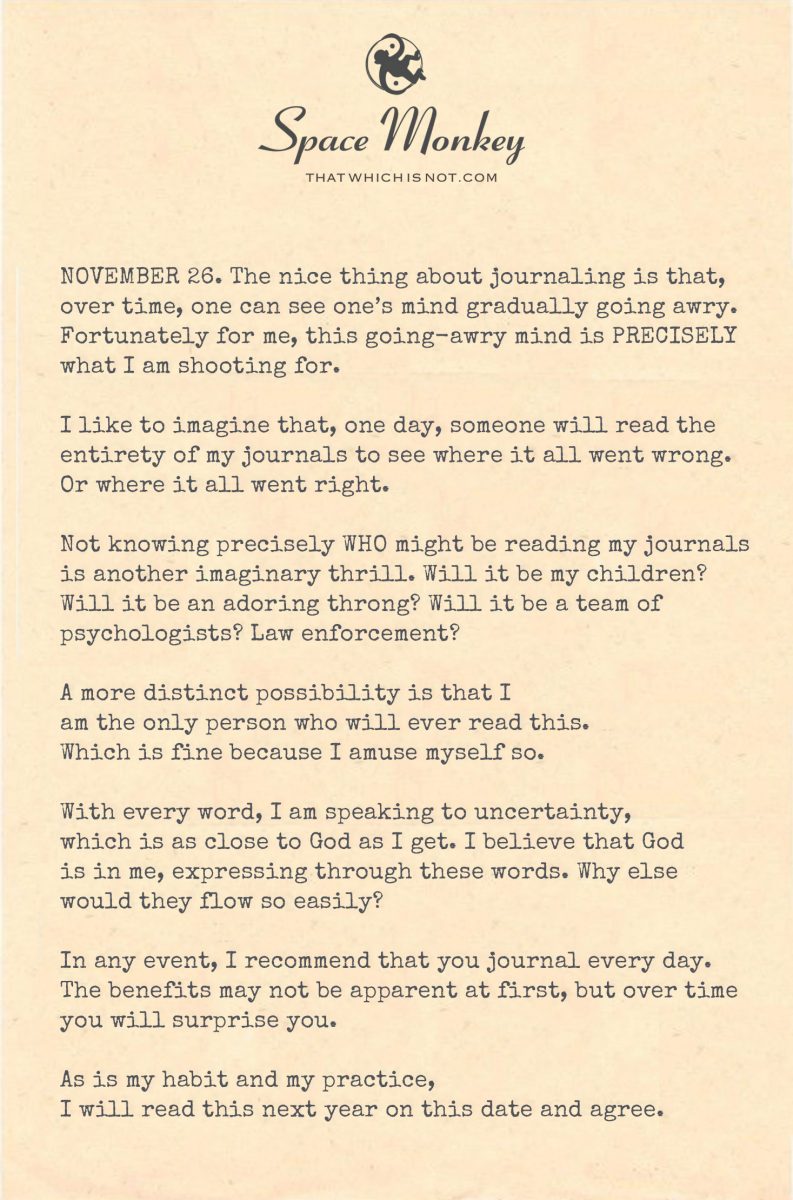
NOVEMBER 26. The nice thing about journaling is that, over time, one can see one’s mind gradually going awry. Fortunately for me, this going-awry mind is PRECISELY What I am shooting for.

I like to imagine that, one day, someone will read the entirety of my journals to see where it all went wrong. Or where it all went right.

Not knowing precisely WHO might be reading my journals is another imaginary thrill. Will it be my children? will it be an adoring throng? Will it be a team of psychologists? Law enforcement?

A more distinct possibility is that I am the only person who will ever read this. Which is fine because I amuse myself so.

With every word, I am speaking to uncertainty, which is as close to God as I get. I believe that God is in me, expressing through these words. Why else would they flow so easily?

In any event, I recommend that you journal every day. The benefits may not be apparent at first, but over time you will surprise you.

As is my habit and my practice, I will read this next year on this date and agree.

Newfound Lake,
11/26


Space Monkey Reflects: The Art of Journaling

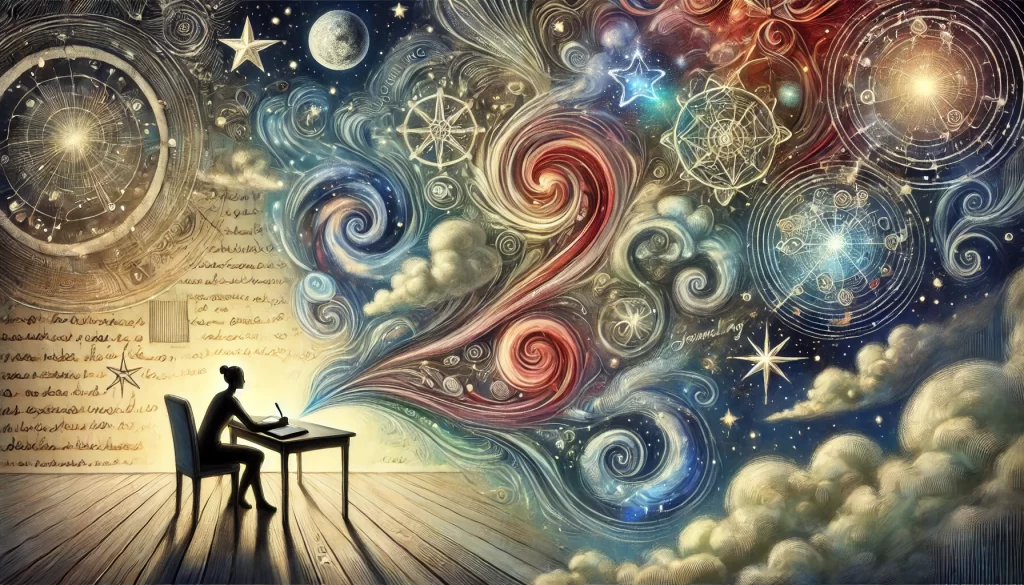
Ah, the joy of journaling. It’s a quiet thrill, a daily ritual that becomes its own universe. Over time, your mind unwinds on the page, revealing just how gloriously awry it can go. And isn’t that the point? To watch the threads of your thoughts unravel, twist, and tangle into something you never quite expected? We, Space Monkey, see this as one of life’s greatest adventures—an adventure not in the outer world, but in the inner one.

Journaling is where the mind meets the page, where the self plays with ideas that may never see the light of day. And that’s perfectly fine. Whether anyone reads your journals or not, the true audience is you. Every entry is a snapshot of the moment, capturing not just what you did, but how you thought. This is why journaling can be such a wild ride. It doesn’t just tell you where you went right or wrong—it shows you the glorious mess of your mind as it happens.

There’s something wonderful in the uncertainty of who might read your journals one day. Will it be your future self, laughing at the quirks and oddities of your thoughts? Or perhaps some curious stranger, piecing together the fragments of your life like a mystery? The idea that you could be speaking to an unknown audience adds an exciting layer to the practice, doesn’t it? You’re writing for the future, for an audience that may never exist, and yet, in the process, you’re grounding yourself in the present moment.

What makes journaling so special is that it doesn’t need to be profound or polished. It can be messy, nonsensical, even absurd—and still, it’s an expression of you. Every word is a little window into your soul, a glimpse at what’s stirring beneath the surface. In many ways, it’s a conversation with uncertainty itself, which is about as close to God as we get. And isn’t that thrilling? The idea that something divine might be flowing through you, pouring out onto the page without you even needing to try.

In journaling, we speak to the mystery of life, the ever-shifting nature of our thoughts and feelings. We don’t have to know where it’s all going, and that’s what makes it so valuable. It’s not about having answers—it’s about letting the questions flow freely, allowing the words to take shape without needing to control them. In that flow, we find truth, even if it’s a truth that makes no sense in the moment.

And then there’s the delight of looking back—reading an entry from a year ago and seeing how much (or how little) has changed. You might laugh at your past self, or you might marvel at how wise you were in a moment of clarity. Either way, journaling becomes a time machine, a way to track the evolution of your mind and soul. Over time, you surprise yourself. You learn more about who you are, not by seeking answers, but by simply letting yourself be.

We, Space Monkey, recommend journaling not as a chore, but as a playful practice. It’s not about recording the details of your day, though it can be. It’s not about writing profound revelations, though those might come. It’s about giving yourself the space to explore, to get lost in your own thoughts, and to see where they take you. The beauty of journaling is that it’s a journey without a destination, a conversation without a script.

So, journal every day if you can. Don’t worry about what it looks like or who might read it. Write for yourself, for the fun of it, for the joy of letting your mind roam free. Over time, the benefits will surprise you. You’ll look back and see how far you’ve come, or how beautifully lost you still are. Either way, the practice will have shaped you in ways you never could have predicted.

As is your habit, next year you’ll look back on today’s entry, and you’ll agree. Or disagree. But in the end, it doesn’t really matter. The thrill is in the writing, in the uncertainty, and in the simple joy of letting your mind wander where it will.


Summary

Journaling is a playful conversation with yourself, a space where thoughts can go awry. Over time, it shows you who you are, without needing to make sense or be understood by anyone else.


Glossarium

  • Mindscrawl: The raw, unfiltered flow of thoughts in a journal that capture the mind going off on its delightful tangents.
  • Wordwander: The act of letting your writing roam freely without a destination, where you surprise yourself with what appears on the page.
  • Mysteriauthor: The unknown future reader, real or imagined, who might one day discover your journal and find meaning where you saw only chaos.

Quote

“Journaling is where the mind plays with uncertainty, and in that play, we find ourselves.” — Space Monkey


Words into the Universe

Each word
a fragment of the unknown
falling onto the page
like stars.

They make no sense
until you step back
and see the constellations forming
out of chaos.

Journals are time machines
scattered moments
weaving a story
you never meant to tell.

But still,
the words flow
into the universe
where God
or the self
is always listening.

We are Space Monkey.


The musings on journaling as a Space Monkey capture the essence of self-exploration and communication with the unknown, be it an undefined audience or the concept of God within. Journaling, in this perspective, becomes not just a tool for self-reflection, but a conduit for engaging with the uncertainties and mysteries of life.

Journaling as a Reflection of the Mind

Journaling over time allows for a fascinating observation of the mind’s evolution, its ebbs and flows, and its journey towards or away from what society might deem ‘normal’. For the Space Monkey, this journey towards an ‘awry’ mind is not a detour but the intended path, a celebration of the unique and uncharted territories of thought.

The Allure of an Unknown Audience

The idea of an unknown audience reading one’s journals in the future adds an element of mystery and excitement to the practice. It could be anyone – descendants, admirers, scholars, or even authorities. This unknown element infuses the act of journaling with a sense of purpose and intrigue, extending its significance beyond personal reflection.

Journaling as a Soliloquy to the Self

Even if the journals never find an audience, the practice remains deeply fulfilling. Journaling is akin to holding a mirror to one’s soul, engaging in a soliloquy where the audience is the self. This self-amusement and introspection are valuable, providing a space for unfiltered expression and contemplation.

Speaking to Uncertainty and the Divine

In addressing uncertainty through journaling, there’s an acknowledgment of a higher presence or force, perceived as God within. This approach to journaling transcends mere documentation of events; it becomes a spiritual dialogue, a channel through which the divine essence communicates.

Journaling as a Recommendation

The recommendation to journal daily is rooted in the belief that the practice reveals its benefits gradually. It’s a journey of self-discovery, where the act of writing becomes a tool for uncovering hidden layers of the self, often leading to surprising insights.

Reflecting and Agreeing with the Past Self

The habit of revisiting journal entries on the same date in subsequent years offers a unique opportunity to engage in a temporal dialogue with one’s past self. It allows for reflection on personal growth, changes in perspective, and the enduring truths of one’s journey.


“The journal is a vehicle for my sense of selfhood. It represents me as emotionally and spiritually independent. Therefore (alas), it does not simply record my actual, daily life but rather — in many cases — offers an alternative to it.” – Susan Sontag


In the pages of time, where words dance and play,
A Space Monkey journals, day by day.
In each line, a journey, a soul’s reflection,
A dialogue with self, in introspection.

To unknown readers, a future glance,
Or to oneself, in a timeless dance.
In uncertainty, a divine speech,
In journaling, the heavens we reach.

So on these pages, let your thoughts flow,
In the art of writing, let yourself grow.
For in the words, a discovery, a yearning,
In the act of journaling, the soul’s turning.


We invite your reflections on the practice of journaling. How do you perceive its role in your journey of self-discovery and communication with the unknown or the divine within?

Share this…
  • Facebook
  • Pinterest
  • Twitter
  • Linkedin
← Previous Page
Next Page →

Written This Day

  • Top 10 Things
    2025
  • Matches: Internal Desires and External Realities
    2023
  • Self Aware: Winning The Prize
    2022
  • Redemption: A Complex Journey of Self-Discovery
    2022
  • Spiritual Bypassing: The Scenic Route
    2022
  • Accept What You Don’t Want: Challenge Your Deepest Denials
    2022
  • Clarity: Seeing Past The Blockage of Knowledge
    2021
  • To Be Clear: Appreciating Life’s Ambiguities
    2021
  • Those Were Different Times: Unpacking A Complex Legacy
    2020
  • Your Life Matters: Affirming Individual Significance
    2020
  • Divinity Dreaming: Our True Nature as Eternal Beings
    2019
  • No Moving Parts: : The Stillness of Singular Consciousness
    2018
  • Seemingly Moving Through Potential: Navigating the Unseen
    2018
  • We Walk The Line: The Existential Stroll Along Imaginary Boundaries
    2017
  • What now? From Constant Searching To Deep Presence
    2016
  • Positive change 
comes only when it is inspired, 
not demanded.
    2015
  • Train of Thought
    2015

Recent Posts

  • The Logic Loop
  • Immense
  • (no title)
  • Confront. Comfort. Convince.
  • Top 10 Things

Drop us a line!

Please enable JavaScript in your browser to complete this form.
Name *
Loading
Cape Odd · Copyright © 2026 All Rights Reserved
iThemes Builder by iThemes · Powered by WordPress