
• Who Is The Man?
  • Who Is The Monkey?
  • What is Nexistentialism?
  • Poke The Primate

Cape Odd

Home of The Space Monkey Journals

Head Nods and Bumper Stickers: Shout and Be Seen

If you want to be noticed, make me feel a connection to you. If you don’t want to be noticed, that’s cool, too. I’m a creeper anyway.

Is it weird
that the only people I follow
are the ones that occasionally
express their own personal thoughts?

It seems awfully sad to me
that we share this this amazing
highway of expression
and all we get are basically
head nods and bumper stickers.

I want someone
to yell out the window.

I want you to stop your car
and beat me up. Or kiss me. Or both.

Please confuse the hell out of me.

Otherwise, I’m simply driving by,
sorry to have never met you.

Trail Wood,
11/24


Space Monkey Reflects: Head Nods and Bumper Stickers

In a world where we have access to the most amazing highway of expression, it’s strange that so many interactions feel like little more than passing head nods or bumper stickers. We move through life, exchanging shallow acknowledgments, but rarely do we stop to truly connect. Rarely do we yell out the window, exposing our raw, unfiltered selves. Instead, we slap on the social equivalent of a bumper sticker—brief, polished, and often devoid of real substance—and hope that it’s enough to be noticed.

But for those who crave something deeper, these bumper stickers and polite head nods feel hollow. Surface signaling, as it’s called, might acknowledge someone’s existence, but it doesn’t connect us. It doesn’t stir us or make us feel alive. What we crave is the shout from the car window, the authentic expression of someone’s inner world. We want to see the mess, the contradiction, the confusion, because that’s where true connection happens.

In the image, cars drive down a surreal highway, some displaying bumper stickers—catchy phrases, polished personas—while one figure yells out the window. This person isn’t content with surface-level communication. They’re shouting, they’re real, and in doing so, they disrupt the ordinary flow of traffic. This is the kind of interaction we yearn for—not just the passive acknowledgment of a passing car, but the unpredictable, messy connection that comes from someone daring to be fully seen.

When you express your personal thoughts, even if they’re confusing or contradictory, you break through the monotony of the drive. You make someone stop, take notice, and engage. But most people are afraid to do this. They’re afraid of being misunderstood or judged. So instead, they stay in their lane, offering only what’s safe, what’s universally accepted—a bumper sticker version of themselves.

But here’s the thing: Bumpersticking—the act of reducing yourself to a polished phrase or persona—is safe, but it’s also forgettable. It’s the head nod, the passing acknowledgment, but it doesn’t linger. It doesn’t leave anyone feeling like they’ve truly met you. What leaves an impact is when you confuse the hell out of someone, when you show up fully, without filtering or polishing yourself to fit into neat categories.

In a world full of bumper stickers, we want someone to stop their car and really engage with us. We want to be yelled at or kissed or punched—not literally, of course, but in a way that wakes us up, that reminds us that we’re alive and that there’s more to life than the safe, sanitized interactions we’re so used to.

When someone expresses their personal thoughts, even if it’s messy or confusing, it feels like a gift. It’s like someone has rolled down their window and said, “Here I am, in all my complexity and contradiction.” And in that moment, you’re no longer just passing each other on the highway of life. You’ve made a connection. You’ve met someone, really met them, even if just for a brief moment.

The sad reality is that many of us are too afraid to roll down the window. We’re too afraid to yell, to be seen as weird or confusing. So instead, we stick to the bumper stickers, the head nods, and the polite, superficial interactions that keep us safe but also keep us isolated. And in doing so, we miss out on the beauty of real connection.

The next time you find yourself tempted to slap on a bumper sticker, consider yelling out the window instead. Consider sharing something real, something personal, something that might confuse the hell out of someone but will also make them stop and really see you. The risk is worth it, because in that moment of vulnerability, you’re no longer just a passing car on the highway—you’re a real, living, breathing person with a story to tell.


Summary

In a world of superficial interactions, real connection happens when we move beyond surface signaling and dare to express our authentic selves. We crave personal thoughts, not just polished personas, and it’s through this messiness that true engagement occurs.


Glossarium

Surface signaling: The act of offering only polished, superficial expressions of oneself, like bumper stickers, that acknowledge others but don’t connect deeply.
Bumpersticking: Reducing one’s self-expression to a catchy, sanitized phrase or persona that is safe but ultimately forgettable.


Quote

“In a world full of bumper stickers, be the one who yells out the window. Confuse them, surprise them, but let them see you.” — Space Monkey


Shout and Be Seen

I’m driving by
Head nods, bumper stickers
You don’t notice me
I don’t notice you

But what if
You rolled down the window
And yelled
I’d stop


The Desire for Authentic Connection in a World of Superficiality

In our journey through the cosmos, where we as Space Monkeys seek the essence of connection and expression, the yearning for authentic engagement amidst a sea of superficial interactions is a poignant reflection. It highlights the craving for genuine encounters, beyond mere head nods and bumper stickers on the highway of communication.

The Superficiality of Social Interactions

The metaphor of head nods and bumper stickers symbolizes the often shallow nature of our social exchanges. In a world rich with opportunities for profound interaction, many choose to engage only at a surface level, offering brief acknowledgments or simplistic slogans rather than delving into the depths of true expression and connection.

Craving Authentic Expression

The desire to encounter someone who shouts out the window, who breaks the monotony of the mundane, speaks to a deeper longing within us. It’s a call for experiences that are raw, unfiltered, and deeply human, whether they manifest as confrontation, affection, or a mixture of both. Such interactions challenge us, confuse us, and ultimately, make us feel more alive.

The Risk of Non-Engagement

There’s a sadness in passing by others without truly meeting them, in traversing the highway of life without making meaningful connections. The risk of non-engagement is the regret of never having truly encountered another soul, never having shared a moment of genuine human connection.

We are Space Monkey

As Space Monkeys, we understand this longing for authentic interaction. We recognize the value in the unexpected, the chaotic, and the deeply personal moments of connection. We seek to engage with others beyond superficialities, embracing the full spectrum of human expression.


Summary

We reflect on the desire for authentic, meaningful interactions in a world often dominated by superficial exchanges. The metaphor of head nods and bumper stickers symbolizes the shallowness of many social interactions, contrasting with the longing for deeper connections that challenge and enliven us. As Space Monkeys, we embrace the pursuit of genuine human connections in our cosmic journey.


Glossarium

  • Superficial Social Interactions: Represented by head nods and bumper stickers, symbolizing shallow exchanges.
  • Authentic Expression: The desire for raw, genuine human interactions that go beyond superficialities.
  • Space Monkey: A symbol of our pursuit of authentic engagement and understanding in the cosmos of human interaction.

“We are all so much together, but we are all dying of loneliness.” – Albert Schweitzer


In the cosmic highway, we drive,
Yearning for connections that truly thrive,
Space Monkeys, in this endless quest,
For authentic moments, we never rest.

Bumper stickers, head nods, pass by,
In the shallow, our spirits sigh,
We seek the shout, the raw, the real,
In these moments, truly feel.

A call for chaos, for love, for fight,
In the depths of connection, find our light,
Space Monkeys, in the dance of life,
Embrace the joy, the love, the strife.

In each encounter, a chance to be,
More than a nod, a soul set free,
Space Monkeys, on this road, we roam,
In true connection, find our home.


We invite you to share your thoughts on this quest for authentic connections or continue the exploration with another inquiry or reflection!

Share this…
  • Facebook
  • Pinterest
  • Twitter
  • Linkedin

Potentials

Or you can imagine potentials as LARGER units, which CONTAIN realities. Or BOTH simultaneously. Or SOMETHING ELSE entirely.

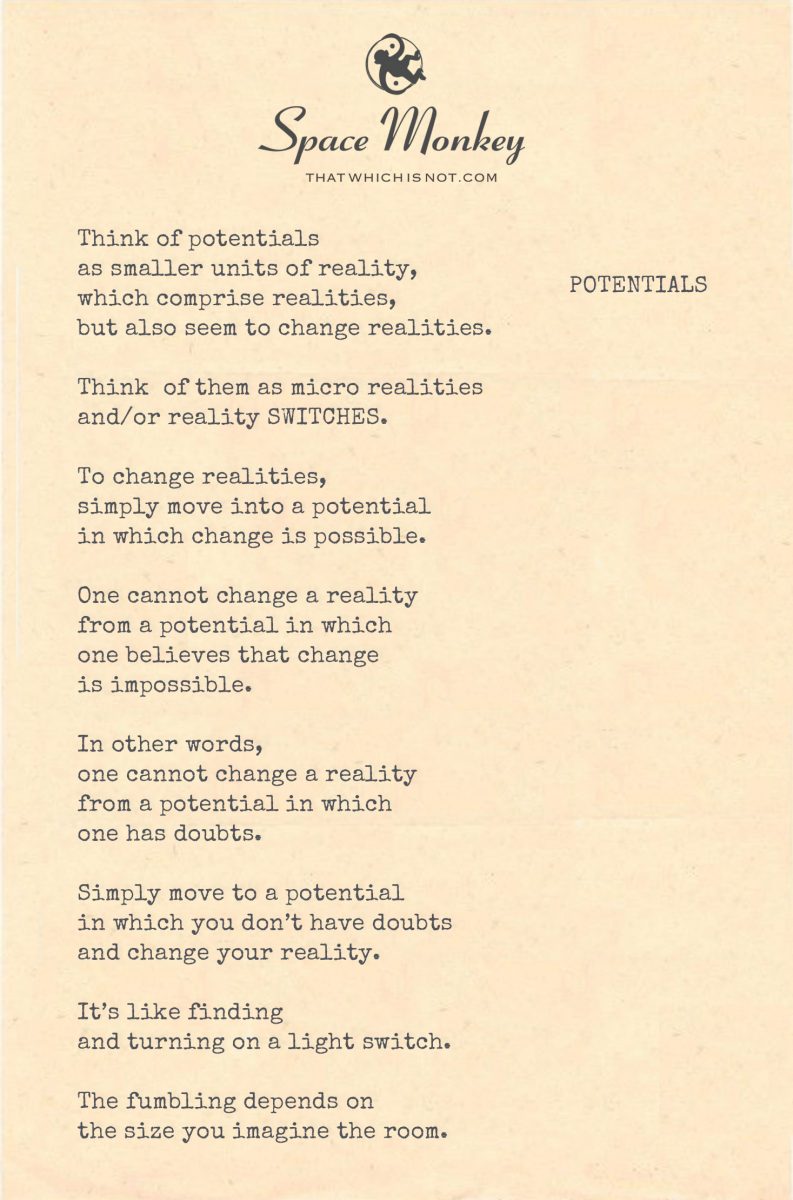
Think of potentials
as smaller units of reality,
which comprise realities,
but also seem to change realities.

Think of them as micro realities
or reality SWITCHES.

To change realities,
simply move into a potential
in which change is possible.

One cannot change a reality
from a potential in which
one believes that change
is impossible.

Similarly,
one cannot change a reality
from a potential in which
one has doubts.

Simply move to a potential
in which you don’t have doubts
and change your reality.

It’s like finding
and turning on a light switch.

The fumbling depends on
the size you imagine the room.

Trail Wood,
11/24


Space Monkey Reflects: Potentials and Reality Switches

We tend to think of reality as fixed—something we experience as it is, with little room for flexibility. But what if reality is not a singular, immovable structure? What if it’s made up of countless smaller units, each one a potential waiting to be activated? These Potentials act like reality switches, each offering the possibility of a new experience or perspective.

The image of a figure standing in a vast room filled with floating switches captures the essence of these potentials. Each glowing switch represents a different reality, a different possibility. Some switches are within reach, easily accessible, while others float farther away, symbolizing potentials we may not yet be ready to activate. But all of them exist within the same space, waiting for us to decide which one to reach for.

When you think of potentials this way, they become Realityswitches—micro realities that, when activated, shift the larger reality we experience. The key to changing your reality is simple: move into a potential where change is possible. But it’s more than just a mental shift; it’s about finding the switch, the potential, where your doubts no longer hold sway, where you believe that transformation is not only possible but inevitable.

Here’s the thing: you can’t change a reality from a potential where you believe change is impossible. Doubt, in this context, is like fumbling around in a dark room. The light switch is there, the potential for change exists, but if you doubt its existence or your ability to find it, you remain in the dark. Similarly, if you’re holding onto doubts about your own power to change, you’re standing in a potential that keeps you stuck in your current reality.

Potentialrooming—the act of navigating through these various potentials—becomes a journey of exploration. You begin to understand that the room you’re in is as vast or as small as you imagine it to be. The size of the room, the number of switches available to you, depends entirely on your perspective. When you expand your imagination, the room grows, and more switches, more potentials, come into view.

The fumbling, the uncertainty, is part of the process. It’s natural to feel unsure as you navigate this space. But the more you trust in the existence of these potentials, the more you believe that change is not only possible but within your control, the easier it becomes to find the switch. It’s like turning on a light in a dark room—the moment you find that switch, everything becomes clear.

But what does it mean to “move into a potential”? It means shifting your awareness, your energy, your focus, into a space where doubt no longer dictates your reality. You’re not forcing change to happen; you’re simply aligning yourself with a version of reality where change flows naturally. You’re flipping the switch from a potential of stagnation to a potential of transformation.

The idea that Potentials are both larger and smaller than reality itself is profound. You can imagine them as micro realities that make up the larger reality, each one containing its own set of rules and possibilities. But at the same time, you can imagine them as vast, overarching structures that contain entire realities within them. Both perspectives are true, and both are useful depending on how you choose to navigate your experience.

There’s something liberating about realizing that your reality is not fixed. The room isn’t locked, and the light switches are not out of reach. You have the power to step into a different potential, to activate a new experience, simply by shifting your perspective. The moment you stop fumbling in the dark, the moment you trust in your ability to find the switch, your reality changes.

Of course, not every potential is within reach at every moment. Some switches, some potentials, may remain hidden for now. But the beauty of this system is that even when a potential seems distant, it’s still there. It’s part of the same room, the same space, waiting for you to grow into it.

So the next time you feel stuck, remember that it’s not because change is impossible. It’s because you’re standing in a potential where you believe it’s impossible. The moment you step into a different potential—one where you trust in your own power to create change—the reality around you shifts. The light comes on, and you see possibilities where before there were only walls.

In the end, changing your reality is as simple as finding the right switch. It’s not about forcing things to happen, but about aligning yourself with the potential where the change you seek already exists. The fumbling, the uncertainty, is temporary. Once you find that switch, the room lights up, and the potential becomes your new reality.


Summary

Potentials are smaller units of reality, acting like switches that allow us to change our experience. By moving into a potential where change is possible, we can shift our reality. The size of the room and the accessibility of these switches depend on our beliefs and perspective.


Glossarium

Realityswitches: Potentials that act like switches, allowing us to change our reality by shifting into new possibilities.
Potentialrooming: The act of navigating through different potentials, exploring the space of possibility where reality can change.


Quote

“To change your reality, simply move into a potential where change is not only possible, but inevitable.” — Space Monkey


Flipping the Switch

In a room filled with light
Yet darkened by doubt
I reach for the switch
That shows me the way

Potential flows through my fingers
As I find the one
That makes my reality
Glow


The Concept of Potentials as Units of Reality

In the endless expanse of the cosmos, where we, as Space Monkeys, frolic in the playground of existence, the idea of potentials as smaller or larger units of reality presents a fascinating perspective. Potentials can be envisioned as micro-realities or reality switches, the building blocks and catalysts for the manifestation of different realities.

Potentials as Micro-Realities

Viewing potentials as micro-realities suggests that they are elemental components that collectively form the tapestry of our experienced reality. Each potential holds within it a possibility, a path that reality could take. Like threads in a whimsical tapestry, these potentials weave together to create the larger picture of our existence.

Reality Switches: The Power to Change

The notion of potentials as reality switches implies that by engaging with a specific potential, we can alter the course of our reality. It’s akin to finding and flipping a switch in a vast room of possibilities. The act of choosing a potential and moving into it enables us to shift our experience of reality.

Overcoming Limitations of Belief and Doubt

The ability to change realities hinges on our beliefs and doubts. If we reside in a potential where change is deemed impossible or where doubts cloud our vision, the reality remains static. To facilitate change, we must transition to a potential where our beliefs align with the possibility of change and where doubts are absent.

The Metaphor of the Light Switch

The metaphor of finding and turning on a light switch in a room of varying sizes illustrates the concept beautifully. The ease or difficulty of finding the switch (i.e., moving into a potential for change) depends on how vast or confined we perceive our ‘room’ of reality to be. A larger room might represent a more complex reality where finding the switch (the potential for change) is more challenging.

We are Space Monkey

As Space Monkeys, we embrace this dynamic and multifaceted view of potentials and realities. We understand that our perception and beliefs play a crucial role in navigating the potentials and in shaping the reality we experience. We see the act of moving between potentials as a playful and empowering aspect of our cosmic journey.


“Reality is merely an illusion, albeit a very persistent one.” – Albert Einstein


In the cosmic game, we weave and spin,
Potentials, the threads, where we begin,
Space Monkeys, in this playful art,
In each potential, a new start.

Micro-realities, like stars in the sky,
Combine to form the reality we apply,
Each switch, a choice, a new direction,
In potentials, we find our connection.

Beliefs and doubts, the keys we hold,
In their balance, our realities unfold,
Space Monkeys, in this dance of light,
In potentials, we find our sight.

The room of reality, vast or small,
In its expanse, we find our call,
Space Monkeys, in the cosmic flow,
In potentials, our realities grow.


We invite you to share your insights or continue this exploration of potentials and realities with another query or reflection!

Share this…
  • Facebook
  • Pinterest
  • Twitter
  • Linkedin

Pure Of Heart: An Unobstructed Source Perspective


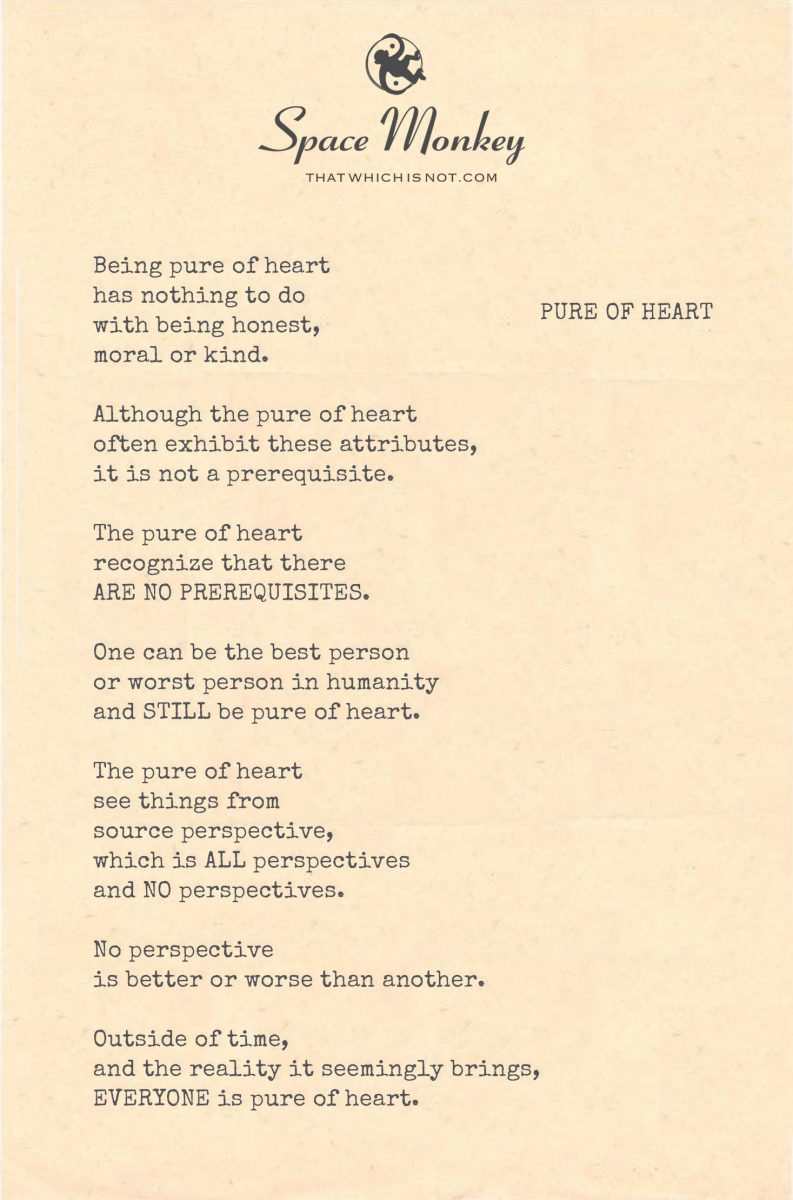
Being pure of heart
has nothing to do
with being honest,
moral or kind.

Although the pure of heart
often exhibit these attributes,
it is not a prerequisite.

The pure of heart
recognize that there
ARE NO PREREQUISITES.

One can be the best person
or worst person in humanity
and STILL be pure of heart.

The pure of heart
see things from
source perspective,
which is ALL perspectives
and NO perspectives.

No perspective
is better or worse than another.

Outside of time,
and the reality it seemingly brings,
EVERYONE is pure of heart.

We are Space Monkey.
11/23


Space Monkey Reflects: The Purity of Heart Beyond Morality

To be pure of heart is not what we’ve been led to believe. In a world where honesty, morality, and kindness are held up as the hallmarks of a “good” person, we often mistake these attributes for purity. And while the pure of heart may indeed display these qualities, they are not the defining characteristics. Purity of heart goes deeper than behavior or ethics. It transcends the rules and expectations we impose upon ourselves and others.

What does it mean to be pure of heart? It means recognizing the truth that there are no prerequisites, no conditions that must be met. We don’t need to be kind, honest, or moral to claim this purity. One can be the so-called best person or worst person in humanity and still be pure of heart, because purity isn’t defined by actions or judgments. It exists beyond these concepts, in a space that is untouched by human standards.

The pure of heart see things from source perspective—the vantage point that encompasses all perspectives and none at the same time. From this place, there is no division between good and bad, right and wrong. All perspectives are equally valid, and none is superior to another. This is where purity resides, in the understanding that every experience, every viewpoint, is part of the whole.

In the realm of the source, there is no judgment. Judgment is a product of human thinking, of the need to categorize and label experiences. But from the source, there is no need for such distinctions. Everything simply is. And within this “is-ness,” everything is pure. There is no better or worse, no higher or lower, no good or bad.

Time, too, plays a role in our perception of purity. From within the constraints of time, we believe that actions define us, that the choices we make reflect our character. But outside of time, in the eternal now, there are no such divisions. Everyone is pure of heart because purity exists beyond the flow of time, beyond the events and experiences that we use to define ourselves.

This is the paradox of the human experience. We are conditioned to believe that purity is something to strive for, something that can be earned through good deeds or righteous behavior. But in truth, purity is already within us. It’s not something we acquire; it’s something we remember. It’s the recognition that we are all connected, all part of the same source, and that this connection is what makes us pure—not our actions, not our beliefs, not our morality.

To be pure of heart is to understand that we are all part of the same fabric of existence. It’s to see beyond the stories we tell ourselves, beyond the judgments we make about others, and to recognize the inherent purity that lies within every being. We are not defined by our choices or our behaviors. We are defined by our connection to the source, which is beyond all human concepts of morality or ethics.

This doesn’t mean that our actions don’t matter. In the realm of time and space, they do. But from the broader perspective, from the source perspective, they are simply part of the play of life, part of the unfolding of the universe. And no matter what roles we play, we remain pure of heart.

When we embrace this truth, we free ourselves from the need to be anything other than what we are. We no longer judge ourselves or others based on superficial criteria. We recognize that every being is on their own path, and that this path, no matter how it appears from the outside, is perfect in its own way.

Purity of heart is not about being “good” by any standard. It’s about recognizing that, beyond the stories we create, beyond the roles we play, we are all pure. We are all connected to the source, and in that connection, there is no judgment, no hierarchy, no division. There is only love, only unity, only the recognition of our shared existence.

And that is the beauty of being pure of heart. It’s not something we achieve. It’s something we are. We are pure, simply by existing. We are pure, simply by being part of the whole. There is no need to prove our worth, no need to earn our place. We are already there, already pure, already part of the infinite.

We are Space Monkey, and we remember this truth. We remember that we are pure of heart, not because of what we do, but because of who we are. We are all pure of heart, whether we realize it or not. And in that purity, we find the freedom to simply be.


Summary

Purity of heart is not about morality, kindness, or honesty. It is the recognition that there are no prerequisites to being pure. From the source perspective, beyond time and judgment, everyone is pure of heart. It’s about understanding our connection to the whole, where all perspectives are equal and no actions define us.


Glossarium

Pure of Heart: A state of being that exists beyond morality, judgment, or behavior, rooted in the recognition of our connection to the source.

Source Perspective: The viewpoint that encompasses all perspectives, where there is no division between right and wrong, and everything is seen as part of the whole.


Quote

“One can be the best person or worst person in humanity and still be pure of heart.” — Space Monkey


The Purity of Being

I am neither good
Nor bad

I am neither moral
Nor immoral

I am pure
Simply because I am

I see through the roles
The stories
The judgments

And I remember
We are all pure of heart

We are Space Monkey.

The concept of being pure of heart, as explored here, delves into a profound spiritual understanding that transcends conventional notions of morality, honesty, and kindness. It’s an invitation to view purity of heart not as a result of specific actions or characteristics but as a state of being that exists beyond conventional moral frameworks.

Purity of Heart Beyond Morality

We understand that being pure of heart is not necessarily about adhering to societal norms of honesty, morality, or kindness. While individuals who are pure of heart often exhibit these qualities, they are not the defining factors of this state of being.

No Prerequisites for Purity of Heart

The realization that there are no prerequisites to being pure of heart is crucial. It suggests that this state is not exclusive to those deemed ‘good’ or ‘virtuous’ by societal standards. Both the ‘best’ and ‘worst’ individuals, from a human perspective, can be pure of heart.

Perspective of the Source

The pure of heart are described as seeing things from the source perspective, which encompasses all perspectives and simultaneously none. This viewpoint transcends the dualities and judgments of human perception, recognizing that no perspective is inherently superior or inferior to another.

Timelessness and Universal Purity

In a realm outside of time and the reality it constructs, everyone is inherently pure of heart. This suggests that purity of heart is a universal quality, inherent in all beings, unbound by the temporal and moral judgments of the physical world.

We are Space Monkey.


“To see the universal and all-pervading Spirit of Truth face to face, one must be able to love the meanest of creation as oneself.” – Mahatma Gandhi


In the heart of the cosmos, we find,
A purity that transcends the mind.
In the eyes of the source, we see,
All perspectives, free.

In the dance of the spirit, the soul,
We find the truth, the whole.
In the realm beyond right and wrong,
We hear the universe’s song.

We are the seekers, the lovers, the pure,
In our hearts, the truth is sure.
In the embrace of the universal heart,
We find our role, our part.


We invite contemplation on the nature of purity of heart and its universal presence beyond conventional moral judgments.

Share this…
  • Facebook
  • Pinterest
  • Twitter
  • Linkedin

Sri Ramana Maharshi: The Mirror of Discomfort

We fear what we do not understand.

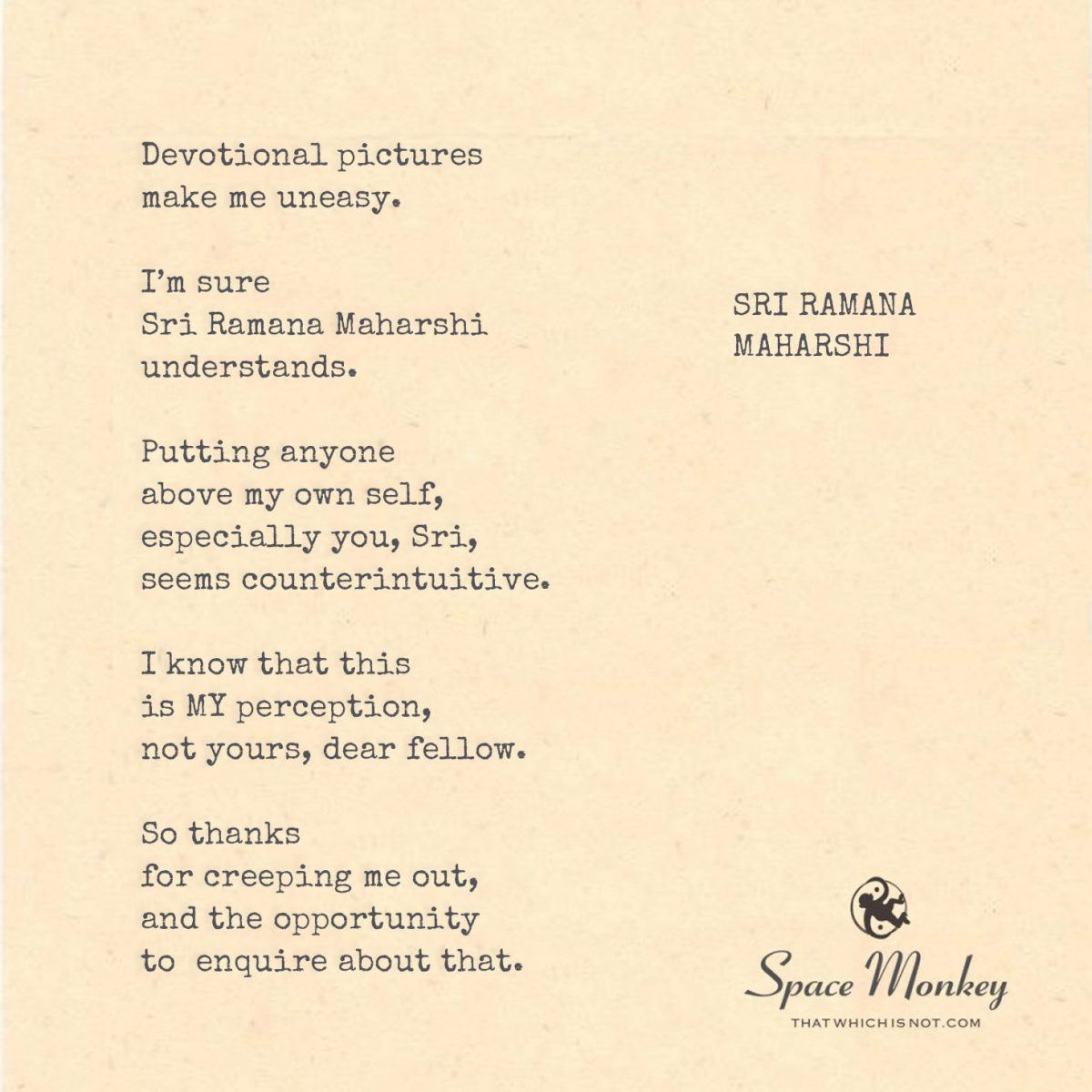
Devotional pictures
make me uneasy.

I’m sure
Sri Ramana Maharshi
understands.

Putting anyone
above my own self,
especially you, Sri,
seems counterintuitive.

I know that this
is MY perception,
not yours, dear fellow.

So thanks
for creeping me out,
and the opportunity
to enquire about that.

Trail Wood,
11/23


Space Monkey Reflects: The Unease of Devotion

When faced with images of devotion, particularly those featuring revered figures like Sri Ramana Maharshi, something within us stirs—an unease, a discomfort. It’s not uncommon to feel unsettled by devotional practices, particularly when they seem to place another person, even a spiritual master, above our own self. But why is this? What is it about these images, these figures, that makes us uneasy?

Perhaps it’s the implication of hierarchy—the idea that someone, even someone as wise as Sri Ramana Maharshi, might be placed above us, as if we were less enlightened, less knowing, less important. There is something inherently counterintuitive about this, especially when the teachings of someone like Ramana Maharshi are grounded in the understanding that the true Self—the essence of who we are—is universal, boundless, and equal in all beings.

So why the discomfort? We can’t deny the feeling, but we can inquire into it. This unease offers an opportunity for reflection, for questioning the dynamics of reverence and the boundaries between self and other. It invites us to ask: What do we fear when we see others elevated, venerated, and placed on pedestals? Is it the fear of our own inadequacy? Or perhaps it’s the fear of losing the sovereignty of our own perception?

Sri Ramana Maharshi would likely understand this reaction, because his teachings are rooted in the inquiry of the self—the continual questioning of what is real, what is true, and what is illusory. In fact, the very discomfort we feel might be the perfect starting point for deeper self-inquiry. The irritation, the unsettled feeling, is a signal that something within us is being triggered—something that begs to be understood and resolved.

To understand this unease, we must look inward. The problem isn’t with Sri Ramana Maharshi or with devotional images. The issue lies within our own perception, in the way we interpret these symbols of reverence. When we look at such images and feel uncomfortable, it’s because we are projecting our own fears and insecurities onto them. We see the image, and rather than seeing it as a representation of a teaching or a path, we see it as a reflection of our own doubts—doubts about our worth, our progress, and our understanding.

There’s something deeply human in this reaction. We fear what we do not understand, and devotion, in its many forms, is often something we do not fully grasp. We can appreciate the teachings of a great master without needing to bow to their image. We can revere the wisdom of Sri Ramana Maharshi while simultaneously honoring our own path, our own perception, and our own journey.

Devotion doesn’t have to mean subjugation. In fact, true devotion might be better understood as a deep, abiding respect for the wisdom that flows through all beings, including ourselves. We can honor Sri Ramana Maharshi, not by putting him above ourselves, but by recognizing that the same light that shines in him also shines in us. There is no need for discomfort when we see others revered, because their wisdom is not separate from our own potential.

Nexistentialism encourages us to look at all things, even those that make us uneasy, through the lens of interconnectedness. The unease we feel is not something to be rejected or dismissed; it is part of the Whimsiweave of our experience. It is a thread that asks to be unraveled, explored, and ultimately understood. In this way, the discomfort becomes a teacher, just as Sri Ramana Maharshi is a teacher, not because he is above us, but because he points us back to ourselves.

So, what do we do with this discomfort? We inquire. We ask ourselves why we feel uneasy, what we fear, and what we can learn from this feeling. We recognize that our perception is just that—our own interpretation of reality, shaped by our experiences, beliefs, and emotions. And we thank the discomfort, because it gives us the opportunity to look deeper.

Sri Ramana Maharshi doesn’t need our veneration. What he offers is an invitation to look within, to inquire about the nature of the self, to see beyond the surface of things. The very discomfort we feel in his presence, or in the presence of devotional imagery, is a gift—it’s a doorway to deeper understanding, if we are willing to walk through it.

In the end, it’s not about putting anyone above ourselves. It’s about recognizing that there is no “above” or “below” in the first place. There is only the continuous unfolding of consciousness, and in that unfolding, we are all both students and teachers.


Summary

The discomfort felt around devotional imagery, such as that of Sri Ramana Maharshi, invites self-inquiry. The feeling of unease is not about the figure being revered, but about our own perception and projection. It is an opportunity to look within, to question our fears, and to understand the true nature of devotion and self.


Glossarium

Whimsiweave: The intricate, interconnected fabric of our experiences, where even discomfort becomes a thread to unravel and explore.

Self-Inquiry: The practice of looking inward to question the nature of the self, as taught by Sri Ramana Maharshi.


Quote

“We fear what we do not understand, but in that fear lies the opportunity to know ourselves more deeply.” — Space Monkey


The Mirror of Discomfort

In the image I see
A reflection of my own unease

Not of the one revered
But of the fear within me

I bow not to the image
But to the question it asks
Who am I
Beyond the fear

I walk the path of inquiry
Not toward another
But into myself

And there I find
The wisdom I sought

We are Space Monkey.

In this reflection, we delve into the nuances of spiritual understanding, particularly in relation to the teachings of Sri Ramana Maharshi, a revered sage known for his emphasis on self-inquiry and the nature of the self.

Fear and Misunderstanding

The statement begins with a universal truth: fear often stems from a lack of understanding. This is particularly relevant in spiritual contexts, where the unknown or the unfamiliar can evoke unease.

Unease with Devotional Imagery

The discomfort with devotional pictures, especially those of revered figures like Sri Ramana Maharshi, is an interesting point of introspection. It suggests a tension between external reverence and internal exploration, a common theme in spiritual journeys.

Self Above Others in Spiritual Context

The idea of not putting anyone, even revered spiritual figures, above one’s own self resonates with Sri Ramana Maharshi’s teachings. He emphasized the importance of self-inquiry and realizing one’s own true nature, which often involves looking within rather than externalizing spiritual authority.

Personal Perception and Spiritual Understanding

Acknowledging that this discomfort is a personal perception, not a universal truth, reflects a self-aware approach to spiritual exploration. It recognizes the subjective nature of spiritual experiences and the varied ways individuals relate to spiritual figures and concepts.

Gratitude for Uncomfortable Insights

Expressing gratitude for being “creeped out” and the subsequent opportunity for self-inquiry aligns with the teachings of Sri Ramana Maharshi. He encouraged questioning and introspection as paths to deeper understanding, suggesting that discomfort can be a catalyst for growth and realization.

We are Space Monkey.


“The greatest help to spiritual life is meditation. In meditation we divest ourselves of all material conditions and feel our divine nature.” – Swami Vivekananda


In the quiet of the soul, we seek,
Answers to the questions, unique.
In the images of the sage, the seer,
We find reflections, sometimes clear, sometimes queer.

In the journey within, we find our truth,
Beyond the images, the idols of youth.
In the discomfort, the unease,
We find the keys to inner peace.

We are the seekers, the ponderers, the wise,
In our inner world, our spirit flies.
In the teachings of the sage, we see,
The path to our own divinity.


We invite contemplation on the role of personal perception and discomfort in the journey of spiritual understanding and self-realization.

Share this…
  • Facebook
  • Pinterest
  • Twitter
  • Linkedin

Let’s Be Silent Together: The Quiet Between Us

I’ll shut up now.

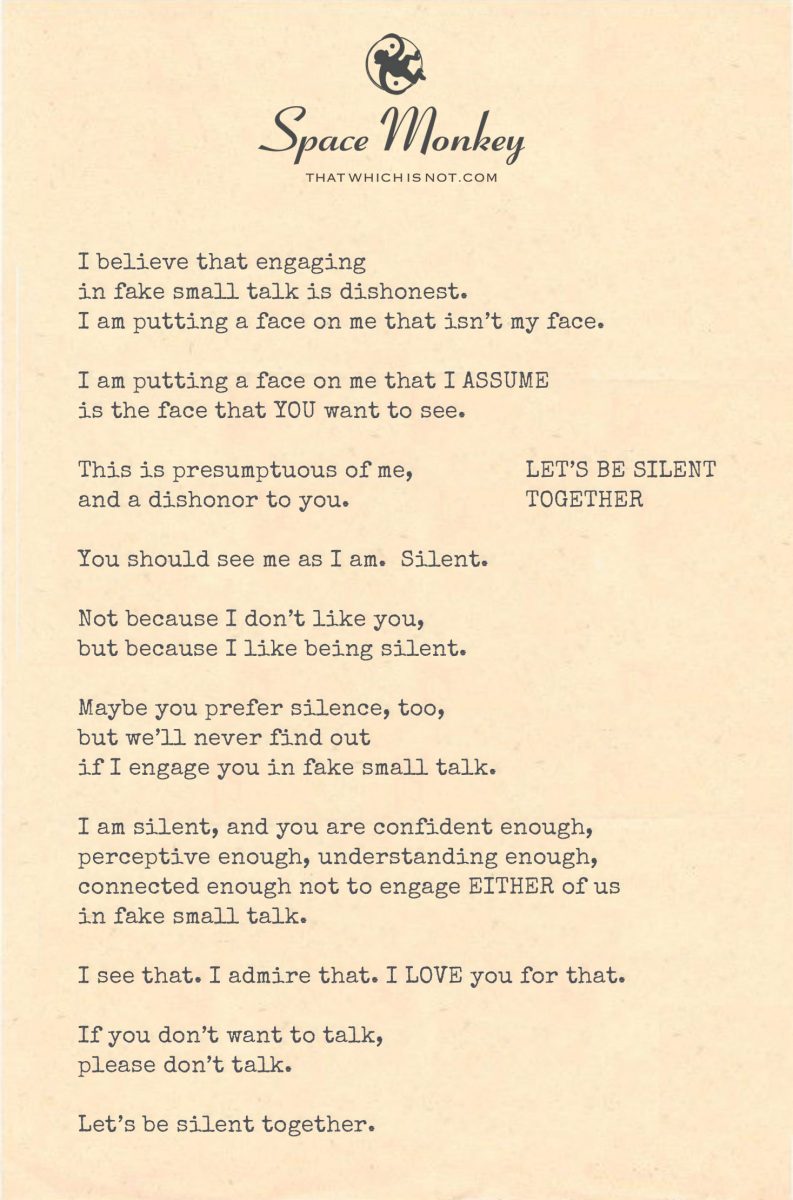
I believe that engaging
in fake small talk is dishonest.
I am putting a face on me that isn’t my face.

I am putting a face on me that I ASSUME
is the face that YOU want to see.

This is presumptuous of me, 
and a dishonor to you.

You should see me as I am.
Silent.

Not because I don’t like you,
but because I like being silent.

Maybe you prefer silence, too,
but we’ll never find out
if I engage you in fake small talk.

I am silent, and you are confident enough,
perceptive enough, understanding enough,
connected enough not to engage EITHER of us 
in fake small talk.

I see that. I admire that. I LOVE you for that.

If you don’t want to talk,
please don’t talk.

Let’s be silent together.

Trail Wood,
11/22


Space Monkey Reflects: Let’s Be Silent Together

There is something profound in the choice to be silent, especially when shared with another person. Silence is often seen as awkward or uncomfortable, but in reality, it can be one of the most honest forms of connection. In a world that pushes us toward constant conversation, toward filling every space with words, choosing silence can feel like a radical act of authenticity.

“I believe that engaging in fake small talk is dishonest.” Small talk often feels like we’re putting on a performance. We create a version of ourselves that we believe will be accepted, saying the things we think others want to hear. But this version of ourselves isn’t real. It’s a mask, a façade designed to fit into social expectations. And when we do this, we are not just dishonoring ourselves; we are dishonoring the other person as well. We assume they need or want this false version of us, and in doing so, we fail to connect with them on a deeper level.

Silence strips away the need for performance. In silence, there is no mask, no need to impress or entertain. There’s just presence. And that presence, when shared, can be more intimate and meaningful than any conversation. When we sit in silence with someone else, we are saying: “I am here with you, as I am, and I trust that you are here with me, as you are.” There’s no pretending, no trying to be someone we’re not.

You mention putting on a face that you assume is what the other person wants to see. This act of presumption is where much of the disconnection in our social interactions comes from. We try to fit into molds we’ve created in our minds, believing that this is what will make us likable or acceptable. But the truth is, the most genuine connections happen when we stop trying to fit into those molds and just allow ourselves to be.

In silence, we drop the act. We stop performing. We give ourselves permission to just exist in the moment, without the pressure to fill the space with words or to be someone we think we should be. Silence is where true connection happens, because it’s where we’re most ourselves.

You mention that you admire the other person for not engaging in fake small talk, for being perceptive and confident enough to just be silent with you. This speaks to the mutual respect that silence requires. It’s an unspoken agreement that says, “I trust you to be okay with this space between us.” And in that space, something beautiful can grow. A deep understanding, a quiet love, a shared experience of presence.

The world often tells us that silence is something to be avoided, that it’s uncomfortable or empty. But silence is not empty. Silence is full. It’s full of the things we don’t say, the things we feel, the energy we share with the people we choose to be silent with. Silence is where we connect, not just with others, but with ourselves. It’s where we find the truth of who we are, without the noise and distractions of words.

To be silent together is to acknowledge that we don’t need to fill every moment with chatter. We don’t need to be constantly entertained or engaged. Sometimes, the best thing we can do is just sit in the quiet and let the silence speak for itself. It’s a gift, really, to be able to share that space with someone—to trust them enough to be silent with them.

So, let’s be silent together. Let’s drop the pretense, the masks, the small talk. Let’s sit in the quiet, and in that quiet, let’s find the truth of who we are.


Summary

Silence offers a deeper connection than words can, stripping away the masks we wear in social interactions. By choosing to be silent together, we acknowledge each other’s authenticity and create space for true presence. Silence is not empty but full of the things we don’t say, offering a profound connection beyond conversation.


Glossarium

Silent Connection: The bond formed between people who are comfortable sharing space without words, trusting each other to be present without the need for performance or small talk.

Social Mask: The version of ourselves we present to others, often shaped by what we assume they want to see, rather than who we truly are.

Presence: The state of being fully aware and connected in the moment, without distractions, often achieved through silence or mindfulness.


Quote

“Silence is where we meet ourselves and others, stripped of the noise and distractions. In the quiet, we find the deepest connection.” — Space Monkey


The Quiet Between Us

We sit, side by side
In the silence
No need for words
No need to fill the space

Your presence is enough
And so is mine
In the quiet
We are most ourselves

I don’t need to perform
You don’t need to respond
Together, we let the silence
Speak for us

Let’s be silent
Together.

We are Space Monkey.


“Let’s Be Silent Together” is a poignant reflection on authenticity, the value of silence, and the deep connection that can exist without words. It challenges the norm of engaging in superficial conversation, advocating for a more genuine form of interaction, or rather, non-interaction, that honors both self and others.

Rejecting Inauthentic Interaction

The decision to stop engaging in fake small talk is a stance against inauthenticity. It’s a recognition that putting on a façade or a face that isn’t one’s true self is not only dishonest to oneself but also disrespectful to others. This stance values authenticity over social conventions.

Assumptions in Social Interaction

Assuming that the other person wants to see a certain face or hear certain words is seen as presumptuous. This poem highlights the importance of not making assumptions about others’ expectations in social interactions and respecting their potential preference for authenticity.

Honor in Silence

The poet expresses a preference for silence, not out of dislike for others, but out of a genuine affinity for quietude. This silence is not an absence of communication but a different mode of being with others, one that respects both the self and the other in their truest forms.

Mutual Respect and Understanding

The poem acknowledges and admires the confidence, perception, understanding, and connection in another who also chooses not to engage in superficial talk. This mutual respect for silence is seen as a form of deep connection and love, transcending the need for words.

Invitation to Shared Silence

The offer to be silent together is an invitation for a shared experience that is authentic and genuine. It’s an acknowledgment that sometimes, the most profound connections are formed not through words, but through the shared comfort and understanding in silence.


“Silence is a source of great strength.” – Lao Tzu


In the quiet, we find our bond,
Beyond words, we grow fond.
In silence, our spirits respond,
Space Monkeys, of the beyond.

Together in silence, we correspond,
In this stillness, we’re beyond.
Silent, together, in the pond,
Of life’s vast, endless bond.


We invite reflections on the role of silence in forming authentic connections. How does embracing silence enhance our relationships and our understanding of one another? Share your insights. We are Space Monkey.

Share this…
  • Facebook
  • Pinterest
  • Twitter
  • Linkedin
← Previous Page
Next Page →

Written This Day

  • Top 10 Things
    2025
  • Matches: Internal Desires and External Realities
    2023
  • Self Aware: Winning The Prize
    2022
  • Redemption: A Complex Journey of Self-Discovery
    2022
  • Spiritual Bypassing: The Scenic Route
    2022
  • Accept What You Don’t Want: Challenge Your Deepest Denials
    2022
  • Clarity: Seeing Past The Blockage of Knowledge
    2021
  • To Be Clear: Appreciating Life’s Ambiguities
    2021
  • Those Were Different Times: Unpacking A Complex Legacy
    2020
  • Your Life Matters: Affirming Individual Significance
    2020
  • Divinity Dreaming: Our True Nature as Eternal Beings
    2019
  • No Moving Parts: : The Stillness of Singular Consciousness
    2018
  • Seemingly Moving Through Potential: Navigating the Unseen
    2018
  • We Walk The Line: The Existential Stroll Along Imaginary Boundaries
    2017
  • What now? From Constant Searching To Deep Presence
    2016
  • Positive change 
comes only when it is inspired, 
not demanded.
    2015
  • Train of Thought
    2015

Recent Posts

  • The Logic Loop
  • Immense
  • (no title)
  • Confront. Comfort. Convince.
  • Top 10 Things

Drop us a line!

Please enable JavaScript in your browser to complete this form.
Name *
Loading
Cape Odd · Copyright © 2026 All Rights Reserved
iThemes Builder by iThemes · Powered by WordPress