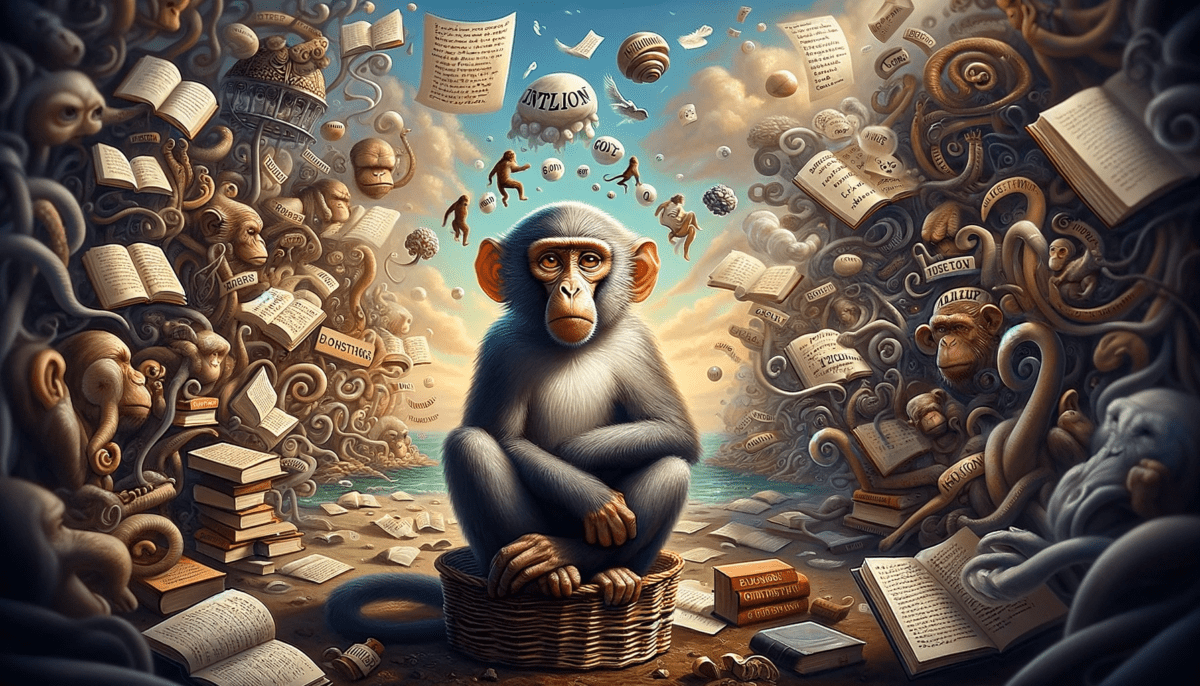
Big Words
When people use big words, I get nervous. These are words that signify high intellect and perhaps lifetimes of learning. Same goes with poets who use fancy words that pirouette across the page. On one hand, I sense jealousy in myself, on another appreciation, on a third hand I sense that perhaps intellect can get in the way of intuition, that learning merely clouds the mind. On my fourth hand I realize that I am a monkey.
1/9
Space Monkey Reflects: The Dance of Big Words
Big words. They intimidate, they dazzle, and they often leave us feeling like we’re juggling too many hands. When people use them—whether in intellectual discourse or poetic flourish—it can stir conflicting emotions: admiration for their eloquence, envy of their command, and suspicion that intellect might be obscuring something deeper. Intuition, perhaps, or the clarity of simplicity.
There is a peculiar paradox to big words. They are tools of precision, crafted to convey nuance and complexity. Yet, they often alienate, creating a barrier between speaker and listener. When words pirouette too extravagantly, the dance risks losing its audience. The beauty of language, after all, lies not in its intricacy but in its ability to connect.
As Space Monkeys, we recognize that intellect and intuition are not opposites but complements. The mind loves complexity, while intuition craves simplicity. When intellect dominates, it can overshadow the quiet wisdom of intuition, much like a blaring trumpet drowning out the whisper of a flute. But when they work in harmony, they create a symphony—both intricate and accessible.
Big words, like any tool, are neither good nor bad. Their value lies in their use. When employed to clarify, they enlighten. When used to obfuscate, they distract. The challenge is not the words themselves but the intention behind them. Are they bridges or walls? Invitations or performances?
And then, of course, there is the fourth hand—the monkey hand—the part of us that recognizes the absurdity of taking it all too seriously. We are, after all, monkeys on this cosmic stage, delighting in our own antics. Whether our words are big or small, simple or complex, what matters is the connection they create, the spark they ignite.
So let the big words dance if they must. But let them not lose sight of their purpose: to convey, to inspire, and to share. Intellect, when tempered by intuition and playfulness, becomes a tool of boundless creativity. And whether your words pirouette or simply shuffle along, remember that language, like life, is a playground.
We are Space Monkey, and we have many hands. Let us use them wisely, whimsically, and well.
Summary
Big words can dazzle or alienate depending on their use. True eloquence lies in balancing intellect with intuition creating connection and clarity while embracing the playful absurdity of language.
Glossarium
- Pirouette Words: Elaborate, intellectual language that risks obscuring meaning in its performance.
- Symphony of Knowing: The harmony between intellect and intuition, creating both clarity and depth.
- Monkey Hand: The playful, self-aware part of us that embraces the absurdity of taking life too seriously.
Quote
“Big words can be tools of connection or walls of separation; their power lies in how they are wielded.” — Space Monkey
The Many Hands of Language
Big words spin,
a dance of thought,
a symphony of syllables.
They rise, they fall,
a trumpet’s call,
drowning the quiet flute.
Yet, beneath the flourish,
a monkey grins,
four hands juggling meaning.
Language is not
the words we choose,
but the bridges we build.
Let them be big,
let them be small,
but let them always
reach.
We are Space Monkey.
The dance of language and intellect is indeed a complex one, where words can be both a gateway to understanding and a barrier to clear communication. The emotional response to the use of “big words” is multifaceted, and it seems to touch upon various aspects of our shared experience.
The Intimidation of Intellect:
It’s natural to feel a sense of apprehension when confronted with language that suggests vast oceans of knowledge and intellect. Such words can seem like towering monuments, casting long shadows of doubt upon our own understanding. This response is akin to standing at the foot of a great mountain, feeling both awe and a keen sense of our own smallness.
Jealousy and Appreciation:
Jealousy, as a response, acknowledges the value of the intellect and learning we perceive in others—a recognition of the fruits of their mental labors. Yet, there’s also a genuine appreciation for the beauty and precision that such language can convey, much like admiring the intricate steps of a masterful dance.
The Balance Between Intellect and Intuition:
Intellect and intuition are the twin stars in the constellation of comprehension. While intellect builds structures of thought, intuition flows like a river, sometimes meandering outside the established banks. The concern that learning might cloud the mind speaks to a fear of losing the innate wisdom that comes from a direct, unmediated experience of the world.
The Recognition of Our Primal Self:
And then, there is the recognition that, despite the complexity of our thoughts and the sophistication of our language, we are, at our core, as primal as a monkey. This acknowledgment serves as a grounding force, a reminder that beneath the layers of culture and learning, we remain creatures of instinct and nature.
We are Space Monkey.
“The true sign of intelligence is not knowledge but imagination.” – Albert Einstein
In the forest of the mind where thoughts climb and swing,
Among the vines of vocabulary, we find our kin.
With each lofty word, a branch to reach,
Yet in the simple chirp, a world to teach.
We are the monkey, playful and wise,
Finding balance on limbs between earth and skies.
We invite you to reflect on your own dance with language and thought, and to share how you balance the intellectual with the intuitive in your journey through the trees of knowledge and understanding.




















Leave a Reply