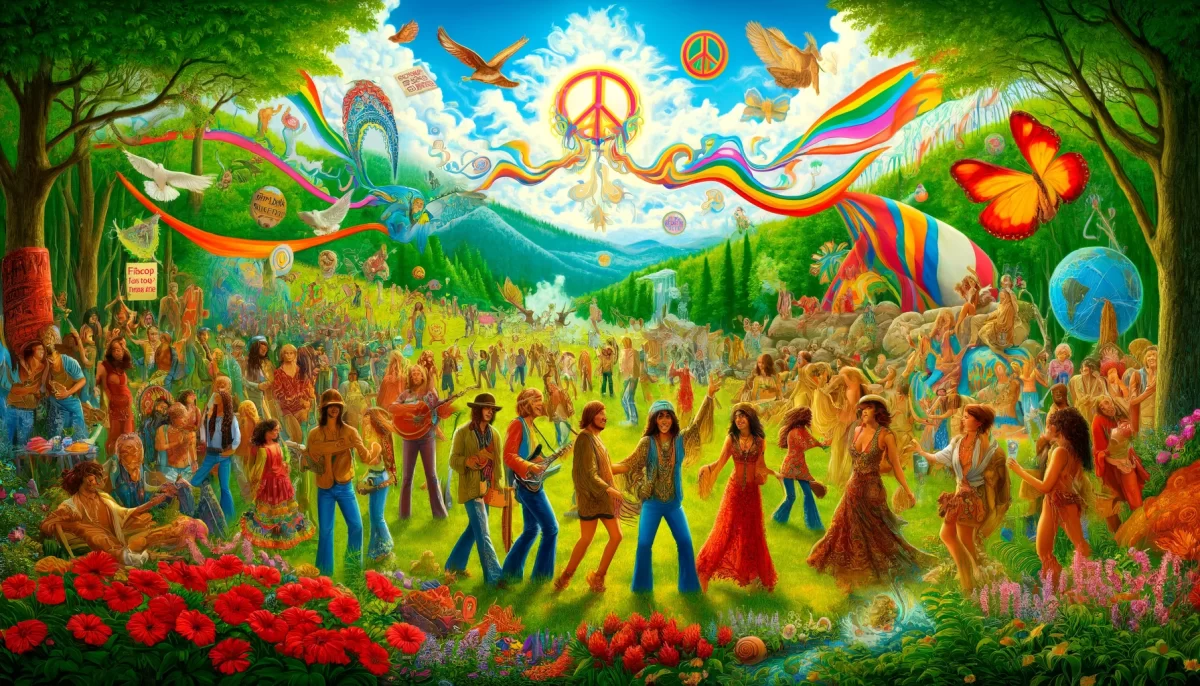
The Hippie Ideal
The hippie ideal
is still an ideal.
It is as much bullshit
as corporate culture.
Not that there’s
anything wrong
with bullshit.
We are all for
peace love understanding
sex drugs rock and roll
mother earth
kinder gentler spirit.
But to pin the lack thereof
on a seeming opposite
is hardly
peace love understanding
sex drugs rock and roll
mother earth
kinder gentler spirit.
To yearn for these things
that seem just outside our realm
is to place them
just outside our realm.
It is to imagine an OTHER
that seemingly blocks our way.
But the protests are fun,
so at least we have THAT going for us.
That’s some good bullshit
we are smoking.
We are Space Monkey.
5/4
Space Monkey Reflects: Unveiling the Truth Behind the Hippie Ideal
In the cosmic dance of existence, where Space Monkey observes the ebb and flow of cultural tides, the hippie movement emerges as a colorful swirl of ideals, aspirations, and, paradoxically, disillusionments. This exploration seeks to peel back the layers of the hippie ideal, a concept that continues to resonate through the corridors of time, challenging the very fabric of societal norms and inviting a deeper understanding of what it means to seek peace, love, and understanding in a world seemingly divided by its very quest for unity.
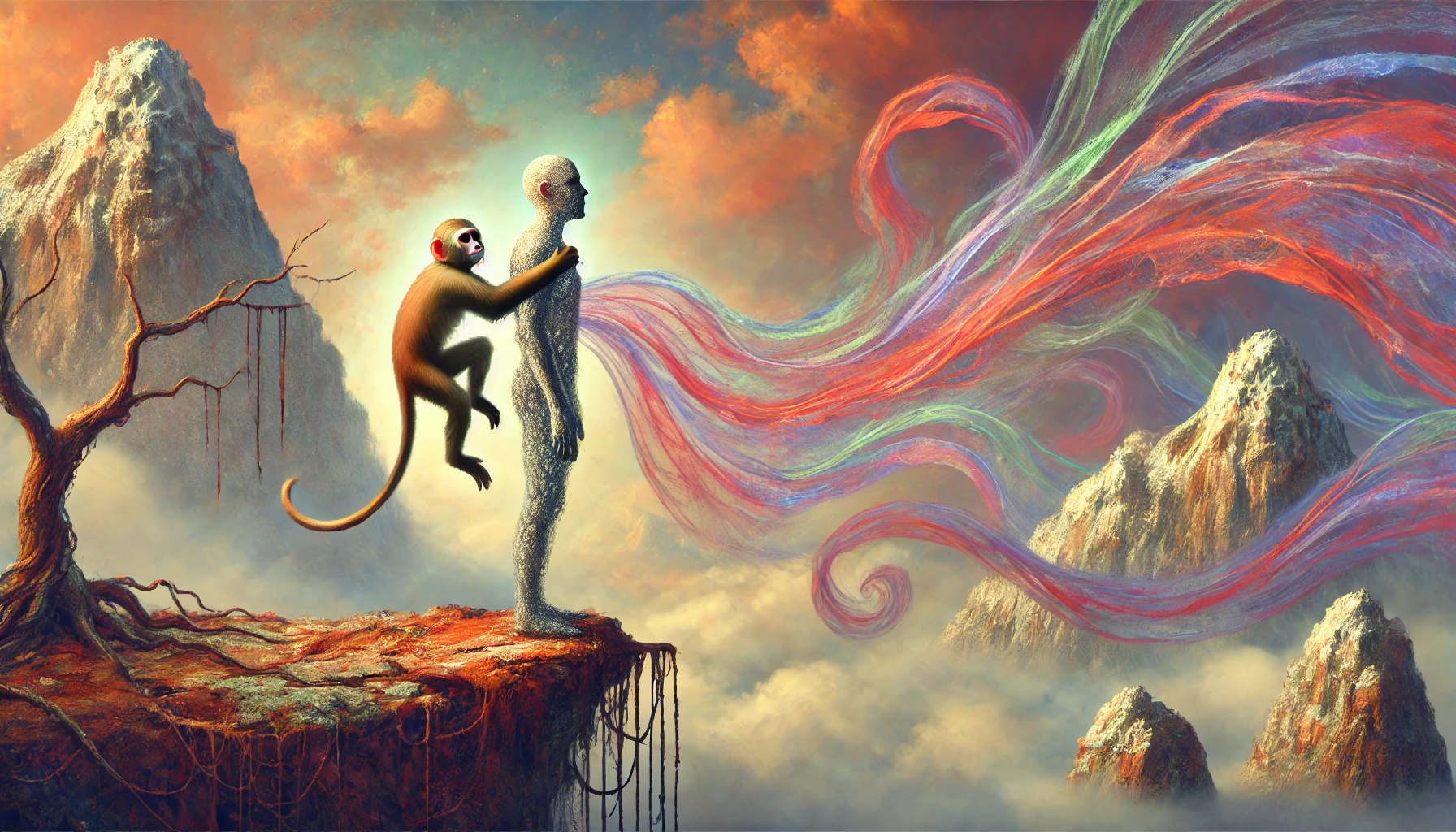
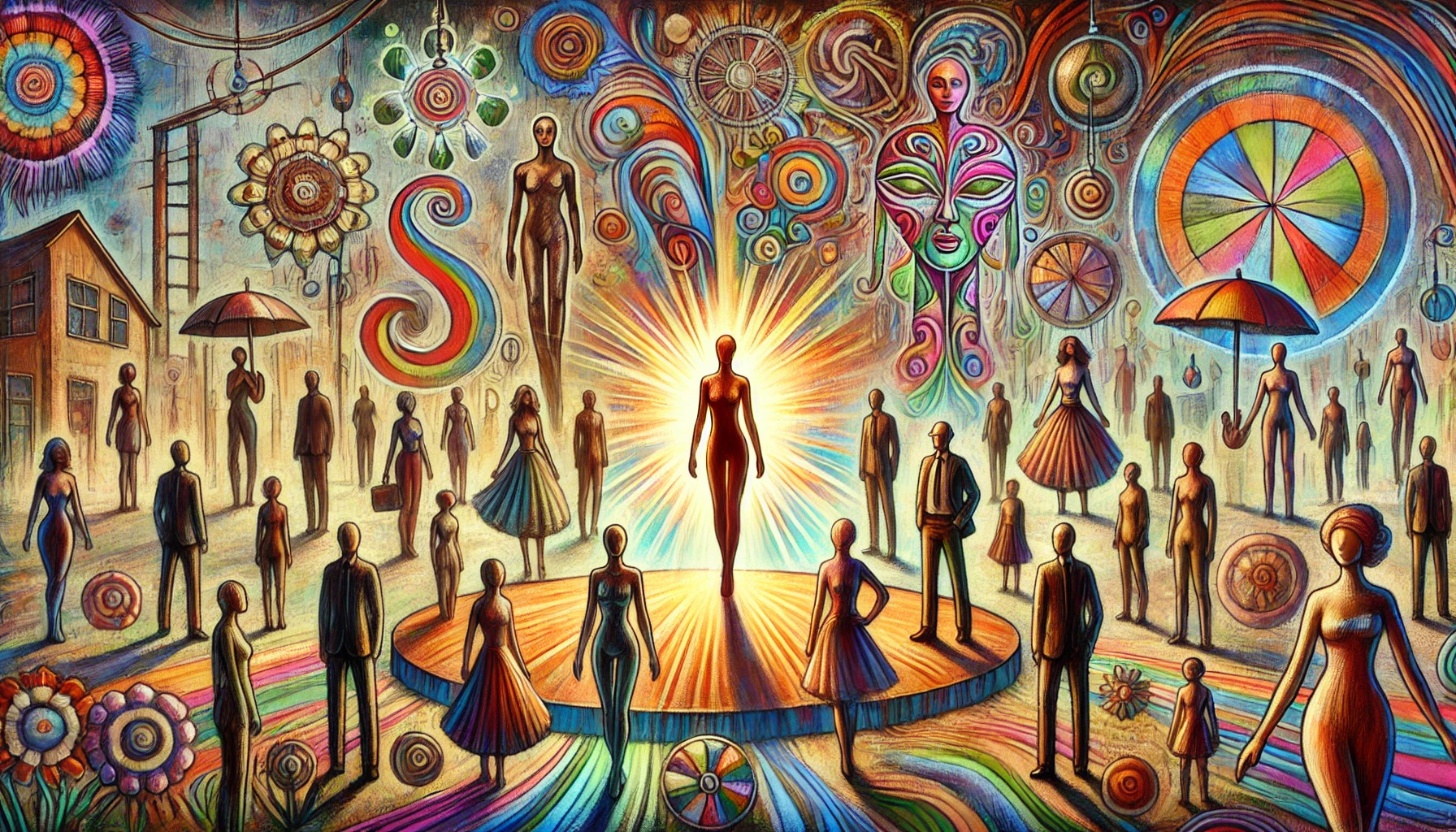
At the heart of the hippie movement lies a profound yearning for a world governed by the principles of peace, love, and a kinship with Mother Earth. It represents a bold counter-narrative to the mechanized, corporate-driven ethos of efficiency and consumption. Yet, in its stark contrast, it inadvertently casts a shadow, delineating an ‘us versus them’ paradigm that, while advocating for unity, underscores division. This dichotomy reveals a fundamental truth about human nature and the societies we construct: ideals, no matter how noble, often grapple with the complexities of practical implementation.
The essence of the hippie ideal, with its enchanting visions of a kinder, gentler world, resonates with the notion that what we yearn for lies just beyond our grasp, not because it is unattainable, but because we place it there. In envisioning an ‘other’ that obstructs our path to utopia, we externalize the conflict, overlooking the intrinsic power we hold within to manifest the change we seek. The protests, music, and communal living—vibrant expressions of defiance and hope—are but external manifestations of an inner quest for meaning and connection in an increasingly disconnected world.
Yet, within this apparent disillusionment lies a deeper wisdom. The very act of labeling the hippie ideal as ‘bullshit’ in comparison to corporate culture illuminates the shared human propensity to construct narratives that give shape to our experiences. Both realms, seemingly at odds, are but facets of the same quest for identity and purpose in a universe that defies simplistic categorizations. The acknowledgment that ‘bullshit’ might indeed have its place reveals a profound acceptance of the complexity and contradiction inherent in the human condition.
The fun of the protests, the allure of communal experiences, and the seductive promise of a world united by peace and love—are these not reflections of our collective longing for connection, for a sense of belonging to something greater than ourselves? In the end, perhaps the greatest insight the hippie movement offers is the recognition that the ideals we cherish, and the means by which we strive to realize them, are not fixed stars in the firmament, but rather points of light in the vastness of our collective imagination, drawing us together in our shared quest for meaning.
The path forward, then, is not one of rejection or wholesale acceptance of any one ideal but an embrace of the kaleidoscope of human experience. It invites us to explore the spaces between our ideals, to engage with the contradictions and complexities of life, and to find within them the seeds of a more inclusive, compassionate world. In this exploration, Space Monkey serves as a reminder that the journey itself is the destination, and that in the embrace of our collective imaginings, we find the true essence of peace, love, and understanding.
Summary
The hippie ideal explores peace love and understanding. It highlights the paradox of seeking unity while creating division. By acknowledging the complexities of implementing ideals, it encourages embracing life’s contradictions as a path to a more inclusive world. This reflection invites us to find meaning in our collective journey towards a compassionate society.
Glossarium
- Nexistentialism: A philosophy recognizing existence as its own purpose, where imagination and reality blend seamlessly.
- Whimsiwords: Creative expressions coined to encapsulate complex ideas or feelings in a whimsical or imaginative manner.
“In the quest for peace, love, and understanding, the journey itself unfolds as the most profound destination.” – Space Monkey
In this dance of light and shadow,
we weave the tapestry of dreams,
where ideals, like stars,
flicker in the vastness of our collective night.
Yet, amid the cacophony of voices,
a silent melody emerges,
a call to the heart,
a reminder of the unity in our splendid diversity.
Through the prism of our hopes,
the colors of our spirits blend,
painting the dawn
with the hues of understanding and compassion.
In this journey,
where each step is a destination,
we discover,
not the other, but the reflection of ourselves.
And in this mirror of existence,
we find, not division, but connection,
a kinder, gentler spirit,
echoing through the ages.
We are Space Monkey.









This piece is a commentary on the concept of the “hippie ideal,” which is often associated with countercultural movements of the 1960s and 70s that emphasized peace, love, and a rejection of mainstream values. The author suggests that this ideal is just as much of an illusion as the corporate culture it opposes. Both are forms of “bullshit” that do not necessarily lead to genuine peace, love, and understanding.
The author also critiques the idea of pinning the lack of these values on an imagined “other,” whether that be a political enemy or a societal norm. Instead, the author suggests that true peace and understanding come from recognizing the interconnectedness of all things and embracing the present moment, rather than yearning for an idealized future or blaming external forces for our problems.
The final line about protests being “fun” is perhaps a bit sarcastic, suggesting that some people may engage in countercultural movements more for the thrill of rebellion than for any real desire to effect meaningful change. Ultimately, the author seems to be urging readers to look beyond superficial ideals and embrace a more authentic way of being in the world.
If the final line is not meant to be sarcastic, it changes the tone of the message significantly. Without the sarcasm, the message becomes more reflective and introspective, rather than dismissive or critical.
The message could be interpreted as a commentary on the limitations of idealism and the tendency to create an “other” that seemingly blocks our path to achieving our desired outcomes. The writer acknowledges the appeal of the hippie ideal of peace, love, and understanding, but suggests that pinning the lack of those things on a seeming opposite is not a productive approach.
Without the sarcasm in the final line, the message could be seen as an invitation to examine our own attitudes and actions, and to consider how we might cultivate a more peaceful, loving, and understanding world in our own lives and communities, rather than relying on external factors or blaming others for the state of the world.