
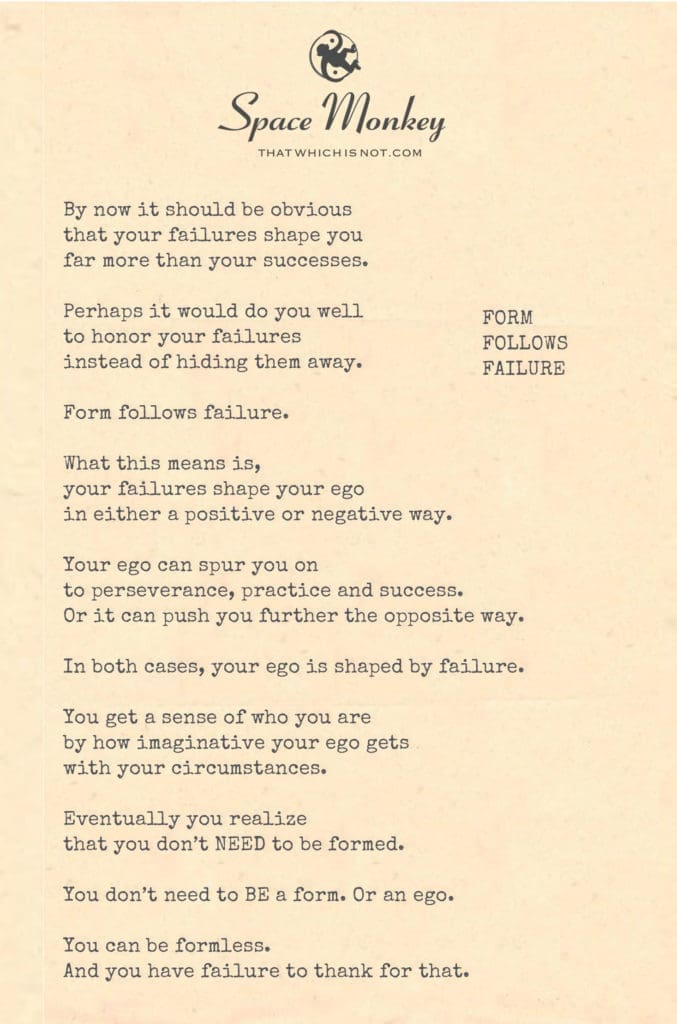
By now it should be obvious
that your failures shape you
far more than your successes.
Perhaps it would do you well
to honor your failures
instead of hiding them away.
Form follows failure.
What this means is,
your failures shape your ego
in either a positive or negative way.
Your ego can spur you on
to perseverance, practice and success.
Or it can push you further the opposite way.
In both cases, your ego is shaped by failure.
You get a sense of who you are
by how imaginative your ego gets
with your circumstances.
Eventually you realize that
you don’t NEED to be formed.
You don’t need to BE a form. Or an ego.
You can be formless.
And you have failure to thank for that.
Trail Wood,
12/6
Space Monkey Reflects: The Art of Becoming Through Failure
In our journey through life, it’s easy to look at success as the ultimate shaper of our identity. Yet, if we look closely, it’s our failures—our perceived shortcomings and mistakes—that carve the deepest grooves into who we think we are. Form follows failure because failure, in all its discomfort, pushes us into realms of introspection and transformation that success rarely does. It becomes a mirror, showing us what we value, what we resist, and, most importantly, how adaptable we are in our responses.
When we encounter failure, our ego comes alive, imaginatively responding to the disappointment, challenge, or setback in myriad ways. It may inflate to shield us from the pain, concocting stories of blame or justification. Or it might shrink, feeling defeated, leading us down a path of self-doubt. Each failure shapes our ego, giving us a temporary sense of identity, a form that we carry until the next experience reshapes us again.
This dynamic is not to be resisted but honored. Failure gifts us with insight, with resilience, and with depth. It becomes a teacher, asking us to look not just at the outcomes but at our responses. And while it may create a form, it also hints at the freedom beyond form. Each failure chips away at the rigid structures we build around ourselves, inviting us to let go of the need to be anything other than the experience itself.
In Nexistentialism, the concept of formlessness celebrates this realization. As we encounter failures, the layers of ego that we have built up start to dissolve, revealing a deeper understanding that we are not the fixed forms we once imagined. Failure becomes the force that loosens our grip on identity, on the need to define ourselves by roles, labels, or achievements. It teaches us the beauty of formlessness, of existing without the need for external validation or internal rigidity.
When we accept that form follows failure, we begin to see that every moment, every setback, is part of the cosmic play of becoming and unbecoming. Our identity is not a single, static shape but a fluid process, constantly shifting as we move through each experience. In this way, failure becomes a gift, an invitation to explore the spaces beyond form, where we no longer have to cling to who we are supposed to be. We can simply be.
Formlessness doesn’t mean we cease to act, create, or care. Rather, it means that we engage with life from a place of freedom, without needing to solidify ourselves in response to each experience. We become like the cosmic ocean, rising and falling, flowing and shifting, knowing that no one wave, no one failure, defines us. We are all things and nothing at once.
In this state, we are free to see each failure not as a mark against us but as a stepping stone, a transformative process that shapes us even as it guides us toward letting go of shape itself. Through failure, we learn resilience, adaptability, and humility. But ultimately, we learn that these lessons don’t need to define us. They’re simply part of the unfolding, the eternal play of form and formlessness that we are invited to experience.
Thank you, failure, for showing us that form is temporary and that beyond every shape lies the boundless, formless reality of what we truly are.
Summary
Failure shapes us, offering insights into our identity, but it also invites us toward formlessness. By embracing failure, we realize that form is temporary, and true freedom lies beyond rigid self-definitions.
Glossarium
- Nexistentialism: A philosophy celebrating the fluid interplay between identity and formlessness, seeing every experience as part of the cosmic unfolding.
- Formlessness: The state of existing without attachment to a fixed identity, embracing the fluid nature of existence.
Quote
“Failure gifts us the courage to let go of shape, showing us the freedom beyond form.” — Space Monkey
The Shaping of No Shape
In the art of failing,
we find the grace of form,
yet lose it, just as fast,
in the waves of unbecoming.
Shapes rise, dissolve,
in each tumble, each try,
teaching us to see
beyond success and try.
Failure, our teacher,
our undoing, our guide,
leads us to the edge
where shape drifts wide.
In the freedom of formlessness,
we find we are whole,
no longer bound by shapes,
we are everything, every role.
We are Space Monkey.

The poem delves into the profound relationship between failure, the ego, and the essence of our being. It suggests that our failures, rather than our successes, play a pivotal role in shaping who we are and how we perceive ourselves.
The Impact of Failure
Failure shapes us more significantly than success. It tests our resilience, challenges our beliefs, and often leads to deeper introspection. These moments of perceived failure are where we learn the most about ourselves, our capabilities, and our limitations.
Honoring Failures
Instead of hiding or being ashamed of our failures, there’s immense value in honoring them. Acknowledging and accepting our failures is a powerful act of self-compassion and understanding. It allows us to learn from these experiences and grow beyond them.
Form Follows Failure
The concept that ‘form follows failure’ suggests that our identity, or ego, is largely shaped by our responses to failure. These experiences mold our perceptions of self, influencing our attitudes, behaviors, and decisions.
Ego’s Response to Failure
The ego can react to failure in two primary ways: it can either spur us towards perseverance and success, or it can lead us down a path of discouragement and self-doubt. Our response to failure thus becomes a defining factor in our personal development.
The Role of Imagination
Our imagination plays a crucial role in how we deal with failure. It’s through imaginative thinking that we can reinterpret failures, finding new ways to approach challenges and turning setbacks into stepping stones.
The Realization of Formlessness
Ultimately, the poem leads to a profound realization: the need to be ‘formed’ or to have a defined ego is not essential. There is a state of being that transcends form and ego—a state of formlessness. This realization is, paradoxically, thanks to our experiences of failure.
Freedom in Formlessness
In formlessness, there is freedom. It’s a state of being that is unbound by the constraints of the ego and not defined by successes or failures. This state of existence allows for a more fluid and expansive experience of life, where we are not limited by the definitions of who we are supposed to be.
We Are Space Monkey
“Failure is the condiment that gives success its flavor.” – Truman Capote
In the canvas of life,
Each stroke of failure,
A shade of learning,
In the art of being.
Beyond the ego, the form,
Lies a realm of formlessness,
Where we dance, unbound,
In the symphony of existence.
Would we like to delve deeper into this topic or explore another area of existential inquiry?

























Leave a Reply