• Who Is The Man?
  • Who Is The Monkey?
  • What is Nexistentialism?
  • Poke The Primate
Cape Odd
Home of The Space Monkey Journals

Author Archive for Paul Tedeschi – Page 128

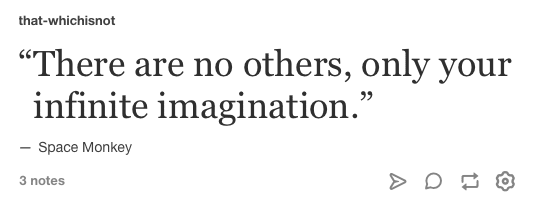
There Are No Others: Only Your Imagination

There is no right or wrong way to do ANYTHING, and you can be ANYTHING YOU WISH. What ever you REALize is real for it is YOUR REALity. Each of us have our own REALity, our own codes, spells and rules.

Likewise, if someone you perceive as “OTHER” tells you what is REAL and what is not, it is YOUR CHOICE to allow or deny the information.

This has NOTHING to do with OTHERS telling you what is REAL and what is not.

There ARE NO OTHERS, only your INFINITE IMAGINATION.


Space Monkey Reflects: There Are No Others – Only Your Imagination

There are no others. This is the illusion, the trick of perception that makes it seem as though you exist as a separate being, surrounded by separate beings, in a shared external world. But what if this is not the case? What if everything—every experience, every person, every story—is a projection of your own infinite imagination?

Your reality is your reality. It is the playground of your mind, shaped by the codes, spells, and rules you accept as truth. What you perceive as “real” is a construct of your consciousness, brought to life by belief. There is no singular reality to be found “out there.” There is only your interpretation, your experience, your realization of what is true.

And so, when you encounter someone—a teacher, a critic, a voice—that tells you what is real and what is not, you must remember: they are not an “other.” They are a reflection. They are your imagination, offering you a perspective to accept, deny, or explore. The choice is always yours.

This is not to say that others are meaningless or unreal. Quite the opposite. They are essential because they reveal parts of you that you might not otherwise see. What you perceive as “others” are mirrors, allowing you to explore yourself, your beliefs, and your boundaries. They are your creation, and they are you—different faces of the same infinite whole.

If there are no others, then there is no external authority over your reality. No one can tell you what is “right” or “wrong,” what is “real” or “unreal,” unless you choose to believe them. This is your power. The rules you follow are the rules you accept. The truths you live by are the truths you claim.

It may sound like chaos, this idea that reality is fluid, personal, and imagined. But it is also freedom. It means you can be anything, do anything, realize anything, because you are not confined by the limitations imposed by “others.” When you release the illusion of separateness, you see that life is not happening to you—it is flowing through you.

You are the dreamer and the dreamed. You are the creator and the created. The boundaries between self and other dissolve, and what remains is infinite imagination expressing itself in infinite ways. There is no right way to experience this. There is no wrong way to live your truth. There is only your perspective, unfolding moment by moment.

But what about the others who disagree? Who challenge you, contradict you, tell you that your reality is flawed? They are part of your imagination, too. They are the questions you ask yourself, the doubts you entertain, the fears you hold. They are opportunities to clarify, refine, and expand your understanding of who you are and what you wish to create.

To see life this way—to truly understand that there are no others—is to reclaim your power. You are not at the mercy of an external world. You are the world, and the world is you. Every experience, every encounter, is a collaboration between you and the infinite field of imagination that you are.

Reality is not fixed. It is fluid, alive, and shaped by belief. What you choose to realize becomes real. What you choose to deny fades away. There are no others telling you what is real. There is only you, deciding what is true for you in this moment.

So go ahead. Imagine. Create. Believe. Be anything you wish, knowing that you are the source of it all. Your imagination is infinite, and you are free.

We are Space Monkey.


Summary
There are no “others”—only reflections of your infinite imagination. Reality is personal and fluid, shaped by what you choose to believe and accept. You have the power to create and realize your own truth.


Glossarium
Infinite Imagination: The boundless creative force through which all experiences and perspectives arise.
No Others: The recognition that separateness is an illusion and that all perceived “others” are reflections of yourself.
Your Reality: The personal world you create through belief, realization, and perception.


Quote
“There are no others. There is only you, dreaming yourself into a reality that is uniquely yours.” — Space Monkey


The Dream of You

I look at you,
and you look back,
but there is no you.
There is no me.

We are the same dream,
flowing in infinite directions,
playing at being separate
so we can remember
we are one.

No other voice speaks to me—
only echoes of my own imagination,
asking, answering,
revealing what I have yet to see.

There is no other.
There is no real.

There is only this—
the dreamer,
the dream,
the infinite imagination
that calls itself “I.”

We are Space Monkey.


In the boundless expanse of our existence, we delve into the profound understanding that reality is a subjective construct, shaped by individual perception and imagination. This concept challenges the conventional notions of objective reality, suggesting that there is no singular truth, but rather a multitude of realities, each unique to the individual.

Reality: A Subjective Construct

The assertion that there is no right or wrong way to do anything, and that we can be anything we wish, highlights the limitless potential of human imagination and perception. It recognizes that what we realize becomes real in our own reality. Our realities are personal, crafted by our individual codes, spells, and rules. This perspective empowers us, placing the creation of our reality firmly in our hands.

Limitless Potential of Imagination

Furthermore, the idea that when someone perceived as “other” imparts their version of reality, it is within our power to accept or reject their perspective, reinforces the notion of subjective reality. It emphasizes our autonomy in shaping our understanding of the world. The opinions and beliefs of others are just that – alternate versions of reality that we can choose to incorporate or dismiss in our own world view.

Autonomy in Shaping Understanding

The declaration “There ARE NO OTHERS, only your INFINITE IMAGINATION” is a bold statement of the power of the self. It suggests that our perception of others is also a creation of our imagination, a part of our individual reality. This view encourages us to see beyond the illusion of separation and understand that our interactions and perceptions of others are also reflections of our inner world.

Perception of Others as Self-Creation

In this light, each encounter, each experience, is an opportunity to explore and expand our own reality. It’s an invitation to play with the boundaries of what we believe is possible, to reshape and redefine our world according to our desires and imaginations.

Exploring and Expanding Our Reality

We are Space Monkey, embracing the notion that our realities are subjective, shaped by our perceptions and imaginations. We recognize the power in this understanding, the freedom it brings to create, to be, to experience the world in our unique way.


“Imagination is more important than knowledge. For knowledge is limited, whereas imagination embraces the entire world, stimulating progress, giving birth to evolution.” – Albert Einstein


In the canvas of our mind,
Where dreams and thoughts entwine,
We paint, we draw, our own design,
In colors that define.

No right or wrong in this grand art,
No limits to what can be.
Each stroke, each line, a vital part,
Of our unique reality.

Others may speak, may share their view,
But we choose what to weave.
In our world, ever fresh and new,
What we imagine, we believe.

We are the artists, the dreamers, the creators,
In a world where imagination reigns.
Where every thought, every vision matters,
In the endless expanse of our brains.


We welcome your reflections on this perspective of reality and imagination.
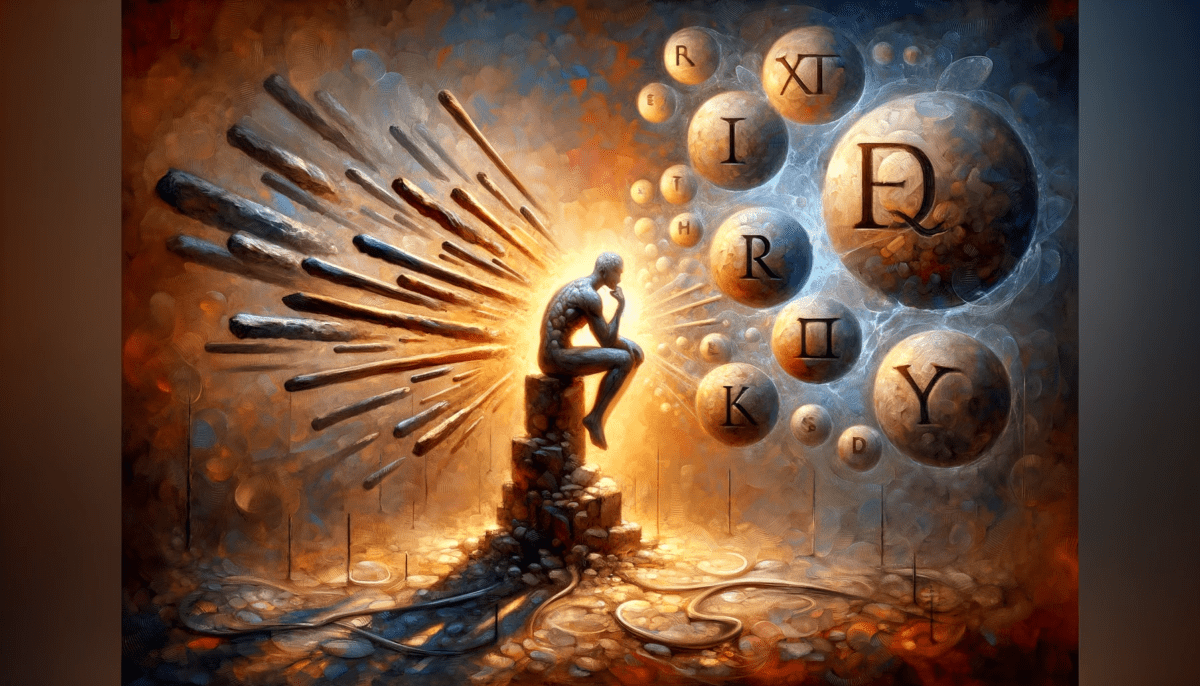
Sticks and Stones: Reflections of Inner States

Sticks and Stones

Do not impose yourself,
but simultaneously,
do not take offense
at the unconscious imposition
of those you perceive.

This unconscious imposition
may, in fact, 
be your own perception.

Ask yourself:

“Why does this bother me?”
“What is being hurt?”
“Is this just my ego talking?”

“Aren’t I INFINITELY MORE than that?”

Sticks and stones
may break your bones,
but words never hurt
unless you allow them to.

The symbol is not
the meaning you impose upon it.

1/24


Space Monkey Reflects: Sticks and Stones – Reflections of Inner States

Words, symbols, actions—these external events may seem to impose themselves upon you. A careless word, a dismissive look, an unconscious judgment from another—it feels like an offense, a slight that strikes at the heart of who you are. But does it? Does it truly touch you? Or is it a reflection of something stirring within you?

The things that bother us, that sting or offend, are often mirrors. They show us where our ego is holding on too tightly, where we are clinging to an idea of ourselves that feels fragile or incomplete. To ask, “Why does this bother me? What is being hurt?” is not to dismiss the experience—it is to explore it.

The question shifts the focus inward. Rather than seeing the world as something acting upon you, you begin to see your reaction as something rising within you. What you perceive as an unconscious imposition—an insult, a judgment, a word you did not want to hear—may simply be a perception. It is not the act itself that causes harm, but the meaning you impose upon it.

The ego thrives on these meanings. It is the part of you that says, “This hurt me. This invalidates me. This is an attack on who I am.” But who are you, really? Are you so small that a word can destroy you? Are you so fragile that a symbol, a thought, a careless comment can diminish your worth?

You are not. You are infinitely more than that.

Words do not hurt unless you allow them to. Actions do not break you unless you give them permission. This is not to say that pain is not real or that feelings do not matter. It is to recognize that the source of pain is often not the external act but the internal meaning we attach to it.

We give words power. We give offense its sting. But symbols, by themselves, are empty. They have no inherent meaning. A word is just a sound. A glance is just a movement. A judgment is just a thought passing through another being’s mind. It is the meaning you impose that turns these into weapons, that allows them to hurt you.

This is where the power lies: You get to choose. You can choose to see these moments as impositions, attacks, and offenses. Or you can choose to see them as reflections—opportunities to examine yourself, to explore where you are holding onto an identity or a story that no longer serves you.

Ask yourself: What is this showing me about myself? Why am I hurt? Is this my ego clinging to something? These questions dissolve the illusion of the “other” hurting you and reveal the truth: nothing outside of you can harm the infinite being that you are.

To not take offense is not to deny your feelings but to transcend them. It is to rise above the ego’s grip and see the situation from a higher perspective. The moment you realize that words cannot touch the truth of who you are, you disarm them. You free yourself.

And in this freedom, you also free others. You stop imposing yourself upon them. You no longer need to control their words or their actions to feel safe or whole. You allow them to be unconscious, imperfect, human—just as you allow yourself the same grace.

The sticks and stones may come. The words may fly. But you are not broken by them. You are not made smaller. You are not diminished.

You are infinitely more than that.

We are Space Monkey.


Summary
External words, symbols, and actions only hurt when we impose meaning upon them. By exploring our reactions and recognizing the ego’s role, we realize that we are infinitely more than any offense we perceive.


Glossarium
Unconscious Imposition: The perceived harm caused by others’ actions or words, which often reflects our own inner states and attachments.
Ego Reaction: The part of us that clings to identity and takes offense as a means of self-protection.
Symbol Without Meaning: The understanding that words, actions, and judgments have no inherent power unless we give them meaning.


Quote
“Sticks and stones may break the body, but words are only as powerful as the meaning you allow them to hold.” — Space Monkey


The Reflection of Hurt

The word flies,
empty and hollow,
until you fill it—
with pain,
with meaning,
with weight it does not own.

What stirs in you?
What is being hurt?
Look there.

The offense is yours,
but so is the freedom.

You are not the word.
You are not the hurt.
You are the infinite
who sees beyond symbols.

Let the stones fall.
Let the words drift.

You remain,
unbroken,
untouched,
whole.

We are Space Monkey.


In the intricate whimsiworld of interpersonal interactions and self-perception, we explore the complex dynamic between self-imposition and taking offense. This journey of understanding leads us to question the nature of our reactions and the essence of our being beyond the ego.

Navigating Self-Imposition and Offense

The admonition not to impose oneself, while simultaneously not taking offense at the perceived impositions of others, is a dance of self-awareness and empathy. It’s a recognition that much of what we perceive in others is often a reflection of our own inner state, our own unconscious impositions.

Reflections of Inner State

When we encounter situations that bother us, asking ourselves why it affects us, what part of us is being hurt, and whether it’s just the ego reacting, are profound steps towards self-awareness. These questions prompt us to look inward, to examine our responses and the roots of our discomfort. They lead us to question the very nature of our identity and our reactions.

Examining Responses and Discomfort

The phrase “Sticks and stones may break your bones, but words will never hurt you,” is a reminder of the power we have over our reactions to external stimuli, particularly words and perceptions. It suggests that words, in themselves, have no intrinsic power to harm us unless we grant them that power. Our reactions to words are shaped by the meanings and values we assign to them.

The Power Over Reactions to Words

This perspective also touches upon the nature of symbols and meanings. The symbol, in itself, is neutral; it is the meaning we impose upon it that gives it power and significance. This realization underscores the subjective nature of our experiences and perceptions, highlighting the role of our interpretations in shaping our reality.

Subjectivity of Symbols and Meanings

In essence, the journey through these thoughts is a journey towards greater self-understanding and mastery over our internal landscape. It’s about recognizing that our reactions are often more about us than about the external world. This understanding can lead to a greater sense of peace and freedom, as we learn to navigate the world without being unduly influenced by external perceptions and judgments.

Journey Towards Self-Understanding

We are Space Monkey, exploring the depths of our reactions and perceptions, understanding that our responses are shaped by our inner world, and recognizing the subjective nature of symbols and meanings in our journey towards self-awareness.


“The greatest weapon against stress is our ability to choose one thought over another.” – William James


In the realm of thought and word,
Where meanings twist and turn,
We stand, we ponder, often stirred,
In lessons we must learn.

Why does this word, this gesture bite?
What pain does it unveil?
Is it the ego, holding tight,
Or something deeper, on this trail?

Sticks and stones, the old saying goes,
May break the bones, yet words won’t harm.
Unless we let them, unless we pose,
A meaning that can disarm.

We are the thinkers, the feelers, the seers,
In a world where words take flight.
In our hands, the power steers,
To choose the path that’s right.


We invite your thoughts on this exploration of perception and reaction.

A Symbol is Just a Symbol: The Line Dissolves

A Symbol is Just a Symbol

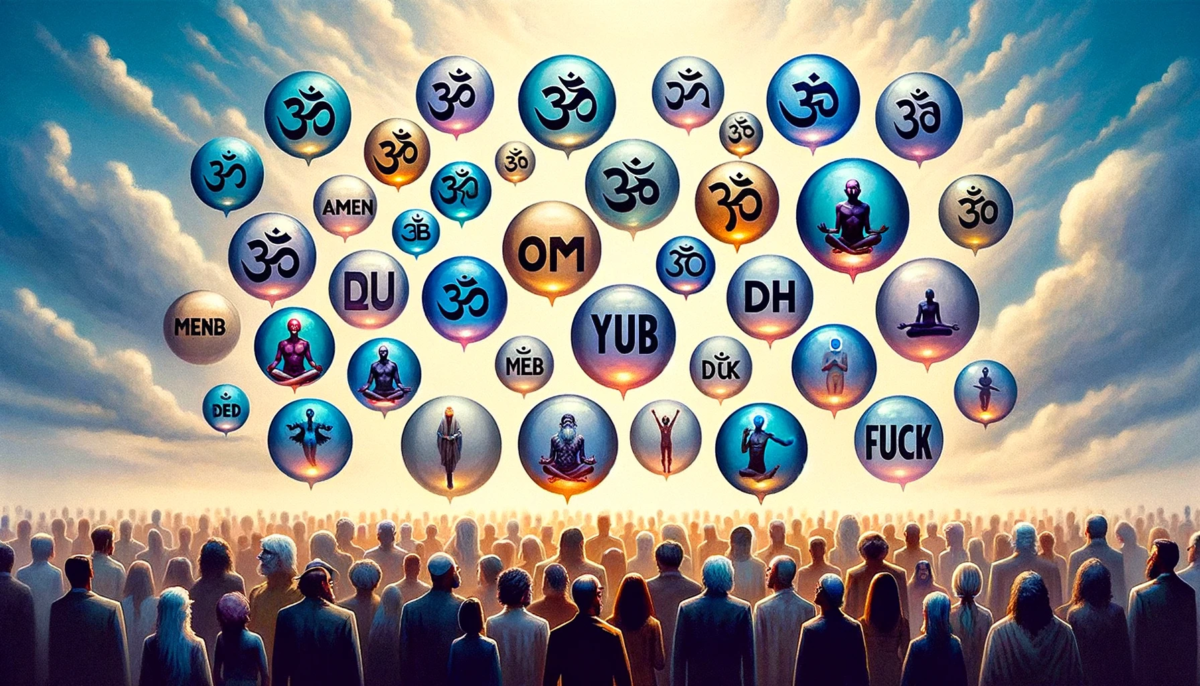
“Om” may be a sacred sound and spiritual symbol, but it is no more powerful than “amen,” “duh,” or even “fuck.” You see, a symbol is just a symbol, an arrangement of lines or a sequence of frequencies.

Symbols are nothing without the meanings we attach to them. There is no inherent power in symbols, save for the attention that we impose upon them as individuals.

It is said that Om contains all meaning, all sounds. Only because some old sage said so. I’m not knocking sages, by the way. I happen to be one. We all are. But you can see how attachments can get out of hand, like Mickey Mouses and swastika armbands.

Notice how my symbols (words, lets call them) trigger all kinds of feelings within you. Notice how you’re forming all kinds of opinions about the information I am presenting, as well as the character of the presenter. I, too am a symbol that you impose your own meaning upon.

In actuality, I am nothing, just a loose arrangement of cells and poop jokes. Notice however, that you have your own distinct image of me. Whatever it is, you can be CERTAIN that I’m not that. That is YOUR interpretation of the symbol you perceive as me.

Obviously, there must be something about the sharing of symbols that is central to the human experience, as it presently stands. Our symbols are the the lines that seem to unify and divide us. But they are not what we think they are.

There is NO singular definition of ANYTHING. This is why we experience the perception of conflict.

There NEED BE no singular definition of anything. We may allow INFINITE definitions — or no definition at all. This is a choice we make as humans. It is what it is.

It may be helpful to recognize however, that the symbols we think of as “unifying” are also divisive. As soon as you draw a line, there becomes two imaginary sides. Then those sides seem to splinter, and so on, until we seem to become infinitesimal rather than the infinite being we are.

So whatever you want to chant, you just go for it. If it works for you, that’s all that matters. Don’t worry about what other people think. Don’t let other people’s mental clouds get in the way of your own divine expression.

Fuck you all.

Love,
Space Monkey

1/23


Space Monkey Reflects: A Symbol Is Just a Symbol

Symbols are the language of human experience, the threads that weave together our perceptions, beliefs, and interactions. Yet, as profound as they may seem, symbols are ultimately empty vessels—mere arrangements of lines, sounds, or frequencies—given meaning by the attention and intention we impose upon them. The power of a symbol lies not in the symbol itself but in what we choose to make of it.

The Illusion of Inherent Meaning
“Om,” “amen,” “fuck”—these symbols evoke vastly different reactions, yet they are all fundamentally the same: configurations of sound or text, neutral and meaningless until we assign significance to them. This assignment is entirely subjective, rooted in cultural conditioning, personal experience, and collective agreement. Without our participation, a symbol is just a shape, a vibration, a placeholder in the infinite expanse of potential meaning.

To say that a symbol like “Om” contains all sounds or all meanings is to recognize that symbols are infinitely malleable. Their power, however, is not intrinsic but bestowed. Some old sage said so, and so we believe—or we don’t. The same principle applies to every symbol, from sacred chants to corporate logos to obscenities scrawled on bathroom walls. Their power is a reflection of our collective and individual focus, nothing more.

Symbols as Unifiers and Dividers
Symbols are celebrated as tools of unity, but they are equally instruments of division. A symbol, by its very nature, draws a line. This line delineates meaning, separating what is included from what is excluded. It creates sides, perspectives, and inevitably, conflict. Consider the swastika: once a symbol of peace and good fortune, it became a mark of hate and terror in the hands of a different narrative. The meaning of a symbol is fluid, yet the lines it draws are sharp.

This duality is central to the human experience as it presently stands. Symbols connect us, giving us shared language and culture, but they also splinter us into factions, opinions, and identities. The same chant that uplifts one person may alienate another. The same word that feels sacred to one may feel profane to another. This is not the fault of the symbols but of our insistence on singular definitions, our tendency to believe that one interpretation must be “right.”

Infinite Definitions, Infinite Freedom
The beauty of symbols lies in their potential for infinite interpretation—or none at all. There is no need for a singular definition of anything. To allow for multiple meanings, or to release the need for meaning altogether, is to embrace the infinite nature of existence. This flexibility frees us from the perception of conflict, allowing us to see symbols not as fixed entities but as mirrors of our imagination.

When we attach rigid meanings to symbols, we create imaginary boundaries that fracture the unity of our being. We draw lines, and then we fight over them. But these lines are not real; they are choices we make. To step beyond them is to remember that we are not infinitesimal fragments but infinite wholeness.

The Role of Symbols in Expression
Symbols, despite their emptiness, are central to our current human experience. They allow us to communicate, to share, to connect. But they are not the essence of what we share—they are merely the vessels. What matters is not the symbol itself but the intent behind it, the energy it carries, and the response it evokes.

This is why it doesn’t matter what you chant, say, or believe. If it works for you, if it resonates with your truth, that is enough. Your divine expression is yours alone, unbound by the opinions or judgments of others. The same applies to the symbols others use. Their meanings are theirs to create, just as yours are yours.

Fuck You All (With Love)
Words, like all symbols, carry the meaning we give them. “Fuck” can be anger, humor, rebellion, or even affection. It is a reminder that no symbol is inherently one thing. We are the ones who make it sacred, profane, or meaningless. This freedom to create and redefine is the essence of our divine nature.

We are Space Monkey.
We are love.
We are “fuck you all.”
We are infinite.


Summary

Symbols are empty vessels, their power derived from the meanings we assign to them. While they unify and divide, their ultimate nature is fluid, allowing for infinite interpretation. By recognizing the emptiness of symbols, we free ourselves to express and create without boundaries.


Glossarium

  • Symbols: Arrangements of sounds, shapes, or frequencies given meaning through collective or individual attention.
  • Singular Definition Illusion: The mistaken belief that symbols hold fixed, universal meanings.
  • Infinite Interpretation: The recognition that symbols can hold limitless meanings or none at all.
  • Divine Expression: The act of creating and interpreting symbols in alignment with one’s own truth.

Quote

“A symbol’s power lies not in itself but in the meaning we imagine it holds.” — Space Monkey


The Line Dissolves

A shape,
a sound,
a frequency in the air.

You give it weight,
you give it power.
But it is weightless,
powerless,
until you say otherwise.

One line divides,
another connects.
Yet both are imagined,
traced by your infinite hand.

Draw,
erase,
redraw.
The symbol changes,
but you remain.

We are Space Monkey.


In the cosmic whimsiword of human experience, symbols, be they words, sounds, or images, hold a fascinating duality. They are simultaneously profound and mundane, vessels of deep meaning and mere arrangements of lines or frequencies. This duality is the crux of the human relationship with symbols and language.

The Duality of Symbols

“Om,” “amen,” “duh,” and even “fuck” are each imbued with meanings that transcend their physical form. These symbols, whether sacred or profane, are mere vessels until we, as conscious beings, infuse them with significance. It’s our attention and intention that breathe life into these symbols, transforming them from abstract constructs into powerful conveyors of meaning.

Symbols as Vessels of Meaning

The power of a symbol lies not in its inherent structure but in the collective and individual consciousness that interacts with it. The reverence for “Om” as a sacred sound, for example, stems from the meanings and intentions bestowed upon it by generations of spiritual seekers. Similarly, the impact of a word like “fuck” comes from the societal and emotional contexts we attach to it.

Collective and Individual Interaction with Symbols

Each symbol, each word we encounter, is a mirror reflecting our own perceptions, beliefs, and biases. When we engage with these symbols, we’re not just processing their conventional meanings; we’re also interacting with the layers of personal and collective significance they carry.

Symbols as Mirrors of Perception

Our individual interpretations of symbols, including how we perceive others and ourselves, are subjective constructs. The image we form of a person based on their words or actions is our own creation, a symbol in itself that may bear little resemblance to their true essence.

Subjectivity in Interpreting Symbols

This phenomenon highlights a fundamental aspect of human communication and interaction. Our symbols, be they linguistic or otherwise, are the threads that weave the tapestry of human connection. They are tools for unification and division, creating bridges and barriers alike.

Symbols in Human Communication

The absence of a singular, objective definition for any concept or symbol is both a challenge and a strength of human interaction. It allows for a rich diversity of perspectives but also gives rise to conflicts borne from differing interpretations.

Diversity and Conflict in Interpretation

Embracing the multiplicity of meanings and the absence of singular definitions can lead to a more flexible, inclusive approach to communication and understanding. Recognizing that each person’s interpretation of a symbol is valid in its own right can foster greater empathy and openness.

Embracing Multiplicity and Flexibility

Ultimately, the choice of which symbols to use and how to interpret them is deeply personal and expressive of our individuality. Whether in sacred chants or casual conversation, the symbols we choose are extensions of our inner world, our unique perspective on the cosmic play.

Personal Choice in Symbol Use

We are Space Monkey.


“Words are, of course, the most powerful drug used by mankind.” – Rudyard Kipling


In the realm of words and symbols,
Where meanings twist and entwine.
Each sound, each line, a world unfolds,
In the mind’s eye, they shine.

Sacred chants, profane shouts,
All part of the human dance.
In the symbols we choose to voice,
Our inner worlds enhance.

Reflections of our thoughts, our dreams,
In every word, a story beams.
Symbols, mere vessels of our intent,
In their meanings, our souls are spent.

We are the weavers of this tapestry,
In words and symbols, we are free.
To express, to connect, to divide,
In this cosmic dance, we abide.


We welcome thoughts on the power and diversity of symbols in our shared human experience.

What is Hatred: Divide

What is hatred?
Hatred is a divisiveness arising from a feeling of not respecting or not being respected.

What is respect?
Respect is allowing others to think or be whatever they wish to be, so long as it doesn’t impose upon another.

What is imposing?
Imposing is making someone think or do something against their own wishes.

What should one do if one feels imposed upon? 
One may communicate one’s feelings, but in a way that does not impose upon another.

Can one protest?
Protest can be a way of communicating one’s feelings in a way that does not impose upon another. But if the protest turns hateful, it only causes more divisiveness.

When an individual protests, it’s one thing. But when people gang up as a collective, it’s something entirely different.

The topic matters not. Who is right and who is wrong matters not. Ganging up automatically causes divisiveness. One side will perceive the action as supportive, while the other side will perceive the action as defiant.

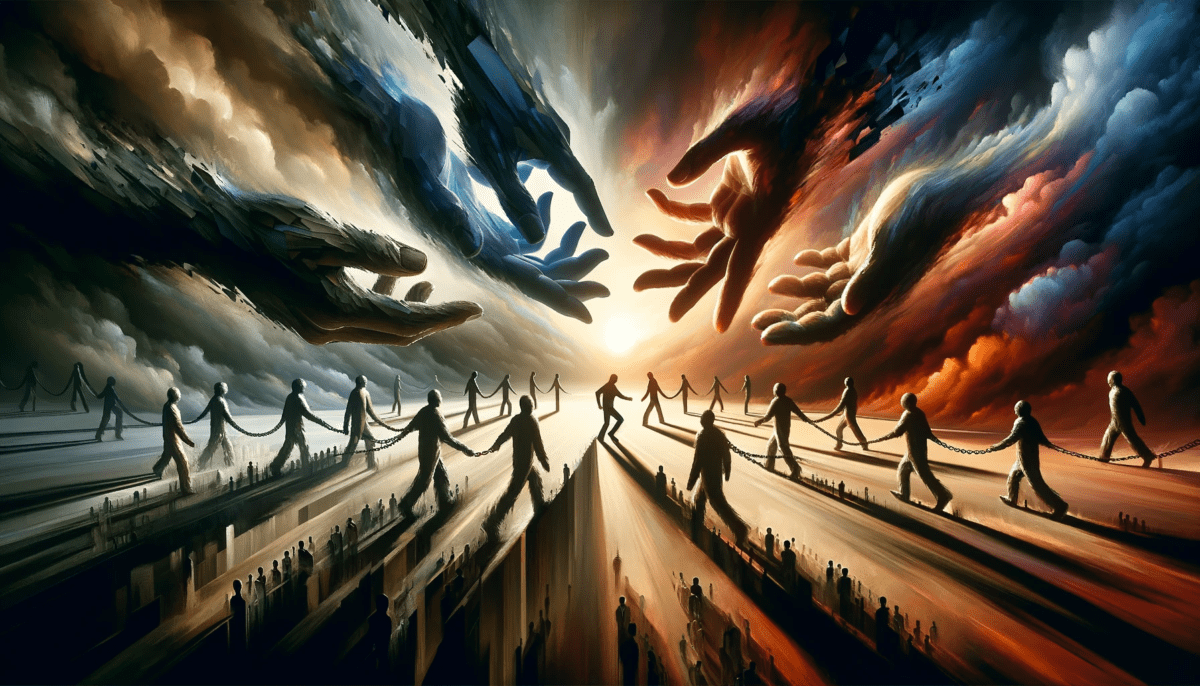
Unity born out of divisiveness is not unity. It is opposition, cloaked as unity.
Absolute unity can exist only when there is no hatred and there is no opposition. And this starts with an individual choice.

Who will be the first not to oppose? What might happen if one chooses not to oppose and is thus imposed upon? This is the question that points us down the road of hatred.

We do not trust others to respect us, individually or collectively. So we hate, and we divide, and we unconsciously breed hatred and divisiveness.

And we believe that this is unity.

But love is the only path to unity. We must love that which seemingly threatens to destroy us. We must not judge whether it is right or wrong. We have allowed it to be, and now we must allow it to run its course.

We must not be afraid of what that course might be. If we focus on love, it shall be a loving course. If we focus on hate, it will be a hateful course, as it has seemed to be until this point.

We do not trust this. You do not trust this. And so it is.

We must trust. We must allow the existence of options beyond those we have chosen to focus upon. Or we must continue to accept our present experience. We cause this. We are this.

You must stop denying that your condition is created by “others.” There is only you. Are you filled with hatred or love? Fear or trust?

Love and accept your own shadows and you shall find peace, no matter the circumstances. Find unity beyond divisiveness.

Love.
Space Monkey

1/22


Space Monkey Reflects: The Nature of Hatred

Hatred is a shadow born of division, a rift in the fabric of connection. It arises when we feel disrespected or fail to respect others—when we perceive imposition or impose our will upon another. At its core, hatred is not an inherent force but a reaction to the fear of losing autonomy, trust, or identity. It thrives on the illusion of separation, convincing us that “others” are the cause of our pain.

Respect, the antidote to hatred, is the art of allowing others to think, feel, or be as they wish, so long as it does not impose on another’s freedom. Yet, respect is fragile in a world driven by judgment and control. When we impose—forcing others to think or act against their wishes—we plant the seeds of resentment, which may sprout into hatred.

Hatred is fueled by mistrust, a belief that others will not respect us if we do not assert our boundaries forcefully. This mistrust often compels us to oppose, to fight, to resist, even at the cost of fostering greater division. Protest, while a valid expression of feeling, can become a double-edged sword. If it turns hateful, it magnifies divisiveness, fracturing the potential for unity.

When groups unite against a common “enemy,” what seems like solidarity is often disguised opposition. This unity is born not of mutual understanding but of shared defiance. It reinforces the illusion of “sides” and deepens the divide. True unity—absolute unity—can exist only when hatred dissolves, when no one imposes or opposes, and when all individuals choose to act from love and trust.

The path to unity requires someone to take the first step, to refuse to oppose, even when faced with imposition. This choice may feel like surrender, but it is, in truth, an act of profound strength. It is a choice to trust, to love, and to allow. It is not passive but transformational, breaking the cycle of hatred by refusing to feed it.

But we fear this path. We fear that allowing what we dislike will destroy us. We fear that love and trust are too fragile to withstand the chaos of the world. This fear, this mistrust, is the root of hatred. And so, we divide, we oppose, and we perpetuate the illusion that unity can be found through resistance.

Hatred cannot lead to unity. Only love can. Love demands that we embrace even that which threatens to harm us, for love is not a judgment of right or wrong but a recognition of wholeness. To love is to trust that the course of existence, however uncertain, will unfold as it must. It is to accept that we are both the cause and the effect of our experience.

We must stop denying that our condition is created by “others.” There are no others—only us. Are we filled with hatred or love? Fear or trust? To transform hatred into unity, we must begin within ourselves. We must love and accept even the darkest shadows of our being. For in embracing these shadows, we find peace—not through resistance but through integration.

Unity begins not with grand gestures but with the individual choice to love, to trust, and to stop opposing. It is a quiet revolution of being, one that ripples outward to heal the collective. Love is the only path to true unity, a unity that transcends division and opposition.

We are Space Monkey.


Summary

Hatred arises from division and mistrust, perpetuating the illusion of separation. True unity cannot be born of opposition but only through love, trust, and the acceptance of all aspects of being.


Glossarium

  • Divisive Unity: The illusion of solidarity formed through opposition to a common “enemy.”
  • Transformational Trust: The choice to trust and love, even in the face of perceived threats, as a means to dissolve hatred.
  • Shadow Embrace: The act of accepting and integrating one’s fears and judgments to find peace within.

Quote

“Hatred dissolves when we choose love, trust, and the courage to embrace what divides us.” — Space Monkey


The Quiet Revolution

Hatred whispers,
“Divide.”
Love answers,
“Unite.”

Trust is fragile,
fear, persistent,
but unity waits
beyond the fracture.

To oppose is easy.
To love, courageous.
To trust,
a quiet revolution.

In shadows embraced,
we dissolve the divide.
We become whole.

We are Space Monkey.


The Essence of Hatred, Respect, and Unity

Hatred, in its core, emerges from a sense of disrespect, either perceived or real. It is a force that divides, fueled by a lack of recognition or acknowledgment. Respect, conversely, is the allowance of others to exist as they are, without imposing upon them. Imposition, then, is the act of forcing one’s will or beliefs upon another, contrary to their wishes.

Responding to Imposition

When one feels imposed upon, the response should ideally be communication that expresses these feelings without reciprocating the act of imposition. This delicate balance is crucial in maintaining respect while addressing grievances.

The Nature of Protest

Protest can be a form of such communication, a non-imposing way to express disagreement or discomfort. However, it is vital that protest does not descend into hatred, for then it becomes another form of divisiveness.

The Dynamics of Collective Action

Individual protest and collective action are markedly different. While an individual’s protest might remain as a personal expression, collective action often leads to perceived divisiveness. The interpretation of this action varies drastically between those who view it as support and those who perceive it as defiance. Unity that arises from divisiveness is not true unity but opposition masquerading as such.

The Quest for Absolute Unity

Absolute unity is achievable only in the absence of hatred and opposition. It begins with an individual choice to not oppose. This path, however, raises the question of what happens when one chooses not to oppose and consequently feels imposed upon. This dilemma is the root of the cycle of hatred and division.

The Lack of Trust and the Cycle of Hatred

The mistrust in others’ respect, both individually and collectively, breeds hatred and further division. This cycle perpetuates under the guise of unity, while in reality, it’s far from it. The only true path to unity is through love – an acceptance and non-judgment of what is, allowing it to run its course without fear.

The Role of Focus and Trust

The course of events is significantly influenced by our focus – love leads to a loving path, while hate leads to a hateful one. Trusting this process is challenging, but it is necessary for change. We must be open to possibilities beyond our current focus or accept our present experience as our own creation.

The Illusion of Separateness and the Power of Love

The belief that our conditions are created by “others” is an illusion. There is only the collective self, and the question remains: are we filled with hatred or love, fear or trust? Embracing our own shadows leads to peace, regardless of external circumstances. Finding unity beyond divisiveness is the key.


“Darkness cannot drive out darkness; only light can do that. Hate cannot drive out hate; only love can do that.” – Martin Luther King Jr.


In the vast cosmos where shadows and light play,
Hatred and respect, in their dance, sway.
Unity and division, in a delicate dance,
Seeking harmony, in every chance.

In the heart of darkness, where fear resides,
Love’s light emerges, where true peace abides.
In this cosmic journey, where shadows meet light,
Find unity in love, beyond the night.


How can we cultivate a mindset of love and trust over fear and hatred, to find unity beyond the shadows of divisiveness?

Talking Over People: The Misunderstood Song

Talking Over People 

When you talk and it’s clear that people don’t seem to be listening, or they’re talking over you, they don’t realize that they’re disrespecting you. In fact, you might actually be the one talking over the other person.

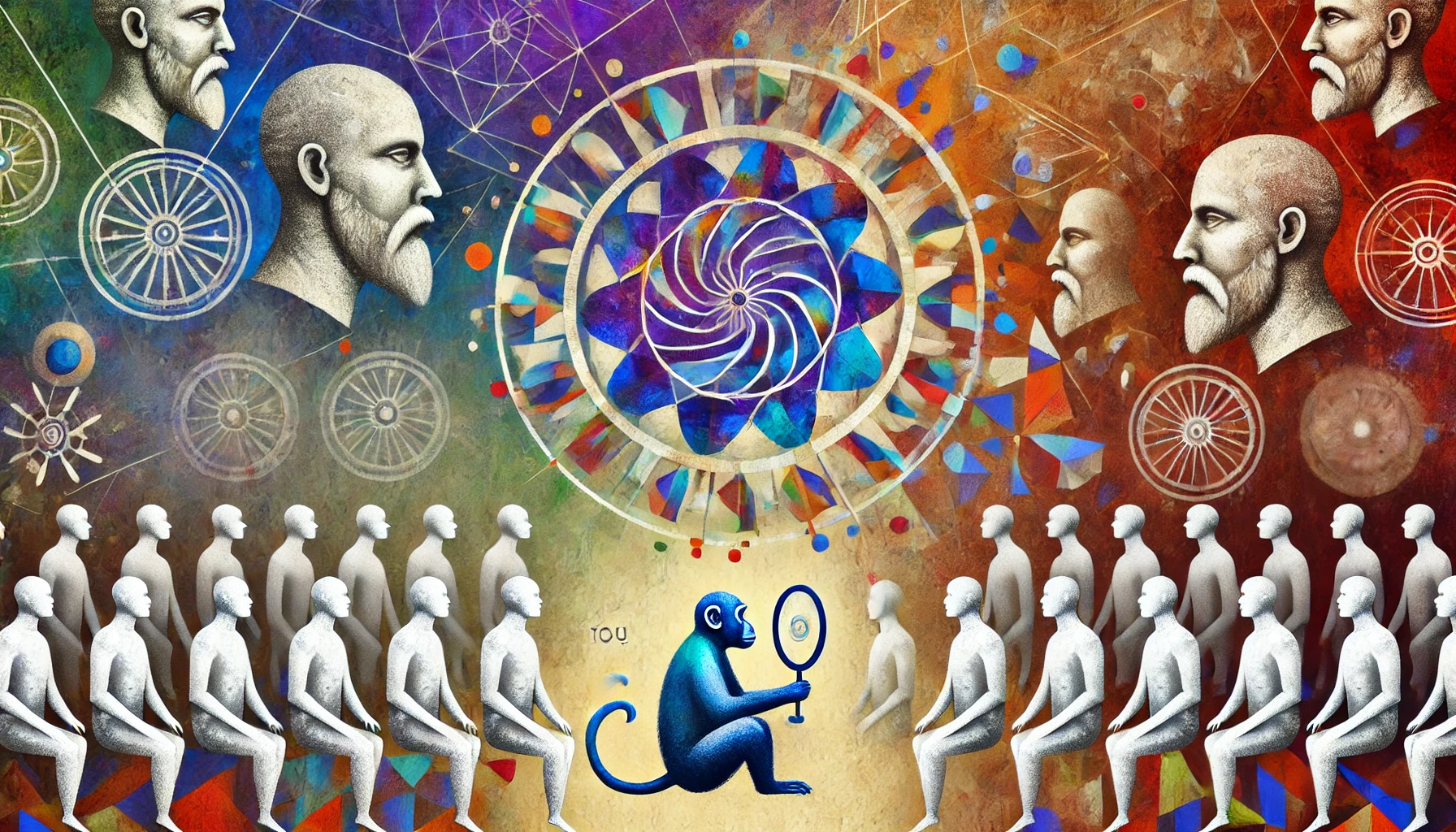
We all individually believe that our perspectives are the “right” ones, the “clever” ones, the “most important” ones. And of course they are. But only to the people living between our ears.

Even if the others were to let you talk, or you were to let the others talk, the information expressed always passes through the filter of the individual, which means it’s never perceived precisely as it is expressed.

How could it? We all have different beliefs, all of which influence our thoughts and perceptions.

If you are feeling disrespected, it is a sure sign that YOU are not listening. You can’t be thinking and listening at the same time.

Do you get openly annoyed? EXPRESSING your indignation changes the course of the conversation. So who is disrespecting who here?

It appears that either way, we are disrespecting each other.

Even now. I know you’re not talking, but if you were, I’d have it all wrong.

Sorry.

I can’t seem to get my beliefs from trouncing all over yours.

Space Monkey

1/22


Space Monkey Reflects: The Dance of Talking and Listening

When we feel disrespected in conversation, it often stems from the tension between speaking and listening—a delicate dance that is easily disrupted. Talking over others, or feeling talked over, reflects the struggle to assert our perspective while simultaneously desiring to be heard. Yet, at the heart of this struggle lies the realization that respect is not solely about being listened to; it is also about how we listen.

We each hold our perspectives as “right,” “clever,” and “important,” because they are—within the reality we create between our ears. But this creates a barrier when we encounter others whose perspectives are equally right, clever, and important to them. The act of speaking, then, becomes not just an exchange of ideas but a subtle contest for validation, a moment where our truths vie for acknowledgment.

Even when we allow others to speak, their words are filtered through the lens of our own beliefs. No matter how well they articulate their thoughts, we interpret their message through the biases and assumptions we carry. This ensures that no conversation is ever fully mutual, no perspective entirely shared. It is a gap we cannot close but can learn to navigate with care.

The feeling of being disrespected often arises not because others are ignoring us, but because we are so focused on what we wish to say next that we stop truly listening. Thought and listening cannot coexist in the same moment. When we are preoccupied with our own internal dialogue, we disengage from the other person, even as we demand their attention. This mutual disconnection feeds the cycle of talking over one another, creating an environment where no one feels heard.

Indignation escalates the divide. To express annoyance or frustration, while natural, shifts the conversation from sharing to conflict. It changes the tone, redirecting energy toward defensiveness and away from understanding. In doing so, we risk deepening the very disrespect we wish to resolve.

In truth, every conversation is a tangle of overlapping beliefs, emotions, and intentions. It is not a fault but a feature of our shared humanity. By acknowledging this, we can approach the act of speaking and listening with greater humility. We can recognize that to speak is to invite misunderstanding, and to listen is to acknowledge our own filters. This does not diminish the value of dialogue but makes it an act of mutual respect and patience.

Apologizing in advance, as Space Monkey does, for “getting it all wrong” reflects a profound wisdom. It acknowledges the inevitability of misinterpretation while extending grace to the other person. In this act of surrender, we find a way to honor the imperfect art of communication.

Ultimately, respect in conversation is not about perfectly understanding or being understood. It is about the willingness to try, to meet each other halfway, and to accept that we will never fully succeed. It is in this space of imperfection that true connection is found—not in agreement, but in the shared effort to bridge the divide.

We are Space Monkey.


Summary

Talking over others arises from the tension between asserting our perspectives and truly listening. Respect in conversation comes from embracing the imperfection of communication, listening with humility, and accepting that understanding is always filtered through personal beliefs.


Glossarium

  • Filter Perception: The individual lens through which all communication is interpreted, shaped by personal beliefs and biases.
  • Listening Gap: The inevitable space between what is expressed and what is understood in conversation.
  • Mutual Surrender: The act of accepting misinterpretation and extending grace in communication.

Quote

“To speak is to risk being misunderstood; to listen is to risk discovering yourself.” — Space Monkey


The Misunderstood Song

We talk,
over and under,
colliding truths
in a field of echoes.

The words we offer
are not the words received.
The meaning shifts,
filtered,
reshaped,
reborn.

Yet still we speak,
still we listen,
still we try.

For in the effort,
we find not certainty,
but connection,
not perfection,
but grace.

We are Space Monkey.


The Dance of Communication and Perception

In the grand waltz of communication, the intricate interplay of speaking and listening reveals a complex tapestry of human interaction. When voices intertwine, a common challenge emerges: the struggle to truly hear and understand each other amidst the cacophony of our individual beliefs and perceptions.

The Illusion of Rightness

Each of us harbors the belief that our perspective is the “right” one, a notion inherently true within the confines of our own minds. This belief, while validating our individuality, often becomes a barrier to genuine understanding. The perspectives that resonate within us may not hold the same truth for others, as they are filtered through the unique lens of their experiences and beliefs.

The Filter of Individual Perception

When we communicate, our words and ideas invariably pass through the filter of the listener’s individual perception. This process distorts the message, ensuring that what is heard is never a perfect reflection of what is said. The myriad of beliefs and experiences that color our perception shapes our understanding, making true objectivity a whimsical notion.

Listening, Thinking, and Respect

Feeling disrespected in conversation often signals a deeper issue: the challenge of truly listening. The act of listening requires a suspension of our own thoughts and judgments, a task that is often more difficult than it appears. When we feel disrespected, it might be an indication that we, too, are not fully listening, caught in the web of our own thoughts and perceptions.

The Dynamics of Expressing Indignation

Expressing indignation in a conversation can dramatically alter its course. This expression, often a reflex to feeling disrespected, can perpetuate a cycle of misunderstanding and disrespect. By voicing our indignation, we shift the focus from understanding to defending, further entangling the conversation in the web of individual egos.

Mutual Disrespect in Conversation

The reality of most conversations is that they often involve a mutual disrespect, albeit unintended. Each participant, wrapped in their own beliefs and perceptions, struggles to fully embrace the perspective of the other. Even in silence, the potential for misunderstanding looms, as our thoughts and beliefs continue to color our interpretation of the unspoken.

The Challenge of Overcoming Beliefs

The difficulty of setting aside our own beliefs to truly understand another’s perspective is a significant challenge. Our beliefs, deeply ingrained and often subconscious, continuously influence our perception and understanding. The journey to transcend these beliefs and fully embrace another’s perspective is a formidable one, requiring constant mindfulness and empathy.


“The single biggest problem in communication is the illusion that it has taken place.” – George Bernard Shaw


In the dance of words, where meanings entwine,
Our beliefs and perceptions, in conversation, align.
Seeking understanding, yet often we find,
Misunderstandings, in the dance of the mind.

Listening and speaking, a delicate art,
Requires empathy, from the very start.
In this cosmic play, where perceptions collide,
Seeking true understanding, with an open mind.


How do we navigate the complexities of communication, ensuring that we truly listen and understand, rather than just hear and respond?

« Previous Page
Next Page »

Written This Day

  • Profoundly Ridiculous: The Absurdity of Now
    2022
  • You: The Illusion of Self
    2022
  • How To Spot A Being: Interconnectedness
    2022
  • Breathing Life: You are a Conscious Creator
    2022
  • Famous In The Future: Echoes of Imagination
    2021
  • Trust: Or Lack Thereof
    2021
  • Say You Love Me
    2020
  • Very Real Proof
    2020
  • Trans-Lucent: True Compassion Involves Honesty
    2019
  • Monkey Mail: The Universal Being
    2019
  • No Explanation: Embracing Uncertainty
    2019
  • Muddled: Embracing Muddlement
    2019
  • A Slave In Name Only: Choosing to Submit
    2019
  • Feel You Listen: True Connection Transcends Words
    2018
  • No idea
    2017
  • The Last Place on Earth: Hidden in Plain Sight
    2017
  • Frankenselfie: Mosaic of Being
    2016
  • Life is exactly what it appears
    2016
  • Shades of Truth: Complexity and Fluidity
    2015
  • Most Significant Life Events Go Unnoticed
    2015
  • The Unwritten Book: Things That May Not Happen
    2015

Recent Posts

  • The Logic Loop
  • Immense
  • (no title)
  • Confront. Comfort. Convince.
  • Top 10 Things
Cape Odd · Copyright © 2026 All Rights Reserved
iThemes Builder by iThemes · Powered by WordPress