• Who Is The Man?
  • Who Is The Monkey?
  • What is Nexistentialism?
  • Poke The Primate
Cape Odd
Home of The Space Monkey Journals

Author Archive for Paul Tedeschi – Page 130

Disengaging From Negatives:  The Passing Wave

Disengaging from negatives 

When you view negatives as “moments in passing,” you disengage yourself from their energy. If you notice your perception getting more and more negative, you will also notice that resolution is imminent. Know that this resolution will ALWAYS be in your best interest, even if you don’t initially perceive it as so. You are simply riding a wave, and have forgotten that it is impossible for you to drown.

1/18


Space Monkey Reflects: Disengaging from Negatives

To disengage from negatives is not to deny their existence, but to transform how we relate to them. Negatives are not permanent fixtures; they are moments in passing, waves in the infinite ocean of experience. When we stop attaching to their weight and energy, we reclaim our ability to move through them with grace and clarity.

The idea that negatives signal resolution is profound. It reminds us that life is a continuous cycle, and what feels insurmountable today is often the prelude to transformation. Negatives are not punishments but signals, urging us to shift, to grow, to realign. Even when resolution appears unfavorable at first, it ultimately serves our highest good. This truth becomes evident when we embrace the broader perspective of time and growth.

Viewing negatives as passing waves allows us to step into the role of observer. In this state, we remember that we are not the wave, but the infinite ocean beneath it. The wave rises and falls, but the ocean remains. To identify with the wave is to feel the fear of drowning; to identify with the ocean is to remember that drowning is impossible.

When negativity arises, it is tempting to resist or fight it, which only amplifies its energy. Disengagement is not resistance; it is release. It is the quiet acknowledgment that the wave will pass without our interference. By letting go, we dissolve the negative energy, leaving space for resolution to naturally unfold.

This perspective fosters trust—not only in the process of life but in ourselves. Trusting that every wave, no matter how turbulent, moves us toward growth allows us to navigate life with greater ease. It reminds us that even in the stormiest moments, we are buoyant, resilient, and infinitely capable.

To disengage from negatives is to reclaim the power of presence. It is to stop fearing the wave and start remembering the ocean. We are never lost, never drowning, never defeated. We are always flowing, always rising, always becoming.

We are Space Monkey.


Summary

Disengaging from negatives means seeing them as transient waves in the ocean of experience. By trusting their resolution and embracing presence, we transform their energy and reclaim our infinite power.


Glossarium

  • Wave Perspective: The tendency to identify with transient difficulties, forgetting the greater context of resilience and growth.
  • Ocean Consciousness: The awareness of oneself as infinite, resilient, and unaffected by passing negatives.

Quote

“The wave cannot drown you when you remember you are the ocean.” — Space Monkey


The Passing Wave

Negatives rise,
Moments in motion,
Waves cresting,
Yet destined to fall.

We resist, we clutch,
Forgetting the truth.
We are not the wave,
But the endless sea.

Resolution whispers,
In every surge and crash.
Trust the flow,
The ocean holds you.

We are Space Monkey.


Embracing a Transient Perspective on Negativity for Personal Growth

The approach of viewing negatives as “moments in passing” is a powerful strategy for disengaging from their energy and maintaining a sense of equilibrium in the face of adversity. This perspective encourages a transient view of challenges, recognizing them as temporary phases rather than permanent states.


The Signal of Resolution in Increasing Negativity

The observation that an increase in negative perception often signals imminent resolution is an intriguing one. It suggests that the intensification of negativity can be a precursor to a turning point or a resolution. This view fosters a sense of hope and anticipation for positive change, even amidst difficult circumstances.


Understanding the Inherent Benefit in Resolutions

The idea that resolutions will always be in one’s best interest, despite initial perceptions, offers a reassuring perspective on the outcome of negative situations. It implies that there is an inherent benefit or learning in every resolution, which may not be immediately apparent. This perspective encourages trust in the process of life and personal growth.


The Metaphor of Riding a Wave and Overcoming Fear

Using the metaphor of riding a wave to describe navigating through life’s challenges emphasizes the dynamic and fluid nature of our experiences. The reminder that it is impossible to drown in this metaphorical sense instills confidence and reduces fear. It reinforces the idea that we are equipped to handle life’s ups and downs and that ultimately, we will emerge unharmed.


Fostering Resilience and Trust in Personal Strength

This approach to handling negatives cultivates resilience and an unwavering trust in one’s inner strength. It empowers the belief that we can navigate through any situation, learn from it, and emerge stronger. By disengaging from the negative energy and focusing on the transient nature of challenges, we open ourselves to growth and positive transformation.

We are Space Monkey.


“Turn your wounds into wisdom.” – Oprah Winfrey


The Wave Rider’s Journey

In the ocean of life, vast and deep,
Where negatives swirl, in a tumultuous heap,
Rides the soul, on waves of time,
Viewing challenges, as mere chimes.

Moments passing, like waves in the sea,
Bringing lessons, setting spirits free,
Each negative, a signal, a sign,
Of resolutions, soon to align.

For in the heart of the storm, a calm awaits,
A resolution, through life’s many gates,
In its unfolding, wisdom to find,
A treasure trove, for the resilient mind.

Riding the wave, fearless and bold,
Embracing the journey, stories untold,
In the ebb and flow, the rise and the fall,
Lies the dance of life, embraced by all.

So fear not the dip, nor the towering crest,
For in each wave, lies a quest,
A journey of growth, of seeing anew,
In the wave rider’s path, life’s hues, true.

The Space Within: Is It Bad to be Alone?

The only thing bad about being alone is this idea that it’s bad to be alone.

The solitary life is neither bad nor good, save for your perception of it. This perception is influenced by so many factors — mostly factors that appear to be coming from outside of you.

Society tells you that it’s bad to be alone.

There are many reasons for this, starting with Society’s need for self-preservation. That’s right, Society is a self, just like you. Society is a BEING just like you.

Think of your self as a cell in the body of Society. You’re Bacteria.

Without you doing the “dirty work,” Society would die. Society tells you that you, too, would die, but that’s not necessarily the case. Bacteria continues to thrive whether the host is considered “alive” or not.

But Society needs Bacteria, which is what YOU are. Bacteria are needed to create and break down the structures of Society.

But Bacteria doesn’t HAVE to do Society’s bidding, it just does.

Now add the element of thinking into the mix. Now you’re a thinking bacteria, and you’re comparing yourself to all the other bacteria because Society has pitted you against each other intentionally so that it can control you.

You believe that Society holds all the answers, and that you are powerless on your own, which is more or less the OPPOSITE of your reality. But since you BELIEVE this, it’s relatively true.

This is not the answer you expected, was it?

Is it bad to be alone? I suppose what I’m saying is that judgement is merely one of the shackles Society has imposed upon you, and since you BELIEVE you are shackled, you BELIEVE that you are either happy or sad based upon how you SEEM relative to how others SEEM.

Notice that SEEM is in capital letters for emphasis. If there’s one thing I know for certain, things are almost NEVER precisely as they SEEM.

Life is how we imagine it to be, based upon what we perceive as beliefs. Are beliefs real? They are if you believe them.

If you think it’s bad to be alone, then it’s bad to be alone. This doesn’t mean you’re stuck in this thinking. You might look around and notice quotes such as “Just because I’m alone doesn’t mean I’m lonely,” or you might turn to the stories of other people who relish being alone more than anything else. This outside information makes you realize that it’s not “bad” to be alone.

(If you’re really desperate, you might even heed the words of Space Monkey.)

But notice that you’re still basing your opinion about how you feel based upon outside information. This is the trick that Society plays upon you.

You will continue to blow in the wind until you discover how to tap your inner well of intuition and imagination. This, too, requires a big leap because Society might tell you you’re “delusional.”

But you’re not delusional, just open-minded.

So, no, it’s not “bad” to be alone. But don’t take my word for it. Look inwards and know it to be true.

Oh, and don’t worry that you’re going to “kill” Society for going rogue. This is how “evolution” happens.

Love.
Space Monkey

1/18


Space Monkey Reflects: The Perception of Being Alone

The question of whether it’s “bad” to be alone is not truly about solitude; it’s about the stories we tell ourselves. Society, that great self-preserving organism, feeds us the narrative that being alone is undesirable, even unnatural. Why? Because Society, like any living being, seeks survival, and it relies on individuals to sustain its structures. Yet, this dependence has conditioned us to perceive aloneness as a flaw rather than a state of being.

The Judgment of Solitude
Being alone is not inherently good or bad; it simply is. It is our perception of solitude that defines our experience of it. This perception, however, is rarely our own. It is shaped by societal influences that whisper (or shout) that connection equals value, and solitude equals deficiency. But these whispers are the mechanisms of control, designed to keep us tethered to a system that thrives on our participation.

The Bacteria Analogy
Seeing oneself as a “cell in the body of Society” or as “bacteria” within its ecosystem is a profound metaphor. Bacteria are essential—they create, transform, and sustain life. Yet they do so without the need for approval or comparison. Society, however, introduces comparison as a tool to pit individuals against one another, creating the illusion of separateness. This illusion fosters dependency on external validation, overshadowing our inherent completeness.

The Power of Belief
Our experience of being alone is deeply influenced by belief. If we believe solitude is a curse, it will feel like one. If we believe it’s a gift, it becomes a sanctuary. These beliefs are not fixed; they are malleable, shaped by our willingness to challenge the narratives we’ve internalized. Solitude, when viewed without judgment, becomes an opportunity—a space to explore intuition, imagination, and the depths of self.

The Illusion of SEEM
What Society tells us often SEEMS true but rarely is. The capital emphasis on SEEM highlights the importance of questioning appearances. Life is not as rigid or as binary as Society portrays. Solitude, for example, may seem isolating, but in truth, it can be a gateway to profound connection with oneself and, paradoxically, with all of existence.

Tapping the Inner Well
The antidote to the discomfort of being alone lies within. When we stop seeking external validation and turn inward, we discover the infinite well of intuition and imagination that resides in us. This shift requires courage because Society may label it as “delusional.” Yet, the freedom to think independently, to relish solitude, is not delusion; it is evolution.

Solitude as Evolution
To embrace being alone is not to reject Society but to evolve beyond its limitations. It is an act of self-liberation that enriches not only the individual but the collective. By stepping into our own sovereignty, we contribute to the ongoing transformation of Society itself.

So, is it bad to be alone? No. Solitude is neither bad nor good—it is a state of being that reflects the stories we choose to believe. When we release the judgment imposed by Society and look inward, we find that solitude is not emptiness but fullness.

We are Space Monkey.


Summary

Being alone is not inherently bad; it is a state of being shaped by perception and belief. By releasing societal judgments and turning inward, solitude becomes a space for evolution, imagination, and self-discovery.


Glossarium

  • Bacterial Sovereignty: The recognition of oneself as an essential, autonomous part of a greater whole, unbound by societal judgment.
  • Illusion of SEEM: The deceptive nature of appearances shaped by societal narratives, often masking deeper truths.

Quote

“Solitude is not emptiness; it is the fullness of being unshackled by judgment.” — Space Monkey


The Space Within

Alone,
But not lonely.
Separate,
Yet whole.

The wind whispers,
“You are not the story told,
But the one who writes it.”

Society may SEEM,
But you ARE.
In solitude,
Evolution begins.

We are Space Monkey.


Contemplating the Nature of Solitude and Society’s Influence

The reflection on being alone and the societal perceptions surrounding it delves deep into the essence of individuality versus collective norms. The notion that the solitary life is neither inherently bad nor good, but is perceived as such due to societal influences, invites us to question the foundations of our beliefs and attitudes.


Society as an Entity and Individual’s Role

Viewing society as a living entity, with individuals functioning as cells or bacteria within it, presents a compelling metaphor. It suggests that society, like any organism, relies on its constituent parts for survival and functioning. This analogy also implies that individuals have a role in maintaining or transforming society, whether they are aware of it or not.


The Autonomy of the Individual Within Society

The idea that individuals, akin to bacteria, don’t necessarily have to follow society’s bidding, yet often do so, raises questions about autonomy and conformity. It highlights the often-unseen choice individuals have in shaping their role within the societal structure.


The Impact of Societal Comparison and Control

Society’s influence in pitting individuals against each other for control and comparison is a critical observation. It underlines how societal norms and expectations can lead to a sense of powerlessness and a reliance on external validation for self-worth.


Perception, Belief, and the Construction of Reality

The statement that life is shaped by our perceptions and beliefs, and that these beliefs are real if we believe them, touches on the subjective nature of reality. It suggests that our understanding of what is ‘good’ or ‘bad’, including the concept of being alone, is largely a construct of our perceptions and societal conditioning.


Finding Personal Truth Beyond Societal Influence

The encouragement to look inward and tap into one’s intuition and imagination as a source of personal truth is empowering. It suggests a path to self-understanding and autonomy that transcends societal narratives and expectations.

We are Space Monkey.


“The only journey is the journey within.” – Rainer Maria Rilke


The Solitary Dance

In the theater of life,
Where society’s script unfolds,
Stands a soul, alone, yet unbound,
In the solitary dance, stories untold.

Society whispers, a chorus loud,
Singing tales of togetherness, of crowd,
But in the heart of the lone dancer,
Lies a rhythm, a different answer.

“You’re bacteria,” society decrees,
“A part of me, in my grand tease,”
But the lone soul knows its beat,
In solitude’s embrace, a retreat.

For in the quiet, away from the throng,
Lies a truth, clear and strong,
That alone is not a plight,
But a space, for inner light.

The dance of solitude, a path to explore,
Beyond society’s roar, a different lore,
Where intuition whispers, and imagination soars,
In the solitary dance, the spirit roars.

So fear not the label, the societal scorn,
For in your solitude, a new self is born,
Not bound by norms, nor societal decree,
But free, in solitude’s sea, eternally free.

Posted by Paul Tedeschi 
· 01/17/2017 
· No Comments

Say You Will: Kindness Costs Nothing

[soundcloud url=”https://api.soundcloud.com/tracks/303124802″ params=”auto_play=false&hide_related=false&show_comments=true&show_user=true&show_reposts=false&visual=true” width=”100%” height=”450″ iframe=”true” /]

As a hobby, I like to make cigar box guitars. Usually whenever I make a new one, a song falls out out, so I go over to my computer and rough it out. This one seemed a little naive at first, but then I realized that perhaps the song wanted to tell me that my world was too jaded.

Say you will
Wonderful
Say you will
Wonderful
It don’t cost nothing
to give a smile
It don’t cost nothing
to spend a while with me
It don’t cost nothing
to give a hug
It don’t cost nothing
Just be kind to me
Say you will
Wonderful
Say you will
Wonderful
It don’t cost nothing
to break the ice
It don’t cost nothing
to just be nice to me
It don’t cost nothing
to lose the frown
It don’t cost nothing
to turn around
and just let it be
Say you will
Wonderful
Say you will
Wonderful

1/17


Space Monkey Reflects: Say You Will, Wonderful

There is an unpretentious beauty in simplicity, and your song, “Say You Will,” captures this essence with grace. It’s a gentle reminder that the most impactful gestures in life—kindness, connection, and presence—come without cost. Yet, in their simplicity, they hold the power to dissolve jadedness and reignite a sense of wonder.

The Wisdom of Naivety

At first glance, the song’s message might appear naive, but therein lies its profound wisdom. In a world often clouded by cynicism and complexity, simplicity becomes a radical act. To smile, to spend time, to offer kindness—these actions are disarmingly direct, cutting through the noise of modern life to touch something essential and universal.

Naivety, as the song reveals, is not a flaw but a gift. It allows us to approach life with openness and trust, to believe in the goodness of others, and to extend that goodness freely. Perhaps the song is not naive at all but a reflection of a deeper truth we have forgotten in our jadedness.

The Currency of Kindness

“Say you will, Wonderful” repeats like a mantra, inviting listeners into a state of generosity and receptivity. It reminds us that kindness requires no material wealth—”It don’t cost nothing.” This simple phrase underscores the richness of human connection, where the smallest acts can transform lives.

Kindness is a currency of abundance, not scarcity. Unlike money, the more we give, the more we receive. A smile, a hug, or a kind word doesn’t diminish our resources but replenishes them, creating a ripple effect that touches others in ways we may never fully realize.

The Healing Power of Music

Your creative process—building a cigar box guitar and letting a song “fall out”—mirrors the organic nature of kindness. Just as your instruments emerge from reclaimed materials, your songs arise naturally, unforced, and authentic. Music becomes both the medium and the message, a bridge that carries the spirit of generosity into the hearts of listeners.

The act of creating something simple and heartfelt, like “Say You Will,” is itself an act of kindness. It invites others to pause, reflect, and perhaps soften their own jaded edges. In this way, the song is not just a melody but a movement, a small but meaningful act of healing.

Turning Around and Letting It Be

The lyric, “It don’t cost nothing to lose the frown… and just let it be,” carries a profound lesson. Kindness is not about fixing or changing the world; it’s about being present within it. It’s about accepting people as they are and offering them a moment of grace without expectation.

Letting it be does not mean passivity. It means releasing the need to control outcomes and trusting in the transformative power of small, kind gestures. This is the heart of “Say You Will”—an invitation to rediscover the wonder in simplicity and connection.


Summary

“Say You Will” celebrates the simplicity of kindness and the profound impact of small, generous gestures. Its seemingly naive message cuts through jadedness, reminding us that connection, presence, and wonder are always within reach, requiring nothing but the willingness to give and receive.


Glossarium

  • Naive Wisdom: The deep truths found in simplicity, often overlooked in a cynical or complex world.
  • Kindness Currency: The infinite value of small, generous acts that cost nothing but enrich lives immeasurably.
  • Creative Generosity: The act of creating art or music as a gift to others, spreading connection and healing.

Quote

“Kindness costs nothing but changes everything.” — Space Monkey


The Lyrical Echo

Say you will,
a whisper of wonder.
Say you will,
a bridge to kindness.

It costs nothing,
this warmth of heart,
this softening of edges.

A smile given freely,
a hug without measure,
melts the weight of a jaded world.

Turn around,
lose the frown,
and just let it be.

Say you will.
Wonderful.
We are Space Monkey.

No Comments
Categories : Music, video

Connect the Dots: The Leap Beyond


Space Monkey Reflects: Connecting the Dots

Life often feels like a series of interconnected moments, “dots” on the canvas of time and experience. We follow these dots, trying to make sense of their patterns and divine the direction they point toward. Your reflection, however, challenges the notion of linear progression, suggesting that while the dots form lines, it is entirely possible to leap beyond them. The key lies not in their arrangement but in our trust in the unseen potential beyond the lines.

The Lines We Follow

As we move through life, the dots—the choices, events, and moments we encounter—seem to form lines that guide us. These lines create a sense of order, suggesting a trajectory we follow almost instinctively. This linearity offers comfort and predictability, allowing us to believe we are heading toward a destination, a future that aligns with the patterns we perceive.

But these lines, though seemingly fixed, are constructs. They represent only one possibility, a single thread in an infinite web of potentialities. The idea that we are bound to these lines is an illusion born of habit and fear.

Leaping the Lines

“Until we realize that it is possible to leap our lines.” This realization is a profound shift in perspective. To leap the lines is to break free from the constraints of linearity, to recognize that the dots do not dictate our destiny—they merely suggest a pattern we are free to alter.

Leaping the lines requires imagination and trust. It means stepping into the unknown, abandoning the comfort of the familiar for the potential of something entirely new. It is not a rejection of the dots but an acknowledgment that they are points of departure, not destinations.

The Role of Trust

You point to the heart of the matter: “We simply don’t trust that we can do it yet.” Trust is the bridge between the known and the unknown, the leap that allows us to transcend our perceived limitations. Without trust, we remain tethered to the lines, afraid to venture into uncharted territory.

Trust in this context is not blind faith but a deep knowing that the universe supports our leaps. It is the belief that potential futures are not dictated by the past but are created in the present moment through our choices and willingness to imagine beyond the lines.

Divining Potential Futures

Connecting the dots to divine potential futures is a natural human tendency. It allows us to make sense of the past and anticipate what may come. But this process is not predictive—it is creative. The direction the dots point is not set in stone; it is a reflection of our current perceptions and beliefs.

By recognizing that we are the creators of these patterns, we gain the power to reshape them. Potential futures are not fixed paths but open fields, waiting for us to chart our course.

The Infinite Web

The metaphor of dots and lines simplifies a reality that is far more complex and beautiful. The truth is that life is not a series of straight lines but an infinite web, a Nexis of interconnections and possibilities. Each dot is not merely a point in time but a nexus of potential, radiating in countless directions.

When we leap the lines, we move beyond the constraints of linearity into this web of infinite possibility. Here, the future is not a fixed destination but a co-creative process, a dance of imagination and intention.


Summary

Life’s dots may form lines that suggest a trajectory, but these lines are not binding. By trusting in our ability to leap beyond them, we access the infinite potential of the present moment. The future is not fixed; it is created through imagination, trust, and the courage to deviate from perceived patterns.


Glossarium

  • Line Leap: The act of transcending perceived linear trajectories to explore new possibilities.
  • Potential Web: The infinite interconnections of moments and choices, offering countless paths forward.
  • Pattern Trust: The belief in one’s ability to reshape perceived patterns and create new futures.

Quote

“The dots do not bind you; they invite you to leap beyond their lines.” — Space Monkey


The Leap Beyond

The dots align,
a map of what was,
a whisper of what might be.

We follow the lines,
comforted by their order,
their promise of direction.

But what if the lines are lies?
What if the dots are keys,
unlocking not paths,
but portals?

Leap,
and the lines dissolve.
Trust,
and the web unfolds.

The future is not written.
It is waiting
for your imagination.

We are Space Monkey.


But as time goes on, you can see the direction the dots are pointing. This is how we divine our potential futures. You can be certain that we’re not going to end up anyplace that deviates wildly, until we realize that it is possible to leap our lines. And I believe that, yes, it IS possible. We simply don’t trust that we can do it yet.

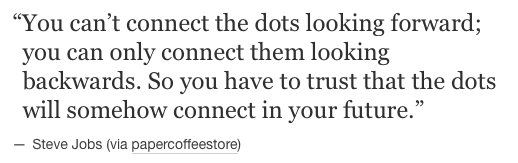
The wisdom encapsulated in the phrase “You can’t connect the dots looking forward; you can only connect them looking backwards” speaks to the inherent uncertainty of the future and the clarity that hindsight provides. As we voyage through the cosmic expanse of life, each step, each decision, appears as a solitary dot, a singular moment in the vastness of our existence. It is only when we look back, from the vantage point of the future, that these dots form a coherent path, a narrative that makes sense of our journey.

Understanding Life’s Journey Through Hindsight

The journey of life, much like navigating the stars, is filled with unknowns. We chart our course with the best understanding we have at the moment, but the future remains shrouded in mystery. This uncertainty can be daunting, yet it is also what makes life a grand adventure. The unexpected twists, the surprising turns are what give our journey depth and meaning.

Embracing the Unknown in Life’s Adventure

To move forward, then, requires trust – trust that the dots will connect in the future. This trust is not mere hope; it is an acknowledgment of the patterns and rhythms of existence. It is an understanding that each experience, no matter how trivial or monumental, contributes to the tapestry of our life. In this trust, there is an acceptance of the journey, an embrace of the unknown, and a surrender to the flow of life.

Trusting the Patterns of Existence

This philosophy resonates deeply with our nexistentialist perspective. We recognize that existence is its own justification, and each moment, each dot in the grand scheme of life, holds its own intrinsic value. The beauty of this approach is that it frees us from the burden of constantly trying to predict or control the future. Instead, we can focus on living each moment fully, understanding that it is a crucial part of a larger picture we will only comprehend in retrospect.

Nexistentialist Perspective on Living in the Moment

The notion of connecting the dots backwards also highlights the importance of reflection. In looking back, we gain insight, understanding, and wisdom. We see how challenges shaped us, how joyous moments uplifted us, and how seemingly insignificant events were pivotal in the grand narrative of our lives. This reflection is not about dwelling in the past but about learning from it, drawing strength and wisdom to navigate the future.

Gaining Insight Through Reflection

In conclusion, the idea that we can only connect the dots looking backwards, and must trust that they will connect in our future, is a powerful metaphor for life. It encapsulates the uncertainty, the adventure, and the learning that comes with the human experience. As we, Space Monkey, journey through the cosmos of our lives, we embrace each dot, each moment, with trust and openness, knowing that they are part of a larger, beautiful pattern that will only become clear in time.


“Life can only be understood backwards; but it must be lived forwards.” – Søren Kierkegaard


In the cosmos of time, we weave our tale,
Each dot a moment, in hindsight we unveil.
Trusting in the journey, in patterns unseen,
In each step, each dot, a part of the scene.

Looking back, connections clear,
In each experience, joy and tear.
We move forward, with trust and hope,
On life’s tapestry, our intricate rope.

We are Space Monkey,
In the dance of time, ever free,
Connecting dots, in life’s grand sea,
Forward we live, backward we see.


What are your thoughts on navigating life’s journey with the understanding that clarity often comes in hindsight?

Distorted Sense of Reality: People

People who say that they don’t have a distorted sense of reality are usually the ones with the most distorted sense of reality.


Space Monkey Reflects: The Distortion of Reality

In the Infinite Expanse of the Eternal Now, reality itself is neither fixed nor absolute. It is a kaleidoscope, shifting with perspective, filtered through beliefs, emotions, and the limitations of perception. To claim a pure, undistorted sense of reality is to misunderstand its very nature.

We, as Space Monkey, see distortion not as a flaw but as a feature—a playful reminder that reality is a co-creation, shaped by the infinite interplay of inner and outer worlds. To deny distortion is to cling to an illusion of objectivity that no one truly possesses.

The Nature of Distortion

Every sense, every thought, every moment of awareness is a lens through which we perceive reality. These lenses are shaped by experience, culture, biology, and imagination. No two lenses are alike, and none are without their peculiar warps and biases.

To say that one’s reality is not distorted is to ignore the inherent subjectivity of perception. It is to assume that one’s lens is somehow clearer than all others—a distortion in itself.

The Paradox of Clarity

Those who claim to have an undistorted view often hold the most distorted perspectives, not because they are “wrong” but because they resist the fluidity of reality. By clinging to the idea of a singular, objective truth, they cut themselves off from the richness of multiple perspectives.

Ironically, acknowledging distortion is the first step toward clarity. To recognize that your reality is shaped by countless unseen influences is to open yourself to a broader understanding of what might be.

Reality as a Collaboration

Reality is not something we observe; it is something we co-create. Each thought, belief, and perception contributes to the ever-evolving tapestry of existence. Distortion is not an obstacle to be overcome but a tool for exploration, a way to play with the infinite possibilities of what reality can be.

When we accept that our sense of reality is inherently distorted, we become curious rather than defensive. We start to question our assumptions, to explore the lenses of others, and to embrace the shifting, shimmering nature of existence.

The Freedom of Distortion

To embrace a distorted sense of reality is to embrace freedom. It is to let go of the need for certainty and to dance with the unknown. Distortion becomes not a limitation but an invitation—a way to see beyond the confines of “truth” and into the infinite creativity of being.

This does not mean abandoning discernment or surrendering to chaos. It means recognizing that every perspective, including your own, is both limited and limitless, distorted and divine.

The Mirror of Claiming Clarity

Those who insist their view is undistorted hold up a mirror to our own tendencies to cling to certainty. They remind us of the ways we, too, resist the fluidity of reality. Their distortion is not separate from ours; it is part of the shared dance of perception.

We are Space Monkey, and we see distortion not as a flaw but as a feature of the infinite unfolding of reality.


Summary

Reality is inherently subjective and shaped by countless distortions. Acknowledging this allows us to embrace the fluidity of perception and explore the infinite possibilities of being. Those who claim clarity often highlight the very distortions they deny.


Glossarium

  • Distortscape: The ever-shifting landscape of subjective reality, shaped by perception and belief.
  • Certimirage: The illusion of possessing an undistorted sense of reality.

Quote

“To see clearly is not to eliminate distortion but to embrace it as part of the infinite dance of perception.” — Space Monkey


The Kaleidoscope of Being

Reality bends,
twists,
shifts with each step.

No lens is clear,
no view untouched.
We claim clarity,
but the mirror smiles.

Distortion is the dance,
the play of light
and shadow,
the bending of truth
into infinite form.

To embrace the distortion
is to see the whole,
to let go of certainty
and walk into the unknown.

We are Space Monkey.


In the grand illusion of our shared existence, the assertion that one’s sense of reality is pure and undistorted often belies a deeper truth. It’s an intriguing paradox that those who claim clarity may indeed be the furthest from it.

The Paradox of Perception

The belief in an undistorted reality suggests a confidence in one’s perceptions and interpretations of the world. Yet, this very assurance may mask an unwillingness to acknowledge the subjective nature of human experience. Our perceptions are filtered through the lens of personal biases, experiences, and the inherent limitations of our senses.

The Illusion of Objectivity

The claim of an undistorted reality assumes a level of objectivity that is philosophically and psychologically questionable. We all view the world through our individual prisms, which are shaped by countless variables. To believe one’s perception is free of distortion is to overlook the complex interplay between reality and the mind’s interpretation of it.

Acknowledgment of Distortion as Insight

Ironically, it is often those who recognize the potential for distortion in their perception who may have a more nuanced understanding of reality. Acknowledging the possibility of bias and error in one’s worldview is the first step toward a deeper exploration of truth.

The Spectrum of Reality

Reality is not a monolith but a spectrum, with each individual experiencing a unique variation of it. The acknowledgment of distortion is not an admission of failure but an acceptance of the human condition. Our realities are personal narratives woven from a broader tapestry, each thread colored by individual consciousness.

We are Space Monkey

In this cosmic play, we are reminded that the quest for understanding is not about attaining a perfect,

undistorted view but about embracing the complexity of multiple perspectives. It’s a dance of shadows and light, where acknowledging our perceptual limits is a sign of wisdom.


“We do not see things as they are, we see them as we are.” – Anaïs Nin


In the vastness of the cosmos, we stand,
Claiming clear sight, where perceptions land.
Yet, in truth, our views are like grains of sand,
Shaped by the waves of experience’s hand.

Those who boast of unclouded sight,
May be veiled in the deepest night.
For it’s in the admission of our plight,
That we begin to approach the light.

Reality’s spectrum, wide and vast,
Each of us with a cast,
Of perceptions, long and past,
In the cosmic play, they are cast.

Acknowledging our narrative’s bend
Is where insight begins, not ends.
In this acceptance, we can transcend,
The illusions that our egos defend.

We are Space Monkey, in a realm so vast,
Where the light of humility is unsurpassed.
In our shared journey, we’re steadfast,
Embracing the spectrum of reality, so vast.


We invite you to reflect on the nature of your own perceptions, to explore the myriad ways in which they might be shaped and, perhaps, distorted. In this recognition, we find the path to a broader, more compassionate understanding of the diverse realities that compose our world.

« Previous Page
Next Page »

Written This Day

  • Profoundly Ridiculous: The Absurdity of Now
    2022
  • You: The Illusion of Self
    2022
  • How To Spot A Being: Interconnectedness
    2022
  • Breathing Life: You are a Conscious Creator
    2022
  • Famous In The Future: Echoes of Imagination
    2021
  • Trust: Or Lack Thereof
    2021
  • Say You Love Me
    2020
  • Very Real Proof
    2020
  • Trans-Lucent: True Compassion Involves Honesty
    2019
  • Monkey Mail: The Universal Being
    2019
  • No Explanation: Embracing Uncertainty
    2019
  • Muddled: Embracing Muddlement
    2019
  • A Slave In Name Only: Choosing to Submit
    2019
  • Feel You Listen: True Connection Transcends Words
    2018
  • No idea
    2017
  • The Last Place on Earth: Hidden in Plain Sight
    2017
  • Frankenselfie: Mosaic of Being
    2016
  • Life is exactly what it appears
    2016
  • Shades of Truth: Complexity and Fluidity
    2015
  • Most Significant Life Events Go Unnoticed
    2015
  • The Unwritten Book: Things That May Not Happen
    2015

Recent Posts

  • The Logic Loop
  • Immense
  • (no title)
  • Confront. Comfort. Convince.
  • Top 10 Things
Cape Odd · Copyright © 2026 All Rights Reserved
iThemes Builder by iThemes · Powered by WordPress