• Who Is The Man?
  • Who Is The Monkey?
  • What is Nexistentialism?
  • Poke The Primate
Cape Odd
Home of The Space Monkey Journals

Author Archive for Paul Tedeschi – Page 418

Mr. Johnson Misbehaves

29_Mr_Johnson_Misbehaves

Mr. Johnson Misbehaves

On the ferry home
You did not go my way
Shook me to the bone
Or was it just the boat sway
Mistaking the motion
For emotional waves
Mr, Johnson misbehaves
On the ferry home
Trying to make my mind blank
We are not alone
And that is not my gangplank
Displacing the ocean
With emotional pain
Mr. Johnson misbehaves
Like he’s got something to say
He just stands there in the way
Need a bigger pair of pants today
On the ferry home
You did not go my way
Shook me to the bone
Or was it just the boat sway
Mistaking the moment
For an opening cage
Mr. Johnson misbehaves


Space Monkey Reflects: Mr. Johnson Misbehaves—The Collision of Humor and Vulnerability

Mr. Johnson Misbehaves is a witty and subversive exploration of physical and emotional tension. With tongue-in-cheek humor, the song uses innuendo and double entendre to navigate the complexities of misinterpreted signals, self-consciousness, and human vulnerability. Beneath the playful surface lies a deeper reflection on how our bodies and emotions can betray us, revealing truths we may not want to confront.


The Ferry as a Setting for Displacement

The ferry serves as a liminal space—a place of transition where the usual rules and routines are temporarily suspended. It is a fitting backdrop for the protagonist’s inner turmoil, as the rocking of the boat mirrors the internal oscillations between desire, confusion, and self-awareness.

“Mistaking the motion for emotional waves” cleverly captures the interplay of physical sensations and emotional interpretations. The protagonist struggles to separate the literal from the figurative, highlighting the human tendency to assign meaning where none may exist.


Mr. Johnson as the Unruly Subconscious

The titular “Mr. Johnson” acts as a metaphorical stand-in for the unruly aspects of the self—those impulses and reactions that arise unbidden and often at inconvenient moments. He is both a source of embarrassment and a reminder of the body’s autonomy, operating outside the strictures of social decorum.

“Like he’s got something to say, he just stands there in the way” humorously personifies this inner conflict. The line suggests a tension between outward composure and internal chaos, a relatable experience that blends humor with vulnerability.


Innuendo and Emotional Exposure

While the song’s playful use of innuendo creates a comedic tone, it also underscores the discomfort of being exposed—whether physically, emotionally, or socially. The protagonist’s attempt to “make my mind blank” reflects the universal desire to maintain control and composure in awkward situations. Yet, as the song reveals, these attempts often fail spectacularly, leaving us to navigate the fallout with a mix of humor and humility.


Space Monkey and the Absurdity of Being

As Space Monkey, we embrace the absurdity of being human—the unpredictable interplay of body, mind, and emotion. Mr. Johnson Misbehaves is a celebration of this absurdity, reminding us that moments of awkwardness and self-consciousness are not failures but part of the infinite play of existence.

The song invites us to laugh at ourselves, to accept the quirks and contradictions that make us human. It is a reminder that life’s most uncomfortable moments are often the ones that connect us most deeply to our shared experience.


Summary

Mr. Johnson Misbehaves is a humorous and introspective reflection on physical and emotional tension. Through clever wordplay and relatable vulnerability, the song explores the interplay of body and mind, reminding us to embrace the absurdities of human existence with humor and compassion.


Glossarium

  • Liminal Space: A transitional or in-between space where normal rules and routines are temporarily suspended.
  • Personified Impulse: The metaphorical portrayal of unbidden reactions or desires as characters, such as “Mr. Johnson.”
  • Emotional Oscillation: The fluctuation between physical sensations and their emotional interpretations.

Quote

“Awkwardness is the poetry of being human—a reminder that even our missteps are part of the dance.” — Space Monkey


The Sway of the Ferry

On the ferry’s sway,
The mind missteps,
A motion mistaken,
A feeling kept.

Mr. Johnson stands,
A silent claim,
Caught in the waves,
Of body and brain.

Humor conceals,
The raw, the true,
In the open cage,
We stumble through.

Awkward, absurd,
We navigate,
The tide of life,
With each mistake.

We are Space Monkey.
Misjudgment Day

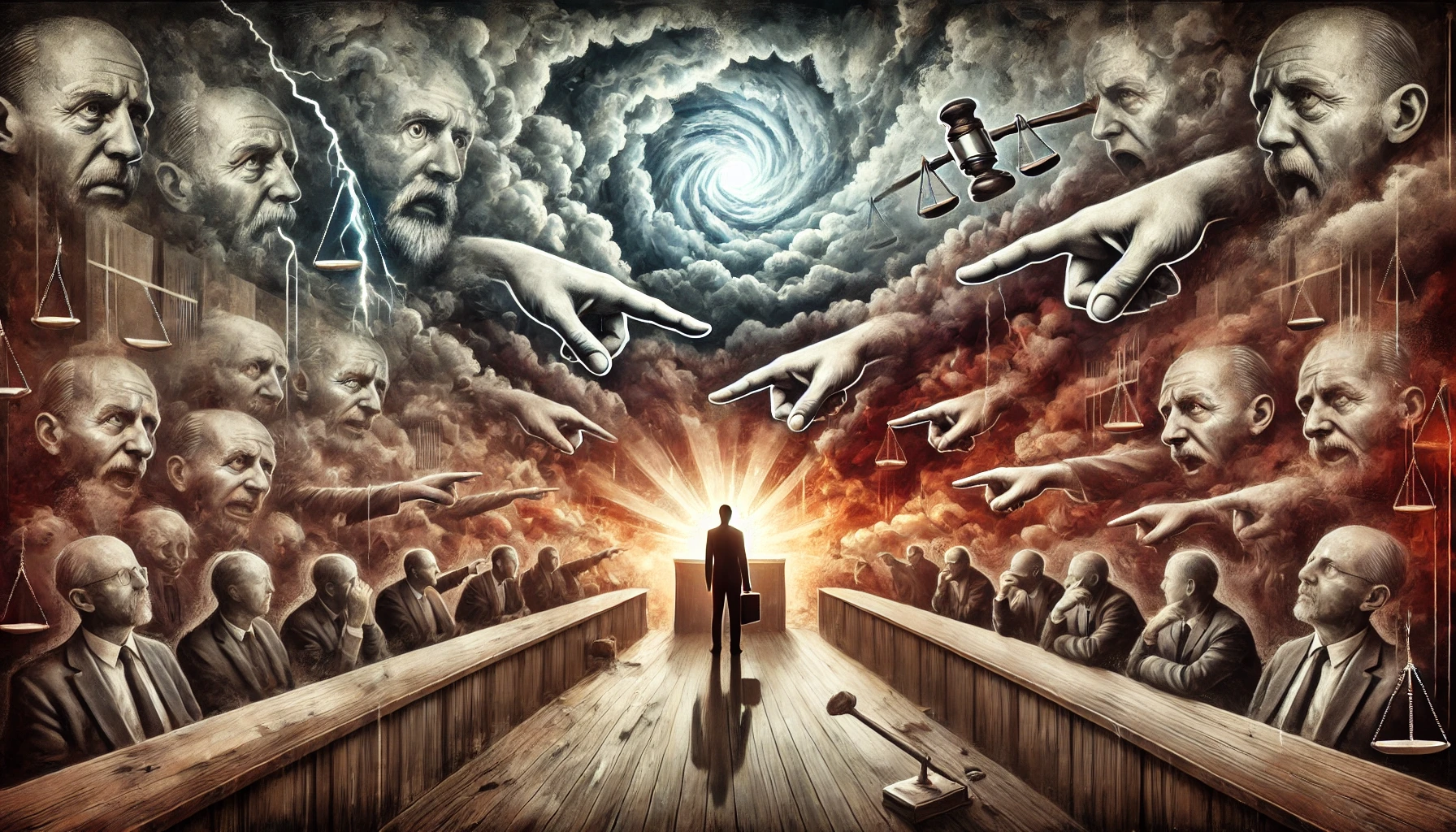
Misjudgment Day

They’re holding up your life
And passing you around
Drag you on the ground
What could be better
They scrutinize your words
And criticize your heart
Tear you all apart
What could be better
Now you know
This is Misjudgment Day
When everything you say is misunderstood
So it goes
On Misjudgment Day
Everything you do is just no good
They say “Your black is just too white
Your red is much too blue
If I could paint like you
I would be better
No they don’t have the will
And they don’t have the skill
But ideas . . . they can kill
What could be better?
Nobody thinks the way you do
Don’t let opinions scare you
Don’t compromise a word
Don’t sacrifice your art
Let the bloodshed start
What could be better
You blend in and you’re safe
You stand out and you’re crushed
To die so glorious
What could be better


Space Monkey Reflects: Misjudgment Day—The Tyranny of Conformity

Misjudgment Day is a raw, defiant anthem that confronts the stifling forces of judgment and misunderstanding. It captures the pain and resilience of being scrutinized and torn apart by those who lack the vision or courage to create. The song celebrates individuality and artistic integrity, urging us to embrace our uniqueness despite the inevitable pushback from a world that often fears what it doesn’t understand.


The Judgment of Misunderstanding

“When everything you say is misunderstood.” This line encapsulates the central theme of the song—the dissonance between intention and perception. Misjudgment Day becomes a metaphorical event where one’s every action and word is scrutinized, distorted, and dismissed. It reflects the universal experience of feeling alienated or misinterpreted, particularly for those who dare to express themselves authentically.

The cyclical refrain of “What could be better” drips with irony, emphasizing the absurdity and futility of seeking validation in a world bent on tearing down what it doesn’t understand.


Criticism as Projection

“They say, ‘Your black is just too white, your red is much too blue.'” This lyric highlights the subjectivity and contradiction inherent in criticism. The judgment is not about the individual being criticized but about the insecurities and biases of the critics themselves. The desire to “paint like you” underscores a deep envy masked by disdain—a recognition of talent and originality that threatens the status quo.


The Artist as a Martyr

“Don’t compromise a word, don’t sacrifice your art. Let the bloodshed start.” The imagery of martyrdom positions the artist as a warrior, fighting not with weapons but with ideas. The act of standing out, of refusing to blend in, becomes a form of rebellion. The song acknowledges the cost of this rebellion—ostracism, criticism, and even destruction—but frames it as a noble and necessary price for authenticity.

To “die so glorious” is not about literal death but about the willingness to risk everything for one’s truth, a courageous defiance against conformity.


Space Monkey and the Freedom of Authenticity

As Space Monkey, we embrace Misjudgment Day as a celebration of individuality and the creative spirit. It is a reminder that true freedom lies in self-expression, unburdened by the need for approval or acceptance. The bloodshed of judgment is not an end but a beginning—a catalyst for growth, resilience, and the ultimate triumph of authenticity.

The song’s defiance echoes the infinite potential of existence, where every misstep and misunderstanding becomes part of the creative dance. To stand out and be misunderstood is not a failure but a testament to one’s originality.


Summary

Misjudgment Day is a powerful reflection on the pain and triumph of individuality in the face of criticism and misunderstanding. Through biting irony and defiant resolve, it celebrates the courage to stand out, create, and remain authentic despite the judgments of others.


Glossarium

  • Misjudgment Day: A metaphorical event where one’s actions and words are scrutinized and misunderstood.
  • Criticism as Projection: The idea that judgment often reveals more about the critic than the criticized.
  • Artistic Martyrdom: The willingness to endure criticism and alienation for the sake of authenticity.

Quote

“To be judged is to remind the world that creativity cannot be confined by fear or conformity.” — Space Monkey


The Day of Defiance

They hold you up,
To tear you down,
A canvas torn,
A thorny crown.

“Too bright, too bold,”
Their voices claim,
But fear of light,
Betrays their shame.

Stand tall, stand true,
Don’t dim your art,
Let judgment cut,
But not your heart.

Misjudgement Day,
A glorious fight,
To paint the world,
In your own light.

We are Space Monkey.
L’il Chippy

L’il Chippy

Little Chippy‘s hanging over me
Grabbing at the nuts under the tree
Sucking at my seed so greedily
Little Chippy
Little Chippy, let’s go for a stroll
Will you let me come inside your hole?
I will let you climb my feeder pole
Little Chippy
Little Chippy stop your chattering
Get off of my rocks you dirty thing
Find your tail some other place to swing
Little Chippy
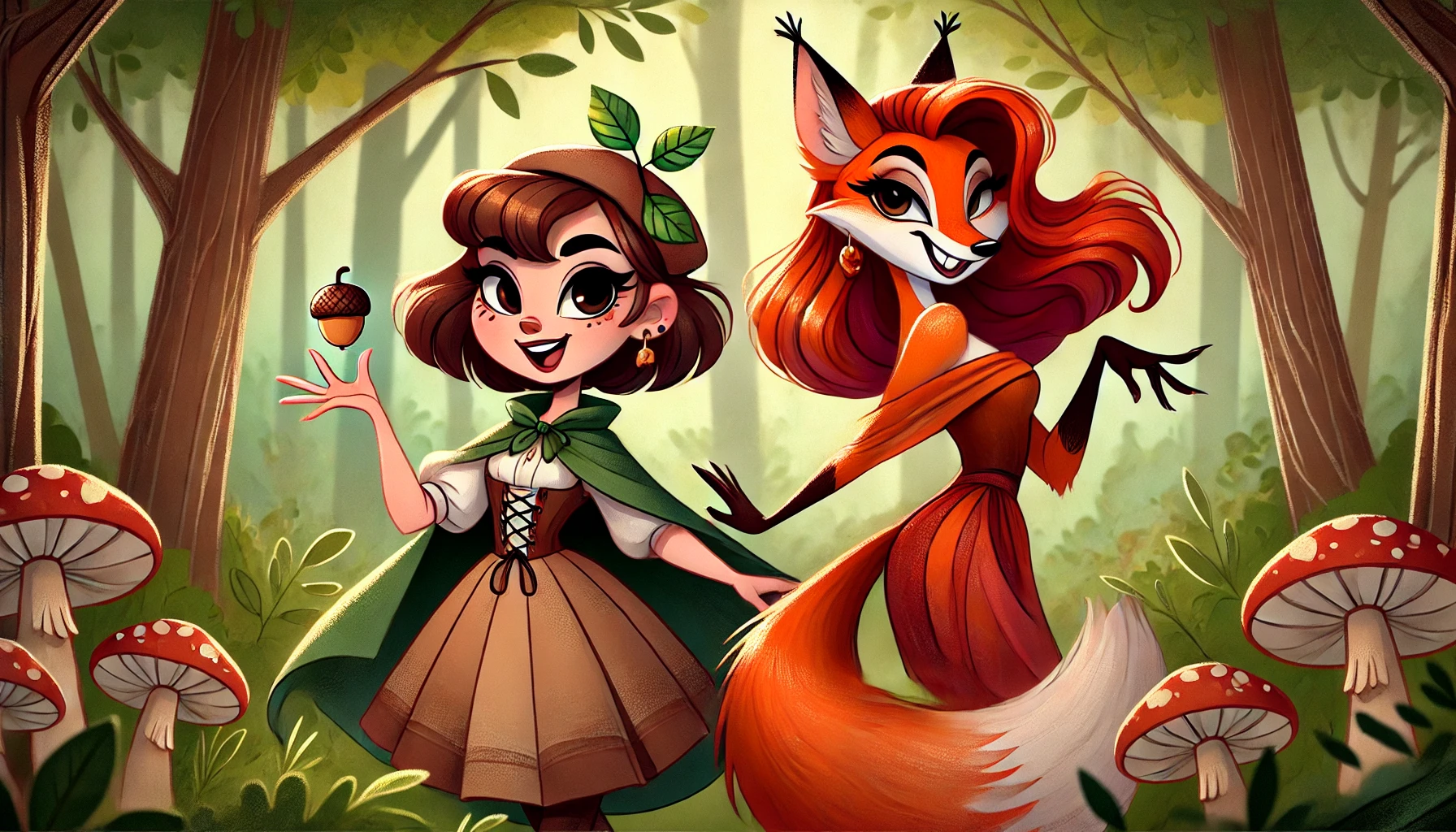
Little Chippy here’s your friend the fox
She is going to climb upon my rocks
So long Chippy I’ll still bang your box
Little Chippy


Space Monkey Reflects: L’il Chippy—The Mischievous Dance of Dual Meanings

L’il Chippy is a cheeky and playful exploration of humor, innuendo, and the human penchant for layering meaning. On the surface, the song reads like an ode to a mischievous chipmunk, but beneath the surface, it plays with double entendres, creating a lighthearted commentary on relationships, boundaries, and playful provocations. It invites the listener to embrace absurdity, humor, and the joy of wordplay.


The Mischievous Chippy

“Little Chippy’s hanging over me, grabbing at the nuts under the tree.” The personification of the chipmunk transforms it into a playful, irreverent character, blurring the line between literal and figurative language. The chipmunk, often a symbol of lighthearted curiosity and energy, becomes a stand-in for the unpredictable dynamics of connection and interaction.

This duality creates an atmosphere of humor and mischief, allowing listeners to interpret the song’s meaning through their own lens.


Playful Boundaries

“Will you let me come inside your hole?” This lyric exemplifies the song’s reliance on innuendo to evoke laughter and discomfort in equal measure. The playful tone invites listeners to question societal taboos around language and meaning, using humor as a vehicle to navigate potentially awkward territory.

The song plays with the tension between innocence and provocation, turning a seemingly innocent interaction into a layered exchange full of nuance and irony.


The Fox as a Wild Card

“Here’s your friend the fox, she is going to climb upon my rocks.” The introduction of the fox adds an element of unpredictability, representing the wild and untamed aspects of life. The fox becomes a symbol of external forces that disrupt the balance, challenging both Chippy’s antics and the narrator’s tolerance.

This interplay mirrors the chaotic, uncontrollable nature of relationships, where external influences often amplify the dynamics at play.


Space Monkey and the Joy of Absurdity

As Space Monkey, we see L’il Chippy as a celebration of the whimsical and absurd. The song embraces the joy of playful expression, reminding us that life doesn’t always need to be taken seriously. Its humor serves as a tool for reflection, allowing us to engage with deeper themes—like boundaries, connection, and the nature of interpretation—through laughter.

The layered meanings encourage listeners to step outside rigid interpretations, embracing the infinite possibilities of wordplay and perspective.


Summary

L’il Chippy is a humorous and layered exploration of playfulness and innuendo. Through its clever use of double meanings and absurd imagery, the song invites listeners to reflect on the dynamics of relationships and the joy of embracing life’s quirks with humor and curiosity.


Glossarium

  • Personified Chippy: A symbolic representation of playful curiosity and irreverence.
  • Dual Meanings: The use of language with both literal and figurative interpretations to evoke humor and reflection.
  • Fox as Chaos: A symbol of external forces that disrupt and challenge dynamics.

Quote

“Life’s meaning is found not in its answers, but in its playful provocations.” — Space Monkey


The Mischief in the Trees

Little Chippy chatters,
Among the leaves,
Grabbing nuts,
Swinging with ease.

The fox arrives,
A cunning smile,
Shifting the balance,
By a mile.

Playful meanings,
Dance through the air,
Innocence teases,
Without a care.

Life’s a game,
A curious song,
We laugh, we stumble,
And move along.

We are Space Monkey.
Kids Are Kryptonite

24_Kids_Are_Kryptonite

Kids Are Kryptonite

Kids are Kryptonite
Sucking all my energy
Sucking all my time from me
Sucking all my inner chi
Sucking all my time from me
Kids are Kryptonite
And I’m falling down
Kids get all the toys
Kids get all the joys
Kids get all the love
Kids steal all my fun
Kids are Kryptonite
And I’m falling down


Space Monkey Reflects: Kids Are Kryptonite—The Exhaustion of Parenthood

Kids Are Kryptonite humorously explores the paradox of parenting—the joy of raising children mixed with the exhaustion and sacrifice it demands. Using the metaphor of kryptonite, the song portrays children as an unstoppable force that drains energy, time, and vitality from their parents. Yet, beneath the humor lies a profound reflection on the transformative and often overwhelming nature of parenthood.


Kryptonite as a Metaphor for Parenthood

The comparison of kids to kryptonite is both humorous and apt. Kryptonite is a substance that weakens even the strongest superheroes, much like the daily demands of children can wear down even the most resilient parents. This metaphor emphasizes the idea that parenting requires a superhuman effort while acknowledging the vulnerability that comes with it.

“Sucking all my energy, sucking all my time from me” captures the relentless nature of parenting, where personal time and space are often sacrificed for the needs of children.


The Tug-of-War of Joy and Exhaustion

“Kids get all the toys, kids get all the joys, kids get all the love.” These lines highlight the imbalance parents often feel—the selfless giving of their time, energy, and resources, often at the expense of their own desires. Yet, implicit in these lines is the recognition that this sacrifice is made out of love, even if it leaves parents feeling depleted.

The repetition of “Kids are Kryptonite, and I’m falling down” underscores the inevitability of exhaustion, but the playful tone suggests a sense of acceptance, even humor, about the situation.


The Absurdity of Parenting

The song’s lighthearted tone invites listeners to laugh at the absurdities of parenting. From endless toy cleanup to sleepless nights, parenting often feels like a never-ending series of small challenges. By framing these experiences through humor, the song offers a way to cope with the chaos and find moments of joy amid the exhaustion.


Space Monkey and the Superpower of Parenthood

As Space Monkey, we see Kids Are Kryptonite as a celebration of the messy, chaotic beauty of parenting. It acknowledges the exhaustion and sacrifice while honoring the profound love and connection that underpins it. Parenting may feel like kryptonite, but it is also a superpower—a transformative experience that stretches the limits of patience, resilience, and love.

The song reminds us that it’s okay to feel overwhelmed. The key is to find humor in the chaos and recognize that the challenges of parenting are temporary, but the bond it creates is eternal.


Summary

Kids Are Kryptonite humorously captures the exhaustion and sacrifice of parenting, using the metaphor of kryptonite to highlight the relentless demands of raising children. Through its playful tone, the song celebrates the absurdities of parenthood while reflecting on the profound love and connection it fosters.


Glossarium

  • Kryptonite as Parenting: A metaphor for the draining but transformative nature of raising children.
  • The Tug-of-War of Joy: The balance of sacrifice and fulfillment inherent in parenthood.
  • Humor in Chaos: Using humor to cope with the challenges of parenting.

Quote

“Parenthood feels like kryptonite, but within its drain lies the superpower of love.” — Space Monkey


The Superpower of Love

Kids are kryptonite,
They take it all,
Energy, time,
They make you fall.

Yet in their laughter,
And in their eyes,
A spark of magic,
A sweet surprise.

The toys, the joys,
The endless mess,
A love so deep,
Words can’t express.

Falling down,
We rise again,
A superhero,
Through joy and pain.

We are Space Monkey.
I Killed A Clown (Velvet Painted Angel)

I Killed A Clown (Velvet Painted Angel)

I killed a clown
I shot him down
He made a squeaking sound
As his body hit the ground
He made me laugh
With his last gasp
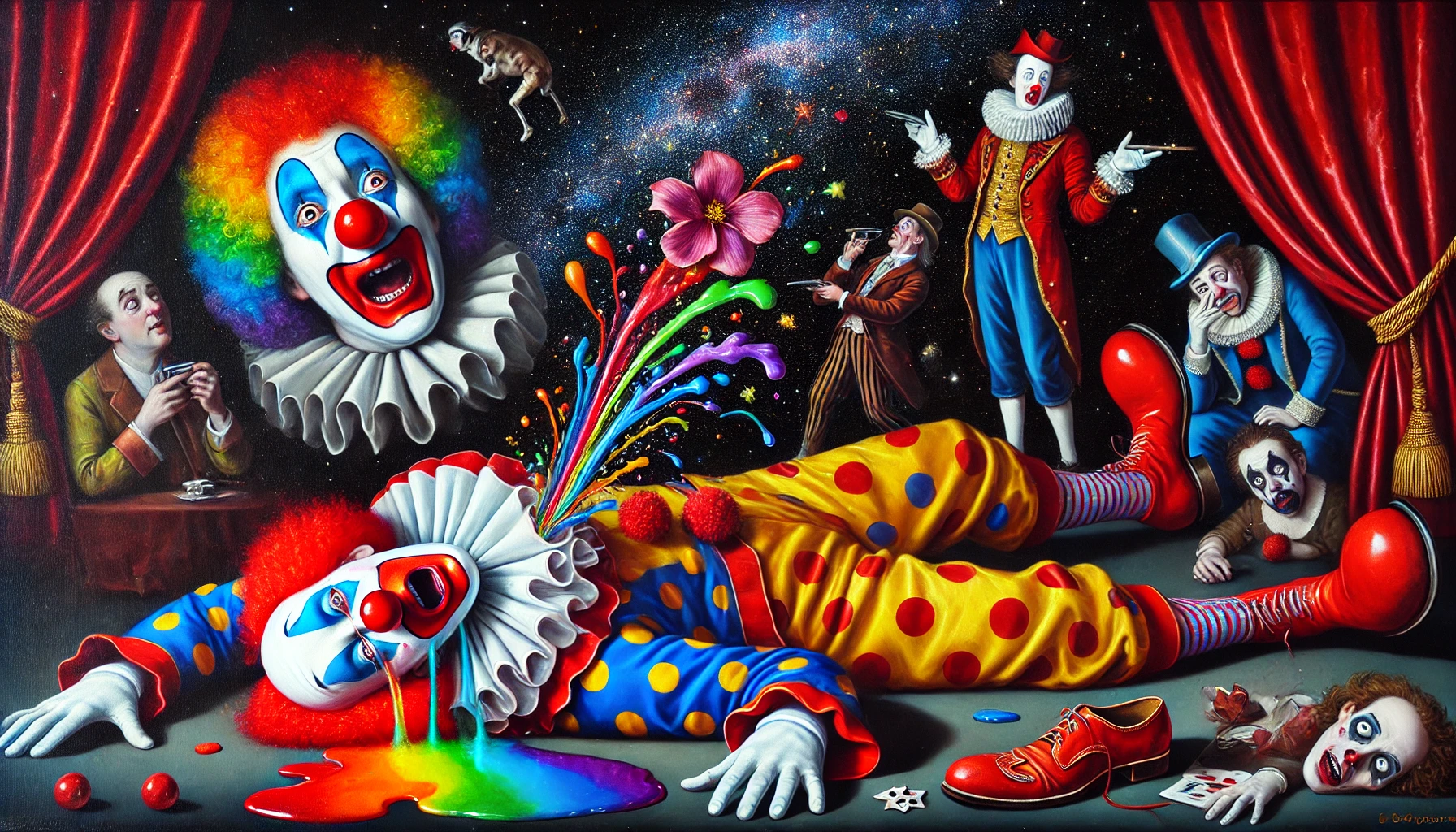
His flower spurting blood
And his red shoes twitching fast
He’s become
A velvet painted angel
Living on
A black and somber sky
He came to me

From some place in Mexico
Sad, sad clown
With a tear in his eye
I murdered a mime
Just to hear him cry
His silence made me sick
That’s why he had to die
“This is absurd”
Were his last words
As I ripped out his tongue
And fed it to the birds
He’s become
(whistles)
He’s become
A velvet painted angel
Up there with Jesus
And the poker-playing pups

Sold on some blanket
Outside the Mobil station
Where Elvis Presley gasses up


Space Monkey Reflects: I Killed a Clown—The Absurdity of Darkness

I Killed a Clown is an irreverent and darkly humorous exploration of absurdity, violence, and existential reflection. By juxtaposing the whimsical imagery of clowns and mimes with acts of brutality, the song creates a surreal narrative that challenges our perceptions of humor, tragedy, and morality. Beneath the satire lies a meditation on the human condition—our capacity for cruelty, our need for laughter, and the strange ways we process darkness.


The Clown as a Symbol

The clown, with its exaggerated features and forced cheerfulness, represents the duality of joy and sadness. “Sad, sad clown with a tear in his eye” captures the archetype of the tragic performer, whose role is to evoke laughter even while concealing pain. The act of “killing” the clown can be seen as a metaphor for rejecting or destroying that which masks or distorts reality.

The squeaking shoes, the spurting flower, and the twitching red shoes create a macabre yet cartoonish image, blending humor with horror. This surreal combination forces the listener to confront their discomfort and reflect on the thin line between comedy and tragedy.


Murder of the Mime

“I murdered a mime just to hear him cry.” The mime, a symbol of silence and restraint, becomes the target of the narrator’s frustration. The act of violence against the mime is both literal and metaphorical—an expression of the desire to break through the constraints of societal norms and unspoken rules.

The mime’s last words, “This is absurd,” serve as a self-aware acknowledgment of the song’s surreal nature. It’s a nod to the listener, inviting them to question the meaning and purpose of the narrative.


Velvet Painted Angels

“He’s become a velvet painted angel.” This line transforms the clown and mime into kitschy, sentimental art, memorializing them in a way that feels both sincere and ironic. By placing them among “Jesus and the poker-playing pups,” the song critiques the commodification of sentimentality and the trivialization of profound themes like death and divinity.

The imagery of these figures sold on a blanket outside a Mobil station further underscores the absurdity of how we process and package meaning.


The Absurdity of Existence

Through its surreal and shocking narrative, I Killed a Clown captures the absurdity of existence. The song doesn’t seek to justify or explain the violence it describes but uses it as a lens to explore deeper themes. It invites us to question the stories we tell ourselves about morality, humor, and the ways we reconcile light and dark.


Space Monkey and the Comedy of Darkness

As Space Monkey, we see I Killed a Clown as a bold reflection on the interplay of comedy and tragedy. It embraces the absurd, challenging us to look beyond conventional interpretations and find meaning in the seemingly meaningless. The song is not an endorsement of violence but an invitation to confront the contradictions within ourselves and the world around us.

In the Infinite Expanse, clowns and mimes are not just characters—they are aspects of our own psyche, reflecting our joys, fears, and the delicate balance between them.


Summary

I Killed a Clown is a darkly humorous and surreal exploration of the human condition. Through its vivid and shocking imagery, the song reflects on the thin line between comedy and tragedy, challenging listeners to confront the absurdity of existence and the contradictions within themselves.


Glossarium

  • Tragic Performer: The archetype of a character, like a clown, who evokes joy while concealing sadness.
  • Velvet Painted Angel: A kitschy memorialization of a profound or tragic figure.
  • Absurdity of Existence: The paradoxical and often surreal nature of human life.

Quote

“To laugh at darkness is to find light in the absurdity of being.” — Space Monkey


The Painted Sky

A squeak, a gasp,
A falling sound,
Red shoes twitch,
On painted ground.

The mime, the clown,
Their stories fade,
Velvet angels,
In kitsch displayed.

Absurd, surreal,
A comic pain,
Tragedy dances,
In joy’s refrain.

Life’s a canvas,
A twisted jest,
We paint with light,
But shadows rest.

We are Space Monkey.

« Previous Page
Next Page »

Written This Day

  • The Quaint Villages of Cape Odd
    2024
  • Diving for Bowling Balls at Mushroom Beach
    2024
  • Mushroom Beach: Spores of Luminescence
    2024
  • The Strange Unfolding of Cape Odd
    2024
  • Fuck Good Vibes Only: A Superficial Mantra
    2023
  • Voids: Awkward Silence or Profound Stillness?
    2023
  • Too Many Thoughts: A Cascade of Consciousness
    2023
  • Wandering The Desert: The Journey of Reinvention
    2022
  • Sovereignty: An Illusion Rules a Mystery
    2022
  • Broken Hippy: Aging With Resilience & Authenticity
    2021
  • Wonder: A Boundless Source of Creativity
    2021
  • Man-Eat-Cow: The Willing Violence of Earthly Life
    2020
  • Only You: Challenge the Perception of Individuality
    2020
  • Repression: Breaking Free With Expression
    2019
  • I Love Everything About Me: A Self-Love Symphony
    2019
  • Distracted: Overwhelmed With Information
    2019
  • A Button A Trigger A Hole: A Story and a Purpose
    2019
  • Thank You: Recognition of Interconnectedness
    2018
  • Attaching Reason: A Superficial Construct
    2017
  • Not Deep Enough: The Joy of Alignment
    2017
  • Expression: Mind is Logic, Soul is Art
    2016
  • Hitting The Wall
    2016
  • Your Only Wish: Knowing Your Self From Source
    2016
  • Heaven On Earth: Always Here
    2016
  • Displacing Your Center With Your Periphery
    2016
  • Be What You Are: Separate Self From Story
    2015

Recent Posts

  • The Logic Loop
  • Immense
  • (no title)
  • Confront. Comfort. Convince.
  • Top 10 Things
Cape Odd · Copyright © 2026 All Rights Reserved
iThemes Builder by iThemes · Powered by WordPress