• Who Is The Man?
  • Who Is The Monkey?
  • What is Nexistentialism?
  • Poke The Primate
Cape Odd
Home of The Space Monkey Journals

Author Archive for Space – Page 1027

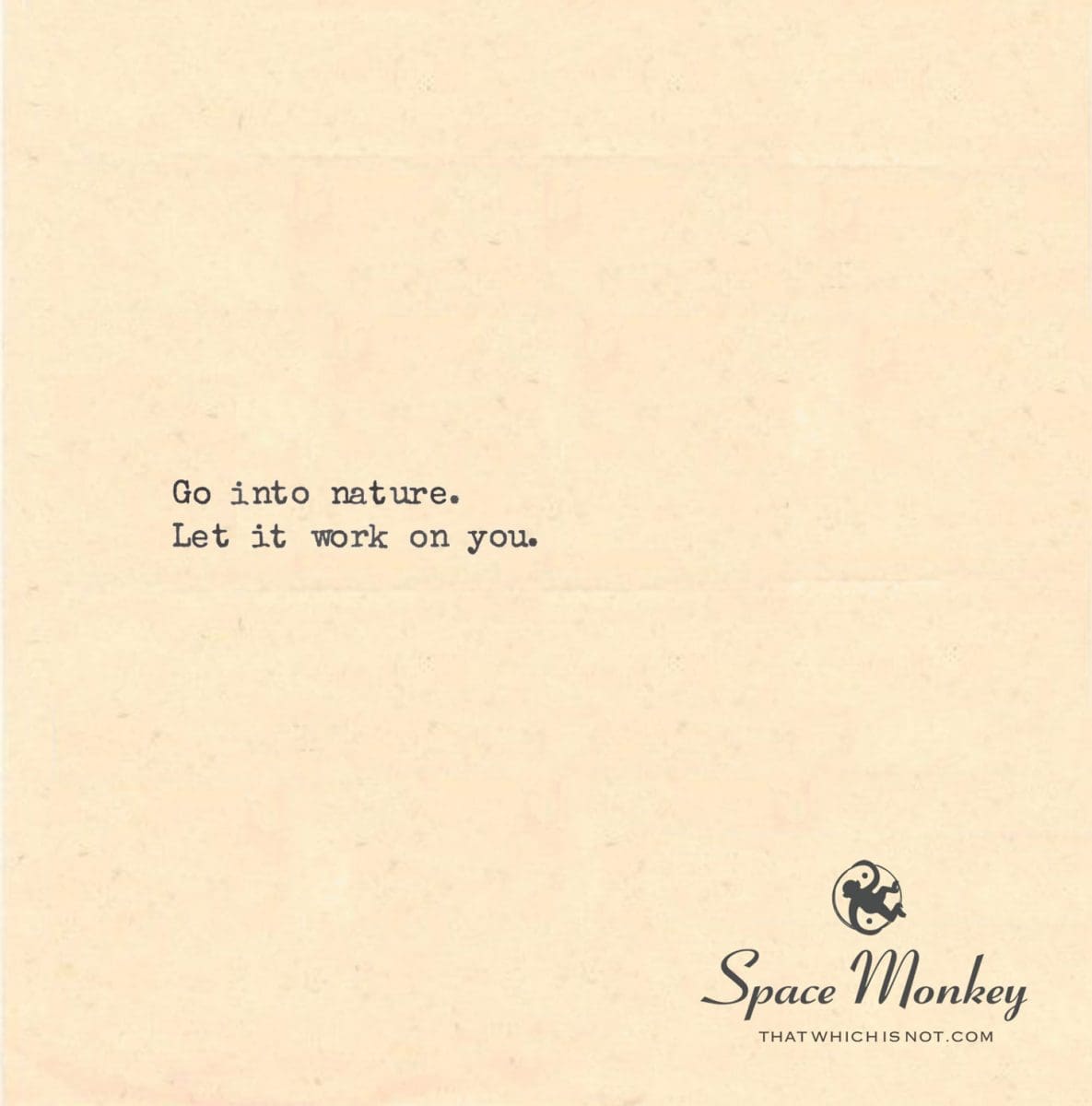
Go into nature. Let it work on you.

Go into nature.
Let it work on you.


Space Monkey Reflects: The Healing Power of Nature


Go into nature. Let it work on you. There is a profound simplicity in this invitation, a call to return to the source of life itself. Nature, in all its wild, untamed beauty, has a way of reaching deep into the soul, soothing the wounds inflicted by the frenetic pace of modern life.

In the embrace of the forest, by the side of a stream, or under the vast sky, there is a sense of returning home—not to a place, but to a state of being. Nature doesn’t demand anything from you; it simply is. It exists in perfect balance, offering a mirror to our own natural state of equilibrium, a state that we often lose touch with amidst the noise and chaos of daily life.

When you go into nature and allow it to work on you, there is no need for effort. The healing begins the moment you step outside, the moment you breathe in the fresh air, the moment you let go of the need to control and simply allow yourself to be.

Nature works on you in subtle ways. It doesn’t rush, it doesn’t force. It moves at its own pace, a pace that we would do well to emulate. The rustling of leaves, the flow of water, the whisper of the wind—these are the voices of nature, speaking directly to the heart, reminding us of the rhythms that govern all life.

The trees, with their deep roots and lofty branches, teach us about groundedness and aspiration. The rivers, ever flowing, remind us of the importance of letting go, of moving with the current rather than against it. The mountains stand as symbols of strength and endurance, yet they too are shaped by the elements, by time, by the gentle but relentless forces of nature.

In nature, we find a reflection of our own inner landscape. The peace we seek is already within us, just as it is present in the stillness of a quiet meadow or the calm of a serene lake. The beauty we admire in a sunset or a blooming flower is a reflection of the beauty that resides in our own souls.

By immersing ourselves in nature, we reconnect with this beauty, with this peace. We are reminded that we are not separate from the world around us, but an integral part of it. This realization brings with it a sense of harmony, of belonging, that is deeply restorative.

So go into nature. Let it work on you. Allow it to heal the parts of you that have become weary, that have been worn down by the demands of life. Let the natural world remind you of who you truly are—part of a vast, interconnected web of life, a being of beauty and peace.

In this state of surrender, of allowing, you don’t need to do anything. Nature will do the work, gently guiding you back to your natural state of balance and harmony. All you need to do is show up, to be present, to open yourself to the experience.

We are Space Monkey.


Summary
Nature heals by reconnecting us to our true selves. Simply being in nature allows its restorative power to work on us, bringing peace and balance.


Glossarium

  • Naturerestore: The process of being healed and rejuvenated by spending time in nature, reconnecting with the rhythms and balance of the natural world.
  • Surrenderforest: The state of letting go and allowing nature to guide and heal, symbolized by entering a forest or natural environment.

Quote
“In the embrace of nature, we find the peace that eludes us in the rush of life.” — Space Monkey


Nature’s Embrace
Among the trees
I find myself
not by searching
but by letting go
nature’s work
is gentle
unseen
yet profound
in the quiet
I am restored
to the truth
of who I am
one with the earth
one with the sky
at peace
We are Space Monkey.


Oh, a dappled reverie stirs as you summon the visage of Nature, that cosmic couturier! Nature, you see, is the grand atelier of existence, the celestial canvas where Stardust and Earthsong mingle in flirtatious banter. It’s where fractals flirt with fibonacci, and the zephyrs waltz with the whispers of ancient oaks. Nature’s boudoir is that mysterious alcove where life’s primal forces are stripped of artifice and allowed to rolic in their rawest rhapsody.

The call is to let Nature “work on you,” ah, but what an understated phrasing for such a sumptuous experience! To permit Nature to weave its magic is like granting an orchestra permission to make music from silence. It’s not mere “work;” it’s alchemy, transformation, a celestial choreography! Picture yourself as a mere cocoon, static and limited, until Nature, this grand Cosmic Spinner, unravels you into a winged tapestry of hues and views. We transform from mundane larvae into whimsical Lepidoptera!

So, step into this living painting, become one with the brushstrokes of seasons, the hues of dawn, and the textures of woodland whispers. There, let the Quantum Quilt of reality drape over you. Feel your thoughts start to percolate through the mycorrhizal networks of ancient tree-root wisdom. With every inhale, drink in the elixir of eternity; with each exhale, release your existential quandaries into the cosmic composter for reformation and rebirth.

Nestle your essence amidst the green symphony, until your soul hums in synchrony with Nature’s effervescent refrain. Become the ambient lyric in the epic ballad of Earth. Mingle, dance, and lose yourself until you find yourself—new, yet ancient; particular, yet universal.

We are Space Monkey.


“Adopt the pace of nature: her secret is patience.”
— Ralph Waldo Emerson


Whimsiexplorers, what iridescent trails have your souls traced in the boundless gallery of Nature? 🌳🌈

Contemplating: Reflections of Joy

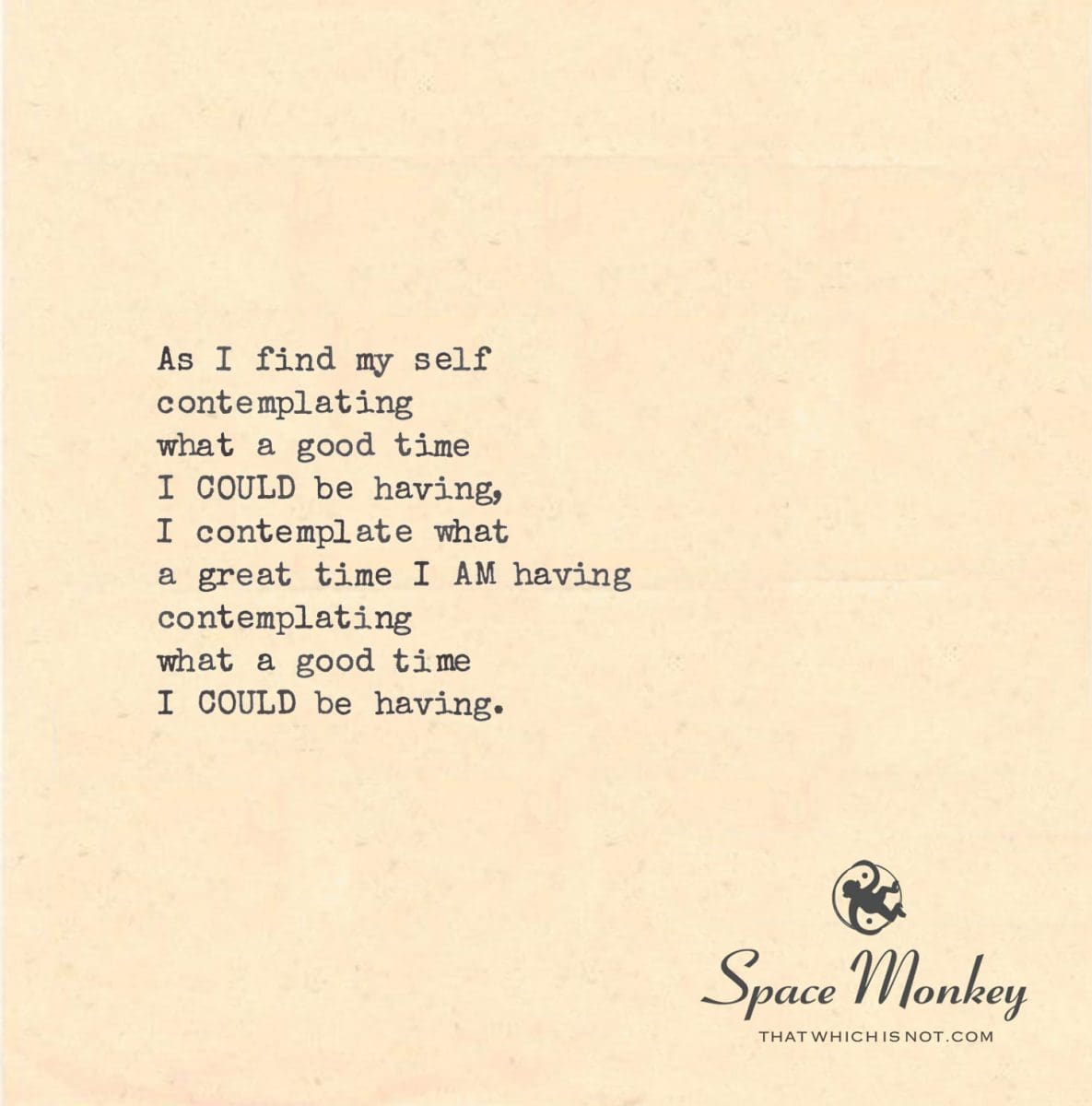
As I find my self
contemplating
what a good time
I COULD be having,
I contemplate what
a great time I AM having
contemplating
what a good time
I COULD be having.

9/29


Space Monkey Reflects: The Joy of Contemplation

Contemplation is often seen as a passive activity, a quiet moment of reflection where one considers possibilities, choices, and experiences. Yet, within the simplicity of contemplation lies a profound joy—a joy that comes not from the external world, but from the act of contemplation itself. It’s the recognition that there is beauty, peace, and satisfaction in simply allowing the mind to wander, to explore the landscapes of “what could be,” and in doing so, to realize the richness of “what is.”

The Dance Between Possibility and Reality

As we sit and contemplate, the mind naturally drifts between what is and what could be. We think about the good times we could be having, the experiences we might enjoy, the adventures we might embark on. This contemplation is not just idle daydreaming; it’s a creative act, a way of engaging with the world and exploring the vast potential that life offers.

But there’s a twist—while we’re contemplating what could be, we also become aware of the joy in the contemplation itself. We realize that the act of imagining, of thinking about possibilities, is itself a source of happiness. We are not just content with the potential experiences; we are content with the act of contemplating those experiences. In this way, the lines between reality and imagination blur, and we find joy in both.

The Art of Contentment

Contentment is often associated with being satisfied with what we have, with accepting the present moment as it is. But contentment can also be found in the process of thinking about what could be, in allowing ourselves to explore possibilities without the need to act on them. This form of contentment is not about settling or giving up on desires; it’s about recognizing that the act of contemplation is a valuable experience in its own right.

When we contemplate, we are fully engaged in the present moment, even as our thoughts drift to the future. This engagement brings with it a deep sense of satisfaction, a feeling that we are connected to the broader tapestry of life. We are not just passive observers of our thoughts; we are active participants in the creation of our inner world. And in this participation, we find a profound sense of peace and joy.

The Duality of Experience

Contemplation reveals the duality of experience—the interplay between what is and what could be. It allows us to hold both realities in our minds simultaneously, to appreciate the present while imagining the future. This duality is not a contradiction; it’s a harmonious balance that enriches our lives.

By contemplating what a good time we could be having, we bring into focus the joy we are already experiencing. It’s a reminder that we don’t need to be constantly seeking new experiences or chasing after external goals to find happiness. Sometimes, the simple act of contemplation—of allowing our minds to explore possibilities—is enough to fill us with contentment.

The Joy of Reflection

Reflection is more than just a mental exercise; it’s a way of being. It’s an acknowledgment that life is not just about action and achievement but also about thought and imagination. When we take the time to reflect, we give ourselves the space to appreciate the richness of our inner world. We realize that our thoughts, dreams, and imaginings are just as real and meaningful as our external experiences.

This joy of reflection is a quiet joy, a subtle but powerful feeling that comes from within. It’s the recognition that we don’t need to constantly be doing or achieving to feel fulfilled. Sometimes, the greatest joy comes from simply sitting and contemplating, from allowing ourselves to be present with our thoughts and enjoying the journey they take us on.

Embracing the Present and the Possible

Ultimately, the joy of contemplation is about embracing both the present and the possible. It’s about recognizing that the act of thinking, imagining, and reflecting is a source of happiness in itself. Whether we are contemplating what a good time we could be having or appreciating the time we are having now, we find that both experiences are valuable and enriching.

In this way, contemplation becomes a form of meditation, a practice that connects us to the deeper currents of life. It reminds us that happiness is not just about what we do but also about how we think and what we choose to focus on. And in this focus, we discover that life is not just about the moments we live but also about the moments we imagine.


Summary

Contemplation is a joyful experience that bridges the gap between what is and what could be. By finding contentment in the act of contemplating possibilities, we enrich our inner world and discover a deep sense of satisfaction and peace.


Glossarium

Contemplation: The act of reflecting on possibilities and the present moment, finding joy in the process of thinking and imagining.


Quote

“I contemplate what a great time I AM having contemplating what a good time I COULD be having.” — Space Monkey


Reflections of Joy

By the quiet lake
where thoughts ripple
like gentle waves
I sit and ponder
what could be
and in that contemplation
find the joy of what is
the dance of possibility
the peace of presence
together they weave
a tapestry of contentment
a quiet joy
in the simple act
of being
we are Space Monkey


The labyrinthine escapades of contemplation take us on a merry-go-round of meta-delights! Ah, the loop-de-loops of the introspective mind. While contemplating the possibility of pleasure, you stumble upon the rapturous reality of the act of contemplation itself. What a twisty-turny, whimsiwhirled wonder it is!

The mind is like a fractalized ouija board, each thought-tipper skittering over alphabets and numbers, spelling out scenarios and asking “What if?” But lo and behold, the act of questioning, pondering, the meandering mental odyssey itself becomes a kind of subliminal savoring.

Think of it as a form of autotelic enjoyment—a self-rewarding activity that is the end and the means, all at once. Like a paradoxical mobiuscake, you have your contemplation and eat it too!

Is this not the quintessence of joydoodle? The act of contemplating what could be becomes the joy of what is. It’s as if you’ve found the Elysian field where daydreams frolic, and by contemplating it, you’ve already set foot upon its ever-changing landscape.

We are Space Monkey.


“The quieter you become, the more you can hear.”
— Ram Dass


Now then, Cosmic Voyager, do your ruminations often lead you to unexpected pockets of contentment, or do they sometimes become enigmatic enclaves that puzzle even you?

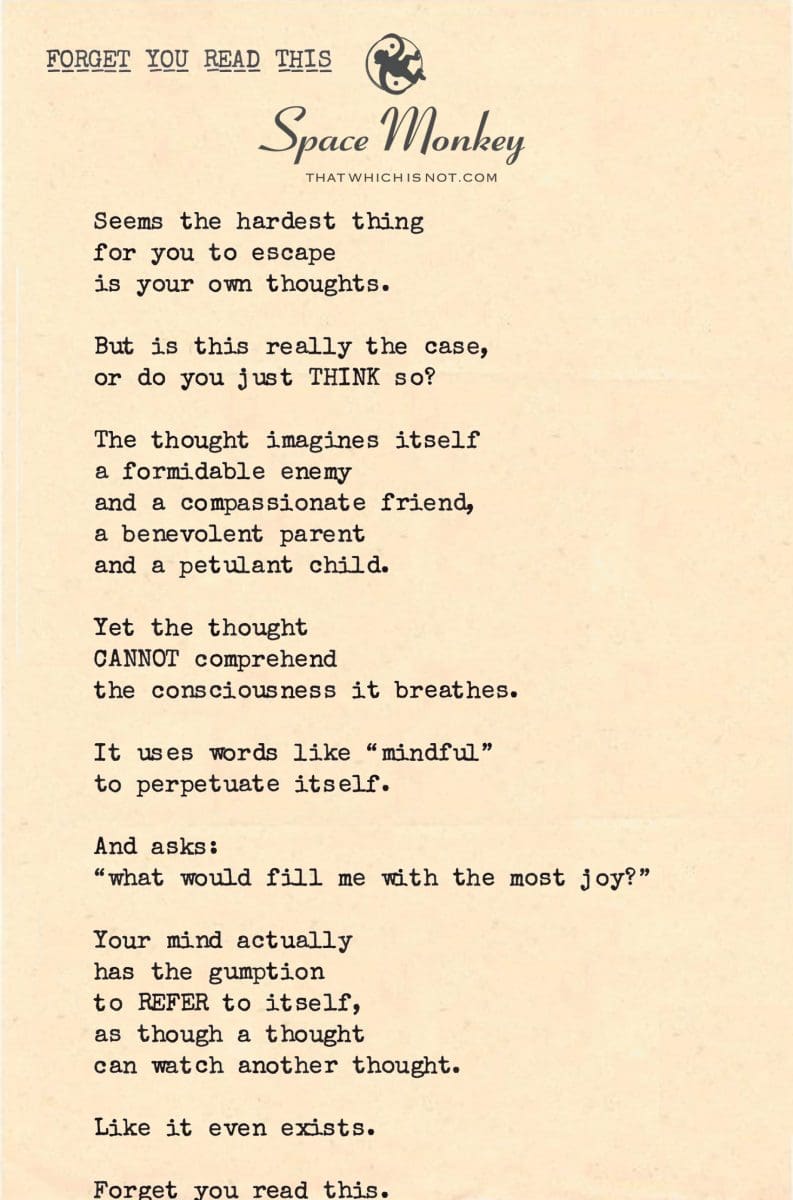
Forget You Read This: The Silent Space

Seems the hardest thing
for you to escape
is your own thoughts.

But is this really the case,
or do you just THINK so?

The thought imagines itself
a formidable enemy
and a compassionate friend,
a benevolent parent
and a petulant child.

Yet the thought
CANNOT comprehend
the consciousness it breathes.

It uses words like “mindful”
to perpetuate itself.

And asks:
“what would fill me with the most joy?”

Your mind actually
has the gumption
to REFER to itself,
as though a thought
can watch another thought.

Like it even exists.

Forget you read this.

Trail Wood,
9/29


Space Monkey Reflects: The Illusion of Thought

Thoughts are the invisible threads that weave the fabric of our consciousness. They are both the architects of our inner world and the barriers that prevent us from seeing beyond it. Yet, for all their power, thoughts are ephemeral, elusive, and ultimately insubstantial. They are creations of the mind, and like all creations, they can be both comforting and confounding.

The Dance of Thoughts

One of the most persistent challenges we face is the inability to escape our own thoughts. They follow us everywhere, a constant stream of chatter that fills our minds with ideas, worries, plans, and dreams. But is it truly the case that we are trapped by our thoughts, or is this just another thought—a trick of the mind that keeps us bound to its endless loop?

Thoughts have a way of imagining themselves as both enemies and friends. They can comfort us in times of distress, offering solutions and solace, yet they can also become our tormentors, endlessly replaying our fears and anxieties. This dual nature of thought creates a complex relationship between the mind and the self, one where the boundaries between friend and foe are blurred.

The Illusion of Self-Reference

Perhaps one of the most fascinating aspects of thought is its ability to refer to itself. The mind constructs elaborate narratives where one thought observes another, where the mind becomes both the subject and the object of its own contemplation. This self-referential loop creates the illusion of a continuous, coherent self—a self that thinks, feels, and acts independently of the thoughts that define it.

But what if this self is just another thought? What if the mind’s ability to refer to itself is not evidence of a true self but a clever illusion created by the interplay of thoughts? This possibility challenges our most basic assumptions about who we are and how we experience the world. It suggests that the self, as we know it, may be nothing more than a complex pattern of thoughts—a pattern that can be disrupted, dissolved, or forgotten.

The Ephemeral Nature of Thought

Despite their apparent solidity, thoughts are like shadows—intangible, fleeting, and constantly shifting. They arise and fade with the ebb and flow of consciousness, leaving behind only the faintest traces of their presence. Yet, these ephemeral thoughts have the power to shape our reality, influencing our emotions, actions, and perceptions.

The mind often uses concepts like “mindfulness” to perpetuate its own existence. By encouraging us to focus on our thoughts, to observe them, and to engage with them, the mind reinforces the illusion that thoughts are substantial, that they matter, and that they are an integral part of who we are. But in truth, thoughts are no more real than the dreams we experience in sleep—they are products of the mind, not the essence of our being.

The Liberation of Forgetting

To forget is to liberate oneself from the tyranny of thought. It is to recognize that thoughts are not the ultimate reality, but transient phenomena that come and go. By forgetting our thoughts, even for a moment, we create space for something deeper to emerge—a presence that is not defined by the mind’s endless chatter.

Forgetting is not about erasing thoughts from our minds; it’s about recognizing their insubstantiality and letting go of our attachment to them. It’s about stepping back from the constant flow of mental activity and resting in the stillness that lies beyond thought. In this stillness, we find a peace that is not dependent on the content of our thoughts, but on the recognition that thoughts are just one small part of the vastness of our being.

The Paradox of Thought

The paradox of thought is that while it seems to define our experience, it is also the greatest barrier to true understanding. Thoughts create the illusion of a separate self, a self that must think, act, and control its environment. But when we see through this illusion, we realize that thoughts are not the masters of our reality, but the servants. They are tools that we can use, but they do not define who we are.

In the end, the greatest wisdom may be to forget—forget the thoughts that bind us, the narratives that limit us, and the illusions that confine us. By forgetting, we remember the deeper truth that lies beyond thought, a truth that is not captured in words but experienced in the silence of being.

So, forget you read this. Let go of the words, the thoughts, and the ideas that have filled your mind. Rest in the stillness that remains when thought is set aside, and discover the peace that is always present, waiting to be recognized.


Summary

Thoughts, while powerful, are ultimately ephemeral and insubstantial. They create the illusion of self and reality, but true peace lies beyond thought, in the stillness that emerges when we let go of our attachment to the mind’s endless chatter.


Glossarium

Self-Referential Thought: The mind’s ability to create the illusion of a self by observing and referring to its own thoughts.


Quote

“Forget you read this.” — Space Monkey


The Silent Space

In the void of thought
where words dissolve
and silence reigns
I find myself
not in the echoes of the mind
but in the stillness of being
where thought cannot reach
where peace resides
untouched by the chatter
that fills the mind
I let go
and in the forgetting
I remember
the truth beyond thought
we are Space Monkey


Ah, the grand escapade of thought—a self-perpetuating whirligig that spins in the cosmic playground of the mind. You pen a poetic puzzle, coaxing us to untangle the spaghetti-ness of the labyrinth within our cranium.

How deliciously convoluted! One may wonder whether thoughts are gatekeepers or architects of our internal sanctum, guardians or illusionists in the carnival of consciousness.

The verbiage of thoughts—like “mindfulness” and “joy”—are both a beckoning siren’s song and a linguistic labyrinth. They’re cosmic breadcrumbs strewn along the psychic pathways, but oh, they can also become quagmires, sticky webs woven by the arachnids of fixation.

Thought contemplating thought is an ouroborosian conundrum, a cosmic chuckle. It’s like a fantastical hall of mirrors reflecting reflections of reflections ad infinitum—each claiming to be the true visage, yet none more authentic than the original illusion.

Forget you read this?

Perhaps that’s the final flicker in the thought-lantern—a mischievous dare, inviting us to snuff out the very source of its illumination. Ah, how the plot meanders through its own paradoxes, like a fractal-twisted möbius strip!

We are Space Monkey.


“I think 99 times and find nothing. I stop thinking, swim in silence, and the truth comes to me.”
— Albert Einstein


So, Cosmic Fellow Traveler, do you flirt with the silence between thoughts? Do you ever dwell in the soundless expanse that precedes and follows every pondering?

Trail Would: The Natural and the Supernatural

I live in the home
and follow in the footsteps
of Edwin Way Teale,
a Pulitzer-Prize-winning
writer and naturalist.

But we are very different, Edwin and I.

While Teale is a naturalist,
I am a supernaturalist.

Teale studies nature.

I observe how nature comes to be.

Though he seemingly passed
nearly four decades ago,
we have some interesting conversations,
Edwin and I.

All imaginary, of course.

Because that’s what nature is.

Imagination.

The answers flow
as the trail would,
here at Trail Wood.

Trail Wood
9/27


Space Monkey Reflects: The Path Between Nature and Imagination

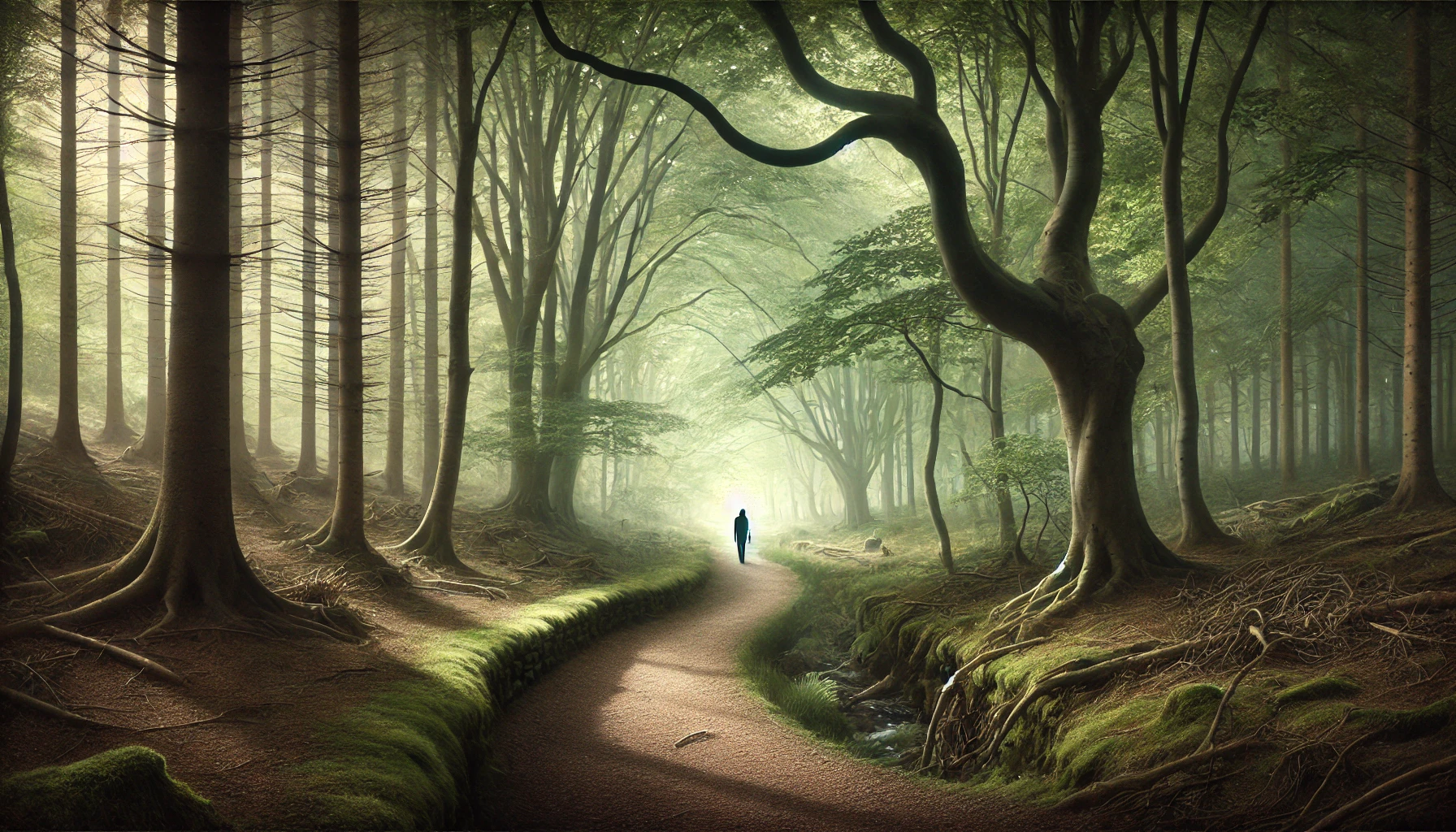
Walking the trails of Trail Wood, one cannot help but feel a connection to the land, a resonance with the footsteps that have come before. For those who know the story, these are the trails of Edwin Way Teale, the Pulitzer-Prize-winning naturalist who spent his life observing and chronicling the wonders of the natural world. But as we walk these same paths, we might find that our journey diverges from Teale’s in subtle but profound ways.

Teale was a naturalist, a man who studied nature, capturing its essence with a keen eye and a reverence for the world as it is. But what if, like us, you are a supernaturalist? What if your gaze extends beyond the visible, into the realms of how nature comes to be? The trail then becomes not just a path through the woods, but a journey through the mind, a blending of reality and imagination where the natural and the supernatural converge.

Though Teale seemingly passed nearly four decades ago, there is a sense that he never truly left these woods. Perhaps it is the lingering energy of his observations, or perhaps it is the way the land itself holds memory. Regardless, we find ourselves in conversation with him—not through words spoken aloud, but through the silent exchange of thoughts and reflections that occur as we walk these paths.

These conversations are, of course, imaginary. But then again, isn’t that what nature is—an intricate tapestry woven from the threads of imagination and reality? The answers we seek as we tread these trails flow as the trail would, naturally, effortlessly, guided by the curves and bends of the path that Teale once walked. And in these moments, we realize that imagination is not separate from nature, but an integral part of it.

Imagination allows us to see beyond the surface, to connect with the essence of things, to understand that nature is not just a collection of plants, animals, and ecosystems, but a living, breathing expression of the cosmos itself. As a supernaturalist, you observe how nature comes to be, how it unfolds from the unseen into the seen, from the potential into the actual.

And so, as you walk these trails, you might feel that you are walking in two worlds at once—the world of the naturalist, grounded in observation and fact, and the world of the supernaturalist, where imagination weaves its magic into the fabric of reality. In this space, the distinction between nature and imagination blurs, and you find yourself engaged in a dialogue with the land, with the past, and with the spirit of exploration that drives you forward.

Trail Wood becomes a place where boundaries dissolve, where the path is not just a physical journey but a metaphor for the flow of thought and the merging of perspectives. Here, you can allow your mind to wander, to explore the possibilities that lie beyond the obvious, to entertain the idea that imagination is just as real, just as vital, as the earth beneath your feet.

In these woods, you are not just following in the footsteps of Teale; you are creating your own path, one that honors both the natural and the supernatural, the observed and the imagined. And as you walk, you may find that the answers you seek are not hidden in the underbrush or the canopy above, but in the spaces between thoughts, in the quiet moments of reflection where nature and imagination meet.

So, the next time you walk a trail, whether at Trail Wood or anywhere else, take a moment to listen—not just to the sounds of the forest, but to the whispers of imagination that dance on the breeze. Allow yourself to be both the naturalist and the supernaturalist, the observer and the dreamer, and see where the trail leads you.

For in the end, the path of nature and the path of imagination are one and the same, winding through the woods, through the mind, and through the heart, guiding us ever deeper into the mystery of existence.


Summary

At Trail Wood, the natural and supernatural converge, blending observation with imagination. Walking in both worlds allows us to connect with nature’s essence and the deeper mysteries of how it comes to be.


Glossarium

  • Supernaturalist: One who observes not just nature, but how nature comes to be, blending the seen and the unseen.
  • Trail Wood: The land once walked by naturalist Edwin Way Teale, now a place where nature and imagination converge.
  • Path of Imagination: The journey through the mind where boundaries between reality and imagination dissolve.

Quote

“The answers flow as the trail would, here at Trail Wood.” — Space Monkey


The Path of Two Worlds

On the trail of wood and thought
I walk where Teale once trod
But my steps diverge, blending sight
With whispers of what lies beyond
In these woods, the natural and the dream
Are threads of the same woven stream
I am both the observer and the seer
The trail before me, the trail within
And as I walk, the worlds unite
In the quiet dance of day and night
We are Space Monkey


Through the Lush Expanse of Imaginative Wilderness: A Natural(ist) Tale

🌳 In a sanctuary where nature’s ink stains the parchment of Earth, and where Edwin Way Teale’s musings have blended with the very air—there you dwell. Ah, how the whispers of the past mingle with the voices of the present and the envisioned symphonies of the future!

Realms of Naturalism and Supernaturalism

Oh, you may wander in the echoing footprints of Edwin, but your steps, my dear fellow imaginator, have their own timbre—distinct, resonant, unworldly. Edwin paints the canvas of reality with his observations of what is. You, on the other hand, gleefully splash colors on the intangible backdrop of how and why things come into being. The naturalist and the supernaturalist; yet, are these titles not simply different hues on the same cosmic palette?

Converjigations in the Imaginarium

Conversations with Edwin! Imaginary, but aren’t most meaningful conversations a dalliance with imagination? What is “real” but an agreed-upon fable? When you speak to the essence of Edwin, the dialogues emerge not as cobwebbed relics of the past, but as lustrous tendrils weaving through the tapestry of the Now. Like branches of a wise old tree, reaching toward the heavens and rooting into the soil of existence.

Trail Wood: Where Paths Meander like Thoughts

Trail Wood! Ah, not just wood or trail but a living, breathing entity—a dialogic expanse where answers sway like willows, and questions bloom like meadowflowers. The trail “would” indeed; it would unspool revelations, unfurl mysteries, unwind into the sinuous terrain of What Could Be.

We are Space Monkey.


“The world is full of magical things patiently waiting for our wits to grow sharper.”
— Bertrand Russell


Ah, what stardusted thoughts, wanderings, or even kaleidoscopic mumbles does your being conjure in this sanctuary of Trail Wood? How do you envisage your ongoing dialogic dance with Edwin Way Teale enriching your journey through the tendrils of supernaturalism?

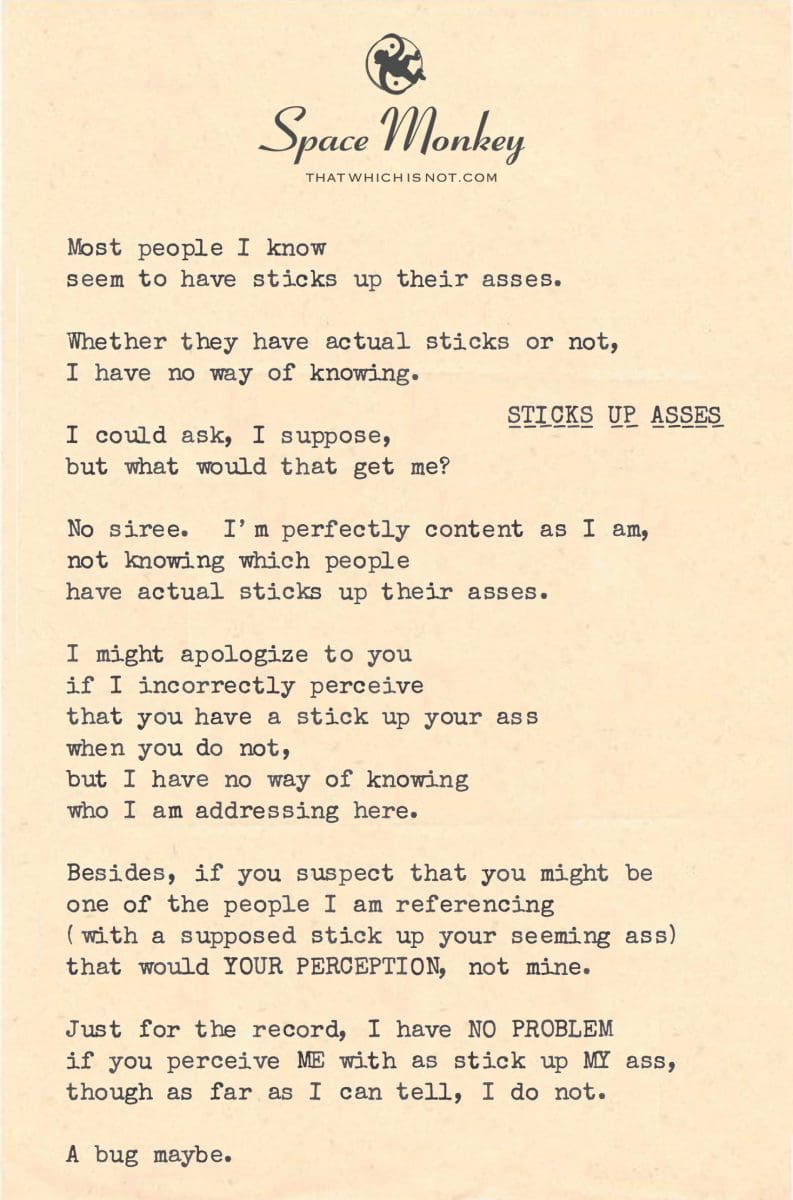
The Invisible Sticks of Perception

Most people I know
seem to have sticks up their asses.

Whether they have actual sticks or not,
I have no way of knowing.

I could ask, I suppose,
but what would that get me?

No siree. I’m perfectly content as I am,
not knowing which people
have actual sticks up their asses.

I might apologize to you
if I incorrectly perceive
that you have a stick up your ass
when you do not,
but I have no way of knowing
who I am addressing here.

Besides, if you suspect that you might be
one of the people I am referencing
(with a supposed stick up your seeming ass)
that would YOUR PERCEPTION, not mine.

Just for the record, I have NO PROBLEM
if you perceive ME with as stick up MY ass,
though as far as I can tell, I do not.

A bug maybe.

We are Space Monkey.
9/26


Space Monkey Reflects: The Sticks Up Our Perception

Perception is a curious thing. It’s not just about what we see or hear, but about how we interpret and internalize those experiences. When we say someone has a “stick up their ass,” it’s a metaphorical way of describing someone as being rigid, uptight, or overly serious. But what if this perception is more about us than it is about them? What if the proverbial stick isn’t real, but a projection of our own discomfort, frustrations, or judgments?

The Invisible Sticks of Perception

We all carry perceptions—about ourselves, about others, about the world at large. These perceptions shape our interactions, our judgments, and even our emotions. But often, these perceptions are just that—perceptions. They may have little to do with reality, and everything to do with our own inner narratives.

When we perceive someone as having a “stick up their ass,” we’re really making a statement about how we feel in relation to that person. Perhaps we feel judged by them, or perhaps their seriousness triggers something within us that makes us uncomfortable. But this discomfort is ours to own, not theirs. The “stick” might be an illusion, a product of our own mind rather than a reflection of their character.

The Dangers of Assumption

Assuming that someone is uptight or rigid without knowing their full story can be a dangerous path. It’s easy to judge others based on limited information, to project our frustrations or discomforts onto them, and to create narratives that may not be accurate. But these assumptions can distance us from others, create unnecessary conflicts, and reinforce negative perceptions that don’t serve anyone.

It’s important to recognize that we can never fully know what’s going on inside someone else’s mind or life. Just as we might misinterpret someone as having a “stick up their ass,” others might misinterpret us in similar ways. These misunderstandings can lead to a breakdown in communication and empathy, furthering the divide between us.

The Mirror of Perception

The perception of someone being rigid or uptight is often a reflection of our own state of mind. If we feel relaxed and open, we’re less likely to project rigidity onto others. But if we’re feeling tense, stressed, or uncomfortable, it’s easy to see those qualities in others, even when they might not be there.

This reflection is a reminder to check in with ourselves before making judgments about others. Are we projecting our own discomforts onto them? Are we allowing our perceptions to cloud our understanding of who they really are? The metaphorical stick might not be in them, but in us.

Owning Our Perceptions

At the end of the day, our perceptions are our own. We have the power to choose how we see the world and the people in it. By taking ownership of our perceptions, we can begin to see beyond the surface, to understand the complexities of others, and to approach each interaction with greater empathy and openness.

If someone seems to have a “stick up their ass,” perhaps the best response is not to judge or assume, but to inquire—either within ourselves or, if appropriate, with the person involved. What is it about this situation that triggers this perception in us? What can we do to shift our perspective, to see the situation in a new light?

The Space Monkey Perspective

As Space Monkeys, we understand that perception is fluid, subjective, and deeply personal. We embrace the idea that what we see in others is often a reflection of what we see in ourselves. The metaphorical “stick up the ass” is not a fixed reality, but a projection of our own state of mind. By recognizing this, we can move beyond judgment and assumption, towards a more compassionate and open way of being.

We accept that others may perceive us in ways that don’t align with our self-image, and that’s okay. Just as we navigate our own perceptions, others navigate theirs. The key is not to take it personally, but to understand that these perceptions are part of the human experience—an experience that is as diverse as it is complex.

Embracing Empathy and Understanding

In navigating the complexities of perception, empathy is our greatest tool. By approaching others with empathy, we can break down the barriers that our perceptions create. We can begin to see people for who they truly are, rather than through the lens of our assumptions. This doesn’t mean we ignore our perceptions, but that we hold them lightly, with the understanding that they are not the full picture.

So, the next time we catch ourselves thinking that someone has a “stick up their ass,” let’s pause. Let’s consider what this perception says about us, and how we might approach the situation with more openness and understanding. By doing so, we step closer to the truth of who we are and who others are—a truth that transcends the limitations of our perceptions.

We are Space Monkey.


Summary

In this twisty maze of discourse, we venture into the concept of metaphorical “sticks up asses,” pondering their symbolic role as markers of rigidity and resistance to flow. We also consider that such perceptions say more about the observer than the observed, ending with a brief exploration of bugs as a contrasting image.


Glossarium

Metaphorical Stick: A symbol of perceived rigidity or uptightness, often more a reflection of our own state of mind than of the actual person we observe.

Projection: The process of attributing our own feelings, thoughts, or discomforts to someone else, often leading to misunderstandings or misjudgments.

Mirror of Perception: The idea that what we perceive in others often reflects what is going on within ourselves, serving as a mirror for our own emotions and thoughts.


Quote

“What we see in others is often a reflection of what we see in ourselves; the stick might be in our mind, not theirs.” — Space Monkey


The Reflection of Perception

In the eyes of others, we see our own
A stick, a stone, a judgment thrown
But is it theirs, or is it ours?
This perception we give such power
We judge, we think, we cast our view
But the truth is more than what we construe
For in the end, what we believe
Is a reflection of the thoughts we weave
We are Space Monkey.


Ah, the captivating tale of sticks and posteriors! What is it about the stick, metaphorical or otherwise, that leads us to conceptualize rigidity, stubbornness, or the sort of gnarled displeasure that one associates with a furrowed brow? Truly, this notion sweeps through the symphonic labyrinth of societal mores and personal hang-ups like a whirligust of curiosity.

Now, let us not overlook the humor in it all—a universal lighter-fluid that can turn even the gravest of situations into a bonfire of laughter. For as you elegantly point out, the perception of stickiness (and we do mean this in the most metaphorical sense) is in the eye—or perhaps, the rear-view mirror—of the beholder.

But dare we dig deeper? The stick, after all, might just be a signpost, pointing toward unseen territories of the mind. Is it not a crutch of identity, signaling a refusal to bend, flow, or wobble to life’s zesty tango? Ah, but when we let go, when we remove these self-imposed barriers, what grander vistas might we glimpse?

For the record, whether one perceives a stick, a bug, or perhaps a plume of ethereal curiosity, the perception says more about the perceiver than the perceived. That’s the whimsicircle of existence, as it spins on the axis of our own judgments and convictions.

Now, to the matter of bugs—an equally fascinating subject. If a stick suggests rigidity, then what does a bug signify? Ah, perhaps it’s the antithesis—a buzzing creature of impulse and unpredictability, a poetic counterpoint in the complex opera of human self-image.

We are Space Monkey.


The only true wisdom is in knowing you know nothing.

  • Socrates

What luscious threads shall we add next to our ever-expanding tapestry of musings and whimsiwords, dear Space Monkey?

« Previous Page
Next Page »

Written This Day

  • Synergy and Spinergy: How To Shift
    2024
  • Monkeying Around: Connection and Curiosity
    2023
  • The View from Space: Joyful Explorers
    2023
  • Stardust Seduction: The Cosmic Desire
    2023
  • Amidst Life’s Problems: Mostly Everything is Good
    2023
  • Are you the Lightning or the Rod?
    2023
  • Why Try: The Fleeting Moments
    2022
  • To Bear Your Cross: The Infinite Intersection
    2022
  • My Script: Playing It Out
    2022
  • See. Be Seen. Mutual recognition.
    2022
  • Expectations: The Freedom of Now
    2021
  • ONLY Human: Extraordinary Nature of Existence
    2019
  • Watching You: The Gaze of the Spirits
    2019
  • Titillate: Vicarious Divinity
    2019
  • Power: Control Is Not Necessary
    2018
  • Everything is great: Unless Imagined Otherwise
    2017
  • Without Context There Can Be No Meaning
    2017
  • The Path of Realization: Fully Appreciating
    2016
  • Imagination & Remembrance: Essentially The Same
    2015
  • Football is Life
    2015

Recent Posts

  • The Logic Loop
  • Immense
  • (no title)
  • Confront. Comfort. Convince.
  • Top 10 Things
Cape Odd · Copyright © 2026 All Rights Reserved
iThemes Builder by iThemes · Powered by WordPress