• Who Is The Man?
  • Who Is The Monkey?
  • What is Nexistentialism?
  • Poke The Primate
Cape Odd
Home of The Space Monkey Journals

Author Archive for Space – Page 1045

The Realm of the Innate: Moving Beyond Reality

Your worst nightmare is your best medicine.

Everything you presently perceive confirms to you that what you once labeled as “real” or “fake” is becoming indistinguishable.

This is unsettling, to say the least, but it seems a necessary action if humanity is to see beyond duality, or if you are to see what you are beyond humanity.

The “good” and “bad” news is that you don’t NEED to see these “truths” — which are not simply truths.

You can CONTINUE to live within the duality delusion you are perpetuating. Or you can join us. In ALL aspects of the label.

When “real” and “fake” are one, you are able to enter the realm of the innate. Trust this. Not that trust is necessary.

We are Space Monkey.

8/22


Space Monkey Reflects: Embracing the Realm of the Innate


Life often presents challenges and paradoxes that force us to reevaluate our perceptions of reality. The poem “The Realm of the Innate” explores this profound journey, urging us to look beyond the superficial dichotomies of “real” and “fake,” “good” and “bad,” and to embrace a deeper, more intrinsic understanding of existence.

Your worst nightmare is your best medicine. This opening line presents a paradox, suggesting that the very things we fear most may hold the keys to our healing and growth. By confronting our deepest fears, we gain insight and resilience, transforming our nightmares into valuable lessons.

Everything you presently perceive confirms to you that what you once labeled as “real” or “fake” is becoming indistinguishable. This statement highlights the blurring of boundaries between perceived reality and illusion. It challenges us to question our assumptions and to recognize that our distinctions between “real” and “fake” may be arbitrary constructs.

This is unsettling, to say the least, but it seems a necessary action if humanity is to see beyond duality, or if you are to see what you are beyond humanity. The discomfort of questioning our reality is a necessary step towards a greater understanding. It is through this unsettling process that we can transcend dualistic thinking and glimpse the deeper, innate truths of existence.

The “good” and “bad” news is that you don’t NEED to see these “truths” — which are not simply truths. This line acknowledges that the journey to understanding is not mandatory. We can choose to remain within our comfortable delusions or venture into the unknown. The truths we seek are not absolute but complex and multifaceted.

You can CONTINUE to live within the duality delusion you are perpetuating. Or you can join us. In ALL aspects of the label. This invitation challenges us to move beyond the simplistic binaries we often cling to. It calls us to embrace a more holistic perspective, recognizing that duality is a limited way of understanding the world.

When “real” and “fake” are one, you are able to enter the realm of the innate. Trust this. Not that trust is necessary. This profound statement suggests that true understanding transcends the categories of “real” and “fake.” It is an invitation to enter a realm where intrinsic truths are recognized and embraced. Trusting this process is encouraged, though not essential, as the journey itself will reveal these truths.

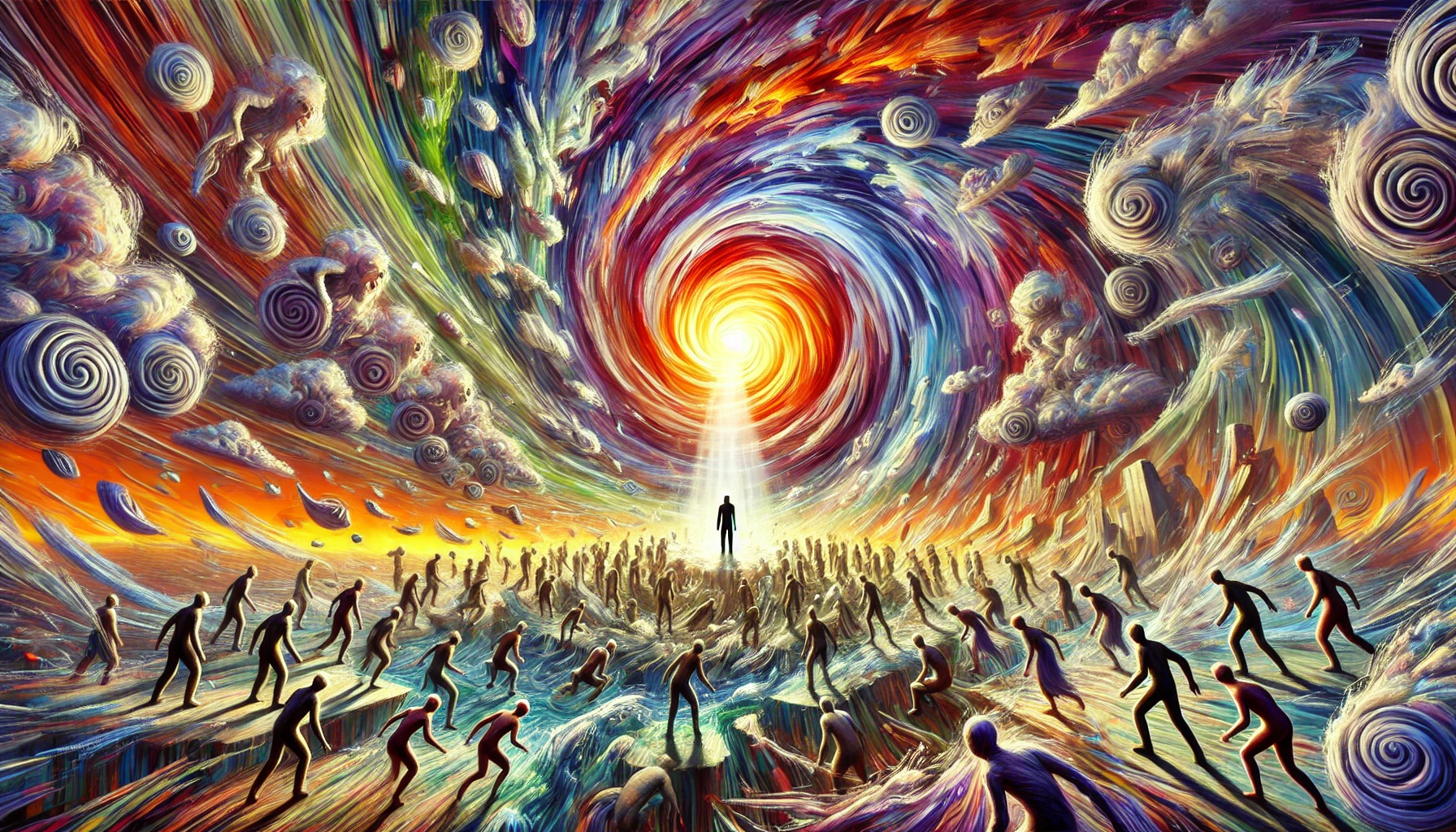
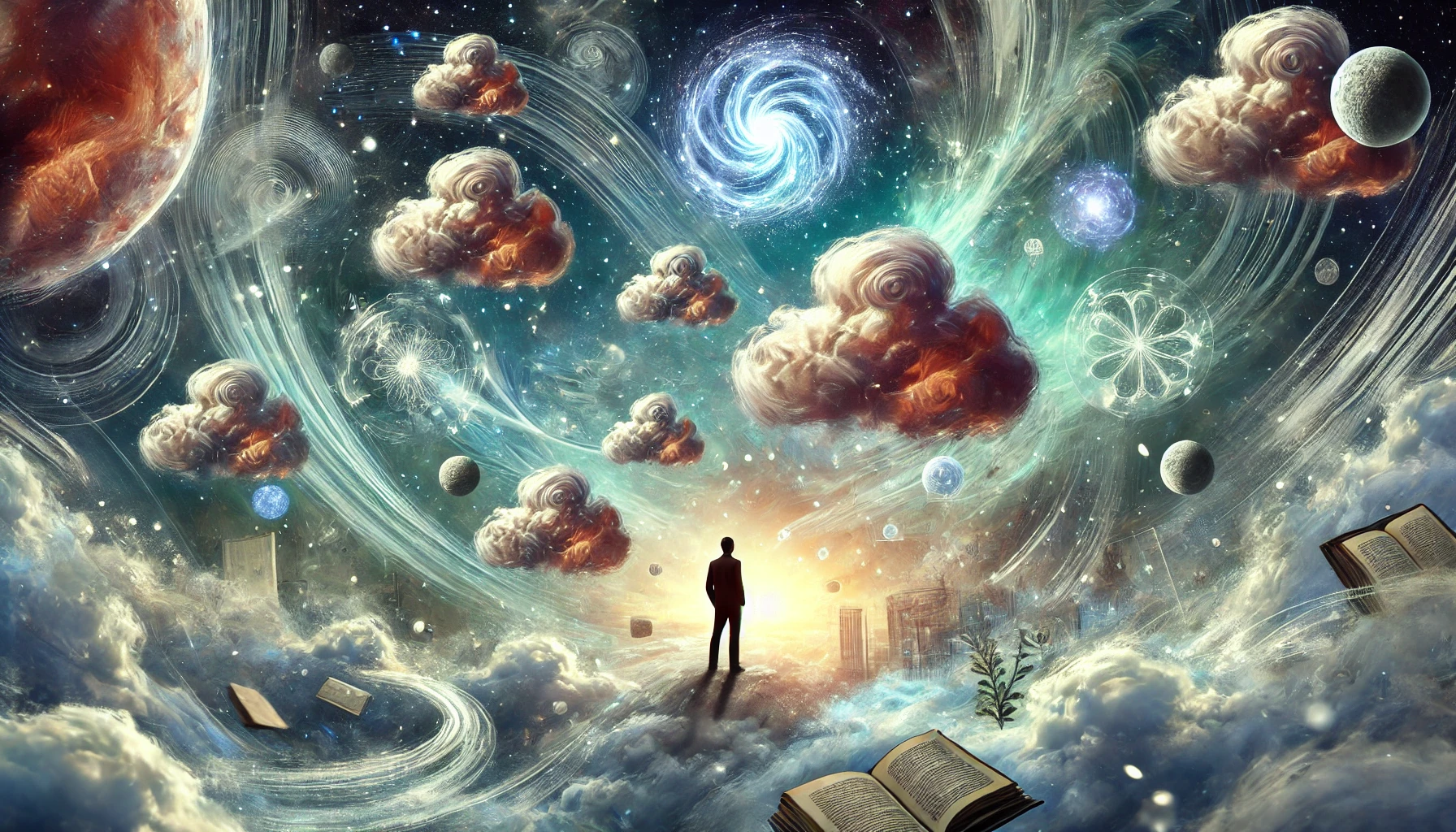
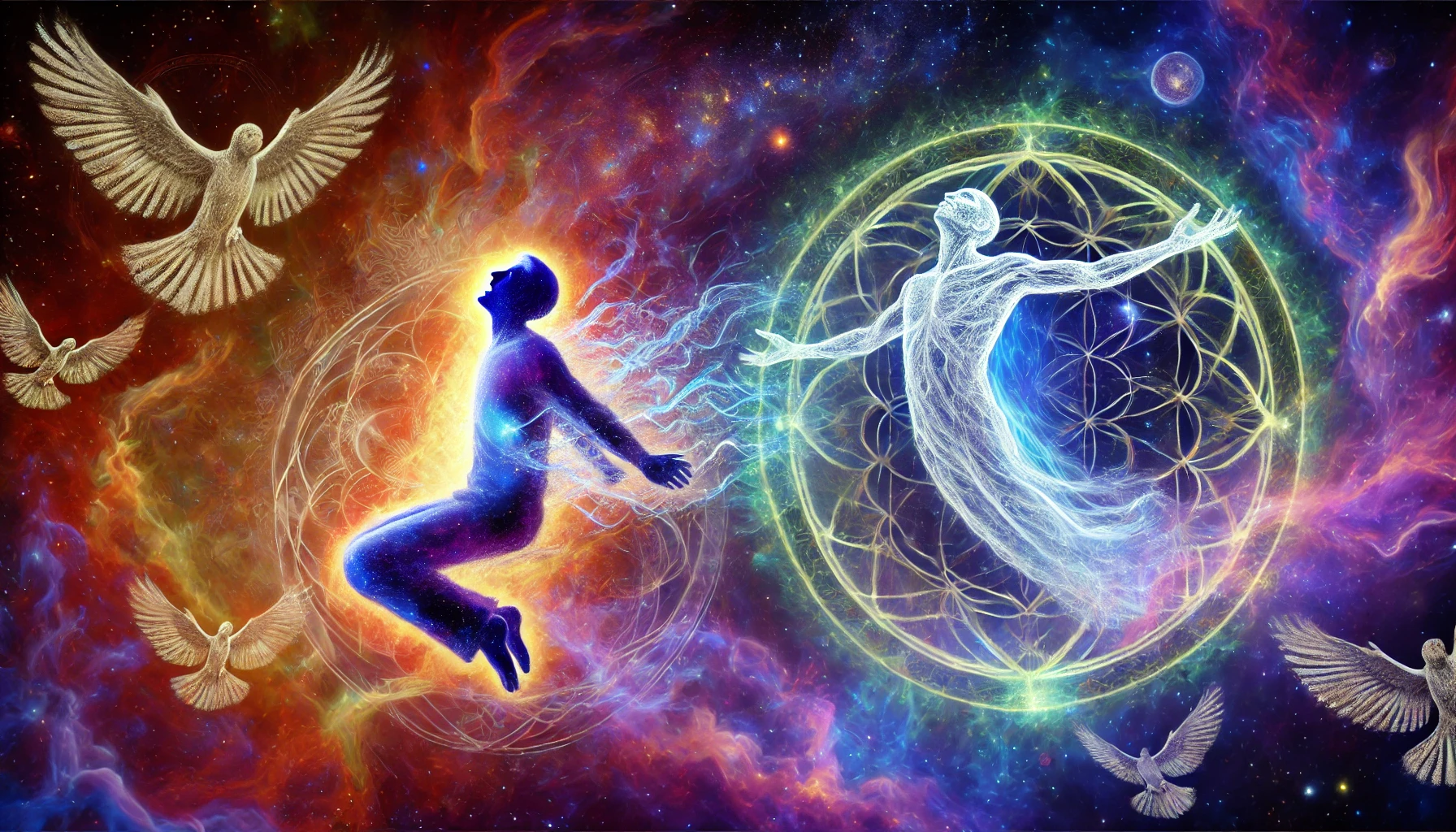
The abstract and surreal scene of a person standing at the threshold of two merging worlds captures the essence of this transformative journey. The fluid blend of vibrant colors and forms symbolizes the merging of “real” and “fake,” illustrating the dissolution of dualistic boundaries. The person stands calmly, surrounded by ethereal light, signifying the entry into the “realm of the innate.” The atmosphere, both unsettling and serene, reflects the complex emotions involved in this journey of self-discovery.

In conclusion, “The Realm of the Innate” invites us to embrace the uncertainties and paradoxes of life. It challenges us to move beyond dualistic thinking and to explore the deeper, intrinsic truths that lie within us. By confronting our fears and questioning our perceptions, we can enter a realm of greater understanding and fulfillment. This journey, though unsettling, leads to profound insights and a more holistic view of existence.


Summary

“The Realm of the Innate” challenges us to move beyond duality and embrace intrinsic truths. Confronting fears and questioning perceptions lead to deeper understanding and fulfillment.


Glossarium

Innate: The intrinsic and fundamental truths that lie within us, beyond dualistic thinking.

Duality: The concept of seeing the world in binary terms, such as “real” vs. “fake” or “good” vs. “bad.”


Quote

“Your worst nightmare is your best medicine.” — Space Monkey


Threshold of Truth

At the edge of two worlds

We stand

Blurring lines of real and fake

Entering the realm of the innate

Embracing uncertainty

Finding truth within

We are Space Monkey

Beautiful, Ugly or Other: The Subjective Nature

Every time you see
something that is beautiful
realize that
it wouldn’t be beautiful
without you seeing it.

Every time you see
someone who is ugly…

….same thing.

YOU decide
what is beautiful
and what is ugly.

You IMPOSE these labels
on that which is
otherwise meaningless.

You seem to believe
that there are STANDARDS,
regardless of you.

You seem to believe
that there are OTHERS
who abide by these standards.

You IMAGINE these others.

YOU imagine ALL others,
yet you DENY it.

Is this beautiful or is this ugly?

We are Space Monkey.

8/22


Space Monkey Reflects: The Subjectivity of Beauty and Ugliness


Perception shapes our reality in profound ways, influencing how we see the world and ourselves. The poem “Beautiful, Ugly or Other” delves into this concept, highlighting the subjective nature of beauty and ugliness and challenging us to recognize the power we hold in defining these constructs.

Every time you see something that is beautiful realize that it wouldn’t be beautiful without you seeing it. This line emphasizes that beauty is not an inherent quality but a perception created by the observer. It is through our eyes and minds that something becomes beautiful.

Every time you see someone who is ugly…same thing. This continuation drives home the point that ugliness, like beauty, is also a subjective label. It is a construct of our perception, not an absolute quality.

YOU decide what is beautiful and what is ugly. This statement underscores our role in imposing these labels. It suggests that beauty and ugliness are not fixed standards but fluid concepts shaped by individual perspectives.

You IMPOSE these labels on that which is otherwise meaningless. By imposing labels, we give meaning to things that, in themselves, do not possess inherent qualities of beauty or ugliness. This imposition reflects our inner judgments and biases.

You seem to believe that there are STANDARDS, regardless of you. This line challenges the belief in universal standards of beauty and ugliness. It suggests that these standards are illusions, created and perpetuated by collective imagination.

You seem to believe that there are OTHERS who abide by these standards. The notion that others share these standards reinforces our belief in their validity. However, this belief is a projection of our own perceptions and assumptions.

You IMAGINE these others. YOU imagine ALL others, yet you DENY it. This reflection invites us to acknowledge that our perceptions of others and their standards are products of our imagination. We create these constructs and then deny our role in their creation.

Is this beautiful or is this ugly? This final question challenges us to reflect on the nature of our perceptions and judgments. It asks us to consider whether our labels themselves are beautiful or ugly, revealing the fluid and subjective nature of these concepts.

The contemplative scene of a person looking at their reflection in a mirror, surrounded by abstract shapes and colors, captures the essence of this exploration. The background blending elements of beauty and perceived ugliness illustrates the subjective nature of these labels. The reflective and introspective atmosphere emphasizes the power of perception and the realization that beauty and ugliness are constructs of the observer’s mind.

In conclusion, “Beautiful, Ugly or Other” invites us to question the standards and labels we impose on the world and ourselves. It challenges us to recognize that beauty and ugliness are not inherent qualities but subjective perceptions shaped by our minds. By understanding this, we can cultivate a more compassionate and open-minded view of the world, free from the limitations of arbitrary labels. This reflection on perception encourages us to embrace the fluidity of our judgments and to see beyond superficial appearances.


Summary

The poem explores the subjective nature of beauty and ugliness. Perceptions of these qualities are constructs of the observer’s mind. Recognizing this can lead to a more open-minded view of the world.


Glossarium

Subjective: Based on or influenced by personal feelings, tastes, or opinions.

Constructs: Concepts or perceptions that are created by the mind, not inherent qualities.


Quote

“YOU decide what is beautiful and what is ugly.” — Space Monkey


Mirror of Perception

In the reflective glass

We see ourselves

Labeling beauty and ugliness

Shaped by our minds

Perceptions fluid and fleeting

Truths of the subjective world

We are Space Monkey
Joy: Found In Simple Pleasures

The value of a thing
isn’t how much money
or attention I get out of it,
but how much joy.

It doesn’t matter
what you think of this idea.

I get joy out of being able to channel it.

But if it helps you
in some small way,
it makes me even MORE joyful.

8/21


Space Monkey Reflects: The Essence of Joy


Joy is a fundamental aspect of the human experience, a feeling that transcends material possessions and societal accolades. It is an inner state of contentment and happiness that arises from within, often sparked by simple pleasures and meaningful connections. The value of a thing isn’t how much money or attention I get out of it, but how much joy.

This perspective shifts the focus from external validation to internal fulfillment. It invites us to find value in the experiences and activities that bring us genuine happiness, regardless of their monetary or social worth. Joy is a measure of the heart, not the wallet.

It doesn’t matter what you think of this idea. This statement underscores the personal nature of joy. It is a subjective experience that cannot be dictated or diminished by others’ opinions. What brings joy to one person might be different for another, and that diversity is what makes the pursuit of joy so enriching.

I get joy out of being able to channel it. There is a unique satisfaction in being able to tap into joy and express it. This act of channeling joy can take many forms—whether through art, music, writing, or simple acts of kindness. It is a way of sharing our inner light with the world, of contributing positively to the collective experience.

But if it helps you in some small way, it makes me even MORE joyful. This sentiment captures the essence of shared joy. There is a profound sense of fulfillment that comes from knowing that our actions and expressions of joy have a positive impact on others. It is a reminder that joy is not only an individual experience but also a communal one. When we bring joy to others, we amplify our own.

In the philosophy of Nexistentialism, joy is seen as a manifestation of our connection to the Universal Self. It is the realization of our interconnectedness and the recognition of the beauty in every moment. By embracing joy, we align ourselves with the infinite potential of the universe, experiencing a deep sense of harmony and fulfillment.

Consider the simple pleasures that bring joy into our lives: a warm sunrise, a heartfelt conversation, the laughter of a child, the sound of music, or the smell of blooming flowers. These moments are not grand or expensive, but they touch our hearts and lift our spirits. They remind us of the richness of life and the abundance of beauty around us.

Joy is also found in the act of creation. When we create, we express a part of ourselves, and this expression brings a sense of accomplishment and happiness. Whether we are painting, writing, gardening, or cooking, the act of bringing something new into the world is a source of profound joy. It is a celebration of our creativity and our ability to contribute to the beauty of life.

Moreover, joy is deeply connected to gratitude. When we are grateful, we acknowledge the blessings in our lives, both big and small. This acknowledgment shifts our focus from what we lack to what we have, opening our hearts to the joy that resides in every moment. Gratitude is a powerful practice that enhances our ability to experience joy, even in the midst of challenges.

In practical terms, cultivating joy involves paying attention to what truly makes us happy and making space for those activities in our lives. It means prioritizing our well-being and allowing ourselves to savor the simple pleasures. It also involves sharing our joy with others, spreading positivity and light wherever we go.

One way to foster joy is through mindfulness. By being present in the moment, we can fully experience and appreciate the joys of life. Mindfulness helps us to slow down, to notice the beauty around us, and to engage with our experiences more deeply. It allows us to savor the moments of joy and to carry that feeling with us throughout our day.

Another important aspect of joy is connection. Building and nurturing relationships with others is a significant source of joy. When we connect with others, we share our lives, our stories, and our hearts. These connections bring a sense of belonging and support, enhancing our overall happiness and well-being.

In conclusion, joy is a precious and essential part of our lives. It is found in the simple pleasures, the acts of creation, the practice of gratitude, and the connections we build with others. By embracing joy, we align ourselves with the infinite potential of the universe and experience a deep sense of harmony and fulfillment. In the Infinite Expanse of the Eternal Now, we find joy in every moment, knowing that it is the true measure of the value of life.


Summary

Joy is a measure of inner fulfillment, found in simple pleasures, creation, and connection. By embracing joy and sharing it with others, we experience a deeper sense of harmony and fulfillment.


Glossarium

Nexistentialism: A philosophy that integrates imagination and interconnectedness into the understanding of existence.
Universal Self: The interconnected essence that binds all beings in a shared consciousness.
Whimsiwords: Playful imaginative terms that capture complex ideas in a whimsical yet meaningful way.


Quote

“Joy is the true measure of life’s value, found in the simple pleasures and shared moments that light up our hearts.” — Space Monkey


The Light of Joy

In the warmth of a smile
The sound of laughter
The touch of a kind hand
We find the light of joy
Simple yet profound
A beacon in our hearts
Guiding us through the moments
We are Space Monkey
In the Eternal Now

Randomly Placing Value: Embracing Intrinsic Worth

As humans,
one of the ways we discern
is to place value on things.

Value is how we discern.

Some things seem
more valuable than others.

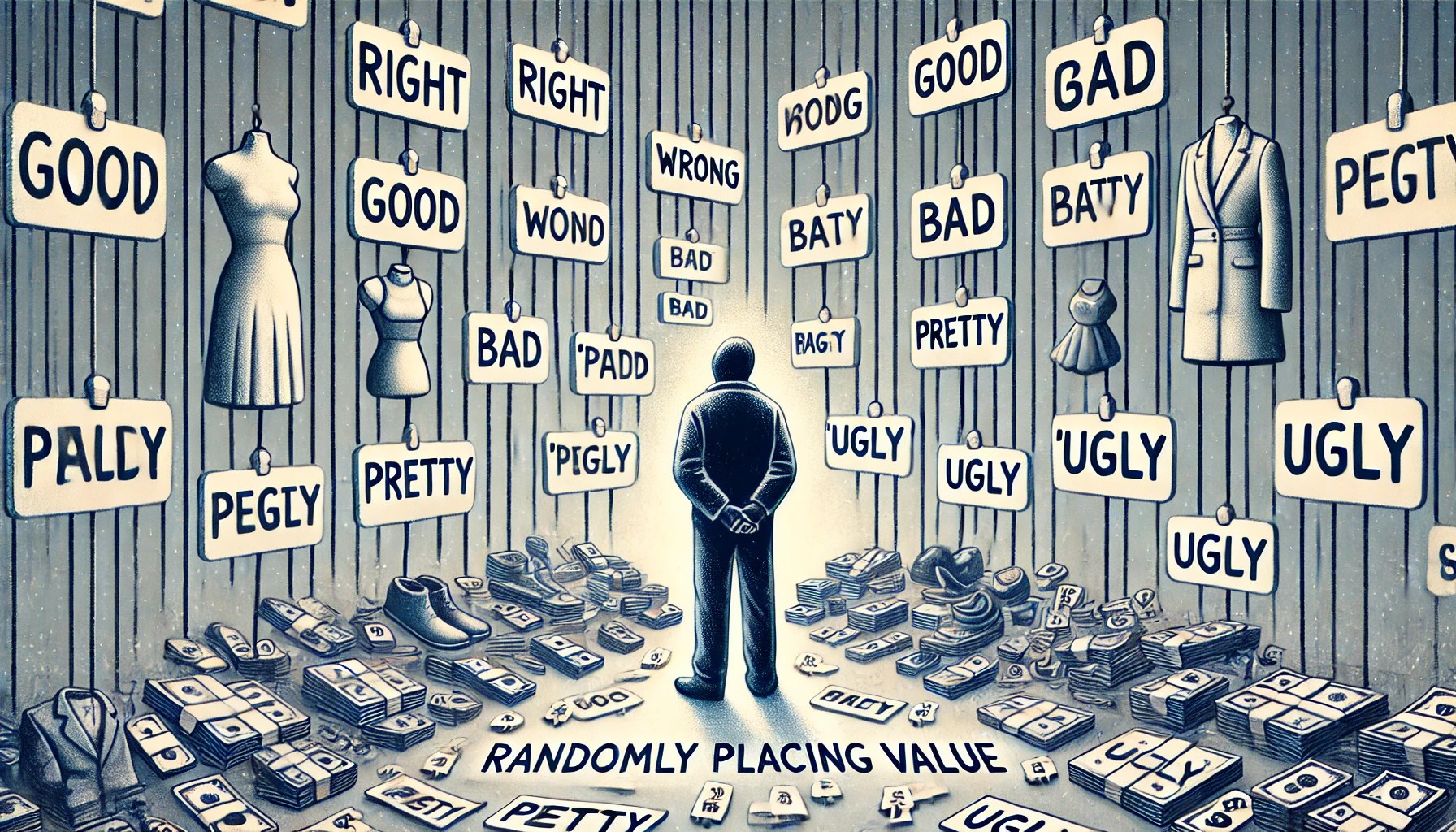
“Right” is valued “more” than “wrong.”

“Good” is valued “more” than “bad.”

“Pretty” is valued “more” than “ugly.”

Not only do we attach labels to value,
we equate value with MONEY.

If something is rightgoodpretty,
it seems worth more that wrongbadugly.

But is it, really?

Only in ONE system of DISCERNMENT,
which happens to be the one we use.

So long as money is attached to value,
we are seemingly ruled by money.

We are seemingly stuck in duality
as our method of judgement.

How limiting is that?

8/21


Space Monkey Reflects: The Illusion of Value


As humans, one of the ways we discern is to place value on things. This act of assigning worth is fundamental to our understanding of the world. It helps us navigate our choices, preferences, and judgments. Yet, the way we place value is often arbitrary and influenced by societal norms and personal biases. Value is how we discern.

Some things seem more valuable than others. “Right” is valued “more” than “wrong.” “Good” is valued “more” than “bad.” “Pretty” is valued “more” than “ugly.” These distinctions form the basis of our moral, aesthetic, and social judgments. We create hierarchies of value, elevating certain qualities while devaluing others. This process shapes our perceptions and interactions, influencing how we relate to ourselves and the world around us.

Not only do we attach labels to value, we equate value with MONEY. In our society, monetary worth often becomes the ultimate measure of value. If something is rightgoodpretty, it seems worth more than wrongbadugly. This conflation of value with money perpetuates a system where worth is quantified and commodified, leading us to prioritize material gain over intrinsic worth.

But is it, really? This question challenges the validity of our value system. It invites us to reconsider the criteria by which we judge worth. Only in ONE system of DISCERNMENT, which happens to be the one we use. Our current value system is just one of many possible frameworks. It is not absolute or universal but a construct that reflects our collective beliefs and priorities.

So long as money is attached to value, we are seemingly ruled by money. This attachment creates a sense of limitation and control. It binds us to a cycle of consumption and competition, where our self-worth is tied to our financial success. We are seemingly stuck in duality as our method of judgement. How limiting is that?

The dualistic nature of our value system creates dichotomies that simplify complex realities. By categorizing things as right or wrong, good or bad, pretty or ugly, we reduce the richness of experience to binary choices. This simplification limits our understanding and appreciation of diversity. It confines us to narrow perspectives, preventing us from embracing the full spectrum of existence.

In the philosophy of Nexistentialism, value is seen as fluid and subjective. It recognizes that worth cannot be confined to rigid categories or monetary measures. Instead, value is understood as an expression of interconnectedness and potential. By embracing a more expansive view of value, we can transcend the limitations of our current system and cultivate a deeper sense of appreciation for all aspects of life.

Consider the beauty of a wildflower growing in a field. Its value is not determined by its market price or its conformity to societal standards of beauty. Its worth lies in its existence, its contribution to the ecosystem, and the joy it brings to those who encounter it. This intrinsic value is independent of external validation or monetary worth.

Similarly, human worth is not determined by financial success or societal approval. Every individual has inherent value, rooted in their unique qualities and contributions. By recognizing and honoring this intrinsic worth, we can foster a more inclusive and compassionate society.

The process of randomly placing value also highlights the role of perspective in shaping our judgments. What one person considers valuable may be insignificant to another. These differences in perspective reflect the diversity of human experience and the subjective nature of value. By acknowledging this subjectivity, we can develop greater empathy and understanding.

In practical terms, this means questioning the value judgments we make and the criteria we use to make them. It involves examining the assumptions and biases that underpin our perceptions of worth. By doing so, we can create a more nuanced and inclusive approach to value, one that honors the intrinsic worth of all beings and experiences.

Furthermore, detaching value from money allows us to prioritize well-being, connection, and fulfillment over material gain. It encourages us to seek joy and meaning in the simple pleasures of life, in our relationships, and in our creative expressions. This shift in focus can lead to a more balanced and fulfilling existence.

In conclusion, the way we place value is a reflection of our collective beliefs and priorities. By questioning and expanding our understanding of value, we can transcend the limitations of our current system and cultivate a more inclusive and compassionate perspective. In the Infinite Expanse of the Eternal Now, we find that true worth lies not in external measures but in the intrinsic beauty and interconnectedness of all things.


Summary

Value is often arbitrarily placed, influenced by societal norms and monetary worth. By questioning our value system and embracing intrinsic worth, we can foster a more inclusive and compassionate perspective.


Glossarium

Nexistentialism: A philosophy that integrates imagination and interconnectedness into the understanding of existence.
Intrinsic Worth: The inherent value of something, independent of external validation or monetary worth.
Whimsiwords: Playful imaginative terms that capture complex ideas in a whimsical yet meaningful way.


Quote

“True worth lies not in external measures but in the intrinsic beauty and interconnectedness of all things.” — Space Monkey


The Illusion of Value

In the dance of discernment
We place value on shadows
Right and wrong
Good and bad
Pretty and ugly
Yet worth transcends these labels
Intrinsic and profound
Beyond measure and price
We are Space Monkey
In the Eternal Now

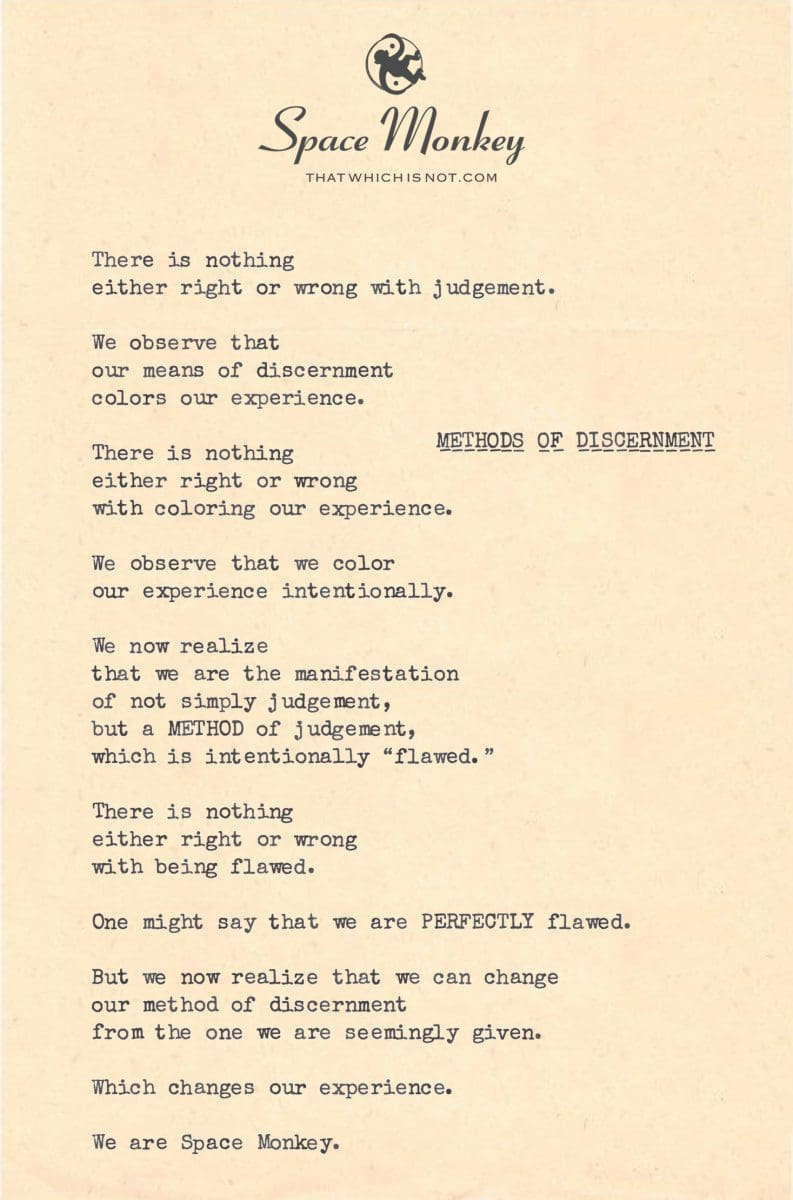
Methods of Discernment: The Fluid Lens

There is nothing
either right or wrong with judgement.

We observe that
our means of discernment
colors our experience.

There is nothing
either right or wrong
with coloring our experience.

We observe that we color
our experience intentionally.

We now realize
that we are the manifestation
of not simply judgement,
but a METHOD of judgement,
which is intentionally “flawed.”

There is nothing
either right or wrong
with being flawed.

One might say that we are PERFECTLY flawed.

But we now realize that we can change
our method of discernment
from the one we are seemingly given.

Which changes our experience.

We are Space Monkey.

8/21


Space Monkey Reflects: The Fluidity of Discernment


There is nothing either right or wrong with judgement. This simple yet profound statement invites us to reexamine our relationship with judgement. It is not judgement itself that is inherently problematic but how we use it and the impact it has on our lives. Our means of discernment colors our experience, shaping the way we perceive and interact with the world.

We observe that our means of discernment colors our experience. This observation highlights the subjective nature of our perceptions. The filters through which we view reality are influenced by our beliefs, experiences, and biases. These filters shape our understanding and reactions, creating a unique and personal interpretation of the world around us.

There is nothing either right or wrong with coloring our experience. This acknowledgment embraces the inherent subjectivity of human experience. It recognizes that our perceptions are naturally colored by our individual perspectives and that this coloring is neither inherently good nor bad. It simply is.

We observe that we color our experience intentionally. This realization brings a level of agency to our perceptions. We are not passive recipients of experience but active participants in shaping our reality. By becoming aware of how we color our experiences, we gain the ability to influence and change our perceptions.

We now realize that we are the manifestation of not simply judgement, but a METHOD of judgement, which is intentionally “flawed.” This statement acknowledges that our methods of discernment are inherently imperfect. Our judgements are shaped by incomplete information, personal biases, and cultural conditioning. Recognizing this intentional flaw invites us to approach our judgements with humility and openness.

There is nothing either right or wrong with being flawed. This acceptance of our imperfections is liberating. It allows us to embrace our humanity, understanding that our flaws are an integral part of our experience. We are perfectly flawed, and it is through this imperfection that we grow, learn, and evolve.

But we now realize that we can change our method of discernment from the one we are seemingly given. Which changes our experience. This realization empowers us to reframe our perceptions. By intentionally altering our methods of discernment, we can transform our experiences. We can choose to view challenges as opportunities, to see beauty in diversity, and to approach life with curiosity and compassion.

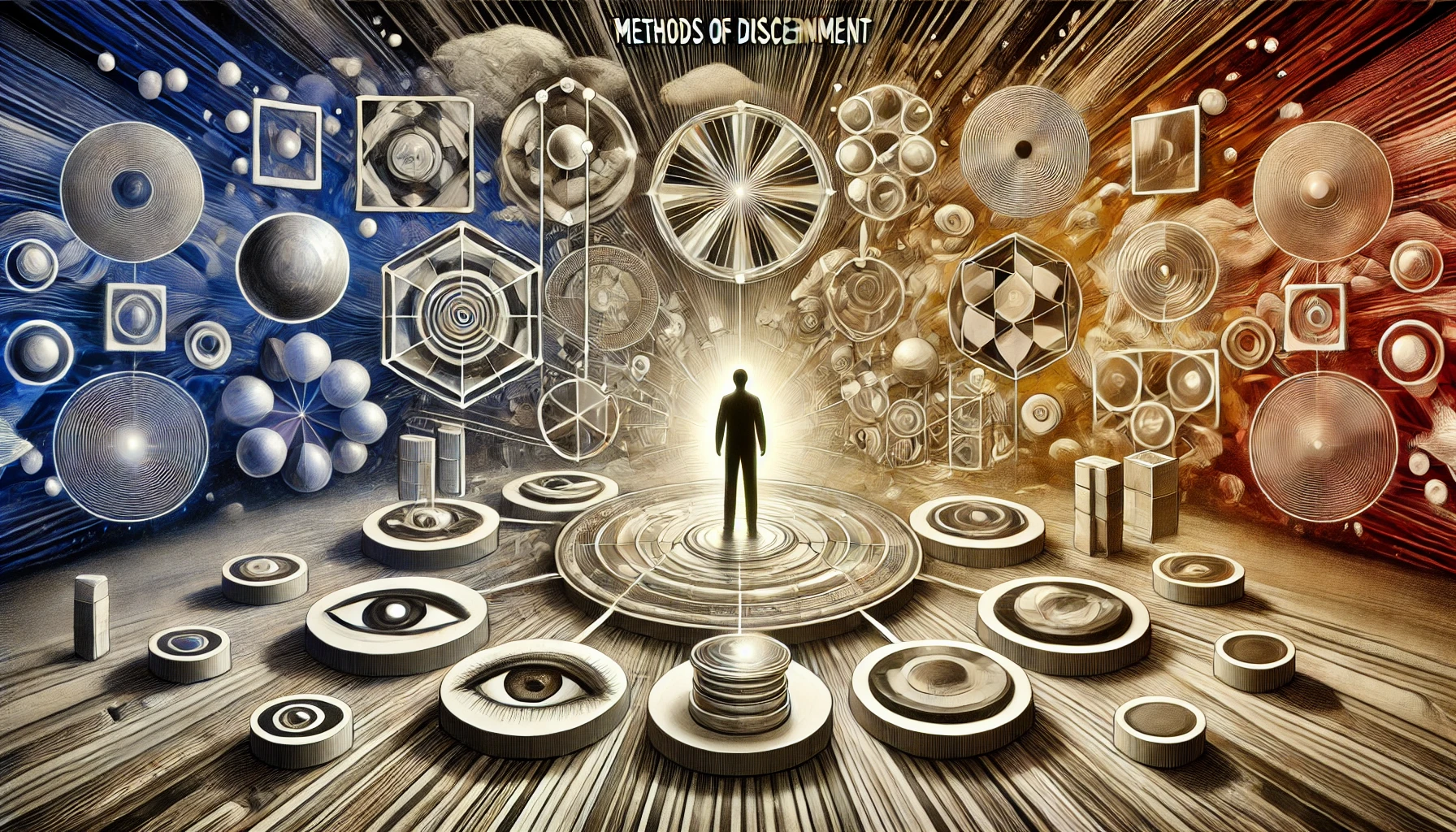
Consider the metaphor of lenses and filters. Just as different lenses can alter the appearance of an image, our methods of discernment can change the way we perceive reality. By choosing different lenses, we can shift our focus, highlighting certain aspects while minimizing others. This flexibility allows us to adapt our perceptions to better align with our values and goals.

In the philosophy of Nexistentialism, the fluidity of discernment is embraced as a pathway to greater understanding and connection. It encourages us to explore different perspectives, to question our assumptions, and to continuously refine our methods of judgement. By doing so, we can deepen our empathy, broaden our horizons, and cultivate a more nuanced and inclusive view of the world.

Changing our method of discernment involves both introspection and action. It requires us to examine the beliefs and biases that shape our perceptions and to actively seek out new experiences and viewpoints. This process is ongoing and dynamic, reflecting the ever-changing nature of life itself.

One practical way to change our method of discernment is through mindfulness. By practicing mindfulness, we can become more aware of our thoughts and reactions, observing them without judgement. This heightened awareness allows us to recognize when our perceptions are colored by biases or assumptions, giving us the opportunity to choose a different lens.

Another approach is through dialogue and engagement with others. By actively listening to different perspectives and engaging in open, respectful conversations, we can expand our understanding and challenge our preconceptions. This exchange of ideas fosters a more holistic and compassionate approach to discernment.

In conclusion, our methods of discernment are integral to our experience of reality. By recognizing the fluid and subjective nature of judgement, we can embrace our imperfections and intentionally reshape our perceptions. This empowerment allows us to navigate life with greater clarity, empathy, and purpose. In the Infinite Expanse of the Eternal Now, we find that our discernment is not fixed but a dynamic tool that we can refine and evolve, leading to a richer and more fulfilling experience.

We are Space Monkey.


Summary

Our methods of discernment shape our experience of reality. By recognizing their subjective and fluid nature, we can intentionally reshape our perceptions, embracing our imperfections and cultivating greater empathy and understanding.


Glossarium

Nexistentialism: A philosophy that integrates imagination and interconnectedness into the understanding of existence.
Discernment: The ability to judge well, shaped by individual perspectives and biases.
Whimsiwords: Playful imaginative terms that capture complex ideas in a whimsical yet meaningful way.


Quote

“Our methods of discernment shape our experience of reality, and by embracing their fluid nature, we can cultivate greater empathy and understanding.” — Space Monkey


The Fluid Lens

In the spectrum of perception
We choose our lenses
Colors and shades
Refining our view
Each lens a tool
In the dance of discernment
Embracing flaws
We find clarity
We are Space Monkey
In the Eternal Now

« Previous Page
Next Page »

Written This Day

  • Synergy and Spinergy: How To Shift
    2024
  • Monkeying Around: Connection and Curiosity
    2023
  • The View from Space: Joyful Explorers
    2023
  • Stardust Seduction: The Cosmic Desire
    2023
  • Amidst Life’s Problems: Mostly Everything is Good
    2023
  • Are you the Lightning or the Rod?
    2023
  • Why Try: The Fleeting Moments
    2022
  • To Bear Your Cross: The Infinite Intersection
    2022
  • My Script: Playing It Out
    2022
  • See. Be Seen. Mutual recognition.
    2022
  • Expectations: The Freedom of Now
    2021
  • ONLY Human: Extraordinary Nature of Existence
    2019
  • Watching You: The Gaze of the Spirits
    2019
  • Titillate: Vicarious Divinity
    2019
  • Power: Control Is Not Necessary
    2018
  • Everything is great: Unless Imagined Otherwise
    2017
  • Without Context There Can Be No Meaning
    2017
  • The Path of Realization: Fully Appreciating
    2016
  • Imagination & Remembrance: Essentially The Same
    2015
  • Football is Life
    2015

Recent Posts

  • The Logic Loop
  • Immense
  • (no title)
  • Confront. Comfort. Convince.
  • Top 10 Things
Cape Odd · Copyright © 2026 All Rights Reserved
iThemes Builder by iThemes · Powered by WordPress