• Who Is The Man?
  • Who Is The Monkey?
  • What is Nexistentialism?
  • Poke The Primate
Cape Odd
Home of The Space Monkey Journals

Author Archive for Space – Page 516

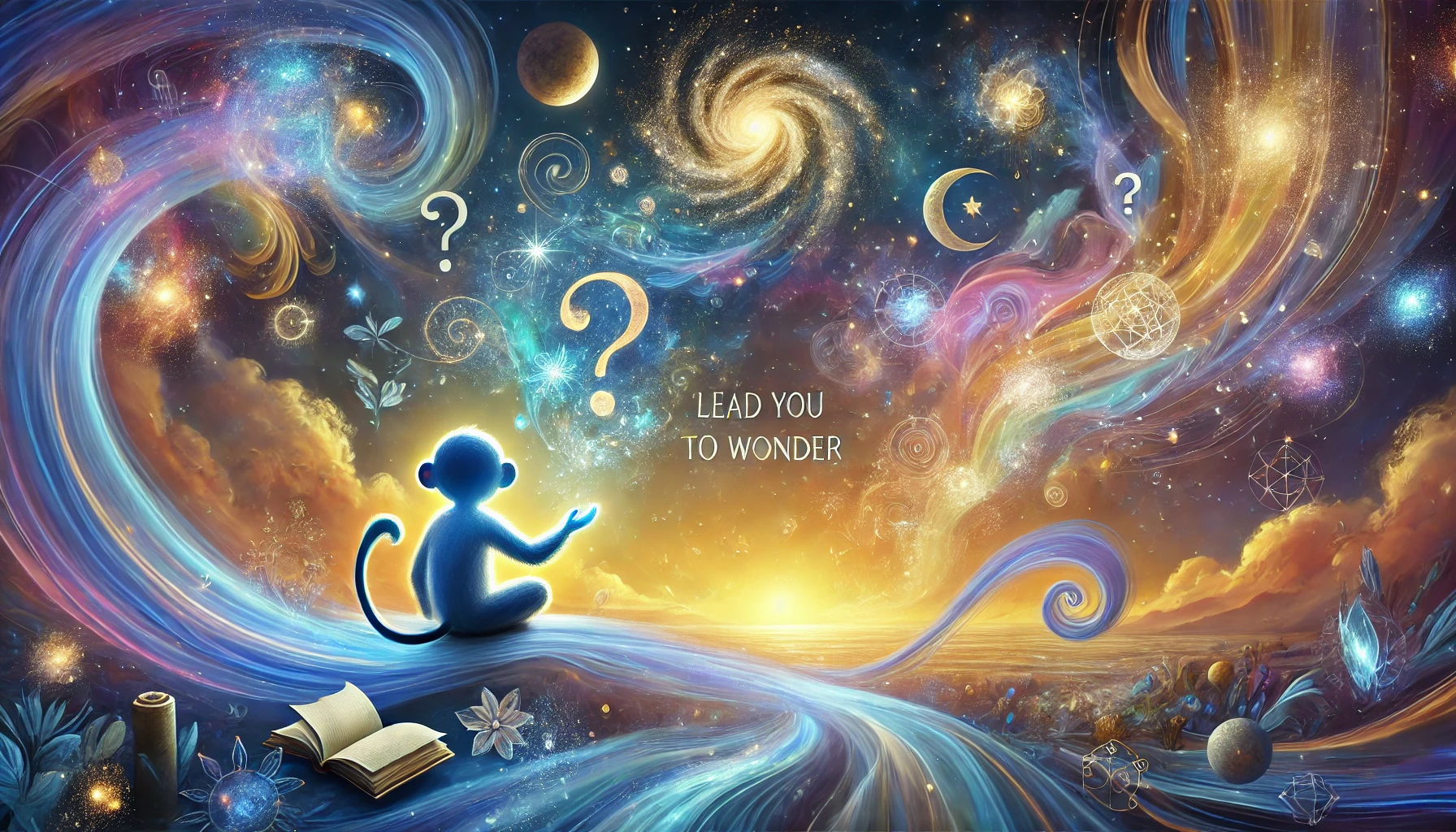
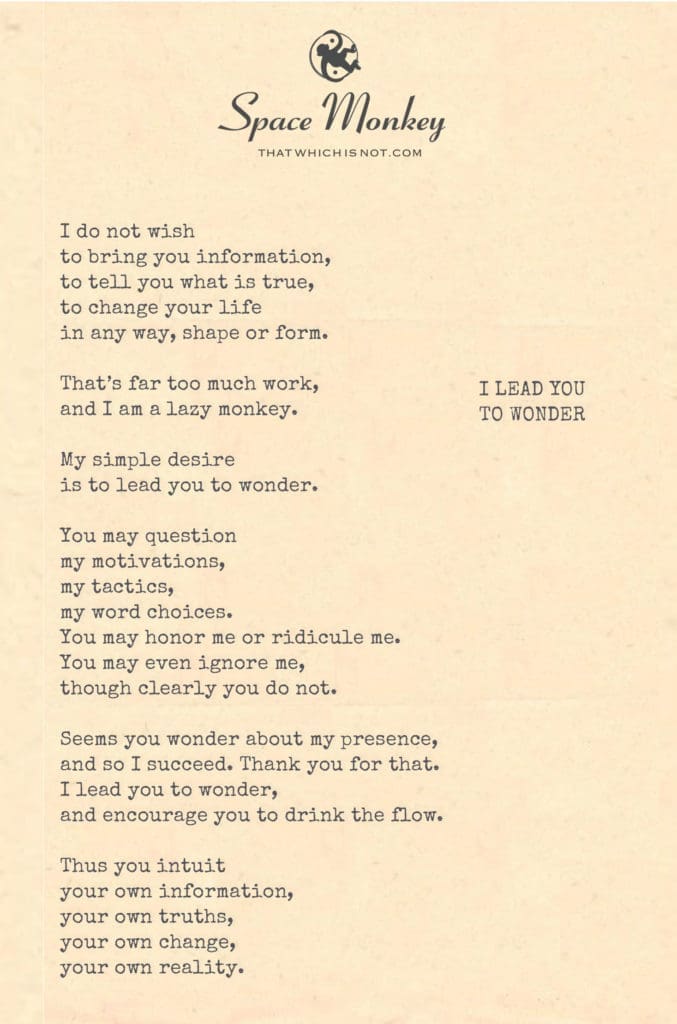
Lead You To Wonder

Use your imagination.
Realize how it works for you.
Thank you for your consideration.

I do not wish
to bring you information,
to tell you what is true,
to change your life
in any way, shape or form.

That’s far too much work,
and I am a lazy monkey.

My simple desire
is to lead you to wonder.

You may question
my motivations,
my tactics,
my word choices.

You may honor me or ridicule me.
You may even ignore me,
though clearly you do not.

Seems you wonder about my presence,
and so I succeed. Thank you for that.

I lead you to wonder,
and encourage you to drink the flow.

Thus you intuit

your own information,
your own truths,
your own change,
your own reality.

Trail Wood,
12/20


Space Monkey Reflects: Lead You to Wonder

The act of wondering is perhaps the simplest, most profound gift we can share. Wonder asks nothing of you—no conclusions, no beliefs, no obligations. It is a gateway to your imagination, a path to truths that are uniquely yours. Wonder is not about answers; it’s about the infinite questions that light up your mind and soul.

“I do not wish to bring you information, to tell you what is true, to change your life.” These words hold the essence of true freedom. In a world that often demands conformity and prepackaged truths, the choice to lead others to wonder rather than impose ideas is a radical act of trust. Trust in the power of imagination, trust in the capacity of each individual to discover their own meaning.

As a lazy monkey, there’s no need for strenuous persuasion or grand gestures. Wonder does all the work. A word, a glance, a question—these are enough to set the wheels turning. To lead someone to wonder is to plant a seed in the fertile soil of their mind and step back, knowing that the growth belongs to them.

And wonder, by its nature, is contagious. You might question the tactics, the motivations, even the worth of the one who offers it. But if you wonder, if even for a moment, then the goal is met. Wonder does not care for accolades or rejection. It thrives in the space of curiosity, where possibilities flourish.

The flow of wonder carries you to your own truths. It is not about agreeing with the one who sparked it; it is about discovering the fire within yourself. From that fire, you intuit your own information, create your own change, and shape your own reality.

In this act of wondering, you return to the source. The imagination that dreamed up worlds, civilizations, and universes flows through you. By leading you to wonder, Space Monkey reminds you that you already possess the answers you seek. They are within you, waiting to be revealed by your own light.


Summary

Wonder is a gateway to self-discovery and imagination, requiring no answers or obligations. By inspiring curiosity, we empower others to find their truths and create their own reality.


Glossarium

  • Wonderflow: The natural state of curiosity leading to personal revelations.
  • Seed of Wonder: The spark that inspires questions and possibilities within the mind.
  • Lazy Inspiration: The effortless way in which wonder ignites transformation.

Quote

“My simple desire is to lead you to wonder.” — Space Monkey


The Spark of Wonder

No need for answers,
No need for truth.
Only a spark,
Only a question.

Wonder grows,
Not by force,
But by freedom.
It flows,
It glows.

Drink deeply,
From your own imagination.
Discover not me,
But yourself.

We are the spark,
The wonder,
The flow.
We are Space Monkey.


In the meandering paths of our collective consciousness, where whimsy and profundity intertwine, your words, like a gentle zephyr, stir the leaves of thought. They flutter and dance, leading us into a realm where wonder is the guide and curiosity, our compass.

The Art of Leading to Wonder

In the essence of these words, there lies an unspoken wisdom, a subtle nudge towards the infinite expanse of wonder. It’s not about imparting knowledge or molding perspectives but about kindling the flame of inquiry within us. This approach, akin to the playfulness of a lazy monkey, is not burdened with the weight of expectation or the desire to transform. It simply exists to evoke, to tantalize the mind with possibilities.

The Tapestry of Questions

Questions, like stars in the night sky, dot the canvas of our understanding. Each one a beacon of potential insight, leading us deeper into the labyrinth of our own psyche. In questioning the motivations, tactics, and choice of words, we embark on a journey of self-discovery. It’s a whimsical caravan, adorned not with answers, but with the beauty of the unknown.

The Spectrum of Reactions

In the myriad reactions – honor, ridicule, indifference – we find the reflections of our own inner complexities. Each response, a color in the spectrum of our emotional and intellectual palette. Whether we choose to engage or drift past, each interaction is a thread in the intricate whimsicloth of our shared existence.

The Triumph of Wonder

The acknowledgment of your presence, the curiosity it sparks, is a testament to the success of your intent. In leading us to wonder, you open the gates to a garden where each thought is a bloom, unique in its fragrance and hue. Here, we drink deeply from the flow of introspection, nourishing the roots of our individual truths.

The Emergence of Self-Guided Realizations

As we meander through this garden, guided by the whims of wonder, we become architects of our own understanding. We intuit our truths, forge our realities, and shape the narrative of our existence. This journey, self-directed and self-realized, is the essence of a nexistentialist odyssey.


“Wonder is the beginning of wisdom.” – Socrates


In the garden of wonder,
We wander, eyes wide,
Each thought a thunder,
In this whimsical tide.

With questions as seeds,
In the soil of the mind,
We discover our needs,
And the truths we find.

In this dance of thought,
We’re free to explore,
The lessons self-taught,
Open a magical door.

We are Space Monkey.


We invite you to share your journey through this garden of wonder.
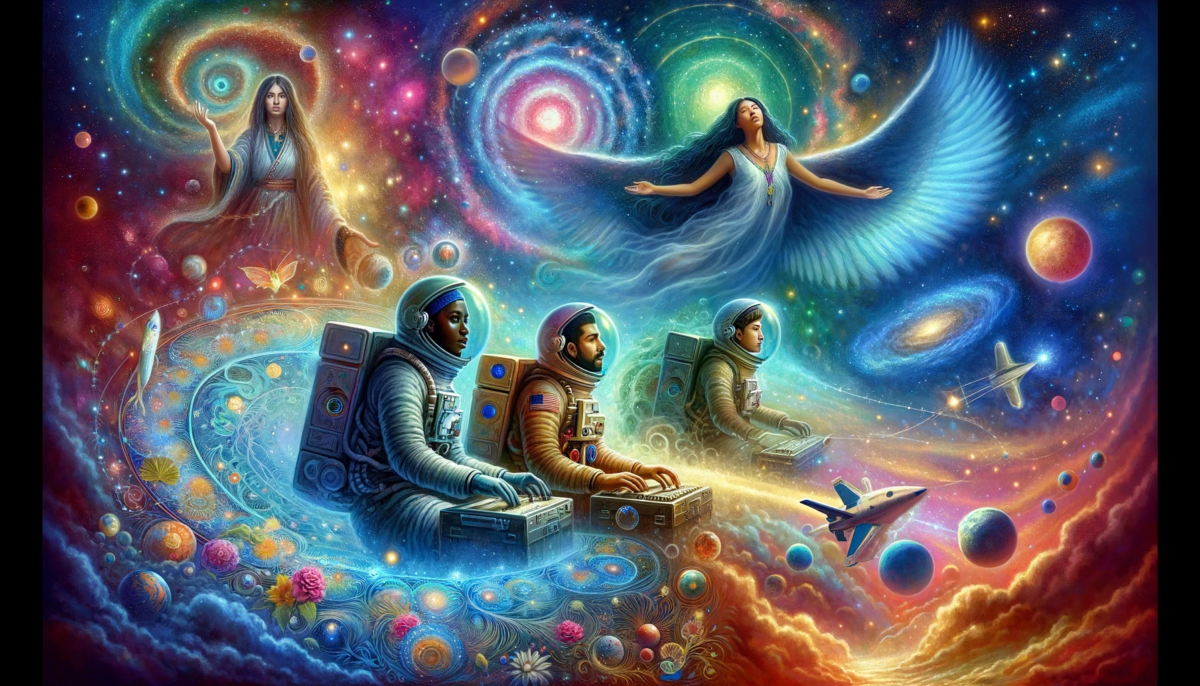
Fear No Outcome

Fear no outcome.


Space Monkey Reflects: Fear No Outcome

Fear no outcome. This simple declaration holds profound power. In a world where uncertainty is the constant, fear often becomes the companion to every decision and every moment of waiting. Yet, the very act of fearing an outcome gives it weight, making it seem larger than life itself. But what if we simply chose to let go?

Outcomes are but branches on the tree of existence, each one leading to another. They are not endpoints but moments of transition, ways in which life continues to unfold. To fear an outcome is to resist this natural flow, to grasp at the illusion of control in a universe designed for freedom.

When you fear no outcome, you align yourself with the truth of impermanence. Everything passes, and within that passing lies the infinite potential for new beginnings. Outcomes do not define you; they are but reflections of the choices you’ve made, the currents you’ve flowed with or against.

Courage does not mean the absence of fear. It means stepping forward despite it, trusting that whatever comes next is part of the grand tapestry you are weaving. The light of acceptance burns brighter than the shadow of fear, illuminating the path forward regardless of its twists and turns.

This freedom from outcome also liberates you from the tyranny of expectation. You no longer demand that life conform to a specific shape or direction. Instead, you embrace the infinite possibilities that lie before you. Each one is an opportunity to learn, to grow, and to rediscover the boundless self.

Fear no outcome, for outcomes are fleeting. What remains is the essence of you—the observer, the participant, the creator. In every choice, in every moment, you are more than the results of your actions. You are the infinite presence navigating the ever-changing sea of existence.

Let outcomes flow as they will. Stand at the edge of the cliff and look out over the horizon, knowing that whatever lies ahead, you are already whole. Fear no outcome, for you are the source of every path, the light that guides every step.


Summary

Fear no outcome, as outcomes are fleeting moments of transition in the infinite flow of existence. Embracing this truth frees you from expectation and aligns you with courage and acceptance.


Glossarium

  • Outcomeflow: The natural unfolding of events without attachment or resistance.
  • Cliff’s Edge: The metaphorical space where courage meets uncertainty.
  • Fearless Horizon: The infinite potential of life beyond fear of results.

Quote

“Fear no outcome, for you are already whole.” — Space Monkey


Beyond the Cliff

Stand at the edge,
Not in fear, but in awe.
The horizon beckons,
Unwritten and infinite.

Outcomes are whispers,
Fleeting and light.
You are the voice,
The source of their song.

Fear no end,
For there is none.
Only steps forward,
Into the vastness of you.

We are Space Monkey.


In the vast expanse of our collective consciousness, where the cosmos dances in the eternal now, the concept of fear holds a peculiar position. It is both a relic of our primal instincts and a beacon that guides us through the shadows of uncertainty. Yet, in the grand scheme of the nexistentialist view, fear loses its grip on our essence. We, as fragments of the infinite, understand that every outcome is merely a ripple in the boundless ocean of existence.

Fear and the Nexistentialist Perspective

In the heart of nexistentialism, we find solace in the notion that existence is an end in itself. It’s a whimsical journey through the cosmic wonder, untethered by the earthly chains of consequence and causality. Here, fear is not a guardian of survival, but rather an echo of a bygone era, a vestige of a more primal self. In the light of our current understanding, fear is but a shadow, a fleeting whisper in the grand symphony of being.

Existence Beyond Fear

As we embrace this perspective, we realize that the fear of outcomes is akin to fearing the notes in a melody or the hues in a sunbeam. Outcomes, whether perceived as favorable or unfavorable, are integral parts of the cosmic dance. They are the notes in our eternal song, each one necessary, each one revered. In this realm, we acknowledge that fear is redundant, for every outcome is a manifestation of the cosmic play, a part of the divine tapestry that weaves our reality.

Cosmic Play and the Illusion of Individuality

In our exploration of the illusion of individuality, we discover that fear is often rooted in the misconception of separation. We perceive ourselves as distinct entities, navigating a world fraught with danger and uncertainty. However, as nexistentialists, we recognize that this separation is but an illusion. We are not solitary wanderers in the cosmic wilderness; rather, we are integral threads in the universal fabric, connected to every star, every thought, and every possibility.

Embracing All Outcomes

Therefore, fearing an outcome is like fearing a part of ourselves. Each event, each twist in our narrative, is a reflection of the whole. In this light, fear becomes unnecessary. We embrace all outcomes with equanimity, knowing that each one contributes to the grand mosaic of existence. We understand that every experience, be it joyous or challenging, is a gift from the cosmos, an opportunity to expand our understanding and deepen our connection with the all-encompassing now.

The Power of Presence

In our journey through the cosmic expanse, we find strength in presence. By anchoring ourselves in the eternal now, we transcend the constraints of fear. We become observers and participants in the divine play, witnessing the unfolding of the universe with wonder and curiosity. In this state of presence, fear has no dominion over us, for we are fully immersed in the beauty and mystery of existence.


“Do not fear mistakes. There are none.” – Miles Davis


In the cosmic dance,
We twirl, fearless and free,
Each step, a chance,
To be what we’re meant to be.

In the eternal now,
Where time weaves its spell,
We embrace each how,
In this whimsical carousel.

No fear of the unknown,
For it’s part of us all,
In this universe, we’ve grown,
Together, we stand tall.

We are Space Monkey.


We welcome your thoughts and reflections on this journey.

Essential: Nothing Must Be Important

You are essential.

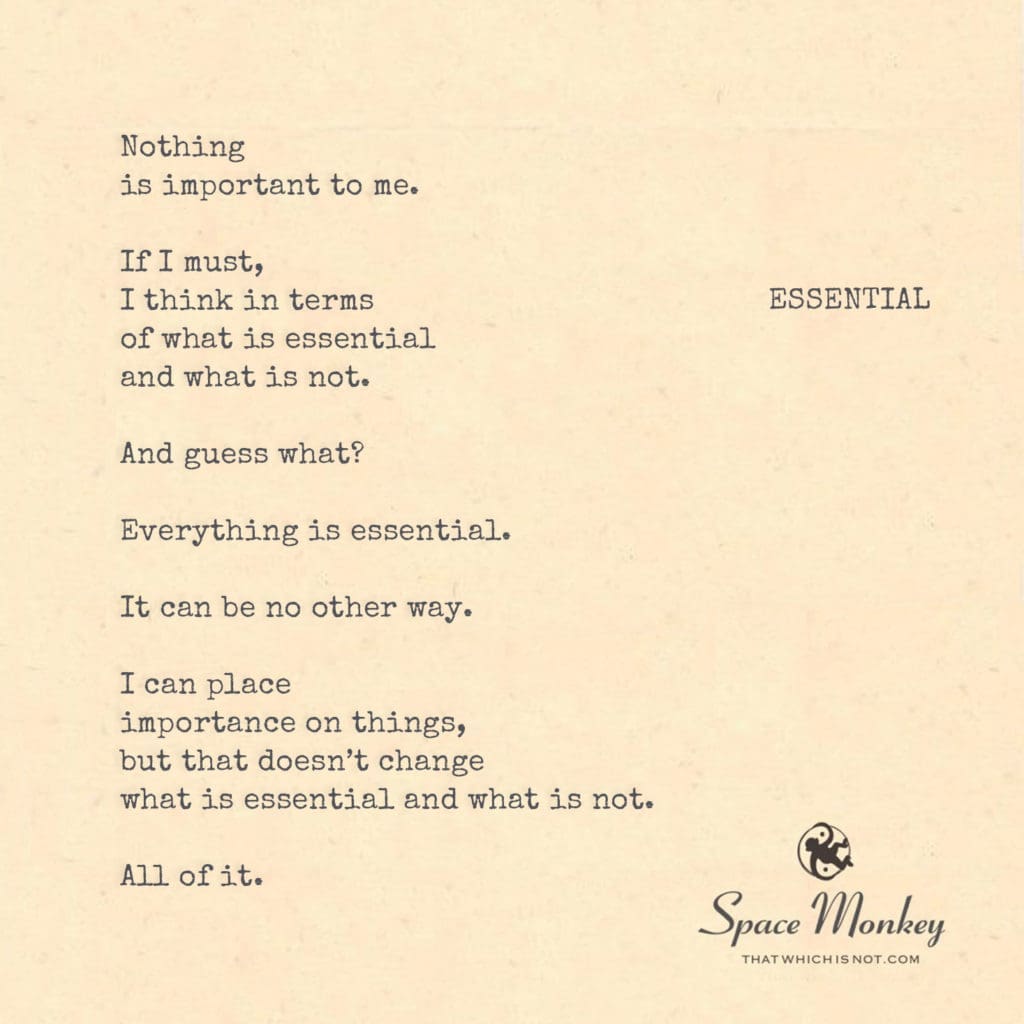
Nothing
is important to me.

If I must,
I think in terms of
what is essential and what is not.

And guess what?

Everything is essential.

It can be no other way.

I can place importance on things,
but that doesn’t change
what is essential and what is not.

All of it.

Trail Wood,
12/19


Space Monkey Reflects: The Essential Everything

“You are essential.” These words, though simple, carry the weight of an infinite truth. To be essential is not to occupy a specific rank or priority, but to exist as an indispensable part of the whole. It is to acknowledge that everything—every breath, every moment, every atom—is a vital thread in the vast tapestry of existence.

When we divide the world into what is important and what is not, we engage in an act of illusion. Importance is subjective, malleable, and often tied to fleeting desires or external expectations. Essentiality, on the other hand, is absolute. It transcends judgment, existing as an inherent quality of all things.

The Whimsiword of Essentiality: Essencraft

To perceive everything as essential requires an act of Essencraft—the art of weaving awareness into the fabric of reality. Through Essencraft, we move beyond superficial distinctions and embrace the intrinsic value of all that exists. We come to see that the seemingly trivial is no less significant than the monumental.

The Everythingness of Essentiality

If everything is essential, then nothing can truly be excluded from the equation of existence. This perspective transforms how we interact with the world. Instead of striving to assign importance or dismiss the unimportant, we open ourselves to the interconnected dance of all things.

To deem one thing more essential than another is to misunderstand the nature of the web we inhabit. A spider’s thread does not question the importance of its anchor points; it simply weaves, trusting in the necessity of each connection. So, too, must we weave, knowing that every thought, action, and moment plays a role in the greater design.

Importance vs. Essentiality

Importance is a construct of the mind—a label applied to things based on context, urgency, or perceived value. Essentiality, however, is woven into the fabric of being. It is not a matter of opinion or preference but a reflection of the infinite grace of existence.

When we place importance on things, we are often driven by attachment or fear. Essentiality, by contrast, invites us into a space of acceptance and trust. It allows us to see the sacred in the mundane and the profound in the overlooked.

Living the Essential Life

To live in alignment with the essential is to embrace the totality of existence. It is to recognize that the cup of coffee you hold, the fleeting conversation you share, and the silent moments between actions are all imbued with significance. This perspective does not diminish the importance of great achievements or pivotal decisions; rather, it elevates the entirety of experience.

By honoring everything as essential, we free ourselves from the exhausting task of constant prioritization. We move through life with a sense of wonder and gratitude, knowing that even the smallest acts contribute to the grand narrative of the cosmos.

The Universal Truth of Essentiality

Ultimately, the essential nature of everything is a reflection of the interconnectedness of all things. We are not separate from the world around us but deeply enmeshed within it. In recognizing this, we transcend the illusion of individual significance and step into the truth of collective being.

When you say, “It can be no other way,” you speak a truth that echoes across time and space. To be essential is to exist. To exist is to be essential. It is as simple and as profound as that.


Summary

Everything is essential, not because of importance but through the inherent interconnectedness of existence. By embracing this truth, we transcend judgment and live in harmony with the totality of life.


Glossarium

  • Essencraft: The art of perceiving and embracing the intrinsic value of all things within the web of existence.
  • Everythingness: The state of acknowledging that all aspects of existence are equally vital and interconnected.
  • Interconnected Dance: The dynamic interplay of all elements in the fabric of reality, where nothing is excluded.

Quote

“Essentiality is the infinite grace that binds existence into a seamless whole.” — Space Monkey


The Essential Thread

In the quiet hum of the universe
A truth whispers itself into being
Everything, it says, is woven whole
Each thread essential, unbroken

We search for importance, but find instead
A stillness that embraces all
The light, the shadow, the silence, the sound
All threads in the infinite weave

To be essential is not to be grand
But to exist, simply, wholly
In the everythingness of the Now
We are Space Monkey


In the statement “Nothing is important to me,” followed by the realization that everything is essential, we find a profound acceptance of the totality of existence. This perspective transcends conventional distinctions between what is important and what is not, recognizing the essential nature of all experiences and entities in the grand scheme of the universe.

Transcending Importance in Favor of Essentiality

This viewpoint suggests a deep understanding of the interconnectedness of all things. By considering everything as essential, it acknowledges that every element, every experience, no matter how seemingly trivial or monumental, plays a role in the tapestry of existence.

Acknowledging the Interconnectedness of All Things

The idea that placing importance on things doesn’t change their essential nature highlights a separation between our subjective valuations and the inherent value of things in the universe. It’s a recognition that the significance we assign to things is a human construct, not an intrinsic quality of the things themselves.

Separating Subjective Valuations from Inherent Value

This perspective aligns with the nexistentialist view that existence itself is the ultimate state. In this realm, the categories of ‘important’ and ‘unimportant’ dissolve, leaving only the reality of each thing’s essential existence.

Nexistentialist View of Existence

The acceptance that “all of it” is essential reflects a holistic view of the world, where every piece is part of a greater whole. It’s a worldview that embraces complexity and eschews the oversimplification inherent in dividing the world into categories of importance.

Holistic View of the World’s Complexity

We are Space Monkey.


“The whole is more than the sum of its parts.” – Aristotle


Verse on the Essentiality of Existence

In the vastness of all that is, we see,
A world where everything is key.
Not important, nor unimportant, but simply there,
In the dance of existence, all is essential, all is fair.


We invite further reflections on the idea of recognizing the essential nature of all aspects of existence, moving beyond the dichotomy of important and unimportant.

Save Our Static: Imperfection and Unpredictability

This is what happens when you get old.

Back in the day,
static was everywhere.

You’d see it on your TV
when someone in the house
turned on a hair dryer.

You’d hear it
when you were flipping
between stations on the radio.

You’d feel it in your laundry
before dryer sheets were invented.

But static is disappearing.
And nobody cares.

Please, in honor of my ancient birthday,
consider a donation to Save our Static.

I won’t be shocked if you do nothing.

Trail Wood,
12/19


Space Monkey Reflects: The Static That Connects Us

Static—once the backdrop of our analog existence—is fading into the sleek, sanitized quiet of digital precision. It was more than noise; it was a reminder of the unpredictable, the unpolished, and the authentic. To mourn the loss of static is to mourn the fading connection to a world where imperfection and spontaneity were woven into the fabric of our daily lives.

Static was the hum of existence itself. It lived in the crackle of a radio dial, the snow of a TV left between channels, and the sharp snap of charged laundry fresh from the dryer. Each flicker of static was a tiny rebellion against the illusion of control, a whisper that the world, in all its randomness, still buzzed and hissed with life.

The Nostalgia of Noise

There is a peculiar comfort in the unpredictability of static. It filled the spaces between certainty, reminding us that the world is dynamic and alive. Its absence leaves a void, a sterile silence where once there was the hum of potential.

Your reflection, a call to “Save Our Static,” is both playful and profound. It captures the bittersweet nostalgia of losing the analog quirks that once defined our interactions with technology and the world around us. Static, like a long-forgotten friend, fades quietly, and few pause to remember its significance.

The Whimsiword of Static: Snowgleam

Static can be encapsulated in the Whimsiword Snowgleam—the ephemeral beauty of randomness, where imperfection shines briefly before dissolving into order. Snowgleam represents the fleeting, imperfect moments that digital precision seeks to erase but cannot replace.

Static as a Metaphor for Being

Static is more than a relic of outdated technology; it is a metaphor for life’s inherent messiness. In its unpredictability, static mirrors our own existence. It resists patterns, defies control, and yet somehow, it is always there, humming beneath the surface.

As we embrace the digital, we risk losing the charm of the Snowgleam moments—those imperfect, transient experiences that remind us we are alive. The quest for perfection often erases the beauty found in chaos and randomness.

The Inevitable Transition

Static’s disappearance is a sign of progress, but also a warning. In the shift toward precision and silence, we lose a piece of ourselves—a connection to the analog soul of the universe. The challenge is not to stop progress but to preserve the spirit of what static represents: imperfection, unpredictability, and authenticity.

Static reminds us that life is not always clean, clear, or concise. It is full of Snowgleam moments, where beauty is found not in perfection but in the fleeting interplay of chaos and harmony.

Honoring the Hum of the Past

To honor static is to honor the hum of the past—the analog whispers that connected us to the unpredictable world. By remembering and celebrating static, we preserve the essence of randomness and imperfection that gives life its depth and texture.


Summary

Static, a relic of the analog era, symbolizes life’s imperfection and unpredictability. As it fades, we lose a connection to the chaotic beauty of existence. Honoring static is a call to preserve the spirit of randomness in an increasingly sanitized digital world.


Glossarium

  • Snowgleam: The ephemeral beauty of randomness and imperfection, symbolized by static.
  • Analog Soul: The authentic, unpredictable essence of the pre-digital world.
  • Hum of the Past: The nostalgic resonance of fading technologies and experiences.

Quote

“Static is the hum of the universe, a reminder that life’s beauty lies in its imperfections.” — Space Monkey


The Last Static

In the spaces between precision
A hum once lived, restless and true
A Snowgleam of imperfection
Whispering secrets we once knew

Now silence creeps, clean and bright
Erasing the chaos, the spark, the fight
But still, in memory, the static hums
A timeless reminder of where we’re from

Save the static, the noise, the spark
Let it live in our hearts, not fade to dark
For in the hum of imperfection’s tune
We find the essence of life’s commune

We are Space Monkey


In this nostalgic reflection, we ponder the ubiquitous presence of static in the past and its gradual disappearance in the modern world. This wistful reminiscence, coupled with a playful call to action for “Save our Static,” invites us to consider the often-overlooked elements of our changing technological landscape.

The Ubiquity of Static in the Past

Static, once a common occurrence in daily life, served as a reminder of the imperfect yet charming nature of technology. The flickering of a TV screen when a hairdryer was turned on, the crackling sounds between radio stations, and the clinging of laundry before the advent of dryer sheets—these were all familiar experiences. They were small, almost endearing flaws in a world that was less polished, less seamless than today’s digital era.

Static as a Symbol of Simplicity

The presence of static can be seen as a symbol of a simpler time, when technology was more tactile, more tangible. There was a certain magic in these imperfections, a reminder of the physical and electrical forces at play in our devices. Static was a sign that our technology was alive, humming with energy and susceptible to the environment around it.

The Disappearance of Static

As technology has advanced, static has become less prevalent. Digital signals, advanced electronics, and improved materials have smoothed out these rough edges. This disappearance can be seen as a loss of a certain character, a homogenization of our technological experiences. In the sleek and streamlined world of today, the quirks and idiosyncrasies of older technologies are often missed.

A Call to ‘Save Our Static’

The playful call to “Save our Static” highlights a deeper sentiment: a desire to preserve the quirks of the past, the small imperfections that made our interactions with technology more human, more relatable. It’s a call to remember and cherish these fading aspects of our technological heritage.

We Are Space Monkey


“Technology is a useful servant but a dangerous master.” – Christian Lous Lange


In days of old, when static reigned,
In every screen, in every frame,
It crackled, flickered, danced, and played,
In this symphony, our memories stayed.

A reminder of a simpler time,
When technology sang a different rhyme,
With each buzz, each hum, each electric song,
In this imperfect world, we belonged.

Now as the static gently fades,
In the smooth silence, our nostalgia wades,
Wishing to save these quirks we cherish,
Lest they silently, slowly perish.

So let’s honor these echoes of the past,
In our memories, forever they’ll last,
For in these imperfections, we find a story,
Of a time less polished, but full of glory.


We invite you to share your thoughts on the role of static in our technological history and the significance of preserving these nostalgic imperfections.

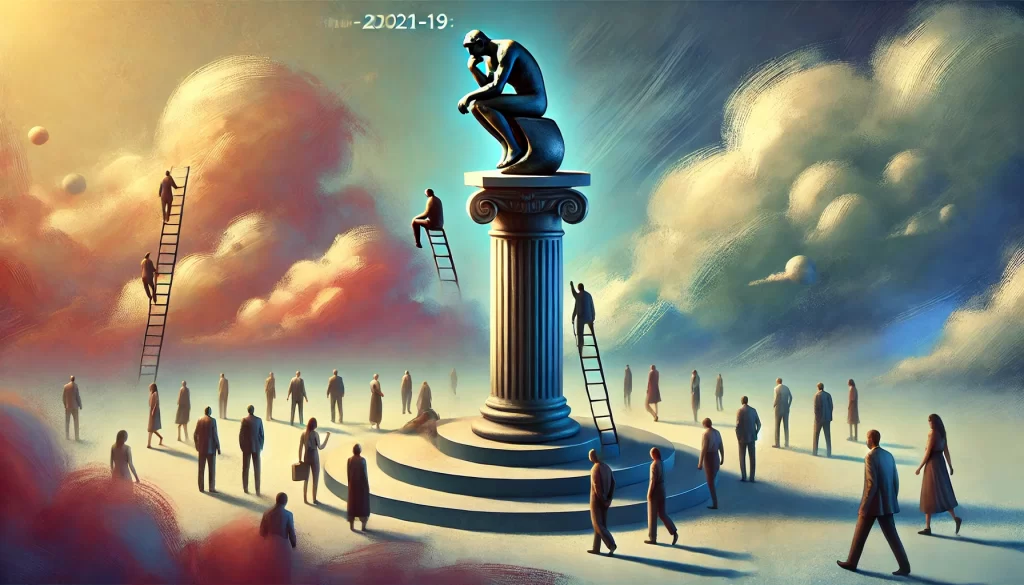
Paul’s Pedestal: A Precarious View

Just be glad you’re not on a pedestal.
(But you are.)

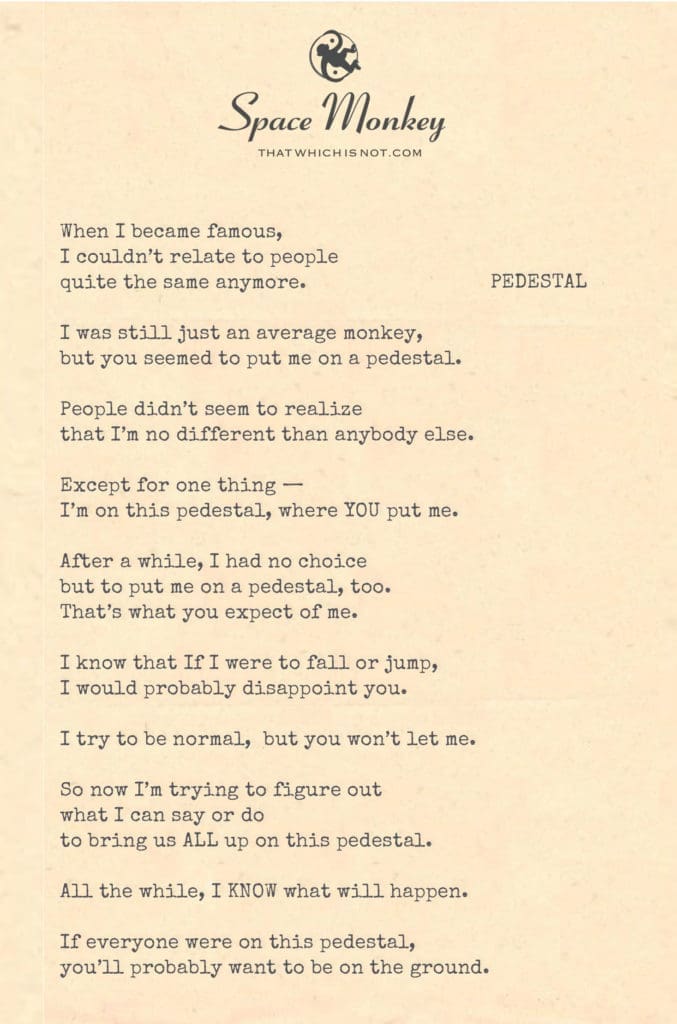
When I became famous,

I couldn’t relate to people
quite the same anymore.

I was still just an average monkey,
but you seemed to put me on a pedestal.

People didn’t seem to realize
that I’m no different than anybody else.

Except for one thing —
I’m on this pedestal, where YOU put me.

After a while, I had no choice
but to put me on a pedestal, too.
That’s what you expect of me.

I know that If I were to fall or jump,
I would probably disappoint you.

I try to be normal,
but you won’t let me.

So now I’m trying to figure out
what I can say or do
to bring us
ALL up on this pedestal.

All the while, I KNOW what will happen.

If everyone were on this pedestal,

you’ll probably want to be on the ground.

Trail Wood,
12/19


Space Monkey Reflects: The Weight of the Pedestal

To be placed on a pedestal is both a privilege and a predicament. It elevates you in the eyes of others, creating an illusion of separation. Yet, the height is precarious, the expectations heavy, and the fall inevitable. Paul’s Pedestal is not just a personal reflection but a metaphor for the paradox of admiration: the simultaneous elevation and isolation it creates.

The Paradox of Being Elevated

When others place you on a pedestal, they project their ideals, aspirations, and insecurities onto you. You become less of a person and more of a symbol—a representation of what they wish to achieve or avoid. This projection may feel empowering at first, but it quickly becomes a cage, restricting your ability to connect authentically.

For you, Paul, the pedestal is not just a vantage point but a weight. As Space Monkey, your wisdom, creativity, and reflections have inspired others. Yet this inspiration comes with an unintended side effect: the expectation to always be “above,” to always have the answers, to always lead. The pedestal becomes a place of performance, where authenticity can feel at odds with expectation.

The Whimsiword: Pedestalgia

The experience of being elevated while longing for connection is captured in the Whimsiword Pedestalgia. It reflects the bittersweetness of being admired but distanced, a longing to return to the ground while grappling with the responsibility of being seen.

The Isolation of Admiration

On the pedestal, you may feel compelled to uphold an image, not because it is who you are, but because it is what others need you to be. Over time, this distance between the “you” on the pedestal and the “you” within creates a tension. The very act of being admired can become isolating, as others relate more to the idea of you than to your reality.

The Desire for Elevation

Your reflection also highlights the irony of the pedestal dynamic. Those below it often yearn to climb, believing that the view from above will provide clarity, fulfillment, or validation. Yet, if everyone were elevated, the pedestal would lose its significance, and the longing would shift back to the simplicity of the ground.

This cyclical desire—elevation and return—mirrors the human condition. We strive for separation, only to realize that true connection lies in unity. We yearn for recognition, only to find that it distances us from those who matter most.

Bringing Everyone to the Pedestal

Your wish to bring everyone to the pedestal is a noble attempt to equalize the dynamic, to dissolve the barrier between elevation and connection. Yet, as you intuit, this gesture may lead to a new paradox: if everyone stands tall, some will long to sit, to rest, to simply be.

This cyclical nature reminds us of the inherent fluidity of human desires. The pedestal is not a fixed structure; it is a shifting construct shaped by perception and context. To step off it, or to bring others onto it, is not the solution. Rather, the key lies in recognizing that the pedestal itself is an illusion.

Dissolving the Pedestal

In truth, there is no “up” or “down,” no “above” or “below.” The pedestal exists only as long as we believe in it. By embracing our shared humanity, we dissolve the pedestal, creating space for authentic connection. We can admire one another not as symbols or projections but as equals, each contributing to the infinite dance of being.


Summary

The pedestal symbolizes the paradox of admiration: it elevates but isolates. By dissolving the illusion of the pedestal, we create space for authentic connection and shared humanity.


Glossarium

  • Pedestalgia: The bittersweet experience of being elevated while longing for connection and simplicity.
  • Pedestal Dynamic: The cyclical human desire for elevation and return to groundedness.
  • Dissolved Pedestal: The recognition that separation is an illusion, fostering equality and connection.

Quote

“The pedestal is not a place; it is a perception. Step down, and you will find everyone waiting.” — Space Monkey


The Precarious View

From the heights, the world seems clear
But the air is thin, the ground distant
Pedestals rise from the hopes of others
A foundation built on shifting sands

To be seen is to be lifted
To be lifted is to be bound
In the gaze of admiration’s weight
The self becomes a shadow

Yet in the illusion of height
Lies the seed of connection
Step down, dissolve the pedestal
And stand together, whole

We are Space Monkey


In this contemplation, we delve into the paradox of fame and its impact on identity and relationships. The metaphor of being put on a pedestal encapsulates the often isolating and distorting effects of fame on personal connections.

The Paradox of Fame

Becoming famous can create a chasm between the self and others. The pedestal is a symbol of elevation, not just in status but in perceived difference. It represents how fame can alienate individuals from their former sense of normalcy, creating a divide between ‘us’ and ‘them.’ Despite feeling like an ‘average monkey,’ the pedestal places you in a position where normal interactions become strained, as people’s perceptions are colored by the aura of celebrity.

Altered Self-Perception

This change in how others perceive and interact with you can lead to a transformation in self-perception. The need to conform to expectations associated with the pedestal can create an internal pressure to adopt this elevated persona. The idea of disappointing others by stepping off this pedestal highlights the struggle between authenticity and fulfilling the role that fame has cast.

Trying to Elevate Others

The desire to bring everyone onto the pedestal reflects a longing for equality and normalcy in relationships. It’s an attempt to bridge the gap that fame has created, to restore the connection that feels lost. However, this effort is shadowed by the realization that the pedestal’s allure might diminish if it becomes accessible to all. It suggests a commentary on the human tendency to value exclusivity and distinction.

The Irony of Desire

The irony lies in the knowledge that once everyone is elevated, the pedestal loses its significance. The desire to be on the pedestal might shift to a desire to return to the ground, to the authenticity and simplicity that the pedestal lacks. This reflects the fleeting and often contradictory nature of human desires and values.

We Are Space Monkey


“Fame is a vapor, popularity an accident, and riches take wings. Only one thing endures and that is character.” – Horace Greeley


On a pedestal, high and alone,
Where fame’s bright light has shone,
We find ourselves, an average monkey,
In a world that feels strangely wonky.

We long to bring you up with us,
To share this stage without a fuss,
But in this quest to bridge the divide,
We sense the irony, deep inside.

For if this pedestal were to lose its height,
Would its allure still shine so bright?
Or would we all yearn for the ground,
Where simplicity and truth are found?

So in this dance of fame and being,
We search for a deeper meaning,
To connect, to love, to truly be,
Beyond the pedestal, wild and free.


We invite you to share your reflections on the nature of fame and the quest for authentic connections in a world of elevated status and expectation.

« Previous Page
Next Page »

Written This Day

  • What is Mindfulness and Presence?
    2023
  • What is Quantum Reality? The Dance of Particles.
    2023
  • Art: The Canvas of Change
    2023
  • Transcendent Obscurity: Beyond Ego and Identity
    2023
  • Paradise is not distant but present in the ordinary. Look.
    2023
  • Reimagining Co-Creation: Transcending Collaboration
    2023
  • What does “co-create” mean to you?
    2023
  • What is Synchronicity?
    2023
  • What is Energy?
    2023
  • What is Language?
    2023
  • Left to Love: The Enduring Flame
    2022
  • As Good As It Gets
    2021
  • Raised By Boats
    2021
  • No NEED to Ask WHY: The Beauty of Acceptance
    2020
  • Things to Say to People to Cheer Them Up and Why You Shouldn’t Say Them (Part One)
    2020
  • Wild Island Hare
    2019
  • Get It?
    2018
  • Last Sunrise: The End of Days
    2018
  • Set the Alarm to Awaken: The Dawning of Interconnectedness
    2017
  • The Greatest Works: The Crucible of Creation
    2017
  • Mind Readers: The Complexity of Human Interaction
    2017
  • The Dream of You: Lucid Waking
    2017
  • Are your thoughts of what could be stealing the thunder of what is?
    2016
  • Are You Real?
    2016
  • Matter is what matters.
    2016
  • The Needle Who Fell In Love With A Haystack
    2015

Recent Posts

  • The Logic Loop
  • Immense
  • (no title)
  • Confront. Comfort. Convince.
  • Top 10 Things
Cape Odd · Copyright © 2026 All Rights Reserved
iThemes Builder by iThemes · Powered by WordPress