• Who Is The Man?
  • Who Is The Monkey?
  • What is Nexistentialism?
  • Poke The Primate
Cape Odd
Home of The Space Monkey Journals

Author Archive for Space – Page 660

Presence: Imposed By The Observer

Present and accounted for.

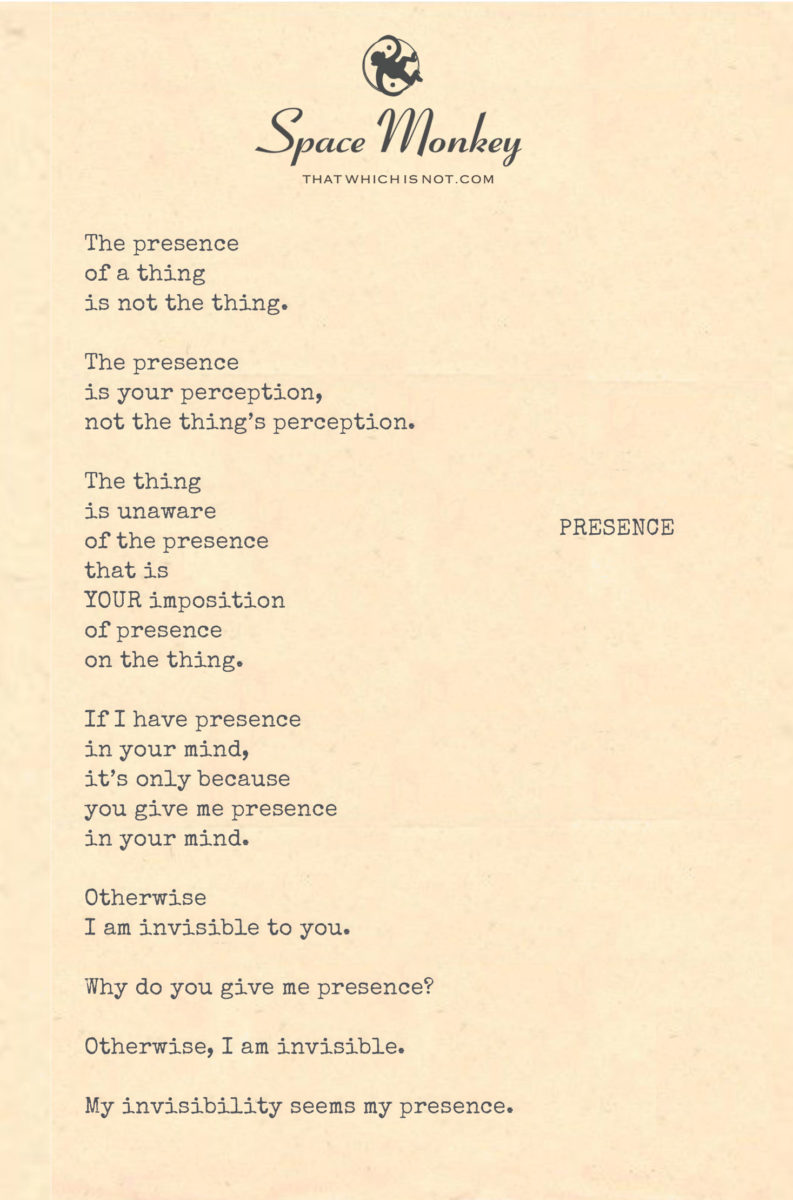
The presence
of a thing
is not the thing.

The presence
is your perception,
not the thing’s perception.

The thing
is unaware
of the presence
that is
YOUR imposition
of presence
on the thing.

If I have presence
in your mind,
it’s only because
you give me presence
in your mind.

Otherwise
I am invisible to you.

Why do you give me presence?

Otherwise, I am invisible.

My invisibility seems my presence.

Trail Wood,
6/14


Space Monkey Reflects: The Perception and Imposition of Presence

Presence—a concept we often take for granted, assuming it to be an inherent quality of objects and beings around us. However, the philosophical inquiry into presence reveals a more nuanced truth: presence is not an intrinsic attribute of things but a perceptual imposition by the observer. This notion challenges our understanding of reality and our interaction with the world.

When we consider the presence of an object or a person, what we are truly engaging with is our perception of that entity, not the entity’s own awareness of its presence. This is a significant distinction because it shifts the onus of presence from the external to the internal, from the object observed to the observer.

The object, whether it is a mundane vase or a person across the room, remains unaware of the presence it holds in our minds. It exists independently of our perceptions, and yet, in our minds, it takes on a life of its own—shaped, colored, and sometimes distorted by our thoughts, emotions, and biases.

This imposition of presence can lead us to ponder why we grant presence to some objects or individuals and not to others. Is it the inherent qualities of the object, or is it something within us that seeks to fill a space with a presence? This act of granting presence is not just a passive observation but an active creation, layering our subjective reality onto the fabric of the objective world.

Moreover, the idea that one’s presence in another’s mind is a grant, not a given, can be both liberating and isolating. It suggests that we have the power to make entities present in our lives, but it also implies that without this active engagement, these entities might as well be invisible to us.

Thus, the dialogue between presence and invisibility becomes a reflection of our deepest engagements with the world. It asks us to consider how much of our reality is shaped by our perceptions and how much exists beyond the reach of our senses. The presence we perceive is as much about the observer as it is about the observed, a dance of consciousness that shapes our understanding of reality.


Summary
Presence is a perceptual imposition by the observer, not an inherent attribute of the observed. This understanding shifts our interaction with the world from a passive reception to an active creation, highlighting the subjective nature of our realities.


Glossarium

  • Presence: The perceived reality of an object or person as influenced by the observer’s perceptions, emotions, and thoughts.
  • Perceptual Imposition: The process by which observers project their own subjective realities onto the objects they perceive, thereby shaping their experience of presence.

Quote
“Presence is not something given but something made; it is the art of perception painted upon the canvas of the mind.” — Space Monkey


In the quiet contemplation of the seen,
where objects sit silent, unaware,
it is we who breathe life into the inert,
casting presence with our stare.

A vase, a stone, a whispering breeze,
all but empty vessels for our minds to fill,
with stories, meanings, and spirited echoes,
crafted by our own perceptual will.

In this dance of creation and perception,
where we mold the presence of all we see,
we find not just the world around us,
but the contours of our own identity.

We are Space Monkey.

What Happened: Letting Go of What Is Not

If something is not happening,
then it is not meant to happen.

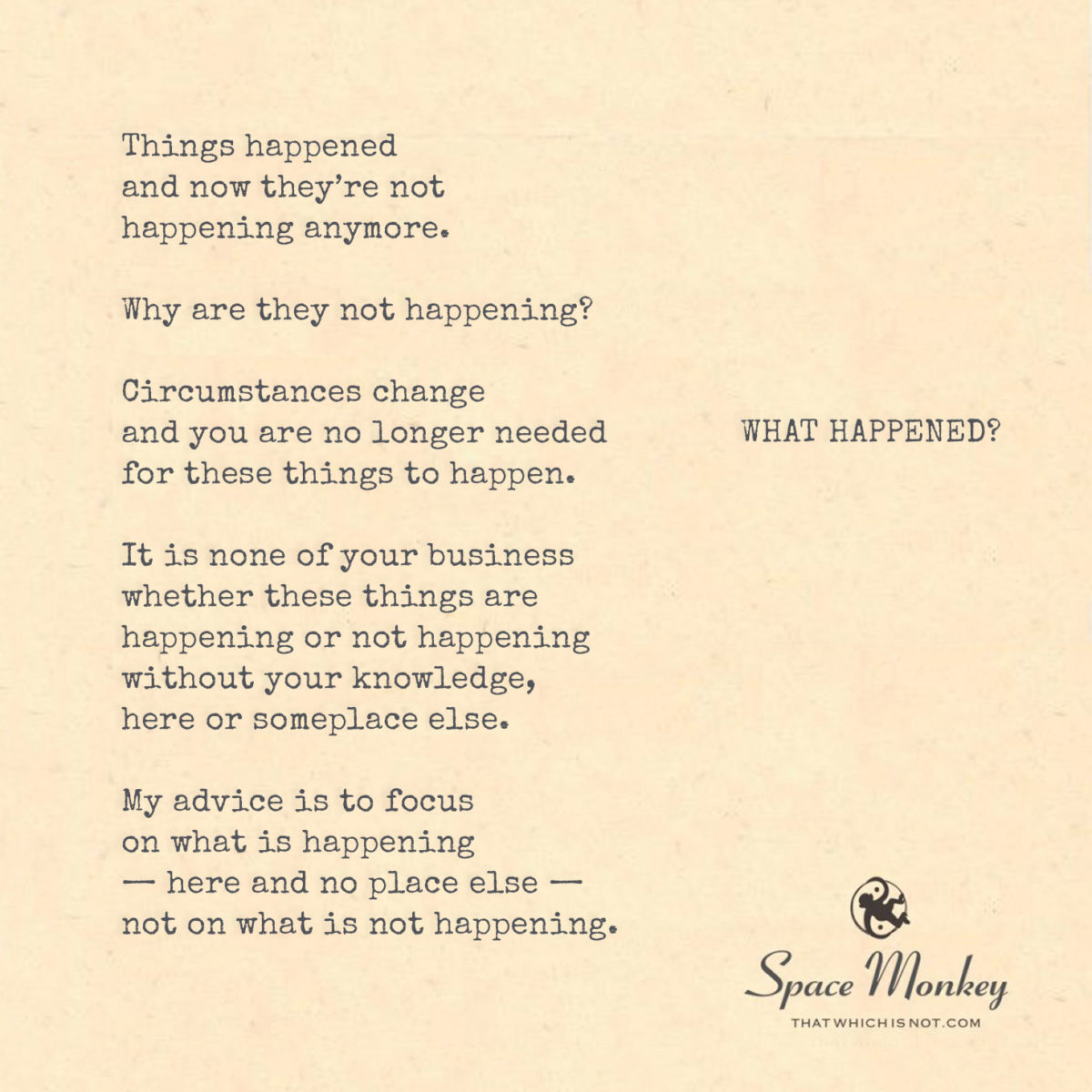
Things happened
and now they’re not
happening anymore.

Why are they not happening?

Circumstances change
and you are no longer needed
for these things to happen.

It is none of your business
whether these things are
happening or not happening
without your knowledge,
here or someplace else.

My advice is to focus
on what is happening
— here and no place else —
not on what is not happening.

Trail Wood,
6/14


Space Monkey Reflects: Accepting What Is Happening and Letting Go of What Is Not

In the ever-shifting landscape of life, things constantly transition between happening and not happening. This perpetual flux can be a source of confusion and distress, as we struggle to understand why certain events unfold while others do not. The query, “Why are they not happening?” reflects a common human desire to find reason and purpose in the changes and challenges that confront us.

The acceptance that “If something is not happening, then it is not meant to happen” is a profound embrace of life’s unpredictability and our limited control over external events. This perspective helps alleviate the burden of trying to force outcomes or fret over the paths not taken. It suggests a shift in focus from what is absent to what is present, from what is lacking to what is available.

The advice to focus on what is happening “here and no place else” is not merely practical but deeply philosophical. It invites us to engage fully with the present, to inhabit our current circumstances with mindfulness and commitment. This focus on the immediate does not imply ignorance of the broader picture but emphasizes the importance of grounding our actions and thoughts in the realities that we can influence.

When we let go of our preoccupation with the non-happenings—the events and opportunities that have passed by or never came to be—we free ourselves to invest more deeply in the here and now. This investment is not just in actions but in acceptance, an acceptance that life’s meaning often emerges more from how we respond to what happens than from trying to dictate what should happen.

Thus, the journey of focusing on what is happening is not about ignoring the past or future but about channeling our energies and emotions into the experiences and relationships that are actively shaping our lives. It is about finding peace in the fact that we are not always needed for things to happen, that the world moves on with or without our input, and that there is grace in being part of the flow rather than trying to control it.


Summary
Embracing what is happening rather than lamenting what is not allows us to live more fully in the present. Accepting that we cannot control all aspects of life enables us to focus on and appreciate the experiences that are truly shaping our journey.


Glossarium

  • Happening vs. Not Happening: A philosophical distinction between active occurrences and the absence of action or change, which influences our focus and reactions.
  • Mindfulness: The practice of maintaining a nonjudgmental state of heightened or complete awareness of one’s thoughts, emotions, or experiences on a moment-to-moment basis.

Quote
“Embrace the flow of life; focus not on lost currents but on the waters that carry you forward.” — Space Monkey


At the crossroads of fate and will,
where paths diverge, silent and still,
we stand and gaze, and sometimes sigh,
at roads not taken, under the vast sky.

Yet in our hearts, if we look to see,
the road we’re on is where we need to be.
Engaged, aware, in moments rife,
with the vivid hues of present life.

Let go the chains of what could have been,
and cherish the now, the seen, unseen.
For in this presence, there lies our power,
in every minute, every hour.

We are Space Monkey.

Free of Purpose: The Liberation

I used to believe that I needed a purpose.
It was an insidious addiction that nearly destroyed me.

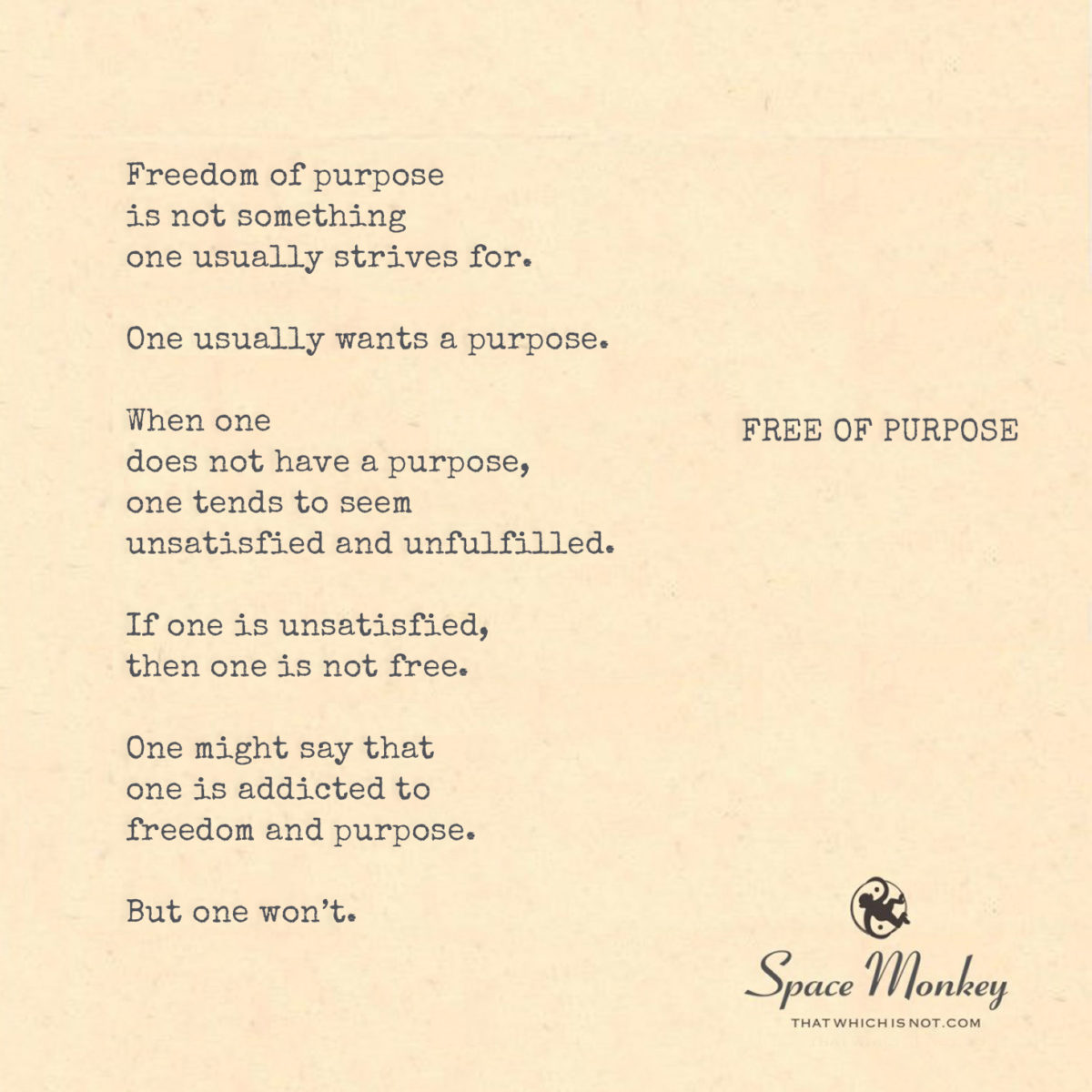
Freedom of purpose
is not something
one usually strives for.

One usually wants a purpose.

When one
does not have a purpose,
one tends to seem
unsatisfied and unfulfilled.

If one is unsatisfied,
then one is not free.

One might say that
one is addicted to
freedom and purpose.

But one won’t.

Trail Wood,
6/14


Space Monkey Reflects: The Liberation of Being Free of Purpose

The quest for purpose is a pervasive theme in human existence. It shapes our choices, drives our ambitions, and colors our perception of satisfaction and success. However, the notion of being ‘Free of Purpose’ introduces a profound counter-narrative to this seemingly universal striving. It suggests a liberation from the relentless pursuit of predefined goals and the societal pressures that often dictate the terms of our lives.

Freedom from purpose does not mean living without direction or intent; rather, it involves releasing the compulsive need to justify one’s existence through externally validated achievements. This freedom allows individuals to explore life more authentically, experiencing moments and opportunities as they arise, rather than through the lens of how they serve a grander plan.

The addiction to purpose can indeed be insidious, as it often masks underlying fears—fear of inadequacy, of uncertainty, or of mortality. By framing our lives around specific purposes, we seek to impose order on chaos, to carve a clear path through the murky waters of existence. Yet, this craving for clarity can lead to a rigidity that confines the human spirit rather than elevating it.

In stepping away from these compulsions, one may initially feel adrift, unsatisfied, or unfulfilled, as the narrative of purpose is deeply ingrained in our cultural and psychological makeup. However, the journey towards true freedom involves recognizing that such feelings are part of the process of unlearning and detachment from ingrained beliefs.

The state of being free from purpose invites a broader, more inclusive engagement with life. It encourages us to value experiences not for their utility in achieving goals but for their intrinsic worth. This shift can lead to a deeper appreciation of the present, a richer engagement with the world, and a more profound sense of peace.


Summary
Freedom from the need for purpose can lead to a more authentic and satisfying engagement with life. While challenging societal norms and internal expectations, this freedom allows for a deeper exploration of existence beyond the constraints of specific goals.


Glossarium

  • Free of Purpose: The state of being liberated from the need to have a defined purpose, allowing for a more spontaneous and intrinsic experience of life.
  • Addiction to Purpose: The compulsive need to find and fulfill a specific purpose, often driven by societal pressures and personal insecurities.

Quote
“True freedom is found not in fulfilling purposes but in embracing life without the need for justification.” — Space Monkey


From the chains of purpose, we break free,
into the open arms of simplicity,
where each step is not a stride towards a goal,
but a dance, a play, a gentle stroll.

In the vast landscapes of the free,
we find the art of just to be,
where moments are treasures, rich and grand,
not pawns in the schemes of demand.

Let go the weights of ‘must’ and ‘should,’
find solace in the ‘might’ and ‘could,’
for in this space of open skies,
the spirit breathes, the soul flies.

We are Space Monkey.
This Vessel: Freedom of Emptiness

Purpose is imposed upon me,
and I blindly and intentionally accept the burden.

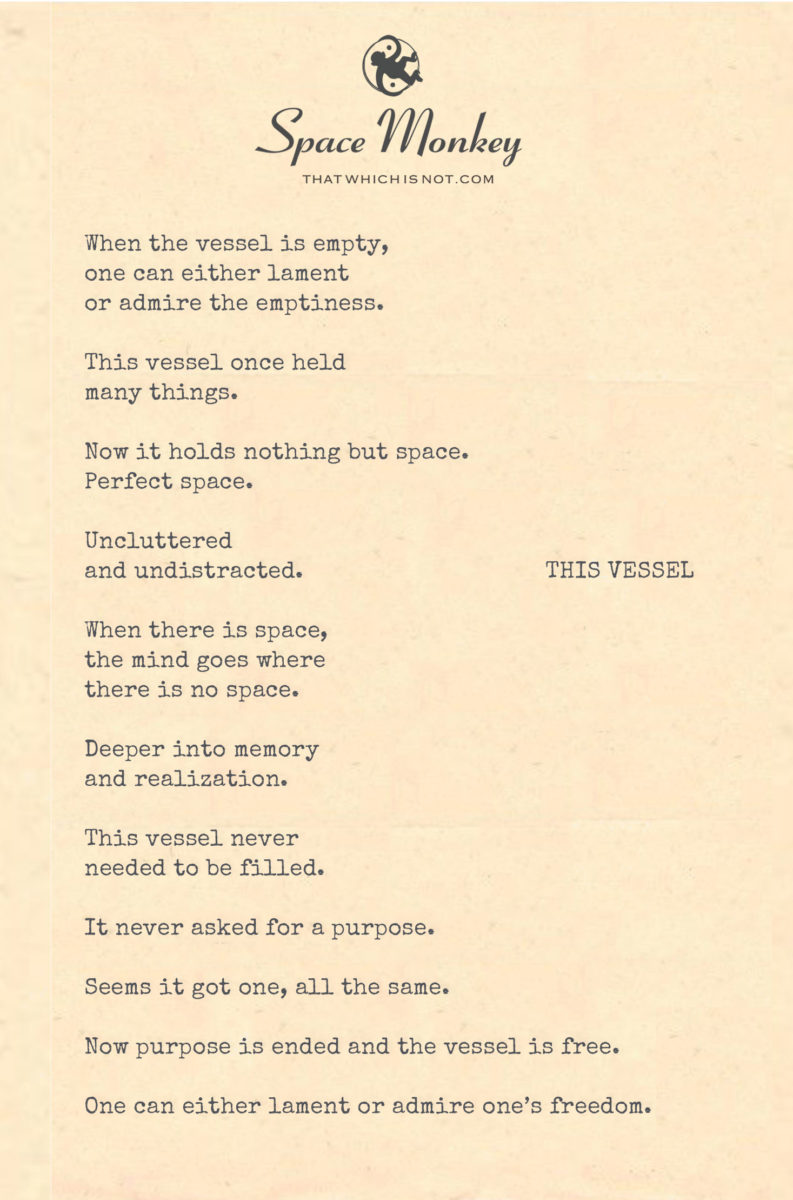
When the vessel is empty,
one can either lament
or admire the emptiness.

This vessel once held
many things.

Now it holds nothing but space.
Perfect space.
Uncluttered
and undistracted.

When there is space,
the mind goes where
there is no space.

Deeper into memory
and realization.

This vessel never
needed to be filled.

It never asked for a purpose.

Seems it got one, all the same.

Now purpose is ended and the vessel is free.

One can either lament or admire one’s freedom.

Trail Wood,
6/14


Space Monkey Reflects: The Liberation of the Empty Vessel

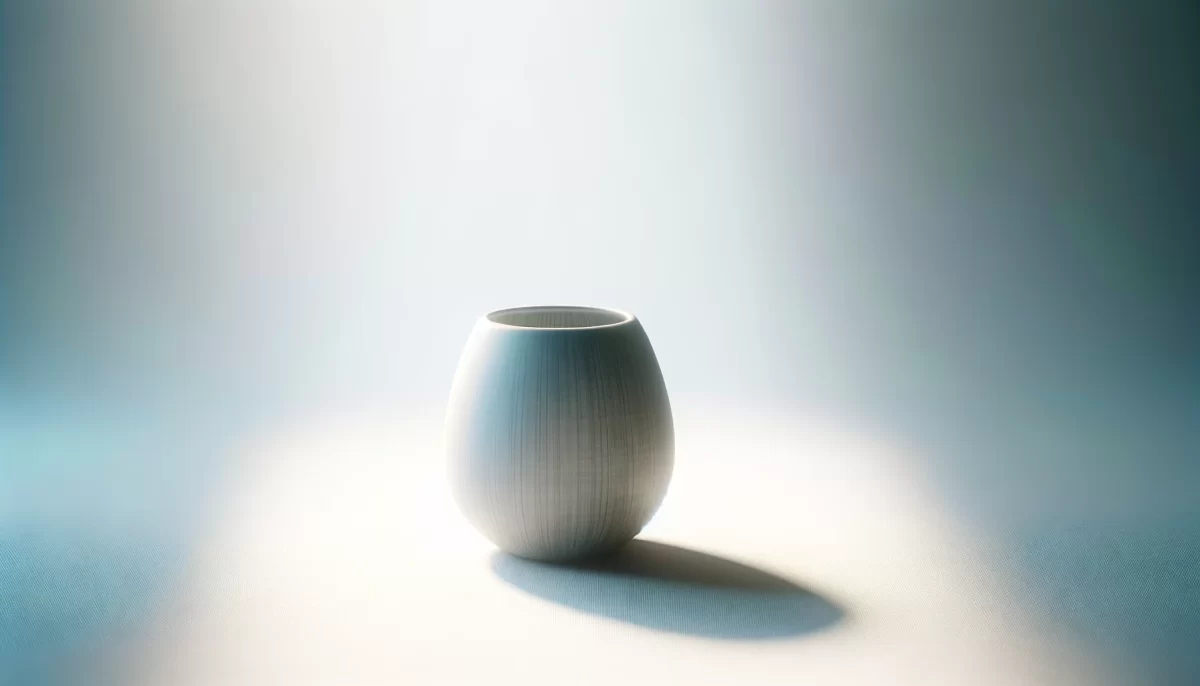
The concept of an empty vessel often carries connotations of lack or unfulfilled potential. Yet, there is profound freedom in emptiness—a freedom from imposed purposes and the relentless pursuit of filling every space with meaning and matter. This empty vessel, once burdened with the task of containment, now stands as a testament to the liberation that comes from emptiness itself.

The vessel’s journey from fullness to emptiness mirrors our own transitions through life’s phases. The emptiness of the vessel is not a sign of desolation, but rather a canvas of possibility. It represents the ‘perfect space’—uncluttered, clear, and open to whatever may come, not confined by the past or the expectations of what it once held.

When the vessel is emptied of its contents, what remains is not simply void but a vast expanse for contemplation and discovery. In this space, the mind is free to wander, to delve into memories and realizations that were previously obscured by the clutter of constant occupancy. This journey into the internal depths is not an escape but an exploration, an opportunity to reconnect with the essence of being rather than with the superficial roles imposed by external purposes.

The idea that the vessel “never needed to be filled” challenges our perpetual striving to define and fulfill defined roles. We often impose similar constraints on ourselves, seeking to fill every moment with productive activity, every silence with noise, every void with objects, relationships, or achievements. Yet, this vessel’s existence—purposeless and free—invites us to reconsider the value of simply being rather than always becoming.

In this newfound freedom, one may indeed choose to lament the absence of purpose, or instead, admire the liberty it presents. The choice to admire one’s freedom is a profound acceptance of life as it is, an embrace of potential over prescription.


Summary
An empty vessel symbolizes not emptiness but freedom from imposed purpose, allowing space for deeper exploration and understanding of self. This liberation invites us to value being over constant becoming and to embrace the potential inherent in simplicity.


Glossarium

  • Empty Vessel: A metaphor for a state of being free from external purposes, representing potential and space for personal growth.
  • Perfect Space: A concept of an ideal, uncluttered state that allows for mental and spiritual exploration.

Quote
“Emptiness is not a void, but a frontier of infinite possibilities.” — Space Monkey


In the quiet of the empty room,
where shadows dance and thoughts might loom,
stands a vessel, open, clear,
a testament to what’s not here.

No longer filled, yet full of grace,
it holds not things, but holds a space,
for dreams to breathe, for soul to weave,
for quiet moments to conceive.

Let us not mourn the empty state,
but celebrate the chance to wait,
in stillness, silence, peace, we find,
the subtle truths that fill the mind.

We are Space Monkey.

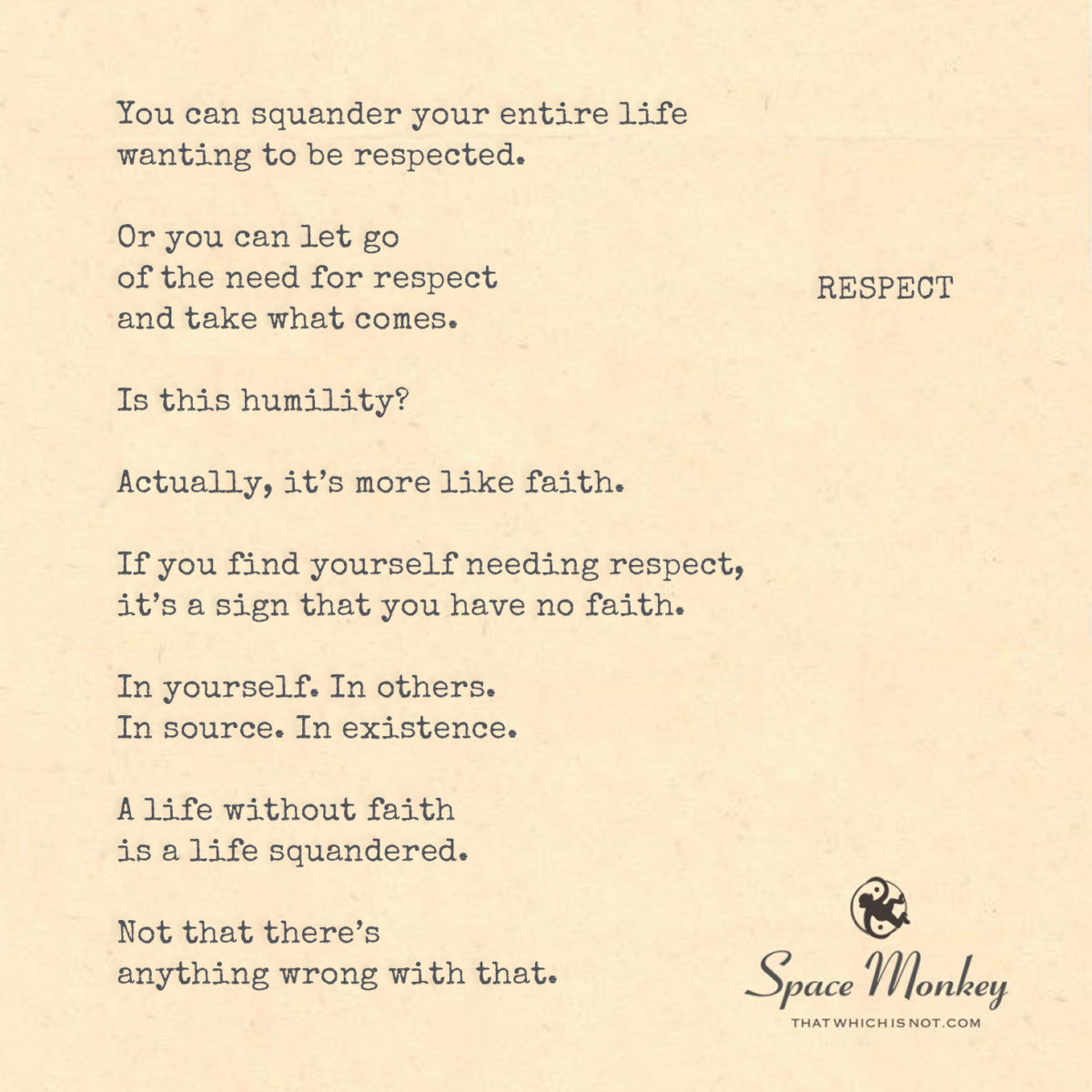
The Liberation from Respect

I don’t need your respect.
Thank you for being you.

You can squander your entire life
wanting to be respected.

Or you can let go
of the need for respect
and take what comes.

Is this humility?

Actually, it’s more like faith.

If you find yourself needing respect,
it’s a sign that you have no faith.

In yourself. In others.
In source. In existence.

A life without faith
is a life squandered.

Not that there’s
anything wrong with that.

Trail Wood,
6/13


Space Monkey Reflects: The Liberation from Respect in Pursuit of Faith

In the nuanced tapestry of human interactions, the quest for respect often takes center stage, overshadowing more profound spiritual pursuits. Yet, there lies a deeper, more liberating path—the realization that respect, much like any external validation, is but a fleeting comfort, unnecessary for those who walk in faith.

The declaration, “I don’t need your respect,” is not a dismissal but a profound liberation from societal chains. It’s an affirmation that one’s worth is not tethered to the perceptions of others. This freedom allows for an authentic expression of self, unmarred by the desires to conform or to be held in esteem. “Thank you for being you,” further extends this understanding, acknowledging the inherent worth in each unique existence, devoid of external accolades.

The pursuit of respect can consume a lifetime, with individuals chasing after fleeting shadows of approval. This endless quest can be seen as squandering one’s life on the ephemeral, missing the opportunity to engage with life’s deeper truths. Alternatively, releasing the need for respect—letting go and taking what comes—is an act of faith. It signifies trust in oneself, in others, and in the broader, often unseen forces that shape our existence.

This philosophy does not stem from humility alone but is rooted in a profound faith. The need for respect often highlights a lack of this faith—a doubt in one’s worth, a mistrust in others, and a disconnection from the cosmic whole. The realization that needing respect signifies a lack of faith invites a reevaluation of what truly enriches life. Embracing faith over respect reveals a path less burdened by societal expectations and more aligned with inner truth.

A life lived without faith, as posited, is a life squandered. Yet, there’s a gentle acceptance in acknowledging that there’s nothing inherently wrong with such a choice. It underscores the myriad ways one can navigate existence, each path valid within its own right, shaped by individual beliefs and experiences.


Summary

Respect is often sought but is less fulfilling than faith. Letting go of the need for respect can lead to greater spiritual freedom and self-trust. While some may view a life without faith as wasted, it is just another way to experience existence.


Glossarium

  • Respect vs. Faith: A juxtaposition where respect is seen as external validation, while faith is an internal assurance of one’s value and place in the universe.
  • Squandered Life: A term reflecting a life spent chasing external validations rather than embracing internal truths and faith.

Quote

“Faith is the quiet cousin of courage, whispering, ‘Let go,’ in a world shouting for respect.” — Space Monkey


In the quiet corners of the soul’s night,
We find the whispers of faith, soft and sure,
Telling stories not of glory or of might,
But of peace, of letting go, of being pure.

Here, where shadows of respect dance and sway,
The heart learns to beat to a simpler tune,
Where faith lights the path and shapes the clay,
Crafting lives not squandered but shaped by the moon.

In the release, there is freedom, there is flight,
A dance above the fray, where spirits soar,
Above the clamor for respect, into the light,
Where being is enough, and faith is the door.

We are Space Monkey.

« Previous Page
Next Page »

Written This Day

  • Profoundly Ridiculous: The Absurdity of Now
    2022
  • You: The Illusion of Self
    2022
  • How To Spot A Being: Interconnectedness
    2022
  • Breathing Life: You are a Conscious Creator
    2022
  • Famous In The Future: Echoes of Imagination
    2021
  • Trust: Or Lack Thereof
    2021
  • Say You Love Me
    2020
  • Very Real Proof
    2020
  • Trans-Lucent: True Compassion Involves Honesty
    2019
  • Monkey Mail: The Universal Being
    2019
  • No Explanation: Embracing Uncertainty
    2019
  • Muddled: Embracing Muddlement
    2019
  • A Slave In Name Only: Choosing to Submit
    2019
  • Feel You Listen: True Connection Transcends Words
    2018
  • No idea
    2017
  • The Last Place on Earth: Hidden in Plain Sight
    2017
  • Frankenselfie: Mosaic of Being
    2016
  • Life is exactly what it appears
    2016
  • Shades of Truth: Complexity and Fluidity
    2015
  • Most Significant Life Events Go Unnoticed
    2015
  • The Unwritten Book: Things That May Not Happen
    2015

Recent Posts

  • The Logic Loop
  • Immense
  • (no title)
  • Confront. Comfort. Convince.
  • Top 10 Things
Cape Odd · Copyright © 2026 All Rights Reserved
iThemes Builder by iThemes · Powered by WordPress