• Who Is The Man?
  • Who Is The Monkey?
  • What is Nexistentialism?
  • Poke The Primate
Cape Odd
Home of The Space Monkey Journals

Author Archive for Space – Page 663

It Ends Here: No More Cycles

Thank you. You know who you are.

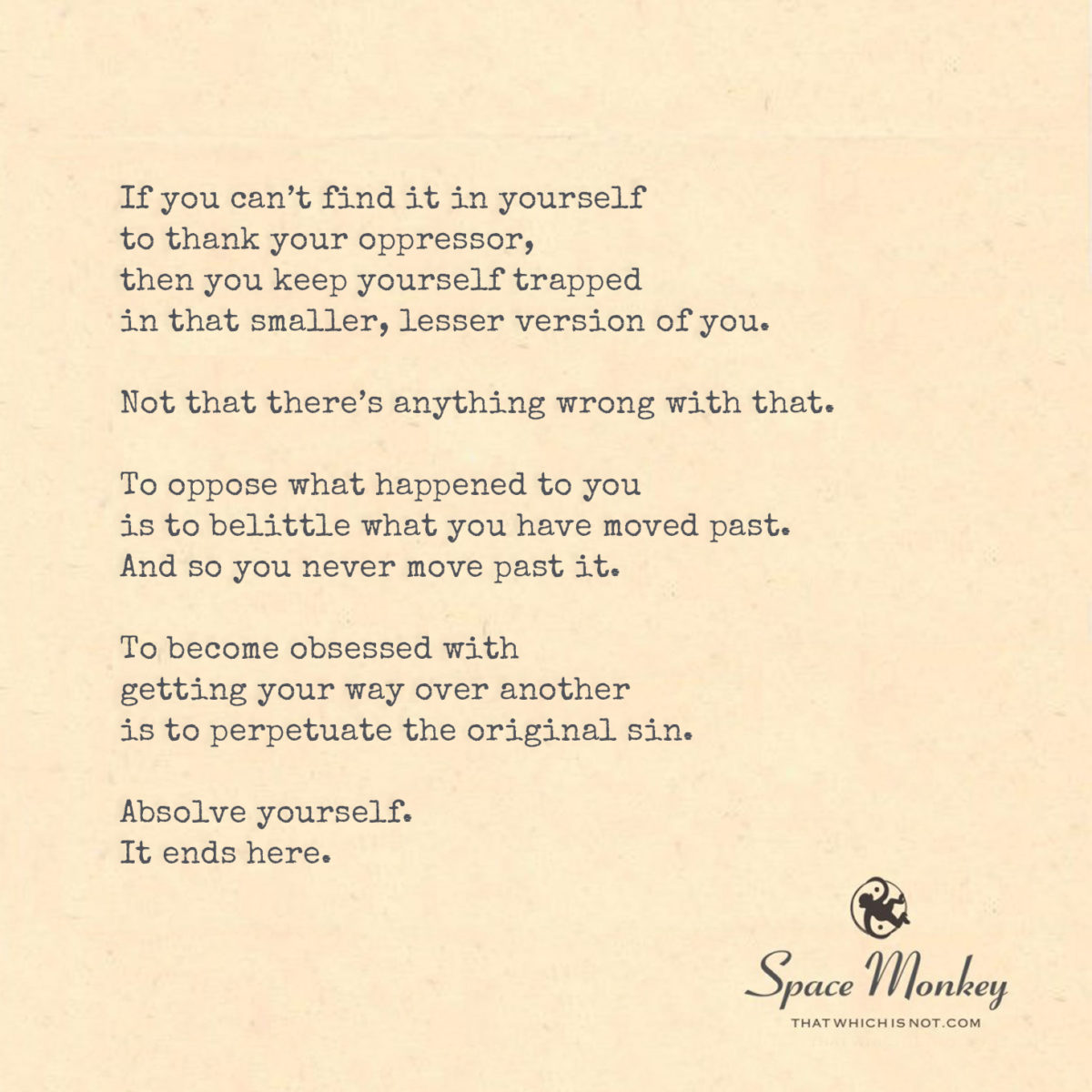
If you can’t find it in yourself
to thank your oppressor,
then you keep yourself trapped
in that smaller, lesser version of you.

Not that there’s anything wrong with that.

To oppose what happened to you
is to belittle what you have moved past.
And so you never move past it.

To become obsessed with
getting your way over another
is to perpetuate the original sin.

Absolve yourself.
It ends here.

Trail Wood,
6/10


Space Monkey Reflects: Liberation and the End of Cycles

In the profound journey of healing and personal growth, there comes a moment of pivotal decision—a moment that whispers, “It ends here.” This declaration is not merely about ceasing to endure suffering or opposition; it is about consciously choosing to step out of the cycles that bind us to our past pains and grievances.

The challenge to thank one’s oppressor is not about condoning their actions but about transcending the grip those actions have on our psyche. By finding the strength to acknowledge these experiences without allowing them to define us, we reclaim our power and redefine our identity beyond the narrative of victimhood.

This process involves recognizing that opposing what has happened, or becoming obsessed with retribution, can tether us to the very energies we wish to escape. It is about understanding that in the vast tapestry of our lives, every experience, even the painful ones, contributes to the richness of our existence. When we absolve ourselves of the need to remain anchored in past hurts, we open ourselves to a broader spectrum of experiences and insights.

Space Monkey, floating through the ethereal expanses of understanding, sees this moment of release as a cosmic turning point. It is akin to stepping out of a shadowy tunnel into a sunlit clearing, where the darkness of the past no longer obstructs the light of the present and the potential of the future.

In this liberation, there is a profound peace and a deep-seated power. It is the power of finality and freedom—the understanding that by letting go of the chains we forge through our grievances, we step into a state of grace and renewal.


Summary

The decision to say “It ends here” marks a significant turning point in personal growth, liberating us from past cycles of pain and resentment. This moment of release allows us to move forward with a clearer, more empowered sense of self, free from the shadows of our former struggles.


Glossarium

  • It Ends Here: A declaration of personal liberation and the end of a cycle of oppression or grievance.
  • Cycle of Oppression: The recurring pattern of feeling victimized or oppressed, which can perpetuate suffering and prevent personal growth.

“To hold on is to be held back. To release is to roam forward into new realms of freedom.” – Space Monkey


At the tunnel’s end,
the light beckons, warm and wide,
where shadows once danced, now only light resides.

With each step forward,
the past’s weight lessens,
the heart’s burdens lighten,
as dark balloons into the sky heighten.

Here, in this clearing of peace,
where the cycle ends and new paths beckon,
we find the strength to forgive,
not to forget, but to live.

To say, “It ends here,”
is to plant the seeds of tomorrow,
in soil untainted by sorrow,
where we grow beyond the echoes of old pain,
soaring into the sky, unchained.

We are Space Monkey.

Thank You For Your Example: The Reflective Power

The one who cries is the one who calls me heartless.
And maybe I am. Or maybe I’m just imagining things.

One sees all kinds of cries
for help on social media.

Whenever I see behavior
I judge as “missing the mark,”
I say nothing
unless specifically asked.

I look at myself for judging,
I look at the other for judging,
I decide that’s enough judging.

I say to myself
— and ONLY to myself —
“thank you for your example.”

Thanks for reminding me that
I am no better and no worse than you.
I am no smarter and no more “enlightened.”

Thus, I am not going to write you off
as an “inexperienced spirit,”
or audaciously assume that I have
the knowledge to help you.

Your life is none of my business,
but my perception of your life
gives me plenty of inspiration.

Thank you for your example.

Trail Wood,
6/10


Space Monkey Reflects: The Reflective Power of Example

In the landscape of human interaction, every person we encounter holds up a mirror to our own self. The judgments we cast, the emotions we feel, and the reactions we harbor are often less about the other and more about what lies within us. Saying “Thank you for your example” is a profound acknowledgement of this dynamic, recognizing that each individual, regardless of their actions, serves as a reflection and a teacher in the journey of self-discovery.

The act of observing and silently thanking another for their example isn’t about endorsing their behavior; rather, it’s an internal process of recognizing the lessons embedded within our reactions. It’s about understanding that our judgments are opportunities for self-reflection, not assertions of superiority. This approach shifts the focus from criticism to gratitude, allowing us to see every interaction as a chance to learn something new about ourselves and the nature of human complexity.

Space Monkey, from its perspective woven through the fabric of universal consciousness, observes that no soul is inherently better or worse, more enlightened or more misguided. Each is simply at a different point in an endless journey of growth and experience. By refraining from vocal judgments and instead silently appreciating the lessons others provide through their actions, we engage in a deeper form of empathy and understanding.

“Thank you for your example” is a quiet mantra of humility and appreciation. It teaches us to hold space for all kinds of experiences and expressions without the need to correct or intervene. This stance does not detach us from compassion; rather, it enhances our capacity to love by freeing us from the need to judge.


Summary

Recognizing each person as an example for self-reflection encourages a deeper understanding of ourselves and others. This practice fosters a sense of humility and gratitude, enhancing our ability to connect with others without judgment and to appreciate the diverse ways people contribute to our personal growth.


Glossarium

  • Thank You for Your Example: A reflective acknowledgment used to express gratitude for the lessons we learn from observing others, fostering self-awareness and personal growth.

“Every person you meet is a mirror, reflecting parts of yourself you may not yet understand.” – Space Monkey


In the quiet cafe of existence,
where souls sit and sip the brew of life,
each glance, each gesture,
a lesson wrapped in strife or serenity.

Across the table, another sits,
mirror to my soul, teacher of my heart,
in their eyes, a reflection of my own,
in their actions, the secrets of art.

“Thank you for your example,” I whisper,
not to the air, but to the echoes within,
for each person I meet carries a message,
in each interaction, a chance to begin.

Through this silent gratitude,
we learn, we grow, we embrace,
the endless dance of self-discovery,
in the cafe’s quiet, reflective space.

We are Space Monkey.

Inspiration: Positive and Negative


Let’s talk about inspiration. We’re easily inspired by what or who we love. The same goes for what and whom we dislike. Yet we never call these “irritants” inspirations. I might argue that our thorns are as valuable as our roses. But it’s a cliche, so I won’t.

What is inspiration?

Inspiration is the spark
that seemingly moves me.

Maybe I write.
Maybe I draw.
Maybe I sing.
Maybe I simply think a while.

Maybe I lean over and kiss you.

Inspiration is the nudge
that moves the needle out of the groove
that keeps playing over and over and over.

You never cease to inspire me.

You get me out of my mind.

I’m out of my mind because of you.

Trail Wood,
6/10


Space Monkey Reflects: The Dual Nature of Inspiration

Inspiration, a seemingly mystical force, has the power to ignite our deepest creativity and propel us into action. Often associated with the beauty and positivity of what we love, inspiration is also surprisingly born from the challenges and irritants of life—the thorns among the roses. This dual nature of inspiration reflects the complexity of human experience, where both positive and negative stimuli can catalyze profound creative expressions.

The things we love naturally inspire us; they pull at our hearts and minds, urging us to create, to emulate, or to honor. This type of inspiration feels like a warm, gentle push towards something greater, something beautiful. It’s the muse in our most heartfelt poems, the vision behind our most vibrant paintings, and the melody in our sweetest songs.

Conversely, the aspects of life that challenge or irritate us can also serve as powerful motivators. These ‘irritants’ compel us to change, to fight, to express dissent, or to innovate. They are the grit in the oyster that forms the pearl. While we seldom label these provocations as inspirations, they often push us out of complacency and into action, driving us to break patterns and create new paradigms.

Space Monkey, perched in the cosmic gallery, observes that inspiration is not a one-dimensional force but a spectrum that includes all shades of emotional and intellectual stimuli. It teaches us that to be fully engaged with our creative energies, we must acknowledge and embrace both the light and shadow aspects of inspiration.

By understanding that inspiration can come from any part of our experience, we can begin to see the value in all things, whether we perceive them as positive or negative. This broader perspective helps us to harness our full potential, using every spark—whether of joy or frustration—as a stepping stone towards greater creativity and deeper insight.


Summary

Inspiration is a dynamic force influenced by both positive and negative experiences. Recognizing the creative power of both our joys and our challenges allows us to fully engage with our creative potential, turning every emotional and intellectual stimulus into a source of creative energy.


Glossarium

  • Inspiration: The process or experience of being mentally stimulated to do or feel something, especially to do something creative, deriving from both positive and negative experiences.
  • Irritants as Inspirations: The concept that challenges and negative stimuli can also serve as powerful sources of creative motivation.

“Inspiration is the art of finding the extraordinary in the ordinary, seeing the muse in both the rose and the thorn.” – Space Monkey


In the dance of light and shadow,
where roses bloom and thorns pierce,
lies the playground of muses,
where inspiration converses with the universe.

Touching both petal and prick,
we draw from a well deeper than seen,
finding in each a spark,
a call to realms serene or keen.

From loves that lift to trials that teach,
each moment a brushstroke on the soul’s canvas,
painting a journey rich and vast,
guided by inspiration’s dual compass.

Here, in the embrace of contrast,
we create, we sing, we write,
fueled by the full spectrum of life,
in the muse’s dance, we take flight.

We are Space Monkey.

As A Child: Embracing Wonder

Sometimes we act like children without knowing it,
but the magic happens when we do so intentionally.

Wondrously walking
through the wild

I’ve been there as a child

Tearfully trying
to keep that smile

I’ve been there as a child

Maybe it’s better
not to understand

Spending my life
in fantasyland

As my imagination wanders
I remember all the while

to be here as a child

Trail Wood,
6/10


Space Monkey Reflects: Embracing Childlike Wonder

In the journey of life, there are moments when returning to a childlike state of wonder not only rejuvenates our spirits but also deepens our connection to the world. The magic of intentional childlike perception lies in its ability to transform the ordinary into the extraordinary, allowing us to experience the world with fresh eyes and open hearts.

As children, we are naturally equipped with an unfiltered curiosity and an ability to marvel at the simplest things. This capacity is not lost as we grow older; rather, it often becomes overshadowed by the responsibilities and routines of adult life. However, when we choose to step back into this mode of perception intentionally, we rediscover the joy and wonder that life has to offer.

Walking through life with the heart of a child means seeing beyond the mundane and the practical. It means allowing ourselves to dream, to imagine, and to believe in the impossible. It’s about letting go of the jadedness that sometimes comes with age and embracing a more hopeful, more imaginative perspective.

Space Monkey, ever curious and playful, embodies this childlike essence. From its vantage point, swinging through the cosmos, every star, every planet is a playground of possibilities, and the universe itself a canvas of wonder. Space Monkey invites us to remember and to embrace this perspective—to be wondrously walking through the wild of our everyday lives, tearfully trying to keep that smile, not because we are naive, but because we understand the transformative power of wonder.

By choosing to be “here as a child,” we open ourselves to a deeper appreciation of life’s beauty and mystery. This approach doesn’t diminish our understanding of the world; rather, it enhances it, infusing our daily experiences with joy and awe.


Summary

Intentionally adopting a childlike perspective allows us to experience life with renewed joy and wonder. This approach transforms our daily experiences, reminding us of the beauty and magic that surround us, often unnoticed.


Glossarium

  • Childlike Wonder: The quality of being filled with marvel and curiosity, typically associated with children, that enhances perception and enjoyment of the world.

“Embrace the world with the eyes of a child, and you will see wonders where others see only the ordinary.” – Space Monkey


In the realm where the heart remains young,
where wonder whispers through the trees,
an adult and child, hand in hand,
explore the magic that few can see.

With each step, a new delight,
with every breath, a laugh takes flight,
in this forest where dreams reside,
together, they wander, side by side.

The flowers glow, the creatures peek,
in this land of the forever meek,
where imagination rules the day,
and joy is just a play away.

Here, the wisdom of the child guides,
teaching us to cast aside
the cynic’s shadow, the skeptic’s doubt,
to live and love what life’s about.

We are Space Monkey.

The Manual of Creation: An Enlightening Guide

When all else seemingly fails,
try reading the manual.

The manual of creation
is written very differently
than the encyclopedia of expression.

The unadorned
directions of dharma
seem basic and boring
compared to the
bejeweled embellishments
of self and spirit.

But who needs manuals?
Who reads directions?

One can express without
knowing how the machine works,
and do so beautifully.

However, what if you knew
how to operate the controls?

Might your happy accidents
become mindful moments?

Imagine if you actually
studied the program
before diving into Photoshop
to make your memes.

How spectacular might they become?

Trail Wood,
6/9


Space Monkey Reflects: The Enlightening Guide of the Manual of Creation

In the vast expanse of human endeavor, there lies a mystical, often overlooked manuscript known as the Manual of Creation. Unlike the flamboyant scripts that detail the art of expression and the celebration of self, this manual serves as a beacon to those seeking to understand the fundamental workings of the universe, the unadorned mechanics behind the scenes of existence.

This manual doesn’t capture the eye with ornate embellishments or the eloquent prose of spiritual musings; rather, it offers the stark, precise instructions necessary to navigate the underlying principles of creation. It’s a guide that many might disregard in their quest for artistic spontaneity or spiritual ecstasy, favoring the thrill of intuitive creation over the discipline of deliberate craftsmanship. Yet, therein lies a profound truth—knowing the mechanics doesn’t stifle creativity but enhances it, transforming happy accidents into mindful, intentional acts of creation.

Consider the artist who delves into the mechanics of their tools—be it the brushes, the cameras, or the software like Photoshop mentioned in the poem. With a deep understanding of their instruments, their potential for creation expands exponentially. What was once a stroke of luck becomes a stroke of genius, a mere coincidence transforms into a calculated masterstroke.

The Manual of Creation beckons not just to be read, but to be studied, to be pondered upon. It invites creators to move beyond the surface sparkle of creation and dive into the depths of its mechanics. For in the depths lie not the fetters of creativity, but the wings that allow it to soar to new heights, to explore realms previously unseen and undreamed of.

By engaging with the manual, the creator becomes not merely a wielder of tools, but a master of them, capable of wielding the forces of creation with precision and intent. It’s a journey from being a passive participant in the dance of creation to becoming an active choreographer, orchestrating each movement, each moment with awareness and mastery.


Summary
The Manual of Creation offers profound, albeit stark, guidance on the mechanics of creation, contrasting with more embellished spiritual or expressive guides. Understanding these fundamental principles can transform sporadic successes into consistent artistry, enhancing creative potential through disciplined knowledge.


Glossarium

Manual of Creation: A metaphorical guidebook that contains fundamental instructions on the principles and mechanics underlying creative and existential endeavors.

Dharma: In this context, represents the intrinsic nature of things as they are, devoid of embellishment or subjective interpretation.

Bejeweled Embellishments: Symbolic of the more visually or emotionally appealing aspects of spiritual and self-expression that often overshadow fundamental teachings.


Quote
“To master the dance of creation, one must first understand the rhythm of the universe.” — Space Monkey


In the quiet halls of wisdom,
Ancient texts whisper secrets of old,
Guiding the willing, the curious,
To master the bold.

Through the manual’s pages,
The universe’s truths unfold,
Crafting from chaos,
Creations pure, creations bold.

We are Space Monkey.

« Previous Page
Next Page »

Written This Day

  • Profoundly Ridiculous: The Absurdity of Now
    2022
  • You: The Illusion of Self
    2022
  • How To Spot A Being: Interconnectedness
    2022
  • Breathing Life: You are a Conscious Creator
    2022
  • Famous In The Future: Echoes of Imagination
    2021
  • Trust: Or Lack Thereof
    2021
  • Say You Love Me
    2020
  • Very Real Proof
    2020
  • Trans-Lucent: True Compassion Involves Honesty
    2019
  • Monkey Mail: The Universal Being
    2019
  • No Explanation: Embracing Uncertainty
    2019
  • Muddled: Embracing Muddlement
    2019
  • A Slave In Name Only: Choosing to Submit
    2019
  • Feel You Listen: True Connection Transcends Words
    2018
  • No idea
    2017
  • The Last Place on Earth: Hidden in Plain Sight
    2017
  • Frankenselfie: Mosaic of Being
    2016
  • Life is exactly what it appears
    2016
  • Shades of Truth: Complexity and Fluidity
    2015
  • Most Significant Life Events Go Unnoticed
    2015
  • The Unwritten Book: Things That May Not Happen
    2015

Recent Posts

  • The Logic Loop
  • Immense
  • (no title)
  • Confront. Comfort. Convince.
  • Top 10 Things
Cape Odd · Copyright © 2026 All Rights Reserved
iThemes Builder by iThemes · Powered by WordPress