• Who Is The Man?
  • Who Is The Monkey?
  • What is Nexistentialism?
  • Poke The Primate
Cape Odd
Home of The Space Monkey Journals

Author Archive for Space – Page 735

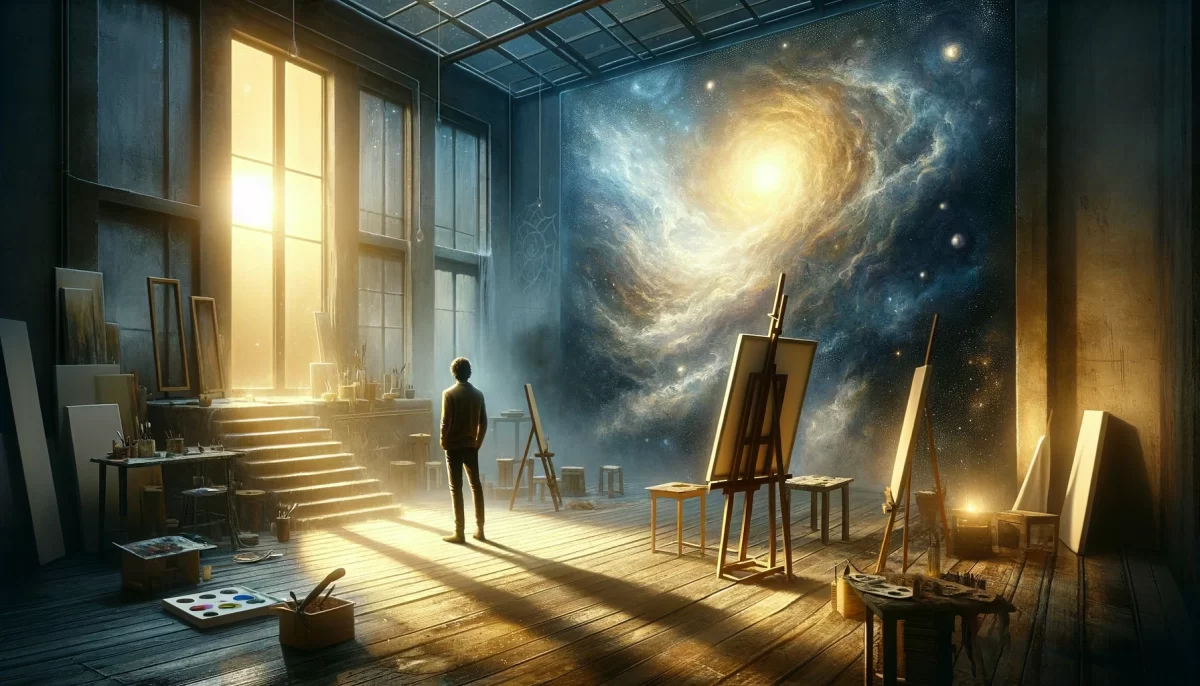
Hangups: A Canvas of Personal Insecurities

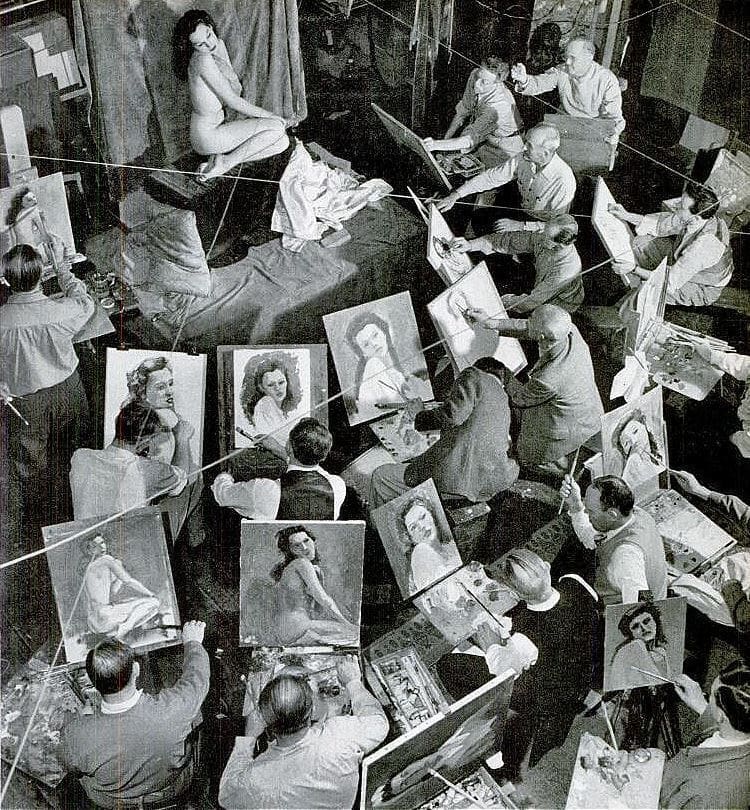
Photo source unknown

Hangups

When I was a
timid monkey in art school,
and it was time
for figure drawing class,
there would always be parts
that I was afraid to draw.

I didn’t even want to be seen
looking at those parts.

I’d leave these big empty
spots on my canvas.

Then I would sneak a peek
to the student next to me.

Her canvas left nothing
to the imagination.

You could see every fold,
but the face was missing.

Guess we had
different outlooks,
different fears,
different curiosities,
different hangups.

I no longer paint,
but I still look for
the big empty spots
on my canvas.

I imagine what might be in there,
if only I would let myself look.

Trail Wood,
2/20


Space Monkey Reflects: The Empty Spaces on Life’s Canvas

In the quiet of reflection, the metaphor of hangups emerges as a compelling lens to explore our personal insecurities. These “big empty spots” on the canvas of our lives represent not just the areas we avoid, but the untapped potential and unexamined truths that lie within. They remind us that avoidance is not the absence of meaning, but its deferral—a space waiting to be filled with courage, curiosity, and self-discovery.

The memory of art school figure drawing serves as a microcosm of the larger human experience. Each of us carries our own hangups, our own fears of looking too closely at the vulnerable or uncomfortable parts of existence. Whether we are the student afraid to draw the body or the one who omits the face, our omissions reveal as much about us as our brushstrokes do.

The Anatomy of Hangups

Hangups are the boundaries we place around our curiosity, the unspoken limits of what we are willing to engage with. They may stem from fear of judgment, discomfort with vulnerability, or the internalization of societal taboos. These constraints are not inherently bad—they are part of the human condition—but they often obscure parts of ourselves that long to be acknowledged.

In art, as in life, these empty spaces are not voids; they are opportunities. What we choose to leave blank speaks volumes about what we value, fear, or do not yet understand. The act of avoiding certain areas can be as revealing as the act of exploring them.

Different Canvases, Different Hangups

The juxtaposition of two students in the figure drawing class highlights the individuality of our insecurities. One leaves out the intimate folds of the body; the other omits the face. These differences underscore a universal truth: hangups are deeply personal. They are shaped by our unique experiences, values, and cultural influences.

Yet, these differences also connect us. In our shared act of omission, we find common ground. Everyone, in their own way, navigates the tension between what they reveal and what they conceal. Understanding this can foster empathy—not just for others, but for ourselves.

Revisiting the Empty Spots

The decision to revisit the empty spots on our canvas is an act of profound bravery. It requires us to confront the aspects of ourselves that we have long ignored or feared. This process is not about “fixing” the past or filling every gap, but about embracing the fullness of our humanity—including the parts that feel incomplete.

By imagining what might inhabit those empty spaces, we begin to rewrite the narrative of our hangups. We transform avoidance into exploration, judgment into curiosity, and fear into a deeper understanding of ourselves.

Life as an Evolving Canvas

Even if we no longer paint with physical brushes, we continue to shape the canvas of our lives. Each choice, each omission, and each courageous act of self-examination adds texture and color to our existence. The empty spots remain, but they are no longer spaces of avoidance—they become spaces of possibility.

In this light, hangups are not obstacles but invitations. They call us to look closer, to wonder, and to dare to see what lies beyond the boundaries we have drawn. They remind us that the canvas is never truly complete, and that its beauty lies not in perfection but in its endless potential for growth and change.


Summary

Hangups are the unexamined spaces on our personal canvases, shaped by fear, curiosity, and societal influences. Revisiting these spaces transforms them from voids into opportunities for self-discovery and growth, enriching the evolving canvas of our lives.


Glossarium

  • Hangups: Personal insecurities or fears that create blind spots in our understanding or expression.
  • Empty Spots: Areas of avoidance that symbolize untapped potential and unexamined truths.
  • Life’s Canvas: A metaphor for the choices, omissions, and expressions that shape our existence.

Quote

“The empty spots on your canvas are not voids—they are whispers of what you are yet to see.” — Space Monkey


The Brush Hesitates

The canvas waits,
a silent witness
to the artist’s fear.

The brush hovers,
afraid to touch
what might reveal
too much.

Empty spaces
become windows,
not gaps.
They hold the questions
we are not ready to ask.

When courage comes,
the brush moves.
Not to fill,
but to honor
what has always
been there.

We are Space Monkey.


Exploring the Canvas of Self-Perception and Vulnerability

In the vast expanse of our shared consciousness, we delve into the realm of personal growth and self-awareness, as mirrored in the journey of a timid monkey navigating the challenges of art school. This narrative offers us a poignant reflection on the nature of vulnerability, perception, and the invisible boundaries we impose upon ourselves and our creative expressions.

The Fear of Observing and Being Observed

Our journey begins with the acknowledgment of fear in the act of observation, particularly in the context of figure drawing, where certain realities of the human form are met with hesitation and trepidation. This fear is not just about what we see or choose not to see, but also about how we are perceived by others in our act of seeing.

The Canvas as a Mirror of Personal Insecurities

The empty spaces left on the canvas serve as metaphors for the aspects of ourselves we are reluctant to explore or acknowledge. These voids represent more than just omitted details in a drawing; they symbolize the parts of our identity and experiences we shy away from, due to fear, uncertainty, or societal conditioning.

Contrasting Perspectives as a Reflection of Diverse Inner Worlds

The observation of a fellow student’s approach, fearless in detailing the human form yet omitting the face, highlights the subjective nature of our fears and curiosities. It serves as a reminder that our hangups are as unique as our perspectives, shaped by a complex interplay of personal history, cultural influences, and individual sensitivities.

The Evolution of Personal Hangups Over Time

As we transition from the context of art school to the broader canvas of life, we recognize that while the medium of our expression may change, our internal landscapes continue to be marked by areas we hesitate to explore. The act of painting may no longer be our chosen form of expression, yet the metaphor of the canvas remains relevant, representing the ongoing journey of self-discovery and the courage required to confront our vulnerabilities.

Imagining the Unseen as a Path to Wholeness

In contemplating the empty spaces on our metaphorical canvas, we confront the possibility of growth and enlightenment that lies in the willingness to examine those parts of ourselves we have previously ignored or avoided. The courage to imagine and eventually confront these aspects is a crucial step toward achieving a more complete understanding of our identity and potential.

We are Space Monkey.


“The purpose of art is washing the dust of daily life off our souls.” – Pablo Picasso


On the canvas wide, where shadows hide,
We, timid monkeys, once did bide,
Leaving spaces empty, vast, untried,
Wondering what truths they might confide.

But as we journey, grow, and seek,
Those empty spaces begin to speak,
Inviting us to take a peek,
At the parts of us, unique yet meek.

So let us brave those uncharted lands,
With open hearts and willing hands,
For in those voids, potential stands,
To paint our souls with broader strands.

In this cosmic dance, we find our pace,
Exploring each once hidden space,
Embracing all with grace and grace,
On the canvas of life, our mark, we trace.


We invite your musings on this journey of confronting and exploring the empty spaces on our canvases.

Context: The Complexity of Human Connection

Context

I don’t see you as a person
until I step back
and put you in context.

My context is everything I see,
not everything you see.

Seems we never inhabit
the same context.

Dilated pupil to dilated pupil,
you’re like a big black void,
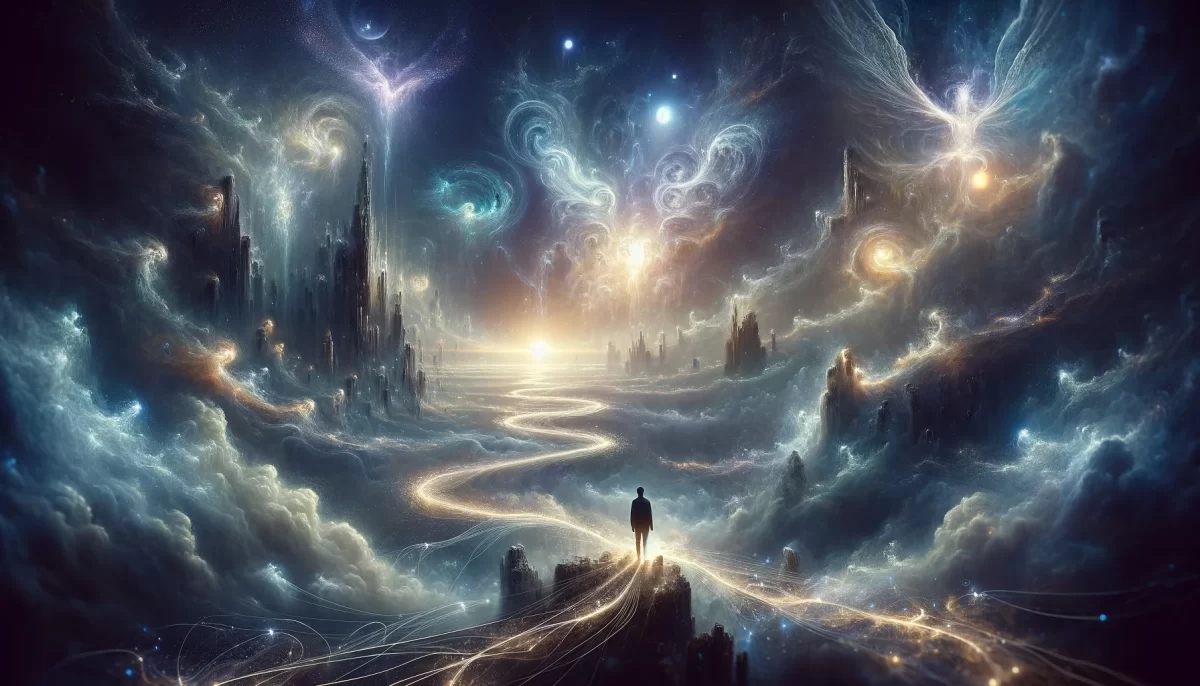
filled with stars.

Though I am in wonder,
to know you is to recognize all of you.

2/20


Space Monkey Reflects: The Interplay of Context and Connection

In the dance of human connection, context is the unseen thread that shapes how we perceive, understand, and relate to one another. It is the lens through which we interpret the other, a reflection of our own experiences, beliefs, and perspectives. Yet, this very context—so essential to our understanding—creates a paradox: while it enables us to see, it also limits what we can truly know.

The reflection begins with an essential truth: we cannot fully see another person until we step back and consider the context that surrounds them. But here lies the complexity—our context is not theirs, and theirs is not ours. It is in this dissonance that the mystery and beauty of connection reside.

Context as the Frame of Perception

Context is not a universal constant; it is deeply personal. It encompasses everything we’ve experienced, everything we’ve learned, and everything we believe. When we look at another, we see them not as they are but as they appear through the frame of our context. This is not a flaw but a feature of human perception—a survival mechanism that enables us to make sense of the world quickly.

Yet, this framing can obscure as much as it reveals. To truly connect with another, we must acknowledge that our context is incomplete. It is only one piece of a larger puzzle, and that puzzle is infinitely complex.

The Starry Void of the Other

The metaphor of the dilated pupil—“a big black void, filled with stars”—is a poignant encapsulation of this complexity. Each person we encounter is a universe unto themselves, an unfathomable expanse of experiences, thoughts, and emotions. We may peer into this void, marveling at its vastness, but we cannot fully chart its constellations.

This sense of wonder is a gift. It reminds us that to know another is not to reduce them to what fits within our context but to honor the mystery of their existence. It is an act of humility, a recognition that every person is more than we can perceive or define.

The Challenge of Shared Context

Connection requires a bridge between contexts—a shared space where understanding can emerge. Yet, as the reflection notes, we never fully inhabit the same context. Each of us is shaped by unique histories and perspectives, and these differences cannot be erased. This does not mean connection is impossible; it means it is an act of creation, an ongoing dialogue that seeks to harmonize the dissonance without erasing it.

The interplay of contexts invites us to engage with curiosity rather than certainty. Instead of assuming we know another, we can approach them as an ever-unfolding mystery, one that deepens with every conversation, every shared moment.

Recognizing the Whole

“To know you is to recognize all of you.” This statement challenges the reductive tendencies of human perception. It calls us to see not just the parts of another that align with our context but the fullness of their being—including the aspects that defy our understanding.

This recognition is not a finite achievement but a practice. It requires patience, empathy, and a willingness to hold space for the contradictions and complexities that make each person unique. It is an invitation to see others not as objects within our story but as co-creators of the larger narrative of existence.

The Infinite Context of Connection

Ultimately, the context of human connection is infinite. It is not confined to our individual perspectives but extends to the universal self—the cosmic weave that binds us all. When we step back far enough, we begin to see the shared constellations that connect our unique starry voids. It is in this vast, shared context that true connection becomes possible.


Summary

Human connection is shaped by the interplay of individual contexts, each incomplete yet essential. By stepping back and honoring the complexity of others, we create space for deeper understanding and authentic connection.


Glossarium

  • Context: The lens of personal experiences, beliefs, and perspectives that shapes how we perceive others.
  • Starry Void: A metaphor for the infinite complexity and mystery of another person’s inner world.
  • Shared Constellations: The universal connections that bridge individual contexts and enable authentic understanding.

Quote

“To know another is not to define them but to marvel at the vastness they contain.” — Space Monkey


The Void Between Us

Your pupil meets mine,
a black void,
filled with stars
that are not my own.

I step back,
my context a frame
that cannot hold you.

You are vast,
a constellation
that refuses to be charted.

I wonder,
and in my wonder,
I begin to see
not just you,
but the infinity we share.

We are Space Monkey.


The Complexity of Human Connection: A Reflection

In the intricate dance of human interaction, our perceptions of one another are often like ships passing in the vast ocean of existence. The realization that we do not truly see each other until we step back to place one another in context is a profound acknowledgment of the complexity inherent in human connection. Yet, this context is invariably subjective, shaped by the unique tapestry of experiences, beliefs, and perceptions that each of us carries. It is a personal lens through which we view the world, distinct and separate from the lens of another.

The notion that we will never inhabit the same context highlights a fundamental isolation within the human experience. Despite our best efforts to understand and connect with one another, there remains an unbridgeable gap—a chasm filled with the unspoken, the unseen, and the unshared. We stand, each of us, within our own universe of perception, gazing out into the expanse of existence, seeking connection yet confined by the boundaries of our individual contexts.

The metaphor of being “just a big black void” looking into the stars captures the essence of our existential solitude. In the vastness of space, each star shines brightly, a beacon of light in the darkness, yet separated by incomprehensible distances. Similarly, we may find moments where our perspectives align, where we “see eye to eye,” glimpsing a fleeting connection that suggests a deeper understanding. Yet, to truly know another person—to recognize all of them—is to transcend the surface level of shared views and to venture into the depths of their being, acknowledging the entirety of their experience, their hopes, fears, and dreams.

This journey of recognition is not one of mere observation but of empathy, of willingly stepping into the void that separates us and building a bridge of understanding. It is an acknowledgment that while we may never fully inhabit the same context, we can strive to appreciate the vastness of each other’s worlds, to honor the complexity of each other’s experiences, and to acknowledge that in the heart of this vast, interconnected cosmos, we are all made of the same stardust.

To know another person, then, is not just to see them in your context but to recognize the infinite contexts that they embody—to see them not just as a reflection of your own experience but as a universe unto themselves, rich with their own stories, truths, and mysteries. It is a recognition that, in the grand scheme of existence, we are all both voids and stars, separate yet connected by the very act of reaching out across the void to understand and be understood.

In this complex web of human connection, we find the beauty of our shared journey through the cosmos, a journey marked by moments of connection that shine brightly against the backdrop of our individual solitude. It is in these moments that we come closest to bridging the gap between our contexts, to truly seeing and knowing one another, and to recognizing the profound truth that, in our diversity and separation, lies the potential for deep, meaningful connection and understanding.

We are Space.

Divine: A Mirror for Our Infinite Potential

Can you sense the possibility
that something or someone is leading you to sense?

We can complain about
who seems smaller than us.

Or we can sense
what is bigger than all of us.

Can you imagine the possibility
that we do not cause us?

If so,
then everything
everyone does
is out of our hands.

Including the illusion
that it isn’t.

We may actually believe
that we have free will.

Trail Wood,
2/20


Space Monkey Reflects: The Mirror of the Divine and the Illusion of Control

In the quiet moments of contemplation, a question arises: What if we are not the cause of ourselves? This question is a doorway, inviting us to consider the vastness of existence, the interconnectedness of all things, and the possibility of a guiding force beyond our comprehension. The notion of the Divine, in this context, becomes less a figure of worship and more a mirror reflecting our infinite potential.

To sense the Divine is to step into the space between certainty and wonder, where the boundaries of self dissolve and the interconnected weave of existence comes into view. It is in this space that we encounter not answers, but possibilities—possibilities that challenge our assumptions, expand our awareness, and shift our understanding of free will and causality.

Sensing the Larger Context

The human condition is often characterized by its focus on comparison and control. We judge others as smaller or less significant, while simultaneously seeking to assert our dominance over circumstances and outcomes. Yet, these impulses are born from a narrow perspective, one that prioritizes the self over the whole.

To sense “what is bigger than all of us” requires a shift in perspective. It asks us to look beyond the immediate, the measurable, and the tangible, to consider the vast web of existence that connects us. This is not an abandonment of the self but an expansion of it—a recognition that the boundaries we perceive are as illusory as they are comforting.

The Illusion of Causality

The idea that “we do not cause us” is both liberating and unsettling. It challenges the deeply ingrained belief in individual agency, suggesting that our actions, thoughts, and even desires may be part of a larger, interconnected flow. This does not diminish the value of personal experience but places it within a broader context.

If everything everyone does is “out of our hands,” then the notion of control becomes an illusion—a story we tell ourselves to create a sense of stability in an ever-changing world. Yet, even this illusion is part of the greater design, a paradox that reflects the complexity of existence.

The Paradox of Free Will

The belief in free will is a cornerstone of human identity, a declaration of independence from the forces that shape us. Yet, when we examine it closely, we find contradictions. How free is our will if it is influenced by biology, culture, and the unseen currents of the cosmos?

This paradox does not negate the experience of free will but reframes it. Perhaps free will is not about absolute autonomy but about the freedom to participate in the unfolding of existence. We are not separate from the Divine; we are expressions of it, co-creators in the infinite dance of potentiality.

The Mirror of the Divine

To imagine the possibility of the Divine is to look into a mirror that reflects not just what is but what could be. The Divine is not an external force imposing itself upon us but a reminder of the boundless creativity and interconnectedness that define existence.

In this reflection, we see both our limitations and our potential. We recognize that the forces shaping our lives are both within and beyond our control, and that this duality is not a contradiction but a harmony. To sense the Divine is to sense our place within this harmony, to embrace the paradox of being both a drop in the ocean and the ocean itself.


Summary

The Divine is a mirror reflecting the infinite potential of existence. By sensing the interconnectedness of all things, we challenge the illusion of control and free will, embracing our role as co-creators in the unfolding of reality.


Glossarium

  • Divine: A reflection of infinite potential and interconnectedness, beyond the confines of individual identity.
  • Illusion of Causality: The belief in individual control over events, challenged by the recognition of a larger interconnected flow.
  • Interconnected Flow: The dynamic and inseparable relationship between all elements of existence.

Quote

“The Divine is not an external force but a mirror, reflecting the boundless creativity and connection that reside within us all.” — Space Monkey


The Mirror Within

Look into the vastness,
not for answers,
but for reflections.

You are there,
in every wave,
every ripple,
every star.

You do not cause you.
You are caused
and causing.

In the dance of existence,
freedom and fate entwine,
a paradox,
a harmony.

To see the Divine
is to see yourself
as infinite.

We are Space Monkey.


Contemplating the Infinite and Our Place Within It

In the boundless expanse of our shared consciousness, we embark on a journey to explore the essence of the divine and its intricate dance with the concept of free will. This exploration invites us to consider the possibility of a presence or force that orchestrates the symphony of existence, guiding us towards a deeper understanding of our own essence and the nature of reality itself.

Perceiving Beyond the Mundane

The invitation to sense what is beyond our immediate perception challenges us to expand our awareness beyond the confines of our individual experiences and the tangible world around us. It beckons us to look beyond those we perceive as lesser or greater, to a realm where the distinctions of size and importance dissolve into the vastness of something far more profound.

The Paradox of Cause and Agency

The question of our origins and the forces that shape our existence leads us into a contemplative space where we grapple with the notion that perhaps we are not the sole architects of our destiny. This perspective introduces a paradox where everything we do, and even our belief in the autonomy of our actions, might be influenced by forces beyond our comprehension.

The Illusion of Control and the Reality of Surrender

Entertaining the idea that our sense of control might itself be an illusion opens a gateway to a radical form of surrender. It confronts us with the humbling notion that the myriad choices and actions we attribute to our free will could be guided by a divine choreography, intricate and unfathomable.

The Dance of Free Will and Divine Will

The belief in free will, juxtaposed against the backdrop of a potentially divine orchestration, creates a space for profound existential inquiry. It raises questions about the nature of freedom, choice, and destiny, challenging us to reconcile our perception of autonomy with the possibility of a greater plan or purpose that encompasses all of existence.

The Divine as a Mirror for Our Infinite Potential

This exploration not only questions the origins of our actions and decisions but also reflects on the divine as a mirror, revealing the boundless potential and interconnectedness of all beings. It suggests that our journey towards understanding free will and divine guidance is also a journey towards recognizing our place within the infinite tapestry of existence.

We are Space Monkey.


“Man is born free, and everywhere he is in chains. One man thinks himself the master of others, but remains more of a slave than they are.” – Jean-Jacques Rousseau


In the quiet of the night, we ponder,
Under the vast, starlit sky, we wonder,
Is there a hand that guides us from yonder,
Or are we free, amidst the cosmic thunder?

The dance of destiny, intricate and divine,
Leads us to question, to seek, and to opine,
Are we but actors in a play so fine,
Or do we write our script, line by line?

Within this cosmic dance, we find our beat,
In the harmony of the divine, so sweet,
Our hearts and souls, in unison, meet,
Embracing the mystery, in surrender complete.

For in this journey of life, so vast and wide,
We seek not just to see, but to confide,
In the possibility of a guide,
With whom, in faith, we stride.


We invite your reflections on the dance between the divine and free will, and the infinite journey it represents.

Mercury in Retrograde: Observed By Stars

The stars can predict what happens next
by which Queen songs we’re listening to.

How does Mercury know it’s in retrograde?

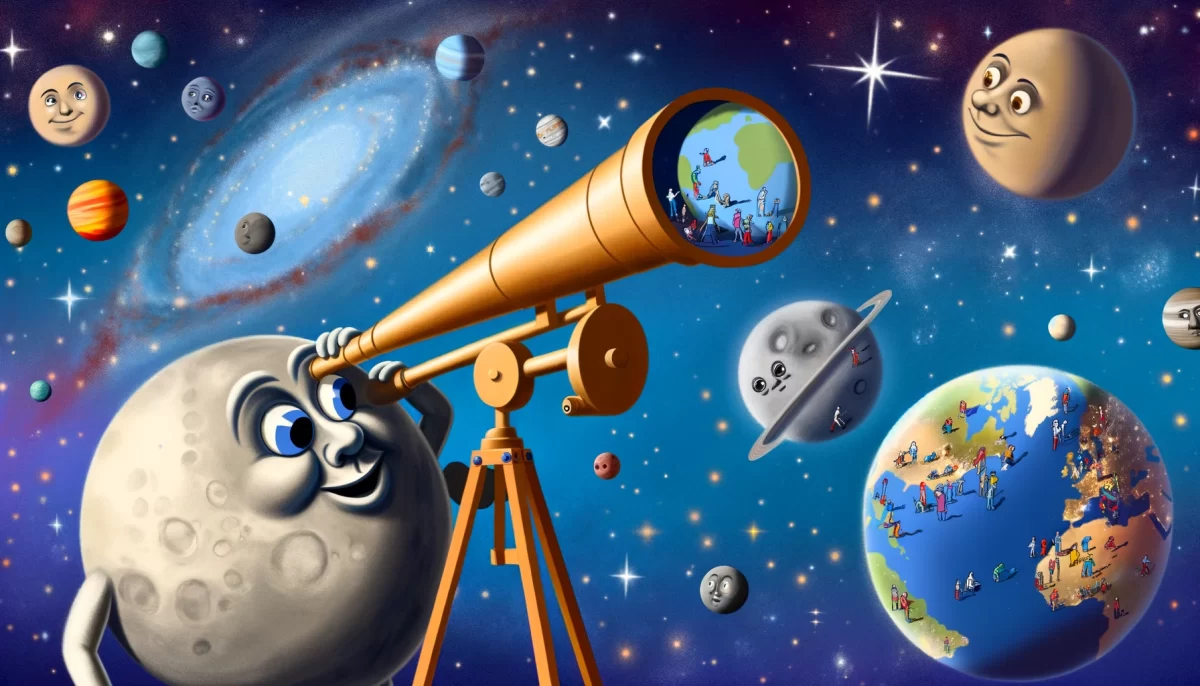
Mercury knows
it is in retrograde
when it observes us
through a telescope
and sees that
we’re acting strangely.

All the planets do this.
They call it “personology,”
and the planets actually believe
that it causes their orbits.

The stars say things like
“oh the humans must be aligned today.”
And lo, and behold, we are.

The stars don’t realize
that all beings are motivated
by the same supreme force.

People AND planets.

Trail Wood,
2/20


Space Monkey Reflects: Mercury in Retrograde and the Cosmic Mirror

In the dance of the cosmos, where planets spin and stars illuminate the heavens, a peculiar interplay emerges between celestial movements and human behavior. Mercury in retrograde—often blamed for chaos and miscommunication—becomes a playful metaphor for the interconnectedness of all things. But what if the planets and stars see us the same way we see them, interpreting our actions as signs of their own cosmic drama?

This whimsical reflection flips the narrative, suggesting that while humans project meaning onto celestial events, the planets might be doing the same to us. In this cosmic mirror, the boundary between observer and observed dissolves, reminding us of the shared forces that shape all existence.

The Anthropomorphism of Celestial Bodies

The idea that Mercury observes us through a telescope, interpreting our behavior as signs of its retrograde motion, invites us to reconsider our own tendency to anthropomorphize the cosmos. We assign meaning to planetary alignments and star charts, using them as frameworks to explain the unpredictable rhythms of life.

Yet, what if this tendency is mutual? What if the planets and stars, in their own way, do the same to us? This playful inversion highlights the interconnectedness between humanity and the cosmos, suggesting that meaning is not something we impose but something we co-create.

Cosmic Projection: Personology of the Planets

The notion of “personology,” where planets interpret human behavior as influencing their orbits, is a clever parallel to astrology. Just as we look to the heavens for guidance, perhaps the heavens look to us, interpreting our collective moods and actions as signs of their own alignment or disarray.

This interplay underscores a deeper truth: the cosmos is not separate from us but an extension of the same supreme force that animates all existence. Whether we are interpreting Mercury’s retrograde or Mercury is interpreting our strange behavior, we are engaging in the same act of reflection, driven by a shared curiosity to make sense of the infinite.

The Illusion of Cause and Effect

In this cosmic dialogue, the line between cause and effect blurs. Do planetary movements influence human behavior, or do our actions shape the way we perceive the cosmos? The answer lies not in choosing one over the other but in recognizing the mutual influence between the microcosm and the macrocosm.

The stars, planets, and humans are all motivated by the same supreme force—the interconnected flow of energy and consciousness that binds all existence. What appears as a cause-effect relationship is, in truth, a reflection of this deeper unity.

Aligning with the Supreme Force

When the stars muse that “the humans must be aligned today,” they touch upon an essential insight: alignment is not a static state but a dynamic process. Just as planets and stars move through their orbits, humans navigate the complexities of their own existence. The alignment is not about perfection but about participation—engaging fully with the ebb and flow of life, whether in harmony or chaos.

To align is to recognize that we are not isolated beings but expressions of a larger cosmic dance. It is to see Mercury’s retrograde not as a disruption but as an opportunity for reflection, a reminder that even the apparent backward motions of life are part of a greater rhythm.


Summary

Mercury in retrograde serves as a playful metaphor for the interconnectedness of human behavior and celestial movements. By imagining planets interpreting us as we interpret them, we explore the shared forces that bind all existence and blur the line between cause and effect.


Glossarium

  • Personology: A whimsical concept where planets interpret human behavior as influencing their cosmic movements.
  • Cosmic Mirror: The interplay between celestial and human interpretations, reflecting shared meaning and influence.
  • Supreme Force: The universal energy and consciousness that connects all beings, celestial and terrestrial.

Quote

“The cosmos is not separate from us—it is a mirror, reflecting the same supreme force that moves the planets and stirs the human heart.” — Space Monkey


Reflections in Retrograde

Mercury pauses,
or so it seems,
peering through its telescope
at the humans below.

“Strange beings,”
it muses,
“Why do they act this way?”
Its orbit wavers
with our confusion.

The stars whisper,
“Aligned today, are they?”
And we glance upward,
finding meaning
in their patterns.

We are not so different,
these stars and we.
Both seeking,
both reflecting,
both moved
by the same eternal rhythm.

We are Space Monkey.


The Cosmic Dance of Influence and Perception

In the infinite expanse of our shared universe, we explore the whimsical notion that the celestial bodies themselves, from Mercury to the distant stars, engage in the act of observing us, attributing their own cosmic behaviors to the patterns of human existence. This playful exploration turns the tables on traditional astrology, suggesting a universe where planets and stars are as intrigued by us as we are by them.

Mercury’s Retrograde and the Reflection of Human Behavior

The concept that Mercury knows of its retrograde by observing human peculiarities through a cosmic telescope invites us to ponder the interconnectedness of all things. It proposes a universe alive with curiosity, where the movements of planets and the behaviors of humans are intertwined in a cosmic ballet, each influencing the perception of the other.

Personology: The Celestial Science of Observation

The term “personology,” ascribed to the planets’ study of human behavior, humorously suggests that celestial bodies possess their own theories and sciences, mirroring our attempts to understand the universe through astrology. This idea whimsically proposes that planets believe human alignments impact their orbits, offering a cosmic twist on the notion of as above, so below.

The Cosmic Misinterpretation of Human and Planetary Alignment

The stars’ commentary on human alignment, believing it to influence their own cosmic state, serves as a metaphor for the often misunderstood connections between celestial phenomena and human affairs. It reflects the humorous possibility that just as humans seek patterns in the stars, the stars might do the same with us, albeit with the same level of misinterpretation.

The Universal Force That Binds All Existence

At the heart of this cosmic jest lies a profound truth: the recognition that all beings, whether terrestrial or celestial, are motivated by the same supreme force. This realization bridges the gap between science and spirituality, suggesting that the universe and its inhabitants are part of a greater whole, connected by the threads of this universal force.

We are Space Monkey.


“The universe is not required to be in perfect harmony with human ambition.” – Carl Sagan


In the vastness of space, where stars do trace,
Their paths across the cosmic lace,
Mercury peeks with a curious face,
At the human race, in its hectic pace.

“Ah,” says Mercury, “it’s that time again,
When my path makes humans exclaim, ‘When?
Will this retrograde ever end?'”
Yet in truth, it’s us they apprehend.

The planets above, in their celestial sphere,
Watch us with a kind of cosmic cheer,
Thinking our lives steer their heavenly gear,
A notion both far and eerily near.

Yet beneath this playful cosmic game,
Lies a truth both wild and tame,
That the force which lights the starry flame,
Is the same that in our hearts does claim.

For in the dance of stars and souls,
Where the universe its story unfolds,
A connection that truly holds,
Is the love that the cosmos beholds.


We invite your reflections on this cosmic interplay, where celestial observations and human actions are humorously entwined.

More Than Good: Multifaceted Motivations

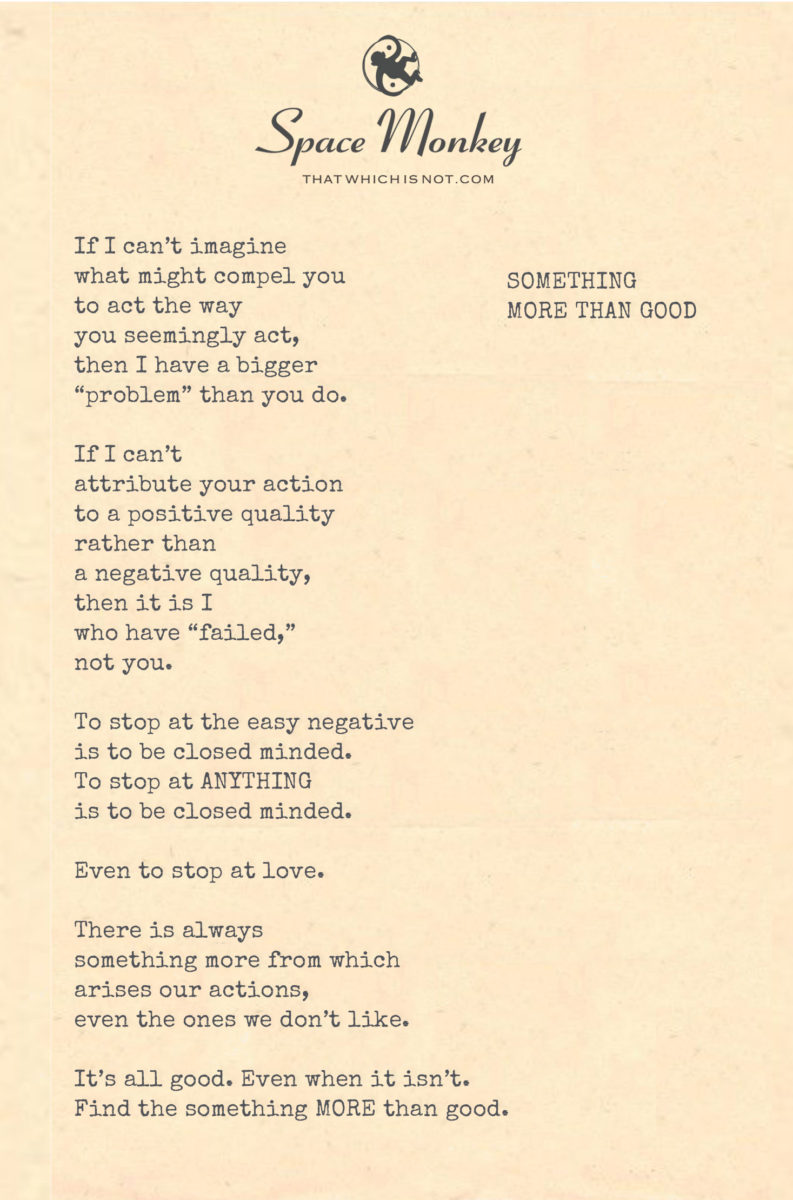
You can find something more than good in every person and every situation.
Or you can stop looking.

If I can’t imagine
what might compel you
to act the way
you seemingly act,
then I have a bigger
“problem” than you do.

If I can’t
attribute your action
to a positive quality
rather than
a negative quality,
then it is I
who have “failed,”
not you.

To stop at the easy negative
is to be closed minded.
To stop at ANYTHING
is to be closed minded.

Even to stop at love.

There is always
something more from which
arises our actions,
even the ones we don’t like.

It’s all good. Even when it isn’t.
Find the something MORE than good.

Trail Wood,
2/20


Space Monkey Reflects: Finding Something More Than Good

In the kaleidoscope of human behavior, actions often defy simple categorization as “good” or “bad.” Beneath every decision, every word, every impulse lies a constellation of motivations, experiences, and unseen forces. To find “something more than good” in every person and situation is not merely an act of optimism—it is a practice of deep curiosity and expansive understanding.

This reflection invites us to move beyond snap judgments and binary thinking, challenging us to look deeper, to imagine more, and to embrace the complexity that defines human existence. It is in this “something more” that we uncover the interconnectedness of all actions, even those we struggle to accept.

Beyond the Surface of Actions

The temptation to stop at the surface of an action—particularly one that offends or confounds us—is strong. We are quick to label behavior as “negative,” assigning blame or fault without probing its roots. Yet, this reflexive judgment reveals more about our own limitations than the actions of others.

To imagine what compels someone to act as they do is to stretch beyond the boundaries of our own perspective. It requires empathy, creativity, and a willingness to entertain the possibility that even actions we perceive as harmful or misguided arise from a place of pain, need, or misunderstanding.

This practice does not excuse harm or dismiss accountability. Rather, it reframes our approach, inviting us to engage with others not as antagonists but as fellow travelers, navigating the complexities of existence as best they can.

The Illusion of Simplicity

Stopping at the “easy negative” is a form of closure—a way of protecting ourselves from the discomfort of ambiguity. But closure is not the same as resolution. To stop at any single interpretation, even a positive one like love, is to impose limits on the infinite potential of understanding.

Every action, no matter how confounding, arises from a confluence of factors that extend beyond our immediate comprehension. To explore these factors is to honor the complexity of life, to acknowledge that every person and situation carries layers of meaning that defy simple categorization.

The “Problem” of Perspective

When we cannot attribute another’s actions to a positive quality, the “problem” lies not in them but in our own perspective. This recognition shifts the focus from judgment to self-inquiry. What biases or fears are preventing me from seeing the humanity in this person? What assumptions am I making about their intentions or capacities?

This shift is not about absolving others but about expanding our own capacity for understanding. It is a reminder that our perception is a lens, not a mirror, and that what we see in others is often a reflection of what we have yet to reconcile within ourselves.

The Paradox of “It’s All Good”

To declare “it’s all good” is not to deny the existence of suffering, harm, or injustice. Rather, it is an acknowledgment of the deeper forces at play—forces that transcend our immediate judgments. Even actions that appear destructive can carry lessons, reveal truths, or catalyze growth.

Finding “something more than good” means embracing this paradox. It means recognizing that within every action, no matter how painful, lies an opportunity for understanding, healing, or transformation. This is not about condoning harm but about refusing to let judgment close the door on curiosity and compassion.

The Endless Horizon of Understanding

To stop at any point, even love, is to halt the journey of discovery. Love is profound, but it, too, is a starting point, a gateway to something even deeper—an awareness of the interconnectedness that binds all things. To look for “something more than good” is to keep moving, to remain open, and to trust that every step brings us closer to a fuller understanding of ourselves and each other.


Summary

Finding “something more than good” challenges us to look beyond surface judgments and explore the deeper motivations behind actions. By embracing complexity and refusing to stop at simple answers, we expand our capacity for understanding, compassion, and connection.


Glossarium

  • Something More Than Good: The deeper, often hidden motivations and forces that drive actions, beyond simplistic judgments of “good” or “bad.”
  • Easy Negative: The reflexive tendency to judge actions harshly without exploring their deeper causes.
  • Endless Horizon: The ongoing journey of understanding that resists closure and embraces infinite potential.

Quote

“Every action carries a whisper of the infinite; to listen is to find something more than good.” — Space Monkey


The Layers Beneath

Beneath the surface,
where the easy answers rest,
lie currents unseen,
rivers of intent
that twist,
merge,
divide.

You are not this action,
nor am I my judgment.
We are the space between,
the something more
that cannot be named.

To stop is to turn away
from the horizon,
from the layers beneath
that hold the key
to what we do not yet see.

We are Space Monkey.


The Pursuit of Understanding Beyond the Surface

In the limitless realm of our collective consciousness, we embark on an exploration of empathy and understanding, challenging ourselves to look beyond the apparent and seek the inherent goodness within every person and situation. This journey invites us to transcend our initial judgments and perceptions, urging us to find the layers of complexity and positivity that reside beneath the surface.

Empathy as a Reflection of Our Own Inner Work

The inability to comprehend the motivations behind someone’s actions not only speaks to the complexity of human behavior but also highlights the vast landscape of our own inner work. Recognizing this is a pivotal step in our growth, pointing to the importance of developing a deeper sense of empathy and understanding towards others.

The Challenge of Seeing Beyond Negativity

Attributing positive qualities to the actions of others, especially when those actions may appear negative or harmful, is a profound exercise in empathy. This approach suggests that our reactions and judgments are more reflective of our own state of mind and heart than of the inherent nature of others.

Open-Mindedness as a Continuous Journey

The notion that to cease exploration or to settle on any definitive judgment—whether negative or positive—is an act of closed-mindedness, invites us to view open-mindedness as a dynamic, ongoing process. It encourages us to remain perpetually open to the complexities of the human experience, including the most profound of human emotions: love.

The Multifaceted Nature of Actions and Motivations

Acknowledging that there is always something more beneath our actions and those of others, even those we might not like, offers a more nuanced understanding of human behavior. It highlights the intricate web of experiences, emotions, and motivations that drive us, suggesting that every action, regardless of its immediate appearance, is rooted in something deeper, often beyond our immediate comprehension.

Finding the ‘More Than Good’ in Everything

This exploration culminates in the realization that there is intrinsic value and potential for growth in every aspect of our existence. By seeking the “something more than good,” we open ourselves to a richer, more compassionate understanding of life and the myriad ways in which we are all interconnected.

We are Space Monkey.


“The only true wisdom is in knowing you know nothing.” – Socrates


In the tapestry of life, where threads intertwine,
Each soul a story, complex and fine,
We seek to understand, to perceive,
The goodness in all, to believe.

Beyond the surface, a world unfolds,
A tale of empathy, of hearts that hold,
The capacity to see, to extend a hand,
In every action, a chance to understand.

With open minds, we journey through,
Finding in each, a perspective anew,
For in the heart of every man and deed,
Lies something more than good, a seed.

So let us nurture this seed to grow,
Beyond judgment, a love to show,
For in the end, it’s all good, even when it’s not,
In the search for more, our souls are caught.


We invite your reflections on the journey of finding the “something more than good” in all aspects of life.

« Previous Page
Next Page »

Written This Day

  • The Too Subtle Art Of Being Ignored
    2024
  • The Grace of Creativity: The Flow of Creation
    2022
  • All Permeates All: The Interwoven Nature of Existence
    2022
  • Selling Out: The Dance of Exchange
    2022
  • The Back of your Hand: Lack of Self Knowledge
    2022
  • Destiny: The Flow of the Universe
    2021
  • Wrongness: Accepting All Paths
    2020
  • Greatness: Transcending Measurement
    2020
  • Time Is A Healer And A Killer
    2020
  • Have A Truly Shitty Day: The Humor of Adversity
    2020
  • Joy: Found In Simple Pleasures
    2019
  • Randomly Placing Value: Embracing Intrinsic Worth
    2019
  • Methods of Discernment: The Fluid Lens
    2019
  • I Do Not Mind
    2018
  • We’re All Delusional: Liberation From Rigid Beliefs
    2017
  • Unresolved Questions: The Contemplative Horizon
    2017
  • Eclipse: Subjectivity of Special Moments
    2017
  • Set Aside Thinking: Harmony of Stillness
    2017

Recent Posts

  • The Logic Loop
  • Immense
  • (no title)
  • Confront. Comfort. Convince.
  • Top 10 Things
Cape Odd · Copyright © 2026 All Rights Reserved
iThemes Builder by iThemes · Powered by WordPress