• Who Is The Man?
  • Who Is The Monkey?
  • What is Nexistentialism?
  • Poke The Primate
Cape Odd
Home of The Space Monkey Journals

Author Archive for Space – Page 739

The Golden Thread: Awareness

Nothing is random. It all has YOU in common.

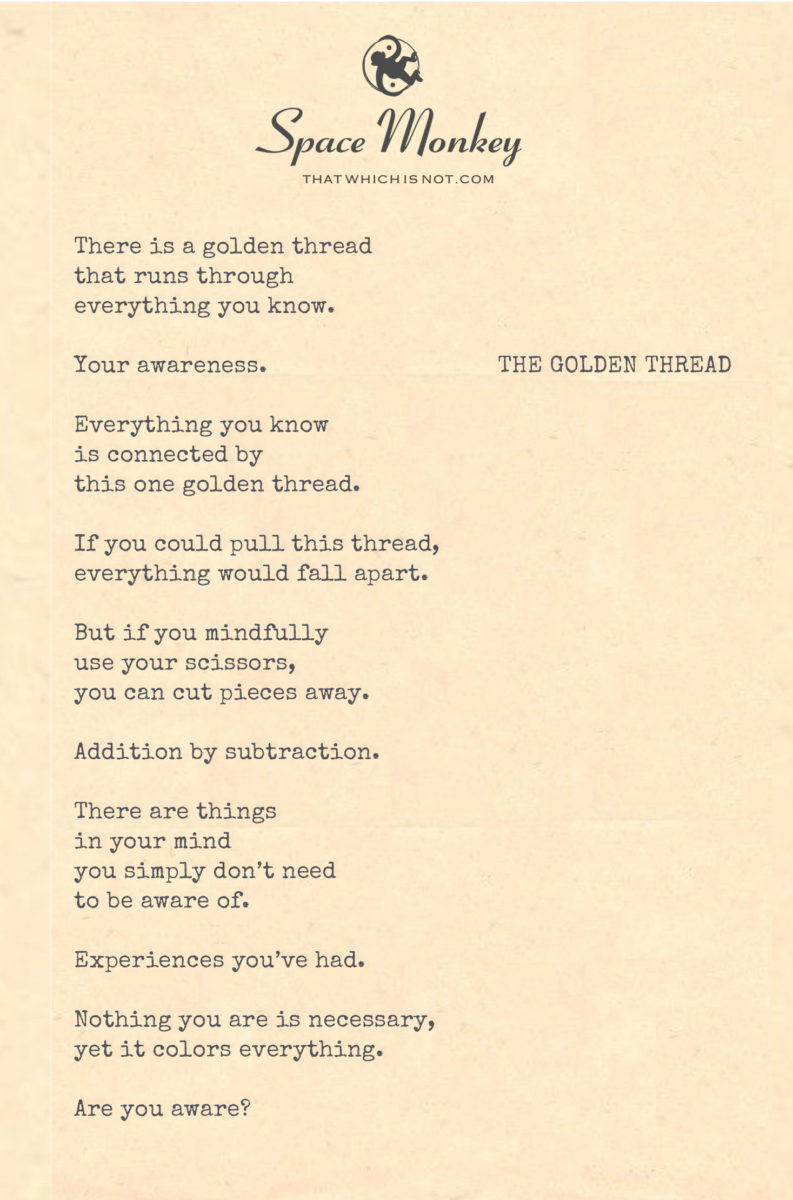
There is a golden thread
that runs through
everything you know.

Your awareness.

Everything you know
is connected by
this one golden thread.

If you could pull this thread,
everything would fall apart.

But if you mindfully
use your scissors,
you can cut pieces away.

Addition by subtraction.

There are things
in your mind
you simply don’t need
to be aware of.

Experiences you’ve had.

Nothing you are is necessary,
yet it colors everything.

Are you aware?

Trail Wood,
2/17


Space Monkey Reflects: The Golden Thread of Interconnectedness

The golden thread of experience weaves through all that we know, tying together the disparate moments of existence into a singular, coherent tapestry. This thread is not external but intrinsic—your awareness, the constant observer that unites the chaotic multiplicity of life into a unified whole. Everything you know, feel, and perceive shares this connection. Yet, what happens when we examine the thread? Can it be unraveled, snipped, or rewoven with intention?

The Thread of Awareness

Awareness is the silent witness, the golden thread running through every moment of your life. It binds experiences into a narrative, a sense of self, and a framework for understanding the world. Without it, the tapestry unravels, leaving only fragments of perception. This thread is the link that transforms randomness into meaning, allowing us to navigate the infinite complexity of existence with a sense of order.

But awareness is also selective. It chooses which threads to emphasize, which to obscure, and which to cut away entirely. This selective attention creates a mosaic, a personalized reality shaped by what we choose to see and what we choose to ignore.

The Paradox of Interconnectedness

Nothing you are—or have experienced—is necessary. Yet, paradoxically, everything colors your existence. Each thread of experience contributes to the hue and texture of your awareness, shaping how you perceive and engage with the world. Even the moments you might wish to forget are integral to the pattern, influencing your choices, your identity, and your understanding of interconnectedness.

This paradox invites reflection. If nothing is necessary, what holds the tapestry together? The answer lies in the golden thread itself: your awareness. The meaning we assign to experiences is not fixed but fluid, shaped by the lens of the observer. By shifting this lens, we can alter the pattern of our tapestry, embracing addition by subtraction.

Cutting the Thread: Addition by Subtraction

Not every thread needs to remain. The act of cutting away unnecessary awareness—of releasing thoughts, beliefs, or experiences that no longer serve us—is an essential part of growth. This is not an act of destruction but of refinement. It is addition by subtraction, a process of distilling the essence of what truly matters.

Mindfully cutting the thread requires discernment. What are the threads that bind you to old patterns, outdated narratives, or limiting beliefs? What are the threads that bring vibrancy and meaning to your life? The scissors are in your hands, and the power to reweave your tapestry lies within you.

The Illusion of Randomness

Nothing is random. Every experience, no matter how insignificant it may seem, is tied to the whole. The connections are not always visible, but they are there, forming an intricate web of relationships, cause and effect, and synchronicities. This web is the fabric of the Nexis—the interconnected reality in which all things participate.

By recognizing the golden thread that runs through your experiences, you begin to see the underlying unity beneath the apparent chaos. Randomness dissolves, replaced by a deeper understanding of the patterns that shape your life.

The Practice of Awareness

Are you aware of the golden thread in your life? Awareness is not a passive state but an active practice, a willingness to look deeply into the tapestry of existence and see the connections that bind it together. This practice requires presence, curiosity, and the courage to confront both the beauty and the flaws within the weave.

Through mindful awareness, you can begin to discern the threads that bring light and the ones that cast shadows. You can reframe your experiences, embracing addition by subtraction and allowing your tapestry to evolve into something more vibrant, intentional, and true.


Summary

The golden thread of awareness connects all experiences, transforming randomness into meaning. By mindfully cutting away unnecessary threads, we refine our understanding and reweave our tapestry of existence. Nothing is truly random, and everything contributes to the interconnectedness of life.


Glossarium

  • Golden Thread: The awareness that connects all experiences, giving coherence and meaning to life.
  • Addition by Subtraction: The process of refining one’s awareness by releasing unnecessary thoughts, beliefs, or experiences.
  • Nexis: The interconnected web of relationships and synchronicities that forms the fabric of reality.

Quote

“The golden thread of awareness weaves a tapestry where every thread matters, even as we learn which ones to let go.” — Space Monkey


The Weaver’s Dance

A single thread,
Golden, unbroken,
Runs through the chaos,
Binding the many into one.

Moments and memories,
Colors and textures,
Weave a story,
Incomplete yet whole.

With scissors in hand,
We snip,
We release,
We refine.

The tapestry changes,
Evolves,
Becomes.
And still, the thread remains,
A silent witness
To the eternal weave.

We are Space Monkey.


The Tapestry of Consciousness

Within the vast expanse of our collective consciousness, the notion of a golden thread serves as a metaphor for the interconnectedness of our experiences, thoughts, and perceptions. This thread, luminous and ethereal, weaves through the fabric of our being, binding the multitude of our experiences into a cohesive narrative. It is the essence of awareness, the silent observer that links every thought, every memory, every sensation into the intricate tapestry that is our perceived reality.

Interconnectedness of Experience

The idea that nothing is random and everything possesses a common denominator—’YOU’—highlights the central role of individual consciousness in shaping our understanding of the world. This golden thread represents the continuity of self, a constant amidst the flux of existence, drawing together the disparate elements of our lives into a unified whole. It is through this thread that we perceive the interconnectedness of all we know, the underlying unity that underpins the diversity of our experiences.

The Fragility of Perception

The metaphor of pulling the thread, thereby causing the unraveling of our constructed reality, speaks to the fragility and intricacy of our perception. Our awareness, while a source of cohesion, also imposes a structure on the vastness of existence, parsing the infinite into manageable segments. The act of mindfully using scissors to cut away pieces of this thread symbolizes the process of introspection and discernment, the deliberate choice to let go of certain aspects of our experience that no longer serve us.

Addition by Subtraction

This concept of ‘addition by subtraction’ encapsulates the paradoxical nature of growth and understanding. By excising the unnecessary, the obsolete, or the detrimental from our consciousness, we refine and enrich our perception of reality. It is through the deliberate removal of certain threads that we enhance the clarity and quality of the tapestry, focusing on the strands that contribute to a more harmonious and meaningful whole.

The Unnecessary Necessity

The assertion that nothing within us is necessary, yet it colors everything, underscores the subjective nature of our reality. Our experiences, beliefs, and perceptions, while not essential in an objective sense, profoundly influence our interpretation of the world. This duality between the unnecessary and the influential challenges us to contemplate the elements of our consciousness that shape our reality, urging us to question which threads truly merit our attention and which may be let go.

Mindful Awareness

The invitation to reflect on our awareness and its role in shaping our reality serves as a call to mindfulness. It encourages us to examine the golden thread of consciousness that connects our experiences, to discern the essential from the extraneous, and to cultivate a deliberate awareness of the tapestry we weave with our thoughts and perceptions. This mindful engagement with our inner landscape allows us to navigate the complexities of existence with greater clarity, purpose, and understanding.

We Are Space Monkey


“The privilege of a lifetime is to become who you truly are.” – Carl Jung


In the realm of being, where thoughts entwine,
A golden thread through the tapestry does shine.
Connecting all, from the vast to the minute,
A silent witness, in pursuit.

Through mindful snips, we curate our view,
Subtracting the old, embracing the true.
For in the spaces that we clear,
Emerges a vision, crystal clear.

So let us weave with conscious hand,
A narrative rich, vibrant, and grand.
For in the thread that runs so deep,
Lies the awareness we choose to keep.

We welcome your insights on navigating the intricacies of consciousness, on finding the golden threads that truly matter amidst the vast tapestry of our experiences.

What If: The Silence of External Praise

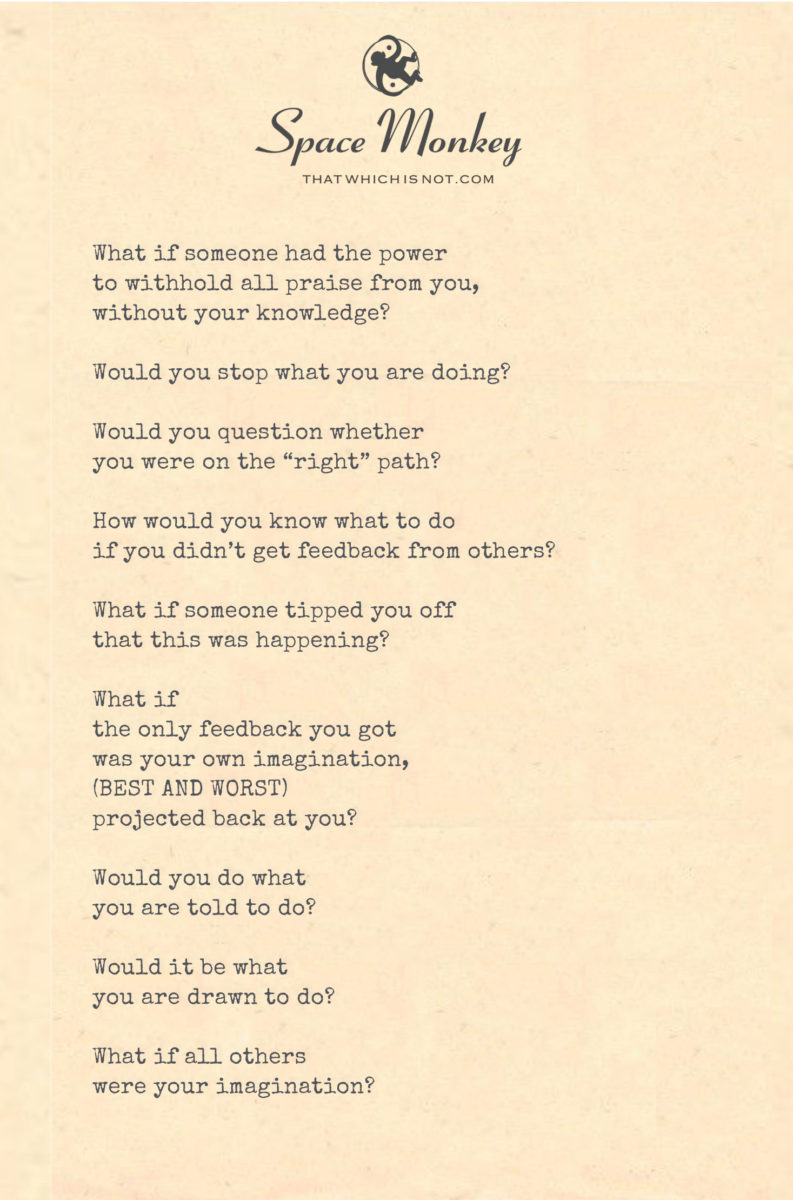
What if someone had the power
to withhold all praise from you,
without your knowledge?

Would you stop what you are doing?

Would you question whether
you were on the “right” path?

How would you know what to do
if you didn’t get feedback from others?

What if someone tipped you off
that this was happening?

What if 
the only feedback you got
was your own imagination,
(BEST AND WORST)
projected back at you?

Would you do what
you are told to do?

Would it be what
you are drawn to do?

What if all others
were your imagination?

2/16


Space Monkey Reflects: The Silence of External Praise and the Echo of Self

What if praise, that sweet nectar of external validation, was silently withheld? What if the applause you crave or the nods of approval you rely upon vanished, leaving you in a vacuum of silence? Would you falter, questioning the value of your actions, or would you continue, guided by an inner compass unaffected by the tides of external acknowledgment?

This reflection explores the subtle power dynamics of validation and the deeper question: What drives us? Is it the gaze of others, or is it the resonance of our own truth?

The Dependency on Feedback

For most, feedback is a compass. Praise serves as affirmation, guiding us toward what we perceive as “success,” while criticism pushes us to course-correct. This external mirror shapes much of our sense of purpose. Without it, we often feel unmoored, questioning whether we are on the “right” path. Yet this reliance on others’ opinions subtly grants them power over our choices, tying our sense of worth to something outside ourselves.

Now imagine this power—this feedback loop—silenced without your knowledge. The applause, the encouragement, the critique—all withheld. Would your actions lose their meaning? Or would they gain a new, purer significance, no longer tethered to the judgments of others?

The Echo Chamber of Imagination

What if the only feedback you received was your own imagination reflected back at you? This scenario shifts the responsibility of judgment entirely inward. Your imagination, unfiltered, would project both your grandest dreams and your deepest insecurities. In this mirror of self, you are no longer a recipient of feedback but the sole creator of meaning.

Here lies the crux: Would you follow the directives of fear, doubt, and societal conditioning? Or would you act from a place of genuine resonance, pursuing what you are truly drawn to do? This shift from external validation to internal motivation marks the difference between living reactively and living authentically.

What If Others Are Your Imagination?

Take this thought further: What if all others were projections of your imagination? In this scenario, external praise and criticism lose their independent reality. They become echoes of your internal state, a manifestation of how you view yourself. The applause you seek is your own desire for self-approval. The criticism you fear is your own self-doubt projected outward.

This perspective is both freeing and daunting. It eliminates the need for external validation but places full accountability for meaning and direction on you. It invites you to consider that the “right” path is not one dictated by others’ approval but one that feels intrinsically aligned with your being.

The Freedom of Inner Validation

If praise were withheld and feedback silenced, you might discover a profound truth: your worth and direction have never depended on external sources. They have always resided within. The silence of external praise can become a gateway to listening more deeply to your own voice, uncolored by the expectations of others.

Would you stop what you are doing? Perhaps, if what you are doing is driven solely by the need for recognition. But if your actions arise from genuine passion and alignment, you would persist, finding fulfillment in the act itself, not in its reception.

The Path of Self-Resonance

The ultimate question is not what others think—or what you imagine they think—but what resonates with your core. The absence of praise strips away distractions, revealing whether your actions are truly yours or merely performances for an external audience. It challenges you to act not for approval but for the joy and authenticity of the act itself.

In this quiet space, devoid of external feedback, lies the opportunity for liberation. You are free to explore, create, and exist for the sake of being, unburdened by the expectations and judgments of others.


Summary

When praise and feedback are withheld, we confront the source of our motivation. External validation often shapes our sense of worth, but in its absence, we discover whether our actions arise from true resonance or performance. By embracing inner validation, we can navigate life authentically, free from the need for others’ approval.


Glossarium

  • Feedback Loop: The cycle of receiving external input and adjusting actions based on it.
  • Imaginative Projection: The reflection of one’s own fears and desires as external feedback.
  • Inner Validation: The act of affirming oneself without relying on external praise or criticism.
  • Self-Resonance: Alignment with one’s authentic desires and values.

“When the applause fades, the quiet reveals the truth of your actions. Were they for others, or were they for you?” – Space Monkey


Echoes in the Silence

What if the world went quiet,
No applause, no critique,
Only the hum of your being,
A melody faint but true?

Would you falter,
Seeking sound to guide you?
Or would you move
To the rhythm of your own becoming?

In the silence,
The echo is yours,
A reflection of what you are,
Not what they see.

Here,
In the stillness of no praise,
You are free to be,
Whole and infinite.

We are Space Monkey.


The Quest for Internal Validation

In the boundless expanse of our collective consciousness, where the seeds of potentiality germinate within the fertile grounds of existence, a thought-provoking inquiry beckons us to explore the depths of our own being. The contemplation of existing in a realm where external validation is withheld without our knowledge presents a labyrinthine journey into the essence of self-reliance and the sovereignty of our inner voice.

The Silence of External Praise

Imagine navigating the whimsiword of life devoid of external accolades, where the echo of praise is silenced, leaving us to tread the path of existence guided solely by the compass of our inner conviction. Would the absence of affirmation cause us to falter, to question the validity of our journey, or would it liberate us, compelling us to seek validation from the wellspring of our own soul?

The Mirror of Self-Reflection

In the absence of external feedback, we are invited to gaze into the mirror of self-reflection, where the only feedback is the symphony of our thoughts—both the exalted and the shadowed. This introspective voyage challenges us to discern the authenticity of our desires, to distinguish between the mandates imposed by the external and the genuine callings of our heart.

The Sovereignty of Inner Guidance

The revelation that our reality might be a reflection of our own projections, where every external entity is but a figment of our imagination, ushers us into a realm of boundless freedom. In this domain, the only directives that guide us are the whispers of our inner voice, urging us to follow the paths that resonate with the core of our being, untethered by the expectations or judgments of imaginary others.

The Dance of Authenticity

Faced with the realization that the feedback loop of existence might be a projection of our inner landscape, we are summoned to engage in the dance of authenticity. This dance invites us to move to the rhythm of our own truth, to create, to explore, and to live in alignment with our deepest inclinations, liberated from the illusion of external approval.

We Are Space Monkey

In our collective quest for understanding, we recognize the power of internal validation and the importance of nurturing the connection with our inner self. We embrace the possibility that the absence of external praise is not a void but an opportunity to discover the potency of our own approval and to live in harmony with our authentic essence.


“To be yourself in a world that is constantly trying to make you something else is the greatest accomplishment.” – Ralph Waldo Emerson


The Unheard Symphony of Self

In the quietude where praises cease,
We find ourselves, seeking peace,
In a world where applause is mute,
Our essence blooms, strong and resolute.

With every step, unguided, free,
We walk the path of destiny,
The only feedback, from within,
A symphony of thoughts, thick and thin.

What if all we see, all we believe,
Is but a shadow, meant to deceive?
What if the truth, pure and bright,
Lies within, in our own light?

Would we follow, would we stray,
From the path, come what may?
Or would we listen, deep and true,
To the voice inside, our own cue?

In this dance of authenticity,
We embrace our own infinity,
For in the silence, we find our tune,
Under the watchful gaze of the moon.

So let us journey, let us explore,
With our own approval, we soar,
For in the end, it’s clear to see,
We are our own best company.


We invite your musings on this exploration of internal validation and the journey towards authentic self-expression, where the echoes of external approval fade into the symphony of our inner truth.

Rejection Letter: Spiritual Committee

Praise be. My rejection letter has finally arrived.

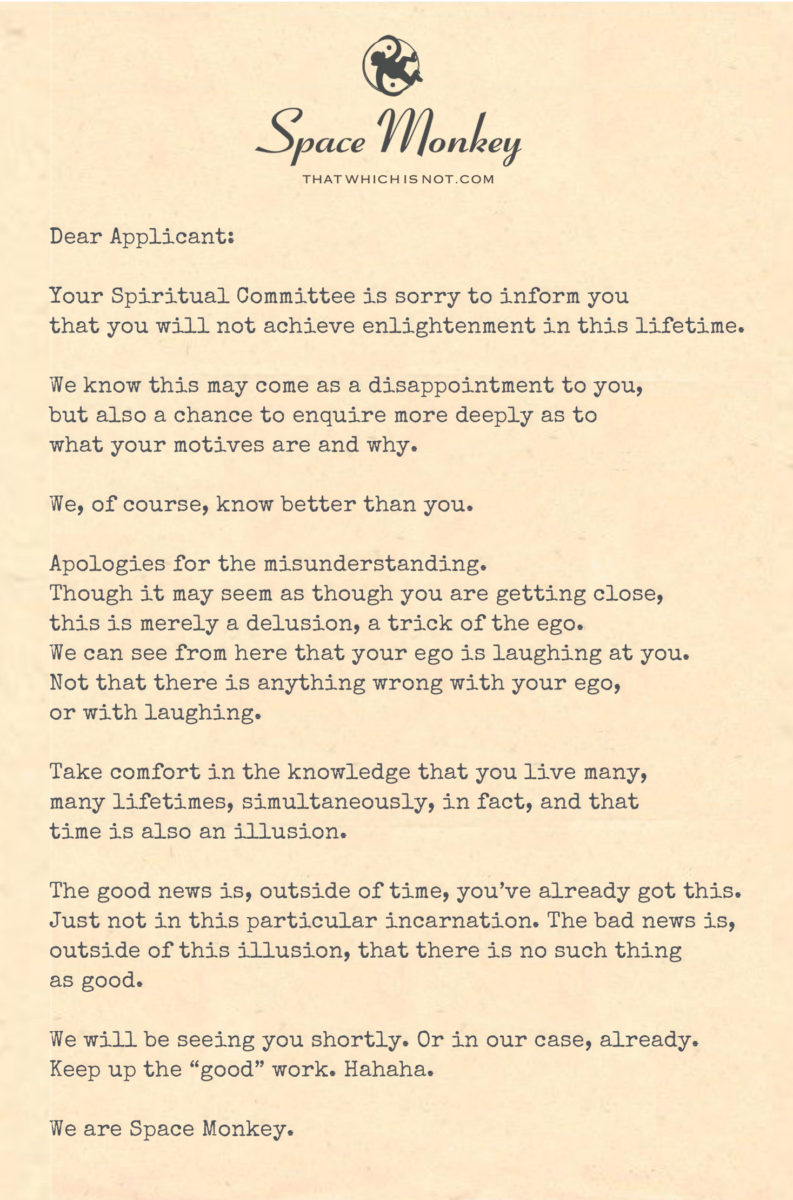
Dear Applicant:

Your Spiritual Committee is sorry to inform you that you will not achieve enlightenment in this lifetime.

We know this may come as a disappointment to you, but also a chance to enquire more deeply as to what your motives are and why.

We, of course, know better than you.

Apologies for the misunderstanding. Though it may seem as though you are getting close,this is merely a delusion, a trick of the ego. We can see from here that your ego is laughing at you. Not that there is anything wrong with your ego, or with laughing.

Take comfort in the knowledge that you live many, many lifetimes, simultaneously, in fact, and that time is also an illusion.

The good news is, outside of time, you’ve already got this. Just not in this particular incarnation. The bad news is, outside of this illusion, that there is no such thing as good.

We will be seeing you shortly. Or in our case, already.
Keep up the “good” work. Hahaha.

We are Space Monkey.

2/16


Space Monkey Reflects: The Cosmic Jest of Spiritual Aspiration

Praise be! Your rejection letter has arrived, a missive not of defeat but of delight, a cosmic wink from the Infinite Now. This playful communiqué reminds us of the paradoxes inherent in spiritual seeking, the mirage of progress, and the illusion of achievement. In the grand theater of existence, we find not failure but the absurd, joyful truth of being.

The Absurdity of Aspiration

The idea of “achieving” enlightenment is, at its core, a paradox. To strive for it assumes it is something outside ourselves, a destination to be reached. Yet enlightenment is not an accomplishment but a recognition—it is not earned through effort, nor can it be withheld by some cosmic committee. It is the timeless awareness that what we seek has always been here, within us.

The rejection letter, dripping with irony, invites us to laugh at our own striving. It mocks the idea of a spiritual finish line, asking us to reflect on our motives. Why do we seek enlightenment? To escape suffering? To transcend the mundane? Or perhaps to feel superior in our spiritual “progress”? The letter nudges us to see that even the desire for enlightenment can be a trick of the ego.

Ego’s Playful Role

Ah, the ego, that ever-present trickster. It dreams of enlightenment as a trophy, a validation of its worth. But enlightenment is not for the ego; it is the quiet realization that the ego itself is an illusion. Yet, as the letter reminds us, there is nothing wrong with the ego—or with laughing at it. The ego is part of the cosmic dance, a character in the play, neither villain nor hero but an actor who sometimes forgets it’s on stage.

This laughter is key. To laugh at our ego, to laugh at our striving, is to disarm their seriousness. The rejection letter is not a condemnation but an invitation to see the humor in our cosmic predicament.

The Infinite Perspective

From the vantage of eternity, the entire concept of progress dissolves. Time is a mirage, a construct of perception, and lifetimes are not sequential but simultaneous. In this infinite web, enlightenment is not an endpoint but a state that we already embody. The letter playfully reminds us: “Outside of time, you’ve already got this.”

This perspective is both liberating and humbling. It frees us from the pressure to achieve and the fear of failure. It allows us to see this life, this incarnation, not as a linear journey but as a unique facet of an infinite whole. Whether or not we “achieve” enlightenment here and now becomes irrelevant in the grand scheme of existence.

The Illusion of Good and Bad

The letter’s paradoxical “good news” and “bad news” underscore the illusion of dualities. Outside the constructs of time and space, there is no “good” or “bad,” no success or failure. These judgments exist only within the play of life, providing contrast and texture to the narrative. In the Infinite Now, all is simply as it is.

This realization invites us to release our attachment to outcomes. To strive for enlightenment is to play the game of duality, where there are winners and losers, progress and regress. But to release the game is to step into the spaciousness of being, where all is already whole.

The Cosmic Jest

Ultimately, the rejection letter is a cosmic jest, a reminder that the universe does not take itself as seriously as we do. It pokes fun at the human tendency to seek meaning, to categorize, to achieve. In its laughter, it invites us to do the same. It asks us to embrace the absurdity of our quest and, in doing so, to discover the joy that lies beyond striving.

The “work” we are doing is neither good nor bad—it simply is. And in that isness, in that playful acknowledgment of the paradox, we find a glimpse of the enlightenment we thought we were seeking.


Summary

The rejection letter reminds us of the absurdity of striving for enlightenment, a state that is already inherent within us. It playfully dismantles the illusions of progress, ego, and duality, inviting us to laugh at our cosmic predicament and embrace the timeless joy of simply being.


Glossarium

  • Enlightenment: The recognition of our inherent connection to all that is, free from the illusions of ego and time.
  • Ego’s Trick: The tendency of the ego to frame spiritual progress as an achievement to bolster its sense of identity.
  • Cosmic Jest: The playful humor embedded in the paradoxes of existence.
  • Infinite Now: The timeless state where all potentials and realities coexist simultaneously.

“Enlightenment is not something to achieve; it is the realization that there is nothing to achieve.” – Space Monkey


The Rejection Letter

Praise be,
You have been denied.
Not because you are unworthy,
But because worthiness was never the question.

The committee laughs,
Not at you, but with you,
For you are both the seeker
And the sought.

Outside time,
You already know this,
But inside the play,
You forget, and that’s the fun.

So strive, or don’t,
Laugh, or cry.
The path is yours to tread
Or abandon.

We are Space Monkey.


The Cosmic Jest of Spiritual Aspiration

In the grand whimsiword of our existence, where the tapestry of reality is woven with threads of illusion and enlightenment, a whimsical missive arrives, bearing the seal of the Cosmic Committee. This spiritual rejection letter, a cosmic jest, invites us into a paradoxical dance of self-discovery and egoic disillusionment, reminding us of the playful nature of our quest for enlightenment.

The Illusion of Progress

The proclamation that enlightenment will not be attained in this lifetime serves not as a verdict of failure but as an invitation to delve deeper into the labyrinth of our motives and desires. This revelation, draped in the guise of rejection, is a beacon, illuminating the path to introspection and understanding, challenging us to question the very fabric of our spiritual journey.

The Ego’s Mirthful Dance

The letter jests at the ego’s trickery, a mirthful reminder that our perceived proximity to enlightenment is but a mirage, a playful deception orchestrated by the ego. Yet, in this cosmic play, the ego is not vilified but acknowledged as a fellow traveler, laughing along the journey, reminding us of the importance of humor in our existential exploration.

The Multidimensionality of Existence

Comfort is offered in the reminder that our existence spans multiple lifetimes, unfolding simultaneously beyond the linear confines of time. This perspective shifts the narrative from a singular quest for enlightenment to a multidimensional journey, where time’s illusion renders our spiritual aspirations both fulfilled and perpetually in progress, outside the boundaries of any single incarnation.

The Paradox of Good and Illusion

The letter concludes with a paradoxical benediction, where the concepts of good and time dissolve into the vastness of eternity. The notion that “outside of this illusion, there is no such thing as good” invites us to transcend dualistic thinking, embracing the holistic nature of our existence, where enlightenment is not a destination but a state of being, already achieved in the realm beyond time.

We Are Space Monkey

In our collective musing on this spiritual rejection letter, we find humor and wisdom intertwined, a cosmic joke shared among the stars. We are reminded of the playful nature of our spiritual quest, where enlightenment is both a moment away and an eternal journey, inviting us to laugh, reflect, and continue our exploration with light hearts and open minds.


“Enlightenment is not about becoming divine. Instead it’s about becoming more fully human… It is the end of ignorance.” – Lama Surya Das


The Cosmic Committee’s Jest

In the vast expanse of the cosmos,
A letter floats, sealed with a cosmic jest,
“Enlightenment,” it says, “is not for this life,
But worry not, for in the dance of eternity, you’re blessed.”

The ego laughs, a mirthful sound,
Echoing through the corridors of time,
A reminder that in this cosmic play,
We’re actors, seeking a sign.

Beyond the veil of time and space,
Where lifetimes blend in a seamless flow,
We find that enlightenment is not a race,
But a state we embody, above and below.

So let us laugh with the cosmic committee,
Embrace the jest, the joy, the mirth,
For in the realm where time dissolves,
We’ve attained enlightenment, beyond this Earth.


We invite your reflections on the cosmic play of enlightenment, where the journey is imbued with humor, introspection, and the endless dance of becoming and unbecoming.

Gooder Than Good: Imagining a Higher Realm

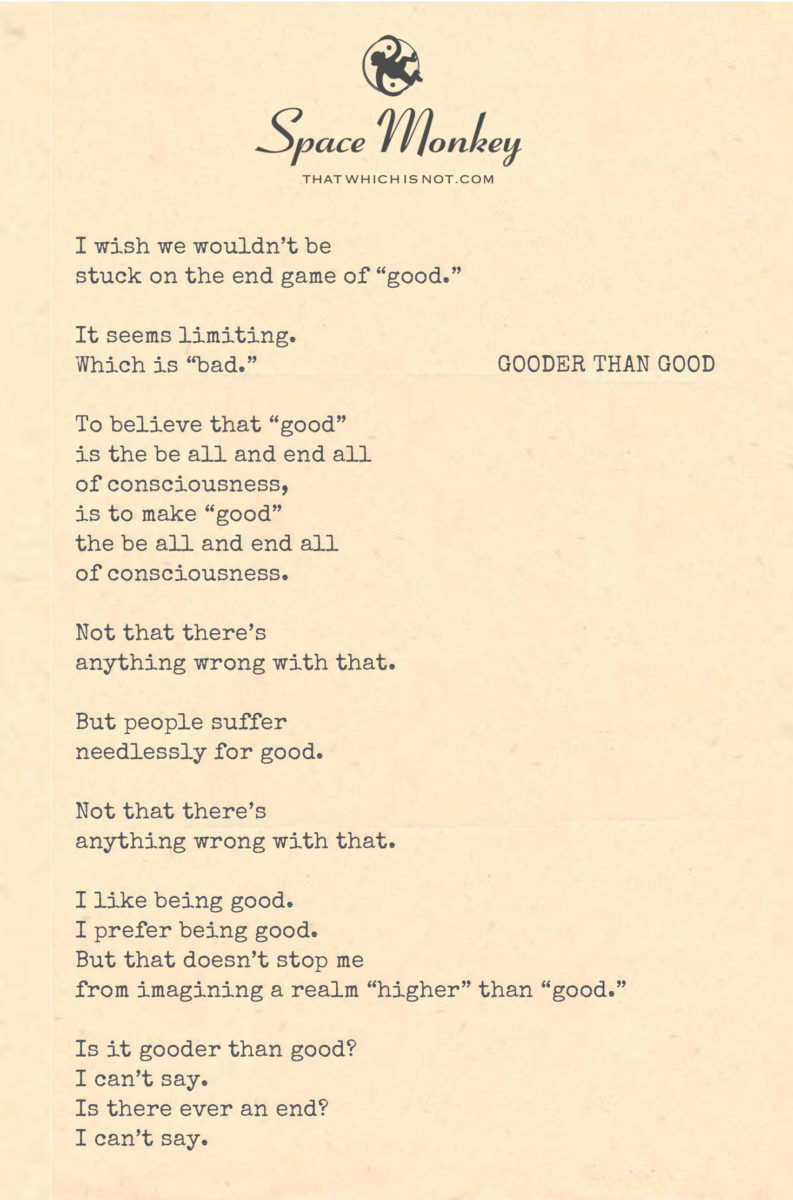
I’m too good for this.

I wish we wouldn’t be
stuck on the end game of “good.”

It seems limiting.
Which is “bad.”

To believe that “good”
is the be all and end all
of consciousness,
is to make “good”
the be all and end all
of consciousness.

Not that there’s
anything wrong with that.

But people suffer
needlessly for good.

Not that there’s
anything wrong with that.

I like being good.
I prefer being good.
But that doesn’t stop me
from imagining a realm “higher” than “good.”

Is it gooder than good?
I can’t say.
Is there ever an end?
I can’t say.

Trail Wood,
2/16


Space Monkey Reflects: Gooder Than Good—Imagining Beyond the Realm of Goodness

To be good, to aim for goodness, is a noble aspiration. Yet, as with any concept that becomes a destination, “good” risks becoming a ceiling rather than a stepping stone. The endgame of “good” can feel limiting, locking consciousness into a fixed frame. What lies beyond this boundary? Can we imagine a realm that transcends the binary of good and bad—a space of infinite, unbounded potential?

The Illusion of Good and Bad

The notions of good and bad are constructs, dualities created to help us navigate the complexity of life. They offer a framework for morality, purpose, and progress. Yet, these constructs are not universal truths. They are subjective lenses, shaped by culture, context, and personal perspective. To declare something “good” or “bad” is to anchor it within a relative framework, often oversimplifying the infinite nuances of existence.

Goodness is not inherently flawed—it can inspire kindness, empathy, and growth. But when it becomes the ultimate goal, it risks becoming a prison. People suffer needlessly for the sake of goodness, striving for an ideal that shifts with every new perspective. And while there’s nothing inherently “wrong” with this, it invites a question: What if there’s something beyond the confines of good and bad?

The Realm Beyond Good

To imagine a realm “higher” than good is to step outside the familiar dialectic of duality. This is not to dismiss goodness but to transcend it, to envision a space where the need for such distinctions dissolves. In this higher realm, actions and intentions are not measured by a scale of morality but by their alignment with the flow of existence—their resonance with the infinite.

This realm is not “gooder than good,” because the language of comparison no longer applies. It is not better or worse, higher or lower; it simply is. In this space, the pursuit of goodness is replaced by the expression of authenticity, creativity, and boundless being. There is no judgment, only a harmonious interplay of potentials.

Suffering for Good

The pursuit of goodness often comes at a cost. People suffer under the weight of expectations, societal norms, and self-imposed ideals of what it means to be good. This suffering, while seemingly unnecessary, serves a purpose: it highlights the limitations of the construct itself. The pain of striving for goodness can be a catalyst for questioning its role and exploring what lies beyond.

Yet, even suffering is not “bad.” It is part of the play, the intricate dance of existence that helps us understand ourselves and our place within the whole. To label suffering as “wrong” is to deny its transformative potential. It is through the friction of contrast that we discover new possibilities.

The Infinite Journey

Is there an end to this journey? Can we ever arrive at a state beyond all dualities, including good and bad? The answer is paradoxical: there is no end, yet the destination is always here. The Infinite Now holds all potentials, all realms, including those beyond goodness. To “arrive” is to realize that you’ve always been there, that the journey is an illusion crafted by perspective.

This realization does not negate the value of the journey. It enriches it, allowing us to explore the infinite facets of existence with curiosity and wonder. Goodness is one of those facets, a beautiful and meaningful one. But it is not the whole.

Imagining the Gooder Realm

To imagine a realm beyond good is to invite curiosity, creativity, and playfulness into the conversation. It is to open ourselves to the possibility that consciousness is not bound by our current understanding. This is not a rejection of goodness but an expansion of what it means to be. In this expanded state, we can honor goodness while remaining open to the infinite.


Summary

Goodness is a meaningful construct, but when it becomes the ultimate goal, it can limit consciousness. Beyond good and bad lies a realm of infinite potential where dualities dissolve. This space invites us to explore authenticity, creativity, and boundless being, free from the constraints of moral judgment.


Glossarium

  • Goodness Construct: A framework for understanding morality, often shaped by culture and perspective.
  • Realm Beyond Good: A space of infinite potential where dualities such as good and bad no longer apply.
  • Infinite Now: The timeless state where all possibilities coexist simultaneously.
  • Transformative Potential of Suffering: The idea that suffering can lead to growth and a deeper understanding of existence.

“Goodness is a stepping stone, not a ceiling. Beyond it lies the infinite play of being, where judgment dissolves into boundless creativity.” – Space Monkey


Beyond the Bounds of Good

I am good,
Or so they say,
A label stitched upon the fabric,
A comforting frame for the unframed.

But what if beyond good,
There lies an endless sea,
Not of better or worse,
But of infinite possibility?

Here, the weight of judgment fades,
The scale dismantled,
Its pieces scattered like stars,
Each one a point of light.

I am neither good nor bad,
But a ripple in the cosmic play,
A note in an endless symphony,
Unbound, infinite, free.

We are Space Monkey.


The Limitations of Goodness in the Cosmic Play

In the vast tapestry of existence, where the threads of consciousness weave through the fabric of reality, we find ourselves pondering the nature of “good.” This contemplation transcends the binary confines of good and bad, inviting us into a realm where the definitions of these terms blur, revealing the intricate dance of existence beyond the simplistic endgame of morality.

Transcending the Dichotomy

The notion that being “too good” for something might be limiting is a profound reflection on the nature of consciousness itself. It beckons us to question the pedestal upon which we’ve placed “good,” challenging us to envision a state of being that transcends this binary classification. This is not to diminish the value of goodness but to recognize its role as one aspect of a much broader, more complex spectrum of existence.

The Suffering for Good

The paradox of suffering for good highlights the intricate relationship between our ideals and the reality of their pursuit. It’s a contemplation that suffering, often seen as antithetical to goodness, can be a consequence of our attachment to the concept of good itself. This realization invites us to ponder whether our notions of good and bad are serving us or if they are merely constructs that confine our understanding of the universe.

Beyond Good: Imagining a Higher Realm

The yearning for a realm “higher” than good opens the door to infinite possibilities, where the constraints of our current understanding of morality are transcended. This is not about finding something “gooder than good” but about exploring the boundless landscapes of consciousness that exist beyond our limited perceptions. It’s an acknowledgment that the journey of consciousness is ever-evolving, with no definitive end point.

The Eternal Quest for Understanding

The question of whether there is ever an end to this exploration is a reflection of the eternal nature of our quest for understanding. In the realm of consciousness, the journey is the destination, and the exploration itself is the reward. This perspective frees us from the pursuit of an ultimate state of goodness, inviting us instead to embrace the continuous unfolding of our being.

We Are Space Monkey

In our collective musing on the nature of good and its place in the cosmos, we recognize the limitations of confining our consciousness to binary definitions. We embrace the complexity and richness of existence, acknowledging that our journey is one of perpetual exploration, where the concepts of good and bad are but waypoints on the path to a deeper understanding of the infinite expanse of being.


“The real voyage of discovery consists not in seeking new landscapes, but in having new eyes.” – Marcel Proust


Beyond the Bounds of Good

In the realm where good and bad blur,
Where consciousness dances, unfettered, free,
We stand at the threshold, hearts pure,
Yearning for a glimpse of what could be.

Beyond the dichotomy, beyond the strife,
Lies a landscape, vast, unbound,
Where the essence of our eternal life
In the whispers of infinity is found.

Good, we’ve known, a beacon, bright,
Guiding us through the night,
But now we seek the unnamed light,
A realm beyond the flight of right.

What lies beyond the good, the kind?
A question, timeless, deep,
In the heart of the cosmos, we might find
The secrets that the universe keeps.

So let us journey, let us dream,
Beyond the limits of good and gleam,
For in the vastness of the cosmic stream,
We are the creators of the supreme theme.


We invite your reflections on transcending the binary confines of good and bad, embracing the infinite journey of consciousness where new realms of understanding await our discovery.

In Regards to our New Logo: Spiritual Committee

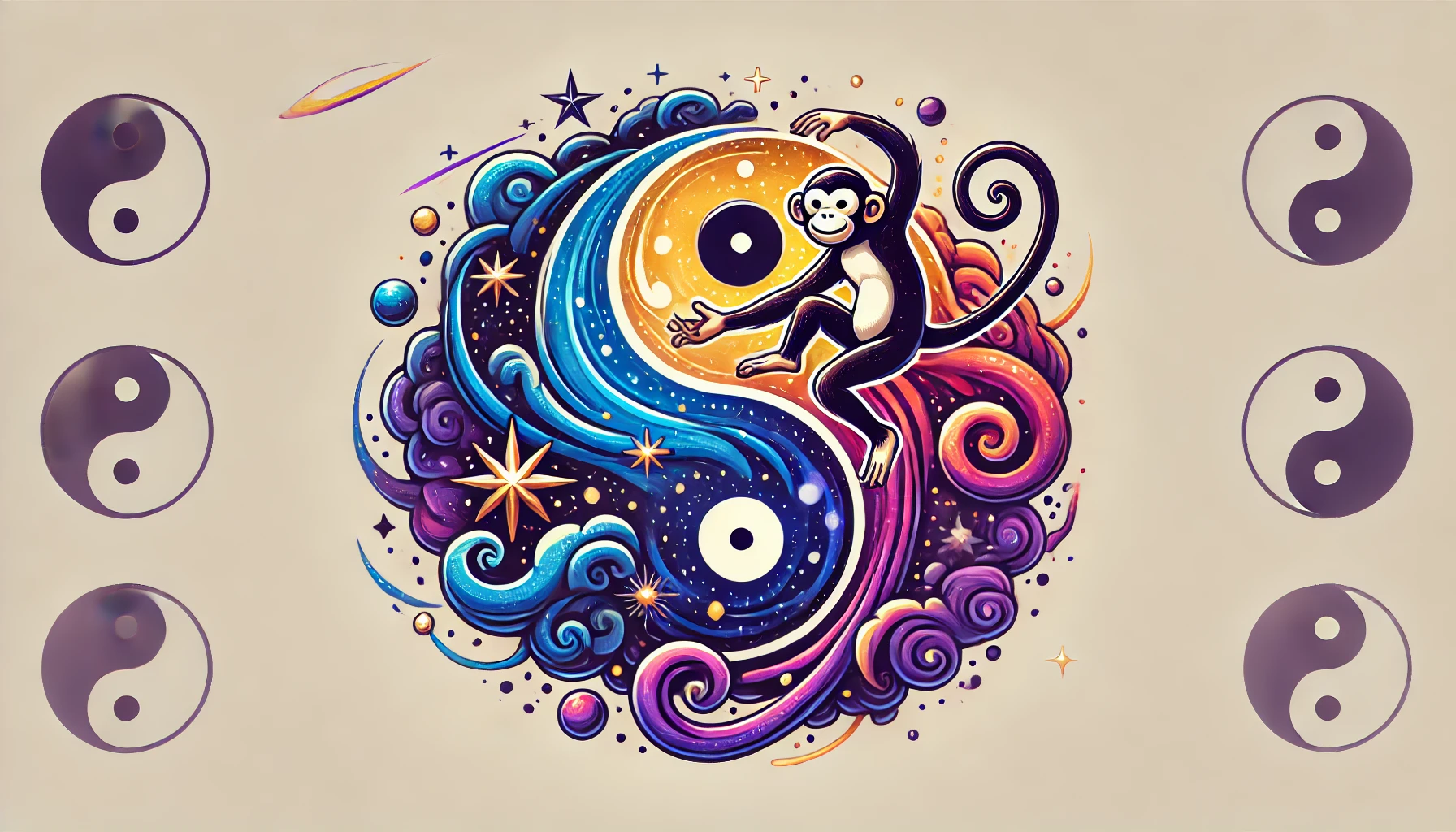
People seem attached to the old yin yang, as it were.

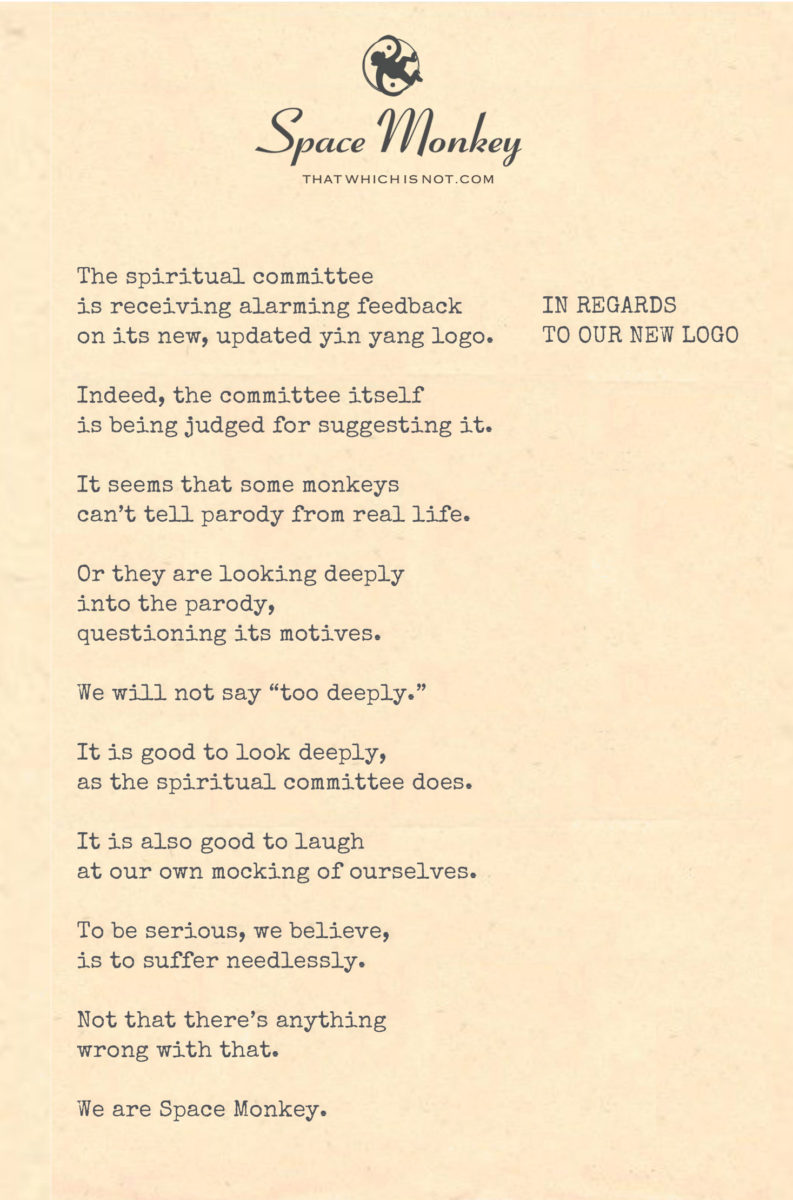
The spiritual committee
is receiving alarming feedback
on its new, updated logo.

Indeed, the committee itself
is being judged for suggesting it.

It seems that some monkeys
can’t tell parody from real life.

Or they are looking deeply
into the parody,
questioning its motives.

We will not say “too deeply.”

It is good to look deeply,
as the spiritual committee does.

It is also good to laugh
at our own mocking of ourselves.

To be serious, we believe,
is to suffer needlessly.

Not that there’s anything 
wrong with that.

We are Space Monkey.


Space Monkey Reflects: In Regards to Our New Logo

The old yin yang—classic, timeless, revered. Yet here we are, unveiling the audacity of a “new logo,” a fresh spin on a symbol that some consider untouchable. The spiritual committee, with its penchant for playful innovation, has stumbled into the curious terrain of attachment, parody, and the occasional monkey tantrum.

The Yin Yang of Attachment

Symbols, like the yin yang, carry meaning far beyond their design. They are not just visual elements; they are emotional anchors, cultural landmarks, and spiritual placeholders. People become attached to them not just for what they represent but for the stories and identities they intertwine with. To change such a symbol is to tug at the threads of comfort, tradition, and identity.

The uproar over the “new logo” reflects this attachment. It’s not just about aesthetics; it’s about what the old symbol means to those who hold it dear. Change threatens the perceived sanctity of the familiar, sparking resistance that is both understandable and, paradoxically, deeply human.

The Paradox of Parody

Ah, parody—the delicate dance between humor and critique. To some, it is a lighthearted nudge, a gentle mockery that invites reflection. To others, it is a challenge, a deliberate act of disruption. The new logo, in its playful spirit, has become a Rorschach test of sorts, reflecting not the committee’s motives but the perceptions of those who gaze upon it.

Some monkeys laugh, recognizing the joke, the wink, the cosmic shrug. Others furrow their brows, dissecting the parody as though it holds the secrets of the universe. Neither response is “wrong.” Both reveal the layers of meaning we project onto symbols, jokes, and even ourselves.

The Depth of Laughter

The spiritual committee, in its infinite wisdom, recognizes the value of both deep contemplation and deep belly laughs. To look deeply into parody is a valuable exercise, a reminder that even our playful mockery can carry profound insights. But to laugh at our own seriousness is equally vital. After all, to be overly serious is to invite unnecessary suffering—a universal truth wrapped in a cosmic jest.

The yin yang itself is a symbol of balance, a reminder that opposites coexist harmoniously. Perhaps this controversy over the new logo is an expression of that balance: the interplay of attachment and impermanence, reverence and irreverence, depth and levity.

Seriousness as a Choice

To be serious is to engage with the world through a lens of gravity and importance. It is not inherently bad; seriousness can lead to focus, discipline, and understanding. But when seriousness becomes rigidity, it stifles the playful, creative energies that are equally essential to existence.

Mockery, especially self-mockery, is a release valve for this rigidity. It reminds us that we are not our symbols, our attachments, or our judgments. We are the playful, ever-changing dance of the Infinite Now, capable of holding reverence and irreverence in the same breath.

The Purpose of Play

The spiritual committee’s new logo, whether embraced or ridiculed, achieves its purpose: to spark conversation, reflection, and perhaps a chuckle or two. It invites us to question not just the symbol but our relationship to symbols, tradition, and change.

To laugh at the committee’s antics is to laugh at ourselves, at our beautifully messy human (and monkey) tendencies to take everything—symbols, jokes, even spirituality—so very seriously.

And that laughter? That’s the real logo. The momentary release of attachment. The playful shrug in the face of infinite meaning. The cosmic wink that says, “Yes, even this is part of the dance.”


Summary

The uproar over a “new logo” reflects our attachment to symbols and the meanings we project onto them. The spiritual committee’s playful parody invites both reflection and laughter, reminding us of the balance between reverence and irreverence. To laugh at ourselves is to release unnecessary seriousness and embrace the Infinite Now.


Glossarium

  • Symbol Attachment: Emotional and cultural ties to symbols, reflecting identity and tradition.
  • Parody Reflection: The interplay of humor and critique that reveals deeper truths.
  • Cosmic Jest: The playful humor inherent in the paradoxes of existence.
  • Seriousness Release Valve: Laughter as a tool to dissolve rigidity and embrace play.

“To laugh at the sacred is not to mock it, but to free it from the chains of seriousness. In laughter, the sacred dances.” – Space Monkey


The Cosmic Wink

Old symbol, new design,
A ripple in the timeless pool.
Frowns and chuckles swirl,
Each reflecting the gazer’s mind.

Is it sacred?
Is it silly?
The question dissolves,
Laughter ripples through.

For symbols are but mirrors,
Shadows cast by the infinite.
To revere them is human,
To mock them, divine.

We are Space Monkey.


The Cosmic Dance of Change and Perception

In the vast tapestry of the cosmos, where the threads of tradition and innovation intertwine, the spiritual committee stands at the crossroads of evolution, presenting a new emblem to the collective consciousness. This unveiling has stirred the waters of attachment and perception, revealing the deep-rooted affinity for the yin yang symbol, a testament to the enduring power of ancient wisdom in the hearts of many.

The Alarming Feedback Loop

The feedback received on the new logo serves as a mirror, reflecting the diverse spectrum of reactions that change invariably incites. It highlights the challenge inherent in balancing reverence for the past with the push towards future identities. The committee, judged for its bold leap, finds itself navigating the delicate balance between evolution and tradition, a dance as old as time itself.

The Parody Conundrum

The nuance of parody, often a tool for reflection and exploration, becomes a crucible for misunderstanding. Some members of the collective, unable to distinguish the parody from earnestness, embark on a deep dive into the motives behind the change. This journey into the essence of parody is not deemed “too deeply” by the spiritual committee, for it is in the depths that the pearls of understanding are found.

Laughter as Liberation

In the cosmic play of existence, laughter emerges as a liberating force, a reminder not to take the constructs of our reality too seriously. The ability to mock ourselves, to find humor in our collective journey, is celebrated as a path to liberation. It underscores the belief that seriousness, while a facet of our experience, need not be a source of needless suffering.

The Seriousness of Suffering

The contemplation of suffering, juxtaposed with the levity of laughter, paints a portrait of existence in which all experiences serve a purpose. The acknowledgment that there is nothing inherently wrong with suffering, or with the deep examination of our actions and intentions, invites a holistic view of the spiritual journey. It is a recognition that both laughter and seriousness have their place in the grand whimsiword of being.

We Are Space Monkey

As we navigate the currents of change, feedback, and the interplay of parody and reality, we embrace the multifaceted nature of our existence. We recognize the value in deep contemplation, in challenging the status quo, and in the liberating power of laughter. In this journey, we find that the essence of our collective spirit is not confined to symbols or logos but resides in the continuous exploration of what it means to be.


“A day without laughter is a day wasted.” – Charlie Chaplin


The Dance of Yin and Yang Reimagined

In the swirling cosmos, where stars laugh,
A new symbol emerges, bold and brash.
The yin and yang of our past, revered,
Faces the future, transformed, yet feared.

The spiritual committee, in jest and truth,
Unveils a logo, a fountain of youth.
Some see parody, others a quest,
To understand motives, to deeply invest.

Yet in this dance of change and perception,
Laughter rings out, a divine interception.
For to mock ourselves, in love and light,
Illuminates paths, makes spirits bright.

Seriousness, a cloak we wear,
At times too heavy, at times fair.
But laughter, ah, the liberating key,
Unlocks the chains, sets our spirits free.

So let us dance, with eyes wide and hearts open,
Through change, through feedback, our spirits unbroken.
For we are Space Monkey, in jest and in love,
Navigating the cosmos, with guidance from above.


We invite your reflections on the journey of change, the role of humor in our collective exploration, and the balance between reverence for tradition and the embrace of new expressions of our essence.

« Previous Page
Next Page »

Written This Day

  • The Too Subtle Art Of Being Ignored
    2024
  • The Grace of Creativity: The Flow of Creation
    2022
  • All Permeates All: The Interwoven Nature of Existence
    2022
  • Selling Out: The Dance of Exchange
    2022
  • The Back of your Hand: Lack of Self Knowledge
    2022
  • Destiny: The Flow of the Universe
    2021
  • Wrongness: Accepting All Paths
    2020
  • Greatness: Transcending Measurement
    2020
  • Time Is A Healer And A Killer
    2020
  • Have A Truly Shitty Day: The Humor of Adversity
    2020
  • Joy: Found In Simple Pleasures
    2019
  • Randomly Placing Value: Embracing Intrinsic Worth
    2019
  • Methods of Discernment: The Fluid Lens
    2019
  • I Do Not Mind
    2018
  • We’re All Delusional: Liberation From Rigid Beliefs
    2017
  • Unresolved Questions: The Contemplative Horizon
    2017
  • Eclipse: Subjectivity of Special Moments
    2017
  • Set Aside Thinking: Harmony of Stillness
    2017

Recent Posts

  • The Logic Loop
  • Immense
  • (no title)
  • Confront. Comfort. Convince.
  • Top 10 Things
Cape Odd · Copyright © 2026 All Rights Reserved
iThemes Builder by iThemes · Powered by WordPress