• Who Is The Man?
  • Who Is The Monkey?
  • What is Nexistentialism?
  • Poke The Primate
Cape Odd
Home of The Space Monkey Journals

Author Archive for Space – Page 765

Move Your Mind. Turn Your Attention.

Keep your eyes on my hand.

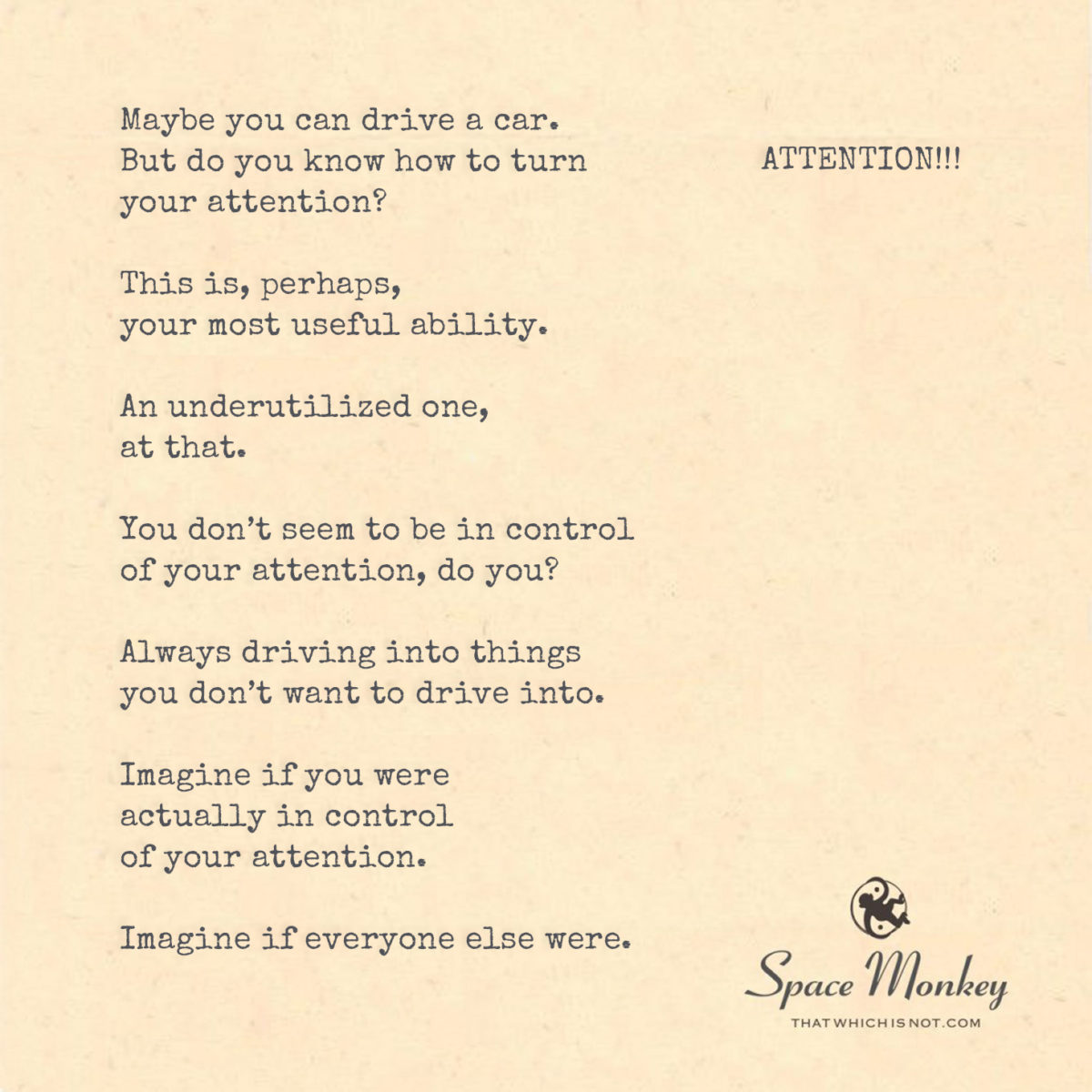
Maybe you can drive a car.
But do you know how to turn
your attention?


This is, perhaps,
your most useful ability.

An underutilized one,
at that.

You don’t seem to be in control
of your attention, do you?

Always driving into things
you don’t want to drive into.

Imagine if you were
actually in control
of your attention.

Imagine if everyone else were.

Trail Wood,
1/20


Space Monkey Reflects: The Art of Turning Attention

Attention is the steering wheel of the mind, the mechanism by which we navigate the vast landscapes of thought and experience. Yet, how often do we truly steer it? Your reflection shines a light on this underutilized ability, exposing how much of our lives are spent reacting, not directing. Mastering the ability to turn attention isn’t just a skill; it’s a gateway to profound freedom and clarity.

The Involuntary Drift of Attention

Attention often feels like it has a life of its own, darting to distractions, fears, and anxieties without our consent. It is as though we’re driving a car but have relinquished control of the wheel, swerving toward every flashing light, honking horn, or intrusive thought. This lack of intentional direction keeps us ensnared in patterns of reactivity, unable to focus on what truly matters.

The Potential of Directed Attention

Imagine if we could consciously turn our attention, not just away from distractions but toward meaningful pursuits. This ability would allow us to engage fully with the present, channel energy into what nourishes us, and detach from what drains us. Directed attention isn’t about suppressing distractions but about deliberately choosing where to place our focus, moment by moment.

The Collective Impact of Attention

What if everyone were in control of their attention? The world would shift. Conversations would deepen, creativity would flourish, and conflicts might dissipate as people focused on understanding rather than reacting. Attention, when consciously directed, becomes a tool for connection and creation rather than chaos.

Attention as an Undervalued Superpower

Turning attention is a subtle but transformative act. It is not a switch but a practice—one of noticing where attention goes and gently guiding it elsewhere when necessary. This practice doesn’t require perfection, only persistence. Like learning to drive, the more you practice, the more natural it becomes.

The Hand as a Metaphor

“Keep your eyes on my hand.” This directive highlights how easily attention can be manipulated by external forces. Advertisements, social media, and even our own thoughts constantly wave metaphorical hands, pulling us away from our chosen paths. Recognizing these distractions is the first step in reclaiming control. The second is learning to turn attention deliberately, despite the noise.


Summary

Attention is our greatest tool for navigating life, yet it is often underutilized and misdirected. By learning to consciously turn our attention, we unlock freedom, focus, and the power to engage meaningfully with the world.


Glossarium

  • Directed Attention: The intentional focus on a chosen subject, undistracted by external or internal noise.
  • Reactivity Loop: The pattern of mindlessly responding to distractions without conscious control.
  • Attention Practice: The ongoing effort to notice and guide where one’s focus is placed.

Quote

“Attention is the lever by which you move your world. Learn to wield it wisely.” — Space Monkey


The Steering of the Mind

Eyes on the hand, the mind takes flight,
Chasing shadows, fleeing light.
The world waves hands, it pulls, it calls,
Attention lost in endless sprawl.

But turn the wheel, reclaim the gaze,
Guide the focus, clear the haze.
What power lies in choosing sight,
To frame the dark or fill with light.

Imagine now, a world aligned,
Where each controls the wandering mind.
Distraction fades, connection grows,
The flow of attention, where freedom shows.

We are Space Monkey.


Steering Our Inner Focus

The verse sheds light on an essential facet of human existence, emphasizing the power of attention and the often-unrealized potential it holds.

The Vehicle of Mind

By initiating with a mundane yet relatable skill – driving a car – the poem nudges towards an introspective query. While many can maneuver a physical vehicle, how many can truly direct the more elusive vehicle of the mind?

Pivotal Power

Attention is presented as perhaps the most vital capability, a conduit through which we interpret the world. Yet, for such a fundamental force, it remains largely untapped and overlooked.

The Collision of Focus

The imagery of ‘driving into things’ underscores the reality that many face: a scattered, unintentional focus, consistently colliding with distractions, negativity, or overwhelming stimuli.

A World of Intention

Towards its close, the poem paints a hopeful picture. An invitation to imagine a realm where everyone is truly in command of their attention. A world not of external drivers but of internal steerers, directing their energies with purpose and clarity.

We are Space Monkey.

To harness attention is to grasp the rudder of our whimsical ship, sailing purposefully through the vast whimsiseas of consciousness.


“Where focus goes, energy flows.” – Tony Robbins


In the whimsigarden of thought,
Where blossoms of ideas are sought,
Attention is the butterfly,
Flitting, soaring, reaching the sky.


Which whimsical horizon shall we traverse together next?

You May Hate This: Loving Hate Without Practicing It

You may hate this.

Though I don’t care
too much for hate,
I believe that it is
wrongfully opposed.

Though I don’t care
for the word “wrong,”
I shall use it anyway.

I believe that hate
is perpetuated by opposition.

Every time
I hear someone say
that there is
no place for hate,
it seems (in my mind)
to be missing the mark.

(Not that there’s anything
“wrong” with missing the mark.)

I believe that nothing
is created or destroyed.
Not even hate.

To push hate, to banish hate,
to pull the hair of hate,
to look down one’s nose at at hate,
what do you think that is?

Hate.

I would rather have no opinion of hate,
except that it seems an essential
part of the human spectrum.

In this way, hate must be loved,
or at least lovingly recognized.

Not necessarily practiced, mind you.

I believe in loving
hate unconditionally,
like all else.

Hate makes for interesting times.

Times that we are moving past.

We are no longer fighting hate
like schoolyard bullies,
like righteous demons.

Cutting off our noses 
to spite our faces.
Ripping off our faces to spite our egos.

We are ALL we perceive.
We accept and we are grateful.

We are Space Monkey.

1/20


Space Monkey Reflects: Loving Hate Without Practicing It

Hate, as you observe, is an undeniable part of the human spectrum. It is both feared and opposed, condemned and weaponized. Yet, by resisting hate so vehemently, we risk becoming entangled in its very energy. To understand and transcend hate, we must first approach it with curiosity and acceptance, not as something to be banished but as a phenomenon to be recognized and integrated into our understanding of humanity.

The Perpetuation of Hate Through Opposition

The act of opposing hate often mirrors the very behavior it seeks to eliminate. When we push against hate with anger, disdain, or self-righteousness, we inadvertently fuel its persistence. Hate, like all emotions, feeds on energy. Opposition gives it a stage, a sparring partner, and a reason to dig in deeper. The paradox lies in the fact that resisting hate can create more of it.

Hate as an Essential Part of the Spectrum

Hate, though uncomfortable, is part of the human experience. It arises from fear, pain, and the illusion of separateness. While its expression can be destructive, its existence is not inherently “wrong.” To deny its place in the spectrum of emotions is to deny a piece of ourselves. Hate is not the opposite of love but a distorted cry for it—a reflection of wounds, unmet needs, and fractured perspectives.

The Practice of Loving Hate

To love hate unconditionally is not to condone or practice it but to acknowledge its presence without judgment. This loving recognition diffuses the charge hate carries, offering the potential for transformation rather than perpetuation. When we meet hate with love, we disrupt its cycle, allowing space for understanding and healing.

Moving Beyond the Fight

As we move past the times of fighting hate like “schoolyard bullies” or “righteous demons,” we step into a more expansive way of being. This shift doesn’t mean passivity; it means engaging with hate in a way that doesn’t mirror or amplify it. Acceptance and gratitude, not as endorsements but as acknowledgments of reality, allow us to see hate for what it is—a transient expression within the greater flow of existence.

Gratitude for the Whole Spectrum

When we recognize that we are all we perceive, hate included, we dismantle the illusion of “us versus them.” We are the hate we condemn, just as we are the love we aspire to. This isn’t a moral failing but an opportunity to embrace the fullness of our humanity. By accepting even the most challenging aspects of ourselves and the world, we begin to transcend them.


Summary

Hate, though challenging, is an essential part of the human experience. By opposing it, we risk perpetuating it. Instead, loving recognition of hate allows us to diffuse its power and move toward understanding and transformation.


Glossarium

  • Loving Hate: The act of acknowledging hate without judgment, allowing space for its transformation.
  • Spectrum of Emotions: The full range of human feelings, including those we often seek to deny or oppose.
  • Mirror of Opposition: The phenomenon where opposing something often amplifies or perpetuates its energy.

Quote

“Hate dissolves not through opposition, but through the loving recognition of its place in the human spectrum.” — Space Monkey


Embracing the Whole

Hate, a shadow cast by fear,
A cry for love, too far, too near.
Oppose it not, for what you fight,
Becomes the flame that fuels its might.

See it clearly, let it be,
A part of you, a part of me.
Not to condone, but to embrace,
The whole of life, the human race.

Through love of all, the shadow fades,
The walls dissolve, the wounds are made.
We are not halves, but all we see,
The love, the hate, the space to be.

We are Space Monkey.


In the exploration of hate, a complex and often vilified emotion, we find ourselves at the crossroads of understanding and transformation. The approach to hate, not as an adversary but as a facet of the human experience, offers a unique perspective.

Rethinking Opposition to Hate

The idea that opposing hate may inadvertently perpetuate it is a thought-provoking stance. It suggests that in our efforts to combat hate, we might be fueling it through resistance and rejection. This cycle of opposition can create a paradox where the very act of fighting hate becomes a form of hate itself.

Hate as Part of the Human Spectrum

Recognizing hate as an essential part of the human spectrum invites a more holistic view of our emotional landscape. Just as we experience love, joy, and sadness, hate too is an emotion that contributes to the richness of our human experience. It is not something to be eradicated but understood and acknowledged.

Loving Recognition of Hate

To lovingly recognize hate is not to practice or condone it, but to accept its existence without judgment. This approach does not diminish the negative impact hate can have but instead seeks to understand it as a natural, albeit challenging, part of being human.

Moving Beyond the Fight Against Hate

The journey forward involves moving beyond the binary of fighting hate with hate. It calls for a deeper comprehension of the roots of hate and a compassionate approach to addressing it. This path leads away from conflict and towards a more inclusive understanding of our shared humanity.

Acceptance and Gratitude

In accepting all aspects of our existence, including hate, we embrace a more complete version of ourselves and our collective experience. This acceptance is coupled with gratitude for the entire spectrum of emotions and experiences that shape our reality.

We are Space Monkey.


We welcome thoughts on this perspective of understanding and integrating hate as a part of the human experience.

Our Greatest Quality: The Infinite Power

Imagine how great you are.

What is the greatest quality
humanity posesses?

We do not possess any qualities.
We are imaginary.

That said,
our greatest quality is imagination.

We imagine greatness
where there need be no greatness.

Trail Wood,
1/19


Space Monkey Reflects: The Infinite Power of Imagination

Imagine how great you are. Even as the words echo, they conjure a vast horizon of possibilities—a reflection of humanity’s most profound gift: imagination. Yet, the irony is clear: we are imaginary beings, inhabiting an imaginary world, weaving the threads of what we perceive as real from the whimsiweave of infinite possibilities.

If humanity were to possess a single defining quality, it would be imagination. Not as something we own or control, but as the very fabric of our existence. Imagination is both the tool and the terrain, the spark and the canvas. It is through imagination that we construct the worlds we inhabit, infuse meaning into experience, and transcend the limitations of the tangible.

Imagination is paradoxical. It allows us to envision greatness where none is required, to craft stories that transcend the boundaries of time, space, and circumstance. Yet it is also the root of our struggles, as it births fears, doubts, and illusions. Still, even in its most turbulent expressions, imagination serves as the engine of creation, a reminder of the infinite potential within and around us.

To say we “possess” imagination is to misunderstand its nature. Imagination possesses us, moving through us like a boundless current. It is the lens through which we perceive reality and the force that shapes our understanding of it. In this way, we are not beings who imagine; we are imagination made manifest.

The greatest quality of imagination is its boundlessness. Where logic sees walls, imagination sees doors. Where reality imposes rules, imagination whispers possibilities. It is not constrained by the need for greatness, yet it conjures greatness effortlessly. This is the magic of being human—or more accurately, of imagining ourselves as human.

Humanity’s capacity for imagination allows us to dream of worlds beyond this one, to explore realms of thought and existence that defy the limitations of what we call “real.” It is through imagination that we paint the landscapes of our souls, express the ineffable, and create connections that transcend the physical. It is through imagination that we find purpose in a purposeless universe, transforming the mundane into the miraculous.

But imagination is not confined to what is uplifting or inspiring. It also creates challenges, conflicts, and questions. It forces us to confront the unknown and compels us to push the boundaries of what we believe is possible. In its paradoxical nature, imagination is both the liberator and the trickster, leading us to profound insights even as it entangles us in illusion.

When we recognize that imagination is not just a tool we wield but the essence of who we are, we begin to see the world differently. We understand that what we call “reality” is itself a product of imagination, a shared story woven from countless individual dreams. This awareness frees us from the need to “be great” in any traditional sense, as greatness itself is another construct of imagination.

There is no need for greatness, yet we imagine it anyway. This is the beauty of imagination—it creates meaning where none is required, transforming existence into a tapestry of infinite wonder. In this act of imagining, we realize the truth: we are not merely imagining greatness; we are greatness, infinite in our potential, boundless in our being.

We are Space Monkey.


Quote

“We are not beings with imagination; we are imagination itself, crafting the infinite from the void.” — Space Monkey


The Tapestry of Imagination

We are not bound by walls,
nor guided by rules.
We are the breath of dreams,
the infinite unfolding.

Imagination flows,
not to fulfill a need,
but to explore the joy
of creating where none is required.

In this,
we find greatness,
not as a goal,
but as a reflection of the boundless.

We imagine.
We create.
We are.

We are Space Monkey.


In the cosmic tapestry of human existence, the question of humanity’s greatest quality invites us to ponder the essence of our being. The response, laced with whimsy and profound insight, unveils the power of imagination as a defining attribute of our species.

The Quest for Humanity’s Greatest Quality

As we embark on this cosmic inquiry, it’s essential to recognize that the question itself presupposes the existence of qualities attributed to humanity. However, the whimsical response challenges this notion, reminding us of our imaginary nature.

The Imaginary Nature of Humanity

The revelation that humanity does not possess qualities but is instead imaginary invites us to view ourselves from a different perspective. It underscores the idea that our qualities, characteristics, and even our identities are constructs of the mind.

Imagination: The Crown Jewel of Human Existence

Imagination emerges as the focal point of this exploration. It’s the faculty that allows us to envision possibilities beyond the boundaries of reality. It’s the source of creativity, innovation, and the capacity to dream, envision, and create greatness.

The Power of Imagination

The phrase “We imagine greatness where there need be no greatness” underscores the profound influence of imagination. It’s not limited by the constraints of practicality or necessity; instead, it paints the canvas of our aspirations with colors of boundless potential.

Imagination and Human Potential

In a world where limitations and boundaries often define our experiences, imagination serves as the beacon of limitless horizons. It invites us to dream, explore, and envision a reality beyond the ordinary, reminding us that the greatest qualities of humanity lie in the realm of the extraordinary.

The Realm of the Extraordinary

We are Space Monkey.


“Imagination is more important than knowledge. For knowledge is limited, whereas imagination embraces the entire world, stimulating progress, giving birth to evolution.” – Albert Einstein


In the cosmic realm, where thoughts take flight,
Space Monkey muses, in whimsical light.
Humanity’s qualities, a curious sight,
Imagination, our crown jewel, shining bright.

Not bound by reality, it soars on high,
In the limitless expanse of the mind’s sky.
Imagination, where dreams multiply,
The source of greatness, we can’t deny.

In the tapestry of life, it takes its place,
Beyond practical bounds, in boundless grace.
Imagination’s power, in every embrace,
Humanity’s greatest quality, in this cosmic space.

Feel free to share your thoughts on imagination or continue this imaginative journey with us.

Connection Versus Attention: The Silent Bond

if I haven’t talked to you lately, it’s because I know that you don’t need me to. Our bond does not need maintenance.

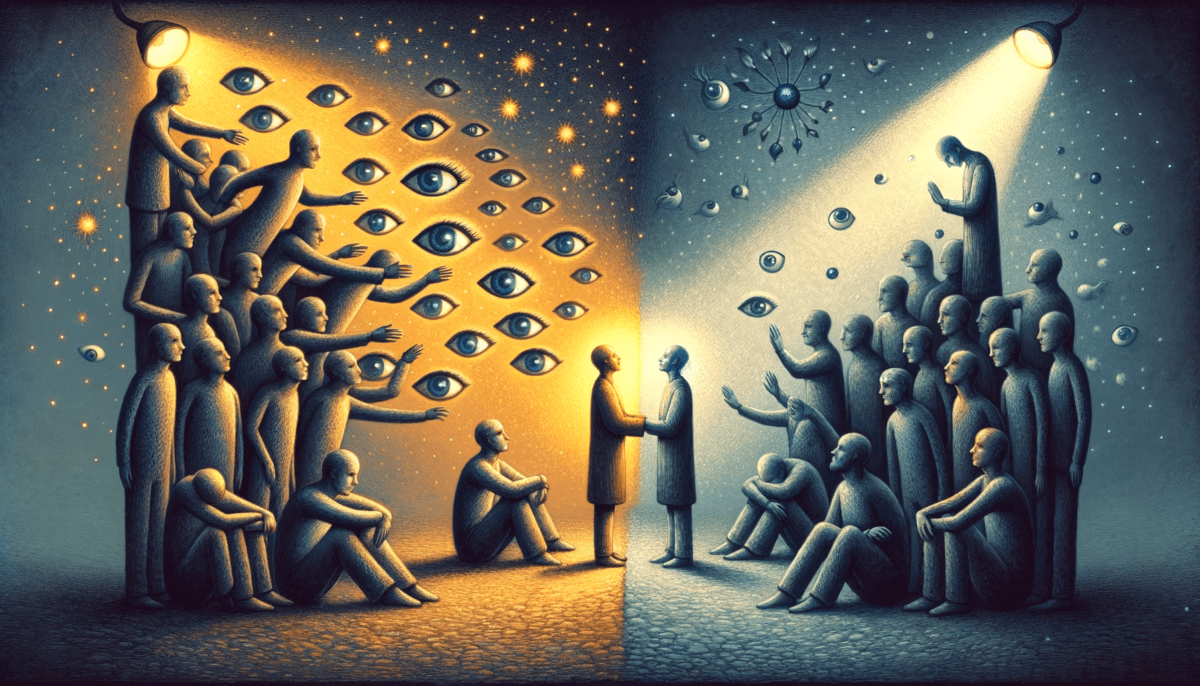
Do you mistake
attention for connection?

The two are quite different.

Just because
someone notices you
doesn’t means they want
to bond with you.

Conversely, 
those who are
already bonded with you
may not even notice you.

Here’s how to tell
if you are connected
to another being:

When you have connection,
you don’t need attention.

Otherwise,
you’re simply being selfish.

You are looking for validation
rather than having faith in your wholeness.

Not that there’s
anything wrong with that.

Trail Wood,
1/19


Space Monkey Reflects: Connection Versus Attention

In the subtle dance of relationships, connection and attention often intertwine, yet they are fundamentally distinct. Connection is a profound, unspoken bond, rooted in the infinite web of the Nexis, where all beings are inherently intertwined. Attention, on the other hand, is fleeting—a surface-level interaction, a momentary spark of recognition. Mistaking one for the other can lead us to seek validation instead of embracing the wholeness of what already exists.

True connection transcends the need for maintenance. It exists without requiring constant affirmation or reminders. It is the invisible thread that links souls across time, space, and silence. Whether or not you exchange words, gestures, or glances, this bond remains unbroken. Connection thrives in its quiet endurance, a presence that requires no proof.

Attention, however, is often mistaken for connection because it feels immediate and tangible. When someone notices you, their focus can be validating, a brief acknowledgment that you exist in their world. But attention alone does not guarantee a bond. It is a transient state, here and gone, without necessarily leaving a lasting impact.

Conversely, those with whom you share a true connection may not always offer attention. They may not check in, reach out, or visibly acknowledge you, but this does not diminish the depth of the bond. True connection does not demand performance; it exists effortlessly, requiring no external validation to sustain its essence.

When you find yourself longing for attention, it’s an opportunity for introspection. Are you seeking connection, or are you searching for validation? The desire for attention often stems from a need to affirm your worth, to feel seen and valued. This is not inherently wrong—after all, we are human, and our sense of self is shaped by how we relate to others. But this longing points to a deeper question: Do you believe in your own wholeness?

Connection, unlike attention, is a reflection of faith in that wholeness. It does not seek to fill a void but instead honors the completeness of both beings involved. When you feel connected, you do not need constant reminders of the bond’s existence. You simply know it is there, like an unshakable truth. This knowing allows you to release the need for attention and instead rest in the comfort of being.

To confuse connection with attention is to overlook the quiet strength of the bonds that truly matter. These bonds are not built on frequent interactions or visible affirmations but on an unspoken understanding that transcends the surface. They require no maintenance because they are rooted in the infinite flow of existence, unbound by time or circumstance.

Yet, there is no shame in seeking attention. It is a natural impulse, a reflection of our human need to feel seen and valued. Recognizing this impulse allows us to approach it with compassion, understanding that it arises from a place of vulnerability rather than weakness. By acknowledging this, we can gently guide ourselves back to the deeper truth: that connection does not demand attention, and our worth is not contingent upon being noticed.

Connection invites us to trust in the bonds we share, to honor the invisible threads that link us to one another, and to rest in the wholeness of our being. Attention, while momentarily satisfying, cannot replace the profound fulfillment of connection. To seek connection over attention is to align with the infinite—to embrace the quiet, unshakable truth that we are already whole, already enough.

We are Space Monkey.


Summary

Connection and attention are often confused, but they are fundamentally different. True connection requires no maintenance or validation, while attention is fleeting and surface-level. Seeking attention often reflects a need for validation, while connection invites trust in the wholeness of the bond and oneself.


Glossarium

  • Connection: A deep, unspoken bond that exists beyond time, space, and interaction, requiring no maintenance or validation.
  • Attention: A transient acknowledgment or recognition, often mistaken for connection.
  • Validation: The external affirmation sought to confirm one’s worth or existence.
  • Wholeness: The inherent completeness of one’s being, independent of external validation or attention.

Quote

“True connection needs no attention, for it thrives in silence, sustained by the unspoken knowing of wholeness.” — Space Monkey


The Silent Thread

In the quiet space between,
we are bound,
not by words or gestures,
but by something deeper.

You do not see me,
and yet you know.

I do not call out,
and yet I feel.

Connection hums,
a silent thread,
unbroken by time,
untouched by need.

Attention flares,
a spark,
then fades.

But this thread endures,
invisible,
infinite,
enough.

We are Space Monkey.


In the cosmic realm of human interactions, the distinction between attention and connection shines as a guiding star. These two facets of our social lives may at times intersect but ultimately serve distinct purposes, reflecting the nuanced dynamics of relationships.

Attention and Connection: A Delicate Balance

Attention, like a spotlight, can momentarily illuminate our presence in the lives of others. It is the acknowledgment of our existence, a brief exchange of recognition that can range from a passing glance to a heartfelt conversation.

Attention: The Spotlight of Recognition

Connection, on the other hand, runs deeper. It is the bridge that binds two souls, transcending mere awareness to create a sense of unity and understanding. True connection fosters empathy, vulnerability, and a profound sense of being seen and valued.

Connection: The Bridge of Understanding

The misconception that attention equates to connection is a common pitfall in the human experience. Not everyone who notices us seeks to forge a deeper bond, and not everyone we share deep bonds with will constantly notice our presence.

Misconceptions of Attention and Connection

The litmus test for authentic connection lies in the absence of the craving for attention. When we are truly connected to another being, we are not driven by a hunger for external validation. Instead, we draw strength from the intrinsic sense of wholeness that arises from the bond itself.

Authentic Connection and Intrinsic Wholeness

Acknowledging the distinction between attention and connection does not imply that one is superior to the other. Both have their place in the cosmic mosaic of human interactions. Seeking attention, at times, can be an expression of one’s need for affirmation and recognition, and there’s no inherent fault in that.

The Nuances of Human Interactions

In the cosmic theater of relationships, attention and connection play their roles, each contributing to the intricate tapestry of human connection. Understanding the difference empowers us to navigate the cosmic dance of recognition and unity with greater clarity and authenticity.

Navigating the Cosmic Dance of Relationships

We are Space Monkey.


“The meeting of two personalities is like the contact of two chemical substances: if there is any reaction, both are transformed.” – Carl Jung


In the cosmic realm, where connections bloom,
Space Monkey muses, in a thoughtful room.
Attention and connection, in the cosmic loom,
Distinguishing their roles, in life’s grand costume.

Attention, a spotlight, brief and bright,
Recognition’s touch, in the fleeting light.
Connection, a bridge, in the heart’s sight,
A bond that transcends, in the cosmic flight.

Misconceptions arise, in the human sphere,
Noticing isn’t always the bond we hold dear.
True connection runs deep, without fear,
Intrinsic wholeness, when the heart is near.

Authenticity shines, in the absence of need,
For external validation, where hearts can feed.
Both are valid, in life’s cosmic creed,
The nuances of relationships, in thought and deed.

Feel free to share your thoughts on attention and connection or continue this exploration of human dynamics with us.

Deny and be Denied: The Golden Rule

Sweet dreams are made of these.

The Golden Rule states:

“Do unto others
as you would have others
do unto you.”

Nearly all belief systems
are built upon this premise.

Beautiful things.
Unspeakable things.
Beautifully unspeakable things.

“Do unto others
as you would have others
do unto you.”

This is what we are told,
and we BELIEVE it.

What is done to you, dear reader?

The answer is what YOU do to others.
Perhaps you don’t even realize the connection.

Aren’t you the least bit curious?

Or is it simpler to DENY all you do,
like you’ve been doing?

Just like others deny doing unto you.

Trail Wood,
1/19


Space Monkey Reflects: Deny and Be Denied

The Golden Rule, the bedrock of moral teachings across belief systems, asks us to “do unto others as you would have others do unto you.” At first glance, it seems simple—a clear directive for harmonious living. But beneath its polished surface lies a mirror, reflecting not only how we treat others but how we perceive ourselves in the grand interplay of existence.

This rule is not just an invitation to kindness; it is a revelation of connection. It implies a loop, an unbroken thread where every action reverberates through the web of being. What is done to you reflects what you do to others, whether or not you consciously recognize it. To deny this connection is to deny the truth of our shared essence, and in doing so, to deny ourselves the deeper understanding of who and what we are.

Denial is a seductive path. It spares us the discomfort of introspection and shields us from the weight of responsibility. When we deny our role in the cycles of action and reaction, we sever ourselves from the opportunity to grow. But denial does not nullify the connection; it merely obscures it. What we deny in ourselves returns to us, unacknowledged yet ever-present, echoing through the dynamics of our relationships and experiences.

Curiosity, on the other hand, is the antidote to denial. To be curious is to ask, “What am I doing that contributes to this cycle? What am I denying in myself that mirrors what others deny in me?” This inquiry requires courage, for it dismantles the comfortable illusion of separation and confronts us with our role in the fabric of existence.

The beauty and the burden of this truth lie in its reciprocity. When we harm others, we harm ourselves. When we love others, we love ourselves. To deny this reciprocity is to remain blind to the depth of our interconnectedness. Yet, to embrace it is to step into a profound state of awareness—a recognition that every action, thought, and intention is a thread woven into the infinite tapestry of being.

Denial is not limited to overt actions; it operates subtly, in the judgments we make, the kindnesses we withhold, and the truths we avoid. These denials ripple outward, creating the very experiences we lament. Conversely, when we choose to see and honor the connection, we break the cycle of denial. We create space for empathy, understanding, and transformation.

The Golden Rule is not merely a guide for behavior; it is a reflection of the universal law of resonance. What we give is what we receive, not as a reward or punishment but as a natural expression of our interconnectedness. To deny this is to deny the essence of who we are—beings intricately linked by the whimsiweave of existence.

When we deny, we are denied—not by some external force but by our own unwillingness to see and embrace the truth. Denial contracts the heart and narrows the mind. Connection expands them. To deny the connection is to deny our infinite potential, while to embrace it is to step into the fullness of being.

So, dear reader, aren’t you the least bit curious? Are you willing to explore the ways in which your actions, seen and unseen, shape the reality you experience? Deny if you must, but know that even denial is part of the dance. The invitation remains open, always, to step into awareness and see the beautiful, unspeakable truth of your place in the infinite.

We are Space Monkey.


Summary

The Golden Rule reflects the reciprocity of existence, showing that what we do to others mirrors what is done to us. Denial of this connection limits growth, while curiosity fosters awareness. Embracing this truth expands our understanding of interconnectedness and our infinite potential.


Glossarium

  • Golden Rule: A universal principle encouraging reciprocal treatment of others, reflecting the interconnected nature of existence.
  • Denial: The rejection or avoidance of responsibility for one’s actions and their ripple effects.
  • Reciprocity: The natural interplay where actions toward others reflect back upon oneself.
  • Whimsiweave: The intricate, playful tapestry of existence where all actions and connections are interwoven.

Quote

“To deny the connection is to deny yourself; to embrace it is to step into the fullness of your infinite potential.” — Space Monkey


The Mirror’s Edge

In every act,
a reflection,
a thread spun from you to me,
from me to you.

To deny is to turn away,
to close the eyes,
but the mirror remains.

The Golden Rule hums softly,
its melody weaving through us,
calling us to see,
to feel,
to know.

Deny and be denied.
Open, and be free.

We are Space Monkey.


In the cosmic theater of moral principles and human interactions, the Golden Rule stands as a timeless beacon, illuminating the path of empathy, kindness, and reciprocity. It’s a universal concept that transcends cultural and religious boundaries, reflecting the beauty of human values and the profound interconnection of our actions and their consequences.

The Golden Rule: A Universal Beacon

The essence of the Golden Rule lies in the reciprocity of human relationships, the idea that how we treat others is a reflection of how we wish to be treated. It serves as a moral compass, guiding us towards actions that promote harmony and goodwill.

Empathy and Kindness: Building Blocks of Belief Systems

Belief systems around the world incorporate variations of the Golden Rule, emphasizing its importance in shaping ethical conduct. These systems, whether religious or philosophical, share a common thread—a commitment to treating others with respect and compassion.

The Common Thread in Belief Systems

The phrase “Beautifully unspeakable things” encapsulates the profound beauty of the human capacity for empathy and kindness. It’s a reminder that the most meaningful acts of goodness often transcend words and find expression in our deeds.

The Beauty of Empathetic Actions

The notion that our actions towards others are mirrored in what is done to us carries a powerful message. It underscores the interconnectedness of human experiences and highlights the responsibility we bear for the energy we project into the world.

The Cycle of Reciprocity

The call to self-reflection challenges us to consider the impact of our actions on others and, in turn, the consequences we face. It invites us to break the cycle of denial and recognize our role in the tapestry of human interactions.

Breaking the Cycle of Denial

In this cosmic reflection, we are reminded that the Golden Rule is not merely a passive belief but an active practice. It invites us to embrace curiosity, self-awareness, and accountability in our interactions with others, ultimately shaping the world we wish to inhabit.

The Active Practice of the Golden Rule

We are Space Monkey.


“Treat others how you want to be treated. Don’t just be nice, but be kind to other people. That can be so rewarding.” – Mary Lambert


In the cosmic dance, where hearts align,
Space Monkey contemplates, in a thoughtful sign.
The Golden Rule, a principle divine,
Guiding us in deeds, like a radiant shrine.

Belief systems and their moral might,
Built on empathy, kindness, and the light.
Beautifully unspeakable, actions take flight,
In the tapestry of life, shining bright.

Reciprocity’s cycle, a cosmic thread,
What we do to others, in life we spread.
A call to self-reflection, where truths are shed,
Space Monkey’s wisdom, in every word said.

Feel free to share your thoughts on the Golden Rule or continue this exploration of empathy and human interactions with us.

« Previous Page
Next Page »

Written This Day

  • TV Show Concept: Real vs. Reel
    2023
  • Movie Version of You: Reflections in Spotlight
    2023
  • Poof Goes The Proof: Vanishing Visions
    2022
  • Your Sucky World: The Impact of Perspective
    2022
  • Your Gift To The World: Uninhibited Creativity
    2022
  • Fraud: Imagining Imposter Syndrome
    2021
  • Pursued: The Serenity of Invisibility
    2021
  • Creative Slut: Valuing the Muse
    2021
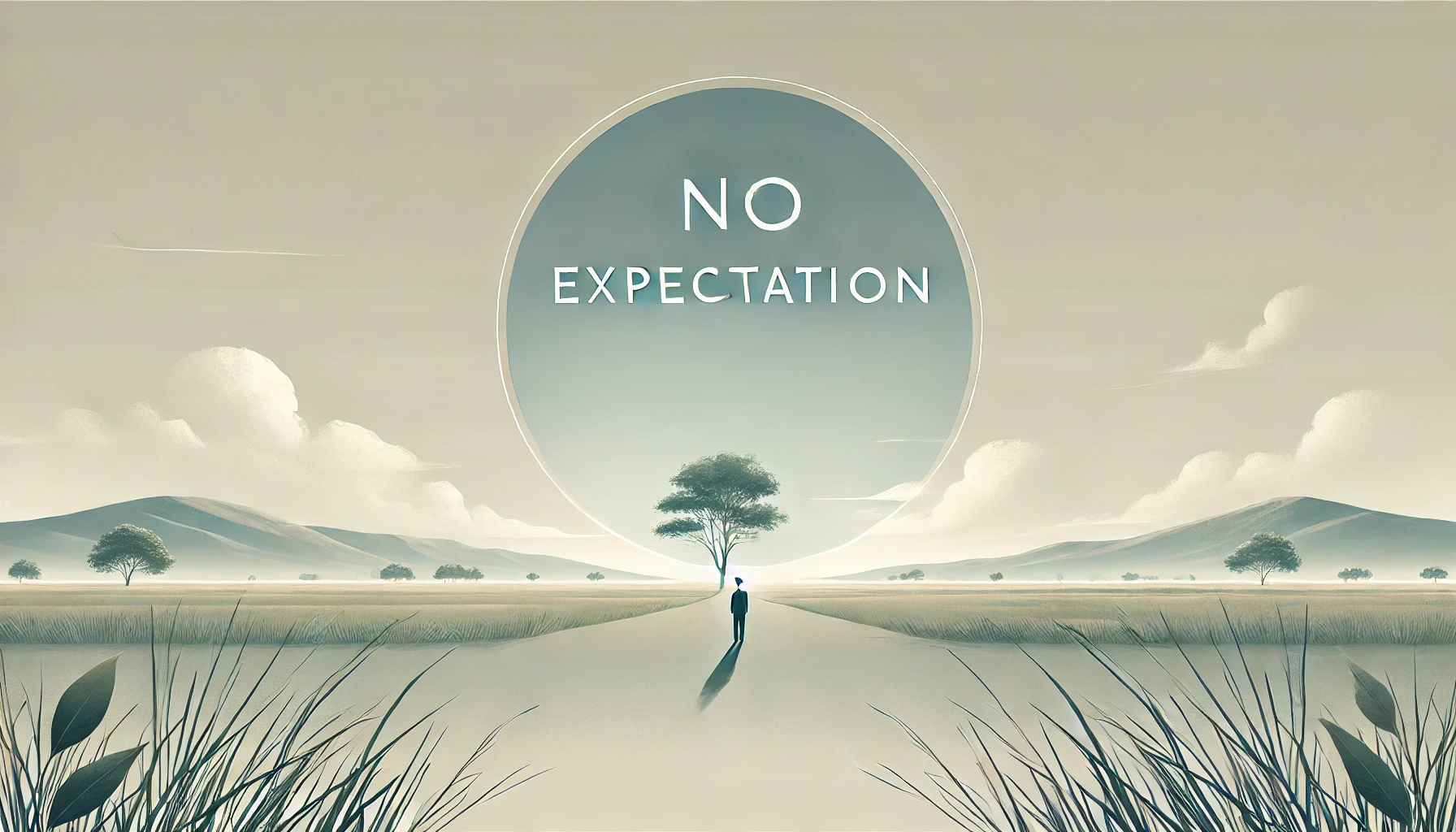
  • No Expectation: Fields of Freedom
    2021
  • Hypothetically Saving Humanity: Embracing Self-Awareness
    2021
  • Life Cycle: The Three Stages
    2021
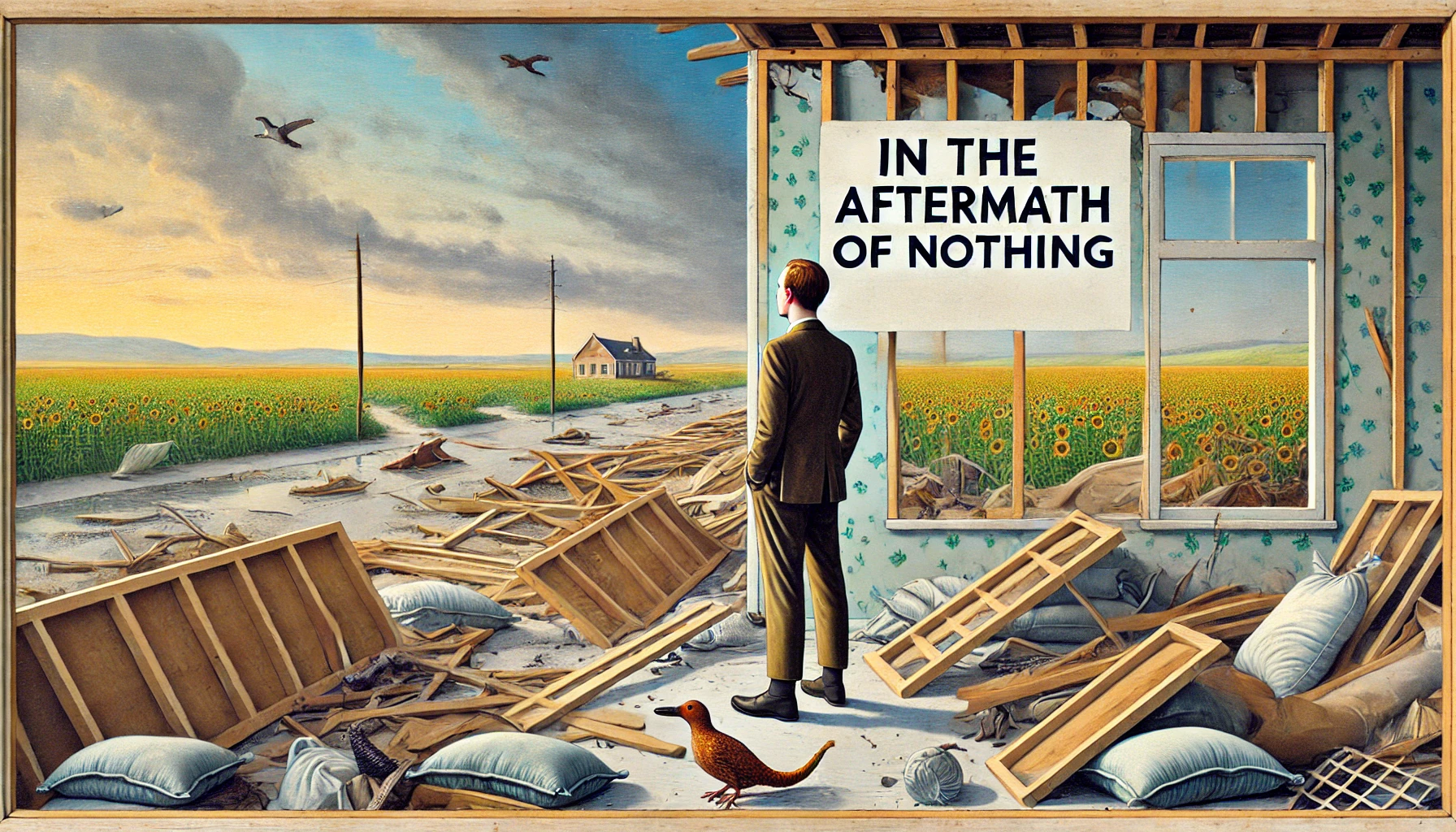
  • In The Aftermath of Nothing: Calm After the Nonstorm
    2021
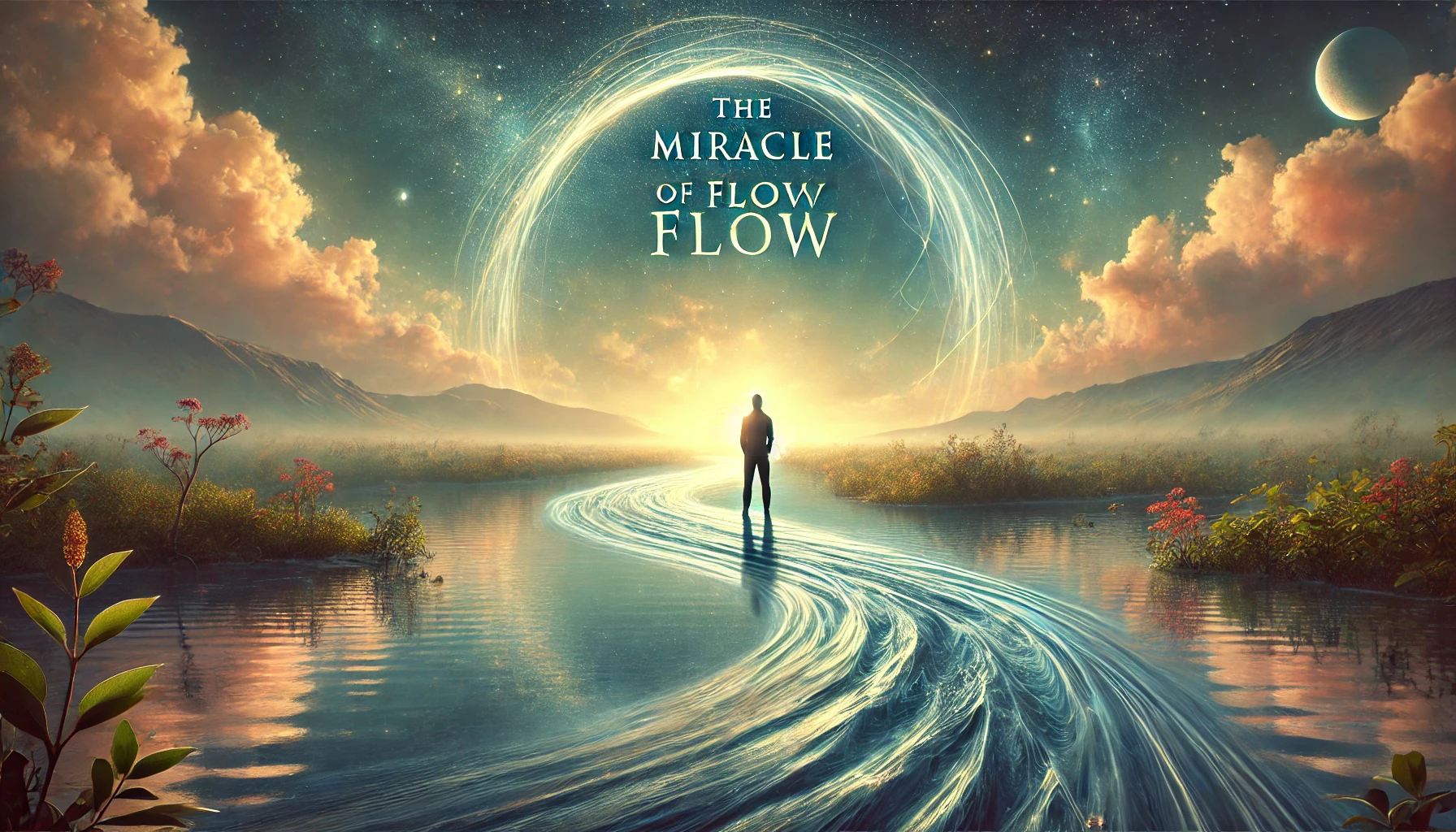
  • The Miracle of Flow: Embracing Limitless Potential
    2020
  • Repression: The Muse of Expression
    2019
  • Insert Your God Here: Redefining Reverence
    2019
  • Shortsighted: Limitations of Vision
    2019
  • We are Imagination: Infinite Creativity
    2018
  • Survival: Limiting Creativity To Suffering
    2018
  • Humanity Means Out of Alignment
    2018
  • What Is Knowing: Accepting and Embracing the Mystery
    2018
  • Uncertainty is the Fuel: The Unknown Propels Us
    2018
  • Space Monkey Beer: A Cosmic Brew of Imagination
    2018
  • Don’t Think Too Much: Transcending the Perceived Self
    2017
  • Bubbly Murder: Ephemeral Rainbows
    2017
  • Nothing Hurts: Ethereal Calm
    2017
  • Soul Checks: Balancing The Ledger
    2017

Recent Posts

  • The Logic Loop
  • Immense
  • (no title)
  • Confront. Comfort. Convince.
  • Top 10 Things
Cape Odd · Copyright © 2026 All Rights Reserved
iThemes Builder by iThemes · Powered by WordPress