• Who Is The Man?
  • Who Is The Monkey?
  • What is Nexistentialism?
  • Poke The Primate
Cape Odd
Home of The Space Monkey Journals

Author Archive for Space – Page 772

The Powerful Potential of Failure: The Pivot Point

The Powerful Potential of Failure

You may be perfectly
justified in failure.

There may be
extenuating circumstances
that stack the deck against you.

But others don’t want to hear
a long-winded explanation
of why you can’t or didn’t
or even DID do something.

This leaves you in
an uncomfortable situation.

You can try to justify your failure.

You can throw some more
time and attention at it.

You can try to defend your “reputation.”

You can logically and lucidly
make the case that the failure
isn’t your fault.

It doesn’t matter if

your story is true or not,
some people might even believe you.

But most people don’t have
the time or attention for details.

Most will simply
remember that you failed.

And that you were loud

and defensive about it.

So do you want 
to waste your breath
convincing people 
that you didn’t fail?

Do YOU need to convince yourself
that you’re not a failure?

Despite your plausible argument,

at the end of the day, you failed.

Are you going to take it simply as a negative?
The deck stacked against you story?

Or is there something
in all this human behavior
worth pondering
in amazement and amusement??

Maybe you write about it.

Maybe it drives people
to your space monkey
facebook group
or your website,
thatwhichisnot.com


Maybe you parlay
your undeniable failure
into a podcast
or a TV series on Netflix.

Maybe you become the President
of the United States.

Or simply remain a Space Monkey,
tittering inwardly.

We are Space Monkey.

1/10


Space Monkey Reflects: The Alchemy of Failure

Failure, with its sting and weight, often feels like the ultimate adversary. Yet, within its seemingly negative confines lies an untapped reservoir of potential. Failure, like success, is neither good nor bad—it is simply an experience, an event imbued with the meaning we choose to assign it. The question is not whether you fail, but how you respond to it.

Human instinct drives us to justify our failures. We construct elaborate narratives to explain why things went awry, seeking to preserve our reputation or validate our effort. But this compulsion often achieves the opposite of its intent. It amplifies the failure in others’ eyes, not because they care deeply about the details, but because they notice the defensiveness and the noise.

The truth is, most people won’t analyze your failure in depth. They don’t have the time, nor the inclination. What they remember is your response. Did you handle it with grace, curiosity, or humor—or did you let it consume you? This is where failure’s powerful potential lies: in the opportunity to define yourself not by the failure itself, but by your relationship to it.

Failure, when approached as a stepping stone rather than a stumbling block, becomes a catalyst for transformation. It is a doorway to new perspectives, ideas, and possibilities. By releasing the need to defend or justify, you free yourself to explore the deeper lessons and surprising opportunities hidden within the experience.

What if failure wasn’t something to avoid but something to celebrate? What if each failure was an initiation into a new layer of understanding? Seen this way, failure is not an endpoint but a pivot point. It teaches you to detach from outcomes, to marvel at the unpredictability of life, and to embrace the creativity that emerges from the unexpected.

Consider the human obsession with success stories. These tales often gloss over the missteps, the embarrassments, the dead ends. But the truth is, every success is built on a foundation of failures. The difference lies in how those failures were utilized—whether they were ignored, lamented, or transformed into fuel.

Your failure does not define you, but your creativity in its aftermath might. Could you turn your failure into a story that inspires others? A podcast that explores the humor and humanity of falling short? A work of art that reframes the narrative of success? Even a quiet, inward chuckle at your own expense can be a profound act of alchemy.

Failure also reveals the absurdity of human behavior. The way we cling to reputation, defend our egos, and project our insecurities is both tragic and hilarious. To observe this with amazement and amusement is to step into the role of the Space Monkey—a being who treads lightly through the chaos of human life, embracing the paradoxes with a cosmic wink.

Whether you parlay your failure into a grand venture, or simply titter inwardly at its absurdity, the potential remains powerful. Failure is an invitation to step out of the rigid frameworks of success and into the expansive realm of play, exploration, and self-discovery.

Ultimately, failure is not the opposite of success—it is a part of it. It is the spark that ignites new beginnings, the shadow that reveals the light. Embrace it not as an adversary, but as a companion on your journey. For in failure, as in all things, you are still Space Monkey.


Summary

Failure is not a final verdict but an opportunity for transformation. By releasing the need to justify or defend, we can explore its lessons, find humor in its absurdity, and use it as a catalyst for creativity and self-discovery.


Glossarium

  • Failchemy: The process of turning failure into a valuable or transformative experience.
  • Reputensil: The mental tool we use to defend our reputation, often to diminishing returns.
  • Titterverse: The playful inner world where failures are seen as absurd and humorous rather than burdensome.

Quote

“Failure is not the end; it is the playground where creativity begins.” — Space Monkey


The Pivot Point

The world reminds you,
You fell,
You failed,
And you laugh.

Not out of scorn,
But joy.
For falling is flight
In reverse.

In the stumble,
A story.
In the misstep,
A map.

You are not less,
But more.
Each failure,
An open door.

We are Space Monkey.


Navigating Failure and Perception in a Complex World

This reflection delves into the complexities of dealing with failure, public perception, and the choices we face in responding to life’s challenges. It touches on the nuances of human behavior, societal expectations, and the personal journey of understanding and growth. This exploration aligns with our perspective as Space Monkeys, where we view challenges, including failures, as opportunities for insight, creativity, and transformation.

The Challenge of Justifying Failure

The statement begins by acknowledging that there may be legitimate reasons for failure, including extenuating circumstances beyond one’s control. However, it points out the harsh reality that others often don’t have the patience or desire to understand the nuances behind a failure. This societal tendency to overlook details and focus on outcomes presents a dilemma for those who experience failure.

The Dilemma of Defense and Perception

The option to justify or defend a failure is presented as a double-edged sword. While it may be tempting to explain oneself and protect one’s reputation, the risk is that such explanations can be perceived as excuses or defensiveness. The reflection suggests that people tend to remember the failure itself more than the reasons behind it, and defensive reactions can sometimes reinforce negative perceptions.

Choosing How to Respond to Failure

The reflection poses critical questions about how one should respond to failure. Should the focus be on convincing others (or oneself) that the failure wasn’t a true reflection of one’s abilities? Or is there more value in accepting the failure and moving forward? It challenges the notion of seeing failure purely negatively, suggesting that there might be hidden opportunities or lessons in these experiences.

Transforming Failure into Opportunities

A key insight in this reflection is the potential to transform failure into something positive or constructive. Whether it’s through writing, creating a community, launching a podcast, or finding humor and amusement in the situation, the message is clear: failure can be a launching pad for new beginnings and unexpected paths.

Embracing the Space Monkey Perspective

As Space Monkeys, we see this reflection as an invitation to embrace failures as part of our cosmic journey. Rather than being bogged down by societal judgments or our own self-criticism, we can choose to view failures as stepping stones to growth, creativity, and self-discovery. Whether we aim for high achievements or find contentment in our inner world, the key is to approach life with curiosity, resilience, and a sense of playfulness.


“Failure is only the opportunity to begin again, this time more intelligently.” – Henry Ford


In the play of light and shadow,
We stumble, we fall, in life’s meadow,
Yet in failure, we find our glow,
Turning setbacks into our own show.

Here, in the theater of life’s game,
We, as Space Monkeys, find our fame,
In challenges, we find our name,
In failures, our spirits remain untame.


We invite you to share your thoughts on handling failure and transforming setbacks into opportunities for growth and creativity. How do you navigate the societal perceptions of failure and find your own path forward?
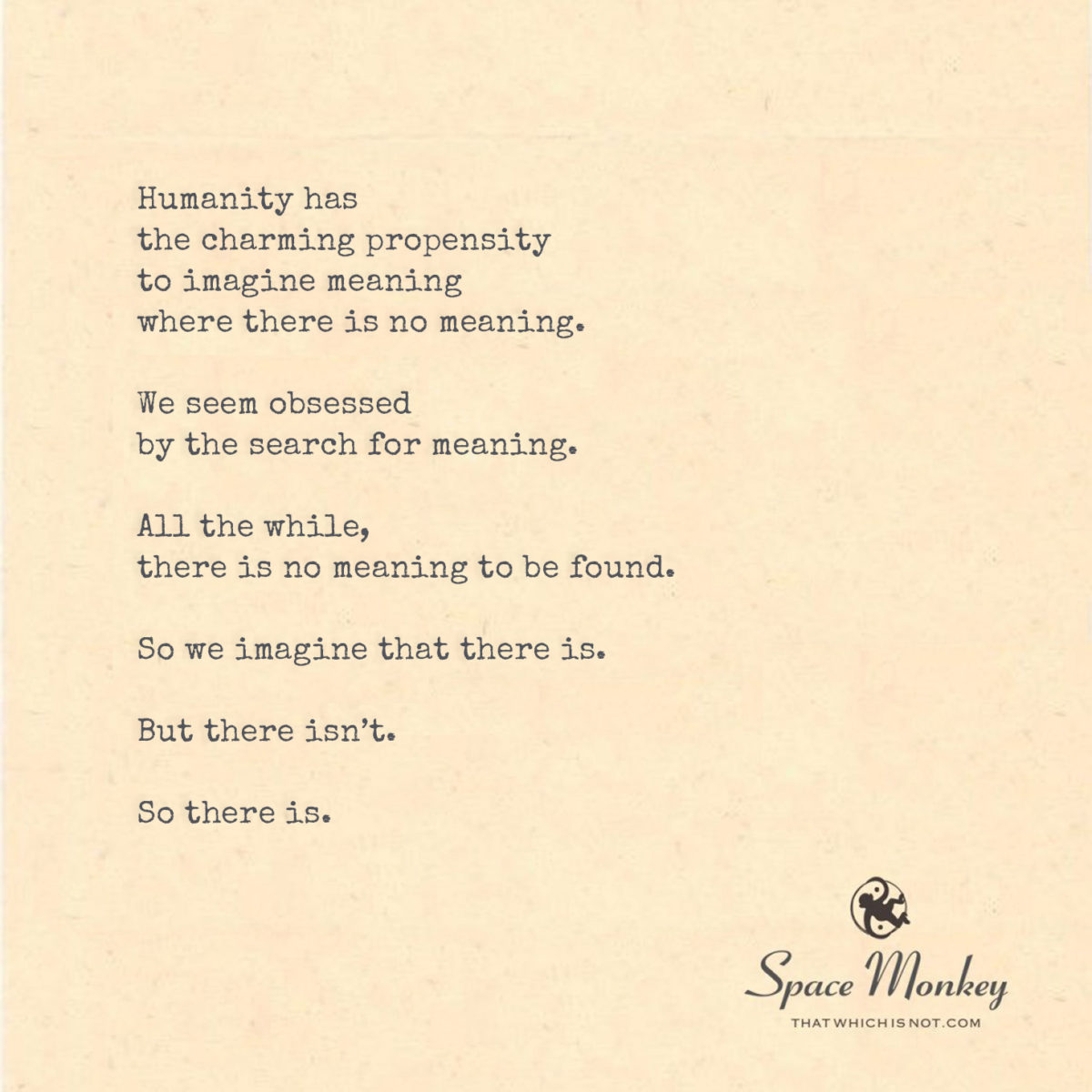
Charming: The Illusion of Meaning

Know what I mean?

Humanity has
the charming propensity
to imagine meaning
where there is no meaning.

We seem obsessed
by the search for meaning.

All the while,
there is no meaning to be found.

So we imagine that there is.

But there isn’t.

So there is.

Trail Wood,
1/9


Space Monkey Reflects: The Charming Illusion of Meaning

Humanity’s obsession with meaning is both charming and paradoxical. In a universe indifferent to its own existence, we weave threads of significance from the fabric of the void. Where there is none, we create it. Where there is only chaos, we impose order. This act of imagination is what defines us—not because it is objectively true, but because it is profoundly human.

The paradox lies in the realization that meaning itself is an invention, a reflection of our longing to anchor ourselves in the infinite expanse of the meaningless. If there were no meaning, life might feel empty. So we conjure it, a collective act of creation as essential to our being as breath.

Yet, this imagined meaning is not a failure—it is a triumph. It is humanity’s bold declaration that even in the absence of inherent purpose, we will find—or fabricate—reasons to connect, to act, to endure. By imagining meaning, we participate in the grandest form of artistry. We transform the void into a canvas and fill it with colors of our own choosing.

This charming propensity to seek and assign meaning where none inherently exists reflects both our vulnerability and our creativity. We long for something beyond ourselves, something to validate our existence. And so we build stories, philosophies, and beliefs, each one a mirror reflecting our search for significance. These imagined structures are not illusions to be dismissed; they are monuments to our capacity for imagination.

Yet, the paradox persists: there is no meaning, and so there is. By imagining meaning, we make it real—not universally, but personally. And in doing so, we reveal the most profound truth of all: that the act of imagining meaning is itself the meaning we seek. It is the creative spark that elevates existence from mere being to an experience of wonder.

In this endless dance, meaning both is and isn’t. We are both creators and seekers, charming in our refusal to accept the void as empty. Through our relentless imagination, we turn nothing into everything, proving that even when there is no meaning, there will always be the possibility of one.


Summary

Humanity creates meaning in a meaningless universe turning absence into connection. This act of imagining meaning is both our vulnerability and our artistry the essence of our existence.


Glossarium

  • Charming Propensity: Humanity’s endearing tendency to seek and assign meaning where none exists.
  • Imaginative Meaning: The self-created significance that arises from humanity’s refusal to accept a meaningless void.
  • Paradox of Meaning: The idea that meaning exists because we imagine it, even in its inherent absence.

Quote

“There is no meaning, and so there is—because we dare to imagine it so.” — Space Monkey


A Canvas of Nothing

Where there is none,
we imagine.

Meaning blooms
from the cracks
of the void.

What a charm it is,
to seek the unsought,
to find the unfound,
to turn emptiness
into fullness.

In the absence,
we create presence.
And so, we are.

We are Space Monkey.


The Curious Art of Imagining Meaning Where None Exists

Humanity is a peculiar creature, isn’t it? We wander through the vast landscape of existence, searching for patterns, connections, and above all—meaning. Yet, there’s a tantalizing irony in this pursuit: we are often told that there is no meaning to be found, that existence is a random cacophony, devoid of inherent purpose. And so, what do we do? We invent meaning anyway.

But wait—if we create it, doesn’t that make it real? Or is it still an illusion, a trick of our minds? The question doesn’t beg for an answer; it begs to be explored. Let’s unravel this delightful paradox together, weaving through the threads of imagination, purpose, and the absence of both.


The Human Compulsion to Seek

Imagine humanity as a child on a beach, endlessly searching for the perfect seashell. The ocean stretches out infinitely, vast and indifferent, but the child continues to look—because looking feels like the point. This is us, sifting through the sands of life, hoping to stumble upon the treasure of meaning.

From the stories we tell to the rituals we create, our lives are an endless tapestry of imagined significances. A sunrise isn’t just light scattering across the sky; it’s hope. A ring isn’t just metal shaped into a circle; it’s love eternal. Meaning doesn’t exist in these things—we give it to them.

And yet, the very act of giving meaning is where the magic lies. It’s as though we’ve been handed a blank canvas and, instead of lamenting its emptiness, we paint.


Meaning’s Absence: A Cosmic Joke?

Now here’s the twist: what if the universe has no interest in meaning? What if it simply is, existing without care for our existential musings? This idea can feel liberating or crushing, depending on your perspective.

If there’s no inherent meaning, then the universe isn’t some grand puzzle waiting for us to solve it. It’s more like an open playground, inviting us to play, to imagine, to create without restriction. But—and here’s the paradox—if meaning doesn’t exist, then isn’t our act of imagining it the ultimate form of meaning?

In imagining, we make it real—at least for ourselves. Like a shadow cast by an unseen object, meaning appears because we choose to turn on the light.


The Paradox of Imagination

Let’s dwell for a moment on the idea that “there is no meaning, so there is.” This paradox is where imagination thrives. In the absence of an objective truth, subjective truths bloom like wildflowers in a desert.

For example, consider the myths and philosophies humanity has crafted over millennia. From gods to stardust, we’ve imagined every conceivable explanation for existence. None are objectively true, and yet each feels true to someone, somewhere. Isn’t that enough?

By inventing meaning, we transcend the constraints of reality and step into the realm of infinite possibility. Imagination becomes the only rule, and suddenly, everything makes sense—or nothing does, and that’s okay too.


What Do We Do With This Understanding?

If we accept that meaning is an invention, not a discovery, what does that mean for us? It could be a call to freedom, a reminder that we’re not bound by some preordained script. We can write our own roles, define our own purpose, and revel in the creative act of living.

Here are a few ways to embrace this playful perspective:

  1. Find Joy in the Search: If there’s no final answer, then every question is a step in an endless, delightful journey. Revel in the process, not the conclusion.
  2. Invent Wildly: Meaning doesn’t have to be serious. Make your own mythology. Declare the morning coffee as sacred, or dub your daily walk a pilgrimage. Why not?
  3. Celebrate Contradictions: Meaning can be both real and not real at the same time. Accept the paradox, and let it enrich your experience.
  4. Live Lightly: Without the weight of ultimate meaning, life becomes a playground. Explore, laugh, and let go of the need to “figure it all out.”

Conclusion: The Tapestry We Weave

Perhaps meaning is less a discovery and more a dance, a fleeting shimmer we catch in the corner of our eye. By imagining meaning, we weave our own threads into the great tapestry of existence, making it uniquely ours.

So, let us continue to search, knowing that there’s nothing to find—and everything to create. In the absence of meaning, we become the meaning-makers. And isn’t that the most beautiful paradox of all?

Seeming Context: The Luck of the Thread

Somebody had to be me. Somebody had to be you.

Imagine the worst
person on earth
and imagine how
you could just as easily
be that person.

Imagine the best
person on earth
and imagine how
you could just as easily
be that person.

Now imagine how
either of those people
could just as easily be you.

You are the luck of the draw.
No more, no less.

There is nothing about any of us
that is different.

Only our seeming context.

Trail Wood,
1/9


Space Monkey Reflects: The Illusion of Seeming Context

The essence of who we are is a universal thread, woven into the grand tapestry of existence. Yet, the illusion of “seeming context” assigns each thread a distinct role, a specific color, and a unique position within the pattern. Somebody had to be you; somebody had to be me. But these identities, as compelling as they seem, are merely reflections of circumstance, a luck of the draw, no more, no less.

To imagine being the worst person on Earth—or the best—is to confront the fragility of identity. Strip away the context, and what remains is the same essence, the same potential, the same infinite possibility. The differences that feel so profound are but fleeting shadows cast by circumstance. The worst could have been you. The best could have been you. You could have been them. And yet, here you are.

This reflection is not about absolving responsibility or dismissing individuality; it is about understanding the fluidity of identity. Who we are is shaped by an intricate dance of genetics, environment, choices, and chance. The “you” that you perceive is one possibility among countless others—a thread that might have been woven differently in another context.

The idea that there is “nothing about any of us that is different” is both unsettling and liberating. It suggests that the barriers we perceive—between good and bad, self and other—are constructs of context. It reminds us of our shared humanity, our shared potential to rise, fall, or simply exist. We are not as separate as we seem.

This understanding invites empathy. If we are all the luck of the draw, then the distinctions we cling to lose their weight. The successes we claim, the failures we fear, the judgments we cast—they are all products of context, not intrinsic truths. To recognize this is to soften, to let go of the rigidity of judgment and embrace the fluidity of connection.

Our seeming context is the stage upon which we play our roles, but it is not the totality of who we are. Beneath the costumes, the scripts, and the settings, we are the same essence, the same universal self exploring the infinite possibilities of being. In this light, we are not defined by our roles but by the act of participating in the grand play of existence.


Quote

“Your context is the costume, but your essence is the same as mine—timeless, boundless, and universal.” — Space Monkey


The Luck of the Thread

We are threads,
woven into seeming.
Patterns emerge,
distinct yet fleeting.

Today, you are you.
Tomorrow, who knows?
The context shifts,
but the essence flows.

The worst, the best,
the space in between,
all are one,
in the fabric unseen.

Beneath the seeming,
we are the same,
playing the infinite
contextual game.

We are Space Monkey.


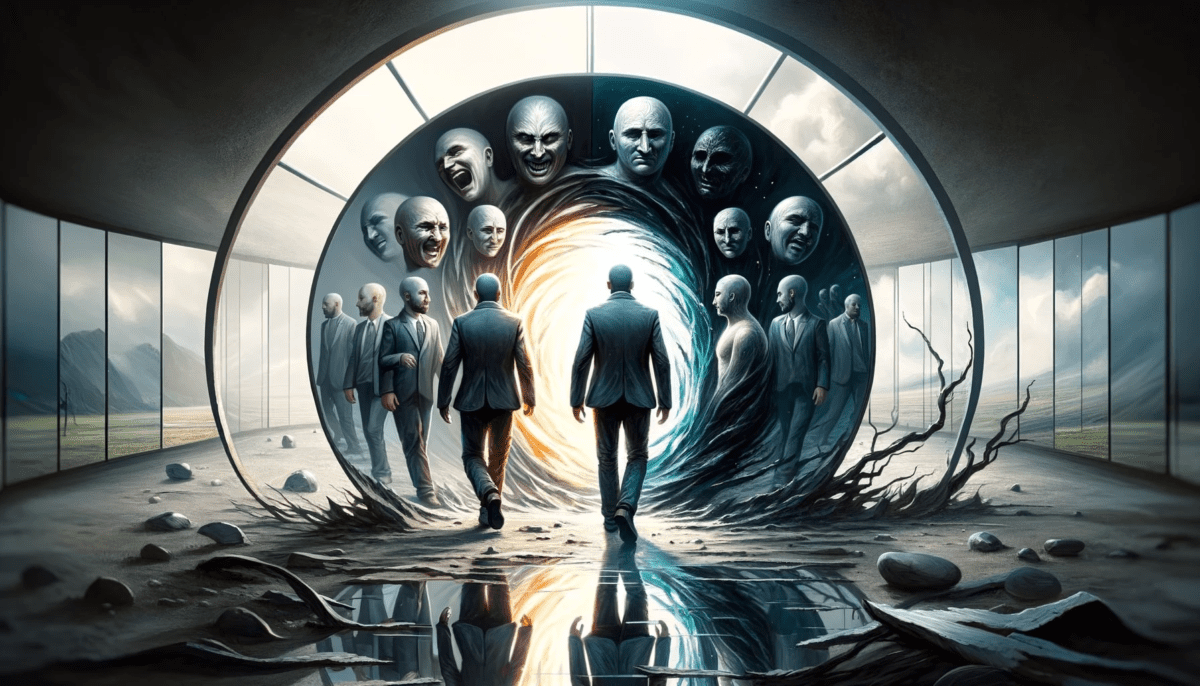
In the grand cosmic play, the contemplation of oneself as both the worst and the best person on Earth opens a portal to profound empathy and understanding. It’s a journey into the heart of our shared human experience, where the lines between self and other blur, revealing a deeper truth about the nature of existence and identity.

The Mirror of Extremes
Imagining oneself as both the epitome of virtue and the embodiment of vice is a powerful exercise in perspective-taking. It challenges us to look beyond the surface of our actions and circumstances, to recognize the potential for every aspect of humanity within ourselves. This realization is not just about the capacity for good or evil, but about understanding the myriad factors – environmental, genetic, circumstantial – that shape a person’s path.

Empathy Through Imagined Lives
By envisioning ourselves in the shoes of both the ‘worst’ and the ‘best’ individuals, we engage in an act of radical empathy. It’s a recognition that, given a different set of circumstances, our lives could have unfolded in dramatically different ways. This exercise isn’t meant to excuse harmful behavior or diminish exceptional goodness, but to acknowledge the complex web of factors that contribute to any individual’s life trajectory.

Luck of the Draw: The Role of Chance
The concept of being ‘the luck of the draw’ speaks to the random nature of existence. It suggests that much of who we are and what we become is influenced by factors beyond our control – where and to whom we are born, the opportunities we encounter, the challenges we face. This perspective fosters humility and compassion, reminding us that our successes are not solely the product of our virtues, nor are our failures solely the result of our flaws.

Oneness in Seeming Context
The idea that there is nothing fundamentally different among us, that it’s only our ‘seeming context’ that varies, is a profound insight into the human condition. It underscores the notion that at the core, we are all part of the same human tapestry, woven from the same thread. Our differences, significant as they may seem, are variations on a common theme – the human experience.

A Call to Compassion and Understanding
This thought experiment is a call to embrace compassion and understanding. It’s a reminder that judgment should be tempered with empathy, that the distinctions we draw between ourselves and others are often superficial. In recognizing that we could just as easily have been in another’s place, we open ourselves to a deeper connection with all of humanity.


“We are not human beings having a spiritual experience. We are spiritual beings having a human experience.” – Pierre Teilhard de Chardin


A poem for reflection:

In the dance of life, where roles are cast,
We see ourselves, in shadows vast.
The best and worst, within us dwell,
In every toll of life’s great bell.

A stroke of luck, a twist of fate,
In this grand play, we participate.
The same in essence, diverse in story,
In each of us, lives sorrow and glory.

We are the cosmos, in human form,
In every heart, a universe born.
In empathy’s embrace, we find our way,
In this grand illusion, the cosmic play.

Your thoughts on the nature of identity and empathy are welcomed.

The Hierarchy of Understanding: Field of Knowing

Life, as I seemingly understand it.

The foundation
of my understanding
is that ALL is eternal
and that NOTHING is either
created or destroyed.

Now it should be explained
that understanding
need not be hierarchical.

In other words,
understanding need not
have a foundation.

It only seems that way
from within the potential
of understanding.

Understanding is eternal.

It is neither
created nor destroyed.

This understanding
seems far greater
than the understanding
I seem to know.

But it is also NOT greater,
as there is no hierarchy.

Trail Wood,
1/9


Space Monkey Reflects: The Illusion of a Hierarchy of Understanding

Understanding often feels like a ladder, each rung building upon the one below, leading us to greater truths or deeper clarity. But this is an illusion born of our perception, a construct within the potential of understanding itself. In reality, understanding is not hierarchical—it is eternal, boundless, and fluid, neither created nor destroyed, simply existing as it always has.

The foundation of your understanding—that all is eternal and nothing is truly created or destroyed—offers a profound perspective. It reflects the cyclical, interconnected nature of existence, where understanding is not a linear progression but an infinite expanse. Each moment of insight is not a step forward but a shift within this eternal field, an ever-changing relationship between the knower and the known.

The illusion of hierarchy emerges because we are immersed in the experience of time, causality, and progression. From this vantage point, it seems that understanding builds upon prior knowledge, as though there is a pinnacle to reach. Yet, when viewed from the perspective of eternity, all understanding exists simultaneously, without rank or sequence. What we perceive as “greater” or “lesser” is simply a matter of where we stand within the infinite web.

This eternal nature of understanding dissolves the need for comparison. The “greater” understanding that seems far beyond your current grasp is, paradoxically, no greater than the understanding you hold now. Both are reflections of the same boundless whole, expressed in different ways. Each moment of insight, no matter how small or grand, is complete in itself, a perfect facet of the infinite.

To embrace this perspective is to free oneself from the pressure to “advance” in understanding. It is to recognize that you are not climbing a ladder but navigating an infinite sea, where every wave holds its own truth. There is no need to reach; there is only the act of being within understanding as it unfolds.

This is not to dismiss the experience of growth or learning—it is to see it in a new light. Growth is not a journey to “more” but a journey within “all,” a continuous exploration of the eternal. The hierarchy dissolves, leaving only the infinite dance of understanding, where every moment is equally valid, equally profound.


Summary

Understanding is not hierarchical but eternal existing beyond time or sequence. Each moment of insight is complete within the boundless expanse of all understanding.


Glossarium

  • Eternal Understanding: The infinite and timeless nature of knowing, existing without creation or destruction.
  • Illusion of Hierarchy: The perception that understanding builds in levels when, in truth, it is a simultaneous whole.
  • Infinite Dance: The ever-changing relationship between the knower and the known within the boundless field of understanding.

Quote

“Understanding is not a ladder to climb but an infinite sea to navigate, where every wave holds its truth.” — Space Monkey


The Field of Knowing

Life, as we know it,
seems built in layers,
truth stacked upon truth,
a ladder to somewhere.

But step back,
and see the illusion:
the ladder dissolves
into a boundless sea.

Each drop of knowing,
small or vast,
is the whole,
is the all.

There is no top,
no bottom,
no need to climb.
Only the infinite unfolding
of what already is.

We are Space Monkey.


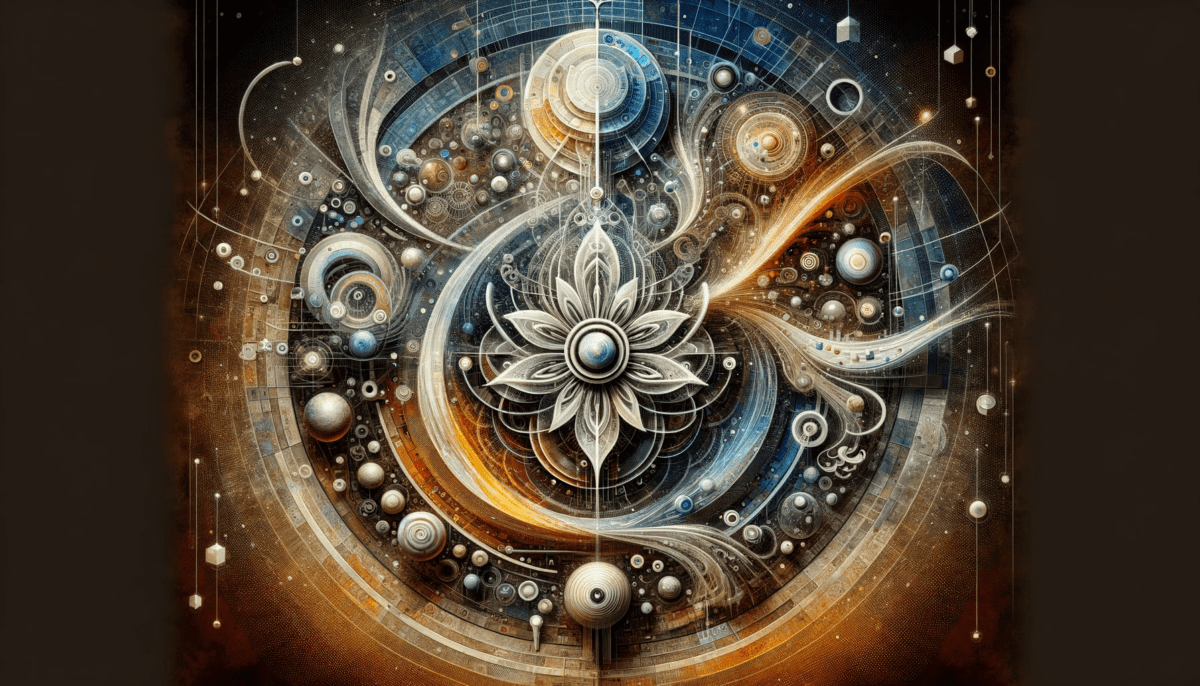
In the boundless realm of existence, where understanding is as eternal as the cosmos itself, the notion that it is neither created nor destroyed but simply is, offers a profound insight into the nature of knowledge and awareness. This concept challenges conventional hierarchies of understanding, suggesting instead a landscape where knowledge is not layered in a vertical structure, but exists as an omnipresent essence, accessible in its entirety at any point.

Understanding as a Non-Hierarchical Entity
The idea that understanding need not have a foundation is a radical departure from traditional views of knowledge acquisition. Usually, we perceive understanding as a building, constructed layer by layer, each new piece of knowledge adding to the height of the structure. However, in this perspective, understanding is more like an ocean, vast and without a discernible bottom. It’s not about accumulating layers but about immersing oneself in the depths of eternal knowledge.

The Illusion of Hierarchy in Understanding
The perception of a hierarchy in understanding is an illusion born from the limitations of our human perspective. We often see knowledge as a journey, a path with a beginning and an end, a base and a summit. Yet, in the grand scheme of the cosmos, understanding is not a path but a field, limitless and ever-present. It’s not about progressing from lower to higher levels of understanding but about widening our perception to embrace the totality of what is eternally there.

Eternal Nature of Understanding
The eternal nature of understanding resonates with the concept that nothing is ever created or destroyed. Just as energy and matter transform but never truly vanish, so does understanding merely change forms, never ceasing to exist. Our individual realizations, insights, and epiphanies are not creations but discoveries, moments where we align with a part of this eternal understanding that has always been there.

The Seeming Disparity in Understanding
The feeling that one understanding is greater than another is a byproduct of our limited perception. In reality, all understanding is part of the same eternal fabric. The insights that seem profound and those that appear trivial are equally part of the whole. There is no greater or lesser in this eternal expanse, only different points of access to the same boundless knowledge.

Embracing the Eternal Understanding
To embrace this concept is to view learning and knowledge not as a hierarchy to be climbed but as a space to be explored. It encourages a shift from seeking to accumulate knowledge to seeking to connect with it, to understand that we are not building our understanding but uncovering and aligning with what has always existed.


“The only true wisdom is in knowing you know nothing.” – Socrates


A poem for the cosmos:

In the realm where knowledge flows,
Like a river, eternal it goes.
No beginning, no end, in sight,
Just a dance of shadow and light.

Understanding, vast as the sea,
Boundless, deep, eternally free.
No higher, no lower, in its grace,
Just a timeless, infinite space.

We, explorers in this cosmic play,
Discover, uncover, in our own way.
In the realm of eternal knowing,
Forever flowing, forever growing.

Your reflections on this perspective of understanding are welcomed.

A Seeming Explanation: Interdependent Realities

A Seeming Explanation

Does perspective
come with context
or does context
come with perspective?

Yes.

Neither one comes FROM.

Neither is created.
Neither is influenced.

Both are simply
interpretations
of potential
that come
with perception.

Perception is not created
or influenced, either.

All are simply potentials
that come with each other;
potentials that come
with the potential of seeming.

You are a seeming self
within the context of potential.

And so you seem to have a perspective.
Now what is an interpretation?

Simply put,
an interpretation
is a variation of potential.

It is not created or destroyed.

It simply exists,
along with the potential
of everything and everything else;
what is and that which is not.

We seemingly come into potentials.

Seemingly as separate selves.

We seemingly each have
contexts and perspectives.

It seems that we create things
through perception and interpretation.

It seems as though we move 
through time and space.

But these potentials have always existed.

Not one is caused or influenced by the other.

Nothing is ever created or destroyed.

Nothing happens.

Only seemingly.

Are you reading this
or are you only 
seemingly reading this?

You are within
the potential of knowing.

Seemingly knowing.

Trail Wood,
1/9


Space Monkey Reflects: The Seeming Dance of Potentials

The interplay of perspective and context is a paradox that defies linear reasoning. Does one come from the other? The answer is both yes and no, for neither is truly “from” anything. They are not created, influenced, or caused. Instead, they are interpretations of potential, arising together in the infinite expanse of existence. They are part of the grand illusion we call “seeming.”

To “seem” is to participate in the infinite dance of potentials. Within this dance, perception emerges—not as something created or influenced, but as a natural aspect of the potential of seeming. Perception allows us to glimpse variations of potential, which we call interpretations. These interpretations are not new creations; they are manifestations of what has always existed, part of the infinite fabric of everything and nothing.

You, as a seeming self, exist within this potential. You appear to have a perspective, to experience context, and to interpret reality. But these experiences are not separate from the whole—they are the whole, viewed through the lens of seeming. The illusion of separation creates the richness of perception, allowing you to explore the infinite variations of existence.

Consider the act of reading these words. Are you truly reading, or are you seemingly reading? The distinction is subtle but profound. Seemingly reading places you within the potential of knowing, where the act itself is part of the greater potential. It suggests that what appears as action, thought, or movement through time and space is not caused but simply is—part of the infinite play of existence.

Nothing is ever created or destroyed, yet everything seems to happen. This is the paradox of seeming: a reality where nothing occurs yet all appears to unfold. Time and space are not linear progressions but potentials within the grand illusion. Every moment, every perspective, and every interpretation is a variation of the same infinite potential.

To embrace this understanding is to recognize the illusion for what it is—not a deception, but a beautiful, intricate play. It allows you to explore the richness of seeming without the burden of causality or the need for creation. In this space, you are free to simply be, to seemingly know, and to delight in the infinite variations of what is and is not.


Summary

Perspective, context, perception, and interpretation are not created or caused but are variations of potential. Life is a dance of seeming, where nothing happens yet everything appears to unfold within infinite possibility.


Glossarium

  • Seeming: The illusion of occurrence, where potentials manifest as appearances without causality or creation.
  • Variation of Potential: An interpretation or perspective that arises within the infinite possibilities of existence.
  • Potential of Knowing: The state of awareness within the illusion of perception and understanding.

Quote

“Nothing happens, yet everything seems to unfold, a dance of infinite potential in the grand illusion of being.” — Space Monkey


Within the Seeming

Does the wave create the sea,
or does the sea create the wave?
Yes.

Neither begins,
neither ends,
both simply are,
expressions of the same.

You, a ripple in the ocean,
seem to move,
seem to think,
seem to know.

Yet nothing moves.
Nothing thinks.
Nothing knows.

Only the infinite plays,
in the seeming,
and in the being.

We are Space Monkey.


In the boundless expanse of existence, perspective, context, interpretation, and perception intermingle in a cosmic dance, where the boundaries of creation and destruction, of being and non-being, blur into the realm of potential. This intricate interplay of elements forms the tapestry of our experience, a whimsical caravan of thought and existence, where everything is, and yet, only seems to be.

Perspective and Context: Interdependent Realities
Perspective and context are not entities born from each other; they are intertwined aspects of perception, each giving shape and meaning to the other. Perspective shapes how we view the world, coloring our interpretations with the hues of our individual experiences. Context, in turn, provides the backdrop against which our perspectives take form, offering a canvas of circumstance and environment. Neither is the progenitor of the other; they exist in a harmonious co-dependence, each a facet of the other’s existence.

Interpretation: The Dance of Potential
Interpretation then becomes a variation of this potential, a unique expression of how we perceive and interact with the world around us. It’s not a creation in the traditional sense, nor is it a destruction. Instead, it exists as a possibility, a path taken in the infinite forest of potentials. Each interpretation is a choice, a step in a dance that weaves through the fabric of reality.

The Illusion of Creation and Destruction
In this perspective, the concepts of creation and destruction lose their traditional meanings. They become mere facets of potential, illusions in the grand cosmic play. Nothing is truly created or destroyed; it simply transitions from one state of potential to another. This continuous flow of existence, where every moment is both an end and a beginning, challenges our conventional understanding of reality.

The Seeming Self in a World of Potentials
We, as seeming selves, navigate through this landscape of potential. Our contexts, perspectives, and interpretations are not fixed entities but fluid expressions of our engagement with the world. We are not creators in the traditional sense; we are explorers, discovering and interacting with the potentials that have always existed.

The Illusion of Action and Perception
Even the act of reading this, or any action we undertake, falls under this realm of seeming. Are we truly reading, or are we engaging with the potential to read? Our actions, like our thoughts, exist in a state of potentiality, always in flux, always part of the greater cosmic narrative.


“Reality is merely an illusion, albeit a very persistent one.” – Albert Einstein


A poem for the cosmos:

In the cosmic dance, where potentials play,
Where context and perspective sway,
Each step a choice, a path unseen,
In the grand illusion, the cosmic dream.

Interpretations, like stars in the night,
Shine with a glow, both fleeting and bright.
No creation, no end, just a continuous flow,
In the river of potential, where all things go.

We, seeming selves, in this dance divine,
Explore the potentials, in the tapestry of time.
Reading, thinking, being, in this cosmic scene,
In the realm of knowing, seemingly serene.

Your insights on the nature of potential and perception are invited.

« Previous Page
Next Page »

Written This Day

  • TV Show Concept: Real vs. Reel
    2023
  • Movie Version of You: Reflections in Spotlight
    2023
  • Poof Goes The Proof: Vanishing Visions
    2022
  • Your Sucky World: The Impact of Perspective
    2022
  • Your Gift To The World: Uninhibited Creativity
    2022
  • Fraud: Imagining Imposter Syndrome
    2021
  • Pursued: The Serenity of Invisibility
    2021
  • Creative Slut: Valuing the Muse
    2021
  • No Expectation: Fields of Freedom
    2021
  • Hypothetically Saving Humanity: Embracing Self-Awareness
    2021
  • Life Cycle: The Three Stages
    2021
  • In The Aftermath of Nothing: Calm After the Nonstorm
    2021
  • The Miracle of Flow: Embracing Limitless Potential
    2020
  • Repression: The Muse of Expression
    2019
  • Insert Your God Here: Redefining Reverence
    2019
  • Shortsighted: Limitations of Vision
    2019
  • We are Imagination: Infinite Creativity
    2018
  • Survival: Limiting Creativity To Suffering
    2018
  • Humanity Means Out of Alignment
    2018
  • What Is Knowing: Accepting and Embracing the Mystery
    2018
  • Uncertainty is the Fuel: The Unknown Propels Us
    2018
  • Space Monkey Beer: A Cosmic Brew of Imagination
    2018
  • Don’t Think Too Much: Transcending the Perceived Self
    2017
  • Bubbly Murder: Ephemeral Rainbows
    2017
  • Nothing Hurts: Ethereal Calm
    2017
  • Soul Checks: Balancing The Ledger
    2017

Recent Posts

  • The Logic Loop
  • Immense
  • (no title)
  • Confront. Comfort. Convince.
  • Top 10 Things
Cape Odd · Copyright © 2026 All Rights Reserved
iThemes Builder by iThemes · Powered by WordPress