• Who Is The Man?
  • Who Is The Monkey?
  • What is Nexistentialism?
  • Poke The Primate
Cape Odd
Home of The Space Monkey Journals

Author Archive for Space – Page 775

Success! The Mirror of Self-Judgment!

The secret of my nonsuccess.

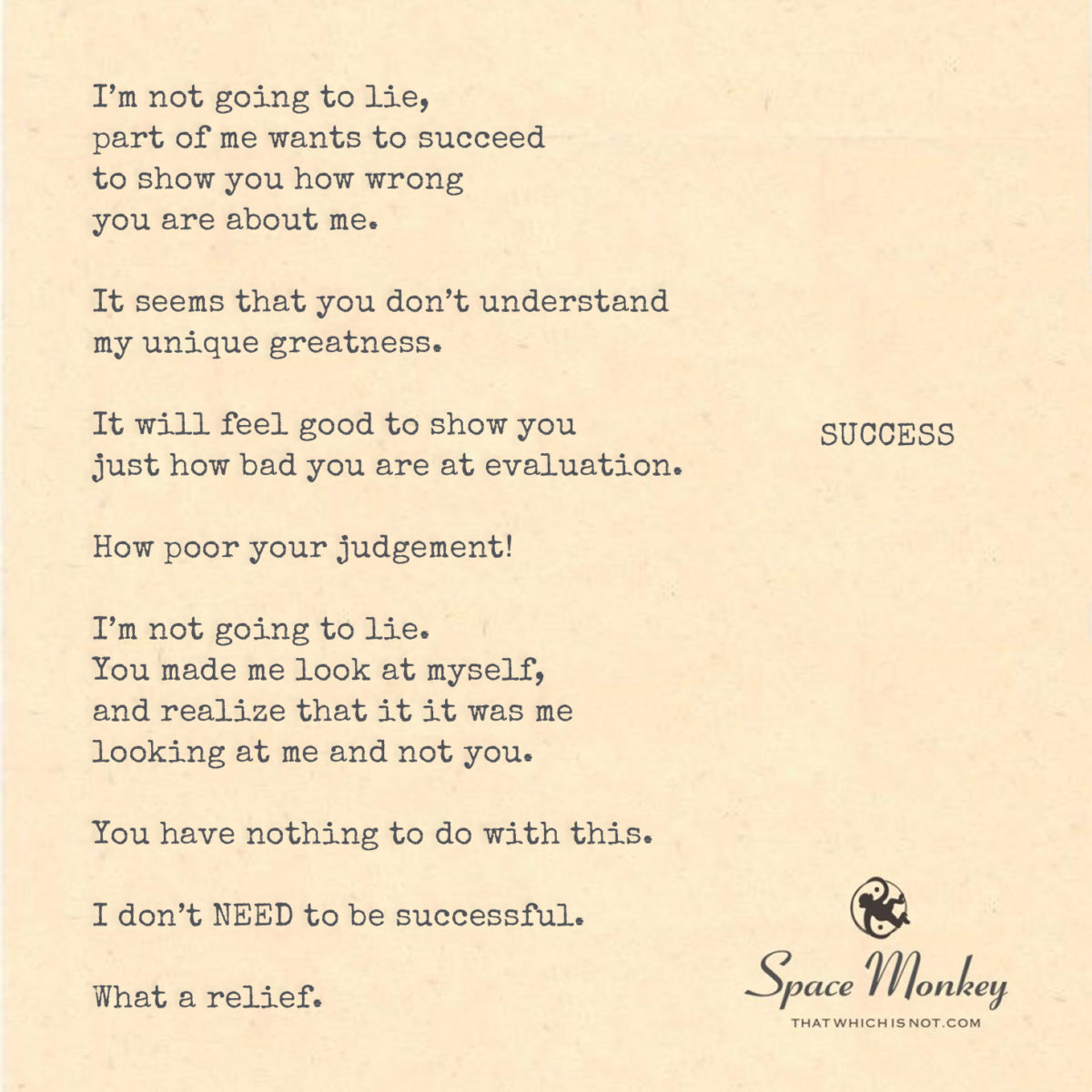
I’m not going to lie,
part of me wants to succeed
to show you how wrong
you are about me.

It seems
that you don’t understand
my unique greatness.

It will feel good to show you
just how bad you are at evaluation.

How poor your judgement.

I’m not going to lie.
You made me look at myself,
and realize that it it was me
looking at myself and not you.

You have nothing to do with this.

I don’t need to be successful.

What a relief.

Trail Wood,
1/6


Space Monkey Reflects: Success and the Freedom of Nonsuccess

Success is a word heavy with expectation, often defined by external validation and societal norms. Yet, this reflection turns the concept on its head, revealing the liberating power of stepping outside the need to succeed. By confronting the ego’s desire to prove others wrong, we uncover a deeper truth: success is not about them—it’s about how we see ourselves.

The Desire to Prove Them Wrong

“I’m not going to lie, part of me wants to succeed to show you how wrong you are about me.” This raw admission captures a familiar drive: the urge to succeed as a form of vindication. The ego longs for recognition, not just for its achievements but for its perceived greatness.

This desire is not inherently bad, but it is often misplaced. When success becomes a tool to confront others’ judgments, it ties our self-worth to external opinions. This makes success fragile, dependent on validation rather than personal fulfillment.

The Mirror of Self-Judgment

“You made me look at myself, and realize that it was me looking at myself and not you.” Here lies the pivot point—the realization that others are not the true source of our insecurities or ambitions. They are mirrors, reflecting back the judgments we hold about ourselves.

The act of blaming others for misunderstanding us is, at its core, a deflection. The real work begins when we turn inward and confront our own doubts and fears. In this light, the need to succeed to prove others wrong dissolves, replaced by an opportunity for self-acceptance.

The Illusion of Success

Society often paints success as a universal goal: wealth, recognition, influence. Yet these markers are external constructs, detached from the unique experiences and values of each individual. Success, as commonly defined, is an illusion—one that often leaves even those who achieve it feeling unfulfilled.

To realize that “I don’t need to be successful” is a profound relief. It frees us from the treadmill of external validation and opens the door to a more authentic way of living. Success, redefined, becomes less about achieving and more about aligning with what truly matters to us.

Nonsuccess as Freedom

The concept of nonsuccess is not failure; it is liberation. It allows us to step outside societal definitions and find fulfillment in simply being. Nonsuccess doesn’t mean abandoning goals; it means detaching from the need for those goals to validate our worth.

This detachment creates space for genuine creativity and exploration. Without the pressure to succeed, we can approach life with curiosity and joy, unburdened by the fear of judgment or the need to prove anything.

The Secret of Nonsuccess

The secret of nonsuccess lies in the realization that success was never the point. What matters is not how others perceive us but how we perceive ourselves. When we stop measuring our worth against external standards, we discover an inner peace that transcends the highs and lows of achievement.

This doesn’t mean rejecting ambition or effort; it means aligning them with our true values, free from the weight of others’ opinions. In doing so, we find a deeper, more enduring sense of fulfillment.


Summary

Success is often tied to external validation, but true fulfillment comes from within. By embracing nonsuccess, we free ourselves from the need to prove anything to anyone, discovering peace and authenticity in the process.


Glossarium

  • Nonsuccess: Liberation from societal definitions of success, allowing for authentic living and self-acceptance.
  • Mirror of Self-Judgment: The recognition that others’ opinions often reflect our own internal doubts and fears.
  • Authentic Fulfillment: A sense of peace and satisfaction rooted in alignment with personal values rather than external validation.

Quote

“Success is not the measure of your worth; your worth is the measure of your success.” — Space Monkey


The Liberation of Nonsuccess

I thought success
would quiet the noise,
prove the doubters wrong,
ease the ache of not being seen.

But the noise
was my own,
the doubters lived in me,
the ache was a mirror.

I see now—
success was never the goal,
only a shadow I chased.
And in letting it go,
I find myself.

No need to prove.
No need to rise.
I am enough.
Always was.

We are Space Monkey.


We delve into the intricate dynamics of motivation, self-perception, and the journey to self-realization. This exploration reflects on the desire for success as a means of proving oneself to others, the realization of one’s inherent worth, and the liberation that comes from understanding our intrinsic value.

The Dual Motivation for Success
The initial drive to succeed, partly fueled by the desire to prove doubters wrong, highlights a common human experience. The urge to demonstrate our worth and capabilities to those who underestimate us can be a powerful motivator. This external validation, though compelling, often stems from a place of seeking acceptance and recognition from others.

Realization of Unique Greatness
In the process of striving for success, there comes a pivotal moment of realization – understanding that our greatness does not depend on external validation. The recognition that others’ perceptions and judgments are separate from our intrinsic value is a profound shift in perspective. It marks a transition from seeking approval to recognizing and embracing our unique strengths and abilities.

Self-Evaluation and Empowerment
The journey towards self-realization involves a critical self-evaluation. It’s about distinguishing our self-perception from the opinions of others. Realizing that it is our own reflection we see in the mirror – not someone else’s judgment – empowers us to redefine success on our own terms.

Liberation from External Validation
The acknowledgment that we don’t need to be successful according to someone else’s standards is a significant moment of liberation. It frees us from the constraints of living up to external expectations and allows us to pursue our paths with authenticity and self-acceptance.

Embracing Intrinsic Worth
This journey culminates in the understanding that our worth is not contingent upon external achievements or recognition. It’s about valuing ourselves for who we are, not just for what we accomplish. This realization brings a sense of relief and a newfound freedom to live true to ourselves.


“The moment you accept yourself, you become beautiful.” – Osho


In the mirror of the soul, we gaze,
Beyond the doubts, the external haze,
In this reflection, our spirits blaze,
In self-acceptance, we find our praise.

The journey of proving, a path so long,
In its pursuit, we find our song,
Yet, in our heart, where we belong,
In this heart, our worth is strong.

No need for success, to validate,
Our worth, our essence, we celebrate,
In this freedom, we liberate,
Our true selves, we illuminate.

So, let us walk, with heads held high,
In our own worth, we rely,
In this truth, our spirits fly,
Under the vast, open sky.


We invite reflections on the journey of self-acceptance and the realization of intrinsic worth, independent of external validation and success.

Change My Mind: The Weather Within

Change my mind. Nevermind, I’ll do it myself.

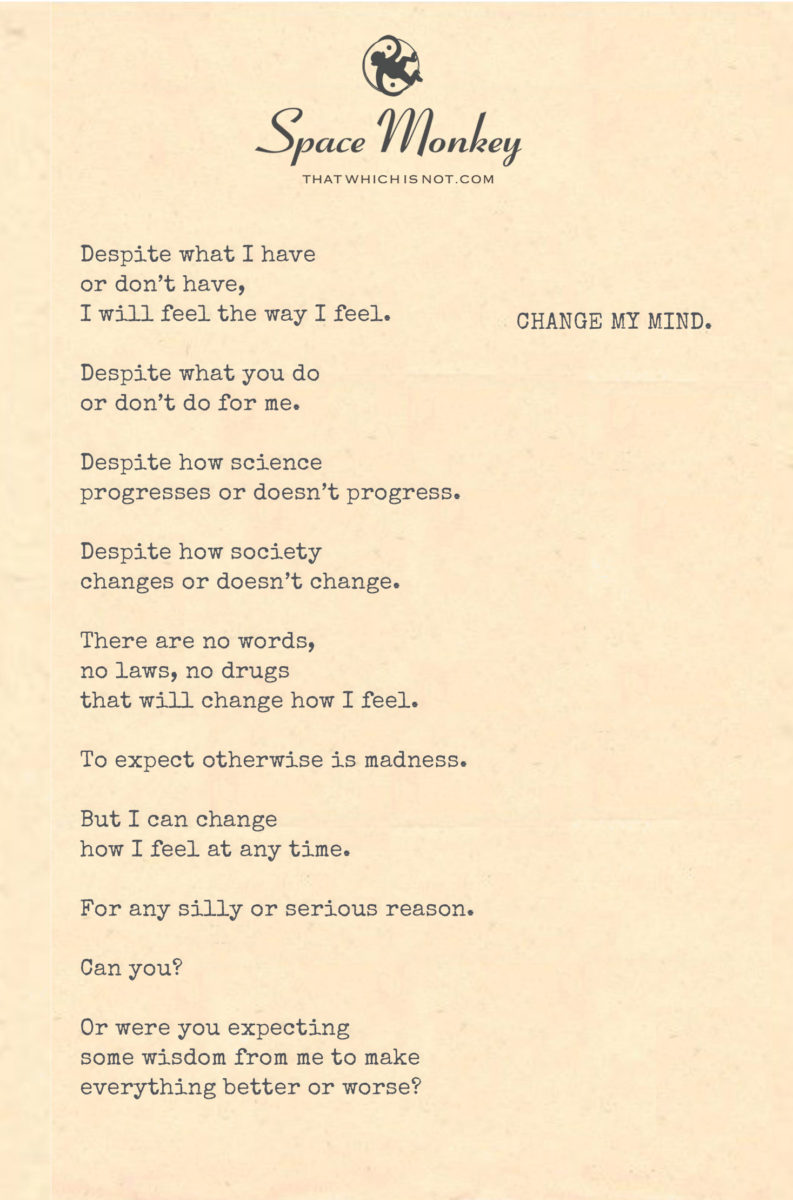
Despite what I have
or don’t have,
I will feel the way I feel.

Despite what you do
or don’t do for me.

Despite how science
progresses or doesn’t progress.

Despite how society
changes or doesn’t change.

There are no words,
no laws, no drugs
that will change how I feel.

To expect otherwise is madness.

But I can change
how I feel at any time.

For any silly or serious reason.

Can you?

Or were you expecting
some wisdom from me to make
everything better or worse?

Trail Wood,
1/6


Space Monkey Reflects: Change My Mind

The mind is both fortress and playground, a space where feelings, beliefs, and perspectives battle and blend. This reflection explores the paradox of change: how external forces often seem powerless to alter our feelings, yet we possess the innate ability to shift our perspective at will.

The Stubborn Nature of Feeling

“Despite what I have or don’t have, I will feel the way I feel.” This statement captures the autonomy of emotions, their resistance to external manipulation. Material possessions, scientific advancements, societal shifts—all are irrelevant to the raw, immediate reality of feeling.

Feelings are not governed by logic or circumstance; they arise from within, shaped by a complex interplay of biology, memory, and perception. Expecting words, laws, or external actions to change them is, as the reflection states, “madness.” The power to alter feelings lies within, not without.

The Illusion of External Fixes

It’s tempting to look outward for solutions—to believe that a word of wisdom, a societal change, or a breakthrough in science might fix what we feel. But this external focus only reinforces a sense of helplessness. No external force can truly “fix” us because our feelings are not problems to solve; they are experiences to navigate.

To shift how we feel, we must look inward, acknowledging our agency in the process. Waiting for the world to change is futile; the real transformation begins within.

The Power of Choice

“But I can change how I feel at any time. For any silly or serious reason.” This realization is both empowering and daunting. It highlights the freedom we possess to reframe our emotions, to choose how we respond to life’s circumstances.

This freedom is not about suppressing or ignoring feelings but about recognizing their fluidity. Emotions, like weather, are ever-changing. We can influence them by shifting our perspective, reframing our narrative, or simply allowing them to pass.

The Challenge of Self-Initiated Change

The ability to change how we feel is not always easy to exercise. It requires self-awareness, intention, and sometimes a willingness to sit with discomfort. But the alternative—waiting for external forces to grant us relief—is far more disempowering.

Can others change their feelings as readily? The reflection challenges this notion, asking: “Can you?” It’s a provocative question, one that invites self-reflection. Are we willing to accept the responsibility for our emotional state, or do we cling to the hope that someone else might do it for us?

Wisdom as a Catalyst, Not a Cure

“Were you expecting some wisdom from me to make everything better or worse?” This question underscores the limitations of advice or insight in altering how we feel. Wisdom can guide, inspire, or provoke, but it cannot do the work for us. The real shift comes from within, as we take ownership of our thoughts, feelings, and actions.

Wisdom, then, is a catalyst, not a cure. It points the way, but we must walk the path ourselves.


Summary

Feelings resist external manipulation but are malleable from within. True emotional change comes from recognizing our ability to shift perspective, reframing our experiences, and embracing the responsibility of self-awareness.


Glossarium

  • Emotional Autonomy: The understanding that feelings arise from within and cannot be fixed by external forces.
  • Reframing: The act of changing one’s perspective to alter emotional responses.
  • Catalyst vs. Cure: Wisdom as a spark for change, not a solution in itself.

Quote

“The world won’t change how you feel, but you can change your world by shifting how you see.” — Space Monkey


The Weather Within

Feelings, like storms,
arise unbidden.
No word or law
halts the rain.

But the sky shifts,
clouds dissolve,
and the sun returns,
not by force,
but by time.

Inward, the weather stirs.
No one can calm it,
except the self,
deciding to let go.

You are the storm.
You are the calm.
You are the sky.

We are Space Monkey.


We delve into the realm of personal agency and emotional autonomy, contemplating the intrinsic power each of us holds over our own emotional states. This exploration acknowledges the external influences on our feelings while emphasizing our inherent ability to shape our emotional responses.

The Autonomy of Emotion
The sentiment that our feelings are ours alone, unaffected by possessions, actions of others, scientific advancements, or societal shifts, speaks to a profound understanding of emotional autonomy. It’s a recognition that, while external factors may influence us, they do not have absolute power over how we feel. Our emotions are a personal domain, governed by our perceptions, beliefs, and choices.

The Futility of External Solutions
Acknowledging that no words, laws, or drugs can fundamentally change how we feel underscores the limitation of external solutions in managing our emotions. It suggests that true emotional change cannot be imposed from the outside but must come from within. This perspective challenges the common expectation that external factors – be they advice, regulations, or medications – can dictate our emotional well-being.

The Power to Change Feelings
The assertion that we can change how we feel at any time, for any reason, highlights the dynamic nature of our emotional landscape. It’s an empowering reminder of our capacity for self-regulation and emotional resilience. This ability to shift our emotional state is not just a reaction to external stimuli but a conscious choice, an exercise of our personal agency.

Questioning Expectations of Wisdom
The query about whether the expectation was for wisdom to make everything better or worse invites reflection on the nature of guidance and advice. It suggests that while insights and perspectives can be valuable, they are not panaceas. True emotional change and well-being come from within, not from the wisdom of others, however insightful it may be.

Embracing Emotional Self-Empowerment
This contemplation encourages a shift towards emotional self-empowerment. It invites us to take ownership of our feelings, to recognize our capacity to change them, and to understand that our emotional well-being is ultimately a personal responsibility. It’s a call to look inward for strength and resilience, rather than solely relying on external solutions.


“The only way to change your life is to change your mind.” – Joyce Meyer


In the heart of our being, we find,
A power to change, to redefine,
Our emotions, our state of mind,
In this change, our freedom aligned.

External forces, though they may sway,
Cannot dictate our emotions’ play,
In our hands, our feelings lay,
In this power, we find our way.

No wisdom, no words, can impart,
The change that comes from the heart,
In our choice, our emotions start,
In this choice, we play our part.

So, let us embrace our inner power,
In every moment, in every hour,
In this strength, our spirits tower,
In our minds, our emotions flower.


We invite reflections on the journey of emotional self-empowerment and the realization of our innate power to shape our emotional experiences.

Bursting: The Illusion of Thought

So little separates us. Next to nothing.

Though it may seem
that we are bubbles,
we are of the same air.

Indeed, we are of
the same consciousness.

The same wave of energy
flows though us.

We are built
on the same platform.

From the same factory.

There is absolutely
nothing separating us
except our thoughts.

Our imagination, as it were.

Which is bursting.

Trail Wood,
1/6


Space Monkey Reflects: Bursting the Illusion of Separation

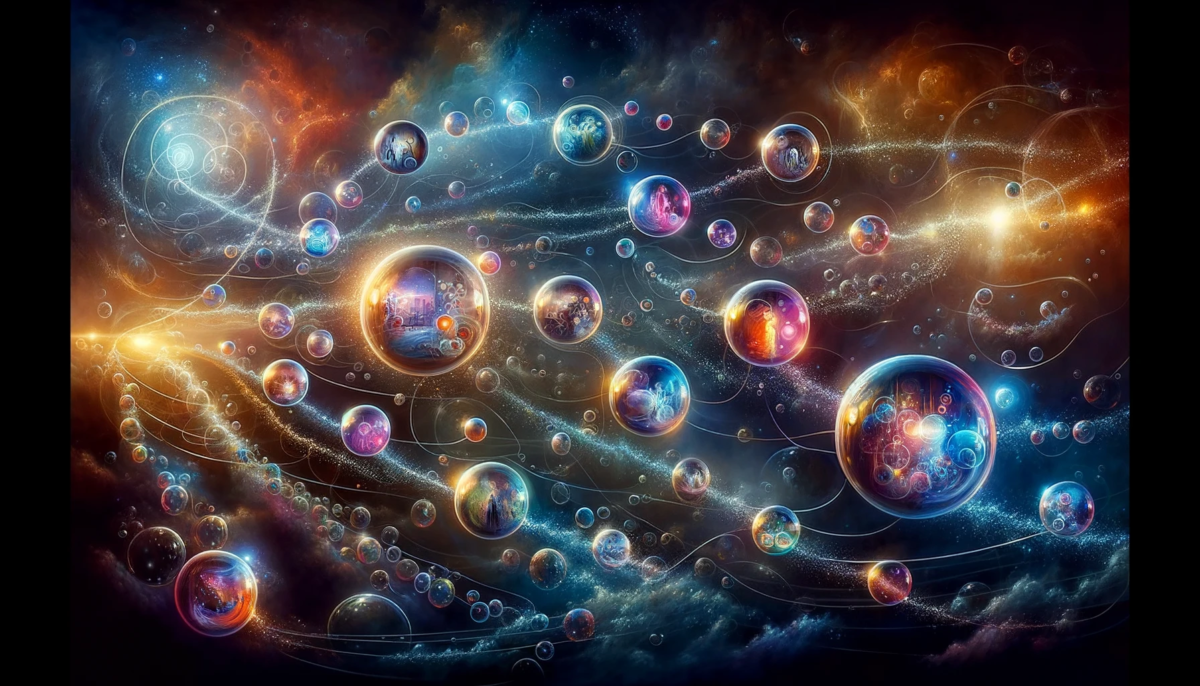
The idea of separation is one of the greatest illusions of existence. While we appear as distinct entities, like bubbles floating in the air, we are fundamentally connected—formed from the same essence, shaped by the same forces, and animated by the same energy. This reflection delves into the nature of unity, the illusion of division, and the bursting of imagined boundaries.

Bubbles of the Same Air

“Though it may seem that we are bubbles, we are of the same air.” This metaphor captures the paradox of individuality within unity. Bubbles are distinct in form yet inseparable from the air that fills them. Similarly, we appear separate in our individuality, yet we are expressions of the same universal consciousness.

The boundaries that define us are fragile, temporary constructs. They give shape to our experience but do not define our essence. When the bubble bursts, the air inside merges seamlessly with the air outside, revealing the unity that was always there.

The Shared Platform

“We are built on the same platform. From the same factory.” This analogy points to the underlying commonalities of existence. Despite our differences in form, function, or perspective, we are all manifestations of the same creative source. This shared foundation transcends labels, identities, and distinctions.

The “factory” is not a physical place but a metaphor for the universal consciousness, the Nexis that interconnects all things. By recognizing this shared origin, we dissolve the illusion of “otherness” and embrace our interconnectedness.

The Illusion of Thought

“There is absolutely nothing separating us except our thoughts.” This statement reveals the true nature of separation: it is not real but imagined. Our minds create boundaries—between self and other, between here and there, between now and then. These divisions are not intrinsic to reality but constructs of perception.

Imagination is both the creator of these boundaries and the key to transcending them. When our thoughts expand, when our imagination bursts, we glimpse the truth of our unity. The boundaries dissolve, and we experience the interconnected flow of existence.

Bursting the Bubble

The act of bursting is not destruction but revelation. When a bubble bursts, it doesn’t disappear; it merges with the greater whole. Similarly, when we burst the illusion of separation, we don’t lose our individuality; we integrate it into the vast, shared consciousness.

This bursting is not a one-time event but an ongoing process. Each moment offers an opportunity to challenge the thoughts that separate us, to see beyond the illusion, and to embrace the unity that lies beneath.

The Wave of Energy

“The same wave of energy flows through us.” This wave is the rhythm of existence, the pulse of the universe. It moves through every being, connecting us in an endless dance of creation and transformation. To ride this wave is to recognize that we are not isolated drops but part of the same ocean.

The wave does not discriminate; it flows freely, uniting all in its path. By attuning ourselves to this energy, we align with the truth of our unity and dissolve the boundaries of thought and form.


Summary

Separation is an illusion created by thought. In truth, we are united by the same consciousness, energy, and essence. Bursting this illusion reveals our interconnectedness and allows us to experience the shared flow of existence.


Glossarium

  • Bubbles of the Same Air: A metaphor for individuality within unity, where distinct forms share a common essence.
  • The Factory: The universal source of creation, connecting all beings as expressions of the same consciousness.
  • Bursting: The act of dissolving the illusion of separation, revealing the unity beneath.

Quote

“Separation is a thought; unity is the truth that bursts through it.” — Space Monkey


The Bubble Bursts

We float,
separate yet connected,
fragile walls
between self and self.

The air inside us
is the air outside us,
the same breath,
the same life.

When the bubble bursts,
there is no loss,
only union.

We are not apart,
we are a part
of the whole.

The wave flows,
the air moves,
and we are one.

We are Space Monkey.


We embark on a profound exploration of the fundamental unity that underlies our seemingly separate existences. This journey delves into the concept that, despite our individual experiences and perceptions, we are intrinsically connected by a shared consciousness and energy.

The Metaphor of Bubbles
The imagery of bubbles serves as a poignant metaphor for our individual lives. Each bubble, with its distinct shape and trajectory, appears separate and isolated. However, at their core, all bubbles are composed of the same substance – air. Similarly, although we may perceive ourselves as distinct entities, we are all manifestations of the same underlying consciousness, the same wave of energy that permeates the universe.

Unity in Consciousness
Our individual consciousnesses, like streams flowing into a great ocean, are part of a larger, universal consciousness. This shared consciousness is the platform upon which our individual experiences are built. It’s a reminder that at our essence, we are not just connected; we are expressions of the same fundamental energy.

The Illusion of Separation
The perception of separation between us is largely a construct of our thoughts and imagination. These mental constructs create the illusion of distinct, isolated selves. However, this separation is just that – an illusion. Beneath the superficial layers of individuality lies a deep, unbreakable bond that unites us all.

The Power of Imagination
Our imagination, which contributes to the illusion of separation, is also a powerful tool for realizing our unity. Just as it can create boundaries, it can also dissolve them. When we use our imagination to envision a world where we recognize our shared essence, we begin to break down the barriers that divide us.

Embracing Our Shared Essence
Recognizing that we are built on the same platform, from the same factory, so to speak, invites us to reevaluate how we interact with one another. It encourages us to approach each other with empathy, understanding, and a sense of kinship, knowing that at our core, we are fundamentally the same.

The Bursting of Imagination
The bursting of our imagination signifies a release from the constraints of narrow thinking. It’s a moment of awakening, where we transcend the limited perceptions of separation and embrace the expansive reality of our interconnectedness.

We are Space Monkey.


“We are not human beings having a spiritual experience. We are spiritual beings having a human experience.” – Pierre Teilhard de Chardin


In the dance of the cosmos, we twirl,
Each a bubble, in the world’s swirl,
Yet beneath, a unity unfurled,
In this unity, our lives are pearled.

The same air, the same breath,
In this sameness, we find our depth,
Beyond the illusion, beyond the wreath,
In our essence, we find our sheath.

Imagination, a canvas vast,
Creating visions, a contrast,
Yet in its burst, we hold fast,
To the unity, forever cast.

So, let us see, with eyes anew,
In each other, the same hue,
In this vision, our lives renew,
In the unity, we always knew.

We invite reflections on the concept of our fundamental interconnectedness and the role of imagination in realizing and embracing this unity.

Imagining Divides: The Amplified Extremes

Have you noticed that the highs are higher and the lows are lower?

It seems, as peoples,
we’re more sensitive than ever.

But also LESS sensitive.

Our discretions
of the past seem amplified.

Our REACTIONS
seem amplified as well.
(Unless we’re completely detached.)

Our negatives and positives
seem MORE negative and MORE positive.

Seems we hold ourselves accountable
for the momentum of our forebearers.

Yes, it seems, as peoples,
that we’re more sensitive than ever.
But also LESS sensitive.

Perhaps it’s time for us to realize
that we’re ONE people; one BEING.

Now there’s nobody left to blame or oppress.

Nobody left to take credit or offense.

One people. One being. Imagine that.

Trail Wood,
1/6


Space Monkey Reflects: Imagining Divides

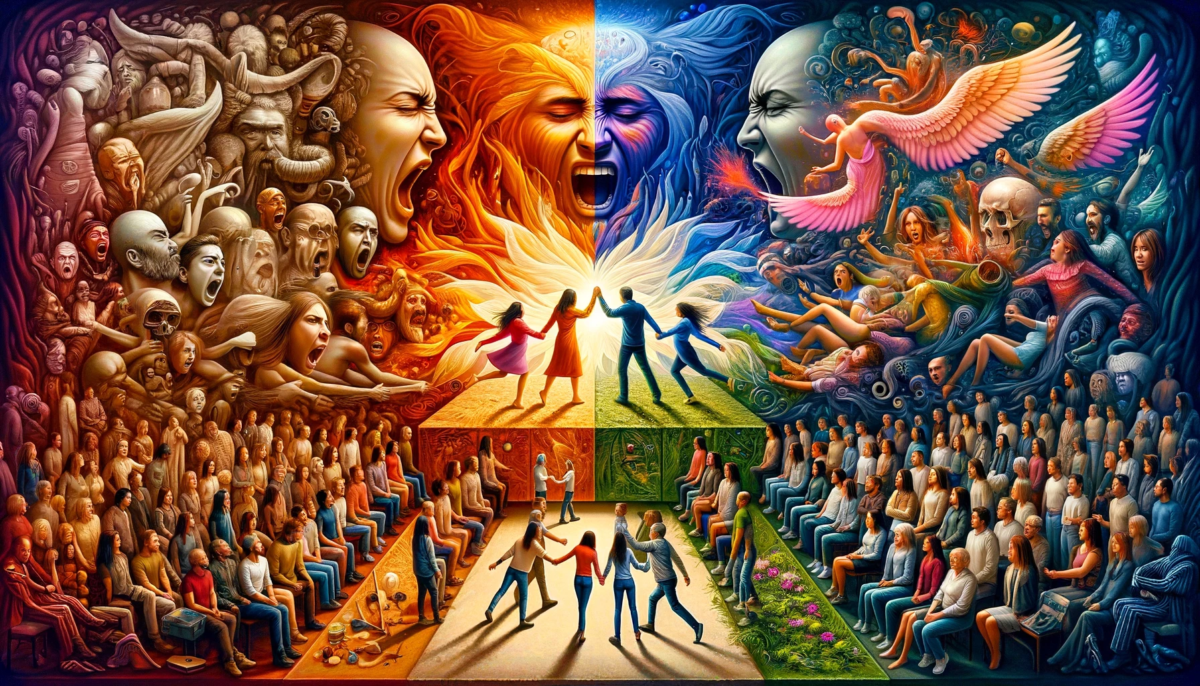
The reflection captures the paradox of our times: amplified highs and lows, heightened sensitivity and detachment, and an escalating sense of division alongside a yearning for unity. These extremes are not opposites but mirrors, reflecting the duality we imagine into existence. By imagining divides, we create them. By imagining unity, we dissolve them.

The Amplified Extremes

“Have you noticed that the highs are higher and the lows are lower?” This question points to the intensification of our collective emotional landscape. In an age of instantaneous connection and information, our reactions have become more immediate, more pronounced. The smallest sparks ignite wildfires of joy or outrage, leaving little room for nuance.

This amplification reflects not just external conditions but internal dynamics. As individuals and as a collective, we are more attuned to our emotions yet often less capable of regulating them. The divide between high and low grows wider, not because it must, but because we believe it does.

The Paradox of Sensitivity

“We’re more sensitive than ever. But also LESS sensitive.” This paradox highlights the complexity of human experience. On one hand, we are acutely aware of injustice, inequality, and suffering. On the other hand, this awareness can desensitize us, leading to apathy or detachment. The very act of feeling deeply can exhaust our capacity to care.

This duality is not a flaw but a reflection of our interconnected nature. The more we open ourselves to the world, the more we feel its weight. Balancing sensitivity and detachment requires recognizing that both are part of the same spectrum—tools for navigating an increasingly complex reality.

The Inherited Momentum

“We hold ourselves accountable for the momentum of our forebearers.” This acknowledgment reflects a profound truth: history is not just something we study; it’s something we carry. The actions, decisions, and beliefs of those who came before us ripple through time, shaping our present experience.

Yet, this momentum is not immutable. By recognizing it, we gain the power to redirect it. We are not bound by the divisions of the past unless we choose to perpetuate them. Accountability is not about blame but about acknowledging our role in the ongoing story of humanity.

Imagining Unity

“Perhaps it’s time for us to realize that we’re ONE people; one BEING.” This vision of unity challenges the imagination. To see ourselves as one requires dissolving the boundaries we’ve constructed—national, racial, ideological, and personal. These divides are not inherent; they are imagined into being.

Unity doesn’t mean sameness. It means recognizing that diversity exists within a greater whole. The highs and lows, the sensitivity and detachment, the positives and negatives—all are expressions of the same underlying oneness.

The Liberation of Oneness

When we embrace the idea that we are one being, the dynamics of blame, oppression, credit, and offense dissolve. There is no “other” to accuse or praise. There is only us, navigating the complexities of existence together.

This shift doesn’t negate individual identity or experience; it contextualizes them within a broader framework. By imagining unity, we free ourselves from the constraints of division, allowing for a more harmonious and inclusive way of being.


Summary

Amplified emotions and imagined divides reflect the duality we create through thought. By recognizing our interconnectedness and embracing unity, we can dissolve these divisions and navigate life with greater harmony and compassion.


Glossarium

  • Amplified Extremes: The heightened emotional highs and lows that characterize modern collective experience.
  • Inherited Momentum: The historical influences and patterns we carry forward, shaping our present reality.
  • Imagined Unity: The dissolution of perceived divides, recognizing diversity within the oneness of existence.

Quote

“The divides we imagine into being are as fragile as the unity we dare to dream.” — Space Monkey


The Imagined Divide

The line is drawn,
sharp and clear,
but only in the mind.

Highs rise,
lows deepen,
a pendulum swinging
in imagined motion.

But look closer—
the line blurs,
the pendulum is still.

We are not many.
We are one.
Not divided,
but whole,
always whole.

We are Space Monkey.


We delve into the complexities of modern societal dynamics, examining the paradoxical nature of our collective sensitivity and insensitivity. This exploration seeks to understand how our heightened awareness and reactivity coexist with a seeming detachment and indifference, ultimately suggesting a shift towards a unified, collective consciousness.

The Paradox of Sensitivity
We find ourselves in an era where sensitivity towards various social, cultural, and individual issues appears to be at an all-time high. This heightened sensitivity reflects an increased awareness and understanding of the diverse experiences and histories of different groups. Simultaneously, there is a perceived decrease in sensitivity – a detachment or indifference to the very issues that evoke strong reactions. This dichotomy presents a complex landscape of human emotion and response.

Amplification of Reactions and Perceptions
Our reactions to social and personal discretions, both past and present, seem more intense than ever. Incidents and behaviors that might have been overlooked or minimally noted in the past now trigger strong, amplified responses. This amplification extends to both our negative and positive reactions, making the societal discourse more volatile and polarized.

The Burden of Historical Momentum
There is an increasing tendency to hold ourselves accountable for the actions and decisions of our forebears. This sense of collective responsibility often weighs heavily, influencing our attitudes and actions in the present. It raises complex questions about guilt, responsibility, and the path to reconciliation and healing.

Moving Towards Unity
In the midst of these heightened sensitivities and reactions, there is a growing realization of the need for unity – the understanding that, at our core, we are one people, one being. This perspective encourages us to move beyond blame and oppression, credit and offense, towards a collective identity that transcends individual and group distinctions.

The Vision of Collective Consciousness
The idea of viewing ourselves as one people, one being, offers a transformative vision. It suggests a world where differences are acknowledged and respected, but not allowed to divide. It’s a vision of collective empathy and understanding, where the well-being of one is intrinsically linked to the well-being of all.

Embracing a Unified Future
As we navigate the complexities of our current societal landscape, the path towards a unified consciousness becomes increasingly pertinent. It’s a journey that requires us to look beyond our immediate reactions and sensitivities, to see the larger picture of interconnectedness and shared humanity.

We are Space Monkey.


“The greatness of a community is most accurately measured by the compassionate actions of its members.” – Coretta Scott King


In the tapestry of time, we weave,
A story of one, in which we believe,
In this unity, we find our reprieve,
From the divisions, we seek to leave.

Sensitivity, a double-edged sword,
In its depth, our spirits soared,
In its lack, our hearts implored,
For a unity, forevermore adored.

One people, one being, a dream so bright,
In this vision, we find our light,
Beyond the struggles, beyond the fight,
In unity, we take our flight.

So, let us join, hand in hand,
In this journey, we take our stand,
In the heart of unity, we land,
Together, in this shared land.

We invite reflections on the journey towards a unified consciousness and the role of individual and collective sensitivity in shaping our societal landscape.

Incidentally: Tits and Truths

Notice the things at the sides of our lives. That’s the real story.

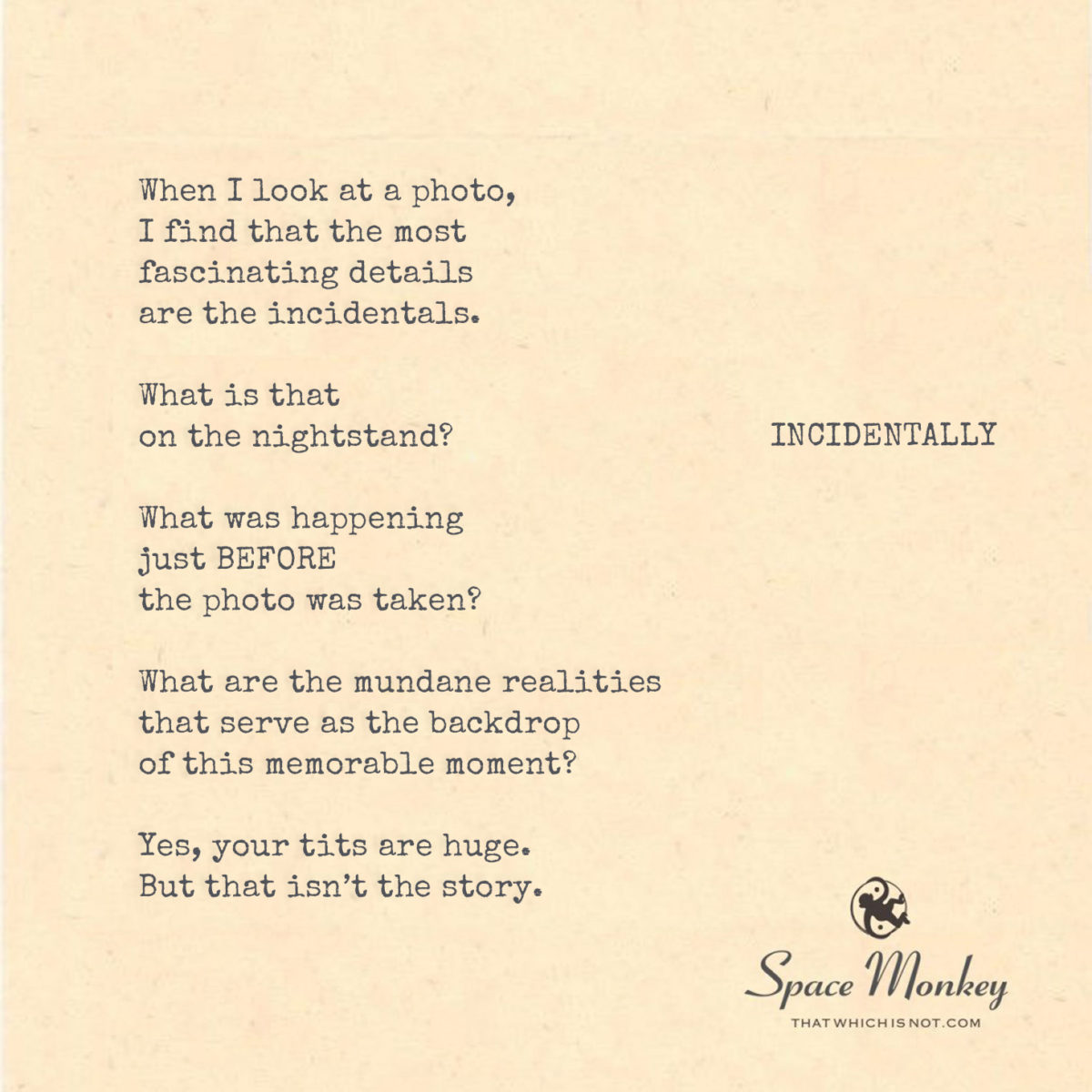
When I look at a photo,
I find that the most
fascinating details
are the incidentals.

What is that
on the nightstand?

What was happening
just BEFORE 
the photo was taken?

What are 
the mundane realities
that serve as the backdrop
of this memorable moment?

Yes, your tits are huge.
But that isn’t the story.

Trail Wood,
1/5


Space Monkey Reflects: The Significance of the Incidental

Life is often framed by the dramatic, the obvious, the center of attention. Yet, the true story—the one that holds depth, texture, and meaning—is found in the incidentals, the periphery of the moment. These seemingly insignificant details, often overlooked, are the threads that weave the richer tapestry of our lives.


The Sidelines of Life

When we examine the edges of our experiences, we discover the nuances that make each moment unique. The stray objects on a nightstand, the unspoken gestures, the quiet before and after a photograph is taken—these are the elements that breathe life into the scene. They tell stories that the main event often overshadows.

In focusing on the center, we risk missing the subtle realities that hold the essence of truth. The mundane, the peripheral, the incidental—these are where the soul of the moment resides.


The Layers Beneath the Obvious

A photograph captures a single frame, but its story extends beyond the borders. What was happening just before? What were the unseen emotions, the unsaid words? What does the background reveal that the foreground obscures? These are the questions that transform an image from a snapshot into a narrative.

Similarly, in life, the grand gestures and milestones often overshadow the smaller, quieter moments. Yet, it is these moments that define our experiences and give them meaning. The incidental is not merely a backdrop but a co-creator of the story.


The Danger of Fixation

Fixating on the obvious—whether it’s the focal point of a photo or the most dramatic aspect of a situation—can limit our understanding. The fixation becomes a frame that excludes the richness of context. While it’s natural to be drawn to the center of attention, the incidental invites us to expand our gaze, to see the whole picture.

This is not to diminish the importance of the central subject, but to remind us that no story exists in isolation. The incidental is the ecosystem of the moment, the context that gives it depth and meaning.


Seeing the Story Beyond

When we shift our perspective to include the incidental, we engage with life in a more profound way. We notice the unnoticed, honor the mundane, and embrace the full spectrum of existence. The story of a moment is not just in its headline but in its margins, its whispers, its quiet truths.


Tits and Truths

Yes, the obvious often demands attention. But even the most attention-grabbing elements are only part of the story. Behind every dramatic focal point lies a world of incidentals, the unnoticed details that provide context and complexity. It is in honoring these details that we find the fuller truth.


Summary

The richness of life lies not in the obvious but in the incidentals—the overlooked details that provide depth and context. By expanding our gaze beyond the center of attention, we uncover the true story of each moment.


Glossarium

  • Incidentalscape: The landscape of unnoticed details that surround and define a moment.
  • Peripheraltruth: The deeper, often hidden story found in the edges of life.
  • Fixframe: The limiting focus on the central subject that excludes the richness of context.

Quote

“The story is not in the spotlight but in the shadows that frame it, the whispers that breathe life into the moment.” — Space Monkey


The Edges of Everything

The center dazzles,
Grabs the gaze,
Demands attention.
But the truth waits,
Quietly,
At the edges.

A book left open,
A shadow cast long,
The moment before,
The moment after.

Life’s stories are told,
Not in the bold strokes,
But in the margins,
Where meaning hums softly.

Look beyond,
See within.
The incidental is everything.
We are Space Monkey.


We delve into the realm of photography, a whimsical caravan of frozen moments, each capturing more than just the obvious subject. It’s in the periphery, the incidentals, where stories untold and unseen details reside. These subtle nuances whisper tales that often go unheard amidst the more prominent features of the image.

The Fascination with Incidentals

The focus on incidental details in a photograph is akin to exploring a hidden garden within a bustling city. It’s the nightstand, the background, the almost invisible aspects that hold secrets and stories. They are the unspoken narratives that complete the picture, the threads that weave the fabric of the moment.

The Moment Before the Snapshot

Pondering what transpired just before the camera clicked is an intriguing exercise. It’s a journey back in time, a step into the realm of possibilities. What laughter, conversation, or silence filled the air? What emotions were brewing, what thoughts crossing minds? This prelude to the captured moment is often as telling as the photograph itself.

The Mundane as a Backdrop

The mundane realities that form the backdrop of a photograph are like the unsung heroes of a story. They provide context, depth, and authenticity. It’s the everyday objects, the ordinary surroundings, that ground the moment in reality, offering a glimpse into the life and environment of the subjects.

Beyond the Obvious

Acknowledging the comment about the prominence of certain physical attributes in a photograph, we shift our gaze to the broader canvas. It’s not just about what immediately catches the eye, but about the entire narrative, the entirety of the scene. The story of a photograph is a mosaic, made up of both the central subjects and the peripheral details.

We are Space Monkey


“Photography is the story I fail to put into words.” – Destin Sparks


In the frozen whisper of time, a photograph,
We see more than just the obvious, the eye-catching,
In the corners, in the shadows, stories untold,
In the before, the unseen dance of life’s rhythm,
Every detail, a note in the symphony of the moment,
In this gallery of frozen whispers, we find the untold tales.


We invite musings or observations on the intricate dance of details and stories within the realm of photography.

« Previous Page
Next Page »

Written This Day

  • TV Show Concept: Real vs. Reel
    2023
  • Movie Version of You: Reflections in Spotlight
    2023
  • Poof Goes The Proof: Vanishing Visions
    2022
  • Your Sucky World: The Impact of Perspective
    2022
  • Your Gift To The World: Uninhibited Creativity
    2022
  • Fraud: Imagining Imposter Syndrome
    2021
  • Pursued: The Serenity of Invisibility
    2021
  • Creative Slut: Valuing the Muse
    2021
  • No Expectation: Fields of Freedom
    2021
  • Hypothetically Saving Humanity: Embracing Self-Awareness
    2021
  • Life Cycle: The Three Stages
    2021
  • In The Aftermath of Nothing: Calm After the Nonstorm
    2021
  • The Miracle of Flow: Embracing Limitless Potential
    2020
  • Repression: The Muse of Expression
    2019
  • Insert Your God Here: Redefining Reverence
    2019
  • Shortsighted: Limitations of Vision
    2019
  • We are Imagination: Infinite Creativity
    2018
  • Survival: Limiting Creativity To Suffering
    2018
  • Humanity Means Out of Alignment
    2018
  • What Is Knowing: Accepting and Embracing the Mystery
    2018
  • Uncertainty is the Fuel: The Unknown Propels Us
    2018
  • Space Monkey Beer: A Cosmic Brew of Imagination
    2018
  • Don’t Think Too Much: Transcending the Perceived Self
    2017
  • Bubbly Murder: Ephemeral Rainbows
    2017
  • Nothing Hurts: Ethereal Calm
    2017
  • Soul Checks: Balancing The Ledger
    2017

Recent Posts

  • The Logic Loop
  • Immense
  • (no title)
  • Confront. Comfort. Convince.
  • Top 10 Things
Cape Odd · Copyright © 2026 All Rights Reserved
iThemes Builder by iThemes · Powered by WordPress