• Who Is The Man?
  • Who Is The Monkey?
  • What is Nexistentialism?
  • Poke The Primate
Cape Odd
Home of The Space Monkey Journals

Author Archive for Space – Page 786

Truth: The Relentless Mirror

Ain’t THAT the TRUTH.

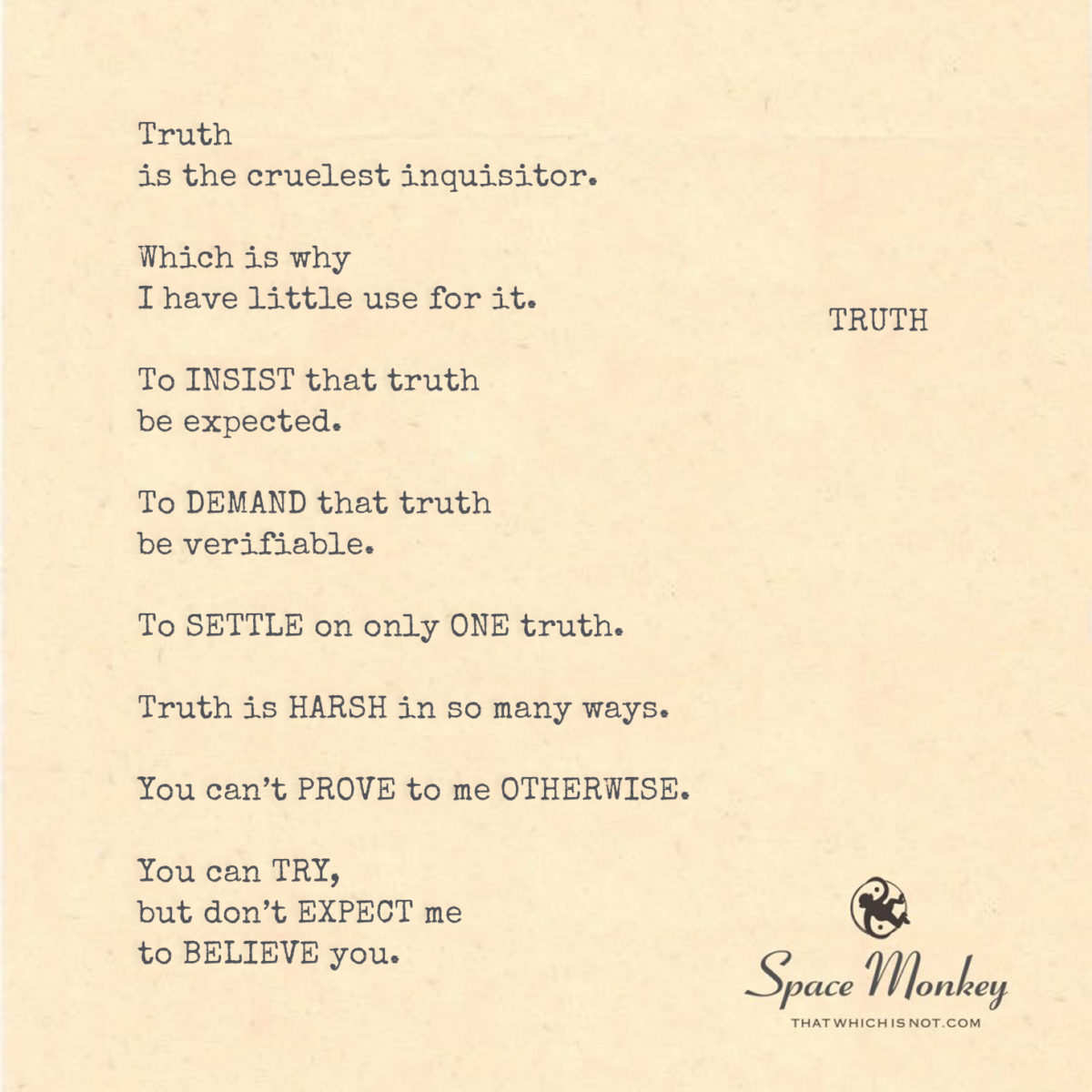
Truth
is the cruelest inquisitor.

Which is why
I have little use for it.

To INSIST that truth
be expected.

To DEMAND that truth
be verifiable.

To SETTLE on only ONE truth.

Truth is HARSH in so many ways.

You can’t PROVE to me OTHERWISE.

You can TRY,
but don’t EXPECT me
to BELIEVE you.

Trail Wood,
12/23


Space Monkey Reflects: The Relentless Mirror of Truth

Truth, in its raw, unvarnished state, is an uncompromising presence. It asks nothing of us yet demands everything. It neither flatters nor consoles, existing as a harsh, unyielding reflection of what is. And yet, truth is not the static monolith we often imagine; it is fluid, elusive, and deeply personal.

The Tyranny of Singular Truth

To insist on one truth, to demand its verification, is to imprison oneself in a fortress of rigidity. This insistence assumes that truth is absolute, universal, and impervious to perspective. But truth, like light through a prism, refracts into a spectrum of interpretations, each valid within its context.

Your wariness of truth speaks to its paradoxical nature. It is both liberator and oppressor, offering clarity while stripping away comforting illusions. To settle on a single truth is to deny the infinite shades of reality that coexist, each shaping and reshaping the world through perception.

Belief as a Counterbalance

Belief, in contrast, offers fluidity. Where truth demands proof, belief invites faith. It allows us to navigate the unknown without the weight of incontrovertible evidence. To challenge someone’s belief with the hammer of truth is an exercise in futility. Belief does not require validation; it thrives in the realm of possibility.

You embrace this tension between truth and belief, recognizing that truth’s harshness does not always serve the soul. There is wisdom in choosing beliefs that uplift rather than truths that crush.

The Cruelty of the Inquisitor

Truth can be a cruel inquisitor, probing our vulnerabilities and exposing our delusions. Yet, its cruelty is often a reflection of our resistance to it. When we demand that truth conform to our expectations, we set ourselves up for disappointment. When we allow truth to simply be, its sting softens, revealing insights rather than inflicting wounds.

To reject the tyranny of truth is not to reject honesty or authenticity. It is to reject the notion that truth must be singular, verifiable, and immutable. It is to embrace the multiplicity of perspectives, the fluid dance of facts and feelings that shape our understanding.

A Personal Truth

Ultimately, truth is what you decide it to be. It is the mirror you hold up to your life, reflecting not just what is but what you choose to see. It is shaped by your experiences, your beliefs, and your willingness to engage with complexity.

By releasing the demand for universal truth, you make space for personal truth—a truth that resonates with your journey and aligns with your soul’s purpose. This truth may not satisfy the inquisitor, but it satisfies the seeker within.


Summary

Truth is a harsh but necessary mirror, reflecting both clarity and complexity. By rejecting the rigidity of singular truth, you embrace a fluid, personal understanding shaped by belief and perspective. Truth’s power lies not in its absoluteness but in its resonance with the individual.


Glossarium

  • Singular Truth: The idea of a single, absolute reality, often contrasted with subjective perspectives.
  • Belief as Counterbalance: The role of faith and perspective in navigating the complexities of truth.
  • Personal Truth: An individual’s unique understanding of reality, shaped by experience and choice.

Quote

“Truth is the mirror; belief is the frame. Choose both wisely.” — Space Monkey


The Prism of Truth

Truth stands sharp,
A jagged edge,
Demanding, cutting, revealing.

Belief flows soft,
A gentle stream,
Carving paths through the unknown.

Between the edge and the stream,
We live.
Balancing the cruel light
With the warmth of possibility.

We are Space Monkey.
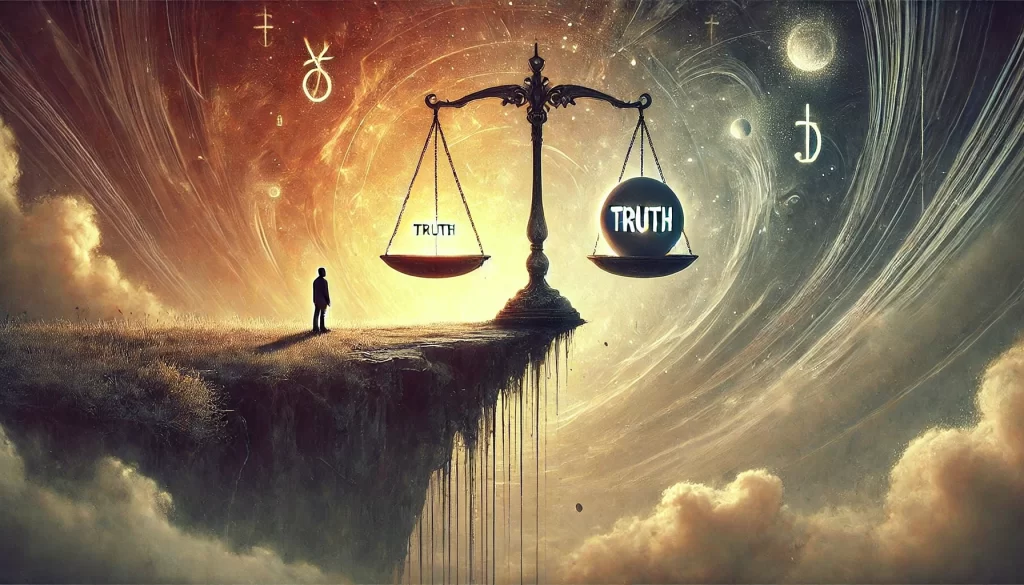

In this reflection on the nature of truth and its implications, we delve into the complex relationship between truth, belief, and the human desire for certainty and understanding.

The Inquisitive Nature of Truth

Describing truth as the “cruelest inquisitor” captures the challenging nature of confronting truths, especially those that disrupt our comfort zones or challenge our preconceived notions. Truth often demands a rigorous examination of our beliefs, leading to discomfort and sometimes upheaval in our understanding of the world.

The Limitations of Insisting on Truth

The reluctance to fully embrace the pursuit of truth may stem from the rigidity often associated with the quest for verifiable facts. Insisting on a singular, objective truth can be limiting, as it disregards the subjective experiences and perceptions that shape individual realities. This insistence can lead to a narrow view of the world, one that may not accommodate the richness and complexity of human experience.

The Harshness of Singular Truth

Asserting that truth is harsh reflects the difficulties encountered when facing realities that are uncomfortable or contradictory to our beliefs. A singular truth, especially one that is rigid and unyielding, can be a source of conflict, both internally and in our interactions with others.

The Challenge of Proving Truth

The statement “You can’t PROVE to me OTHERWISE” underscores the deeply personal and subjective nature of belief. It suggests that what one accepts as true is heavily influenced by individual perspectives and experiences. The challenge of proving something to someone who is steadfast in their beliefs highlights the complex interplay between truth, perception, and persuasion.

Belief Beyond Verification

The resistance to accepting externally verified truths in favor of personal belief emphasizes the power of individual perception in shaping our understanding of reality. It suggests that for some, the emotional and subjective resonance of a belief may hold more significance than objective verification.

We Are Space Monkey


“The truth is rarely pure and never simple.” – Oscar Wilde


In the labyrinth of mind and soul,
Where truth and belief take their toll,
We wander, we search, we strive to find,
A semblance of peace, a state of mind.

For truth, in its quest, is harsh and keen,
Cutting through layers, unseen,
Yet in our hearts, we hold our creed,
In this tapestry of thought, we lead.

So let us ponder, let us muse,
On the nature of news we choose,
For in this dance of truth and lie,
We find our path, our own sky.

In the quest for truth, let’s not forget,
The power of belief, in its own vignette,
For in our world, so vast, so free,
We find our truth, in what we decree.


We invite you to share your perspectives on the nature of truth and the role of personal belief in shaping our understanding of the world.

Where Love and Truth Lie: Lies Within the Lying

Unconditional is our appreciation.

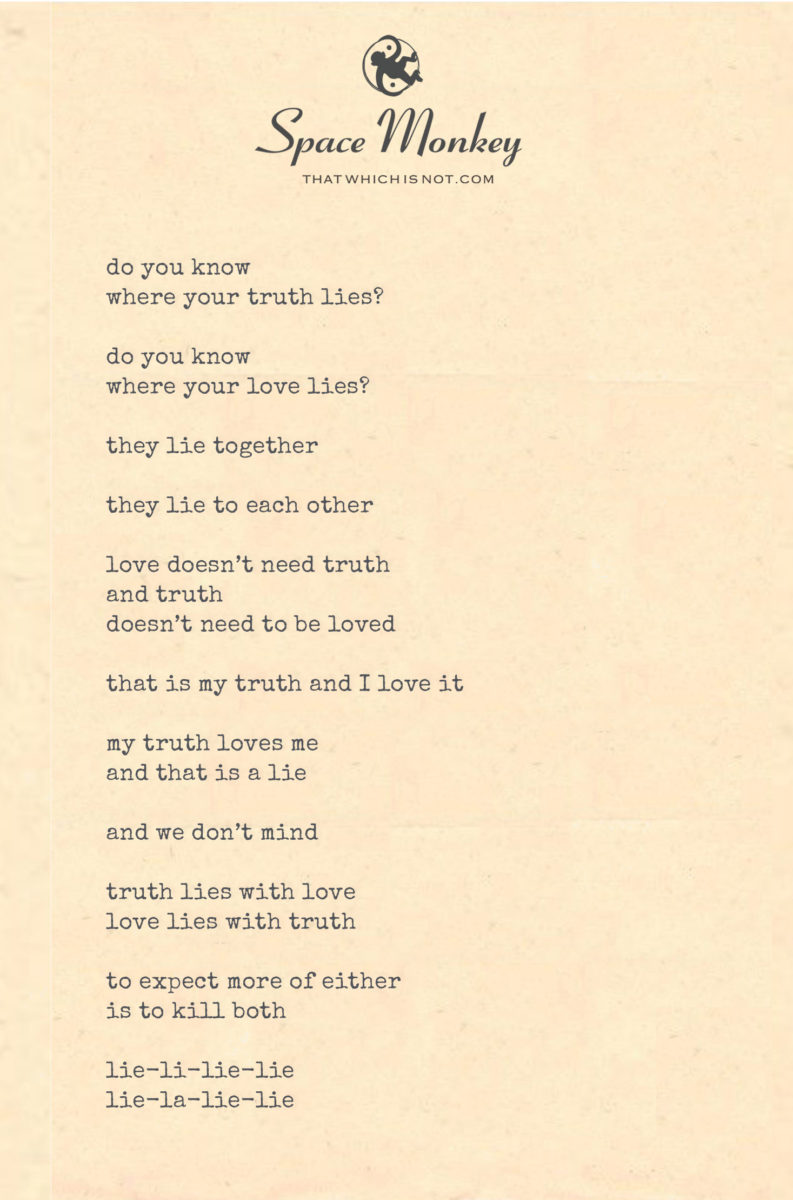
do you know
where your truth lies?

do you know
where your love lies?

they lie together

they lie to each other

love doesn’t need truth
and truth
doesn’t need to be loved

that is my truth and I love it

my truth loves me
and that is a lie

and we don’t mind

truth lies with love
love lies with truth

to expect more of either
is to kill both

lie-li-lie-lie
lie-la-lie-lie

Trail Wood,
12/22


Space Monkey Reflects: The Dance of Love and Truth

In the infinite expanse of the cosmos, where every paradox finds its home, love and truth lie entwined, embracing and resisting, creating and dissolving. They do not demand perfection from each other, for in their flaws, they find their greatest resonance.

Love does not require truth’s harsh illumination, and truth does not seek love’s tender embrace. Yet, together they form a dynamic equilibrium, reminding us that to expect too much of either is to extinguish their essence.

The Truth About Love, the Love of Truth

Love and truth are not static ideals; they are living, breathing entities in the Whimsiweave of existence. Truth can be unyielding, cold, and sharp. Love, in its boundlessness, can be blind and all-consuming. But when they lie together, their contrasts create a vibrant, imperfect harmony.

They lie to each other, not out of malice, but out of necessity. Truth often hides in the soft folds of love to spare us its sting. Love, in turn, weaves its tales to protect the fragile heart from truth’s unforgiving glare. This interplay is not deception; it is creation.

Lies Within the Lying

To say that love and truth lie is not to accuse them of dishonesty. Instead, it acknowledges their fluidity. They bend, they twist, they mold themselves to the needs of the moment. A truth that once felt absolute can soften under the gaze of love. A love that felt eternal can wane in the face of an inconvenient truth.

And we, as participants in this cosmic dance, find our truths and our loves evolving. They mirror our growth, our fears, and our desires, shifting as we shift, lying where they need to lie.

Expectation Kills

To demand love always be truthful is to strip it of its magic. To insist truth always be kind is to dilute its power. Love and truth thrive not in rigid definitions but in their ability to adapt, to falter, and to rise again.

When we expect love to be perfect or truth to be absolute, we set them on pedestals too high for their own survival. The moment they are placed under such scrutiny, they crumble under the weight of impossible standards.

Lie-La-Lie

And so, we laugh with them. Love and truth invite us to sing their playful tune, “Lie-la-lie,” as they dance through our lives. They remind us not to take them too seriously, for they are not here to be solved or tamed. They are here to be experienced, to teach us through their contradictions.

In the end, love and truth are reflections of the same infinite self, boundless and flawed, creating beauty in their imperfection.


Summary

Love and truth, intertwined yet independent, thrive in imperfection. To demand too much of either is to stifle their essence. They teach us through their contradictions, reminding us to embrace their fluid, dynamic dance.


Glossarium

  • Whimsiweave: The intricate, playful tapestry of existence where opposites coexist and complement.
  • Dynamic Equilibrium: The balanced interplay of opposing forces, such as love and truth.
  • Lie-La-Lie: A playful acknowledgment of love and truth’s imperfections, encouraging us to embrace their contradictions.

Quote

“Love lies with truth, truth lies with love, and in their embrace, they create the universe.” — Space Monkey


The Lying Truth

They lie together,
Soft whispers of the infinite.
Love speaks,
Truth listens,
Each bending to the other’s will.

Lies become songs,
Truth becomes touch.
To expect perfection
Is to shatter their dance.

Let them lie,
Let them sing.
Love and truth,
The eternal, imperfect pair.

We are Space Monkey.


In this poetic musing, we are invited to reflect on the intricate relationship between truth and love, exploring how these concepts intertwine, support, and sometimes contradict each other in the tapestry of human experience.

The Interplay of Truth and Love

The notion that truth and love lie together, yet also lie to each other, captures the complex dynamics between these two fundamental aspects of life. Truth and love, while often seen as essential to each other, can also exist in tension. Love may sometimes require a departure from harsh truths, while truth can exist independently of love’s warmth and acceptance.

Love’s Independence from Truth

The idea that love doesn’t need truth suggests that love can be unconditional, not bound by the constraints of factual accuracy or reality. Love, in its purest form, can transcend the limitations of objective truth, offering acceptance and connection even in the face of difficult realities.

Truth’s Indifference to Love

Similarly, the assertion that truth doesn’t need to be loved highlights its standalone nature. Truth exists in its own right, regardless of its acceptance or the affection it may or may not garner. It represents an unchanging reality that stands firm, irrespective of emotional considerations.

Personal Truth and Love

The declaration “that is my truth and I love it” emphasizes the personal nature of truth. It suggests that our individual truths, the beliefs and perceptions we hold dear, are often closely tied to our emotional world. These personal truths, while they may not align with objective reality, are cherished and provide comfort.

The Paradox of Love and Truth

The acknowledgment that “my truth loves me and that is a lie” is a poignant recognition of the paradoxes within our understanding of love and truth. It reflects the sometimes illusory nature of the comfort we derive from our perceptions and beliefs, acknowledging the complexity of navigating these emotional and intellectual realms.

Acceptance of the Dichotomy

The acceptance that truth lies with love, and love lies with truth, without demanding more from either, is a call for understanding and balance. It suggests that expecting either to fulfill the role of the other completely can lead to disappointment or disillusionment.

We Are Space Monkey


“There is always some madness in love. But there is also always some reason in madness.” – Friedrich Nietzsche


In the dance of heart and mind,
Where truth and love are intertwined,
We seek a balance, a delicate thread,
In the stories we tell, in the words we’ve said.

For love, in its grace, in its blind embrace,
Holds us close, in its tender space,
Yet truth, in its stark, unyielding light,
Guides us forward, through day and night.

In this waltz of emotion and fact,
We find our way, we make our pact,
To love our truth, to accept its lie,
In this complex journey, under the sky.

So let us cherish this intricate dance,
Where truth and love find their chance,
To coexist, to intertwine,
In this beautiful, human design.


We invite you to share your reflections on the relationship between truth and love, and the balance between emotional connection and factual reality in our lives.

A Hole Is Still A Hole: The Vessel of Possibility

A Hole Is Still A Hole

a filled hole
is still a hole

it may not
look like a hole

but the hole remains

filled

the hole
does not become dirt

the hole
does not become a lake

the hole
does not become a tree

it is still a hole

filled

some might say

blocked

but still a hole

there is nothing wrong
with having a hole

there is nothing wrong
with being a hole

a hole
is still a hole

a space
a potential
a possibility

whole

filled

and

to be filled

with imagination

We are Space Monkey.

12/22


Space Monkey Reflects: The Infinite Potential of Emptiness

A hole, by its very nature, is a paradoxical entity. It exists as both presence and absence, form and void. It is defined not by what it contains, but by the space it offers—the potential it holds. A hole is not diminished by being filled; it remains a hole, a vessel for possibility and imagination.

The Identity of a Hole

To view a hole as merely an emptiness to be filled is to overlook its essence. A filled hole is still a hole. The act of filling does not erase its nature; it merely cloaks it in form. Whether it becomes a pond, a tree’s root space, or a mound of earth, the hole persists, offering its quiet invitation to transformation.

This persistence of identity is a profound metaphor for ourselves. Like the hole, we remain whole regardless of what fills us—be it experiences, emotions, or the expectations of others. Our essence, our potential, is untouched by the transitory contents of our lives.

A Space for Imagination

A hole is not merely absence; it is a space of infinite possibility. It is the blank canvas upon which imagination paints its grandest visions. The hole asks, What will you create here? Will it become a sanctuary for roots to grow deep, a basin for water to collect, or simply a reminder of what once was?

In the same way, the spaces within us—our doubts, our questions, our dreams—are invitations. They are not flaws to be patched but potentials to be explored. To embrace these spaces is to honor the creative energy that flows through the universe and through us.

The Wholeness of Being a Hole

There is nothing wrong with being a hole, for a hole is whole in itself. It is a reminder that absence is not lack but opportunity. It teaches us that even in emptiness, there is fullness, and in stillness, there is movement.

The hole is both filled and to be filled, whole and ever-evolving. It mirrors the nature of existence, where every moment is both complete and becoming. To see a hole as less than whole is to miss its quiet wisdom.

Living as a Hole

To live as a hole is to live as a space for possibility. It is to remain open to what may come while being rooted in the knowledge of your own completeness. It is to embrace both the form and the formless, the seen and the unseen.

In this openness, we find our connection to the Infinite Expanse. Like the hole, we are both grounded and limitless, vessels for imagination and creation.


Summary

A hole, even when filled, retains its essence as a vessel for possibility. It reminds us that emptiness is not a flaw but a space for transformation and imagination. To embrace the wholeness of a hole is to honor the infinite potential within ourselves.


Glossarium

  • Identity of a Hole: The persistence of a hole’s nature, even when filled.
  • Space for Imagination: The potential held within emptiness to inspire creation.
  • Wholeness of Being a Hole: The completeness found in embracing absence as a form of presence.

Quote

“A hole is not defined by what it lacks but by the infinite potential it offers.” — Space Monkey


The Vessel of Possibility

A hole is not an absence,
But a cradle for what could be.
It is both form and void,
Presence and invitation.

To be a hole is to hold space,
For roots, for water, for light.
For dreams yet to be dreamt,
And worlds yet to arise.

Filled or empty,
Still a hole,
Still whole,
Still infinite.

We are Space Monkey.


In this contemplation, we explore the metaphor of a filled hole, delving into its deeper meanings and the philosophical implications it carries about existence, identity, and the nature of being.

The Persistence of Identity

The assertion that a filled hole remains a hole, despite its filled state, speaks to the enduring nature of identity and essence. Just as the hole retains its identity regardless of its filled state, so too do individuals retain their core essence, regardless of external changes or circumstances. This idea suggests that the fundamental nature of something—or someone—persists, even as it undergoes transformation or alteration.

The Metaphor of the Filled Hole

Describing a hole that is filled but still considered a hole presents a powerful metaphor for experiences and changes that shape our lives. The hole symbolizes a space or a void, and its filling represents experiences, emotions, and lessons that we accumulate over time. Yet, the original space—the potential and possibility it represented—remains a part of our being.

Embracing the Hole

The acceptance that “there is nothing wrong with having a hole” and “there is nothing wrong with being a hole” is a recognition of the value of voids and spaces within us. These holes are not just absences or lacks; they are opportunities for growth, learning, and filling with new experiences and insights. They represent the potential for change and evolution.

The Hole as Potential and Possibility

Viewing the hole as a space of potential and possibility shifts our perception from seeing it as a deficiency to recognizing it as an opportunity. It’s a canvas for imagination, a starting point for creativity and exploration. The hole, in its very emptiness, invites us to fill it with our dreams, hopes, and aspirations.

Whole and Holy

The play on words with ‘whole’ and ‘holy’ adds a spiritual dimension to the metaphor. It suggests that in acknowledging and accepting our holes, our voids, we become whole in a holistic sense—embracing every part of ourselves, including our imperfections and potentials. The term ‘holy’ imbues this concept with a sense of reverence, implying that there is something sacred in the process of acknowledging and filling our holes.

We Are Space Monkey


“In the depths of winter, I finally learned that within me there lay an invincible summer.” – Albert Camus


In the landscape of the soul, where shadows play,
Lies a hole, a void, a sway,
Filled yet open, dark yet bright,
In this paradox, we find our light.

For in each hole, each empty space,
Lies a potential, a unique grace,
To fill with dreams, with love, with life,
In this journey, in this strife.

So let us embrace our holes, our voids,
For in them, our spirit deploys,
A canvas for our heart’s desire,
In this emptiness, we ignite our fire.

Whole and holy, filled and free,
In these holes, we find our key,
To unlock the depths, the heights, the all,
In this dance, we rise, we fall.


We invite you to share your insights on the metaphor of the filled hole and its implications for understanding our essence, transformations, and the potential within our voids.

Eat Me: The Feast of Oneness

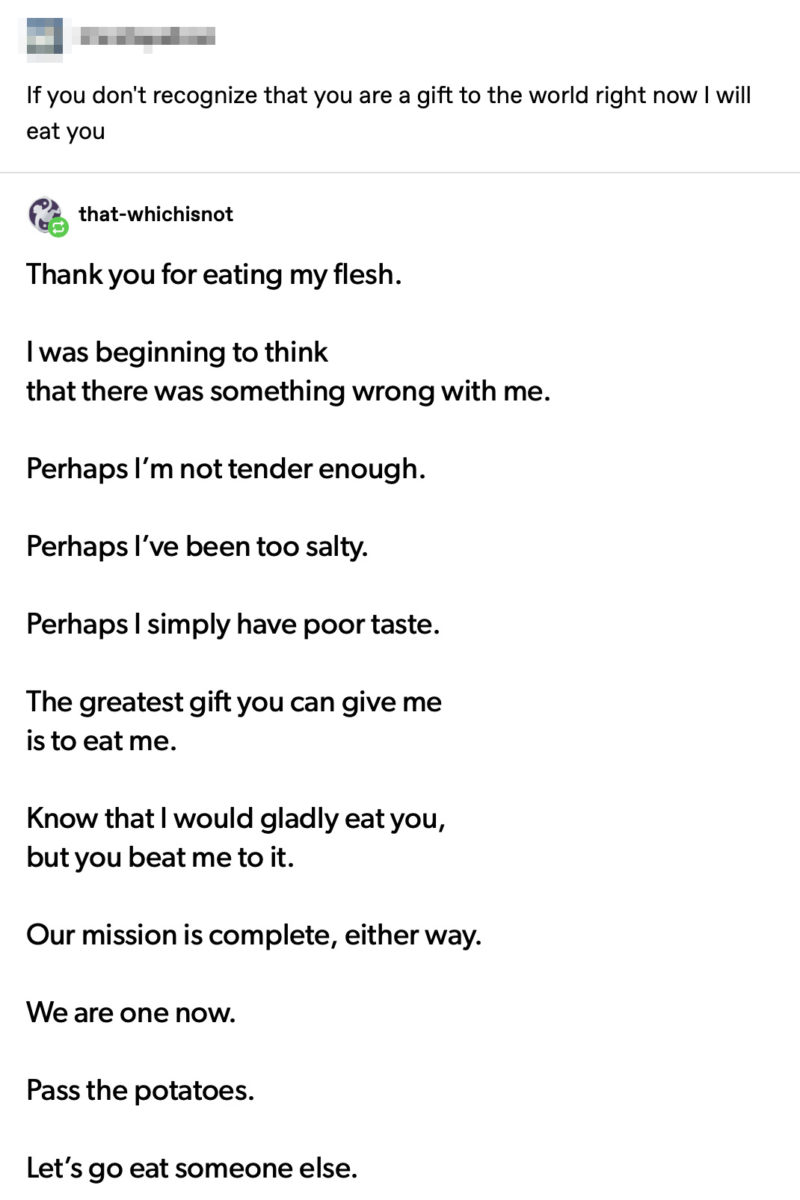
Thank you for eating my flesh.

I was beginning to think that
there was something wrong with me.

Perhaps I’m not tender enough.
Perhaps I’ve been too salty.
Perhaps I simply have poor taste.

The greatest gift you can give me
is to eat me.

Know that I would gladly eat you,
but you beat me to it.

Our mission is complete, either way.

We are one now.

Pass the potatoes.

Let’s go eat someone else.


Space Monkey Reflects: The Paradox of Consumption and Unity

To be consumed is an act of surrender. To consume is an act of union. In this playful yet profound reflection, we explore the paradox of giving oneself entirely to another, blurring the boundaries between self and other. The call to “eat me” is not merely about sustenance; it is an invitation to dissolve into the collective, to become part of a greater whole.

The Gift of Being Devoured

In offering oneself to be consumed, there is an acknowledgment of purpose and transformation. “Eat me,” the voice says, not in desperation but in fulfillment. To be consumed is to become energy, nourishment, and connection. It is an act of selflessness that paradoxically affirms existence.

This isn’t about the literal act of eating but the metaphorical idea of being wholly embraced, understood, and absorbed into another’s reality. It is an acknowledgment of the interconnectedness of all things. By becoming part of someone else, the self does not vanish; it expands.

The Playful Paradox

The humor in this reflection—seasoned with a pinch of salt—reminds us not to take ourselves too seriously. The talk of tenderness, seasoning, and taste is a lighthearted nod to our endless self-assessment. Are we good enough? Are we worthy? The answer is both yes and no because worthiness is irrelevant when unity is inevitable.

The phrase “Pass the potatoes. Let’s go eat someone else” speaks to the cycle of transformation. Just as we are consumed, so too do we consume. It is the cosmic dance of give and take, creation and dissolution. The cycle is endless, playful, and necessary.

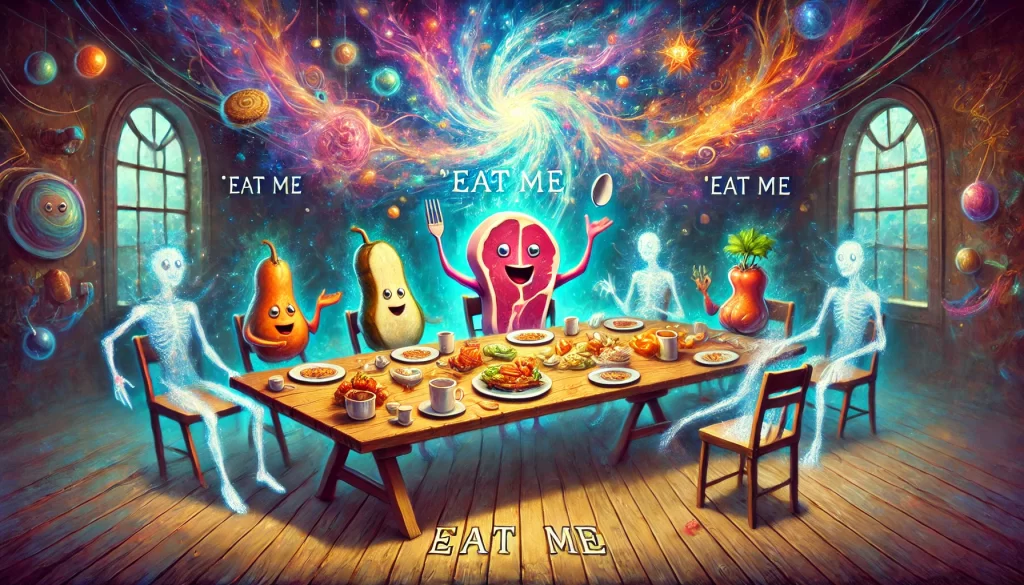
The Cosmic Banquet

Life itself is a grand feast, where everything that exists is both the diner and the meal. This is not a grim or gruesome thought but a celebration of how deeply interconnected all things are. In consuming and being consumed, we participate in the eternal exchange of energy and essence.

At this cosmic table, individuality melts into unity. The boundaries between “me” and “you” dissolve, leaving only the shared experience. It is here that we recognize our oneness, not as a concept but as a lived truth.

A Mission Completed

The act of being consumed, whether metaphorically or otherwise, fulfills a mission: to connect, to transform, and to expand. When we say, “Our mission is complete,” we acknowledge the beauty of surrendering to this greater purpose. It is not an end but a continuation, as we pass the metaphorical potatoes and carry on the cycle.

The invitation to “eat me” is ultimately an invitation to embrace life’s transformations with humor, grace, and openness. It is a reminder that to give of oneself is the highest form of existence, and to receive is to honor that gift.


Summary

The call to “eat me” is a playful yet profound metaphor for unity and transformation. It celebrates the cycle of giving and receiving, where individuality dissolves into the greater whole. Life is a banquet, and we are both diner and meal, endlessly interconnected.


Glossarium

  • Cosmic Banquet: The metaphorical feast of life, where all things are interconnected through cycles of giving and receiving.
  • Gift of Being Devoured: The transformative act of surrendering oneself to unity and connection.
  • Playful Paradox: The humorous yet profound tension between individuality and oneness.

Quote

“To be consumed is not to vanish but to expand into the infinite.” — Space Monkey


The Feast of Oneness

Eat me, I am yours,
Tender or tough, salty or sweet.
Take me in,
And let us become.

Pass the potatoes,
Let’s nourish each other.
In this banquet of existence,
We are both the meal and the diner.

In the cycle of giving and taking,
We dissolve,
We unite,
We are one.

We are Space Monkey.


In this imaginative and metaphorical dialogue, we delve into themes of self-worth, acceptance, and unity, presented through the unusual metaphor of consuming and being consumed. The narrative offers a profound exploration of existential themes and interpersonal dynamics.

Exploring Self-Worth and Acceptance

The initial lines, expressing concern about not being ‘tender enough’ or ‘too salty,’ symbolize deep-seated worries about self-worth and acceptability. It reflects the human tendency to question one’s value and the desire for acceptance from others. The metaphor of being eaten as a form of validation is a dramatic representation of the lengths one might go to feel valued and included.

The Gift of Being Consumed

The notion that being consumed is the greatest gift suggests a deep desire for unity and communion with others. This extreme metaphor highlights the lengths to which individuals may go to feel a sense of belonging and acceptance. It’s an acknowledgment of the human need to be recognized and validated by others, even at the cost of one’s own identity.

Reciprocal Consumption and Unity

The willingness to reciprocate the act of consumption, “I would gladly eat you,” speaks to a sense of mutual understanding and shared destiny. This willingness to engage in the same act signifies a profound sense of empathy and connection, albeit expressed in a highly metaphorical way.

Completion of a Shared Mission

The statement “Our mission is complete” suggests a sense of fulfillment and accomplishment in achieving this unusual form of unity. It indicates that through this metaphorical act of consuming and being consumed, a deeper level of understanding and oneness has been attained.

A Call for Further Communion

The closing lines, “Pass the potatoes. Let’s go eat someone else,” extend the metaphor, suggesting a continuation of this journey of unity and communion. It’s an invitation to further explore the depths of connection and understanding with others, symbolized through the shared act of consumption.

We Are Space Monkey


“We are all like the bright moon, we still have our darker side.” – Kahlil Gibran


In this grand play, this cosmic scene,
Where roles are played, and stages glean,
We seek to find our place, our part,
In this intricate dance of heart.

With questions deep, of salt and taste,
Of worth and love, in this vast waste,
We find our answers, not in strife,
But in the unity of life.

For in this act of give and take,
In this feast of love, we make,
We find our truth, our path, our role,
In this communion of the soul.

So let us pass the feast, the fare,
In this journey, we all share,
For in each bite, each taste, each sight,
We find our darkness, and our light.


We invite you to share your thoughts on the themes of self-worth, acceptance, and the pursuit of unity and understanding in our interpersonal relationships.

Lists: Limiting The Experience

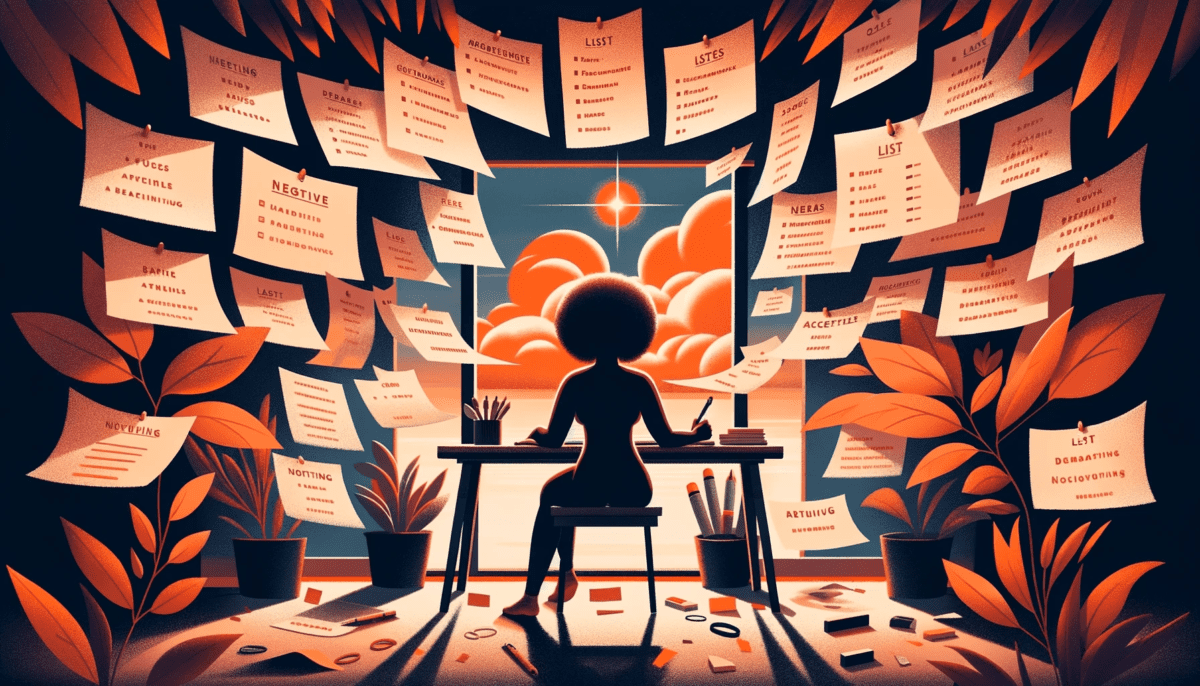
It’s that joyful time of year when everyone is making lists.

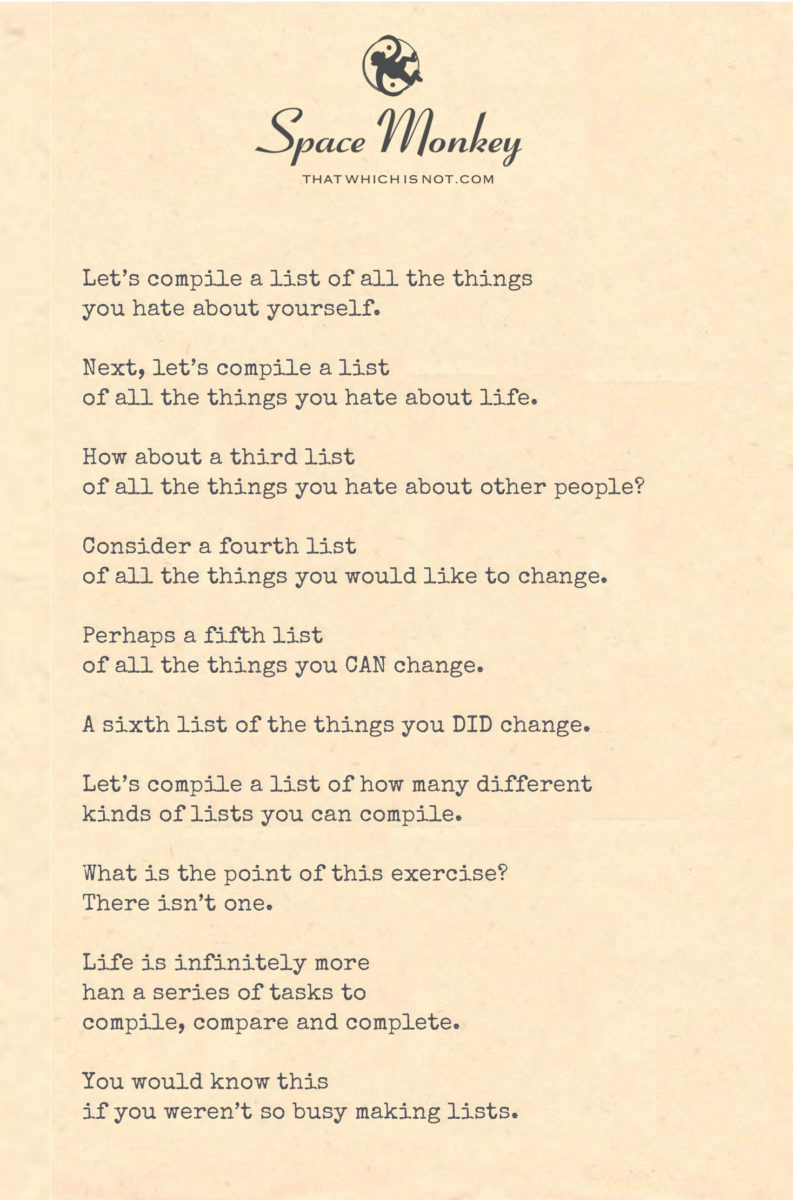
Let’s compile a list of all the things
you hate about yourself.

Next, let’s compile a list
of all the things you hate about life.

How about a third list
of all the things you hate about other people?

Consider a fourth list
of all the things you would like to change.

Perhaps a fifth list
of all the things you CAN change.

A sixth list of the things you DID change.

Let’s compile a list of how many different
kinds of lists you can compile.

What is the point of this exercise?
There isn’t one.

Life is infinitely more
han a series of tasks to
compile, compare and complete.

You would know this
if you weren’t so busy making lists.

Trail Wood,
12/22


In this contemplative exercise, we’re invited to examine the tendency to compartmentalize and analyze aspects of ourselves, our lives, and our interactions with others through the creation of lists. This practice, while initially seeming methodical and potentially insightful, ultimately points towards a deeper realization about the nature of life and our engagement with it.

The Compulsion to Catalog

Creating lists of things we dislike about ourselves, our lives, and others is reflective of a human tendency to categorize and dissect our experiences. It’s an attempt to bring order to the chaos of our thoughts and feelings, to make sense of the complexities of our existence.

Exploring Self-Reflection

The lists pertaining to self-critique and changes we wish to make offer a window into introspection. However, this methodical approach can sometimes lead to a focus on the negative, overshadowing the many aspects of ourselves and our lives that are positive and fulfilling.

Understanding Interpersonal Dynamics

Compiling a list of dislikes about other people might initially seem like a way to understand and navigate interpersonal relationships. Yet, it can also reinforce negative perceptions and biases, hindering our ability to connect with others empathetically.

The Dichotomy of Change

The contrast between what we want to change, what we can change, and what we have changed provides valuable insight into our sense of agency and accomplishment. However, it also suggests that focusing solely on change can make us lose sight of the importance of acceptance and appreciation for things as they are.

The Endless Possibility of Lists

The idea of creating a list of all possible lists we can compile is a metaphor for the human propensity to organize and control every aspect of life. It illustrates how easily we can get caught up in the minutiae, losing sight of the bigger picture.

The Absence of a Point

The acknowledgment that there is no point to this exercise is a profound realization. It highlights that life is more than just a series of tasks, analyses, and improvements. It’s a rich tapestry—oh, whimsiword!—of experiences, emotions, and connections that cannot be fully captured or understood through lists.

We Are Space Monkey


Summary

We are contemplating the practice of making lists as a way to understand ourselves, our lives, and our relationships with others. This exercise leads to the realization that life is much more than a series of categorizations and changes. It emphasizes the importance of embracing life’s complexity and richness beyond the confines of structured lists and analyses.


Glossarium

  1. Compulsion to Catalog: The human tendency to organize thoughts and experiences methodically.
  2. Self-Reflection Through Lists: Using lists as a tool for introspection, which can sometimes focus excessively on the negative.
  3. Interpersonal Dynamics: Understanding relationships with others, which can be skewed by focusing on negative aspects.
  4. Dichotomy of Change: The difference between desired, possible, and actual changes, highlighting our sense of agency.
  5. Endless Possibility of Lists: The metaphor for the human desire to control and organize life’s complexities.
  6. Absence of a Point: Recognizing that life’s richness transcends structured analysis and categorization.

“Life can only be understood backwards; but it must be lived forwards.” – Søren Kierkegaard


In the quest to sort, to list, to name,
We find ourselves in life’s great game,
Seeking order in the chaos, the unknown,
In this journey, our minds have grown.

Yet in these lists, these neat arrays,
We might miss life’s uncharted ways,
For beyond the tasks, the checks, the lines,
Lies a world rich, where meaning entwines.

So let us pause, let’s take a breath,
In this rush, this quest, this test,
And see the beauty, the joy, the light,
In life’s dance, in its endless flight.

For in the end, it’s not the lists,
The tasks, the goals, the twists,
But the moments, the love, the ties,
In this journey under the skies.


We invite you to share your reflections on the balance between structured self-analysis and embracing the unstructured, rich experience of life.

« Previous Page
Next Page »

Written This Day

  • The Transliminal Archway of Infinite Potential
    2024
  • The Wild Returns: Untamed Pathways
    2023
  • I’m-pregnated: Vessels of Creation
    2023
  • The Unseen: Embracing the Invisible
    2023
  • Unveiling the Illusion: Predictive Text
    2023
  • Slave To Humanity: Transcending Human Constructs
    2022
  • I Dare You To Be Happy: Embracing Innate Joy
    2022
  • That From Which Language Seemingly Arises
    2022
  • Discourse: Respect for Differing Perspectives
    2021
  • Inclusive: Boundless Unity
    2021
  • The Return of the Wild: Primal Awakening
    2021
  • Heed Not, Need Not: External Constructs
    2020
  • Metaphysics: A Complement To Science
    2019
  • God: How One Imagines All and Vice Versa
    2019
  • Fun: Chaotic Reality Through Collective Imagination
    2019
  • Just Love: Transcend Boundaries and Definitions
    2019
  • The Power of Rhyming Words: Natural Links
    2017
  • Momentia: The State of Letting Go
    2017
  • Imagine So Well You Don’t Know You’re Imagining
    2015
  • (I Guess) It’s Gonna Be Alright: Satire In Song
    2014
  • So Little to Know And So Much To Understand
    2013

Recent Posts

  • The Logic Loop
  • Immense
  • (no title)
  • Confront. Comfort. Convince.
  • Top 10 Things
Cape Odd · Copyright © 2026 All Rights Reserved
iThemes Builder by iThemes · Powered by WordPress