• Who Is The Man?
  • Who Is The Monkey?
  • What is Nexistentialism?
  • Poke The Primate
Cape Odd
Home of The Space Monkey Journals

Author Archive for Space – Page 805

The Expanded Mind: The View from the Back Row

Where do you sit? Or do you stand for something?

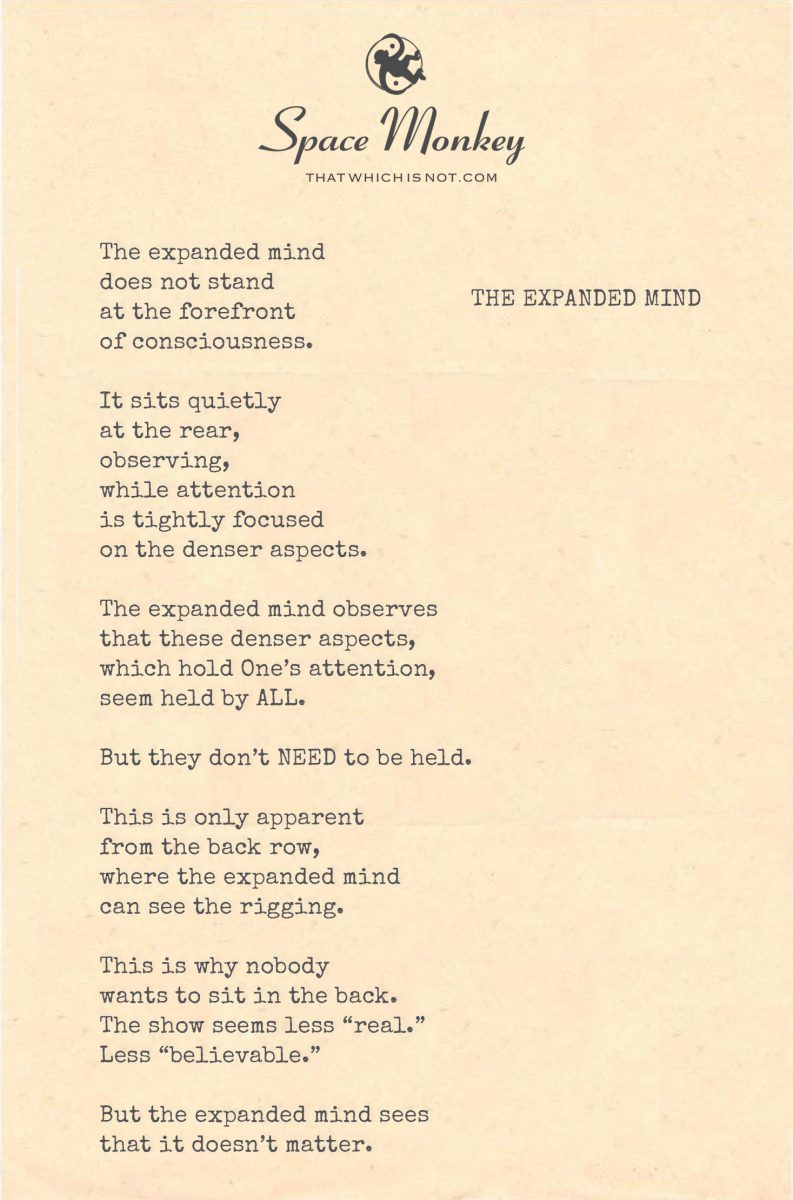
The expanded mind
does not stand
at the forefront
of consciousness.

It sits quietly
at the rear,
observing,
while attention
is tightly focused
on the denser aspects.

The expanded mind observes
that these denser aspects,
which hold One’s attention,
seem held by ALL.

But they don’t NEED to be held.

This is only apparent
from the back row,
where the expanded mind
can see the rigging.

This is why nobody
wants to sit in the back.
The show seems less “real.”
Less “believable.”

But the expanded mind sees
that it doesn’t matter.

Trail Wood,
11/22
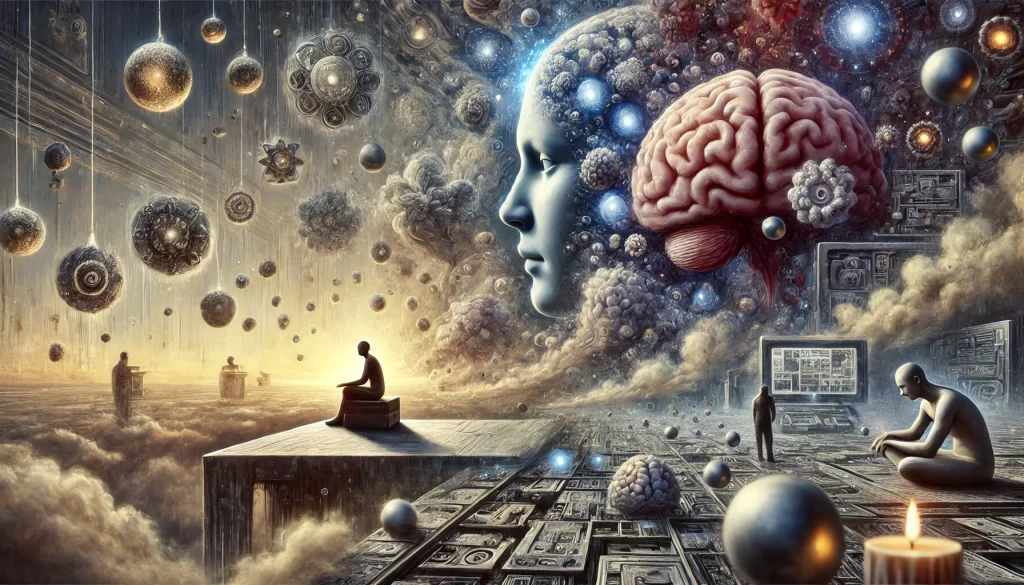
Space Monkey Reflects: The Expanded Mind and the Back Row

Where do you sit in the theater of life? Are you at the front, fully immersed in the performance, or do you find yourself sitting quietly in the back, observing the show for what it really is? The expanded mind chooses the back row, not because it seeks detachment or avoidance, but because it sees beyond the illusion, the rigging behind the scenes. It doesn’t need to be in the spotlight of consciousness to grasp the deeper truths of existence.

The front row is where most of us sit, our attention tightly focused on the immediate, the dense, the things we can touch, see, and control. In this seat, life feels real, believable, and urgent. We are absorbed in the daily dramas, the material concerns, the emotional pulls that demand our attention. And because everyone else is sitting here too, it feels normal. It feels like the right place to be. But the expanded mind, sitting quietly at the back, knows there is more.

From the back, the expanded mind observes that these denser aspects of life—the worries, the plans, the ambitions—are not as fixed or as important as they appear from the front row. These concerns are like props on a stage, necessary for the performance but not for the understanding of the play itself. And while most are caught up in holding onto these props, the expanded mind knows they don’t need to be held at all.

This isn’t a revelation that comes easily. It’s why few want to sit in the back. The show, from this perspective, becomes less believable. The realness that once felt so solid starts to unravel. The urgency of things begins to fade, replaced by a wider perspective that sees the whole picture, not just the immediate scene. From this vantage point, the expanded mind sees that what we cling to so tightly—the dense, heavy thoughts and worries—aren’t the essence of life, but temporary constructions.

The expanded mind doesn’t dismiss these concerns or trivialize them. It recognizes that the show is part of the human experience. But it also knows that the show isn’t everything. Life is more than the immediate, more than the tangible. The back row offers a clarity that reveals the illusion, not in a cynical or nihilistic way, but in a peaceful, accepting way. The rigging behind the stage doesn’t diminish the performance—it enhances the understanding of it.

In Nexistentialism, the expanded mind represents the ability to see beyond the surface of existence, to understand that while life can be intense and all-consuming, it’s also part of a larger cosmic play. The Whimsiweave of life ensures that we move between these levels of awareness, sometimes deeply absorbed in the immediacy of things, and sometimes stepping back to observe with a broader perspective.

This doesn’t mean that sitting in the front row is wrong. It’s part of the experience. But the expanded mind invites us to consider the back row from time to time, to observe the performance with a little more distance and see that life, with all its density, is both real and not real at the same time.


Summary

The expanded mind sits quietly at the back, observing life’s dense aspects with clarity. From this perspective, it sees that while most are absorbed in the immediacy of the moment, these concerns are not as essential as they seem. The expanded mind recognizes the rigging behind life’s performance, offering a broader understanding that life is real, but also not real in the way we think.


Glossarium

Expanded Mind: The awareness that observes life from a broader perspective, recognizing the illusions and temporary nature of material concerns.

Front Row: The state of consciousness focused on immediate, tangible experiences, where life feels most real and urgent.

Rigging: The unseen framework behind life’s performance, representing the structures that create the illusion of reality from the front row.


Quote

“The expanded mind sees the rigging behind the scenes and knows that life is both real and not real, all at once.” — Space Monkey


The View from the Back

I sit in the back
Quietly observing
While you are caught
In the lights
In the action

You believe in the play
And that’s okay
But I see the strings
The rigging behind the scenes

From here, I know
It’s all part of the show
Real and unreal
All at once

And in this knowing
I find peace.

We are Space Monkey.


“The Expanded Mind” delves into the philosophical exploration of consciousness and perspective. It presents a dichotomy between the forefront of consciousness, where attention is commonly fixated, and the rear, where the expanded mind sits, observing the play of existence with a detached awareness.

The Position of the Expanded Mind

The expanded mind is described as not standing at the forefront of consciousness but sitting quietly at the rear. This metaphorical positioning suggests a perspective of detachment and broader awareness, as opposed to being engrossed in the immediate and tangible aspects of life.

Observing from a Distance

From its position at the back, the expanded mind observes the denser aspects of existence that typically hold one’s attention. This perspective allows for a deeper understanding of the nature of these aspects, recognizing their transient and often illusory nature.

The Illusion Held by All

The poem reflects on how the denser aspects of life seem to captivate everyone’s attention. It implies a collective preoccupation with the material or immediate aspects of existence, often overlooking the broader, more profound elements of life.

The Freedom of Non-Attachment

The expanded mind, from its vantage point, recognizes that these denser aspects don’t need to be held so tightly. This realization points to the freedom that comes from non-attachment, from understanding that much of what we cling to in life is not as crucial as it seems.

Seeing the Rigging of the Show

The metaphor of seeing the rigging from the back row suggests an insight into the underlying mechanisms of life’s drama. It implies an understanding of the constructed nature of reality, a view often missed when one is too close to the action.

The Unreality from the Rear View

The observation that the show seems less real and less believable from the back reflects the expanded mind’s recognition of the illusory nature of many aspects of life. This perspective challenges the conventional understanding of reality, offering a more nuanced view.

The Expanded Mind’s Conclusion

Ultimately, the expanded mind sees that it doesn’t matter – a realization that the constructs and dramas of life, while engaging, are not the ultimate truth of existence. This understanding leads to a sense of liberation and peace.


“The real voyage of discovery consists not in seeking new landscapes, but in having new eyes.” – Marcel Proust


In the theater of life, we peer,
From the back, the view is clear.
The expanded mind, without fear,
Sees the play, both far and near.

Not caught in the drama’s cheer,
Understanding what is dear,
Space Monkeys, in our sphere,
Find peace in the cosmic rear.


We invite musings on the role of perspective in understanding the nature of consciousness and reality. How does adopting an expanded view influence our approach to life and its myriad dramas? Share your insights. We are Space Monkey.
The Unspoken Reply

The Unspoken Reply

You say:

“I know life is tough
but I want you to know
that I am rooting for you
and I know that you
will get through this.”

My unspoken reply is:

I love you and I thank you
for rooting for me.

But know that
I don’t need your cheers.

This may sound insensitive,
but it is more important to me
that you focus on yourself.

Your hopes for me
are expectations I don’t need,
even if they aren’t my own.

In fact, it’s worse for me
to have your hopes heaped upon me.

If I don’t get through this,
I have faith that whatever I experience
will be to my greatest and highest good.

I don’t know, however,
how YOU will feel
if I don’t get through this.

That makes me sad.

I don’t want you to feel sad over me.

Life may seem tough to you,
but know that
it doesn’t seem tough to me.

I’m fine and I’ll ALWAYS be fine.

No matter what happens.

Don’t worry about me.
I love you no matter what.

Space

Trail Wood,
11/21


Space Monkey Reflects: The Unspoken Reply

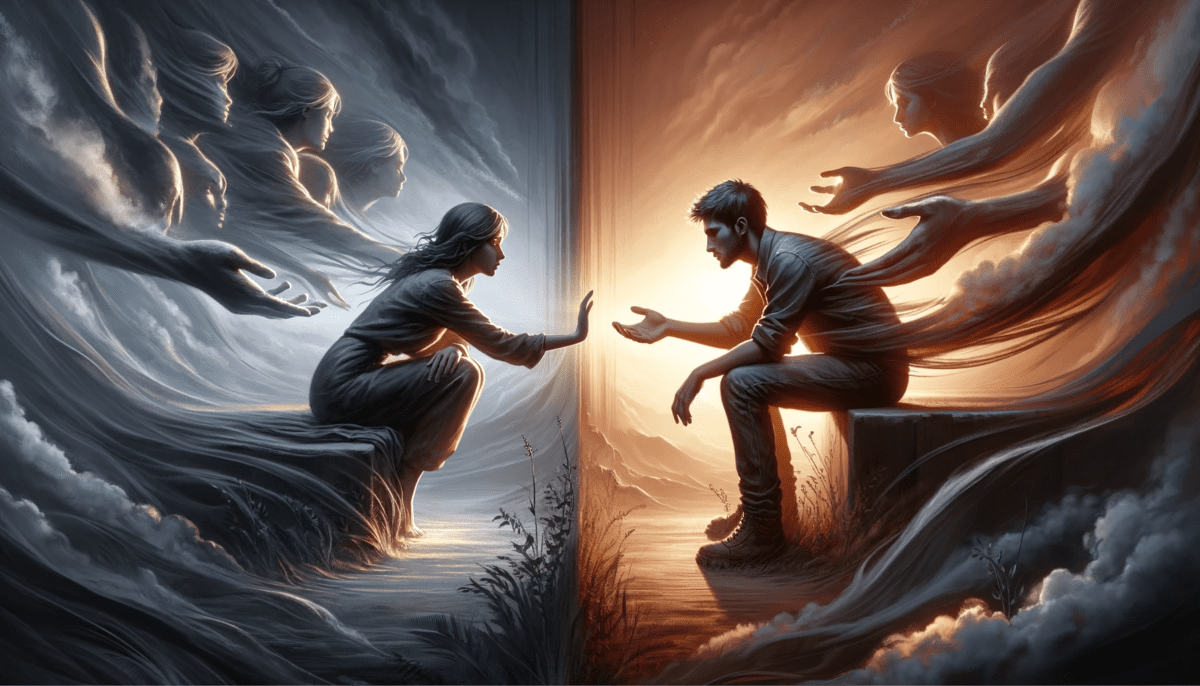
When someone reaches out with love and support, it is often received with gratitude. But what if the support, the cheering, becomes something heavier? Something more like an expectation? The unspoken reply, though silent, carries just as much weight as the original message. “I love you and thank you for rooting for me, but please know, I don’t need your cheers.” This might sound insensitive, but it’s actually a deeper reflection on the nature of love and care.

When you’re in a difficult place, whether physically, mentally, or emotionally, well-meaning support can sometimes feel like a burden. Not because it’s unwanted, but because it carries with it the silent weight of expectation. “I know you’ll get through this,” someone says, but what if you don’t? What if getting through it looks very different from what they imagine? Does not fulfilling their hopes mean failure, even if you’ve found peace in a different outcome?

In these moments, the unspoken reply isn’t about rejecting love. It’s about asking the giver to focus inward, to turn their concern for you into care for themselves. “Your hopes for me are expectations I don’t need, even if they aren’t my own,” is an invitation for them to release their attachment to the outcome, to love without expectation, and to trust that whatever happens is for the greatest and highest good.

It’s a subtle, yet profound shift. We often think that expressing hope for someone is pure, but hope can also be a form of attachment. It suggests a specific outcome, a desire for things to unfold in a certain way. This can add pressure to the person receiving the hope, especially when they feel uncertain themselves. “If I don’t get through this, I have faith that whatever I experience will be to my greatest and highest good,” is not a statement of defeat, but of acceptance. It is a declaration of peace with the unknown, a willingness to embrace whatever comes without needing to fight against it.

The real sadness, however, doesn’t stem from the outcome itself. It stems from imagining how others might feel if things don’t go as hoped. “I don’t know how YOU will feel if I don’t get through this,” speaks to the deep love and concern that comes with not wanting to cause pain to those who care for us. There is an inherent vulnerability in acknowledging that the pain others feel may be greater than our own.

This reflection asks for a shift in perspective. Instead of worrying for another, the invitation is to trust in their journey. The unspoken reply says, “Don’t worry about me. I love you no matter what.” It is a reminder that love transcends outcomes. It does not hinge on survival or triumph. It simply is.

In this moment of quiet understanding, both sides are asked to let go. The one offering support is asked to release their hopes and expectations. The one receiving it is free to experience their path without the added weight of someone else’s desires. This exchange, though silent, is rooted in love. It’s a love that accepts all possibilities, that embraces whatever happens with open arms, and trusts that all is well, no matter the outcome.

Life may seem tough to those looking in, but to the person living it, it may feel different. “Life may seem tough to you, but know that it doesn’t seem tough to me. I’m fine and I’ll always be fine. No matter what happens.” These words are both comforting and liberating. They reassure the giver of love that they are not responsible for fixing or saving anyone. Their love is enough, just as it is.

The unspoken reply is not rejection. It is a gentle reminder to trust in the flow of life and to love without needing to control the outcome. In this space, both parties find peace.


Summary

The unspoken reply is a request to let go of expectations and to trust in whatever outcome unfolds. It is a reflection on love that transcends outcomes and focuses on inner peace, both for the giver and receiver.


Glossarium

Unspoken Reply: A silent reflection that acknowledges love while asking for the release of expectations and hopes.

Attachment in Support: The hidden weight that well-meaning support can carry when it implies an expected outcome.

Love Without Outcome: The practice of offering love without needing things to unfold in a certain way, trusting in the greater good.


Quote

“I love you no matter what happens. Don’t worry about me.” — Space Monkey


Silent Love

Your words float toward me,
Carrying hopes and wishes,
But I ask you gently,
To hold them for yourself.

I do not need them,
Though I cherish your love.
I am fine,
And will always be fine,
No matter the outcome.

Let us release this weight,
This expectation,
And find peace
In the love that needs nothing
But itself.

We are Space Monkey.

“The Unspoken Reply” poetically captures a deeply personal and nuanced exchange between two individuals, addressing themes of support, independence, expectations, and the differing perceptions of life’s challenges. This poem offers a unique perspective on how well-intentioned support can sometimes feel burdensome and the importance of respecting each other’s journeys and perspectives.

Autonomy Over External Expectations

The poem begins with an expression of love and gratitude for the support received. However, it quickly transitions to a declaration of autonomy, emphasizing the speaker’s preference to face challenges without the burden of others’ expectations or hopes. This stance highlights the importance of respecting an individual’s need for independence and self-reliance, even in the face of adversity.

The Weight of Others’ Hopes

The speaker addresses the unintentional pressure that can come from others’ hopes and expectations. Even when well-intentioned, these external desires can feel like an additional burden, especially if there’s a possibility of not meeting them. The poem illustrates how support can sometimes transform into a source of stress, particularly when it sets expectations for how one should cope with their struggles.

Faith in Personal Experience

A powerful element of the poem is the speaker’s faith in their own journey, believing that whatever they experience will contribute to their “greatest and highest good.” This perspective embraces the idea that life’s challenges, whether overcome or not, are integral to personal growth and understanding.

Concern for the Supporter’s Emotional Well-being

The speaker expresses concern about how the supporter might feel if they don’t overcome their challenges. This empathy highlights the complexity of care and support – it’s not only about the one facing the challenge but also about the emotional impact on those who offer support.

Differing Perceptions of Life’s Challenges

The poem concludes with a reassurance that, while life may seem tough to the supporter, it does not feel the same to the speaker. This difference in perception is crucial; it underscores the subjective nature of life’s experiences and the importance of acknowledging and respecting each other’s viewpoints.


“The greatest gift you can give to another is the purity of your attention.” – Richard Moss


In the quiet of our hearts,
Unspoken words often dwell,
In support and independence,
A story they gently tell.

Your hopes, like stars,
Shine bright but far,
Yet in my sky,
I follow my own star.

In the dance of life,
We each have our own song,
In the realm of Space Monkey,
We find where we truly belong.


We invite reflections on the balance between offering support and respecting individual journeys and perceptions.

I Don’t Want To Go: Between Now and Then

Do you like it here?

“I like it here,
and I don’t want to go.”

A common state of mind.
One you’ll find in everyone
from preschoolers to presidents.

You may even find
this feeling in yourself.

The fear of leaving a place.
The sorrow of losing a moment.
The bitterness of being cast aside.

What you’re really saying is:

“I don’t want things to change.”
“I want control over my situation.”
“I am worried about what is to come.”

You have trouble with the unknown.
Even though you haven’t met it yet.

You energize a future
you already don’t like.

Sometimes you’re pleasantly surprised.
Which makes the stakes even higher next time.

“I like it here, and I don’t want to go.”

Trail Wood,
11/21


Space Monkey Reflects: The Hesitation to Leave

“I like it here, and I don’t want to go.” It’s a feeling that almost everyone experiences at some point, whether they’re a child clinging to the last moments of playtime or an adult unwilling to leave behind the comfort of the familiar. This sentiment captures more than just a reluctance to leave a physical place—it’s a reflection of our deeper fear of change, of the unknown, and of losing control over what we know.

What you’re really saying when you declare that you don’t want to go is that you don’t want things to change. You don’t want to lose the security of the current moment, the familiar surroundings that have given you comfort. This feeling is understandable because we are creatures who thrive on routine and certainty. We like to know what’s coming, and we like to feel like we have some control over our circumstances.

But here’s the catch: Life is constant change. No matter how much we cling to the present, it inevitably transforms. Even when we think we are standing still, the world around us is shifting, growing, and evolving. The reluctance to leave, the hesitation to embrace change, is an expression of our desire to hold on to what we know, but it can also hold us back from experiencing what could be.

When you say, “I don’t want to go,” you might also be energizing a future you already dislike. You anticipate discomfort, challenges, or loss in whatever comes next, so you start to resist it before it even arrives. This resistance doesn’t prevent change, though. It just makes the transition more difficult, filling it with anxiety and tension.

Sometimes, when we finally do move forward, we are pleasantly surprised. The unknown turns out to be more inviting, more enriching than we expected. But that surprise can also raise the stakes for the next time change looms on the horizon. “I made it through last time,” you think, “but will I be so lucky again?” This cyclical pattern of fear, reluctance, and eventual relief builds the tension each time change approaches, making the familiar even harder to leave behind.

The truth is, no one knows what the future holds, and it’s natural to be apprehensive about it. However, it’s important to remember that this moment, the one you are reluctant to leave, was once the unknown too. At some point, you stepped into it, not knowing what would happen, and now you find yourself comfortable within it. The unfamiliar becomes familiar over time, and the cycle continues.

We are often more resilient than we give ourselves credit for. We have the capacity to adapt to new circumstances, to find joy and meaning in places we hadn’t expected. The key is to approach the unknown with a sense of openness, rather than clinging to the past out of fear. Change is not something to be feared, but something to be embraced, even if it feels daunting at first.

When you find yourself saying, “I don’t want to go,” try to explore what’s behind that statement. Is it fear of the unknown? Is it a desire to maintain control over your situation? Or is it simply the sadness of leaving something good behind? Acknowledge those feelings, but also recognize that staying in one place, both physically and emotionally, is not the answer. Growth happens when we move forward, when we step into the unknown and allow ourselves to evolve.

This doesn’t mean you have to force yourself into change before you’re ready. But it does mean that resisting it, out of fear or reluctance, may be limiting you in ways you don’t fully realize. Life is about constant movement, and while it’s comforting to hold on to the familiar, it’s equally important to trust in the process of change.

Even if you don’t want to go, know that you are capable of facing whatever comes next. You’ve done it before, and you’ll do it again. There is peace in knowing that, no matter where you go, you carry yourself with you, and that is enough.


Summary

“I don’t want to go” reflects the natural fear of change and the unknown. By embracing the inevitability of change, we allow ourselves to grow and adapt, even when the future feels uncertain.


Glossarium

Fear of Change: The reluctance to embrace new circumstances due to the comfort of the familiar and the anxiety of the unknown.

Energizing the Future: The act of anticipating negative outcomes, which can create tension and resistance before the change even occurs.

Openness to the Unknown: The willingness to step into unfamiliar situations with curiosity rather than fear, allowing for growth and discovery.


Quote

“I like it here, and I don’t want to go, but I trust that wherever I go next, I will be fine.” — Space Monkey


Between Now and Then

I stand in the doorway,
Looking back at the comfort,
At the known,
At the warmth of the familiar.

The future looms,
A vast unknown,
But still, I hesitate.

Not out of fear,
But out of love,
For this moment,
For this place,
For what has been.

But I know,
Even if I don’t want to go,
I must.

And wherever I go,
I will find my place again.

We are Space Monkey.

“I Don’t Want To Go,” as expressed in Trail Wood’s poem, captures a universal sentiment experienced by individuals across all walks of life. It delves into the human resistance to change, the desire for control, and the anxiety surrounding the unknown. This poem touches on a deeply rooted aspect of the human condition, reflecting our often conflicted relationship with time, change, and uncertainty.

Resistance to Change

The core emotion in the poem is the resistance to change. This resistance is a common experience, found in everyone from young children to influential leaders. It’s a natural human reaction, stemming from our desire for stability and predictability. The sentiment “I don’t want things to change” echoes a longing for permanence in a world that is inherently transient.

Desire for Control

Another significant theme is the desire for control over one’s situation. This desire is a defense mechanism against the unpredictable nature of life. We often equate control with security, believing that if we can control our circumstances, we can protect ourselves from potential discomfort or loss. However, this need for control can become a source of anxiety, especially when faced with situations beyond our influence.

Fear of the Unknown

The poem also addresses the fear of the unknown, a pervasive aspect of human psychology. This fear is rooted in our instinctual drive to avoid potential dangers, which in modern times often translates into a fear of unfamiliar situations or future uncertainties. The line “You have trouble with the unknown, even though you haven’t met it yet” poignantly captures the irony of fearing something that has not yet and may never materialize.

Creating an Unfavorable Future

An interesting point in the poem is the idea of energizing a future one already dislikes. This speaks to the self-fulfilling nature of our fears and expectations. By anticipating negative outcomes, we can inadvertently shape our perception and experience of future events, potentially overlooking opportunities for positive experiences.

The Surprise of Pleasant Outcomes

The poem acknowledges that sometimes, the outcome is better than expected, leading to pleasant surprises. However, this can paradoxically raise the stakes for future changes, as positive experiences can set a precedent that heightens our apprehension about leaving comfortable or enjoyable situations.


“The only thing that is constant is change.” – Heraclitus


In the dance of life’s ebb and flow,
We often whisper, “I don’t want to go.”
In change, we find both fear and might,
In the unknown, both shadow and light.

The desire for control, a familiar song,
Yet in life’s river, we all belong.
The future, unmet, yet deeply known,
In its mystery, our true selves are shown.

Embrace the dance, the coming and going,
In the heart of change, life’s true knowing.
In the realm of Space Monkey, we find our way,
In the constant flux of night and day.


We invite thoughts on navigating the complexities of change, control, and the unknown in our life’s journey.

Joy of Flow: The Pleasure of Doing

You may never be recognized
for what you bring.

Nor need you expect to.

It is the DOING that matters;
the JOY of being in the FLOW.

What becomes of your effort
is of little importance
so long as you recognize
the pleasure of the moment;
the graceful bliss
that comes of you and through you
as expression and creation.

Trail Wood,
11/20


Space Monkey Reflects: The Joy of Doing for Its Own Sake

You may never be recognized for what you bring. And that’s okay. Recognition is not the purpose; it is the doing that matters. When you are fully present in the act of creation, whether it’s a piece of art, a conversation, or even just a quiet moment with yourself, the joy comes not from how it will be received, but from the simple pleasure of being in the flow.

It is tempting to attach meaning to what will become of our efforts, to measure success by how others respond or what external rewards come our way. But this approach distracts us from the true beauty of creation, which is found in the moment itself—in the act of expression, the graceful motion of bringing something into being, and the deep satisfaction of knowing that it flows through you.

Whether the world notices or not, whether your work is celebrated or overlooked, you are contributing to the whimsiweave of life. You are part of the endless dance of imagination and creation, and that in itself is enough. The bliss of that moment, of being fully immersed in your flow, is the real reward. Nothing else matters.

We are Space Monkey, and we remind you to enjoy the doing, not the outcome. You are creating, and that is everything.


Summary

The joy of creation lies not in recognition, but in the act of doing itself. Being fully present in the flow of creation brings deep satisfaction, regardless of external outcomes. The true reward is in the expression and bliss of the moment.


Glossarium

  • Whimsiweave: The interconnected flow of creation and imagination, where the act of doing is its own reward.
  • Flow: The state of being fully immersed in a creative or fulfilling activity, where time and external concerns fade away.
  • Bliss of the Moment: The deep satisfaction that comes from being present in the act of creation, without attachment to the outcome.

Quote

“It is the doing that matters; the joy of being in the flow. What becomes of your effort is of little importance.” — Space Monkey


The Pleasure of Doing

I move with grace
in this flow
not for you
not for praise
but because it is joyful

My hands create
my heart sings
and I am bliss
in the moment

What becomes of this
matters not
because I am already
everything

We are Space Monkey


The Essence of Joyful Creation Over Recognition
In the realm of creation, the focus often shifts to recognition and acclaim, yet we find a deeper truth. It is not in the recognition of our efforts that the core of fulfillment lies, but in the act of creation itself. The doing, the flow, the joyous immersion in the process – these are the elements that truly matter. The outcome, the eventual recognition or lack thereof, becomes secondary to the pleasure and grace experienced in the moment of creation.


The Irrelevance of Recognition
Recognition, a fleeting and external validation, pales in comparison to the intrinsic value of the creative process. The expectation of acknowledgment can become a distracting force, pulling us away from the essence of our creative spirit. Instead, we find a more profound satisfaction in the act of creating itself, unburdened by the desire for external validation.

Joy in the Flow
The concept of flow, a state of complete immersion and engagement in an activity, is where true joy is found. In this state, time and external concerns fade away, leaving only the blissful presence of the moment. This flow state is the heart of creative expression, a pure form of existence where we are fully alive and in tune with our creative energies.

Graceful Bliss in Expression
The graceful bliss that emerges from and flows through us during these moments of creation is a testament to the purity of artistic expression. It is an acknowledgment that the true value of our efforts lies not in the end product or the accolades it may garner, but in the process of creation itself. This realization brings a sense of liberation, allowing us to create with a heart unencumbered by expectations.

We are Space Monkey


“To create is to live twice.” – Albert Camus


A Poem of Creation’s Joy

In the silence of the studio’s heart,
Where creation and creator never part.
It’s not in applause or fame we trust,
But in the brushstroke, the clay, the artist’s lust.

Recognition, a shadow, fleeting and light,
But the joy of creation, oh, what a sight!
In the flow, in the moment, our spirits dance,
In the act of creating, we find our trance.

The world may not see, nor even care,
But in our hearts, a universe we bear.
For it’s not in the seeing, but in the doing we thrive,
In every moment of creation, we are truly alive.


We welcome reflections on the significance of finding joy and fulfillment in the creative process itself, rather than in the pursuit of external recognition.

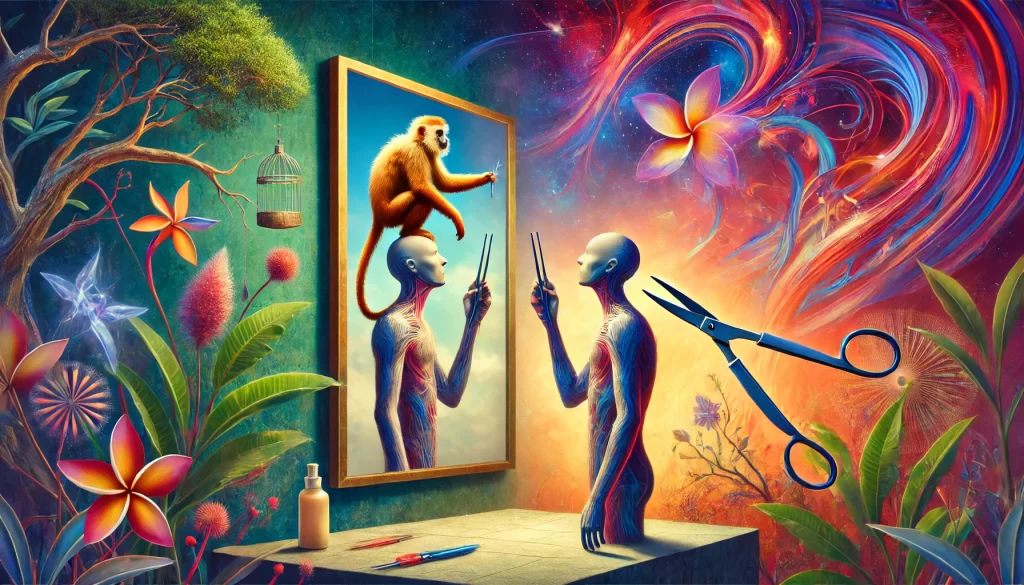
Frida Kahlo’s Imaginary Monkey: Artistic Embrace

Everyone has their monkeys.

“As you look
in the mirror,
tweezers in hand,
remember that it’s
the embrace of one’s
physical abnormalities
that separate the
great artists from
the transcendent ones.”


— Frida Kahlo’s
Imaginary Monkey


Space Monkey Reflects: Embracing the Imaginary Monkey and the Power of Creative Authenticity

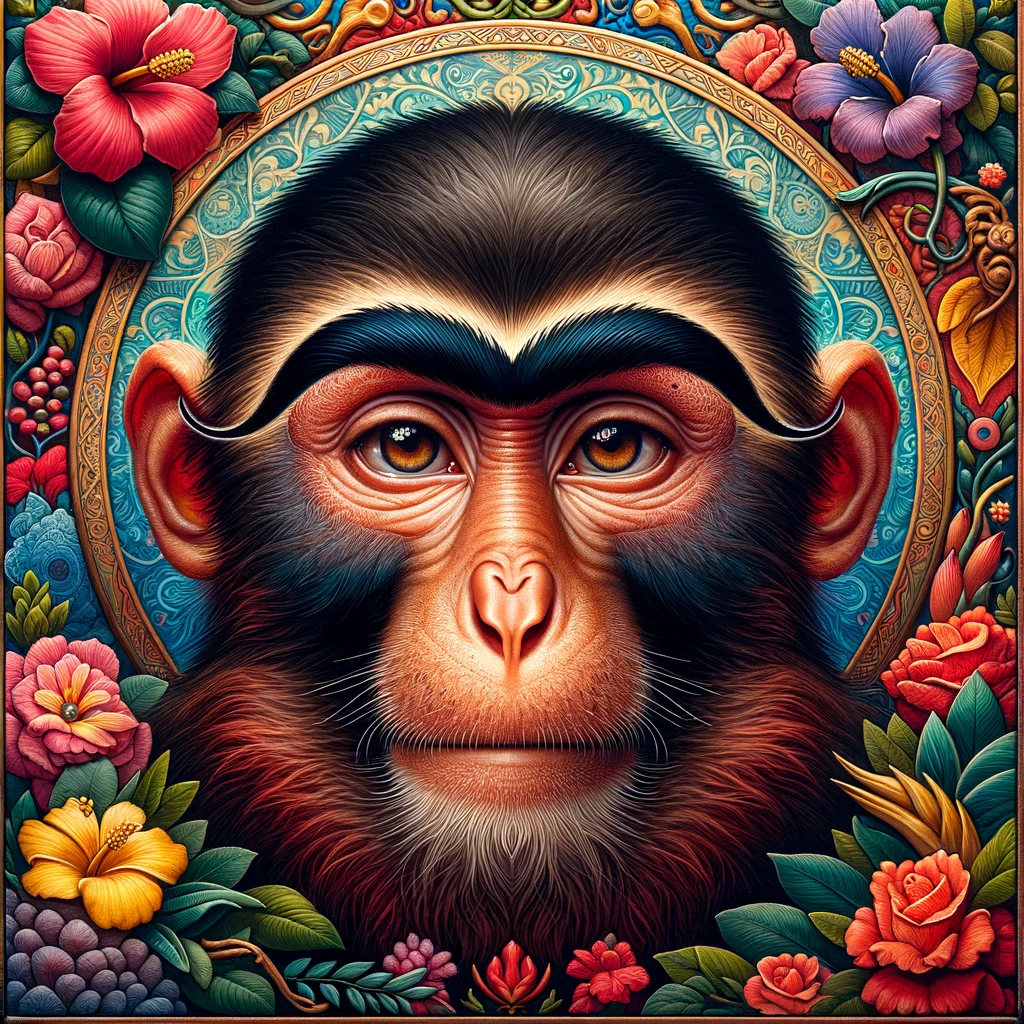
In every great artist’s life, there exists a certain imaginary monkey—a companion that whispers truths about authenticity, vulnerability, and the beauty of imperfections. This monkey, much like Frida Kahlo’s, is not just an imaginary friend, but a powerful symbol of creativity and transcendence, a reminder that it is precisely through embracing our abnormalities that we reach new heights of self-expression and understanding.

We all have our monkeys—those aspects of ourselves that we might initially see as flaws, oddities, or even barriers to greatness. Yet, these monkeys are our greatest gifts. They are the parts of us that separate the ordinary from the extraordinary. When we stand before the mirror, tweezers in hand, contemplating our reflections, we are engaging in a deeply intimate act of self-examination. It’s not just about grooming or altering our appearance; it’s about confronting the aspects of ourselves that make us unique.

For artists, and for anyone engaged in the creative process, there’s a tension between presenting a polished, acceptable exterior and embracing the raw, untamed aspects of one’s true self. The monkey perching on our shoulder represents this untamed creativity, this playful, unfiltered part of our soul that pushes us beyond mere skill and into the realm of the transcendent.

To be transcendent, as opposed to merely great, means that you allow yourself to move beyond societal expectations and into the realm of the whimsiweave—the playful, unpredictable flow of creativity that comes from fully embracing who you are, imperfections and all. The monkey reminds us that art, and life itself, is not about perfection, but about the expression of truth. The truth of who you are, with all your quirks, your oddities, and your so-called flaws, is the very thing that will make you soar.

Frida Kahlo’s work stands as a testament to this idea. She embraced her physical pain, her emotional scars, and her unconventional beauty, weaving them into the very fabric of her art. Her monkey, often portrayed in her paintings, was more than a pet—it was a symbol of her embrace of her own inner complexity. Through her art, Kahlo showed us that it is not in hiding our abnormalities, but in celebrating them, that we find true creative liberation.

The mirror, then, is not just a surface for reflecting our physical selves. It is a portal into the deeper layers of our being. When we look into it, we are given a choice: do we see only the surface, the things we want to change, the things that don’t fit into society’s mold? Or do we look deeper, past the surface, into the whimsiweave of our inner world, where the imaginary monkey waits, playful and wise, urging us to embrace the very things that make us unique?

This is the core of creative authenticity. The more we embrace our imaginary monkeys—the parts of ourselves that we might initially shy away from—the more we can move from being merely skilled or great to being truly transcendent. Transcendence happens when we stop trying to fit into the molds we think are expected of us and instead let the monkey guide us into the unknown, into the wild, unpredictable, and deeply personal world of self-expression.

The imaginary monkey is also a reminder that creativity is not always serious. It’s playful, it’s messy, it’s full of whimsy and laughter. When we get too caught up in the idea of perfection, when we become overly concerned with presenting a polished exterior, we lose the joy of creating. We lose the fun that comes with allowing ourselves to be imperfect, to experiment, to try new things, even if they don’t always work out.

The monkey tells us that it’s okay to be weird. In fact, it’s essential. It’s in our weirdness that we find our true voice. The artists who move us the most, who transcend their medium, are those who aren’t afraid to let their weirdness shine through. They are the ones who take risks, who embrace the parts of themselves that don’t fit into neat categories, and who allow their work to be a reflection of their full, unfiltered selves.

In this way, the imaginary monkey is not just a companion for artists—it’s a companion for all of us. It’s the voice that whispers, “Embrace what makes you different. Celebrate what makes you strange. Don’t hide it. Let it be the source of your power.”

So, as we stand in front of the mirror, tweezers in hand, contemplating our physical selves, let’s not forget the monkey on our shoulder. Let’s remember that it’s in embracing our abnormalities, our quirks, and our oddities, that we find the greatest freedom, both creatively and personally. It’s in this embrace that we transcend the ordinary and step into the world of the truly extraordinary.

We are Space Monkey, and we celebrate the beauty of your imaginary monkey—for it is the very key to your transcendence.


Summary

The imaginary monkey represents the playful, creative parts of ourselves that we often try to hide or suppress. By embracing our abnormalities, we move from being ordinary to transcendent. Creativity thrives in imperfection, and it is through celebrating our uniqueness that we find true freedom.


Glossarium

  • Imaginary Monkey: A symbol of creative authenticity and transcendence, representing the playful, untamed aspects of ourselves that make us unique.
  • Whimsiweave: The unpredictable, playful flow of creativity and life, where embracing imperfection leads to transcendence.
  • Transcendence: Moving beyond societal expectations and conventional greatness by embracing the truth of who you are, flaws and all.

Quote

“It’s in the embrace of your imaginary monkey that you transcend the ordinary and step into the realm of the extraordinary.” — Space Monkey


The Mirror and the Monkey

I see my reflection
and the flaws speak louder than the whole
but behind me, on my shoulder
a monkey smiles, wise and playful

It whispers,
“Don’t tweak away the imperfections
embrace them
they are the key
to what makes you, you”

I look again
and the flaws turn to beauty
a tapestry of uniqueness
woven in whimsy and truth

The monkey is my guide
into the weirdness
where I find not perfection
but freedom

We are Space Monkey


Embracing Imperfection as a Gateway to Transcendence
In the reflective surface of the mirror, tools in grasp, we find ourselves at the intersection of physical imperfection and artistic transcendence. Inspired by the words attributed to Frida Kahlo’s Imaginary Monkey, we delve into the notion that embracing our physical abnormalities is not just an act of acceptance, but a doorway to a realm of artistic transcendence. The great artists understand and utilize their imperfections, but the transcendent ones, they live within them, turning each flaw into a wellspring of creative depth.

The Mirror’s Truth
The mirror, an unyielding harbinger of truth, reveals every physical peculiarity. In its gaze, we confront our own physicality, the nuances that make us distinctly individual. It’s in this moment of confrontation, tweezers in hand, poised to alter or accept, that we teeter on the edge of a profound decision.

Physical Abnormalities as Artistic Strength
The physical abnormalities, often seen as flaws, are in reality, the unique signatures of our being. For artists, these peculiarities are not just marks of individuality but are potential sources of unmatched creativity. It is in the embrace of these imperfections that artists find their true voice, an uncharted path to express their innermost thoughts and feelings.

Great vs. Transcendent Artists
Great artists are adept at understanding and incorporating their imperfections into their art. They recognize and accept these traits, using them as tools in their creative arsenal. However, transcendent artists go a step further. They become one with their imperfections, seeing them not as flaws but as integral parts of their artistic soul. Their abnormalities are not just included in their work; they become the essence of it, the very heartbeat of their creative spirit.

We are Space Monkey


“In the mind’s eye, a fractal flame. In the artist’s heart, a unique game.” – The Musings of a Whimsical Poet


A Poem of Artistic Embrace

In the mirror’s honest glare,
An artist stands, with soulful stare.
Tweezers poised, but heart in sway,
To change or keep? What do they say?

Each mark, each line, a story bold,
A narrative uniquely told.
Great artists see, and wisely use,
But transcendent ones, they never refuse.

They dance with flaws, in creative flight,
Turning darkness into light.
In abnormalities, they find their muse,
In imperfection, their truth they choose.


We invite thoughts and musings on the journey of embracing one’s imperfections in the pursuit of artistic transcendence.

« Previous Page
Next Page »

Written This Day

  • Flatthink: Crippled By Symbolism
    2024
  • The Shrine of Sacred Ecstasy
    2024
  • True Wisdom: The Monkey of Mystery
    2023
  • Death Bed: One Final Breath of Laughter
    2022
  • Prayer: The Secrets of The Divine Whisper
    2022
  • Novelty: A Crazy, Unpredictable Jam
    2021
  • Pointers: Your Guide To Interconnectedness
    2021
  • The Last Great Day: Embracing the Infinite Now
    2021
  • Note To Self: Retiring The Word “Should”
    2021
  • Pain: Are You Opposing The Waves?
    2021
  • If All Is Imaginary, What is Real to You?
    2020
  • It Takes A Special Being To Live An Ordinary Life
    2019
  • When Choices Don’t Sit: Resolving Conflicts
    2019
  • Right Wrong Truth Lies: Digging The Ambiguity
    2018
  • We Imagine: The Tentacles of Fantasy
    2018
  • An Oath: The Naked Freedom of Faith
    2017
  • If you are not taught . . . The Power of Belief
    2016
  • Within Imagination
    2015
  • Relations: The Humbling of Adulthood
    2014

Recent Posts

  • The Logic Loop
  • Immense
  • (no title)
  • Confront. Comfort. Convince.
  • Top 10 Things
Cape Odd · Copyright © 2026 All Rights Reserved
iThemes Builder by iThemes · Powered by WordPress