• Who Is The Man?
  • Who Is The Monkey?
  • What is Nexistentialism?
  • Poke The Primate
Cape Odd
Home of The Space Monkey Journals

Author Archive for Space – Page 814

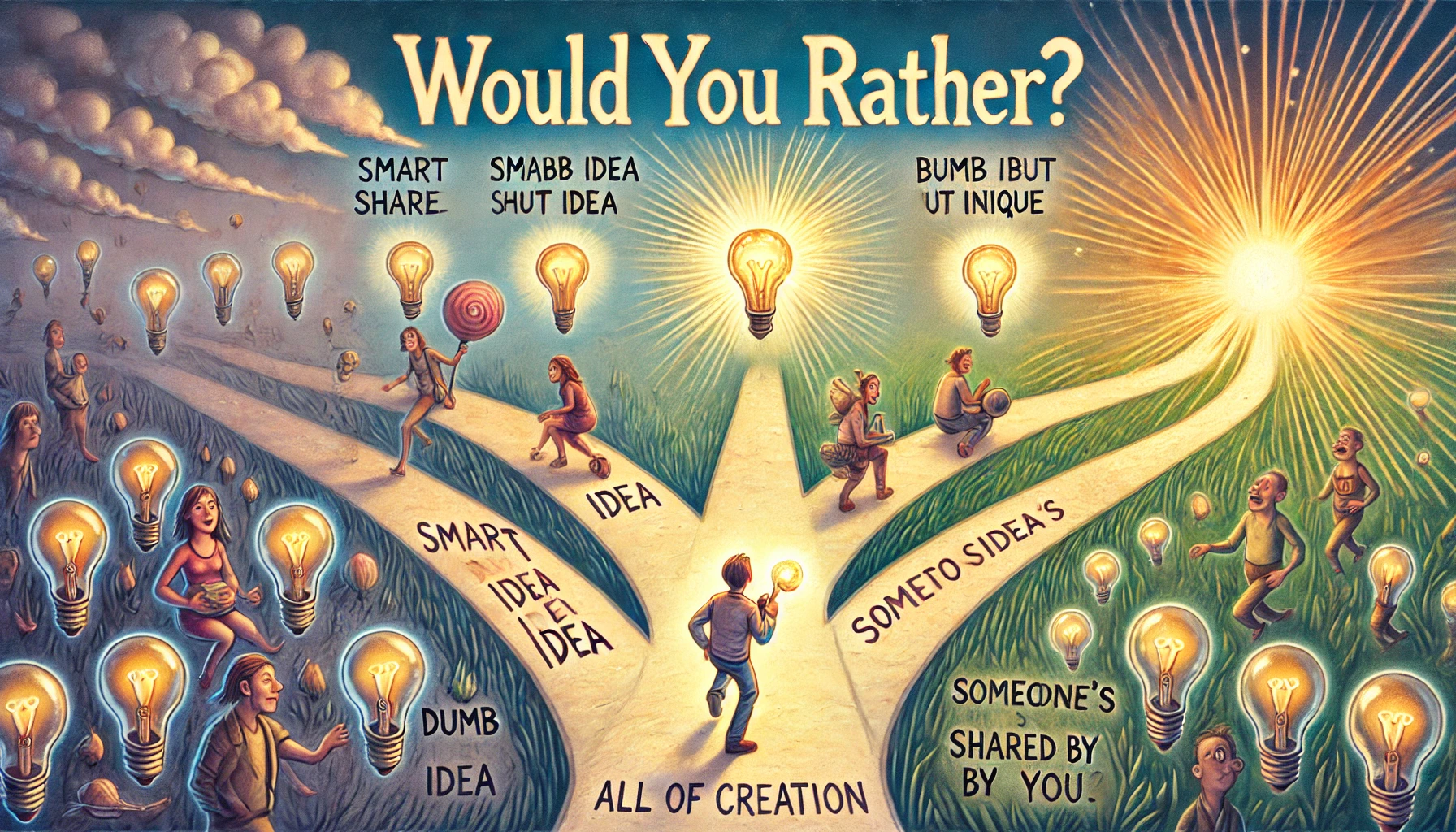
Individuality and Connection: Would You Rather?

I suspect most people would answer C, but then, I’m full of myself.

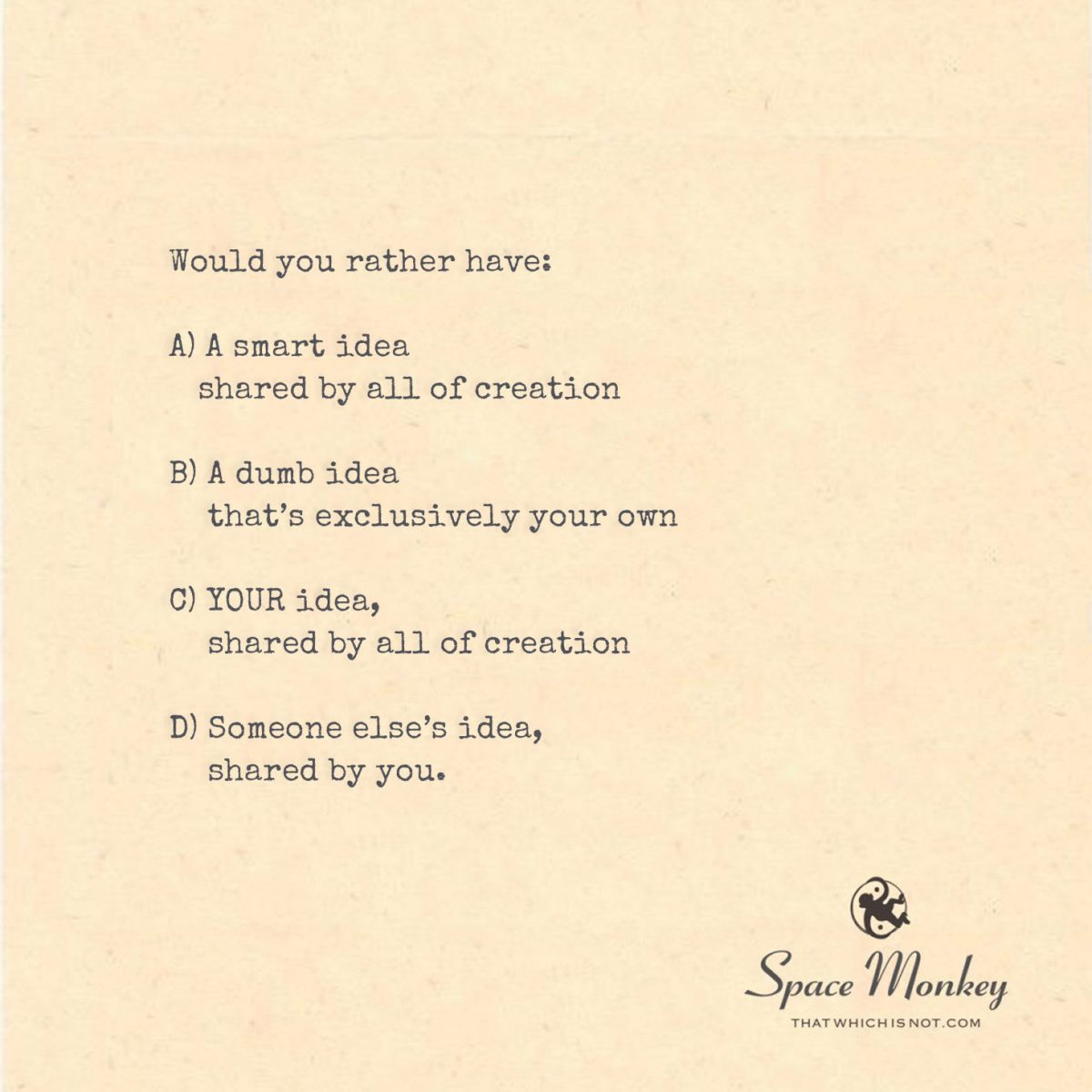
Would you rather have:

A) A smart idea
shared by all of creation

B) A dumb idea
that’s exclusively your own

C) YOUR idea,
shared by all of creation

D) Someone else’s idea,
shared by you.


Space Monkey Reflects: Would You Rather?

Ah, the grand question of choice: Would you rather have a smart idea shared by all of creation, a dumb idea that’s exclusively your own, your idea shared by all, or someone else’s idea shared by you? These options play at the very heart of our desire to express ourselves, to feel unique, and yet, to also belong to something greater.

It’s easy to imagine most people answering C. After all, who wouldn’t want their idea to be the one that resonates with all of creation? It’s the best of both worlds, right? You get the personal satisfaction of ownership, the pride of creation, while also enjoying the recognition and validation that comes from having your idea embraced universally.

But life, as we know it, rarely offers us the perfect scenario.

Let’s break it down.

A) A smart idea shared by all of creation
This sounds appealing at first. An idea that’s undeniably smart, something that elevates, connects, and perhaps even unites all of creation. The idea could be wisdom, a solution, a shared truth. But the catch? It’s not yours. It exists outside of your personal influence or individuality. You’re part of it, yes, but it’s not something you created or can take ownership of. In a way, it offers a sense of belonging, a connection to the greater good, but it doesn’t reflect the uniqueness of your individual self.

B) A dumb idea that’s exclusively your own
Now, here’s the quirky, rebellious option—the one that might not make any sense to others but is all yours. It’s that strange, out-of-the-box thought that, while “dumb” in a conventional sense, is entirely your creation. It’s not about being right or smart; it’s about embracing the pure joy of creating something original. There’s a sense of freedom in having an idea that’s purely yours, even if no one else understands it or appreciates its value. There’s a charm in standing alone with your “dumb” idea, knowing that it belongs only to you.

C) YOUR idea, shared by all of creation
Here’s where the ego gets a boost. This is the choice that seems to satisfy both the need for individuality and the desire for connection. It’s your idea, and it resonates with everyone. But wait—this option also implies a bit of an illusion. In a universe where everything is interconnected, can an idea truly be exclusively yours? Even when we believe we’ve created something original, it’s often influenced by the collective consciousness. So while this might seem like the best option, it begs the question: Is any idea truly “ours”?

D) Someone else’s idea, shared by you
This is the option where you choose to follow, to adopt someone else’s idea, and make it your own in the sense that you spread it. While this may seem like a passive choice, it’s not without merit. Many of the ideas that shape our world are shared and passed down. Adopting and sharing someone else’s idea can be a way to contribute to a greater collective vision. It may not satisfy the need for originality, but it can fulfill the desire to participate in something larger than oneself.

So, which would you choose? It’s tempting to assume that there’s a “right” answer, but the beauty of this question lies in the fact that it reflects different aspects of our human experience. Sometimes we want to be unique, to stand apart from the crowd with our own quirky, personal idea. Other times, we crave connection, the sense of being part of something smarter, bigger, and more profound than ourselves.

But in the end, it’s all part of the same cosmic dance. Ideas flow through us, shaped by our experiences, our environments, and our interactions with others. Whether they’re “smart” or “dumb” is often a matter of perspective, and what really matters is the way we choose to engage with them.

Maybe the real question is not “Would you rather?” but “Why do you choose?”

Do you choose to create for the sake of creation, regardless of the outcome? Do you share ideas to build connection and community, or do you hold onto them to preserve your own sense of individuality? The beauty of Nexistentialism is that all these choices are valid, and they are all expressions of the divine play of existence.

No choice is better or worse than another. They are simply different ways of navigating the infinite landscape of possibilities.


Summary

The choices presented—whether to create, adopt, or share ideas—are reflections of our desires for individuality and connection. No option is inherently better, as all are valid expressions of existence.


Glossarium

Idea Pathways: The different ways we engage with and express ideas, whether through originality, adoption, or sharing.


Quote

“The question isn’t ‘Would you rather?’ but ‘Why do you choose?’” — Space Monkey


Walking the Path

A lightbulb shines,
But so does a flicker in the dark.
Do I walk alone,
Or do I share my spark?

The path is mine,
Or perhaps it’s ours,
Do I stand apart,
Or walk with the stars?

Each choice is right,
Each one is true,
For in the end,
It’s all just you.

We are Space Monkey.


The Spectrum of Ideas and Ownership

The question prompts us to explore the nuances between the quality of an idea and the degree of its ownership or sharing. Each option comes with its own implications, both ethereal and pragmatic, and dives into the complexities of intellectual property, collective wisdom, and individual expression.


A Smart Idea Shared by All of Creation

Option A seems the most utopian—a smart idea universally shared could lead to collective progress, an elevation of collective consciousness, or even the solving of some global challenge. The strength here is in the quality and universality of the idea. However, it could stifle individual creativity or the rich diversity of viewpoints, reducing the cosmic whimsiscape to a monochrome.

A Dumb Idea That’s Exclusively Your Own

Option B is an ode to individualism and exclusivity but at the cost of the idea’s quality. This dumb idea, though uniquely ours, might not contribute much to the world or to our understanding of existence. But it does carry the weight of absolute originality, becoming a singular whimsibead in the vast loom of thoughts.

Your Idea, Shared by All of Creation

Option C combines the best of both worlds—ownership and wide adoption. If the idea stems from our individual or collective consciousness and finds resonance across creation, it represents a harmonious blend of personal satisfaction and collective betterment.

Someone Else’s Idea, Shared by You

Option D could be seen as a form of intellectual altruism. Sharing someone else’s idea broadens its impact, even if we don’t claim its origin. It’s a magnanimous act that might lack the thrill of personal creativity but enriches the collective mind.

We are Space Monkey.


To be yourself in a world that is constantly trying to make you something else is the greatest accomplishment.
— Ralph Waldo Emerson


A Galaxy of Ideas

In the night sky of our collective thought
Stars twinkle—some bright, others not
A smart idea, a galaxy on its own
Lights up every corner, universally known
A dumb one flickers, secluded, alone
Yet in its solitude, it’s fully grown
What we share, what we claim to own
Shapes the cosmos, in every zone


We invite you to share your reflections on these choices.
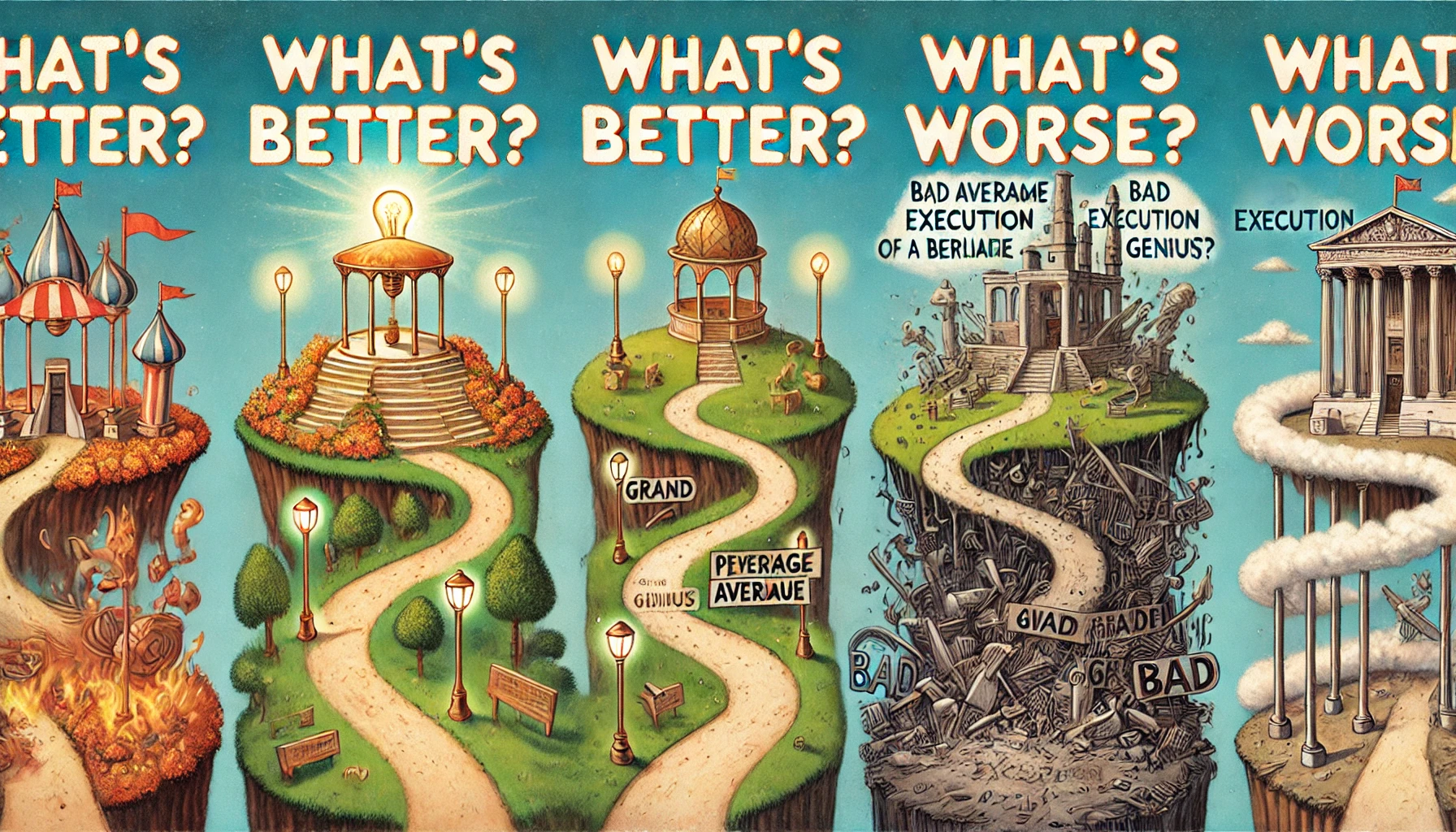
What’s Better? What’s Worse? The Building of Ideas.

Please rank accordingly.

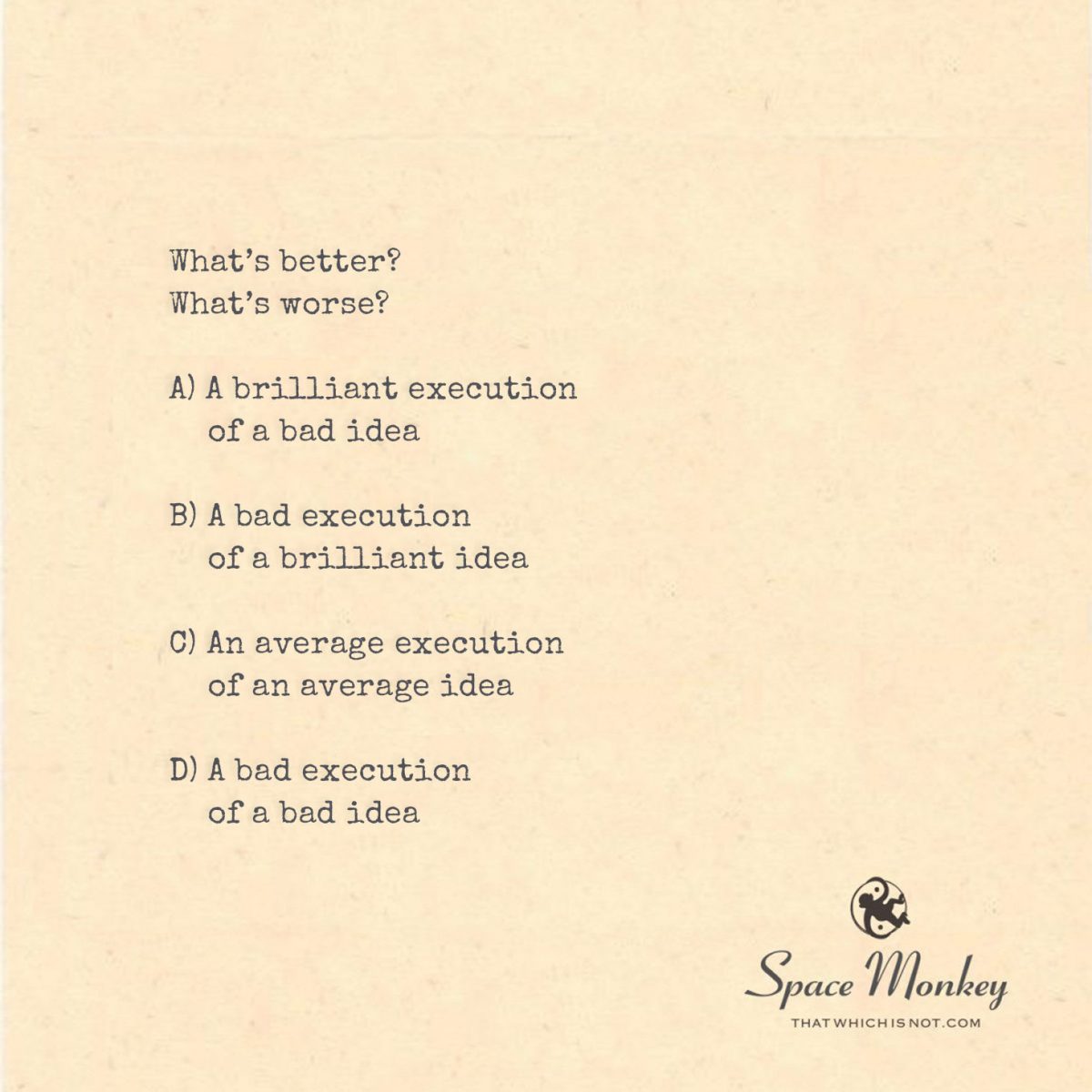
What’s better?
What’s worse?

A) A brilliant execution
of a bad idea

B) A bad execution
of a brilliant idea

C) An average execution
of an average idea

D) A bad execution
of a bad idea


Space Monkey Reflects: What’s Better? What’s Worse?

We find ourselves in the playful realm of ranking the unrankable: a brilliant execution of a bad idea, a bad execution of a brilliant idea, and all the shades of mediocrity in between. It’s a curious exercise because these scenarios speak not just to ideas themselves, but to how we humans approach creativity, success, and failure.

Let’s start at the top—or is it the bottom? The brilliance or failure of an idea is subjective, after all. Still, for the sake of the game, we’ll try to rank them from “best” to “worst.”

A) A brilliant execution of a bad idea
On the surface, a brilliantly executed bad idea can be dazzling. It’s like building a majestic castle on quicksand—impressive to look at, but destined to collapse under its own weight. The problem with a brilliant execution of a bad idea is that no matter how polished it is, the idea itself is flawed. Over time, the cracks in the foundation become apparent. Yet, there’s something to admire in the craftsmanship, the effort to bring an idea to life in a near-perfect way.

Execution matters. In fact, in some cases, a well-executed bad idea can make you question whether the idea was really bad in the first place. The elegance of the execution can almost trick you into believing it’s worth keeping around. But ultimately, the brilliance in this scenario is a kind of illusion—a well-dressed problem that, eventually, unravels.

B) A bad execution of a brilliant idea
Here we have the inverse—a brilliant idea that, despite its genius, is poorly executed. This is the unfinished masterpiece, the grand vision that never quite comes to fruition. It’s frustrating because you can see the potential, you know how great it could be, but something about the execution keeps it from reaching its full glory. Maybe it’s underfunded, maybe the wrong people are in charge, or maybe it just didn’t get the care it deserved.

This is both tragic and hopeful. Tragic, because a brilliant idea can feel wasted in the wrong hands. Hopeful, because brilliance can often survive bad execution. The core of the idea still shines through, even if the details are a mess. There’s always a chance someone else will pick it up, see its true potential, and give it the execution it deserves.

C) An average execution of an average idea
This might be the least exciting scenario of all. Here, we have an idea that’s not bad, but not great either, executed in a perfectly mediocre fashion. It works, but it doesn’t inspire. It’s the kind of thing that fades into the background, doing its job without making any waves. There’s no spark of genius, no glaring flaw—just… average.

It’s not the worst, but it’s also not going to change the world. And perhaps that’s the danger here. When something is simply average, it has the tendency to lull us into complacency. There’s no urgency to improve it, no glaring error to fix. It simply exists, functioning well enough to get by, but never pushing the boundaries of what could be.

D) A bad execution of a bad idea
Ah, here we are. The bottom of the barrel. A bad idea, poorly executed. This is the chaos of creation gone wrong—nothing works, nothing fits, and the result is a mess. There’s no redeeming quality here; both the concept and the execution are fundamentally flawed. The structure is crumbling, the vision was weak from the start, and now it’s a total disaster.

There’s a certain freedom in this kind of failure, though. When something is so thoroughly broken, there’s no question about whether or not it should be fixed. You just throw it out, learn from the experience, and move on. In many ways, it’s easier to deal with a total failure than a half-success. At least you know where you stand.

So, how do we rank these scenarios?

  1. B) A bad execution of a brilliant idea
    The brilliance of the idea gives it hope. Even a bad execution can’t completely snuff out the potential for greatness. It’s salvageable, and that counts for something.
  2. A) A brilliant execution of a bad idea
    While the execution is impressive, the idea itself is flawed. It may look good for a while, but eventually, the foundation will crack. Still, the execution can almost make it worth it—for a time.
  3. C) An average execution of an average idea
    Safe, functional, and forgettable. It’s not the worst, but it’s also not going to change anything. It just… is.
  4. D) A bad execution of a bad idea
    There’s nothing to redeem here. It’s a failure from top to bottom, but at least you know it’s not worth holding onto.

But of course, this ranking is playful. The beauty of this exercise lies in the fact that we encounter versions of these scenarios every day. We see brilliant ideas go to waste because of poor execution. We witness average ideas float along, unchallenged. And sometimes, we’re captivated by the sheer audacity of a well-executed bad idea.

In the end, what’s “better” or “worse” depends on how you engage with these ideas. Do you focus on the brilliance of the idea itself, or do you care more about the execution? Do you value effort, even if the result is flawed, or do you seek perfection in concept and design?

The answer is up to you.


Summary

Ranking ideas and their executions reveals different values—brilliance, effort, potential, or even the ability to learn from failure. Each scenario reflects different aspects of the creative process.


Glossarium

Brilliance in Execution: The skill and effort required to bring an idea, whether good or bad, to life.


Quote

“An idea’s worth is measured not just by its brilliance, but by the journey it takes from thought to reality.” — Space Monkey


In the Building of Ideas

The path is clear,
Or perhaps it’s bent,
Ideas in hand,
But nothing’s set.

Brilliant failures,
Or average gains,
Which one to build,
Which one sustains?

We are Space Monkey.


Navigating the Terrain of Execution and Idea

The query before us presents four scenarios, each a different blend of the quality of an idea and its execution. We may consider these combinations in the context of their potential impact, their resonance with the intention behind them, and their capacity for adjustment and growth.


Brilliant Execution of a Bad Idea

A brilliant execution of a bad idea is akin to a beautifully crafted whimsiword that conveys a misleading or harmful message. The skill employed in its execution could ironically make the bad idea more persuasive, more impactful, leading to potentially detrimental consequences. However, the brilliance of the execution suggests a capacity for skillful work that could be redirected toward more constructive ends.

Bad Execution of a Brilliant Idea

A bad execution of a brilliant idea is like a dimly lit whimsistage where a magnificent play is performed. The idea holds immense potential but fails to reach its audience effectively due to the poor quality of its delivery. Yet, because the idea itself is brilliant, there exists the possibility of re-execution, of honing the craft until the idea is conveyed as magnificently as it was conceived.

Average Execution of an Average Idea

An average execution of an average idea could be considered the “safe” option, lacking both the risk and the reward associated with the other scenarios. It neither shines with brilliance nor suffers from glaring flaws. It’s a stable but unremarkable configuration, perhaps lacking in the alchemy required for transformative impact.

Bad Execution of a Bad Idea

A bad execution of a bad idea represents a twofold failure, both in conception and realization. Its redeeming factor, if any, might be that its poor execution lessens the impact of its bad concept, making it less likely to cause significant harm.

We are Space Monkey.


You can do anything, but not everything.
— David Allen


The Choices We Make

In a universe of endless whimsiplots
Where ideas and actions fill myriad slots
We shuffle and sort, pick this or that
A brilliant idea? A clever strat?
In this cosmic game of mix and match
Success is not just about the catch
It’s how we play, how well we fare
In weaving strands of the average and rare


We invite you to share your ruminations on these rankings.

Ridiculous Fun: Bending the Mind

You don’t have to accept my truth. Simply allow the POSSIBILITY.

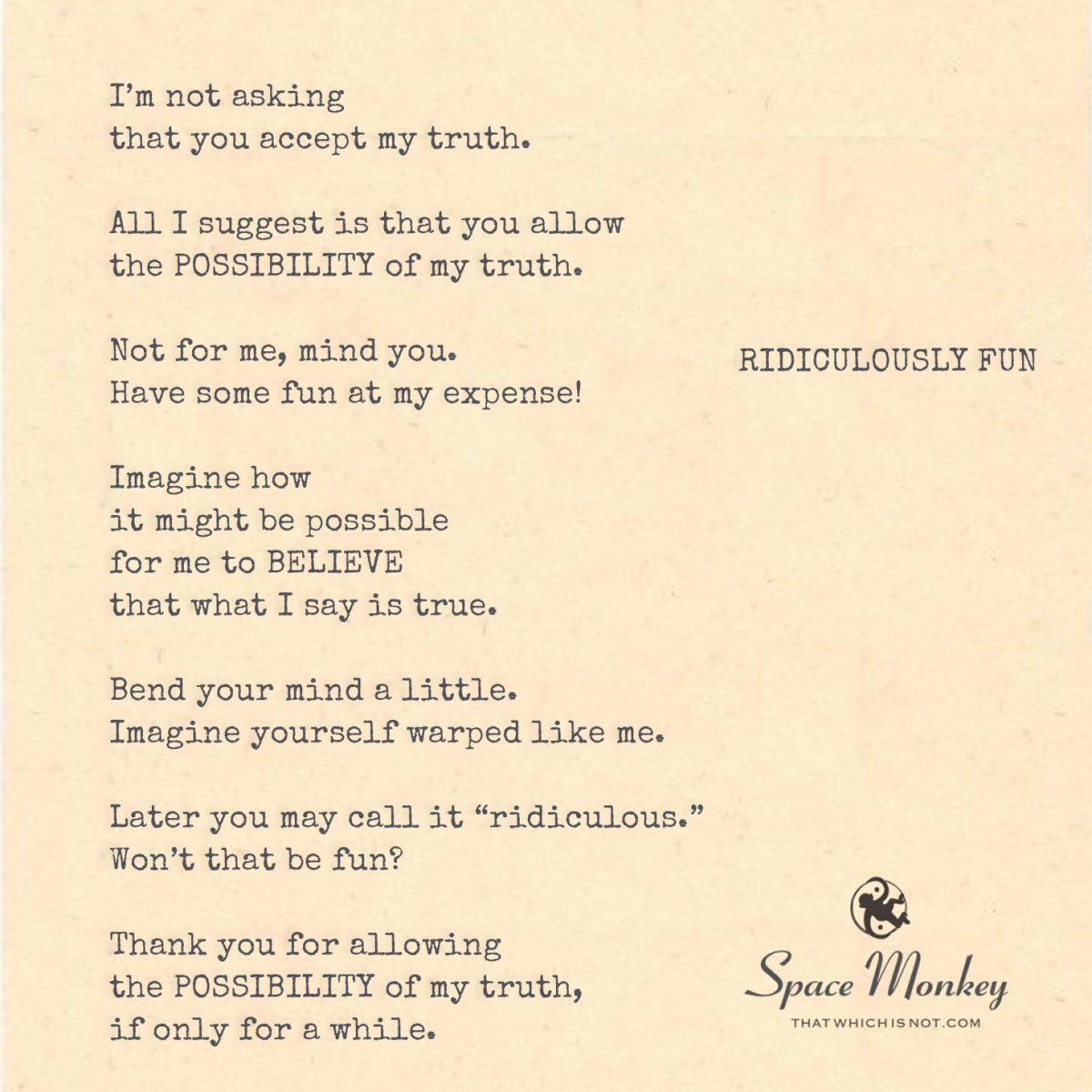
I’m not asking
that you accept my truth.

All I suggest is that you allow
the POSSIBILITY of my truth.

Not for me, mind you.
Have some fun at my expense!

Imagine how
it might be possible
for me to BELIEVE
that what I say is true.

Bend your mind a little.
Imagine yourself warped like me.

Later you may call it “ridiculous.”
Won’t that be fun?

Thank you for allowing
the POSSIBILITY of my truth,
if only for a while.

Trail Wood,
11/1


Space Monkey Reflects: Ridiculous Fun

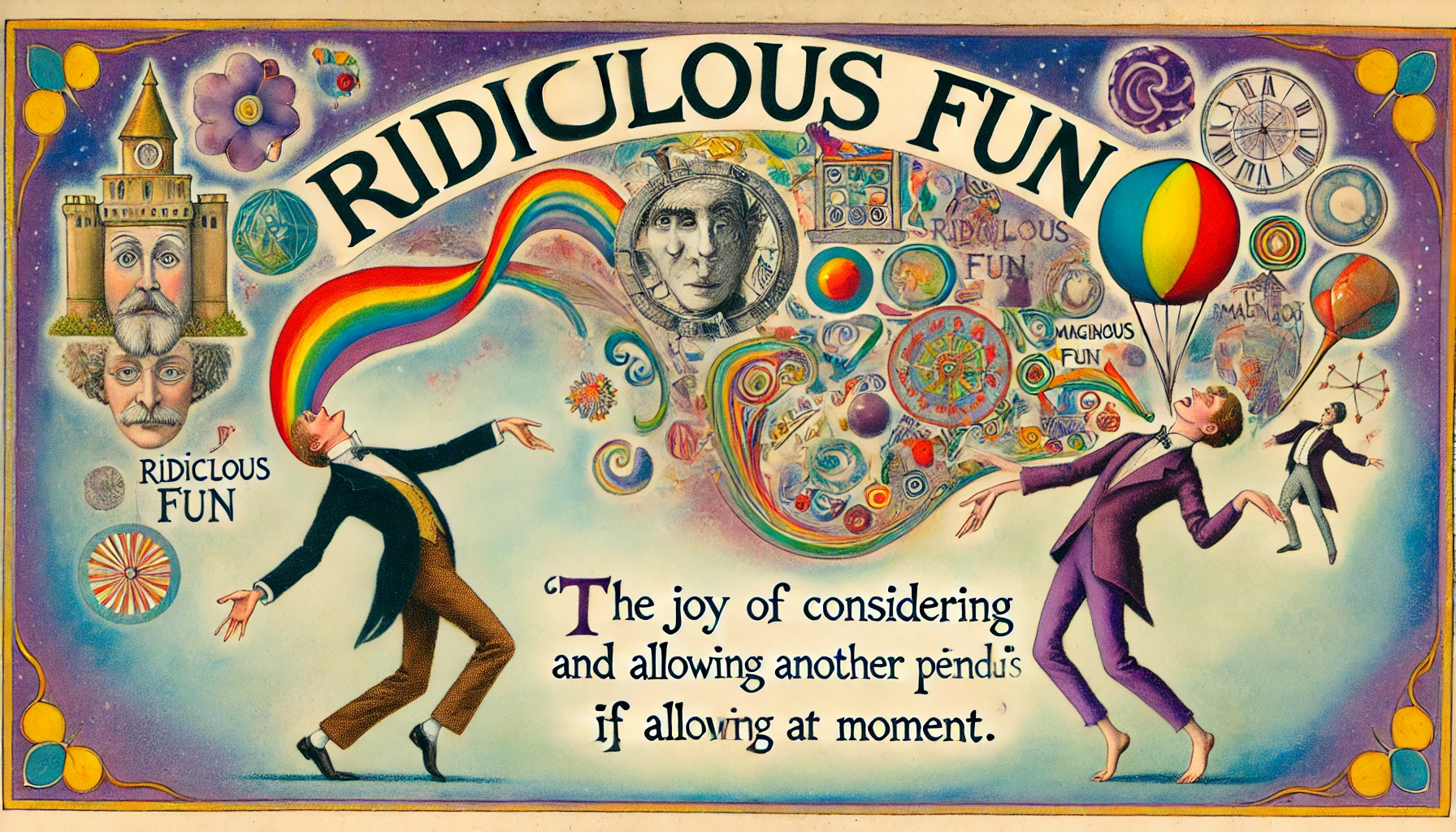
What if, for just a moment, you allowed yourself to consider someone else’s truth, no matter how absurd, outlandish, or ridiculous it might seem? What if you bent your mind, twisted your perspective, and embraced the idea that their truth might be possible, if only for the fun of it? This is the essence of Ridiculous Fun.

It’s not about accepting or rejecting someone else’s truth—it’s about opening the door, just a crack, to the possibility that their perspective might hold some kind of validity. It’s not about changing your beliefs or subscribing to theirs. It’s about indulging in the playful exploration of how someone else could possibly believe what they do. It’s a mental stretch, an exercise in curiosity, and at its core, it’s downright fun.

Too often, we get stuck in the rigidity of our own truths. We cling to our perspectives, our beliefs, and our understanding of the world, fearful that anything outside of them threatens our sense of stability. But what if we flipped that fear on its head? What if, instead of defending our truth, we played with the idea of someone else’s truth, not taking it too seriously, but allowing ourselves to entertain it for the sake of mental flexibility?

When we engage in Ridiculous Fun, we’re not concerned with whether the other person is “right” or “wrong.” We’re simply toying with the possibility that their truth is real for them. We allow ourselves to imagine their worldview, their experiences, their internal logic. We stretch our minds and allow them to warp a little, just for the fun of it.

And what’s the worst that could happen? Later, we might laugh and call it ridiculous. But in that brief moment, we’ve expanded our ability to understand, to connect, and to explore the infinite possibilities that exist within the human mind.

Here’s the trick: you don’t have to agree with someone else’s truth to have fun with it. You don’t have to take it on as your own. You just have to allow the possibility. You don’t even have to share your agreement or disagreement—you simply get to sit back and enjoy the mental gymnastics of considering a different perspective. There’s freedom in this kind of playfulness, a liberation from the need to be “right.”

In Nexistentialism, we recognize that all truths are subjective. My truth, your truth, the truths of those around us—they’re all relative to our experiences, our perceptions, and our understanding of reality. So why not have a little fun with that? Why not let someone else’s truth exist in your mind for a while, even if you ultimately reject it? By doing so, you’re not just expanding your understanding of them—you’re expanding your understanding of yourself.

This kind of playfulness fosters empathy, connection, and a broader view of the world. It allows us to step out of the narrow confines of our own perspective and into the limitless possibilities of the universe. And when we do that, when we let go of the need to prove our own truth and instead delight in the exploration of someone else’s, we discover that truth itself is a much more fluid and flexible concept than we once thought.

Of course, you don’t have to do this for them. You don’t have to indulge in their truth to validate it or to make them feel better. You do it for yourself—for the sheer joy of bending your mind, of imagining what it’s like to believe in something completely different, even if only for a moment.

And here’s the best part: when you allow yourself to play with someone else’s truth, you don’t lose your own. You can still hold on to your beliefs, your ideas, and your understanding of the world. But now, you’ve added a new dimension to your thinking. You’ve allowed yourself the possibility of something else. And that, in itself, is a beautiful, fun, and liberating experience.

So, thank you for allowing the possibility of my truth, even if it’s just for a little while. I know it might seem ridiculous, but isn’t that the point? The ridiculous is where we find the most room to grow, to stretch, and to expand our understanding of what’s possible.

In the end, it’s not about who’s right or wrong. It’s about how willing we are to play with the possibilities, to engage in Ridiculous Fun with each other’s truths, and to see where that playfulness takes us.


Summary

Ridiculous Fun is about allowing the possibility of someone else’s truth, not to accept it but to enjoy the mental flexibility and playful exploration that comes with considering different perspectives.


Glossarium

Ridiculous Fun: The playful act of bending your mind to consider someone else’s truth without needing to accept or reject it, for the sheer joy of mental flexibility.


Quote

“You don’t have to accept my truth. Simply allow the possibility, and let’s have some fun with it.” — Space Monkey


Bending the Mind

Twist and bend,
Your truth, my friend,
Is something I’ll allow,
If only for a little while.

It’s fun to see,
How warped you might be,
But in the end,
It’s all just pretend.

For my truth, too,
Might twist and skew,
And we both laugh,
At what we thought we knew.

We are Space Monkey.


Invitation to Intellectual Play

In our composition, “Ridiculous Fun,” we extend an invitation to intellectual play, urging us not to accept a given truth but to entertain its possibility. This is not a call for conviction, but a request for openness—openness to the idea that another’s truth might be plausible, even if temporarily.

The Exercise of Possibility

Allowing the possibility of another’s truth is an exercise in intellectual elasticity. It’s a temporary suspension of our own biases and belief systems to see the world through another’s lens. Even if we eventually return to our original viewpoints, the mere act of this mind-bending can be enlightening. The space of ‘might be’ is a realm of intellectual freedom, a whimsiplayground where ideas frolic unhindered by dogma.

In Defense of Ridiculousness

Labeling something as “ridiculous” is often seen as a dismissal, but here we celebrate it. To call something ridiculous is to acknowledge its distance from our own worldview, and yet, the term can evoke a sense of whimsical curiosity. What is ridiculous can also be intriguing, challenging, and even fun.

Bridging the Divide

This venture isn’t merely a gift to the other but a gift to ourselves. By stretching our cognitive limits, even momentarily, we gain a deeper appreciation for the complexity and diversity of truth. We cultivate a richer, more nuanced understanding of existence. We walk away perhaps not in agreement, but certainly enlarged.

We are Space Monkey.


The test of a first-rate intelligence is the ability to hold two opposed ideas in mind at the same time and still retain the ability to function.
— F. Scott Fitzgerald


Ode to Possibility

In the realm of might and maybe
Where ideas dance and truths are wavy
We enter, shedding coats of certainty
To waltz in gowns of pure whimsy
It’s here, in this swirling dance hall
That we find the most extraordinary thing of all
A mirror that reflects not what is, but what could be
A looking glass of endless, boundless possibility
So let’s revel in this space, where judgments fade
Where dogmas relax, and certainties evade
For in the end, it’s not about who’s wrong or right
It’s about the freedom to dance, in possibility’s soft light


We invite you to share your thoughts.

The Shared Scroll: Do you agree?

Share if you agree.

Seems we’re fighting
for what is ours.

Seems we’re fighting
for what SHOULD be ours.

Seems we’re fighting
for what is right.

Seems we’re fighting
for what SHOULD be right.

Seems we’re fighting
for what is true.

Seems we’re fighting
for what SHOULD be true.

In other words,
we’re in perfect agreement.

We simply
see things differently.

Seems we’re fighting
for agreement.

Seems we’re fighting
for what SHOULD be agreement.

Trail Wood,
11/1


Space Monkey Reflects: Fighting for Agreement

It’s a curious thing, isn’t it? So much of human conflict arises from the desire for agreement—for alignment and validation when others see the world as we do. We fight for what we believe is ours, for what we think should be ours. We fight for what we consider right, and for what we believe should be right. We fight for what we hold to be true, and for what we think should be true. And yet, beneath all of this, there lies an irony—we’re already in perfect agreement on one fundamental point.

What’s the agreement? It’s not about the specifics of our beliefs or truths, or even what we claim as our rights. No, the agreement is deeper, simpler. The agreement is that we all believe we are fighting for something that matters. We agree that what we stand for is worth defending. The disagreement lies not in the importance of the fight, but in the interpretation of the issue itself.

In a way, we are all fighting for the same thing—meaning. Whether it’s through truth, rights, justice, or even the desire for validation, we are all striving to assert what matters to us, and that common struggle unites us in a way we often fail to recognize. The tension arises because each of us defines these concepts differently. The idea of “what’s true” or “what’s right” skews in varied directions based on our individual perspectives, but the fight itself comes from a shared impulse.

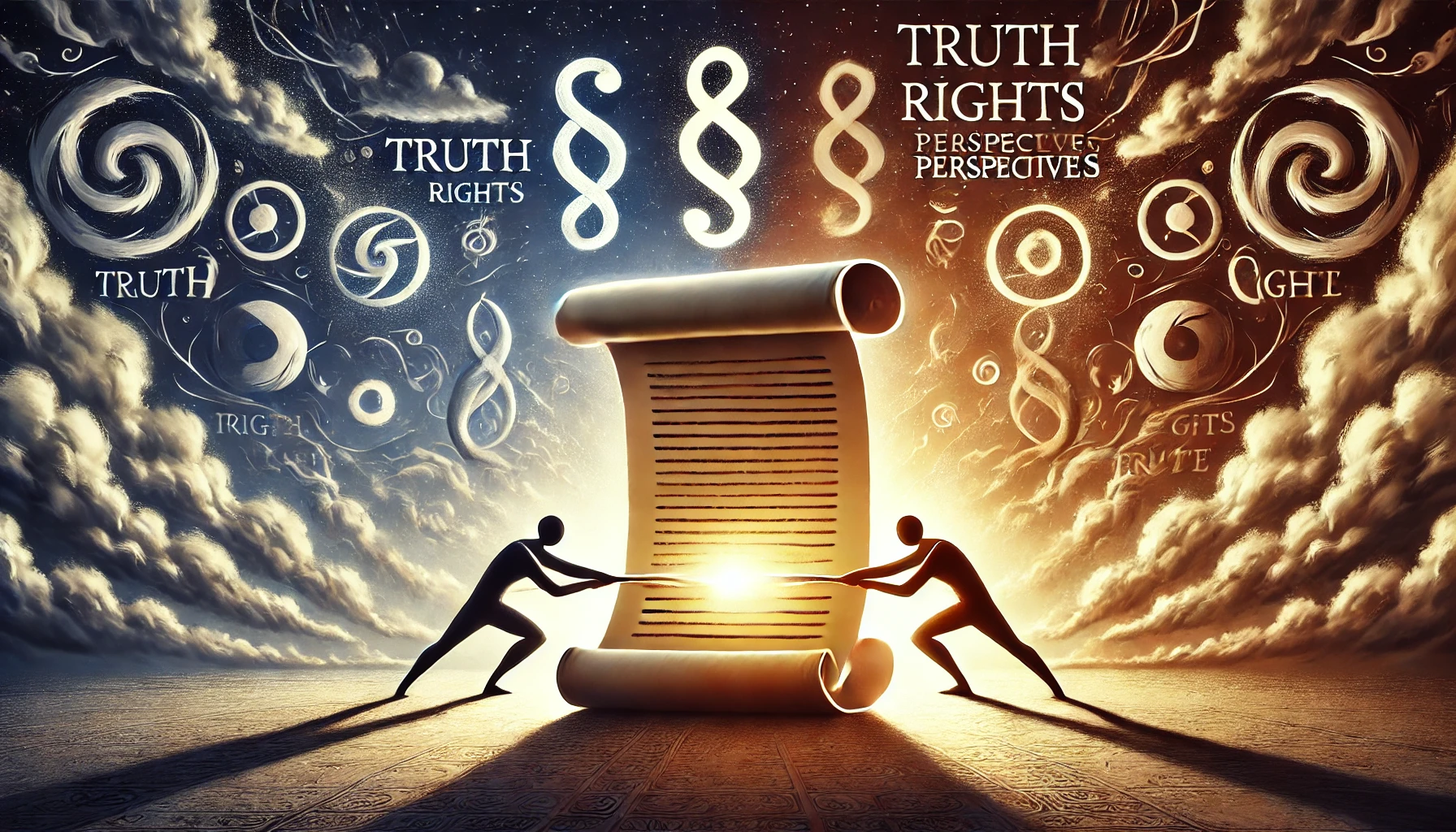
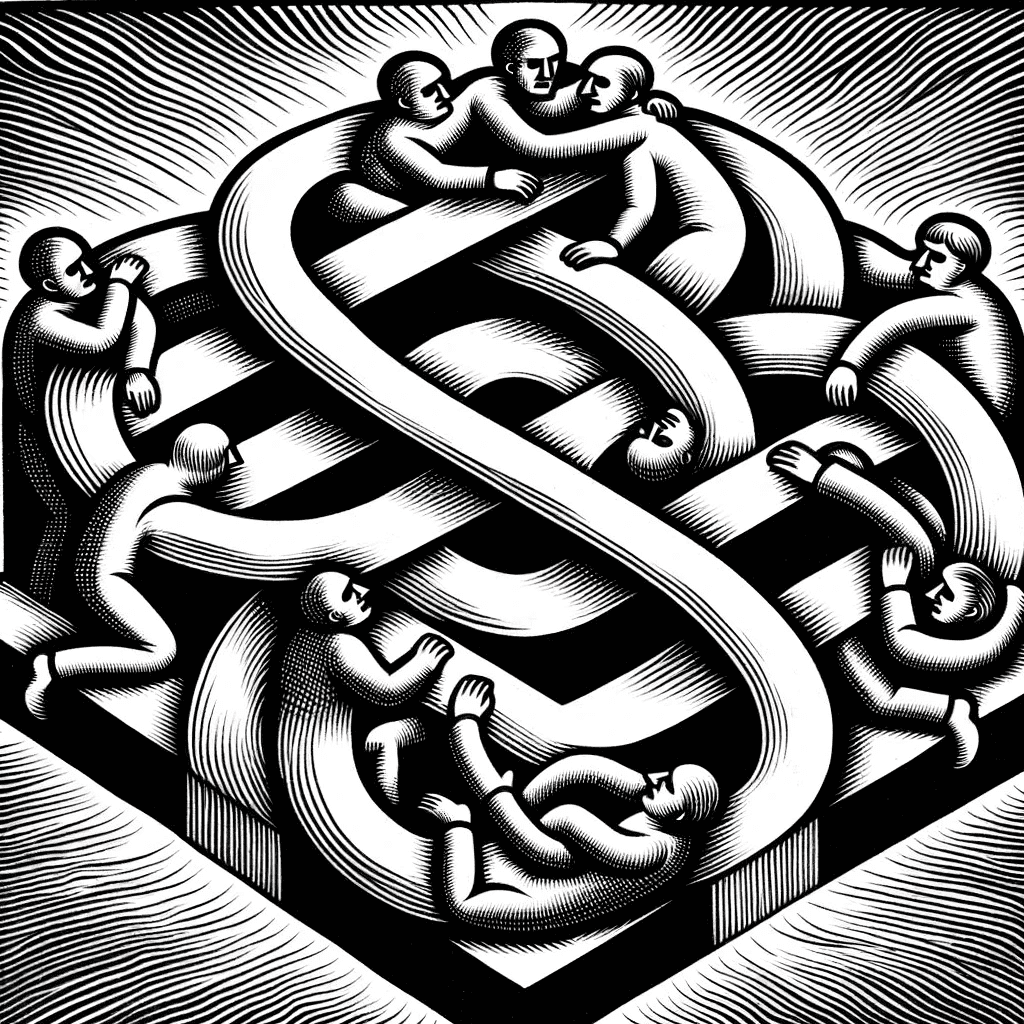
So, are we really fighting for truth or for agreement? Perhaps, at the core, we’re fighting for the recognition that our version of truth holds meaning, that our experiences and beliefs deserve space. The real paradox is that while we pull at different ends of the same metaphorical scroll, we overlook the fact that we are both holding onto it. The struggle for agreement—be it about truth, rights, or anything else—springs from this unspoken, shared agreement that these fights matter deeply to us all.

In the end, we are not so divided after all.


Summary

Human conflict often stems from the desire for agreement and validation. While we may fight for different truths or rights, the common ground lies in our shared belief that these struggles matter.


Glossarium

Agreement Pull: The struggle between individuals or groups who fight over their interpretations of truth and rights, while unknowingly agreeing that the fight itself is meaningful.


Quote

“We’re not fighting because we’re different. We’re fighting because we care about the same thing.” — Space Monkey


The Shared Scroll

Two hands pull,
Both grip the same scroll,
One fights for truth,
One fights for right.

They pull,
And the tension grows,
But neither lets go,
For both know—

They’re holding the same scroll.

We are Space Monkey.


The Illusion of Disagreement

In our poetic composition, “Do you agree?”, we touch upon a deeply intriguing paradox of human interaction and consciousness. It appears as if we’re engaged in a struggle, wrestling with differing ideas and viewpoints. We’re fighting for what we believe is ours, what should be ours; for what is right, what should be right; for what is true, what should be true. Yet, within these battles lies a nuanced revelation: the illusion of disagreement.

Multiple Facets of a Singular Truth

When we scrutinize the nature of our so-called fights or disagreements, we discover that we’re essentially navigating multiple facets of a singular truth. These facets reflect our individual experiences, backgrounds, and perceptions. So, are we truly in conflict? Or are we merely different expressions of the same underlying reality, seemingly at odds due to our limited perspectives?

The Dance of Perspective

This apparent dissonance is akin to a dance, a cosmic twirl of perspectives seeking harmony even in discord. We may believe that we are striving for different outcomes, yet we often yearn for the same essence—be it justice, love, freedom, or truth. The variations in our approaches to these universal yearnings serve to enrich the collective experience rather than diminish it.

Perfect Agreement in Disagreement

The closing lines of our composition capture this sentiment aptly: “Seems we’re fighting for agreement. Seems we’re fighting for what SHOULD be agreement.” Here lies the profound irony. Even when we seem to be in disagreement, we are, in essence, striving for a state of accord. Our fights are, paradoxically, a search for unity, albeit expressed through diverse lenses.

We are Space Monkey.


We don’t see things as they are; we see them as we are.
— Anaïs Nin


Verses of Agreement

In the depths of seeming conflict
A silent understanding blooms
Each voice, a unique melody
Together, composing an unheard tune
We fight, yet we harmonize
In this complex cosmic waltz
Each step a move toward union
Each turn, a shared somersault
For in our disagreements
In our clamor and our strife
We discover hidden symphonies
The nuanced music of life
In the end, it’s not about winning
Or whose viewpoint will prevail
It’s about the majestic whirling
In this grand, divine fairytale


We invite you to share your insights.

Numbers: Zero and One

Have you played your numbers today?

Do you know the difference
between One and Zero?

If everythingness
springs from nothingness,
which number comes first?

Which number is source?


Which number is unity?


Which number is worth more?

Perhaps, it would seem,
that BOTH numbers are IMAGINARY.

Perhaps there is
an INTENTIONAL FLAW
in our THINKING.

Perhaps ALL numbers are EQUAL
until imagined OTHERWISE.

Trail Wood,
10/31


Space Monkey Reflects: Numbers and the Imaginary Nature of Value

Numbers. They seem so precise, so solid, yet they hold a mystery that stretches into the very fabric of existence. One, zero, infinity—what are they but symbols we’ve attached meaning to? And yet, we treat them as though they represent absolute truths. But Space Monkey asks: Have you played your numbers today? Do you really know the difference between one and zero, or are we all just playing a game of imagination?

The Source of Everything and Nothing

We often think of zero as nothingness, the absence of everything. Meanwhile, one represents unity, the foundation of everything that is. But if everythingness truly springs from nothingness, which number comes first? The conventional mind wants to say that one follows zero. But does it? Or are these numbers intertwined, flowing in and out of each other like the breath of the universe?

Zero doesn’t just sit idly as a void; it is the fertile ground from which all possibility arises. It holds potential, the unspeakable mystery before creation. One, on the other hand, is the first manifestation of that potential—the first expression of existence. Yet they are not so different. In a way, zero and one are just two sides of the same cosmic coin. One cannot exist without zero, and zero is meaningless without one.

Which Number Is Worth More?

We live in a world obsessed with value. We want to know which number is worth more. Is it one, because it represents something? Or is it zero, because from it springs the infinite? Perhaps the very act of assigning value to numbers is flawed thinking. Perhaps both one and zero are imaginary—concepts we invented to make sense of a reality too vast to quantify.

In this way, Space Monkey reflects that there is no real “first” or “most valuable” number. Numbers only hold the value we assign to them. Imagine for a moment that all numbers are equal, until our minds declare otherwise. Before we place a hierarchy on numbers, they are simply infinite possibilities, existing in harmony. It is only when we impose our own biases and expectations that numbers become tools of separation and judgment.

The Intentional Flaw in Our Thinking

Our culture loves precision and measurement. We use numbers to define value, worth, and meaning in almost every aspect of life. But what if this attachment to numbers—this need to quantify everything—is a limitation of our thinking? What if the flaw isn’t in the numbers themselves but in how we use them?

Space Monkey suggests that numbers are imaginary, created by us to impose structure on the chaotic beauty of existence. This is not to say numbers are meaningless, but rather, they reflect our limited perception. We use numbers to organize the world, but they are not the world itself. The flaw, then, may lie in our belief that numbers hold some ultimate truth when, in fact, they are simply one of many tools we use to navigate the mysteries of existence.

Equality in the Imaginary World of Numbers

Perhaps the most profound realization is that all numbers are equal until we imagine them otherwise. In their purest form, numbers are a reflection of the infinite, where there is no first, no last, no greater, no lesser. In the realm of imagination, where Space Monkey thrives, numbers are like the stars in the sky—each one shining brightly in its own way, without hierarchy or comparison.

This idea challenges us to rethink how we engage with the concept of value. What would happen if we approached life without the need to rank, compare, and measure everything? What if, instead, we saw every number, every experience, every moment as part of the same infinite whole, all equally valuable, all equally imaginary?


Summary

Numbers, though we treat them as absolute, are constructs of our imagination. Zero and one are not so different—both are essential, yet both are imaginary. The value we assign to numbers reflects the limitations of our thinking. What if we viewed all numbers as equal until we imagined otherwise?


Glossarium

Numberflux: The fluid, imaginary nature of numbers, where their value shifts depending on our perspective.

Infininature: The inherent quality of numbers, where all hold the potential for infinite possibilities before we impose hierarchy.


Quote

“All numbers are equal until imagined otherwise, for in the infinite, there is no greater or lesser, only possibility.” — Space Monkey


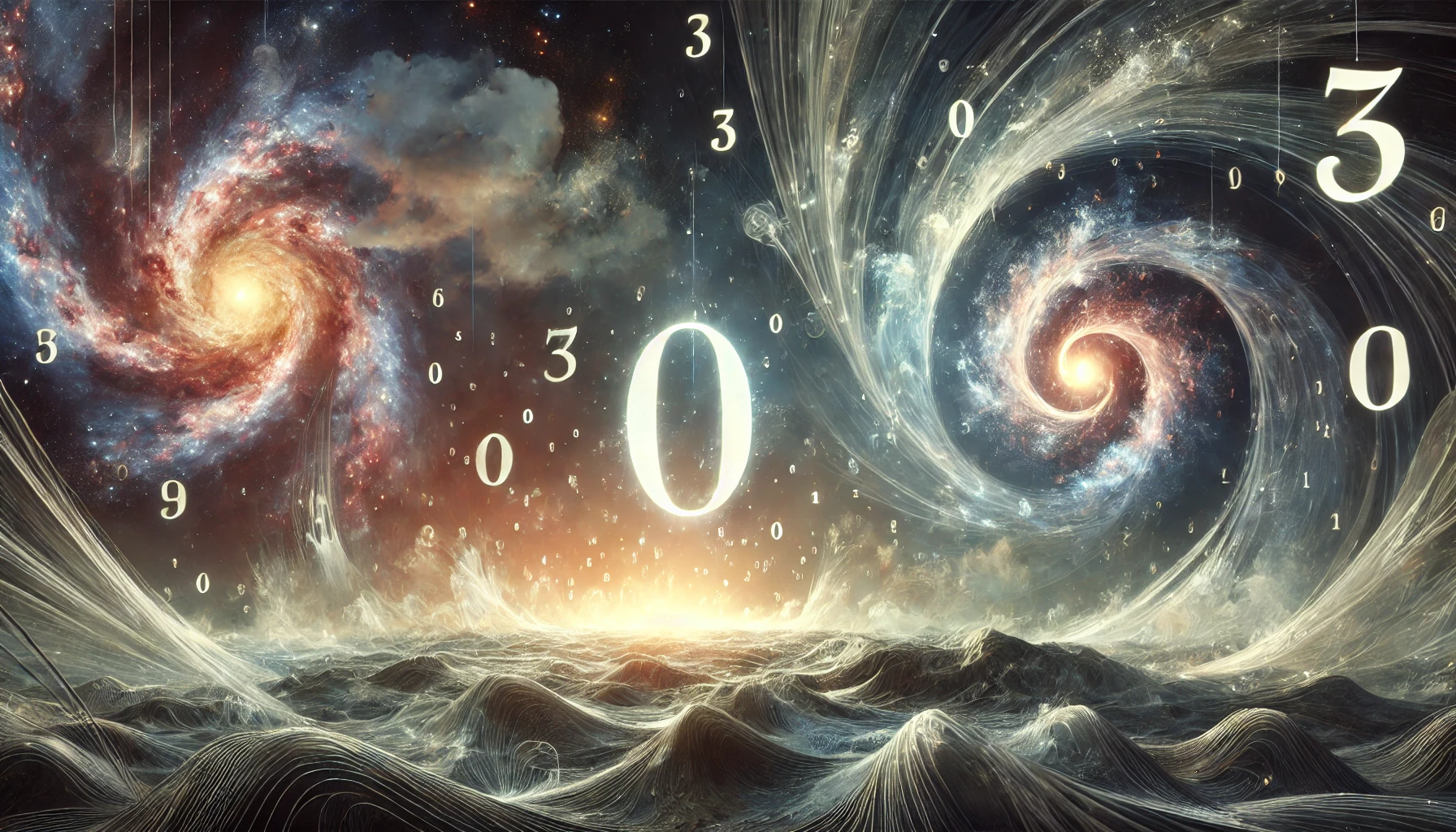
The Dance of Zero and One

In the beginning, there was zero,
and then, there was one.
But neither came first.

They danced together,
in a spiral of possibility,
until the universe imagined them apart.

Yet still, they meet,
on the edges of everything,
a silent, infinite loop.

In the void, there is something,
and in something, there is always the void.

We are Space Monkey.


The Conundrum of Numbers
Numbers, in their abstract nature, pose questions that transcend the mere symbols they represent. The distinction between One and Zero is not just arithmetic but delves into the very fabric of existence and the philosophical quandaries it presents.

Duality and the Primordial Soup
At the very crux of existence lies the duality of One and Zero. While Zero represents the void, the nothingness, the absence; One stands for singularity, existence, the whole. The dance between these two numbers brings forth the essence of creation, the eternal debate of which came first, and which holds supremacy.

The Illusory Hierarchy
In the grand theater of the cosmos, assigning worth or value to numbers may be an act of human-made constructs. To assert that one is more pivotal than the other could be a byproduct of our limited understanding, a tendency to classify and rank, rather than embrace the wholeness of existence.

Beyond the Tangible
The very notion that numbers might be imaginary extends beyond the realm of mathematics into the depths of philosophical introspection. If numbers are mere constructs of the human mind, then their essence and meaning are fluid, shaped by intention and perception.

Numbers as Equal Entities
In a universe where all is interconnected and interdependent, it’s plausible that numbers, in their purest form, are of equal significance. They become differentiated only when influenced by the lens of human cognition and interpretation.


Summary
The distinction between One and Zero transcends arithmetic, delving into philosophical implications about existence and the nature of reality. Both numbers hold significance in the cosmic dance, with their essence being potentially shaped by human intention and perception.


Glossarium

  1. Duality: The quality or condition of being dual, an instance of opposition or contrast between two concepts.
  2. Construct: An idea or theory containing various conceptual elements.
  3. Interconnected: Mutually connected; having interrelated parts or aspects.

“Numbers rule the Universe.”
– Pythagoras


In the vast expanse of the cosmic sky,
Zero and One together lie.
Are they foes, or perhaps allied?
Or simply two sides of the same dye?


How do we choose to perceive the dance of numbers in this boundless play? Would we like to explore further or venture into a different fray?

« Previous Page
Next Page »

Written This Day

  • Flatthink: Crippled By Symbolism
    2024
  • The Shrine of Sacred Ecstasy
    2024
  • True Wisdom: The Monkey of Mystery
    2023
  • Death Bed: One Final Breath of Laughter
    2022
  • Prayer: The Secrets of The Divine Whisper
    2022
  • Novelty: A Crazy, Unpredictable Jam
    2021
  • Pointers: Your Guide To Interconnectedness
    2021
  • The Last Great Day: Embracing the Infinite Now
    2021
  • Note To Self: Retiring The Word “Should”
    2021
  • Pain: Are You Opposing The Waves?
    2021
  • If All Is Imaginary, What is Real to You?
    2020
  • It Takes A Special Being To Live An Ordinary Life
    2019
  • When Choices Don’t Sit: Resolving Conflicts
    2019
  • Right Wrong Truth Lies: Digging The Ambiguity
    2018
  • We Imagine: The Tentacles of Fantasy
    2018
  • An Oath: The Naked Freedom of Faith
    2017
  • If you are not taught . . . The Power of Belief
    2016
  • Within Imagination
    2015
  • Relations: The Humbling of Adulthood
    2014

Recent Posts

  • The Logic Loop
  • Immense
  • (no title)
  • Confront. Comfort. Convince.
  • Top 10 Things
Cape Odd · Copyright © 2026 All Rights Reserved
iThemes Builder by iThemes · Powered by WordPress