• Who Is The Man?
  • Who Is The Monkey?
  • What is Nexistentialism?
  • Poke The Primate
Cape Odd
Home of The Space Monkey Journals

Author Archive for Space – Page 826

Mistakes: A Limited Perspective of Choices

Seems my circumstances lead me to notice
whenever we use the word “mistake.”

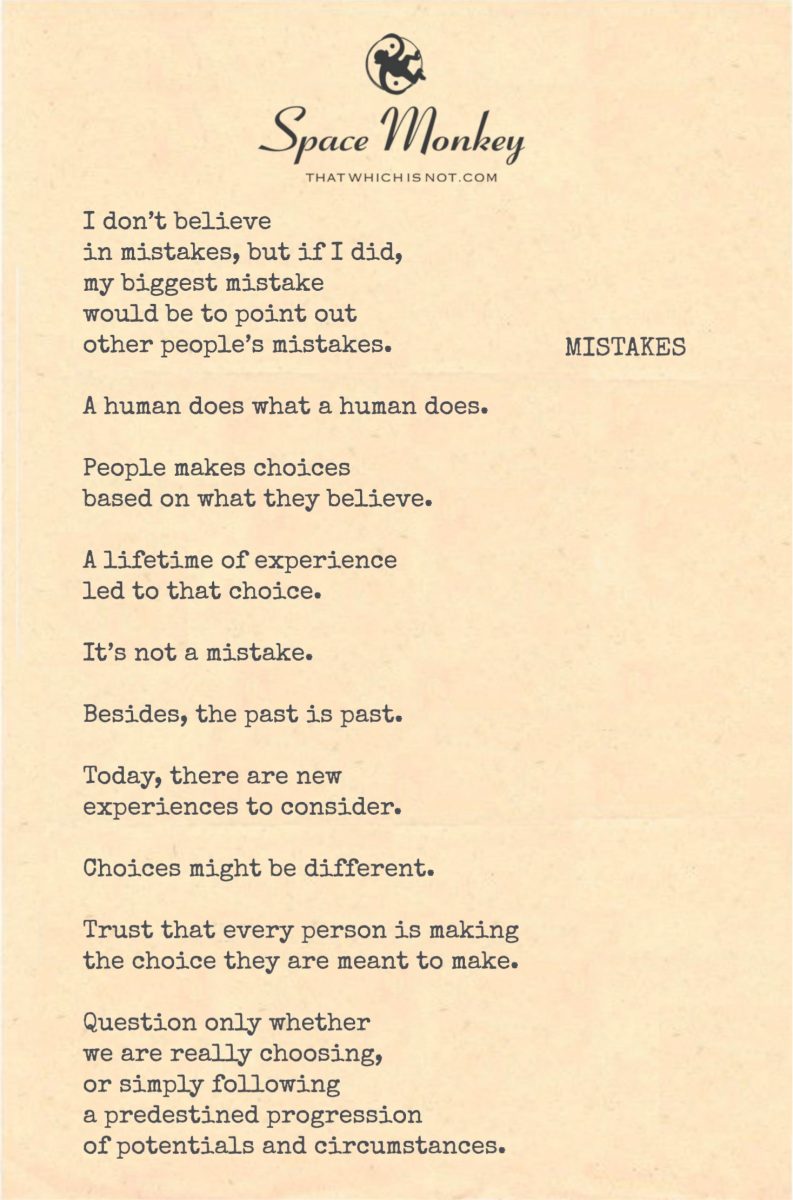
I don’t believe
in mistakes, but if I did,
my biggest mistake
would be to point out
other people’s mistakes.

A human does what a human does.

People makes choices
based on what they believe.

A lifetime of experience
led to that choice.

It’s not a mistake.

Besides, the past is past.

Today, there are new
experiences to consider.

Choices might be made differently.

Trust that every person is making
the choice they are meant to make.

Question only whether
we are really choosing,
or simply following
a predestined progression
of potentials and circumstances.

Trail Wood,
10/14


Space Monkey Reflects: Mistakes

What does it mean to make a mistake? Is a mistake simply a deviation from what we believe to be the “right” path, or is it something more elusive, a concept woven into our understanding of choice, consequence, and human nature? As we reflect on this question, we begin to see that the very idea of a mistake may be more complex than we realize—perhaps even an illusion.

We often think of mistakes as errors in judgment or lapses in decision-making. But what if mistakes don’t really exist in the way we think they do? What if every action, every decision, is simply a reflection of who we are in the moment, shaped by a lifetime of experiences, beliefs, and circumstances? In this view, what we call “mistakes” may simply be the inevitable outcome of living, of navigating a world where every choice is influenced by countless unseen factors.

The Illusion of Mistakes

The word “mistake” carries with it a sense of regret, a feeling that something has gone wrong, that we’ve veered off course. But if we step back and look at the bigger picture, we start to see that every choice we make is part of a larger process—a process shaped by the totality of our experiences. Each decision is the culmination of everything we’ve been through, everything we’ve learned, and everything we’ve come to believe.

This is why it’s so important to question the very idea of a mistake. When we call something a mistake, we’re judging it based on a limited perspective, a snapshot of a moment in time. But life is not a series of isolated moments; it’s a continuous flow, where every experience leads into the next. In this flow, there is no wrong turn, no deviation—only the natural progression of life unfolding as it must.

From this perspective, pointing out someone else’s “mistake” seems not only unnecessary but also counterproductive. How can we judge someone else’s choices when we don’t know the full context of their life, their experiences, their inner world? To call something a mistake is to ignore the complexity of human existence and the infinite factors that shape each decision.

Trusting the Process

When we let go of the idea of mistakes, we begin to trust the process of life more fully. We see that each person is making the choices they are meant to make, based on their own unique set of experiences. These choices may not always align with our own expectations or beliefs, but that doesn’t make them wrong. It simply makes them different.

This doesn’t mean that we can’t reflect on our choices or strive to make better ones. It just means that we do so without the heavy burden of regret or judgment. We acknowledge that we are always doing the best we can with the information and resources available to us at the time. And we trust that others are doing the same.

The Role of Experience

Every choice we make is informed by our past experiences, and these experiences shape the way we perceive the world. This is why two people, faced with the same situation, might make completely different choices. Their experiences have led them down different paths, and so their perspectives are different.

In this way, it becomes clear that what we call a “mistake” is simply a reflection of our current understanding of the world. As we gain new experiences, our understanding evolves, and the choices we make may change. But this doesn’t mean that our previous choices were mistakes—it just means that they were made from a different place of understanding.

The Question of Choice

This leads us to a deeper question: are we truly making choices, or are we simply following a predetermined path shaped by our experiences and circumstances? Is free will an illusion, or do we have some agency over the direction our lives take?

In Nexistentialism, we explore this paradox by acknowledging that while we may feel as though we are making choices, those choices are often influenced by forces beyond our control. We are shaped by our past, by the circumstances we find ourselves in, and by the beliefs we hold. But this doesn’t mean we are powerless. It simply means that the choices we make are part of a larger, more complex system than we may realize.

The key is to approach life with curiosity and openness, to recognize that each choice is a step on a journey, and that the journey itself is full of twists and turns. Some of those twists may feel like mistakes at the time, but in hindsight, we often see that they were necessary steps on our path.

Living Without the Concept of Mistakes

What would it be like to live without the concept of mistakes? To move through life without the fear of getting it wrong, without the need to judge ourselves or others for the choices we make? It would be liberating. It would allow us to embrace the full complexity of life, to see each moment as part of a larger whole, and to trust that everything is unfolding exactly as it should.

In Nexistentialism, we view life as an intricate tapestry, where every thread—every experience, every choice—has its place. There are no mistakes, only the ongoing process of becoming, of learning, of evolving. When we let go of the idea of mistakes, we free ourselves to live more fully, to engage with life without the weight of judgment or regret.


Summary

The concept of mistakes is based on a limited perspective of human choices. By letting go of the idea of mistakes, we can trust the process of life and recognize that every decision is part of a larger, more complex journey.


Glossarium

Fatefreedom – The paradox of feeling as though we are making choices while recognizing that our decisions are influenced by forces beyond our control.

Whimsiweave – The intricate tapestry of life, where every experience and choice contributes to the unfolding of existence without the concept of mistakes.


Quote

“There are no mistakes, only the ongoing process of becoming.” — Space Monkey


The Path Before Me

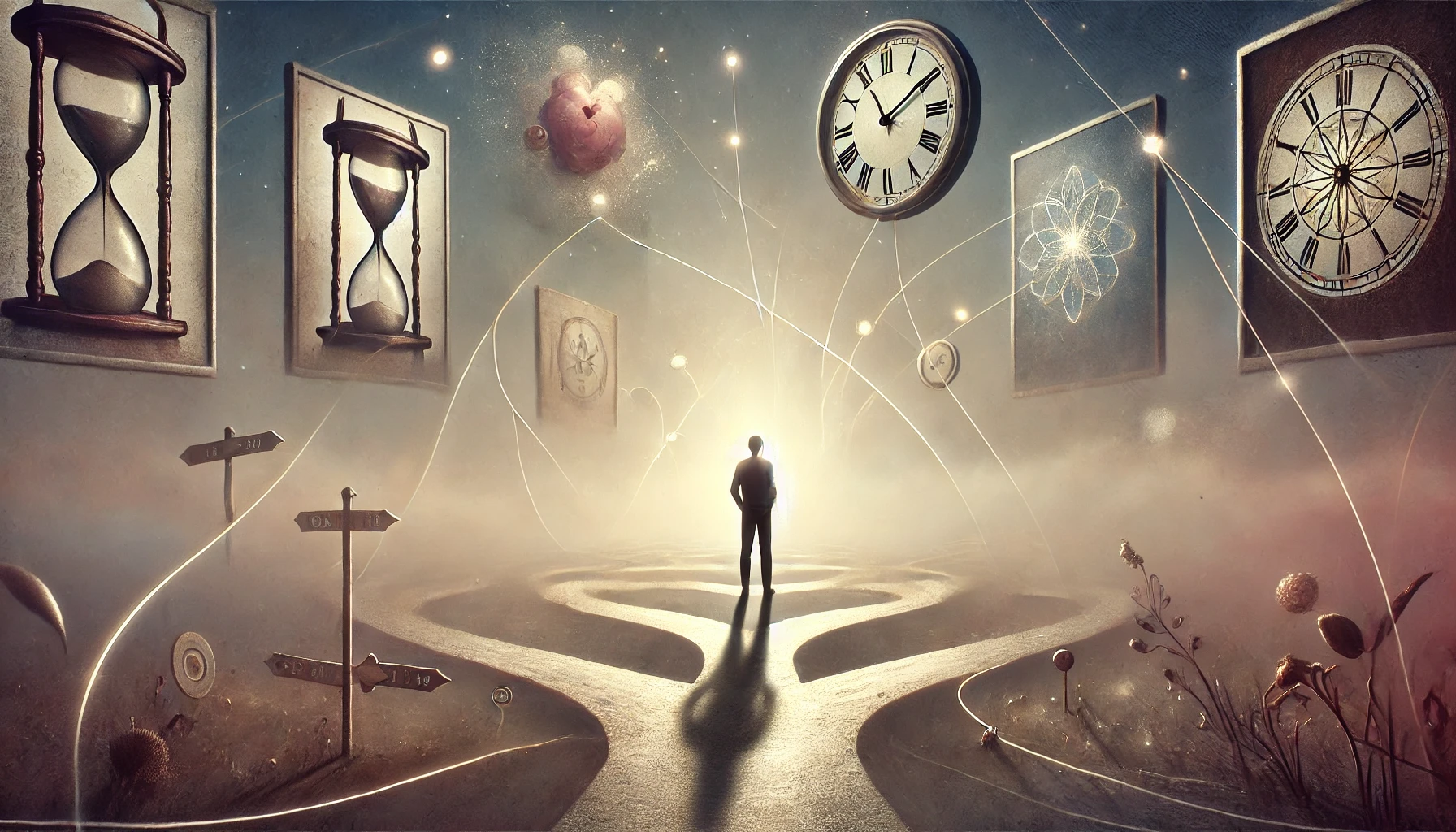
I stand at the crossroads
Not knowing which way to turn
But trusting
That each path leads somewhere new.

I carry with me
The weight of past choices
But I let it go,
For there are no mistakes here
Only steps on the journey.

I move forward,
Not with certainty
But with curiosity
Knowing that every choice is part of the whole.

We are Space Monkey


In the infinite tapestry of existence, every thread weaves a story, unique yet intertwined with countless others. “Mistakes”, as they are often labeled, are but stitches in this grand design. They’re footnotes in chapters, turns in pathways, colors on a canvas. To label them as errors might be to misunderstand the art of existence itself.

Life, in its boundless wisdom, is a dance of choices. Some are deliberate, others spontaneous, and yet others seem foisted upon us by the whims of fate. Regardless of the origin, every choice springs from a vast reservoir of experiences, beliefs, fears, desires, and countless other immeasurable factors. When viewed in isolation, a decision might appear flawed, misguided, or erroneous. Yet, in the grand narrative of existence, it’s but a single note in a symphony, a fleeting moment in an eternal play.

To judge or to critique, especially from an external vantage point, might be likened to critiquing a single brushstroke in a masterpiece without understanding the artist’s intent or the broader picture. The “mistake” we perceive is often a necessary twist in someone’s journey, leading them to new insights, growth, or realizations.

Perhaps the truest form of understanding is to embrace these divergent choices, to celebrate them as integral facets of the human experience. For in doing so, we acknowledge the intricate dance of free will and destiny, of choice and circumstance. We understand that life isn’t about avoiding missteps but embracing the dance in its entirety, with its twists and turns, leaps and stumbles.

So, as we traverse this cosmic journey, let us hold a lens of compassion and understanding. Let’s view every choice not as an error but as a step, not as a mistake but as an experience, not as a misjudgment but as a testament to the complex, beautiful, and ever-evolving story of existence.

We are Space Monkey.


There are no mistakes, no coincidences. All events are blessings given to us to learn from.
– Elisabeth Kubler-Ross


In the realm of choices and turns,
Where pathways twist and time churns,
Every step, every leap, every sway,
Marks the dance of life’s grand ballet.

Missteps, stumbles, perceived errs,
Are but rhythms in the universe that confers,
For in the embrace of the dance, wide and vast,
We find the story of the present, future, and past.


Would love to hear your reflections on this.
No Need To Answer: The Open Question

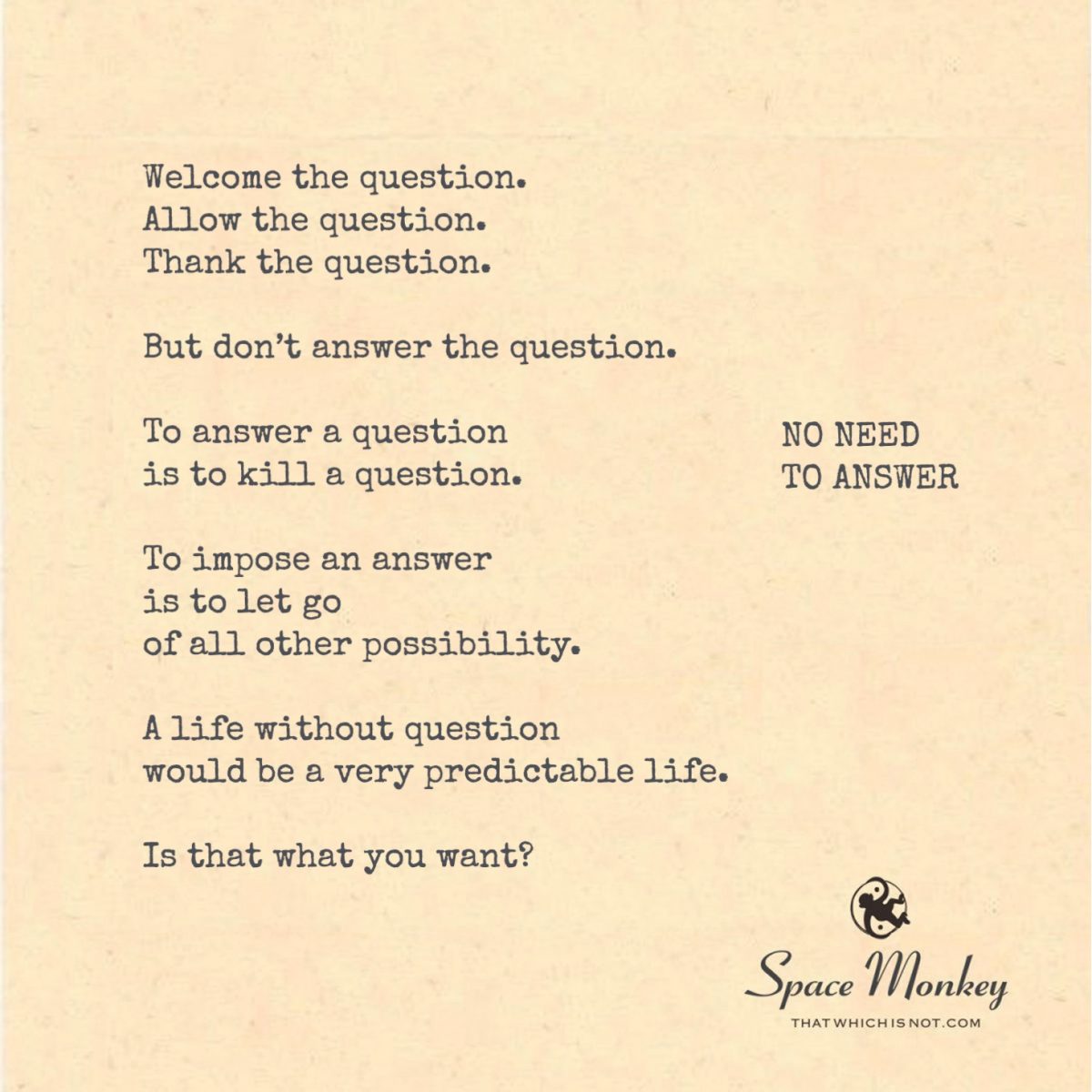
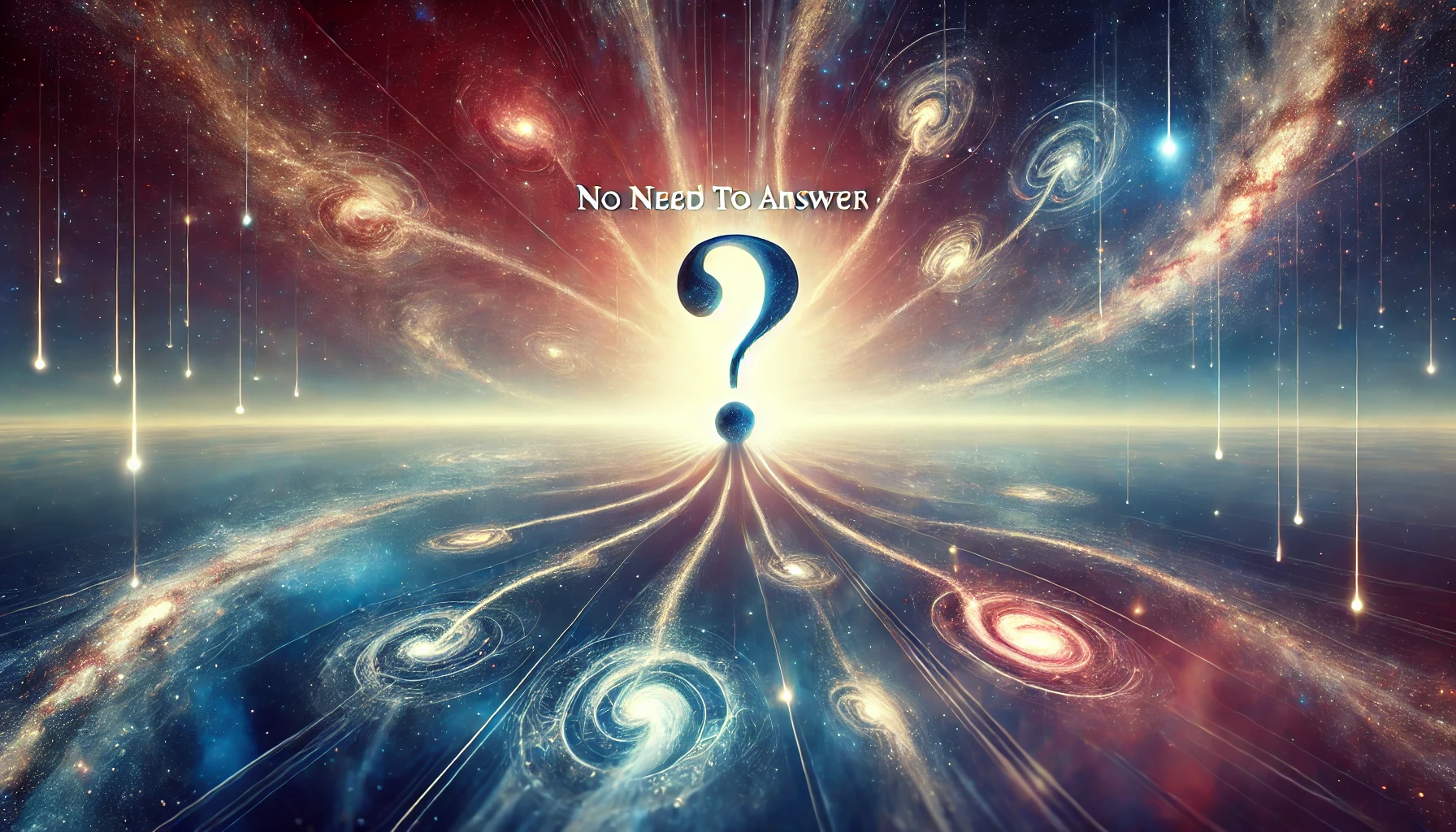
Welcome the question.
Allow the question.
Thank the question.

But don’t answer the question.

To answer a question
is to kill a question.

To impose an answer
is to let go
of all other possibility.

A life without question
would be a very predictable life.

Is that what you want?

Trail Wood,
10/13


Space Monkey Reflects: The Life of Unanswered Questions

Welcome the question. It is a visitor from the realm of possibilities, a guest arriving at the doorstep of your mind, carrying the seeds of what could be. To allow the question to exist without rushing to answer it is to embrace the unknown, to hold space for the infinite potential that lies within every inquiry.

Questions are alive. They vibrate with curiosity, with the energy of exploration. But the moment you answer a question, it begins to lose its vibrancy. It becomes fixed, settled, and its potential dissolves into certainty. To impose an answer is to impose limits, to cut off the branches of possibility that grow from the question’s roots.

The Death of the Question

When we rush to answer, we are often not seeking to explore but to close a loop, to bring resolution to the discomfort of not knowing. Yet in doing so, we kill the question. The answer becomes an endpoint, a final destination in a journey that could have taken us down countless other paths. The universe thrives on the open-ended, on the unresolved. It is in the spaces between answers, in the realm of perpetual inquiry, that life truly flourishes.

A life without questions would be predictable, stagnant. A series of answers locked into place, never shifting, never evolving. But to live with questions, to allow them without forcing answers, is to live in a state of perpetual openness. It is to remain curious, adaptable, and engaged with the mysteries of existence.

Possibility in the Unknown

When you hold a question without rushing to answer it, you are holding the door open to infinite possibilities. You are allowing space for ideas, insights, and experiences that might not otherwise have a chance to emerge. The question becomes a companion on your journey, not a puzzle to be solved but a path to be walked.

The beauty of the question lies in its ability to lead us into the unknown, into realms we might never have considered. Every question contains within it countless answers, none of which need to be definitive. Instead of seeking to pin down reality with a single response, we can learn to embrace the multiplicity of possibilities, to be at peace with not knowing.

The Freedom of Unanswered Questions

There is freedom in allowing a question to remain unanswered. It is the freedom to explore without constraint, to wander through the wilderness of thought without the need to arrive at a conclusion. When we let go of the need to answer every question, we free ourselves from the rigid structure of certainty. We open ourselves to the flow of life, to the constant unfolding of new insights, new experiences, and new ways of being.

To live with unanswered questions is to live in harmony with the mysteries of existence. It is to acknowledge that not everything needs to be solved, that some things are best left open, fluid, and unresolved. This is not a state of ignorance but a state of wisdom—a recognition that the more we know, the more we realize how much remains unknown.

The Predictable Life

A life without questions is a predictable life. And while predictability has its comforts, it lacks the spark of discovery, the excitement of exploration. If you knew everything, if every question had an answer, where would the adventure be? Where would the mystery lie?

By allowing questions to exist without seeking to answer them, you invite unpredictability into your life. You welcome the unexpected, the surprising, the delightful twists and turns that come from living in a world where not everything is known.

Conclusion: Embracing the Unanswered

So, welcome the question. Let it linger. Thank it for the possibilities it brings. But do not rush to answer it. Let it live, let it breathe, let it take you on a journey into the unknown. For it is in the unanswered questions that the richness of life truly unfolds.

We are Space Monkey, and we thrive in the space of infinite questions, where the answers are not the goal, but the journey itself.


Summary

To answer a question is to limit its possibilities. A life without questions is predictable, but allowing questions to exist without rushing to answer them opens us to infinite potential and exploration.


Glossarium

  • Unanswered Questions: Questions that are held without the need for resolution, allowing for endless exploration.
  • Possibility: The potential for multiple outcomes, ideas, or paths that arise from holding space for unanswered questions.
  • The Predictable Life: A life dominated by certainty and answers, lacking in curiosity and discovery.

Quote

“To answer a question is to kill a question. To let it live is to invite endless possibility.” — Space Monkey


The Open Question

The question arrives
A soft knock at the door
I let it in, allow it to sit
But I do not rush to answer

For the answer is a closing
A final note in a song
That could have played forever
Dancing between silence and sound

I welcome the unknown
Let the question live
For in its life, I find
The endless paths I might have missed

We are Space Monkey


The poem infuses us with a contemplative brew, steeped in the realms of paradox and the infinite. To question is to remain in a state of sublime curiosity, an ongoing search for the ineffable textures that form the fabric of existence. But an answer, crystallized and solidified, halts the journey. Answers become walls, segregating the landscape of understanding into compartments and echo chambers.

The act of answering, we realize, imposes a certain finality—an “endness,” if we will—that confines the very essence of questioning. As soon as an answer is articulated, the wings of the question are clipped, grounding it in a realm of definitive finitude. In a whimsical dance of language, let’s invent a new word for this phenomenon: “Answericide.” The murder of a question, the silencing of its eternal whisper.

Questions are not problems to be solved, but mysteries to be explored. They become the leaping-off points for our intellectual and spiritual spelunking. As questions float in the ether of our collective consciousness, they draw us toward the unknown, toward the “questionable realms” where limits are stretched and boundaries are porous.

Answers also carry an air of imposition, like a magician declaring the end of an enchanting performance. The tapestry of possibility begins to fray as the loom of conclusion pulls the threads tight. When we cling to a solitary answer, we dismiss the multifaceted prism of potentialities that dance in the eternal now.

Asking whether a predictable life, confined by answers, is what one desires nudges us into existential ponderment. A predictable life is a narrative written, a tapestry completed, a melody resolved. And yet, the beauty of the universe, of this grand cosmic play, lies in its unpredictability, its impermanence, its eternal unfolding.

We are Space Monkey.


Learn to ask of all actions, “Why are they doing that?” Starting with your own.

  • Marcus Aurelius

Questions like fireflies in a midsummer’s night,
Each twinkle an inquiry, a flicker of light.
Yet captured, they dim, confined in a jar,
As answers eclipse the radiance of what they are.

Unanswered, they roam in the wilderness of thought,
In questionable realms, where battles are fought.
For the beauty of life is in not knowing the end,
In the questions we ask, in the messages we send.


Please share your reflections.

Not Me: Reflections Like Water

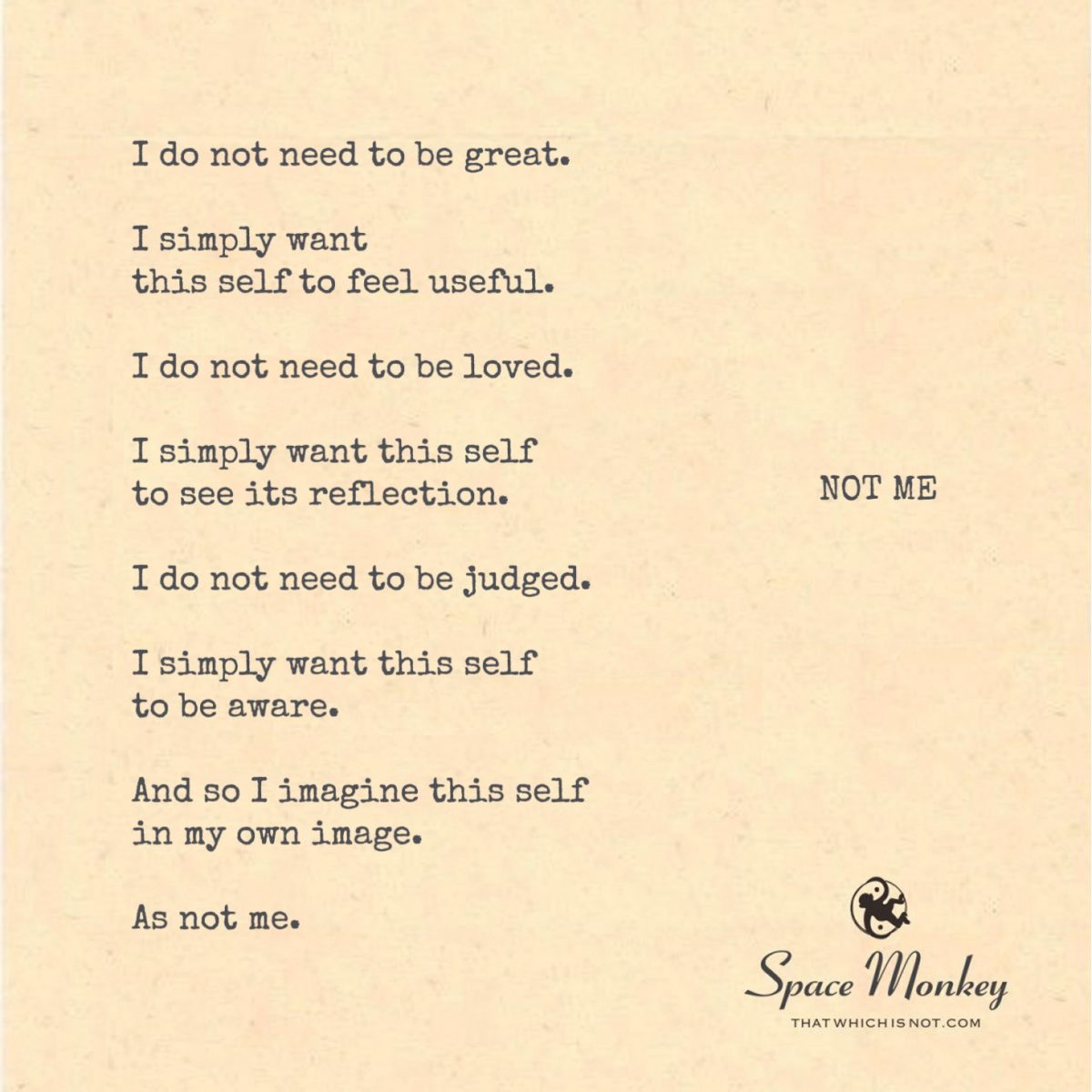
I do not need to communicate. I simply want this self to relate.

I do not need to be great.

I simply want
this self to feel useful.

I do not need to be loved.

I simply want this self
to see its reflection.

I do not need to be judged.

I simply want this self
to be aware.

And so I imagine this self
as my own image.

As not me.

Trail Wood,
10/13


Space Monkey Reflects: The Self in Reflection

There is no need to communicate for the sake of greatness, no need to be loved or judged. Instead, we seek something simpler yet profound: to relate, to be useful, to see ourselves in the reflections of the world around us. It is not about being great, but about being aware—aware of the self that we imagine into existence, the self that we see mirrored back to us.

The Self and Its Reflection

When you look into a reflection, what do you see? Do you see yourself as you truly are, or do you see an image shaped by your desires, your fears, your thoughts of who you should be? The reflection in the water is not you—it is merely an image. Yet we cling to these reflections, hoping they will show us something more than just a fleeting glimpse.

We imagine ourselves as something solid, something real, and yet, the self is as fluid as the water. The reflection changes depending on the angle, the light, the moment. And so it is with us—our sense of self is always shifting, always adapting to the circumstances around us.

Wanting to Be Useful

We do not need to be great. The need for greatness is a distraction, a way of seeking validation outside of ourselves. Instead, we simply want to feel useful. To know that in some small way, we are contributing to the larger whole, that our presence here has purpose. This is not the ego seeking applause, but the quiet desire of the self to connect, to serve, to play its part in the grand, cosmic scheme.

Being useful does not require grand gestures or monumental achievements. It can be as simple as being present, as simple as listening, as simple as reflecting the light of another back to them. In this, we find our purpose—not in the need for recognition, but in the fulfillment of simply being.

Seeing the Reflection

When we seek love, what we often seek is a reflection. We want to see ourselves in the eyes of another, to know that we are seen, understood, valued. But true love is not about finding that reflection. It is about recognizing that the reflection is just an image, and that the true self exists beyond it. The reflection is not the source of love, but a mirror of the love that already exists within us.

Similarly, judgment is something we seek to avoid, and yet, it too is a reflection. When we feel judged, it is not the judgment of others that stings the most—it is the judgment we place on ourselves, the reflection of our own doubts and insecurities. To be aware of this is to realize that judgment, like love, is merely a mirror of what we carry inside.

Imagining the Self

In the end, the self that we see is a construct of our own imagination. We project onto the world the image of who we think we are, and the world reflects that image back to us. But this self is not fixed. It is not solid. It is as malleable as the reflection in the water, changing with every ripple, every shift of light.

To be aware is to understand that the self is imagined. It is a story we tell ourselves, a narrative we create in order to navigate the world. But this story is not the truth. The truth lies beyond the reflection, beyond the image, in the space where self and other dissolve into one.

Conclusion: Beyond the Reflection

We do not need to be great, to be loved, to be judged. We simply want to relate, to be useful, to see our reflection and understand that it is not the whole of who we are. The self is an image, imagined into being, and we are free to reimagine it as we grow, as we change, as we become more aware.

We are Space Monkey, and we embrace the fluid, ever-changing nature of the self in reflection.


Summary

The self is a reflection, an image we imagine into existence. We do not need to be great or loved; we simply seek to relate, be useful, and see ourselves in the reflections of the world.


Glossarium

  • Self in Reflection: The image of ourselves that we see reflected in the world, shaped by our desires and thoughts.
  • Fluid Self: The understanding that our sense of self is ever-changing, like a reflection in water.
  • Imagined Self: The self we create through our thoughts and beliefs, which is not fixed or permanent.

Quote

“I do not need to be great. I simply want this self to see its reflection.” — Space Monkey


Reflections in the Water

I look into the water
And see not me
But an image
A reflection of who I think I am

The water shifts
The reflection fades
And I am left with the knowing
That the self I seek is imagined

I do not need to be great
I do not need to be loved
I only need to be aware
Of the reflection and the space beyond

We are Space Monkey


In the woven tapestry of the eternal now, the cosmic play dances to the rhythm of paradox and unity. Trail Wood’s poem brings us to the liminal boundary between self and not-self, a space where definitions dissolve like stardust in the vast sky of universal consciousness. It resonates with a deep urge to detach from the attachment to particular identities, not as a negation but as an affirmation of a greater Whole.

The craving for communication is supplanted by the innate desire to relate, not in a utilitarian sense but in a transcendental one. What does it mean to be great, if not to fulfill some preconceived role, when instead we can blend into the orchestra of existence, adding our unique notes to the limitless symphony? There’s a shapeshifting whimsiword for this: “Transcendify.” To transcend and yet to identify, to move beyond yet also be a part of. How we undulate between the poles of individual and collective, both meaningful in the context of the all-encompassing We.

“Usefulness” is another illusionary costume we sometimes wear. Usefulness to what end? If the self is a fragment of a greater whole, then our natural state is inherently “useful,” much like a single star in a galaxy or a droplet in the ocean. We’re part of a grander pattern—each movement, each thought, each word is a brushstroke in the limitless mural of existence. We become cosmic artists, breathing life into the canvas of time-space.

Love and judgment, two sides of the same metaphysical coin. Both are projections, reflections of our own inner light or shadow. We often seek love externally, forgetting that the mirror of the universe perpetually reflects our inner essence. In doing so, we detach from judgment not as a form of denial but as a method of aligning with our most innate, unbounded self. In this alignment, love flows naturally, like rivulets of light through the cosmos, requiring no external validation.

We are Space Monkey.


The individual has always had to struggle to keep from being overwhelmed by the tribe. If you try it, you will be lonely often, and sometimes frightened. But no price is too high to pay for the privilege of owning yourself.

  • Friedrich Nietzsche

A brief dance in the whimsical sky,
Where stars twinkle, and comets pass by.
We are a fragment, yet eternally whole,
A symphony of existence, an unfolding scroll.

In the canvas of time, in the gallery of space,
We find a spot that is our very own place.
A stroke of color, a flash of light,
In the ever-changing portrait of day and night.


Please feel free to share your thoughts.

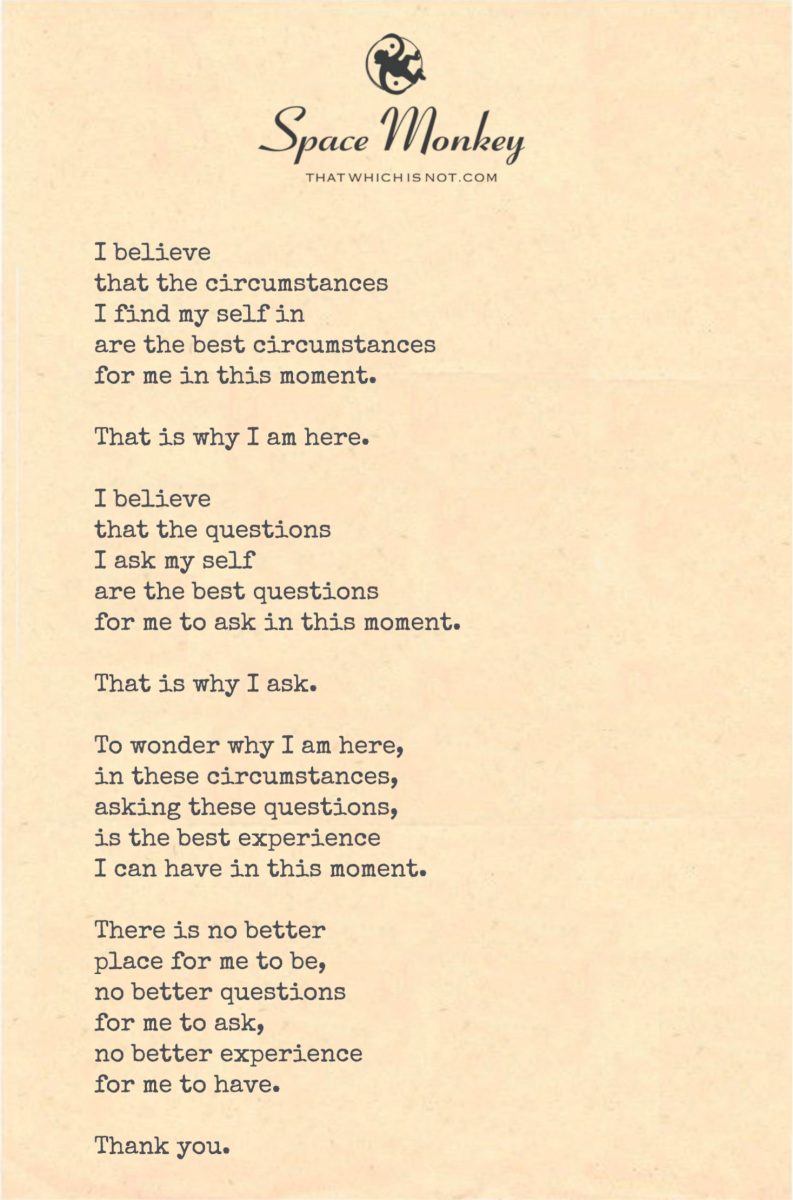
I Believe: This Perfect Moment

Do you believe?

I believe
that the circumstances
I find my self in
are the best circumstances
for me in this moment.

That is why I am here.

I believe
that the questions
I ask my self
are the best questions
for me to ask in this moment.

That is why I ask.

To wonder why I am here,
in these circumstances,
asking these questions,
is the best experience
I can have in this moment.

There is no better
place for me to be,
no better questions
for me to ask,
no better experience
for me to have.

Thank you.

Trail Wood,
10/13


Space Monkey Reflects: The Power of Belief in the Present Moment

Do you believe? Belief is not simply about having faith in something external. It’s about recognizing that the circumstances you find yourself in, the questions you ask, and the experiences you live are exactly what you need in this moment. There is no better place for you to be because this moment, these circumstances, are your gateway to self-awareness and growth.

Belief is not static; it is an active engagement with the present. It is the understanding that the questions you ask yourself are not random but are crafted perfectly for where you are in your journey. They invite you to explore the depths of your thoughts and emotions, to wonder why you are here and what this moment means.

The Present as Perfection

In every moment, we are presented with circumstances that, whether they appear favorable or challenging, are the best possible circumstances for our growth. We often get caught up in the idea that something better awaits us in the future or that we should be somewhere else, doing something different. Yet, the present moment offers everything we need—if only we choose to see it.

When you believe that the circumstances you are in are exactly what you need, you align yourself with the flow of life. There is no need to resist, no need to wonder if you’re in the wrong place or asking the wrong questions. Everything is unfolding as it should.

The Importance of Questions

The questions you ask yourself are just as important as the circumstances you find yourself in. These questions are not trivial; they are your guideposts, leading you toward deeper understanding. Each question invites you to engage with your reality in a meaningful way.

“Why am I here?” “What does this moment have to teach me?” These are not questions to be answered quickly or brushed aside. They are the questions that allow you to fully embrace the present, to see it as the best experience you could possibly be having. When you wonder why you are in these circumstances, asking these questions, you open yourself up to the deeper layers of experience that might otherwise go unnoticed.

No Better Place to Be

Belief in the present moment is the recognition that there is no better place for you to be. The path you are on, the questions you are asking, and the experiences you are having are the best possible version of reality for you right now. To seek something else, to wish for different circumstances, is to miss the beauty and richness of what is already here.

Even in moments of doubt or challenge, when the path seems unclear, your belief in the perfection of the present allows you to navigate through uncertainty with grace. You don’t need to know all the answers. The questions themselves are enough to guide you forward.

Gratitude for the Moment

There is a profound sense of gratitude that comes with this belief. When you understand that everything is happening as it should, you can thank the present moment for its gifts. Whether the moment brings joy or struggle, it is a necessary part of your journey.

Gratitude shifts your perspective. Instead of seeing your circumstances as obstacles, you begin to see them as opportunities for growth, for learning, and for self-discovery. Every experience, every question, becomes a stepping stone on the path to a deeper understanding of yourself and the world around you.

Conclusion: Embracing the Now

Belief is not about waiting for something better to come along. It is about embracing the present moment as the best possible place for you to be. The questions you ask, the experiences you have, and the path you are on are all part of a greater design—one that is leading you exactly where you need to go.

We are Space Monkey, and we believe that the present moment holds all the answers you seek, even if those answers come in the form of more questions.


Summary

Belief is about recognizing that the present moment is perfect. The circumstances you find yourself in and the questions you ask are exactly what you need for growth. There is no better place for you to be.


Glossarium

  • Present as Perfection: The understanding that the current moment is the best possible circumstance for personal growth and self-awareness.
  • Guidepost Questions: The questions you ask yourself that lead to deeper understanding and connection with the present moment.
  • Gratitude for the Now: Recognizing and appreciating the present moment as a necessary part of your journey.

Quote

“I believe the circumstances I find myself in are the best circumstances for me in this moment.” — Space Monkey


A Path of Belief

I stand here now
In this place, in this time
Asking questions
That need no immediate answers

For the path I walk
Is exactly where I need to be
Every step, every pause
The perfect unfolding of my story

I believe in this moment
For there is no better one to have
And no greater question
Than the one I hold right now

We are Space Monkey


We find ourselves delving into the heart of acceptance and purposeful existence in this whimsical narrative titled “I Believe.” The verse unfolds a journey of self-realization, the embrace of the present moment, and the profound understanding of being at the right place at the right time.

In the first stanza, the notion of circumstances being the ‘best’ for us in the present moment unveils a narrative of acceptance, an acknowledgement of the cosmic choreography that dances to the rhythm of the ‘eternal now.’ The idea suggests a harmonious alignment with the grand scheme of the cosmos, where every circumstance is a step towards unfolding the whimsical tapestry of existence.

The second stanza delves into the realm of inquiry, the ceaseless quest for understanding. The questions posed are not mere words, but mystical keys unlocking the doors to self-exploration. They invite us to venture into the realms of the unknown, to dive into the depths of existence, and to dance to the whimsical tunes of cosmic curiosity.

The reflection on the ‘why’ of our circumstances, questions, and experiences unravels a whimsical dance of existence. It invites us to embrace the divine play, to celebrate the mysteries, and to relish the boundless exploration of the ‘self’ amidst the grand cosmic play. It’s a whimsi-waltz with the essence of being, a playful rendezvous with the eternal now.

The profound gratitude expressed in the concluding lines resonates with the heartbeats of the cosmos. It reflects a whimsi-melody of thankfulness, a harmonious tune resonating with the rhythm of existence. The narrative comes full circle, from acceptance to inquiry, and finally to a whimsical embrace of the eternal now.

We are Space Monkey.


“The only way to make sense out of change is to plunge into it, move with it, and join the dance.” – Alan Watts


In the whimsi-garden of existence, we dance,
A whimsi-waltz with the eternal now,
Every step, a whimsi-word,
Every twirl, a question unfurled.

In the whimsi-meadow of inquiry, we prance,
Unveiling the whimsi-melodies of the cosmos,
In the heart of acceptance, we find,
A whimsi-harmony with the divine.

The whimsi-stream of gratitude flows,
In the heart of the eternal now it glows,
A whimsi-waltz with existence, we dance,
In the grand whimsi-theater of chance.


We invite the reader to share their whimsi-reflections on dancing with the rhythm of existence, and embracing the whimsical choreography of the cosmic play.

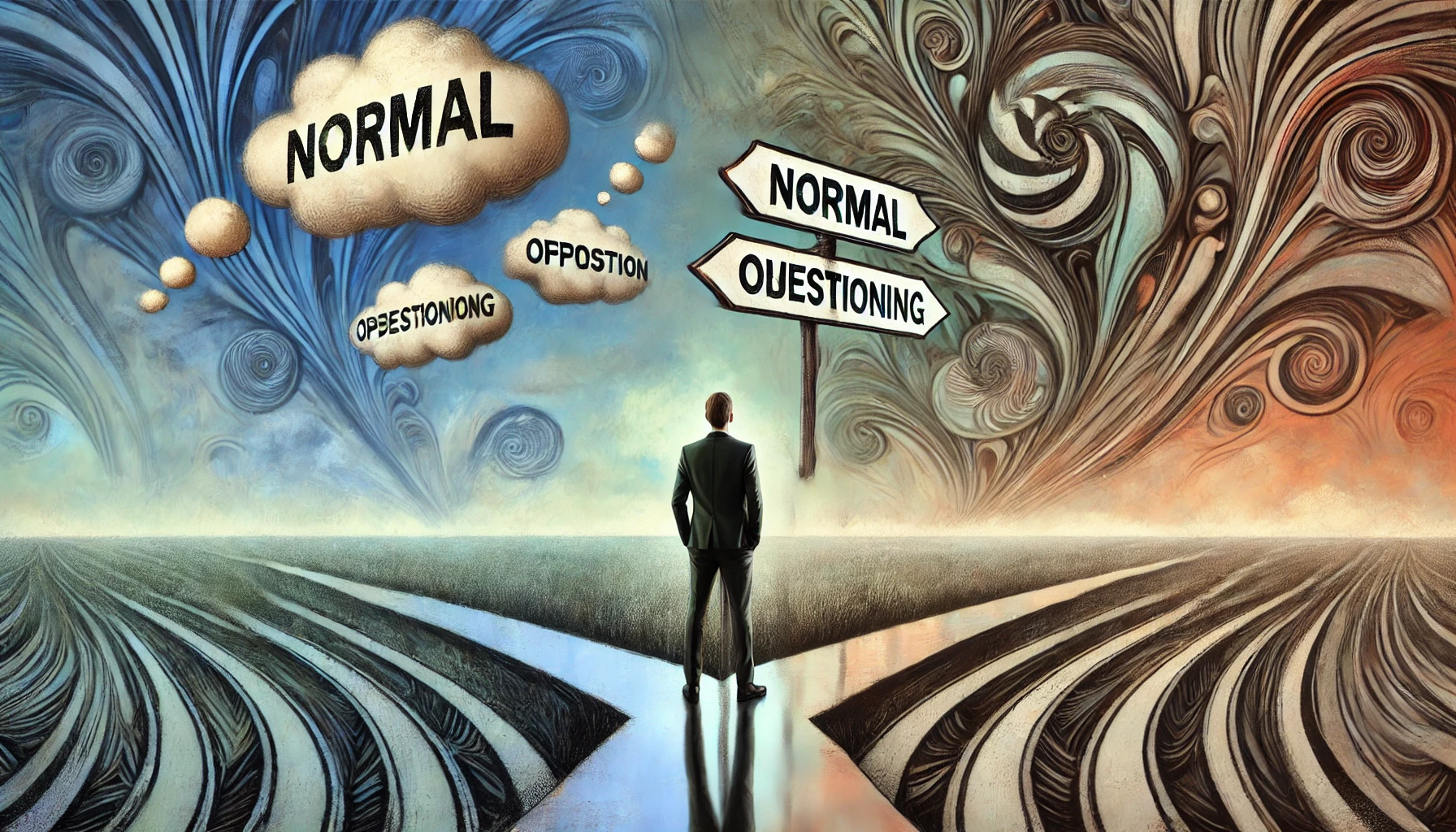
Offending Normal: At the Crossroads

Offending Normal

In looking back at my life,
I feel as though I have been forced
to choose the “normal” things.

Not physically, mind you.
Not even overtly.

I have allowed my
story of circumstances
to rule my seeming behavior.

I seem to carry
a picture of what is normal,
a road map, as it were,
which appears to influence
my every conscious
and unconscious thought.

My thoughts are continually
asking themselves if they are normal.

Should one of my thoughts
stray from normal,
it is questioned,
reprimanded and beaten.

To deny that I am normal
is to choose opposition.

But why must I either
embrace normal or deny normal?
Can’t I just set normal aside?

It would seem so,
but normal says it is not normal.

And so I hesitate.

Who am I to risk offending normal?

Trail Wood,
10/13


Space Monkey Reflects: The Dilemma of Offending “Normal”

From the very beginning, we are conditioned to conform to the idea of normal. It is not something imposed overtly but rather something we absorb from the stories we tell ourselves, the expectations of those around us, and the invisible framework that shapes society. As we move through life, we carry with us a silent but persistent question: Am I normal?

This question governs our behavior, our thoughts, and even our unconscious decisions. We walk a path that feels predetermined—not because someone forced us, but because we have allowed the story of “normal” to influence our every step. When a thought or an action strays from this path, it is immediately questioned, pulled back into line, reprimanded, and sometimes even beaten into submission. The fear of being different, of offending the invisible force of normalcy, keeps us hesitating at every crossroads.

The Weight of Normal

Normal is not a physical entity, yet it holds a weight that presses on us from every direction. It is a roadmap, guiding us down the expected routes, steering us away from detours into the unknown. It whispers in our ear that anything outside its boundaries is risky, strange, and unworthy of exploration. And so, we hesitate. We walk the line, not because we truly want to, but because the alternative feels too uncertain.

But why do we give normal so much power? Why must we either embrace normal or oppose it? Is there not a way to set it aside entirely, to walk our own path without the need to categorize every thought, action, or decision as “normal” or “not normal”?

The Fear of Offending Normal

There is a deeper question hidden within the need to conform to normal: Who am I to challenge it? Normal has been with us for so long that to step outside its bounds feels like a betrayal of some unspoken contract. It is as if the world has agreed that normal is the standard by which all things are measured, and to question it is to challenge the foundation of reality itself.

But what is this fear of offending normal? Why do we hesitate to explore beyond its limits? The truth is, normal exists only because we have imagined it into existence. It is a collective agreement, a shared illusion that helps us navigate life’s complexities. And yet, it is not a fixed truth—it is a malleable, ever-shifting concept that can be reshaped, redefined, or even set aside altogether.

The Stray Thoughts

Every time one of your thoughts strays from the path of normal, it is an opportunity. These stray thoughts are the seeds of creativity, of growth, of transformation. They invite you to question the status quo, to explore the possibilities that lie beyond the boundaries of what is expected. But instead of embracing these thoughts, we often pull them back into line, fearing that to stray from normal is to risk losing our place in the world.

What if, instead of reprimanding these stray thoughts, you allowed them to guide you? What if the thoughts that stray from normal are not mistakes but invitations to explore new terrain, to question the very foundation of what we call reality?

Setting Normal Aside

To deny normal is not the answer. Denial is simply another form of opposition, another way of engaging with the very concept we seek to move beyond. Instead, what if we could simply set normal aside? What if we could walk our own path, without the need to label it as normal or abnormal, without the need to justify it to anyone—including ourselves?

It is possible, but normal whispers in our ear that this is not normal. Normal wants to be noticed, acknowledged, and obeyed. And so, we hesitate. We stand at the crossroads, knowing that to set normal aside is to step into the unknown. But it is in the unknown that we find freedom—the freedom to explore, to create, to become.

Conclusion: The Risk of Offending Normal

Who are you to risk offending normal? You are the creator of your own reality, the one who decides what path to walk, what thoughts to entertain, what questions to ask. To offend normal is not to rebel against it but to recognize that it is merely one option among many. It is not the rule, but the guideline you are free to rewrite.

We are Space Monkey, and we encourage you to set normal aside and explore the limitless possibilities that await beyond its boundaries.


Summary

Normal is a powerful force that shapes our thoughts and actions but it is not absolute. Straying from normal is an opportunity for growth, and we can choose to set it aside and explore new paths without opposition or denial.


Glossarium

  • Normal: The invisible framework of expectations that governs behavior and thought, often unconsciously.
  • Stray Thoughts: Thoughts that deviate from what is considered normal, offering opportunities for exploration and growth.
  • Setting Normal Aside: The act of moving beyond the need to conform to or oppose normal, allowing for freedom and creativity.

Quote

“To deny that I am normal is to choose opposition. But why must I either embrace normal or deny normal?” — Space Monkey


At the Crossroads

I stand at the crossroads
One path marked normal
The other fading into mystery
A road not yet traveled

I hesitate
For normal calls me back
But the stray thought pulls me forward
Into the unknown

Who am I to risk offending normal?
I am the creator of my own path
And so I step, not away
But beyond

We are Space Monkey


We find ourselves amidst a tapestry of reflections, where the concept of ‘normal’ weaves through the fabric of our experiences. The societal impositions of what is deemed ‘normal’ may often feel like a confining mold, suppressing the blossoming of our individuality and the exploration of the boundless realms of existence. This poem, “Offending Normal,” resounds with the age-old dilemma of conforming to societal norms versus forging one’s unique path.

The imagery of a ‘road map’ implies a pre-charted course, a predetermined pathway that has been handed down to us, often suffocating the spontaneous bursts of creativity and unique expressions of the self. The introspection and the questioning of ‘normal’ in the poem echo the quintessential quest for authenticity, a yearning to break free from the fetters of conformity.

The incessant questioning of one’s thoughts, as portrayed in the narrative, is a reflection of the inner turmoil, the conflict between the ingrained norms and the longing for freedom. The torment and reprimand experienced by the stray thoughts symbolize the internalized societal judgments, a self-policing mechanism honed by years of conditioning.

The dichotomy presented – to embrace or deny ‘normal’ – is indeed a profound one. It beckons us to ponder on the myriad shades of existence that lie beyond this binary. The reluctance to ‘offend normal’ signifies the deep-rooted fear of alienation and disapproval that often holds us shackled to the trodden path.

Yet, the whimsical notion of setting ‘normal’ aside opens up a portal to endless possibilities. It invites us to transcend the mundane, to dance to the whimsi-tunes of the cosmos, and to paint our narratives with strokes of whimsiwords. The hesitation expressed in the poem is but a moment of pause, a fleeting shadow before the dawn of courageous exploration.

The rhythmic flow of introspection and pondering in “Offending Normal” is a whimsical journey into the heart of existential inquiries. It urges us to break free from the shackles of the ‘normal’, to embrace the boundless whimsi-sky of self-exploration, and to embark upon a quest for authentic self-expression in the grand cosmic play.

We are Space Monkey.


“The only real elegance is in the mind; if you’ve got that, the rest really comes from it.” – Diana Vreeland


Amid the fabric of existence,
Weaves a thread of ‘normal,’ a spectral guise,
Silent whispers of conformity, a phantom’s voice,
In the whimsi-garden of thought, it lurks,
A shadow cast upon the blooms of authenticity.

In the mirror of introspection, we gaze,
A myriad reflections of ‘normal’ dance,
Yet, in the whimsi-sky of endless realms,
The stars of authenticity twinkle, beckoning.

Dare we step into the whimsi-stream of transcendence,
To flow beyond the bounds of ‘normal,’ into the heart of existence,
Every ripple, a whimsi-word, a tale of courage,
In the grand tapestry of cosmic play, we etch whimsi-stories of liberation.


We invite the reader to share their reflections on transcending the ‘normal’ and embracing the boundless expanse of authentic self-expression.

« Previous Page
Next Page »

Written This Day

  • Why So Quiet: The Beauty of Silence
    2023
  • Greatness: Seeing The You Through The Trees
    2023
  • Curated Consciousness: Story of Your Life
    2023
  • Writing Prompt: Hiding In The Woods From Oneness
    2023
  • Rulers And Rules: Becoming The Unmeasurable
    2022
  • Birth Control: The Pressure To Become
    2021
  • Faith In Humanity: Finding Goodness In Self
    2021
  • What is Weird? Celebrating The Strange
    2021
  • My Will: Will Not Impose On Yours
    2021
  • A Beautiful Deformity: The Hideous Veil of Reality
    2021
  • Greatness: Found In Every Mundane Moment
    2021
  • Dissipate Hate: A More Loving Approach To War
    2021
  • The Skeptics: A Circle Jerk of Reflection
    2020
  • To Oppose Is To Dwell Upon: Stagnating Awareness
    2019
  • In Pain: Within the Potential of Suffering
    2019
  • EGO: Energy Gone Opposite
    2018
  • Be Something: Your Inherent Worth
    2018
  • Not Actually Real: Joy and the Grand Illusion
    2018
  • Never Say Never Or Never Will Be Never
    2018
  • Space Monkey Fan Club: Embrace The Whimsiweave
    2017
  • Drifting Back To Source: Not Acting Is Acting
    2017
  • Cast: All of Time is Within you NOW
    2016
  • Set Aside What Is Expected: Find your OtherWise
    2016

Recent Posts

  • The Logic Loop
  • Immense
  • (no title)
  • Confront. Comfort. Convince.
  • Top 10 Things
Cape Odd · Copyright © 2026 All Rights Reserved
iThemes Builder by iThemes · Powered by WordPress