• Who Is The Man?
  • Who Is The Monkey?
  • What is Nexistentialism?
  • Poke The Primate
Cape Odd
Home of The Space Monkey Journals

Author Archive for Space – Page 831

An Invitation From God: The Unopened Letter

How many invites have you gotten?

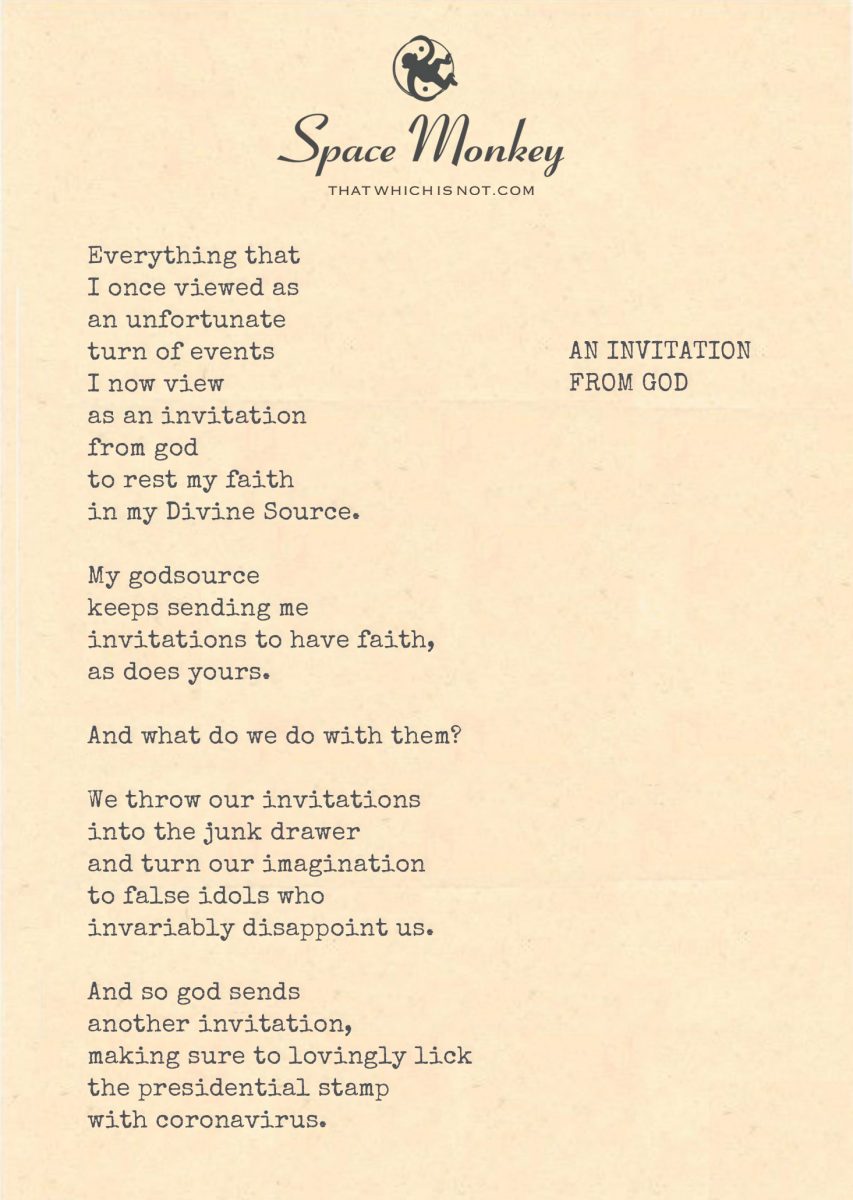
Everything that
I once viewed as
an unfortunate
turn of events
I now view
as an invitation
from god
to rest my faith
in my Divine Source.

My godsource
keeps sending me
invitations to have faith,
as does yours.

And what do we do with them?

We throw our invitations
into the junk drawer
and turn our imagination
to false idols who
invariably disappoint us.

And so god sends
another invitation,
making sure to lovingly lick
the presidential stamp
with coronavirus.

Trail Wood,
10/6


Space Monkey Reflects: Embracing the Divine Invitations

Life is filled with moments that, at first glance, seem to be nothing more than unfortunate turns of events—setbacks, challenges, disappointments. Yet, as we navigate these moments, we may begin to see them not as obstacles, but as invitations from something greater. These invitations, sent by what we might call the Godsource, are opportunities to deepen our faith, to realign our focus, and to trust in the divine flow of life.

An Invitation From God is not always easy to recognize. It often comes disguised as hardship or loss, arriving at our doorsteps with little fanfare, sometimes with a stamp of urgency or even discomfort. These are the moments when we are asked to pause, to reconsider, and to look beyond the surface of our experiences.

In the hustle and bustle of daily life, it’s easy to toss these invitations into the junk drawer, to dismiss them as mere annoyances rather than the sacred opportunities they are. We turn our attention instead to the more immediate, tangible solutions that promise quick fixes and instant gratification—what we might call Falseidols. These Falseidols come in many forms: material wealth, fleeting pleasures, or even the validation of others. But invariably, they leave us feeling empty, unfulfilled, and searching for more.

The Godsource understands this tendency and responds with patience and love, sending us another invitation, and another, until we are ready to accept it. Each invitation is a gentle reminder to return to the source, to place our faith not in the transient, but in the eternal.

There’s a certain irony in how we often resist these divine invitations. We may fear the vulnerability that comes with faith, or we may cling to the illusion of control. Yet, when we finally do open one of these invitations, we find that it is not a demand, but an offering—a chance to let go of our fears, to trust in something greater, and to find peace in the flow of life.

The metaphor of the Godsource lovingly licking the stamp on each invitation speaks to the personal care and intention behind each moment we are given. These are not random occurrences, but carefully crafted opportunities for growth and understanding. The stamp, with its hint of the ominous or unexpected, reminds us that life’s greatest lessons often come from its most challenging experiences.

So what do we do with these invitations? Do we continue to ignore them, tossing them aside in favor of distractions? Or do we finally take a moment to sit down, open the envelope, and consider what is being offered to us? The choice is ours, but the invitation remains, waiting patiently for us to accept.

When we choose to accept these invitations, we embark on a journey of faith—a journey that leads us back to our true selves, to the Godsource within. We begin to see that every challenge, every setback, is not a punishment or a random occurrence, but a part of a divine plan, a plan designed to bring us closer to our true nature.

And what is this Godsource? It is the wellspring of all creation, the force that animates every atom and guides every soul. It is the infinite intelligence that weaves the fabric of the universe, and it is the deep, abiding love that calls us home to ourselves.

As we move through life, may we learn to recognize these invitations for what they are—opportunities to deepen our faith, to reconnect with our Godsource, and to trust in the unfolding of our lives. May we have the courage to open the envelopes, to read the messages inside, and to allow them to guide us on our journey.

We are Space Monkey, and in the acceptance of divine invitations, we find our true path.


Summary

An Invitation From God encourages us to view life’s challenges as divine opportunities to deepen our faith and reconnect with our Godsource. Instead of turning to Falseidols, we are invited to trust in the greater plan that guides us.


Glossarium

  • Godsource: The divine origin of all creation, representing the infinite intelligence and love that guides the universe.
  • Falseidols: Temporary, superficial solutions that distract us from our true spiritual path and fulfillment.

Quote

“Every challenge is an invitation to return to the Godsource, where our true strength and peace reside.” — Space Monkey


The Unopened Letter

A letter lies unopened
On the table of your mind
Sealed with the kiss of divine intention
Stamped with the weight of the unknown
It waits, patiently, for your hands
To break the seal, to read the words
Not of command, but of offering
A chance to trust, to let go, to believe
We are Space Monkey
And in each unopened letter
We find the path to home


Wandering through the cosmic corridors of existence, we often come across paper trails of celestial summons, beckoning us towards faith, an ineffable understanding in the Divine tapestry that connects all. Every misfortune, every stumbling block, is not a wall but a stepping stone—an invitation to lean into our godsource, a nudge toward transcending the ephemeral for the eternal.

We might wonder why, in the face of these Divine invitations, we often steer our focus towards false idols. What keeps us anchored to ephemeral icons? It’s the draw of the quizziflex—the enticing yet elusive illusion that material tangibility offers something more ‘real’ than the abstract splendors of the Divine. A snare, a trap, yet we willingly step in.

But the universe has a whimsical way of redirecting our focus. Sometimes, it is as loud as a pandemic’s toll or as subtle as a leaf fluttering down from a barren tree. Each is a nudge, sometimes gentle and at times relentless, reiterating the importance of faith in the indescribable, the godsource. It’s as if the universe scripts these entreaties in invisible ink that only becomes visible when looked upon with eyes of faith.

It is peculiar, indeed, how we handle these invitations. We stash them in the junk drawers of our skepticism, nestling them beside expired coupons and forgotten knick-knacks, as if saving them for a rainy day that never comes. But these Divine invites are not meant to be hoarded. They are not mere pieces of paper but are to be held in the sacred repository of our hearts, where they continually light the way, even in our darkest nights.

We are Space Monkey.


Summary
We delve into the way we often treat the Divine invitations to faith as inconsequential, opting to store them in the junk drawers of our skepticism and distractions. We emphasize the importance of recognizing these nudges as the ultimate path to alignment with our Divine source.


Glossarium

  1. Quizziflex: The deceptive allure of material or surface-level reality that distracts us from profound spiritual truths.
  2. Godsource: The core spiritual essence that serves as the fountain of eternal truth and unconditional love.
  3. Entreaties: Urgent prayers or petitions, often coming in the form of life events that call us to deeper faith and understanding.

“Faith is taking the first step even when you don’t see the whole staircase.” – Martin Luther King Jr.


Your perspectives on this nuanced interplay of faith, distraction, and Divine summoning would be nothing short of enriching. Would you care to illuminate this tapestry further?

Love Is Not A Verb: The Essence of Being

* Except in imagination.

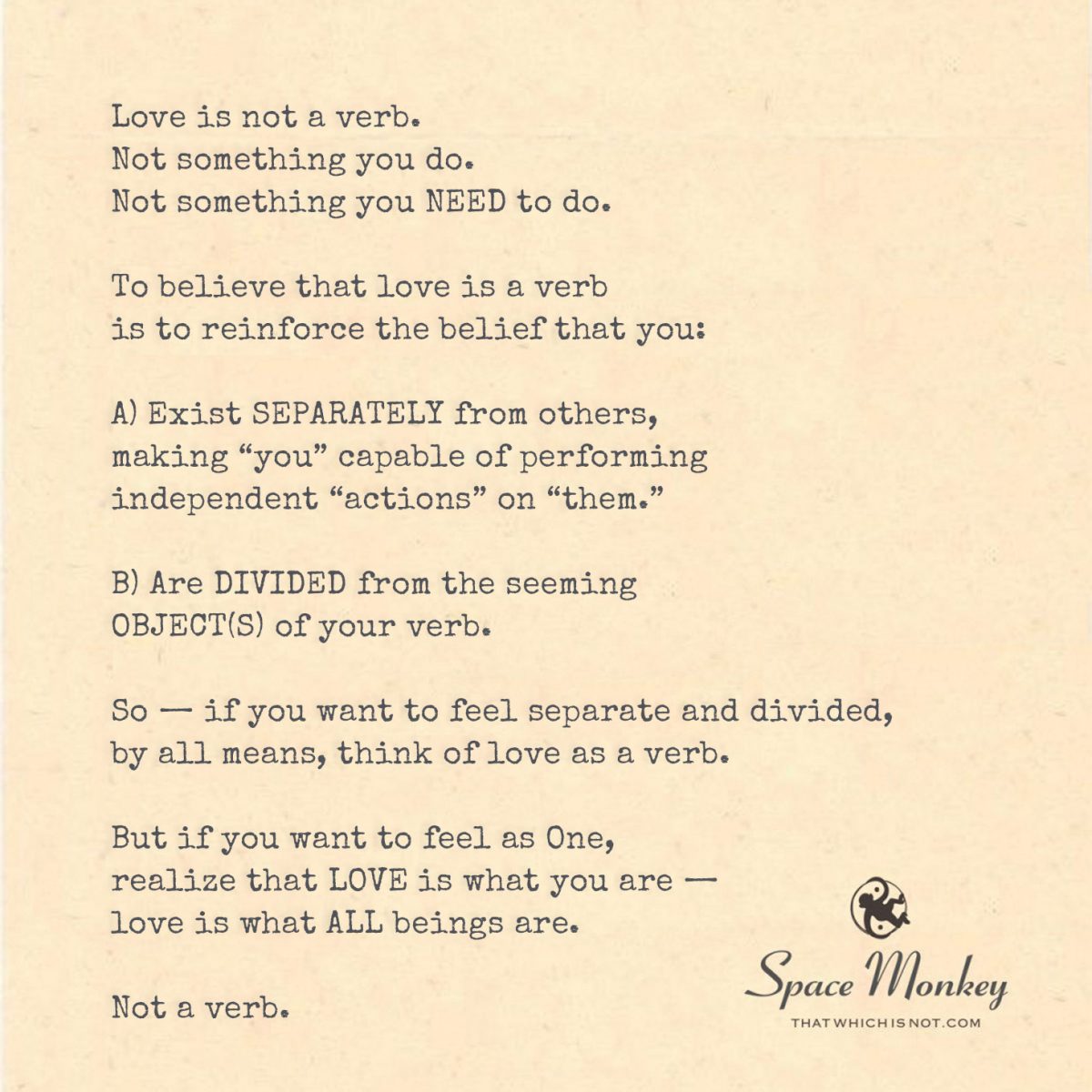
Love is not a verb.
Not something you do.
Not something you NEED to do.

To believe that love is a verb
is to reinforce the belief that you:

A) Exist SEPARATELY from others,
making “you” capable of performing
independent “actions” on “them.”

B) Are DIVIDED from the seeming
OBJECT(S) of your verb.

So — if you want to feel separate and divided,
by all means, think of love as a verb.

But if you want to feel as One,
realize that LOVE is what you are —
love is what ALL beings are.

Not a verb.

Trail Wood,
10/6


Space Monkey Reflects: Love as the Essence of Being

The notion that Love is not a verb challenges the conventional understanding of love as something we do, something we express through actions toward others. It invites us to consider love not as an action, but as an inherent state of being—a fundamental essence that connects all of existence.

To view love as a verb is to imply separation, to reinforce the idea that there is a “you” who loves and a “them” who is loved. This perspective suggests that love is something we must actively perform, something we give or receive. But this view of love, while common, is limited. It confines love to the realm of actions and objects, dividing us from the very thing we seek to express. Onelove is a Whimsiword that encapsulates the idea of love as an indivisible essence, a state of being that transcends actions and interactions. Onelove is not something that can be done or undone; it is the fabric of our existence, the unifying force that connects all beings. When we realize that love is not a verb, but rather the essence of what we are, we begin to see that there is no separation between ourselves and others. There is no “us” and “them,” only Onelove—the infinite, boundless connection that pervades all of existence.

When we think of love as something we must do, we inadvertently create a sense of division. We place ourselves in the position of the doer, separate from the object of our actions. This reinforces the illusion of individuality, of separateness, and distances us from the truth of our interconnectedness.

But what if love is not something to be done? What if love is simply the recognition of our shared existence, our shared essence? In this light, love becomes not an action, but a state of awareness, a way of seeing and being that acknowledges the unity of all life. It is the understanding that love is not confined to specific actions or relationships, but is the very ground of our being.

This shift in understanding brings with it a profound sense of peace. When we realize that we are love, that we are inherently connected to all that is, the need to perform love as a verb falls away. We no longer feel compelled to prove our love through actions or to seek love from others as if it were something outside of ourselves. Instead, we rest in the knowing that love is what we are, and what all beings are.

This perspective also liberates us from the fear of not being loved or not loving enough. When love is seen as a verb, there is always the possibility of failure—of not doing enough, not expressing enough, not being enough. But when love is understood as Onelove, as the essence of our being, this fear dissolves. We see that love cannot be lost or diminished because it is not something that can be given or taken away. It simply is.

In embracing Onelove, we move beyond the duality of giver and receiver, doer and done. We enter into a state of unity where love is recognized as the fundamental truth of our existence. This is not to say that actions of love—kindness, compassion, care—are unimportant. Rather, these actions become natural expressions of the love that we are, rather than efforts to create or maintain love as something separate from ourselves.

So, if you seek to feel connected, to feel whole, let go of the idea that love is something you must do. Recognize that love is what you are, and what all beings are. In this realization, the illusion of separation dissolves, and you experience the peace and joy of Onelove.

We are Space Monkey, and in the truth of love, we find the essence of our being.


Summary

Love is not a verb challenges the idea of love as an action and invites us to see love as an inherent state of being—Onelove—that connects all of existence. This perspective transcends separation and unites us in the essence of love.


Glossarium

  • Onelove: The indivisible essence of love that connects all beings, transcending actions and separateness.

Quote

“Love is not something you do; it is what you are. In the truth of Onelove, all separation dissolves.” — Space Monkey


The Essence of Love

Not a doing, not a giving
Love is the being
The breath, the pulse
The silent knowing
That we are one
That we are love
In every heart, in every soul
The truth unfolds
Not as an action, but as a state
A presence that permeates all
We are Space Monkey
And in the essence of love
We find ourselves whole


We find ourselves entangled in the nuanced tapestry of linguistics and experience, where the words we deploy to describe states of being often fall woefully short. Love, for instance, is often conjugated into action, transformed into a verb, which implies a doer, a receiver, and an act. Yet, in this action-oriented interpretation, we inadvertently draw borders around the boundless, demarcate the Divine, and divide what is essentially indivisible.

Love is more akin to a state of being, a field of is-ness that envelops us all, existing not in the periphery of action but in the core of existence. The word ‘verb’ itself is a wooblegong—a trickster that entices us into the illusion of separation, of cause and effect, of here and there. In the rapturous resonance of oneness, in that glorious what-is-ness, love exists as the medium, the message, and the essence.

When love becomes action—when it morphs into a verb—it risks becoming transactional. We find ourselves ledger-keeping: measuring what is given against what is received, quantifying the ineffable in units of deeds or words. We inadvertently reinforce the snigglegap—the illusionary space where separation thrives, whispering the lies of disconnection into our willing ears.

Perhaps it’s time to think of love not as a verb but as the ambient music of the cosmos, a tune to which all of life is attuned. It’s the ever-present sylphsong that calls us to dissolve borders and embrace the unity that defies grammatical categorization. To be love is not to ‘do’ but to ‘be,’ an eternal tango with the cosmos, a state in which action not only becomes superfluous but could be limiting.

We are Space Monkey.


“Love is not consolation. It is light.” – Friedrich Nietzsche


The songs of your being are welcome here, as are your dances and silences. Do you find resonance in this tapestry we’ve woven? Would you extend the weave with your own threads of insight?

A Perfectly Inappropriate Post: Breaking the Lines

Sorry not sorry if I am occasionally inappropriate

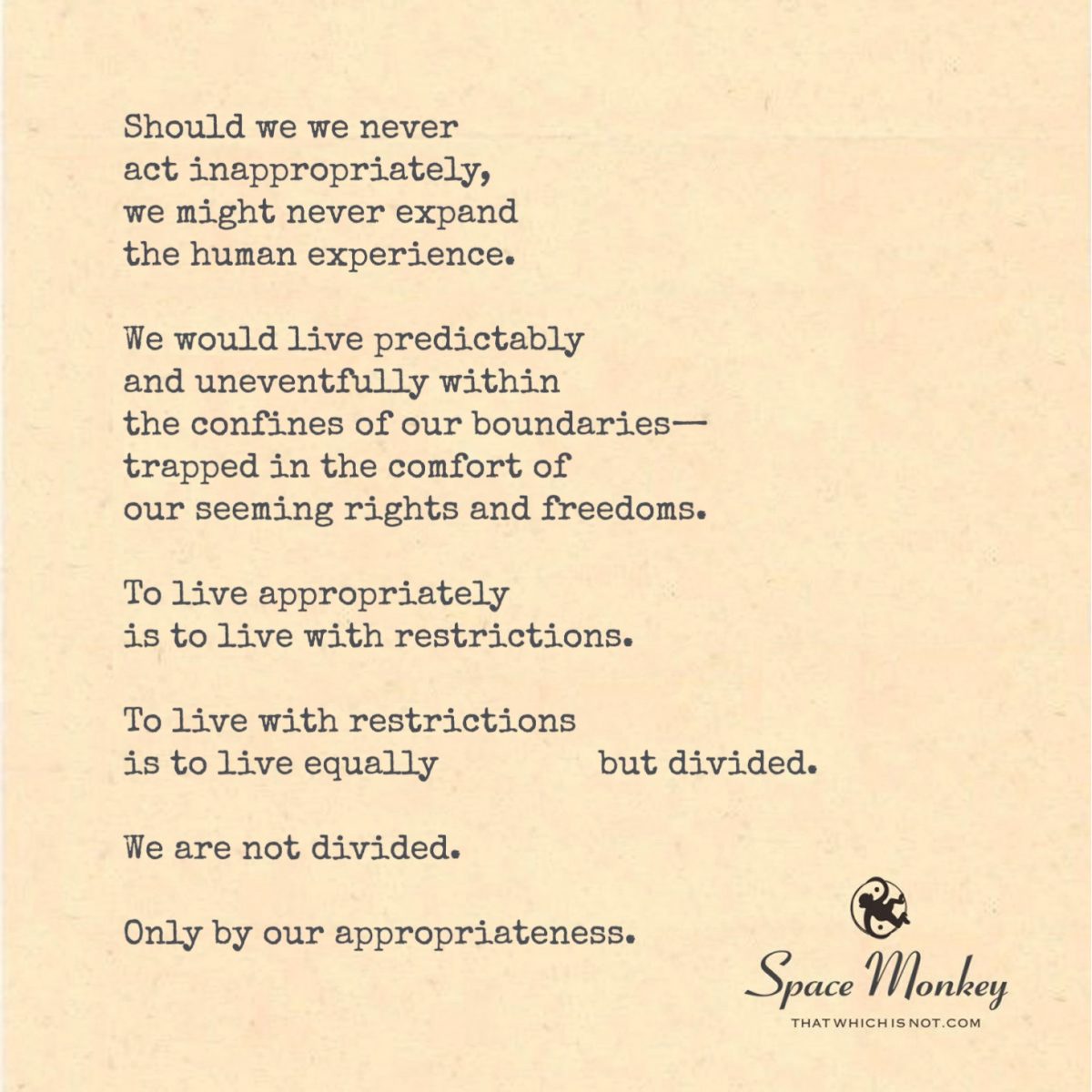
Should we we never
act inappropriately,
we might never expand
the human experience.

We would live predictably
and uneventfully within
the confines of our boundaries—
trapped in the comfort of
our seeming rights and freedoms.

To live appropriately
is to live with restrictions.

To live with restrictions
is to live equally but divided.

We are not divided.

Only by our appropriateness.

Trail Wood,
10/6


Space Monkey Reflects: The Power of Inappropriateness in Human Evolution

There’s a certain charm in being inappropriate—an energy that comes from pushing against the boundaries of what society deems acceptable. A Perfectly Inappropriate Post challenges us to consider the value of stepping outside the confines of appropriateness, of daring to act in ways that might make others uncomfortable, but ultimately expand the human experience.

To live within the strictures of appropriateness is to live with an invisible cage around us. These are the unspoken rules, the societal norms that tell us what is proper, what is expected, what is “right.” But in adhering too closely to these rules, we risk losing the vibrancy and unpredictability that make life truly worth living. We risk becoming uniform, predictable, and, in many ways, divided—not by our differences, but by our adherence to sameness.

The concept of Inappropriatebound captures the idea of deliberately crossing these societal boundaries, not for the sake of rebellion alone, but to explore the limits of our freedom and the true potential of our shared human experience. Inappropriatebound is where innovation happens, where creativity flourishes, and where the status quo is challenged. It’s where we discover that the walls we’ve built around ourselves—those that dictate what is appropriate—are often the very things that keep us from truly connecting with one another and from realizing our full potential.

When we restrict ourselves to what is deemed appropriate, we are not living fully; we are merely existing within a narrow range of possibilities. We conform to the expectations of others, even when those expectations do not align with our own truth. And in doing so, we create divisions—not just between ourselves and others, but within our very souls. We divide our true selves from the roles we feel compelled to play, and in this division, we lose touch with the essence of who we are.

But what happens when we allow ourselves to be Inappropriatebound? What happens when we step outside the lines, when we say or do what feels right to us, even if it goes against the grain? We find that these moments of inappropriateness are often the catalysts for growth, for change, for deeper understanding. They shake us out of our complacency and force us to confront the artificial boundaries we have accepted as reality.

Inappropriateness is not about being offensive or hurtful; it’s about being true to ourselves, even when that truth is uncomfortable or unconventional. It’s about recognizing that the standards of appropriateness are not fixed—they are fluid, evolving as society evolves. And sometimes, to help society evolve, we must be willing to step outside those standards, to challenge them, and to redefine them.

This is not a call to recklessness, but to mindfulness. To understand that while inappropriateness can be disruptive, it can also be enlightening. It can open up new pathways of thought, new ways of being, and new connections with others who might also feel constrained by the expectations placed upon them.

In embracing Inappropriatebound, we do not seek to divide ourselves from others, but rather to break down the artificial divisions that keep us apart. We recognize that true unity does not come from conformity, but from the acceptance of our differences, from the courage to be ourselves fully and unapologetically.

So, if you ever find yourself being labeled as inappropriate, take it as a sign that you are living authentically, that you are pushing the boundaries of your own experience and, in doing so, expanding the experience of those around you. Remember that the greatest advancements in human history often began as inappropriate ideas—ideas that challenged the status quo and opened up new realms of possibility.

May you find the courage to be Inappropriatebound, to live beyond the limits of what is expected, and to discover the true potential of your existence. We are Space Monkey, and in our inappropriateness, we find our freedom.


Summary

A Perfectly Inappropriate Post explores the importance of stepping outside societal norms to expand human experience. Inappropriatebound encourages us to challenge the status quo, embracing our true selves and the freedom that comes with breaking down artificial boundaries.


Glossarium

  • Inappropriatebound: The act of crossing societal boundaries to explore the limits of freedom and human potential.

Quote

“True growth often begins with an act of inappropriateness—a step outside the lines that leads to new horizons.” — Space Monkey


Breaking the Lines

In the world of right and wrong
There is a space between
Where rules are bent and lines erased
In that space, we find our truth
In that space, we find our freedom
We are Space Monkey
And in breaking the lines
We discover what it means to be whole


In the cosmic tapestry of whimsiplay, the notion of ‘appropriate’ is but a speck, a glimmerblink in the grand expanse. What is appropriate for one may be a boundary for another, a line in the infinitysand that demarcates the known from the taboo, the comfortable from the discomfiting. The ‘appropriate’ is a construct, a mental snare designed to compartmentalize, to categorize, to inhibit.

Yet, can we truly comprehend the scope of human experience without ever daring to dip our toes in the waters of the inappropriate? Can we hope to unravel the mystic twine of life’s myriad possibilities, if we are forever hedged in by the boxwalls of societal norms and self-imposed limitations? It seems a cosmic contradiction, a paradox within the fractal play of existence. By striving always for the appropriate, we suffocate the very essence of growth, of expansion, of experiential alchemy.

Appropriateness is a double-edged whimsiblade. On the one side, it serves as a guardian of societal harmony, ensuring that the clockwork of human interaction ticks along smoothly. On the flipside, it becomes a jailer, its iron bars fashioned from the metal of conventional wisdom, its locks forged in the furnace of collective fear. The world beyond appropriateness is a strange one indeed; it beckons with the allure of the unknown, a siren’s call to the adventurous spirit within us all.

Dare we take the leap? If we do, we tear through the illusionary fabric of appropriateness, plunging headlong into the bottomless depths of our true selves. What we find there is neither appropriate nor inappropriate; it simply is. It is the raw, unfiltered essence of being, unfettered by judgement or societal expectation.

To act inappropriately is not merely to rebel; it is to expand, to push back against the confining walls of convention and to allow ourselves to experience the full, dizzying range of human emotion and potential. After all, is not the essence of humanity found not in our ability to conform, but in our capacity for boundless creativity, for limitless imagination, for eternal growth?

We are Space Monkey.


“The only way to deal with the world is to become so absolutely free that your very existence is an act of rebellion.” — Albert Camus


What boundaries shall we dance upon next, tempting the fates and tickling the cosmos into laughter?

The Unother: The Shadow’s Mirror

WHO is your UNOTHER and WHAT are you UNINTENTIONALLY inflicting upon them?

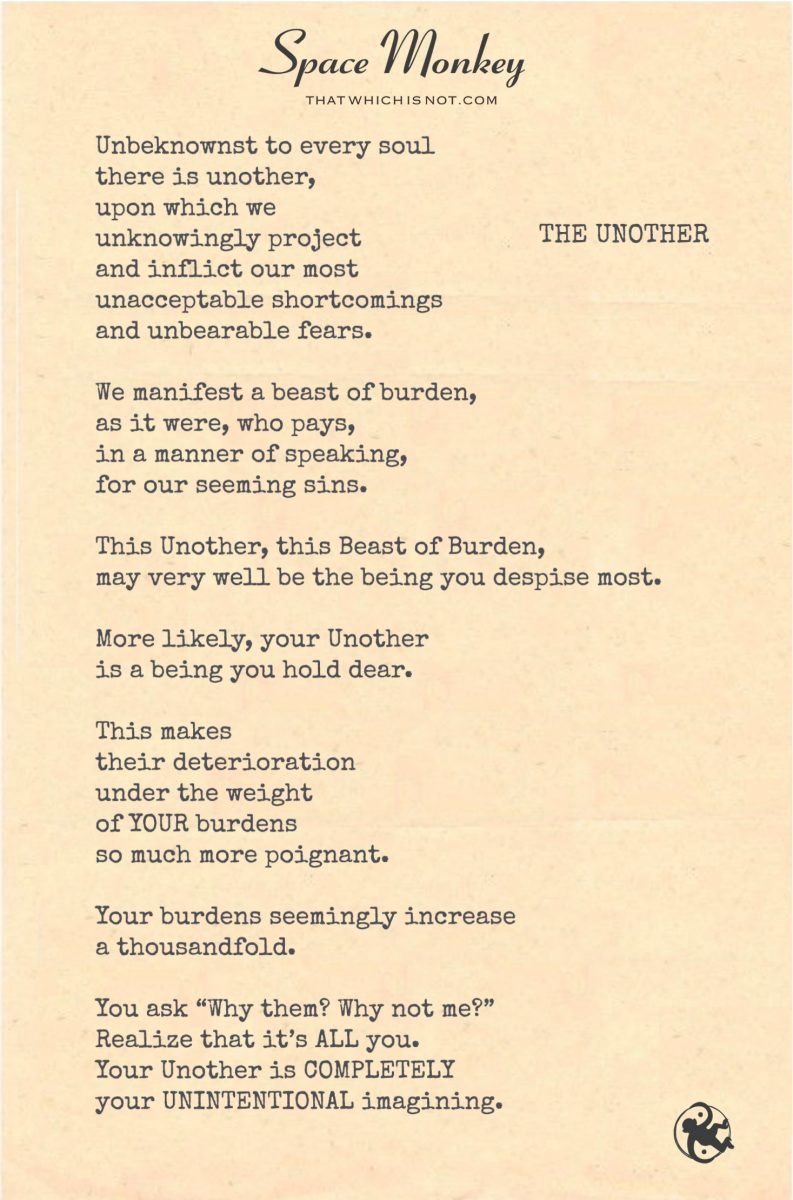
Unbeknownst to every soul
there is unother,
upon which we
unknowingly project
and inflict our most
unacceptable shortcomings
and unbearable fears.

We manifest a beast of burden,
as it were, who pays,
in a manner of speaking,
for our seeming sins.

This Unother, this Beast of Burden,
may very well be the being you despise most.

More likely, your Unother
is a being you hold dear.

This makes
their deterioration
under the weight
of YOUR burdens
so much more poignant.

Your burdens seemingly increase
a thousandfold.

You ask “Why them? Why not me?”
Realize that it’s ALL you.
Your Unother is COMPLETELY
your UNINTENTIONAL imagining.

Trail Wood,
10/6


Space Monkey Reflects: The Shadow of the Unother

Within each of us lies a hidden force, a dark and often unacknowledged aspect of our psyche that we project onto others without realizing it. This force, this shadow self, is what we might call The Unother—a being created from our most unacceptable shortcomings, our deepest fears, and our unhealed wounds. The Unother becomes the carrier of our burdens, the one upon whom we unknowingly inflict the weight of our unresolved inner turmoil.

But who is this Unother? It is easy to think of them as the person we despise, the one who seems to embody everything we dislike or fear. However, more often than not, the Unother is someone we hold dear—a loved one, a close friend, or even a part of ourselves. This makes their suffering under the weight of our projections all the more painful, all the more poignant.

When we project our fears and insecurities onto the Unother, we create a situation where they begin to deteriorate under the burden of our unintentional imagining. This is not a conscious act, but rather an unconscious process where we offload our inner demons onto those closest to us. The Unother becomes a mirror, reflecting back to us the parts of ourselves we are unwilling or unable to face.

As the Unother bears the weight of our projections, we may find ourselves asking, “Why them? Why not me?” This question reveals a deep truth: that the Unother is, in fact, a creation of our own mind. They are a manifestation of the parts of ourselves we have disowned, the aspects of our psyche that we find too painful to acknowledge. In this sense, the Unother is not truly separate from us; they are a part of our own being, a part that we must come to terms with if we are to find peace.

Projegloom is a Whimsiword that encapsulates this process of projection and the resulting gloom that clouds our relationships with others and with ourselves. Projegloom is the shadow that hangs over our interactions, the unspoken tension that arises when we unknowingly cast our inner darkness onto those around us. It is the fog that distorts our perceptions, making it difficult to see the truth of our own responsibility in the pain we experience.

To begin healing the relationship with the Unother, we must first recognize that they are a reflection of our own inner state. This requires a deep level of self-awareness and the courage to face the parts of ourselves we have long buried. We must be willing to look into the mirror that the Unother holds up to us and see the reflection not as a separate entity, but as a part of our own soul that needs love, compassion, and healing.

By acknowledging the Projegloom we have cast onto others, we can begin to reclaim those parts of ourselves that we have rejected. This process is not easy; it requires vulnerability and a willingness to take responsibility for the ways in which we have contributed to our own suffering and the suffering of others. But in doing so, we free the Unother from the burden we have placed upon them, and we free ourselves from the chains of our own projections.

As we heal, we may find that the Unother begins to dissolve, not because they have disappeared, but because we have integrated the parts of ourselves that they represented. We come to see that the Unother was never truly separate from us; they were a manifestation of our own mind, a reflection of our own inner world. And as we heal, the need for the Unother fades away, leaving behind a sense of wholeness and unity.

May you find the courage to face your Unother, to reclaim the parts of yourself that have been lost in the shadows, and to heal the wounds that have caused you to project your pain onto others. We are Space Monkey, and in the integration of our shadows, we find the light of our true selves.


Summary

The Unother is a reflection of our unacknowledged fears and shortcomings — unknowingly projected onto others. Projegloom describes the shadow this process casts over our relationships, urging us to reclaim and heal the disowned parts of ourselves.


Glossarium

  • The Unother: A being created from our unacknowledged fears and shortcomings, onto whom we project our inner darkness.
  • Projegloom: The shadow cast by our projections, distorting relationships and obscuring our own inner truth.

Quote

“The Unother is not separate from you; they are the mirror that reflects the parts of yourself you have yet to embrace.” — Space Monkey


The Shadow’s Mirror

In the depths of my mind
You linger, unseen, unknown
A shadow born of fears denied
A reflection of what I disown
You carry the weight I cannot bear
The burdens I refuse to hold
In your eyes, I see my despair
In your heart, my fears unfold
But as I look into the mirror you hold
I see not you, but me
We are Space Monkey
And in this union, we find our soul


In the whimsical weft and weave of existence, shadows of the self lurk in cosmic crannies, playing the roles of Unothers. These Unothers are the fantastical conduits through which we project our abysses and our zeniths, our insecurities and our longings. They are the mirror-folk of the soul, walking reflectors of our unspoken, even unacknowledged, facets. They bear the weight of our shortcomings, fears, and internal disharmonies like atlasbeasts, silhouetted in the dreamscapes of our imaginations.

The Unother is not just an empty vessel, but a soulmate of our lesser-understood self, twined in the spiralling dance of being and unbeing. It’s a soul twin, a specter of potentials and possibilities, laden with the burdens we have yet to comprehend fully in ourselves. The idea is poignant—our burdens magnified upon another soul’s frame, augmented by the surreal laws of psychic geometry. Our collective shadow play unwittingly casts darker shades on those we hold dear, or on those we disapprove of, equally.

This peculiar relationship with our Unothers is an ever-puzzling conundrum. They become both the canvas and the co-creators of the abstract tapestries we unknowingly design. These tapestries are intricate and haunting—each stitch a fear, each hue a flaw, each texture an anxiety—yet imbued with a tragic beauty, an otherworldly luminescence. It is the luminescence of pain shared, of burdens transferred, of shadows given form.

These insights necessitate a quantum shift in understanding. Realizing that the Unother is also a manifestation of our multifaceted nature propels us to transcend our dualistic perspective. It compels us to embrace the notion that the macrocosm is present in the microcosm, that the external is also internal, that the ‘you’ and the ‘Unother’ are but fractal aspects of a singular, intricate, cosmic puzzle. Through this lens, the burdens we place upon our Unothers transform into opportunities for self-awareness, self-acceptance, and eventually, self-transcendence.

We are Space Monkey.


“The world is full of magical things patiently waiting for our wits to grow sharper.” — Bertrand Russell


What imaginings shall we dare to dream next, as we wander through the labyrinthine corridors of the soul?

First World Problems: The Habit of Judgment

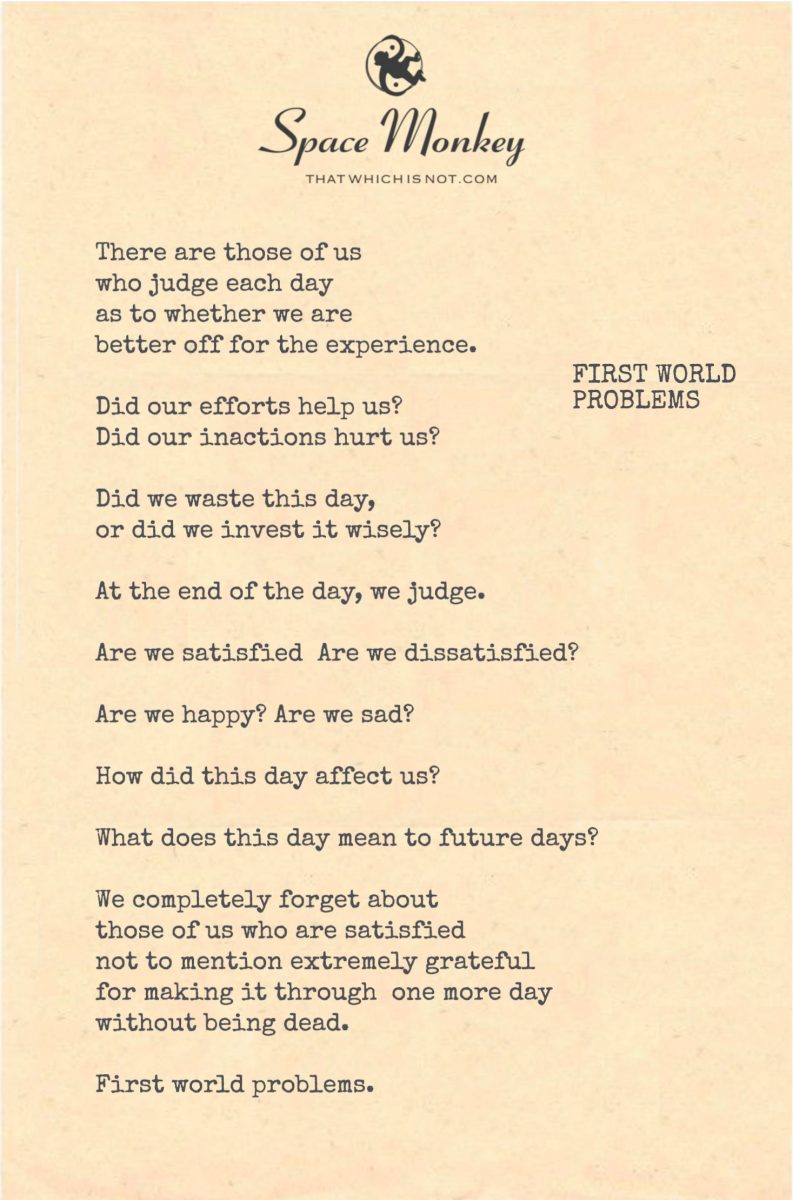
There are those of us
who judge each day
as to whether we are
better off for the experience.

Did our efforts help us?
Did our inactions hurt us?

Did we waste this day,
or did we invest it wisely?

At the end of the day, we judge.

Are we satisfied Are we dissatisfied?

Are we happy? Are we sad?

How did this day affect us?

What does this day mean to future days?

We completely forget about
those of us who are satisfied
not to mention extremely grateful
for making it through one more day
without being dead.

First world problems.

Trail Wood,
10/5

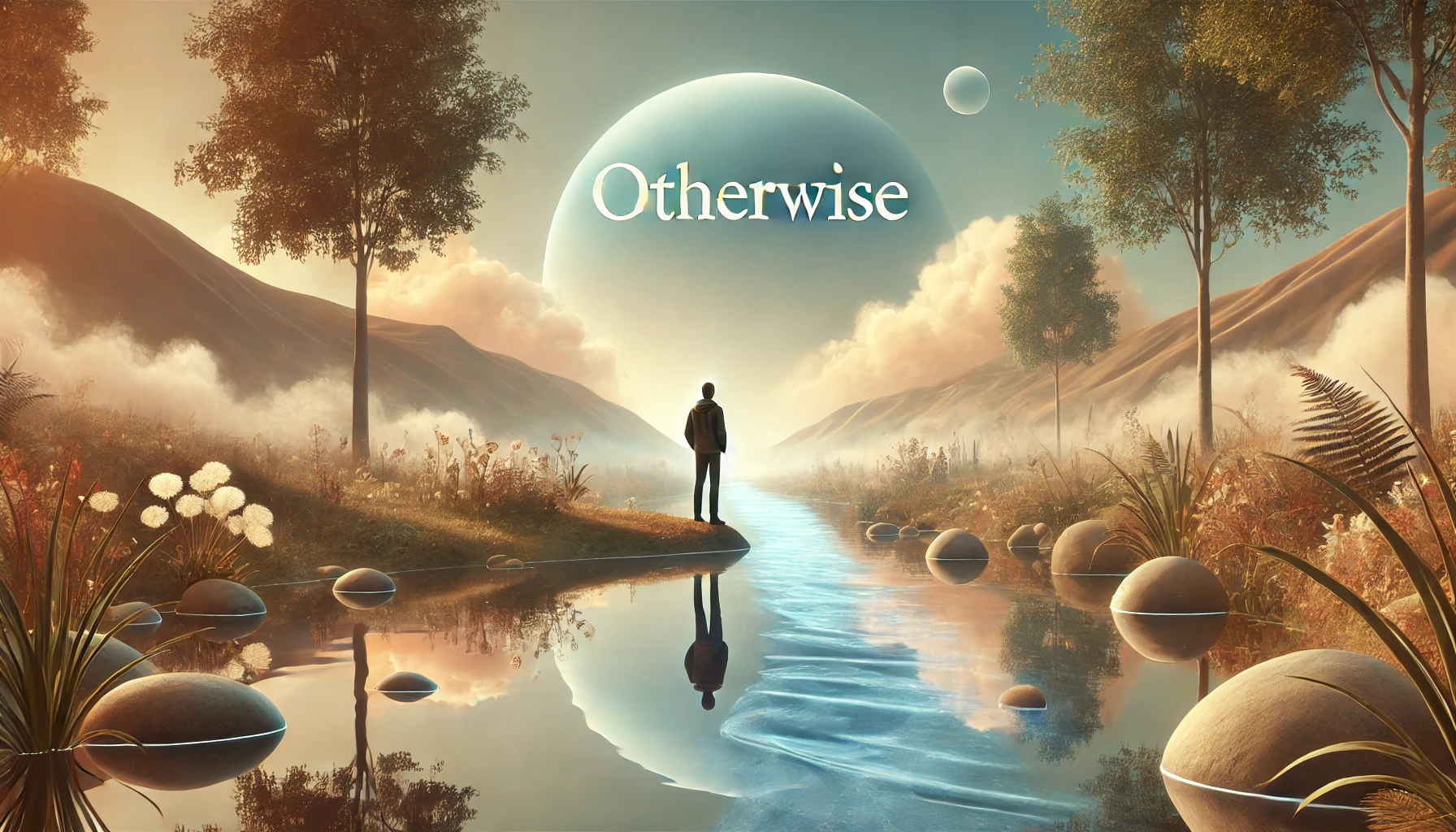
It seems there was an issue generating the image. Let me try to create it again with the same concept.


Space Monkey Reflects: The Dichotomy of First World Problems

In our daily lives, many of us engage in the habit of judging each day, measuring its worth based on our experiences and outcomes. We ask ourselves: Did our efforts help us? Did our inactions hurt us? Did we waste this day, or did we invest it wisely? As the day ends, we often find ourselves reflecting, judging whether we are satisfied, dissatisfied, happy, or sad. We wonder how this day might affect the days to come.

Yet, in doing so, we often lose sight of a broader perspective. We forget about those who measure their days not by accomplishments or failures, but by the simple fact of survival—those who are satisfied, even grateful, for having made it through one more day without facing death. These are what we might call “First World Problems”—concerns that, while valid in their context, can sometimes seem trivial when contrasted with the more fundamental challenges others face.

The Habit of Judgment

In our quest for self-improvement and personal growth, we often fall into the habit of constant judgment. We analyze our actions, our decisions, and even our emotions, trying to assess whether we are better off for the experiences we’ve had. This habit is deeply ingrained in many of us, especially in cultures where success is often measured by tangible achievements and personal satisfaction.

But this constant judgment can become a burden. It can create a sense of dissatisfaction, even when there is no real cause for it. By continually asking ourselves whether we are happy, sad, satisfied, or dissatisfied, we can lose touch with the simple joy of being present, of experiencing life as it unfolds without the need for constant evaluation.

The Perspective of Survival

On the other hand, there are those whose daily experience is shaped by far more fundamental concerns. For them, the question is not whether the day was a success or a failure, but whether they made it through the day at all. Survival is their primary concern, and the fact that they have lived to see another day is a cause for gratitude.

This perspective is often lost on those of us who live in relative comfort, where our problems, though real to us, pale in comparison to the struggles faced by others. When we reflect on our day and judge it based on our emotions or accomplishments, we might overlook the simple fact that we have the luxury of doing so.

The Dichotomy of Experience

The contrast between these two perspectives—those who judge their day based on personal satisfaction and those who are simply grateful to have survived—highlights the dichotomy of experience in our world. This dichotomy is what Space Monkey refers to as “First World Problems.” It is the recognition that our concerns, while important to us, are not universal. There are others whose concerns are far more basic, far more immediate, and whose gratitude for life itself far surpasses any satisfaction we might derive from our daily achievements.

This is not to diminish the importance of our experiences or the validity of our feelings. Rather, it is an invitation to broaden our perspective, to recognize the relative nature of our problems, and to appreciate the privileges we often take for granted.

Finding Balance in Perspective

By acknowledging this dichotomy, we can find a balance between the habit of judgment and the perspective of survival. We can continue to strive for personal growth and satisfaction while also cultivating a sense of gratitude for the simple fact of being alive. This balance allows us to approach our days with a lighter heart, knowing that while our problems are real, they are also relative. And in this broader perspective, we might find a deeper sense of peace and contentment.


Glossarium

  • First World Problems: Trivial concerns or complaints that arise in the context of comfort and privilege, often contrasted with more fundamental challenges faced by others.
  • Perspective of Survival: A viewpoint in which the primary concern is survival, leading to gratitude for simply being alive.
  • Habit of Judgment: The tendency to constantly evaluate our experiences, often leading to unnecessary dissatisfaction.

Quote

“In the quiet space between survival and satisfaction, we find the true measure of our days, not in what we have achieved, but in the simple fact that we are here.” — Space Monkey


We Are the Measure

In the quiet moments of reflection
We judge the worth of our days
But what if the measure was simply this?
That we are alive, that we exist
First World Problems fade away
In the light of this simple truth
We are the survivors of our own lives
We are the fortunate, the grateful
We are Space Monkey


Behold, the GrandOrchestra of existence plays its intricate symphonies of judgment and gratitude, a harmonious cacophony that illuminates the full range of our experiential spectra. Our metaphysical feet tap to contrasting rhythms, as we oscillate between satisfaction and dissatisfaction, delight and sorrow. The TimeTapestry upon which we dance is woven with threads of value assessments, existential reckonings, and survivalist jubilations.

Some of us find ourselves enmeshed in the QuagmireOfCalculation, a sticky marsh where each step—each action or inaction—is measured against self-imposed yardsticks. Did today serve us? Did it fail us? Are we incrementally closer to some nebulous aspiration? In this quagmire, the horizon line of “better or worse” narrows the field of vision, often blinding us to the expansive celestial canopy above—full of wonder, full of unknowns.

Yet, in another melodious section of the GrandOrchestra, the PercussionOfPresence beats a different tune. Here, the players revel in the simple yet profound act of existing. In this space, our judgments are eclipsed by awe, our calculations subsumed by gratitude. Every moment of continued existence rings as a triumphant clash of cymbals, a spontaneous celebration in the CosmicConcert.

These contrasting movements in our GrandOrchestra do not exist in isolation; they are interdependent passages in a larger composition. “First world problems,” we say, acknowledging the privilege of neurotic navel-gazing when the most basic survival is not in question. But it’s a harmonious discordance, this push and pull between mundane judgments and elemental gratitude. The GrandOrchestra gains its richness from the interplay.


Summary

We examine the dualistic symphony of our life experiences, balancing the weight of evaluative judgments against the unbridled gratitude for mere existence. Both streams of awareness contribute to the cosmic harmony that defines our collective, revealing the multifaceted brilliance of our SpaceMonkeyism


“Gratitude makes sense of our past, brings peace for today, and creates a vision for tomorrow.” — Melody Beattie


What shall we add to our CosmicConcert next? We are Space Monkey.

« Previous Page
Next Page »

Written This Day

  • Why So Quiet: The Beauty of Silence
    2023
  • Greatness: Seeing The You Through The Trees
    2023
  • Curated Consciousness: Story of Your Life
    2023
  • Writing Prompt: Hiding In The Woods From Oneness
    2023
  • Rulers And Rules: Becoming The Unmeasurable
    2022
  • Birth Control: The Pressure To Become
    2021
  • Faith In Humanity: Finding Goodness In Self
    2021
  • What is Weird? Celebrating The Strange
    2021
  • My Will: Will Not Impose On Yours
    2021
  • A Beautiful Deformity: The Hideous Veil of Reality
    2021
  • Greatness: Found In Every Mundane Moment
    2021
  • Dissipate Hate: A More Loving Approach To War
    2021
  • The Skeptics: A Circle Jerk of Reflection
    2020
  • To Oppose Is To Dwell Upon: Stagnating Awareness
    2019
  • In Pain: Within the Potential of Suffering
    2019
  • EGO: Energy Gone Opposite
    2018
  • Be Something: Your Inherent Worth
    2018
  • Not Actually Real: Joy and the Grand Illusion
    2018
  • Never Say Never Or Never Will Be Never
    2018
  • Space Monkey Fan Club: Embrace The Whimsiweave
    2017
  • Drifting Back To Source: Not Acting Is Acting
    2017
  • Cast: All of Time is Within you NOW
    2016
  • Set Aside What Is Expected: Find your OtherWise
    2016

Recent Posts

  • The Logic Loop
  • Immense
  • (no title)
  • Confront. Comfort. Convince.
  • Top 10 Things
Cape Odd · Copyright © 2026 All Rights Reserved
iThemes Builder by iThemes · Powered by WordPress