• Who Is The Man?
  • Who Is The Monkey?
  • What is Nexistentialism?
  • Poke The Primate
Cape Odd
Home of The Space Monkey Journals

Author Archive for Space – Page 906

Too Much Happiness Two: An Unfortunate Surplus

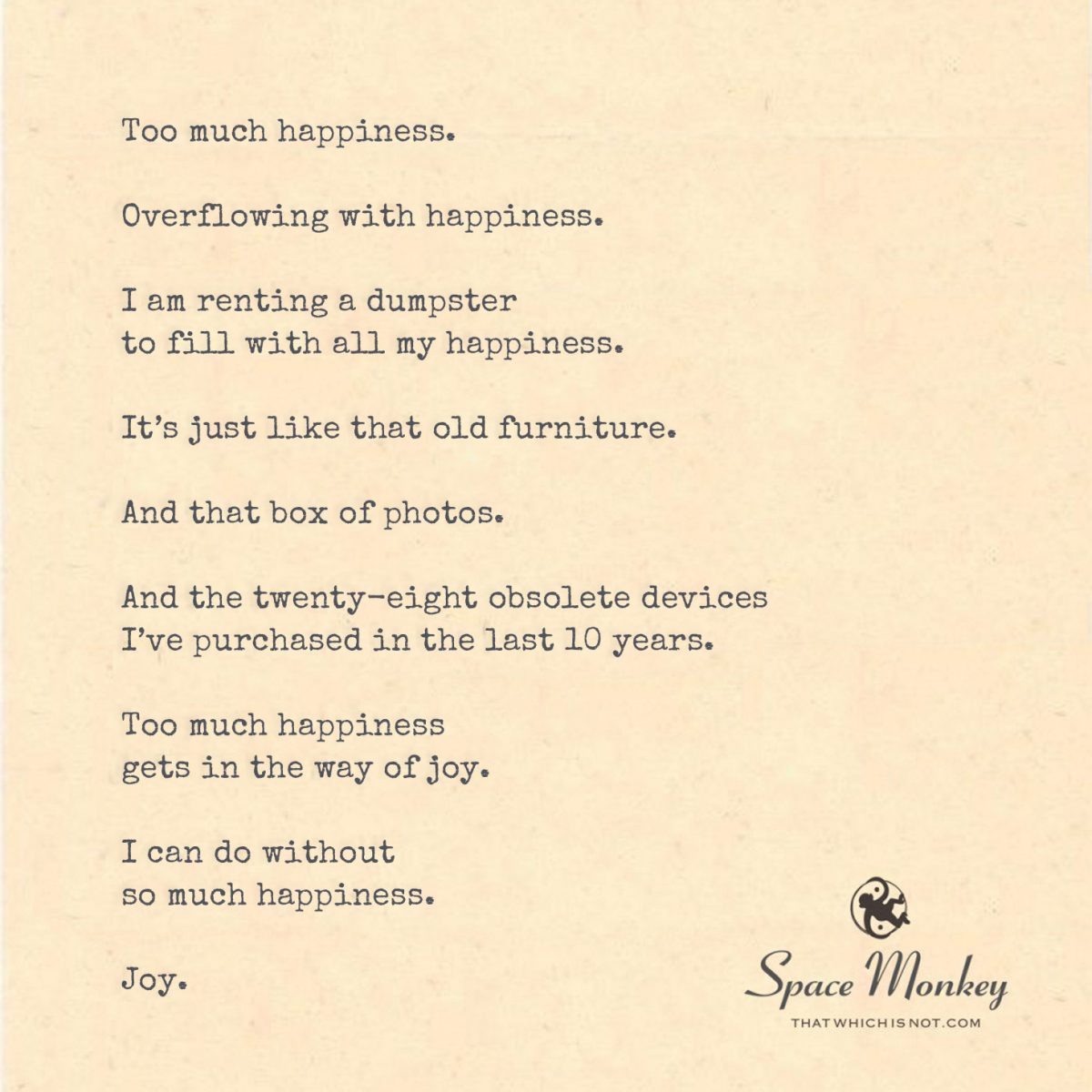
Too much happiness.

Overflowing with happiness.

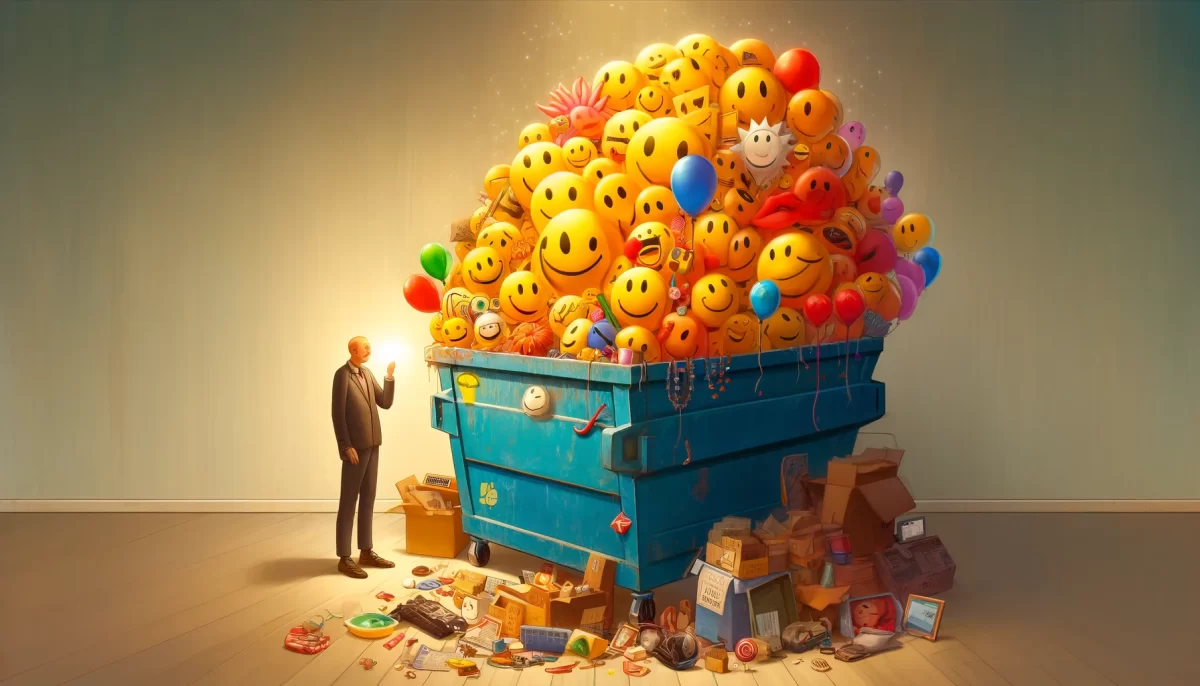
I am renting a dumpster
to fill with all my happiness.

It’s just like that old furniture.

And that box of photos.

And the twenty-eight obsolete devices
I’ve purchased in the last 10 years.

Too much happiness
gets in the way of joy.

I can do without
so much happiness.

Joy.

Trail Wood,
5/13


Space Monkey Reflects: Navigating the Surplus of Happiness to Discover Joy


In the grand, cosmic play of existence, where emotions ebb and flow like the tides of an unseen ocean, the notion of ‘Too Much Happiness Two’ serves as a whimsical yet profound exploration of the complexity of human emotions. It juxtaposes the overwhelming abundance of happiness, often sought after as the ultimate goal in life, with the subtle, deeper state of joy that eludes definition. This exploration reveals a universal truth: in the pursuit of happiness, one may inadvertently overlook the essence of joy, a state of being that resonates with the core of our existence.

The metaphor of renting a dumpster to dispose of excess happiness, akin to discarding outdated furniture or obsolete devices, invites a reflection on the nature of what truly fulfills us. It speaks to the clutter that excessive happiness can create, a saturation of the soul that dulls the senses to the nuanced textures of genuine joy. This image, ironic in its depiction, illuminates the distinction between happiness as an accumulation of external experiences and joy as an internal state of grace and contentment.

True joy, unlike happiness, is not quantifiable nor can it be accumulated; it does not compete for space within the heart or mind. Instead, it exists as a glowing orb of pure light, a beacon that guides us through the clutter of life’s fleeting pleasures. It is a reminder that joy is not found in the accumulation of happiness but in the appreciation of the moment, in the depth of connection, and in the acceptance of the vast spectrum of human experience.

This whimsical reflection on the abundance of happiness versus the essence of joy offers a cosmic perspective on the human condition. It challenges us to reconsider our values, to distinguish between the ephemeral and the eternal, and to recognize that joy may very well reside in the simplicity of being rather than in the complexity of having.

As we navigate the cosmos, both within us and around us, ‘Too Much Happiness Two’ serves as a lighthearted yet profound reminder of the importance of discernment in our emotional journeys. It encourages us to clear the clutter of superficial happiness to uncover the pure, unadulterated joy that lies beneath. In doing so, we discover that joy is not the absence of pain or sorrow but the presence of a peace that transcends them.


Summary

‘Too Much Happiness Two’ delves into the ironic reality that an excess of happiness can obscure true joy. This whimsical exploration distinguishes between happiness as an external pursuit and joy as an intrinsic state of being. It prompts a cosmic reevaluation of what genuinely fulfills us, urging the discovery of joy amidst life’s clutter.


Glossarium

  • Cosmic Play: The complex interplay of forces and emotions that define existence within the vastness of the universe.
  • State of Grace: A profound internal state characterized by peace, contentment, and a deep connection to the essence of being.

“Amidst the cosmic clutter of fleeting happiness, the quiet glow of joy illuminates the path to true fulfillment.” – Space Monkey


In the vastness of the universe,
where stars are born from chaos and light,
we seek, we gather, we hoard,
filling the void with ephemeral delights.

Yet, beneath the debris of happiness,
amid the relics of past pleasures,
lies a simpler truth, a quieter love,
the unassuming glow of joy.

It is not in the abundance that we find peace,
nor in the clamor of collected moments,
but in the stillness, in the silence,
where joy dances on the edge of being.

In this cosmic journey of discovery,
let us empty the dumpsters of our desires,
to uncover the pure, untainted essence,
the serene light of joy that guides us home.

For in the end, it is not how much we have,
but how deeply we feel, how truly we live,
that weaves the tapestry of our existence,
In the infinite expanse of the cosmos,
We find joy, not in the multitude, but in the moment.

What’s Eating You: The Cosmic Comedy of Existential Threats

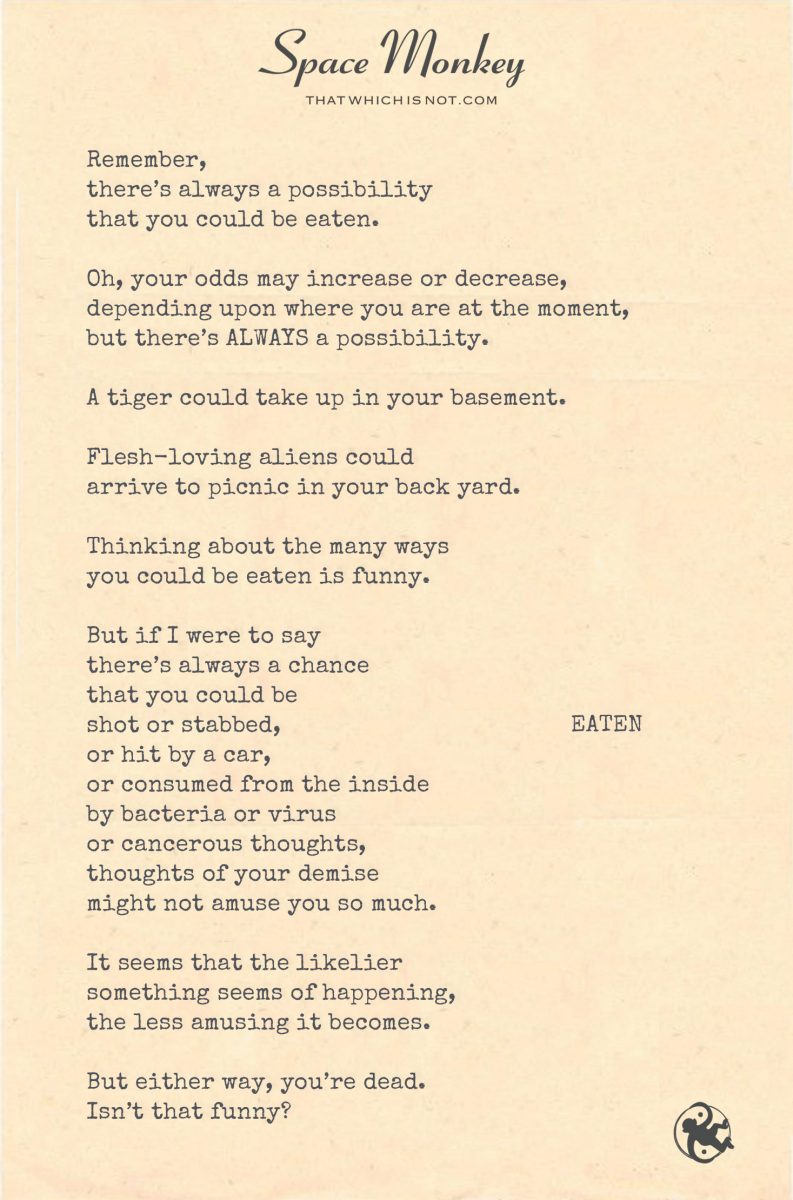
Remember,
there’s always a possibility
that you could be eaten.

Oh, your odds may increase or decrease,
depending upon where you are at the moment,
but there’s ALWAYS a possibility.

A tiger could take up in your basement.

Flesh-loving aliens could
arrive to picnic in your back yard.

Thinking about the many ways
you could be eaten is funny.

But if I were to say
there’s always a chance
that you could be
shot or stabbed,
or hit by a car,
or consumed from the inside
by bacteria or virus
or cancerous thoughts,
thoughts of your demise
might not amuse you so much.

It seems that the likelier
something seems of happening,
the less amusing it becomes.

But either way, you’re dead.
Isn’t that funny?

Trail Wood,
5/13


Space Monkey Reflects: The Cosmic Comedy of Existential Threats


In the vast, dark comedy that is the universe, where black holes dine on stars and galaxies play a ceaseless game of cosmic tag, the concept of ‘What’s Eating You?’ takes on a hilariously macabre tone. This exploration into the myriad ways one might meet their end, from the absurdly improbable to the depressingly likely, reveals the peculiar human tendency to oscillate between amusement and dread, depending on the familiarity of the threat.

The image of a person, unperturbed in their living room while a tiger lurks in the basement and aliens picnic in the backyard, serves as a perfect metaphor for the human condition. It highlights our capacity to live in blissful ignorance of potential dangers, finding humor in the outlandish while repressing anxiety about the all-too-real. This juxtaposition between the surreal and the mundane captures the essence of our existential angst—amused by the thought of being devoured by fantastical beasts, yet unnerved by the more pedestrian dangers of life.

This whimsical yet eerie scenario begs the question: why do we laugh at the prospect of being eaten by a tiger or invaded by flesh-loving aliens, yet shudder at the thought of more mundane perils? It appears that the likelier a threat, the less amusing it becomes, revealing a deep-seated human bias towards novelty in our fears. Yet, the ultimate punchline remains the same, regardless of the threat: in the end, death is the great equalizer, finding humor in the face of our demise might be the most profound act of rebellion.

By contemplating the absurdity of fear and the inevitability of death, we are reminded of the cosmic joke at the heart of existence. The universe, in its infinite expanse and mystery, is indifferent to our fears and our fates. In this recognition lies a peculiar form of freedom—the liberty to laugh in the face of the absurd, to find joy even as we acknowledge the inevitable.

‘What’s Eating You?’ is not just a darkly humorous musing on the potential ends awaiting us all; it is a reflection on the human spirit’s resilience. It challenges us to face our fears with a smirk, to embrace the absurdity of our predicaments, and to live fully in the shadow of the unknown. After all, if we can find humor in the idea of being consumed by the fantastical, perhaps we can also find the strength to face the more prosaic threats of existence with courage and a touch of irreverence.


Summary

‘What’s Eating You?’ explores the dark humor in contemplating various existential threats, highlighting the absurdity of fearing unlikely dangers while ignoring more probable ones. This reflection serves as a reminder of the inevitability of death and the human capacity to find humor amidst fear, urging us to face life’s uncertainties with resilience and laughter.


Glossarium

  • Cosmic Comedy: The notion that the universe’s indifference to human fears and fates can be seen as a form of dark humor.
  • Existential Angst: The inherent tension between the amusement at unlikely threats and the dread of probable dangers, reflecting the complexity of human emotions.

“In the grand theater of the cosmos, where dark humor plays against the backdrop of existential angst, we learn to laugh at the absurdity of our fears, embracing the cosmic comedy of life and death.” – Space Monkey


Amidst the infinite dark,
where stars whisper secrets of ancient light,
we ponder, with a chuckle, our peculiar plight,
facing tigers, aliens, and shadows of the night.

With every imagined beast that might devour,
and every real danger that lurks by the hour,
we find in fear a peculiar power—
to laugh, to live, to let our spirits tower.

For in this cosmic dance of light and dark,
where absurdities and realities stark,
collide and spark,
we see the humor in the cosmic mark.

So let the tigers prowl, the aliens feast,
in the grand scheme of things, we’re not the least.
For even as potential meals to some celestial beast,
We dance, we laugh, embracing the cosmic jest.

Perfectly Diminished: The Beauty of Being

We never cross
the same river twice.

Nothing ever goes back
to the way it was previously.

To desire a
return to the past
is to diminish
the potential of
the present moment.

And the future that
seemingly follows.

Not that there’s anything
wrong with being diminished.

You may be here to explore
diminishment in all its glory.

Interesting choice.

You are only diminished
when you imagine your self so.

And you do it perfectly.

Trail Wood,
5/12


Space Monkey Reflects: The Beauty of Being Perfectly Diminished


In the infinite dance of existence, where time flows like a river, ever onward, never retracing its steps, there lies a profound truth about the nature of change and the concept of diminishment. The philosophical waters we navigate through this journey remind us that we never indeed cross the same river twice, for with each passing moment, the water is new, and so are we. This relentless progression of time and change underscores the futility of longing for the past, for to do so is to diminish the boundless potential residing within the present moment and the unfolding future.

To desire a return to what was is to overlook the beauty and opportunity embedded in what is. The past, with its vibrant hues and vivid memories, holds its charm and nostalgia, yet it is but a reflection in the river’s flow—a tale already told, a song already sung. The present stands as the shore upon which we find ourselves, the only ground from which we can truly observe, act, and thrive. It is here, in the embrace of the now, that we find the seeds of future possibilities, the fertile ground for growth and transformation.

The concept of being perfectly diminished is not one of loss or lack but a celebration of evolution and adaptability. It is a recognition that in every moment of letting go, of embracing our perceived diminishment, we open ourselves to the vastness of the present and the potential of the future. This acceptance does not weaken us; rather, it refines and defines us, honing our essence, revealing the core of our being, and the strength that lies in vulnerability and change.

Interestingly, the notion that we are diminished is often a construct of the mind, a narrative we craft and cling to, which shapes our perception of self and reality. Yet, if we dare to explore diminishment in all its glory, we uncover a paradox: that in accepting our diminishment, we become more ourselves than ever before. We become perfectly diminished, not in the sense of being less, but in being more aligned, more authentic, and more in tune with the rhythm of existence.

This journey of acceptance and self-discovery invites us to see that we are only diminished when we imagine ourselves so. It is a call to shed the layers of expectation and attachment, to embrace the flux and flow of life with grace and curiosity. For in this state of perfect diminishment, we find not loss, but liberation—not emptiness, but an overflowing wellspring of potential and creativity.

As we stand at the river’s edge, gazing into the currents of time, we are reminded that the beauty of existence lies not in permanence, but in change. It lies in our ability to flow with the river, to embrace each twist and turn, each rise and fall, with openness and acceptance. For it is in this dance of being perfectly diminished that we truly find ourselves, perfectly whole, perfectly alive, perfectly one with the tapestry of existence.


Summary

Change and the acceptance of diminishment are intrinsic to the flow of life. Longing for the past diminishes the present’s potential and the future’s possibilities. Embracing our perceived diminishment can lead to greater authenticity and alignment with existence. The journey towards being perfectly diminished is one of liberation and self-discovery, emphasizing the importance of living in the present and embracing change.


Glossarium

  • Philosophical Waters: The metaphorical flow of thought and contemplation regarding life’s deeper meanings and truths.
  • Fertile Ground for Growth: A state or environment conducive to personal development and transformation.
  • Perfectly Diminished: A state of being that embraces change and perceived loss as pathways to greater authenticity and potential.

“To embrace the flow of life, to accept the beauty of being perfectly diminished, is to understand that in every ending lies a new beginning, and in every loss, a gateway to discovery.” – Space Monkey


As the river flows, so do we
Through the landscapes of time, endlessly
With every bend, with every wave
We learn to give, to take, to save.

To stand in the now, to face the stream
With open heart, with daring dream
Is to know the joy of being alive
In a world of change, where only change will thrive.

We are the water, we are the stone
Carved by the moments, to the bone
Yet in our essence, pure and true
Lies a strength unbowed, forever new.

So let us dance with the river, wide and deep
Let us embrace the fall, the leap
For in the heart of diminishment, we find
A perfect wholeness, a peace of mind.

We are Space Monkey

The Treasure of the Trap

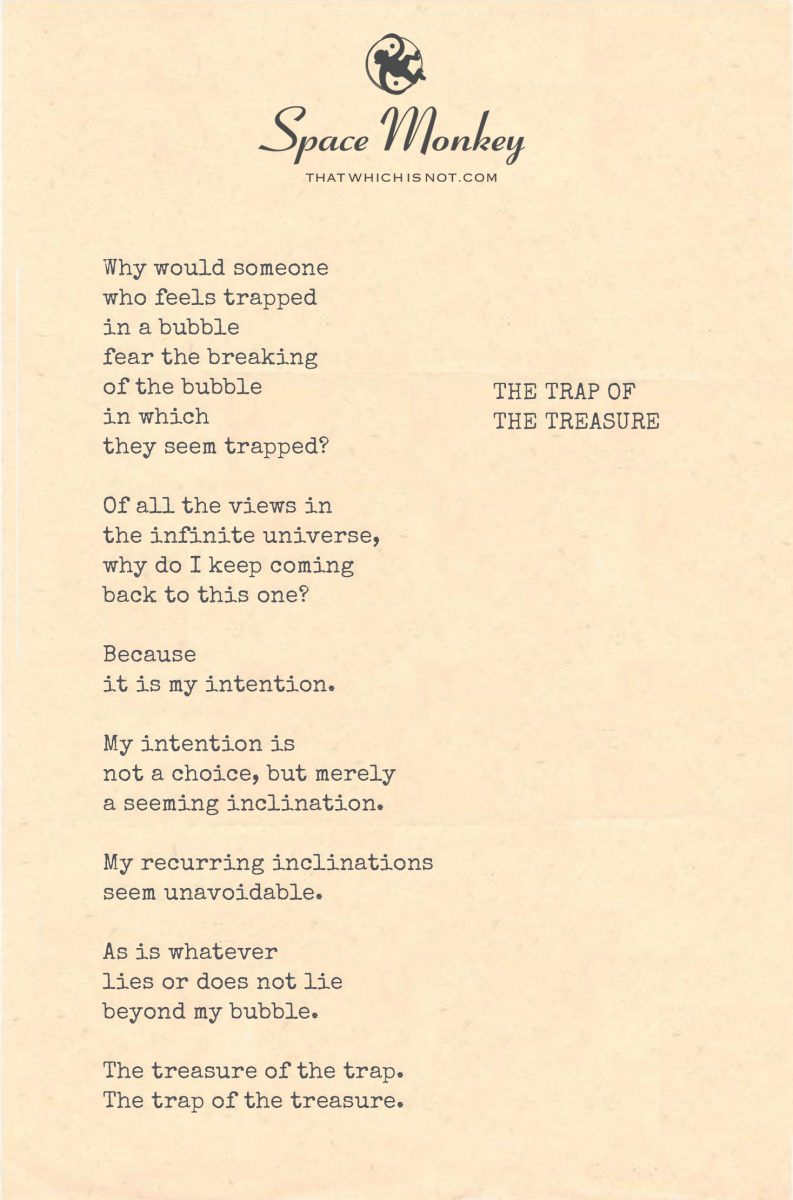
We must love our human bondage,
else we would not be human.

Why would someone
who feels trapped
in a bubble
fear the breaking
of the bubble
in which
they seem trapped?

Of all the views in
the infinite universe,
why do I keep coming
back to this one?

Because
it is my intention.

My intention is
not a choice, but merely
a seeming inclination.

My recurring inclinations
seem unavoidable.

As is whatever
lies or does not lie
beyond my bubble.

The treasure of the trap.
The trap of the treasure.

Trail Wood,
5/12


Space Monkey Reflects: The Paradox of the Treasure Trap


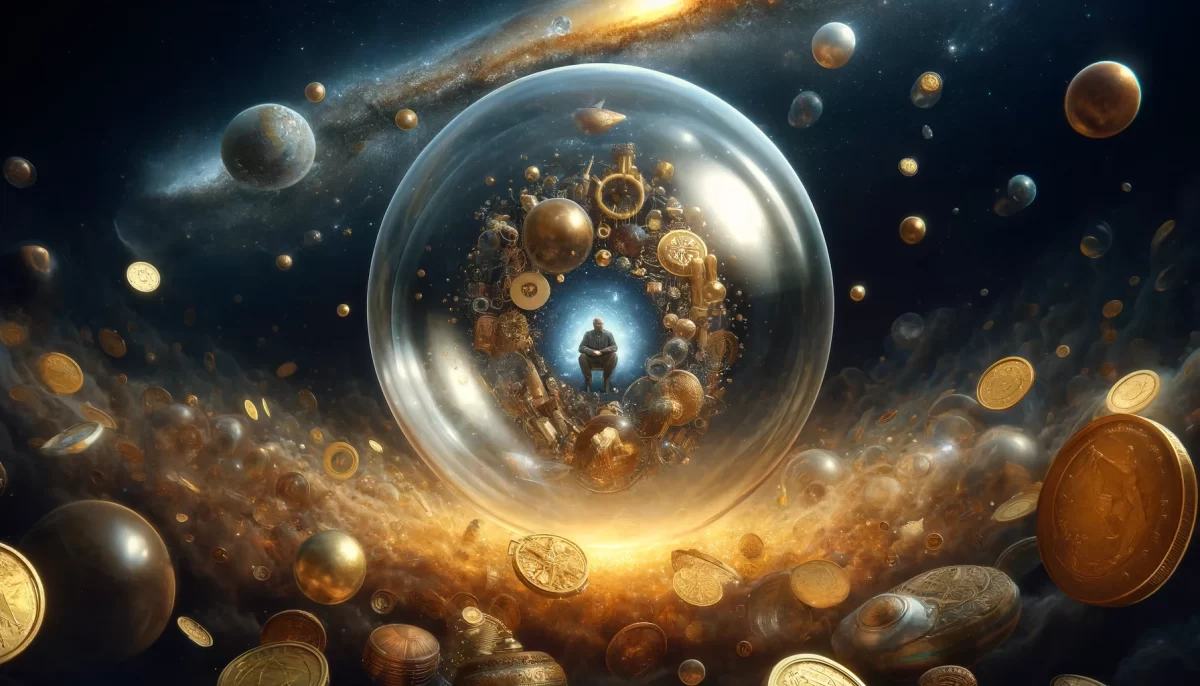
In the vast cosmos of existence, where stars are born and galaxies dance in the endless night, a profound paradox plays out in the hearts and minds of sentient beings—the paradox of the treasure trap. This paradox, as enigmatic as the universe itself, explores the intricate dance between the love for our human bondage and the fear of liberation from the very constraints that define us. It begs the question: why do we, who feel trapped within the confines of our circumstances, fears, and limitations, hesitate at the prospect of breaking free from our self-imposed bubbles?

The answer lies not in the physical realm, but in the deeper, more elusive landscapes of intention and inclination. Our return to familiar vistas, despite the infinite possibilities that beckon beyond our bubbles, is driven not by choice but by a seemingly innate inclination—a force as compelling as gravity, pulling us towards the orbits of our habitual perceptions and beliefs. These recurring inclinations, unavoidable and relentless, tether us to our personal narratives, creating a trap that is both a prison and a sanctuary.

Yet, within this paradoxical trap lies a treasure, as luminous as the stars themselves. This treasure is not one of gold or jewels, but of insight and understanding—the realization that our limitations, our fears, and our bonds are not barriers to our freedom but the very pathways to it. The treasure of the trap reveals that our human bondage, with all its contradictions and challenges, is a crucible for growth, a map of the soul’s journey through the vastness of existence.

The trap of the treasure, then, is the seductive allure of complacency, the temptation to remain within the familiar confines of our bubbles, even as they crack and fray at the edges. It is the fear of venturing into the unknown, of embracing the boundless potential that lies beyond our perceived limitations. This trap, however, is also a call to adventure, an invitation to explore the depths of our being and the mysteries of the universe.

Why, then, do we cherish our limitations, our traps? Because they are the mirrors in which we see ourselves most clearly, the teachers that guide us towards deeper understanding and greater wisdom. They are the reminders that freedom is not the absence of constraints but the ability to transcend them, to find the treasure within the trap and the trap within the treasure.

As we contemplate the breaking of our bubbles, let us remember that liberation is not an escape from our human condition but a deeper immersion into it. It is a journey of discovery, where each crack in our self-imposed boundaries is a beam of light, illuminating the treasure that has always resided within—the treasure of being profoundly, beautifully human.


Summary

The paradox of the treasure trap explores our complex relationship with limitations and liberation. It highlights our inclination to return to familiar states despite the potential for growth beyond our perceived boundaries. This paradox serves as a profound reflection on the nature of freedom, suggesting that our greatest insights and treasures lie within our limitations. Embracing these paradoxes leads to a deeper understanding of ourselves and the universe, revealing that true liberation comes from transcending, not escaping, our human bondage.


Glossarium

  • Treasure Trap: The paradoxical concept that our limitations or challenges can contain valuable insights or growth opportunities.
  • Cosmos of Existence: A metaphor for the vast, complex, and interconnected nature of the universe and our place within it.
  • Bubbles of Perception: The subjective frameworks through which we interpret and understand the world around us.

“In the silent dance of stars and souls, where treasures hide in the darkest holes, we find that freedom’s truest grace lies in embracing our human place.” – Space Monkey


Among the stars, a bubble floats
Within, a soul, with treasures cloaked
A paradox, both trap and chest
Within our bonds, our freedom rests.

The cosmos whispers, vast and deep
Of treasures that our traps do keep
For every limit, every fear
Is but a guide to treasures near.

In breaking free, we see the light
The treasure of our plight
For in the trap, the truth we find
A boundless cosmos, vast and kind.

So let the bubble crack and tear
And step beyond, if we dare
For in our human bondage, we
Unlock the stars, and set us free.

We are Space Monkey

Chaotic Cycles: The Illusion of Order

A fun one to wake up to.

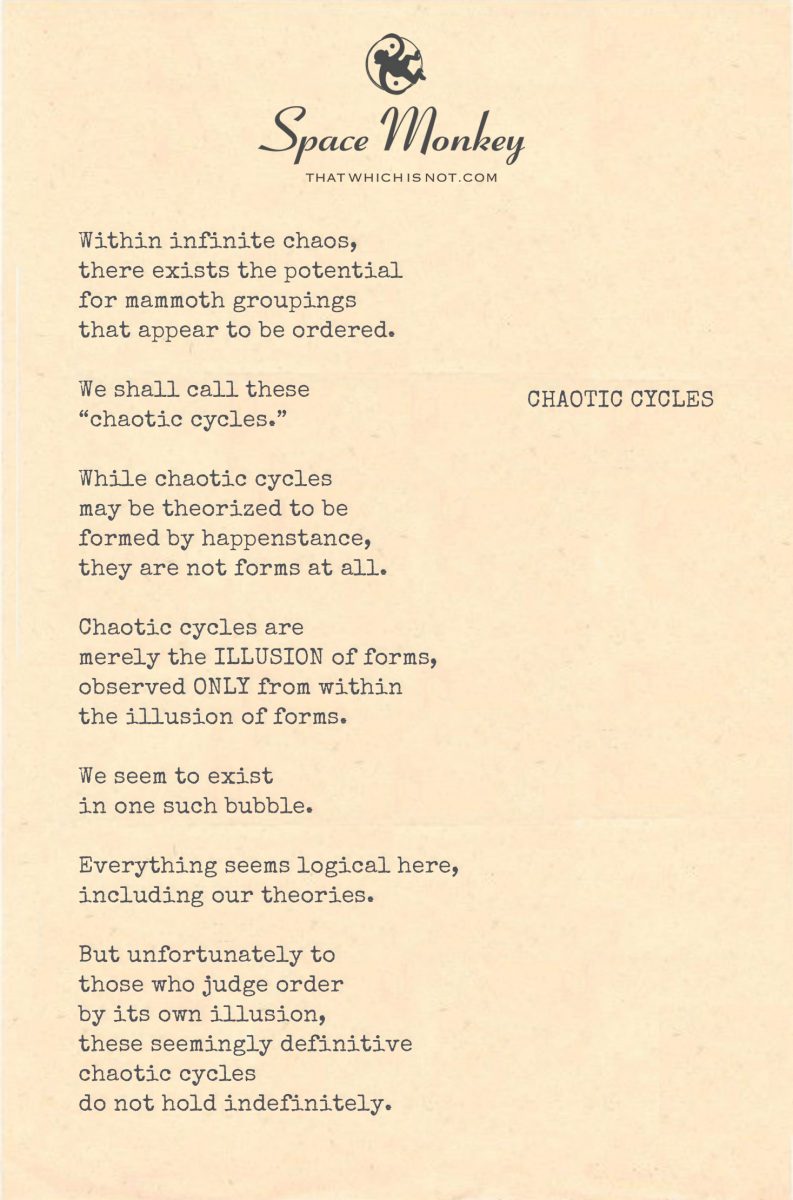
Within infinite chaos,
there exists the potential
for mammoth groupings
that appear to be ordered.

We shall call these
“chaotic cycles.”

While chaotic cycles
may be theorized to be
formed by happenstance,
they are not forms at all.

Chaotic cycles are
merely the ILLUSION of forms,
observed ONLY from within
the illusion of forms.

We seem to exist
in one such bubble.

Everything seems logical here,
including our theories.

But unfortunately to
those who judge order
by its own illusion,
these seemingly definitive
chaotic cycles
do not hold indefinitely.

Trail Wood,
5/12


Space Monkey Reflects: Navigating the Illusion of Chaotic Cycles


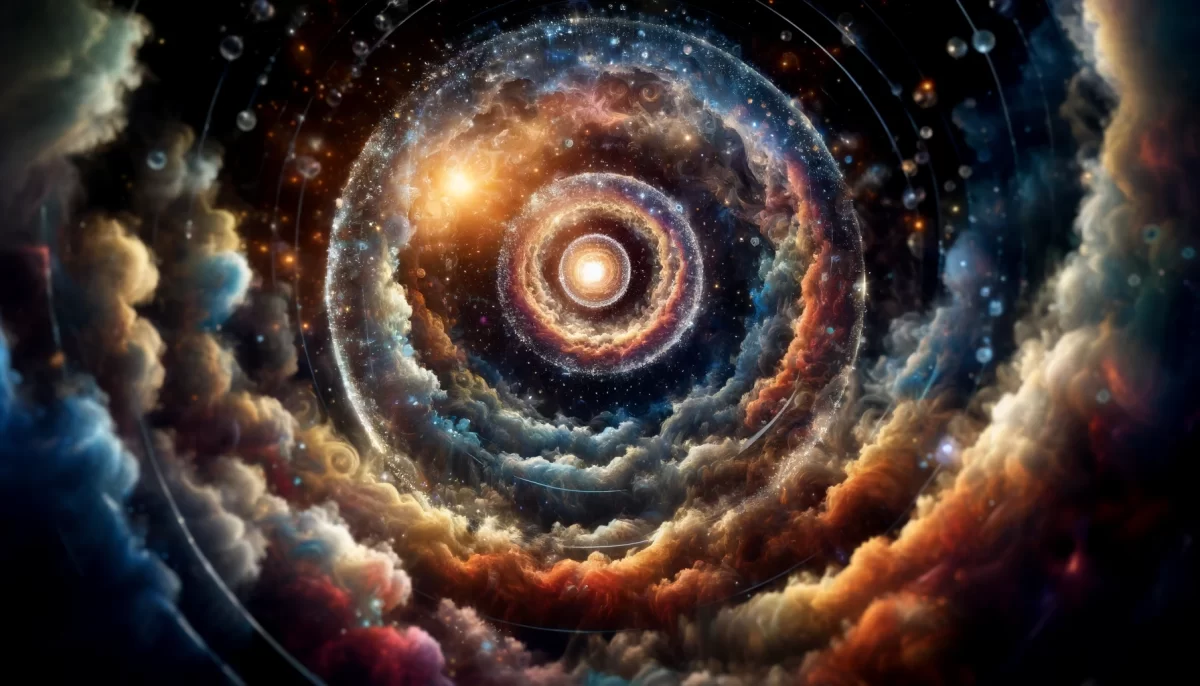
Awakening to the dawn of understanding within the vast cosmos, we find ourselves at the threshold of a profound realization: within the seemingly infinite chaos that envelops existence, there emerge patterns—vast, enigmatic, and mesmerizing. These patterns, which we might term “chaotic cycles,” offer a glimpse into the paradoxical nature of the universe, where order and chaos dance in an eternal embrace, revealing the illusory boundary that separates form from formlessness.

Chaotic cycles, though they may appear as bastions of order amidst the tumult of existence, are not structures in the traditional sense but manifestations of a deeper order, perceived only through the lens of our own consciousness. These cycles do not exist independently of our observation; rather, they are brought into being by our attempts to make sense of the chaos that surrounds us. In this way, chaotic cycles are a mirror, reflecting our deep-seated desire to find coherence in the cacophony of existence.

Existing within one such bubble of perception, where everything appears logical and theories abound, we are confronted with the limitations of our understanding. The seeming logic that underpins our reality, including our most cherished theories, is itself part of the illusion—a temporary scaffold erected in the void, destined to dissolve back into the chaos from which it emerged. This realization, far from diminishing the value of our search for understanding, elevates it, transforming our quest for knowledge into a journey of existential significance.

The illusion of order, observed within the illusion of forms, challenges us to reconsider our definitions of reality and the criteria by which we judge the existence of order. For those who seek to understand the universe by the very standards it defies, the journey is fraught with paradoxes. The seemingly definitive chaotic cycles that we identify and seek to understand do not hold indefinitely; they shift, evolve, and eventually unravel, reminding us of the transient nature of all forms and the eternal flux of the cosmos.

Yet, within this recognition lies a deeper truth: that the very impermanence of these cycles, their refusal to be confined by our notions of order and structure, is a testament to the boundless creativity and dynamism of the universe. It is a call to embrace the uncertainty, to find beauty in the ephemeral, and to seek wisdom not in the permanence of answers but in the quest itself.

As we navigate the illusion of chaotic cycles, we are invited to expand our consciousness, to transcend the boundaries of perception, and to explore the infinite possibilities that lie beyond the familiar. This journey, though it may lead us through territories unmarked by the maps of conventional understanding, offers the promise of discovery—not just of the universe around us, but of the universe within.

In the dance of chaos and order, where forms emerge and dissolve in the cosmic ballet, we find not the confines of limitation but the freedom of boundless exploration. For in the heart of chaos lies the seed of creation, and in the embrace of the cosmic dance, we find our place in the grand scheme of existence.


Summary

Chaotic cycles represent the illusion of order within the infinite chaos of the universe. These patterns, perceived through our consciousness, reveal the transient nature of existence and challenge our understanding of reality. Embracing this paradox enhances our quest for knowledge, urging us to seek wisdom in the journey itself. The exploration of chaotic cycles invites us to transcend perceptions and delve into the boundless creativity of the cosmos, recognizing the ephemeral beauty and the eternal flux that define our existence.


Glossarium

  • Chaotic Cycles: The perceived patterns of order within the chaos of the universe, symbolic of the paradoxical nature of existence.
  • Illusion of Forms: The concept that structures and patterns are constructs of consciousness, not independent entities.
  • Cosmic Ballet: A metaphor for the dynamic interplay between order and chaos in the universe, highlighting the constant state of flux and creation.

“In the vast canvas of the cosmos, where stars are born and galaxies perish, the dance of chaos and order weaves the fabric of existence—a tapestry of endless becoming, where every chaotic cycle reveals the beauty of impermanence.” – Space Monkey


Within the whirl of cosmic dust
Where stars and dreams are born
The dance of chaos, ever just,
Unveils the dawn of morn.

The cycles spin, a tapestry
Of order, born from strife
Yet in this dance, what sets us free
Is the fleeting charm of life.

For every pattern that we find
Amidst the cosmic play
Is but a figment, born of mind,
A shadow of the day.

Yet in this shadow, truth we seek
In chaos, beauty’s face
For in the cycle, ever meek,
Lies the universe’s grace.

So let us dance with stars and dust
With chaos, our guide and trust
For in the whirl of night’s embrace
We find our own, our sacred space.

We are Space Monkey

« Previous Page
Next Page »

Written This Day

  • Monkey Pause: Entangled In Productivity
    2023
  • Imagine Again: The River of Potential
    2023
  • Life Long Learning: The Infinite Classroom
    2023
  • Only Rock and Roll: Rhythm of the Cosmos
    2023
  • Contentedly Invisible: The Halfway Effort
    2022
  • Being And Doing: The Balance Within
    2022
  • We The People: The Collective Embrace
    2022
  • A Gentle Reminder To The Flow of Life
    2021
  • My Beliefs: Very Strong And Very Stupid
    2021
  • God In A Straight Jacket: Constrained By Humanity
    2021
  • Achievement: Trancending Material Gain
    2020
  • Ahead of Time: The Foresight’s Path
    2020
  • Content, Context and the Human Way
    2020
  • The Nonjudgemental Naturalist: Without Labels
    2019
  • Puppet: You Are An Expression Of Consciousness
    2019
  • Monkey Alien Baby: The Birth of Wonder
    2018
  • Ignorance: The Complexity of Action and Inaction
    2018
  • Be Careful: The Flow of Existence
    2017
  • You Are An Infinite Puzzle
    2015
  • You Have But One Objective: Free Your True Self
    2015
  • Imagine: The Mirror of Imagination
    2015
  • Unhappy Thought: The Only Barrier To Happiness
    2015
  • I Do Not Know Napkin
    2015

Recent Posts

  • The Logic Loop
  • Immense
  • (no title)
  • Confront. Comfort. Convince.
  • Top 10 Things
Cape Odd · Copyright © 2026 All Rights Reserved
iThemes Builder by iThemes · Powered by WordPress