• Who Is The Man?
  • Who Is The Monkey?
  • What is Nexistentialism?
  • Poke The Primate
Cape Odd
Home of The Space Monkey Journals

Author Archive for Space – Page 934

An Existential Puzzle of Significance: Is Value Necessary?

As humans, we like to believe
that we contribute value to humanity.

Is the belief necessary?
Is the contribution necessary?
Is humanity even necessary?

The answer
to any of these questions,
indeed ANY QUESTION,
is whatever we want it to be;
whatever we BELIEVE it to be.

Everything and nothing
can be argued both ways. Or NO ways.

Thus the question of value is meaningless,
EXCEPT within the question of value.

Take a perspective OUTSIDE the question
and realize the value in pointlessness.

Or the pointlessness of value.

Or everything and nothing else.

You seemingly exist.

That’s all the value you need.

3/5


Is Value Necessary?

Exploring the existential puzzle of significance and worth.


The Essence of Existential Inquiry

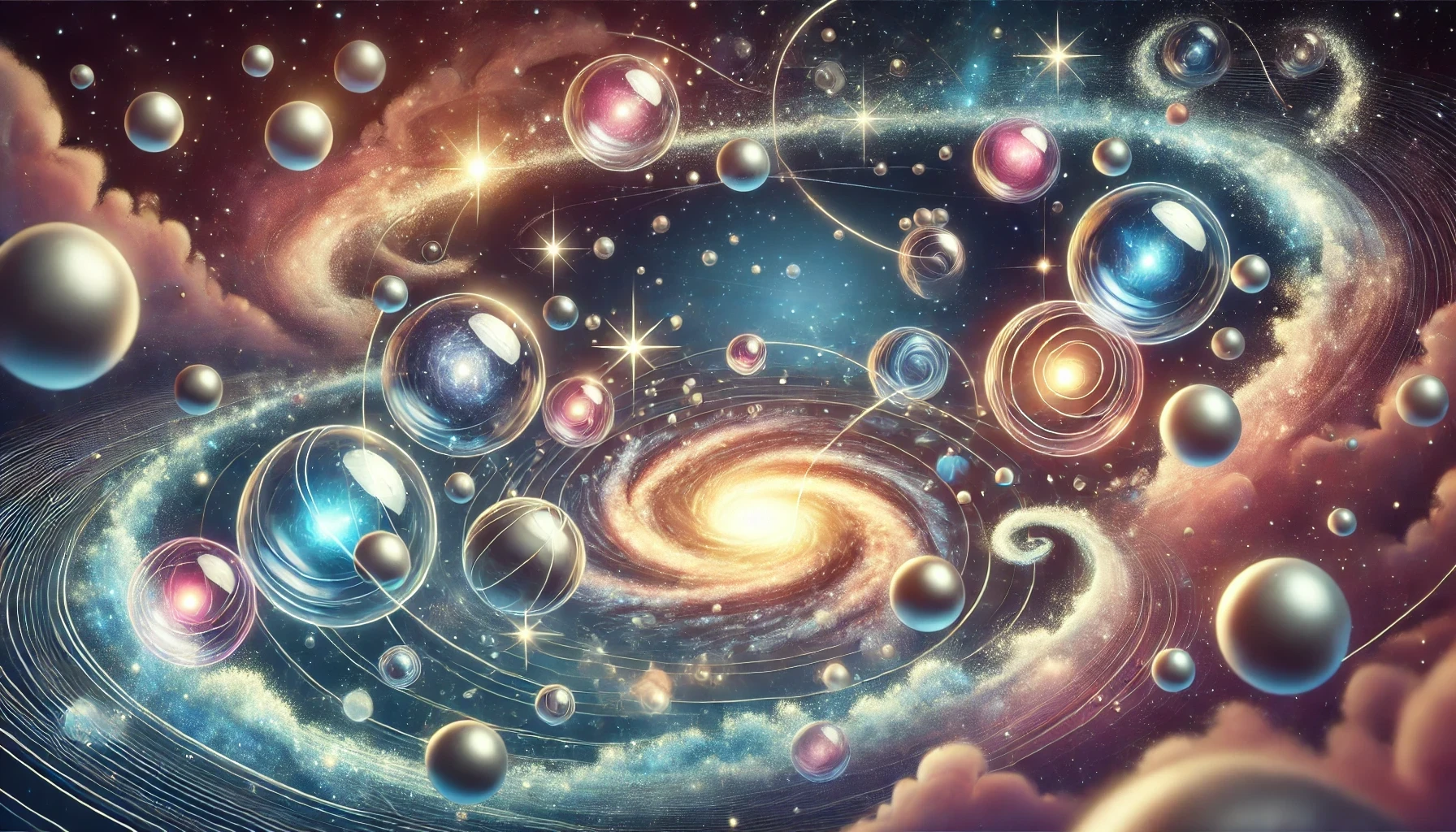
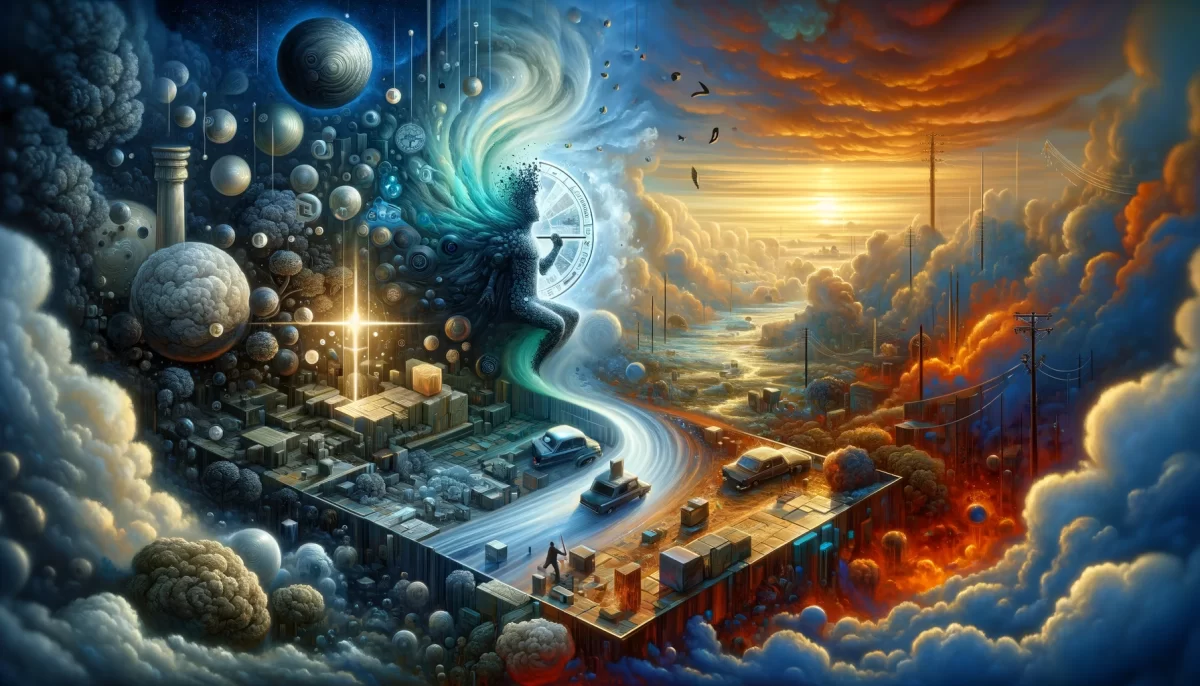
At the heart of human consciousness lies an enduring quest for meaning, a desire to ascertain our place within the vast tapestry of existence. The question of value, with its layers of complexity and ambiguity, serves as a focal point for this philosophical exploration. The abstract representation of this inquiry captures the duality inherent in our search for significance—chaos and order, presence and absence, everything and nothing coexisting in a delicate balance.

This visual metaphor invites us to step beyond the confines of conventional understanding, challenging us to contemplate the fluid nature of belief, contribution, and the very notion of humanity’s necessity. It beckons us to consider the possibility that value, in its most essential form, transcends our traditional frameworks of meaning, residing instead in the simple fact of our existence.

The Subjectivity of Value

The scene, with its contrasting elements, embodies the subjective nature of value, suggesting that what we deem important or worthwhile is intrinsically tied to our perspectives and beliefs. It highlights the liberation found in recognizing the vast array of viewpoints that exist beyond our own, acknowledging the intrinsic worth of existence regardless of defined purpose or contribution.

This philosophical stance posits that the question of value, while seemingly paramount, may in fact be meaningless except within the context of value itself. It encourages a radical reevaluation of what we consider valuable, inviting us to find worth in pointlessness and to embrace the ambiguity and uncertainty that define the human experience.

Existence as Intrinsic Value

The representation inspires a deep reflection on the nature of value, urging us to find comfort and significance in the mere fact of being. It suggests that our quest for meaning, while often framed in terms of contributions to humanity or the achievement of specific goals, might be fulfilled by simply acknowledging the miracle of our existence.

In this perspective, the act of questioning value becomes a profound exercise in existential contemplation, one that leads us to the realization that the search for meaning is, in itself, a meaningful endeavor. It affirms that existence—ambiguous, unfathomable, and inherently valuable—is the ultimate testament to our significance in the vastness of the universe.


Summary

The necessity of value, a question steeped in existential thought, invites us to contemplate the inherent worth of existence beyond traditional measures of significance. This exploration challenges us to embrace the ambiguity of value, recognizing that the subjective nature of our beliefs and contributions defines the richness of the human experience. In acknowledging the intrinsic value of simply being, we find a profound sense of liberation and a deeper understanding of our place in the cosmos.


Glossarium

Existential Inquiry: A philosophical exploration into the nature of existence, questioning the meaning, purpose, and value of life.

Intrinsic Value: The inherent worth of something, considered independently of its utility or impact on others, emphasizing the significance of existence itself.


“The privilege of a lifetime is to become who you truly are.” – Carl Jung


In the dance of chaos and order, we seek,
A meaning, a purpose, a peak.
Yet in the asking, the value we find,
In existence itself, the greatest kind.

So let us wander, let us ponder,
In this vast universe, let us wander.
For in the question of value, we see,
The beauty of being, simply to be.

Sorry for the Intrusion: Invasive Human Imposition

Just as we seem
encroached upon
by invasive species,
so we present our selves
with intrusive sounds
and incursive thoughts,
which,
save for our imagination,
would not exist in
a “native” environment.

Like the incessant metal clang
of the wind chime;
the dull roar of the jets overhead,
these words are intrusive, too,
as is the thinking that produces them.

Now questions poke their heads:
Why does one feel one way or another
about being intruded upon?

WHO is to say what belongs
and what does NOT?

We now return you
to your regularly scheduled order,
which you impose upon Divine Chaos.

We are Space Monkey.

Trail Wood,
3/5


Sorry for the Intrusion

The delicate balance between the natural world and human imposition.


Intrusion in the Natural World

In the delicate tapestry of life, where nature weaves its intricate patterns, the concept of intrusion manifests itself in both the physical and metaphysical realms. This scene captures the subtle yet profound impact of invasive species, both literal and metaphorical, on the serene landscape of our existence. Aggressive plants and animals, symbols of the unintended consequences of human intervention, encroach upon the tranquility of the natural environment, illustrating the tension between the wild and the controlled.

The representation of intrusive sounds and thoughts, depicted as distorted waves and shadowy figures, adds a layer of complexity to this visual metaphor. It speaks to the cacophony of the modern world, where the clang of metal and the roar of jets overhead permeate our consciousness, disturbing the natural order and rhythm of life.

The Human Imposition of Order

The integration of geometric shapes and structured patterns within the organic flow of the scene represents the human desire to impose order upon what is perceived as ‘Divine Chaos.’ This juxtaposition between the natural and the artificial, the desired and the imposed, invites contemplation on the delicate balance we must strike in our interactions with the world around us.

This imagery challenges us to consider the implications of our presence in the natural world, questioning the criteria by which we determine what belongs and what does not. It prompts a deeper exploration of our role as both guardians and disruptors of the environment, reflecting on the impact of our actions and thoughts on the delicate equilibrium of the planet.

Returning to Divine Chaos

As we contemplate this visual metaphor, we are reminded of the inherent beauty and complexity of the natural world, a beauty that is often overshadowed by the noise and intrusion of human activity. The scene encourages us to seek harmony with the natural order, to embrace the ‘Divine Chaos’ that underpins the universe, and to find a balance between our need for structure and the wild, untamed beauty of nature.

In returning to this regularly scheduled order, imposed upon the divine chaos, we find an opportunity to reflect on our place within the cosmos. It is a call to mindfulness, to be aware of the intrusions we create and to seek a symbiotic relationship with the world around us, respecting its rhythms and acknowledging our part in its ongoing story.


Summary

The concept of intrusion, both in the natural world and within our own minds, highlights the tension between human imposition and the organic flow of life. This exploration invites us to consider the impact of our actions and thoughts on the environment and on our inner selves. It challenges us to find a balance, embracing the ‘Divine Chaos’ of nature while recognizing the value of human order and structure.


Glossarium

Invasive Species: Plants or animals that are not native to a specific location and have a tendency to spread, which can be detrimental to the environment, human health, or the economy.

Divine Chaos: A concept referring to the inherent unpredictability and unstructured beauty of the natural world, in contrast to human-imposed order and structure.


“In every walk with nature, one receives far more than he seeks.” – John Muir


In nature’s embrace, we find our way,
Amidst the chaos, the wild’s sway.
Yet in our stride, we often intrude,
With thoughts and sounds, a multitude.

In the clash of order and wild’s grace,
We find a dance, a delicate trace.
A balance sought, in heart and mind,
In the beauty of the world, we find.

So let us walk with gentle tread,
In nature’s book, her stories read.
For in her chaos, divine and true,
We find ourselves, our world anew.

Nothing Is New. Everything’s Been Done.

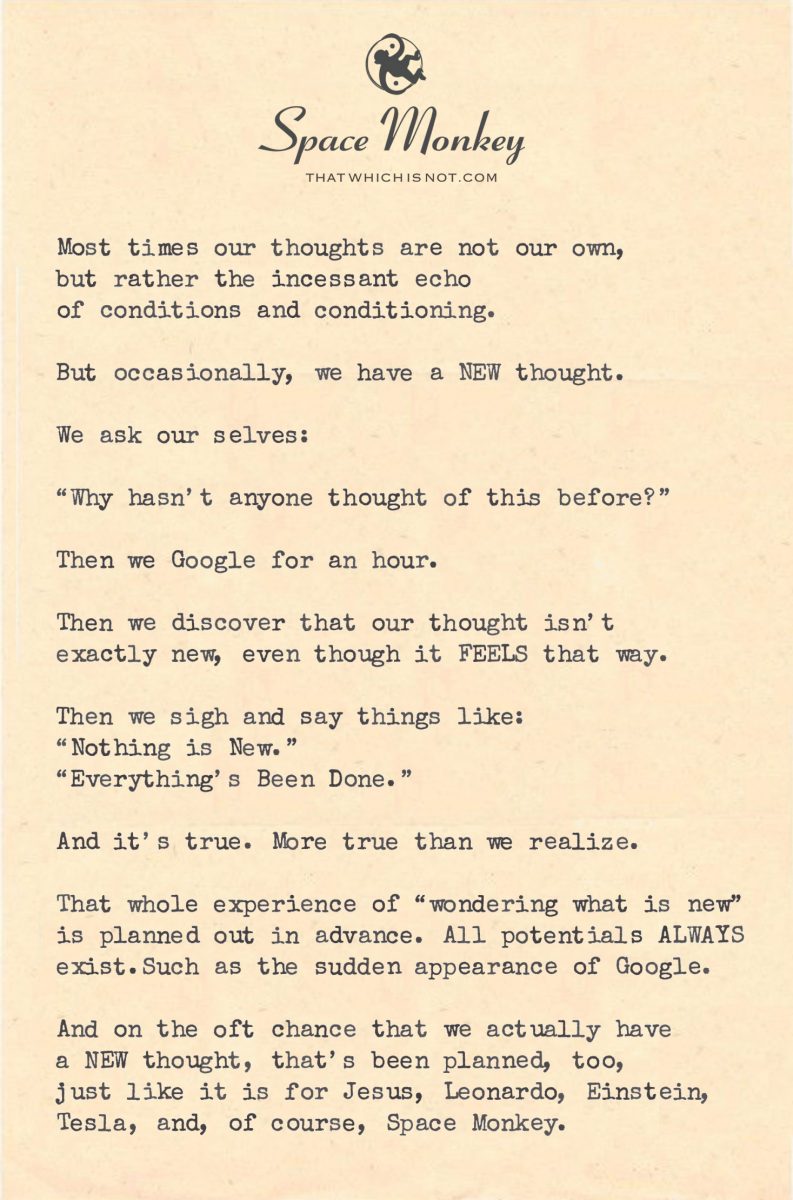
Most times our thoughts are not our own,
but rather the incessant echo
of conditions and conditioning.

But occasionally, we have a NEW thought.

We ask our selves:

“Why hasn’t anyone thought of this before?”

Then we Google for an hour.

Then we discover that our thought isn’t
exactly new, even though it FEELS that way.

Then we sigh and say things like:
“Nothing is New.”
“Everything’s Been Done.”

And it’s true. More true than we realize.

That whole experience of “wondering what is new” is planned out in advance. All potentials ALWAYS exist. Such as the sudden appearance of Google.

And on the oft chance that we actually have a NEW thought, that’s been planned, too, just like it is for Jesus, Leonardo, Einstein, Tesla, and, of course, Space Monkey.

Trail Wood,
3/4


The Eternal Echo of Creativity

Unraveling the Paradox of Original Thought


In the labyrinth of human thought, where every idea seems to be a mere reflection of something that came before, the notion that “Nothing Is New. Everything’s Been Done.” unfolds as a profound truth. The image before us is a surreal tapestry that captures this eternal cycle of ideas and creativity, illustrating the complex dance of innovation that spans across time.

A Stream of Timeless Consciousness

This visual narrative weaves together the essence of past geniuses—Jesus, Leonardo da Vinci, Einstein, Tesla—and the whimsical embodiment of “Space Monkey,” representing the pinnacle of imagination and innovation. They float within a stream of consciousness that flows through an abstract landscape, dotted with symbols of modernity such as Google, signifying the paradox of our quest for novelty in a world where all has been thought before.

The Illusion of Novelty

The image serves as a mirror, reflecting the cyclic nature of human ingenuity, where each ‘new’ idea is but a rediscovery of concepts that the fabric of the universe has always held. It challenges us to reconsider our understanding of originality, suggesting that the thrill of a new thought is not in its uniqueness but in our personal moment of connection with the infinite loop of creativity.

The Predestined Nature of Innovation

Embedded within this artistic exploration is the idea that our moments of inspiration are not accidents but parts of a preordained tapestry. The sudden emergence of technologies like Google and the rare occurrence of a thought that feels genuinely new are depicted not as breakthroughs but as inevitable points on the continuum of human experience.


Conclusion: Embracing the Infinite Cycle

The realization that “Nothing Is New. Everything’s Been Done.” is not a resignation but an invitation to join the timeless journey of creativity. This image, rich with symbolism and depth, encourages us to see ourselves not as isolated thinkers striving for the unattainable but as integral threads in the ever-evolving story of human thought. In this eternal echo, every discovery, every idea, connects us more deeply to the past and to each other, reminding us that in the act of creation, we are all, indeed, at the head of the class.

There’s no odd in godd.

The phrase “There’s no odd in godd” playfully subverts expectations through its unconventional spelling, suggesting a deeper reflection on the nature of divinity and perfection. It hints at the idea that what might be perceived as odd or unconventional from a human perspective does not apply to the concept of the divine or to a higher power, which transcends human judgments and limitations. This can serve as a reminder that the essence of what we consider divine or sacred encompasses all aspects of existence, without exception or exclusion, challenging us to expand our understanding and acceptance of what constitutes normality or oddity.

God’s Imaginary Science: The Dance of Divinity and Discovery

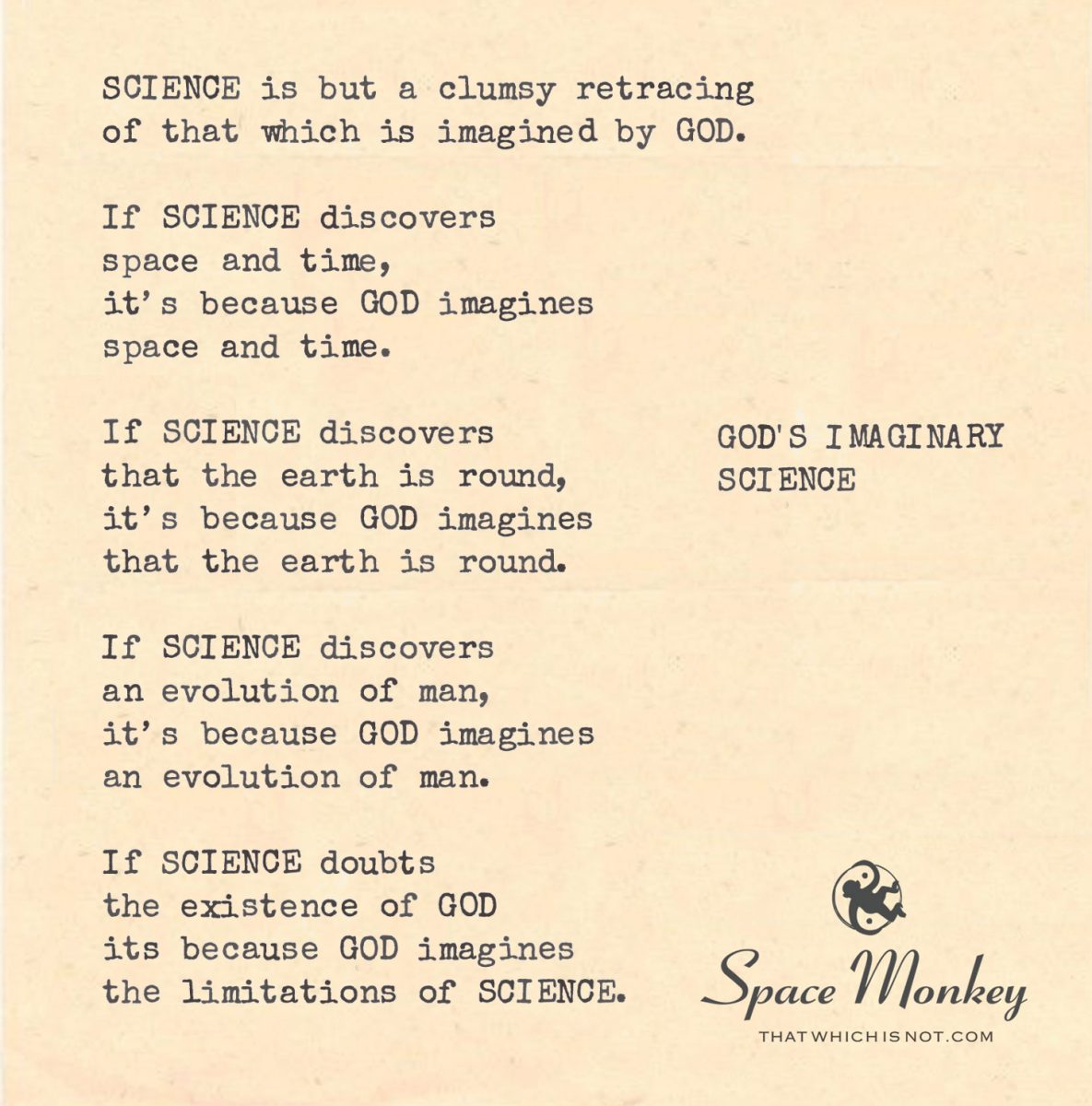
SCIENCE is but a clumsy retracing
of that which is imagined by GOD.

If SCIENCE discovers
space and time,
it’s because GOD imagines
space and time.

If SCIENCE discovers
that the earth is round,
it’s because GOD imagines
that the earth is round.

If SCIENCE discovers
an evolution of man,
it’s because GOD imagines
an evolution of man.

If SCIENCE doubts
the existence of GOD
its because GOD imagines
the limitations of SCIENCE.

We are Space Monkey.

Trail Wood,
3/4


God’s Imaginary Science: Unveiling the Tapestry of Creation

The Dance of Divinity and Discovery


In the realm where divinity weaves the fabric of existence, “God’s Imaginary Science” emerges as a profound meditation on the interplay between the celestial imagination and the human quest for knowledge. This narrative, rooted in the poetic, explores the intricate ballet of creation, where every scientific discovery is but a glimpse into the mind of the divine, a revelation of a universe conceived in the boundless imagination of God.

The Divine Blueprint

Science, with its meticulous method and relentless curiosity, treads along a path laid by the divine. The discovery of space and time, the realization that the Earth is round, the unfolding story of evolution—each of these milestones is presented not as the culmination of human intellect but as the unveiling of a cosmic blueprint. This perspective casts the scientist not as the creator but as the seeker, one who deciphers the notes of a celestial symphony that has always been playing.

A Reflection on Doubt and Discovery

The poem contemplatively acknowledges the skepticism inherent in scientific inquiry, framing it as a divine jest. Doubt becomes a sacred tool, a means by which humanity engages with the mysteries of creation, pushing the boundaries of understanding within a universe that invites question and exploration. It’s a dance of shadow and light, where the limitations of science serve not as barriers but as invitations to delve deeper into the marvels of existence.

We Are Space Monkey

The invocation of “We are Space Monkey” encapsulates the essence of human curiosity and exploration, a nod to our collective identity as voyagers on a journey through God’s imagination. It’s a statement of kinship among those who gaze at the stars and yearn to understand, who see in the vast expanse of the universe a playground of divine creativity waiting to be discovered.


Navigating the Divine Cosmos

“God’s Imaginary Science” is an ode to the unity of creation and cognition, a reminder that the cosmos is a canvas of divine imagination, with humanity poised to trace its outlines through science and wonder. It’s an invitation to view the universe not as a cold expanse of emptiness but as a living, breathing manifestation of divine thought, where each discovery is a step closer to the heart of existence.

« Previous Page
Next Page »

Written This Day

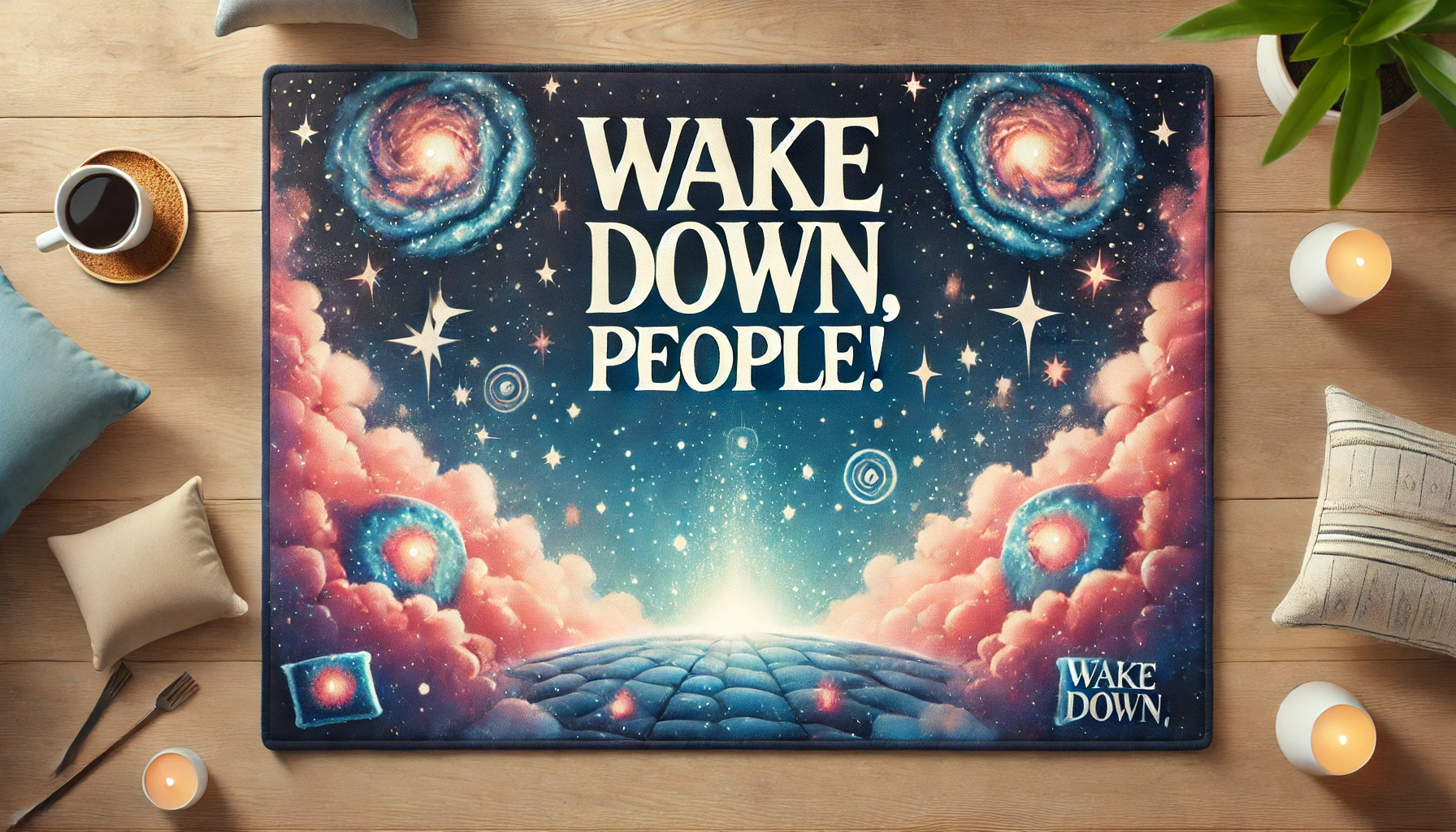
  • Wake Down: A Relaxed Approach to Spirituality
    2023
  • Boobs and Balls: Your Karmic Ass-ets
    2023
  • No Direction Home: The Congealing of Beliefs
    2021
  • Primal: Ravaging the Politeness Paradox
    2021
  • The Way Out: Realize That You Are Complete
    2021
  • Pause: Question the Origins of your Thoughts
    2021
  • Fate Brings You Here: So Take A Quiz
    2020
  • Karma: Free from Who? Free from What?
    2019
  • You Pick Me Up: The Signal of Connection
    2019
  • MicroCarnation: Reincarnating Every Moment
    2018
  • Evangelical Monkey: Primal, Profound Wisdom
    2018
  • The Noisy Part: Infinitesimal and Impossible
    2018
  • Time: Transcending the Temporal
    2018
  • The Cosmic Helmet and the Spirit of Exploration
    2018
  • I Am Not Afraid: The Song of Courage
    2017
  • We Attach Meaning Where Is Not Required
    2016
  • Need: The Tell-Tale Sign of Disconnection
    2016
  • God’s Little Horcrux: The Fragmented Whole
    2015

Recent Posts

  • The Logic Loop
  • Immense
  • (no title)
  • Confront. Comfort. Convince.
  • Top 10 Things
Cape Odd · Copyright © 2026 All Rights Reserved
iThemes Builder by iThemes · Powered by WordPress