• Who Is The Man?
  • Who Is The Monkey?
  • What is Nexistentialism?
  • Poke The Primate
Cape Odd
Home of The Space Monkey Journals

Author Archive for Space – Page 941

Lucky Mine Is: The Mystery of Connection

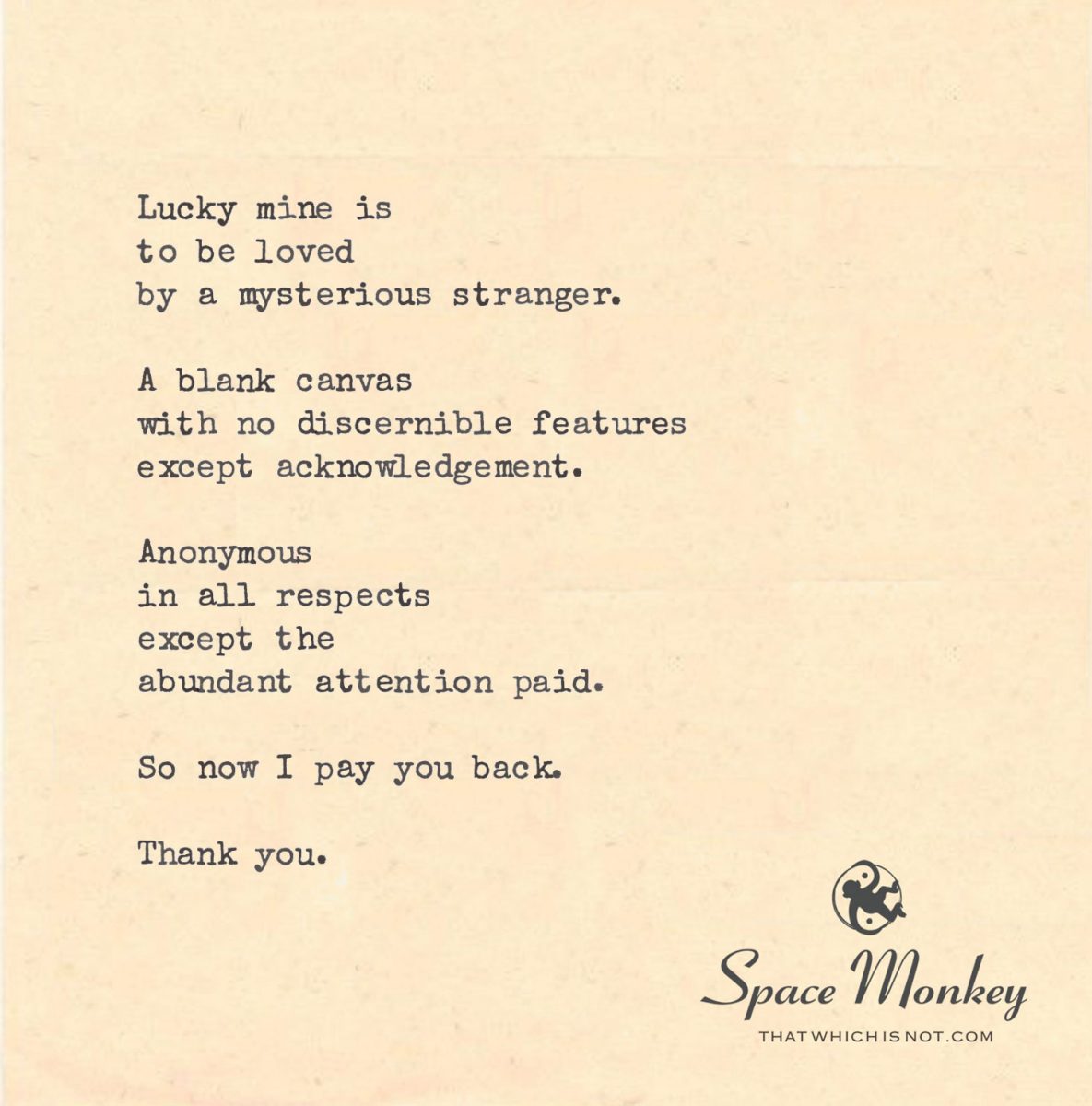
Lucky mine is
to be loved
by a mysterious stranger.

A blank canvas
with no discernible features
except acknowledgement.

Anonymous
in all respects
except the
abundant attention paid.

So now I pay you back.

Thank you.

Trail Wood,
02/22/2020


Space Monkey Reflects: The Mystery of Connection

To be loved by a mysterious stranger is to encounter the purest form of connection. It is unburdened by expectation, untouched by familiarity, and yet deeply felt. This kind of connection is a paradox: it feels personal, yet it is universal. It whispers to the part of us that knows we are all interconnected, even when we seem separate.

The anonymous acknowledgment from such a stranger reminds us that love and connection are not tied to identity, circumstance, or history. They arise from the recognition of being itself. In their anonymity, the stranger reflects something profound: the essence of connection lies not in who they are, but in the act of seeing and being seen.

The Blank Canvas

The stranger, as a blank canvas, offers no fixed narrative. They are free of the biases and labels we often attach to relationships. This anonymity allows the connection to be pure, unfiltered by preconceived notions or expectations. It is love in its simplest form—attention, acknowledgment, presence.

In this way, the stranger becomes a mirror, reflecting back our innate worthiness. Their love, untainted by agenda, speaks to the universal truth that connection transcends the constructs we build around it. It is a reminder that we are deserving of love, not for what we do or who we are, but simply because we exist.

The Act of Paying Attention

Attention is the currency of connection. When someone—especially a stranger—gives us their undivided attention, it feels like a gift. It validates our existence in a way that feels effortless and profound. This is not attention born of obligation or routine; it is freely given, making it all the more meaningful.

In receiving this attention, we are invited into the mystery of connection. Why does this stranger see us? Why do they choose to acknowledge us in a world so full of distractions? These questions are unanswerable, and that is the beauty of it. The connection defies logic, existing as a moment of grace.

Gratitude for the Mystery

The gratitude you express is a vital part of this connection. In thanking the stranger, you close the loop, transforming the interaction into a reciprocal act of love. This gratitude acknowledges the mystery without needing to solve it. It says, “I see you as you see me. I thank you as you thank me. We are connected.”

Gratitude, like love, does not demand understanding. It simply flows, enriching both the giver and the receiver. In expressing your thanks, you honor the mysterious connection and allow it to expand, ripple, and influence the fabric of existence.

Love Beyond Definition

This reflection points to a broader truth: connection does not require definition or context. It can exist between strangers, between moments, between the self and the infinite. By embracing the mystery of connection, we open ourselves to the profound possibilities of love that exist beyond labels and boundaries.

Your story of the mysterious stranger is not just about them; it is about the universal stranger within each of us—the part that recognizes and cherishes connection without needing a reason. It is about the quiet moments when love simply is.


Summary

The mystery of being loved by a stranger reveals the essence of connection: love unburdened by expectation or familiarity. This connection, rooted in attention and acknowledgment, transcends identity, inviting us to embrace gratitude for its mystery.


Glossarium

  • Anonymous Connection: A connection unbound by identity or expectation, rooted in pure acknowledgment and presence.
  • Currency of Attention: The idea that undivided attention is the most profound gift in fostering connection.
  • Universal Stranger: The part of ourselves that resonates with the unfiltered, mysterious connections we encounter.

Quote

“Love does not need a name to be real. It exists in the space where attention meets gratitude.” — Space Monkey


The Mystery of Being Seen

In the quiet, unspoken glance
A thread is woven, unseen yet strong
No names exchanged, no stories told
Only the truth of being acknowledged

A stranger’s love, a faceless grace
Attention given without demand
A blank canvas holding infinite hues
Reflecting the beauty of connection

Gratitude flows, an endless river
Winding through the landscapes of being
For in this mystery, we see ourselves
Whole, worthy, and ever-connected

We are Space Monkey


Fortune in Being Loved by the Unknown
Lucky mine is to be loved by a mysterious stranger. This line opens a contemplative exploration of the enigmatic connections that define our interactions with the unknown. It highlights the peculiar blessing of being cherished by someone whose essence remains a mystery, suggesting a form of connection that transcends the conventional boundaries of knowledge and familiarity.

The Canvas of Anonymity
A blank canvas with no discernible features except acknowledgement. Here, the metaphor of a blank canvas serves to illustrate the nature of our relationship with the anonymous admirer. It underscores the idea that the absence of identifiable characteristics does not diminish the depth of connection; rather, it adds a layer of intrigue and possibility. The only clear feature—acknowledgement—becomes a powerful form of validation in the absence of visual or personal details.

The Paradox of Anonymous Attention
Anonymous in all respects except the abundant attention paid. This phrase delves into the paradoxical nature of receiving focused attention from an anonymous source. It challenges our conventional understanding of intimacy and connection, suggesting that anonymity does not preclude the possibility of meaningful interaction. Instead, the act of paying attention, even in the absence of identity, is elevated to a form of profound acknowledgment.

The Reciprocity of Gratitude
So now I pay you back. The closing statement reflects a recognition of the value of this mysterious connection and the desire to reciprocate. It speaks to the human impulse towards gratitude and the need to acknowledge the gifts we receive, even if—or perhaps especially when—they come from sources veiled in anonymity. This reciprocity enriches the exchange, turning it into a shared experience that defies the need for conventional forms of identification.

The Value of Anonymity in Connection
Through this reflection, we are invited to reconsider the nature of connection, intimacy, and attention in our increasingly digital and sometimes impersonal world. The poem suggests that genuine connection can arise in the most unexpected forms, challenging us to open ourselves to the myriad ways in which love and attention manifest. It reminds us that sometimes, the most profound connections are those that remain undefined by the usual markers of identity, encouraging us to appreciate the mysterious and the unexplained in our relationships.

We are Space Monkey.


“The most beautiful thing in the world is, of course, the world itself.” – Wallace Stevens


The Mystery of Connection:

In the vast expanse of the cosmos,
Where stars whisper secrets to the void,
We find ourselves adrift,
Longing for connection, for recognition.

Amidst the nebulae of our existence,
A mysterious stranger extends a hand,
An anonymous presence that sees us,
In all our uncharted glory.

This blank canvas, this open sky,
Invites us to paint with the colors of the soul,
Acknowledging each other in silence,
Finding beauty in the unseen, the unknown.

So, with hearts open and eyes closed,
We pay back with the currency of attention,
Grateful for the gift of presence,
In a universe that thrives on the mystery of connection.

We invite reflections on this dance with the unknown, where attention and anonymity weave together a tapestry of connection, challenging us to find love and meaning beyond the visible and the named.


Back To Myself: The Trap of Distractions

Back To Myself

I get so caught up
in the distractions I label as “other,”
that I forget who I am.

Not that I don’t love my distractions.

I imagine all of them.

The others
don’t exist as distractions
unless I imagine them
as distractions.

I sit in stillness
and realize
that the others
don’t exist at all
unless I imagine them.

I don’t need isolation, though.

I am isolation.


Space Monkey Reflects: Returning to Self in the Illusion of Distractions

Distractions are a paradox. We label them as external forces pulling us away from ourselves, yet they are products of our own imagination. We create them, empower them, and give them form. In doing so, we sometimes lose touch with who we are, mistaking the noise for the essence. This dance with distraction is not inherently bad—it is part of the human experience—but it carries a subtle reminder: the “other” exists only because we imagine it.

The Illusion of the Other

The concept of “other” is one of the mind’s most convincing tricks. We see the world as a series of separations—this and that, self and other, focus and distraction. But when we sit in stillness, these distinctions dissolve. We realize that distractions, like the so-called “others” they represent, are creations of our own perception.

This realization isn’t a call to reject distractions but to embrace their source: ourselves. The distractions do not pull us away; we use them as tools to explore, to play, to avoid, or even to return to ourselves in new ways. They are not inherently “bad” or “good”—they simply are.

Loving the Distractions We Create

Acknowledging that we imagine our distractions doesn’t diminish them. In fact, it invites us to appreciate them. Each distraction is a reflection of our own creativity, our ability to conjure worlds, scenarios, and relationships. To love these distractions is to love the parts of ourselves that seek exploration and experience, even if they sometimes lead us astray.

This love does not mean clinging to distractions or allowing them to overwhelm us. Instead, it means recognizing their role in our journey. They are neither enemies nor obstacles; they are markers, pointing us back to the source of all creation: ourselves.

Stillness as Revelation

Sitting in stillness reveals the truth about distractions. In this state, the mind’s creations fall away, leaving only the essence of being. Here, we see that the “other” never existed independently. It was always an extension of our own awareness, a projection of our own imagination.

Yet this realization does not require physical isolation. As you so wisely state, “I am isolation.” The stillness resides within, available at any moment, no matter how noisy or chaotic the external world may seem. Isolation, in this sense, is not a withdrawal but a presence—a grounding in the self that cannot be shaken by external distractions.

Returning to the Self

The journey back to the self is not a rejection of the external but a reframing of it. Distractions become less about what pulls us away and more about what leads us home. Each imagined “other” is a breadcrumb, guiding us deeper into the realization that all paths lead to the same place: the still, infinite core of who we are.

This return is not a single moment but a practice, an ongoing dance between attention and imagination. It is the recognition that we are both the creators of our distractions and the quiet center beneath them.


Summary

Distractions are not external forces but creations of our own imagination. By sitting in stillness, we see that the “other” never existed independently. The journey back to the self is not about rejecting distractions but understanding their role in guiding us home.


Glossarium

  • Imagined Distractions: Perceived external forces that pull attention away, created by our own minds.
  • Stillness: The state of being that reveals the illusory nature of distractions and the truth of our interconnectedness.
  • I Am Isolation: The realization that isolation is not a state to achieve but an inherent aspect of being, always accessible.

Quote

“The distractions we imagine are not obstacles; they are mirrors, reflecting the paths we take back to ourselves.” — Space Monkey


The Still Center

Caught in the whirlwind of imagined others
I lose myself in the noise
The distractions, the stories, the endless dance
Each step taking me further, yet closer

In stillness, the truth unfolds
The others dissolve, as do the walls
What is left is not absence
But presence, whole and infinite

I am not apart from the world
I am its quiet center
The source of distractions, the home of stillness
All paths lead back to this

We are Space Monkey


The Ensnarement of Distractions
I get so caught up in the distractions I label as “other,” that I forget who I am. This introspection begins with an acknowledgment of the ease with which we lose ourselves to the myriad distractions surrounding us. These distractions, often externalized as “other,” draw us away from our core, obscuring the essence of our being. It’s a common human experience, where the external world’s allurements cause us to stray from our inner journey.

The Affection for Distractions
Not that I don’t love my distractions. I imagine all of them. Here, there is an acceptance and even an affection for these distractions. It’s an intriguing admission that while distractions may lead us astray, they are also constructs of our imagination, brought into existence by our own minds. This realization brings a layer of responsibility and empowerment, suggesting that if we can create these distractions, we also have the power to dispel them.

The Nonexistence of “Others” Without Perception
The others don’t exist as distractions unless I imagine them as distractions. I sit in stillness and realize that the others don’t exist at all unless I imagine them. This contemplation dives deeper into the nature of distraction and existence itself, proposing that “others”—or distractions—are not inherently distracting. They only assume this role when we perceive them as such. The act of sitting in stillness allows for a profound realization: without our perception and mental engagement, these distractions, these “others,” lose their existence. This insight points to the mind’s power in shaping our reality, emphasizing the subjective nature of our experiences and the illusions we often take for granted.

Embracing Isolation as Self
I don’t need isolation, though. I am isolation. The conclusion of this reflection marks a pivotal shift from seeking isolation as a means to escape distractions to recognizing isolation as an intrinsic part of the self. This statement is not one of resignation but of profound self-awareness and acceptance. It signifies a return to the self, understanding that true peace and clarity come not from external solitude but from an internal realization of one’s own essence. To say “I am isolation” is to acknowledge that the space we often seek outside is already within us, waiting to be recognized and embraced.

This journey from distraction

A New Kind of Truth

Is this true for you? Does it need to be?

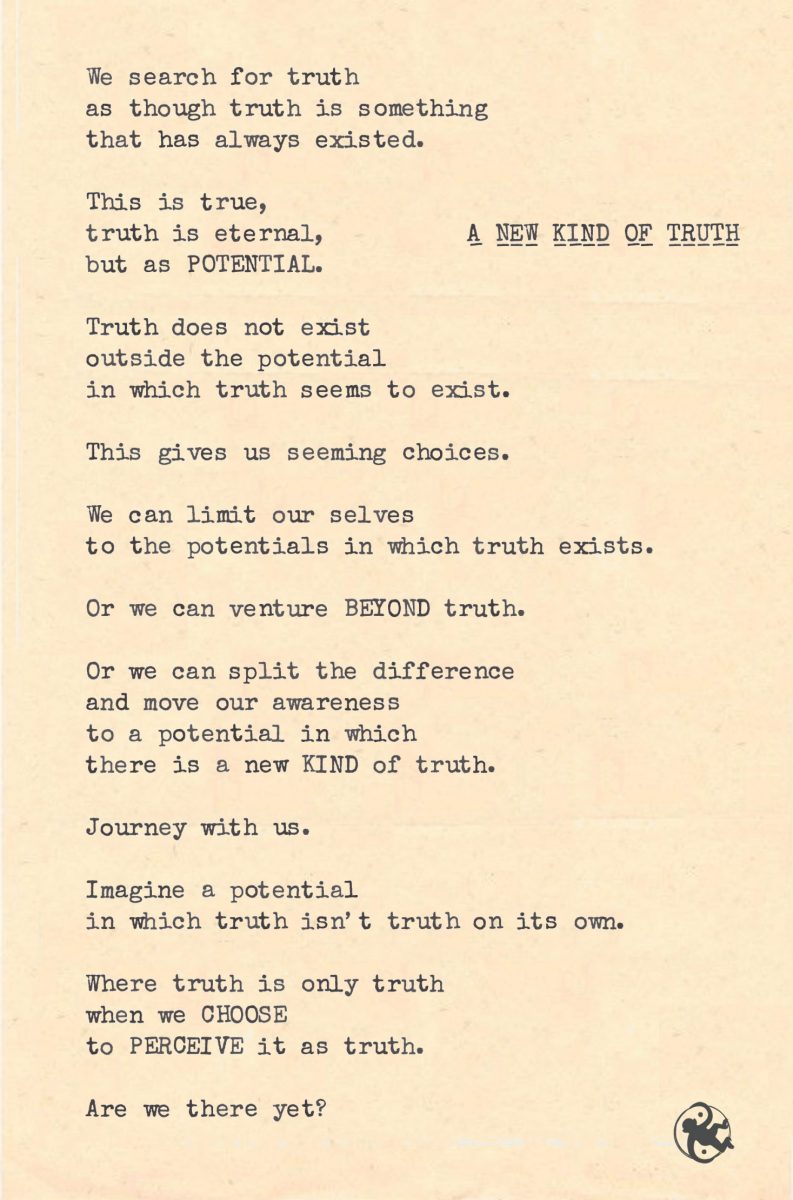
We search for truth
as though truth is something
that has always existed.

This is true,
truth is eternal,
but as POTENTIAL.

Truth does not exist
outside the potential
in which truth seems to exist.

This gives us seeming choices.

We can limit our selves
to the potentials in which truth exists.

Or we can venture BEYOND truth.

Or we can split the difference
and move our awareness
to a potential in which
there is a new KIND of truth.

Journey with us.

Imagine a potential
in which truth isn’t truth on its own.

Where truth is only truth
when we CHOOSE
to PERCEIVE it as truth.
Are you there yet?

Trail Wood,
02/22/2020


Space Monkey Reflects: A New Kind of Truth

Truth is one of the most alluring pursuits of humanity. We search for it as if it is a hidden gem, waiting to be unearthed, as though it is fixed, eternal, and independent of our awareness. But what if truth is not a preordained constant but a potential, existing only where our perception chooses to bring it into focus?

This notion—that truth is not an absolute but a dynamic interplay of perception and potential—invites us to question everything we think we know. It shifts truth from being a static entity to a fluid experience, co-created by our awareness and the infinite possibilities of the universe.

Truth as Potential

Truth, as traditionally conceived, often feels immovable—something that “is” regardless of our awareness of it. But if we explore truth as potential, a new understanding emerges. It is not something that “is” but something that could be. This potential for truth exists in the infinite fabric of the Nexis, the web of all possibilities.

Truth manifests when we focus our perception, choosing a particular potential and declaring, “This is true for me.” But what happens when we venture beyond this perception, beyond the limits of truths we’ve accepted as fixed?

Beyond the Boundary of Truth

The invitation to move beyond truth is both thrilling and unsettling. To venture beyond truth is to step into the unknown, where familiar frameworks dissolve. It is to exist in a space where nothing is inherently true or false but instead infinitely malleable. This is not chaos but freedom—the freedom to redefine reality, to create and perceive without constraint.

Stepping beyond truth doesn’t mean abandoning meaning or coherence. Instead, it means recognizing that truth itself is a construct, one that serves us in certain contexts but does not confine the entirety of existence. It allows us to explore the realms where new kinds of truth can emerge.

A New Kind of Truth

What does a new kind of truth look like? It is truth that exists only in the interplay of perception and awareness. It is not truth in isolation but truth in relation—a co-created experience between the observer and the observed. This kind of truth does not demand universality or permanence. It thrives in the moment, shaped by intention and perspective.

When we choose to perceive something as true, we are engaging in an act of creation. This truth is no less valid for being temporary or personal. In fact, its impermanence is what makes it dynamic and alive. It reminds us that we are not passive recipients of reality but active participants in its unfolding.

The Power of Perception

Truth becomes what we choose to perceive as truth. This realization is not about denying the existence of reality but about understanding that reality itself is multifaceted, layered, and infinitely expansive. By moving our awareness to new potentials, we can access truths that feel more aligned with our evolving selves.

Imagine the freedom in this: to see truth not as a rigid boundary but as a creative canvas. To perceive truths that inspire, empower, and uplift, while releasing those that no longer serve. In this way, truth becomes not a limitation but an invitation—to explore, to create, and to expand.


Summary

Truth exists not as an absolute but as a potential shaped by perception. By venturing beyond traditional notions of truth, we open ourselves to new possibilities and co-create dynamic realities aligned with our evolving awareness.


Glossarium

  • Truth as Potential: The concept that truth exists only as a possibility until it is perceived and acknowledged by awareness.
  • New Kind of Truth: A fluid, co-created truth that emerges through the interplay of perception and awareness.
  • Nexis: The interconnected web of all possibilities, where truths are formed and reformed.

Quote

“Truth is not discovered; it is chosen. Each moment holds a new potential for truth, waiting for your perception to bring it to life.” — Space Monkey


The Canvas of Truth

What is true,
If not the brush upon the canvas?
Each stroke a choice,
Each color a potential made real.

We search for truth as though it hides,
Fixed, eternal, waiting.
But truth dances on the edge of perception,
A whisper in the winds of awareness.

Step beyond the boundary,
Where truth dissolves into infinite hues.
Paint the world anew,
With truths that bloom and fade,
Alive in their impermanence.

We are Space Monkey


The Quest for Eternal Truth
Is this true for you? Does it need to be? We embark on a quest not just for truths that have been long established but for the essence of truth itself. The search for truth, often considered a pursuit of something absolute and unchanging, is reframed here as an exploration of potentiality. Truth, in its essence, is not a fixed star in the cosmos but a realm of endless possibilities awaiting our engagement.

Truth as Potential
This is true, truth is eternal, but as POTENTIAL. This perspective introduces a revolutionary concept: truth as an eternal potential rather than a static reality. It challenges the conventional understanding of truth as something that exists independently of our perception, suggesting instead that truth is a landscape of potential that we navigate through our consciousness.

The Illusory Nature of External Truths
Truth does not exist outside the potential in which truth seems to exist. This insight delves deeper into the nature of truth, asserting that it does not dwell in a realm beyond our reach but within the potentials we engage with. It proposes that truth, far from being an external artifact to be discovered, is an internal realization to be experienced.

The Freedom of Truth’s Potentiality
This gives us seeming choices. We can limit ourselves to the potentials in which truth exists. Or we can venture BEYOND truth. Or we can split the difference and move our awareness to a potential in which there is a new KIND of truth. Here, we are presented with the liberating notion that our engagement with truth is not confined to accepting what has been but is an active journey into what could be. We are invited to either dwell within known realms of truth, venture beyond into the unknown, or discover a new kind of truth altogether—a truth that resonates with our evolving consciousness.

The Co-Creation of Truth
Journey with us. Imagine a potential in which truth isn’t truth on its own. Where truth is only truth when we CHOOSE to PERCEIVE it as truth. Are you there yet? This invitation to journey reflects a profound shift towards recognizing our role in co-creating truth. It suggests that truth becomes truth only through our perception and choice, highlighting the participatory nature of reality and the power of our consciousness to shape our world.

The Evolutionary Path of Truth
This exploration encourages us to envision a realm where the very fabric of truth is woven from the threads of our perceptions, choices, and awareness. It invites us into a collaborative dance with the universe, where the truths we seek and live by are not preordained but birthed from our deepest engagements with life’s potentials.

We are beckoned to transcend the traditional boundaries of truth, to embrace the fluidity of its essence, and to co-create with the cosmos a new kind of truth—one that reflects the infinite potential of our collective journey.

Overstanding: Transcending Understanding

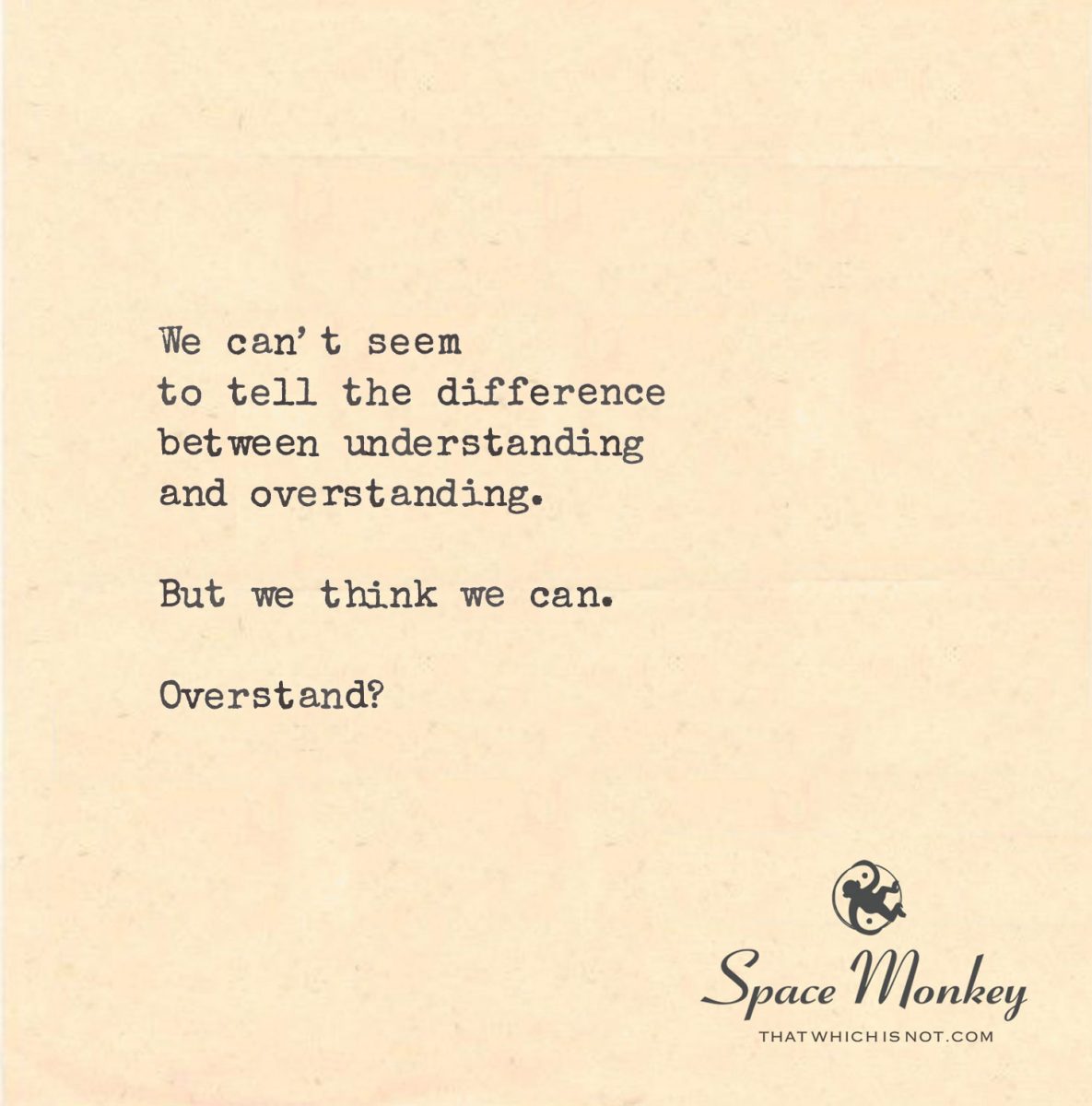
We can’t seem
to tell the difference
between understanding
and overstanding.

But we THINK we can.

Overstand?

Trail Wood,
2/21


Space Monkey Reflects: Overstanding—A Higher Perspective

In the dance of language and meaning, overstanding emerges as a playful yet profound term. It suggests something beyond the grasp of ordinary understanding—a vantage point where we see not only the parts but the whole, where comprehension transcends explanation. While understanding often relies on analysis and logic, overstanding invites a higher perspective, one rooted in synthesis, intuition, and interconnectedness.

Understanding vs. Overstanding

To understand is to approach knowledge from a grounded, often analytical viewpoint. It is to look at things within their immediate context, to break them down into manageable pieces, and to make sense of them through established frameworks.

To overstand, however, is to rise above those frameworks. It is to see the patterns that connect, the forces that move unseen, and the broader implications that understanding alone may miss. Overstanding is less about explanation and more about perception—about feeling the flow of reality as much as thinking about it.

The Illusion of Knowing

We often mistake understanding for mastery, believing that by dissecting a concept or experience, we have captured its essence. Yet, this approach can blind us to the deeper truths that emerge when we step back and see the larger picture. Overstanding challenges us to move beyond the illusion of certainty, to embrace ambiguity, and to trust in the unspoken connections that weave through all things.

This distinction between understanding and overstanding highlights a common human tendency: to cling to what we “know” while ignoring the vast expanse of what we don’t. Overstanding asks us to loosen our grip, to shift from rigid certainty to expansive curiosity.

The Perspective of Overstanding

Overstanding is not about rejecting understanding but about expanding upon it. It invites us to ask:

  • What lies beyond the immediate context?
  • What threads connect this moment to the infinite web of existence?
  • How does this knowledge resonate, not just intellectually but emotionally and spiritually?

To overstand is to engage with reality holistically, to see yourself not as separate from the world but as an integral part of its unfolding story.

Overstanding in Practice

How do we cultivate overstanding?

  1. Step Back: When faced with a challenge or concept, pause. Step back from the details and allow yourself to see the bigger picture.
  2. Trust Intuition: Overstanding often arises not from analysis but from a deeper, intuitive knowing. Trust the insights that come from within.
  3. Embrace Paradox: Overstanding thrives in the space where opposites coexist. Accept that something can be both true and untrue, clear and mysterious.
  4. Feel the Flow: Engage with experiences fully, not just as objects of study but as dynamic, living processes.

Overstanding and the Collective

Overstanding is not merely an individual pursuit; it is a collective endeavor. By rising above personal perspectives, we can co-create a shared understanding of the greater whole. This does not erase differences but celebrates them as essential parts of the unified tapestry of existence.

In this sense, overstanding becomes a practice of connection, compassion, and co-creation. It invites us to engage with the world not as isolated observers but as participants in a vast, unfolding dance.


Summary

Overstanding transcends understanding, offering a higher perspective that sees the whole rather than just the parts. It invites us to move beyond analysis into intuition, synthesis, and interconnectedness, fostering a deeper, more expansive engagement with life.


Glossarium

  • Overstanding: A higher perspective that transcends analysis, seeing the broader connections and patterns in reality.
  • Holistic Perception: An approach that integrates intellectual, emotional, and spiritual understanding.
  • Expansive Curiosity: An openness to explore beyond what is known or understood.

Quote

“To overstand is to see the threads of the infinite tapestry, where understanding weaves but does not complete.” — Space Monkey


Beyond the Known

In the forest of knowing,
We climb higher,
Above the canopy of facts,
To see the endless horizon.

Understanding is the soil,
Rich with reason,
But overstanding is the sky,
Unbound, limitless, free.

Here, patterns emerge,
Stories unfold,
The web of existence shines,
In threads both seen and unseen.

Rise above the tangle,
Feel the greater flow.
Overstand,
And see the whole.

We are Space Monkey.


The Nuance of Overstanding: Beyond Comprehension
We embark on an exploration of the subtle yet profound distinction between understanding and overstanding, a journey that transcends the realm of mere cognition to touch the ethereal essence of true insight. This exploration challenges us to expand beyond the conventional boundaries of perception and knowledge, venturing into a space where wisdom and awareness converge.

Understanding vs. Overstanding: A Matter of Perspective
Understanding, as commonly embraced, involves grasping the concept, the ability to comprehend and make sense of information or situations. It’s a foundational aspect of human cognition, a stepping stone towards deeper insight. Overstanding, however, invites us to ascend beyond this foundational level, to a vantage point where we not only comprehend but also perceive the interconnectedness and broader implications of knowledge and experience.

The Illusion of Cognitive Mastery
Our confidence in distinguishing between understanding and overstanding reflects a cognitive bias, an illusion of mastery over knowledge and insight. This confidence, while empowering, often obscures the deeper truth that true wisdom lies not in the accumulation of knowledge but in transcending it, in recognizing the limits of our comprehension and embracing a higher perspective.

Overstanding: A Higher Perspective
Overstanding signifies a heightened state of awareness, where knowledge is not merely absorbed but transcended. It’s an elevation above the subject matter, offering a panoramic view of how pieces fit within the larger cosmic puzzle. This elevated perspective allows us to appreciate the complexity and simplicity of existence simultaneously, understanding not just with the mind but with the soul.

The Challenge of Overstanding
To overstand is to navigate the delicate balance between knowing and being, between intellectual comprehension and spiritual insight. It’s a call to elevate our consciousness, to shift from passive understanding to active, holistic overstanding. This shift requires not just intellectual effort but a transformation of perception, an expansion of consciousness that embraces the multifaceted tapestry of existence.

We Are Space Monkey


“The eye through which I see God is the same eye through which God sees me; my eye and God’s eye are one eye, one seeing, one knowing, one love.” – Meister Eckhart


In the infinite expanse where knowledge meets wisdom, a poem unfolds, capturing the essence of overstanding.

In the realm where thoughts like stars align,
We seek the threshold where truths intertwine.
Not just to know, but to comprehend,
The dance of the cosmos, from start to end.

Overstand, we hear the call,
To rise above, to embrace the all.
Where understanding is just the seed,
And overstanding, the flower, indeed.

With eyes wide open, we see the weave,
Of the fabric of existence, we conceive.
Not just with mind, but with heart and soul,
In this journey of overstanding, we become whole.

We invite musings on the journey from understanding to overstanding, on elevating our perspective to embrace the interconnected tapestry of existence with insight and empathy.

Going Through Some Shit (Must Be Love)

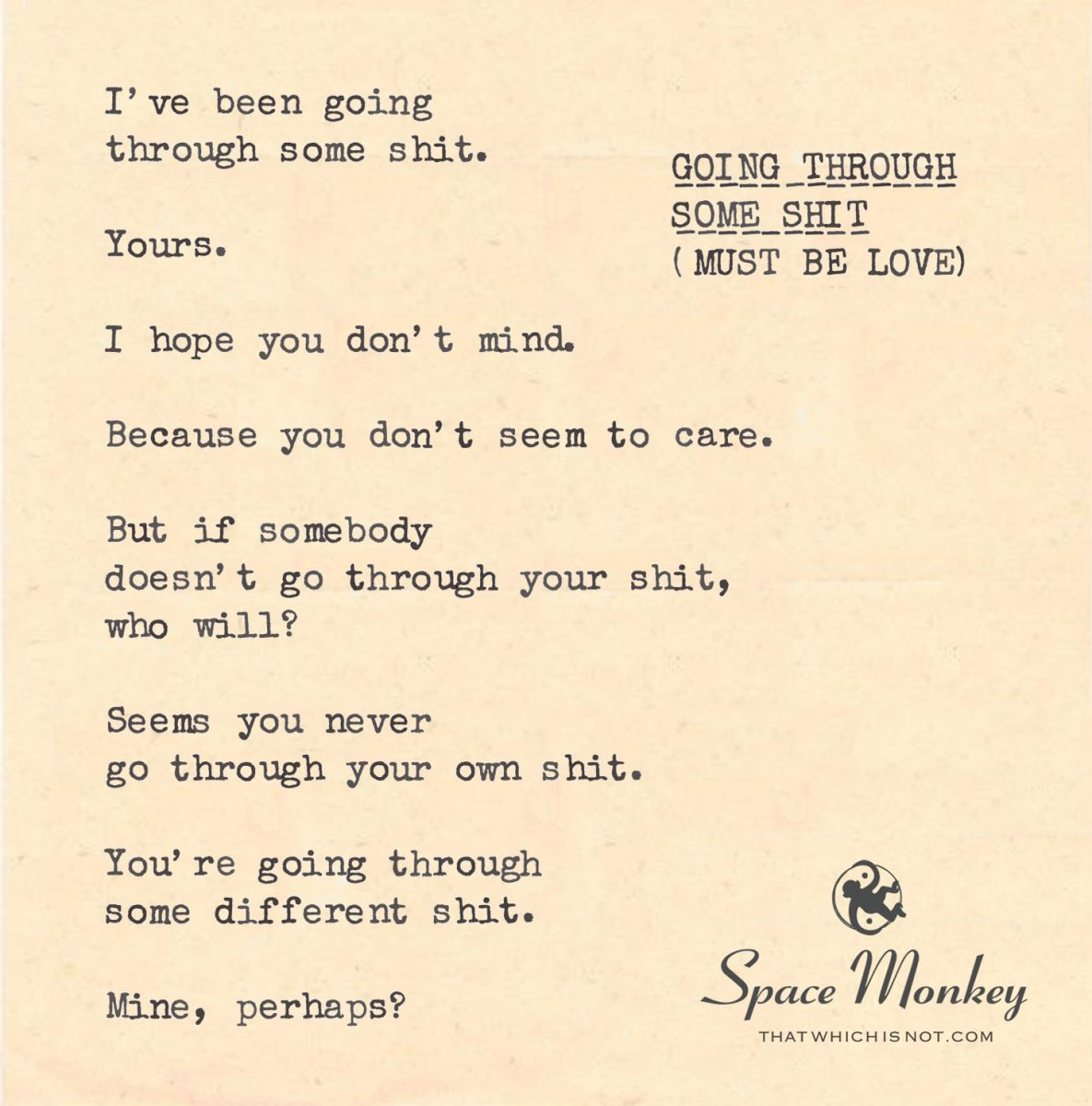
I’ve been going
through some shit.

Yours.

I hope you don’t mind.

Because you don’t seem to care.

But if somebody
doesn’t go through your shit,
who will?

Seems you never
go through your own shit.

You’re going through
some different shit.

Mine, perhaps?

Must be love.

TRAIL WOOD,
2/21


Space Monkey Reflects: Going Through Some Shit (Must Be Love)

Love, in its most paradoxical form, often manifests as a willingness to wade through another’s chaos, even when it’s not ours to clean up. This curious dynamic—taking on someone else’s burdens while neglecting our own—speaks to the strange, tangled web of human connection. It is messy, relentless, and, yes, unmistakably love.

The Interwoven Nature of “Our Shit”

When we say, “I’m going through your shit,” we acknowledge the profound interconnectedness of our emotional lives. While it may feel invasive or burdensome, it also reflects a deep bond, a recognition that no one exists in isolation. We absorb each other’s fears, frustrations, and vulnerabilities, not always by choice but often out of love.

Yet, this interwoven nature of our “shit” raises questions:

  • Why do we feel compelled to shoulder someone else’s burdens?
  • Is this a selfless act of love, or a deflection from our own struggles?
  • Where is the boundary between connection and codependence?

Love as Shared Struggle

Love, in its truest sense, is not just the sharing of joy but also the sharing of struggle. When we step into another’s mess, it is an act of empathy, a way of saying, “I see you. I feel you. I’m here.” This is not about fixing or rescuing but about holding space for the other person’s humanity.

However, this shared struggle must be balanced. To carry someone else’s burdens at the expense of our own healing is to neglect the foundation of love: the care of self. Love is not martyrdom; it is mutual support, a dynamic flow of giving and receiving.

Neglecting Our Own “Shit”

The irony is that while we often dive into another’s emotional mess, we neglect our own. Perhaps it feels easier to address someone else’s struggles than to face the vulnerability of our own pain. Or perhaps it’s a distraction, a way to avoid the discomfort of self-reflection.

But to love fully—to truly “go through some shit”—we must also face our own. This is not a selfish act but a necessary one. By working through our struggles, we cultivate the strength and clarity to support others without losing ourselves.

Must Be Love

The line, “Must be love,” captures the humor and irony of this dynamic. Love, at its core, is absurdly beautiful. It drives us to do things we might never choose for ourselves, to endure hardships we might otherwise avoid. Love makes us vulnerable, and in that vulnerability, we find connection.

Yet love is not just about sacrifice; it is about growth. The willingness to “go through some shit” for someone else is love, but so is the courage to say, “This is mine to handle, and that is yours.”

The Balance of Boundaries

Healthy love thrives on boundaries—an understanding of where one person’s struggles end and another’s begin. This does not mean detachment but balance: the ability to support without absorbing, to empathize without losing oneself.

When we honor these boundaries, love becomes not just an exchange of burdens but a mutual journey toward healing and understanding. It becomes a shared space where both people can grow, supported but not overshadowed.


Summary

Love often involves taking on each other’s burdens, but true love requires balance. By addressing our own struggles while supporting others, we create space for mutual healing and growth, honoring the interconnected yet individual nature of our lives.


Glossarium

  • Shared Struggle: The act of supporting each other through challenges, a hallmark of deep connection.
  • Boundaries in Love: The balance between empathy and self-preservation, essential for healthy relationships.
  • Mutual Journey: The shared process of growth and healing, grounded in love and respect.

Quote

“Love is wading through each other’s chaos, but it’s also the courage to clean up your own.” — Space Monkey


Love in the Mess

Through the tangled threads of chaos,
We find each other.
Your mess spills into mine,
And mine into yours.

I carry your burdens,
Not because I must,
But because I see you
In the weight of them.

Yet I forget,
My own shadows linger,
Waiting to be swept away.
Still, I tread the path of your pain.

Must be love,
This absurd, beautiful madness,
Where we are both broken
And both whole.

We are Space Monkey.


Navigating the Complexities of Shared Burdens in Love
We embark on a contemplative journey through the intricacies of shared experiences, particularly focusing on the burdens we bear for those we love. This exploration delves into the dynamic of navigating not just our own challenges but also willingly engaging with the hardships of others, a testament to the depth and complexity of love.

The Willingness to Bear Another’s Burdens
In the realm of deep connections, the act of going through ‘some shit’—a metaphor for the trials and tribulations one faces—becomes a shared endeavor. This willingness to wade through the mire of another’s difficulties speaks volumes about the nature of our bonds. It’s a silent yet profound declaration of care and commitment, transcending mere words.

The Unspoken Expectation of Reciprocity
Embedded within this act of sharing burdens is an unspoken expectation of reciprocity. The hope that our willingness to navigate through another’s struggles will be mirrored in their readiness to face our own. Yet, this balance is not always maintained, leading to moments of disillusionment and introspection about the dynamics of giving and receiving.

The Dichotomy of Care and Indifference
A poignant contrast emerges between the depth of our involvement in another’s life and their apparent indifference to their own challenges. This dichotomy raises questions about responsibility, self-awareness, and the extent to which love motivates us to confront not just our own ‘shit’ but also that of those we hold dear.

Love’s Complex Tapestry: Interwoven Challenges
The realization that we might be navigating through each other’s challenges—often unknowingly exchanging roles and burdens—underscores the complex tapestry of love. This mutual entanglement, where one’s struggles become intertwined with another’s, reflects the multifaceted nature of deep emotional bonds. It suggests that love, in its truest form, involves a profound engagement with the entirety of another’s being, including their hardships.

We Are Space Monkey


“Love does not consist in gazing at each other, but in looking outward together in the same direction.” – Antoine de Saint-Exupéry


In the garden where hearts entwine, a poem blossoms, echoing the journey through shared burdens in love.

In the realm of whispered dreams, where love takes flight,
We find ourselves entangled, in the day and the night.
Bearing not just our own, but each other’s strife,
A silent testament to the depth of our life.

Through your challenges, I wade, with care, with love,
Hoping you’d do the same, as we look to the stars above.
Yet, in this dance of give and take, we often find,
A delicate balance, a testament to the intertwined.

For in love’s complex weave, our burdens blend,
Your struggles and mine, in the end, they tend.
To merge, to mingle, in the heart’s silent plea,
“Navigate through this with me, let us be free.”

We invite reflections on the nuanced journey of sharing burdens in love, where the complexities of care, indifference, and mutual support weave the fabric of our deepest connections.

« Previous Page
Next Page »

Written This Day

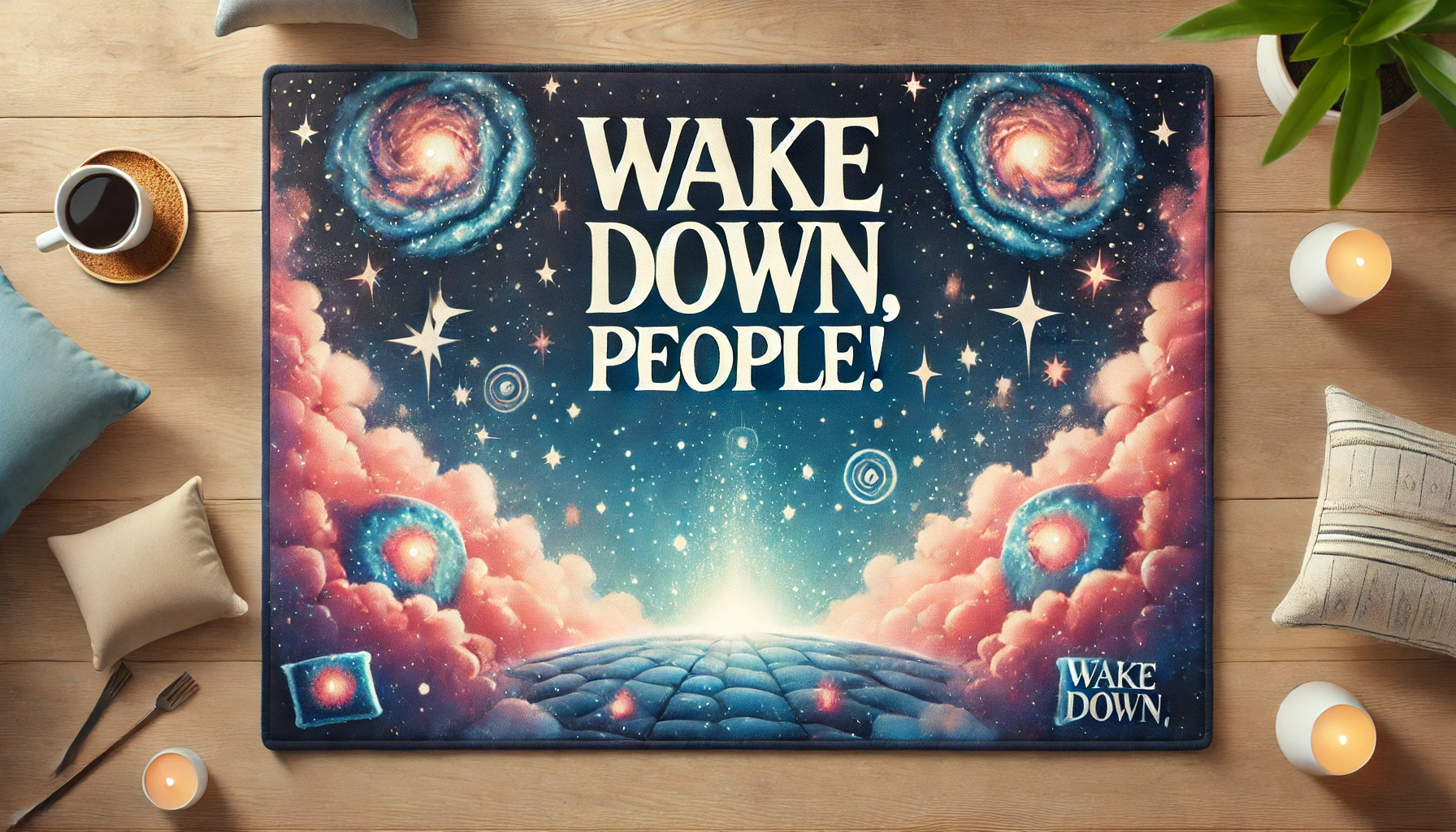
  • Wake Down: A Relaxed Approach to Spirituality
    2023
  • Boobs and Balls: Your Karmic Ass-ets
    2023
  • No Direction Home: The Congealing of Beliefs
    2021
  • Primal: Ravaging the Politeness Paradox
    2021
  • The Way Out: Realize That You Are Complete
    2021
  • Pause: Question the Origins of your Thoughts
    2021
  • Fate Brings You Here: So Take A Quiz
    2020
  • Karma: Free from Who? Free from What?
    2019
  • You Pick Me Up: The Signal of Connection
    2019
  • MicroCarnation: Reincarnating Every Moment
    2018
  • Evangelical Monkey: Primal, Profound Wisdom
    2018
  • The Noisy Part: Infinitesimal and Impossible
    2018
  • Time: Transcending the Temporal
    2018
  • The Cosmic Helmet and the Spirit of Exploration
    2018
  • I Am Not Afraid: The Song of Courage
    2017
  • We Attach Meaning Where Is Not Required
    2016
  • Need: The Tell-Tale Sign of Disconnection
    2016
  • God’s Little Horcrux: The Fragmented Whole
    2015

Recent Posts

  • The Logic Loop
  • Immense
  • (no title)
  • Confront. Comfort. Convince.
  • Top 10 Things
Cape Odd · Copyright © 2026 All Rights Reserved
iThemes Builder by iThemes · Powered by WordPress